




Abstract
Aims and objectives/purpose/research questions:
Pronoun comprehension can present challenges for young bilingual and monolingual children. The current study aimed to assess cross-linguistic influence (CLI) and pronoun comprehension in early childhood. Several studies have demonstrated the role of overlap across languages and its impact on language development. The present study investigates the influence of the acquisition of another language containing third-person pronouns on pronoun comprehension in English. Additional possible social influences are also discussed.
Design/methodology/approach:
In addition to the completion of language surveys and vocabulary tests, toddlers and preschoolers were presented with a forced-choice test to identify the pronouns ‘he/she/it’ between a man doll, a woman doll, a ball, and a monkey.
Data and analysis:
Accuracy in pronoun comprehension was analysed based on age and preschooler’s accuracy was compared across language groups (monolingual in English, bilingual with and without third-person pronouns).
Findings/conclusions:
Overall, the results demonstrated that, although young toddlers were able to comprehend ‘it’, children struggled with ‘he’ and ‘she’ until 3 years of age. In addition, bilingual preschool children that were learning a language that distinguished between the third-person pronouns, ‘he’ and ‘she’, performed similarly to monolingual English-speaking children and both groups performed better than bilingual children learning a language that did not distinguish between ‘he’ and ‘she’. The findings are discussed in the context of within- and between-language factors that can impact comprehension.
Originality:
Most recent research on early pronoun development involves production. This study presents evidence of early pronoun comprehension and investigates the role of CLI in this difficult, yet common component of language.
Significance/implications:
The results suggest that learning a language with different features can negatively impact pronoun comprehension in another language. The findings are discussed in the context of an integrated system for bilinguals.
Keywords
The purpose of this study is to assess cross-linguistic lexical influence in children. Cross-linguistic influence (CLI) refers to the influence that one language has on the acquisition and/or processing of the bilinguals’ other language(s) (Hulk & Müller, 2000; Serratrice, 2013). CLI has been shown to affect bilinguals’ phonology, lexicon, and grammar (Bóna et al., 2020; Foursha-Stevenson & Nicoladis, 2011; Hulk & Müller, 2000; Tanaka et al., 2019). The current study examines this influence on pronoun acquisition. Critically, we also examine development in monolinguals as a comparison to indicate the existence of the influence. Additional possible social influences are also discussed.
Pronoun production and comprehension
Pronouns are an important component of vocabulary development as they are crucial to the comprehension of language. Pronouns are used frequently in language production in English (Al-Shaer, 2014). In addition, the recent emphasis on pronouns in speech in society may also have an impact on how pronouns are acquired. Despite the frequency and the emphasis on pronouns, parental report data indicate that children do not consistently produce third-person pronouns until about 30 months of age (Fenson et al., 1994). There is little experimental evidence of children’s comprehension of these words in isolation or the experiential factors that may contribute to this understanding. Comprehension may be a more basic measure of the linguistic ability of the child than production as it does not require the child to physically coordinate and produce the sounds. This can potentially provide a better representation of lexical developmental trajectories. In addition, for words that can be ambiguous, experimental methods can provide a better assessment of understanding.
Pronouns are notoriously difficult for children to master (Chan, 2004; Girouard et al., 1997; Goodrich Smith et al., 2019; Oshima-Takane et al., 1999; Radford & Galasso, 1998; Rispoli, 1994, 2005). Children make a number of different errors in pronoun production, including referent errors (e.g., refer to themselves as ‘you’) (Girouard et al., 1997; Oshima-Takane et al., 1999) and case errors (e.g., ‘her likes that’) (Rispoli, 1994, 1998). However, Qi (2010) presents evidence in support of the Speech Role Hypothesis. This hypothesis states that children understand the roles of individuals and therefore can apply this knowledge to speech. According to this hypothesis, most children can comprehend pronouns from early on based on salience between pronouns and speech roles (cf. Girouard et al., 1997). In other words, personal pronoun meaning is accurate, and reversals between the first- and second-person pronouns are rare.
Despite the use of contextual cues, there are several reasons why pronouns may still present a challenge for young children. One reason that pronouns are particularly difficult is that the referent can only be established by knowing the speaker and context (Girouard et al., 1997; Oshima-Takane et al., 1999). Furthermore, one type of pronoun can refer to multiple individuals or objects. For example, ‘She told her that she should go to the store’. In this case, the same word, ‘she’, can be referring to two different individuals and these referents typically shift from one speaker to the next; Clark (1978) describes this as the Name Hypothesis. Moreover, pronouns are phonologically small in scale and similar. For example, the pronouns, ‘he’ and ‘she’ contain considerable phonological overlap and can be misheard if not emphasized in speech. In addition, in child-directed speech, pronouns are often replaced with proper names. For example, a mother might be more likely to say, ‘Look, Mommy found your blanket’ or ‘Daddy came home from work’ rather than using ‘I’, ‘She’, or ‘He’.
Inflectional complexity could also affect pronoun comprehension. Rispoli (1998) argued that word-specific pronoun paradigms or structural conditions for assigning cases influence the pattern of case error. The paradigms aid in the determination of inflectional patterns in different constructions and these generalizations may be inaccurate. For example, it was found that the overextension of ‘him’ and ‘them’ for ‘he’ and ‘they’ occurred less often than the overextension of ‘her’ for ‘she’. There is a double cell effect, in which there are only two feminine pronouns used for nominative, objective, and genitive cases (‘she’ and ‘her’), while the masculine pronoun has separate pronouns for each case (‘he’, ‘him’, and ‘his’). This overlap in case use could result in more confusion for feminine pronouns. Inflectional complexity and individual differences in inflectional development have been shown to be significantly related to language development and pronoun acquisition. For instance, children who have strong inflectional abilities make few pronoun case errors, while those with weaker inflectional abilities are more variable in their error production (Rispoli, 2005).
Most of the research on this topic, highlighting abilities and challenges, examines pronoun production rather than comprehension. There is very little data on children’s comprehension of pronouns, particularly in isolation and at this early age.
Initially, the present study tests whether English monolingual children can identify an appropriate referent for a third-person pronoun in isolation in English. Once this is established, we then compare the comprehension of monolingual and bilingual children. By 18 months of age, children have extensive knowledge about gender, including their own (Martin et al., 2002; Nicoladis & Foursha-Stevenson, 2012) as well as gender stereotypes (Eichstedt et al., 2002). Thus, it seems likely that children will be able to distinguish between a man and a woman. Although children are able to conceptually distinguish between gender, this study questions if children make this distinction linguistically. The current study also provides the opportunity to examine children’s comprehension of ‘it’. In general, children do not experience the same difficulties in their production of ‘it’ in comparison to their production of ‘he’ and ‘she’.
CLI and pronoun acquisition in bilinguals
When considering pronoun comprehension, it is important to emphasize that pronominal gender varies across languages. Although ‘he’, ‘she’, and ‘it’ are consistently used in English, languages such as Persian and Turkish use the same word for both ‘he’ and ‘she’. In addition, pronouns for ‘he’ and ‘she’ are pronounced the same in Chinese even though they are orthographically different. Qi (2010) provides a detailed discussion of the pronominal systems in English and Mandarin. These differences in addition to CLIs may affect the acquisition of pronouns, which is an important consideration for the development of these fundamental features of vocabulary.
This study aimed to investigate whether bilingual children show CLI in interpreting pronouns. This influence may be more likely to occur depending on the structure of the two languages. For example, Hulk and Müller (2000) have proposed that CLI is more likely to occur in situations in which there is overlap and ambiguity. Overlap indicates that the same structure occurs across the languages and ambiguity is represented by variations in the acceptable structure within a language. This ambiguity can lead to vulnerability and susceptibility to influence from the other language. For instance, Serratrice et al. (2004) found that English-Italian bilingual children used more overt pronoun subjects and post verbal strong objects than monolinguals. The overlap between Italian and English creates a situation in which the ambiguity at the syntax-pragmatic interface becomes susceptible to CLI from English. For instance, the child says, ‘s′ı proprio simpatica perche lei ′e solo ‘travestita da strega’ (‘yes really nice because she is only dressed up as a witch’). The child uses the overt pronoun ‘lei’ when a null subject should be used. While English has overt pronouns, Italians have both overt and null depending on the situation resulting in potential errors from CLI. In addition, Polish-German bilingual children demonstrated a delay in the acquisition of null subjects in early L2 German (Sopata et al., 2021). Although both languages allow for null arguments, the use varies across the languages. The authors argue that the bilinguals experience CLI as a result of this complexity and they must integrate the syntactic and pragmatic information.
The conceptual similarity between L1 and L2 can also promote acquisition (Hemsley et al., 2013). Nicoladis et al. (2010) argue that according to the speech production model (e.g., Levelt et al., 1999), when the conceptualizations across languages are different, children produce speech that is specific to that language, and CLI does not occur. Specifically, when the conceptualizations in relation to emphasis across their languages are different (e.g., emphasis on the action [English – ‘dancing cow’] vs the character [French – e.g., ‘vache qui danse’/‘cow who dances’]), participants did not demonstrate any transfer in their productions. In particular, the children were more likely to name the action in English. However, if the conceptualizations are the same (e.g., both languages distinguish between ‘he’ and ‘she’), then CLI is possible.
CLI and transfer has been extensively studied at the lexical level. Of interest is how specific words and word forms are affected by words and forms in other languages. For instance, in a naming task, Storms et al. (2015) provided evidence that Dutch-English bilinguals performed similarly to monolinguals with separate lexicons early in development. However, later in development, the languages converged. For pronominal development, Chinese-Korean bilingual children demonstrate first language transfer from Chinese in their target-like interpretation of Korean reflexive pronouns (Kim & Joo, 2021). Furthermore, Sorace et al. (2009) found that how pronouns are used within discourse across languages can affect production. As with many aspects of bilingual development, language dominance, and proficiency play a role in this CLI (Lago et al., 2020).
In the present study, we compared two groups of bilinguals, both of whom spoke English as one of their languages. Their non-English languages either distinguished between ‘he’ and ‘she’ (e.g., French) or did not (e.g., Chinese). For bilingual children who are learning a language that does not distinguish between the third-person pronouns, ‘he’ and ‘she’, it is still possible that they are making the conceptual distinction between the two, but not the linguistic distinction. However, learning a language with fewer third-person pronoun distinctions may lead to confusion in the distinction between ‘he’ and ‘she’ in another language. This effect may be seen, for example, in Chinese ESL speakers who substitute ‘he’ for ‘she’ and vice versa (Chan, 2004).
The current study
The initial purpose of this study was to test whether children could distinguish between ‘he’, ‘she’, and ‘it’ in English with an emphasis on how this comprehension develops and the possible role of clothing in this distinction. Our first prediction is that younger children will have difficulty comprehending ‘he’ and ‘she’ in comparison to ‘it’. This is predicted because of semantic and phonological ambiguity, which is more prevalent in gendered pronouns.
Social considerations
In the current study, we have used very salient, distinct, and somewhat stereotypical characterizations of gender with our stimuli (e.g., hair, clothing). This was done to make the distinction easier for younger children to provide a more accurate test of their pronoun comprehension. However, it is important to note that gender categories are based on other cues, including voice frequency and behavioural roles (e.g., mother, father), particularly for children (Bradley et al., 2019; Halim et al., 2017). In addition, gender has become even more complex recently as gender identification can fall outside of these stereotypical categories and is more personalized (Bradley et al., 2019). These sociological changes impact how children learn and consider pronoun use. For instance, a family associated with the lab described a story of their 5-year-old child feeling quite upset after mis-gendering a dog, named Bailey as male. We also included conditions in which the dolls were wearing a neutral cloth and the clothes were switched (the man was wearing the dress and the woman was wearing the suit) to examine some of the other potential influences. Although the influences on the discrimination of the characters is not a central focus of the study (i.e., we are not investigating the characteristics that determine gender categorization), we included these as control trials to see if the clothing, in general, had an impact on comprehension.
CLI in the current study
After investigating the comprehension of pronouns in monolinguals, we were then able to examine the possibility of CLI from their non-English language in interpreting English pronouns in bilingual children. Essentially, we asked if having gendered pronouns in one language will impact the comprehension of pronouns in a second language. Does lexical knowledge in one language impact lexical acquisition and comprehension in another and does the absence of lexical examples negatively impact comprehension in another language? We predicted that children who spoke a non-English language that did not distinguish between ‘he’ and ‘she’ (e.g., Mandarin or Tagalog) would be less accurate in identifying the referent of gendered pronouns than bilinguals who spoke a non-English language that does distinguish gendered pronouns (e.g., French or Spanish). This prediction is based on the theory that bilinguals have an integrated or connected system between languages, which can then allow children to use conceptual distinctions from one language to inform comprehension in their other language.
Method
Participants
The sample included 294 total participants (53.56% girls, 46.44% boys). The participants were split into six age groups (1 [N = 16], 1.5 [N = 23], 2 [N = 17)], 3 [N = 80], 4 [N = 79], and 5 [N = 79] years of age). The younger children or toddlers (1, 1.5, and 2 years) were all monolingual English speakers. The older children or preschoolers (3, 4, and 5 years of age) were further split into groups based on language knowledge. The language groups consisted of monolingual English (MONO) (N = 96), bilingual in English and a language that has the third-person pronouns ‘he’ and ‘she’ (BIL3PP) (N = 63), and bilingual in English and a language that does not distinguish between the third-person pronouns, ‘he’ and ‘she’ (BILneut) (N = 81). The children in the BIL3PP group spoke a variety of non-English languages: French, Spanish, German, Romanian, Bulgarian, Hindi, Polish, Kutchi, Lithuanian, Korean, Croatian, Italian, Serbian, Greek, and Welsh. The children in the BILneut group spoke Mandarin, Cantonese, Punjabi, Farsi, or Tagalog with the majority speaking Chinese with exposure from birth. In the BIL3PP group, 50% of the mothers and 49.15% of the fathers spoke only English. In the BILneut group, only 6.02% of the mothers and 12.35% of the fathers spoke only English. Across both bilingual groups, 78.15% of the children with reported daycare or school languages (N = 151) were exposed to only English in those settings.
The participants’ proficiency (MONO [N = 95], BILneut [N = 78], BIL3PP [N = 56]) and vocabulary (MONO [N = 91], BILneut [N = 75], BIL3PP [N = 52]) scores were collected. The guardians rated the bilingual participants on their proficiency between the languages with nine being ‘your child only speaks English’, five being ‘your child speaks both languages with the same proficiency’, and one being ‘your child only speaks another language’. Not surprisingly, the English proficiency scores were significantly higher for English monolinguals (M = 8.79, SE = 0.09) than the BIL3PP (M = 6.73, SE = 0.24), t(149) = 9.44, p < .001, d = 1.29 and the BILneut (M = 4.03, SE = 0.26) groups, t(171) = –18.68, p < .001, d = –2.86. The BIL3PP bilinguals English proficiency scores were also higher than the BILneut bilinguals, t(132) = −7.3, p < .001, d = −1.28. On the English Peabody Picture Vocabulary Test (described below) (Dunn & Dunn, 1997), although the MONO (M = 64.08, SE = 2.2) children performed better than the BILneut (M = 51.37, SE = 2.6) children, t(164) = −3.75, p < .001, d = −0.59, there was no difference between the MONO children and the BIL3PP children (M = 64.1, SE = 3.76), t(141) = −.005, p = .1, d = −0.001. However, there was a significant difference between the scores of the two bilingual groups, with BIL3PP performing better than BILneut, t(125) = −2.88, p = .005, d = −0.52.
Materials
Peabody Picture Vocabulary Test (PPVT), Third edition
The PPVT test, developed by Dunn and Dunn (1997), was used to measure the receptive vocabulary level of children in English. The age of the child determined at which stage in the test they began (e.g., children 2.5–3 years of age started with Item 1). Participants were presented with four pictures and a word that corresponded to one of the four pictures. Words were not presented to the child with an article (e.g., a, an, the) or any other utterances that could indicate the nature of the target word. Rather, the words were indicated by ‘show me X’ or ‘which one is X’. The child pointed to the picture that they thought was correct for the in-person testing and responses were recorded by the research assistant. In the online-testing format, participants pointed to the picture that they thought was correct and also stated the colour assigned to that picture while the research assistant recorded the answer (this was to ensure that the picture being pointed to by the child in the online format was correctly interpreted by the research assistant). Encouragement was given to participants without indicating if the child was correct or incorrect. When a child did not know which picture to choose, they were prompted to guess. Test items were administered in prescribed sets of 12. Scores were calculated by subtracting the individual’s total number of errors from the ceiling range they achieved (a set of 12 that contained 8 or more errors). We used raw scores in this study, as we were interested in the individual differences among children, regardless of age.
Pronoun Knowledge Test
The pronoun test measured the child’s knowledge of pronouns (he/she/it) by presenting a male doll, a female doll, a monkey, and a golf ball (see Table 1). The child was presented with two of the pictures on a laptop simultaneously. An audio recording in child-directed speech within the PowerPoint file prompted the child to choose either the left or right picture (e.g., ‘show me he/she/or it’). Encouragement was given to participants without indicating if the child was correct or incorrect. When a child did not know which picture to choose, they were prompted to guess. Each correct response trial received a score of one. Participants received an average score for the two ‘it’ trials and an average score for the six ‘he/she’ trials. Participants were also scored on four ‘he/she’ trials presenting the dolls in gender-switched and gender-neutral clothing.
Presentation design.
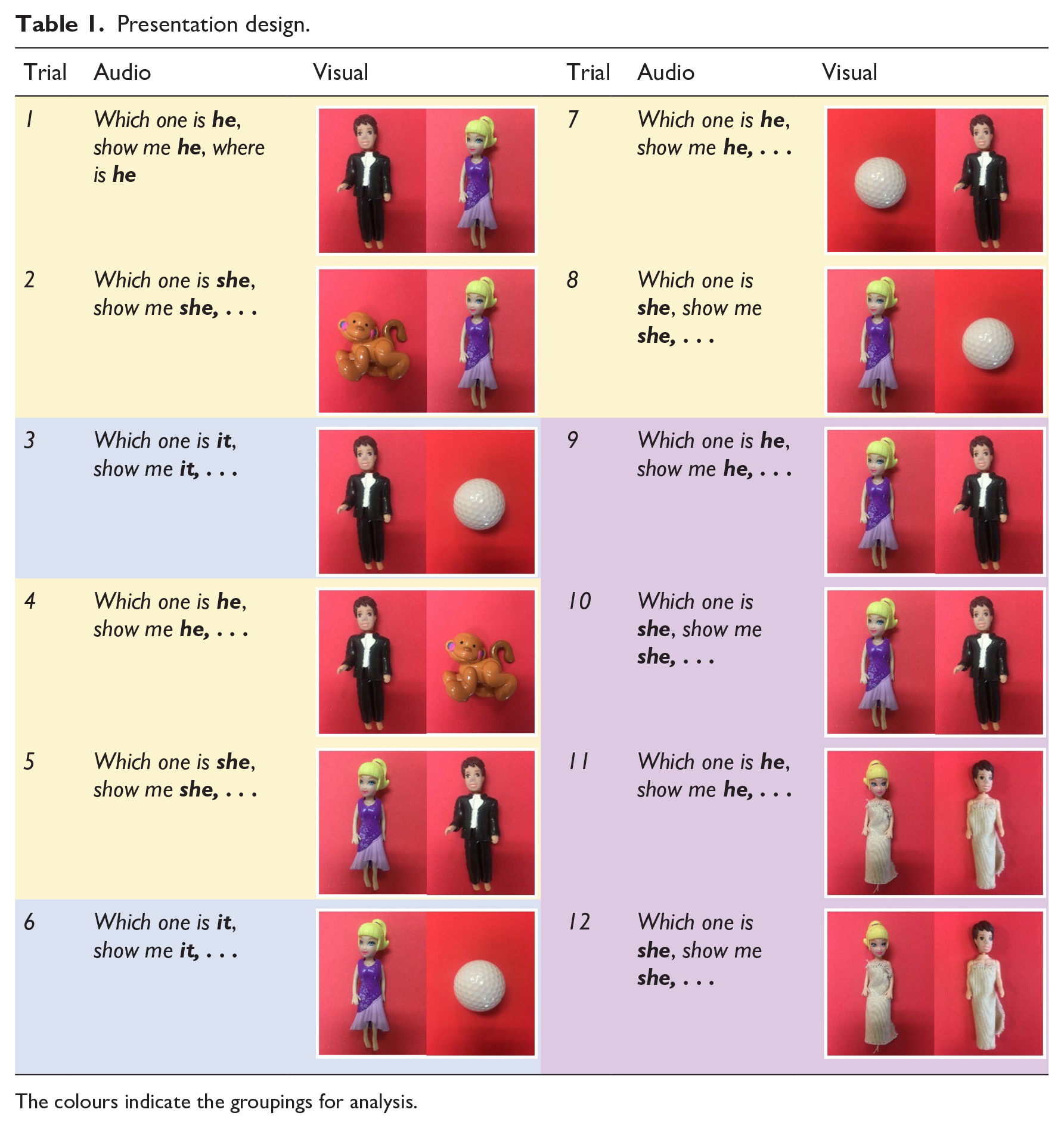
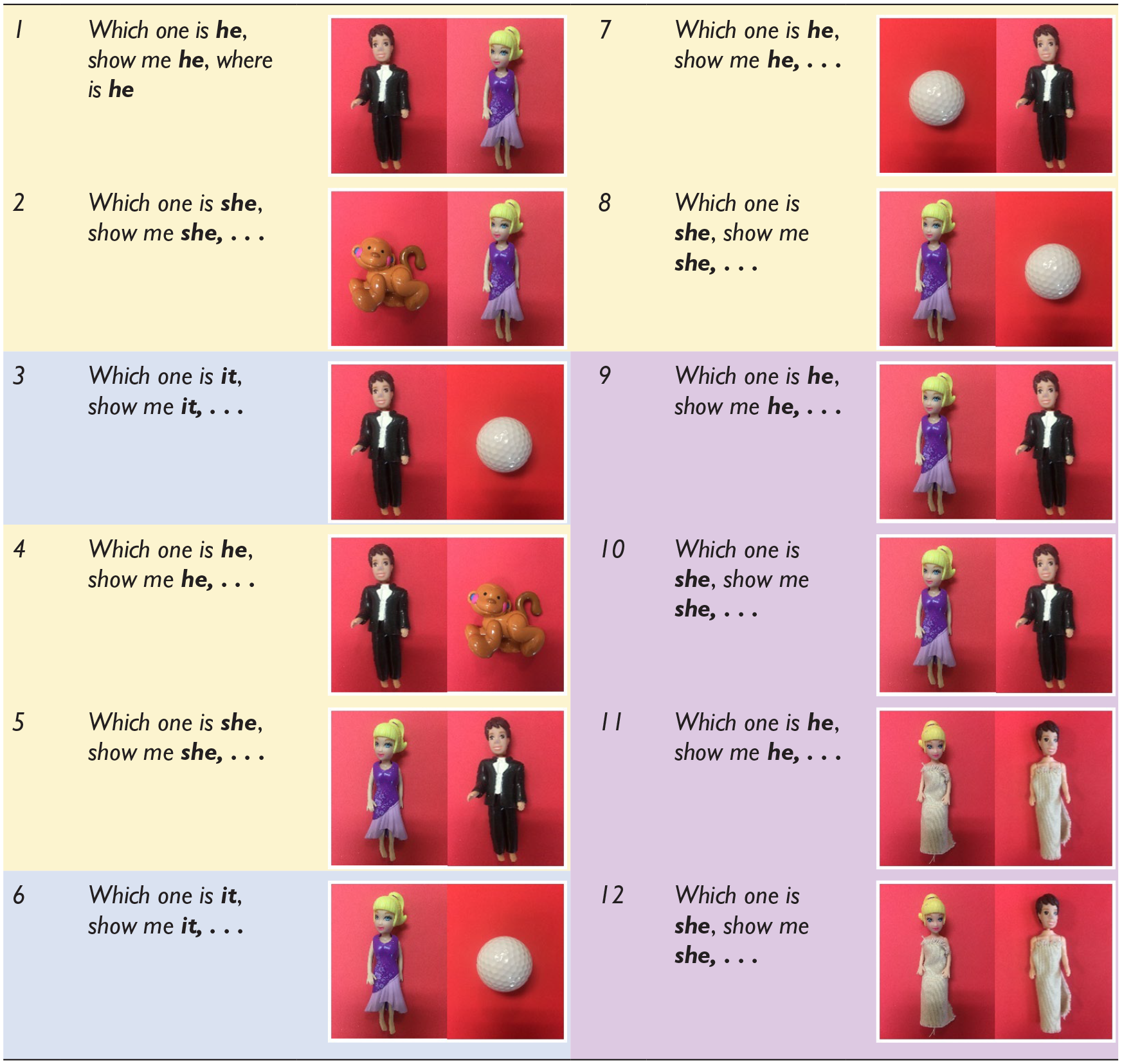
The colours indicate the groupings for analysis.
Design
The children’s overall accuracy on the ‘he/she’ and ‘it’ trials was analysed based on age for toddlers (1, 1.5, and 2 years of age) and preschoolers (3, 4, and 5 years of age). The preschoolers’ accuracy on the ‘he/she’ trials was also analysed based on language group (MONO, BIL3PP, BILneut) (see Figure 1).
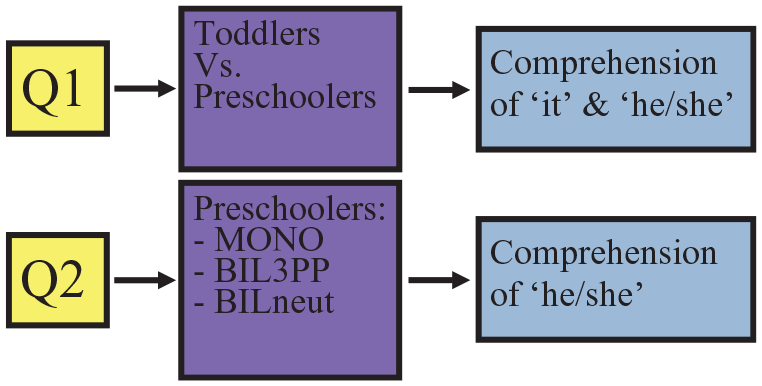
Research questions by age and language group.
Procedure
Thirty-one of the preschoolers (3, 4, and 5 years of age) were tested online due to the pandemic. No significant differences were found in overall performance between the online and in-person testing so the online children (M = 0.74, SE = 0.04) were analysed with the children tested in-person (M = 0.78, SE = 0.01), t(274) = 0.98, p = .33, d = 0.23.
Children were tested individually, either in person or through a Google Meet, with two research assistants. Guardians of the participants first completed a consent form and information sheet which collected their age, gender, and language abilities. The children sat in front of our testing laptop or in front of their personal laptop at home during the online testing sessions. Before the testing began a video recording was set up on the laptop, with the child’s consent, to record their responses. Children then completed the PPVT and pronoun knowledge test by pointing to different pictures on the computer screen; their answers were recorded by the research assistants. The children were allowed to take breaks in between each test if needed. After all the tasks were completed, the video recording was stopped and children and parents were thanked for their participation in the study.
Results
For clarity in assessing comprehension knowledge, the results from the first eight trials were analysed separately from the last four trials (switched and neutral clothing) and discussed below. In addition, since the ‘he/she’ trials with the monkey could be ambiguous, we performed a t-test comparing the ‘he/she’ data including the monkey trials to the ‘he/she’ data excluding the monkey trials. No significant difference was found (t(290) = −1.46, p = .15, All trials: M = 0.75, SE = 0.016, No monkey trials: M = 0.76, SE = 0.013). In addition, the first trial with the monkey also followed the man and woman trial, so it is likely that the children understood the context of the question.
Overall performance by age
The data were split by age group (Toddler vs Preschooler). Performance was analysed on a one-sample t-test with .5 as the test value to assess accuracy with respect to chance.
On the ‘it’ trials, both groups of children performed significantly above chance (Toddlers: t(54) = 5.08, p < .001, d = 0.35, M = 0.74, SE = 0.047; Preschoolers: t(238) = 7.68, p < .001, d = 0.4, M = 0.7, SE = 0.026) (see Figure 2). A greater proportion of children were more accurate with age. A chi-square test revealed a difference in children with 1.0 versus .5 or 0 accuracy with age, χ2(10, N = 294) = 48.48, p < .001. In addition, age was a significant predictor of performance on a logistic regression, χ2(1) = 13.16, p < .001 (children were classified as 100% correct vs not across the trials). The model explained 33.0% (Nagelkerke R2) of the variance.
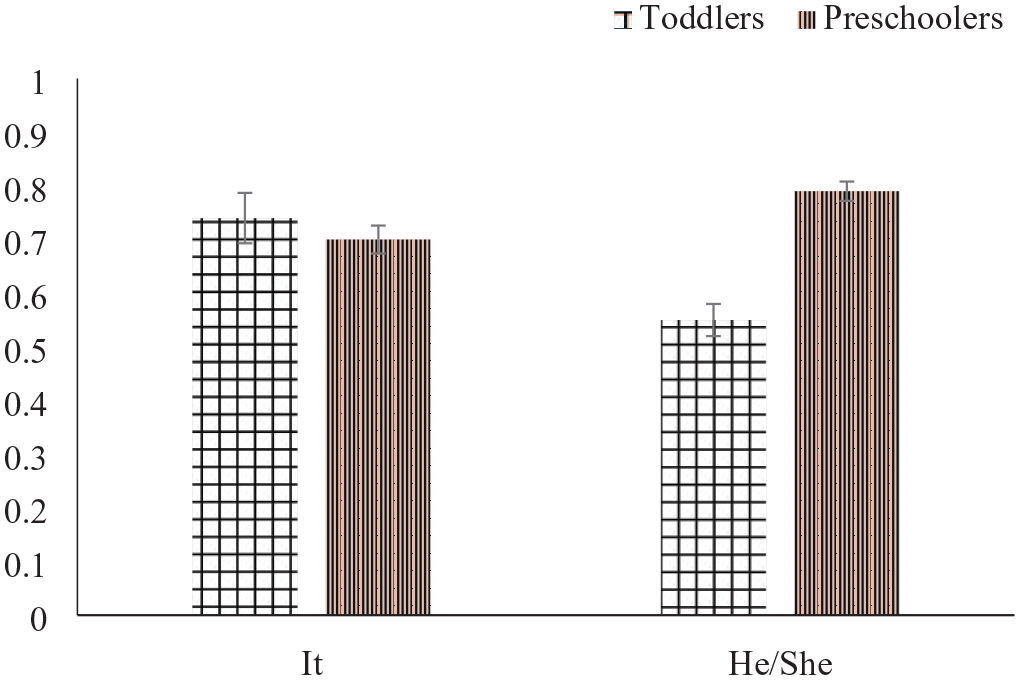
Accuracy rate for preschoolers and toddlers on ‘it’ and ‘he/she’ trials.
The average of the ‘he’ and ‘she’ trials was taken together as the pattern of results was the same. On the ‘he/she’ trials, the preschoolers performed significantly above chance, t(239) = 15.92, p < .001, d = 0.28, M = 0.79, SE = 0.018. However, the toddlers only performed marginally above chance, t(54) = 1.76, p = .08, d = 0.23, M = 0.55, SE = 0.03 (see Figure 2). In addition, age was a significant predictor of performance on a logistic regression, χ2(1) = 61.47, p < .001 (children were classified as 100% correct vs not across the trials). The model explained 45.8% (Nagelkerke R2) of the variance.
A paired t-test revealed that the toddlers performed better on the ‘it’ trials than the ‘he/she’ trials, t(54) = 2.83, p = .007, d = 0.48. In addition, although the preschoolers performed above chance on both types of trials, they actually performed better on the ‘he/she’ trials than the ‘it’ trials, t(237) = −3.03, p = .003, d = 0.43 (see Figure 2).
The ‘he/she’ trials in which the dolls had neutral and switched clothing were analysed separately from the other analyses, split by age group (Toddler vs Preschooler), and the children performed similarly to the other trials with children 3 years of age and up performing above chance (Preschoolers: t(235) = 12.41, p < .001, d = 0.35, M = 9.79, SE = 9.023) and those below 3 years performing at chance (Toddlers: t(235) = 1.71, p = .09, d = 0.23, M = 9.55, SE = 9.03).
In sum, all children performed accurately on the ‘it’ trials, but only preschoolers consistently performed accurately on the ‘he/she’ trials regardless of clothing. Performance improved with age across all pronouns.
Cross-linguistic influence
The preschoolers’ data on the ‘he/she’ trials was analysed with an analysis of variance (ANOVA) with language group (MONO, BIL3PP, BILneut) and gender of the participants (Boy, Girl) as between-subject factors with age (3, 4, and 5 years) and PPVT scores as covariates. A main effect of age was found with older children performing better than younger children, F(1, 209) = 6.34, p = .013,
Notably, a main effect of language group was also found, F(2, 209) = 6.03, p = .003,
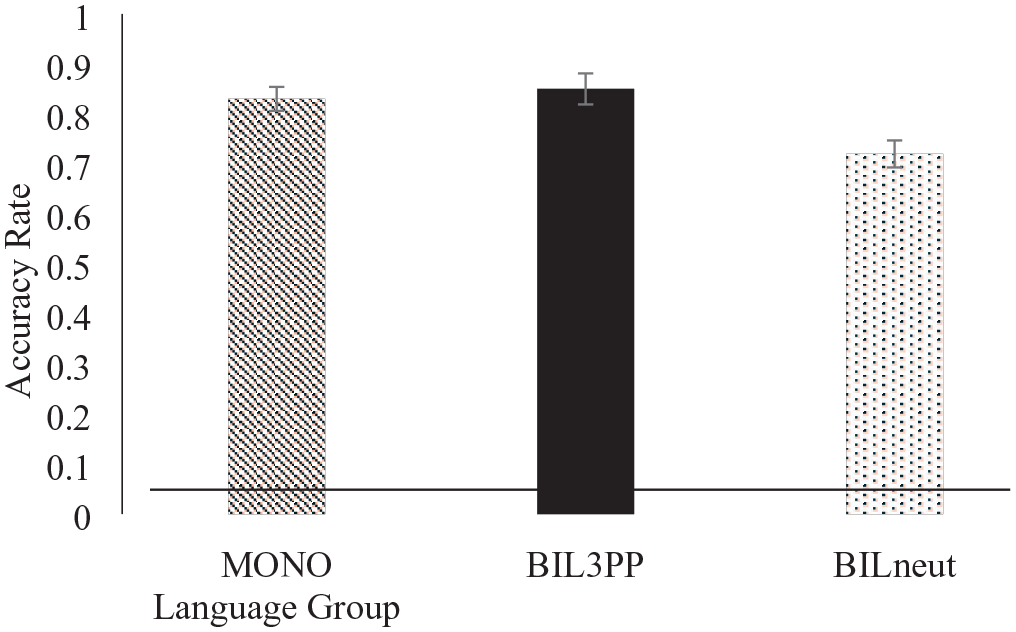
Accuracy rate on ‘He’ and ‘She’ trials for preschoolers by language group.
In sum, these results show that bilinguals who speak English and another language that distinguishes ‘he’ and ‘she’ can comprehend ‘he’ and ‘she’ in English with the same degree of accuracy as English monolingual children. In contrast, bilingual children who spoke English and another language that did not distinguish ‘he’ and ‘she’ performed less accurately than the other children.
Discussion
The results of this study demonstrate two meaningful findings of interest. The first is that even toddlers are reasonably adept at identifying a correct third-person referent in isolation. Specifically, toddlers’ and preschoolers’ performance was above chance on their comprehension of ‘it’. The toddlers did not perform as well on the ‘he’ and ‘she’ trials as they did on the ‘it’ trials. The data indicate that children are not consistent in comprehension of ‘he’ and ‘she’ until around 3 years of age. When age was used as a predictor, more of the variance was explained on the ‘he/she’ trials than the ‘it’ trials. This is likely due to some of the factors previously discussed including referent and phonological ambiguity (e.g., Clark, 1978). For example, the toddlers could be confused since ‘she’ or ‘he’ could apply to multiple individuals (not just the female or male doll) and since ‘he’ and ‘she’ are phonologically similar. This supports previous findings from studies on the production of pronouns (Chan, 2004; Rispoli, 1994, 1998). Certainly, the quality and quantity of exposure to pronouns and their representations at an early age will have an impact on this development. Although pronouns appear frequently in spoken language, it still takes time for their comprehension to develop.
It is likely that the children were relying on the hair and the facial features of the dolls rather than their clothing to determine the pronoun referent. Similar to the other trials, the children were not consistent in identifying ‘he’ and ‘she’ until 3 years of age when the dolls were wearing neutral clothing or had their clothing switched. It may be useful in future research to test a larger sample of toddlers and examine more of the specific influences on their comprehension.
There were no significant differences in overall performance on specific third-person pronouns based on the gender of the participant. Moreover, unlike Rispoli (1998), we did not find that performance was worse on the ‘she’ than the ‘he’ trials. In fact, the opposite pattern was observed. 1 The Rispoli (1998) characterization of the double cell effect errors may only apply to the use of the objective and genitive case rather than the nominative case of the feminine pronoun. In addition, this error effect may be more prominent in production than comprehension.
The second impactful finding is that exposure to another language with third-person pronouns results in monolingual-like comprehension of pronouns. This effect was present at 3 years of age. These bilingual children were outperforming bilingual children that were learning a language that does not distinguish between ‘he’ and ‘she’. This provides support for the argument that similarity between conceptualizations can result in CLI (Nicoladis et al., 2010). When the conceptualization is different (e.g., BILneut), bilingual children tend to perform worse. In addition, English presents some consistency in third-person pronominal use so it is more likely that if some type of interference were to occur, it would occur in the other language. For example, French presents some variability with how pronouns are used (e.g., ‘Il’ (he) can be used for ‘it’ when the grammatical gender is known). Therefore, this variability may make French more susceptible to cross-linguistic interference (e.g., Serratrice et al., 2004).
One explanation for this effect is overall proficiency and vocabulary development in English. This would not be surprising as pronoun comprehension directly relates to these measures. However, it is important to note that despite the monolingual group having higher English proficiency ratings than the BIL3PP group, they performed equivalently on the pronoun comprehension test. In general, our bilinguals would have less exposure to English than our monolinguals leading to the prediction that the bilingual children could perform less accurately than monolingual children on such a difficult aspect of vocabulary. However, our bilinguals who were learning a language that distinguishes between these third-person pronouns did not demonstrate this deficit in comprehension, indicating that the features of another language can impact the children’s language processing. This positive impact decreases the possible costs associated with learning two languages rather than one (e.g., smaller vocabulary in each of the languages) (Bialystok et al., 2009; Pearson et al., 1993).
It is unclear why boy participants in the BILneut group did not perform as well as the other groups. It is possible based on our pattern of findings that, although non-significant, boys may be struggling more early on with pronoun comprehension and the additional effect of learning a language without third-person pronouns results in a more pronounced disadvantage for these boys.
Although collapsing across the language groups of those with and without third-person pronouns is helpful to examine the overall differences, it would be useful to examine specific languages and cultural differences to evaluate the influences on comprehension of gender and the associated terminology. Specifically, language similarity could have an impact. The more similar the languages, the greater the potential CLI. As discussed, variability within a language may also complicate comprehension. In addition, there may be other features and distinctions across languages that impact pronoun comprehension. Moreover, our study used stereotypical representations of men and women for simplicity, but it would be useful to evaluate how toddlers and preschoolers define gender categories and how they apply pronouns to those categories. For example, appearance plays an important role in reflections on gender identity for young children (Halim et al., 2018). These definitions may change over time as our cultural definitions change and more pronouns are included in our languages.
Differences between languages in third-person pronouns are a direct and obvious distinction. A related distinction is that of grammatical gender. Grammatical gender is a system in which words within a language are assigned a gender (e.g., masculine, feminine, and neuter) and this can affect the phonological, morphological, and syntactic structure of the language. Not all languages have a grammatical gender system; modern English does not use formal grammatical gender. In addition, there is variability in the number and types of genders across languages. Some languages, such as Arabic use two grammatical genders (masculine and feminine), while others, such as German, use three grammatical genders (e.g., masculine, feminine, and neuter). Most languages with grammatical gender also distinguish between third-person pronouns.
Grammatical gender can correspond to gender stereotypes. For example, ‘une jupe’ (skirt) and ‘une robe’ (dress) are feminine in French. However, much of the grammatical gender is arbitrary (e.g., ‘une chaise’ [chair] is feminine in French). Despite this arbitrariness, children and adults have a natural tendency to make connections between grammatical and natural gender and this effect can be shown cross-linguistically (e.g., Nicoladis et al., 2021; Nicoladis & Foursha-Stevenson, 2012; Sato & Athanasopoulos, 2018). Grammatical gender systems may cause children to think about gender in a more abstract way, which could then affect how they acquire or process information across languages. In Sá-Leite et al.’s (2019) review of 13 studies on grammatical gender processing in bilinguals, they concluded that there is evidence for a gender-integrated perspective (e.g., Klassen, 2016), in which the representation of gender values is shared across languages forming an integrated system. The authors also discuss this in the context of a connectionist model that is affected by multiple factors, such as language distance.
As a result of the association between grammatical and natural gender, it is possible that grammatical gender may also have an impact on the comprehension of pronouns. This would be evidence of a more abstract influence between the languages. Tagalog provides an interesting contrast as it does not distinguish between the third-person pronouns, ‘he’ and ‘she’, but it does have grammatical gender. This is likely related to the influence of diverse languages over time. Our study only included four English-Tagalog bilinguals so we cannot make any significant generalizations. However, these 4- and 5-year-olds only averaged 0.62 accuracy rate on the ‘he’ and ‘she’ trials, following the pattern of the BILneut group and performing more poorly on their comprehension than the other bilinguals. The presence or absence of third-person pronouns likely has a stronger cross-linguistic impact on pronoun comprehension than grammatical gender, which is less direct. However, this is an interesting empirical question that can be examined.
In summary, further research could examine a larger sample of toddlers along with the more specific influences on their comprehension, the influence of language similarity more specifically by isolating particular language comparisons, and the role of grammatical gender on pronoun comprehension.
In conclusion, although pronouns can be difficult for young children, they do demonstrate more consistent comprehension by 3 years of age. Furthermore, differing performance across groups of bilingual children demonstrates the role of CLI in relation to language features and conceptualization across their languages. This provides evidence for the benefit of an integrated system.
Footnotes
Acknowledgements
We would like to thank the children and parents who have participated in this study. We also appreciate all of the hard work that our research assistants Bella Davey, Kaycie Hartley, Vanessa Sandoval, Alex Baranescu, Kymberley Calhoun, Danica Boily, Amy Patterson, Lauren Muirhead, Marizabel Forno, and Yuehan Yang have put into this project.
Declaration of conflicting interests
The author(s) declared no potential conflicts of interest with respect to the research, authorship, and/or publication of this article.
Funding
The author(s) disclosed receipt of the following financial support for the research, authorship, and/or publication of this article: This work was supported by a grant to the first author (Internal Research Grant Fund at Mount Royal University – Bilingual Word Learning – 1600022050XXXXX37003).
