




Abstract
Aims and objectives:
This article investigates naturalistic acquisition of a second dialect (D2), comparing the global accent of speakers of Brazilian Portuguese (BP) exposed to European Portuguese (EP), either as children or as adults (early vs late bilectals). The focus is on the predicted advantage of an early age of onset of the D2, as well as possible crosslinguistic influence from the D2 onto the first dialect (D1).
Design and methodology:
The study is an Accent Rating Task, where 50 raters judged the global accent of 30 BP speakers living in Portugal (15 early + 15 late bilectals), who were recorded in both BP and EP modes. Using a 6-point Likert-type scale, the raters judged whether the speakers sounded Brazilian or Portuguese and also indicated how certain they were about their judgment.
Data and analysis:
The data consisted of two 10-second audio snippets from each speaker, one in BP and the other in EP mode (altogether 60 items). In addition, there were 10 control items produced by native BP and EP speakers. Several mixed-effects models compared the target groups to each other and to the monolectal controls.
Findings and conclusions:
Both the early and late bilectals were rated as Brazilian in BP mode, but the degree of rater certainty was significantly lower for early than for late bilectals, which was again lower than for BP monolectals. In EP mode, early bilectals were perceived as Portuguese (though the raters were less certain than when rating EP monolectals), while late bilectals were judged as Brazilian.
Originality:
The study adds to the novel but increasing body of research on speakers of two closely related varieties.
Significance and implications:
This research illustrates that bilectalism displays a number of similarities with bilingualism, specifically that there may be significant effects of age of onset of the D2.
Introduction
What is involved in acquiring a new dialect—for example, when Australian English speakers move to Canada or when speakers of Canadian French move to Paris? How does it differ from acquiring a second language? Many people change aspects of their accent after moving to a new region. Siegel (2012) was the first to provide a discussion focusing specifically on how a second dialect is acquired without any special teaching. He proposed that second dialect acquisition is a form of second language acquisition where the relationship between the L1 and the L2 is close enough for them to be considered varieties of the same language. Second dialect acquisition can also occur during early childhood and lead to fluency and high proficiency in the two varieties. In the following paper, we will use the term bilectalism to refer to this situation. We further assume, following Polinsky (2018), that in cases where the use of the first dialect is restricted to the home and not shared by the larger national society, the situation bears much resemblance to that of heritage languages, that is, cases of bilingualism where exposure to and use of the minority language is mostly restricted to the home context.
The distinction between language and dialect is not straightforward. One criterion often used is mutual intelligibility: speakers of two different dialects of the same language can understand each other, while speakers of two languages cannot. However, sometimes speakers of two dialects spoken in the same country (e.g., Sicilian and Venetian) have more problems understanding each other than speakers of two different languages (e.g., Norwegian and Swedish). Moreover, mutual intelligibility is often related to the common origin of two varieties. However, it can be further influenced by the speakers’ familiarity with the respective other variety. For example, while all Italian dialects have developed independently from Latin, speakers of two different dialects in North Italy may be able to understand each other more easily than someone from South Italy, but besides the greater vicinity of the Northern dialects, this may also be due to the fact that they have heard these dialects more often. Another criterion is that languages, but not dialects, are typically associated with a particular country. When referring to the different national standard varieties, such as Australian, Canadian, or African English, people often refer to these as different dialects of English, or “national dialects,” that is, ways of speaking a language that are characteristic of a particular country. However, the fact that there are considerably fewer nations than languages shows that the language-nation relation is equally problematic. Herein, we conceive of dialects and languages to be on a continuum. Despite using the conventionalized term “dialect,” we make the a priori assumption that a dialect can be as independent from another dialect as two languages are from each other, although, given their genealogical closeness, they may share more of their grammars and vocabulary.
This paper studies potential effects of early versus late exposure in speakers who acquire Brazilian Portuguese (BP) and European Portuguese (EP) early in life (henceforth early bilectals) compared to speakers who acquire one of the two varieties later in life (henceforth late bilectals). More specifically, we investigate the global accents of BP speakers who have been exposed to EP either as children or as adults, as perceived by monolectal speakers of the two respective varieties. Our study represents a case of naturalistic dialect acquisition, that is, learning a second dialect without any formal teaching (Siegel, 2012). We show that the situation these bidialectal speakers face is comparable to that of early and late bilinguals, that is, multilingual speakers who acquire two linguistic systems that are considered languages rather than dialects.
Phonological differences between EP and BP
The Portuguese language has two standard varieties, one spoken in Portugal and the other in Brazil (Baxter, 1991), each with their sets of subvarieties. The BP and EP varieties differ considerably from each other at the phonetic and phonological level. According to Mateus and d’Andrade (2000, p. 129, henceforth M&d’A), “foreign listeners first encountering the two varieties of Portuguese get the strange impression that they are facing two different languages.” In what follows, we illustrate the main phonetic and phonological differences between the two varieties at the segmental level. For prosodic differences, see, for example, Frota et al. (2015), Frota and de Moraes (2016), and Frota and Vigário (2001).
In stressed syllables, both varieties essentially have the same vowel inventory. While EP has eight vowels, that is, [i, u, e, o, ɛ, ɔ, ɐ, a], BP has only seven, lacking [ɐ], which is realized as [e] in cognate words. However, this vowel occurs in BP as an allophone of /a/, only in word-final unstressed position, for example, telha “roof tile,” EP [ˈtɐʎɐ], BP [ˈteʎɐ]. At the phonetic or surface level, EP has another vowel missing from the BP system, the high central [ɨ] that only occurs in unstressed syllables as the result of mid-vowel raising. We return to this central vowel later, because with its elusive behavior, it causes another difference between the two varieties. 1
The differences between EP and BP are clearly visible in unstressed nuclei. While EP reduces the inventory to four vowels in all unstressed syllables (cf. Vigário, 2003/2011), BP has a more intricate system, distinguishing three different neutralization patterns depending on the position of the syllable within the word and in relation to the stressed syllable. In unstressed syllables, EP eliminates the mid vowels by raising them. BP admits five vowels in prestressed position, excluding only the lax mid vowels. While BP allows tense mid front vowels in this context, these are raised to high central in EP, yielding a vowel which is missing from the BP surface system.
The two varieties also differ in that one displays vowel deletion and the other vowel epenthesis. In EP, the high central unstressed vowel is frequently deleted, often resulting in surface consonant clusters in EP words, which are separated by a mid front vowel in BP words, as in (7). While EP has a tendency to delete vowels, BP has a tendency to insert vowels in consonant clusters to avoid complex onsets or illicit codas, as in (8).
(7) Vowel deletion in EP desprestigiar “to depreciate” a. EP: [dɨʃpɾɨʃtiʒˈjaɾ]/[dʃpɾʃtiʒˈjaɾ] (M&d’A, p. 44) b. BP: [despɾestʃiʒˈjaɾ]/[despɾestʃiʒˈjax]/[despɾestʃiʒˈja] (8) Vowel epenthesis in BP (examples adapted from M&d’A, p. 45) [piˈnew] pneu “tire” [pisikoloˈʒiɐ] psicologia “psychology” [abiˈsuxdu] absurdo “absurd”
While the consonant inventories are virtually the same across the two variants, BP dental stops are palatalized before high front vowels, yielding affricates in BP. The two varieties can also be told apart by the consonants in syllable codas. Both have a very restricted set of consonants in the coda, permitting only the palato-alveolar fricatives [ʃ] and [ʒ] as well as the liquids /l/ and /r/. While these are produced in EP as a dark or velarized l [ɫ] and a flap [ɾ], respectively, the lateral is realized as a labiovelar glide [w] and the rhotic is realized as a uvular trill [ʀ] or velar/uvular fricative [x] in BP in this position.
In summary, at the segmental level, the two varieties differ in their vowel systems, in the neutralization patterns in unstressed syllables and the distribution of vowels in various phonotactic contexts, as well as in the realization of some consonants, specifically dental stops before palatal vowels and liquids in the coda. Given these differences, we can expect that for a BP native to adapt to EP pronunciation is challenging, since there are a number of automatic and often quite subtle processes that she or he has to “switch off,” such as the minute differences in vowel reduction in the different positions in the word, or phonotactically marked structures that have to be realized (e.g., EP consonant clusters derived by unstressed vowel deletion). Similarly, for listeners, identifying even an assimilated EP-speaking BP native must be expected to be an easy task. 2
There are some indications in the media, suggesting that EP and BP speakers have clear ideas of what BP sounds like. Unfortunately, these are sometimes linked to certain diglossic attitudes. Since they may be relevant to our study, we illustrate them briefly. To provide an extreme example, the general press reports of speech therapists in Lisbon specializing in “treating” Brazilian features in the speech of children who are “(too)” familiar with Brazilian YouTube artists and Tik-Tok influencers who speak a Brazilian variety. This is illustrated from the following quote from the Público: Para a “família tradicional portuguesa” e para uma parcela de profissionais da educação, carregar o sotaque e o vocabulário da antiga colónia é motivo de preocupação e tratamento. “Falar brasileiro” representa uma chaga a ser curada com terapia.
3
[For some traditional Portuguese families and education professionals, speaking with the accent and vocabulary of the former colony is a matter of concern and treatment. “Speaking Brazilian” is a wound to be healed with therapy.]
Such uninformed attitudes can be interpreted in the context of Brazil’s status as a former colony of Portugal. There is an idealization of Portuguese as spoken in Brazil versus Portugal tied to national references, and one idealized standard is what Bagno (2001) refers to as “classical Portuguese”—the model for the language used in Portugal in the 18th and 19th centuries as well as for contemporary written Portuguese in Brazil. While it is obvious to linguists that any assumptions of one variety being superior to another are outdated, it is not our priority to discuss them here. However, they are relevant to the extent that they might catalyze the development of one dialect, while discouraging the other. Herein, we will argue that someone growing up with two dialects can in principle develop separate phonologies, but we also discuss whether the influence of statements like those illustrated in the quote might lead to missed opportunities to do so.
Bilingual phonologies across the lifespan
Numerous language acquisition studies have shown that earlier acquisition leads to more native-like accents (e.g., Abrahamsson & Hyltenstam, 2009; Flege et al., 1995, 1999; Munro et al., 1996). Many researchers see such age effects as evidence for a sensitive period in L2 acquisition and consider differences between L1 and L2 production to result from maturational reductions in neural plasticity (e.g., Bylund et al., 2012; Perani & Abutalebi, 2005). The period relevant to age effects is a matter of controversy; it varies across studies and domains, between shortly after birth and puberty (see, for example, Abrahamsson & Hyltenstam, 2009; Long, 1990; Scovel, 1988, for different views). Alternatively, age-related effects in foreign accent are seen as a consequence of L1 entrenchment in phonetic categorization (Flege, 1995). According to Flege, new categories can only be formed if the learner perceives a phonetic difference between the L1 and L2 sounds, and the likelihood of perceiving such difference is higher the more distinct the L2 sound is from the closest equivalent in the L1. Therefore, new sounds are more likely to form a new phonetic category than similar sounds, that is, the learner perceives them more easily and produces them more authentically. It is conceivable that bilectal contexts pose the additional challenge that similar sounds tend to occur in partially identical lexical and syntactic contexts.
While early exposure seems to be necessary for the development of a “native-like” accent, it is no guarantee for achieving it. One relevant finding in this respect is that heritage speakers (HSs) typically sound native in the majority language of their childhood environment, while they are often deemed foreign in their heritage despite exposure from birth (Kupisch et al., 2014, 2020; Lloyd-Smith et al., 2020; Rato et al., 2015). In some studies, a later age of onset (AoO) in the majority language had a beneficial effect on the speakers’ perceived accents in the heritage language (e.g., Flores & Rato, 2016), arguably because it gives the heritage language more time to develop independently, that is, in the absence of potential influences from the majority language.
Another relevant discussion concerns the idea that L2 knowledge can also lead to changes in L1 processing and use, that is, L1 attrition, when speakers stop using their first language (Schmid & Köpke, 2017). There are a number of examples indicating changes in the phonological systems: Western Armenian HSs in the United States whose acquisition was interrupted during early childhood were more “English-like” than those of uninterrupted speakers (Godson, 2004); the global accents of native Korean students who ceased to use Korean at age 7 (or earlier) were significantly different from those of natives (Oh et al., 2003); the English Voice Onset Times of L1 English speakers who had moved to Brazil as adults had been affected by their exposure to BP (Major, 1992) study; some L1 German speakers who had moved to the Netherlands or Canada between 14 and 51 years were perceived as foreign (De Leeuw et al., 2010). Importantly, Hopp and Schmid (2013), when comparing the perceived foreign accent of late bilinguals who had moved abroad in both languages, found that their participants were closer to the monolingual benchmark in their L1 than in their L2ers. This suggests that it is easier to retain a native-like accent in an L1 (despite periods of non-exposure) than to attain it at a later age. In summary, there is some evidence that even L1-systems can change under massive exposure to and use of an L2, indicating that modification of a fully acquired language continues over the lifespan.
Are these findings generalizable to bilectal situations? Munro et al. (1999) studied the accents of Canadians who had moved to Alabama and found that both Canadian and Alabaman listeners who had never moved from their respective regions perceived these adults as sounding different from their own dialects. Payne (1976, 1980) compared children who had moved with their families from various regions of the United States to Pennsylvania and found that younger children tended to acquire local forms more successfully. Based on a similar study of Canadian-born preteens and teenagers who emigrated to southern England, Chambers (1988, 1992) postulated a “critical age” for second dialect acquisition between ages 7 and 14. Tagliamonte and Molfenter (2007) carried out a longitudinal study on the realization of intervocalic /t/ by three Canadian-born children who moved to England before the age of 5. All three children produced more non-flapped variants over time. In a study of Norwegians who moved from the Stril region to Bergen, Kerswill (1994, 1995) distinguished “early movers” (AoA 12–16 years) and “late movers” (AoA after 17), who differed in the extent to which they accommodated to the Bergen dialect. In summary, younger children are more likely to acquire features of a new dialect than older children or adults, which makes the situation comparable to that of second language acquisition. A relevant question in this context is whether early acquired dialects are more vulnerable if they are comparatively more stigmatized than the later acquired dialects.
Research questions and predictions
The BP-EP pairing presents differences at all phonological levels despite extreme typological similarity and mutual intelligibility. In light of these differences, we pose two research questions. The first question addresses ultimate attainment in the chronological second dialect, D2 (EP). The second question addresses the possibility of Crosslinguistic Influence (CLI) from the later acquired EP to the chronological first dialect, D1 (BP), resulting in a perceived foreign accent. For the late bilectals, D2 exposure started only after D1 had been fully developed (after age 19), while in the case of the early bilectals, the two systems evolved during childhood (ages 2–8 years).
RQ1. Do early bilectals show advantages over late bilectals in speaking their D2?
RQ2. Does either group display signs of CLI from D2 on D1, and if so, does AoO in D2 play a role?
As widely attested in the literature, age effects are expected, that is, early bilectals should sound more native in EP than late bilectals. If we take into consideration Flege’s (1995) Speech Learning Model, we can expect both subgroups of learners to classify EP phones as functional equivalents of BP categories, though more so within the late learner group. Considering the evidence shown for the loss of native accents under intense L2 exposure, we further expect both early and late bilectals to show D2 influence in the form of a foreign accent in their D1. Again, the degree of influence should depend on the age of D2 onset, such that the BP of late bilectals is more stable than that of the early bilectals, whose two systems have been in contact for longer from childhood on.
Methods and materials
Participants
The data analyzed in this study are a randomly selected sample of 70 out of 304 audio files from a production task (Castro et al., 2020). The target groups were (1) late bilectals born in Brazil, who grew up as monolingual and monolectal BP speakers and relocated to Portugal in adulthood, having since been exposed to EP, and (2) early bilectals, also born in Brazil but relocated to Portugal as children, having first been exposed to the BP variety at home and only subsequently, though during early childhood, to EP. EP can thus be considered a late D2 for the former group and an early D2 for the latter group. For all participants, both parents were native BP speakers, which ensures continuous exposure to BP at home.
Since we were interested in the directionality of potential CLI, data were collected in both varieties but in a monolectal mode. Thus, BP data were collected in an entirely BP mode, and EP data were collected in an EP mode, each controlled by native speakers of BP and EP, respectively. This means that the target groups performed the task twice; half of the participants were tested first in EP then in BP, and the other half in the reverse order, with at least 1 week between sessions.
Through a language background questionnaire, both target groups were asked to indicate the frequency with which they use each variant, out of 100% (e.g., BP: 40%, EP: 60%). The average for each of the target groups was the following: late bilectals—BP: 58%, EP: 42%; early bilectals—BP: 20.59%, EP: 79.41%. This is an indicator that the distinctions between the two systems were largely understood by the participants regardless of their mutual intelligibility and typological similarity. In addition, there were two monolectal control groups of EP and BP, respectively, each with minimal exposure to the other variety. The control groups were tested only in their native variant. Table 1 summarizes the relevant information.
Distribution of audio files analyzed.
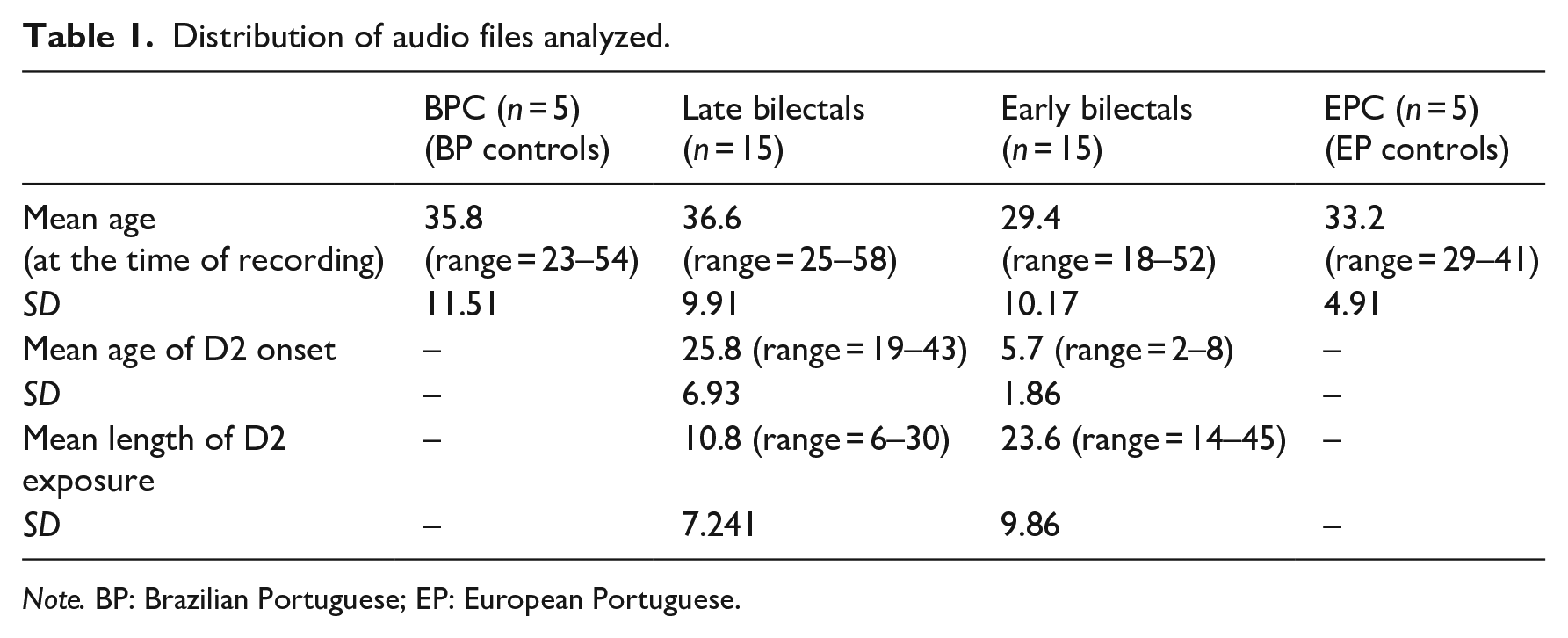
Note. BP: Brazilian Portuguese; EP: European Portuguese.
Rating task
The participants participated in an Accent Rating Task inspired by De Leeuw et al. (2010) and the modified version in Kupisch et al. (2014). Both varieties were combined in one task, as BP and EP can be considered to be on a continuum, with monolectal BP speakers representing one extreme and monolectal EP speakers the other, and speakers of both varieties somewhere in between. The task contained 70 items, 10 of which were control items—5 for each control group. The other 60 items consisted of audio files from the target groups, cut out from naturalistic interviews used in the production task mentioned in 5.1. These interviews consisted of four stories built in sets of six pictures each, fully independent of one another. Participants generated about a minute and a half of spontaneous speech, describing the actions that took place in each story, until all four stories were told. Their speech was recorded using a conventional Olympus VN-713PC voice recorder.
When selecting the audio snippets from these interviews, we avoided passages containing lexical or syntactic cues for one of the two varieties, to prevent linguistic bias from influencing the raters’ judgment. Each bilectal speaker appeared twice in the rating task, once speaking their L1 (BP) and once speaking their L2 (EP). Language mode was controlled for in the original task in the following way: in addition to interacting with native speakers of each language in separate testing sessions, participants were taking part in a larger experiment with several linguistic cues as to which language mode they were in. The native BP and EP speakers who conducted the task also engaged each speaker in a 5-minute conversation, to ensure that they would switch to the appropriate language mode. Each audio file for the current study consisted of approximately 10 seconds of speech. An overview of the experimental items is shown in Table 2.
Overview of experimental items.
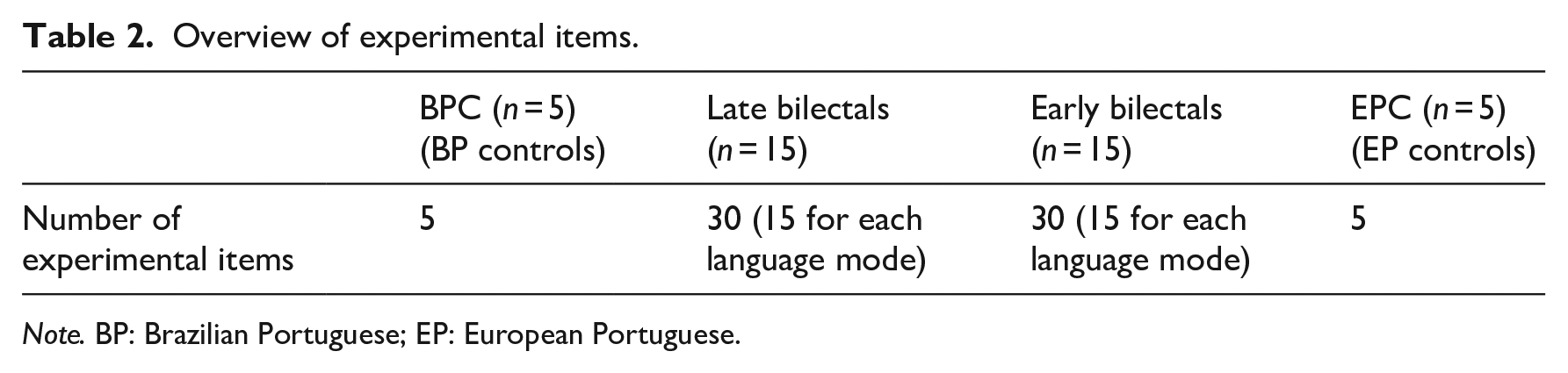
Note. BP: Brazilian Portuguese; EP: European Portuguese.
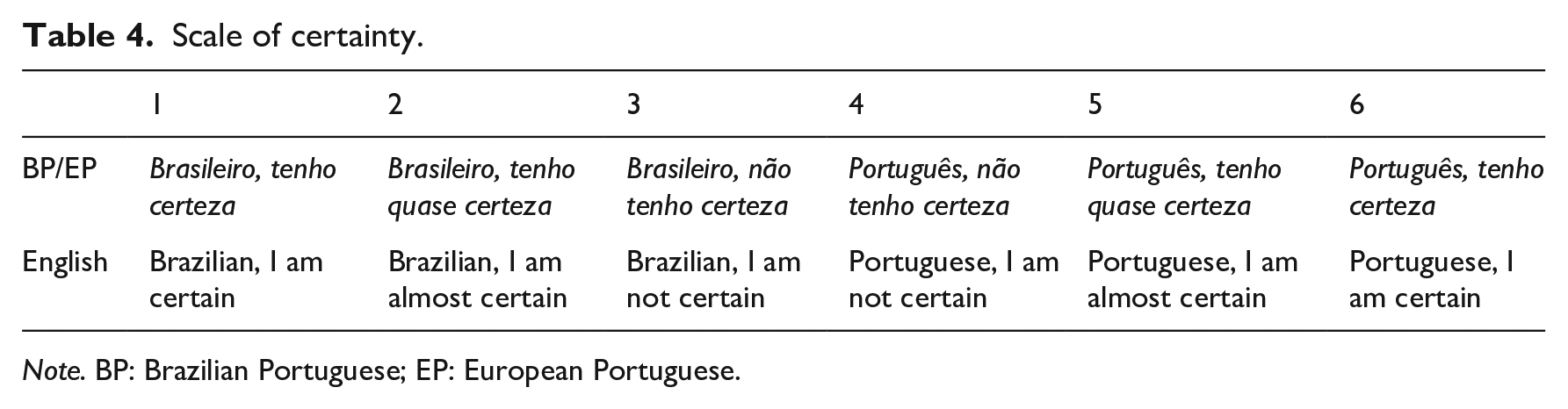
All items were randomized to reduce priming, and all raters judged the same samples. The raters were instructed to listen carefully to each audio file and choose whether the speaker sounded Brazilian or Portuguese, by selecting values on a Likert-type scale corresponding to their degree of certainty (see Figure 1).

Scale of certainty: (from left to right, Brazilian, I am certain; Brazilian, I am semi-certain; Brazilian, I am not certain; Portuguese, I am not certain; Portuguese, I am semi-certain; Portuguese, I am certain).
We used the degree of certainty as a measure to indicate possible deviation from the judgment given by the raters to the monolectal controls. In other words, a rater might be less sure about whether the speaker is Brazilian or Portuguese if that speaker shows phonological influence from one variant when speaking the other. We instructed the raters that they should not consider vocabulary differences or syntactic structures when making their choice, but rather focus on pronunciation (although we had tried to avoid such cues; see above).
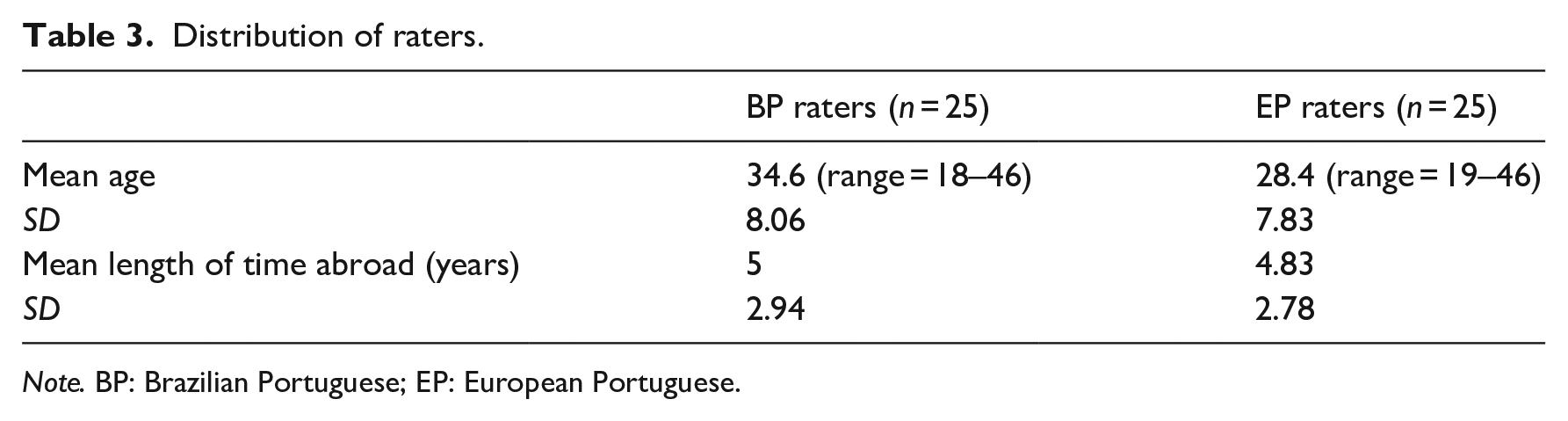
We recruited 2 groups of raters, 25 native BP speakers and 25 native EP speakers, from various regions of Brazil and Portugal (Figures 2 and 3). This was done to neutralize possible dialectal variation within each variant.
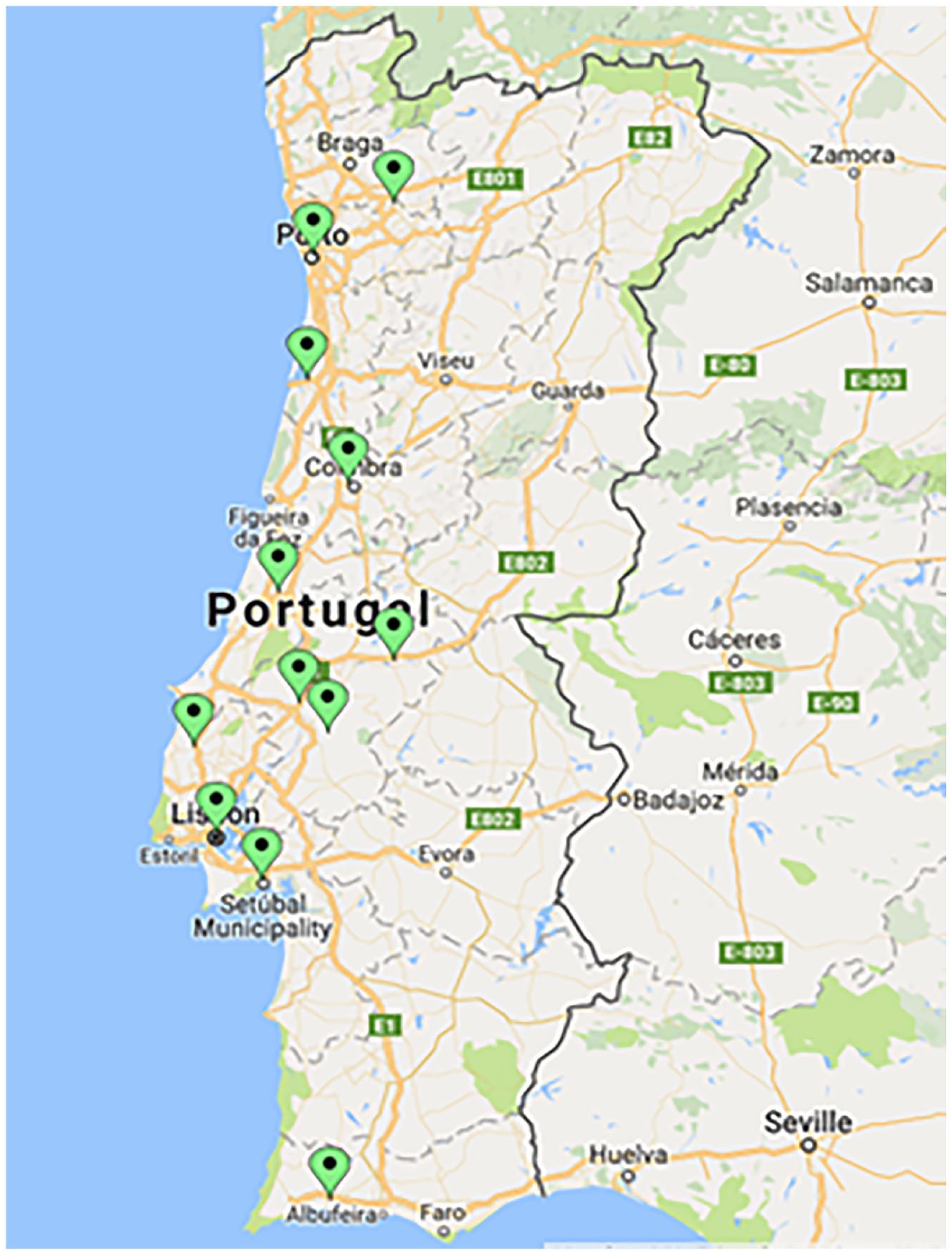
Distribution of EP raters.
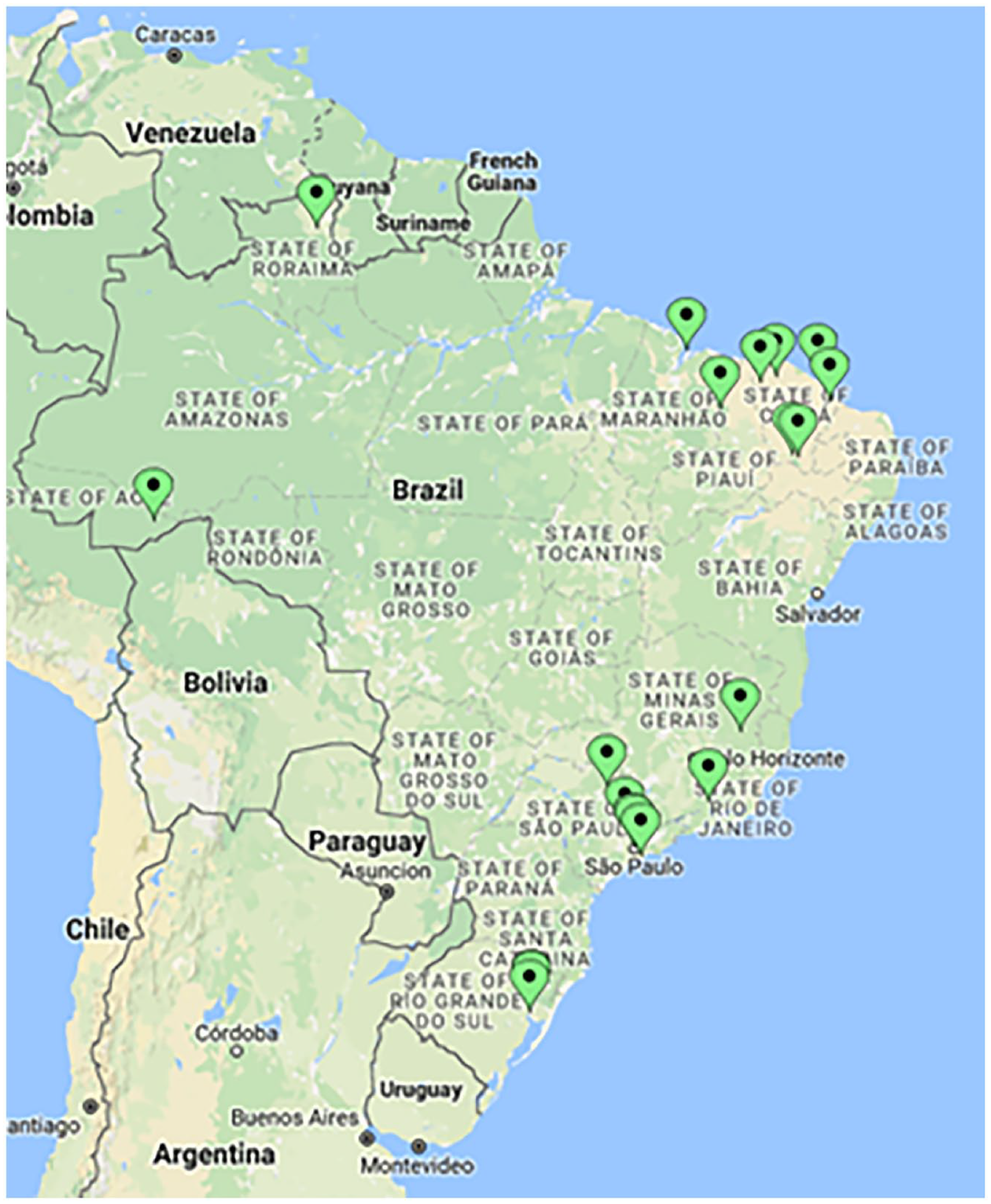
Distribution of BP raters.
Some of the raters in both groups had knowledge of other languages—primarily English and Spanish—but minimal contact with other Portuguese variants. The majority of raters never lived abroad, and the few who did never lived in another Portuguese-speaking country. Table 3 illustrates the demographics of the raters.
Distribution of raters.
Note. BP: Brazilian Portuguese; EP: European Portuguese.
Results
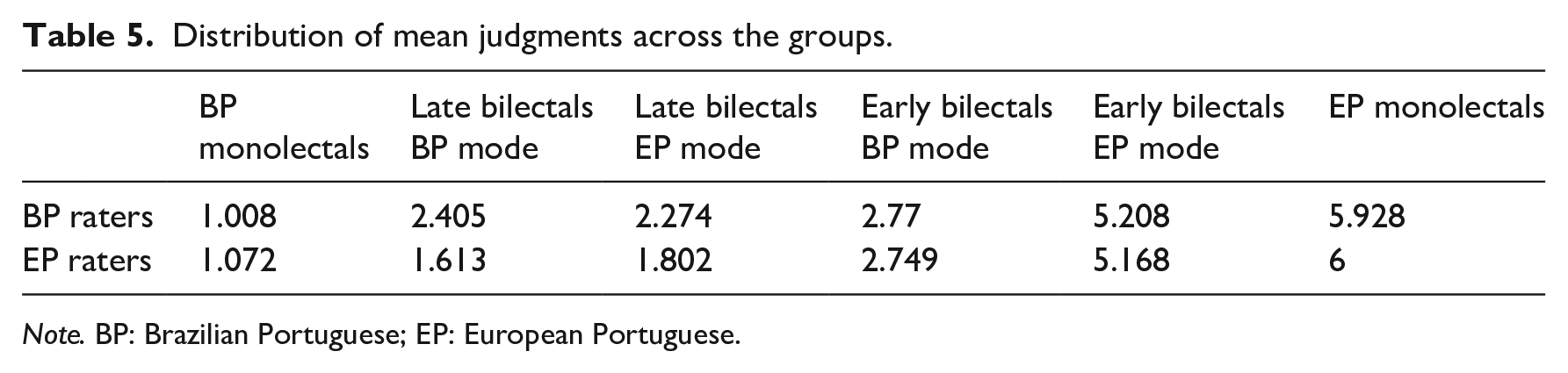
We converted each point on the scale into numbers (1–6), as detailed in Table 4 (the second row is the translation, which was not given in the task). Table 5 shows the mean values the raters attributed to each group of speakers.
Scale of certainty.
Note. BP: Brazilian Portuguese; EP: European Portuguese.
Distribution of mean judgments across the groups.
Note. BP: Brazilian Portuguese; EP: European Portuguese.
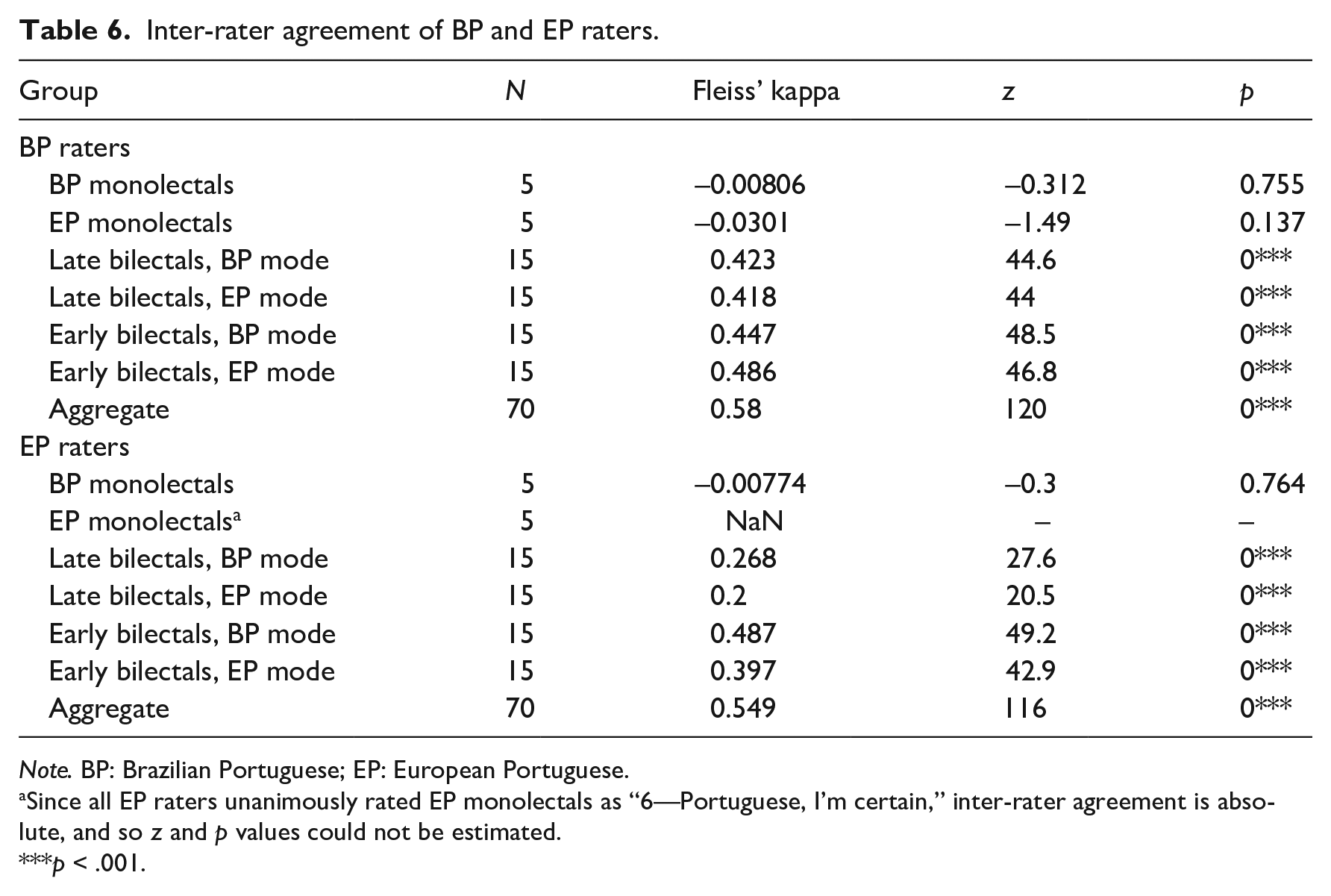
Both groups of raters had virtually no difficulty identifying the control monolectals, attributing values close to 1 and 6 to each extreme. We ran several mixed-effects models comparing the values attributed to the target groups to those attributed to monolectal controls—and across the two language modes. Although rater perception was not part of our research questions, we discriminated between the two rater groups to ensure that they were not biased toward one or the other group because of their native variety. To verify inter-rater agreement, we computed Fleiss’ kappa (Fleiss et al., 2003) scores for each group of raters and each of the control and target groups, as illustrated in Table 6.
Inter-rater agreement of BP and EP raters.
Note. BP: Brazilian Portuguese; EP: European Portuguese.
Since all EP raters unanimously rated EP monolectals as “6—Portuguese, I’m certain,” inter-rater agreement is absolute, and so z and p values could not be estimated.
p < .001.
While BP raters showed moderate agreement for the target groups (0.418–0.486), EP raters were in fair to moderate agreement (0.2–0.487) on the same test items. Both groups of raters showed virtually no disagreement on rating BP monolectals’ performance, and EP raters unanimously rated EP monolectals as certainly Portuguese. On the aggregate of all test items, we do not see significant differences across the two groups of raters (i.e., BP raters’ Fleiss’ kappa: 0.58; EP raters’ Fleiss’ kappa: 0.549), and for this reason, we analyze the BP and EP raters together (henceforth raters).
Our statistical analysis of the raters’ judgments suggests that late bilectals are appropriately judged as Brazilian in BP mode, though the degree of certainty is significantly lower for this group than for the BP monolectals (β = 0.96, t = 7.61, p < .01). The same is true for early bilectals (β = 1.72, t = 13.52, p < .01). That is, both target groups were appropriately judged as Brazilian in BP mode, but the raters were significantly less certain compared to when they judged the monolectal controls. There were also significant differences between the two target groups in this mode, whereby the raters were less certain about the early bilectals being Brazilian than they were about the late bilectals (β = 0.75, t = 8.34, p < .01).
As for the perceived accent in EP mode, raters judged late bilectals as Brazilian and thus significantly different from EP monolectals (β = 3.92, t = 30.86, p < .01). Early bilectals, by contrast, were perceived as Portuguese, though the raters were significantly less certain of their choice than they were when rating the EP monolectals (β = 0.77, t = 6.1, p = 1.17e–09). The difference between the target groups in EP mode was significant (β = 3.14, t = 35.01, p < .01).
Across the two modes, late bilectals displayed a similar behavior (β = 0.02, t = 0.32, p = .744), that is, not adapting their language to their interlocutor’s variety. Early bilectals, on the other hand, produced different pronunciations depending on their interlocutor (β = 2.42, t = 26.99, p < .01). Figure 4 combines the distribution of the judgments across the two modes for ease of illustration, showing a gap between early bilectals across the two modes, which shows a mode-split that late bilectals do not have.
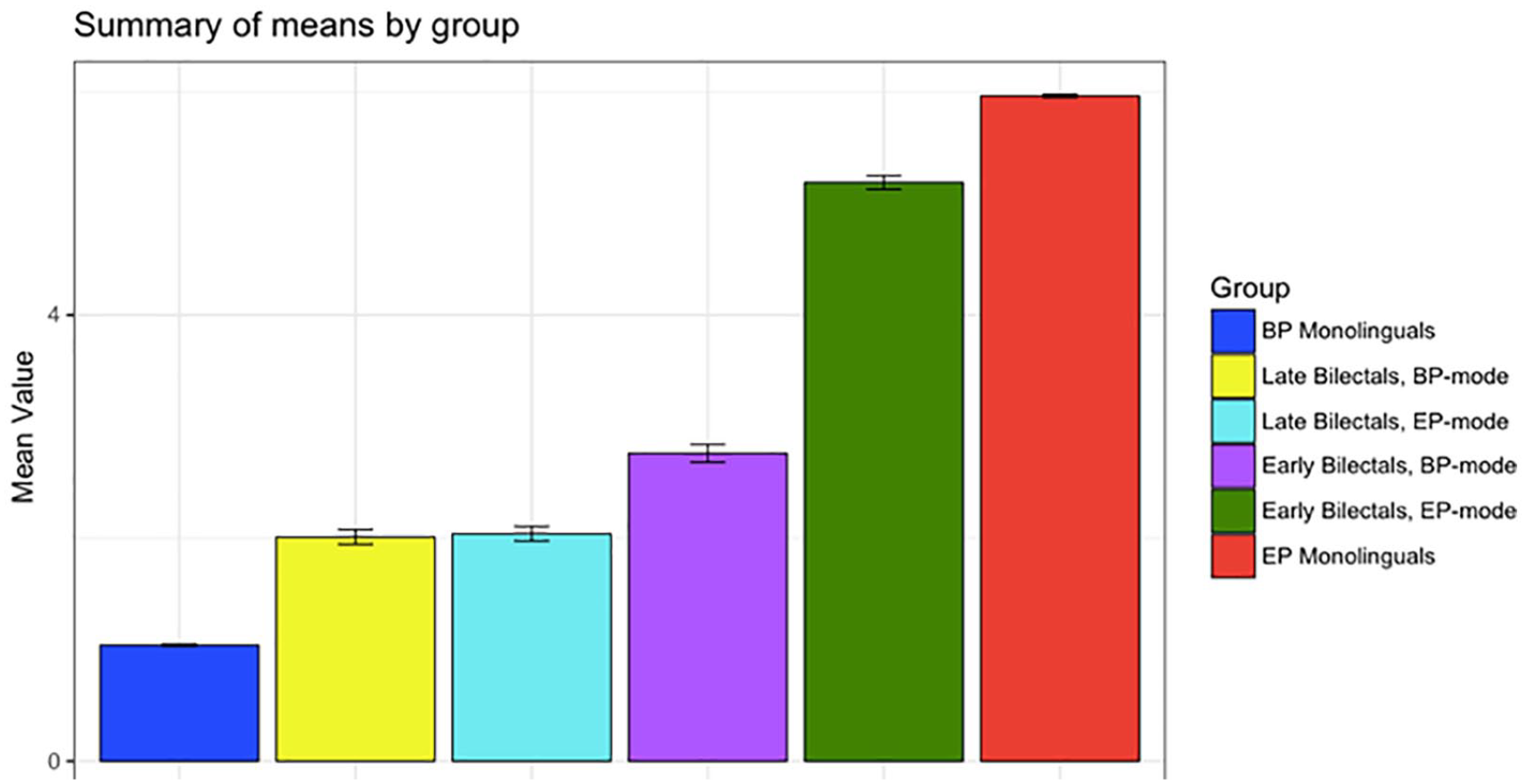
Perceived accent by group in the two modes.
Discussion
In this paper, we asked (RQ1) whether early bilectals speaking BP and EP show advantages over late bilectals in speaking their second dialect, EP, and (RQ2) whether early and late bilectals display signs of CLI from their second onto their first dialect, BP.
As to RQ1, we expected that early bilectals would not be perceived on par with monolectal EP speakers, since they were continuously exposed to BP, and would instead have a slight “foreign” accent, detectable by EP raters. At the same time, early bilectals were expected to be more like EP speakers than late bilectals when speaking EP, due to their earlier AoO and their longer experience with EP. That is, neither group was expected to sound entirely monolectal, but the degree of perceived foreignness would depend on the AoO in the D2. Our data confirmed these expectations. Native BP and EP raters perceived both early and late bilectals as sounding different from monolectal controls in both dialects, but especially in the EP of the late bilectals. This suggests that maturational constraints, paired with more extensive input during an earlier age, play a role in this language contact scenario, just like in a bilingual situation.
RQ2 explored the bilectals’ perceived accents in BP. Following research on language attrition, we expected a detectable accent in the speakers’ native BP dialect as a result of contact with EP, but that late bilectals would sound less foreign than early bilectals since their BP was more stable upon first exposure to EP. Our results confirmed that, in BP mode, both early and late bilectals were perceived to be different from BP monolectals, though the late-learner group’s ratings were closer to BP monolectals than those of the early-learner group. This indicates that the BP of late bilectals in this language scenario is not entirely unaffected by their (late acquired) D2, though early bilectals show a higher degree of CLI from D2 as a result of earlier and longer exposure to this dialect.
A question that is left open by our study concerns the segmental and suprasegmental features that gave rise to the perceived accents. Anecdotally, rater participants mentioned, especially for the late bilectals when speaking in EP mode, the “more rhythmic” sound of their speech, pointing to less vowel reduction, epenthesis, and a more syllable-timed pattern (see examples 7 and 8), and vice versa, for early bilectals in BP mode, their “shorter” vowels and “faster” speech, and the “skipping of sounds.” On the segmental level, a frequently mentioned feature was the overly frequent use of the postalveolar [ʃ] instead of [s] when early bilectals spoke in BP mode. These segmental and suprasegmental features could be the focus of future studies investigating the relative vulnerability of specific phonetic and phonological properties.
A somewhat unexpected finding was that the late bilectals were not perceived differently in the two modes, that is, for the raters it made no difference whether their speech was recorded in BP or in EP mode. This suggests that the late bilectals did not adapt their speech to that of their interlocutors at all, unlike the early bilectals. Whether this is merely an effect of their late AoO or a lower inclination to adapt (since there is mutual intelligibility even without adaptation) cannot be answered based on the data we have.
Taking the attitudes toward the BP variety into account, one would expect BP speakers to try to suppress their dialect features. As reported by Bagno (2003), not only EP speakers but also some Brazilians themselves reveal feelings of inferiority of their (own) native Portuguese varieties vis-à-vis Portugal. Bagno related the low language self-esteem of BP speakers to the distance between what educated classes in Brazil idealize as the standard language and the language use of BP speakers in everyday life in any region of the country. Urban educated Brazilians consider their fellow rural countrymen and women’s language inferior and even have preconceptions about their own urban language varieties. Mattos e Silva (2004, p. 106) described the language situation in Brazil as a disharmonious encounter of the idealized standard language, the educated standards, and the vernaculars of the heterogeneous Portuguese-speaking communities in Brazil. Bugel (2009) reports that Brazilians typically favor the neutral/general (European) variety of Portuguese as the first choice for teaching situations, followed by the Brazilian variety, although this choice contrasts with their subjective preferences for a specific regional variety of Portuguese. How can these impressions be reconciled with our study? It is possible that the late bilectals, consciously or subconsciously, made an attempt at suppressing their BP features and that some EP features have become part of their phonological system. This is not implausible, since they have been living in Portugal for a very long time. But if so, they have been unable to completely acquire the new EP system, presumably due to their comparatively late AoO. 4
Attitudes could also potentially be at play in the observed outcome for the early bilectals. To begin with, they might have been exposed to a BP variety that is already slightly different from that spoken in Brazil. And while they are clearly able to adapt to their interlocutors in both modes, advantaged by their earlier AoO in EP, they may not be inclined or feel the necessity to sound entirely Brazilian, due to the negative attitudes associated with this variety. Furthermore, having grown up in Portugal, they may feel more Portuguese than Brazilian. On the contrary, bilectal speakers in Portugal may have noticed that BP is gaining popularity, due to its presence in the media, at least in the context of youth culture. If this were the case, we would expect greater tolerance toward BP among the younger generations, and our early bilectals were indeed slightly younger on average. As mentioned in the beginning, children and young adults in Portugal are frequent consumers of Brazilian culture, including music, soap operas, movies, comedies, and YouTube productions for children, because they find the content interesting. Neto (2009) assessed the attitudes of people in Portugal toward ethnocultural groups and found that the ethnocultural group viewed most positively was the Brazilian one. This means that it is not unlikely that youth culture might alleviate linguistic prejudice and stereotyping. Our data show that developing two phonological systems separately is in principle possible not only for bilinguals but also for dialect speakers. 5 However, the degree to which this happens may be determined not only by factors such as timing and amount of exposure but also by extra-linguistic factors such as language status and language attitudes.
We mentioned in the beginning that (early) bilectals are somewhat similar to HSs, and this is also shown by the accent data presented here and the discussion of potential extralinguistic factors. Dialects and heritage languages are similar. They are used predominantly in informal contexts, they often carry less prestige, and there are fewer opportunities to use them. While it is always acceptable to use the standard language in a dialect setting, the opposite is not the case. The Portuguese setting described here is special because we are not comparing dialect versus standard but the two standards of a pluricentric language. Nonetheless, the situation of BP speakers growing up in Europe resembles that of many HSs because they use their D1 mostly at home, while they are schooled in the majority dialect. In work on HSs, it is often assumed that the two languages of a bilingual are sufficiently distinct, but, as discussed by Polinsky (2018), they may also be so similar that it may not be clear if they are separate languages or two dialects of the same language. While studies on HSs with typologically close languages are rare or even non-existent, the dialect scenario makes it possible to study what happens to the development of linguistic systems under extreme typological similarity. In phonology, following Flege (1995), it should be harder to form new categories for similar sounds than for different sounds. Our study, though concerned with global accent rather than specific features, suggests that it is nevertheless possible, albeit harder for late bilectals than for early bilectals.
Since we excluded in our study samples stimuli in which morphological or syntactic features could give a clue to dialect origin, one take-home message from our study is that phonetic/phonological information is sufficient to determine where speakers are from. These phonetic/phonological properties can reveal a person’s identity and lead to positive or negative stereotyping. Another implication of our study is that many speakers which we tend to classify as “monolingual” because they grow up in a country with only one official (national) language could sometimes be conceived of as multilinguals, if they are speakers of both a standard variety and a dialect and thus master two varieties that are as distinct as languages in other contexts.
Conclusion
The main goal of this study was to test acquisition and maintenance of accent in early versus late learners of EP with BP as their first dialect (D1) or one of their two first dialects. We were particularly interested in how much of the EP phonology was acquired by each group and to what extent that had affected their native BP phonology. Native BP and EP raters perceived both groups of learners as sounding different from monolectal controls in both dialects, with varying degrees of perceived foreignness. This suggests that the two dialects of bilectals interact, just like the two languages of bilingual speakers. The perceived accent was more prominent in the D1 of the early bilectals and in the D2 of the late bilectals, which suggests that early exposure also plays a role in a dialect setting, although we cannot exclude that extralinguistic factors, specifically attitudes toward a linguistic variety, also play a role. Further research is required to investigate which aspects of EP and BP phonology are more likely to undergo EP influence and induce the perceived accent we have measured. Another path for future research is a more systematic investigation of the role of attitudes onto accent development.
Footnotes
Declaration of conflicting interests
The author(s) declared no potential conflicts of interest with respect to the research, authorship, and/or publication of this article.
Funding
The author(s) received no financial support for the research, authorship, and/or publication of this article.
