




Abstract
Aims and Objectives:
The study investigates the effects of age, language use, and attitudes on Portuguese returnee bilinguals’ knowledge of German nominal morphology. We focused on language attrition. In addition, we compared whether the results of returnee bilinguals differ in relevant ways from the performance of L1 speakers of German and, if so, in which domains.
Methodology:
A background questionnaire and offline tasks that elicit lexical knowledge, case, gender, and plural marking in German were applied to a group of Portuguese–German bilingual returnees (N = 20) and a group of German L1 speakers (N = 20).
Data and Analysis:
The elicited data were analyzed through non-parametric tests (Mann–Whitney tests, Wilcoxon tests, and Spearman correlation tests), since not all the requirements for running mixed models could be fulfilled.
Findings:
The results show that bilingual returnees have very stable knowledge of the analyzed properties: parts of morphosyntactic knowledge are acquired and stabilized in childhood and remain highly invulnerable to loss of contact throughout the speakers’ lifetime. However, returnees’ knowledge of the German case system is constrained by age of input loss, language use, and attitudes. Ungrammatical plural marking is correlated with the speakers’ bonds to the German language and culture. No cross-linguistic influence from Portuguese was found in the domain of plural marking.
Originality:
This study resumes the question of differential attrition effects in returnee bilinguals by using a more controlled methodology. It extends the investigation to returnees’ performance in the lexical domain and with regard to case, gender, and number morphology in German, also quantifying other variables, such as the age of onset of bilingualism, the amount of contact with German after return, and the length of residence in Portugal. In addition, it focuses the less researched question regarding the role of the returnees’ attitudes toward both their languages.
Significance/Implications:
The study highlights the multi-dimensional factors that constrain language proficiency over a bilingual speaker’s lifetime.
Introduction
Returnee bilingual speakers are, typically, second-generation immigrants who spend (part of) their childhood in a migration context, acquiring a societal language that differs from their family language (i.e., their heritage language [HL]). Up to this point, they are typical heritage speakers (Rothman, 2009), who acquire at least two languages through naturalistic exposure in childhood; yet, at a certain moment of their life, they move/return to their family’s homeland. The return may happen between (late) childhood and adulthood, thus leading to differential profiles of speakers (Flores & Snape, 2021). Whereas child returnees enter the homelands’ school system after return and get formal instruction in their HL, adolescent and adult returnees may enroll in professional training or in the university in the homeland or enter directly into the labor market. The degree of contact with the former societal language (FSL) after return may vary from a complete absence of exposure (typically when this language was not spoken within the nuclear family during migration) to a less pronounced reduction if, for instance, one parent is native speaker of the FSL and continues to use it in the new environment. In all scenarios, the FSL becomes a minority language after return and is less present in the speakers’ life than previous to return. Furthermore, returnee bilinguals’ profiles vary according to their age of onset of bilingualism (AoO). They can either be simultaneous or sequential bilinguals—some children with migration background acquire the two languages simultaneously from birth, while others acquire the societal language as second language (L2).
This shows that returnees are certainly not a homogeneous group of bilingual speakers (as bilinguals rarely are). What all returnees have in common is that (1) they acquired (at least) two languages through naturalistic exposure in a migration context and (2) the status of their childhood (native) languages inverts after their return to their (parent’s) homeland—the FSL becomes a minority language and their HL becomes the societal language. It is precisely this change of environment at a relevant moment of development (pre- or post-puberty), which comes along with a significant turn in language dominance (Flores et al., 2022), that makes this population a unique testing ground for both theoretical and empirical questions related with processes of language attrition and retention. Despite the uniqueness of this particular group of heritage speakers, research on this population is still scarce, which is, in part, due to the difficult task of recruiting returnee participants.
One central question in research on returnees targets the role of age in language attrition. Previous research has shown that the degree of attrition affecting the returnees’ FSL, after their return, correlates with the age of environment change, namely whether the return occurs during or after childhood (Flores, 2010, 2020; Berman & Olshtain, 1983; Kuhberg, 1992; Olshtain, 1986; Reetz-Kurashige, 1999; Snape et al., 2014). Many studies report a fast decline of linguistic competences in child returnees, that is, in speakers who lost regular exposure to the FSL during childhood (Flores, 2015; Kuhberg, 1992) in contrast to speakers who return as teenagers (Flores, 2010). A different outcome is mainly observed in child returnees who continue to contact regularly with the FSL, for instance, through formal instruction, as reported for Japanese returnees regarding the maintenance of English (Kubota, Heycock, et al., 2020).
The differences between child and adolescent returnees concerning their retention of the FSL’s grammar has let Flores (2010) to propose that the development of a native language involves two dependent processes: the acquisition of linguistic knowledge, accompanied by a period of its stabilization. Following neurocognitive approaches to language attrition (see Kubota, Chevalier, & Sorace, 2020), the author proposes that, after its consolidation, most domains of a (native) language become relatively immune to effects of disuse. However, which particular language domains and linguistic structures are subject to stabilization, and how long this period may be, is not sufficiently investigated yet.
Based on the investigation of Portuguese returnees from Germany, Flores (2010, 2020) proposes that at least 9 years of exposure to a language in childhood—or up to age 11—may be necessary to stabilize morphosyntactic knowledge. Detachment from the childhood majority language (in this case German) before this stabilization process is concluded leads to unstable knowledge, that is, to attrition effects, visible in the production of deviant grammatical structures. This was shown for verb placement, case, gender, and plural marking in (more or less) spontaneous oral production, elicited by interviews and storytelling tasks. Based on the same data, Flores (2012) concludes that other language domains, for instance, object expression, may not be subject to a stabilization period. This means that certain domains and linguistic properties remain vulnerable to disuse during the speakers’ lifetime, far beyond a critical phase of stabilization. Thus, other factors, such as the amount of contact with the attrited language, the degree of formal instruction, or issues of attitudes toward the FSL may play a more important role in the retention of these properties.
Following this vein of argumentation, the present study aims to resume the question of differential attrition effects in returnee bilinguals by using a more controlled methodology (different types of offline tasks), a larger number of participants, and a control group of German L1 speakers. We investigate returnees’ performance in the lexical domain and with regard to case, gender, and number morphology in German. In addition to the variables “age at return” and “length of residence in Germany,” which were found to determine returnees’ knowledge of German nominal inflection (Flores, 2020), also other variables are quantified, such as their AoO, the amount of contact with German after return, the length of residence in Portugal and the returnees’ degree of identification with the German language and culture after being (re)immersed in the Portuguese society (hence “attitudes”). Ultimately, we aim to add more empirical evidence to the limited research on language attrition in returnee heritage speakers.
Predictive variables in language attrition and research questions
It is largely consensual that language attrition is a complex process, resulting from the interaction of various factors that affect bilinguals’ development over time (Schmid & Köpke, 2017). Understanding the nature of this process requires looking in more detail at the predictors of language attrition. However, as pointed out by Schmid and Cherciov (2019), attrition studies face the methodological challenge of reduced population size, high variability of the collected data and an enormous difficulty in quantifying extralinguistic variables. This also applies to studies on returnee bilinguals, whose population is even more reduced than the populations who live in the migration context. Also, the variability is higher and more interacting predictor factors may explain the outcome variables, since the age and the conditions of return add more constraints to the profile of these speakers. For now, we do not envisage a more reliable response to this challenge than moving the field forward with slight methodological advances. In the present study, this advance consists of the application of an instrument for quantifying background variables, which allows us to assess various domains of language experience in a controlled way. We adopt the Bilingual Language Profile (BLP) that was originally developed by Birdsong et al. (2012) to assess language dominance of bilingual speakers. It allows us to quantify factors related with language history, language use, and language attitudes.
As discussed above, it has been consistently shown that the age at which a returnee bilingual moves from the migration context (back) to the homeland has an impact on the retention of the FSL, namely in case the return occurs during childhood (Flores, 2010, 2020). If the return happens after childhood, the impact of age disappears, and other variables related to language use explain the particular outcome of adult returnees’ linguistic knowledge/performance. We explain this as a period of language stabilization, which comes to an end after 9–12 years of extensive language exposure. Thus, age appears to be a crucial variable in child populations, but it is not deterministic and does not explain the full range of variability observed in returnee populations. The same applies for other types of early bilingual speakers, who experience severe input changes (as independently argued by Montrul, 2008, and Bylund, 2009, and extensively discussed in Bylund, 2019). Furthermore, there is evidence that age effects are selective, that is, not all linguistic domains and structures are equally affected by a period of linguistic consolidation. This leads us to our first set of research questions:
RQ1. Can we confirm effects of age in Portuguese returnee bilinguals’ knowledge of German nominal morphology as predicted in previous research on this population? Are age effects equally visible in the lexical domain?
As discussed by Schmid (2011, 2019), the frequency of language use in a bilingual context and the length of reduced exposure to a given language are two variables which, intuitively, should explain variability in language attrition. The less someone uses a given language during a prolonged period of time, the more attrition effects should be visible. However, this correlation is not that linear, and the picture is far more complex. For returnees, most research has failed to show a clear link between the length of residence back in the homeland (period of incubation), and the degree of attrition (Flores, 2010, 2020; Taura, 2008), particularly in the case of non-child returnees. Similarly, the role of amount of exposure to the FSL has not been sufficiently explored in previous research on returnees (with the exception of Kubota, Heycock, et al., 2020, for child returnees). Most studies assumed a dichotomy between “total loss of contact” and “reduced contact,” not considering the degree of contact as continuum. Thus, a closer look at these variables is due, in particular concerning different language domains, for example, lexical versus morphological knowledge.
Language attitudes is a further extralinguistic variable that may have an impact on language retention/attrition (Schmid, 2002; Schmid & Karayayla, 2020; Yoshitomi, 1992). Language attitudes refer to the bilinguals’ motivation to interact in a given language, which, generally, is not the language of the dominant environment. It includes also the bilinguals’ attitude toward their bilingualism, which may reach gradually from very positive to very negative; and their identification with the respective cultures of the target languages. Despite the assumption that attitudinal variables may play a role in the maintenance of a minority language, most studies fail to reveal a clear link between both dimensions (see Yilmaz, 2019, for a review). Even robust models that quantify a wide range of affective variables, both at the individual as well as the societal levels, such as the Ethnolinguistic Vitality Theory (e.g., Yagmur, 1997), do not reach consistent conclusions regarding the impact of these variables.
To our knowledge, no previous study on returnee bilinguals has systematically addressed the role of attitudes in the retention of the FSL. The present study makes a first step in this direction by attempting to quantify the returnees’ attitudes toward both their languages, Portuguese and German. Taking these variables together, our second set of research questions are as follows:
RQ2. Do variables related with amount of language use, length of incubation, and attitudes explain (at least, part of) performance differences between returnee bilinguals? Do potential effects impact equally on the participants’ lexical and the morphological knowledge?
In addition to the extralinguistic variables, a closer look at the linguistic outcomes of the return is due. Previous research has identified the lexical and the morphological domains as being particularly vulnerable to loss of contact to the FSL. Berman and Olshtain (1983), for instance, who conducted one of the first larger studies on (child) returnees, confirmed relevant attrition effects both in the lexical and morphological knowledge of English–Hebrew children 1 year after their return from the United States to Israel, further constrained by their age at return. The authors identified severe lexical retrieval difficulties and significant attrition effects in morphosyntax, particularly expressive in the participants who returned to Israel between 5 and 8 years of age, which are mainly attributed to transfer from Hebrew. Similar observations regarding the vulnerability of the lexicon and some morphosyntactic properties come also from other studies on returnees (e.g., Kuhberg, 1992; Reetz-Kurashige, 1999). Based on a corpus analysis of Portuguese–German returnees’ speech, Flores (2020) suggests that attrition in German affects mainly those properties that are mastered latest in the development of native German morphology: the lexical dative case regarding the case system, the differentiation between neuter and masculine regarding gender, and the absence of plural markers regarding nominal number morphology. This leads us to our third set of research questions:
RQ3. Are effects of language attrition in the morphological domain, detected in semi-spontaneous speech in earlier studies on Portuguese–German returnees (Flores, 2020), also visible in offline tasks that elicit case, gender, and plural marking in German? Do the results of returnee bilinguals differ in relevant ways from the performance of L1 speakers of German? If so, in which domains?
German nominal morphology
German has a rich system of inflectional morphology. The categories of noun inflection are gender, case, and number. As for grammatical gender, nouns can be masculine, feminine, or neuter. In this case, the gender marking is not on the noun but on the elements that accompany it, such as determiners and adjectives. Corpora estimates indicate that most German nouns have masculine gender (approximately 50%), followed by feminine gender, and, finally, neuter gender is the least frequent (Stöhr et al., 2012). Some morphological, semantic, and phonetic principles give clues about gender assignment (Steinmetz, 1986); however, there are many exceptions to these “rules,” and they are often contradictory.
Regarding the German case system, there are four cases (nominative, accusative, dative, and genitive) marked mainly on articles, demonstrative and possessive pronouns, adjectives and, in some cases only, on nouns. Only four morphemes mark case on nouns: in the singular, {-(e)}, {-(e)n}, {-(e)s} and in the plural {-n}. The distribution of these markers differs according to the inflection category to which the noun belongs. The main function of the case system is to mark grammatical relations within the sentence. The nominative case marks the grammatical subject as well as the subject predicative. The accusative case marks the direct object and is also ruled by certain prepositions. The dative case marks the indirect object and is also ruled by certain prepositions. The genitive case has an attributive function indicating possession or a relationship between nouns, and, like the two previous cases, it is also ruled by certain prepositions.
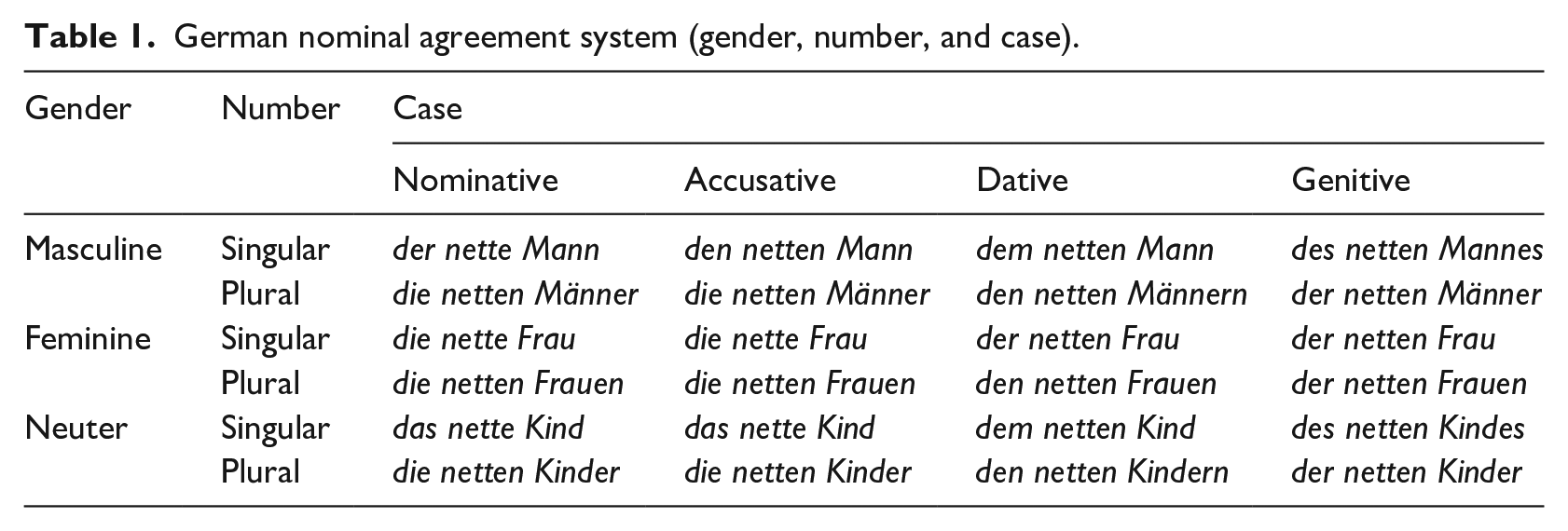
As for the grammatical number, nouns can semantically express one or more than one unit, having therefore singular and plural values. Only the plural is marked, and this is usually done both on the noun and on the other elements of the noun phrase. The choice of plural morphemes is determined by the phonotactic characteristics of the noun, namely the final syllable and the final segment of the root; also, by the gender of the noun. According to Köpcke, (1988, 1993) in German there are eight plural markers: the morphemes {-e}, {-(e)n}, {-er}, and {-s}; a zero morpheme {-Ø} (the plural form is the same as the singular form); and the vowel mutation (graphically represented by the umlaut) in combination with the morphemes {-Ø}, {-e}, and {-er} (Köpcke, 1993). Although there is some variation in the type and token frequency of plural morphemes in the corpora analyzed by different studies, it is unanimous that {-(e)n} is the most frequent plural morpheme (representing between 40% and 50% of plurals), followed by {-Ø} and {-e}, while {-er} and {-s} and plurals with vowel mutation are infrequent (Feldman, 2005). The complexity associated with the German plural is due to the high number of plural morphemes and also to the lack of transparency associated with their assignment because the rules have only limited validity. See Table 1 for an overview over the German nominal agreement system.
German nominal agreement system (gender, number, and case).
Instruments
Background questionnaire
The questionnaire was adapted from the BLP (Birdsong et al., 2012) with the goal of assessing language dominance of bilingual speakers. It was adapted with regard to the content of some questions to make it more suitable to the profile of the returnees while maintaining the original structure and method of quantification. 1 It consists of scalar questions associated with a certain point value related to language exposure, use, self-assessment, and motivation/identification regarding the two languages. The BLP consists of five sections: (I) Biographical Information; (II) Language History; (III) Language Use; (IV) Language Proficiency; and (V) Language Attitudes. While section I collects biographical information, sections II to V comprise a total of 19 questions with quantifiable answers on a scale corresponding to a variable number of points.
Following the original quantification proposal, the maximum possible score that can be obtained for one language is 218, which corresponds to a very high degree of proficiency, contact, and motivation regarding the target language. The comparison of the scores obtained in each language shows the relative dominance of the two target languages. The dominance index is obtained by subtracting the overall score for one target language from the other. A score close to 0 indicates a balanced level of bilingualism, while more positive or negative scores point to the dominance of one of the target languages. The BLP also allows a score to be obtained for each of the sections individually, thus targeting specific factors such as language use (section III, maximum 54.5 points) or language attitudes (section V, maximum 54.5 points).
Lexical decision task
The Lexical Decision Task (LDT) aims to assess the participants’ lexical knowledge to observe whether there is a correlation between the amount of German words the participants know and the extralinguistic variables quantified by the BLP.
The task consists of 64 nouns, 32 of which are real words and 32 are pseudo-words. Participants decide for each item whether they know the word or not. To ensure that the LDT includes frequent words, real words were selected based on the list of the 4000 most frequent German words of levels A1–B2 according to the corpus collected by the Herder-Institut of the University of Leipzig (Tschirner, 2008). The pseudo-words created were based on frequent real words to which changes were made while keeping the German phonotactic features. Although changes were usually made on the first consonant (Luft > Nuft), to preserve certain common prefixes or consonantal groups (such as Vor- or Sch-), in some words the consonant of the second syllable was changed (Vorbild > Vormild; Scheidung > Scheilung). The items are accompanied by the definite article and distributed according to the three grammatical genders (22 masculine, 22 feminine, and 20 neuter). Participants were not told how many pseudo-words were included in the test. The test score was computed following the suggestion by Alderson (2005) for the Dialang vocabulary size placement test (VSPT), namely a simple total of items correctly identified as either real words or non-words, without distinction made between both types of items in terms of scoring weight. This scoring procedure has been argued to be as reliable as other scoring methods (Birdsong, 2016), even though we recognize the strengths and shortcomings of other scoring methods (Beeckmans et al., 2001). We also acknowledge that the decision of including pseudo-words is controversial and has pros and cons (Stubbe, 2012). The maximum score for each language was, thus, 64 points. Recognizing all 32 real words without marking any pseudo-word as existing corresponds to a score of 100%. Conversely, marking all 32 pseudo-words as existing, while not recognizing any real words, corresponds to 0%. All intermediate scores get their corresponding percentages.
Case marking task
A Case Marking Task (CMT) was developed to assess the participants’ knowledge of the German case system to be able to investigate the relationship between the three categories of German noun inflection, namely number, gender, and case.
For this task, a short narrative was created whose protagonist is a magician. The narrative contains a total of 20 items. For the nominative, accusative, and dative cases, four items are elicited for each case—one masculine, one feminine, one neuter, and one plural. For the genitive case, eight items are elicited (two for each gender and two in the plural).
First, the magician makes objects disappear, and the participants are asked what is missing from the picture—in this way, the use of the nominative case is elicited (1a). Then, to elicit the accusative case, the magician looks for objects in his trunk and the participants says what he finds based on an image (1b). In the third part, the production of the dative case is elicited when the magician offers the objects from the trunk to his friends (1c). The participants say to whom he offers each object according to the image shown. For each case, the production of three singular items corresponding to each grammatical gender and one plural item is elicited. The chosen items are high-frequency words that designate objects and animals. The questions elicit case marking using the definite or indefinite articles.
The final part targets the production of the genitive case. In the sequence of objects offered by the magician, participants are asked to indicate who owns the target object by completing the sentence. To ascertain whether participants are influenced in the production of the genitive by the gender of the preceding item, four items are preceded by an item of equal gender (1d) and another four by an item of different gender (1e).
(1) a. Was fehlt jetzt? Es fehlt der Zug. it misses the train.nom What is missing now? The train is missing. b. Was findet er? Der Zauberer findet einen Apfel. the magician finds an apple.acc What does he find? The magician finds an apple. c. Wem schenkt er das Fahrrad? Der Maus. the mouse.dat To whom does he offer the bicycle? To the mouse. d. Das ist der Zug der Katze und das ist das Auto der Schlange. this is the train the cat. gen.fem and this is the car the snake.gen.fem This is the train of the cat and this is the car of the snake. e. Das ist der Zug der Katze und das ist der Apfel des Pferdes. this is the train the cat. gen.fem and this is the apple the horse.gen.neut This is the train of the cat and this is the apple of the horse.
Plural production task
The Plural Production Task (PPT) was inspired by Berko’s (1958) Wug test. Each pseudo-word is presented in the singular with the definite article by an image of an abstract being. Then the next image shows more than one, and the participants are asked to say the plural form of the nonce word. The 16 items that make up this task come from two different approaches. Seven pseudo-words were taken from the SETK 3-5 test (Grimm et al., 2001). However, the SETK 3-5 test does not use pseudo-words that contemplate pluralization with {-er} and {Ø} with and without vowel mutation. Therefore, we created nine additional pseudo-words to obtain two items for each plural morpheme. This association of the pseudo-words to the plural morphemes is established by analogy to the real words on which they are based—hence, it is not the “correct” plural form but rather that which would be expected. The pseudo-words were created based on highly frequent real words. To preserve the German phonotactic features, only the initial part of the noun was changed, usually the first consonant or consonant and vowel (Film > Gilm, Licht > Mecht). 2
Participants
German L1 speakers
The baseline group consists of 20 German L1 speakers, who were raised monolingual in Germany (16 [80%] female). The average age of this group is 40.50 (SD = 19.56), ranging between 15 and 82 years (75% of the participants are younger than 50 years [Q3 = 49.75]). Most participants in this group (70%) have academic qualifications at the university level or higher.
Portuguese–German bilingual returnees
The 20 returnees are bilingual speakers of German and European Portuguese (16 [80%] female), who were raised bilingually in Germany or the German part of Switzerland, being descendant from Portuguese migrant families. Eleven speakers acquired both Portuguese and German from birth, seven started to acquire German after entering kindergarten or school, between 1 and 6 years of age, and two participants started to acquire German at age 11 3 , when they emigrated to Germany (mean age of onset of bilingualism [AoO]: 2.10 years [SD = 3.51]).
All participants had moved (back) to Portugal. The average age of return is 15.15 years (SD = 5.18), ranging from 8 to 27 years (with 75% returning to Portugal until the age of 19 years [Q3 = 19.00]). On average, they lived in the German-speaking country for 13.15 years (SD = 5.22; Q2 = 11.50). As for the time they have lived in Portugal since their return, that is, the period of incubation, the average is 22.20 years (SD = 11.66). Half of the group has lived in Portugal for over 20 years (Q2 = 22.50). Currently, they are aged between 19 and 50 years (mean age: 37.45; SD = 10.50).
With regard to formal instruction in both languages, they attended public schools in Germany or Switzerland and had, on average, 9.70 years of instruction in German (SD = 4.94). Some attended Portuguese HL classes while they lived abroad; those who came to Portugal as children or adolescents attended the Portuguese school system after return. The average years of education in Portuguese is 10.45 (SD = 4.17), similar to German.
As for the BLP index, the average of points attained in Portuguese (the participants’ HL) is 171.45 (min: 127; max: 201). In German, the mean score is 129.2 (min: 75; max: 188). The dominance index (i.e., the difference between the Portuguese and the German score, which indicates language dominance/balance) is, on average, 42.3 in favor of Portuguese; thus, in general, the participants are Portuguese-dominant (only 4 [20%] participants have a score that indicates dominance in German). Table 2 presents a summary of the returnees’ background variables.
Extralinguistic variables of the returnee group.
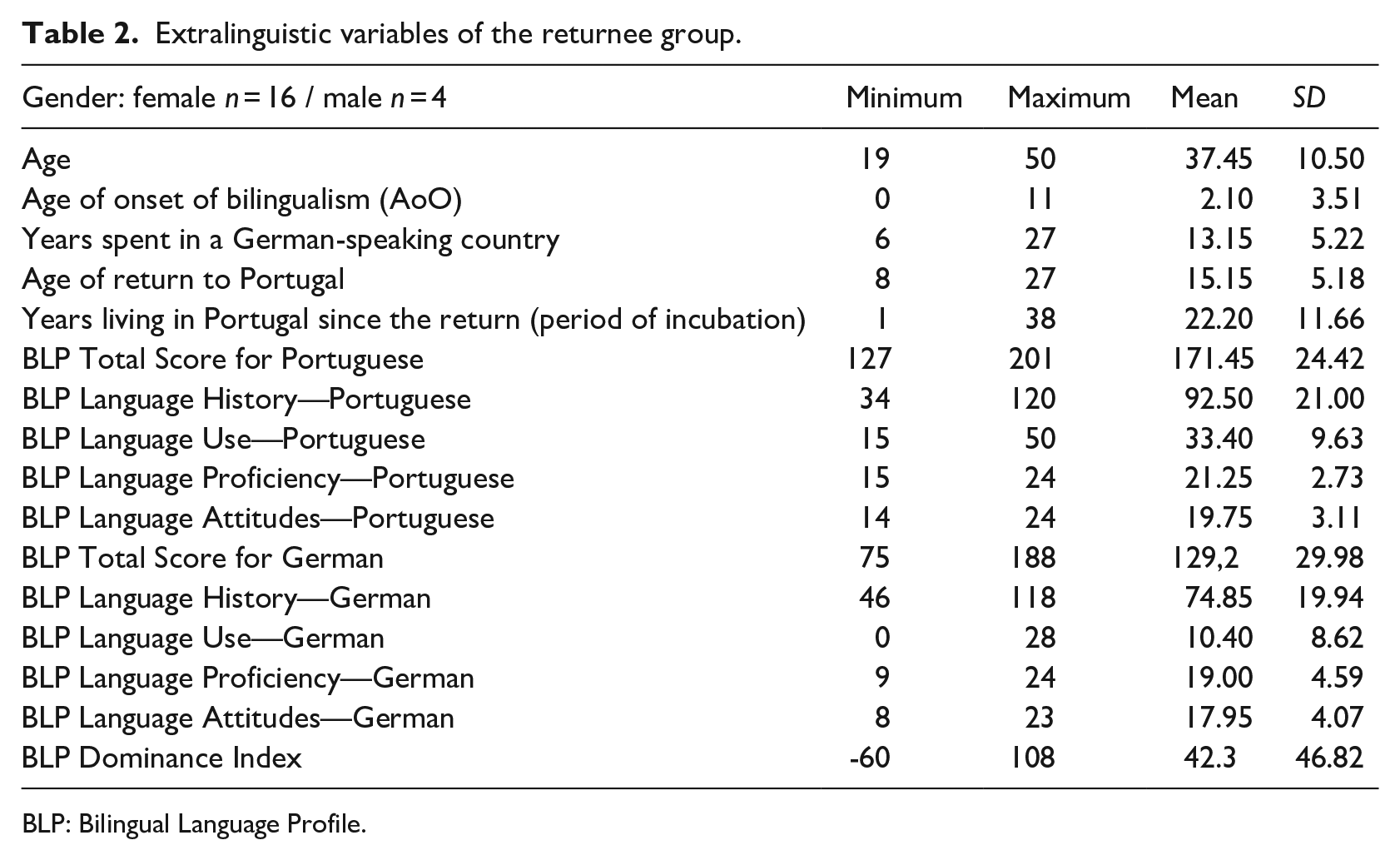
BLP: Bilingual Language Profile.
Results
In this section, we will present the results separately per task. Since the data do not fulfill all the requirements for running mixed models, nor to apply other parametric tests, due to non-normal distribution of the data, non-parametric tests will be used.
Lexical decision task
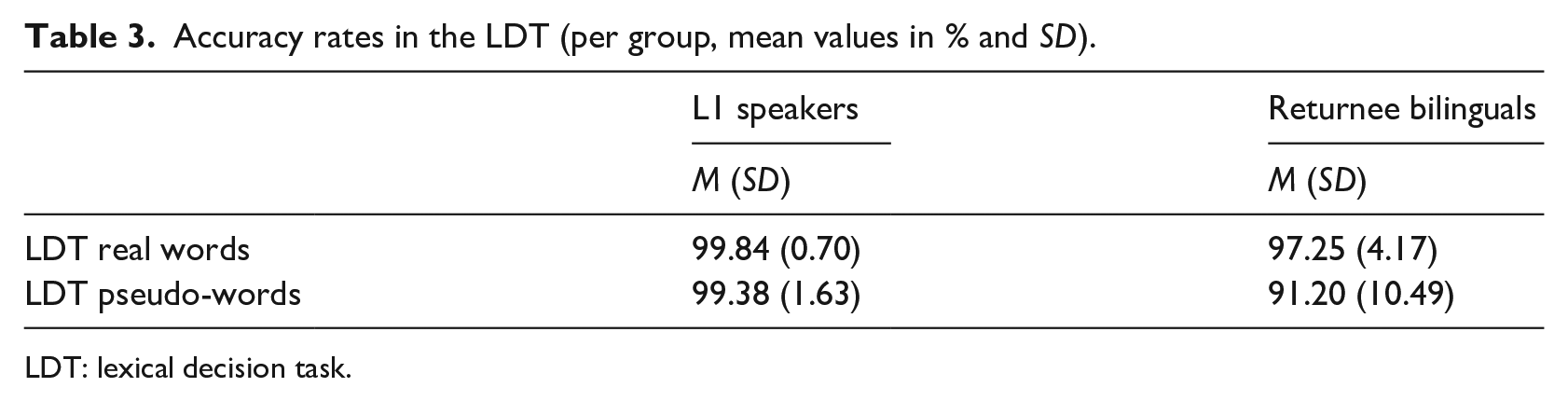
Table 3 presents the results of the LDT, by distinguishing between the rate of accuracy in the list of real words and of pseudo-words.
Accuracy rates in the LDT (per group, mean values in % and SD).
LDT: lexical decision task.
Results show that, globally, the rate of accuracy is very high in both groups. It is almost 100% in the group of L1 speakers, who recognize real and pseudo-words to the same degree in more than 99% of all presented stimuli. In the case of the returnees, the rate of correct recognition of German real words is slightly lower than in the baseline group (97.25%). The returnee bilinguals show more difficulties in recognizing all pseudo-words (91.20%). The SD value indicates much more variation in this group. Non-parametric Mann–Whitney tests reveal that the difference between both groups is significant in both conditions (real words: U = 117.50; p < .001; pseudo-words: U = 96.000; p < .01).
Within the group of returnee bilinguals, a Wilcoxon test shows that there is a significant difference between the correct identification of real words and of pseudo-words (Z = −2.127, p < .05). This reveals that the bilingual speakers show robust knowledge of German vocabulary when they have to identify existing words, but they reveal uncertainty when it comes to identifying words that do not exist.
Since our interest lies in analyzing the effect of extralinguistic variables on the returnees’ performance, in a next step we will concentrate only on the bilingual group and correlate the results of the LDT with the variables extracted from the BLP (presented in Table 2).
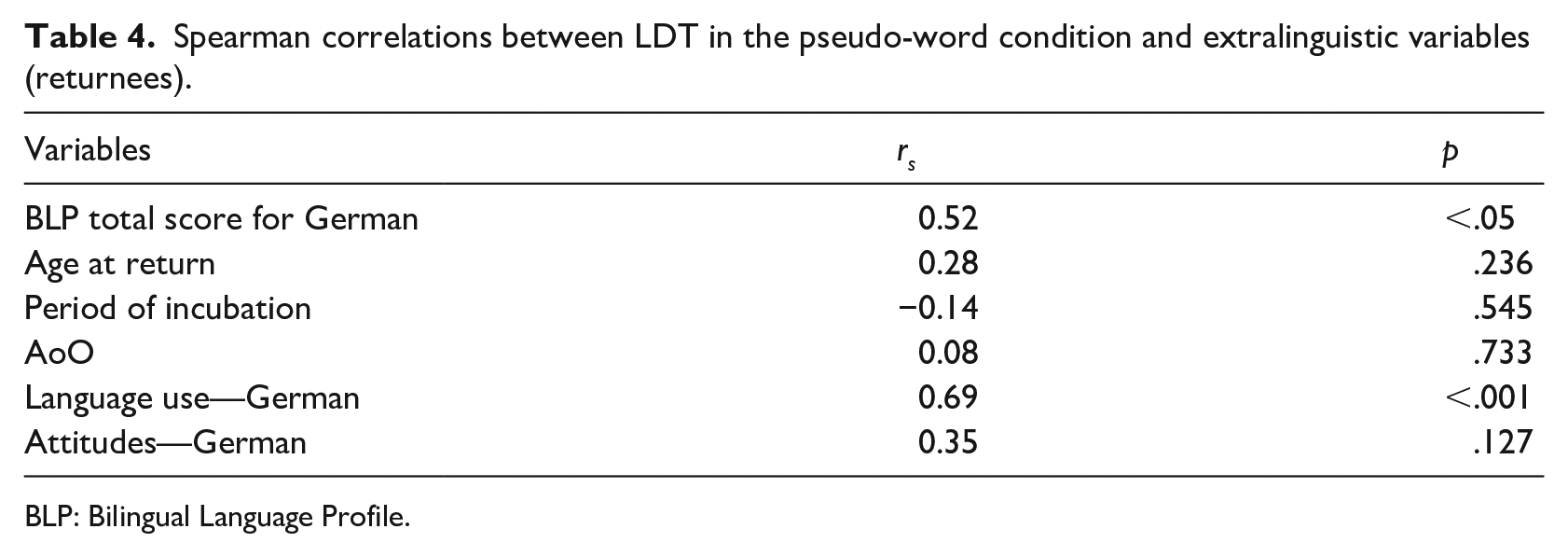
The first variable is the overall exposure index (BLP total score for German, which takes into account all subparts of the questionnaire). As shown in Table 2, the mean score for German is 129.2 (out of 218). A Spearman correlation test indicates that the returnees’ performance in recognizing pseudo-words is highly correlated with their BLP score for German (rs = 0.52, p < .05).
The second correlation targets the returnees’ age of return to Portugal. The bilingual speakers were between 8 and 27 years old when they left the German environment. The Spearman correlation, however, does not reveal an association between the age of return and the bilinguals’ lexical knowledge. Furthermore, no correlation is observed between the LDT pseudo-word results and the length of stay in Portugal, nor with AoO.
Finally, we have a look at the score that quantifies language use, that is, the degree of use of German in the returnees’ daily life, assessed through part 3 of the BLP. This score is also highly variable in this group, ranging from 0 to 28 (out of 50). In fact, the Spearman correlation indicates that the returnees’ performance in the LDT in the pseudo-word condition is significantly correlated with their degree of current use of German (see Table 4).
Spearman correlations between LDT in the pseudo-word condition and extralinguistic variables (returnees).
BLP: Bilingual Language Profile.
As for the factors related with attitudes (part 5 of the BLP), a Spearman test shows no correlation between the LDT results in the pseudo-word condition and the attitudes score for German (see Table 4), nor in the overall LDT results (rs = 0.38, p = .103), revealing no association between the returnees’ lexical knowledge and their attitudes toward their FSL.
In sum, the results indicate that it is mainly the regular use of German that influences the bilinguals’ lexical knowledge and not maturational factors related with the AoO, the age of input loss, or the length of incubation.
Case marking task
We will report, first, on the global results of the CMT and, then, on each case condition. Finally, the results are correlated with the extralinguistic variables extracted from the BLP.
As shown in Table 5, the mean rate of accuracy is near to ceiling in the L1 speakers’ group (99.69%) and lowers to 80% in the bilingual returnees’ group, with a large SD (20.26), indicating considerable variation.
Accuracy rates in the CMT (per group, mean values in % and SD).
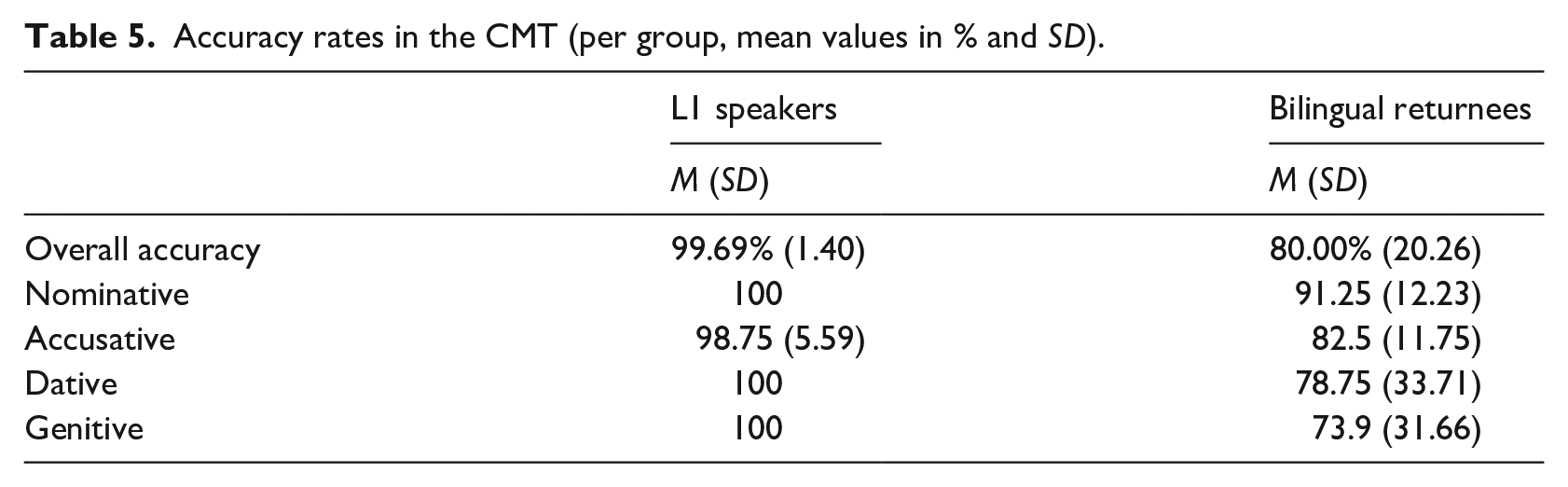
A closer look at the participants’ accuracy rate in the different case conditions shows that the two groups differ in all conditions. The returnees show consistently lower results (Nominative: U = 130.000, p < .05; Accusative: U = 70.000, p < .001; Dative: U = 120.000, p < .05; Genitive: U = 80.000, p < .001).
Furthermore, the results of the returnee group reveal a hierarchy of difficulties in producing accurate case. As expected, the least difficult condition is the context requiring nominative (mean accuracy: 91.25%), followed by the accusative (82.5%) and the dative (78.75%). The less accurate case is the genitive with a mean accuracy of 73.9%.
As for the errors produced by the bilinguals, in the nominative context, there is no consistent error pattern. In the accusative context, the most common deviation is the omission of the {-en} ending on the indefinite article ein (e.g., Der Zauberer findet *ein Apfel, “the magician finds an apple”). This is also the only deviation found in the L1 group and confirms a tendency observed in spoken German (Nübling, 2005). Thus, we may conclude that the returnees amplify a phenomenon that also occurs in the speech of German L1 speakers. As for the dative case, it is substituted by the accusative or nominative case (e.g., *den Hund, “the dog”). Concerning the genitive case, most deviant productions correspond to the incorrect use of the definite article der instead of des (e.g., das ist der Apfel *der Pferd, “this is the apple of the horse”).
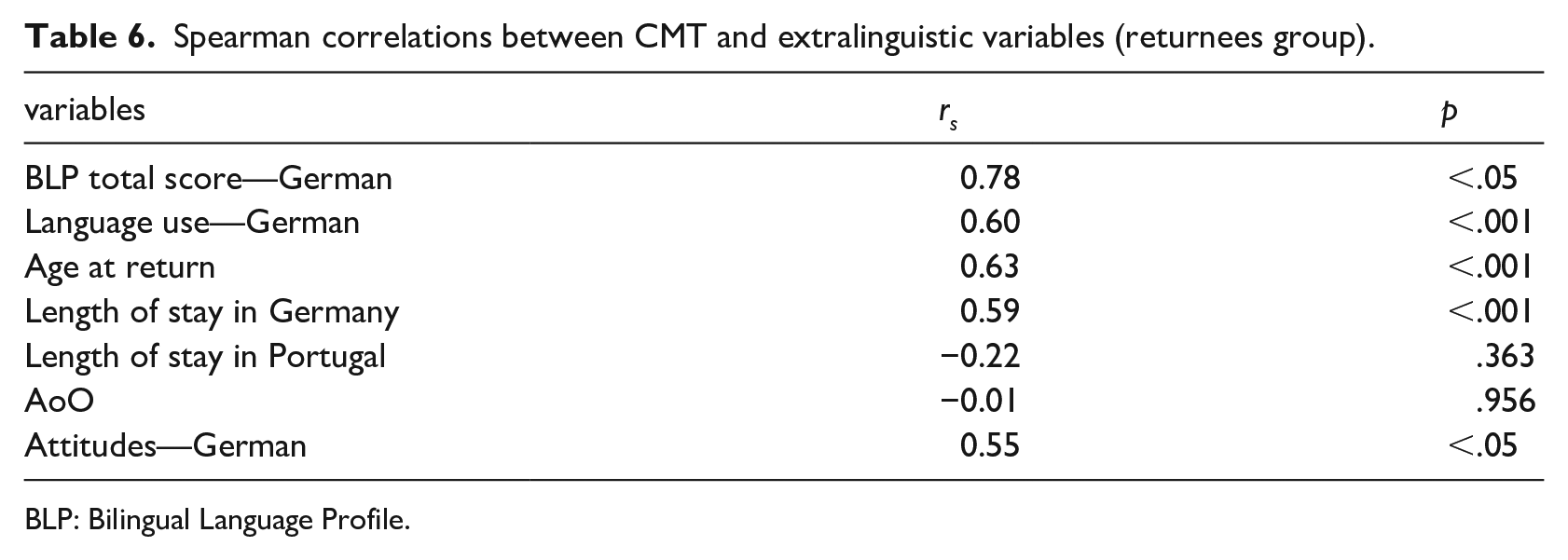
Finally, the target-like use of case was correlated with the extralinguistic variables defined in Table 2 (see Table 6).
Spearman correlations between CMT and extralinguistic variables (returnees group).
BLP: Bilingual Language Profile.
We start with the correlation between the BLP total score for German and the overall score in the CMT, which is very strong and significant (rs = 0.78, p < .05). As expected, the higher the BLP index, the better the bilingual returnees perform in the task. This also applies to the correlation that targets only the score obtained for section III of the BLP (Language use—German). There is a significant positive correlation between the returnees performance in this task and their degree of contact with German at the time of testing (rs = 0.60, p < .001).
In a next step, the impact of age at return, AoO, length of residence in Germany, and length of residence in Portugal (= period of incubation) was analyzed. Contrary to the findings obtained for the returnees’ lexical knowledge, their knowledge of the German case system is not only constrained by current language use, as shown above, but also by factors related with their acquisition process, namely the age at which they left the German environment and the period they lived in the migration context. Spearman correlations show a significant positive effect of age at return and length of stay in Germany (see Table 6), that is, the younger the bilinguals were when they lost regular contact with German and the less time they lived in a German-speaking context in childhood, the more target-deviant forms they produce. The variables AoO and length of stay in Portugal, on the other hand, are not associated with their linguistic competence in the domain of case. Thus, it is not the age at which the bilinguals started to acquire German, nor the period of incubation that impacts their competence in this domain, but it is precisely the period of time they were continuously exposed to German in childhood and the age at which this exposure was interrupted. We will come back to this in the discussion section.
In addition, also the BLP score related with the returnees’ motivation and attitudes toward their German is significantly and positively correlated with their global performance in the CMT (rs = 0.55, p < .05). The higher their identification with the German language and culture, the better their knowledge of the German case system.
Plural production task
The PPT elicits the use of plural morphemes with pseudo-words. The main objective consists of comparing the distribution of different plural markings in both groups, taking into account the various phonetic and syllabic constraints of the non-words (see Table 7). Only the production of morphemes that do not exist in German or types of non-existing double markings were coded as deviant.
Distribution of plural morphemes per group (relative frequency in %).
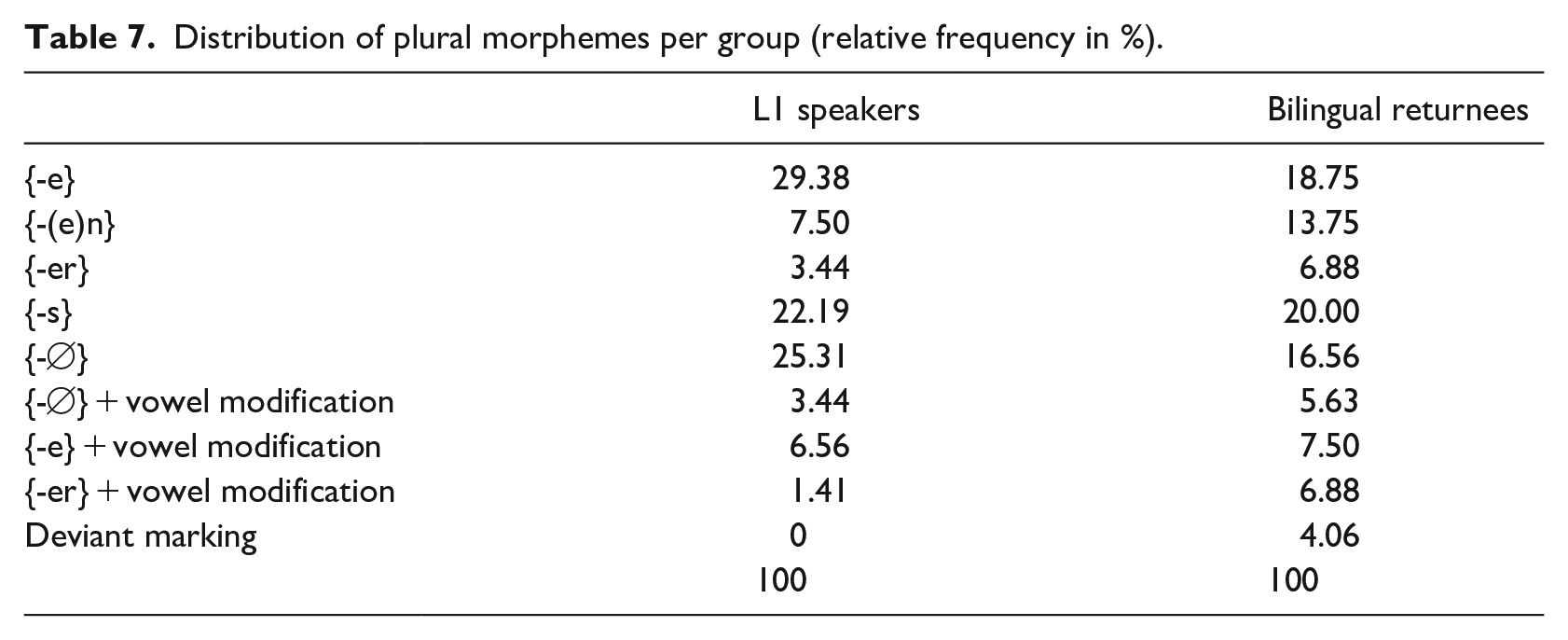
We will start by reporting the deviant forms, since the use of non-existing plural markings reveals deficient knowledge of this property and could be interpreted as effects of language attrition. As shown in Table 7, the L1 speakers do not produce deviant plural forms at all. This reveals that, albeit being a complex system, plural marking in native German is consistently restricted to the identified forms and is not a source of variation or creativity that goes beyond the existing phonotactic rules.
The returnees produce some target-deviant forms, but the frequency of deviant plural marking is low (4.06%). It consists, mainly, of the redundant use of {–(e)n} in combination with other plural markings (e.g., with {-s}, Mecht
Let us now look at the distribution of the eight existing plural forms. What stands out in the L1 group is the dominant use of three plural markers, namely {-e}, {-∅}, and {-s}. These three morphemes make up 76.9% of all used forms. All other forms are used less than 10%, even {-(e)n}, which is considered the most frequent form in early child speech (Bittner, 2000). In the returnee group, we see more variation. The three morphemes {-e}, {-∅}, and {-s} only make up 55.31% of all used forms. The other marking possibilities are more used than in the L1 groups, particularly {-(e)n}, which occurs in 13.75% of all cases.
Thus, there is higher uniformity in marking the plural on pseudo-words in the L1 group compared with the returnees. This is also seen when looking at the pseudo-words with more than 50% of the same morpheme (Figure 1). In the L1 group, nine pseudo-words are marked in more than half of the cases with the same morpheme; in the returnee group, this number decreases to seven pseudo-words. Nonetheless, there is an overlap of six out of these items used by both groups, namely Biwo +{-s}, Linster + {-∅}, Mecht + {-e}, Fisicht + {-e}, Tade + + {-(e)n}, and Tulo +{-s}. This indicates that most of the pseudo-words with more than 50% of the same marking are the same in both groups.
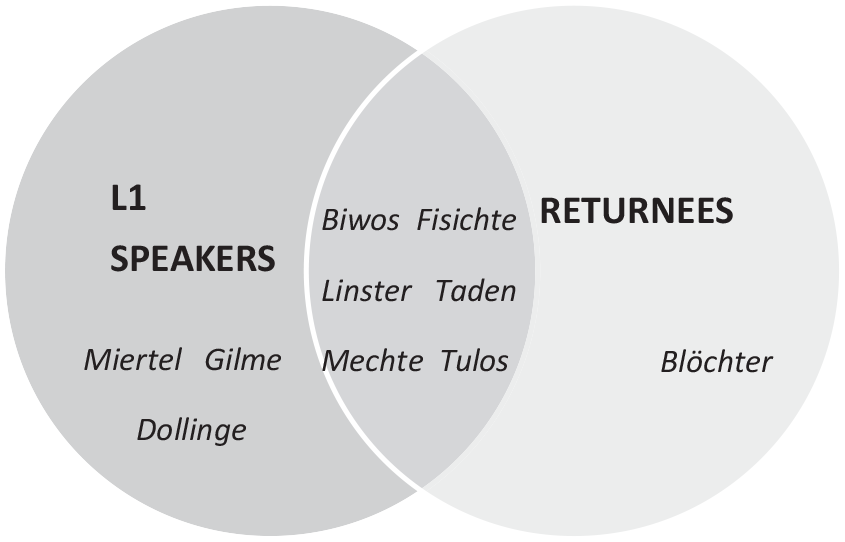
Pseudo-words marked with the same morphemes in more than 50% of the occurrences.
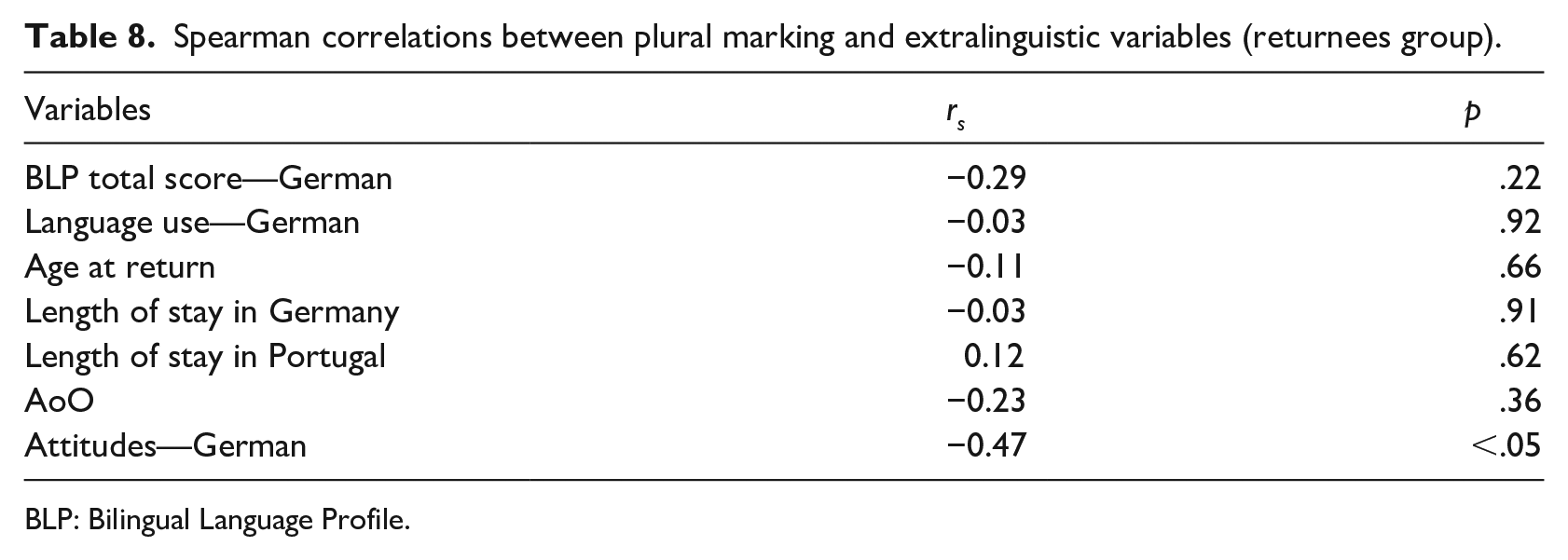
Finally, the impact of extralinguistic variables on the use of ungrammatical plural marking was assessed in the group of returnee bilinguals. We ran several Spearman correlations between the use of ungrammatical morphemes and the variables presented in Table 2. The results show a significant negative correlation between the rate of ungrammatical plural marking and the variable attitudes toward German (rs = −0.47, p < .05), that is, the higher the attitudes score the less ungrammatical marking is produced. The other correlations do not show significance (see Table 8).
Spearman correlations between plural marking and extralinguistic variables (returnees group).
BLP: Bilingual Language Profile.
Discussion and concluding remarks
The results of the present study give us relevant insights into the competence of bilingual speakers who lose intensive contact to one of their childhood languages. They confirm conclusions from earlier studies and contribute to the field with new data and further conclusions.
To discuss the results, we come back to our research questions. The first set of questions focused on the effects of age on Portuguese returnee bilinguals’ knowledge of German nominal morphology. Previous research showed that the age at which bilingual speakers loose regular contact with a childhood language impacts the stabilization of certain properties of morphosyntactic knowledge, as long as it occurs in childhood (Berman & Olshtain, 1983). For German, this was shown on the basis of corpus analyses (Flores, 2010, 2015, 2020). The present study, based on elicited production tasks, confirms that at least the domain of German case marking is vulnerable to age effects. The results of Spearman correlations between the returnees’ performance in the CMT and their age at return as well as their length of residence in the migration context show that these variables are highly correlated. This confirms that the younger the bilingual speakers were when they moved (back) to Portugal and the less time they lived in a German-speaking context during childhood, the more problems they show with case marking when tested as adults. This reinforces the idea of a stabilization period in childhood, that is, bilingual children need enough time to stabilize certain areas of morphosyntactic knowledge, whereby “enough time” means continuous, regular exposure to the target language (in this case German) throughout childhood. Furthermore, results show that it is not AoO that explains the performance differences between the returnees; also, later AoO allows the speaker to fully acquire and stabilize morphosyntactic properties—as long as the length of exposure is sufficient.
For the lexical domain, however, the picture is different. First, the returnees did not show problems in recognizing real words in German. Thus, we cannot conclude that the speakers have lost lexical knowledge, that is, there is no evidence of “vocabulary loss” (as discussed by Meara, 2004). However, they show some problems in recognizing pseudo-words. Indeed several authors have pointed to the differences in judging real words versus pseudo-words in lexical decision tasks (see Stubbe, 2012). Different skills may be involved in speakers’ capacity to correctly recognize real words and to dismiss pseudo-words (Beeckmans et al., 2001). For the returnees, this may show that potential lexical attrition affects “only” the capacity of dismissing pseudo-words; however, the present study design does not allow us to further comprehend this difference. A follow-up study, including, for instance, reaction times could give us further insights in this question.
As acknowledged by several authors, lexical attrition may be evidenced in multiple forms: by difficulties in recognizing words, by word retrieval difficulties and disfluency, or by lexical accuracy (see Jarvis, 2019). Our results show that the variable that explains the success of returnees in recognizing pseudo-words is their degree of contact with German while residing in Portugal. In this case, the age at return does not play a role (nor do the other extralinguistic variables). This means that there is no stabilization period for lexical knowledge: the capacity to recognize non-words depends on the amount of contact with the FSL after return, independently of an early or a late return. In fact, the role of amount and type of language exposure (including use) in lexical attrition has been highlighted since Andersen’s (1982) seminal paper. More recent work, mainly focused on L1 attrition in migration contexts (thus, not on returnees), has shown that, in addition, to the amount of contact, it is the type of contact (e.g., use in professional contexts) that determines attrition effects in the lexical domain (Schmid & Jarvis, 2014).
The second set of research questions looks at variables related to language use and attitudes. As discussed, amount of contact with German after return is correlated with the returnees’ performance in case marking as well as in recognizing pseudo-words. It is relevant to highlight that it is the amount of contact with German, but not the length of stay back in Portugal (i.e., the incubation period) which explains the speakers’ performance. This means that it is not the time with reduced exposure per se that influences the bilinguals’ language competence, but the type of contact during this period.
A novel contribution of this study is the impact of attitudes, measured through the BLP, since this dimension has not been systematically addressed in studies on returnees’ language competence. Even though the correlations are not very strong, results indicate that there may be in fact an association between attitudes and attrition effects. The speakers who value more their relationship with the German language and culture are those who perform better in the CMT and who produce less ungrammatical forms in the PPT. This indicates that the affective and attitudinal dimensions may play in fact a role in language retention/attrition. As discussed by several authors (Schmid, 2002; Yilmaz, 2019), the impact of these variables is more difficult to detect, since they are not as linear as other variables (e.g., age). Several aspects converge into the domain “attitudes,” such as cultural aspects, personal variables, affective dimensions, and motivational issues. Furthermore, these attitudinal variables are closely linked to the variables related to type and amount of contact, even though not necessarily in a linear manner. To better understand the effects of attitudes on language attrition/retention, more complex statistical models are needed, which we were not able to provide in this study, due to the relatively low number of participants and test items. We acknowledge that this is a limitation of the current study and that more research on the following question is due: Do returnee bilinguals who still have some affective bond to the German language and culture and who value their bilingualism indeed show better retention of their detached language, compared with speakers who lost contact with German and lost interest in maintaining this contact?
In a further step, we asked whether the results of returnee bilinguals differ in relevant ways from the performance of L1 speakers of German and, if so, in which domains. The results indicate that the group of returnee bilinguals present, in average, lower rates of accuracy in all tasks, compared with the German L1 speakers, but these rates are still very high. We may, therefore, conclude that the bilinguals show, in general, very stable knowledge of German, despite using it significantly less than Portuguese and living back in Portugal for an average of 22 years. This means that the absence of continued language exposure in case of return of migrants to the homeland leads to attrition effects, as consistently reported in the literature (Flores & Snape, 2021, for an overview); however, the degree of attrition is relatively limited and predicted by developmental paths of German. The rates of accuracy in marking the different cases (Table 5) show a link between the order of acquisition of these cases in L1 German and the difficulty in marking them in the CMT. The most challenging case is the genitive, followed by the dative case. These are the case forms that are reported to stabilize latest in L1 (and also L2) German and to present more variation in spoken German. This speaks in favor of the hypothesis that this (late) knowledge has not been sufficiently stabilized in the bilingual speaker’s mind at the onset on input reduction, remaining, therefore, vulnerable to deviant marking. However, it does not reveal a complete loss or a restructuring of the German case system.
The data from the PPT confirm the conclusion that returnee speakers do not show a systematic restructuring of the German morphology. The results show that they present the same sensitivity to the formal plural marking constraints as German L1 speakers. They use, in general, the same morphemes for different pseudo-words. Nonetheless, returnees show more variation in the choice of plural markers than L1 speakers, which indicates a more permissive grammar and can be interpreted as unstable knowledge in the same manner as for case marking. For instance, bilingual returnees show some residual use of ungrammatical plural marking: Furthermore, they resort more to the use of {-(e)n} than L1 speakers. Since {-(e)n} is more frequent in German child speech (Bittner, 2000), this may, again, speak in favor of some kind of fossilization of knowledge at a point of development when the plural system was still not fully stabilized in some bilingual speakers.
It has to be highlighted, however, that the plural marking strategies, employed by the returnees, are not an outcome of cross-linguistic influence from Portuguese. The default marker in Portuguese is {-s}, which is also a German plural morpheme. These could lead the bilingual speakers to use {-s} much more frequently than German L1 speakers, who do not speak any Portuguese, but this is not the case. Both groups use {-s} in similar ways. It belongs to the set of the three more frequent morphemes ({-e}, {-∅}, and {-s}) in both groups of speakers. Furthermore, it is used mainly in combination with the same pseudo-words by both groups (Biwos and Tulos).
To conclude, this study added further pieces of evidence to the complex picture of language attrition/retention in situations of significant input changes in childhood or adolescence, from the lens of bilingual returnees. In addition to age of input loss and length of exposure to a target language, also amount of input and language attitudes impacts the degree of attrition. However, as we already know, it impacts differently on morphosyntax and lexicon.
We acknowledge that this study has several limitations. Future research on returnees should include more sophisticate statistical methods, in particular to analyze the complex interaction of extralinguistic predictors, such as age, frequency of language use, and language attitudes on language development in bilingual returnees. Furthermore, more diversified tasks, including the measure of reaction times in lexical decision tasks, will add to our understanding of this particular bilingual population.
Footnotes
Declaration of conflicting interests
The author(s) declared no potential conflicts of interest with respect to the research, authorship, and/or publication of this article.
Funding
The author(s) disclosed receipt of the following financial support for the research, authorship, and/or publication of this article: This research was funded by the Fundação para a Ciência e Tecnologia (FCT) through the PhD grant SFRH/BD/114997/2016.
