



Abstract
Aims and Objectives/Purpose/Research Questions:
The study examines contact between the Basque standard variety, Spanish, and Basque dialects in the speech of new speakers of Basque, euskaldun berriak, who have Spanish as their language of primary socialization and who have learned standard Basque in classroom contexts. The overall goal of the study is to determine what linguistic features new speakers draw from in the construction of a colloquial style of Basque.
Design/Methodology/Approach:
The study combines third-wave approaches of sociolinguistic variation with cognitive, usage-based approaches to language contact. The study is based on ethnographic fieldwork conducted in the city of Bilbao between 2016 and 2017.
Data and Analysis:
Forty-seven new speakers of Basque participated in metalinguistic interviews. Many others were observed in the larger context of the ethnographic fieldwork. The data consist of field notes and more than 30 hours of recordings. The analysis combines the metalinguistic commentary of the participants with observation of their linguistic practices.
Findings/Conclusions:
New speakers’ morphosyntactic and stylistic variation in constructing a colloquial style is explained through analogy and similarity, as they draw from interlingual and intralingual analogies and similarities in the process of register construction. The variation can be largely explained by the speakers’ social networks and their involvement in the Basque-speaking cultural sphere.
Originality:
This study examines the role of new speakers in linguistic change. The study presents a novel approach by combining analyses of common cognitive processes with an understanding of shared social language practices that are influenced by language ideologies.
Significance/Implications:
An integrated approach of cognitive processes and the social meaning of language change allow the examination of the interplay of social competence and human faculty. Variationist studies can benefit from studies conducted at the sites of language revitalization with complex indexical fields and rapidly changing social dynamics.
Introduction
‘Language is a social practice, a dialectic between structure and agency: structure constrains action, and action in turn reproduces structure’ (Eckert, 2019b, p. 751). I would add that both action and structure are constrained and aided by individual and collective language ideologies and common cognitive processes. A linguistic repertoire consists of constructions that the speaker has accumulated (and forgotten, unlearned, and re-learned) in interaction with other speakers during their life trajectories (Blommaert & Backus, 2013). However, speakers’ individual varieties are not merely products of these accumulated interactions, but speakers actively create new language forms and registers.
This study is set to find out how new speakers of Basque adapt the standard Basque they have learned at school to informal use, and how they use analogy and similarity as a resource in this process. Bi- and multilinguals, which new speakers are by definition, have the cognitive representation of the constructions related to different languages in their repertoire. They can establish equivalence through identification of interlingual and intralingual links between these constructions. The use of analogy and similarity as a resource can take many forms, which is reflected in morphosyntactic variation in new Basque speakers’ colloquial styles. The focus is on the following research questions:
How do new Basque speakers use interlingual and intralingual analogy/similarity as a resource in the construction of colloquial styles of Basque?
How does the degree and type of participation in Basque-speaking networks affect the use of analogy and similarity as a resource in the process of style construction?
Explanations behind processes of analogy and similarity have a long-established trajectory in interpreting contact-induced language change. For instance, it is often argued that typological distance is a deciding factor in how formulas of equivalence are established (Poplack, 1980, Thomason, 2001). The similarities and dissimilarities that the speakers perceive and exploit in their linguistic interactions, however, have been rarely in the focus of these studies. This seems to be an important gap to fill, as the recent approaches both in contact linguistics – the usage-based approach (Backus, 2014; Hakimov & Backus, 2020; Verschik & Quick, 2021) – and in sociolinguistics (literature related to the third wave of variation study [Eckert, 2012]), both move the emphasis away from the linguistic systems to the role of the speaker as an agent and the locus of experience.
This study connects the particularities of the Basque revitalization situation – a non-authoritative standard variety, a high proportion of new speakers, linguistic activism (Urla, 2012; Urla et al., 2018) – to usage-based contact linguistics and to the third wave of variation study. An approach that combines these two fields and situates them within new speaker research is particularly revealing drawing from previous work on new speakers. We know that in revitalization contexts, or contact situations, complex indexical fields exist, and new speakers may orient towards multiple (often contradictory) norms (Jaffe, 2015). The study brings the social dimension, often implied but rarely investigated, into usage-based studies of language contact. The third wave of sociolinguistic variation studies, on the other hand, has thoroughly examined the social dimension of language change, but in a relatively restricted set of circumstances, as the studies have mostly examined phonetic processes of dialectal variation in monolingual speech. This study expands the scope of the variationist paradigm in several ways, as it moves the focus to the intersection of social and cognitive processes in morphosyntactic variation in the speech of non-native speakers in a multivarietal revitalization context. As Rodríguez-Ordoñez (2021) concludes, the participation in the linguistic practices of ‘Basque speakerhood’ grants new speakers the linguistic authority to transgress standard norms. In this case, the degree of participation is reflected in the increasing use of innovative categorization strategies based on similarity and analogy.
The article proceeds as follows: In the ‘Language change is both cognitive and social’ section, I will explore the intersection of the third wave of variationist sociolinguistics and cognitive approaches to (contact) linguistics, and discuss the core concepts of the paper, such as similarity, analogy, and multilingual awareness. The ‘Data and the research design’ section describes the methods of data collection. The ‘Analogy and similarity as resources in register construction’ section presents three strategies of using similarity and analogy as a resource and connects these strategies to different speaker profiles. The ‘New speakers and stylistic variation’ section discusses the importance of connecting the cognitive, structural, and social factors in explaining the process of style construction, while the ‘Conclusion’ section concludes the findings in this study.
Language change is both cognitive and social
As noted in the ‘Introduction’ section, the methodological-theoretical framework of this article is situated at the crossroads of third wave of sociolinguistic variation studies and usage-based, cognitive, approaches to language contact. Both approaches share the view that languages do not exist per se as systematic, closed entities, but are products of complex social processes. We do not learn ‘languages’ as complete systems with clear boundaries, but as constructions/resources, form-meaning pairings, that are associated with different languages (Rajagopalan, 2001).
Both approaches also examine change through variation, either in terms of frequency of the variables or in terms of their social meaning. In the third wave of sociolinguistics, a special focus is placed on speaker agency: the speakers use certain variables to make ideological moves, and linguistic change spreads because of its social meaning (Eckert, 2008, 2019a). Eckert (2019a) describes style as a process of bricolage, in which people recombine things that are already at hand to create something new, a process based on general pattern-seeking and -making that underlies all linguistic practice. In stylistic practice, speakers combine different indexical signs that evoke something in the surrounding physical, temporal, or social world. Associativeness is central to indexicality, and the meaning of sociolinguistic variation is found in the indexical promotion of commonly held associations.
Cognitive linguists also view language as a social artefact shaped by learning and cultural transmission, even though they emphasize the role of cognitive categorization in shaping our linguistic capacities (Ramscar & Port, 2015, p. 76). The usage-based approaches to language contact examine language change via individual entrenchment and community-wide conventionalization of certain constructions/variables in individual and collective styles (Backus, 2014). Some scholars of language contact have already stated the impossibility of separating the cognitive from the social: Babel and Pfänder (2014) show that speakers build bridges based on perceived similarities between different contact varieties. They conclude that cognitive universals are conditioned by social interaction, and social cognition is part of the cognitive processes whose end product we understand as grammar.
The cognitive processes behind categorization involve the ability to recognize similarity and make analogies. We store experiences in categories largely on the basis of their similarity to a category representation or to stored exemplars: the process of structural mapping and comparison operates over a person’s current representations (Gentner & Markman, 1997) – the general pattern-seeking and -making described also by Eckert (2019a). Bybee (2010) argues that analogical processing is the basis of human ability to create novel utterances. In linguistic terms, speakers draw connections between the constructions/resources in their repertoire/cognitive representation to create new styles and indexical meanings, both between languages and varieties and language-internally.
Gentner and Markman describe the distinction between analogy and similarity as the similarity space with two dimensions: relational similarity (similarity in the relations between the objects, ‘A is to B as X is to Y’) and attribute similarity (similarity in the attributes of the objects, ‘A and B both are red and round’). To draw an analogy, only relational similarity is needed, whereas literal similarity requires both relational similarity and attribute similarity. Common relations are central to analogy; common objects are not. Bybee (2010) names as an example of creative analogy the expression that drives me bananas, which is based on the common construction that drives me. The words used in the empty slot are associated with negative emotions, such as mad and crazy, and by analogy, almost any word used in the slot will acquire that meaning. The potential words in the empty slot of a construction acquire their meaning in the context, and the link between form and meaning is made and remade (Eckert, 2008). The ability to expand on the schematic slots in existing constructions is an important source of linguistic creativity (Bybee, 2010, p. 57). Structural alignment and mapping help people infer new information from the old, adding to the linguistic resources at their disposal, as they can base their innovations on the existing constructions and expand upon that base.
When the degree of attribute similarity increases, the closer we are to literal similarity. Similarity is often given a central role in categorization, as close, literal similarity matches are the easiest sort of mappings (Gentner & Markman, 1997). Close to literal similarity are the linguistic resources that, besides grammatical categories, share phonological and morphological qualities. This is the case of many standard language words with their dialectal/colloquial/sociolectal variants, which are only distinguished from the standard by the use of an allophone, such as numerous cases studied in the history of variationist literature, starting from Labov’s (1966/2006) seminal work (-in vs. -ing) in New York. In these cases, both the grammatical categories and the basic semantics are shared, and the appearance attributes differ only slightly. The differences in pronunciation and social meaning of the linguistic forms, however, separate the forms from being the same. Attribute similarity without relational similarity results in mere-appearance matches, homonymous blocks of linguistic matter that, despite the similar surface, do not share grammatical categories, semantics, or sociolinguistic indexicalities. For instance, the Finnish expression kuusi palaa may mean ‘six pieces’, ‘the spruce is on fire’, or ‘your moon returns’, depending on the context.
The ability to carry out fluent, apparently effortless, structural alignment and mapping is a hallmark of human cognitive processing (Gentner & Markman, 1997). The capacity to recognize similarity between constructions and to establish interlingual analogies is equally a sign of multilingual awareness, metalinguistic awareness in multilinguals. Pavlenko (2016, p. 587) claims that cognitive restructuring might not even be possible without awareness, while Nycz (2018) has found that explicit awareness and will to change a feature do not necessarily translate into control or adoption of the feature. In demystifying the general belief that agency is consciousness, Eckert (2019a) emphasizes that work in cognitive science shows that most of what we do, we do unconsciously. The question remains how multilinguals navigate this agency and consciousness. Speakers are generally aware of the type of personae they wish to convey, yet the individual features of the style emerge more automatically.
Data and the research design
This article examines the different ways in which new speakers of Basque, who have learned Basque not through their primary socialization, but in classroom contexts, create colloquial styles of Basque. The focus is on new speakers in the Bilbao area. As in other new speaker contexts, they tend to be younger and more urban than native speakers of Basque, and they often struggle with issues of legitimacy (Ortega et al., 2015). Their main variety, the Basque standard Euskara Batua, is often perceived as inauthentic and artificial classroom language (Urla et al., 2016).
The research is based on ethnographic fieldwork conducted between 2016 and 2017. In 2016, while I participated in the Basque classes with students at the level of C1 (effective operational proficiency, according to the Common European Framework of Reference for Languages) in euskaltegia (Basque language school), I organized metalinguistic group discussions with 47 participants, focusing on their sociolinguistic trajectories and on their language practices in informal situations. Two to five people were present at each recording. I also conducted ethnographic fieldwork during the Bilbao festival week in 2017 in one of the comparsas, grass-root groups that participate in the organization of the festivities. I took field notes, recorded spontaneous conversations, and conducted semi-structured metalinguistic interviews on the participants’ linguistic trajectories and on their language use. There was some overlap between the participants at the two sites of fieldwork. Altogether, approximately 60 people were observed and/or interviewed in the course of the research.
Participants’ age was between 19 and 58 years. All have learned Basque in classroom contexts, either in the Basque-medium models of schooling (particularly the informants below 35 years of age) or as young adults in adult education. The scenery, the city of Bilbao, is an interesting sociolinguistic laboratory to observe emerging practices and varieties. Out of the Basque speakers, 18.1% of the city population, 64.1% are new speakers of Basque (Basque Government, 2016, p. 12). The rate of language use is rather low, as only 2.5% of the street interactions occur in Basque (Soziolinguistika Klusterra, 2017). The linguistic varieties that are spoken in Bilbao index different values: the Basque standard Euskara Batua is the main variety used by new speakers of Basque, and as noted before, as an amalgamated variety it is considered formal and artificial. Batua has acquired certain anonymity as the language of public administration and schools, but its associations with classroom and new speakers have relegated it with the status of an unauthoritative variety (Rodríguez-Ordoñez, 2021; Urla et al., 2018). Spanish is the unmarked informal code that is spoken by all Bilbao population. The Basque vernacular dialects are generally not learned in formal education. The vernaculars are perceived as the authentic intimate and informal registers of Basque and associated with the native Basque speakers (Urla et al., 2016, 2018).
Ortega et al. (2015) found multiple profiles of Basque new speakers according to their self-identification at different points of a continuum regarding their speaker authenticity. Access to Basque-speaking networks of native Basque speakers and their vernacular varieties was a strong predictor of active language use. Rodríguez-Ordoñez (2021) connects speaker authentication to linguistic practice: Basque-speaking legitimacy is achieved through social practice, and the use of stigmatized variables increases along the authenticity continuum. It seems that when engagement in the Basque-speaking culture, ‘the Basque speakerhood’, increases, so does the licence to transgress the standard norms.
Analogy and similarity as resources in register construction
In the third wave of sociolinguistics, linguistic variation is not examined through macrosociolinguistic categories, but through locally meaningful categories that are identified in ethnographic fieldwork (Eckert, 2012). The variables are combined in speech styles, which are in turn combined with other social-semiotic systems, such as clothing, haircut, political ideology, taste in music, and so on, to construct different personae. Through these personal styles, both linguistic and beyond the level of language, the variation is directly connected to the social world and social order of the local spaces and speech communities (Eckert, 2019a).
All speakers included in this study speak fluent Basque and have grown up in (Greater) Bilbao in a Spanish-speaking environment. However, the frequency of the speakers’ language use and the language of their social networks influence the ways in which the speakers adopt features and create linguistic structure. Another central characteristic that differentiates the speaker profiles is their degree of personal investment with which they seek out Basque-speaking networks and spaces and engage with the linguistic resources at their disposal. Based on these criteria, I have grouped the speakers who use different speech styles into proactive new speakers, insiders, and language activists, as the speakers who use particular forms of similarity/analogy as a resource seem to share some social commonalities. These commonalities can be observed in Table 1.
The characteristics of the different speaker profiles in this study.
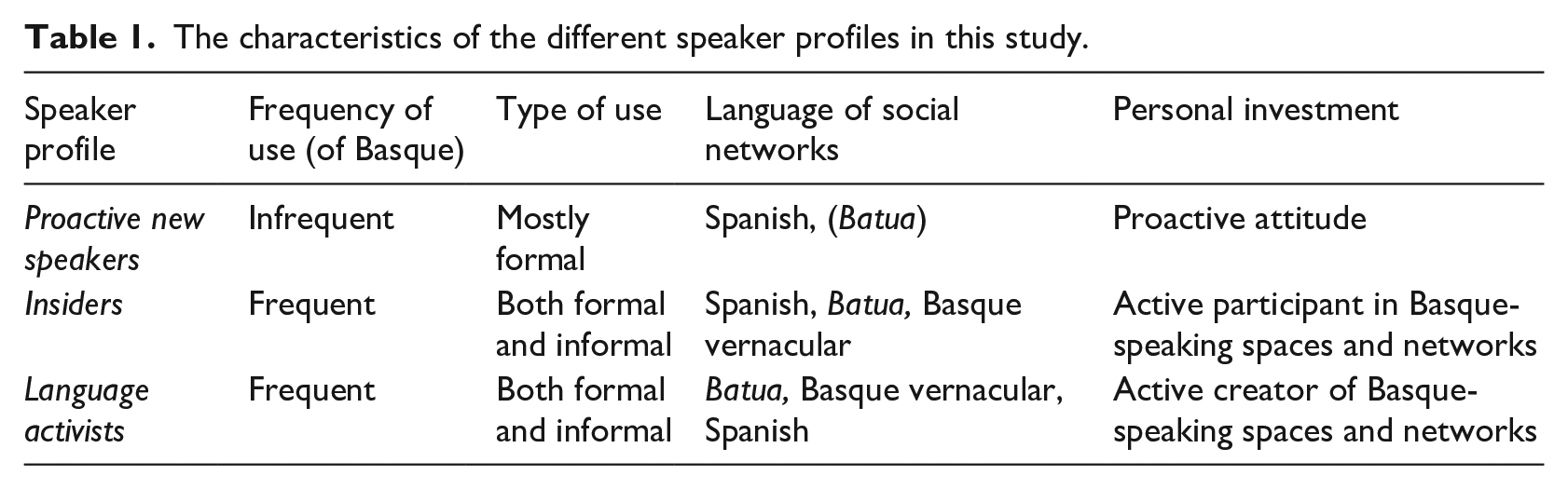
Proactive new speakers wish to increase their use of Basque in their daily interactions in the spaces they frequent, such as the workplace, the local bakery, or a local bar, and with those friends and family who also know (some) Basque. Even though they take the opportunity to use the language when the circumstances allow, they do not actively look for additional spaces and activities to use the language, and they live and move in mainly Spanish-speaking circles. Insiders use Basque frequently in their daily life. They have Basque-speaking colleagues and friends, and they are active in the Basque-speaking networks via social movements (comparsas, other associations, youth movements, etc.) that have a strong pro-Basque component in their worldview. Language activists use Basque frequently in their daily life. In addition to merely participating in Basque-speaking networks, they create and organize opportunities for other speakers to find Basque-speaking spaces, and they are active creators and promoters of the language.
Based on the data, I have also identified three different ways of using similarity and analogy as a resource in the creation of colloquial styles. Their brief explanations can be seen below:
The speakers seem to adopt these different ways of using analogy and similarity as a resource in a hierarchical order, based on their access to and personal investment in the Basque-speaking networks. First, when the speakers have a relatively high fluency of Basque and a wish to use it in their informal interactions (proactive new speakers), Strategy A is adopted. If they also have access to the Basque-speaking networks (insiders) and vernacular Basque varieties, Strategy B might be added to Strategy A. Those individuals who show a particular degree of engagement with the minority language and a high multilingual awareness (language activists) might also add Strategy C to their repertoire: instead of merely exploiting the existing constructions in their repertoire, and adopting resources from other speakers, they expand on the existing constructions and make innovative analogies for their own social group.
The categorizations in groups and strategies should only be seen as wide generalizations and descriptive tools to sort out tendencies in the data. There are speakers who do not fit any of these profiles, such as those new speakers who do not adapt their speech at all, those who use code-switching only as a relief strategy when they do not know an expression in Basque, or the language activists who have a high degree of linguistic engagement, but who wish to maintain the ‘purity’ of the language and thus avoid all types of interference in their speech. However, as the focus of this paper is on variation in the ways of using similarity/analogy as a resource, I have decided to exclude from analysis those speakers who make little use of them in their informal styles.
Proactive new speakers: identifying dissimilarity (between Basque and Spanish)
Most of the informants that I worked with during the fieldwork belong to this group of speakers. Speaking Basque and attending the spaces where the fieldwork was conducted already require an active effort to use Basque, hence the word ‘proactive’. Speakers like Asier (born in 1993) want to participate in the Basque-language culture on a general level: they try to increase their use of Basque and incorporate the language in their life by spraying it into their everyday interactions whenever that is possible. Asier tries to use Basque at the local bakery and sometimes at his workplace. Asier has recently started to use some Basque with his sister-in-law, who is currently attending Basque classes. However, his networks consist mainly of Spanish speakers.
The multilingual awareness and the use of analogy and similarity as a resource clearly come together in the speakers’ ability to recognize when they cannot use the Basque resources to establish equivalence, as the dissimilarity between the languages and the constructions associated with them makes it impossible to do so. The Batua that they have learned in classroom does not provide them with all the resources that they feel that they need in informal conversations. They identify the gap and use Spanish resources instead.
As an example of this strategy, I will show the metalinguistic commentary of Asier and two of his classmates in euskaltegi, Fernando (b.1978) and Mónica (b.1983), where they reflect on their language use. In (1), Asier describes his use of Spanish colloquial discourse markers, such as en plan, ‘like’. The Spanish resources and their translations are bolded in all following examples.
1. A:
F:
A:
F: Eta nire euskera kaskarra daukat, ez dut hainbeste normalizatuta, edo . . .
A: Solturagatik da, nire ustez. Baina
M: Askotan entzuten baduzu, azkenean ya hartzen duzu eta zurea egiten duzu. Eta gero erabiltzen duzu. Eta beharbada ez dauka zentzurik, baina beti entzuten baduzu, gero erabiltzen duzu. ‘A: F: A: F: And my Basque is clumsy, I don’t have it that normalized, or . . . A: It’s because of fluency, I think. But M: If you hear it a lot, finally you take it and make it yours. And then you use it. And maybe it doesn’t make any sense, but if you always hear that, then you use it.
Mónica’s last statement neatly describes the process of change through entrenchment, a key tenet of the usage-based approaches to language contact. She describes how speakers adopt linguistic constructions from their surroundings due to their frequency, and then ‘make them theirs’, their subsequent entrenchment in the individual style. Asier believes that the Spanish discourse markers in his speech are entrenched, part of his Basque, which Fernando attributes to high fluency.
In the same conversation, Asier, Fernando, and Mónica all agree that they use swear words and insults in Spanish, as the Basque insults do not have force. Even when the words are morphologically integrated into Basque, they still are borrowed from Spanish.
2. F: Baina adibidez A: A bai, egia da. F: txotxoloak. A: Bai. M: Horregatik ez daukate indarrik. F: gazteleraz konparatuta M: Eta A: Bai, eta gainera M: Bai. A: Horregatik, baina erabiltzen ditugunak dira gazteleratik ekarritakoak. M: A:Bai, niretzat ere, nik intsultatzeko beti erdara, esaten dut zelako F: Bai. A: Nire ustez bai, intsultoak, M: ‘F: But for example A: Yes. That’s true. F: -lame. M: That’s why they don’t have force. F: Compared to Spanish. M: And A: Yes, and in addition M: Yes. From A: That’s it, but those that we use they come from Spanish. M: A: Yes, I think so too, to insult I always use Spanish, I say what a M:
I have labelled the strategy used by Asier and his classmates as identifying dissimilarity. The speakers have cognitive representation of both Spanish and Basque constructions, and the metapragmatic awareness of how they wish to express themselves, yet they find that establishing equivalence is impossible at times. In their metalinguistic conversations, they identify the dissimilarities: What is my Basque lacking? When they have identified what they need in the interaction, and do not find the Basque equivalents in their repertoire, they create a unified system in which all semantic-pragmatic areas are covered, borrowing those resources from their L1. They use Spanish discourse markers, as colloquial Basque discourse markers are not learned in Basque education; they use Spanish swear words, tags, and colloquial expressions, as the equivalent Basque resources are not easily available. Code-switching to Spanish is an important element in colloquial styles of Basque (Lantto, 2016). Spanish resources add an expressive colloquial element to the standard variety and help the speakers to convey a relaxed, more informal Basque-speaking persona.
Insiders: borrowing based on similarity (between different varieties of Basque)
The speakers who belong to this group, approximately ten out of the approximately sixty new Basque speakers observed for the study, participate in youth movements, social movements, and comparsas. The worldview behind these activities can be characterized by an ideological cluster in favour of causes such as feminism, anti-militarism and anti-racism, Basque left-wing nationalism, helping the refugees, and promoting the minority language. In an otherwise mainly Spanish-speaking city, the movements create a distinctly Basque-friendly atmosphere for the new speakers to expand their repertoires and practices. Many of the friends and colleagues in the movements are L1 Basque speakers, euskaldun zaharrak, who speak their own vernacular varieties. Basque speakers value local vernaculars as markers of intimacy, authenticity, and membership in the local speech community (Urla et al., 2018). Access to Basque-speaking networks of native speakers has been proven to be crucial for language use (Ortega et al., 2015), and through these networks, new speakers also have access to their vernacular varieties.
Itxaso (b.1997) and María (b.1988) both belong to this speaker category. At the moment of the interview, Itxaso was a university student, whereas María was working in the university administration. They have thought about their own relationship to language, and their language practices are often conscious choices. Like the speakers in the first category, they borrow Spanish resources, but they also use constructions that are borrowed from the Basque vernacular dialects. The use of dialectal features is highly variable, and the constructions that are borrowed are often salient vernacular features that function as markers for regional differences.
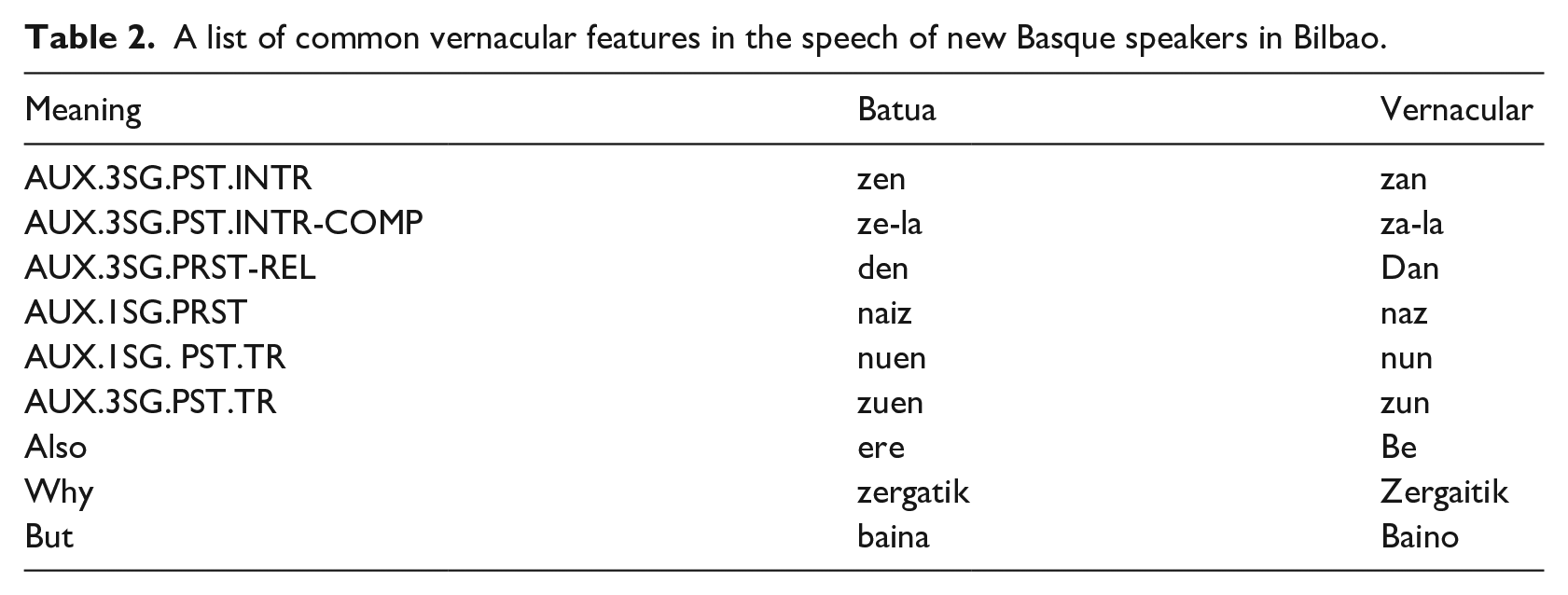
The Basque verbal conjugation relies heavily on auxiliary verbs. The auxiliary verb paradigm varies from one dialectal area to another. The speakers described in this section do not adopt a complete paradigm of the auxiliary verb from vernacular forms, but they incorporate in their speech easily accessible features that have highly similar equivalents in Batua. The adoption of these features is, thus, based on similarity in both content and form.
The verb forms include vernacular variants of the first- and third-personal singular of the auxiliary verb izan, which, in its intransitive form, also functions as a copula verb. These verb forms, first- and third-person singulars in indicative mode, are simple to acquire because of their high frequency in speech. Other vernacular constructions that new speakers frequently employ are particles, such as the use of Biscayan be instead of the standard ere, Biscayan zergaitik ‘why’ instead of the standard zergatik, and the vernacular baino ‘but’ instead of the standard baina. These forms can be observed in Table 2.
A list of common vernacular features in the speech of new Basque speakers in Bilbao.
The examples below demonstrate how Itxaso and María, in addition to Spanish swear words and discourse markers, introduce vernacular verb forms and particles into their speech. In (3), Itxaso describes her school years and the change of group language from Basque to Spanish at a certain age. The vernacular features in the examples are underlined.
3. ‘
The Biscayan dialectal features in (3) are mostly limited to common particles and auxiliary verbs mentioned in Table 1. As these features or constructions do not considerably differ in content or form from their standard variants, they are easy to adopt and use, and the speaker can trust that everyone will understand the deviations from Batua. María’s strategy is slightly different: she adopts features from different dialectal varieties. In (4), she is describing a work project: María: 4. Prestatu ‘I prepared
In (4), besides vernacular features, I have underlined the words hobeki, ‘better’ and ondo, ‘well’. They are considered standard Basque, but they are features of different regional varieties of the standard. The diversity of the vernacular and regional features shows how María’s individual style is a mosaic of accumulated linguistic experiences. In (5) and (6), Itxaso and María describe the process of adopting features from their surroundings: Itxaso: 5. Euskalki baten hitz bat gustatzen zaidanean hartzen dut eta listo! Ba dakizu hemen esaten dugu ‘If I like a word of a vernacular I take it and that’s it! Well you know here we say María: 6. M: Nik izan ditut, Iparraldeko euskarazko irakasleak, Naparrotarrak, eh, Gipuzkoarrak, eh, Arabatarrak, denak. Orduan nire ‘M: I’ve had teachers from the French Basque Country, from Navarre, er, from Gipuzkoa, er from Araba, everything. So my way of
María and Itxaso seem to be conscious of their use of dialectal features. While Itxaso claims that she adopts the features based on a conscious decision, María sees the process as a more automatic accommodation to her surroundings: she describes herself as a ‘sponge’ that absorbs the dialectal features from her interlocutors. Nevertheless, what they have in common is their way of exploiting similarity – both attribute similarity and relational similarity, forms that have a high degree of literal similarity on the similarity scale/space – to vernacularize their speech. These vernacular features, then, function as indexes of informality and authenticity in these speakers’ colloquial styles.
Language activists: creation and innovation based on analogy
The speakers in the third group are language activists who spend a considerable amount of their free time organizing activities of language promotion. Their language use and language play is not accidental, their language promotion is not casual, but intentional and carefully considered. They use their high linguistic awareness to create expressions that are unique to their social group.
Gari and Beñat (both born in 1989) are friends. They belong to a group of friends of similar age connected by their strong commitment to the Basque language. They all have studies in the field of language and communication, and most of them also work at places with a connection to the Basque language, such as language teachers and researchers, or at a book editor. As language activists, they are very conscious of the problem with Batua and its stigma as an artificial variety. Living in Bilbao, where they have no local vernacular to learn and use in conversations among themselves, they have decided to take the task of language planning into their own hands. In (7), Gari and Beñat state explicitly their awareness of what Batua is lacking – informality –, so they need to create their own innovative variety, a very special register.
7. Beñat: Falta zaigu euskara informal bat! ‘We are lacking an informal Basque. Gari: Guk erabiltzen dugu oso erregistro berezia. ‘We have a very special register’.
When I asked them to describe their group register, they told me that they use code-switching, but not excessively. They also adopt resources from vernacular Basque dialects and extend their contexts of use. However, these ways of using analogy/similarity in register construction have been discussed in previous sections. The language activists in this group go a step beyond these first two strategies: they innovate, recycle innovations, and use them in their own group register.
Gari describes how they use Basque synthetic verbs in an unconventional way.
8. Gari: Guk aditz guztiak trinko bihurtzen ditugu. Adibidez Daflipat! Namola! Horrek namola! Edo imajinatu aspertzen naiz. Nasper. Eta hasten gara jolasten pila bat. Datsegit. Entzuten gaituztenek flipatzen dute. ‘G: We use a very special register. We turn all the verbs synthetic. For example, Daflipat! Namola! Horrek namola! Or imagine aspertzen naiz. Nasper. And we start playing a lot. Datsegit. (laughs) Those who listen to us go crazy’.
The Basque verbs are used in periphrastic form for the most part. The main verb shows the aspect (perfective in [9]), whereas the auxiliary verb carries the arguments. In (9), the absolutive object is in third-person plural, the dative recipient in first-person plural, and the ergative subject in the second-person singular.
9. Ekarri di-zki-gu-zu bring-PF AUX-ABS.3PL-DAT.1PL.-ERG.2SG ‘You have brought them to us’
Even though most Basque verbs are conjugated in their periphrastic forms in everyday speech, some common verbs are used in a synthetic form in the present/past imperfective tense, such as joan, ‘to go’, etorri, ‘to come’, eduki, ‘to have’, ekarri, ‘to bring’, eraman, ‘to take’. Syntheticism is generally non-productive: the synthetic verbs are often called ‘the 12 verbs’ and presented as a list. When used with other verbs, syntheticism has either archaic or formal connotations, or it might just sound ‘weird’. Many listeners might not understand it, or as Gari puts it, they would ‘go crazy’.
In the synthetic verb forms, the verb root appears in the middle, as in (10), whereas the morphemes encoding argumental relations appear in the open slots on both sides of the root stem: the absolutive object on the left side and the dative and the ergative on the right side of the root stem. The synthetic verb forms are as transparent as the periphrastic forms, and follow the same template of ABS-ROOT-DAT-ERG.
10. E ‘to bring’ da- ABS.3.PRS-bring-ABS.3PL-DAT.1PL-ERG.2SG ‘you bring those to us’ E na- ABS.1SG-take-ERG.2SG ‘you take me’
In the description offered by Gari, we can identify different strategies of forming new synthetic verb forms based on interlingual and intralingual analogies. The first strategy (11) is to move completely within Basque and turn usually periphrastic Basque verbs synthetic.
11. Aspertzen naiz. (absolutive) > Nasper. n-asper ABS.1SG-bore ‘I’m bored’ Astegin dut. (absolutive-ergative) > Datsegit. d-atsegi-t ABS.3SG-like-ERG.1SG ‘I like it’.
Another strategy is to use Spanish verbs as the root stem (12). The examples that Gari mentions have colloquial Spanish verbs (flipar, ‘think something is crazy’, molar ‘be cool’) as the root, which adds a particularly humorous element to the innovative combination.
12. (Me) mola. > Namola. na-mola ABS.1SG-be.cool ‘That’s cool (to me)’. Flipo. > Daflipat. da-flipa-t ABS.3SG-be.crazy-ERG.1SG ‘I think that’s crazy’.
Even though the conscious creation of a colloquial register is somewhat unique for this group of friends, similar new ‘colloquial synthetic verbs’ are now used as meme material on the internet, especially on Twitter. They may also contain direct loan translations from Spanish, such as the verb dizerdit (d-izerdi-t [ABS.3SG.PRS-sweat-DAT.1SG]), which is a loan translation of the Spanish expression me la suda, ‘I couldn’t care less’, lit. my (dick) is sweating. The Basque word for sweat, izer, equivalent of the Spanish sudar, functions as the root stem. To create these innovations, the speakers and listeners have to recognize the analogous relations between the Basque verbs and the Spanish verbs, the Basque morphosyntax of both periphrastic and synthetic verbs, and the equivalencies in the Basque and Spanish morphosyntax. Several morphosyntactic contact processes operate at the same time: pattern borrowing, morphosyntactic adaptation, and productive synthetism.
These new constructions are what I would call innovative analogy proper, as described by Bybee (2010): the speakers fill empty slots in innovative ways extending the existing domain mapping. They do not draw only on Basque or Spanish resources in order to engage in language play, but they use their multilingual awareness and the linguistic resources in their repertoire as a whole to create a comical effect, group coherence, and a register for their own interactional purposes.
New speakers and stylistic variation
New speakers, defined by O’Rourke et al. (2015) as ‘individuals with little or no home or community exposure to a minority language who instead acquire it through immersion or bilingual education programs, revitalization projects or as adult language learners’, have been the focus of a strong research field in the last 10 years. There are still gaps to fill (Kasstan, 2017), and study addresses some of them: combining cognitive processes with variation in new speaker styles creates a new understanding of how all levels of language are merged at the moment of interaction.
Categorization is a part of the meaning-making process, as speakers pick features from a pool according to their indexical value. The cognitive processes guide our attention towards certain constructions and forms: it is easier to expand existing connections than to create something entirely new (Bybee, 2010). The new Basque speakers select features from their resource pool according to their indexical value as ‘colloquial, non-Batua’, and expand on the existing linguistic resources in their L2, recognizing (dis)similarities and drawing analogies between the linguistic resources in their repertoire. Yet, due to the differences in the frequency and type of their language use, the make-up of their social networks, their degree of personal investment in the Basque-speaking community, and their repertoires differ, which leads to variation in their linguistic practice. In the previous section, I have identified and described three different strategies that non-native Basque bilinguals use to exploit similarity and analogy to create their styles of colloquial Basque. New speakers accrue the strategies as their participation and personal investment in the Basque-language cultural sphere increase, and new strategies are added to the existing ones. Figure 1 illustrates the relationships between these factors.
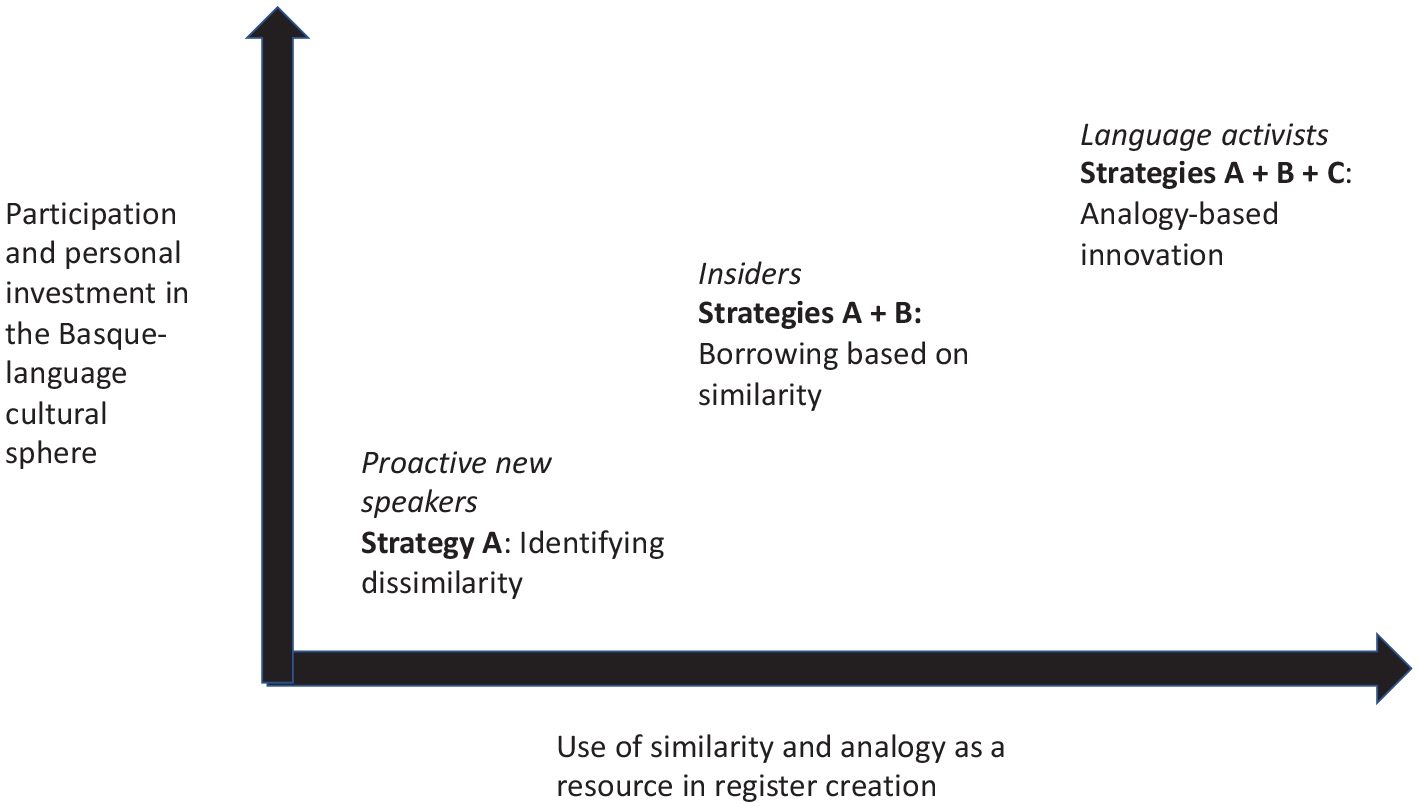
The correlation between the degree of participation and the strategies of using similarity and analogy as a resource.
Rodríguez-Ordoñez (2021) describes how new speakers can achieve legitimacy based on their engagement in linguistic practices that constitute ‘Basque speakerhood’. This legitimacy, then, gives them the permission to transgress standard norms. I can see a similar principle functioning here: the degree of participation in the linguistic practices of Basque speakerhood grants new speakers the linguistic authority to engage in different processes of style construction. All new speakers of this study are active agents in the construction of their colloquial styles, but their degree of participation in the Basque-speaking cultural sphere regulates both the linguistic resources in their repertoire, and their degree of ownership of different linguistic resources and language play.
Proactive new speakers wish to increase their use of Basque, and they allow themselves to transgress the standard norms by using the resources of their L1, Spanish, in order to ‘vernacularize’ their speech when Basque forms are not available. They are active creators of their own personal styles, yet they use linguistic resources that are ‘theirs’ to begin with. Code-switching is an important element of colloquial speech in the Basque Country, and by using Spanish resources, the speakers can convey a relaxed, informal persona.
One step further, insiders use the language frequently, and have access to the social networks of native Basque speakers and their vernacular varieties. They adopt linguistic constructions from these varieties based on their similarity with their standard variants. Basque speakers value their local vernaculars above all linguistic varieties as markers of solidarity and authenticity, and by adding these little elements to their styles the speakers can demonstrate adherence to these values.
The third speaker group, language activists, is highly invested in minority language promotion. In addition to using code-switching to Spanish and vernacular features, they create new colloquial innovations drawing both intralingual and interlingual analogies in style construction. When surrounded by similarly minded individuals who like to play with linguistic resources, they turn non-productive synthetic verbs into productive morphosyntax, showing a high degree of multilingual awareness in the process. By creating their own innovations and their own colloquial register, they claim full ownership of the language.
O’Rourke et al.’s (2015) definition of a new speaker is a useful descriptive tool, yet it does not capture the complexity of new speaker profiles and linguistic practices. In line with Ortega et al. (2015) and Rodríguez-Ordoñez (2021), this study shows that there are (a) several ‘kinds’ of new speakers, (b) there is also a considerable amount of morphosyntactic variation in the linguistic practices of these speakers, and (c) the variation is connected to the make-up of their Basque-speaking networks and to their degree of engagement in the Basque-speaking culture. Their stylistic practice, thus, goes beyond the linguistic, and includes other aspects of their social life, such as participation in social movements and activist circles. In this, new speakers and multilinguals are no different from monolingual native speakers described in most variationist studies, yet the more complicated indexical fields of the multilingual revitalization contexts provide a prolific scene for further studies in sociolinguistic variation and change.
Conclusion
This study has examined how new Basque speakers create informal registers drawing on the linguistic resources in their repertoire. There is significant variation in the types of the resources that new speakers use, and this variation in based on different ways of exploiting analogy and similarity. Different types of categorization processes are adopted in a hierarchical order depending on the degree of participation and personal investment in the Basque-speaking cultural sphere. The study shows that language is an interplay between social factors and cognitive faculty, and the new speakers are creative agents that have an important role in language variation and change.
The study is an important contribution to the research of language contact and variation on several fronts. First, within the third wave of sociolinguistics, the speaker agency in exploiting morphosyntactic variation in multilingual style construction has not been examined thoroughly, as the studies have mostly focused on phonetic variables in monolingual speech. Second, within the research field of usage-based approaches to language contact, the study brings a strong social element to the examination of the cognitive processes. Third, even though new speaker research has emerged as a strong research field during the last decade, cognitive approaches to the field have been lacking (Kasstan, 2017). The study addresses this gap and shows that there are multiple ‘kinds’ or ‘profiles’ of new speakers that are not only based on home language, but what they actually do with the language: how they exploit different categorization processes and how they socially engage with the language. Future studies, both in new speaker research and in contact linguistics, should focus on the interplay of the social and cognitive elements in language contact, and address the agency of non-native speakers in linguistic variation and change. All speakers construct styles in response to the social-semiotic landscapes of their speech communities, and adopt and create linguistic structure guided by the common cognitive processes shared by all humankind. Instead of negative interference of transference, the mobilization of cross-linguistic and dialectal resources should be seen as proof of the cognitive capacities of new Basque speakers as they navigate the linguistic space of their speech communities.
Footnotes
Declaration of conflicting interests
The author(s) declared no potential conflicts of interest with respect to the research, authorship, and/or publication of this article.
Funding
The authors disclosed receipt of the following financial support for the research, authorship, and/or publication of this article: The article received financial support from the project ‘El neohablante como sujeto social-NEOS’ (supported by the Agencia Española de Investigación, under Grant FFI2016-76869-P.
