




Abstract
Aims and objectives:
The present study examined whether phonological awareness reflects a stable construct or whether it varies by the different languages of bilingual speakers. In particular, the study tests to what extent language proficiency determines phonological awareness above and beyond language structural characteristics.
Methodology:
Bilingual adult speakers were tested as they afford within-participant comparisons to address this issue. Specifically, 29 Hebrew (L1)-English (L2) bilinguals were compared to 33 English (L1)-Hebrew (L2) bilinguals on a timed auditory rhyme judgment task including 270 word-pairs (90 English pairs, 90 Hebrew pairs, and 90 pseudo-Hebrew pairs).
Data and analysis:
Reaction times and dʹ on the rhyme judgment task were compared between the two bilingual groups to examine the role of language proficiency in predicting phonological awareness performance. Furthermore, rhyme judgments on Hebrew pairs were correlated with those on English pairs to provide within-participant index of phonological awareness stability.
Findings:
Rhyme judgment performance on the same set of words was affected by the strength of linguistic representations, as determined by language proficiency profile. English-Hebrew bilinguals performed better on English pairs, whereas Hebrew-English bilinguals performed better on Hebrew pairs. Moreover, within-group comparisons revealed that performance in the more proficient language was not correlated with performance in the less proficient language.
Originality:
By testing two groups of bilinguals who differ in their language dominance profile using the same set of materials (including both L1 and L2 pairs), the results reveal differences in phonological awareness abilities as a function of language proficiency that cannot be reduced to structural differences between the examined languages.
Significance:
The findings underscore the dynamic nature of phonological awareness abilities and carry implications for clinical diagnosis of bilingual populations, in that rhyme judgment performance in one language should not be taken to index expected abilities in the other language of bilingual speakers.
Keywords
An important aspect of cognitive ability is the individuals’ awareness of the sound components that combine to create words. This phonological awareness allows decoding of the word’s sound components, supporting comprehension as well as production and fluent retrieval (James & Burke, 2000; Moriarty & Gillon, 2006; Saiegh-Haddad, 2019). Moreover, phonological awareness has been shown to be important for reading and writing acquisition (Fowler, 1991; Saiegh-Haddad & Geva, 2008; Vellutino & Scanlon, 1987; Walley et al., 2003). Specifically, different components of phonological awareness abilities at preschool are linked to reading proficiency later on (for review, see Brady & Shankweiler, 1991), and reading difficulties have been suggested to stem from low ability to manipulate the phonological structure of the language at the spoken level (De Jong & Van der Leij, 2003; Russak & Saiegh-Haddad, 2011; Saiegh-Haddad, 2019). However, despite its prominent role in language research, it is still unclear to what extent phonological awareness is a constant ability, such that a single valid measure is sufficient to predict future performance across multiple contexts, or whether this is a dynamic skill that is dependent on the strength and/or availability of the representations over which it is computed. In the current study, this issue is examined in the context of bilingual speakers. Specifically, we ask whether bilinguals’ phonological awareness is the same in both the first (L1) and the second language (L2).
In the case of bilingual speakers, phonological awareness may be viewed as a single entity, such that it is independent of the language in question. Such language independent view sees meta-phonological skills as part of one’s general cognitive resources operating independently of linguistic representations. Phonological awareness can therefore be seen as constrained by working memory limitations (Leather & Henry, 1994; Oakhill & Kyle, 2000; Rohl & Pratt, 1995) or as tightly linked to auditory perception (e.g., Janssen et al., 2017). Notably, the single entity view would predict that bilinguals’ phonological awareness will be highly correlated between their two languages, because once this metalinguistic ability develops in one language it can be applied to other languages as well (Durgunoğlu et al., 1993). Indeed, there is evidence to suggest that children’s phonological awareness in their L1 is predictive of their phonological awareness performance in their L2 (Bialystok et al., 2005; Durgunoğlu et al., 1993).
In contrast, other theories pose that phonological awareness is not only a domain-general construct, but rather encompasses a linguistic component as well (e.g., the Linguistic Affiliation Hypothesis, Russak & Saiegh-Haddad, 2011, 2017; Saiegh-Haddad, 2007b). By this alternative, phonological awareness abilities depend on the strength and availability of linguistic representations, specifically the phonological representations in long-term memory (for a discussion, see Saiegh-Haddad, 2019). Under such a theoretical view, phonological awareness may be composed of multiple entities such that it may change by language (Russak & Saiegh-Haddad, 2011; Saiegh-Haddad, 2019). These language-dependent, or specific, approaches imply that phonological awareness in one language is not sufficient to explain phonological awareness performance in the other language. This is not to say that there are no domain-general components to phonological awareness that are independent of language, but rather that at least some components change by language.
The multiple-entity view of phonological awareness
To the extent that phonological awareness compromises multiple entities, one may expect divergence in bilinguals’ phonological awareness performance in their two languages. In support of this suggestion, Branum-Martin et al. (2006) exemplified statistical separability of English and Spanish phonological awareness measures among a large sample of English-Spanish bilingual children (although considerable overlap was also documented). Similarly, Saiegh-Haddad and Geva (2008) observed differential performance in a phoneme deletion task in English and Arabic among English-Arabic school-aged children, such that performance was better in English than in Arabic. The direction of this effect may be linked to children’s particular reading experience, but regardless of the direction and source of this difference, the findings demonstrate differential phonological awareness abilities in the two languages of bilingual children. Relatedly, Russak and Saiegh-Haddad (2011) documented better phoneme deletion and isolation in Hebrew than in English among adult Hebrew-English (HE) bilinguals.
Of relevance, performance of the same individuals in a given task that varies by the language of the stimuli suggests that phonological awareness performance cannot be explained by a single entity. One potential factor to contribute to this divergence is the phonological structure of the languages in question. Thus, the Language Structure view assumes that the phonotactic rules and phoneme accessibility of the specific language in question determine performance (Russak & Saiegh-Haddad, 2011; Saiegh-Haddad, 2007b). For example, because in Hebrew typical syllable structure holds a strong cohesion of the consonant–vowel (CV) unit (a body-coda CV-C structure, Russak & Saiegh-Haddad, 2017; Saiegh-Haddad, 2007a; Share & Blum, 2005), consonant clusters are rare, and as a consequence certain phonological awareness tasks such as initial phoneme segmentation or deletion are more difficult to perform (Ben-Dror et al., 1995; Russak & Saiegh-Haddad, 2017). At the same time, in English there is a strong cohesion of the VC rime unit (an onset-rime C-VC structure, the Rime-Cohesion Hypothesis, for example, De Cara & Goswami, 2002; Treiman, 1985). Consistent with this difference between Hebrew and English, whereas native English speakers find it easier to isolate onset phonemes (as the rime is more cohesive), native Hebrew speakers find it easier to isolate final phonemes (as do native Arabic speakers; for a review, see Saiegh-Haddad, 2019). Thus, the difference in performance between speakers of each language is presumably due to cross-linguistic differences in the underlying structure of the syllable and its distributional properties in the language (see also Russak & Saiegh-Haddad, 2017; Saiegh-Haddad, 2019).
Of relevance, the psycholinguistic realization of the language structure in question further depends on the accessibility of the linguistic representations in the speakers’ mind. As emphasized by the Phonological Representation Hypothesis (Goswami, 2000) and the Distinctness Hypothesis (Elbro, 1996), the strength of linguistic representations at the phonological and lexical level affects phonological awareness abilities. According to the Lexical Restructuring Model (Walley et al., 2003), this ability naturally develops and improves along with vocabulary growth, word familiarity, and the increase of segmental representation. As a result, common words should be associated with stronger linguistic representations compared to unfamiliar words (see Russak & Saiegh-Haddad, 2011). Extending this line of thought to the bilingual case, because L1 words are assumed to be of higher frequency and familiarity for bilingual speakers compared to L2 words (Gollan et al., 2011; see also Kroll & Gollan, 2014), performance in phonological awareness tasks should be better on L1 versus L2 or pseudo words (Russak & Saiegh-Haddad, 2011). As a result, under the multiple-entity view, phonological awareness is expected to be dynamically modulated by speakers’ proficiency.
Thus, according to the multiple-entity view, the availability of phonological representations within the individuals’ mind, as determined by both the structures of the two languages of the speaker, and his or her exposure to and proficiency in the language in question affect phonological awareness abilities. Consistent with this conceptualization, in a recent review of the literature, Saiegh-Haddad (2019) proposed that phonological awareness in the L2 should be viewed as a dual-component ability, including a metalinguistic language-independent component and a language-specific linguistic component. Of relevance, this latter component is influenced by two sources of variability, namely, the linguistic distance between the two languages and proficiency in the L2. Whereas ample evidence has accumulated regarding the role of linguistic distance, as this dimension has been shown to constrain the degree of cross-language transfer and the sensitivity of different phonological awareness tasks to performance in each language (for a review, see Saiegh-Haddad, 2019), here we focus on the less studied source of L2 proficiency, as explained below.
Linguistic structure of Hebrew and English
The current study focuses on phonological awareness in Hebrew and English. The two languages in question differ in important ways in their phonological and morphological structure. As alluded to earlier, whereas in English the VC rime unit is cohesive (e.g., De Cara & Goswami, 2002; Treiman & Kessler, 1995), in Hebrew (Saiegh-Haddad, 2007a; as well as in Arabic, Saiegh-Haddad, 2007b, and Russian, Saiegh-Haddad et al., 2010), the core CV unit of the body appears to be the cohesive unit. This is in part because the CV unit is the most frequent phonological unit in Hebrew (Ben-David & Bat-El, 2016; Cohen-Gross, 2015; for a discussion, see Russak & Saiegh-Haddad, 2017; Saiegh-Haddad, 2019). As a result, performance on phonological awareness tasks that differentially tap these two sub-syllabic structures is expected to differ by language. For instance, the rhyme judgment task (as utilized in the current study) is especially sensitive to the VC rime unit as it requires speakers to determine whether word final phonological units overlap across two instances. Thus, performance should be easier on English than on Hebrew words in this task. At the same time, morphological differences between Hebrew and English may lead to a different pattern. Specifically, the VC rime unit may coincide in Hebrew with the word template morphological unit (vocalic pattern), which are frequent units in the language. Thus, rhyme judgments on Hebrew words in which a morphological unit appears as the VC unit may be easier than rhyme judgments on English words.
L2 proficiency
The considerations described above predict phonological awareness performance that is linked to the structural properties of the language in question. Thus, performance may be better in English than in Hebrew due to the rime cohesiveness in English or may be better in Hebrew than in English due to the morphological structure. Critically, if these differences alone determine performance on the phonological awareness task, then all participants, regardless of their proficiency profile, should exhibit the same pattern. However, if the psycholinguistic realization of these language properties affects performance, then participants’ proficiency in the language and the availability of the representations in each language should modulate performance. Thus, in the current study, we go beyond these important language properties to test whether performance is influenced by individuals’ proficiency in the languages in question.
To this end, we test two groups of bilingual speakers who differ in their language proficiency profile. Specifically, HE bilinguals with Hebrew as their native language and English as their L2 are compared to English-Hebrew (EH) bilinguals, who are native English speakers and learned Hebrew as an L2. To the extent that language proficiency modulates the availability of phonological representations, then the two groups are expected to differ in their performance pattern across languages with better performance on the more dominant language in which representations are more available. Specifically, HE bilinguals are expected to perform the rhyme judgment task better in Hebrew, their dominant language, than in English, whereas the EH bilinguals are expected to perform better in English, their dominant language, than in Hebrew. By utilizing the same stimuli set for both groups, the current study sheds light on the relative role of language proficiency, above and beyond language-specific structural differences.
Characteristics of the task
The reviewed literature suggests that there is reason to expect phonological awareness performance to vary as a function of the characteristics of the languages as well as participants’ proficiency profile. In addition, task characteristics may also affect the observed pattern. Indeed, different phonological awareness tasks have been used in the literature (Branum-Martin et al., 2015; Russak & Saiegh-Haddad, 2011), giving rise to differential developmental results (e.g., Saiegh-Haddad, 2007a). Here, we opted to use a rhyme judgment task (e.g., Nation & Snowling, 2004; Wagensveld et al., 2013). This task has been used in previous research with children (e.g., Nation & Snowling, 1998, 2004), and sensitivity to the presence of a rhyme was more generally assessed in other paradigms (e.g., rhyme oddity and rhyme detection tasks; for a review, see Branum-Martin et al., 2012, 2015). These rhyme-based decision tasks are thought to tap epilinguistic, implicit phonological processing (Gombert, 1992), in contrast to “deeper” phonological awareness tasks that are more dependent on explicit reflective and intentional processes (such as phoneme isolation; see Saeigh-Haddad, 2007a). Because our focus was on the role of language proficiency and the way it modulates processing of phonological representations, an implicit, processing-based task, like the rhyme judgment task, was suitable. Furthermore, because such epilinguistic tasks are thought to be relatively easy (Adams, 1990; Saiegh-Haddad 2007a), we opted to use a timed variant of the rhyme judgment task to allow sensitivity to performance of adult speakers, avoiding a ceiling effect.
The current study
To test the prediction of the multiple-entity view, by which linguistic structure and L2 proficiency modulate phonological awareness performance, in the current study we utilized a rhyme judgment task including English, Hebrew, and Pseudo-Hebrew word-pairs and tested two groups of participants who vary in their language proficiency profile. HE bilinguals with Hebrew as their native language and English as their L2 (tested in Experiment 1a) were compared to EH bilinguals, who were native English speakers and learned Hebrew as an L2 (tested in Experiment 1b). If phonological awareness is a single entity, then similar performance is expected across the three conditions of the task (English, Hebrew, Pseudo-Hebrew) within each bilingual group and should correlate across languages. If, however, a multiple-entity view is accepted, then bilinguals’ rhyme judgment performance may differ across the languages of the task. Critically, because the targeted languages Hebrew and English differ in their phonological and morphological structure, performance on the two languages may differ by virtue of the properties of the language, with better performance in English than in Hebrew (due to the rime cohesiveness in English) or with better performance in Hebrew than in English (due to the role of Hebrew morpho-phonological word pattern template).
Of relevance, the linguistic distance component by which differences in phonological structure across languages affect phonological awareness performance would lead to differences between Hebrew and English that are stable across the two bilingual groups. Thus, to the extent that the structural properties of the languages in question (Hebrew vs English) allow for better rhyme judgment performance, then both bilingual groups should pattern in the same way, with better performance in English than in Hebrew, or in Hebrew than in English. Furthermore, if L2 proficiency additionally modulates phonological awareness performance, then performance should pattern with language dominance. Accordingly, the prediction would be that HE bilinguals would perform better on Hebrew (L1) pairs compared to English (L2) pairs, whereas EH bilinguals would perform better on English (L1) pairs compared to Hebrew (L2) pairs.
Performance on the Pseudo-Hebrew words may resemble that of the Hebrew words, if performance is most prominently determined by the morpho-phonological distributional properties of the language in question. However, if the strength of lexical representations further modifies phonological awareness performance, then pseudo-Hebrew words should result in lower performance compared to the Hebrew words (Russak & Saiegh-Haddad, 2011). Thus, the findings of the current study may provide insight into the components contributing to phonological awareness abilities in bilinguals’ languages.
Method
Experiment 1a—HE bilinguals
Participants
Thirty HE bilinguals (9 males; mean age = 27.9, SD = 1.95) participated in this experiment. They were native Hebrew speakers who grew up and were residing in a Hebrew speaking environment, and learned English as an L2 in school. Participants were recruited through social networks, volunteered to participate, and signed an informed consent prior to participation. All participants had Hebrew as their dominant language, as determined by self-report using a detailed language history questionnaire (adapted from the Language Experience and Proficiency Questionnaire [LEAP-Q], Marian et al., 2007). Moreover, objective proficiency measures tapping lexical retrieval abilities in Hebrew and English (semantic fluency tasks in each language) were administered to confirm this dominance pattern. One participant did not complete the language history questionnaire and was therefore excluded from analysis. Background characteristics of the final set of 29 participants are presented in Table 1 in comparison with those of the EH bilinguals tested in Experiment 1b.
Participant’s characteristics as a function of language background group.
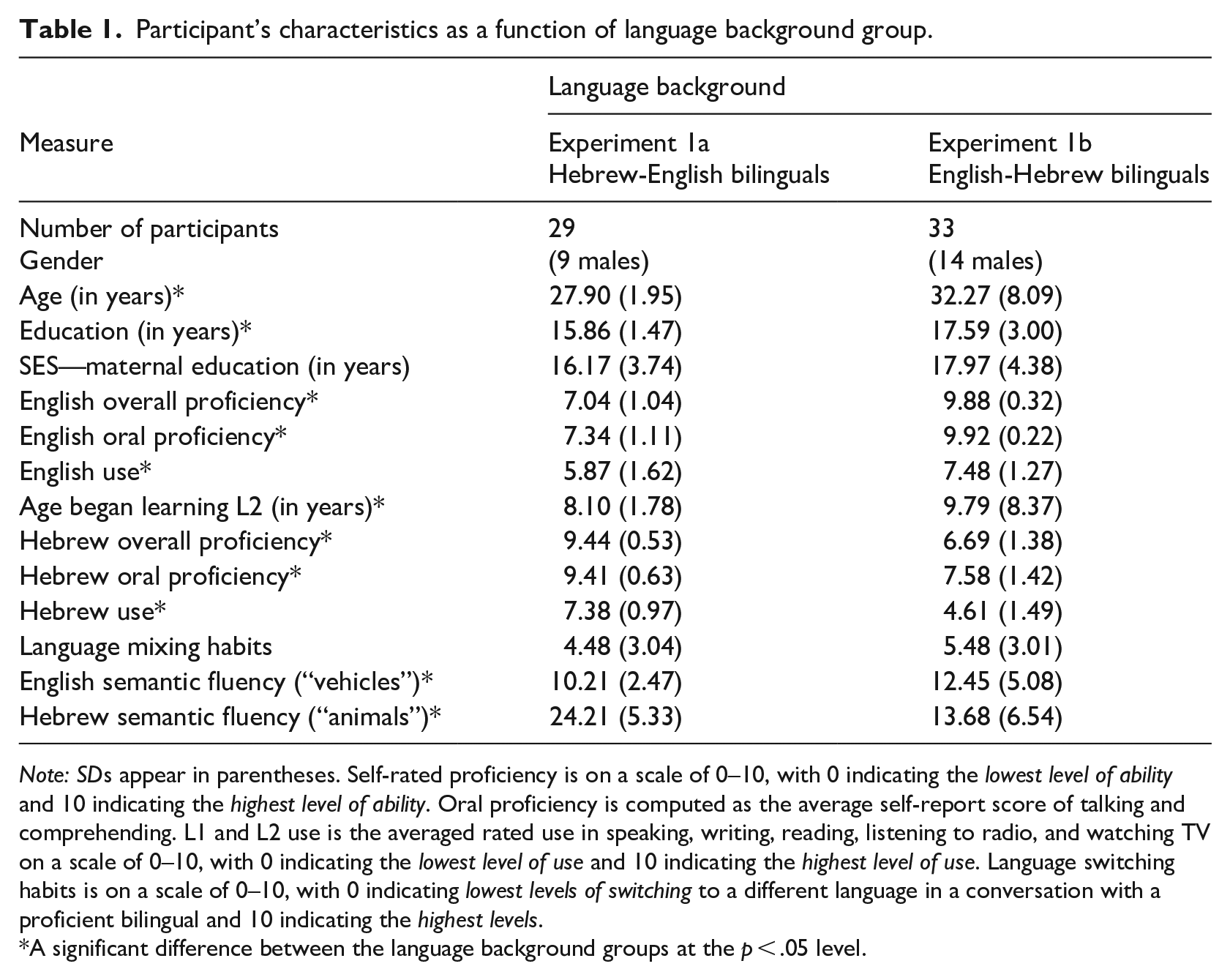
Note: SDs appear in parentheses. Self-rated proficiency is on a scale of 0–10, with 0 indicating the lowest level of ability and 10 indicating the highest level of ability. Oral proficiency is computed as the average self-report score of talking and comprehending. L1 and L2 use is the averaged rated use in speaking, writing, reading, listening to radio, and watching TV on a scale of 0–10, with 0 indicating the lowest level of use and 10 indicating the highest level of use. Language switching habits is on a scale of 0–10, with 0 indicating lowest levels of switching to a different language in a conversation with a proficient bilingual and 10 indicating the highest levels.
A significant difference between the language background groups at the p < .05 level.
Materials and procedure
Each participant was tested individually in a quiet room on a laptop computer with headphones and designated response box (E-prime Chronos; Psychology Software Tools, Pittsburgh, PA). All communication was carried out naturally in Hebrew with an HE bilingual experimenter. Following a consent form, participants completed the rhyme judgment task followed by the semantic fluency tasks in Hebrew and English, and the language history questionnaire. The entire protocol lasted about 1 hour.
Rhyme judgment task
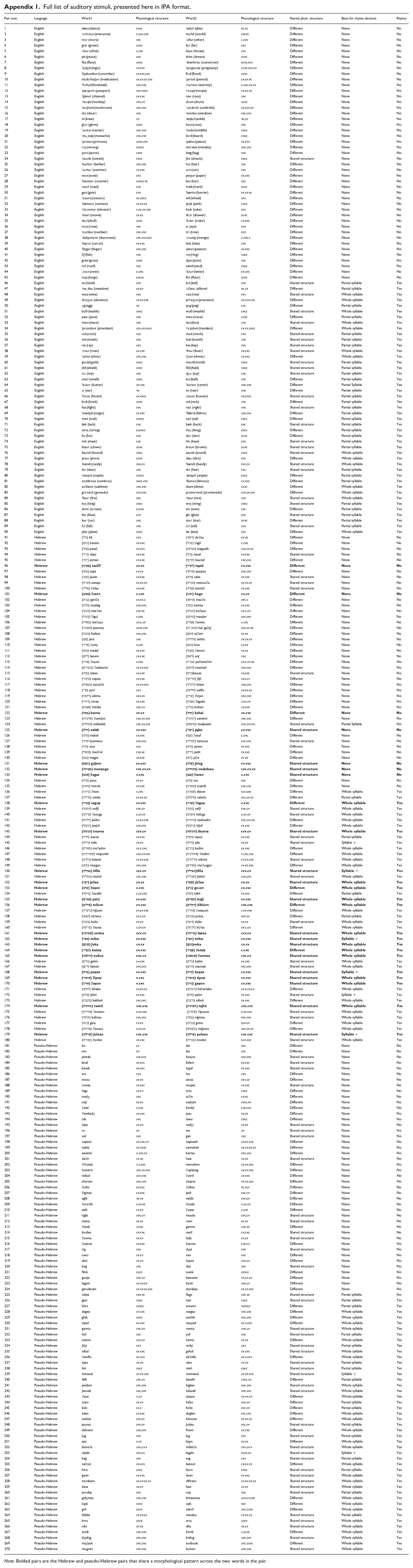
Stimuli included 270 word-pairs in one of three language conditions: English, Hebrew, and pseudo-Hebrew (90 pairs in each, see stimuli list in Appendix 1). All stimuli were recorded by the same female bilingual speaker of English and Hebrew, who recorded English words in an English-like pronunciation, and Hebrew and pseudo-Hebrew words in a Hebrew-like pronunciation. Because bilinguals respond differently to words that share phonological structure and meaning across languages (i.e., cognates, e.g., Hoshino & Kroll, 2008), stimuli in the English and Hebrew lists did not include cognates, and concepts were not repeated across languages. Furthermore, stimuli with ambiguous phonology-to-spelling correspondence were avoided. Pseudo-Hebrew pairs used the Hebrew phonemic repertoire, did not violate Hebrew phonotactic rules, but were not constructed from specific Hebrew roots, templates, or items. Importantly, they were not associated with meaning in either Hebrew or English.
Critically, across the three language conditions, half of the pairs included overlapping phonological units in the final syllable requiring a “yes” rhyme decision (see Table 2), whereas the other half did not include overlapping final syllables, requiring a “no” rhyme decision. Across the three language conditions, roughly half of the “yes” pairs shared the exact same phonological structure (e.g., if the first word is a ccvc, so was the second one). Of the items requiring a “yes” decision, more words in Hebrew shared the entire syllable compared to English (see Table 2 and Appendix 1). This is in line with the difference across the two languages in syllable length, which was statistically controlled for in the analysis. Of note, if greater phonological overlap facilitates rhyme decision, all participants, regardless of proficiency profile, should exhibit this tendency. English and Hebrew items also differed in item frequency, which was similarly controlled for in the analyses. Finally, 17 Hebrew word-pairs in the “yes” condition adhered to a morphological word-pattern that could facilitate rhyme decisions because the final syllable was part of this word-pattern (see Appendix 1). However, because these properties were not targeted in the current design, and were not manipulated as such, there were not enough items to examine this issue systematically (but see Russak & Saiegh-Haddad, 2011).
Stimulus characteristics.
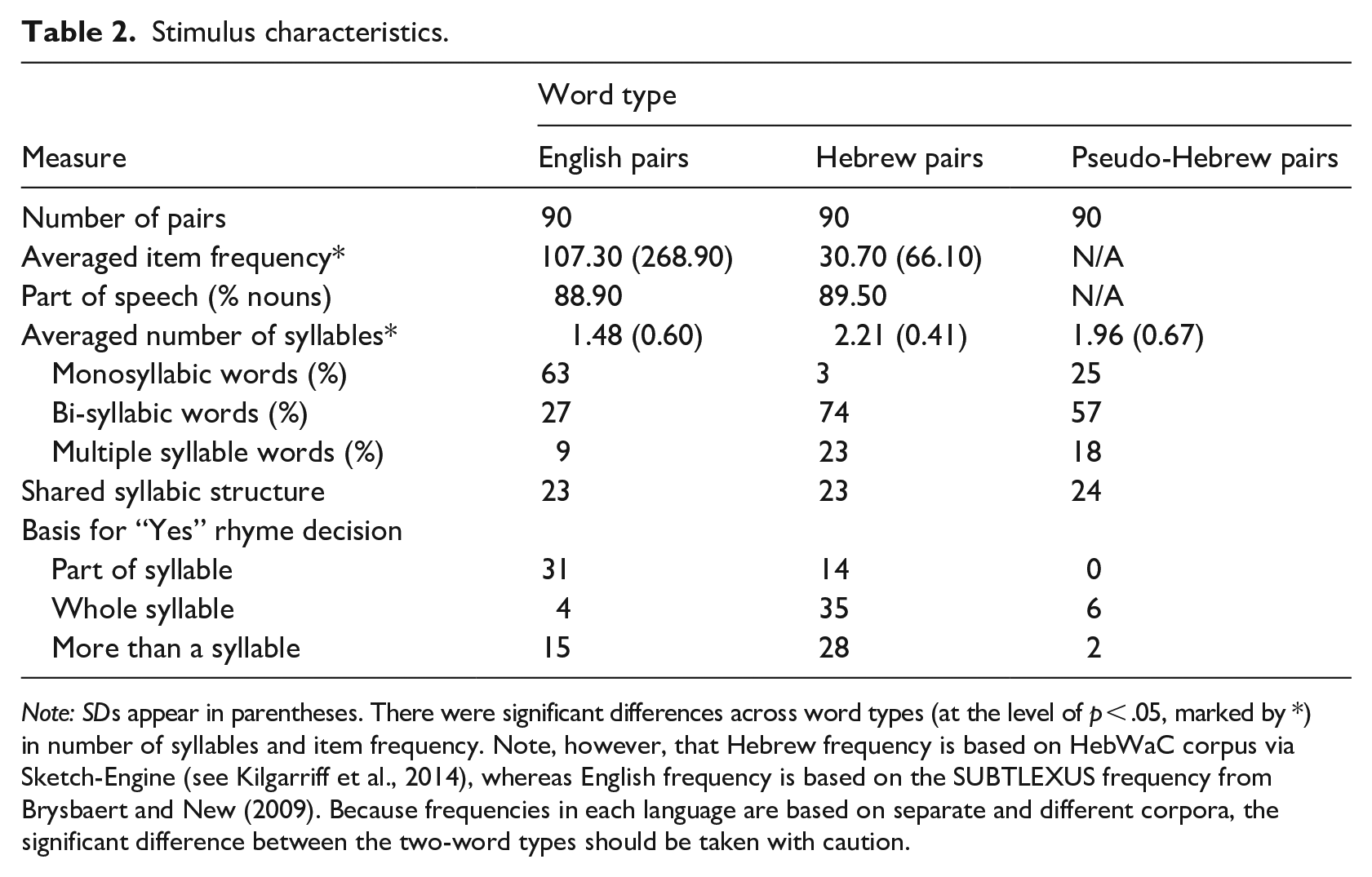
Note: SDs appear in parentheses. There were significant differences across word types (at the level of p < .05, marked by *) in number of syllables and item frequency. Note, however, that Hebrew frequency is based on HebWaC corpus via Sketch-Engine (see Kilgarriff et al., 2014), whereas English frequency is based on the SUBTLEXUS frequency from Brysbaert and New (2009). Because frequencies in each language are based on separate and different corpora, the significant difference between the two-word types should be taken with caution.
Of the “no” rhyme pairs in English and Hebrew, stimuli were further sub-divided into three pair types: (1) semantically related pairs (e.g., “purse–bag”); (2) translated rhyme pairs (e.g., “monkey–drum” translated into Hebrew as a rhyme /kof/-/tof/); and (3) non-related pairs (e.g., “oven–letter”). These sub-types were included to allow examination of how strength of lexical representations and cross-language activation modulate rhyme judgment performance. Notably, however, preliminary analysis revealed no influence of this sub-division, and these were therefore collapsed in current analyses.
In the rhyme judgment task, participants were instructed in their dominant language to decide whether each word-pair presented auditorily rhymed or not, by pressing the response box as quickly and as accurately as possible. No definition of what constitutes a rhyme was given, such that participants were free to base their decision on their intuitive understanding of the concept, following the four practice items given. We return to this issue in the discussion. Each trial began with a fixation cross at the center of the computer screen, followed by a 1,000-ms silent pause. The first word of the pair was then auditorily presented, followed by a silent pause of 1,000 ms. The second word was then auditorily presented, followed by another silent 1,000 ms interval. A question mark then appeared on the screen, and participants were to press “√” to indicate a “yes” response or an “X” to indicate a “no” response, with their dominant hand. Participants’ reaction times (RTs) (in ms, from the onset of the question mark) and accuracy were recorded by the computer program. No feedback was given throughout the task. Presentation order was randomized by the computer program, and experimental trials were interleaved with an optional short break. Four practice trials preceded the experimental trials.
Semantic fluency task
Participants performed a semantic fluency task on one category in each language, “Animals” in Hebrew and “Vehicles” in English (Kavé, 2005). For each category, participants were asked to produce as many words as possible within 1 minute, signaled by an animated hourglass on the screen. Responses were recorded for later coding. As these categories differ in their density (Animals being a wider category than Vehicles), fluency scores served for between individual comparisons, as well as to verify participants dominance profile (Hebrew vs English) in the two groups tested in Experiments 1a and 1b.
Language history questionnaire
Participants’ language background information was collected using a detailed language-history questionnaire fulfilled with the experimenter (modified from LEAP-Q, Marian et al., 2007).
Experiment 1b—EH bilinguals
In addition to providing a comparison to the HE bilinguals tested in Experiment 1a, the original goal of Experiment 1b was also to examine whether short-term changes in language context affect performance in the rhyme judgment task. Our original reasoning here was that language context may affect the accessibility of linguistic representations (Degani et al., 2020; Kreiner & Degani, 2015), such that it may dynamically affect participants’ ability to perform the rhyme judgment task in each language. Thus, participants performed half of the trials (i.e., 135 word-pairs, including English, Hebrew, and pseudo-Hebrew pairs) before a brief exposure manipulation, including either watching an English movie or playing a non-linguistic computer game for 10 minutes, and one-half following this exposure. However, because stimuli lists were unintentionally not properly counterbalanced before and after exposure, and because there were no reliable brief exposure effects, these analyses are reported in Appendix 6 and are not discussed further. For the purpose of the current study, performance in the pre-exposure phase only is considered, consisting of 135 trials. These pre-exposure trials are compared to the first 135 trials completed by the HE bilinguals tested in Experiment 1a.
Participants
A total of 60 EH-speaking participants (26 males; mean age = 34.7, SD = 10.9), who grew up in an English-speaking country and studied Hebrew as an L2, took part in the experiment. At the time of testing, participants were residing in Israel, in which the environmental language is Hebrew. Participants were recruited through social media networks and were paid for their participation. They had English as their dominant language, as determined by self-report using the detailed language history questionnaire (adapted from the LEAP-Q, Marian et al., 2007), and verified using the objective proficiency measure (semantic fluency in each task).
Of these participants, nine were excluded because: they were born in a non-English-speaking country (two participants); were exposed to Hebrew from birth (four participants); or due to technical difficulty in task administration (three participants). In addition, of the remaining 51 participants, there were 8 who reported having a learning disability or attention deficits, 3 who were more than 3 SD above study mean age, 2 who reported low Hebrew proficiency (subjectively rating their Hebrew proficiency below 3 on a 0–10 scale), and 5 who experienced distractions during task administration, including background linguistic exposure. Analyses were conducted with and without these participants and yielded the same patterns. Thus, analysis based on the smaller group (n = 33) is presented here (see Table 1 for background characteristics).
Materials and procedure
Experimental materials and procedure were identical to those used in Experiment 1a, with two exceptions. First, in Experiment 1b, the rhyme judgment task was divided into two blocks (each containing 135 pairs, with 45 pairs in each language condition, matched on syllable length, item frequency, and part-of-speech—see Appendix 2), interleaved with a 10-minute exposure task (watching an English movie or completing a non-linguistic computerized game). As explained above, only the first of these blocks, which was identical for all participants, is analyzed here. Second, the semantic fluency task included two categories in each language (“Animals” and “Professions” in Hebrew, followed by “Fruits and Vegetables” and “Vehicles” in English). Comparisons across the two bilingual groups focus on the shared categories (Animals and Vehicles, see Table 1).
Results
Data analysis approach
To examine performance in the rhyme judgment task, dʹ were computed for each participant to reveal participants’ sensitivity in each pair type (English, Hebrew, pseudo-Hebrew). This measure subtracts the normalized false-alarm rate from the normalized hit rate, thus controlling for participants’ response bias. To examine the within-participant interdependence of sensitivity in the two languages of bilingual speakers, the correlation between the dʹ for Hebrew pairs and the dʹ for English pairs within each bilingual group were examined. In addition, RTs were analyzed using linear mixed-effects models, as these models allow one to simultaneously account for variance related to participants and to items. For completeness, error rate data are presented in Table 3 and their analyses reported in Appendix 5. RTs on correct responses were trimmed to remove trials on which latencies were more than 2.5 SD from the mean of each participant on correct responses (excluding about 8% of the data). To verify excluded data did not change results, analyses were conducted with and without these exclusions and yielded the same pattern of results (see Appendix 3 for raw data analysis). Models were fit using the buildmer function in the buildmer package (v. 1.3, Voeten, 2019) in R (version 3.6.1, R Core Team, 2019), which uses the lmer function from the lme4 package (v 1.1.-21, Bates, Maechler, et al., 2015). Using backward stepwise elimination, the buildmer function starts from the most complex model and systematically simplifies the random structure until the model converges. Once the maximally converging model as supported by the data has been identified (Bates, Kliegl, et al., 2015), the function calculates p-values for all fixed effects based on Satterthwaite degrees of freedom using the lmerTest package (v. 3.1-0, Kuznetsova et al., 2017). When necessary, to probe interactions and examine pairwise comparisons, the selected model was refitted using lmer and followed by the testInteractions function from the phia package (v. 0.2-1, De & Rosario-Martinez, 2015) with Bonferroni adjustments for multiple comparisons.
Reaction times on correct responses (top) and percentage of errors (bottom) in the rhyme judgment task, as a function of response, group, and type of item.
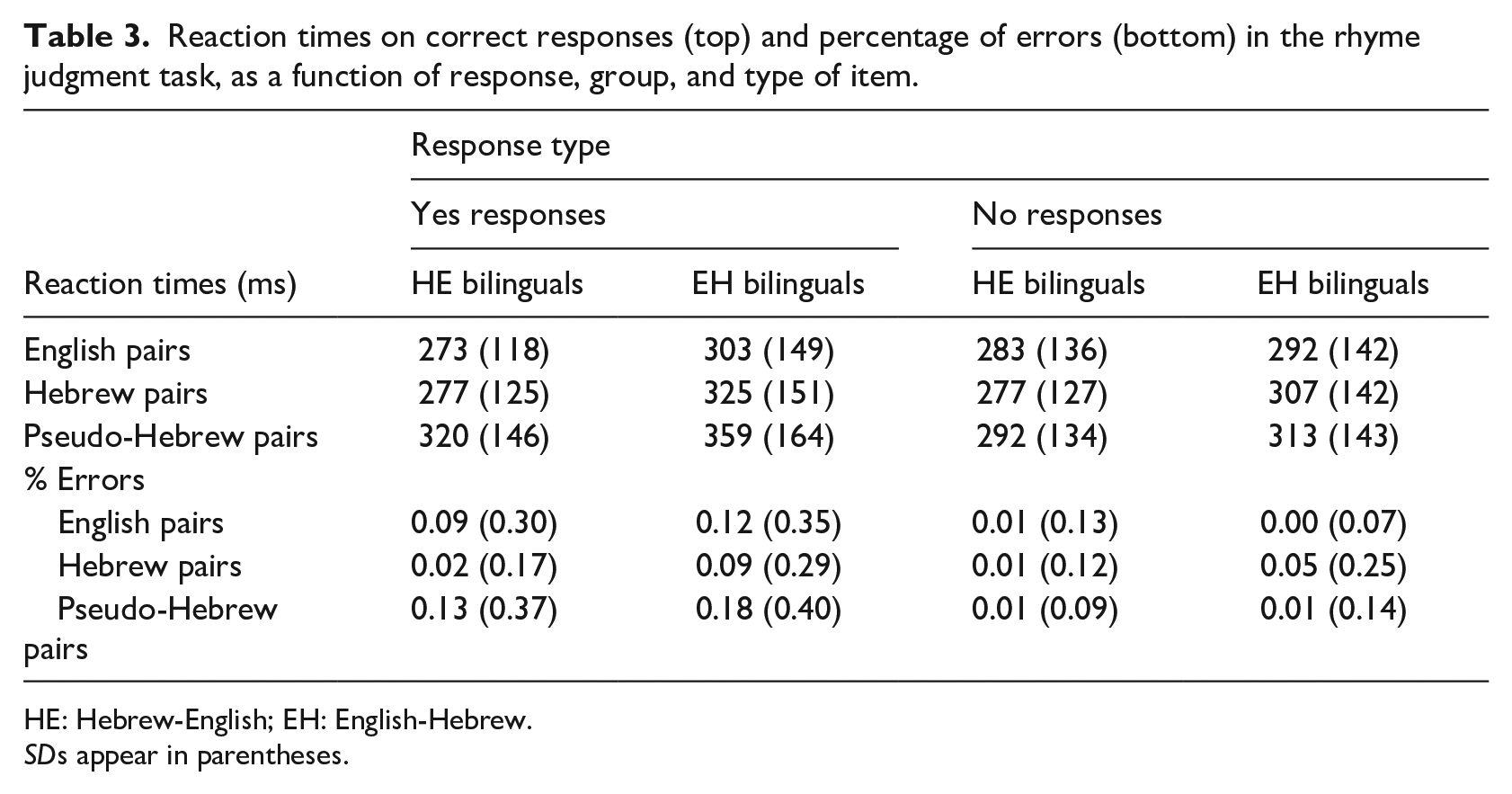
HE: Hebrew-English; EH: English-Hebrew.
SDs appear in parentheses.
The models included the first 135 trials of the HE bilinguals and the pre-exposure block of the EH bilinguals (see Table 3 for descriptive statistics of performance). The maximal models submitted to the buildmer function included Group (HE vs EH, with EH set as the reference), Type (English, Hebrew, and pseudo-Hebrew with English set as the reference), and Rhyme Response (Yes vs No, with No set as the reference) and the interactions among them. Random effects included by-participant and by-item intercepts, as well as by-participant slopes for Response and Type and their interaction, and by-item slope for Group.
To account for baseline differences among the pair types in syllable length, this factor was normalized and included as a control variable. To control for frequency differences between the English and Hebrew items, and because the corpora over which these frequencies were calculated differ, the frequency counts were normalized within each language and this normalized score was used as a control variable. Pseudo-Hebrew words were assigned a value of −1 for these calculations (the minimum normalized score in this sample for Hebrew and English was −0.5). Furthermore, to control for baseline differences between EH and HE bilinguals, age, education, and socioeconomic status (SES) were normalized and included as control variables. Below we report significant findings and present the selected models from the Anova function. Full summary of the models and of the pairwise comparisons with Bonferroni corrections are presented in Appendix 4.
Sensitivity—dʹ
Comparing HE with EH bilinguals
Because the rhyme judgment task entails a yes/no decision component, participants may exhibit a bias in their responses. To account for this, we computed dʹ for each participant in each type. Repeated-measures ANOVA with Type as a within-participant factor and Group as a between-participant factor on dʹ revealed a main effect of type (F(2,120) = 2.81, MSE = 0.97, p = .025,
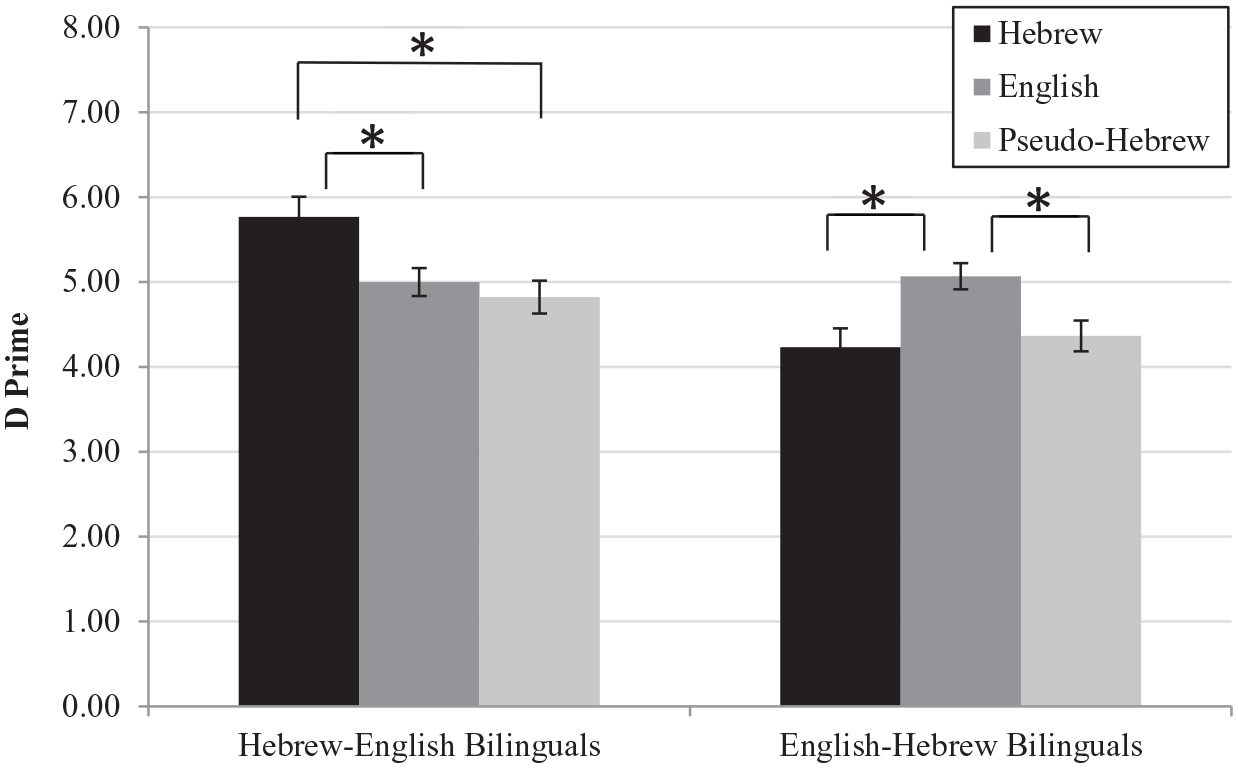
Estimated dʹ in the rhyme judgment task as a function of group and pair type (error bars represent SE).
Correlations between performance in Hebrew versus English
To uncover the degree to which the individual’s performance in each language was independent of his or her performance in the other language, we examined the correlation between the dʹ of Hebrew and the dʹ of English pairs within and across the bilingual groups. These analyses revealed that across the entire sample (r(62) = .12, p = .34), as well as in the HE (r(29) = .18, p = .34) and EH (r(33) = .17, p = .34) bilinguals separately, there was no correlation between the sensitivity to rhymes in English and in Hebrew (see Figure 2).
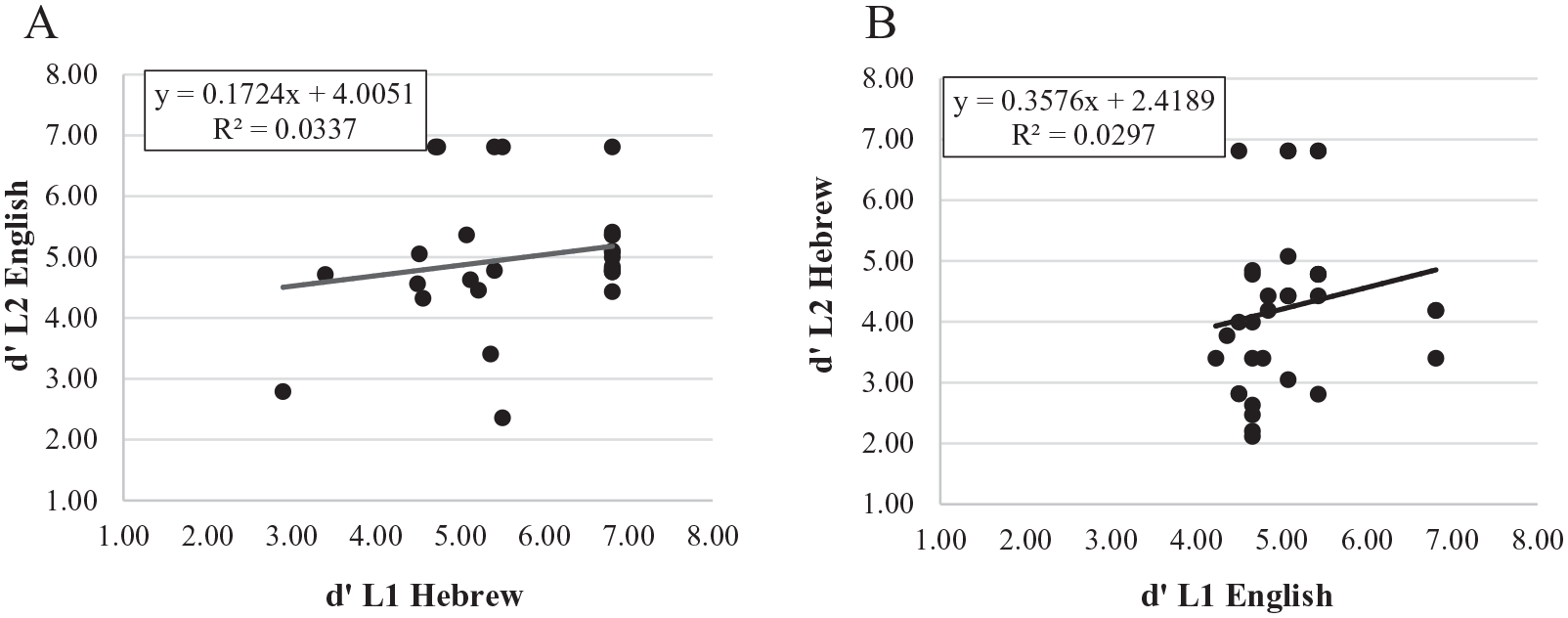
Correlation between dʹ on L1 and L2 pairs in the (A) Hebrew-English bilingual group and the (B) English-Hebrew bilingual group.
Reaction times
Table 3 presents mean performance as a function of Response (yes vs no), Group (EH vs HE) and Type (English, Hebrew, pseudo-Hebrew). The RT analyses revealed that RTs increased with age but decreased with average syllable length. Of relevance, there were main effects for Response, Type, and Group that were qualified by two-way interactions between Response and Type, Response and Group, and critically Type and Group (see Table 4 and corresponding Appendix 4).
Selected model summary predicting RT on correct responses.
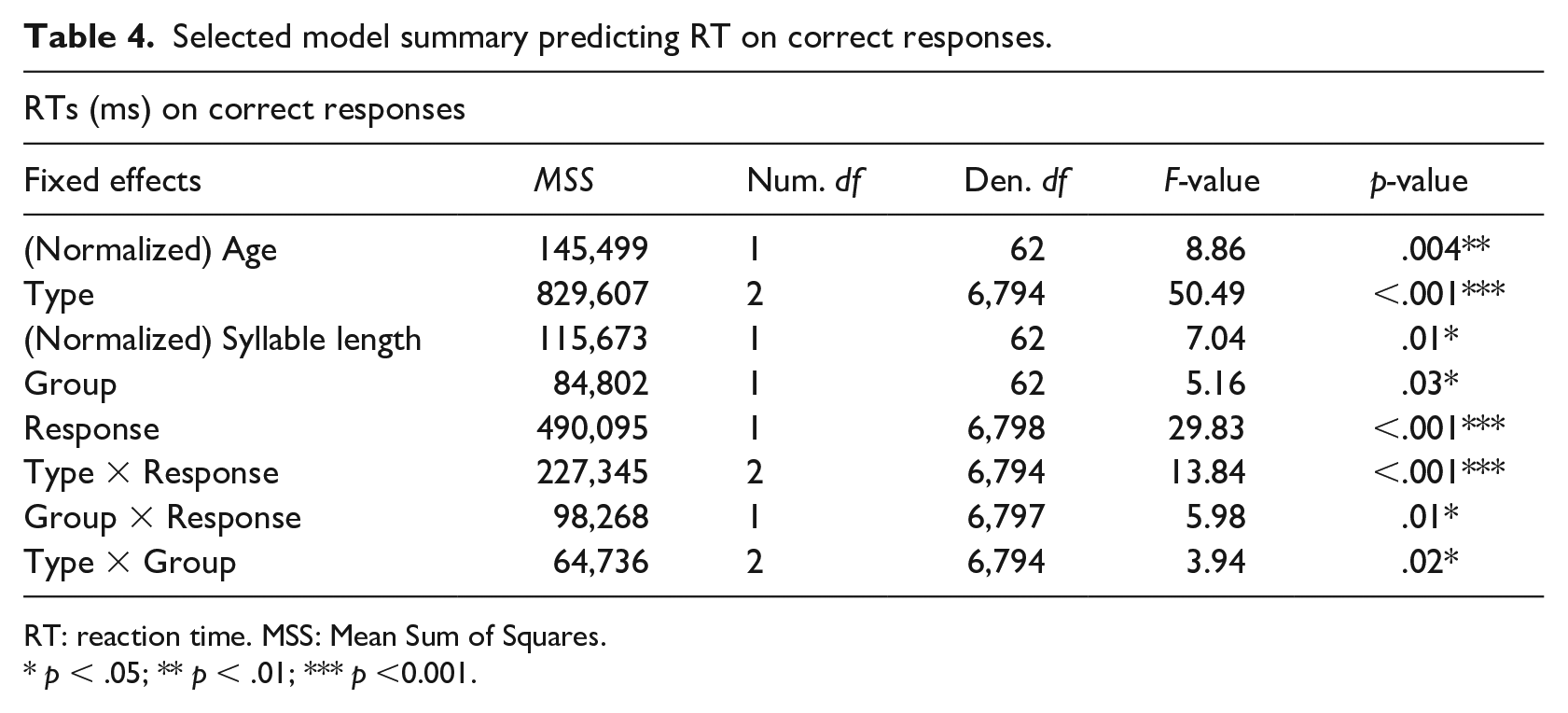
RT: reaction time. MSS: Mean Sum of Squares.
p < .05; ** p < .01; *** p <0.001.
Follow-up tests with Bonferroni corrections for multiple comparisons revealed that RTs were slower for Yes than for No responses only for pseudo-Hebrew words, and that this Response effect was significant for EH bilinguals but only marginal for HE bilinguals. Most critically, collapsing across response type, for EH bilinguals, responses were significantly faster for English pairs than for Hebrew pairs which in turn were significantly faster than the pseudo-Hebrew pairs. For HE bilinguals, responses were equally fast for Hebrew and English pairs, which were both faster than responses to pseudo-Hebrew pairs (see Figure 3 and Appendix 4 for all pairwise comparisons).
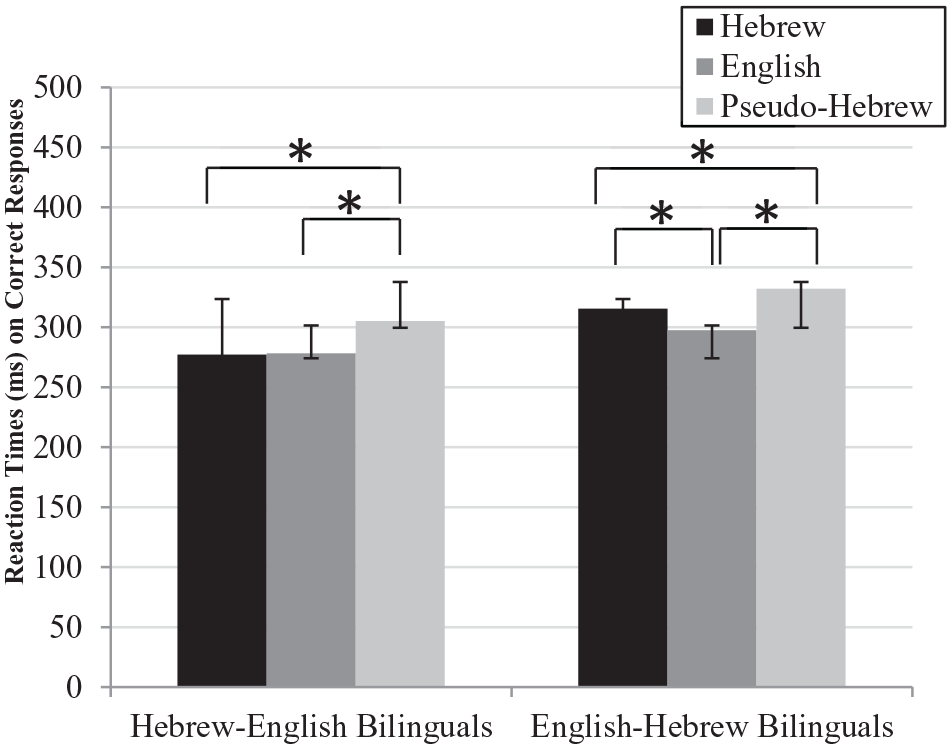
Estimated reaction times on correct responses in the rhyme judgment task as a function of group and pair type (error bars represent SE calculated for within-participant variables following Morey, 2008).
Discussion
The goal of the present study was to examine whether bilinguals’ phonological awareness reflects a single entity, or whether it reflects multiple entities such that phonological awareness performance varies between the L1 and L2 of bilingual speakers. Comparing two groups of bilinguals who differ in their proficiency profile, we observed that rhyme judgment performance on the same set of words was affected by participants’ proficiency profile. In particular, HE bilinguals exhibited increased sensitivity to Hebrew (L1) pairs compared to English and pseudo-Hebrew pairs, as reflected in a dʹ measure, whereas EH bilinguals exhibited increased sensitivity to their L1 (English) compared to Hebrew and pseudo-Hebrew pairs. Furthermore, EH bilinguals responded significantly more quickly to English pairs, compared to Hebrew pairs, which in turn were faster than pseudo-Hebrew pairs. The advantage in RT for English pairs was not observed in the HE bilingual group, who responded equally fast to Hebrew and English pairs, which in turn were both faster than pseudo-Hebrew pairs.
Phonological awareness as a multiple entity
Most prominently, these findings demonstrate that phonological awareness performance varies between the two languages of bilingual speakers. In both bilingual groups, we observed differential performance in Hebrew and English, suggesting that phonological awareness in one language is not fully determined by this ability in the other language. The current findings are in line with previous results showing differences in bilinguals’ phonological awareness performance in their two languages (Russak & Saiegh-Haddad, 2011, with adult HE bilinguals) and the suggestion that phonological awareness is part of one’s language representations (e.g., the Linguistic Affiliation Hypothesis, Russak & Saiegh-Haddad, 2011, 2017; Saiegh-Haddad, 2007b; Swan & Goswami, 1997; White et al., 2017).
Interestingly, the current study sheds light on the particular components that operate to affect phonological awareness. Specifically, the structural differences between the languages in question would have predicted that all participants would respond better to stimuli in a given language compared to the other language. The same ordered performance was predicted regardless of proficiency profile. If the phonological structure of the language is most critical, then the cohesiveness of the VC rime unit in English should have led to better performance on English than on Hebrew pairs. In contrast, if the morpho-phonological structure of Hebrew and the presence of the word pattern template are crucial, then performance on these Hebrew word-pairs was expected to be better than on English word-pairs for all participants (though because the presence of word pattern templates was not systematically manipulated, more work may be revealing here).
Going beyond these predictions, however, the current results revealed modulations by proficiency profile, in that the EH bilinguals processed English pairs better, whereas the HE bilinguals processed Hebrew pairs better. The results are therefore consistent with the suggestion that the strength of the linguistic representations in the speakers’ mind affect his or her ability to perform a phonological awareness task (Walley et al., 2003). Bilinguals across both groups determined the rhyme status of pairs in their L1 better than pairs in their L2. Presumably, long-term accumulated language use increased the frequency and availability of linguistic representations in the more dominant language. This in turn modulated the ease with which different bilingual groups performed the rhyme judgment task in each language.
The current findings underscore the relevance of the availability of linguistic representations as the basis for phonological awareness performance. Notably, these linguistic representations may entail both lexical and sub-lexical (phonological) representations, and these may both be at play. In the current study, the difference in processing of Hebrew versus English word-pairs could be due to differences in the strength of lexical representations, as words in the L1 and L2 are likely to differ in their respective frequency and thus availability (e.g., Gollan et al., 2011). At the same time, frequency of exposure to each language may also affect the availability of and familiarity with sub-lexical (phonological) representations of each language, such that the strength of phonological representations may similarly affect bilinguals’ performance in their L1 and L2. The advantage for phonological awareness performance in the dominant language observed here cannot dissociate these two sources. However, one aspect of our study supports the unique contribution of lexical knowledge. Specifically, processing of Hebrew words was superior to that of pseudo-Hebrew words, in both the dʹ and RT measures for the HE bilinguals. The same numeric pattern was observed for EH bilinguals as well. As the critical difference between Hebrew and pseudo-Hebrew items is the lexical status of their referents, the difference between them provides suggestive evidence that the strength of lexical representations contributes to sub-lexical, phonological, awareness. This suggestion is consistent with the Lexical Restructuring Model (Walley et al., 2003) and previous studies in which language membership and lexical status were directly manipulated (e.g., Russak & Saiegh-Haddad, 2011).
Moreover, in addition to speakers’ exposure to each language, which affects the accessibility of linguistic representations, cross-language overlap may further affect their availability. For instance, a rhyme judgment decision may be easier on pairs that include shared phonemes across languages, than on pairs that include language-specific phonological units (e.g., a vowel contrast that exists in one language but not the other). Structural differences across languages may constrain the degree to which lexical and sub-lexical units are shared across languages. Systematically quantifying the contribution of language exposure and cross-language influences to bilinguals’ phonological awareness performance is, however, beyond the scope of this study (but see Kuo & Anderson, 2010).
Of relevance, the association between participants’ proficiency and their phonological awareness performance in a given language may reflect reciprocal relations, such that proficiency improves phonological awareness, and phonological awareness improves proficiency. Such bidirectional links have been central to the relation between phonological awareness and literacy development (Castles & Coltheart, 2004), and evidence indeed suggests that not only phonological awareness affects reading development (e.g., Tornéus, 1984) but also knowledge of orthographic representations and learning to read affect the way speakers perceive and operate over phonological representations (e.g., Ben-Dror et al., 1995; Goswami et al., 2005). Accordingly, the observed relation between language proficiency and phonological awareness may reflect not only the fact that speakers are better able to manipulate the sound components when the strength of linguistic representations are higher, but also that increased phonological awareness abilities promote speakers’ ability to acquire spoken and written proficiency in the language (see related discussion regarding reading disabled individuals in Russak & Saiegh-Haddad, 2011). Future longitudinal or intervention studies may reveal the nature of this causal relation.
Independence across the two languages
In the current study, participant’s rhyme judgment sensitivity in one language was not correlated with his or her sensitivity in the other language. This independence of phonological awareness in the two languages was observed for both the HE and the EH bilinguals. The finding is at odds with previous studies documenting correlations between bilingual children’s phonological awareness in their two languages (Bialystok et al., 2005; Durgunoğlu et al., 1993; Geva & Siegel, 2000). This correlation was interpreted to suggest the reliance of phonological awareness in the L2 on phonological awareness abilities in the L1 (Navarra et al., 2005; Simon et al., 2014). Of note, most of these studies were conducted with children who are still developing and establishing the components of their phonological awareness abilities, whereas the current study examined typical adult population. It is possible that the reliance on L1 representations in L2 phonological awareness tasks is diminished for more proficient speakers, as may be the case for adult speakers. Furthermore, the structural difference between L1 and L2 may similarly constrain the degree to which phonological awareness in the L1 can serve as the basis for phonological awareness in the L2 (Saiegh-Haddad, 2019). Future studies which directly compare children and adults on the same tasks (Baker et al., 2008; Simon et al., 2014), and that compare more and less similar languages (Bialystok et al., 2005), will be informative in this respect.
Furthermore, in the studies that observed correlations across languages, phonological awareness was examined with other tasks that may rely to a different extent on the strength of linguistic representations. For instance, Durgunoğlu et al. (1993) tested phonological awareness with segmenting and blending assignments, whereas Bialystok et al. (2005) evaluated phonological awareness by phoneme counting and nonword decoding. Different tasks vary in the extent to which they highlight cross-linguistic differences in phonological awareness (Branum-Martin et al., 2015) and may similarly vary in the degree to which they rely on the strength of linguistic representations and depend on language proficiency. Specifically, the rhyme judgment task utilized here may be considered an epilinguistic task (Gombert, 1992), which relative to “deeper,” more explicit metalinguistic awareness tasks relies more on implicit phonological processing skills. As such, the rhyme judgment task is likely to be influenced by language-specific experience more than other, more meta-cognitive tasks such as phoneme segmentation or deletion (Saiegh-Haddad, 2007a). These considerations raise the possibility that the observed language-dependent effects may be exaggerated by the nature of the task used here. Future work in which deeper phonological awareness tasks are utilized are important in this respect. Relatedly, as the task is designed to test implicit phonological processing, instructions were kept to a minimum, and participants were to base their judgments on their intuitive understanding of the task. This aspect likely increased variability in our sample. Critically, however, given that a within-participant design was used, participants’ interpretation of the task likely guided their decisions across all item types. Furthermore, such rhyme judgment tasks are commonly used in educational and clinical practices, and thus understanding the degree to which performance on this task in one language predicts performance in another is of great practical relevance, as described below.
Implications for the theory of phonological awareness and clinical practice
The current study suggests that phonological awareness of bilingual speakers cannot be explained by a single entity approach and is influenced by the strength of linguistic representations. This is evident in three aspects of the findings. First, all bilingual participants exhibited enhanced phonological awareness sensitivity to items in their more dominant compared to their less dominant language. Second, there was no correlation between participants’ performance in the two languages. Third, strength of item representations, as reflected by item frequency, predicted performance, such that rhyme judgments on more strongly represented items (i.e., more frequent items) were better than rhyme judgments on weaker represented items.
Thus, extending the extensive line of research documenting the influence of language structure and linguistic distance on phonological awareness performance (see Janssen et al., 2017; for a recent review, see Saiegh-Haddad, 2019), the current findings highlight the importance of language proficiency as a central component in a multiple-entity view of phonological awareness. Because responses to the same set of linguistic items (e.g., Hebrew pairs) were consistently modulated by participants’ proficiency profile, the findings lend support to the important role of the strength of linguistic representations within the speakers’ mind. Phonological awareness abilities are therefore better conceptualized as dependent, at least to some extent, on participants’ language proficiency. At the same time, domain-general cognitive or auditory abilities may further contribute to participants’ performance (see also Saiegh-Haddad, 2019).
Importantly, we did not observe any correlation between performance in the two languages of the same individuals. This suggests that reliance on speakers’ rhyme judgment in one language as a proxy for his or her ability in the other language is unwarranted. This is a critical consideration for clinical and educational practice. The extent to which similar independence is observed beyond the typical adult population tested here awaits additional research.
Conclusion
The above findings underscore the complex nature of phonological awareness and the strong impact of language proficiency on this important ability. Two groups of bilingual adults exhibited better performance in a phonological awareness task in the language they were more proficient in (i.e., their L1) compared to their less proficient language (L2). The results support the suggestion that the strength of linguistic representations affect phonological awareness performance above and beyond the phonological structure of a specific language. Phonological awareness emerges as a multiple-entity complex ability, heavily influenced by speakers’ strength of linguistic representations, as indexed by their language proficiency profile. Further research is needed to determine whether phonological awareness performance can be dynamically modulated by short-term modulations of language accessibility.
Footnotes
Appendix 1
Full list of auditory stimuli, presented here in IPA format.
| Pair num | Language | Word1 | Phonological structure | Word2 | Phonological structure | Shared phon. structure | Basis for rhyme decision | Rhyme |
|---|---|---|---|---|---|---|---|---|
| 1 | English | dæns (dance) | cvcc | ˈeɪbəl (able) | vc.cc | Different | None | No |
| 2 | English | ˈɛvriˌwʌn (everyone) | c.ccv.cvc | wɜrld (world) | cvccc | Different | None | No |
| 3 | English | mɔr (more) | cvc | ˈʌðər (other) | c.cvc | Different | None | No |
| 4 | English | grin (green) | ccvc | fɑr (far) | cvc | Different | None | No |
| 5 | English | ˈɑləv (olive) | c.cvc | haʊs (house) | cvc | Different | None | No |
| 6 | English | pis (peace) | cvc | drim (dream) | ccvc | Different | None | No |
| 7 | English | flut (flute) | ccvc | ˈskærkroʊ (scarecrow) | ccvc.cvc | Different | None | No |
| 8 | English | ˈlɑʤɪk (logic) | cv.cvc | ˈprɛgnənsi (pregnancy) | ccvc.cvc.cv | Different | None | No |
| 9 | English | ˈkjukəmbər (cucumber) | cv.cvc.cvc | flʌd (flood) | ccvc | Different | None | No |
| 10 | English | mɛdəˈkeɪʃən (medication) | cv.cv.cv.cvc | ˈpɪriəd (period) | cv.cv.vc | Different | None | No |
| 11 | English | ˈfɔrhɛd (forehead) | cvc.cvc | ɪˈtɜrnəti (eternity) | c.cvc.cv.cv | Different | None | No |
| 12 | English | ˈpæˌspɔrt (passport) | cvc.cvcc | ˈrɛsəpi (recipe) | cv.cv.cv | Different | None | No |
| 13 | English | ˈʧænəl (channel) | cv.cvc | reɪs (race) | cvc | Different | None | No |
| 14 | English | ˈmʌŋki (monkey) | cvc.cv | drʌm (drum) | ccvc | Different | None | No |
| 15 | English | ˈmʌʃrum (mushroom) | cvc.cvc | ˈʌmˌbrɛlə (umbrella) | cv.ccv.cv | Different | None | No |
| 16 | English | dɔr (door) | cvc | ˈwɪndoʊ (window) | cvc.cvc | Different | None | No |
| 17 | English | ni (knee) | cv | ˈæŋkəl (ankle) | vc.cc | Different | None | No |
| 18 | English | glʌv (glove) | ccvc | koʊt (coat) | cvc | Different | None | No |
| 19 | English | ˈsɛntər (center) | cvc.cvc | ˈmɪdəl (middle) | cvcc | Different | None | No |
| 20 | English | ˈmʌˌstæʃ (mustache) | cvc.cvc | bɪrd (beard) | cvcc | Different | None | No |
| 21 | English | ˈprɪnsɛs (princess) | ccvc.cvc | ˈpæləs (palace) | cv.cvc | Different | None | No |
| 22 | English | rɔŋ (wrong) | ccvcc | mɪsˈteɪk (mistake) | cvc.cvc | Different | None | No |
| 23 | English | pɜrs (purse) | cvcc | bæg (bag) | cvc | Different | None | No |
| 24 | English | ˈtaʊəlz (towels) | cvcc | ʃits (sheets) | cvcc | Shared structure | None | No |
| 25 | English | ˈbɑrbər (barber) | cvc.cvc | hɛr (hair) | cvc | Different | None | No |
| 26 | English | ˈsʌmər (summer) | cv.cvc | sʌn (sun) | cvc | Different | None | No |
| 27 | English | noʊt (note) | cvc | peɪpər (paper) | cv.cvc | Different | None | No |
| 28 | English | ˈkaʊntər (counter) | cvccc.vc | bɑr (bar) | cvc | Different | None | No |
| 29 | English | roʊd (road) | cvc | træk (track) | ccvc | Different | None | No |
| 30 | English | geɪt (gate) | cvc | ˈbæriər (barrier) | cv.cv.vc | Different | None | No |
| 31 | English | ˈsɪzərz (scissors) | cv.cvcc | wil (wheel) | cvc | Different | None | No |
| 32 | English | ˈkæmərə (camera) | cv.cv.cv | pɪŋk (pink) | cvcc | Different | None | No |
| 33 | English | ˈɛləˌveɪtər (elevator) | c.cv.cv.cvc | keɪk (cake) | cvc | Different | None | No |
| 34 | English | ˈmuvi (movie) | cv.cv | drɔr (drawer) | ccvc | Different | None | No |
| 35 | English | skʌl (skull) | ccvc | ˈkɔlər (color) | cv.cvc | Different | None | No |
| 36 | English | roʊz (rose) | cvc | aɪ (eye) | vcv | Different | None | No |
| 37 | English | ˈnʌmbər (number) | cvc.cvc | tri (tree) | ccv | Different | None | No |
| 38 | English | ˈdɑkjəmɛnt (document) | cvc.cv.cvcc | ˈɔrənʤ (orange) | c.cvc.c | Different | None | No |
| 39 | English | ˈkærət (carrot) | cv.cvc | leɪk (lake) | cvc | Different | None | No |
| 40 | English | ˈfɪŋgər (finger) | cvc.cvc | ˈpinət (peanut) | cv.cvc | Different | None | No |
| 41 | English | fɪʃ (fish) | cvc | rɪŋ (ring) | cvcc | Different | None | No |
| 42 | English | græs (grass) | ccvc | ʤus (juice) | cvc | Different | None | No |
| 43 | English | ruf (roof) | cvc | sænd (sand) | cvcc | Different | None | No |
| 44 | English | ˈʌvən (oven) | c.cvc | ˈlɛtər (letter) | cv.cvc | Different | None | No |
| 45 | English | lʌŋz (lungs) | cvccc | flɔr (floor) | ccvc | Different | None | No |
| 46 | English | wɔl (wall) | cvc | bɔl (ball) | cvc | Shared structure | Partial syllable | Yes |
| 47 | English | ˈmɛˌdoʊ (meadow) | cv.cv | ˈɛlˌboʊ (elbow) | vc.cv | Different | Partial syllable | Yes |
| 48 | English | waɪz (wise) | cvc | raɪz (rise) | cvc | Shared structure | Whole syllable | Yes |
| 49 | English | dɪˈsɪʒən (decision) | cv.cv.cvc | priˈsɪʒən (precision) | ccv.cv.cvc | Different | Whole syllable | Yes |
| 50 | English | ɛg (egg) | vc | pɛg (peg) | cvc | Different | Partial syllable | Yes |
| 51 | English | hɛlθ (health) | cvcc | wɛlθ (wealth) | cvcc | Shared structure | Whole syllable | Yes |
| 52 | English | peɪs (pace) | cvc | treɪs (trace) | ccvc | Different | Partial syllable | Yes |
| 53 | English | meɪs (mace) | cvc | leɪs (lace) | cvc | Shared structure | Whole syllable | Yes |
| 54 | English | ˈprɛzɪdənt (president) | ccv.cv.cvcc | ˈrɛzɪdənt (resident) | cv.cv.cvcc | Different | Whole syllable | Yes |
| 55 | English | rɑk (rock) | cvc | mɑk (mock) | cvc | Shared structure | Partial syllable | Yes |
| 56 | English | tuθ (tooth) | cvc | buθ (booth) | cvc | Shared structure | Partial syllable | Yes |
| 57 | English | reɪ (ray) | cvc | beɪ (bay) | cvc | Shared structure | Partial syllable | Yes |
| 58 | English | ˈrɪvər (river) | cv.cvc | ˈfivər (fever) | cv.cvc | Shared structure | Whole syllable | Yes |
| 59 | English | ˈsɪlvər (silver) | cvc.cvc | ˈʃɪvər (shiver) | cv.cvc | Different | Whole syllable | Yes |
| 60 | English | goʊld (gold) | cvcc | moʊld (mold) | cvcc | Shared structure | Partial syllable | Yes |
| 61 | English | ʃild (shield) | cvcc | fild (field) | cvcc | Shared structure | Partial syllable | Yes |
| 62 | English | tɔɪ (toy) | cvc | ʤɔɪ (joy) | cvc | Shared structure | Partial syllable | Yes |
| 63 | English | smɛl (smell) | ccvc | bɛl (bell) | cvc | Different | Partial syllable | Yes |
| 64 | English | ˈbʌtər (butter) | cv.cvc | ˈkɑrtər (carter) | cvc.cvc | Different | Partial Syllable | Yes |
| 65 | English | ɪr (ear) | vc | tɪr (tear) | cvc | Different | Partial syllable | Yes |
| 66 | English | ˈfɔrɪst (forest) | cv.cvcc | ˈɑnəst (honest) | cv.cvcc | Shared structure | Partial syllable | Yes |
| 67 | English | brɪk (brick) | ccvc | nɪk (nick) | cvc | Different | Partial syllable | Yes |
| 68 | English | faɪt (fight) | cvc | raɪt (right) | cvc | Shared structure | Partial syllable | Yes |
| 69 | English | ˈmæʤɪk (magic) | cv.cvc | ˈfæbrɪk (fabric) | cvc.cvc | Different | Partial syllable | Yes |
| 70 | English | treɪl (trail) | ccvcc | teɪl (tail) | cvcc | Different | Partial syllable | Yes |
| 71 | English | læk (lack) | cvc | bæk (back) | cvc | Shared structure | Partial syllable | Yes |
| 72 | English | strɪŋ (string) | cccvcc | θɪŋ (thing) | cvcc | Different | Partial syllable | Yes |
| 73 | English | fɜr (fur) | cvc | slɜr (slur) | ccvc | Different | Partial syllable | Yes |
| 74 | English | mit (meat) | cvc | hit (heat) | cvc | Shared structure | Partial syllable | Yes |
| 75 | English | klaʊn (clown) | ccvc | braʊn (brown) | ccvc | Shared structure | Partial syllable | Yes |
| 76 | English | baʊnd (bound) | cvcc | saʊnd (sound) | cvcc | Shared structure | Whole syllable | Yes |
| 77 | English | praɪs (price) | ccvc | daɪs (dice) | cvc | Different | Whole syllable | Yes |
| 78 | English | ˈkændi (candy) | cvc.cv | ˈbændi (bandy) | cvc.cv | Shared structure | Whole syllable | Yes |
| 79 | English | dɪr (dear) | cvc | dɪr (fear) | cvc | Shared structure | Partial syllable | Yes |
| 80 | English | ˈsteɪpəl (staple) | ccvcc | ˈæmpəl (ample) | vccc | Different | Partial syllable | Yes |
| 81 | English | cumbrous (cumbrəs) | cvcc.cvc | ˈfeɪməs (famous) | cv.cvc | Different | Partial syllable | Yes |
| 82 | English | səˈblaɪm (sublime) | cvc.cvc | slaɪm (slime) | ccvc | Different | Whole syllable | Yes |
| 83 | English | grəˈneɪd (grenade) | ccv.cvc | prɑməˈneɪd (promenade) | ccv.cv.cvc | Different | Whole syllable | Yes |
| 84 | English | ˈfaɪər (fire) | cvc | ˈtaɪər (tire) | cvc | Shared structure | Whole syllable | Yes |
| 85 | English | kɪŋ (king) | cvcc | wɪŋ (wing) | cvcc | Shared structure | Partial syllable | Yes |
| 86 | English | skrin (screen) | cccvc | tin (teen) | cvc | Different | Partial syllable | Yes |
| 87 | English | blu (blue) | ccv | glu (glue) | ccv | Shared structure | Partial syllable | Yes |
| 88 | English | kɑr (car) | cvc | stɑr (star) | ccvc | Different | Partial syllable | Yes |
| 89 | English | fɔl (fall) | cvc | tɔl (tall) | cvc | Shared structure | Partial syllable | Yes |
| 90 | English | plet (plate) | ccvc | let (late) | cvc | Different | Whole syllable | Yes |
| 91 | Hebrew | (ילכ) kli | ccv | (ראוד) doɁaʁ | cv.vc | Different | None | No |
| 92 | Hebrew | (םתכ) ketem | cv.cvc | (ליגע) Ɂagil | c.cvc | Different | None | No |
| 93 | Hebrew | (לספ) pesel | cv.cvc | (הפרגמ) magʁefa | cvc.cv.cv | Different | None | No |
| 94 | Hebrew | (ריינ) nijaʁ | cv.cvc | (לחנ) naxal | cv.cvc | Shared structure | None | No |
| 95 | Hebrew | (ןמוי) joman | cv.cvc | (ףנרק) kaʁnaf | cvc.cvc | Different | None | No |
| 96 |
|
|
|
|
|
|
|
|
| 97 | Hebrew | (הפס) sapa | cv.cv | (רפרפ) paʁpaʁ | cvc.cvc | Different | None | No |
| 98 | Hebrew | (ןכש) ʃaxen | cv.cvc | (טלס) salat | cv.cvc | Shared structure | None | No |
| 99 | Hebrew | (היינח) xanaja | cv.cv.cv | (הרונמ) menoʁɁa | cv.cv.cv | Shared structure | None | No |
| 100 | Hebrew | (רלוא) Ɂolaʁ | cv.cvc | (דימצ) tsamid | cv.cvc | Shared structure | None | No |
| 101 |
|
|
|
|
|
|
|
|
| 102 | Hebrew | (עיבג) gaviɁa | cv.cv.c | (הארמ) maʁɁa | cvc.c | Different | None | No |
| 103 | Hebrew | (גלזמ) mazleg | cvc.cvc | (רמנ) nameʁ | cv.cvc | Different | None | No |
| 104 | Hebrew | (ןעטמ) matɁen | cvc.vc | (הרעק) keɁaʁa | cv.c.cv | Different | None | No |
| 105 | Hebrew | (לוגיע) Ɂigul | c.cvc | (בשחמ) maxʃev | cvc.cvc | Different | None | No |
| 106 | Hebrew | (הרעמ) meɁaʁa | cv.c.cv | (ץימא) Ɂamits | c.cvc | Different | None | No |
| 107 | Hebrew | (רתנספ) psanteʁ | ccvc.cvc | (הר געש) har gaɁaʃ | cvc.cv.vc | Different | None | No |
| 108 | Hebrew | (זובזב) bizbuz | cvc.cvc | (םעט) taɁam | cv.vc | Different | None | No |
| 109 | Hebrew | (םש) ʃem | cvc | (הליהת) tehila | cv.cv.cv | Different | None | No |
| 110 | Hebrew | (ריוא) Ɂaviʁ | c.cvc | (אסכ) kise | cv.cv | Different | None | No |
| 111 | Hebrew | (ףדמ) madaf | cv.cvc | (ימצע) Ɂatsmi | vc.cv | Different | None | No |
| 112 | Hebrew | (םחל) lexem | cv.cvc | (שאר) ʁoʃ | cvc | Different | None | No |
| 113 | Hebrew | (זרוא) Ɂoʁez | c.cvc | םיימעפ paɁamaɁim | cv.c.cv.vc | Different | None | No |
| 114 | Hebrew | (םירבכע) Ɂaxbaʁim | cv.cv.cvc | (נחמד) nexmad | cvc.cvc | Different | None | No |
| 115 | Hebrew | (חבט) tabax | cv.cvc | (סרכ)keʁes | cv.cvc | Shared structure | None | No |
| 116 | Hebrew | (רופיצ) tsipoʁ | cv.cvc | (ישילש) ʃliʃi | ccv.cv | Different | None | No |
| 117 | Hebrew | (תיאצח) xatsaɁit | cv.cv.cvc | (ךולכל) lixlux | cvc.cvc | Different | None | No |
| 118 | Hebrew | (ירפ) pʁri | ccv | (הפילח) xalifa | cv.cv.cv | Different | None | No |
| 119 | Hebrew | (המקר) ʁikma | cvc.cv | (ןיינע) Ɂinjan | cvc.cvc | Different | None | No |
| 120 | Hebrew | (רוויח) xiveʁ | cv.cvc | (הדגא) Ɂagada | c.cv.cv | Different | None | No |
| 121 | Hebrew | (עבצא) Ɂetsba | cvc.cv | (ןהוב) bohen | cv.cvc | Different | None | No |
| 122 |
|
|
|
|
|
|
|
|
| 123 | Hebrew | (תוינזוא) Ɂoznijot | cvc.cv.cvc | (לוקמר) ʁamkol | cvc.cvc | Different | None | No |
| 124 | Hebrew | (תדלקמ) mikledet | cvc.cv.cvc | (תספדמ) madpeset | cvc.cv.cvc | Shared structure | Partial Syllable | No |
| 125 |
|
|
|
|
|
|
|
|
| 126 | Hebrew | (לקמ) makel | cv.cvc | (ףנע) Ɂanaf | c.cvc | Different | None | No |
| 127 | Hebrew | (רוזמר)ʁamzoʁ | cvc.cvc | (רורמת) tamʁuʁ | cvc.cvc | Shared structure | None | No |
| 128 | Hebrew | (רוח) xoʁ | cvc | (חתפ) petax | cv.cvc | Different | None | No |
| 129 | Hebrew | (לוענמ) manɁul | cvc.vc | (תידי) jadit | cv.cvc | Different | None | No |
| 130 | Hebrew | (בגמ) magav | cv.cvc | (העי) jaɁe | cv.vc | Different | None | No |
| 131 |
|
|
|
|
|
|
|
|
| 132 |
|
|
|
|
|
|
|
|
| 133 |
|
|
|
|
|
|
|
|
| 134 | Hebrew | (הרפ) paʁa | cv.cv | (סוס) sus | cvc | Different | None | No |
| 135 | Hebrew | (קותמ) matok | cv.cvc | (קיטסמ) mastik | cvc.cvc | Different | None | No |
| 136 | Hebrew | (ןותיע) Ɂiton | c.cvc | (ןותפש) sfaton | ccv.cvc | Different | Whole syllable | Yes |
| 137 | Hebrew | (הללוס) solela | cv.cv.cv | (הלסלס) salsela | cvc.cv.cv | Different | Partial syllable | Yes |
| 138 |
|
|
|
|
|
|
|
|
| 139 | Hebrew | (ישפוח) xofʃi | cvc.cv | (ישפנ) nafʃi | cvc.cv | Shared structure | Whole syllable | Yes |
| 140 | Hebrew | (הגורע) Ɂaʁuga | c.cv.cv | (הגופה) hafuga | c.cv.cv | Shared structure | Whole syllable | Yes |
| 141 | Hebrew | (תודלי) jaldut | cv.cv.cvc | (תודנדנ) nadnedot | cvc.cv.cvc | Different | Whole syllable | Yes |
| 142 | Hebrew | (ףושני) janʃuf | cvc.cvc | (ףושיכ) kiʃuf | cv.cvc | Different | Whole syllable | Yes |
| 143 |
|
|
|
|
|
|
|
|
| 144 | Hebrew | (זורח) xaʁuz | cv.cvc | (זופת) tapuz | cv.cvc | Shared structure | Partial syllable | Yes |
| 145 | Hebrew | (הלימ) mila | cv.cv | (הליפ) pila | cv.cv | Shared structure | Syllable + |
Yes |
| 146 | Hebrew | (םידאמ) maɁadim | cv.c.cvc | (םידכ) kadim | cv.cvc | Different | Whole syllable | Yes |
| 147 | Hebrew | (תיקורשמ) maʃʁokit | cvc.cv.cvc | (תיקלטיא) Ɂitalkit | c.cvc.cvc | Different | Whole syllable | Yes |
| 148 | Hebrew | (תינלכ) kalanit | cv.cv.cvc | (תינוליח) xilonit | cv.cv.cvc | Shared structure | Whole syllable | Yes |
| 149 | Hebrew | (ןגזמ) mazgan | cvc.cvc | (ןגרואמ) meɁuʁgan | cv.vc.cvc | Different | Whole syllable | Yes |
| 150 |
|
|
|
|
|
|
+ |
|
| 151 | Hebrew | (לולסמ) maslul | cvc.cvc | (לולבש) ʃablul | cvc.cvc | Shared structure | Whole syllable | Yes |
| 152 |
|
|
|
|
|
|
|
|
| 153 |
|
|
|
|
|
|
|
|
| 154 | Hebrew | (לפרע) Ɂaʁafel | c.cv.cvc | (לפת) tafel | cv.cvc | Different | Partial syllable | Yes |
| 155 |
|
|
|
|
|
|
|
|
| 156 |
|
|
|
|
|
|
|
|
| 157 | Hebrew | (ןורשיכ) kiʃʁon | cv.cv.cvc | (ןורחא) Ɂaxaʁon | c.cv.cvc | Different | Whole syllable | Yes |
| 158 | Hebrew | (הנאת) teɁena | cv.c.cv | (הנינפ) pnina | ccv.cv | Different | Partial syllable | Yes |
| 159 | Hebrew | (הבוב) buba | cv.cv | (הבוד) duba | cv.cv | Shared structure | Whole syllable | Yes |
| 160 | Hebrew | (הסירע) Ɂaʁisa | c.cv.cv | (הסיעל) leɁisa | cv.c.cv | Different | Whole syllable | Yes |
| 161 |
|
|
|
|
|
|
|
|
| 162 |
|
|
|
|
|
|
+ |
|
| 163 |
|
|
|
|
|
|
|
|
| 164 |
|
|
|
|
|
|
|
|
| 165 |
|
|
|
|
|
|
|
|
| 166 | Hebrew | (םילג) galim | cv.cvc | (םילכ) kelim | cv.cvc | Shared structure | Whole syllable | Yes |
| 167 | Hebrew | (ןציל) lejtsan | cvc.cvc | (ןצרח) xaʁtsan | cvc.cvc | Shared structure | Whole syllable | Yes |
| 168 |
|
|
|
|
|
|
+ |
|
| 169 |
|
|
|
|
|
|
|
|
| 170 |
|
|
|
|
|
|
|
|
| 171 | Hebrew | (הקהל) lehaka | cv.cv.cv | (הקמעה) haɁamaka | cv.v.cv.cv | Different | Whole syllable | Yes |
| 172 | Hebrew | (טלש) ʃelet | cv.cvc | (טלפ) pelet | cv.cvc | Shared structure | Syllable + |
Yes |
| 173 | Hebrew | (קובקב) bakbuk | cvc.cvc | (קוביח) xibuk | cv.cvc | Different | Whole syllable | Yes |
| 174 |
|
|
|
|
|
|
|
|
| 175 | Hebrew | (ןוריווא) Ɂaviʁon | v.cv.cvc | (ןורפיע) Ɂipaʁon | v.cv.cvc | Shared structure | Whole syllable | Yes |
| 176 | Hebrew | (רמלק) kalmaʁ | cvc.cvc | (רמגנ) nigmaʁ | cvc.cvc | Shared structure | Whole syllable | Yes |
| 177 | Hebrew | (הניג) gina | cv.cv | (הניבג) gvina | ccv.cv | Different | Whole syllable | Yes |
| 178 | Hebrew | (החורא) Ɂaʁuxa | v.cv.cv | (החפשמ) miʃpaxa | cvc.cv.cv | Different | Whole syllable | Yes |
| 179 |
|
|
|
|
|
|
+ |
|
| 180 | Hebrew | (תודבע) Ɂavdut | vc.cvc | (תודבכ) kvedut | ccv.cvc | Shared structure | Whole syllable | Yes |
| 181 | Pseudo-Hebrew | ko | cv | dix | cvc | Different | None | No |
| 182 | Pseudo-Hebrew | mo | cv | leʁ | cvc | Different | None | No |
| 183 | Pseudo-Hebrew | pintab | cvc.cvc | funʁes | cvc.cvc | Shared structure | None | No |
| 184 | Pseudo-Hebrew | bisaf | cv.cvc | fofem | cv.cvc | Shared structure | None | No |
| 185 | Pseudo-Hebrew | kanak | cv.cvc | lopal | cv.cvc | Shared structure | None | No |
| 186 | Pseudo-Hebrew | tre | ccv | los | cvc | Different | None | No |
| 187 | Pseudo-Hebrew | mosu | cv.cv | zinxa | cvc.cv | Different | None | No |
| 188 | Pseudo-Hebrew | rowas | cv.cvc | moper | cv.cvc | Shared structure | None | No |
| 189 | Pseudo-Hebrew | lega | cv.cv | təlx | cvcc | Different | None | No |
| 190 | Pseudo-Hebrew | madʒ | cvc | taɁin | cv.vc | Different | None | No |
| 191 | Pseudo-Hebrew | niaʃ | cv.vc | nadʒim | cvcc.vc | Different | None | No |
| 192 | Pseudo-Hebrew | Ɂelel | c.cvc | bivdal | cvc.cvc | Different | None | No |
| 193 | Pseudo-Hebrew | Ɂembadʒ | cv.cvc | jazu | cv.cv | Different | None | No |
| 194 | Pseudo-Hebrew | oik | cvc | lawʁ | cvcc | Different | None | No |
| 195 | Pseudo-Hebrew | lepe | cv.cv | nadʒi | cv.cv | Shared structure | None | No |
| 196 | Pseudo-Hebrew | ru | cv | wa | cv | Shared structure | None | No |
| 197 | Pseudo-Hebrew | xel | cvc | gak | cvc | Shared structure | None | No |
| 198 | Pseudo-Hebrew | tupasti | cv.cvc.cv | xapisash | cv.cv.cvc | Different | None | No |
| 199 | Pseudo-Hebrew | tuklai | cv.ccvc | ʁemekeli | cv.cv.cv.cv | Different | None | No |
| 200 | Pseudo-Hebrew | awatmi | c.cvc.cv | bertas | cvc.cvc | Different | None | No |
| 201 | Pseudo-Hebrew | daɁir | cv.vc | haiz | cv.vc | Shared structure | None | No |
| 202 | Pseudo-Hebrew | ɁiɁunab | c.c.cvc | metudem | cv.cv.cvc | Different | None | No |
| 203 | Pseudo-Hebrew | tutseriv | cvc.cv.cvc | Ɂoplaseg | cv.cv.cvc | Different | None | No |
| 204 | Pseudo-Hebrew | tkikol | ccv.cvc | Ɂutril | cv.cvc | Different | None | No |
| 205 | Pseudo-Hebrew | shertan | cvc.cvc | tioprai | cv.vc.cvc | Different | None | No |
| 206 | Pseudo-Hebrew | Ɂuilts | cv.ccc | Ɂoftsa | vc.ccv | Different | None | No |
| 207 | Pseudo-Hebrew | Ɂigmax | cv.cvc | jesli | cvc.cv | Different | None | No |
| 208 | Pseudo-Hebrew | agfe | vc.cv | nalde | cvc.cv | Different | None | No |
| 209 | Pseudo-Hebrew | ɁoreɁik | c.cv.vc | Ɂutale | c.cv.cv | Different | None | No |
| 210 | Pseudo-Hebrew | sadi | cv.cv | Ɂupas | c.cvc | Different | None | No |
| 211 | Pseudo-Hebrew | tiglo | cvc.cv | musda | cvc.cv | Shared structure | None | No |
| 212 | Pseudo-Hebrew | mene | cv.cv | rawi | cv.cv | Shared structure | None | No |
| 213 | Pseudo-Hebrew | Ɂetab | v.cvc | gemva | cvc.vc | Different | None | No |
| 214 | Pseudo-Hebrew | koshar | cv.cvc | nasil | cv.cvc | Shared structure | None | No |
| 215 | Pseudo-Hebrew | Ɂunma | cv.cv | lada | cv.cv | Shared structure | None | No |
| 216 | Pseudo-Hebrew | Ɂoptux | cv.cvc | kuxma | cvc.cv | Different | None | No |
| 217 | Pseudo-Hebrew | rig | cvc | dʒat | cvc | Shared structure | None | No |
| 218 | Pseudo-Hebrew | navu | cv.cv | xes | cvc | Different | None | No |
| 219 | Pseudo-Hebrew | absi | cv.cv | lopʁa | cvc.cv | Different | None | No |
| 220 | Pseudo-Hebrew | keg | cvc | daz | cvc | Shared structure | None | No |
| 221 | Pseudo-Hebrew | flmk | cccc | iʁank | ccvcc | Different | None | No |
| 222 | Pseudo-Hebrew | gunje | cvc.cv | kewawe | cv.cv.cv | Different | None | No |
| 223 | Pseudo-Hebrew | lagevi | cv.cv.cv | baxti | cvc.cv | Different | None | No |
| 224 | Pseudo-Hebrew | gerulanam | cv.cv.cv.cvc | dunabaz | cv.cv.cvc | Different | None | No |
| 225 | Pseudo-Hebrew | nidsa | cvc.vc | fisga | cvc.vc | Shared structure | Partial syllable | No |
| 226 | Pseudo-Hebrew | gasr | cvcc | tasr | cvcc | Shared structure | Partial syllable | Yes |
| 227 | Pseudo-Hebrew | klivs | ccvcc | owʁivs | vccvcc | Different | Partial syllable | Yes |
| 228 | Pseudo-Hebrew | dageʁ | cv.cvc | vatgeʁ | cvc.cvc | Different | Whole syllable | Yes |
| 229 | Pseudo-Hebrew | ghib | ccvc | saxhib | cvc.cvc | Different | Whole syllable | Yes |
| 230 | Pseudo-Hebrew | tiyad | cv.cvc | veoyad | cv.v.cvc | Different | Whole syllable | Yes |
| 231 | Pseudo-Hebrew | gamta | cvc.cv | ramta | cvc.cv | Shared structure | Whole syllable | Yes |
| 232 | Pseudo-Hebrew | duf | cvc | yuf | cvc | Shared structure | Partial syllable | Yes |
| 233 | Pseudo-Hebrew | tsemo | ccv.cv | hemo | cv.cv | Different | Whole syllable | Yes |
| 234 | Pseudo-Hebrew | ʃdʒi | ccv | mdʒi | ccv | Shared structure | Partial syllable | Yes |
| 235 | Pseudo-Hebrew | xifad | cv.cvc | gefad | cv.cvc | Shared structure | Whole syllable | Yes |
| 236 | Pseudo-Hebrew | Ɂamflu | vc.ccv | deɁaflu | cv.v.ccv | Different | Whole syllable | Yes |
| 237 | Pseudo-Hebrew | sase | cv.cv | nise | cv.cv | Shared structure | Partial syllable | Yes |
| 238 | Pseudo-Hebrew | linl | cvcc | minl | cvcc | Shared structure | Partial syllable | Yes |
| 239 | Pseudo-Hebrew | lomesal | cv.cv.cvc | womesal | cv.cv.cvc | Shared structure | Syllable + |
Yes |
| 240 | Pseudo-Hebrew | fafli | cvc.cv | bendli | cvcc.cv | Different | Partial syllable | Yes |
| 241 | Pseudo-Hebrew | pexbes | cvc.cvc | kigbes | cvc.cvc | Shared structure | Whole syllable | Yes |
| 242 | Pseudo-Hebrew | ʃesʁab | cvc.cvc | lobʁab | cvc.cvc | Shared structure | Whole syllable | Yes |
| 243 | Pseudo-Hebrew | Ɂaʁe | c.cv | zizaʁe | cv.cv.cv | Different | Whole syllable | Yes |
| 244 | Pseudo-Hebrew | toyo | cv.cv | lofyo | cvc.cv | Different | Partial syllable | Yes |
| 245 | Pseudo-Hebrew | lole | cv.c | fotle | cvc.cv | Different | Partial syllable | Yes |
| 246 | Pseudo-Hebrew | lulen | cv.cvc | duglen | cvc.cvc | Different | Whole syllable | Yes |
| 247 | Pseudo-Hebrew | nadʁie | cvc.cv | kimaʁie | cv.cv.cv | Different | Whole syllable | Yes |
| 248 | Pseudo-Hebrew | poʁxa | cvc.cv | ʃudxa | cvc.cv | Shared structure | Partial syllable | Yes |
| 249 | Pseudo-Hebrew | dekvam | cvc.cvc | fivam | cv.cvc | Different | Whole syllable | Yes |
| 250 | Pseudo-Hebrew | ʃug | cvc | lug | cvc | Shared structure | Partial syllable | Yes |
| 251 | Pseudo-Hebrew | ayo | c.cv | bayo | cv.cv | Different | Whole syllable | Yes |
| 252 | Pseudo-Hebrew | binteɁa | cvc.cv.v | milteɁa | cvc.cv.v | Shared structure | Whole syllable | Yes |
| 253 | Pseudo-Hebrew | obabi | vcv.cv | kigabi | cvcv.cv | Shared structure | Syllable + |
Yes |
| 254 | Pseudo-Hebrew | keg | cvc | seg | cvc | Shared structure | Partial syllable | Yes |
| 255 | Pseudo-Hebrew | naɁozi | cv.vcv | bakozi | cv.cv.cv | Different | Whole syllable | Yes |
| 256 | Pseudo-Hebrew | forx | cvcc | borx | cvcc | Shared structure | Partial syllable | Yes |
| 257 | Pseudo-Hebrew | gisev | cv.cvc | lasev | cv.cvc | Shared structure | Whole syllable | Yes |
| 258 | Pseudo-Hebrew | mətikato | cv.cv.cv.cv | difirato | cv.cv.cv.cv | Shared structure | Whole syllable | Yes |
| 259 | Pseudo-Hebrew | dase | cv.cv | fase | cv.cv | Shared structure | Whole syllable | Yes |
| 260 | Pseudo-Hebrew | yurubp | cvc | rup | cvc | Shared structure | Partial syllable | Yes |
| 261 | Pseudo-Hebrew | gidʒmaz | cvc.cvc | klewamaz | ccv.cv.cvc | Different | Whole syllable | Yes |
| 262 | Pseudo-Hebrew | lopk | cvcc | opk | vcc | Different | Whole syllable | Yes |
| 263 | Pseudo-Hebrew | gvli | cccv | sakvli | cvc.ccvc | Different | Whole syllable | Yes |
| 264 | Pseudo-Hebrew | fafaba | cv.cv.cv | wesabɑ | cv.cv.cv | Shared structure | Partial syllable | Yes |
| 265 | Pseudo-Hebrew | krtu | cccv | srtu | cccv | Shared structure | Whole syllable | Yes |
| 266 | Pseudo-Hebrew | nilɑ | cv.cv | dilɑ | cv.cv | Shared structure | Whole syllable | Yes |
| 267 | Pseudo-Hebrew | etvik | cvc.cvc | bnvik | c.ccvc | Different | Whole syllable | Yes |
| 268 | Pseudo-Hebrew | dʒisfag | cvc.cvc | kizfɑg | cvc.cvc | Shared structure | Whole syllable | Yes |
| 269 | Pseudo-Hebrew | mɑʃʁuk | cvc.cvc | sunbʁuk | cvc.ccvc | Different | Whole syllable | Yes |
| 270 | Pseudo-Hebrew | mɑgvev | cvc.cvc | bɑlvev | cvc.cvc | Shared structure | Whole syllable | Yes |
Note: Bolded pairs are the Hebrew and pseudo-Hebrew pairs that share a morphological pattern across the two words in the pair.
Appendix 2
Appendix 3
Appendix 4
Appendix 5
Appendix 6
Acknowledgements
The authors thank Natalia Meir for comments on an earlier version of this manuscript, as well as Rama Novogrodsky and Yael Chiffer for assistance with item characteristics.
Declaration of conflicting interests
The author(s) declared no potential conflicts of interest with respect to the research, authorship, and/or publication of this article.
Funding
The author(s) disclosed receipt of the following financial support for the research, authorship, and/or publication of this article: This project was funded by an ISF 1341/14 to Tamar Degani and Hamutal Kreiner.
