



Abstract
Aims and Objectives:
This study explored the extent to which bilingual language exposure and practice might alter the way in which bilingual first-generation adult speakers use deictic demonstratives in their first language (Spanish) after immersion in a new language environment (Norwegian). Fully developed L1 systems are expected to be stable and less susceptible to change or restructuring than child systems. In addition, core domains of a language such as deictic demonstrative reference are hypothesized to be more robust.
Design:
Participants were tested with the Spanish version of the memory game. They completed an ethnolinguistic background questionnaire with questions targeting demographic data, experience with language, and daily routines in language use.
Data and analyses:
Demonstrative use was analysed using binomial multilevel modelling, allowing residual variance to be partitioned into a between-participant component and a within-participant component.
Findings:
Results demonstrate a shift in the demonstrative system of Spanish native speakers who have resided in Norway for a median of 6.5 years. This shift is reflected in extensive use of the semantically underspecified item ese at the expense of the form aquel. The latter form is less frequent and highly context-dependent in corpora of the modern language. It can be hypothesized that first-generation speakers are faster in converging on a simplified system of deictic reference than the native speaker group tested in Spain, but this development parallels tendencies observed in the monolingual variety of the language. This faster shift may well be influenced and catalysed by bilingual language practice.
Originality:
This article addresses a gap in research on deictic terms under conditions of language attrition. It documents a restructuring of the deictic system in first-generation speakers of Spanish residing in another country. The results suggest that marking peri-personal space is a core feature of deictic systems across languages, also preserved under deictic system shift.
Introduction
Language attrition was originally defined as the disintegration or attrition of the structure of a first language (L1) in contact situations with a second language (L2) (Seliger & Vago, 1991). Subsequent definitions have refined the notion as ‘the loss of, or changes to, grammatical and other features of a language as a result of declining use by speakers who have changed their linguistic environment and language habits’ (Schmid, 2011). This more flexible understanding of the term has been brought forth by the awareness that language learning and language ‘forgetting’ are inherently related to each other. Furthermore, it has been suggested that bilingualism is a natural setting for studying how native language abilities interact with abilities in subsequently acquired languages, and how newly acquired languages, in turn, impact back on the first language (Bice & Kroll, 2015; Gollan et al., 2005). This bidirectional relationship is also reflected in the notion of multicompetence introduced in research to describe changes in language functioning in the context of learning and/or using two or more languages at the same time (Cook, 2016; Grosjean, 2008).
The past decades have witnessed increased interest in the study of potential changes in the language competence and processing in first-generation speakers of a language after immersion in another language environment (Köpke & Schmid, 2004, 2019 and references therein; Köpke, 2007; Schmid & Köpke, 2007). Immersion in an L2 environment can affect differentially on aspects of native language competence. It can affect grammar competence (Gürel, 2008; Håkansson, 1995), speech production/accent (de Leeuw et al., 2010), and lexical choices (Jarvis, 2019). However, the extent to which attrition affects the L1 and the type of changes in the grammar of first-generation speakers can vary substantially, as evidenced in recent research. Thus, Schmid et al. (2013) characterize attrition as a complex, nonlinear development driven by several external and internal factors. In addition, the question arises whether attrition leads to changes of a representational nature or is rather the overt manifestation of bilingual language use under processing or resource allocation/interface constraints (Chamorro & Sorace, 2019; Sorace, 2011; Wilson et al., 2009). From the point of view of the neural networks supporting language, invoking processing constraints is consistent with the idea of activation thresholds as crucial predictors of language attrition as claimed by the Activation Threshold Hypothesis (ATH) (Köpke, 2007; Paradis, 2007).
While some changes in the L1 of first-generation speakers can be attributed to influence of the second language, there is also evidence that L2 cross-linguistic influence cannot fully explain the pattern of performance of language attriters. Thus, overuse of overt pronouns in first-generation speakers of pro-drop languages has also been documented in the second language of bilingual speakers of two languages with the same type of pronominal system (Chamorro & Sorace, 2019, for an overview). In a similar way, bilinguals may extend and overgeneralize the use of demonstratives as pro-forms (Ellert, 2013; Juvonen, 1996). This indicates the overall generic nature of changes in the L1 as a result of learning/using another language, characterized by overgeneralization, simplification, an issue we resume later in the discussion of current results. The studies cited above also evidence a degree of optionality in the grammar systems of attriters. Thus, it is possible that the grammar itself is unaffected, but differences emerge when accessing the grammar in the process of integrating contextual information and grammar competence in real time, and under processing load, for example, suggestive of a problem of the interface (Sorace, 2011).
Seliger and Vago (1991) define changes that result from cross-linguistic influence as external influences on L1 competence. However, LI attrition is also characterized by changes that may be internally induced, whereby the modification of linguistic forms either can be motivated by universal principles or is related to some fact in the particular grammar of the first language. Often, many of the linguistic changes typical of attrition are simplificatory in nature and can be characterized as generalization, simplification, regularization, intralinguistic effects, or conceptual/cognitive/innate strategies (Dressler, 1991; Seliger, 1991; Silva-Corvalan, 1991; Smith & van Buren, 1991; Vago, 1991). For instance, in LI attrition unmarked forms appear to be better preserved than, and substitute for, marked ones, but not vice versa (Smith, 1989). To the extent that regularization and simplification can also be observed with time and in natural circumstances in nonimmigrant and monolingual native language communities, it can be stipulated that certain patterns of language use in first-generation speakers may manifest parallel tendencies also observable in the nonimmigrant community.
Of interest for the current study is the case of lexical attrition. Lexical attrition can result in word-retrieval difficulties. In such cases, speakers usually eventually recall the words they need for the task at hand, but these words are retrieved only after an effortful and apparently time-consuming mental search (Jarvis, 2019). Slowdown in word retrieval and failure to access and produce a word are considered among the first and strongest indicators of language attrition (Ecke, 2004). Such problems can be explained in terms of access rather than loss of representations in the mental lexicon. The Activation Threshold Hypothesis predicts that infrequent activation may lead to temporal inaccessibility of items and thus to internal simplification of the lexicon of attriters (Paradis, 2007; Schmid, 2011). Furthermore, lexical attrition can affect both lexical diversity and lexical density, both of which are mostly studied in text, with attriters displaying lower levels of lexical diversity than monolingual native speakers (Schmid & Jarvis, 2014). A relevant aspect of lexical diversity is lexical rarity, also defined as the relative frequencies (in the language at hand) of the words used, respectively, by first-generation speakers and monolingual (nonimmigrant) speakers of the same language. It can be argued that lexical rarity is one of the components of lexical diversity and should be included in models of this construct (Jarvis, 2012, 2013a, 2013b). Alternatively, lexical rarity has been described as a separate construct labelled lexical sophistication (e.g., Linnarud, 1986). With few exceptions, lexical sophistication has not been studied extensively. There is, however, evidence that L1 attrition may lead to increased reliance on highly frequent words and semantically underspecified words in the L1 (e.g., poor vs. destitute), which in turn may coincide with decreased levels of lexical diversity (Schmid, 2011; Schmid & Jarvis, 2014). This leads to the prediction that highly frequent and less specified words will be less subject to attrition.
Demonstratives are function words typically used to refer to physical, concrete entities in a real-world communicative situation. Furthermore, demonstratives are often accompanied by a pointing gesture (Bühler, 1934; Diessel, 1999, 2006; Levinson, 2004), which places them at the interface of language and the action system (Coventry et al., submitted). Languages around the world differ in terms of the number of adnominal and pronominal demonstratives they require, as well as the factors that affect their felicitous use. Given this cross-linguistic variation in deictic demonstrative terms, and the features that determine their felicitous use, an open question is how this is accommodated within bilingual cognition and language. In particular, we were interested in the extent to which bilingual language exposure and practice might alter the way in which bilingual first-generation speakers are using deictic demonstratives in their first language (Spanish) after immersion in a new language environment (in Norway). Given the spatial parameters underlying deictic demonstratives in the languages of interest, the observed reliance on less specified lexical items characteristic of L1 attrition was particularly relevant for the current investigation.
The two deictic systems
The languages in the current study are a three-term language, Spanish, and a two-term language, Norwegian. Diessel (1999, 2005, 2013) and Dixon (2003) provide a comprehensive survey of cross-linguistic variation in relation to the system of demonstratives and the parameters affecting the choice of demonstratives in specific contexts. Furthermore, Diessel (2005, 2013) indicates that two-termed proximal/distance contrast systems have a higher frequency (54.4%) than the three-termed contrast (37.4%), and other combinations of demonstratives (8%). In addition, distance-oriented systems are by far the most widespread in comparison with person-oriented systems.
Spanish is traditionally described as based on a tripartite demonstrative system with three elements, este, ese, and aquel (Jungbluth & Da Milano, 2015), which can inflect for gender and number and are used adnominally. The Spanish demonstrative terms are commonly defined as conveying different degrees of distance with respect to the deictic centre (i.e., the speaker): este (‘this’) is proximal, ese (‘that’) medial, and aquel (‘that yonder’) is the distal demonstrative of the tripartite system. Furthermore, the Spanish demonstrative system reflects an egocentric, distance-oriented preference, which accounts for the proximal, medial, and distal forms in relation to the speaker, with little or no consideration of the position of the hearer (Coventry et al., 2008; Diessel, 1999; Jungbluth, 2003; Jungbluth & Da Milano, 2015). However, the extent to which the position of the hearer plays a role in demonstrative usage is still controversial. Jungbluth (2003), Jungbluth and Da Milano (2015), and Coventry et al. (2008) investigated the effect of the hearer’s position in the choice of demonstratives. Jungbluth (2003) and Jungbluth and Da Milano (2015), for instance, propose three possible conditions (‘constellations’) with respect to the hearer namely, face-to-face, side-by-side, and face-to-back, and provide evidence that speaker–hearer configuration might alter the orientation of the deictic system. Thus, during semi-naturalistic interactions, Spanish monolingual speakers preferred a distance-oriented system in a side-by-side condition, a person-oriented system in a face-to-face condition, and both a person-oriented and a distance-oriented system in a face-to-back condition. Furthermore, Coventry et al. (2008) provide experimental evidence that hearer position affects the use of the three terms and interacts with distance.
Unlike Spanish, Norwegian is a two-term system. Traditionally, the demonstrative pronouns denne and den have been described as reflecting the contrast between proximal (denne) and distal (den) object locations (Faarlund et al., 1997). However, the modern colloquial language uses a spatial adverb (her [here] and der [there]) as a reinforcement of both denne (proximal) and den (distal), thus yielding the so-called complex demonstrative forms den/denne her (this here) (Johannessen, 2006). This usage suggests that the form den, originally assumed to be distal, has evolved into a neutral form rather than signalling distance (Halmøy, 2016), a state of affairs further confirmed by the possibility of combining den both with the proximal adverb her (here) and with the distal adverb der (there), with den der meaning ‘this one over there = that one’. Adverbs denoting location have been the source of reinforcing expressions in several languages in the world. In addition, when a demonstrative adverb is used adnominally, it usually does not function as a modifier of the noun, but rather as a reinforcement of the co-occurring demonstrative determiner. Vindenes (2018) argues that speaker strategies to achieve joint attention are particularly important mechanisms in the diachronic process of demonstrative reinforcement, also evidenced in the Modern Norwegian situation. While Spanish has been studied experimentally, the first study on Norwegian was reported in Coventry et al. (submitted).
Dixon (2003) points out that a three-term system of demonstratives might either convey a relative distance (i.e., near, mid, and far) or relate to the participant (i.e., near the speaker, near the hearer, near neither). Other parameters affecting the choice of demonstratives may refer to perspective-taking (e.g., for Turkish, Küntay & Özyürek, 2005), sociocentric proximity (Peeters et al., 2015; Stevens & Zhang, 2013, 2014), semantic features (Rocca et al., 2019), ownership, visibility and familiarity of referent (Coventry et al., 2014), and proximity/distance of referent in relation to both speaker and hearer (i.e., Spanish, Catalan, and Japanese; Coventry et al., 2008; Diessel, 1999; Jungbluth, 2003).
Given these considerations, the difference between the Spanish and Norwegian demonstrative systems mainly lies in the morpho-lexical choice of demonstrative term, and the number of such terms, as well as the level of specification of semantic content encoded in each item.
Current study and hypotheses
Recent research on language attrition suggests that L2 learning selectively affects aspects of the native language, with some domains of language competence being more vulnerable than others (Jakobson, 1941; Keijzer, 2007; Seliger & Vago, 1991). Demonstratives are common in the languages of the world and are acquired relatively early (Capirci et al., 1996; Clark, 1978; Clark & Sengul, 1978). They also remain frequent in adult face-to-face communication (Peeters et al., 2021; Wu, 2004) and their use is deeply rooted in the action system (Coventry et al., submitted). In addition, they can be argued to have an important role in language change and language evolution, in that they have emerged early in language evolution and are often accompanied by deictic gestures (Diessel, 2013; Diessel & Coventry, 2020). It follows then that if demonstratives are basic, acquired relatively early, and highly frequent in daily communication, they should be less susceptible to change and attrition, a hypothesis which is directly testable.
Language attrition is a complex, nonlinear development influenced by a number of factors. Still, age of onset of exposure to the second language appears to be the most indisputable and straightforward external factor in both language acquisition and language attrition (Schmid et al., 2013). Adult first language systems are assumed to be stable and settled, while child systems are still developing. Schmid et al. (2013) describe the fully developed L1 system as a powerful attractor state, as defined by Dynamic Systems Theory, and suggest that, for this reason, a fully developed L1 system is less susceptible to attrition than a child system. Extant research demonstrates that L1 attrition (including lexical attrition) is often dramatic in cases where attrition begins before puberty, and is reduced in cases where the onset of attrition is after puberty (cf. Köpke & Schmid, 2004; Isurin & Seidel, 2015). Thus, a participant sample involving adult L2 learners with age of L2 onset after puberty constitutes an optimal group to test L1 deictic demonstrative use in the context of immersed exposure to another language (L2). Our expectation was that deictic demonstratives will not be affected in first-generation speakers with age of onset to the L2 in adulthood.
Another important factor in bilingualism is the individual’s patterns of bilingual use (Grosjean, 1992; 2008; Halliday, 1968; Schmid et al., 2013) that determine the amount and type of exposure to the languages in the bilingual repertoire. We were specifically interested in this factor that was targeted by dedicated questions in the Language Background Questionnaire administered to participants. Our prediction was that participants’ use of deictic demonstratives would be affected by amount of use of, respectively, Spanish (L1) and Norwegian (L2) at both the oral/interactive and receptive/passive level (Schmid, 2011). We also predicted that L2 language proficiency and ways of acquiring the L2, naturalistic or through structured instruction, would also explain the variance in performance (Dahl & Vulchanova, 2014).
Method
Participants
Participants in the study were 21 adult native speakers of Spanish who had lived in Norway for work or study on average 110.4 months (3 – 444 months) (Spanish Living in Norway group, henceforth [SLiN]) (N = 21, MA = 43.3, SD = 9.88, female = 11). They were recruited via various channels, social media, university networks, and social contact. All participants provided signed informed consent prior to the study. Approval for the study and for collecting and storing the data was obtained from the Norwegian Data Protection Service (NSD). All SLiN participants had their first exposure to Norwegian (age of arrival [AoA]) after age of 20 years (Mdn AoA = 30, interquartile range [IQR] = 27 [21 – 48]).
In addition, a control group of Spanish native speakers living in Spain (henceforth [SLiS]) (N = 30, MA = 23.5, SD = 5.88, female = 18) were tested. They were native speakers of Castilian Spanish recruited at Universidad de Valladolid. Approval for the study and for collecting and storing the data was obtained from Comité de Ética de la Investigación (Universidad de Islas Baleares), and the School of Psychology Ethics Committee at the University of East Anglia as part of a bigger cross-linguistic study. All participants were matched for socioeconomic and educational background. Participants did not get any economic compensation for participation. The participants in the SLiS group were all residents in Spain at the time of testing.
Stimuli and procedure
Participants were tested with the Spanish version of the (Spatial) Memory game (Gudde et al., 2018). The memory game paradigm is a behavioural procedure to explore the relationship between language, spatial memory, and object knowledge and has already been widely used in cross-linguistic research (Diessel & Coventry, 2020). The current study employed the spatial language version of the paradigm. Participants were tested on naming markers placed on a table at different distances from the participant (= speaker). In one set up, the experimenter (= hearer) was seated next to the participant, and in another, opposite to the participant. The experimenter elicited the production of demonstratives by locating six circular plastic discs on top of a conference table. The discs were 6 cm wide and presented different sketched images (see Figure 1). The experimenter located the discs on top of coloured dots distributed on the table at equal distances (320 × 80 cm, see Figure 2). The table was covered by a black cloth. The current study employed the following six locations to locate the discs: 25, 50, 150, 175, 275, and 300 cm. Participants were instructed to use este, ese, and aquel to name the discs in the experimental locations.

Images of the discs. From left to right, the discs presented the following images: a green star, a black cross, a red moon, a yellow triangle, an orange square, and a blue heart.
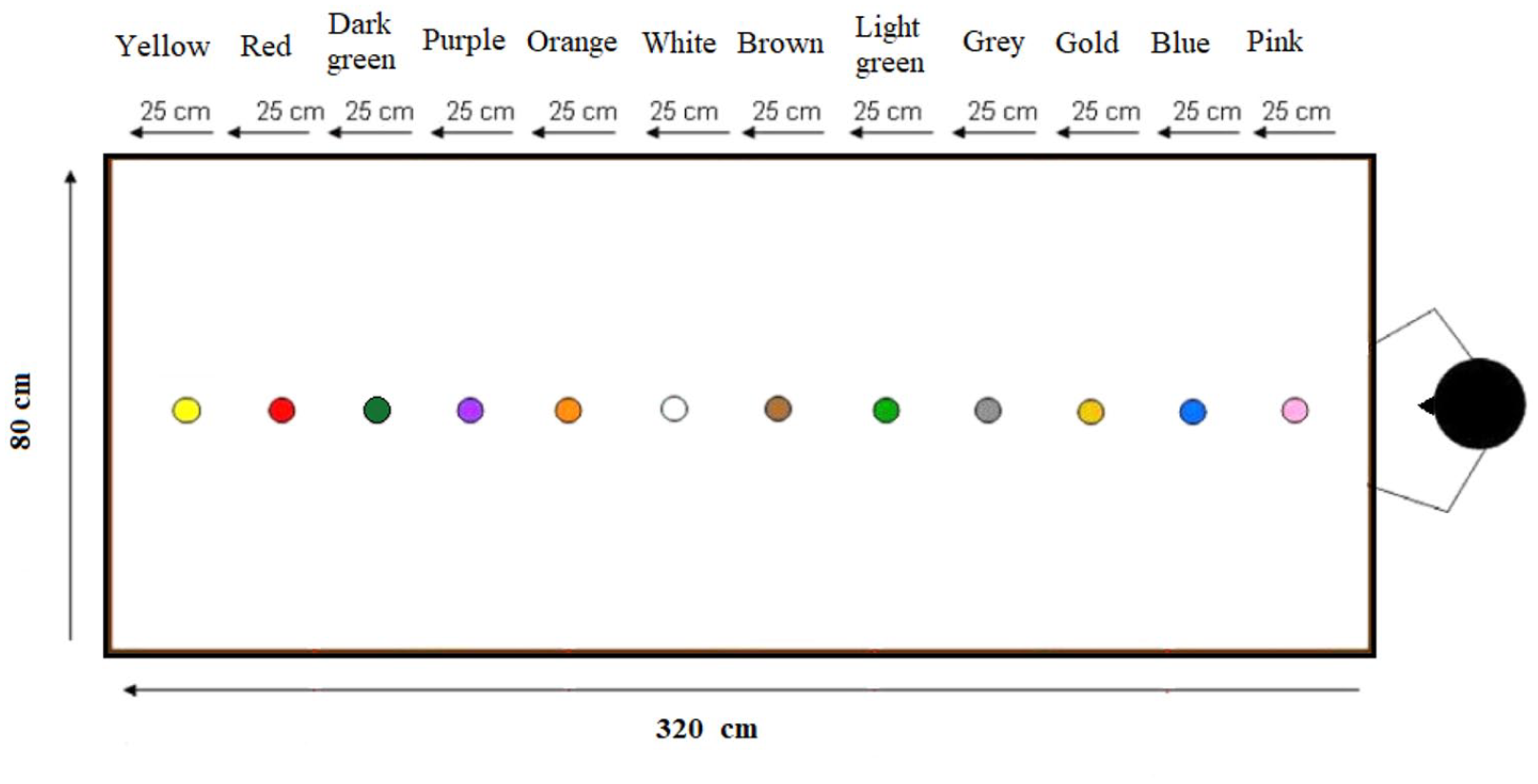
Experiment set up. We used six positions: pink (first position at 25 cm), blue (second position at 50 cm), brown (third position at 150 cm), white (fourth position at 175 cm), red (fifth position at 275 cm), and yellow (sixth position at 300 cm). The space could be divided in three subspaces depending on the participants’ arm reach: one peri-personal space, within participants’ arm reach, and two extra-personal subspaces, out of reach.
During the experiment, the participants sat at the table (within 3 cm distance), in front of the line marked by the coloured dots (40 cm). The experimenter sat either laterally or frontally with respect to the participant. Participants were instructed to memorize the position of the discs that the experimenter was locating on top of the dots. To help the memorization process, participants were asked to use bimodal production: gestural and verbal. Every time the experimenter sat after locating the disc, the participant had to point at the disc (i.e., gestural performance), without standing up or touching the table, thus avoiding change of position and distance relative to the stimulus. In addition, the participant had to produce a sentence consisting of (at least) three verbal elements: a demonstrative, the label of the colour, and the image on the disc (e.g., this/that red moon). Every time the participant performed the gestural and verbal production, the experimenter stood up to locate the subsequent disc on the next location. The trials were randomly interspersed with breaks with memory questions regarding the last position of one or more discs. The total number of trials was 36 per participant divided into two subsessions of 18 trials each. On 18 trials the experimenter sat next to the participant (laterally), and on the remaining 18 trials opposite the participant (frontally). We counterbalanced the order of presentation of the stimuli, the locations of the discs on the dots, and the position of the experimenter to avoid any effect of order. The whole session, from welcoming to debriefing, was conducted in the language of testing (i.e., Spanish) for each participant.
Language background questionnaire
Participants in the SLiN group were also asked to fill in an ethnolinguistic background questionnaire with questions targeting demographic data, experience with language, and other details of daily routines in language use. The questionnaire comprised 20 questions in the participants’ L1 (Spanish) about the participants’ length of residence in Norway, AoA, way of learning Norwegian, languages used at home, frequency of use of Spanish (L1) and Norwegian (L2) across domains of usage (work/leisure/home), and self-assessed L2 level of proficiency. In addition, a couple of questions probed attitudes to the L1 and extent to which the participant was considered a native speaker of Spanish among friends and family back home (see Online Appendix 1). Participants responded to the questionnaire in writing after the memory game test to avoid any bias or focus on the purpose of the test.
Analyses and results
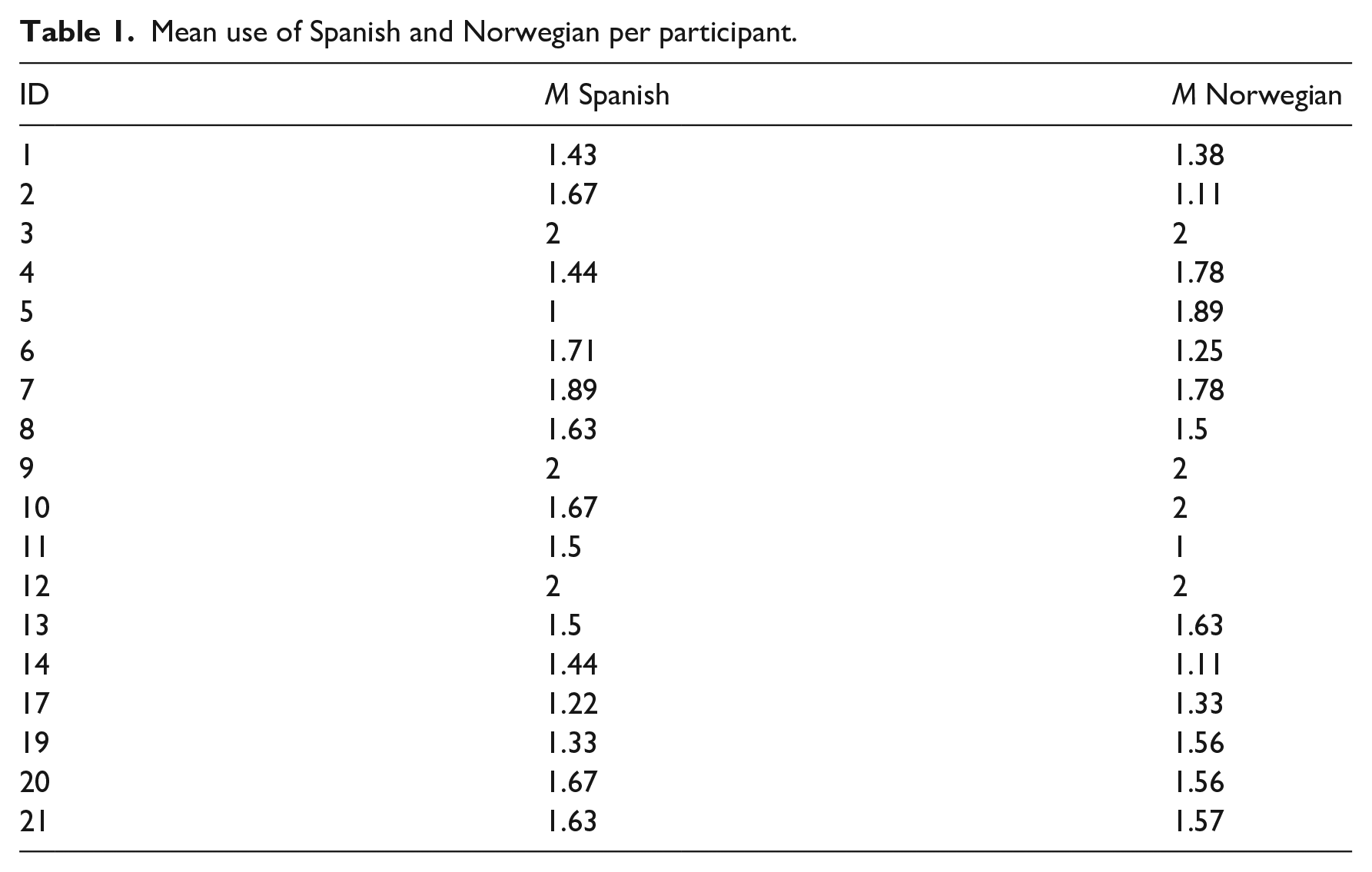
The key dependent variables in the analyses were use of este, ese, and aquel. The predictor variables of interest were distance of the disc from the speaker and position of the hearer, as targeted in the experimental design of the memory game. Predictor variables of interest from the participant questionnaire were time (= length of residence) in Norway (in months), way of learning Norwegian (two levels: Naturalistic/Course), Norwegian (L2) proficiency (three levels: A [basic]/B [intermediate]/C [advanced]), motivation = Is keeping your Spanish important to you (five levels on Likert-type scale, with 5 = very important), and frequency of use of Spanish & Norwegian (with two levels for each language, 1 = frequent & 2 = rarely). Responses to this last question were averaged across the nine different contexts (see Online Appendix 1, Question 14) and the mean score was used in the analyses (see Table 1).
Mean use of Spanish and Norwegian per participant.
AoA in Norway was not pursued in the analyses, since all participants had arrived in the country in adulthood. Moreover, the purpose of the study was to investigate stable adult L1 systems, as hypothesized in Schmid et al. (2013). In addition, motivation was not expected to introduce any variance in the data, as all respondents, except one participant, considered this important. For this reason, it was excluded from further analyses. Native speaker perception by family and friends was also excluded, as all participants had responded affirmatively to this question. Interestingly, one participant had added that they only get occasional comments on their accent.
We hypothesized that the following predictors would predict performance on deictic term for the SLiN group: distance from speaker; Norwegian proficiency; frequency of L1 versus L2 use, and specifically L2 use; and ways of learning Norwegian (naturalistic/course).
Previously reported analyses of performance on the task revealed that the Spanish Living in Spain (SLiS) group used the three terms according to distance from speaker regardless of position of hearer (Vulchanova et al., 2020). Thus, the proximal term este was used to name the two closest distances (25 and 50 cm), the distal term aquel was used exclusively to name the two outmost distances (275 and 300 cm), and the medial (third) term ese was used for the medial positions (150 and 175 cm). This was not the case for the Spanish Living in Norway (SLiN) group, whereby the most prevalent term used was the medial term (ese) regardless of distance from speaker/hearer at a total of 420 times (58.3%). Thus, overall, the Spanish Living in Norway used ese more than those living in Spain (58.3% vs. 38.3%), with minimal reduction in este (27.8% vs. 32.1%) and a notable drop in the use of aquel/aquella (13.9% vs. 29.1%). Multilevel regression models analyses revealed significant fixed effects for distance and for the Language × Distance interaction, but were not significant for language and for position of the hearer (see also Vulchanova et al., 2020). The descriptive data showed that aquel was used only 13.9% of the time in the SLiN group and there were empty cells for that item in the proximal region in the condition when the hearer was opposite. It was thus necessary to run the analyses only for data on este and ese, with aquel removed.
The use of demonstratives by participants was analysed using binomial multilevel modelling in SPSS, allowing residual variance to be partitioned into a between-participant component (the variance of the ‘clustered’ participant-level residuals) and a within-participant component (the variance of the response-level residuals). The Satterthwaite approximation was used to control for unbalanced sample variances. The classification table was used to assess overall model accuracy.
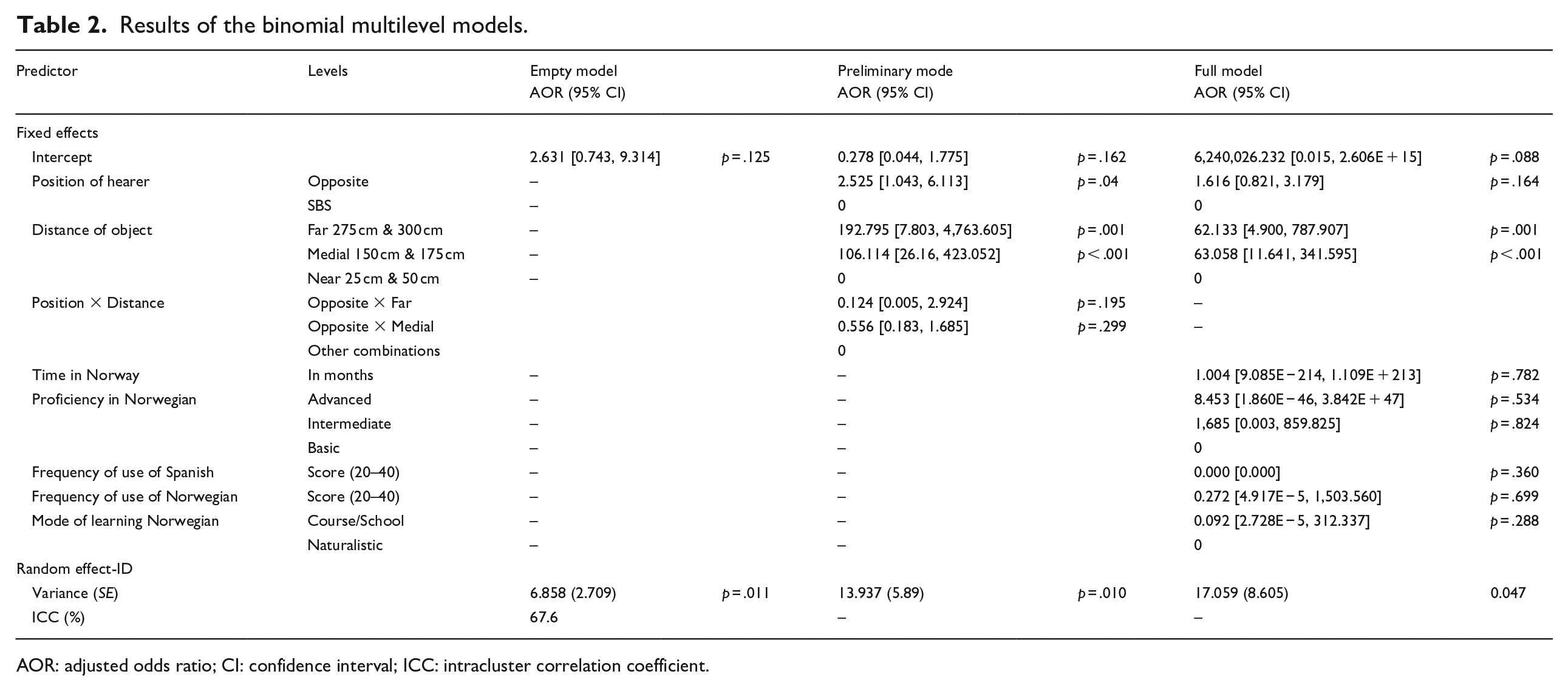
An empty model was run with the participant as the random effect level to confirm the necessity of using a multilevel model. This was confirmed as the empty model identified that 67.6% of the variance was accounted for by the clustering (see Table 2, Empty model, intracluster correlation coefficient [ICC]).
Results of the binomial multilevel models.
AOR: adjusted odds ratio; CI: confidence interval; ICC: intracluster correlation coefficient.
As the literature suggests that for some languages there can be an interaction between proximity/distance of referent in relation to both speaker and hearer (Coventry et al., 2008), a preliminary model was run with just these two terms and their interactions to determine whether the interaction was required in the analysis. This preliminary model was significant, F(5, 614) = 9.51, p < .01, but the interaction term was not significant, F(2, 614) = 1.08, p = .340, and thus did not need to be considered in further models (see Table 2, preliminary model). This initial model remained significant after the removal of the interaction term, F(3, 616) = 14.017, p < .001, correctly classifying 92.7% of responses. The initial model correctly predicted 95.0% of responses where ese was used and 88.0% of responses where este was used, giving an overall percentage correct prediction rate of 92.7%.
The full binomial multilevel model was run with the additional five predictors as identified at the beginning of this section. The model was significant, F(9, 9) = 3.938, p = .025, but only increased the correctly classified responses by 0.5% to 93.2%. Fixed effects indicated that only the distance of object placement was significant, F(2, 545), p < .001. The five additional predictors, namely, position of hearer, time living in Norway, self-rated L2 language proficiency, frequency of use of Spanish and of Norwegian, and mode of learning Norwegian, were not significant. The full model’s fixed effects standardized coefficients (adjusted odds ratios) and 95% confidence intervals can be found in Table 2. The full model correctly predicted 96.0% of responses where ese was used and 87.3% of responses where este was used, giving an overall percentage correct prediction rate of 93.2%.
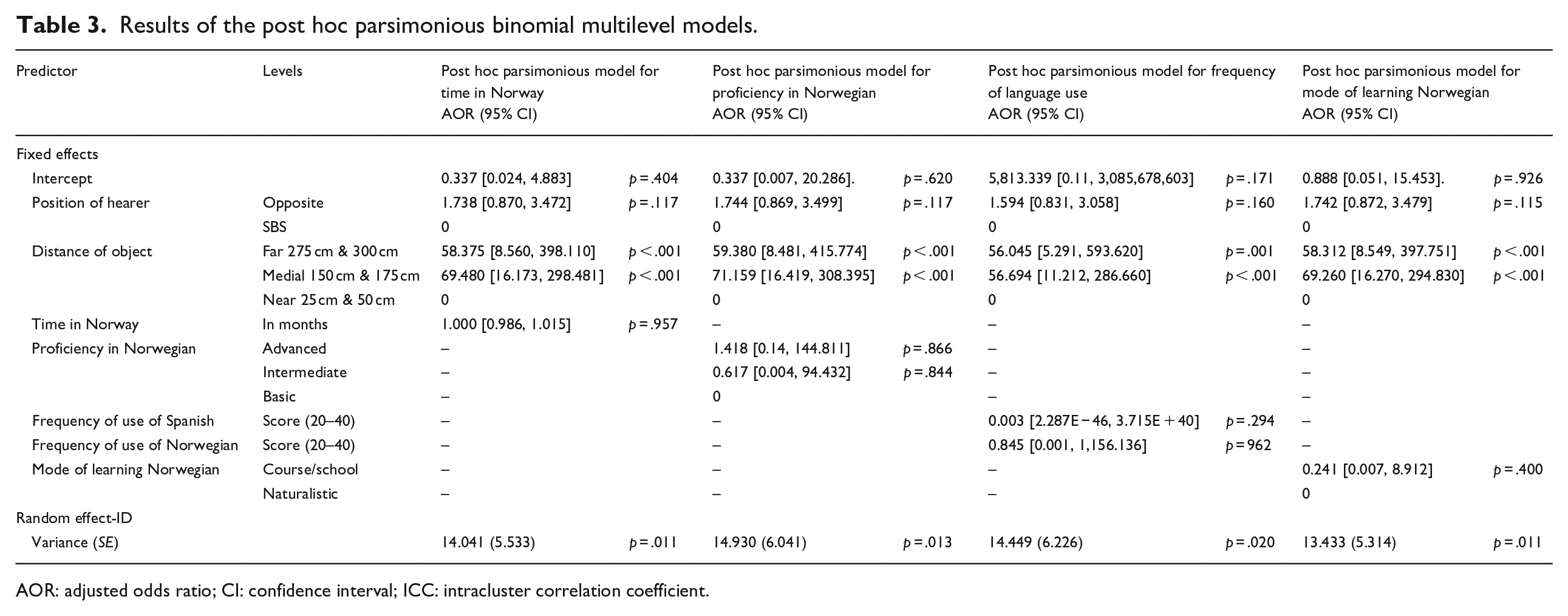
The width of the 95% confidence intervals for the additional variables and the intercept in the full model indicate that the additional variables were imprecise predictors of the demonstrative used. In light of the imprecision within the full model, a parsimonious model was run post hoc for each of the additional predictors individually added to the initial model, that is, with position of hearer and distance of object placement (see Table 3). The 95% confidence intervals returned to meaningful estimates, but each additional predictor remained nonsignificant (p > .05, see Table 3 for coefficients), and had minimal effect on the model classification or on the predictive effect of position of hearer and the distance of object placement.
Results of the post hoc parsimonious binomial multilevel models.
AOR: adjusted odds ratio; CI: confidence interval; ICC: intracluster correlation coefficient.
Discussion
Given that deictic demonstratives are acquired relatively early, are frequent in daily communication, and are deeply rooted in the action system, in the current study we hypothesized that deictic demonstrative use would not be affected by immersed exposure to another language in first-generation speakers who had all moved to the new country in adulthood. Contrary to our expectations, the results indicate a significant difference between the two groups in the use of deictic terms, indicative of a change in the preferred number of terms used, and reflected in extensive use of ese (the middle term) at the expense of both este (proximal term), and mainly aquel (distal term) for the Spanish Living in Norway group. It deserves mention here that these results were obtained despite explicit instruction for the participants to use all three terms. One way of interpreting those data is in terms of language attrition and changes in the deictic inventory available to those speakers, as a result of extended exposure to Norwegian, a language that employs semantically underspecified demonstratives. Indeed, cross-linguistic influence has been shown to impact bilingual language competence (Bice & Kroll, 2015; Gollan et al., 2005). In this case, immersion in and exposure to input from Norwegian might have influenced the observed pattern of performance in the SLiN group as a result of the nature of the Norwegian deictic system. However, the only significant predictor of performance was the distance from the speaker suggestive of the importance of peri-personal space in the use of deictic terms regardless of participant group. In addition, neither frequency of using Spanish or Norwegian, length of immersion in Norwegian nor ways of learning Norwegian predicted performance on the task, as indicated in the additional post hoc parsimonious models. This was not expected against evidence indicative of frequency and domains of usage as decisive in language maintenance and attrition. However, Schmid (2019) observes that the available evidence in research on the role of frequency of use and length of residence points to a complex picture of interaction among external and other predictor variables, including the range of linguistic skills available to the language user. Thus, a possible account might be sought beyond the external factors.
We searched for independent evidence of the use of deictic terms in Modern Spanish beyond the context of the current controlled experiment. Indeed, there is emerging evidence that the use of aquel in Modern Spanish is highly context-dependent and infrequent in corpora of the language (Guijarro-Fuentes & González-Peña, submitted), a finding consistent with the results of the SLiN group. Given this evidence, an alternative account of the SLiN results would be that the observed pattern of performance reflects the bilingual status of participants and is thus driven by what Schmid (2019) labels ‘the range of linguistic skills available to the individual’. Consequently, it can be viewed as the result of processing or resource allocation/interface constraints, rather than language attrition (Chamorro et al., 2016; Chamorro & Sorace, 2019; Sorace, 2011; Wilson et al., 2009). Kroll and Bialystok (2013) argue that bilingual experience has profound consequences for both language and cognition, based on ample evidence that bilingual language use is marked by the simultaneous activation of both languages regardless of target language to be used. The descriptive data for frequency of use of Spanish and Norwegian for the SLiN group suggest a balanced picture across domains of use of both languages, indicative of daily active use of both systems. The current results thus suggest that deictic referential use may change under pressure from bilingual language exposure, and as a result of bilingualism itself, whereby bilingual competence may act as a catalyst. Interestingly, this change appears to observe universal trends of simplification (Seliger & Vago, 1991) and is consistent with both viable and observable trends in the specific language itself, as documented in the corpora data from Guijarro-Fuentes and González-Peña (submitted) and the experimental study by Todisco, Guijarro-Fuentes and Coventry (2021). Thus, the target group participants’ simplified demonstrative system is in line with an ongoing process of reduction of deictic terms in Modern Spanish. The question then arises why this reduced system is not also observed in the performance of the SLiS group. A possible explanation is the experimental format of the testing procedure and the design of the Memory game whose main aim is to elicit deictic pronoun use in a controlled environment. This issue needs to be pursued in future research.
Our results support the idea that it is not the grammar itself that shows changes in first-generation speakers, but rather access to the grammar and the flexibility to map linguistic labels to referents in context. Since mapping between demonstrative form and contextual features that impact deictic use requires cognitive effort, bilinguals may not always be in a position to do the appropriate mapping (Sorace, 2011, 2016, 2020). This may result in simplification and overuse of the most neutral or explicit form that fits a wider range of referential contexts, indicative of adaptive changes as a result of bilingual exposure (Sorace, 2016). The observed extended use of ese (the middle term) at the expense of aquel (the distant term) in the SLiN group can be explained by its underspecified semantic content in that it does not explicitly signal any specific distance from the speaker, thus making it applicable to more contexts. This finding is consistent with evidence from lexical attrition reflected in preference for semantically underspecified items (Schmid, 2011; Schmid & Jarvis, 2014).
Simplification has been documented in other domains of first-generation language use. For example, the study by Tsimpli and colleagues (2004) provides evidence of attrition of subject pronouns in native speakers of Italian, a null-subject language after prolonged exposure to English. This study shows a selective simplification of the original system with inappropriate extension of the explicit form, in parallel with evidence from L2 speakers of such languages. Research on adult and child bilingual speakers of two null-subject languages of the same type found the same over-extension of the overt pronoun (Bonfieni et al., 2019; Margaza & Bel, 2006). The observed simplification and under-specification of referential categories are consistent with the hypothesis that language attrition involves ‘unmarking’ (Smith, 1989). Indeed, markedness theory has been implicated to account for evidence in language attrition studies whereby changes in the L1 are driven by the semantics and frequency of morphemes, as well as historical trends as the factors underlying markedness scales (Hansen, 2001; Hansen & Chen, 2001; see Schmitt, 2019, for a review of markedness theory in relation to attrition). Furthermore, if frequency in input is a powerful influence that modulates the path of least resistance imposed by markedness constraints (Hansen, 2001), the current findings are consistent with the evidence from corpora of Modern Spanish where the distant term aquel is highly infrequent. This simplification of deictic reference is also consistent with the higher prevalence of two-term systems documented in the cross-linguistic survey in Diessel (2005, 2013). Importantly, the current binomial models replicate the results of Vulchanova et al. (2020) with distance from speaker as the only significant predictor of deictic form used. This suggests that marking peri-personal space is a core feature of deictic systems across languages which is preserved also under deictic system shift (see also Diessel & Coventry, 2020).
Limitations of the study and directions for future research
The current study was based on a relatively small sample and employed a controlled experimental paradigm where participants might have experienced processing load, as a result of the testing environment. It is unknown, however, whether participants use deictic pronouns in a similar way in daily situations. Thus, to verify the current results, future research must collect data from free use of deictic pronouns. In addition, an open question is whether participants will regain use of the three-term system after re-exposure to an L1 environment.
Conclusions
The main goal of this study was to explore the extent to which bilingual language exposure and practice might alter the way in which bilingual first-generation speakers are using deictic demonstratives in their first language (Spanish) after immersion in a new language environment (Norwegian). Fully developed L1 systems are expected to be stable and less susceptible to change or restructuring than child systems. In addition, core domains of a language such as deictic demonstrative reference are hypothesized to be more robust. The current study demonstrates a shift in the demonstrative system used by native speakers of Spanish who have resided in Norway on average of 9 years. Neither length of residence nor frequency of use of the L1 or L2 predicted performance in the target group. The shift in the participants’ demonstrative system is reflected in extensive use of the semantically underspecified item ese primarily at the expense of the form aquel specified for longer distance from the speaker. The latter form is also less frequent and highly context-dependent in corpora of the modern language. Thus, it can be hypothesized that first-generation speakers are faster in converging on a simplified system of deictic reference than the native speaker group tested in Spain, but this development parallels tendencies observed in the monolingual variety of the language. This faster shift may well be influenced by immersed exposure to Norwegian, and as a result of bilingual language use.
Supplemental Material
sj-pdf-1-ijb-10.1177_13670069221078610 – Supplemental material for Variation in first-generation L1 deictic systems: Language attrition and bilingualism effects
Supplemental material, sj-pdf-1-ijb-10.1177_13670069221078610 for Variation in first-generation L1 deictic systems: Language attrition and bilingualism effects by Mila Vulchanova, Jacqueline Collier, Pedro Guijarro-Fuentes and Valentin Vulchanov in International Journal of Bilingualism
Footnotes
Declaration of conflicting interests
The author(s) declared no potential conflicts of interest with respect to the research, authorship, and/or publication of this article.
Funding
The author(s) disclosed receipt of the following financial support for the research, authorship, and/or publication of this article: Work on this study has received funding from the European Union’s Horizon 2020 research and innovation programme under the Marie Sklodowska-Curie Actions grant agreement No 676063.

Supplemental material
Supplemental material for this article is available online.
Author biographies
References
Supplementary Material
Please find the following supplemental material available below.
For Open Access articles published under a Creative Commons License, all supplemental material carries the same license as the article it is associated with.
For non-Open Access articles published, all supplemental material carries a non-exclusive license, and permission requests for re-use of supplemental material or any part of supplemental material shall be sent directly to the copyright owner as specified in the copyright notice associated with the article.
