



Abstract
Aims and objectives/purpose/research questions:
This study compares transfer from Dutch to German by native Dutch speakers who learned German as a second language (forward transfer: L1 to L2) and by native German speakers who are living in the Netherlands (reverse transfer: L2 to L1). The aim of this comparison is to see whether both groups experience the same kind of transfer (i.e., transferring the Dutch preference for prepositional phrases in the postfield position to German) and whether the extent of transfer depends on their language use.
Design/methodology/approach:
We compiled a corpus (2,908,154 words) consisting of German e-mails written by native Dutch speakers (n = 21) and native German speakers living in the Netherlands (n = 9). In addition, speakers filled in the BLP (bilingual language profile) test.
Data and analysis:
The corpus was analyzed for the speakers’ placement of prepositional phrases, and we linked their answers on the BLP test to their language use in the corpus data.
Findings/conclusions:
Our data show that the native Dutch speakers use the postfield position more frequently in their German than the native German speakers do. Besides, for both groups, the postfield use was related to the speakers’ use of Dutch as well as German varieties that are influenced by Dutch.
Originality:
This study directly compares forward and reverse transfer using a large corpus of written German texts, and it links both types of transfer to the speakers’ language use. In doing so, the study shows that the mechanism of entrenchment is likely to underlie transfer in both cases.
Significance/implications:
The results of this study are in line with a usage-based approach: there is extensive individual variation between speakers regarding their extent of transfer, which partly can be attributed to the speakers’ language use, both in the case of forward and reverse transfer.
Keywords
Introduction
Language transfer plays a central role for people who use a second language as well as for people who use their L1 in an L2 environment. In both cases, the bilingual speakers have to alternatively use both their languages, which involves activating forms in the language they want to use and simultaneously (trying to) suppress the activation of the corresponding forms in the other language, especially when speakers find themselves in situations in which they want to avoid language mixing. However, strict inhibition of the other language is not always possible and words or constructions of the supposedly deactivated language regularly appear anyway (Blumenfeld & Marian, 2007; Marian & Spivey, 2003; Schmid & Köpke, 2017; Treffers-Daller & Sakel, 2012). This phenomenon is referred to as codeswitching when it concerns using words from the other language, and as language interference or transfer when it concerns grammar.
The difference between transfer in SLA and in contact-induced change is its direction. Research in SLA mainly focuses on “forward” transfer (Cook, 2003), that is, transfer from the speakers’ first language (L1) to the language being learned (L2) (N. C. Ellis, 2006; R. Ellis, 1994). Here, the target is to acquire the language in a way that is as native-like as possible, which means that transfer from the L1 is often seen as an error, something to be avoided (see Jarvis & Pavlenko, 2008, for an overview). In the field of contact-induced change, on the contrary, many studies focus on influence from the L2, often the societal majority language, on the L1 or the original community language (e.g., Backus, 2015; Mougeon et al., 2005; Schmid & Köpke, 2017; Treffers-Daller, 2012; Treffers-Daller & Sakel, 2012). Cook (2003) refers to this transfer as “reverse” transfer, as it occurs from the speakers’ second language to their native language. While in SLA, advanced learners tend to show less and less L1 transfer as their L2 proficiency develops, in language contact scenarios, L2 transfer tends to solidify, especially when social conditions promote ever increasing use of the L2, decreasing use of the L1, and decreasing exposure to non-contact varieties of the L1. Such situations therefore often result in a new, slightly different variety of the language.
The fact that transfer can both occur from the L1 to the L2 (forward transfer) and from the L2 to the L1 (reverse transfer) raises the question whether these two processes are similar. From a usage-based perspective, we would expect the answer to this question to be affirmative, for the following two reasons: First, usage-based approaches place strong emphasis on the cognitive mechanisms that govern our language use. Specifically, they assume that we make use of a set of general cognitive mechanisms, such as entrenchment, categorization, and schematization (Bybee, 2011; Ibbotson, 2013), and that these mechanisms together can account for how we use and process language. From such a perspective, it is therefore particularly interesting to ask which cognitive mechanisms play a role in language transfer, and how. Second, usage-based approaches do not categorically distinguish between L1 and L2 knowledge. Instead, they assume that the same mechanisms organize all our language input and output, irrespective of whether it is in the L1 or L2. This also applies to transfer. From a usage-based perspective, we would therefore assume the cognitive processes that underlie forward and reverse transfer to be the same, or at least to be very similar.
In this paper, we mainly focus on the cognitive mechanism of entrenchment. According to usage-based approaches, words or constructions that speakers encounter frequently, in whichever language, are repeatedly strengthened and therefore become more and more entrenched in the speakers’ minds. Due to these high entrenchment levels, speakers can easily activate these constructions (Blumenthal-Dramé, 2016; Bybee, 2011; Schmid, 2016) and therefore, they are also more likely to select them in subsequent language production (Bybee, 2011; De Smet, 2016; Langacker, 1987). Importantly, bilingual speakers form a language representation that contains words and constructions and their corresponding entrenchment levels for both of their languages (Cook, 2003; Treffers-Daller & Sakel, 2012). As a consequence, when these speakers want to express a given meaning in one of their languages, constructions from the other language may also compete for selection (Blumenfeld & Marian, 2007; Bybee, 2011; De Smet, 2016; Marian & Spivey, 2003; Schmid, 2016). When a given construction in language A is highly entrenched—due to frequent use of that language—it might get activated and used in language B, even if that means using lexical and morphological material from the other language. This shows that the construction of foreign origin is not consciously selected in most cases, but gets activated on the force of its deep entrenchment, 1 which Backus (2015) refers to as “interference through entrenchment” (p. 30).
In previous research, these changes in entrenchment levels have been linked to the notion of language dominance (Köpke & Schmid, 2004; Schmid & Köpke, 2017; Silva-Corvalán & Treffers-Daller, 2016), with language dominance in this case being defined as the language that speakers access more easily. When speakers in an L2 environment use more and more words and constructions in their L2 and therefore these constructions become more and more entrenched for these speakers, it is possible that over time, speakers’ access to the L1 becomes slower than their access to the L2 (Frenck-Mestre, 1993; Köpke & Schmid, 2004; Lachman & Mistler-Lachman, 1976; Schmid & Köpke, 2017), especially for constructions that these speakers use much more frequently in their L2 than in their L1. As Schmid and Köpke (2004) argue, these changes in language accessibility can be classified as a reversal of language dominance: the speakers used to access words and constructions in their L1 faster, but now this has shifted to their L2. This reversal in turn may make it more likely that the L2 constructions interfere during language production, which could result in language transfer. Therefore, the notion of language dominance is a good measure to approach the question of shifting entrenchment levels and how that might influence language transfer (see also Kupisch, 2007; Silva-Corvalán & Montanari, 2008; Yip & Matthews, 2005, who test this assumption in the case of language acquisition by bilingual children), especially as there are widespread, validated questionnaires to assess dominance such as the BLP (bilingual language profile) questionnaire (Gertken et al., 2014).
This (reversal of) accessibility due to changes in entrenchment is likely to influence transfer both in the case of forward transfer by second language learners and reverse transfer by speakers in contact situations, and it can explain when these speakers do and do not tend to experience transfer. When starting to learn a new language, speakers will inevitably have much higher entrenchment levels for words and constructions in their native language than for those in the language that they are just beginning to learn, and at this point, speakers tend to experience a lot of forward transfer (N. C. Ellis, 2006; R. Ellis, 1994), but generally no or only minimal reverse transfer. However, if they continue to use this language very frequently, the entrenchment levels will gradually change, especially when they start to use it more frequently than their native language, for instance, after migrating to another country (Köpke & Schmid, 2004; Schmid & Köpke, 2017). Psycholinguistic studies suggest that immersion in a different linguistic environment can indeed result in speakers becoming faster in accessing words in their L2 than in their L1 (Frenck-Mestre, 1993; Lachman & Mistler-Lachman, 1976; Schmid & Köpke, 2017). For example, Lachman and Mistler-Lachman (1976) conducted an experiment in which native German speakers living in an English-speaking environment were asked to name pictures in both German (L1) and English (L2). Results indicated that the speakers were faster to name the pictures in their L1 in the first years after immigration, but eventually became faster in their L2. These results strongly suggest that language use and entrenchment are closely related, with frequent use of a given construction strengthening its entrenchment and extended periods of disuse weakening it (Langacker, 1987, 2016; Schmid, 2016; Steinkrauss & Schmid, 2016).
However, to the best of our knowledge, no studies so far have tested whether these changes in entrenchment and the resulting reversal of language dominance in turn do really lead to the speakers experiencing more language transfer, and whether that is the case for both forward and reverse transfer. As argued above, transfer from language A to B is particularly likely if a given construction is more entrenched for a given speaker in language A than B. Based on this, we expect speakers who use language A more frequently than language B to experience more transfer from language A to B than speakers who use language A less frequently, and vice versa. To test this claim, this study measures bilingual speakers’ frequency of use of a particular language as a proxy for the entrenchment levels of constructions in that language, and compares it to the extent of forward and reverse transfer in the speakers’ language output.
To do this, we compare German as spoken by native Dutch speakers who learned German as a second language and whose German may therefore contain forward transfer from Dutch (L1) to German (L2), and by native German speakers who are currently living in the Netherlands and whose German may therefore contain reverse transfer from Dutch (L2) to German (L1). The focus of this comparison is the placement of prepositional phrases (PPs). In both Dutch and German, PPs can occur in the “middlefield” (1) and the “postfield” (2) position, that is, before or after the lexical verb (Drach, 1963). However, in Dutch, they occur much more frequently in the postfield position than in German (De Sutter & Van de Velde, 2007; Van Oost et al., 2016). For instance, De Sutter and Van de Velde (2007) analyzed Dutch and German corpora and found that approximately 20% of the PPs occur in the postfield position in Dutch and less than 5% do so in German. Therefore, speakers who use Dutch very frequently are likely to have the schematic construction with a PP in the postfield position stored with a higher degree of entrenchment than speakers who use Dutch less frequently, which makes it more likely for these speakers to select that construction even when speaking German. Transfer from Dutch to German would then be reflected in a frequency increase of the postfield position in German (see Fitch (2011) for a similar interpretation of a frequency increase of the postfield position in Pennsylvania German).
(1) Ich habe den Mann in der Stadt gesehen. (Fitch, 2011, p. 372) I have the man in the city seen I saw the man in the city. (2) Ich habe den Mann gesehen in der Stadt. (Fitch, 2011, p. 372) I have the man seen in the city I saw the man in the city.
Aim and hypothesis
The aim of this project is to compare transfer from Dutch to German by native Dutch speakers who learned German as a second language (forward transfer: L1 to L2) and native German speakers who are living in the Netherlands (reverse transfer: L2 to L1) to see whether (1) both groups experience the same kind of transfer (i.e., transferring the Dutch preference for PPs in the postfield position to German) and (2) whether the extent of transfer depends on their language use of Dutch and German. Based on the reasoning explained in the previous section, we expect that speakers who frequently use Dutch have a higher entrenched representation of the postfield position than speakers who use Dutch less frequently, and therefore also transfer and use the postfield position more often in their German. We expect this for both the native speakers of Dutch (for whom it would constitute forward transfer) and German (for whom it would be reverse transfer), as that would suggest that similar cognitive mechanisms underlie both kinds of transfer.
Method
Participants
The participants in this study worked in the customer service team of a holiday home rental company, which operates from the Netherlands but also rents out houses to German customers. As a result, all employees were highly proficient in German. A total of 30 participants (28 female, 2 male) took part. They were native speakers of Dutch (n = 21) or German who were living in the Netherlands at the time of the study (n = 9). The native Dutch speakers (M = 44.2 years, SD = 14.31) were raised monolingually in Dutch and had acquired German as a second language in high school. Four speakers took additional German classes during their studies: one speaker studied tourism, which included mandatory German classes, and three speakers had studied to become German teachers. Two of them had taught German classes to Dutch students for several years. Seven speakers had lived in Germany for varying lengths of time, ranging from a few months up to 44 years. The native German speakers (M = 38.25 years, SD = 14.25) had all migrated to the Netherlands as adults (i.e., 18 years or older). On average, they had been 27.00 years old when they emigrated (SD = 7.71), ranging from 18 to 40 years. Most of them had moved to the Netherlands because their partner lived in the Netherlands or because of work or college. One speaker had taken Dutch classes in high school in Germany and two speakers took Dutch classes after moving to the Netherlands. All speakers indicated that they had learned most of their Dutch by living in the Netherlands. At the time of the study, they had been living in the Netherlands for an average of 13.64 years (SD = 8.5), ranging from 2 to 26 years.
Corpus
A corpus was compiled, consisting of German e-mails written at work by the participants between 2015 and 2017. The data collection was approved by the company and by the Research Ethics and Data Management Committee of Tilburg School of Humanities and Digital Sciences. All speakers also signed a written consent form agreeing that their e-mails could be included in the corpus. The e-mails were mostly written as a reply to customers’ questions. Therefore, their contents were always about holiday home rental, such as information about houses, booking requests, payment information, and so on. The corpus had a total word count of 2,908,154 words with an average word count of 96,938.47 words per speaker (SD = 126,876.26, min: 3,931 words, max: 513,654 words).
The e-mails were analyzed using a Python script specifically written for the task of counting PPs in the middlefield and postfield positions in German texts, which performed with an overall accuracy of 94.8% on a set of 1,000 randomly retrieved PPs from the corpus (see Supplemental Material Appendix A for a description of the program and its performance). For each speaker, we calculated the percentage of placing a PP in the postfield position (number of PPs in the postfield position divided by the total number of PPs in the postfield and middlefield position).
Measure of language dominance
To measure the participants’ language dominance (and thereby derive a proxy for the entrenchment levels of the German and Dutch constructions), participants filled out the BLP questionnaire. This questionnaire combines questions on language history, language use, language proficiency, and language attitudes for both languages, and can therefore provide a relatively detailed picture about a bilingual’s language experience (Gertken et al., 2014). Scores on the different categories are combined into a continuous measure, referred to as the dominance score, which has been shown to be indicative of other measures of bilingual speakers’ language use (Silva-Corvalán & Treffers-Daller, 2016).
Results
Language dominance
Table 1 shows the German and Dutch language scores as well as the language dominance score for the native speakers of Dutch and German. The dominance score was calculated by subtracting the German score from the Dutch score, resulting in negative values when the German score was higher than the Dutch score (interpreted as the speaker being dominant in German) and in positive values when the Dutch score was higher (interpreted as the speaker being dominant in Dutch). A repeated-measures analysis of variance (ANOVA) with the variables native language (German and Dutch) and language score (German and Dutch) showed a main effect of language score, F(1, 28) = 10.595, p = .003, η 2 = .28. On average, speakers had a language score of 171.79 points for Dutch and a lower language score of 119.91 points for German (see Table 1). There also was an interaction effect between native language and language score, F(1, 28) = 80.46, p < .001, η 2 = .74. Native German speakers scored higher on German than on Dutch, whereas native Dutch speakers scored higher on Dutch than on German (see Figure 1). Importantly, the difference between scores was larger for the native Dutch speakers than for the native German speakers (see Figure 1), which means that while both groups were generally dominant in their native language, this dominance was much more pronounced for the native Dutch speakers compared to the native German speakers living in the Netherlands.
Language scores for the native speakers of German and Dutch, minimum score of 0 and maximum score of 218 for all three measures.
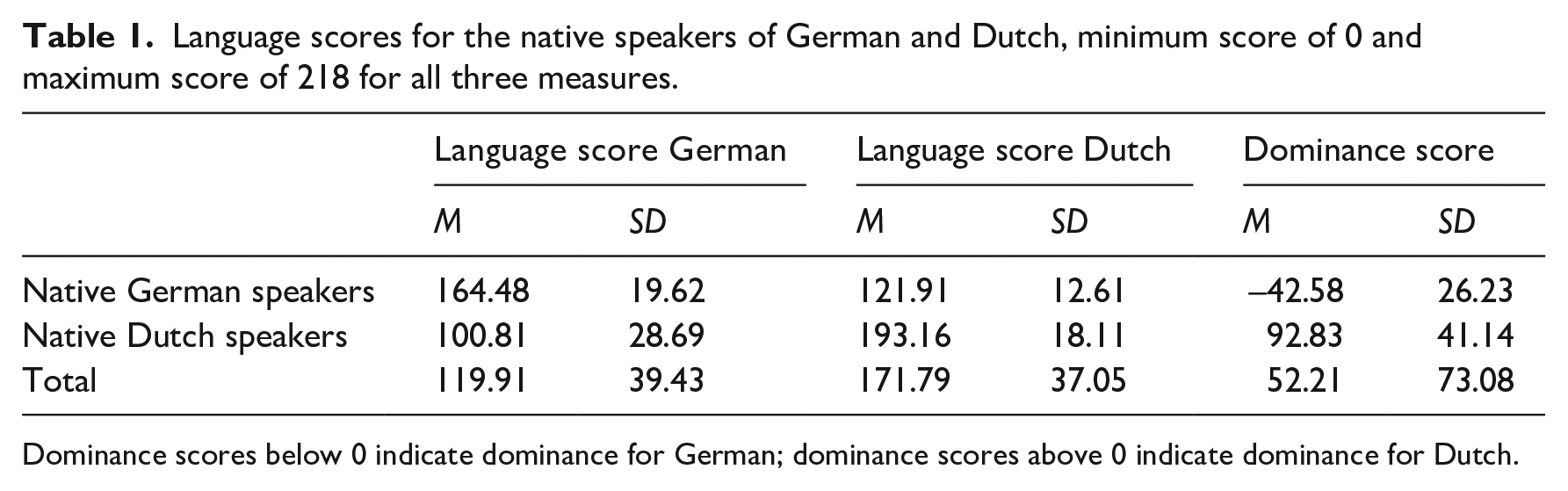
Dominance scores below 0 indicate dominance for German; dominance scores above 0 indicate dominance for Dutch.
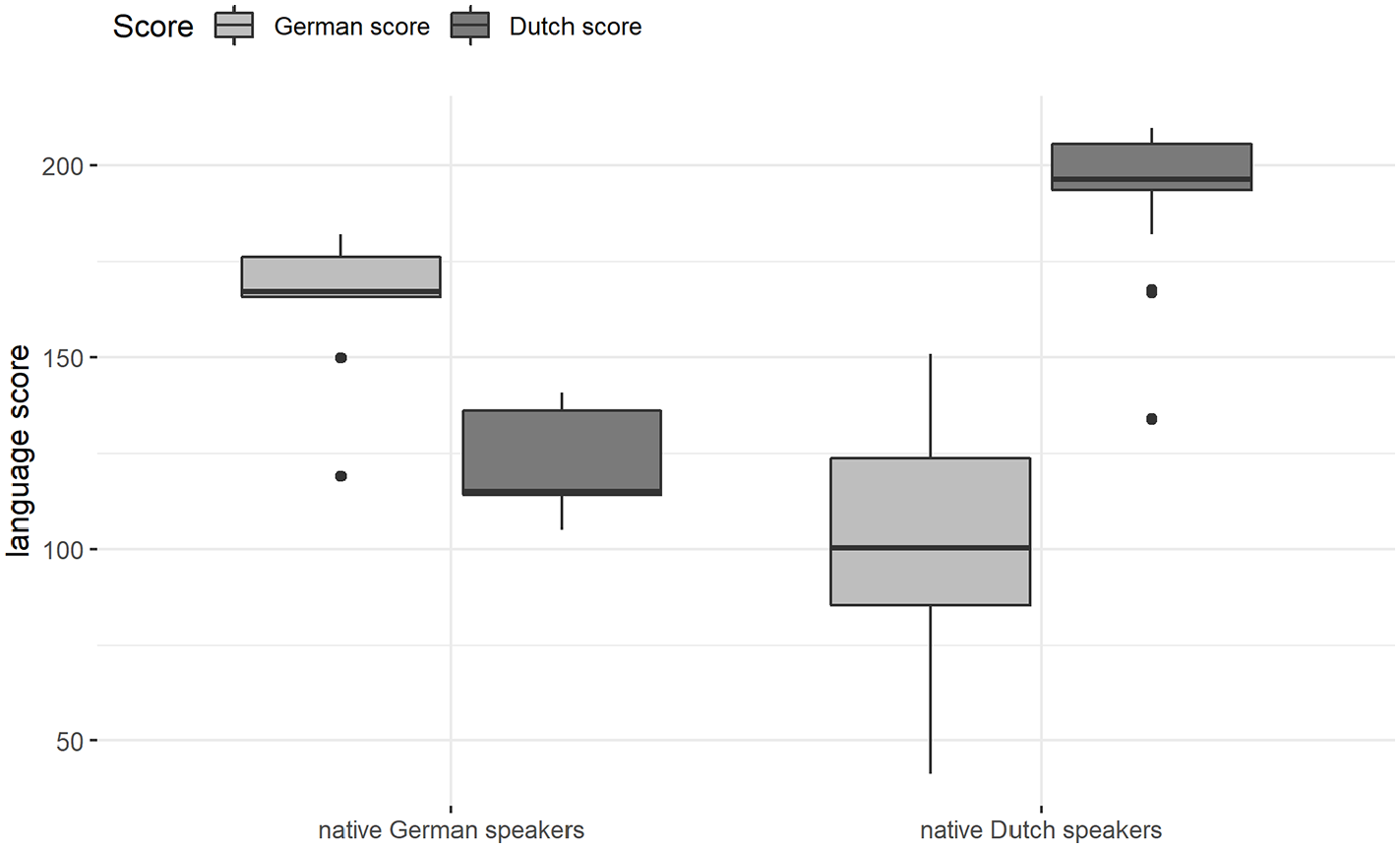
Language dominance scores for German and Dutch for the native speakers of German and Dutch, minimum score of 0 and maximum score of 218.
Language transfer
Table 2 shows the average percentage of PPs in the postfield for the native speakers of German and Dutch. The percentage of PPs in the postfield position was higher for the native Dutch speakers than for the native German speakers, t(28) = –2.43, p = .02, Cohen’s d = 0.91. At the same time, there was considerable variation within both groups (see Figure 2).
Percentage of PPs in the postfield position for native speakers of German and Dutch.
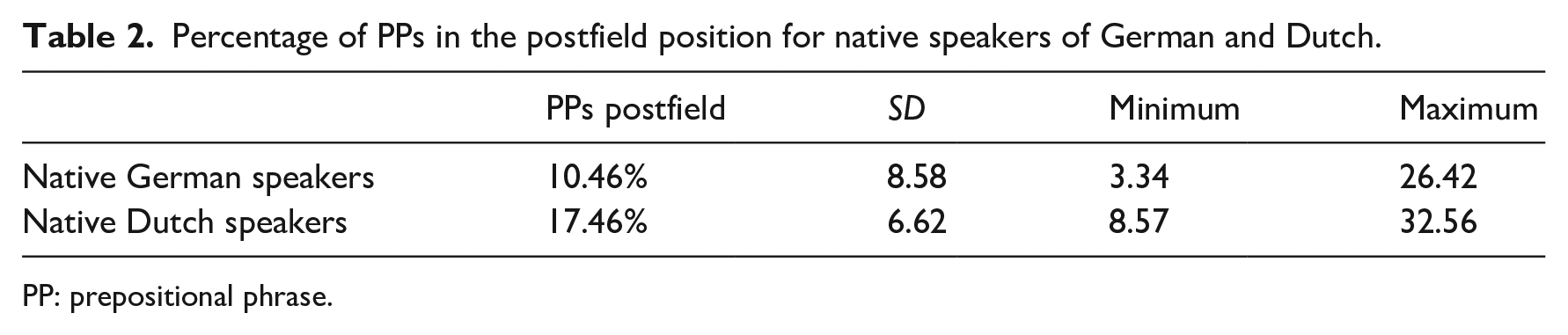
PP: prepositional phrase.
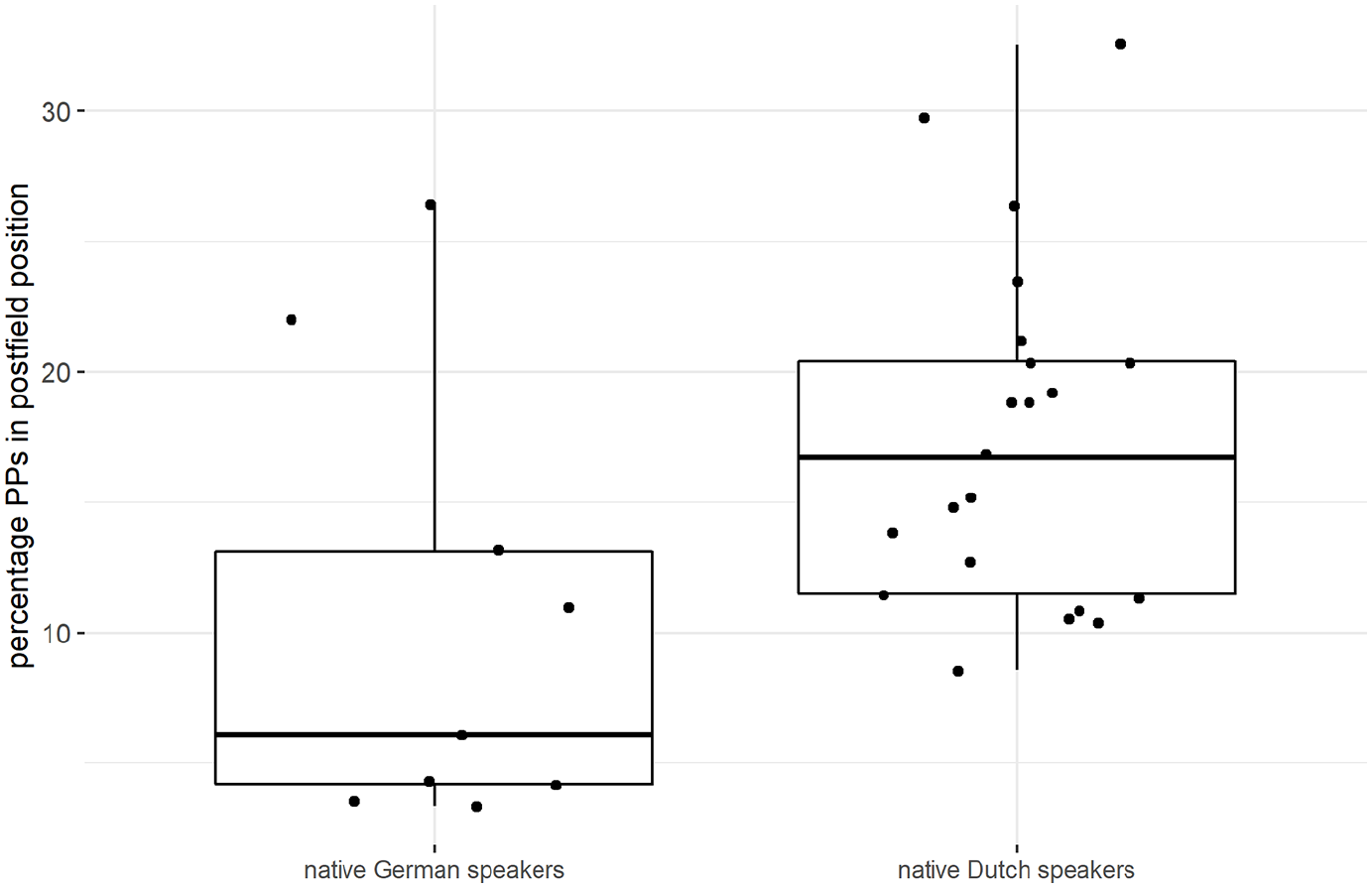
Percentage of PPs in the postfield position for the native speakers of German and Dutch.
Language dominance and language transfer
Figure 3 plots the individual percentages against the speakers’ language dominance scores. As described above, negative scores indicate increasing dominance for German and positive scores increasing dominance for Dutch. Overall, the language dominance score and the percentage of PPs in the postfield were correlated (r = .35, p = .04): the higher the dominance score, the higher the percentage of PPs in the postfield position. However, this relationship did not apply in the same way to the different groups of speakers. The correlation was significant for the native German speakers (r = .82, p = .007: see the left line in Figure 4), but it was not for the native speakers of Dutch (r = –.13, p = .58; see the right line in Figure 4).
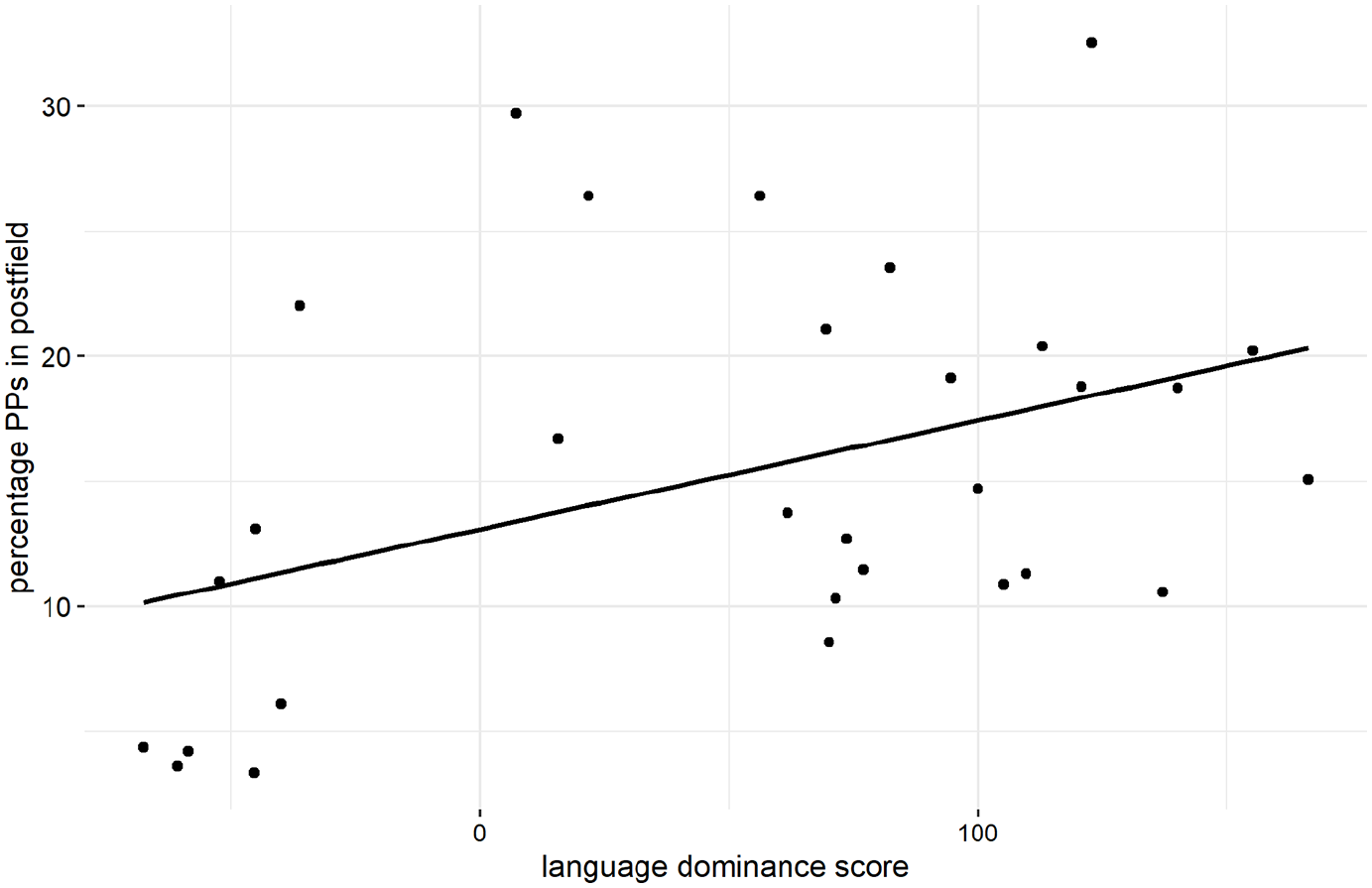
Language dominance score and percentage of PPs in the postfield position.
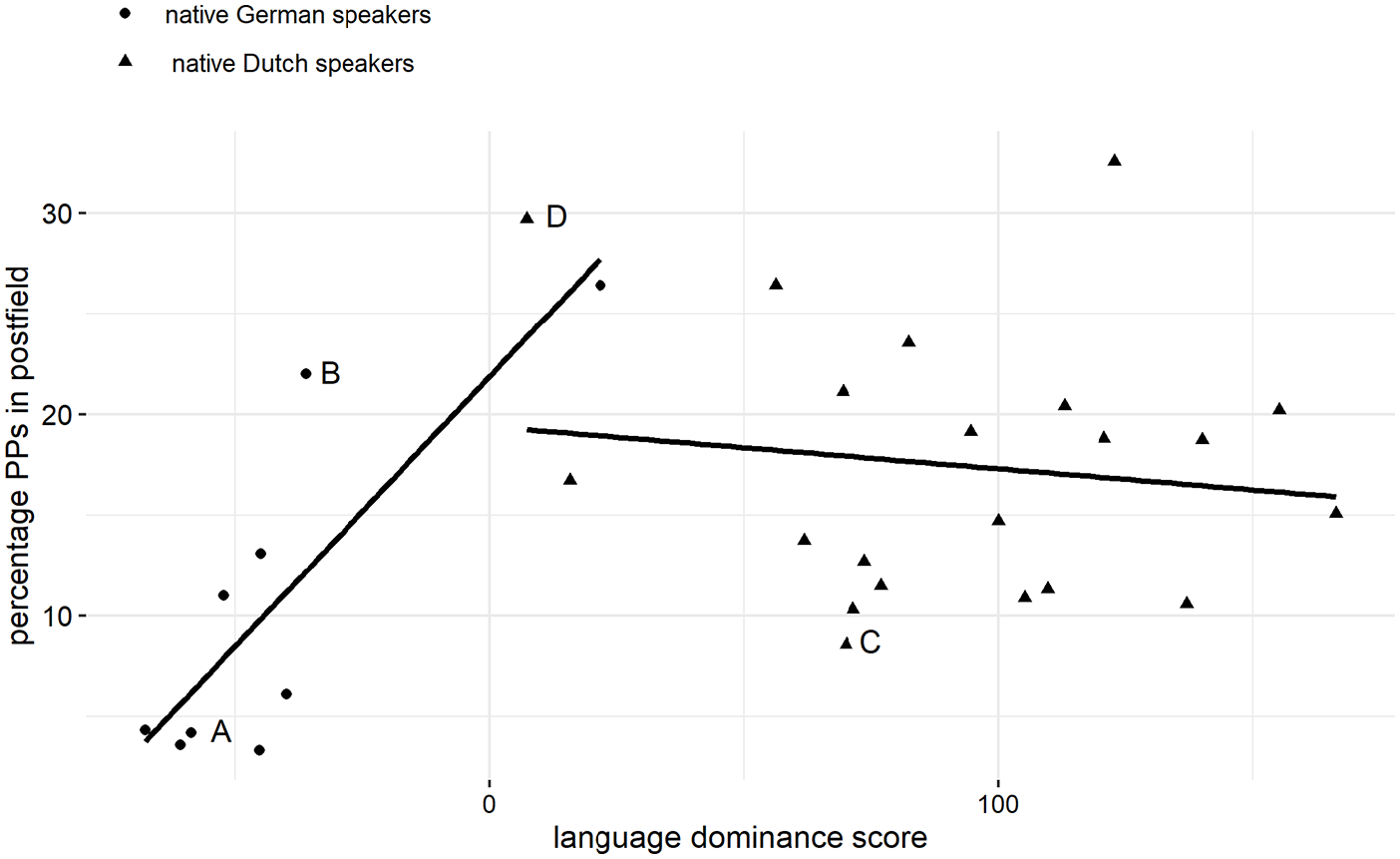
Language dominance score and percentage of PPs in the postfield position for the native speakers of German and Dutch.
Additional information about speakers’ language experience
To further zoom in on the language use of the speakers and to see how it influences the speakers’ extent of transfer, we discuss the language use of our participants in more detail. We start with a brief description of the similarities between the speakers, before highlighting some differences in the language use of some selected speakers (see Supplemental Material Appendix B for additional information for all speakers).
The participants all worked in the customer service department of a Dutch company renting holiday homes. The company’s headquarters was situated in a city in the Dutch province of North Brabant, and all participants either lived in or near that city. For some participants, that meant that they were living relatively close to the German border (see also Supplemental Material Appendix B), resulting in them being frequently exposed to German. Part of their work in the customer service department was to answer German phone calls and e-mails, which means that they also heard and used a lot of German during their work. This was both the German spoken/written by the customers of the company and that of their co-workers. They would, for example, hear each other speak German on the phone or read each other’s e-mails. The primary language to communicate with each other was Dutch.
To further investigate the difference between the native German speakers, we selected two speakers who showed very different percentages of postfield use (speaker A and speaker B, see Figure 4) despite the fact that both of them had been living in the Netherlands for around 20 years. Speaker A indicates that—apart from work—she mostly uses German when speaking with her family living in Germany. That means that when she is exposed to German, it is likely a variety that is not influenced by Dutch. Speaker B migrated to the Netherlands when she was 40 years old. Before that, she had lived together with her Dutch husband in Germany for a couple of years. They have two daughters, who they raised bilingually in Dutch and German. Speaker B indicates that she mostly uses German when talking to her family, which means that the German that she is exposed to is likely to be a German that is already influenced by Dutch, as her husband’s native language is Dutch and her daughters have been raised bilingually in both languages and have lived in the Netherlands for most of their lives. In fact, one of her daughters coincidentally also worked in the same customer service department, which allowed us to also inspect her use of the postfield position. She used that position in around 29.9% of the cases, which is one of the highest percentages overall. 2 These examples illustrate that the language varieties that the two speakers are exposed to, that is, varieties with and without influence from Dutch, might explain why these speakers show such different percentages of postfield use in their own language use.
For the native Dutch speakers, we can also observe different patterns of language use. Most speakers learned German in high school and had continued to use German during their work, though rather infrequently in most cases. This might explain the relatively high percentages of postfield use for most of the speakers. However, some speakers used German much more frequently. For example, speaker C (see Figure 4) studied German to become a German teacher. As part of this study, he had lived in Germany for several months. He indicates that he still has several friends in Germany whom he is in regular contact with and visits frequently. As such, he was, and continues to be, exposed a lot to the German of native speakers living in Germany, that is, to varieties that are likely not marked by influence from Dutch. This might explain why he uses the postfield position in only 8.6% of the cases, which is the lowest percentage of all native Dutch speakers. At the same time, it is important to note here that not all cases are as clear-cut. For instance, speaker D (see Figure 4) shows a relatively high percentage of postfield use at 29.7%. This speaker has been living in Germany with her German husband for the last 44 years and only comes to the Netherlands to work. As such, it is likely that she is more frequently exposed to a German not influenced by Dutch than speaker C, yet she uses the postfield position much more frequently.
Discussion
The aim of this study was twofold: first, we wanted to test whether second language learners and native language speakers living in an L2 environment show the same kind of transfer. Second, we wanted to see whether their language dominance as a measure of the relative entrenchment of words and constructions in the speakers’ L1 and L2 is related to transfer, and whether that is the case for both groups of speakers. In this section, we discuss what our data reveal about these questions as well as what this might tell us about the cognitive mechanisms behind transfer, specifically whether and how levels of entrenchment might play a role.
Regarding the first question, it is important to note that the transfer investigated in this study is a form of covert transfer (Mougeon et al., 2005; also referred to as system-preserving change, Aikhenvald, 2003; or frequential copying, Johanson, 2002). This means that transferring the Dutch preference for the postfield position does not lead to a new construction in German (i.e., the postfield position is also used in “standard” German, albeit infrequently), but to a marked frequency increase of an already existing one. As a consequence, it is difficult to tell whether any particular instance of use of the postfield position really is the result of transfer from Dutch or of activating the less frequent of two existing German constructions. This in turn makes it impossible, at least with the corpus data used in this study, to tell for each speaker how much of their postfield use really constitutes language transfer from Dutch.
Nevertheless, the results strongly suggest that both groups of speakers experience transfer. First, the native Dutch speakers use the postfield position more frequently than the native German speakers, which very likely is the result of transfer of their Dutch preference. We suggest a usage-based explanation. The native German speakers have been exposed to German their entire lives and are likely to have formed a highly entrenched representation of the construction with the middlefield position, as this position is used much more frequently than the postfield position in German (see MacWhinney, 2008, 2011, for a similar argumentation). This high entrenchment leads them to frequently select this construction over the alternative (i.e., the construction with the postfield position), which can explain their overall low percentage of postfield use. The native Dutch speakers, on the contrary, presumably formed a mental representation in which the postfield construction is much more entrenched than it is for the native German speakers. When they speak German, that construction might therefore get activated and used—due to “interference through entrenchment” (Backus, 2015, p. 30)—instead of the conventional German middlefield position. Second, the results also suggest that (at least some of) the native German speakers experience transfer from Dutch, in that the results show that the more dominant they become in Dutch, the more they use the postfield position. Again, this likely is the result of transfer: the more speakers use Dutch, the more entrenched the postfield construction will be for them, and therefore the more likely that this position may occasionally interfere with the preference for the conventional middlefield construction.
These findings are in line with other research in which the language use of second language learners is compared to that of speakers in an L2 environment. For example, Schmid (2014), who describes changes in the speakers’ native language, including changes due to language transfer, in terms of language attrition, compared the language use of a monolingual German control group, a group of advanced L2 learners of German (i.e., native English speakers living in Germany) and a group of L1 attriters (i.e., native German speakers living in Canada). She found that, on a group level, the language use of the L1 attriters was more similar to that of the monolingual control group than the language use of the advanced L2 learners in a variety of categories, such as morphology and word order. At the same time, there was considerable variation within the groups, with many L2 speakers still performing very similar to the L1 speakers. Interestingly, this was not the case for constructions for which their L2 is more complex than their L1, such as morphological marking on noun phrases, which are marked for case and gender in German but not in English. This finding suggests that interference from their L1 makes it more challenging for the L2 speakers to use these constructions in a native-like way (Schmid, 2014). Overall, the results of Schmid’s study are comparable to the results of our study: first, we also observed a significant difference between our groups, with the native German speakers living in the Netherlands overall being less likely to use the postfield position in their German than the native Dutch speakers. Second, we observed extensive individual variation as well, resulting in a lot of overlap between groups (i.e., some native German speakers using the postfield position more frequently than some of the native Dutch speakers, and vice versa; see Figure 4) just as in the study by Schmid (2014; see also Hopp & Schmid, 2013; Schmid & Hopp, 2014, for similar results regarding a comparison of perceived foreign accent between L1 attriters and L2 learners).
Regarding the second question, that is, whether the speakers’ language dominance influences the extent of language transfer both in the case of forward and reverse transfer, the results show that there is a significant relationship between language use and language transfer for the native German speakers, but not for the native Dutch speakers. Instead, for these speakers, the use of the postfield position is stable (and as such, relatively high) across different levels of language dominance. At first sight, these different patterns for the two groups seem to contradict the assumption that entrenchment might underlie both forward and reverse transfer. However, such a conclusion would be too hasty. The concept of entrenchment entails that constructions that speakers encounter frequently, including the middlefield and postfield position, become increasingly entrenched. Therefore, it is important to look at the constructions the different groups of speakers encounter to see whether there are differences between the two groups that might explain the different patterns.
The native German speakers grew up in Germany with German as their only native language. They thus learned, heard, and used German constructions without any Dutch influence, and as a consequence, these constructions became highly entrenched in their minds, especially the middlefield construction. Once they started to learn Dutch, they also stored representations of Dutch words and constructions, including the postfield construction, which became increasingly entrenched as they became more and more proficient in Dutch. At the same time, the entrenchment of the German words and constructions may have started to decrease, because as an inevitable consequence of speaking more Dutch they speak less German in their daily lives. At some point then, the Dutch words and constructions are so highly entrenched, maybe even more so than their German counterparts, that they start to interfere with the German constructions, and it is at this point in time that the speakers start to experience transfer from their second language Dutch to their native language German. However, the results suggest that this is a relatively slow process, as most of the native German speakers show relatively low percentages of transfer, even after having lived in the Netherlands for several years: the middlefield construction proves robust. This suggests that in a Second Language Acquisition setting, the constructions in a native language are so highly entrenched to begin with, that they can resist influence from another language for a long time (MacWhinney, 2008, 2011). Importantly here, the results also suggest that the extent of transfer highly depends on the kind of German that speakers continue to be exposed to. Most speakers indicated to still be in regular contact with family members who are living in Germany, and therefore they are likely to continue to be exposed to German that is unaffected by Dutch patterns. However, there are also some speakers who have extensive exposure to a German variety heavily influenced by Dutch, and those speakers tend to show much more transfer in their own language use.
The native Dutch speakers, on the contrary, already know Dutch when they start to learn German, and the Dutch words and constructions are already entrenched in their minds, much more so than the German counterparts they are just beginning to learn. Therefore, they are likely to experience extensive transfer from Dutch to German from the very beginning of learning German. Importantly, whenever they use a word or construction in German, its mental representation is strengthened and thereby becomes increasingly entrenched, including the representations of words and constructions that were influenced by transfer from Dutch. By entrenching these transferred forms, speakers form a representation of the German language system that is quite different from the representation that is acquired by a monolingual German speaker, both in terms of what elements the system includes and how highly entrenched each element is. Speakers thus acquire their own form of an individual German contact variety, in which, for instance, the use of the postfield position is likely to be much more entrenched than it is for speakers who learned German without any Dutch influence.
When the second language learners start to use more German in their daily lives, it is likely to be this contact variety that they use. This is also supported when looking at the individuals’ language backgrounds in more detail. Most speakers indicated to use German rather infrequently and that when they did use it, to mostly use it in a Dutch context, which makes it likely that the German they use and are exposed to is heavily influenced by Dutch. This means that when these speakers use German, they are likely to frequently use the postfield position and to thereby constantly strengthen its representation, which can explain why the percentage of PPs in the postfield position was so stable across different levels of language dominance for these speakers. Importantly, there are also some speakers who are frequently exposed to German as spoken in Germany, for instance, by having lived in Germany or by being in contact with German friends. Our results showed that these speakers tend to use the postfield construction less often, which suggests that exposure to a non-contact variety of German, which likely does not contain frequent use of the postfield position, could help explain their lower rates of postfield use. Again, these findings suggest that the German language variety that speakers are exposed to greatly influences the extent to which speakers use the postfield position in their own German language use.
In sum, the different patterns observed by the native German speakers and the native Dutch speakers might be explained by assuming that the representations of the German language system, which the speakers acquire by entrenching frequently occurring schematic items, differ from each other. Crucially, this finding calls for a rethinking of how we should define and measure language usage. General questions such as the ones asked in the BLP test (e.g., “In what percentage of the time do you speak German with your family/friends/etc.?”) are too global to capture the (contact) variety that speakers use, specifically here whether the German they hear on a daily basis contains transferred forms from Dutch, which is very likely to be the case both for native Dutch speakers who learned German as a second language and also for the native German speakers who are now living in the Netherlands and have previously experienced transfer from Dutch. When speakers use this contact variety of German, they further entrench the Dutch-influenced forms (in this case: the use of the postfield position), either because they experience new transfer from Dutch or because they re-activate forms they have previously transferred and stored. To illustrate this effect, think again about speaker A who mainly uses German with her family in Germany and speaker B who uses German with her daughters who grew up bilingually. As the German that these speakers are exposed to probably contains minimal use of the postfield position in the case of speaker A and frequent use of this position for speaker B, speaker A is likely to reinforce the entrenchment of the German middlefield construction when using German, whereas speaker B is likely to entrench the Dutch-like postfield construction more. In that sense, speaking German is likely to lead to less use of the postfield position in German for speaker A and more use of that position for speaker B.
The finding that the kind of language variety that speakers hear around them is likely to influence their own language use has also been attested in previous research. For example, Köpke (2004), who investigated the language use of native German speakers who migrated to Canada, showed that—other than expected—it was a speaker who continued to frequently use German as a member of a German club in Canada who showed the most changes in the way she used German. This finding is in line with the results of our study: for example, speaker B who showed a relatively high percentage of postfield use also still frequently uses German. Similarly to the German migrant in Canada who uses German with other German migrants, speaker B uses German with her bilingual daughters whose German is likely to contain a lot of Dutch influence. As such, both Köpke’s (2004) results and the results of this study show that frequent exposure to a contact variety of the native language might be precisely what allows the transferred constructions to be heard, to be used, and to become entrenched. As Köpke (2004) argues, “in this way, the contact with other migrants can be seen as a factor preventing L1 maintenance in the sense of the L1 variety spoken in the home country” (p. 1341).
Overall, the results of this study thus clearly underline the importance of assessing the kind of language variety that speakers use, which we tried to do in our study by describing our participants’ language experience and language use in detail and looking for patterns within these descriptions. Future research could approach this challenge in a more systematic way, for example, by asking participants to answer questions about their language use, while not only distinguishing between their use of their L1 and L2, but also between the use of each language with speakers who are still living in the country of origin (e.g., German speakers living in Germany) or with other speakers living in the L2 environment (e.g., German speakers living in the Netherlands). At the same time, it is important to note here that, as was also shown in this study, there is considerable individual difference regarding the extent of using transferred constructions within the group of speakers living in the L2 environment. This means that knowing how often participants speak with other migrants could still not fully inform us about how often they are exposed to transferred constructions in their L1. Nevertheless, this approach would be more informative than only asking about speakers’ L1 use in general, and future research should therefore include how speakers use these different varieties of their L1 in the analysis of language transfer.
Conclusion
Overall, the results strongly suggest that both groups of speakers experience transfer from Dutch to German, at least for this kind of transfer. Importantly, the extent of transfer in both groups seems to depend on language use, with speakers who are frequently exposed to the postfield position, either by using a lot of Dutch or a contact variety of German that is already influenced by Dutch, being more likely to use the postfield position in their own language use. Overall, these findings fit very well in a usage-based explanation: the more speakers are exposed to a particular construction in Dutch, the more this construction becomes entrenched, and the more likely speakers are to use it even when they are speaking German at that moment. If the transfer occurs frequently enough, speakers also form a representation of the transferred form and continue to entrench it with each subsequent use, eventually leading them to use the transferred form even more frequently.
Supplemental Material
sj-docx-1-ijb-10.1177_13670069211052517 – Supplemental material for Comparing forward and reverse transfer from Dutch to German
Supplemental material, sj-docx-1-ijb-10.1177_13670069211052517 for Comparing forward and reverse transfer from Dutch to German by Marie Barking, Maria Mos and Ad Backus in International Journal of Bilingualism
Supplemental Material
sj-docx-2-ijb-10.1177_13670069211052517 – Supplemental material for Comparing forward and reverse transfer from Dutch to German
Supplemental material, sj-docx-2-ijb-10.1177_13670069211052517 for Comparing forward and reverse transfer from Dutch to German by Marie Barking, Maria Mos and Ad Backus in International Journal of Bilingualism
Footnotes
Declaration of conflicting interests
The author(s) declared no potential conflicts of interest with respect to the research, authorship, and/or publication of this article.
Funding
The author(s) disclosed receipt of the following financial support for the research, authorship, and/or publication of this article: This publication is part of the project “Two Languages in One Mind” (with project number PGW.18.019) which is financed by the Dutch Research Council (NWO).

Supplemental material
Supplemental material for this article is available online.
Notes
Author biographies
References
Supplementary Material
Please find the following supplemental material available below.
For Open Access articles published under a Creative Commons License, all supplemental material carries the same license as the article it is associated with.
For non-Open Access articles published, all supplemental material carries a non-exclusive license, and permission requests for re-use of supplemental material or any part of supplemental material shall be sent directly to the copyright owner as specified in the copyright notice associated with the article.
