



Abstract
Aims and objectives:
This paper captures social dimensions of language in highly diverse small-scale multilingual contexts that appear to pose challenges for (socio)linguistic description and documentation. I focus on the seeming contradiction of monolingual imaginations of places with heterogeneous and multilingual inhabitants, on great fluidity and variability of language use and the concomitant limits of reification-based identification of codes, and on personalised repertoires shaped by individual trajectories and relational, rather than categorical, stances.
Approach:
I propose patterns and perspectives as two interrelated dimensions to guide research in configurations of this kind, illustrating epistemological and methodological points through data from multilingual settings in Casamance, Senegal.
Data and analysis:
I focus on data collected in the village of Agnack Grand and its surroundings, but also include data from across the Lower Casamance and adjacent regions of Guinea-Bissau, discussing patterns of multilingual organisation and extracts from conversation and how their speech forms are categorised.
Findings:
The paper brings sociohistorical dimensions of small-scale multilingualism to the fore and identifies their lasting influences on spatial representations of language regimes. Linguistic spaces influence perspectives on speech events taking place in them and circumscribe speech participants’ and observers’ choices in describing repertoires, producing and analysing speech forms. Beyond the selection of language modes, perspective also determines how speech forms are categorised. I demonstrate that the patterns speakers and observers have experienced and the perspectives they assume are decisive in shaping their perception.
Originality:
My central observation is that there is no objective, neutral viewpoint on (multilingual) speech, but that positionality frames it at all levels. I develop new epistemologies for studying these dimensions.
Significance:
Putting the categorisation processes employed by speakers and observers and their underlying motivations centre stage and integrating sociolinguistic and anthropological linguistic methods and historical knowledge into linguistic description and documentation constitutes an innovative research programme.
Keywords
Introduction
Small-scale multilingualism is a type of multilingualism in which individuals maintain complex repertoires in locally confined languages because of their social indexical values. Small-scale multilingualism is studied in an emerging inter- and multidisciplinary field of descriptive and documentary linguistics investigating these non-polyglossic multilingual settings often originating in precolonial times (see Lüpke, 2016, Pakendorf et al., 2021 for an overview). This field of study requires holistic approaches combining linguistic and sociohistorical outlooks, since language regimes in complex small-scale societies are influenced by settlement, cohabitation and political organisation at various levels, as outlined in the remainder of the introduction. These dynamic factors give rise to patterns, here understood as sociospatial arrangements and placements over time sedimented into perceptual structures that can find expression in ideas of language.
While speech has objective and verifiable acoustic properties, its transcription and categorisation are dependent on perspectival judgements, including those on speakers’ identities. Sometimes, particular perspectives are established through linguistic norms reflected in standard registers. Such registers are common in regulated linguistic spaces but absent from diffuse linguistic settings (Le Page & Tabouret-Keller, 1985) such as the one in the focus of this paper. These settings are characterised by the absence of established standards or widely shared prototypes (Watson, 2019) that could serve as a baseline for the categorisation of multilingual speech. In fact, in the light of the limited available grammatical description and the absence of detailed dictionaries for many languages, it is impossible to even assume a heuristic baseline through relying on reifications drawn from description (Blommaert, 2008; Makoni & Pennycook, 2007). Not only is speech is highly variable, but establishing which codes are represented in it and whether forms identified as ‘foreign’ are code-switched or borrowed also depends on vantage points influenced by repertoires of speech participants and observers and on processes of erasure and iconisation. These processes stem from language ideologies (Schieffelin et al., 1998), which influence and are recursively shaped by language territorialisation.
Against the backdrop of patterns and perspectives as a conceptual framework, this paper answers the following research questions, based on case studies from the Lower Casamance region in Senegal:
(a) Who constructs linguistic spaces, when, where and for whom? Are regional structural patterns recognisable that result from similar language ideologies or practices? How do the structures of linguistic spaces change over time, and in response to what socio-political circumstances?
(b) Who reports and categorises repertoires in terms of named languages and registers, how and in which context? Which ontologies are used by different speech and research participants and observers and what insights do naming patterns allow on the rationale underlying them?
(c) Who categorises speech, how, where and when? Which aspects of linguistic, social and spatial knowledge influence categorisation?
In the Casamance, speakers navigate languages of great social, genealogical and typological contrast, as well as closely related lects set apart only by a limited number of emblematic features and containing a large pool of common features (see Figure 1 ). Depending on scale (Gal, 2016; Irvine, 2016), these lects can be conceptualised as single, regional languages, if widely shared features are foregrounded, or as village-based patrimonial languages when locally salient features are emphasised, based on socio-political motivations. Multilingual repertoires can be acquired in one place or through the trajectories of individuals, connecting them to different places and their language regimes, causing them to dynamically adapt their repertoires throughout their lifetime, and finding reflection in linguistic convergence and divergence in their speech (Watson, 2018, 2019).
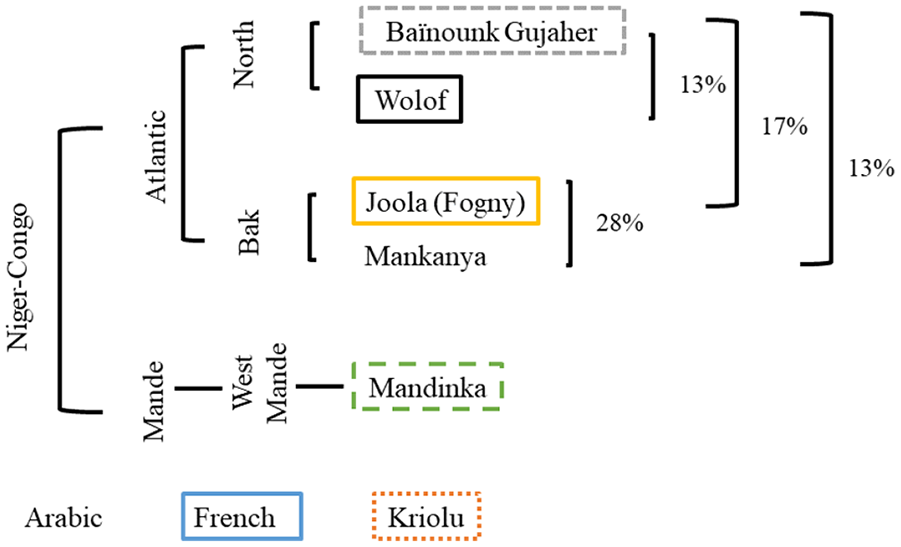
Self-reported repertoire of ANM, with lexical genealogical relatedness and similarity percentages indicated by brackets.
Speakers’ and observers’ full linguistics experiences influence their categorisation and constrain their indexical options (Silverstein, 1976, 1979, 2003); that is, which signs can be invested with social meaning. In the many small-scale multilingual settings where speech communities do not correspond to language communities (Silverstein, 2015), but constitute spaces in which people with very personal multilingual repertoires cohabit, it is of central relevance to investigate how variable signs achieve indexical meaning for individuals with different practices and trajectories. Building on Gal’s and Irvine’s seminal research synthesised in their (2019) book, and extending it to the study of naming and categorising speech forms, I investigate how social experiences, expectations and positions circumscribe the vantage point from which speech and research participants make sense of signs. Through extracts from conversation, I illustrate how the perspectives of speech participants, researchers and transcribers influence the composition and analysis of multilingual speech events and speech forms, starting with transcription choices. In the mostly open-air, inclusive, conversational spaces of Casamance, transcribers’ and researchers’ perspectives on the nature of speech events are pivotal for the selection of participants to transcribe or eliminate. Social and linguistic features are equally decisive for the association of speech with a named language. An important number of linguistic forms, including many phonetic features, are shared across language boundaries. Therefore, repertoires and (meta)linguistic knowledge and viewpoints of analysts and hearers are crucial for the categorisation of speech as mono- vs. multilingual, of speech forms as borrowed vs. inherited, and for their tagging as belonging to one or several named language(s). In the absence of a language institution creating standard languages and authorising their licensed forms, and in the absence of authoritative etymological research allowing to identify source languages at least in historical perspective, many speech forms can be categorised in multiple ways. Their potential ambivalence entails that whenever they are identified as belonging to a named language, several options exist. Rather than seeking an ultimate and unequivocal linguistic categorisation or simply labelling them as floating, this paper suggests studying the processes underlying their categorisation. The investigation of these processes lays bare fault lines linked to different perspectives that are crucial in order to reveal the different relational motivations underlying them, reflected in practice and judgements (Goodchild, 2016, 2019, forthcoming; Goodchild and Weidl, 2018; Weidl, 2019).
In small-scale multilingual societies, language use and linguistic identities are not categorical but relational (Di Carlo et al., 2020). These multiple linguistic identities are incompatible, contradictory or incoherent from ethnonationalist perspectives, since they are situationally negotiated. Perception therefore should not just be seen as prone to be influenced by observer’s paradox, designating the fact that the presence of researchers changes the circumstances they desire to observe (Labov, 1972). Building epistemological reflections on perspective and positionality into a research programme and integrating sociolinguistic and ethnographic methods such as semi-structured interviews and participant observation into its design constitutes an important step towards a multilingual and sociolinguistically informed turn in descriptive and documentary linguistics. While such a turn is of prime relevance for small-scale settings, in which the indexical potential of language is unsurpassed, perspective shapes and constrains speech participants’ and linguists’ ideas about language(s) everywhere. Looking beneath and beyond denotational codes at their social meaning and how it is construed and conveyed, by whom and to whom, is thus of general importance for social and (socio)linguistic theory.
The geographic focus of this paper is on complex rural multilingual language ecologies in which (Baïnounk) Gujaher is or was a patrimonial language. A short introduction adopting a genealogical perspective is provided here in order to enable the reader to arrive at a rough appreciation of the intermingling of speakers of very diverse languages and their options both in speaking and categorisation. Gujaher is a language of the Nyun cluster in the Nyun–Buy node of the North branch of the Atlantic family, a contested branch of Niger–Congo (Pozdniakov & Segerer 2017). The language is associated with approximately 20 villages in Southern Senegal and adjacent Northern Guinea-Bissau. Gujaher is one recognised variety in the Nyun cluster, alongside Gunyaamolo, Gubëeher, and Djifanghor Nyun. Its sister language in the Nyun cluster, Guhaja (Cassanga/Kasanga in Portuguese), has its home base in nearby Guinea-Bissau. Many Nyun speakers have adopted Baïnounk ethnic identity since the second half of the 20th century (Bühnen, 1994). This recent identity is not based on a shared language and sometimes includes Guhaja as well. Other Atlantic language clusters spoken in the area belong to the Bak branch of Atlantic (Joola, Manjak, Mankanya, Pepel and Balant) or to the Mande family of the Niger–Congo phylum, (Mandinka). In addition, a Portuguese-based Creole (Kriolu), has been attested in the wider area since the 17th century. The official language of Senegal, French, and its most widely spoken language, Wolof, spread through French colonisation and national importance in the postcolonial state of Senegal.
Gujaher expresses a strongly localised identity concept unknown beyond a very small-scale local sphere. There is no exonym for Gujaher, since outsiders are not aware of its existence and classify its speakers as belonging to the present-day Baïnounk ethnic group, if they have awareness of Baïnounk in the first place. Speakers refer to themselves as Ujaher in the singular and Ñanjaher in the plural. 1 The term Baïnounk is an outsider term without an equivalent in any of the Baïnounk languages. In the remainder of the paper, I investigate through which patterns languages become associated with places in villages associated with Gujaher and beyond in the second section; demonstrate how these patterns influence perspectival categorisation of speech events and their speech forms in the third section; and outline a research programme integrating these notions into multilingualism research in the fourth section.
Patterns of language territorialisation
Small-scale multilingual societies in the Lower Casamance are built on an apparent paradox: most places are associated with one language, apparently resembling miniature ethnolinguistic nation states. Yet, their inhabitants do not conform to the image of linguistic citizens of monolingual places, nor are places built around the notion of a shared linguistic and cultural identity. The dialectic relationship between unequivocal associations of spaces with particular languages and the heterogeneity of their inhabitants is caused by complex sociospatioal patterns described in the remainder of this section.
Heterogenous and dynamic spaces
In linguistic descriptions, public discourse, and polities, villages or wards in the Lower Casamance are unambiguously associated with languages, and multilingualism and mobility are often seen as recent phenomena disturbing a prior monolingual order (e.g., Sagna & Hantgan, 2021). A closer look at settlement patterns through history and on their consequences on language use and language territorialisation reveals that heterogeneity and multilingualism have existed in the area throughout history. Historians and anthropologists are unanimous in describing the Upper Guinea Coast where the Casamance is located as an area in which adaptation, assimilation, migration and (gendered) mobility have been and remain the source for heterogeneous settlements in Frontier societies (Baum, 1999; de Jong, 2010; Green, 2012; Hawthorne, 2003; Mark, 1985; Van der Klie & de Jong, 1995). Similar observations hold for West Africa more generally (Green, 2019; Lentz, 2013), and African Frontier societies are places in constant flux because of self-perpetuating settlement processes perceiving them as empty and ready for being claimed (i.e., as new Frontiers), described by Kopytoff as follows: [In an internal frontier area, a] new immigrant compound becomes the nucleus of a hamlet. In time, the hamlet grows into a village as it attracts relatives from back home and other settlers that have been similarly ejected from the surrounding societies onto the frontier. Sometimes the new settlement solidifies, joins with other settlements or establishes a hegemony over them, and finally crystallizes into a new polity and eventually a society. (Kopytoff, 1987, p. 6)
To these continuous reconfigurations through migration of small lineages and landlord–stranger cohabitation dynamics (Brooks, 1993) must be added continuous transformations due to long-distance trade across the Sahara and Mande migrations westwards in the last millennium. The Upper Guinea Coast has also been entangled in early Iberian networks and the transatlantic slave trade from its inception. The first Portuguese travellers already found a complex multilingual mosaic in place, as illustrated by the following statement by Fernandes from 1506: The Casamance river is a great trading river. . . in this kingdom people of all nations [geraçoes] are mixed together, Mandinkas, Floups [one of the precursors of the Joola ethnic group, FL], Balantas and others. (translated by Green, 2012, p. 58)
Similar impressions are captured by Almada a century later: the kingdoms of the Blacks and their languages are as many and various as their diverse customs, because everywhere in less than 20 leagues [approximately sixty-two miles/one hundred kilometres] there are two and three nations all mixed together, with some of the kings minor and others powerful, the one subject two the other, and . . . their sects and customs and the laws of their government and oaths come, for the most part, to be all as one. (translated by Green, 2012, p. 58)
Historical, ethnographic and linguistic evidence identifies the general building blocks of landlord–stranger societies based on constant flux as follows: family-based migration networks constitute the focal points of settlements, around which strangers are invited to dwell; small lineages break off to found a place, leaving their extended family behind and settling afresh, often in order to escape conflicts or find sufficient arable space for a family that has outgrown its former place of settlement; 2 their (male) 3 founders claim land rights over the new place; and language(s) with which they identify, and in many cases their patronym, are associated with it. I call the language that is territorialised as the founders’ language the patrimonial language (Lüpke, 2018). Lineages seldom stay among themselves in a settlement based on co-habitation of kin relations. The founders and their (male) descendants hold land stewardship, but receive and settle strangers, in order to create polities of a viable size and benefit from the influx of specialised endogamous status groups such as cattle herders and various artisans. Widespread landlord–stranger settlement patterns and exogamous marriages (Barbieri et al., 2012) plausibly underlie the wider area’s great linguistic fragmentation with simultaneous areal spread of linguistic (Güldemann, 2008) and cultural features (Mark, 1985). New forms of political organisation and land ownership, concomitant with new ethnic conceptualisations of linguistic territorialisation and citizenship have partly superseded landlord–stranger cohabitation dynamics and rely on the construal of these places as being ethnolinguistically homogeneous instead (Goodchild, 2019). Disputes around territorialisation along similar ownership claims have been described by Khachaturyan and Konoshenko (2021) for a nearby West African setting.
Landlords, strangers, and patrimonial languages in contemporary societies
Despite recent changes in imaginations of identity in postcolonial states, landlord–stranger settlement patterns can still be observed at work in the contemporary societies of the Upper Guinea Coast, as the following examples illustrate.
Figure 2 shows the village of Agnack Grand as I perceived it in 2015. The village is composed of several wards or ‘quartiers’; these wards, composed of several households each, constitute linguistic ecologies at the micro-level, whereas the village is a political entity with federal character. 4 The village was founded at the beginning of the 20th century. The descendants of founders with the patronym Mané inhabit the founders’ ward with their in-married wives and biological and fostered children. Their patrimonial language is Baïnounk Gujaher; they identify as Ñanjaher (singular: Ujaher), control land and ancestral shrines, the sacred groves and holy trees, and issue the chef de village. The families also have close links to Kriolu. These dual identities reach back far into the past, since people identified as Banyun by outsiders were among the first who traded with the Portuguese from the late 15th century onwards (Bühnen, 1994). Many contemporary Baïnounk also identify as Kriolu, as is the case of the late village chief Dominic Mané (deceased 2012). As a child, he took part in the infertility practice gubos 5 , which entails removing affected individuals from the influence of an evil spirit seen to cause infertility and infant death. He was given the Kriolu name Nterego (from teregado ‘borrowed’) and sent to a family in the nearby village Sindone, where Kriolu is the patrimonial language, since it was founded as a colonial trade post by Portuguese/Luso-African settlers. The kin relations created through the gubos (a practice different from the also widespread child fostering) are as valid as biological relatedness and result in individuals having multiple names and identities for their entire lives.
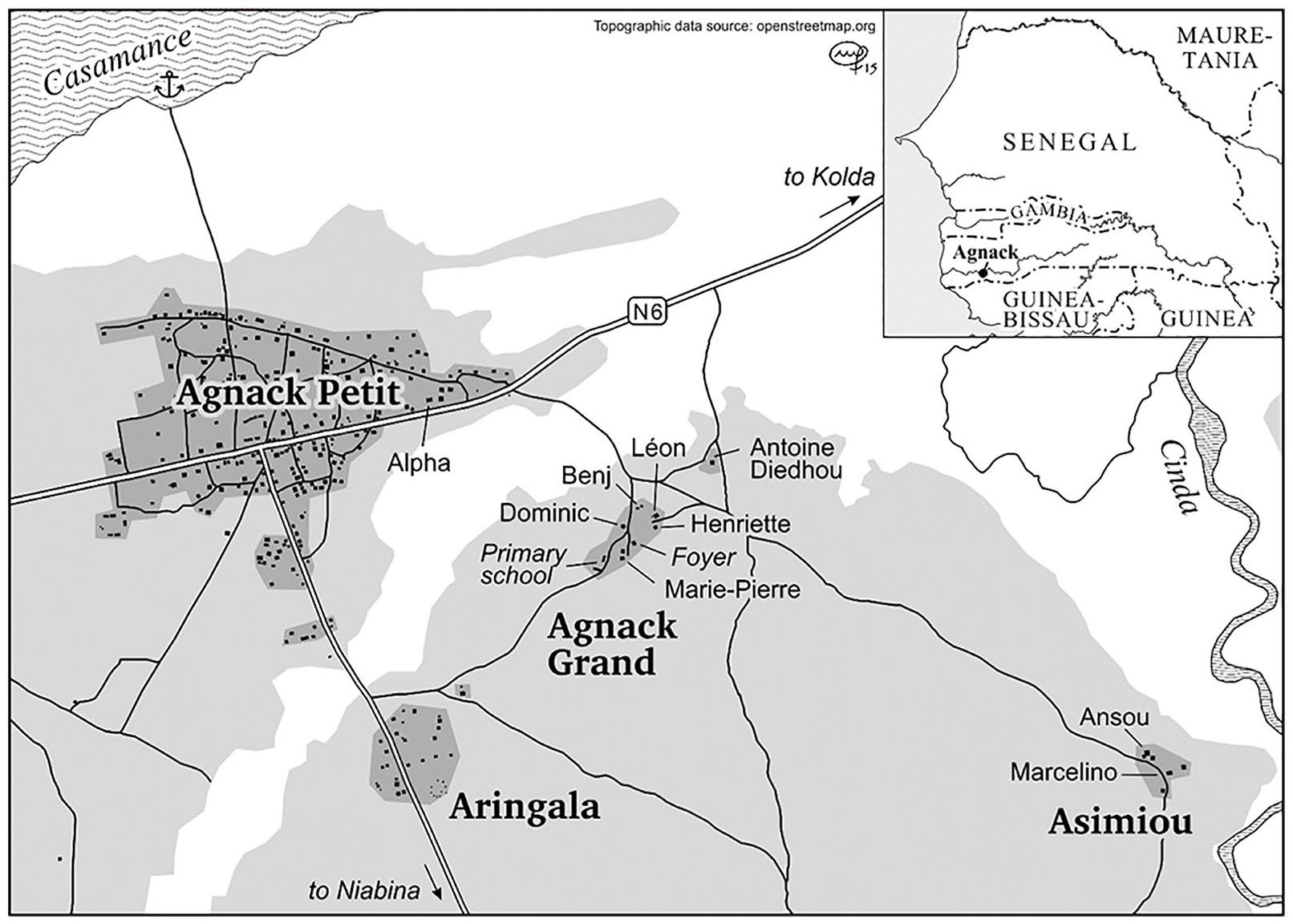
Map of Agnack based on information available in 2015.
The village of Agnack has two established stranger settlements in addition to the founders’ ward: Asimiou and Diedhoukunda (on the map labelled with the name of its founder, Antoine Diedhou). Illustrating patrimonial deixis, many of the wards are named after their male founder, here two settlers with the patronyms Asimiou and Diedhou. As is often the case over time, ownership can be contested and spaces claimed by founders can be construed as virginal places situated at the empty Frontier, available for settlement. In Asimiou, a gradual shift towards independence is observable: its Jalonke settlers, Asimiou and his half-brothers learned Gujaher and speak it comfortably. Their children, brought up by multilingual parents, and with mothers whose patrimonial identities are Manjak, Pepel or Balant, do not. A formal rift occurred when the young men stopped taking part in the youth organisation and built their own foyer or youth club, and it is possible to project that Asimiou will take its political independence from Agnack Grand, including a new patrimonial language, in the near future.
In 2015, I was not aware of the existence of a third historical stranger settlement called Monjelum and located to the south-east of Asimiou. This settlement, hosting speakers of a Joola variety from nearby Guinea-Bissau who had fled the country’s independence war (1960–1974), was abandoned when I began my research in Agnack, because its inhabitants in turn had fled Senegal when the Casamance conflict erupted in the 1980s. In 2016, children of these settled strangers returned and claimed the abandoned grounds as theirs. Monjelum is known as one of several named places of arable land belonging to Agnack Grand, but nobody has knowledge of the exact boundaries of this land. A conflict ensued that appears temporarily settled, since the authorities sided with the Agnackais and confirmed their firstcomer status, denying the latecomers owner status. Yet, in a region where individual landownership is encroaching on older systems of collective ownership, and where land has become a lucrative source of income when used for cashew cultivation and logging, it is likely that it will rekindle.
The status of Aringala, another ward of Agnack Grand, is illuminating for a different dynamic that brings about changes in ownership and concomitant linguistic affiliation. Aringala is regarded historically as a Ñanjaher ward now belonging to the Manjak, who were its original strangers. This flip in ownership occurred because its founding family only had daughters, who all left the village when marrying. Exogamy is practised in Agnack without exception, with all adult women having married into the village, and all daughters leaving it upon marrying. The outflow of the founders’ exclusively female descendants left Aringala without patrimonial rule, and its strangers stepped in.
Memories of founding events in toponyms and patrimonial languages
The continuously reconfiguring social and linguistic organisation has left traces in tenacious language territorialisation patterns and memories of landlord status. Written documentation of foundational events in the distant past can be found in Portuguese records. Their accounts offer insight into the history of trade posts on the Upper Guinea Coast created in the 17th century (Jacobs, 2010). In the area of interest, the posts of Cacheu, São Domingos, and Ziguinchor are situated upstream of tidal rivers. They were founded by Portuguese traders and their brokers, Creoles from Cabo Verde, where Kriolu, a Portuguese-based Creole, first emerged. According to the patrimonial principle of language territorialisation, these places were and still remain associated with Kriolu, despite their heterogeneous nature. For speakers of many Casamance languages, this pattern is transparent in naming practices. Ziguinchor, the regional capital, 18 km to the west of Agnack, was founded in 1645 by Portuguese/Creole traders. In Baïnounk languages, its name is Gu-baabo ‘the place/language of the white people/Creoles’. Baabo is a backformation from tubab, a widespread word designating Europeans/white people in West Africa, with tu reanalysed as a noun class prefix and replaced with the singular prefix gu- to form the glossonym. Derived from the same stem, Ubaabo (plural Ñan-baabo) is the designation for white people and Creole speakers. Ziguinchor became French in 1888 and is now part of officially francophone Senegal. Yet, the meaning of U/Gu-baabo has not changed to accommodate this new association: the French language is Gu-faranse and its speakers are U-/Ñan-faranse. Ubaabo cannot be used to denote a speaker of French, only a speaker of Kriolu or a white person in the generic sense.
The village of Sindone in the immediate proximity of Agnack, is another case illustrating patrimonial deixis and its long-lasting effects, while at the same time testifying to micro-adjustments through internal Frontier processes. Named after Santa Sindone, the Shroud of Turin (de Benoist, 2008), it goes back to a Luso-African settlement (Bühnen, 1994). After the establishment of French trade posts in the 19th century, vessels on the Casamance river stopped there, halfway between the trade posts of Carabane and Sédhiou. Its original ward on the riverbank is still called Lisboa. A nearby Baïnounk settlement called Barigholi was incorporated into the growing village at some point, and Baïnounk now constitute a small minority of its inhabitants. Sindone is also called Terra Metadi ‘the territory in the middle’, in Kriolu, an avoidance term used by non-inhabitants who did not dare uttering the village name when travelling on the river Casamance for fear of not returning – a possible allusion to the slave trade. 6 That this toponym is in Kriolu, the language associated with Portuguese and Creole traders, and that it refers to a Portuguese/Creole settlement vividly illustrates the main activity of Portuguese traders and Creole brokers: raiding local people and selling them into the transatlantic slave trade. Although contemporary inhabitants of Sindone also identify with different present-day ethnic groups of Casamance, Kriolu is seen as the patrimonial language. In addition to regionally widespread practices, Creole identity continues to shape cultural life, through the tradition of singing mornas and performing a marriage dance called pina di terra (Cécile Diemé, personal communication).
Patrimonial deixis is thus very persistent, akin to the founder principle described by Mufwene (1996) for plantation settlements, where the influence of the founders’ linguistic identities looms large. It is indeed very plausible that the origins of the founder principle lie in the patrimonial language territorialisations that have characterised West African societies through history. Small lineages are continuously migrating, either as firstcomers or as newcomers joining already established villages. Subtle demographic changes and the political ambition of newcomers result in shifts in power. Historical memory often retains palimpsests of settlement patterns preceding the redrawn Frontiers. However, it is fallacious to assume historical continuity of populations whose current linguistic and/or ethnic identity appears to match historical territorialisation patterns. This becomes evident when looking at present-day Kriolu inhabitants of Ziguinchor. Because of the Guinea-Bissau independence and civil wars, many speakers of Guinea-Bissau Kriolu sought residence in Casamance, including Ziguinchor (Nunez, 2015), giving rise to an internally very heterogeneous Kriolu population in this city, which also still hosts many speakers of Casamance Kriolu, and entailing great variation in speech. Similarly, there are no systematic connections between the present-day Baïnounk inhabitants of Sindone and the former inhabitants of its ward Barighol. I met two out of the six inhabitants of Sindone self-identifying as Baïnounk (0.3% out of 2,037 according to Fondation Dimbaya, 2014). None of them descends from presumed founders: both are women, one married in from Agnack, where Baïnounk Gujaher is spoken, the other from Djifanghor, which has Djifanghor Nyun as its patrimonial language. Both these villages are much younger than Sindone; they were founded at the beginning of the 20th century.
To conclude, many places are associated with the languages of their founders; but settlements do not only comprise their descendants but also systematically host inhabitants classified as strangers and other members who are not male descendants of founders, for instance in-married women. The dynamic relationship between monolingual spaces and their multilingual and heterogeneous inhabitants can be resolved and understood through the patrimonial patterns of language territorialisation.
Perspectives on speech events, speech forms, and speakers’ repertoires
The iconisation of founders in language territorialisation is an eminent example for a practice privileging a particular perspective. Perspectival classificatory processes are at work not only in the genesis of sociospatial patterns and language ideas, but also in the categorisation of speech events, speech forms and repertoires (as expressed in named languages; see also Khanina, 2021). This section is dedicated to an exploration of the different levels at which perspective is manifest, starting with the selection and representation of speech events.
Representations of speech events and categorisation of speech forms as influenced by perspective
In many discourse contexts in the Lower Casamance it is possible to identify different pragmatically conditioned language modes (Cobbinah et al., 2016), including a language mode in which the speakers have the pragmatic intention to stay within the confines of a named language. This mode is the one most commonly included in language-focused description and documentation. However, even for speech events of this kind, a categorisation in terms of local variety and unambiguous code-association of speech forms on linguistic grounds alone has limits. The analysis of forms as diachronically/etymologically or synchronically/code-interactionally ‘foreign’ in a text pragmatically intended to be in “Baïnounk”, poses analytical problems. In the following, this is illustrated through forms etymologically identifiable as French. French is spoken by a minority of Senegalese, conventionalised ‘mixed’ registers abound and phonetic features of Senegalese varieties of French are shared with local languages (Mc Laughlin, 2018). Therefore, etymologically French forms are potentially polyvalent (Woolard, 1998). These forms could be analysed as synchronic code alternations or integrated loanwords. This ambivalence is often removed through transcription conventions. Forms are presented in their respective orthographic forms rather than in phonetic transcription. This widespread practice 7 favours their analysis as code-switched, regardless of the status of speech forms from the perspective of speakers and listeners. However, this convention is an artefact of a particular viewpoint in itself, which notates the forms of colonial languages not in phonetic transcriptions but renders them in the respective standard orthographies of English, French or Portuguese. Table 1 illustrates phonetic divergences between sounds in standard and Senegalese French registers. The latter sounds are shared with other languages of Senegal.
Some divergences between standard French and Senegalese pronunciations.
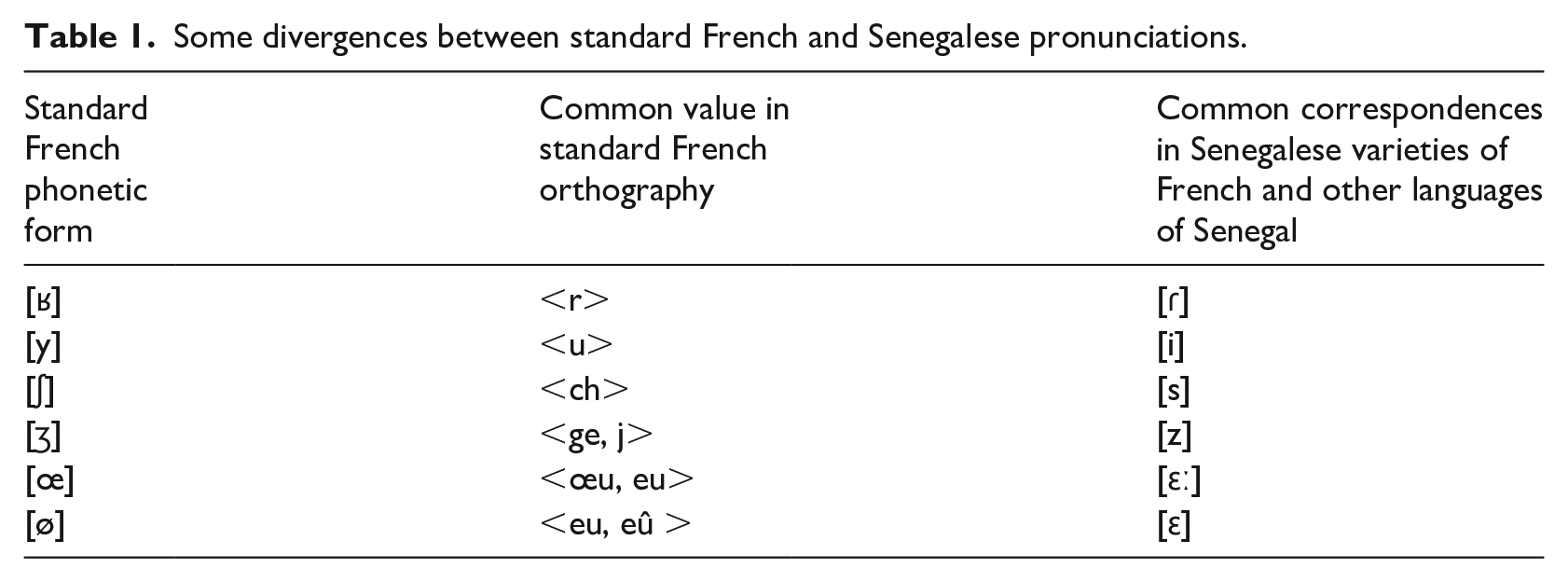
Representing languages that have standard orthographies in their orthographic forms in linguistic examples (as in my own transcription in Table 2) testifies to the seductiveness of standard writing) but obstructs their linguistic analysis through assuming an analytical perspective already in transcription.
Transcription of segments of the initial 10 minutes of recording AGG260112FL2; transcription conventions, remaining transcription, identification of languages and translation into French by ANM; translation into English by FL. Segments in angular brackets were not originally transcribed by ANM *.
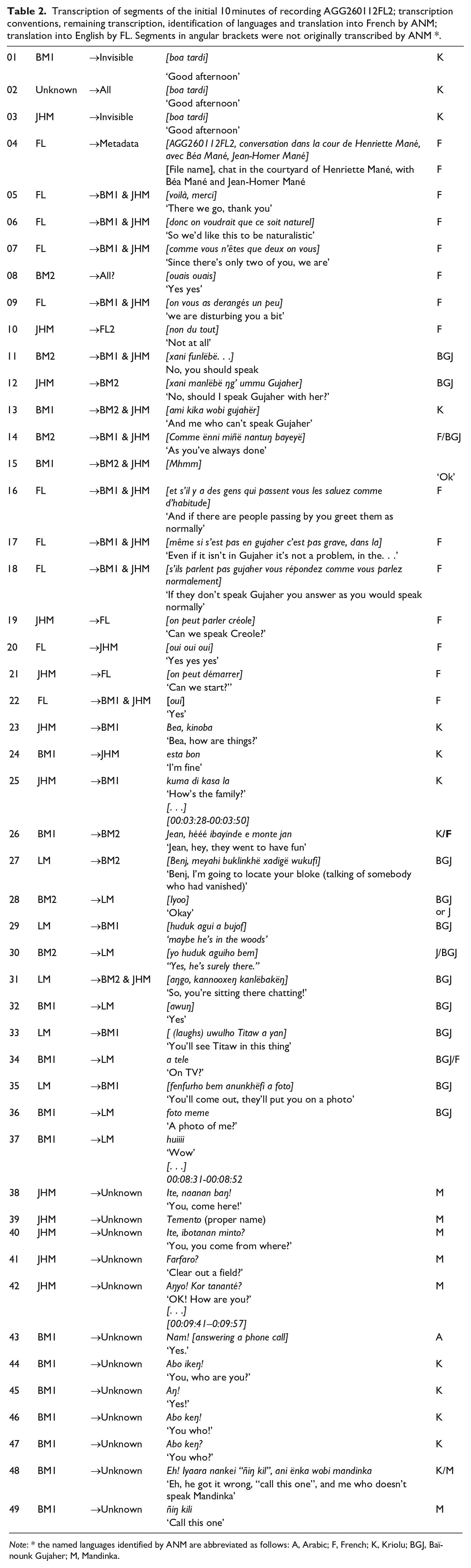
Note: * the named languages identified by ANM are abbreviated as follows: A, Arabic; F, French; K, Kriolu; BGJ, Baïnounk Gujaher; M, Mandinka.
Self-reported and observed linguistic repertoires as perspectival
Repertoires and the named languages they contain are also perspectival statements, as discussed in detail by Goodchild (2016, 2019) and (Weidl, 2019) for two other Casamance settings. In the context of this paper, for instance, it is noteworthy to record that all inhabitants of Agnack knew that I was interested in and knowledgeable about different named Baïnounk languages and Guhaja. Consequently, the names for local varieties instead of the generic label Baïnounk were given, even when we were speaking in French. Regarding Joola languages and Balant, which also comprise language clusters with considerable internal differences, such a distinction was not made to me. The exonym applied by others to categorise Baïnounk languages and their speakers does not allow internal differentiations. Baïnounk speakers themselves also underdifferentiate languages and speakers perceived as distinct relative to available more fine-grained self-categorisations. For instance, Guriat is the only Gujaher glossonym for Joola, which is an internally very diverse language cluster with upwards of 15 lects of varying linguistic distance. Linguists differentiate between Casamance Kriolu and Guinea-Bissau Kriolu, which are set apart by a number of emblematic features (Biagui et al., forthcoming). Speakers in Agnack generally do not volunteer this differentiation. ANM, the transcriber of the conversation in Table 2, tagged Kriolu speech as ‘Créole de Guiné’, although the speakers in this conversation learned Kriolu in Senegal, not in Guinea-Bissau. In their daily lives, speakers encounter highly variable features that do not align with varieties named by linguists or speakers. This observation entails that the processes through which different discourse participants and analysts arrive at particular categorisations are as important to study as the actual speech forms.
Languages included and emphasised in repertoires are indicative of the social categories and contrasts important in particular situational contexts, of the language regimes of the space in which such repertoires are collected and of interviewees’ interpretations of the interviewer’s intentions. One female inhabitant of Agnack Grand, married in from the village of Ganjand in Guinea-Bissau, originally identified as having Gujaher as her patrimonial language to me. Only when I professed my interest in Guhaja, which is also spoken in Ganjand, did she mention that Guhaja was the language she first spoke at home but has now forgotten. Another woman was the only woman in Agnack Grand I had believed to be very sedentary, since she identified as an Ujaher from the Aringala ward who had spent her entire adult life in Agnack Grand, only moving into the founders’ ward upon marrying. She had given Gujaher, Kriol, Wolof and Mandinka as the named languages in her repertoire. It turned out that she had lived for several years in Djifanghor, where the Nyun language Djifanghor Nyun is spoken. I only learned this after 10 years of research, when coming across somebody calling her by a different name. When I inquired, this second name was revealed as her ubos name: she had given birth to most of her children while undergoing the gubos ritual in Djifanghor, also acquiring its patrimonial language. The space and motivation for the interaction with me (my interest in Agnack, its patrimonial language and multilingualism patterns) made Djifanghor Nyun irrelevant to be mentioned to me. Sometimes, consultants have practical reasons to conceal parts of their repertoires and trajectories. I worked with a now deceased consultant on Guhaja. He revealed to me to have been born in Ganjand, but was born in Agnack according to his (fake) Senegalese identity card and assumed an Ujaher identity to outsiders. He had been fighting in the Portuguese army during the Guinea-Bissau independence war and had fled to Senegal to escape recriminations, a fact he wished to dissimulate.
Self-reported repertoires therefore only allow a heuristic appraisal of linguistic capacities and need to be triangulated with language use and observations stemming from different contexts and perspectives, ideally offering deep insight into local sociolinguistic patterns and linguistic biographies of speakers (Goodchild, 2019; Weidl, 2019).
The interaction of perspectival processes in categorisation of speech forms and repertoires
Language categorisation is likewise intricately bound to perspectival categorisation, not only when concerned with heteroglossic speech, but also regarding research participants’ desire to offer ‘authentic’ forms seen as prototypical for a named language (Watson, 2019). In Gujaher, a frequently used word for ‘cat’ is siibo, and the one for ‘plane’ is avioŋ. After several years, one of my consultants offered the word dali as the real Gujaher word for ‘cat’, and roplan for ‘plane’. Siibo occurs in homophonous or phonetically close realisations in Joola languages, making it less distinctive/prototypical Gujaher for this consultant, who, crucially, does not count Guhaja/Kasanga in her self-reported repertoire. In this closely related language, dali is attested as well, so for a speaker of both languages, dali would be emblematic or distinctive for neither. Roplan, related to both the Portuguese and archaic Kriolu form for airplane (Segerer, 2002) likewise appears more authentically Gujaher to a speaker who learned Kriolu in the second half of the 20th century, when this form had been replaced by avion in Kriolu (cognate with Portuguese avião and French avion). The perspectives of (different) speakers can thus be radically distinct from (different) linguists’ analyses. The divergences in interpretation cannot be resolved – there is no (etymologically or linguistically) ‘right’ categorisation of forms, since their exact history is unknown and since many of the languages are related to differing degrees. Rather, we should study different judgements on speech forms. They are of crucial importance in order to apprehend speech participants’ options in achieving social indexicality (Silverstein, 2003) with particular words and features.
Contrasting verdicts on the characteristics of speech further illustrate this role of perspective; they sometimes reveal more about the repertoires of those that give them than about those who are characterised. Cobbinah (2019) reports that a speaker of the Baïnounk language Gubëeher regards the speech of speakers of Baïnounk Gunyaamolo as corrupted with Mandinka, and judges that Gubëeher speakers alone speak ‘pure’ Baïnounk (pure in the statement ironically being derived from French). Contrarily, in Agnack, a speaker of Gujaher volunteered that speakers of Gunyaamolo mix their speech with Joola, in contrast to Ñanjaher, who do not. These judgements do not tell us as much about the frequency of code alternations or borrowings and their provenance in Gunyaamolo. They reveal, however, that speakers of Gubëeher, who mostly do not count Mandinka in their repertoires but commonly speak several Joola languages, are highly aware of the presence of Mandinka and regard it as alien, and that speakers of Gujaher, using Mandinka far more often than Joola languages, do the inverse.
Perspective illustrated through a transcribed speech event
Perspectival judgements underlie the selection of communicative events to observe and record, decisions on who to include as a speech participant in transcription, and they also shape how participants position themselves in relation to observers. The following extract from the initial 10 minutes of a 45 minutes-long conversation recorded in a household in Agnack Grand in 2012 illustrates how different perspectives can structure linguistic production and its perception. While the selection of speech events is often left implicit, in this case, a recording was made according to a methodology described in detail in Lüpke (2016). In a nutshell, the procedure consisted of visiting households, conducting an interview on their members and their self-reported repertoires and returning at an agreed date to record an afternoon’s worth of filming everyday life in the courtyard, regardless of the nature of (linguistic) interaction. The preliminary discussion framing the speech event through the interaction of all participants are present in the recording, revealing my instructions and research assistants’ and speech participants’ considerations. The relevant parts of linguistic repertoires of myself (FL), central speech participants (BM1 and JHM), the research assistant who was present during the interaction (BM2) and the transcriber (ANM) are given in Table 3.
Relevant parts of self-reported repertoires of all participants in the production, transcription and analysis of the speech event AGG260112FL2 in Table 2.
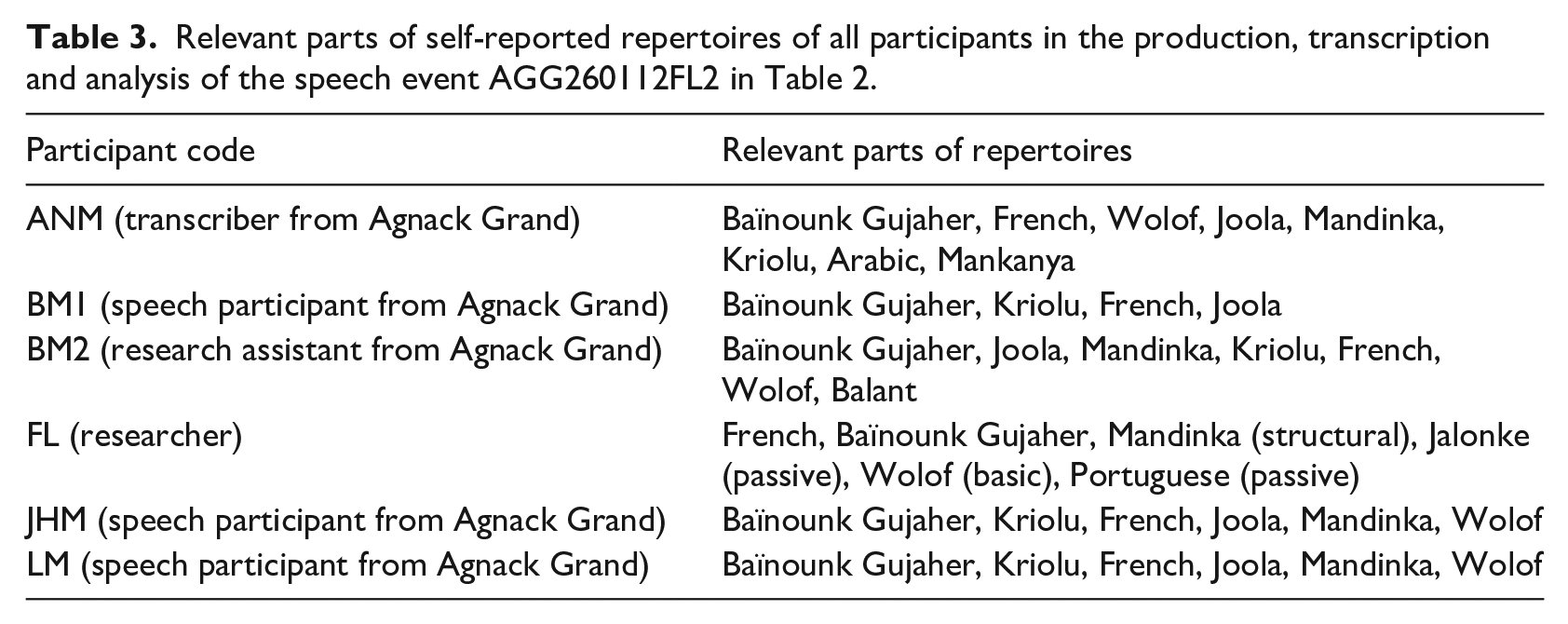
It is well known that transcription, rather than offering a graphic representation of speech, presents an edited, curated analysis in its own right (Ochs, 1979). Here I focus on those ideological processes underlying the selection and analysis of participants and speech forms that relate to framing texts as mono- vs. multilingual. I illustrate how selection, representation and identification of languages in transcription offers useful evidence for assessing indexical potential – which speech forms might be social signs and what they signify for whom. The repertoires of all stakeholders determine the limits of language choice and influence how they select and categorise speech forms, including potentially ambivalent forms. Transcribers do not only read the situated social meaning in the speech event, they also add to it and alter it by contributing their own linguistic knowledge and by interpreting linguists or speakers’ intentions. Just as the different categorisation of speech forms, different layers of transcription and tagging, and conflictual views of speech events are sources for revealing metapragmatic knowledges.
Figure 1 charts the self-reported repertoire of ANM, indicating both the genealogical relatedness of named languages in his repertoire and percentages of lexemes different in only one phonetic feature as indicated by Sapir (1971). Non-genealogically related languages also feature lexical overlap through borrowing and code alternation, resulting in convergent forms. Although only allowing rough approximations of repertoires, even rough knowledge of their composition and on the proportion of shared forms in them offers insight into the speakers’ perspectival options.
In its original transcription and analysis by ANM, the conversation appears as largely monolingual in Kriolu, with occasional segments that might constitute intrasentential and intersentential code alternations. In the original transcription, the potential code alternations occurred at places that appeared random to me. I therefore accessed the media file and found that not all audible linguistic forms had been transcribed. The divergences reveal different perspectives on the speech event and its speech acts that can be captured as follows.
To ANM, the focal speech event participants were BM1 and JHM, with one speech act involving an exchange between BM1 and JHM and BM2. The preliminary discussion with myself (FL) and my research assistant (BM2) was not transcribed. BM2’s speech was only transcribed when he was talking to BM1 and JHM; his exchange with the passing neighbour LM and another invisible and inaudible speech participant was not transcribed, although LM’s chat with BM1 and JHM was. The speech of children playing in the vicinity was not transcribed, although BM1 and JHM occasionally call their names and comment on their actions. This perspective on the speech event portrays it as a basically dyadic, sometimes triadic, exchange with Kriolu as the pragmatic language mode and two exchanges in Mandinka and Baïnounk Gujaher language mode. While the beginning of the speech event is clearly staged for the sake of being recorded, the interaction unfolds based on conversation-internal dynamics, with BM2 participating in the discussion, and with passers-by and a caller requiring spontaneous reactions.
My added perspective, like ANM’s limited by the position of the camcorder and of the microphones to capture BM1 and JHM, includes a greeting at the immediate beginning (01–03) not represented in the diagram in Figure 3, prior to me giving metadata and providing instructions in French (4–10), with short confirmatory turns by JHM. My instruction is then contradicted by BM2, who favours the use of Agnack Grand’s patrimonial language, Gujaher. Certainly, BM2’s attempt at steering the language used by BM1 and JHM towards Gujaher, by addressing them in Gujaher (11) is based on his knowledge of my interest in Baïnounk Gujaher as the language I work on which overrides his knowledge of my interest in spontaneous multilingual speech. Since he is a descendent of the founders of Agnack and speaks and sees Gujaher as his patrimonial language, his initial insistence of policing language may also reside in his own language ideologies that dictate that people identifying as Ñanjaher should speak Gujaher in Agnack. However, BM1, despite identifying as Ujaher and Creole, confesses not to speak it (13), and thus flouts BM2’s expectations by declaring that she does not speak Gujaher. She and JHM then decide to settle on Kriolu (19), making the pragmatic language choice explicit and thus allowing to identify their exchange as one in discourse–pragmatic monolingual language mode.
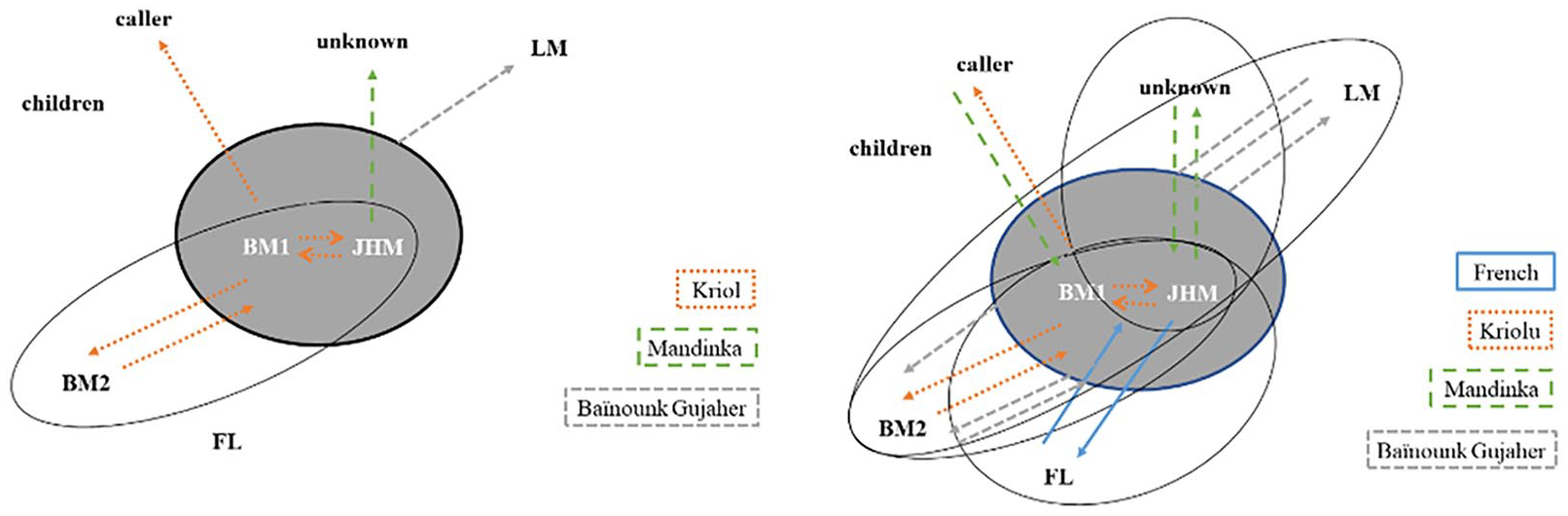
Schematic representation of the initial 10 minutes of speech event AGG260112FL2 according to ANM’s original transcription (left) and my subsequent additions (right).
Some speech acts within the conversation can be clearly identified as code alternations; in the extract, these are participant-related code-switchings in 27–37 and the code-switched ñiŋ kili that constitutes reported speech in 48 and 49. In fact, participant-related language changes, switching from monolingual mode in one language to monolingual mode in another language, are frequent and easy to identify. My focus here is on the perspectives inherent in categorisation of speech as belonging to a particular named language.
In the extract in Table 2, ANM’s knowledge of the sociolinguistic space and perspective on codes is present in the language tagging. It should be noted that ANM has command of written standard French. Therefore, transcriptions of forms he identifies as French that deviate from French orthographic norms do so by choice and constitute an analytical stance of his own. His transcription conventions and analyses vary, even for forms that he analyses as French, and this variation allows insight into his own judgement on the status of these forms as (code-switched) French vs. integrated loans. While comme (14) is provided in French orthography, monte (26), and tele (34) are not, although they are labelled as French. 8 Foto (35, 36) is not identified as French, although there are no grounds to regard it as more integrated into local languages than tele – there is a long-established lexeme for photo, portal(e)en in Gujaher and Kriolu. ANM’s analysis of some forms as code alternations crucially depends on his knowledge of French, Kriolu and Gujaher; for a speaker without knowledge of French, the potential categorisation as French would be inaccessible, and without knowledge of Gujaher and Kriolu, this word might have been accepted as an integrated loanword. One form in the extract is tagged by ANM as ambivalent: the discourse marker iyoo is common in Baïnounk and Joola languages and recognised as ‘belonging’ to both. However, Creissels and Biaye (2016) feature a sentence containing iyoo with the same meaning in Balant Ganja, and it is areally distributed. Forms such as iyoo would be analysed as ‘bivalent’ (extended to ‘polyvalent’ for the multilingual contexts covered here) by Woolard (1998) or ‘floating’ by Nunez and Léglise (2016). However, their uncertain status depends on hearers’ and analysts’ access to the codes they might be attributed to and thus is equally perspectival. Thus, only ANM’s repertoire delimits his categorial options, as also evident from the fact that all Baïnounk forms are categorised as Gujaher. While there is considerable lexical and morphological distance between Baïnounk varieties, some forms are (close to) homophonous – repertoires, place and perspective on speech participants are crucial for judgments. The different Baïnounk languages are not spoken in adjacent spaces; therefore, speakers are not generally aware of shared and divergent features of these different registers, unless their personal mobility brings them to an area where another Baïnounk language is spoken. Forms shared by several Baïnounk languages are hence not ambivalent from the perspectives of most speakers, since in many cases they have only knowledge of their local variety. In contrast, Joola languages are spoken in a contiguous area, offering various options for the association of features with a named variety, as described in detail by Watson in Lüpke and Watson (2020). The emblematicity of a form thus crucially hinges on its possibility to unambiguously and prototypically stand for a particular register (Watson, 2019).
It has important repercussions whether analysts take their knowledge of speech participants’ repertoires into account when associating forms with a named language, and whether linguistics takes account of transcribers’ linguistic and metapragmatic knowledge. In ANM’s case, an external perspective that is not influenced by his knowledge of speech participants’ can be detected in language tagging, since he analyses the form nam ‘yes, understood’ in 43 as Arabic although BM1 states no knowledge of Arabic. Through his analysis, ANM demonstrates his own knowledge of Arabic where the corresponding form is na’aam rather than offering a perspective based on discourse participants’ repertoires. Regardless of its etymology, nam is widespread in languages of Casamance and could equally receive multiple language values.
Only forms that can be unequivocally categorised have the potential to become a second-order index of difference that acquires social meaning, or to turn into a third-order index and become enregistered as a named lect or language (Agha, 2005; Silverstein, 2003). Recognised polyvalent forms, on the other hand, blur boundaries and foreground shared parts of repertoires. Therefore, it is of central importance to understand which forms are unequivocally associated with particular registers/named languages and which ones can be linked to several codes for particular speakers, addressees, observers and analysts with different linguistic profiles and social realities. I have shown in detail how perspective underlies every aspect of linguistic categorisation, including the constitution of the speech event and its participants itself, and importantly also regarding its mono- vs. multilingual nature. In settings where strong linguistic norms exist, these questions appear settled. Standardised orthographies offer conventionalised perspectives, differentiating linguistic forms that are potentially ambivalent. In diffuse settings, the processes determining constituency and composition of speech events and their forms deserve to be studied in their own right. Transcription and annotation conventions that do not pre-empt their analysis by adopting an orthographic convention that categorises them are thus crucial to understand the formation of repertoires and the categorisation of registers.
Building perceptions into a research programme
In this paper, I have focused on small-scale linguistic settings built on the premise of simultaneous similarity and difference at their interior. Their architecture resides both on overcoming and on maintaining internal diversity over time, constantly adapting to socio-political and demographic factors. Patterns of language territorialisation grant linguistic visibility to founders, but do not erase settled strangers and other incomers, whose presence is seen as necessary and desirable. Such patterns constitute an antithesis to the model of the ethnolinguistic nation state, which relies on the notion of internal congruence, categorical identity models and clear external demarcations. Small-scale multilingualism is ontologically different from polyglossic multilingual settings, which result from attempts at regulating and even erasing multilingualism within a nation state. In contrast, small-scale multilingualism of the kind presented here creates relational and convivial, but not homogeneous nor regulated spaces. Its study requires a research programme that is not tied to monolingual ways of seeing multilingualism (Piller, 2016). This endeavour crucially involves seeing languages not as primordial entities whose linguistic forms can be studied in a positivistic research paradigm. It entails seeing languages as constructed and placing research on how they are created in the minds of different actors at centre stage. This stance does not dismantle the notion of languages but brings the processes of perspectival making and unmaking of their boundaries to the fore of basic linguistic description. Only such a focus enables us to grasp the categorisation processes inherent in the selection and interpretation of linguistic features. Epistemologically, this requires a shift from focusing on phenomena (spaces, languages, people, and texts), to processes in language documentation and description (Di Carlo, 2016).
The paper has foregrounded processes regarding the formation of patterns and perspectives as crucial to the study of small-scale multilingualism, answering several research questions on the example of multilingual ecologies in the Lower Casamance. The paper reveals the dialectic underlying the association of spaces inhabited by multilingual individuals with one language as motivated by a longstanding sociospatial pattern of landlord–stranger cohabitation practices in which founders (landlords) are iconised. I illustrate how repertoires are linked to these spaces but are additionally connected to relationships created between speakers. Detailed linguistic, social and spatial knowledge is shown to be decisive in the analysis of speech events as well. It follows that small-scale multilingualism studies have much benefit to gain from the inclusion of sociospatial patterns and of perspective into research design, as also argued by Epps (2021). A crucial step in this endeavour is preserving different perspectives as present in selections of speech events, speech forms, speech categorisation, variation of language names in repertories, etc. Rather than eliminating variation or overwriting one participant’s or analyst’s seemingly ‘wrong’ or ‘contradictory’ judgements or statements, different viewpoints can be added, conserving the points of tension that make different perspectives visible. Such a multi-perspectival annotation can be used as an entry point into research on the motivations of different perceptions. The resulting multi-layered ‘thick’ descriptions (Geertz, 1973), flanked by sociolinguistic and anthropological–linguistic methodologies and detailed local historical knowledge, allow capturing the dialectics of similarity and alterity hardwired into small-scale multilingual settings (see also Di Carlo et al., 2021; Epps, 2021). A research programme thus bringing patterns and perspectives to the fore promises great insight into the parameters that govern linguistic identities, language variation and language change by providing a matrix for conceptualising divergence and convergence in time and space. Since small-scale multilingual settings are the ones in which language evolved (Evans, 2018) and was and is most widely used (Silverstein, 2015), linguists of all fields have much to gain from turning their gaze to their emergence and continual reorganisation through their speakers’ ‘acts of identity’ (Le Page & Tabouret-Keller, 1985).
Footnotes
Acknowledgements
I dedicate this paper to Michael Silverstein. He was an incontournable point of reference for many different linguists. Depending on their field and interactions with him, my colleagues knew him as a syntactician, fieldworker, semiotician, anthropological linguist, wine connoisseur or dry martini drinker, thus unwittingly testifying of the importance of perspective in perception, so crucial for indexical order. His intellectual presence is sorely missed.
The research reported here was funded by the VW Foundation DoBeS grant “Pots, plants and people: the documentation of Baïnounk knowledge systems” and the Leverhulme Trust Research Leadership Award Grant “At the crossroads – investigating the unexplored side of multilingualism” in which I was the principal investigator. I am indebted to all project members and research participants, but first and foremost to Dominic and Hortence Mané and Alpha Naby Mané and their families in Agnack. The constructive feedback from reviewers and editors have helped me develop the red thread of my argument and I would like to thank them for their insight.
Declaration of conflicting interests
The author(s) declared no potential conflicts of interest with respect to the research, authorship, and/or publication of this article.
Funding
The author(s) disclosed receipt of the following financial support for the research, authorship, and/or publication of this article: The research reported here was funded by the VW Foundation DoBeS grant “Pots, plants and people: the documentation of Baïnounk knowledge systems” and the Leverhulme Trust Research Leadership Award Grant “At the crossroads – investigating the unexplored side of multilingualism”.
