




Abstract
Aims and objectives/purpose/research questions:
We characterized the impact of several bilingualism-related factors on the executive control of Spanish-Catalan bilinguals.
Design/methodology/approach:
Participants self-reported information regarding their age of acquisition, second language proficiency and frequency of natural language switching, and performed non-linguistic tasks tapping into specific executive control subcomponents, including inhibition, switching and updating.
Data and analysis:
Data were analyzed by means of a structural equation model (SEM) approach.
Findings/conclusions:
Results revealed that the frequency of natural language switching positively modulated the executive control performance of Spanish-Catalan bilinguals, while neither age of acquisition nor second language proficiency had an effect. Moreover, we found that the impact of natural language switching exerted general-processing influences, affecting all subcomponents of executive control. Findings are discussed in relation to context-specific effects on the cognitive system of a particular bilingual population.
Originality:
The current study applied an SEM approach to provide new evidence on the previously ambiguous relation between bilingualism-related factors and executive control.
Significance/implications:
Our findings suggest that the frequency of natural language switching does globally influence the executive control of Spanish-Catalan bilinguals.
Keywords
Introduction
Executive control (EC) is a domain-general group of superior cognitive processes that are required in the face of changing situations to adjust goal-driven behaviors (Diamond, 2013; Miyake & Friedman, 2012). Typically, the study of EC mechanisms has focused on three subcomponents: the ability to resist interference of competing information (i.e., inhibition), shifting between tasks or mental sets of information (i.e., switching), and maintaining relevant information in working memory, replacing this information when it is no longer relevant (i.e., updating; Miyake et al., 2000; Miyake & Friedman, 2012). Since bilinguals have to control and adapt repeatedly their languages to varying contextual demands on a daily basis, bilingualism is thought to enhance EC (for a review, see Bialystok, 2017). Theoretically, these benefits are assumed to be a consequence of the lifelong experience bilinguals have in managing two competing languages, which are simultaneously active and lead to cross-language interactions (Kroll et al., 2014), even when the language not in use is not explicitly presented in a given situation (Wu & Thierry, 2010). In order to resolve the conflict between the relevant and non-relevant language in a bilingual conversation, bilinguals have to deliberately inhibit the non-target language by recruiting both language and executive control resources (Abutalebi & Green, 2008; Borragan et al., 2018). Moreover, bilinguals also have to update the contextual linguistic cues in a conversation and switch between languages to adjust the language they consider appropriate to speak according to their interlocutors (Abutalebi et al., 2012). Furthermore, both the linguistic and the general processing mechanisms (i.e., EC) seem to show a partial functional overlap in several brain regions (Abutalebi & Green, 2008; Declerck et al., 2017). In this vein, it has been proposed that the core neuroanatomical substrates of the EC subcomponents lie mainly within the prefrontal cortex and extend towards other regions, such as midline, subcortical and parietal brain areas (Friedman & Miyake, 2017; Niendam et al., 2012). For example, the inferior frontal gyrus belonging to the frontal lobe has been neuroanatomically related to both inhibition and switching (Brass et al., 2005), but also to language control (Coderre et al., 2016; de Bruin et al., 2014). In addition, the supramarginal gyrus in the parietal lobe has been shown to be engaged in both the switching subcomponent of EC (Lemire-Rodger et al., 2019) and language switching (Abutalebi & Green, 2008; Reverberi et al., 2018). Moreover, the caudate nucleus, a subcortical region, seems to contribute to the executive inhibitory and switching performance (Heyder et al., 2004), while participating in language switching as well (Hervais-Adelman et al., 2015). Finally, the anterior cingulate cortex seems to be involved in tasks requiring EC in the form of inhibition and updating (Bomyea et al., 2018), as well as in bilingual’s language control (Coderre et al., 2016; Seo et al., 2018). For a comprehensive review regarding the overlap of EC and language control brain regions, see Wu et al. (2019). Hence, it has been proposed that this linguistic-specific practice exerted by bilinguals when managing their two languages transfers to non-verbal general-domain abilities through neuroplasticity (Bialystok et al., 2012; Kroll & Chiarello, 2016; Mechelli et al., 2004).
Bilingualism, however, is not a categorical variable but an amalgam of dynamically related dimensions that interact to shape every bilingual’s individual linguistic experience (Luk & Bialystok, 2013). Thus, efforts have been made in the last years to explore how distinct aspects of bilingualism might impact the EC abilities in this heterogeneous group (Bialystok, 2016). Among others, research on the characterization of bilinguals has especially focused on bilingual linguistic background factors (such as both age of second language acquisition and second language proficiency; Luk et al., 2011; Tse & Altarriba, 2014) and usage factors (where the frequency of language switching stands out; Soveri et al., 2011).
Regarding the bilingual linguistic background factors, the age of second language acquisition (AoA) has been suggested to influence EC, in such a way that the earlier the second language is acquired, the more pronounced would be the effects of bilingualism on general-domain abilities (Garbin et al., 2011; Kapa & Colombo, 2013; Luk et al., 2011; Soveri et al., 2011; Tao et al., 2011; Yow & Li, 2015). The rationale behind this relation lies in the amount of practice early bilinguals have in exercising language control, which is assumed to be larger than in the case of late bilinguals (Luk et al., 2011). Complementarily and closely related, the influence of the second language proficiency (PL2) on EC has also drawn a considerable amount of attention on this topic. It has been hypothesized that bilinguals who are more proficient in their second language should find the inhibition of the non-target language more effortful, thus showing more EC benefits as a consequence of this exercise (Blom et al., 2014). In this vein, several studies have shown that bilinguals with higher PL2 evidence enhanced EC, as compared to participants with a lower PL2. Specifically, these associations have been found in abilities such as lexical fluency (related to EC in verbal production; Friesen et al., 2015; Luo et al., 2010), inhibition (Bialystok & Feng, 2009; Fernandez et al., 2013; Iluz-Cohen & Armon-Lotem, 2013; Sabourin & Vinerte, 2015; Tse & Altarriba, 2012, 2014; Zied et al., 2004), switching (Green & Abutalebi, 2013; Iluz-Cohen & Armon-Lotem, 2013; Tse & Arriba, 2015) and updating (Blom et al., 2014; Tse & Altarriba, 2014).
Concerning bilingual language usage, several authors have proposed that a crucial (if not the most important) factor for developing more robust influences of bilingualism on EC is the language switching frequency (LSF) (Prior & Gollan, 2011; Verreyt et al., 2016). Although the underlying mechanisms of this link are still unclear (Paap et al., 2017), it has been suggested that the effect of language switching may be due to the functional (Prior & Gollan, 2011) and neuroanatomical (De Baene et al., 2015) overlap with the non-verbal task switching. Moreover, the adaptive control hypothesis poses that bilinguals’ training gains on EC might depend on the interactional context in which bilinguals are immersed (Green & Abutalebi, 2013). Hence, it is expected that those bilinguals who are used to switch languages more often in similar contexts (i.e., dual-language context) experience larger effects on language switching and EC, since demands to their language control are greater than those experienced by single-language context bilinguals (Costa et al., 2009; Green & Abutalebi, 2013; Hartanto & Yang, 2016). In this vein, several studies have found associations between switching languages more frequently and better execution in different measures of non-verbal switching paradigms (Barbu et al., 2018; Becker et al., 2016; de Bruin et al., 2015; Hartanto & Yang, 2016; Prior & Gollan, 2011; Soveri et al., 2011). Furthermore, Verreyt et al. (2016) studied the effect of LSF on inhibitory control abilities, showing that bilinguals who alternated between languages more often were more likely to evidence smaller congruency effects in tasks tapping into interference suppression (when PL2 was controlled for in the analyses). Similarly, Woumans et al. (2015) found a relation between more fluent switching and smaller Simon effects in terms of response times (RT). Therefore, and in accordance with Costa et al. (2009), these results revealed that the practice accrued by those bilinguals who switch languages more often seems to transfer to domain-general mechanisms.
Nevertheless, recent reports regarding the relation between bilingualism and EC are heterogeneous and mixed (Sanchez-Azanza et al., 2017), contributing to the debate on the key factors involving bilingualism-related effects on EC. For instance, there are also several studies showing findings that are in conflict or nuance the literature presented in the two previous paragraphs regarding the AoA (Vega-Mendoza et al., 2015), PL2 (Pelham & Abrams, 2014) and LSF (Paap et al., 2017) factors. One of the possible reasons for this mixture of results might be the divergent sample characteristics, in particular regarding the bilingual groups (Luk & Bialystok, 2013; Woumans & Duyck, 2015). Thus, some authors have claimed for a better characterization of bilingual samples in order to correctly differentiate between distinct outcomes and to accommodate discrepancies according to the extant divergence of results between studies (Takahesu Tabori et al., 2018).
In this study, we aimed at characterizing the influences of several bilingualism-related factors’ on the EC in a large sample of Spanish-Catalan bilinguals. This objective was addressed by using a structural equation model (SEM) approach. SEM is a statistical technique that combines factor analysis and multiple regression allowing to examine and test the hypothesized simultaneous covariation among latent variables (Morrison et al., 2017; Schreiber et al., 2006). In other words, SEM enables researchers to inspect whether the interrelations among objectively measured variables, clustered in latent variables by their shared variance, behave like in a given specific theoretical model. Therefore, we proposed two competing models accounting for the influences of AoA, PL2, and LSF on the EC of bilinguals, based on the previously commented studies (see Figure 1). In particular, in a first model (Figure 1a) we evaluated if all the above-mentioned factors do concurrently influence EC in this particular sample of bilinguals. In this vein, note that AoA and PL2 are both assumed to impact the functional and structural neuroplasticity of the bilingual’s brain regions independently (Nichols & Joanisse, 2016). Furthermore, AoA seems to modulate several factors related to the degree at which individuals achieve PL2 and the magnitude of the neuroplasticity processes involved in its development (Birdsong, 2018). Additionally, it has been proposed that LSF might be partially affected by the individual’s attained PL2 (Rodriguez-Fornells et al., 2012). Hence, to provide an exhaustive theoretical framework, all the aforementioned relations were introduced in the first model (Figure 1a). However, due to the sociolinguistic context of Spanish-Catalan bilinguals, where both languages are extensively and interchangeably used, their talkers are recurrently involved in bilingual conversations in which natural language switching is frequent. In this vein, there is evidence that the bilingual linguistic background factors (i.e., AoA and PL2) do not seem to have a significant effect on EC in bilingual samples who switch languages frequently in dual-language contexts (Prior & Gollan, 2011; Verreyt et al., 2016), such as the one Spanish-Catalan bilinguals are immersed in. Hence, we tested with the second model (Figure 1b) whether LSF was the only latent variable positively influencing the EC. Therefore, and in relation to the first and main aim of this study, it was hypothesized that the second model would better characterize the influence of bilingualism on EC since the sample of the present study is immersed in a dual-language context. Secondarily, we aimed at exploring whether the indirect influence of the bilingualism-related factors had an impact on all subcomponents of EC (i.e., domain-general executive processing involving inhibition, switching, and updating), or whether it was circumscribed to a particular subcomponent (e.g., inhibition or switching).
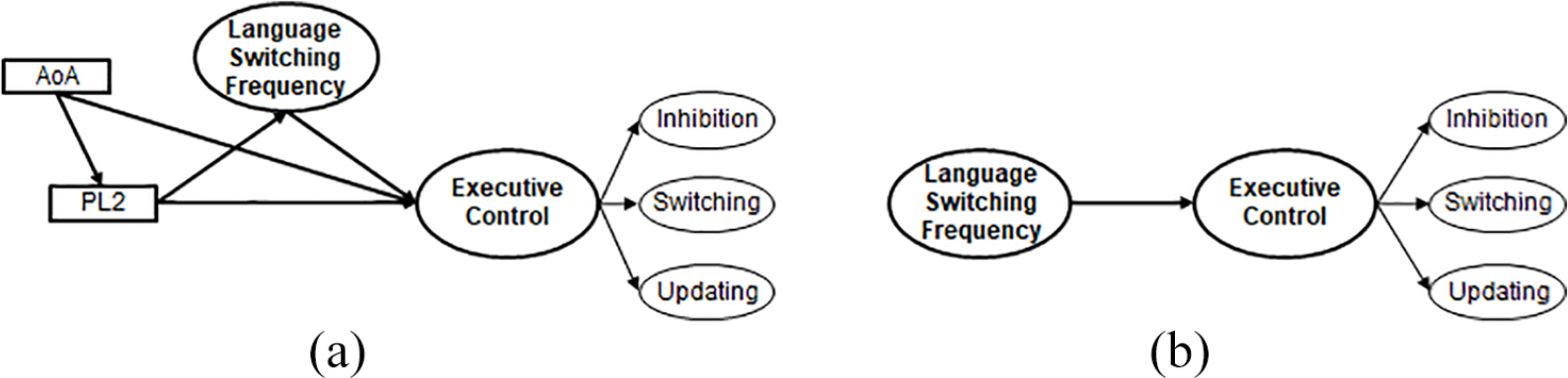
Graphical representation of the proposed theoretical models displaying the influence of the bilingualism-related factors on the executive control of Spanish-Catalan bilinguals. The first model (a) involves the effect of the bilingual linguistic background factors: age of acquisition (AoA) and second language proficiency (PL2), along with the language switching frequency; while the second model (b) comprises only the effect of the language switching frequency on executive control.
Method
Sample
The sample of this study comprised 184 participants (146 females), all of them were Spanish-Catalan bilingual university students recruited at the University of the Balearic Islands. Participants were between 19 and 45 years old (M = 22.1 ± 5 years), and had between one and six years of university education (M = 2.3 ± 1 years).
Moreover, all participants considered themselves as bilinguals, and several of them referred to Catalan as their first language (L1; 62.5%) and Spanish as their L2; while the rest of the sample indicated Spanish to be their L1 (37.5%) and Catalan their L2. Participants learned their second language early in life (M = 3 ± 2 years) and were very proficient in both languages (ML1 = 11.2 ± 1; ML2 = 9.8 ± 2; in a 12-graded scale), even though their languages were not balanced in terms of self-reported proficiency, t(183) = –3.42, p = .001.
Procedure
All participants answered two questionnaires and performed three computerized tasks. First, all participants received on-line forms of self-reported questionnaires, having to answer questions regarding demographic (i.e., age, gender and years of university studies) and linguistic background information. Once all participants had answered the self-reported instruments, the computerized session took place. The computerized session lasted about 60 minutes, in which three tasks were applied: the flanker task, the feature-switching task, and the block-tapping task, all of them included in the Psychology Experiment Building Language Test Battery (PEBL; Mueller & Piper, 2014). The distance between the participant and the computer screen was approximately 60 cm.
All participants gave written informed consent before testing, had a normal or corrected-to-normal vision and did not report to have a history of mental or neurological illness. At study completion, all participants received extra credit points in a psychology subject for their participation. This study was conducted in accordance with the recommendations of the Committee on Research Ethics of the Balearic Islands University.
Materials and measures
Bilingual linguistic background
Participants received a questionnaire in which they were asked about linguistic background questions, including whether they considered themselves as bilinguals, the age of acquisition of their L2 (AoA), which was their mother tongue (L1) and their second language (L2), and proficiency in their two languages.
Overall scores for the proficiency on L2 (PL2) and L1 were calculated separately as the addition of three items: oral and written expression, and oral comprehension proficiencies. Hence, overall scores could range from 0 to 12, given that specific scores were obtained by means of five-point Likert scales quantifying the competence in each of these language skills (0 = very poor, 1 = poor, 2 = intermediate, 3 = good, 4 = very good).
Regarding bilingual linguistic background information, no latent variable was specified. Two bilingual linguistic background measures were used (only in Model 1, see the Model Specification section for more details): AoA and PL2. While larger values of AoA reflected an older age acquiring the L2, larger values on PL2 reflected better proficiency in this language.
Language switching frequency
In order to assess LS habits, participants answered the Spanish version of the Bilingual Switching Questionnaire (BSWQ; Rodriguez-Fornells et al., 2012). This instrument provides scores on four scales involving three items each: tendencies to switch from L2 to L1 (named hereafter L1S), tendencies to switch from L1 to L2 (L2S), the tendency to switch languages in specific situations or contexts (CS), and the tendency to switch languages unintendedly (US). Answers to each item of the BSWQ were given in a five-point Likert scale quantifying the self-reported frequency of the behavior described on each question (1 = never, 2 = rarely, 3 = occasionally, 4 = frequently, 5 = always).
To specify the LSF latent variable, the four scales’ overall scores were used: L1S, L2S, CS, and US. Higher values of each scale reflected more frequent language switching according to their respective conditions (e.g., a high L2S score implied that a participant switched languages from L1 to L2 very often).
Inhibition
A modified version of the original flanker task (Eriksen & Eriksen, 1974) was used to explore interference suppression of irrelevant information. Participants were instructed to indicate the direction of the central arrow (target) of an array of five horizontally aligned stimuli (Figure 2a) by pressing the appropriate keyboard button (with the left or the right index finger). The target was always an arrow, while the four flanking distractors could be either arrows or horizontal lines. According to the nature of the distractors, three conditions were presented: congruent (e.g., <<<<<), incongruent (e.g., >><>>) or neutral (e.g., –<–). The task comprised 120 randomized trials, and the number of trials per condition was kept equivalent (40 trials each). Prior to the actual test, participants performed 12 practice trials that were not analyzed. The trial sequence started with a fixation cross displayed for 500 milliseconds (ms), then the target was presented in the middle of a black screen until a response was given or up to a maximum of 800 ms. The inter-trial-interval was 1000 ms. Response accuracy and RTs were recorded and averaged for each experimental condition and participant.
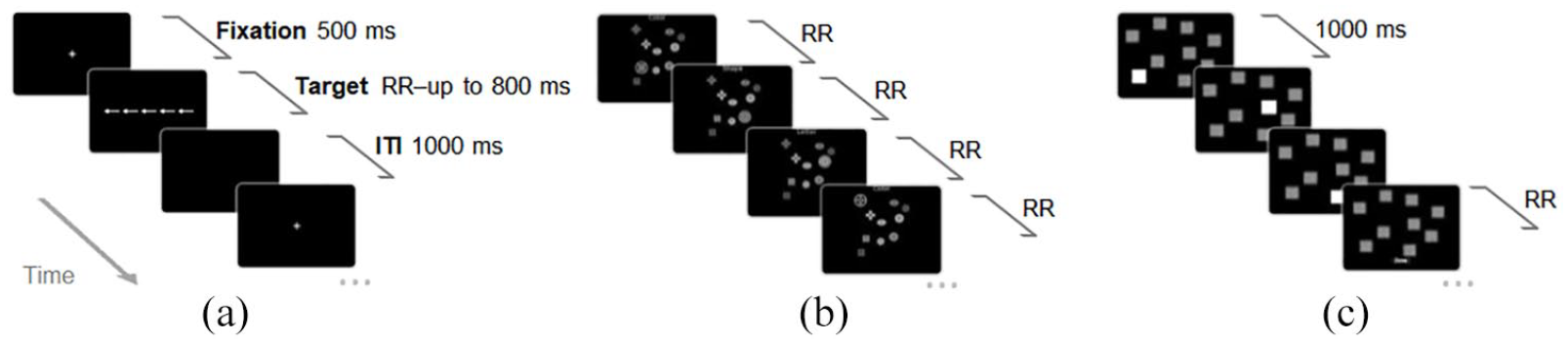
Graphical representation of the tasks administered, including (a) the Flanker task, (b) the Feature-switching task and (c) the Block-tapping task. See text for more details regarding the specifics of each task. “ITI” refers to the inter-trial interval, “RR” to response required and “ms” to milliseconds.
To specify the Inhibition latent variable of EC, three different flanker effects were used: proportional flanker costs for incongruent versus congruent trials and for incongruent versus neutral trials, and the inverse efficiency score of the flanker effect. We used these RT corrected measures in order to avoid shared variance that could be attributable to the speed of processing between these measures and the ones used for the Switching latent variable (all of them RT-dependent). Proportional flanker costs were computed as follows for incongruent–congruent proportional flanker costs and incongruent–neutral proportional flanker costs, respectively: [(RTincongruent – RTcongruent)/ RTincongruent]2 and [(RTincongruent – RTneutral )/ RTincongruent]2 (de Bruin & Della Sala, 2018). Moreover, the inverse efficiency score was computed by dividing the mean RT of correct trials for both congruent and incongruent trials by the overall proportion of corrects (Pcor), separately for each condition. Then, we subtracted the congruent inverse efficiency score to the incongruent one to achieve the FIES measure, that is, flanker costs in terms of inverse efficiency scores: (RTincongruent /(Pcor) – (RTcongruent /(Pcor) (Bruyer & Brysbaert, 2011). Note that we reversed these score’s values (ρs original Flanker scores, reversed Flanker scores = –1) in order to provide a unified scale among EC latent variables, in which larger values revealed a better performance in EC. Thus, larger incongruent–congruent proportional flanker costs, incongruent–neutral proportional flanker costs and incongruent–congruent flanker inverse efficiency score values (i.e., lesser interference or cost, reversed) reflected better performance.
Switching
A computerized feature-switching task (Anderson et al., 2012) was used in order to assess the ability to flexibly switch between tasks or mental sets. Participants were instructed to match an object in accordance with a target feature that changed in every trial. On each of the 108 trials, 10 objects were presented on a black screen (Figure 2b). Each object was characterized as a function of three features: shape (circle, plus, ellipse, square, and star), color (blue, green, orange, red, and yellow), and the letter appearing inside (from A to Z); yet objects matched a single another object in only one feature. At the beginning of each trial, a target feature was displayed at the top of the screen, and participants had to search for the object matching that feature. Once participants had correctly matched the object, a different target feature was specified. The task was divided into nine blocks of 12 trials each. Object configuration was different for every block. For the first three blocks, participants alternated between two of the three features (two-predictable features condition). For the next three blocks, participants switched between all three features in a consistent order that differed for each block (three-predictable features condition). For the last three blocks, target features were alternated randomly after each correct response, so that the next target feature could not be anticipated prior to making the response (three-unpredictable features condition). The number of errors and RT for each trial were recorded and averaged for each of the three experimental conditions.
To specify the Switching latent variable of EC, direct RT measures to the correct responses for each condition of the feature-switching task were used: two-predictable features, three-predictable features, and three-unpredictable features conditions. Note that we reversed these score’s values (ρs original Feature-switching scores, reversed Feature-switching scores = –1) in order to provide a unified scale among the EC latent variables, in which larger values revealed a better performance in EC. Thus, larger two-predictable features, three-predictable features, and three-unpredictable features RT values (i.e., the reversed values of the more rapid RTs while shifting) reflected better performance.
Updating
A computerized version of the Corsi’s (1973) block-tapping task (Croschere et al., 2012) was used to assess the visuospatial updating of information. Participants were instructed to remember visual patterns of increasing length. On each trial, nine blue squares were presented on a black screen (Figure 2c). Squares lit up (changed from blue to yellow; 1000 ms duration) one at a time in a sequence. After the sequence was completed, participants were instructed to click on the squares in the same order they lit up (forward). The task started with a sequence of two squares length. If participants were able to correctly respond to two sequences of the same length, the following sequence increased its length in one lit square. The task finished when the participant failed to correctly remember two consecutive sequences of the same length. Prior to the actual test, participants performed three practice trials that were not analyzed. The length of the last correctly remembered sequence and the number of correct trials were recorded.
To specify the Updating latent variable of EC, the block-tapping total score was modeled as a single-indicator factor (Keith, 2014). The block-tapping total score was calculated as the product of the length of the last correctly remembered sequence and the number of correct trials, and it was computed for each participant. Note that this score was not reversed. Thus, larger block-tapping total score values reflected better performance.
Model specification and data analyses
Model specification
In order to address the relations among the target latent variables, we followed an SEM approach. We proposed two theory-driven models differing in whether bilingual linguistic background measures affected or not the frequency of either the LSF or EC. In both models LSF influenced EC.
In particular, Model 1 (see Figure 1a) assumed that one (or both) of the bilingual linguistic background factors (i.e., AoA and PL2) had an effect on EC. In this model, AoA is assumed to influence PL2 (thus, they did not form a latent variable) and they both were assumed to influence, or not, EC. Moreover, PL2 was expected to influence both LSF and EC, and LSF was hypothesized to influence EC. On the other hand, Model 2 (see Figure 1b) involved only the relation between LSF and EC. A summary of descriptive statistics for every measure used in the two models, along with their respective categories, can be found in Table 1.
Descriptive statistics and normality tests for the bilingual linguistic background, language switching and executive control measures (N = 184). All measures are in their original scale (none of the Inhibition or Switching scores is reversed in this table).
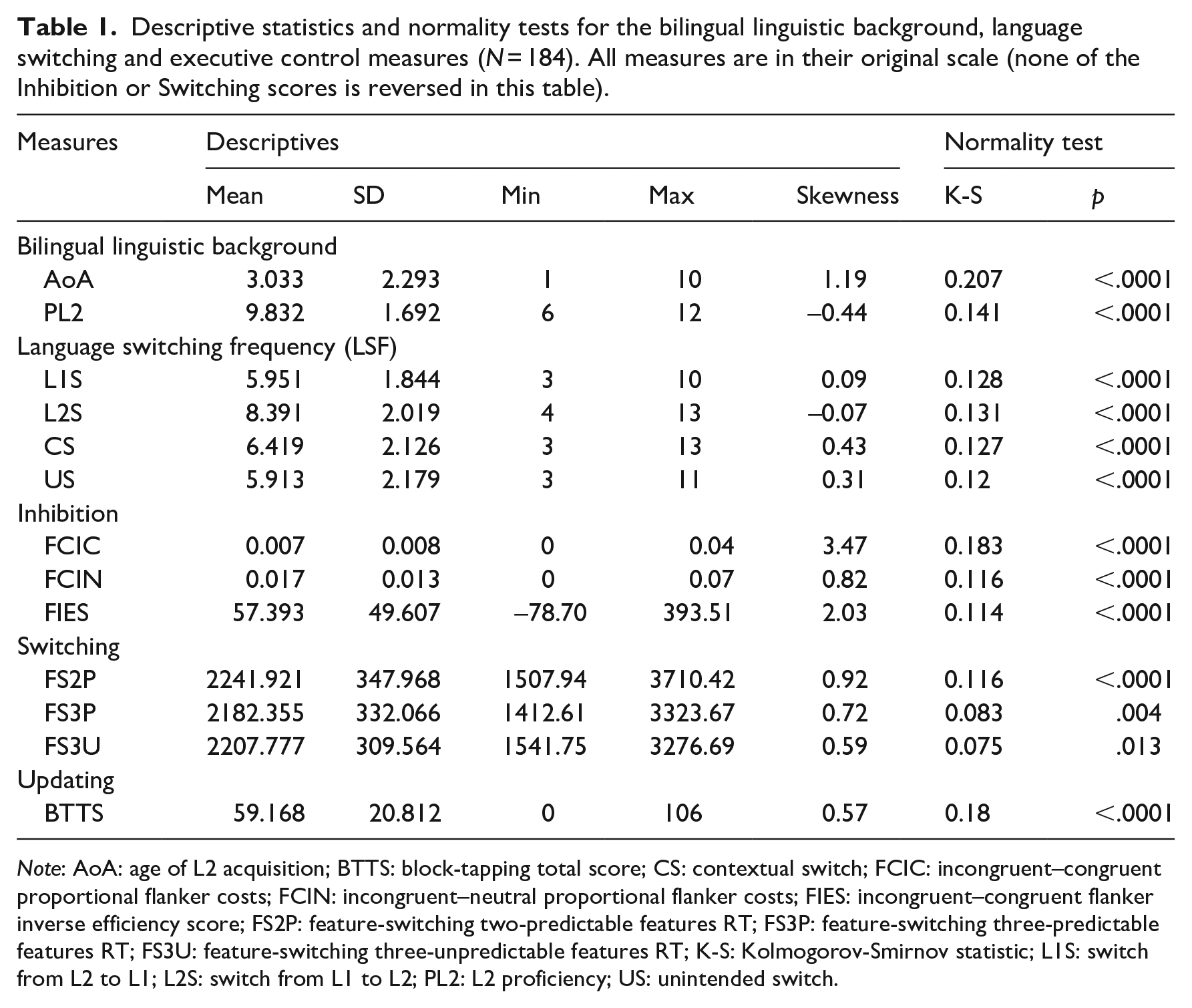
Note: AoA: age of L2 acquisition; BTTS: block-tapping total score; CS: contextual switch; FCIC: incongruent–congruent proportional flanker costs; FCIN: incongruent–neutral proportional flanker costs; FIES: incongruent–congruent flanker inverse efficiency score; FS2P: feature-switching two-predictable features RT; FS3P: feature-switching three-predictable features RT; FS3U: feature-switching three-unpredictable features RT; K-S: Kolmogorov-Smirnov statistic; L1S: switch from L2 to L1; L2S: switch from L1 to L2; PL2: L2 proficiency; US: unintended switch.
Data analyses
Since preliminary variable analyses revealed that none of the observed measures were normally distributed (see Table 1), we opted to use the asymptotically distribution-free (ADF; Mooijaart, 1985) procedure to estimate all models. Confirmatory factor analysis (CFA) was first used to examine model fit for both LSF and EC latent variables. Standardized and unstandardized path coefficients and significance values were obtained for the two hypothesized structural models. The SEM was specified to test direct and indirect associations among measures involving bilingual linguistic background (only in Model 1), LSF, and EC. Thus, 1000 ADF bootstrapping samples were used to generate 95% bias-corrected confidence interval (CI) of specific indirect effects, since this CI has shown to be the most accurate test of mediation in SEM simulation studies (Cheung & Lau, 2007). Moreover, no imputation method was used because there were no missing values.
In relation to the different types of effects mentioned before, direct effects reveal the unmediated influence of a variable on another given a proposed theory-driven model (MacKinnon, 2008). On the other hand, indirect effects quantify the specific amount of the total influence on a variable that is attributable to the preceding factor once the effect of the mediating variable is partialled out (Preacher & Hayes, 2008). For example, EC mediates the relation between LSF and Inhibition in Figure 1b. Hence, the indirect effect of LSF on Inhibition estimates the specific impact of LSF on Inhibition controlling for the influence of EC on the latter. This procedure is conducted for every variable that is mediated in a given model (following the example, in both Switching and Updating as well), and is calculated using the parameters estimated on all paths connecting the relevant variables of the model for each indirect effect. In summary, the main goal of the present study (characterizing the influence of bilingualism on EC) was focused on estimating direct effects on EC. The secondary aim of the work was centered on the estimation of the indirect effects between the bilingualism-related factors and the specific subcomponents of EC, assuming that the EC general ability mediates that relation.
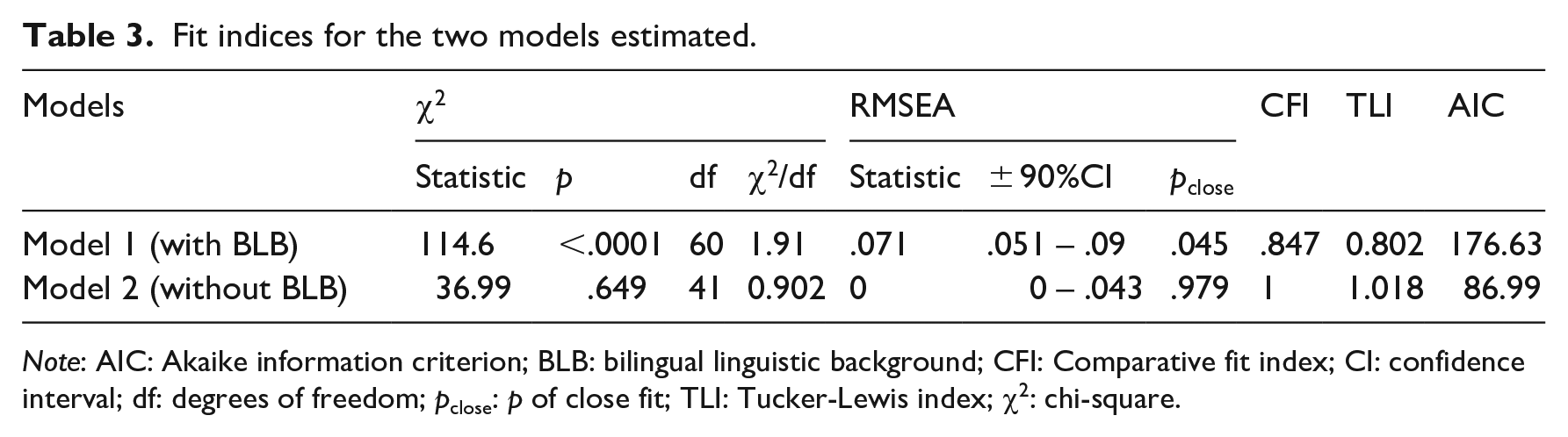
Regarding model fitting, that is, indices that reflect how well does a particular model fit the data, chi-square (χ2) and the chi-square/degrees of freedom ratio (χ2/df), Comparative fit index (CFI), Tucker-Lewis index (TLI), root mean square error of approximation (RMSEA), and Akaike information criterion (AIC) were calculated. A model was considered to have a good fit when the following indices were above or below their specified cut-off criteria (Schermelleh-Engel et al., 2003; Schreiber et al., 2006). When χ2 was non–significant at the .05 level (i.e., p > .05) and when χ2/df was less than two (values closer to 1 indicate better fit because of model parsimony). When the RMSEA was below .05, including values smaller than .05 for the lower bound and smaller than .08 for the upper bound of the confidence interval. Moreover, the p-value for the test of the close fit (pclose) of the RMSEA was accepted as a good fit when its values were between .1 and 1. When both CFI and TLI revealed values equal or above .95 (note that the latter can show values above 1). Finally, a model was considered to have a better fit when its AIC value was smaller, as compared to the AIC value of another model.
SPSS v22 statistical software was used for descriptive and correlational analyses. SPSS AMOS v21 software was used for CFA and SEM estimation.
Results
Correlations among all the measures used in this work are presented in Table 2. Prior to assessing the hypothesized relations among variables in the two theoretical models, we examined by means of two CFAs the LSF and EC latent variables. Regarding the LSF latent variable, inspection of fit indices showed an overall adequate fit (with the exception of the TLI, for which the value fell moderately below its cut-off criterion), χ2 (2 dfs) = 3.9, p = .145, CFI = .97, TLI = .89. Moreover, all scales showed significant loadings on the LSF factor (ps < .022), ranging from .3 to .73. With respect to the EC latent variable, fit indices inspection did also reveal a good fit, χ2 (12 dfs) = 7.1, p = .852, CFI = 1, TLI = 1.08. Furthermore, all measures showed significant loadings on their respective factors (ps < .001), ranging from .46 to .95. Thus, we used these latent variables in all subsequent analyses.
Spearman correlation matrix for the bilingual linguistic background, language switching and executive control measures (N = 184).
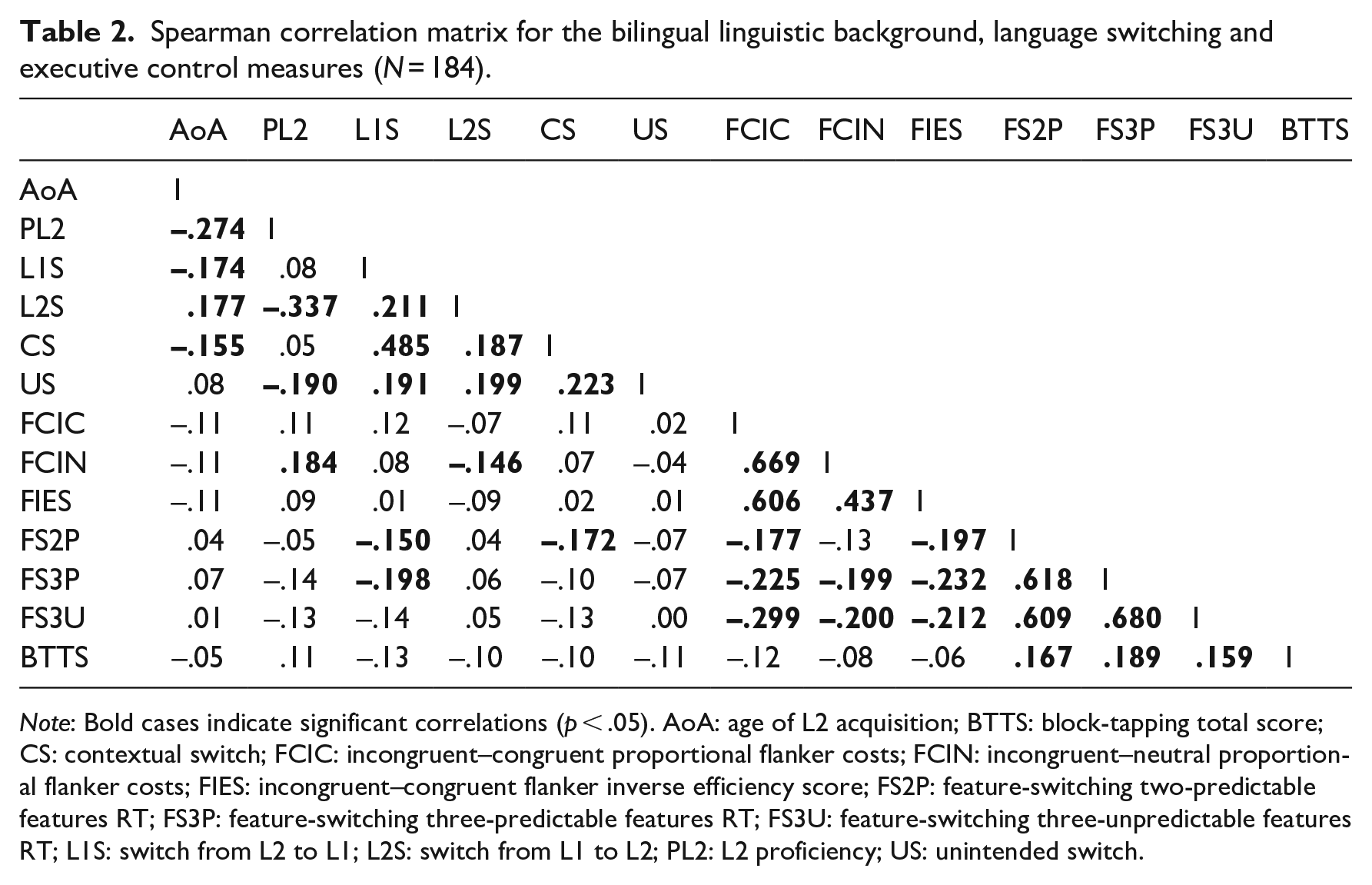
Note: Bold cases indicate significant correlations (p < .05). AoA: age of L2 acquisition; BTTS: block-tapping total score; CS: contextual switch; FCIC: incongruent–congruent proportional flanker costs; FCIN: incongruent–neutral proportional flanker costs; FIES: incongruent–congruent flanker inverse efficiency score; FS2P: feature-switching two-predictable features RT; FS3P: feature-switching three-predictable features RT; FS3U: feature-switching three-unpredictable features RT; L1S: switch from L2 to L1; L2S: switch from L1 to L2; PL2: L2 proficiency; US: unintended switch.
To address the hypothesis of the present work, both Model 1 and Model 2 were estimated. As can be seen in Table 3, Model 1 showed a bad fit to the data according to the cut-off criteria. In particular, χ2 was significant at the .05 level, RMSEA was above the .06 value, and both CFI and TLI showed values below .95. Even though this model did not fit well, we report here the specific relations between bilingual linguistic background variables and both LSF and EC for informative purposes. AoA revealed a negative effect on PL2, β (standardized direct effect) = –.12, p = .022, and PL2 showed a negative influence on LSF, β = –.38, p < .0001. These results might suggest that participants who learned their L2 later were less proficient. Beyond, less proficient bilinguals would be more prone to switch frequently between languages. Neither AoA nor PL2 had an effect on EC (ps > .56). Nevertheless, we emphasize again that no conclusions should be drawn regarding Model 1 because of its lack of fit. Furthermore, to ascertain whether Model 1 was suitably selected, we also estimated two alternative and more parsimonious nested models. We specified a nested model constraining to zero the path between AoA and EC, in which both LSF and PL2 (but not AoA) influence EC; and another constraining to zero the path between PL2 and EC, in which both LSF and AoA (but not PL2) influence EC. These models were similar in every other way to the default nesting model (Model 1), except for the constraints mentioned, and showed no fit to the data. As compared to the original Model 1, they revealed a similar fit (χ2sdiff < 0.351, dfsdiff = 1, psdiff > .554), even though they were more parsimonious models. These outcomes confirm that Model 1 was properly selected, and support the results reported here.
Fit indices for the two models estimated.
Note: AIC: Akaike information criterion; BLB: bilingual linguistic background; CFI: Comparative fit index; CI: confidence interval; df: degrees of freedom; pclose: p of close fit; TLI: Tucker-Lewis index; χ2: chi-square.
On the other hand, Model 2 did show a good fit to the data (see Table 3): its fit indices values were appropriately above or below their respective cut-offs. Structural equation results for the hypothesized Model 2 can be seen in Figure 3. Both the LSF and the EC latent variables are depicted as ellipses, and the arrows linking latent variables among them, as well as the observable measures, showed the direction and magnitude of direct standardized effects, which were all significant (ps < .013).
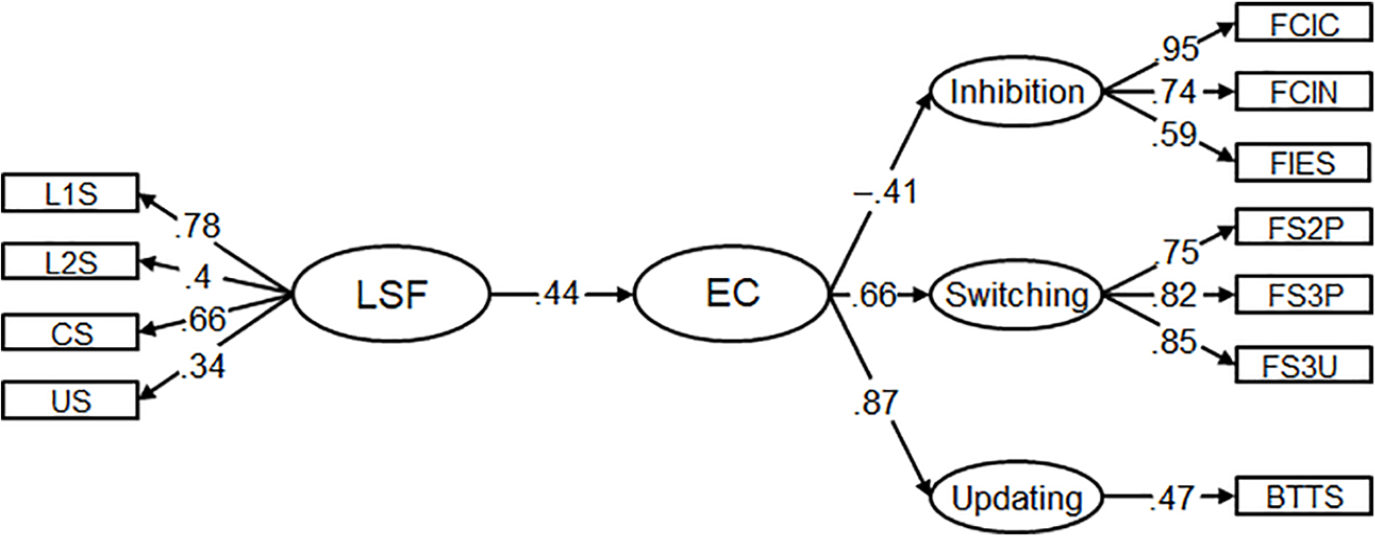
Structural equation results of Model 2 (without the bilingual linguistic background variables), in which the language switching frequency (LSF) positively influences the executive control (EC) of bilingual individuals. Ellipses indicate latent variables and rectangles show observable measures. Numbers on arrows represent the standardized direct effects (β), all of them significant at the .05 level. Note. L1S: switch from L2 to L1; L2S: switch from L1 to L2; CS: contextual switch; US: unintended switch; FCIC: incongruent–congruent proportional flanker costs; FCIN: incongruent–neutral proportional flanker costs; FIES: incongruent–congruent flanker inverse efficiency score; FS2P: feature-switching two-predictable features RT; FS3P: feature-switching three-predictable features RT; FS3U: feature-switching three-unpredictable features RT; BTTS: block-tapping total score.
Our primary interest regarding this model was in the direct influence of LSF on EC. In this regard, Model 2 results showed that LSF had a positive significant effect on the EC latent variable, β = .44, p = .013, R2 = .19. Besides, regarding the standardized coefficients of EC on its subcomponents, all effects were significant. In particular, both the Switching subcomponent, β = .66, p = .006, R2 = .44, and the Updating subcomponent, β = .87, p = .004, R2 = .76, did positively load on the EC second-order latent variable. Surprisingly, the Inhibition subcomponent showed the opposite pattern (see Figure 3), β = –.41, p = .003, R2 = .17, showing a negative relation with EC. Note that it was hypothesized that all subcomponents should have shown a positive relation with EC since we did unify the scale of every observed measure (i.e., larger values in all observed measures should reveal a better performance in EC, as stated in the Methods section). However, this was not the case with the Inhibition subcomponent. Close inspection of Table 2 revealed that all Inhibition-related measures (incongruent–congruent proportional flanker costs, FCIC in the table; incongruent–neutral proportional flanker costs, FCIN; and incongruent–congruent flanker inverse efficiency score, FIES) showed a negative relation with both Switching-related measures (feature-switching two-predictable features RT, FS2P; feature-switching three-predictable features RT, FS3P; and feature-switching three-unpredictable features RT, FS3U) and the Updating measure (block-tapping total score, BTTS). Moreover, the EC latent variable’s CFA did also show that this pattern of negative correlations was replicated at the latent level, corroborating that this result was not an artifact or a mistake when estimating the model.
Furthermore, we also aimed at identifying the specific effects of LSF (since this is the only model that fitted the data) on the different EC subcomponents (i.e., Inhibition, Switching, and Updating), an aspect that was evaluated by means of the indirect effects. Standardized indirect effect coefficients (βi) of LSF on the EC subcomponents were all significant (ps < .032), indicating that LSF had an indirect effect on every specific subcomponent through the mediating EC latent variable. In particular, LSF showed a negative indirect effect on Inhibition, βi = –.18, a positive indirect effect on Switching, βi =.29, and a positive indirect effect on the Updating subcomponent, βi = .38.
Discussion
Bilinguals are a heterogeneous group with diverse environmental influences that might play different roles in the development of their cognitive processes. Thus, it seems likely that distinct contexts (e.g., single versus dual-language contexts) lead to varied bilingual experiences and ways to cognitively accommodate the practice exercised according to the particular dimensions of each context (Green & Abutalebi, 2013). Hence, the present study sought to characterize by means of an SEM approach the impact of several bilingualism-related factors previously described in the literature, age of second language acquisition (AoA), second language proficiency (PL2), and language switching frequency (LSF), on the executive control (EC) ability of Spanish-Catalan bilinguals who are immersed in a dual-language bilingual context. Our results showed that the model that included the bilingual linguistic background factors, such as AoA and PL2, along with the LSF (i.e., Model 1), did not adequately fit the data. In contrast, Model 2, which was specified so that LSF was the only factor hypothesized to influence EC, revealed a good model fit. Hence, in accordance with our hypothesis and in line with previous literature (Costa et al., 2009; Hartanto & Yang, 2016; Prior & Gollan, 2011; Verreyt et al., 2016), the main finding of this study is that the only bilingualism-related factor that seems to influence the EC of Spanish-Catalan bilinguals is the LSF, regardless of AoA and PL2. However, this pattern of results is only likely when bilinguals have achieved a high degree of PL2 (Barbu et al., 2018; Prior & Gollan, 2011), as it is the case of our sample, which was composed by high-proficient bilinguals immersed in a dual-language context in which the two languages are widely used and the communication language may change according to the addressee. Furthermore, this finding partially endorses the hypothesis that bilingualism in dual-language contexts is assumed to increase the demands on the EC (Green & Abutalebi, 2013; Henrard & Van Daele, 2017) because the EC adaptation appears to be driven to some extent by the LSF in this specific interactional setting, as evidenced by our results.
Although this first main conclusion might be appealing to shed some light onto the varied outcomes found in the research field investigating the relation between bilingualism and EC, it might also lead to some misconceptions. Thus, we believe it is noteworthy to recommend caution when integrating this outcome into the theoretical background and to comment on some specific issues regarding our results. The bilingualism-related factor of LSF did only explain 19% of the EC variance in the accepted model (Model 2), even when considering a sample of participants immersed in the interactional context assumed to be the most demanding (Green & Abutalebi, 2013). Albeit this seems to be a considerable quantity of explained variance, it remains unclear which other factors (bilingualism-related or not) might be influencing the EC of these individuals. Regarding the bilingualism-related factors, there might be a plethora of covariates involved, such as the similarity of languages (Oschwald et al., 2018) or the degree of bilingualism associated to the linguistic context (e.g., bilingual mass media exposure; Costa et al., 2009). Besides, even though neither AoA nor PL2 seem to influence the EC of Spanish-Catalan bilinguals, presumably because of the scarce variability of these factors in this sample, it does not imply these aspects might not exert a positive influence in different bilingual populations (e.g., Yow & Li, 2015). In this vein, it is noteworthy to underline that the present conclusions are to be ascribable mainly to bilinguals who acquired both languages very early, show a high level of proficiency in their second language, and whose language usage develops and takes place in dual-language contexts, as it is the case with Spanish-Catalan bilinguals. However, for other bilingual populations, the impact of the bilingualism-related factors on EC might be different. This is why it is relevant to provide a more exhaustive model that is capable of accounting for these influences (Model 1) and can be used as a framework to compare particular bilingual populations in future research. The fact that we have revealed with Model 2 which of the factors seems to be the most important in the specific case of the Spanish-Catalan bilinguals does not imply that the outcomes of Model 1 are completely meaningless. In practice, these results are very informative because they can be compared with those of other bilingual populations as long as the methodology used to test them resembles the one employed in the present study.
Secondarily, we were also interested in exploring whether the effect of the bilingualism-related factors, as mediated by a general executive processing ability, was restricted to any specific subcomponent of the EC, or whether the influences were domain-general. Our results support the latter notion: LSF indirectly influenced all EC subcomponents (as mediated by a general executive processing mechanism). This outcome is in line with the available evidence showing modulations on inhibition, switching and updating as a function of LSF (Costa et al., 2009; Prior & Gollan, 2011; Verreyt et al., 2016), and with the expected increase in general cognitive demands elicited by the dual-language context (Green & Abutalebi, 2013). Moreover, each subcomponent was distinctly affected by this bilingualism-related factor. In particular, the Updating dimension was the most benefited by the LSF, presumably because of the constant need to monitor for linguistic cues in order to efficiently react in a bilingual conversation (Bialystok, 2017; Costa et al., 2009). Consequently, our results seem to converge with the hypothesis suggesting that the general improvement of EC stems mainly from a general updating ability that modulates the cascade of cognitive control processes required to adequately manage two languages simultaneously according to the enhanced demands of a bilingual environment (Green & Abutalebi, 2013; Hilchey & Klein, 2011). Furthermore, our results revealed that the Switching subcomponent was also indirectly influenced by the LSF. In other words, it seems that bilinguals who tend to alternate between languages more often when engaging in natural conversations in which interlocutors may be addressed in different languages are more efficient in managing their set-shifting abilities. However, some studies have not been able to capture the effect of LSF on the task-switching ability when comparing bilingual groups differing in how often individuals switch languages. For example, both Paap et al. (2017) and Yim and Bialystok (2012) failed to find an association between their LSF measures and nonlinguistic task-switching costs. In contrast, yet similarly to Barbu et al. (2018), we found that those participants who switched languages more often were faster (i.e., more efficient) when switching in a non-verbal switching task. Even though these four studies differ in several characteristics (e.g., participants’ context, LSF measurement methods), one crucial aspect might explain the inconsistencies between results: the task-switching paradigm used. While Paap et al. (2017) and Yim and Bialystok (2012) administered non-verbal switching tasks involving switching and non-switching trials (thus being able to calculate task-switching costs), both our task-switching paradigm and that of Barbu et al. (2018) did not allow this possibility, since all trials required to set-shift. Hence, it seems that the key characteristic to find an association between LSF and non-verbal switching abilities might be related to the expected frequency of task-switching in a specific setting (Dreisbach & Haider, 2006; Mayr et al., 2013). Thereby, the effects of LSF could only be captured when the switching abilities are tested in a high-frequency set-shifting setting that might resemble the linguistic context these bilinguals are immersed in.
The LSF did also indirectly affect the Inhibition subcomponent, revealing that those bilinguals more prone to switch languages frequently were less efficient at suppressing irrelevant information. In this vein, the direction of this influence was unexpected and counterintuitive according to previous literature suggesting that bilinguals show better inhibition abilities given the lifelong practice resolving the continuous competition elicited by the language not in use (Kroll et al., 2014), an effect that is assumed to be magnified in Spanish-Catalan bilinguals because of their interactional context (Green & Abutalebi, 2013). However, our results showed the opposite pattern; not only did we not find an advantage in inhibition, but our data revealed a disadvantage in this regard. A plausible explanation for this finding might be accounted for by the stability-flexibility dilemma (Dreisbach & Fröber, 2019; Goschke, 2000, 2013). In brief, the executive cognitive system has a limited amount of resources that can be allocated in order to achieve an effective adaptation in an environment in constant change. Within this context, two opposing strategies compete to adjust the goal-directed behavior: stability, in which cognitive processes that maintain the current task representation avoiding irrelevant intrusions (i.e., inhibition); and flexibility, in which cognitive processes allow to shift efficiently to another task representation (i.e., switching). Moreover, the balance between these strategies regarding the way control is exerted appears to be dependent of both the individuals and the context, and it can be biased or directed towards stability or flexibility, thus triggering a trade-off. Additionally, it has been suggested that societal practice (prompted by the particular features of a given environment, such as a dual-language context) might contribute to the long-term development and persistence of a bias or style favoring either stability or flexibility (Gruber & Goschke, 2004; Hommel, 2015; Hommel & Colzato, 2017), a process argued to be neurally modulated by the dopamine system (Cools & D’Esposito, 2011). In this vein, we speculate that our results might constitute evidence of an inhibition-switching trade-off mediated by the particular Spanish-Catalan bilingual interactional context. Therefore, we suggest that the lifelong adaptation to a high-frequency of language switching might have biased the executive control towards a switching-prone style. This would, in turn, facilitate set-shifting reconfiguration processes with an associated cost of lowered inhibition ability (Mayr et al., 2013; Musslick et al., 2018).
To summarize, we found that the LSF was the only factor affecting EC, while neither AoA nor PL2 modulated the cognitive ability of Spanish-Catalan bilinguals. Moreover, this influence was both general and specific, that is, it did show an indirect effect in the three subcomponents of the EC tested: Inhibition, Switching, and Updating. In this respect, while the effect of the LSF on the Switching and Updating dimensions of EC was the expected, according to previous studies, the influence on the Inhibition subcomponent was inconsistent regarding previous evidence and theory. Our proposal to account for this finding was that the diminished inhibition subcomponent was a result of both a verbal and non-verbal set-shifting specialization associated with the interactional context Spanish-Catalan bilinguals are immersed in. In particular, and following our results, it seems that the sociolinguistic context of the present sample of participants modulates their EC in such a manner that their updating and switching abilities are enhanced, while their inhibition is lessened because of the limited cognitive resources that can be efficiently allocated. However, even though these findings require further replication, the present study provides the first evidence on the direct influence of LSF on EC using an SEM approach. Further studies might extend and complement the present results in order to better understand how bilingualism-related factors modulate the cognitive characteristics of specific bilingual populations.
Footnotes
Declaration of conflicting interests
The author(s) declared no potential conflicts of interest with respect to the research, authorship, and/or publication of this article.
Funding
The author(s) disclosed receipt of the following financial support for the research, authorship, and/or publication of this article: This study received the support from the Spanish government (MINECO/AEI) and the ERDF, UE (European Regional Development Fund): grants EDU2013-45174-P and EDU2017-85909-P; and a predoctoral fellowship (BES-2014-069063) for the first author. The funders had no role in study design, data collection and analysis, decision to publish, or preparation of the manuscript.
