



Abstract
Addressing jurors’ false beliefs in rape and serious sexual offence (RASSO) cases has been a priority for law reformers worldwide. This includes the Law Commission, whose 2025 report Evidence in Sexual Offence Prosecutions recommended that juror misconceptions be addressed in England and Wales by enhanced judicial directions, supplemented by expert evidence where issues are particularly complex. This paper reviews existing evidence on the effectiveness of jury directions and expert evidence in this context, including quantitative and qualitative studies, and presents new findings from the Scottish Jury Research. It concludes that ‘the jury is out’ in terms of the ability of judicial directions or expert evidence to address false beliefs. This is partly because the evidence base is limited, with a paucity of realistic studies. But there are also reasons for scepticism about the effectiveness of ‘myth-busting’ judicial directions, because they are attempting something different to directions instructing jurors about the law. The latter are attempting to convey information, but the former are trying to impact attitudes, which may be deep-seated and resistant to change. The difficulty is that there are few feasible alternatives. As such, further research into how to maximise their impact, or whether expert evidence might be more effective, is vital.
Keywords
Introduction
In July 2025, the Law Commission published its final report on evidence in sexual offences prosecutions. The issue of effectively prosecuting rape and serious sexual offence (RASSO) cases is one that multiple adversarial jurisdictions have been grappling with, in response to concerns about complainant experiences of the criminal justice system and low conviction rates (Law Commission, 2025: paras 1.2–1.17). In the last decade, aside from the Law Commission's work in England and Wales, there are (or have been) ongoing or concluded law reform exercises in Ireland (O’Malley, 2020); 1 New Zealand (New Zealand Law Commission, 2015); Northern Ireland (Gillen, 2019; Northern Ireland Executive Department of Justice, 2024); Scotland (Scottish Courts and Tribunals Service, 2021); 2 and most of the Australian jurisdictions (e.g., Australian Law Reform Commission, 2025; New South Wales Law Reform Commission, 2020; Victorian Law Reform Commission, 2021). 3
The Law Commission's final report represents the culmination of a comprehensive project, which stemmed from the UK Government's End-to-End Rape Review (HM Government, 2021). The Law Commission project was launched in 2022 and covered a wide range of issues including the defence's access to the complainant's personal records; the admissibility of sexual behaviour evidence; criminal injuries compensation; independent legal representation for complainants; measures to assist complainants in giving evidence; the conduct of sexual offences cases by the prosecution and defence; specialist sexual offences courts; and jury decision making. It is the last of these issues that this paper will focus on. There has been long-standing concern that jurors may not be determining RASSO cases objectively, but are instead influenced by so-called rape myths – false and prejudicial beliefs about rape and rape victims – that affect their decision making.
The extent to which jurors might hold these false beliefs, and the extent to which they affect their decision making in rape trials, has been the subject of debate and it is not our intention to add to that debate here. 4 Even the most sceptical of commentators, however, accept that there is evidence that at least some jurors believe some rape myths. This is not a state of affairs that should be left unaddressed. Setting aside any concerns about the effect this may have on conviction rates, confidence in the criminal justice system rests on jurors evaluating evidence objectively, free from the influence of false beliefs and biases. As such, the Law Commission (2025: para 1.14) proceeded on the basis that ‘there is a risk that jurors may inadvertently be influenced by myths and misconceptions and reform strategies should try to minimise such risks’.
The question then is what strategies might best be employed. This question formed a substantial part of the Law Commission's report (chapter 10 and parts of chapters 11 and 12), with the Commission ultimately recommending a number of reforms, all of which centred around jury directions and expert evidence. 5 These recommendations will be examined and compared to the recommendations of other major reviews that have considered strategies to address juror misconceptions about RASSO. 6
The primary aim of this paper, however, is to assess the research evidence that relates to the effectiveness of jury directions and expert evidence in addressing the false beliefs of jurors in RASSO cases. It analyses a wide range of studies – both quantitative (experimental mock jury studies) and qualitative (analysis of the content of mock jury deliberations and juror interviews). 7 It also presents previously unpublished findings from the Scottish Jury Research, a large-scale mock jury research project where jurors were exposed to a judicial direction aimed at countering false beliefs about delayed reporting in sexual offence cases. We conclude that ‘the jury is very much out’ in terms of the ability of judicial directions or expert evidence to effectively address false beliefs about rape. This is in part because the evidence base is a limited one, with a paucity of studies undertaken in realistic scenarios. But there are also good reasons to be sceptical about the effectiveness of (in particular) judicial directions, because they are trying to do something of a different nature to directions that are instructing jurors about the law they should apply to the facts. They are not simply attempting to convey information. They are trying to change attitudes, which may be deep-seated and resistant to change. The difficulty is, as we explain below, there may be few feasible alternatives. As such, further research into how to maximise their impact, or whether expert evidence might be better suited to the task, is vital.
What are rape myths?
Rape myths are false and prejudicial beliefs about rape and rape victims. 8 There are essentially two types of rape myth, depending on the harm that they might cause complainants in RASSO cases: credibility myths and blame myths (Leverick et al., 2025).
Blame myths are those that harm complainants by regarding them as being at fault in some way for their rape because, for example, they had consumed excessive alcohol (Jenkins, 2021: 41). Blame myths are untrue, but they do not cast doubt on the veracity of the rape – they accept that the complainant may have been raped, but place the blame for the incident, at least in part, with the complainant rather than the defendant. Blame myths are not considered further here, as our interest is in the way in which rape myths might affect jury decision making in criminal trials, where the jury is the fact finder and has to reach a decision on whether or not it is proved beyond reasonable doubt that a rape occurred.
Credibility myths are false beliefs that that cast inappropriate doubt on the credibility of rape allegations (Leverick et al., 2025). They include the belief that rape is always accompanied by significant violence and/or injury; someone being raped would forcefully resist and/or would always shout and scream to attract attention; a genuine rape victim would always report the incident immediately (or as soon as possible); genuine rape victims are always emotional when giving evidence; a genuine rape victim would always be able to give a consistent and detailed account of the incident; and that false rape allegations are commonly made (e.g., to ‘cover up’ sexual infidelity or to gain ‘revenge’ on a sexual partner). 9 It is these myths that we are concerned with, and the remainder of the review will consider studies that have examined educational interventions to address credibility myths. It will also focus only on studies that involved adult complainants.
Approaches to addressing rape myths
How might this be done?
As noted above, the Law Commission's reform recommendations focused on jury directions and expert evidence. But these are not the only possible ways in which jurors’ false beliefs might be tackled. There are two broad approaches to addressing the influence of rape myths: (a) indirectly, by limiting the introduction of rape myth narratives in evidence and (b) directly, by implementing strategies to prevent or limit juries from relying on false beliefs in decision making.
The indirect approach to preventing rape myths from influencing jury decision making is to limit the extent to which the trial process provides a foundation for them to be relied upon. The most obvious way in which rape myths might be brought up at the trial is via the cross-examination of the complainant and/or in a defence speech, but they can also arise – perhaps inadvertently – via examination-in-chief by the prosecution (Quilter and McNamara, 2023: 15). Measures that might be utilised here include prohibitions on leading sexual history evidence (sometimes called ‘rape shield’ legislation), managing the trial process to prevent improper questioning, and promoting trauma-informed practice and training for professional participants in the trial. The Law Commission made a number of recommendations in these areas, 10 which are not considered further here as our focus is on direct interventions. Indirect approaches are unlikely to be sufficient on their own because jurors can independently rely on rape myths, even if the trial strategy used by the defence does not rely on them.
The second way of countering the influence of rape myths is to take a more direct approach by targeting the decision-making body in the criminal trial. There are essentially three main options: (a) removing the jury as a decision maker entirely, replacing it with a professional judge (or judges) or a mixed panel; (b) juror screening/selection with the aim of removing jurors from the panel who hold false beliefs; and (c) educating jurors through judicial directions and/or expert evidence. 11
The rejected options
Option (a) – removing the jury as a decision maker – was considered but rejected by the Law Commission. It is notable that it was considered at all. Two of the most comprehensive reviews undertaken in comparable adversarial jurisdictions – the Australian Law Reform Commission (2025) and the Gillen Review in Northern Ireland (Gillen, 2019) – did not consider this as an option. The Law Commission identified various arguments in favour of removing the jury from RASSO trials – primarily that even if judges hold false beliefs, it is easier to educate them than a group of jurors who are in court on a one-off basis for a short time; and that it is far more practical for a judge than a jury to give a reasoned verdict – another measure that might reduce reliance on false beliefs in decision making (Law Commission, 2025: para 12.182; see also Leverick, 2023: 21–22). The Commission also pointed to strong arguments against judge only trials, most notably the importance of juries to democracy and public faith in the criminal justice process (para 12.183; see also Leverick, 2023: 22).
Ultimately the Law Commission concluded that ‘there is an insufficient evidence base for such a significant change, both in terms of the overall impact of myths and misconceptions on trial procedure and outcomes, and how effective juryless trials would be in addressing those issues’ (para 12.228). The ‘strong opposition’ (para 12.229) they encountered to the possibility of removing juries was also acknowledged and, although not explicitly referenced, they may have been mindful of the experience of both Scotland and New Zealand in this respect. In Scotland, in response to concerns that rape myths might be influencing jury decision making, a judge-led review of sexual offence prosecutions recommended that consideration be given to a pilot of judge only trials (Scottish Courts and Tribunals Service, 2021: recommendation 5). This proposal made it as far as a draft Bill, 12 before being abandoned as there was ‘not enough cross-party support at this time’ 13 for it to progress. The proposal had proved controversial for several reasons including the risk of judicial bias, concerns about removing public participation in the criminal justice process, and ethical issues associated with selecting accused persons to participate in the pilot. The Scottish Solicitors Bar Association had stated that there was support amongst members for a boycott of the pilot if it went ahead. 14 In New Zealand, the Law Commission stated that there was ‘a case for conferring the decision making function in sexual violence cases on some entity other than the jury’ (New Zealand Law Commission, 2015: para 6.34). It did not, however, go as far as making a firm recommendation in this area, mindful that it might be difficult to secure support for changes to the legislative provisions guaranteeing the right to a jury trial for any offence punishable by two or more years imprisonment. 15
Option (b) – juror screening – would involve jurors who hold false beliefs about rape being identified through the use of a screening tool (such as a rape myth acceptance questionnaire) and prevented from serving. At present in England and Wales jurors are selected at random from the electoral register and while there are various restrictions on who might serve, it is not possible to screen jurors out based on beliefs that they hold. Juror screening was, however, also rejected by the Law Commission as ‘neither viable nor desirable’ (para 12.131), mirroring the conclusions reached by the Gillen Review in Northern Ireland (Gillen, 2019). It was not an option that was considered by the Australian Law Reform Commission (2025), the Dorrian Review (Scottish Courts and Tribunals Service, 2021) or the New Zealand Law Commission (2015).
They were right to do this. Screening is impractical and unlikely to be effective. It would be very difficult to select an appropriate screening tool and to determine the score that should prevent a juror from serving. It might also have meant that juries were no longer representative of the public, as it has been shown that men and older people are significantly more likely to hold false beliefs about rape (see e.g., Hockett et al., 2016; Suarez and Gadalla, 2010). The main problem, however, is that questionnaire surveys of juror attitudes are subject to social desirability bias and jurors who score low on rape myth acceptance scales can still express false and prejudicial beliefs during deliberations. 16
What did the Law Commission recommend?
Having ruled out replacing the jury and screening jury members, the Law Commission went on to make a number of recommendations relating to option (c): juror education. There are essentially two ways in which jurors might be educated – judicial directions and expert evidence (whether given in person or via a video). The Law Commission made recommendations relating to both. Although there are some small differences in detail, this mirrors the approach taken by almost all 17 of the other reviews undertaken in the last decade, all of which have seen judicial directions combined with expert evidence in at least some cases as the primary tools to be used to tackle juror misconceptions in RASSO cases (see Australian Law Reform Commission, 2025: paras 8.13, 8.20, 8.47; Gillen, 2019: para 6.96; 18 New Zealand Law Commission, 2015: paras 6.53, 6.55).
Judicial directions
There are different approaches that can be taken to judicial directions that aim to target false beliefs about rape and rape victims. They can vary according to (a) their content (both in terms of the specific rape myths that are addressed and the wording used to do so), (b) their timing (they can be given at the commencement of the trial, during the trial and/or after all the evidence has been led), and (c) whether they are mandatory or discretionary.
In England and Wales there are already example judicial directions in the Crown Court Compendium relating to combatting rape myths. 19 These are discretionary and it is open to judges to give them at any time that will assist jurors to evaluate the evidence, including at the start of and during the trial. 20
The Law Commission recommended that the discretionary approach be retained, ruling out mandatory directions, or a rebuttable presumption that directions should be given, on the basis that ‘requiring particular content could encroach on the independence of the judiciary and prevent the judge from being able to tailor the direction to the case’ (Law Commission, 2025: para 10.7). In response to evidence of inconsistency over whether directions are given (para 10.20), the Commission suggested (recommendation 57) that the Judicial College should: consider including guidance in the Crown Court Compendium that directions on myths and misconceptions should be given when: (1) evidence is or will be led relating to the myth or misconception; (2) questions are or will be asked relating to the myth or misconception; (3) a statement is made that relates to a myth or misconception; (4) an application is made for a direction by the parties; or (5) the judge considers that a direction may be needed unless, in the circumstances of the case, no reasonable jury would consider the evidence, question or statement to be material.
This stops short of the approach taken in some comparable jurisdictions, where at least some such directions are mandatory where the relevant issue is raised during the trial. 21
In terms of the timing of directions, there is research evidence suggesting that judicial directions are more effective if delivered prior to the relevant evidence being led or immediately thereafter (Chalmers and Leverick, 2018: 27–31; Quilter et al., 2022). As such, some jurisdictions have provisions about timing that make it mandatory to direct juries on certain issues before evidence has been led.
22
The Law Commission considered but rejected this approach, stating (at para 10.51) that: there is already guidance to judges in the Compendium that the use of split summing up for myths directions can be useful to deter advocates from making ‘bad’ points in their closing speeches. In light of the above, we conclude that further training on the use of split directions or split summing up is unnecessary.
Finally, the Law Commission recommended some changes to the content of directions, both in terms of the content of existing example directions and adding new ones, so that they are more in line with research evidence. For instance, the example direction on lack of resistance presently states that:
23
Experience has shown that people can respond to unwanted sexual activity…in different ways. Some may protest and physically resist throughout the event. But others may be unable to protest or physically resist. This may be out of fear or because they are not a very forceful person.
The Law Commission suggested (para 10.95) that this example direction should provide more detail about ‘the variety of different ways in which someone might respond to non-consensual sexual activity, and why they might do so’ (para 10.90), so that it better reflects up to date research about the common ways in which people respond to sexual offending and to trauma more generally. Changes to other existing directions were proposed on the same basis. 24
The additional example directions proposed by the Law Commission included directions addressing ‘the misconception that a male complainant will make a false allegation about sexual offending due to shame or fear of reprisal in connection with homosexual sexual activity’ (para 10.95); misconceptions relating to ‘those with mental health conditions, learning disabilities, and who are neurodiverse’ (para 10.100); and false allegations (para 10.107). 25 In relation to the last of these, the Law Commission recommended that an example direction be developed along the lines that a prior false allegation by the complainant does not necessarily mean that the present allegation is false. 26
Expert evidence
Expert evidence is another method of delivering education to jurors about rape myths in the context of a trial. There are two types of expert evidence that might be utilised – ‘diagnostic clinical evidence’ or ‘evidence based on general educative scientific findings’ (Australian Law Reform Commission, 2025: para 8.09). Diagnostic clinic evidence is specific to the complainant. It involves (ibid para 8.10): the expert interviewing the complainant before the trial and providing a report. The expert gives specific opinions about the complainant's evidence (including their memory and behaviours) based on their interview with the complainant.
Such evidence is already admissible in limited circumstances in England and Wales and the Law Commission did not suggest any changes to these provisions (Law Commission, 2025: para 10.135).
Evidence based on general educative scientific findings, by contrast, ‘draws on common patterns of behaviour, and does not involve the expert interviewing the complainant’ (Australian Law Reform Commission, 2025: para 8.11). It might be given by the expert in person, or be delivered in the form of a video played to jurors at the start of the trial. These two options were considered separately by the Law Commission.
In terms of in-person evidence, such evidence is presently inadmissible in England and Wales on the basis that it is unnecessary, as such patterns of behaviour are already commonly understood.
27
The evidence reviewed by the Law Commission led them to the conclusion that patterns of behaviour in RASSO cases are not commonly understood, but this does not necessarily lead to the conclusion that expert evidence should be admissible on this issue because judicial directions – as discussed above – may suffice to correct misunderstandings. However, expert evidence and judicial directions are not necessarily mutually exclusive and some comparable jurisdictions permit both.
28
The Law Commission concluded that expert evidence may be preferable in more complex cases, such as those that involve domestic abuse or cultural differences, recommending that (Law Commission, 2025: para 10.174): expert evidence of general behavioural responses to sexual violence should be admissible to address myths and misconceptions in particularly complex sexual offences trials where it is necessary because: (1) the evidence is directed to something that is outside the knowledge and experience of the jury; and (2) other forms of juror education, including by means of judicial directions, would not provide sufficient help to the jury.
In terms of an educational video, the Law Commission felt that there was insufficient evidence concerning the use and effectiveness of such videos to reach a firm recommendation, concluding that (para 10.181): Further empirical research into the effectiveness of these juror education methods, and their potential implications for the wider trial process is needed. At present, we cannot recommend that any of these methods should be introduced.
The paucity of empirical research into expert evidence delivered by video is a theme we return to in the next section of the paper.
The evidence base on the effectiveness of juror education
As the discussion above outlines, the Law Commission has very firmly planted its stake in juror education as a way of addressing concerns about false beliefs influencing decision making in RASSO cases. This is entirely understandable – short of removing the jury altogether (which, even if desirable, is unlikely to be politically achievable) this is the only feasible option in the specific context of a criminal trial. It is, however, something of leap of faith because the evidence base on the effectiveness of educational methods in this arena is limited and does not yet provide a basis for confidence in their effectiveness.
This section examines that evidence base. It only includes studies that have considered interventions designed to be used within the criminal trial setting. There is a wider body of literature that has examined the effectiveness of education delivered outside of the trial context (see Hudspith et al., 2024), but our specific interest here is in those interventions that could be utilised in the time limited context of a criminal trial, where legal rules must be complied with.
There are a variety of ways in which the effectiveness of juror education methods might be tested, which we divide here into quantitative and qualitative studies. 29 Each is considered in turn.
Quantitative studies
Quantitative studies are controlled experiments where responses of a group of jurors who have been exposed to the educational intervention are compared to a group of jurors who have not (while the experiment keeps all other factors equal, to isolate the effect of the intervention). This is not a method that can be used in a real criminal trial – the studies here are all mock jury studies, where participants are recruited and shown materials aimed at reproducing what would happen in a real trial.
A search of legal and psychological databases (HeinOnline, LexisNexis, MEDLINE, PsycArticles, PsycInfo, Westlaw) and publisher-specific databases (ScienceDirect, Wiley Online Library, Taylor and Francis Online, SAGE Premier, Cambridge Core, SpringerLink) was undertaken to identify relevant studies in peer-reviewed academic journals. We searched ProQuest and EThOS to identify relevant PhD theses. Finally, we undertook an online search to identify relevant grey literature such as Government reports and reports published by law reform bodies such as national Law Commissions. The latter involved both a search of the British Columbia Law Institute Law Reform Database, but also searching the websites of the official law reform bodies of adversarial jurisdictions that use juries to determine RASSO cases, including Australia, Canada, England and Wales, Ireland, New Zealand, Northern Ireland and Scotland. For all of the relevant sources identified, we undertook a secondary search of the references cited therein, to make sure we were not missing any significant items.
Our interest was specifically in studies that had examined the effectiveness of interventions designed to target ‘credibility myths’ – false beliefs that cast inappropriate doubt on the credibility of RASSO allegations. As such, studies were not included simply because they tested an educational intervention in the context of a mock RASSO trial (such as studies that tested interventions to tackle juror understanding or recall of general legal directions or the impact of decision trails/routes to verdict).
This search identified 12 studies in peer-reviewed journals that have undertaken experimental research testing the effectiveness of either judicial directions or expert evidence. It also identified several doctoral dissertations, although only one of these was publicly available. 30 In a systematic review of quantitative studies published between 1980 and 2023, Hudspith et al. described this evidence base as ‘compromised by internal and external validity issues’ (Hudspith et al., 2024: 4071). 31 This is a fair comment. Ideally interventions targeted at jurors would be tested in as realistic an environment as possible, mirroring the key features of real trials. However, this is difficult, time-consuming and expensive and thus, for understandable reasons, studies often compromise on realism. There is also the danger that accurately replicating the features of a criminal trial in one trial type or jurisdiction means that findings cannot be generalised to other trial types or jurisdictions (Kerr, 2017).
There are a variety of ways in which studies can lack realism. The first is in terms of the sample. Some studies use a convenience sample of students, which inevitably means that the profile of their ‘mock jurors’ is different to that of real jurors in terms of characteristics like age and education. The extent to which this matters is contested. Bornstein et al.'s (2017) meta-analysis concluded that the use of student jurors makes very little difference to research results. Others have questioned this conclusion, suggesting that this depends on the issue being researched (Wiener et al., 2011). In relation to educational interventions to address false beliefs about RASSO, the position is unclear, but it might be hypothesised that interventions might be more effective when directed at student samples, compared to the general population, given the higher educational levels of the former.
The second is in terms of the stimulus materials. Some studies present mock jurors with a live or audio-visual trial re-enactment. Others use less realistic materials such as an audio-only trial re-enactment, a written vignette (a short – usually single paragraph and no more than one page – summary of events); a trial summary (a longer written stimulus – although still in summary form) or a trial transcript (a written document that sets out the evidence in script form). Even where research does attempt to re-create a full trial, this can lack realism in terms of, for example, the legal directions used or (almost inevitably, given how much time mock jurors can reasonably be asked to give up) its length. The measurement tools used can also lack realism, with, for example, some studies asking jurors to rate guilt on a scale, rather than making a binary decision.
Here too, the difference that, say, an audio-visual trial versus a short written stimulus might make to a study's findings is unclear. Bornstein et al. (2017: 22) conclude from their meta-analysis of mock jury decision making generally that ‘using one trial format might not generalize to others’. Nitschke et al. (2023: 970) conclude that, in the context of mock juror judgments about the credibility of distressed vs calm complainants, the nature of the stimulus made no difference. The likelihood is that it depends on exactly what is being tested. It would not be unreasonable to presume that in a study testing the impact of an educational intervention, the closer that the stimulus replicates a real trial, the more confidence we can have in the findings. In real trials, legal directions would be delivered in-person by the judge after the witnesses have given evidence and been cross-examined. Jurors may be fatigued, or may switch off because they have already reached a conclusion on the guilt of the defendant. The directions targeting rape myths would also be delivered alongside the rest of the judge's charge to the jury, which can be lengthy, meaning that their impact might be lessened.
The third is deliberation. Most of the studies discussed here focused on the decisions of individual jurors who had not deliberated in a group. The size of the deliberation group can also vary and may not reflect a real trial. It is, once again, unclear what difference this might make, although Bornstein et al. do see the absence of deliberation as ‘a threat to construct validity’ (Bornstein et al., 2017, 24). There is also a vast body of social psychological literature indicating that group decisions differ from individual decisions (for a summary of this, see Nuñez et al., 2011: 443–446). Research with real and mock jurors has shown that deliberation does affect the verdict reached in a small but significant proportion of cases (Kalven and Zeisel, 1966; Ormston et al., 2019; Sandys and Dillehay, 1995) and that where this happens, this tends to be towards leniency (MacCoun and Kerr, 1988). As one of the concerns in relation to jury decision making in RASSO trials is the low conviction rate, studies that did not involve deliberation may over-state the likelihood of conviction and need to be regarded with some caution.
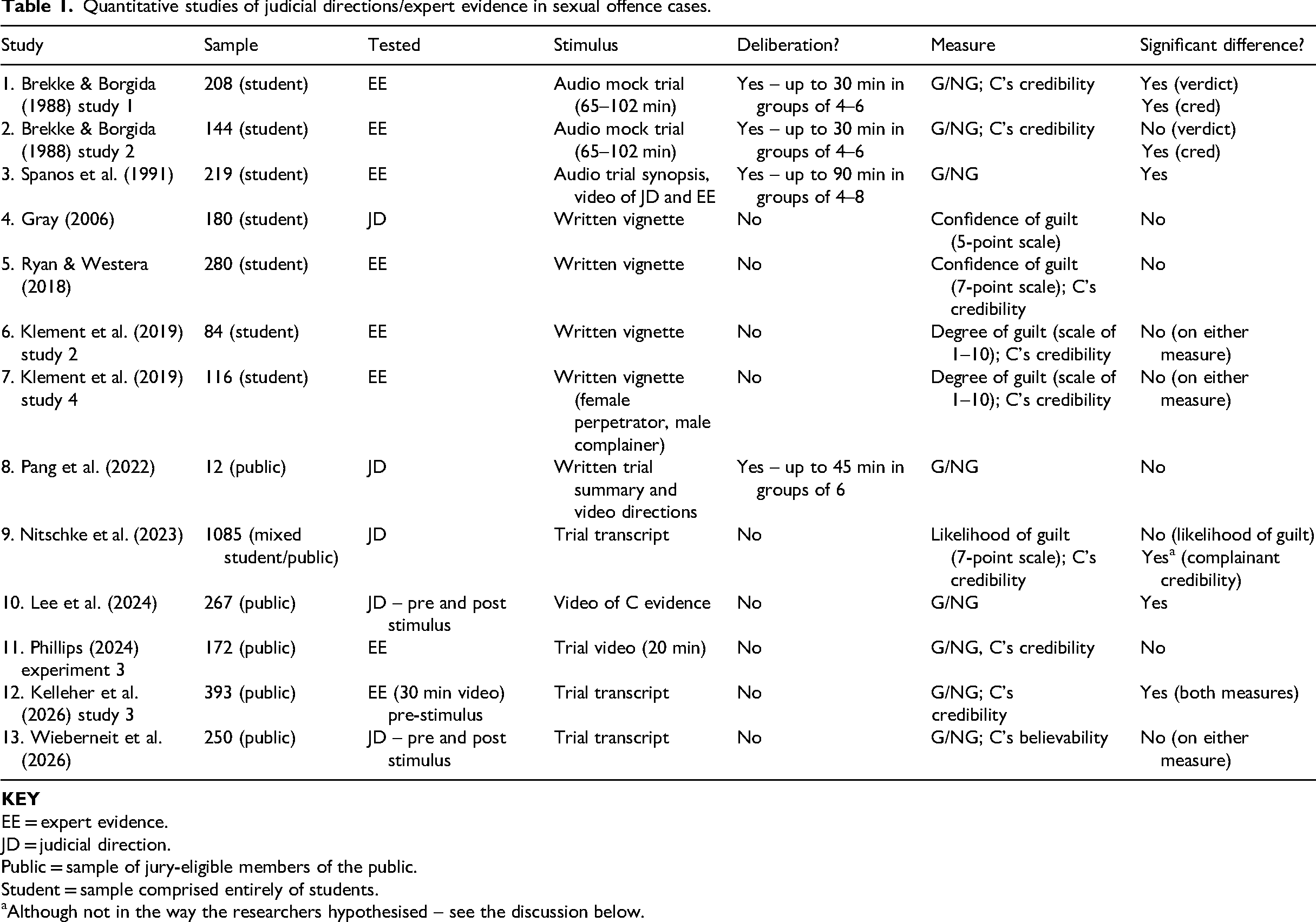
Table 1 presents the relevant studies, including key indicators of their realism. In all of the studies, unless otherwise stated, the alleged perpetrator was male and the complainant female and the educational intervention was delivered after the trial stimulus. The table shows whether the educational intervention made a statistically significant difference to verdict choices and/or juror ratings of complainant credibility.
Quantitative studies of judicial directions/expert evidence in sexual offence cases.
EE = expert evidence.
JD = judicial direction.
Public = sample of jury-eligible members of the public.
Student = sample comprised entirely of students.
Although not in the way the researchers hypothesised – see the discussion below.
As Table 1 shows, these 13 studies undertook statistical analysis to see if the introduction of judicial directions or expert evidence made a significant difference to juror's decisions about guilt or ratings of the complainer's credibility. Seven of them (Gray; Ryan and Westera; the two Klement et al. studies; Pang et al.; Phillips; Wieberneit et al.) found no statistically significant effects.
This might lead us to conclude that educational interventions are unlikely to be effective, but we should exercise caution in reaching this conclusion. Six of these seven studies used written vignettes or trial transcripts, rather than audio-visual trial materials (Gray; Ryan and Westera; the two Klement et al. studies; Pang; Wieberneit et al.). 32 Four used a sample comprised entirely of students (Gray; Ryan and Westera; the two Klement et al. studies). Two (Pang et al.; Wieberneit et al.) recruited participants via social media or Prolific (a survey tool where people volunteer to complete surveys in exchange for money), which again is unlikely to deliver a truly representative sample. Only one incorporated deliberation into the study design (Pang et al.) but here the sample size was so small (only 12 participants) that a significant relationship between the intervention and verdict choice was always going to be very unlikely. The Phillips study was the most realistic. It used a trial video (albeit only 20 min long) where the roles were played by actors, and recruited participants from the electoral roll. The expert evidence was delivered via video by a detective constable with extensive experience of investigating rape and covered a number of rape myths including the use of force/violence, the freeze response, delayed reporting and emotional demeanour. It did lead to higher credibility ratings and an increase in guilty verdicts, but neither of these changes were statistically significant.
The other six studies reported that the educational intervention did make a statistically significant difference to verdict choice and/or ratings of the complainant's credibility. In the case of Nitschke et al.'s study, this was not in the way that was hypothesised. The study tested three judicial direction conditions – no direction on witness credibility, a ‘standard’ direction on evaluating witness credibility, and a trauma-informed direction on witness credibility (this last one being the one that was designed to target rape myths). The researchers also tested two complainant conditions – one where the complainant was visibly distressed when giving evidence and one where she was not. Regardless of the complainant's emotional state, she was evaluated as significantly less credible where jurors received either the standard or trauma-informed direction, compared to receiving no direction at all. The researchers speculate that this may have been because the directions focussed on the cues that jurors should not rely on in evaluating credibility, without informing them about the reliable cues that they should be using instead.
Brekke and Borgida's two studies found that expert evidence about false accusations and complainant resistance resulted in a significant increase in ratings of the complainer's credibility and – although only in one of the two studies – guilty verdicts. It is worth pointing out, however, that the nature of the evidence about false allegations was unlikely to be approved for use in a real trial – the expert testified (unchallenged) that ‘few women falsely accuse men of rape’ (Brekke and Borgida, 1988: 374).
In Spanos et al.'s experiment, an expert witness gave evidence aimed at countering a number of different possible false beliefs (for example that women provoke rape by their appearance and that false allegations are common). For one group, the expert was cross-examined and agreed that there are documented cases of false allegations (as well as making some other concessions). At both the individual juror and jury level, juries were significantly more likely to return guilty verdicts when they heard the expert testimony, but only in the condition with no cross-examination. The experiment did involve deliberation, but used a student sample and an audio trial synopsis. In addition, the nature of the cross-examination went beyond what would normally be acceptable in a real trial.
Lee et al. tested a range of jury directions on a community sample of jurors, including those targeting the degree of emotion of the complainant when testifying and the use of force and the freeze response, 33 and found a significant increase in guilty verdicts when the directions were given. The directions were based on those in the Crown Court Compendium and were delivered via a video. However, the trial video the participants watched only included the complainer's evidence. This limits the reliance that can be placed on the result.
Finally, Kelleher et al. tested a 30-min educational video addressing key rape myths, namely delayed reporting, fear and trauma responses (fighting back, physical injuries), and false reporting. 34 The mock jurors watched the video before reading a trial transcript. A control group watched a video of the same length on climate change. Participants who watched the expert evidence video were significantly more likely to return a guilty verdict. There were some limitations in terms of the realism of the study. The participants were recruited via social media or Prolific (although they were all jury service eligible), the trial stimulus was a four-page trial transcript, and there was no deliberation. Some of the statements made were also more categorical than would likely be acceptable in a real trial – the video stated, for example, that ‘statistics suggest that on average 5% of sexual assault cases reported to the police are false’. Nonetheless, this research does provide some evidence that an educational video might be an effective method of addressing false beliefs. It is the only study that was identified that has specifically tested a pre-recorded audio-visual expert evidence intervention.
Qualitative studies
‘Qualitative studies’ is used here as an umbrella term for studies that are not performing statistical analysis. One way to gain insight into the way that jurors understand and respond to educational interventions would be to see if – and how – such interventions are discussed in real jury deliberations. This has not, however, been used as a research method – as far as we are aware – in any jurisdiction that uses juries, even those that permit some limited research into jury deliberations for academic purposes. 35 It is certainly not permissible in England and Wales, where research into the content of real jury deliberations is strictly forbidden. 36 As such, two alternative methods have been utilised: analysis of mock juror deliberations and interviews with jurors who have sat on real trials. The latter is not permissible in England and Wales either (at least to the extent of asking jurors about the content of deliberations), but it is possible in other comparable jurisdictions, most notably Australia and New Zealand.
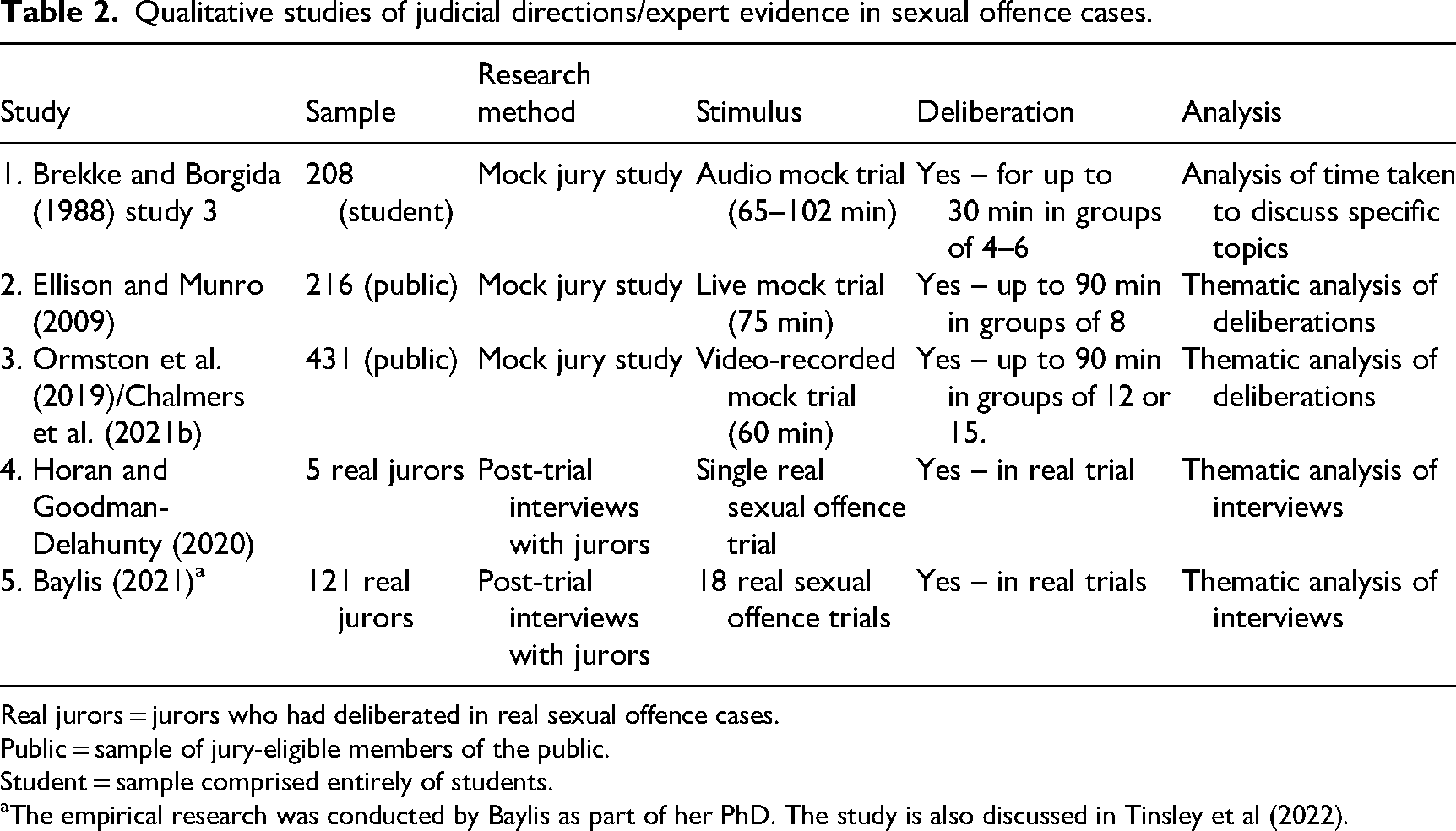
Table 2 presents the relevant studies, all of which either examined mock jury deliberations or interviewed jurors who had sat on real sexual offence cases. Brekke and Borgina's analysis was limited to measuring the time devoted to discussing particular themes in the deliberations. Ellison and Munro and the Ormston et al./Chalmers et al. studies undertook a thematic analysis of deliberations. Horan and Goodman-Delahunty and Bayliss did the same in relation to the juror interviews that were undertaken.
Qualitative studies of judicial directions/expert evidence in sexual offence cases.
Real jurors = jurors who had deliberated in real sexual offence cases.
Public = sample of jury-eligible members of the public.
Student = sample comprised entirely of students.
The empirical research was conducted by Baylis as part of her PhD. The study is also discussed in Tinsley et al (2022).
It should also be said that this is a very limited body of research and that we should apply as much caution in relying solely on these studies as we should to relying solely on what the quantitative studies tell us. The Brekke and Borgida study involved only student participants and an audio-only mock trial. All of the juror interview studies are subject to recall issues and cannot shed much light on whether the intervention in question had any effect on jurors other than the interviewee. In addition, the Horan and Goodman-Delahunty study involved interviews with only five jurors. None of the studies – bar that of Ellison and Munro – was specifically designed to examine the effectiveness of an educational intervention. And, as with any study that utilises only a single mock trial and/or specific educational intervention, there are limits to the generalisability of the findings. Nonetheless, they do provide at least a starting point for examining how educational interventions are received by jurors.
Analysis of mock jury deliberations prior to the Scottish Jury Research
As Table 2 shows, three of the studies recorded and analysed the deliberations of mock juries. The first was that of Brekke and Borgida. They found limited discussion of the expert testimony during the deliberations of those juries who heard it (an average of two minutes’ discussion of the 30 min total deliberation time). However, they also found that in the groups who had not heard the expert testimony, complainant resistance was a dominant theme during more than 15% of the deliberation and discussion tended to be favourable to the defence. The juries who heard the case-specific testimony devoted, on average, less than 2% of their time to discussing resistance and the discussion was generally favourable towards the complainant. In terms of realism, while they did include deliberation in their study design, they used student samples and an audio-only trial stimulus.
The second was that of Ellison and Munro, who examined the way in which the content of deliberations differed between groups of jurors who had received educational guidance and groups who had not. They supplemented this with analysis of questionnaires completed by individual jurors after they had deliberated. The study involved 233 jurors recruited from the general public, who deliberated in groups of eight or nine for up to 90 min. They watched a 75-min mock rape trial performed live by a mixture of actors and barristers, and experienced legal professionals advised on the realism of the trial script. The scenario was a work event, where the defendant gave the complainant a lift home. The two spent a few hours together drinking a glass of wine and some coffee, before kissing. After that, their accounts diverged, with the complainant reporting that she was raped and the defendant claiming they engaged in consensual intercourse. There were nine experimental conditions. The main substance of the trial remained the same, but (a) the level of the complainant's physical resistance; (b) the delay between the incident and its report to the police by the complainant; and (c) the level of observable distress in the complainant's courtroom demeanour were varied. In addition, in one third of the trials a direction from the judge informed jurors about the feasibility of a complainant freezing during an attack, the frequency with which complainants delay reporting, or the different emotional reactions that victimisation might elicit. In another one third of the trials, the same information was provided by an expert called by the prosecution and cross-examined by the defence. In the remaining trials, no such guidance was provided.
The educational guidance on complainant demeanour and delayed reporting had a noticeable effect on the deliberations, but the guidance on lack of resistance did not. In respect of complainant demeanour, the jurors who had been exposed to the educational guidance were less likely to make reference to the complainant's demeanour when giving evidence and – when the issue was raised – were more likely to offer explanations for what might account for the complainant's lack of emotionality and more inclined to comment that it was ‘normal’ that a victim of rape could respond in such a calm manner. This was supplemented by the post-deliberation questionnaires, where jurors in the expert testimony and judicial instruction conditions were less likely to say that it would have influenced their decision if the complainant had been more obviously distressed when giving her testimony.
In respect of delayed reporting, the jurors who had been exposed to the educational guidance were more likely to state that they were untroubled by the three-day delay in reporting the alleged rape. Jurors in the no-education condition were more likely to express the view that the complainant's response had undermined her credibility and described the delayed reporting as, variously, ‘odd’, ‘strange’ and ‘disturbing’. This was also supported by the questionnaire data, where jurors in the non-guidance condition were more likely to agree that it would have made a difference to their deliberations if the complainant had reported the alleged assault to the police sooner. In relation to lack of resistance, there was no discernible difference in either the deliberations or the questionnaire data between the way jurors responded to the complainant's claim to have frozen in shock after initially attempting to push the defendant away and telling him to leave her alone.
New findings from the Scottish Jury Research
The third study that recorded and analysed jury deliberations was undertaken by Ormston et al. 37 This study was not set up with the purpose of investigating jury deliberations about rape – the primary reason that deliberations were recorded in this study was to examine how jurors discussed the Scottish not proven verdict – but because one of the two mock trials it used was a rape case where a judicial direction was given about the significance of delayed reporting, it is worth discussing here. The study involved 431 jurors (across 32 juries) who watched a video of a rape trial that was performed by actors and a real trial judge, before deliberating for up to 90 min. 38 The trial was scripted with the assistance of experienced legal professionals and jurors heard the same directions they would hear in a real trial. In the trial scenario, the alleged rape took place at the female complainer's home. After the accused left her home, her phone records showed that she first tried to phone her sister (who did not answer) and then, 40 min after the accused had left, phoned the police alleging that she had been raped. This is not in any sense a long ‘delay’ but in consultation with legal professionals, it was agreed that the mandatory statutory direction on delayed reporting should be given. 39
Despite the direction being given, the 40-min delay in reporting cast suspicion on the complainer's account in 13 of the 32 juries. Comments made by jurors included: My thing is how could it take her 40 min to phone the police, how could it take it that long? Normally you wouldn’t take that much if you’ve been attacked or assaulted in any way or that, you would have phoned the police right way. It's the phone call to the sister that kind of threw me. You would have phoned the police straight away, I think. It's possible [that the complainer was raped], but there was that 40 min period before she got the cops involved? That's it, the 40 min of waiting. If she was quick to phone her sister why wasn’t she quick to phone the police? The time delay factor when she reported to the police for me was a bit sketchy. I thought if she was adamant she had been raped, initially she should have made a quicker response to that. 1 would have called the police like maybe within a couple of minutes of him leaving and saying that he’d raped her rather than waiting 40 min. If she has been viciously attacked where did the 40 min and the phone call to the sister come from?… If she has been attacked and left lying on the floor, why does she not phone the police immediately saying ‘I’ve been attacked’? I mean if you are attacked in your home…you would be on the phone to the police. You would try and report that as soon as possible.
In 10 of the 13 juries where suspicion was raised about the delay, other jurors challenged the false assumption. In 2 of the 10 challenges jurors explicitly referred to the judge's direction on delay. One stated that the judge ‘said something about in the rape cases the time not being an issue, he said don’t be swayed by that’. The other commented ‘I think what the judge said [about the delay] is a really good point, it’s not actually that long at all.’ These were the only two occasions across the 32 deliberations that jurors explicitly referred to the judge's delay direction to challenge comments made by other jurors. In addition, a third juror mentioned the judge's direction to support their own belief that the 40-min delay was not a long one. Aside from these three times, the judicial direction on delay was not mentioned at all during deliberations, although of course it may have been influential on jurors who did not mention it.
It should be stressed again that this study was not designed to test the effectiveness of judicial directions. It was not a controlled experiment comparing a control group who received no direction with a group who did receive a direction. The delay in question was also a very short one – if the delay had been longer, jurors might have taken more note of what the judge said about it. Nonetheless, it is concerning that the direction did not prevent jurors from attaching undue weight to a very short delay in assessing the complainer's credibility.
Post-verdict interviews with real jurors
Two studies interviewed jurors who had sat on real sexual offence trials. The first is the Trans-Tasman jury study (see Spivak et al., 2020). Here, the researchers interviewed jurors across a wide range of criminal trials, including 121 jurors across 18 sexual offence trials, some of which included judicial directions aimed at targeting rape myths. The data from those 121 interviews was analysed by Baylis (one of the interviewers) for her doctoral research. Directions on delayed reporting were given in two of the 18 cases in the sample. In one of them the direction did not appear to be very effective, as jurors when interviewed still saw the delay as undermining the complainant's credibility. In the other it did seem to have more impact. One juror from that case commented (Baylis, 2021: 76): It made those people think again that [immediate reporting] was not necessary… I know that's quite important to some people, and I’m sure defence lawyers love that she took too long to complain.
Directions warning jurors not to rely on the complainant's demeanour in assessing her credibility were given in 4 of the 18 cases. This did not appear to have much of an impact, although possibly because the jurors were given several inter-connected directions about assessing credibility and may have been confused (Baylis, 2021: 81). Jurors were especially prone to drawing negative conclusions about complainants whose demeanour fluctuated (for example those who were unemotional when initially interviewed by the police, but were emotional when giving evidence). A more nuanced direction about demeanour might have been more effective in targeting these beliefs (Baylis, 2021: 81). Tinsley et al. concluded that ‘[w]here judicial directions were used in the study cases, the results were mixed: they were certainly not a panacea and were sometimes the subject of confusion’ (Tinsley et al., 2022: 482).
The second is that of Horan and Goodman-Delahunty, who interviewed five jurors who had sat on a real sexual assault case about their perceptions of the expert evidence given in that case. There was evidence that following the incident the complainant was hysterically laughing and crying and an expert psychiatrist explained that this was not unusual in genuine victims of an assault. The expert evidence did appear to be useful to the jurors, who remembered the evidence and felt that it corrected some jurors’ misconceptions. One stated that jurors in the case did ‘mention about why would a girl be laughing or carrying on in this way after being raped? But after his evidence a lot of people just accepted that, yeah’ (Horan and Goodman-Delahunty, 2020: 722). The case nonetheless resulted in an acquittal.
Discussion
What, then, do we know about the effectiveness of juror education in rape and serious sexual offence trials? The quantitative studies provide us with a mixed picture. Of the 13 experimental studies identified, seven found that judicial directions/expert evidence made no statistically significant difference to jurors’ verdict choices or ratings of the complainant's credibility. The remaining six found that the intervention did have a statistically significant effect (although in the case of one of the studies this was not quite in the way that it was intended to). It is perhaps notable that six of the seven studies where no significant effect was found used written vignettes or trial transcripts, rather than audio-visual trial materials. But none of the studies was especially realistic. All had weaknesses, whether that be the use of a purely student sample, ‘expert evidence’ that would never be admissible in a real trial, or an absence of deliberation. This is not to criticise the researchers – realistic mock jury research is time-consuming and expensive and the studies discussed here do give us a starting point and show that educational interventions can make a difference, albeit in an experimental scenario. But all that can really be said about the quantitative evidence base is that it is inconclusive.
The qualitative studies add to the knowledge base, although these too need to be regarded with caution, especially as only one was specifically designed to test the impact of an educational intervention. The studies of mock juror deliberations tell us that jurors do sometimes explicitly refer to judicial directions when challenging rape myths expressed by other jurors. This is itself an important finding and does provide reassurance that at least some (mock) jurors recall and take in these directions. However, in the largest study – the Scottish Jury Research – while there were some explicit references to the judge's directions on delayed reporting, these were few and far between (three of the 32 trials). While this does not demonstrate that other jurors ignored them, it gives pause for thought. The directions certainly did nothing to prevent jurors in 13 of the 32 juries from attaching evidential weight to a very short delay in reporting, for which there could have been numerous obvious explanations. The two studies that interviewed jurors who had sat on real sexual offence cases also tell us that judicial directions do not always stop jurors making false assumptions.
That there is limited support for the effectiveness of judicial directions is perhaps not surprising. Even a cursory examination of the psychological literature on attitude and belief formation and change suggests that some beliefs can be very deep-seated and resistant to efforts to change them (see e.g., Crano and Gardikiotis, 2015; Maio et al., 2018). It is unlikely that something as simple as telling jurors that their beliefs are ‘wrong’ is going to be effective. But without further research focused specifically on this issue, we simply cannot know.
Does the evidence base tell us anything about what might make educational interventions more effective? Here it is worth returning to Munro and Ellison's mock juror deliberation study. Although the researchers did not undertake statistical analysis, there was some evidence that both judicial directions and expert evidence were effective, although only in relation to false beliefs about demeanour and delayed reporting. The educational intervention on resistance had no noticeable effect. This may have been, as the researchers speculate, because false beliefs about resistance are more deeply engrained than other false beliefs about rape. It may also have been because the educational information provided did not explain why rape victims might not react in a particular way (for example that freezing is a natural physiological response to danger or that there may be good reasons for not reporting a sexual offence immediately). This would be consistent with experimental research into the effectiveness of judicial directions more generally, which suggests that jurors are more likely to follow instructions if it is explained why they are being given. 40
The timing of the directions could also have been an issue. In Munro and Ellison's study they were delivered at the end of the trial, after all the evidence had been heard. As noted earlier, however, research suggests that judicial directions are more effective if delivered prior to the relevant evidence being led or immediately thereafter (Chalmers and Leverick, 2018: 27–31; Quilter et al., 2022). There are established psychological phenomena that support this conclusion, such as the primacy effect and confirmation bias. The primacy effect holds that individuals are more likely to remember items presented at the beginning of a series than at the end (Asch, 1946; Lund, 1925). Conformation bias is the tendency to pay more attention to information that confirms our existing beliefs – beliefs that might have been formed via the primacy effect (Wason, 1960).
These insights have been applied to the criminal trial by Pennington and Hastie, who suggest that jurors, rather than passively absorbing all the evidence as it is presented to them, instead settle on a ‘story’ that makes sense to them relatively early in the proceedings and attempt to fit the remainder of the evidence into that narrative rather than evaluating it independently (Pennington and Hastie, 1992). As such, early intervention may prevent a particular view of the case from becoming ingrained in the minds of jurors, which becomes difficult to shift.
Only one of the studies compared the effect of delivering the educational intervention before and after the trial stimulus – that of Wieberneit et al. (2026). This found that the timing of the intervention made no difference to either the believability of the complainant or to verdict choice. This does, however, have to be seen in the context of the broader finding that the judicial directions made no significant difference to these outcomes at all, regardless of when the directions were delivered. It is also notable that in this study, 70% of participants selected a guilty verdict. This is an unusually high number and raises the possibility that this was not the type of scenario where participants were relying on rape myths in the first place. It is perhaps notable that the two quantitative studies that delivered the educational intervention before the mock jurors heard any evidence (Lee et al. and Kelleher et al.) both found that it resulted in a statistically significant difference in juror attitudes and verdict, compared to the group who did not have the educational guidance.
What we can say is that the evidence base is very limited in terms of giving rape myth related directions at different points during a trial and, indeed, the content of an effective direction. It is also lacking in terms of the effectiveness of different methods of providing information to jurors. No mock jury studies have compared, for example, the effectiveness of an expert evidence video to providing the same information via judicial directions. The Ellison and Munro study did compare judicial directions and expert evidence, finding little difference between the two. However, this comparison has not been replicated in the sorts of relatively realistic trial conditions used in the Ellison and Munro study.
Conclusion
Addressing the issue of false beliefs held by jurors who are determining rape cases has been a priority for law reform exercises across common law jurisdictions. For most – the Law Commission included – the recommended approach has been to rely primarily on judicial directions to counter any prejudices. But little is known about their effectiveness in this context. The body of research that has evaluated the impact of judicial directions relating to rape myths has mostly been undertaken in settings that are far removed from the conditions of a real trial and these studies have shown mixed results. There is a limited body of research that has analysed deliberations and interviewed real jurors, but this too is inconclusive about whether the directions given during the trial made any difference.
It is also notable that most of the published studies delivered their judicial directions at the end of the trial stimulus that was used and only one study compared the effectiveness of delivering them at different points in the trial. As such, there is a research gap relating to the timing of directions and whether directions given to jurors at the start of the trial, or immediately after the evidence in question, might be more effective than those given after all the evidence has been led. Research in other contexts suggests that this might be the case, and psychological research certainly supports this.
The paucity of research on the impact specifically of rape myth directions is concerning. This is because directions targeting rape myths are different to the majority of directions that judges give. For the most part, judicial directions are conveying information to jurors about the law that they should apply to the facts. The main issues of concern for these ‘information conveying’ directions are whether jurors (a) accurately recall and (b) comprehend them. Jurors receiving ‘information conveying’ directions are unlikely to have existing knowledge of, say, the three-part test for self-defence. Even if they did, they are unlikely to hold strong beliefs about it and thus to be effective a judicial direction is having to do little more than provide accurate (and comprehensible) information that jurors can apply in decision making.
Directions on rape myths are different to ‘information conveying’ directions. Recall and comprehension are pertinent issues for rape myth directions too, but rape myth directions are trying to do something more than simply convey information. They are trying to have an impact on attitudes and beliefs. What's more, they are trying to address attitudes and beliefs that may be deep rooted and strongly held. Such beliefs may be rooted in misogyny or other prejudices. Or they may perform the function of reassuring people that sexual violence is not going to happen to them, as they would not engage in behaviour such as excessive drinking or believe that they would be able to fight off a perpetrator. It is pertinent here that research has found a relationship between scores on rape myth scales and scores on scales measuring the extent to which people hold what have been termed ‘just world beliefs’ (Lerner, 1980). Just world beliefs are beliefs that ‘the world is a just place where good things happen to good people and bad things happen only to those who deserve them’ (Lonsway and Fitzgerald, 1994: 135). It is the latter of these two concepts (measured by a section of the just world belief scale called ‘JWB-other’) that is especially closely related to holding rape myth beliefs (Hayes et al., 2013; Russell and Hand, 2017). As such, rape myth supporting beliefs serve a protective function, and may be resistant to change.
Law reformers have also looked to expert evidence as a way of educating jurors about their false beliefs – primarily in cases where the issues are more complex than can be targeted by standard directions. But here too we know very little about the extent to which expert evidence is effective and – in particular – whether it might be more effective than the same information delivered by judicial directions. One difficulty here is that most of the studies that have been undertaken in this area have not been realistic, as the expert evidence used in the study (or the cross-examination that followed it) would not be admissible in a real trial. There are also very few studies that have compared the two – most research has examined the impact of either one or the other.
Most studies of expert evidence have involved the evidence being given in person, but another option briefly considered by the Law Commission was expert evidence delivered by way of a pre-prepared video. In this context, however, the published research evidence is almost non-existent. The one study we found that examined the effect of an educational video in a mock trial setting did show some promising results, but at least some of the statements made by the expert in the video were more categorical than would likely be acceptable in a real trial. Unsurprisingly, the Law Commission rejected this option until further research was available.
If there is one overall conclusion to be drawn, it is that a comprehensive study into the effectiveness of interventions (both in terms of their mode of delivery and their timing) to address any false beliefs jurors hold about rape and rape victims is much-needed. Ideally, this research would have two key characteristics. The first is that it should be inter-disciplinary. Existing research has, for the most part, tended to be conducted by either lawyers or psychologists. Both disciplines are important. Lawyers can bring their knowledge of the rules of evidence to identify the type of interventions that would be legally permissible within the specific context of a criminal trial. Psychologists can bring their knowledge of the psychological processes that affect human decision making. This is likely to be helpful, for example, in crafting directions that would be effective in changing the type of deep-seated social attitudes discussed above.
The second is that the use of multiple research methods is vital. There is an important role here for mock jury studies (quantitative and qualitative) and for research involving jurors who have sat on real rape trials, as both have strengths and weaknesses. Quantitative mock jury studies are the only method that can specifically isolate the impact of an educational intervention, using an experimental group and a control group who watch exactly the same trial in exactly the same setting, with and without the intervention. The timing, mode and context of the intervention can also be varied, while keeping everything else the same, to see what difference that makes to outcomes. This simply cannot be done in a real trial setting. Mock jury studies can also provide a window into the content of deliberations, telling us whether and how jurors make use of judicial directions to either support their own beliefs or challenge the beliefs of others, or how the content of deliberations differs when a direction has been given, compared to when it has not.
But mock jury studies are always vulnerable to the criticism that people would behave differently in the context of a real trial. 41 Ideally, therefore, they should be supplemented with other methods, such as interviews with jurors who have sat on real sexual offence trials. This has occasionally been done in jurisdictions that allow for the possibility, but not with legal directions that target rape myths as the main focus of the study. If this was the focus, jurors could be asked what they remember of the judicial directions they were given and whether the directions changed either their own opinions or the opinions of other jurors. They could also be asked about their beliefs to see whether, despite having been directed otherwise, they still held false beliefs about rape.
Research of this nature also has limitations. It may be subject to recall issues. It will be difficult to discern whether the directions had any effect on jurors other than the interviewee. Such research cannot compare the effectiveness of different methods, nor can it isolate the specific impact of the directions on the verdict. However, as part of a mixed methods study, it would be valuable, as it would at least evidence the extent to which real jurors recall and understand the directions they are given. In addition, where directions were given but jurors nonetheless exhibited false beliefs when interviewed, it would shed some light on their effectiveness.
Such research would not have been permissible in any of the UK jurisdictions at the time of writing, although this has now changed. In Scotland, section 67 of the Victims, Witnesses, and Justice Reform (Scotland) Act 2025 makes provision for the Lord Justice General to grant permission for research into jury deliberations. England and Wales may not be far behind, with the Law Commission recommending that an exception should be made to the existing prohibition on asking jurors about their deliberations ‘for valuable research that would fill existing gaps in knowledge about how jurors deliberate and how best to assist them in their task’ (Law Commission, 2025: para 10.200). Interestingly the Law Commission does not rule out research that involves ‘direct observation of jury deliberations’, with the safeguard of ‘a rigorous approval process’ (Law Commission, 2025: para 10.198).
Until further research is conducted, the use of judicial directions and expert evidence to address false beliefs that jurors hold about rape is something of a leap of faith. But it is one that, for now, we have little choice but to take, as there are few politically acceptable or viable alternatives.
Footnotes
Acknowledgments
We would like to thank the three anonymous referees who provided helpful comments on the original version of this paper. We would also like to thank the participants in a Royal Society of Edinburgh funded Workshop held at the University of Glasgow in April 2024. One day of the Workshop was devoted to the problem of rape myths prejudicing jury decision making, and this paper draws on some of those discussions.

Funding
The authors disclosed receipt of the following financial support for the research, authorship and/or publication of this article: This work was supported by the Royal Society of Edinburgh.
Declaration of conflicting interests
The authors declared no potential conflicts of interest with respect to the research, authorship and/or publication of this article.