




Abstract
Explanationist theories of evidence are an under-utilised resource in rape research. In this article, we apply these theories to understand the reasoning in rape cases. We show that complainant and defendant credibility is not a zero-sum game, even though comparative, holistic reasoning—together with the typical characteristics of evidence in rape cases—makes the fact-finder prone to accepting (or rejecting) either the complainant’s or the defendant’s version of events in its entirety. Drawing on an empirical analysis of 227 judgments and prosecutorial decisions, we examine what coherence and incoherence consist of, how coherence assessments are associated with case outcomes and how potential contradictions or supporting evidence are restructured as insignificant. We also contemplate reasons for the varied assessments of similar evidence in different cases. This study is the first to examine the full range of reasoning in rape cases through explanationist theories, offering a new and broader perspective on this topical area of law.
Introduction
Rape cases are notoriously difficult to prove. Research on the evaluation of evidence in rape cases has overwhelmingly focused on issues of complainant credibility, adopting a feminist sociological framework that questions whether and how the lived reality of women is understood and recognised in rape trials. For example, the extensive literature on rape myths sheds light on how beliefs about what constitutes consent to sexual relations—and how rape victims and rapists behave before, during and after rape situations—influence perceptions of complainant credibility and the attribution of blame by mock jurors (Chalmers et al., 2021; Ellison and Munro, 2009a, 2009b; Finch and Munro, 2007; Lynch et al., 2013, 2020; for reviews, see Dinos et al., 2015; Leverick, 2020), by police officers (Hine and Murphy, 2019), in police reports (Hohl and Stanko, 2015) or at trial (Smith and Skinner, 2017). In judge-based criminal systems, studies have examined how judges evaluate complainant credibility as a function of the complainant’s characteristics, behaviour or emotional expressions (Barn and Kumari, 2015; Camplá et al., 2020; Wallin et al., 2021), or how underlying beliefs about sleep affect assessments of complainant credibility (Laugerud, 2023). As the evidence in rape trials typically centres on the testimony of the parties, there are many opportunities to frame these trials as ‘he said, she said’ situations (Bladini et al., 2023; Wallin et al., 2021), and to demand that the complainant’s testimony be either accepted or rejected in its entirety (Gore, 2021; Smith and Skinner, 2017). As a result, any doubt about any part of the complainant’s testimony can prove fatal to the entire prosecution. This kind of reasoning has been criticised in the literature on asylum procedures for setting unreasonable standards of proof for vulnerable individuals trying to prove their need for protection (Eyster, 2012; Sweeney, 2009).
Often framed as studies of the pervasiveness of unrealistic and unjust beliefs rooted in a misguided form of rationality, rape research tends to be curiously thin on general theories of evidence. 1 Yet such theories can provide a different interpretation of the evidentiary processes in rape cases compared, for example, to rape myth theory (Piha, 2024). In this study, we adopt explanationist theories of evidence as our theoretical framework and examine them as a tool for understanding outcomes in rape cases.
According to explanationist theories of evidence, evaluating evidence involves comparing the explanatory coherence of competing hypotheses about how the presented evidence came to be (Amaya, 2013; Kolflaath, 2013; Pardo and Allen, 2008; van Koppen and Mackor, 2020). The coherence of these hypotheses can be categorised as (a) coherence with the evidence, (b) coherence with background knowledge and (c) internal coherence (see Mackor et al., 2021: 445–446). Rape studies typically focus on coherence with background knowledge, which involves drawing inferences from general beliefs about human perception and behaviour, physical and psychological causation and other such factors.
In this article, we examine (a) what constitutes coherence and incoherence; (b) how evaluations of coherence are associated with case outcomes; and (c) how potential supporting evidence or contradictions are dismissed as irrelevant or insignificant. We show that certain features of human reasoning, combined with legal principles and the typical characteristics of evidence in rape cases, predispose fact-finders to accept—or reject—either the complainant’s or the defendant’s version of events in its entirety, resulting in a ‘winner takes all’ outcome. Nevertheless, complainant and defendant credibility is not a zero-sum game. Standards of proof can be used to resist declaring a winner, and the need for coherence is greatest when convicting. Legal fact-finders—in our study, Finnish prosecutors and district court judges—also use various methods to interpret events, accommodate inconsistencies or discount certain evidence in order to justify the chosen outcome as coherent with their assessment of the evidence. At times, legal fact-finders also leave inconsistencies unaddressed; that is, they accept a hypothesis even if it is not fully coherent with the evidence.
The significance of our study is twofold. First, to our knowledge, this is the first study to examine the full range of reasoning in rape cases through the lens of explanationist theories, offering a new and broader perspective on this complex and topical area of criminal law. Second, in addition to judicial decision-making, we also examine prosecutorial decision-making, which is an under-researched stage of the criminal process.
This article is divided into two parts. In the first part, we summarise explanationist theories of evidence, coherence-based reasoning and the Finnish legal principles and rules of evidence relevant to the discussion. We show how these interact to encourage the acceptance or rejection of the rape complainant’s and the defendant’s versions of events in their entirety, rather than in a piecemeal fashion. We also outline the processes and principles that mitigate the need to portray a version of events as fully coherent. In the second, empirical part, we use cross-tabulation and qualitative analysis of a natural sample of 227 Finnish rape cases to examine how coherence assessments are made and how they are associated with case outcomes. We then discuss how various aspects of the results can be interpreted in light of explanationist theories. Finally, we consider the implications of our findings for rape research.
The theory and principles of evidence evaluation
In this part, we introduce explanationist theories of evidence, along with the relevant Finnish legal principles and typical features of the evidence in rape cases. Some of these principles and features may not apply in other jurisdictions, but are necessary for understanding the empirical data.
Explanationist theories of evidence
Explanationist theories of evidence are grounded in psychological research on decision-making, and aim to reflect how people actually reason. They are thus posited as alternatives or complements to mathematical models, particularly Bayesian probability, whose proper application would require knowledge and processing power that are typically unavailable to the human fact-finder (Allen and Pardo, 2019: 10–14; Amaya, 2015: 77–79; Cohen, 1977: 58–120; Diesen, 2000: 173; Jellema, 2022: 9). For the purposes of this study, we have counted as explanationist theories of evidence and relied on: Relative Plausibility Theory (Allen and Pardo, 2019, 2023; Pardo and Allen, 2008), Scenario Theory (Mackor et al., 2021; van Koppen and Mackor, 2020), Hybrid Theory (Bex, 2011; Bex et al., 2010), the Theory of Inference to the Most Coherent Explanation (Amaya, 2013, 2015) and the Explanation Model (Kolflaath, 2013). In general, these theories comprise three elements: the idea of competing explanations, a standard for evaluating these explanations and an abductive mode of reasoning.
According to explanationist theories, legal fact-finders reason by comparing different explanations for why the evidence occurred. The terminology varies; 2 in this article, we use either ‘version of events’, as this aligns with the terminology used by Finnish prosecutors and courts, or ‘hypothesis’ for conciseness. The hypothesis that best explains the evidence is accepted, subject to the additional requirements of the relevant standard of proof. Under the beyond reasonable doubt standard and the presumption of innocence, a conviction requires that the ‘guilty hypothesis’ (‘the evidence occurred because the defendant committed the suspected crime’) has a high degree of justification, while any hypotheses consistent with innocence can be rejected (Allen and Pardo, 2019: 15–16; Amaya, 2013: 11; Diesen, 2000: 176; Jellema, 2021; Kolflaath, 2019: 125–126; Sullivan, 2019: 103–104; van Koppen and Mackor, 2020: 1134). Within these overarching hypotheses, there may be competing sub-hypotheses. For example, a witness may have testified as they did because they accurately observed the events they reported, because they were lying, because they misremembered, because they misinterpreted the events or because they misspoke. Their account may also have been misinterpreted by the recipient (see Jellema, 2022). Jellema (2022) has suggested that tailored versions of explanationist theories should be developed for evaluating different types of evidence, and specifies such an account for testimonial evidence.
The standard for evaluating the hypotheses is coherence, particularly explanatory coherence. Again, the terminology varies; 3 we use either ‘coherence’, following Amaya, or ‘credibility’, as this term is commonly used in empirical research on evidence evaluation. Amaya (2013: 12–18) describes coherence as the ‘fit’ between two items, such as the guilty hypothesis and a piece of evidence presented at trial. 4 The degree of coherence within the whole set of items (all parts of the hypothesis, all evidence presented and the necessary background assumptions) determines how well the hypothesis is justified. Explanatory coherence involves a causal relationship between the items, rather than mere co-occurrence, although causality is understood loosely (Amaya, 2019: 64; Bex et al., 2006: 14–15; Kolflaath, 2019: 124; van Koppen and Mackor, 2020: 1133). For example, there would be explanatory coherence between evidence of a rape victim crying and the guilty hypothesis in the following chain of inferences: a witness testified that the victim had cried because she had, in fact, been crying; and she was crying because she had been raped. A piece of evidence (or more precisely, the information it contains) may be coherent or incoherent with the hypothesis to varying degrees. A complainant crying may also be coherent with an innocence hypothesis, but unless this hypothesis suggests a reason for the crying, it remains less coherent with the evidence of crying than the guilty hypothesis.
The coherence of the hypotheses can be categorised into: (a) coherence with the physical and testimonial evidence presented; (b) coherence with background knowledge; and (c) internal coherence (see Mackor et al., 2021: 445–446). The boundaries between these three types of coherence are porous, and background knowledge underlies all reasoning about evidence. The division is nevertheless a useful analytical tool. Internal coherence comprises consistency (the absence of contradictions), completeness, detailedness and the absence of gaps. Coherence with the evidence of the case is the most significant type. In rape cases, typical evidence includes witness testimonies, medical statements, DNA and sperm samples, CCTV footage and messages sent to or by the parties or witnesses. Evaluating a hypothesis’s coherence with background knowledge—or, more accurately, background beliefs—entails comparing the hypothesis with general beliefs about human perception and behaviour, causation and similar factors. Reasoning based on background beliefs should be critically examined because these inferences rely on assumptions about how people typically behave, how situations usually evolve, or what individuals tend to perceive in certain circumstances (Piha, 2024). These inferences therefore draw on notions of normality, logic and rationality (Bladini et al., 2023). The relevance of such beliefs when making inferences about individual cases is open to question. Indeed, questioning the veracity of background beliefs about rape complainants’ behaviour forms a major part of the rape myth literature.
Explanationist theories are grounded in psychological research and aim to reflect how people actually reason. Frequently cited is Pennington and Hastie's (1992) Story Model, which was specifically designed with legal evidence evaluation in mind. The Story Model posits that the ease with which a story can be constructed from the evidence and the story’s completeness influence how evidence is evaluated and how verdicts are formed. Thus, people tend to evaluate evidence narratively. Psychological research on factors affecting eyewitness reliability can also be incorporated within explanationist approaches (Jellema, 2022).
Cognitive consistency theories have also been influential. 5 These theories posit that people strive for cognitively coherent representations of the world (Holyoak and Simon, 1999; Simon, 2019; Simon et al., 2004; Thagard and Verbeurgt, 1998; see Gräns, 2005 for an overview). When faced with ambiguous evidence, people achieve coherence by ‘reconstructing’ the evidence—for example, by changing, reinterpreting, devaluing or rejecting incohering evidence, and by ‘bolstering’ the significance of evidence cohering with the chosen alternative. In this way, coherence is maximised. For example, before knowing anything about a case, the fact-finder may endorse a rule in general (such as ‘The confidence of a witness does not predict accuracy’). However, as soon as case-specific facts are introduced, the fact-finder may dismiss that rule when applied to the case (‘But in this case, the witness was so confident…’). This reconstruction of the elements occurs both before and after a decision has been made. This coherence-based reasoning is therefore bidirectional, proceeding both from conclusions to premises as well as from premises to conclusions: the emerging decision affects the perceived strength of the evidence supporting it, while contradictory evidence is further rejected. This process reinforces confidence in the success of the outcome (Simon et al., 2004: 816). It also leads to holism, namely the idea that ‘the properties of a whole are different from, and typically more pronounced than, the sum of the properties of its constituent parts’ (Simon, 2019: 85).
The dangers of bidirectional, holistic reasoning represent one of the most serious critiques of explanationist theories, namely that reliance on coherence tacitly accepts, or even encourages, psychological fallacies such as confirmation bias (see Amaya, 2013: 39). Holism can skew the evaluation of evidence when there is no good reason for accepting or rejecting a piece of evidence, or by inflating the perceived strength of the overall evidence. Confirmation bias—the tendency to ‘hang onto’ a belief without good reason, often with unjustified confidence—can manifest in the way information is sought, processed and remembered (Klayman, 1995; Oswald and Grosjean, 2004). It has been shown to affect even experienced legal fact-finders (Lidén et al., 2019a, 2019b).
Explanationist theories do not, in themselves, endorse bias or sloppy reasoning. Amaya (2013: 23–27; 34–35) draws on the concept of ‘epistemic responsibility’ to describe the epistemic (second-order) beliefs that should guide the reasoning process, and which should also be included in the ‘coherence calculation’. For example, Amaya’s theory gives privileged status to correctly admitted evidence at trial, and it would be epistemologically irresponsible for a fact-finder to ignore such evidence without good reason. Nevertheless, restructuring evidence is a normal part of justificatory argumentation under conditions of uncertainty. It allows the fact-finder to consider the circumstances under which a version of events could reasonably be true. For example, evaluating the potential sources of error in witness testimonies may justify reinterpretation (e.g., ‘the gaps in the testimony are a normal result of the passage of time’) or rejection (e.g., ‘the witness is lying and therefore their evidence can be discounted’). Some restructuring argumentation can be characterised as rape myth-busting, where the fact-finder restructures the defence’s arguments by dismissing them as predicated on a faulty premise.
As evidence evaluation therefore depends on comparing and choosing between alternative versions of events based on their coherence, and because human reasoning tends to bolster the coherence of the chosen alternative, the process of evidence evaluation encourages the acceptance of one party’s version of events and the emphatic rejection of the other, so that ‘the winner takes all’. However, under explanationist theories, the coherence of the hypotheses presented is not a zero-sum game. Both the complainant’s and the defendant’s versions of events could be fully coherent with the rest of the evidence (apart from the opposing party testimonies), if there is no evidence that can differentiate between the two versions.
The beyond reasonable doubt standard of proof requires that a conviction is only possible when the coherence of the complainant’s version of events is high and that of the defendant’s version is low. However, the standard also mitigates the need to choose one version of events and present it as fully coherent. If uncertain, the legal fact-finder may conclude that the truth cannot be known. They can consider both versions of events coherent, or both incoherent. They may also consider the complainant’s version of events coherent, and the defendant’s version incoherent, but still coherent enough that it raises reasonable doubt. Importantly, then, dismissing a case does not always require dismissing the complainant’s version of events as incoherent. It is therefore important to differentiate between the degree of coherence in a party’s version of events, which is the result of evidence evaluation, and the degree of coherence between the evidence evaluation and the outcome of the case, which is a result of the application of the standard of proof (see also Kagan, 2002). We now turn to other legal principles and to the characteristics of rape cases in Finland.
Finnish legal principles and rape cases
In Finnish District Courts, rape cases are typically decided by one professional judge (with formal legal training) and two lay judges, who are appointed on a part-time basis for four-year terms by the municipal council. The professional judge provides the lay judges with guidance in legal questions. Some cases are decided by a panel of three professional judges instead. All judges, including lay judges, take part in the evaluation of the evidence and in deciding questions of law (see Kolflaath, 2019: 122 on the Norwegian context, which is similar). Any dissenting judge, including a lay judge, must provide written reasons for their dissent. While two lay judges can form the majority opinion, this is rare. One such case appears in our dataset.
The evaluation of evidence is governed by the principle of free evaluation (see Pihlajamäki, 1997), which gives judges wide discretion to determine the relevance and probative value of a piece of evidence. Nonetheless, certain general principles apply: judges must evaluate the evidence thoroughly, impartially, objectively and in accordance with ‘universal rules of experience’ (i.e., background knowledge). Each piece of evidence must first be assessed individually and then considered in the context of all the evidence presented (Code of Judicial Procedure 4/1734, Chapter 17, s. 1; Supreme Court precedent KKO 2013:96, para 6). Guilt must be proven beyond reasonable doubt (Code of Judicial Procedure, Chapter 17, s. 3). Protections against self-incrimination guarantee the defendant’s right to remain silent (Code of Judicial Procedure, Chapter 17, s. 18); however, in practice, defendants in Finnish rape cases usually choose to testify, thereby offering a substantive alternative version of events. However, the defendant’s version of events does not need to be evaluated if the complainant’s testimony and any supporting evidence are not strong enough to warrant a conviction. The evaluation therefore proceeds in stages: first, support for (or evidence against) the complainant’s version of events is evaluated. Then, if the evidence sufficiently supports the complainant’s version, the defendant’s version of events is evaluated to determine whether it would also be sufficiently supported by the evidence to raise reasonable doubt (KKO 2013:96, para 9; see also Diesen, 1993).
In rape cases, the central evidence consists of the parties’ testimonies, and the crucial part of the events usually cannot be directly corroborated. In practice, courts have followed the requirement established by the Supreme Court that the complainant’s testimony (in adult rape cases) must be supported by other, indirect evidence, such as evidence of subsequent events or the physical or psychological consequences of the suspected rape (KKO 2013:96, para 7). The Supreme Court has also instructed that oral testimony should be evaluated based on the coherence of its key content (i.e., lack of contradictions), its constancy (from one telling to the next), its detailedness and its realism, as opposed to the witness’s manner of speaking, eye contact, gestures or other such demeanour in court (KKO 2013:96, para 8). The Court has thus emphasised narrative and coherence-based criteria over behavioural criteria. However, the Court has also stated that inconsistencies or changes in a testimony do not automatically render it incoherent; the reasons for such inconsistencies should be considered (KKO 2013:97, para 36).
A version of events can therefore be assessed for coherence in relation to events not directly relevant to the fulfilment of the elements of the crime (KKO 2013:96, para 8). For example, if the complainant provides verifiable details about events preceding the suspected rape, verifying this part of the testimony can serve to verify the truthfulness of the entire testimony. Conversely, if the complainant’s testimony can be shown to be untrustworthy on a particular point, the whole testimony may be deemed untrustworthy. This structure of evidence evaluation encourages the acceptance or rejection of the different versions of events in their entirety—winner takes all—rather than proving or disproving individual elements in a piecemeal fashion. However, it also allows for a rape conviction beyond reasonable doubt even in the absence of independent direct evidence. 6
Supreme Court precedents apply to court proceedings, and evidence theories are usually constructed with judges or juries—and the standards of proof applied in court—in mind. The context of prosecutorial decision-making is quite different, however. The testimonies of parties and witnesses are usually in the form of written records, which are more akin to summaries than transcripts of the police interviews, and prosecutors lack the ‘data points’ generated during a trial. As a result, they are unable to evaluate the coherence of testimonies to the same extent as judges in court proceedings.
The standard of proof for prosecution is ‘probable cause’. There is, however, no reason to believe that the basic nature of the prosecutor’s deliberation about the evidence differs from that of a judge (Mantila, 2021: 946). The prosecutor will look for the same types of coherence and incoherence as the judge, but in more limited evidence, and if the evidence supporting the suspicion (the complainant’s testimony) is not strong enough to fulfil the prosecution standard, the prosecutor does not need to evaluate alternative hypotheses. The prosecution standard, although lower than the conviction standard, is nevertheless connected to the latter because the prosecutor must consider the likelihood that the conviction standard is fulfilled once the evidence has been presented in court (Jonkka, 1991: 141, see also 2007). Consequently, although one might expect a prosecutor to pay more attention to the coherence of the complainant’s version of events, they should also assess the coherence of the defendant’s version. A credible alternative version of events would reduce probable cause because it is likely to raise reasonable doubt at trial.
The forces of evidence evaluation thus pull in multiple directions. Comparative, holistic reasoning, and the lack of independent direct evidence in rape cases produce forces that pull the assessment outcomes for the complainant’s and defendant’s versions away from each other. At the same time, an explanationist structure of evidence evaluation allows both versions to be coherent or incoherent simultaneously, and restructuring argumentation can help in making sense of both versions. In the next part, we examine legal argumentation by judges and prosecutors from these perspectives.
Coherence in judgments and prosecutors’ decisions
In this empirical part, we examine the role of coherence in Finnish rape cases. We use the division into coherence with the evidence, coherence with background beliefs and internal coherence as an analytical framework to manage the large amount of data. We examine (a) what coherence and incoherence consist of, (b) how coherence evaluations are associated with case outcomes and (c) how potentially supporting evidence or potential contradictions are restructured as irrelevant or insignificant.
Data and methodology
We employ a qualitatively informed mixed-methods approach to a sample of 115 prosecutor’s decisions resulting in non-prosecution (DNP) and 112 district court judgments in cases of rape or aggravated rape (a total of 227 cases). The size and heterogeneity of the sample do not allow for the use of complex quantitative methods; therefore, the analysis combines qualitative methods with descriptive cross-tabulations.
At the time of the decisions and judgments, the definition of rape was coercion-based: rape was defined as sexual intercourse using physical violence or a threat, or as occurring through abuse of the victim’s helpless state, such as unconsciousness or strong intoxication. The violence did not have to be severe; actions such as sitting on top of the victim or pushing on their shoulders qualified. Intercourse included all forms of sexual penetration (for more detail, see Alaattinoğlu et al., 2021; Amnesty International Finnish section, 2019; Jokila and Niemi, 2020).
Although official documents are generally public, rape judgments and DNPs are usually made partially or wholly confidential to maintain the complainant’s privacy. Access to the data was therefore obtained via research permits from the courts and prosecutor’s offices, granted for scientific research purposes under s. 28 of the Act on the Openness of Government Activities (621/1999). To maintain the anonymity of the persons involved, case details have been abstracted before reporting.
The research permits cover all rape judgments handed down in 2016–2017 by three district courts in Finland. The district courts are large or mid-sized, represent a geographical spread, and together account for about 30 per cent 7 of all rape cases decided during those years. The prosecutors’ decisions were handed down in 2017 by the five largest prosecutors’ offices, which together account for 66 per cent of the DNPs handed down in rape cases in 2017. 8 The data was originally acquired by Amnesty International in 2018, 9 and this study is based on the secondary use of that data. The selection criteria have been refined and the data recoded for the purposes of this study.
The selection of cases was carried out as follows. Coding was conducted per count of rape. Below, the terms ‘case’, ‘judgment’, ‘conviction’, ‘acquittal’ and ‘DNP’ refer to a single count. If a count included several defendants or types of sexual intercourse, factors were coded in relation to the main defendant or the most significant act of intercourse. The main defendant was the one who was convicted (if not all were) or the most active defendant, and the most significant intercourse was the one that was proven (if not all were), or the one for which there was most evidence. If no main defendant or most significant act of intercourse could be identified, the data was coded based on the first act of intercourse mentioned in the indictment. Only counts where the complainant was at least 16 years old (the age of consent in Finland), and where the act had taken place on or after 1 September 2014 (the entry into force of a major legal amendment), were included. Two judgments in which the prosecution for rape was dropped (and thus did not include any reasoning beyond the statement that prosecution had been dropped), and 11 DNPs that were too brief for reliable analysis, were removed from the sample.
To zero in on questions of evidence, we then selected the cases that turned on evidence evaluation: non-convictions (DNPs or acquittals) based on insufficient evidence, and convictions. The fact-finder’s reasoning included statements about the coherence of the complainant’s version of events in 223 cases (72 convictions, 40 acquittals and 111 DNPs), and about the defendant’s version in 133 cases (58 convictions, 33 acquittals and 42 DNPs). 10 The overlap between these sets was 129 cases, resulting in a total of 227 cases analysed. The formation and refinement of the data is shown in Appendix 1.
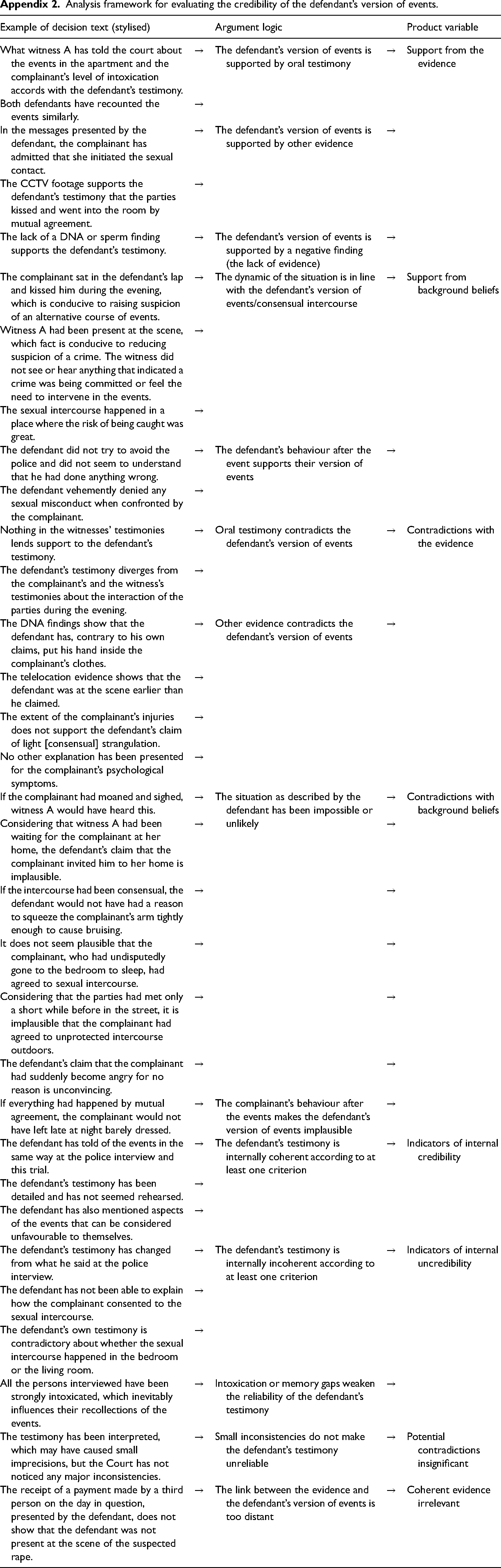
The prosecutors’ and judges’ stated reasons were coded as arguments about the case using qualitative content analysis. The generation of arguments was data-driven, but their categorisation was informed by theories of judicial reasoning, especially the division of evidence evaluation into three types, the findings of prior empirical research on rape, and a practical interest in forming arguments and categories with sufficient data points. Even though the different types of coherence are theoretically distinct, they are sometimes difficult to separate in practice, and some types of inferences in the decisions and judgments could arguably be categorised in several different ways. Appendix 2 shows a non-exhaustive list of examples of how the arguments about the defendant’s version of events were categorised. This method of coding individual arguments has its limitations, however. Classifying a large body of data for an overall characterisation inevitably results in the loss of nuance and obscures certain issues. For example, coding reasoning in relation to only the main defendant and the most significant intercourse can obscure the partial acceptance of a complainant’s versions of events.
The need to interpret the fact-finders’ reasons is also a potential source of uncertainty. For example, judges would sometimes state that ‘the defendant’s testimony is not supported by the witness’s testimony’, even when, in fact, the testimonies contradicted each other. Some DNPs were not explicit about the significance of a fact or a piece of evidence. In these cases, the interpretation relied—in the hermeneutical tradition—on the wider context, and even on how such a fact or piece of evidence had been evaluated in other cases.
As the research permits allowed only the first author to handle the data, the coding was conducted by one person. Naturally, this involves a risk of bias and inconsistency. To increase consistency, each document was coded twice. Malin and Suonpää handled only data prepared for tabulation and had no access to identifying information. The responsibility for the accuracy of the coding naturally rests solely with Piha.
The complainant’s version of events
Table 1 shows the frequency with which the complainant’s version of events was supported by the evidence or by background beliefs, contained contradictions with them, contained indicators of internal credibility or uncredibility, contained argumentation that explained away potential contradictions, or was coherent with evidence that was deemed irrelevant, and how this varied by case outcome (N = 223). The last two types of argumentation ‘restructure’ the evidence. These categories are not mutually exclusive. For example, the complainant’s version of events may be simultaneously supported by evidence (such as one part of a witness’s testimony), and contradicted by it (such as another part of the witness’s testimony). Nor does the cross-tabulation reveal the ‘strength’ of the support or the ‘force’ of the contradictions. For example, the ‘support from the evidence’ category includes cases where the complainant’s version of events was supported by multiple pieces of evidence (such as both DNA evidence and witness testimony), and cases where the complainant’s version was supported by only one piece of evidence. The same applies to the accumulation of contradictions.
Evaluation of the complainant’s version of events in convictions and cases closed due to insufficient evidence, n = 223.
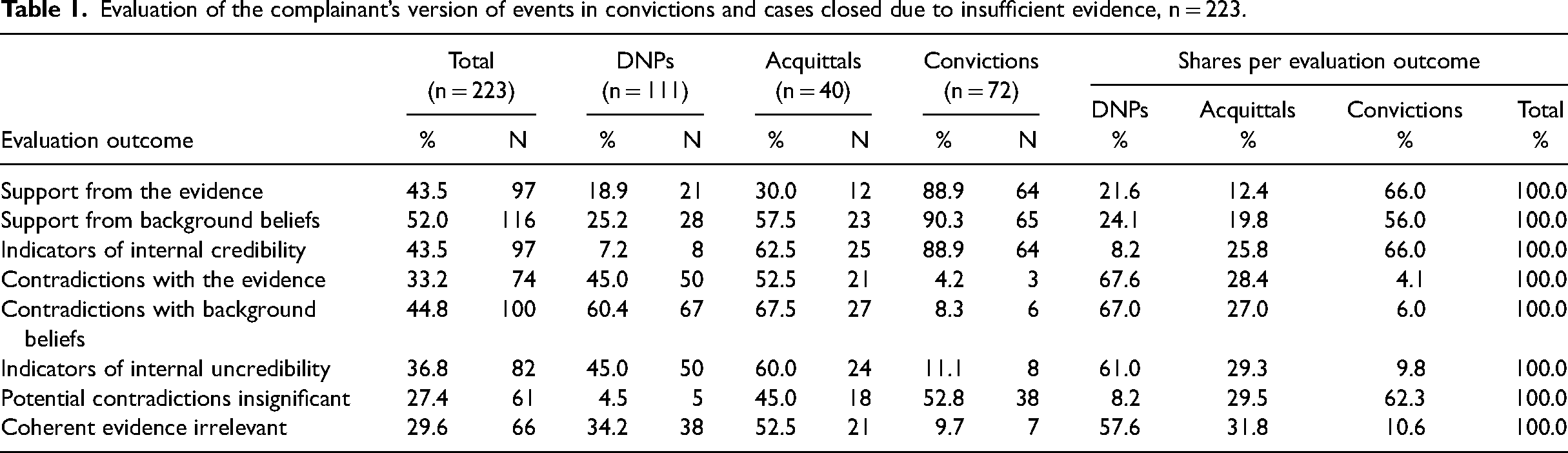
As expected in light of the requirement that the complainant’s testimony be supported by other evidence, the great majority of convictions were considered to be supported by evidence (89 per cent) or by background beliefs (90 per cent). The complainant’s testimony was also often considered internally credible (89 per cent). However, cases containing these indicators of complainant credibility resulted in a conviction only 56–66 per cent of the time. This could be because the supporting evidence was still not deemed strong enough to warrant a conviction, because incoherence was also identified, or because the defendant’s version of events was also sufficiently coherent to raise reasonable doubt.
Inferences from background beliefs were the most common category of argument, with the complainant’s version of events being supported by such inferences in 52 per cent of cases and containing contradictions with them in 45 per cent of cases. The way courts rely on background beliefs has been more fully examined in Piha (2024) and will therefore not be the focus of the analysis here. Support for the complainant’s version of events generally consisted of decisive action taken by the complainant after the suspected rape, such as immediately reporting to the police, signs of distress, such as crying, or of events preceding the suspected rape that deviated from preconceptions about how sexual situations develop (for example, if the complainant had shown no romantic or sexual interest in the defendant). Conversely, reactions and behaviours such as being calm or friendly with the defendant after the suspected rape, or voluntary flirting, kissing and undressing beforehand, were sometimes considered to contradict the complainant’s version of events (but were sometimes considered irrelevant; see below). Contradictions with background beliefs could also include beliefs about sleep, such as the belief that it is not possible to sleep through a rape (for similar findings in Norway, see Laugerud, 2023).
In convictions, the most common type of supporting evidence was physical injuries (N = 34), which varied in severity. Regardless of the outcome, the physical injuries were always claimed to be related to violence inflicted by the defendant. Evidence of physical injuries was therefore not used to verify parts of the testimony unrelated to the moment of rape, unlike some other types of evidence. For example, witness testimonies were typically used to verify what happened before or after the suspected rape.
Witness testimonies, including those of another complainant, formed supporting evidence in 39 cases, 25 of which were convictions. In some of these cases, the witness had made a visual or auditory observation at the moment of the suspected rape, but more often the witness testified about events preceding or following it. The fact that a witness’s testimony regarding other events matched the complainant’s testimony could thus be used to verify the complainant’s overall credibility, thereby also lending support to the complainant’s description of the rape. This type of reasoning relies on the ability to accept or reject the complainant’s version of events in its entirety, based on the verification or falsification of one part of it.
In one example of this kind of reasoning, the fact that the complainant could describe the defendant’s apartment was used as supporting evidence. The case also included other supporting evidence, but we focus here on the reasoning related to the description of the apartment. The defendant claimed that the complainant had never been to the apartment. This was considered uncredible in light of the complainant’s accurate description of it. However, the uncredibility of the defendant’s testimony should not increase the credibility of the complainant’s testimony; doing so would constitute a logical fallacy (Marjosola, 2021: 473). It appears that the complainant’s ability to describe the apartment was used in this way. However, an alternative interpretation is that this part of the complainant’s testimony was verifiable and verified, which helped to anchor the entire testimony. It was then a separate matter that the defendant’s version of events was incoherent with the evidence. This difference in reasoning strategy is further examined in relation to positive DNA results under ‘Discussion’.
There were also examples of the partial acceptance of the complainant’s version of events. In one case, the complainant could not remember the sexual intercourse in detail, but claimed that it had happened. The defendant claimed that there had been some voluntary sexual contact initiated by the complainant, but no sexual intercourse. This latter claim was supported by a negative DNA or sperm finding and the lack of genital injuries. The defendant’s testimony was also internally coherent. However, the complainant’s testimony was supported by evidence of other injuries, by an immediate request for help from a witness, and by her shocked state of mind and dishevelled state of dress, as observed by the witness. The court did not comment on how these factors related to the defendant’s version of events, but it does not seem too strong a conjecture to suppose that the court silently questioned the reason for the complainant’s immediate request for help, her state of mind and why she had not re-dressed properly if the defendant’s version had been true. However, because the court considered sexual intercourse not proven beyond reasonable doubt, the defendant was convicted of attempted rape rather than rape.
Cases where the complainant’s version of events contained contradictions with the evidence or with background beliefs, or where the complainant’s testimony showed indicators of internal uncredibility, overwhelmingly resulted in DNPs or acquittals (90–96 per cent). Contradictory evidence was most commonly a witness testimony (N = 41)—again, often testifying about events before or after, rather than at the moment of, the suspected rape—but the absence of physical injuries was also frequently considered a contradiction (N = 29). The latter type of argument was usually made in relation to the complainant’s testimony: if the violence had been as severe as the complainant described, there should have been (more or different) injuries. This argument could also be used in conjunction with one dismissing the relevance of the injuries recorded (see below).
Negative DNA or sperm findings could also be used as evidence contradicting the complainant’s version of events if the defendant denied intercourse, even though the forensic reports 11 routinely state that the absence of such a finding does not rule out the occurrence of intercourse. The risk with this type of argumentation is similar to the apartment description example above; the relevance of the evidence for the coherence of the complainant’s version of events should not depend on the defendant’s version. Indeed, if the defendant admitted to intercourse, a negative DNA or sperm finding was never claimed to be incoherent with either party’s version of events. In some cases, the fact-finder did not dispute the possibility of rape as such, but considered the negative finding to be more coherent with the defendant’s denial of sexual intercourse. This could also reflect the legal principle that uncertainty should benefit the defendant.
However, the evaluation could also depend on the rest of the evidence. In one case, multiple eyewitnesses testified to the intercourse taking place, and CCTV footage showed the defendant emerging from the scene adjusting their trousers. The court stated that under these circumstances, the negative DNA finding did not suggest otherwise; on the contrary, the case demonstrated that a positive DNA result is not always obtained. Rather than allowing the negative finding to cast doubt on the veracity of the eyewitness accounts (which may be mistaken) and the significance of the CCTV footage (which was indirect), the court dismissed its relevance by relying on a different rule of experience, namely that a negative DNA and sperm finding does not rule out (even unprotected) sexual intercourse. Thus, the court restructured the evidence to maximise coherence.
Over half of the convictions (53 per cent) contained arguments in which the court dismissed a potential source of incoherence. Such arguments were also common in acquittals (45 per cent). These arguments could include repudiations of rape myths, presumably uttered in response to an argument made by the defence. For example, the court might dismiss a claim that a delay in reporting to the police, remaining at the scene despite having an opportunity to leave, or another type of ‘illogical’ behaviour by the complainant was a sign of uncredibility. Courts could also dismiss as insignificant potential signs of internal incoherence, such as minor changes or omissions in the complainant’s account when comparing the police interview and court testimony. They often referred to the major parts of the testimony, such as the number or type of sexual acts and the general course of events, remaining consistent. The significance of an inconsistent, erratic or hard-to-follow testimony could also be explained away, for example by referring to the influence of using an interpreter, or the presence of a mental illness or disability. Nor was the complainant’s intoxication, or even partial memory loss, necessarily taken as a sign of uncredibility, if the complainant could explain which parts of the events they could remember clearly, and which memories were hazy.
Evidence or inferences from background beliefs that were coherent with the complainant’s testimony, and therefore could have supported it, could also be deemed irrelevant. This could occur, for example, with a positive DNA finding if the defendant admitted to having intercourse with the complainant but claimed it was consensual. Over half of the acquittals (53 per cent) and a third of the DNPs (34 per cent) contained such argumentation. Besides DNA and sperm findings, such irrelevant evidence or inferences from background beliefs included physical injuries, psychological injuries, a shocked state of mind and the complainant’s decisive behaviour after the rape, such as immediately contacting the police or going to a doctor. Such facts were sometimes given alternative explanations: a shocked state of mind or longer-term psychological symptoms could be attributed to distress caused by an unpleasant but non-criminal act, or by a crime other than rape, and minor injuries could be explained as the result of stumbling. Even genital injuries could be dismissed as resulting from voluntary sex (N = 8), often in DNPs. In many other cases, similar facts were used as supporting evidence (see above and Piha, 2024).
The defendant’s version of events
Table 2 shows the same coherence assessments and their association with case outcomes in relation to the defendant (N = 133). In light of the beyond reasonable doubt standard, it is unsurprising that convictions were rare when the defendant’s version of events was considered to be supported by the evidence (7 per cent), by background beliefs (17 per cent) or to contain indicators of internal credibility (23 per cent). The fact that not all support raises reasonable doubt is, however, also logical, as the same version of events may face contradictions from the evidence or from background beliefs, or may contain indicators of internal uncredibility. The figures also suggest that courts do not feel the need to portray the defendant’s version of events as totally incoherent in order to convict.
Evaluation of the defendant’s version of events in convictions and cases closed due to insufficient evidence, n = 133.
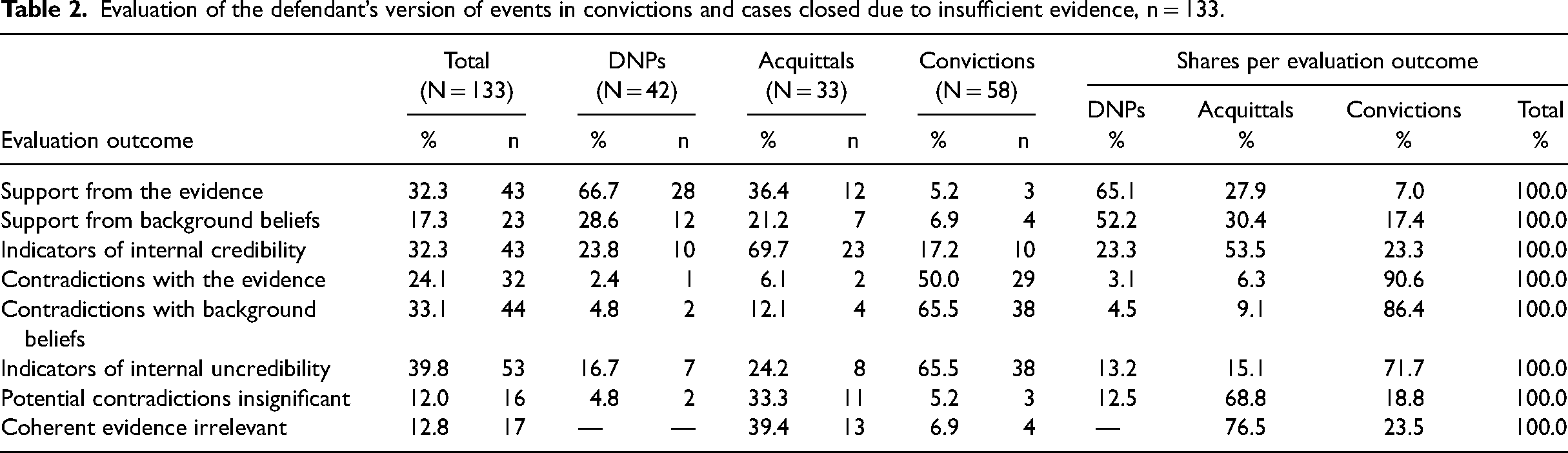
Falsifying a defendant’s version of events appears to be difficult. Only half of the convictions involved contradictions with the evidence. This reflects the fact that rape cases relatively rarely involve the type of evidence that clearly precludes the defendant’s version of events. It might also reflect a certain style of argumentation. The same evidence that supports the complainant’s testimony can simultaneously contradict the defendant’s testimony, but this latter argumentation may only be implicit, as in the attempted rape example above. Nevertheless, cases including evidence contradicting the defendant’s testimony were very likely to result in a conviction (91 per cent). Contradictory evidence was most often a witness testimony, but could also include DNA, sperm or blood samples; physical or psychological injuries inflicted on the complainant; or phone records showing the defendant’s location. As with the complainant’s testimony, such evidence was often related to events and circumstances before or after the suspected rape, rather than to the crucial events themselves. The contradictory evidence was then used to reject the defendant’s testimony in its entirety.
In convictions, contradictions with background beliefs and indicators of internal uncredibility were somewhat more common (66 per cent of each) than contradictions with the evidence (50 per cent), but did not lead to a conviction quite as often (86 per cent and 72 per cent, respectively, vs. 91 per cent). Indicators of internal uncredibility typically included internal contradictions, or changes in the story. The defendant could, for example, simultaneously claim not to remember any sexual intercourse, but also state that the complainant initiated it, or initially deny any sexual intercourse, but admit to it after receiving DNA results. In a few cases, the defendant was unable to answer the prosecutor’s questions, for example about how the complainant had indicated their consent.
The fact that indicators of internal coherence were most numerous in acquittals reflects the rarity of such evaluations in DNPs; this type of coherence evaluation benefits from an oral hearing. The contradictions with background beliefs in these cases were varied, and are examined in more detail in Piha (2024). A particular defendant-related narrative was, however, that an innocent defendant cares for the complainant, and denies any wrongdoing but does not seek to avoid the police. For example, if the defendant insulted the complainant before sexual intercourse took place, or left the (intoxicated) complainant alone by the side of the road afterwards, rather than ensuring their safety, this seemed to contradict the notion of voluntary intercourse, which should be based on mutual care.
Recognised contradictions thus appear to be fatal to the defendant’s version of events, but—as with the complainant’s version of events—some contradictions can receive alternative explanations or be deemed insignificant. For example, the complainant’s psychological symptoms, although deemed to contradict the defendant’s version of events, could sometimes be explained by a lesser offence separately proven, or by the distress caused by non-criminal events. Messages sent by the defendant that could be construed as admissions of guilt could receive an alternative interpretation whereby the defendant apologised for ‘bad sex’. As with the complainant’s testimony, small inconsistencies or changes in the defendant’s testimony could be explained by the passage of time and the workings of memory. Likewise, any potential uncredibility due to the defendant’s state of intoxication was sometimes dismissed. The outcome of the case, of course, also depends on whether the complainant’s version of events is supported. In some cases, the defendant’s version was contradicted by witness testimony that also did not unequivocally support the complainant’s version of events (i.e., the defendant, the complainant and the witness each presented a different account of what transpired). In such cases, the contradictions with the complainant’s version of events explain a non-convicting outcome, despite the contradictions with the defendant’s account.
Many of the acquittals (39 per cent) contained evidence or inferences from background beliefs that were coherent with the defendant’s version of events and thus could have served to support it, but were deemed irrelevant. This could include, for example, messages stating the defendant’s innocence that the defendant claimed were sent by the complainant, but where the sender’s identity could not be verified. Some facts that were used as evidence supporting the defendant’s innocence in certain cases could be dismissed in others. For example, the significance of the defendant not trying to avoid the police varied, seemingly depending on the background belief relied on by the fact-finder (see Piha, 2024 for more detail).
Discussion
The cross-tabulations show a high degree of coherence between case outcome and evidence evaluation as presented by the fact-finder. Judges are careful to justify convictions in such a way that the guilty hypothesis appears highly coherent, and the innocence hypothesis quite incoherent. The complainant’s version of events often receives support from multiple sources (the evidence, background beliefs and internal coherence), while contradictions are rarely left unaddressed. Instead, in half of the convictions, potential contradictions with the guilty hypothesis are explained away. The fact that incoherences are sometimes allowed to remain runs counter to the expectations of cognitive consistency theory, but aligns with Kagan's (2002: 371) argument that credibility must be kept separate from merit. Allowing incoherences to remain is slightly more common when they arise in relation to background knowledge or internal coherence than when they pertain to the evidence, although the number of cases is too small to draw generalisable conclusions. Meanwhile, the defendant’s version of events rarely receives support, and is quite often contradicted by the evidence, background beliefs or internal incoherence. Clear falsification using the evidence nevertheless appears difficult. Interestingly, convictions rarely contain arguments that restructure the defendant’s version of events. This may reflect a tendency to convict only in cases where the evidence is clear-cut in relation to the defendant’s account. It could, however, also suggest that judges are more comfortable dismissing evidence supporting the defendant when they are acquitting.
Support for the complainant’s version of events, whether from the evidence, from background beliefs or through indicators of internal coherence, does not guarantee a conviction or even a trial. A fifth of cases where the complainant’s version is supported by the evidence are closed by the prosecutor, never reaching the courts. By contrast, cases where the complainant’s version is contradicted by the evidence, background beliefs or internal incoherence almost always result in a non-convicting outcome, unless the contradictions can be explained away. As noted above, restructuring potential contradictions is a fairly common exercise, especially in convictions. The fact that judges also restructure potential contradictions in 45 per cent of acquittals may reflect a sensitivity to victim psychology and rape myth-busting, suggesting that they consider it important to dismiss unrealistic or damaging claims made by the defence, even when ultimately acquitting the defendant. Support for the defendant’s version of events is associated with non-convicting outcomes, reflecting the principle that even a somewhat coherent alternative version of events can be sufficient to raise reasonable doubt. If the defendant’s version of events is supported by the evidence, 93 per cent of cases result in a non-conviction.
While arguments that restructure contradictions serve to increase the coherence of a version of events, paving the way for an emphatic acceptance of one version over the other (Simon et al., 2004), they also make visible potential points of contention—places where the evaluation might be challenged. Prosecutors are more prone to use restructuring in relation to the complainant’s version of events than the defendant’s, and in a way that benefits the defendant. Notably, a third of DNPs are characterised by the dismissal of evidence that could potentially support the complainant’s version, whereas in no DNPs was evidence supporting the defendant’s version dismissed. In judgments, restructuring benefits the parties more equally. Restructuring of all kinds is quite common in acquittals, perhaps suggesting that the significance of the evidence was more ambiguous to start with.
Although the cross-tabulations do not reveal the ‘strength’ of the support or the ‘force’ of the contradictions, some associations with case outcomes appear very strong. For example, 96 per cent of cases involving evidence contradicting the complainant’s testimony resulted in a non-conviction. This hints at the possibility that a single contradiction, even if related to only one part of the version of events, can be fatal to the entire case. This kind of argumentation has been criticised in the literature on asylum proceedings for setting the evidentiary bar unreasonably high (Eyster, 2012; Sweeney, 2009). In our data, this kind of argumentation appears more common in decisions not to prosecute, which rarely include arguments suggesting that potential contradictions are irrelevant. By contrast, in acquittals, it is common to explain away some contradictions with the complainant’s testimony, while those that are left unaddressed lead to the non-convicting outcome. This suggests that for rape complainants, this type of disadvantage happens at the prosecutorial decision-making stage rather than in court.
Meanwhile, evaluating the significance of the part for the whole is necessary. Evidence evaluation cannot focus exclusively on the moment of the rape because such evidence is usually limited to the parties’ testimonies. The legal fact-finder therefore faces a difficult balancing act. On the one hand, due to the paucity of evidence, establishing the complainant’s credibility by reference to supporting evidence unrelated to the moment of rape is often necessary. This requires that a version of events can be proven by proving a part of it, often by reference to ‘peripheral’ events, recollection of which is prone to inconsistencies (Sweeney, 2016: 25). On the other hand, treating a version of events as wholly lacking credibility just because one part of it is not credible sets the standard of proof too high in practice.
The qualitative analysis shows that similar facts were sometimes treated differently. Inconsistency in the interpretation of facts, and in case outcomes, is a familiar finding in both the rape literature (see e.g., Chalmers et al., 2021; Piha, 2024; Stewart and Jacquin, 2010; Wallin et al., 2021) and the asylum literature (see e.g., Kagan, 2002: 377; Piccolo et al., 2023). Typically, evidence lending support in one case could be deemed irrelevant in another, or evidence considered contradictory in one case could be dismissed as insignificant in another. There are at least three possible reasons for this.
First, the difference in treatment could be due to case-specific factors. For example, the lack of physical injuries may be expected in cases of sleep-rape, but may contradict a story involving severe violence such as strangulation or beating. Minor injuries to the legs and arms may be explained by stumbling in cases where the complainant is known to have stumbled, but not in cases where no such incident occurred. If the defendant is convicted of a separate physical assault preceding the rape, this assault could potentially explain the complainant’s psychological symptoms. However, this alternative explanation fails if no prior assault has taken place.
Second, similar facts being treated differently could be the result of a difference in reasoning strategy. For example, if the fact-finder focuses only on evidence that can differentiate between the two versions of events, they may consider a positive DNA finding irrelevant when the defendant claims that the sexual intercourse was consensual. By contrast, if the fact-finder evaluates the coherence of the two versions of events separately, the same DNA finding may be seen as supporting the complainant’s version of events (while also being coherent with the defendant’s version). This difference could be significant. According to the Supreme Court’s staged approach to evidence evaluation, the defendant’s testimony will only be examined if the complainant’s testimony is first found to be adequately supported by the rest of the evidence. A fact-finder who considers only differentiating evidence may conclude that the complainant’s version lacks adequate support, and may therefore not proceed to the second stage to evaluate the defendant’s version. In addition, a fact-finder who focuses solely on differentiating evidence will treat the significance of a piece of evidence as depending on the difference between the complainant’s and the defendant’s versions of events, and may thus more easily fall into the logical fallacy of inflating the significance of the fact in terms of the version with which it coheres, due to its incoherence with the other version of events (Marjosola, 2021: 473). However, it could also be argued that a fact that cannot differentiate between the versions carries no significance, and therefore a fact-finder who allows such a fact to support one version of events also inflates the significance of the evidence. Both reasoning strategies therefore come with pitfalls.
Third, the difference in treatment could be arbitrary, that is, lacking an adequate basis. For example, if a negative DNA finding contradicts the complainant’s version of events when the defendant denies sexual intercourse, but not when the defendant claims consensual (unprotected) intercourse, the significance of the finding hinges on a logical fallacy. Sometimes fact-finders anchor their inferences in opposing beliefs, where one belief is unjustified (this is the crux of the rape myth research referenced in the introduction). For example, a fact-finder who considers the complainant’s ‘illogical’ behaviour—such as being friendly with the defendant—as contradicting rape is anchoring the inference in the faulty belief that rape victims are always hostile towards their rapists. Another fact-finder, anchoring their inference in the knowledge that rape victims react in different ways, may deem evidence of the complainant’s behaviour insignificant. This kind of variation threatens access to justice.
Conclusion
The aim of this article was to broaden our understanding of evidence evaluation in rape cases as a function of coherence—especially explanatory coherence—by exploring how explanationist theories of evidence could structure an empirical investigation. Evidence evaluation is inherently complex, and the typical evidence in rape cases makes rapes both difficult to prove and difficult to disprove with physical and testimonial evidence. Explanationist theories of evidence direct our attention to the role of explanations and different types of coherence in evidence evaluations, to methods of evidence reconstruction and to the relative independence of the evaluations of the complainant’s and defendant’s versions of events.
Although the outcome is always dichotomous—one party wins, the other loses—evidence evaluations are not a zero-sum game. In practice, they are often far from clear-cut. While judges are careful to justify convictions in a way that presents the guilty hypothesis as highly coherent, and the innocence hypothesis as quite incoherent, the evidence evaluation in acquittals and non-prosecution decisions is often mixed. Support for the guilty hypothesis is acknowledged, and the innocence hypothesis is not necessarily strongly supported. When the complainant’s and defendant’s versions of events are evaluated separately, each version can be assessed on its own merits. This helps mitigate the risk that the defendant’s silence or an incoherent explanation will be taken to increase the coherence of the complainant’s version (or vice versa).
Maintaining this separation also has the benefit that fact-finders need not (falsely) imply that the complainant lacks credibility if the defendant’s version is found credible. Instead, fact-finders can rely on a strategy of finding the complainant’s version of events (at least partly) credible, while closing the case on the basis of reasonable doubt raised by the defendant’s also (partly) credible account. Differentiating evidence will impact the explanatory coherence of each version differently, thereby influencing the case outcome. It would be important to ensure that fact-finders also clearly communicate the difference between the evidence evaluation and the case outcome, so that the parties can feel that their side of the story has been acknowledged even when the case is decided against them.
Evidence evaluation cannot be conducted ‘mechanically’ by simply counting the evidence and arguments for and against the different hypotheses. Evidence and background beliefs must be critically engaged with. Both prosecutors and judges do this, especially in relation to the complainant’s version of events. However, the results raise the question of whether there might be more scope for prosecutors to critically scrutinise evidence that defendants use to support their innocence, despite legal principles that privilege the defence.
The empirical analysis presented here has its limitations. Classifying a large body of data for the purpose of overall characterisation inevitably results in the loss of nuance, and obscures some issues. For example, coding reasoning in relation to only the main defendant and the most significant intercourse can obscure the partial acceptance of the complainant’s version of events. Future study designs should aim for greater complexity, including a comprehensive representation of the varied patterns of coherence and incoherence in a large dataset; a way to measure the ‘strength’ of coherence or incoherence; and tests of whether contradictions or supporting factors have greater predictive power over case outcomes. Overall, there is a need for further empirical research on explanationist theories of evidence, including studies that more directly seek to inform actual evidence evaluation practices.
Footnotes
Declaration of conflicting interests
The authors declared the following potential conflicts of interest with respect to the research, authorship, and/or publication of this article: Otava Piha originally acquired the data while employed to research the topic at Amnesty International Finnish section. She was employed by Amnesty Finland from 2018 to 2021. In 2019–2020, she represented Amnesty Finland on a working group appointed by the Ministry of Justice to prepare the reform of Finland's sexual offences legislation. From 2018 to early 2022 she was on the board of the NGO Women's Line in Finland.
Funding
The authors disclosed receipt of the following financial support for the research, authorship, and/or publication of this article: This work was supported by the Olga and Kaarle Oskari Laitinen Foundation, the Emil Aaltonen Foundation, Suomalainen Konkordia-liitto and the Finnish Lawyers’ Association. Open access publication supported by the Helsinki University Library.

Notes
Appendices
Analysis framework for evaluating the credibility of the defendant’s version of events.
| Example of decision text (stylised) | Argument logic | Product variable | ||
|---|---|---|---|---|
| What witness A has told the court about the events in the apartment and the complainant’s level of intoxication accords with the defendant’s testimony. | → | The defendant’s version of events is supported by oral testimony | → | Support from the evidence |
| Both defendants have recounted the events similarly. | → | |||
| In the messages presented by the defendant, the complainant has admitted that she initiated the sexual contact. | → | The defendant’s version of events is supported by other evidence | → | |
| The CCTV footage supports the defendant’s testimony that the parties kissed and went into the room by mutual agreement. | → | |||
| The lack of a DNA or sperm finding supports the defendant’s testimony. | → | The defendant’s version of events is supported by a negative finding (the lack of evidence) | → | |
| The complainant sat in the defendant’s lap and kissed him during the evening, which is conducive to raising suspicion of an alternative course of events. | → | The dynamic of the situation is in line with the defendant’s version of events/consensual intercourse | → | Support from background beliefs |
| Witness A had been present at the scene, which fact is conducive to reducing suspicion of a crime. The witness did not see or hear anything that indicated a crime was being committed or feel the need to intervene in the events. | → | |||
| The sexual intercourse happened in a place where the risk of being caught was great. | → | |||
| The defendant did not try to avoid the police and did not seem to understand that he had done anything wrong. | → | The defendant’s behaviour after the event supports their version of events | → | |
| The defendant vehemently denied any sexual misconduct when confronted by the complainant. | → | |||
| Nothing in the witnesses’ testimonies lends support to the defendant’s testimony. | → | Oral testimony contradicts the defendant’s version of events | → | Contradictions with the evidence |
| The defendant’s testimony diverges from the complainant’s and the witness’s testimonies about the interaction of the parties during the evening. | → | |||
| The DNA findings show that the defendant has, contrary to his own claims, put his hand inside the complainant’s clothes. | → | Other evidence contradicts the defendant’s version of events | → | |
| The telelocation evidence shows that the defendant was at the scene earlier than he claimed. | → | |||
| The extent of the complainant’s injuries does not support the defendant’s claim of light [consensual] strangulation. | → | |||
| No other explanation has been presented for the complainant’s psychological symptoms. | → | |||
| If the complainant had moaned and sighed, witness A would have heard this. | → | The situation as described by the defendant has been impossible or unlikely | → | Contradictions with background beliefs |
| Considering that witness A had been waiting for the complainant at her home, the defendant’s claim that the complainant invited him to her home is implausible. | → | → | ||
| If the intercourse had been consensual, the defendant would not have had a reason to squeeze the complainant’s arm tightly enough to cause bruising. | → | → | ||
| It does not seem plausible that the complainant, who had undisputedly gone to the bedroom to sleep, had agreed to sexual intercourse. | → | → | ||
| Considering that the parties had met only a short while before in the street, it is implausible that the complainant had agreed to unprotected intercourse outdoors. | → | → | ||
| The defendant’s claim that the complainant had suddenly become angry for no reason is unconvincing. | → | → | ||
| If everything had happened by mutual agreement, the complainant would not have left late at night barely dressed. | → | The complainant’s behaviour after the events makes the defendant’s version of events implausible | → | |
| The defendant has told of the events in the same way at the police interview and this trial. | → | The defendant’s testimony is internally coherent according to at least one criterion | → | Indicators of internal credibility |
| The defendant’s testimony has been detailed and has not seemed rehearsed. | → | |||
| The defendant has also mentioned aspects of the events that can be considered unfavourable to themselves. | → | |||
| The defendant’s testimony has changed from what he said at the police interview. | → | The defendant’s testimony is internally incoherent according to at least one criterion | → | Indicators of internal uncredibility |
| The defendant has not been able to explain how the complainant consented to the sexual intercourse. | → | |||
| The defendant’s own testimony is contradictory about whether the sexual intercourse happened in the bedroom or the living room. | → | |||
| All the persons interviewed have been strongly intoxicated, which inevitably influences their recollections of the events. | → | Intoxication or memory gaps weaken the reliability of the defendant’s testimony | → | |
| The testimony has been interpreted, which may have caused small imprecisions, but the Court has not noticed any major inconsistencies. | → | Small inconsistencies do not make the defendant’s testimony unreliable | → | Potential contradictions insignificant |
| The receipt of a payment made by a third person on the day in question, presented by the defendant, does not show that the defendant was not present at the scene of the suspected rape. | → | The link between the evidence and the defendant’s version of events is too distant | → | Coherent evidence irrelevant |