



Abstract
According to explanationist theories of evidence, fact-finders reason by evaluating the ‘goodness’ of different narratives that explain the evidence. One standard is external coherence: does the narrative fit with what the fact-finder knows or assumes about the world? This study uses qualitative content analysis to examine how District Court judges draw inferences directly from ‘background knowledge’ in 119 Finnish rape cases and how these inferences are contested by dissenting and appellate judges. The results show that especially the complainant's behaviour was frequently evaluated against behavioural scripts and other background beliefs. Outspoken reliance on rape myths was relatively rare, and myths were explicitly resisted as often as they were relied upon. Where judges used stereotypical behaviour to support the rape complainant's testimony, this reasoning could be explained by the search for optimum (explanatory) coherence or the Finnish legal principle that a rape complainant's testimony requires supporting evidence. Judges also used estimates of prior probabilities to inform their reasoning; few behaviours are impossible, but some actions are ‘more coherent’ with rape than with non-rape, or vice versa. Accruing the type of knowledge necessary (and usually unavailable) for probabilistic reasoning is therefore necessary also for explanationist reasoning.
Keywords
Introduction
How do we recognise rape after the fact, in a trial? The question of judicial reasoning is crucial in all areas of criminal law, but especially interesting in rape cases for two reasons. First, the fact-finder must often support their conclusions with inferences from indirect evidence, whose significance can vary or be unclear. Second, the elements of the crime can themselves be abstract, being built on a lack of consent, involuntariness or a violation of sexual autonomy. To recognise such elements, the fact-finder must draw inferences from tangible actions, non-action and circumstances. In the terminology of explanationist theories of judicial reasoning on evidence, the assumptions underpinning these inferences constitute ‘background knowledge’. Background knowledge or beliefs, which often remain unstated, are both indispensable for judicial reasoning and a potential source of error. According to explanationist theories, fact-finders reason by looking for a causal explanation for the evidence presented and evaluating the ‘goodness’ of different explanatory narratives. One standard for ‘goodness’ is external coherence: does the narrative fit with what the fact-finder knows or assumes about the world?
In this article, I examine judicial reasoning in 119 Finnish rape cases. How do judges draw inferences from ‘background knowledge’ in rape judgments? What might challenge the validity of these inferences? To examine these questions, I have itemised and categorised judges’ arguments using qualitative content analysis, and analyse those arguments where inferences are drawn directly from background beliefs specific to rape. These arguments concern the dynamic (behaviours and circumstances) of the suspected rape situation, and the behaviours of the complainant and the defendant afterwards. Importantly, I study judges’ stated reasons or arguments, not their actual reasoning, a topic which cannot be studied from written documents.
Rape laws can be broadly categorised into coercion-based and consent-based laws (Jokila and Niemi, 2020: 120–123; McGlynn and Munro, 2010: 17). At the time of the judgments, the definition of rape in Finland was based on coercion: Chapter 20, section 1 of the Criminal Code (39/1889, amendments up to 509/2014 included): A person who coerces another person into sexual intercourse by using or threatening to use violence against the person shall be sentenced for rape to imprisonment for at least one year and at most six years. A person who, by taking advantage of the fact that another person is unable to defend themselves or to formulate or express their will due to unconsciousness, illness, disability, a state of fear or another state of helplessness, has sexual intercourse with this person shall also be sentenced for rape. If, taking into consideration the pettiness of the threat or the other circumstances connected with the offence, the rape is less serious than the acts referred to in subsections 1 and 2 when assessed as a whole, the perpetrator shall be sentenced to imprisonment for at least four months and at most four years. A person who coerces another person into sexual intercourse by making some other threat than that referred to in subsection 1 shall be sentenced in a similar manner. What is provided above in this subsection does not apply if violence has been used in the rape. An attempt is punishable.
1
From the beginning of January 2023, rape has been a consent-based crime. Rape (section 1 of Chapter 20 of the Criminal Code 39/1889, amendments up to 723/2022 included) is now defined as sexual intercourse with a person who does not participate voluntarily. The conditions of involuntariness are specified in the law, and include the lack of an expression of voluntariness, coercion with violence or a threat, or abusing the victim's helpless state. 2 Further examination of the new law is beyond the scope of this article.
The definition of sexual intercourse (previously section 10, now section 23 of Chapter 20 of the Criminal Code) includes vaginal and anal penetration with any part of the body or with an object, and oral penetration with or of a sexual organ. The definition is gender-neutral, and neutral as to perpetrator–victim status. Since January 2023, the definition has also included touching a sexual organ or anus with a sexual organ or mouth without penetration. The definition of intercourse will not be problematised in this study.
In principle, the move from coercion-based to consent-based legislation is a major shift in the rape paradigm. However, because even under the old law rape cases were frequently presented as a question of whether the complainant was coerced or participated voluntarily, in practice the change in judicial reasoning may not be great. Jokila and Niemi (2020) have argued that the two types of legislation share an epistemological basis where evidence of rape requires observable signs and behaviour. Thus, rape will still have to be ‘recognised’ in trial by relying on indirect factors, such as the complainant's and defendant's actions after the suspected rape.
The contribution of the article is two-fold. First, it describes how Finnish judges, especially District Court judges, apply background knowledge or beliefs in rape cases, and how these inferences have been contested by dissenting or appellate judges. The analysis reveals how similar or even the same fact-claims can acquire a different significance depending on the beliefs of the fact-finder, which raises questions about equal access to justice. This also gives some indication of the extent to which judges as legal fact-finders explicitly rely on rape myths, a topic which continues to be under-researched. Second, the study examines the extent to which explanationist theories of evidence, as theories that claim to stay close to how people actually reason, can be used to understand this argumentation. In doing so, it also connects research on rape myths to theories of judicial reasoning, a connection which has been lacking.
The article consists of a theoretical part and an empirical part. In the theoretical part, I highlight key aspects of explanationist theories of evidence, of the role of background knowledge in explanationist reasoning, and of Finnish judicial practice. In the empirical part, I introduce the data and method, and describe and discuss the results of the analysis.
Reasoning about evidence
Explanationist theories of evidence
This study takes explanationist theories of evidence—though not any one theory—as its framework. Such theories have been developed by at least Allen and Pardo (Allen and Pardo, 2019, 2023; Pardo and Allen, 2008), Amaya (2013), Wagenaar, Van Koppen and Mackor (Mackor et al., 2021; Van Koppen and Mackor, 2020; Wagenaar, 1995) and Kolflaath (2013). These theories claim to stay close to the way that people actually reason, which is by seeking the best (causal) explanation for the evidence presented rather than engaging in probabilistic calculus. Due to constraints in both cognitive and institutional resources like time and computational processing power, fact-finders simply ask what most convincingly explains the occurrence of the evidence presented. This abductive form of reasoning does not result in logical necessity; rather, it is heuristic in nature (Allen and Pardo, 2019: 17; Amaya, 2019: 63; Mackor et al., 2021: 431).
Explanationist reasoning involves evaluating two or more hypotheses or narratives. The standard of proof that the ‘best’ explanation must satisfy is explanatory, rather than probabilistic, and depends on the legal standard of proof (Allen and Pardo, 2019: 15–17, 2023: 134–135; Amaya, 2013: 13). In a criminal case, the ‘beyond reasonable doubt’ standard requires not only that the prosecution's explanation is ‘the best’, but also that the prosecution's account satisfies a high standard of good explanation and that the defence cannot present a reasonably good explanation; that hypotheses consistent with innocence can be rejected (Allen and Pardo, 2019: 15–16; Amaya, 2013: 11; Diesen, 2000: 176; Kolflaath, 2019: 125–126; Sullivan, 2019: 103–104; Van Koppen and Mackor, 2020: 1134).
Different criteria have been proposed for evaluating the ‘goodness’ of an explanation. For example, in Allen and Pardo's (2019: 16) Relative Plausibility Theory the criterion is plausibility, which includes ‘consistency, coherence, fit with background knowledge, simplicity, absence of gaps, and the number of unlikely assumptions that need to be made’. In van Koppen's Scenario Theory (Mackor et al., 2021: 446; Van Koppen and Mackor, 2020: 1135–1136), developed from Wagenaar's Theory of Anchored Narratives (Wagenaar, 1995), the criteria are internal coherence (internal consistency, completeness, detailedness, absence of gaps), coherence with background knowledge and coherence with the evidence of the case. In Amaya's (2013: 15) Theory of Inference to the Most Coherent Explanation, the central criterion is explanatory coherence: the extent to which the hypothesis explains the evidence. Following Thagard, Amaya (2013: 5–6) defines coherence as ‘a matter of the satisfaction of a set of positive and negative constraints among a given set of elements’. Institutional factors like rules on admissible evidence, the presumption of innocence and the beyond reasonable doubt standard affect the relevant set of constraints (Amaya, 2013: 11–13). It is sufficient for our purposes to understand coherence as the ‘fit’ between two elements, like a hypothesis (indictment) and the evidence at trial.
The terminology of explanationist theories remains in flux and may differ from the terminology used by judges. For example, ‘incoherence’ in an oral testimony can refer to the testimony not proceeding in a clear, structured manner, to internal contradictions or to inconsistency with external knowledge. While ‘plausibility’ is a central concept for Allen and Pardo, Amaya (Amaya, 2019: 64) considers it too vague, 3 and when used by judges, it generally refers to coherence with background beliefs. ‘Inconsistency’ can refer to internal contradictions, lack of constancy over time or incoherence with the evidence or background beliefs. In this article, I will use coherence as the overall notion, but employ the language of the judgments, thus using plausibility and consistency interchangeably with coherence.
The specifics of explanationist theories as well as whether explanationist theories are good normative theories is an ongoing debate, as shown by the lively debate in this journal. Proponents of probabilistic theories have criticised explanationist theories for their lack of truth-conduciveness, at least insofar as they do not conform with or function as a heuristic for Bayesian probabilistic theory (Aitken et al., 2022; Olsson, 2021). Abductive, heuristic reasoning is susceptible to psychological fallacies, for example fallacies of presumption and confirmation bias. Can an approach based crucially on coherence guard against, for example, the prosecutor's fallacy, a psychological fallacy whose key area of application is in the name? In a criminal setting, the fallacy consists of assuming that the probability of the hypothesis (such as the defendant's guilt) being true given the evidence is the same as the probability of the evidence occurring when the hypothesis is true. The former may be low even while the latter is high. One of the constraints of coherence proposed by Amaya (2013: 6) is that coherence is symmetrical, unlike conditional probability. It is entirely coherent that a defendant is guilty of rape when their DNA has been found on the complainant, and just as coherent as their DNA being found on the complainant when the defendant is guilty. However, the probabilities of these two occurrences differ. An appreciation of conditional probability can therefore provide an avenue of critique for reasoning based on explanationism and coherence (Wittlin, 2019).
Background knowledge in judicial reasoning
Background knowledge is indispensable in the evaluation of evidence; it is a practical way of ending a potentially endless regression of things that need to be proven, of avoiding circularity in justification, or of connecting statements about the case to the rest of our knowledge. Understanding cause and effect or other connections between phenomena requires background knowledge. Amaya (2013: 15) suggests that background knowledge ‘helps legal fact finders narrow down the range of plausible candidates’ for explanations of the evidence. According to Bex and others (2006), background knowledge functions as a source of default-style argumentation: the background thesis, like the truthfulness of witnesses under oath, is assumed to be correct, unless it is shown to be false. Mackor and others (2021: 446; see also Van Koppen and Mackor, 2020; Wagenaar, 1995) stress the ubiquity of background knowledge: ‘each and every word in a scenario carries a lot of general world knowledge that we take for granted’. These ‘narratives about the world that are accepted as true’ become ‘anchors’ for arguments about the evidence and the indictment. Much of this background knowledge is stored in scripts (Mackor et al., 2021: 446), collections of information about how events proceed and people behave that help in the interpretation of information related to a particular event, and guide behaviour and expectations of others’ behaviour (Kleider et al., 2008: 2; Krahé et al., 2007: 316).
One of the original findings of the research on anchored narratives was that sometimes the decisions in criminal cases, on closer inspection, are anchored in ‘absurd’ beliefs, leading to the normative demand that background assumptions of judges be made explicit, so that anchoring to absurd beliefs can be avoided (Wagenaar, 1995: 278, 284). This highlights a tension: the narratives or hypotheses in a criminal case should be coherent with background knowledge, but it is unclear what the criteria for ‘knowledge’ are, especially for complex issues like people's behaviour. Scientific or otherwise trustworthy information of people's behaviour in a situation can be contradictory, not easily accessible, highlight the diversity of behaviour, or be completely lacking. The judge must nevertheless make a decision, and will rely on whatever background information is available. Background ‘knowledge’ could thus also be characterised as beliefs or assumptions about the world.
Incorrect background beliefs threaten the epistemic justification of judicial reasoning. Rape is a topic where the influence of faulty background beliefs has been much discussed. Human rights norms, like Article 12 of the Council of Europe Convention on preventing and combating violence against women and domestic violence (Istanbul Convention) and Article 5 of the Convention on the Elimination of All Forms of Discrimination against Women, prohibit basing the evaluation of rape cases on gender prejudice or stereotypes about women's or men's roles.
In rape myth research, false beliefs about rape, rape victims and rapists have been presented as major contributors to low conviction rates in rape cases. Rape myth research argues that judges’ or juries’ thinking on rape is often permeated by a faulty kind of rationalism, one where the ‘real’ rape victim acts in self-preserving ways (fights back, calls for help, immediately reports to the police) and it is safe for them to do so. Other rape myths concern the allocation of blame for rape (victim-blaming for risky or flirtatious behaviour, excusing the perpetrator), what kind of acts constitute ‘real’ rape (particularly the stranger rape myth), and the consequences of rape (that rape results in extensive injuries, that only stranger rape is traumatic). Studies have examined, for example, the use of rape myths in the courtroom (Smith and Skinner, 2017; Temkin et al., 2018), the influence of one or more rape myths on allocations of blame among mock jurors (Chalmers et al., 2021; Ellison and Munro, 2009b; Maeder et al., 2015; Stewart and Jacquin, 2010; for reviews see Dinos et al., 2015; Leverick, 2020) or whether judicial instruction or expert evidence can shift this (Ellison and Munro, 2009c; Gray, 2006; Temkin, 2010). Rape myths function to discredit a rape complainant, distance the case from what is considered to be ‘real rape’ and to otherwise deny, downplay or justify violations of sexual autonomy (Gerger et al., 2007; Temkin et al., 2018). Rape myths hinge on the ‘normality’ or ‘abnormality’ of certain behaviours; deviation from the ‘normal’ is cause for suspicion about the truthfulness of the rape complainant (Ellison and Munro, 2009a; Smith and Skinner, 2017).
Most rape myth research concerns jury decision making, and thus there is a gap in knowledge regarding the influence of rape myths on judges. In Sweden, where the legal environment is very similar to Finland, Wallin and others (2021) found that the rape complainant's behaviour after the suspected rape was emphasised in judges’ reasoning, with evidence of both reliance on and rejection of rape myths present. In India, Barn and Kumari (2015) were optimistic about appellate judges not giving ‘undue weight’ to delays in reporting rape, although other aspects of the evaluation of complainant credibility were causes for concern. Camplá and others (2020) studied sexual assault trials in Chile, and found a statistical relationship between the verdict and complainant–defendant relationship, and between the verdict and ‘counter-stereotypical’ victim characteristics (drug use, sex work, social vulnerability) suggesting the influence of extra-legal factors, but concluded that qualitative research into the reasons for acquittals was needed to determine if there was bias in the decision making.
In Finland, background knowledge is referred to as ‘universal rules of experience’ (see below under ‘The Finnish criminal process and the evaluation of evidence’). Strictly speaking, rules of experience are not usually based on experience of the crime, but on experiences of hearing about the crime, or on more general experiences and assumptions that are analogically applied to the situation. For example, Laugerud (2023: 5) has studied sleep-rape in Norway and found that judges rely on ‘everyday knowledge’ about sleep. This knowledge is intuitive and based on life experience or ‘common sense’. Everyday knowledge might, for example, tell judges that it takes time to fall into a deep sleep, or that people sleep lightly in unfamiliar places. In Sweden, Bladini and others (2023: 2) found that judges frequently used the phrase ‘It sounds like lived experience’ to underline the credibility of a complainant's testimony in a rape case. This implies that the judges have understood the complainant's perspective; it is somehow relatable based on the judges’ prior experience or knowledge. If judges’ rules of experience are based on judicial experience of like cases, the rule is subject to confirmation bias: it will become skewed towards those cases that resulted in a conviction, as these are the cases that come to represent the crime. Rules of experience can also come from ‘experience’ recounted by others: preparatory works, Supreme Court precedents, judges’ training or scientific literature. A reference to ‘universal rules of experience’ or ‘general life experience’ can give an objective-sounding justification for the argument, when, in fact, it refers to beliefs about the world (Jokila, 2010: 216).
The ‘rules of experience’, stereotypes and discourses apparent in rape cases have been studied in Finland before. Based on 98 cases from Appeals Courts from 1999–2002, Jokila (2010: 216–236) found many of the same types of argumentation, and connected them to similar discourses, as in this study. Jokila concluded that although the courts rarely explicated the rules of experience used, the influence of the stereotype of a rational-assertive victim could be seen. The complainant's assertive behaviour—reporting to the police quickly, contacting a witness and so on—after the suspected rape supported the indictment. According to Jokila, this stereotype was not used in a problematic way, because while conformity with this stereotype supported the indictment, deviation from it did not speak against the indictment (see below under ‘Discussion’). While the defence might invoke sexist, victim-blaming arguments related to the relationship between the parties, the complainant's prior sexual conduct, provocation, the complainant's motive to lie, mental health issues and intoxication, the courts rarely accepted them, at least in the written judgment. Because the purpose was not to study changes in judicial reasoning over time, and the results are not directly comparable due to differences in research design, Jokila's results of the prevalence of certain arguments are reported in footnotes.
The Finnish criminal process and the evaluation of evidence
Under the Code of Judicial Procedure (4/1734, Chapter 17, section 3), the prosecution bears the burden of proof and convicting requires that the accused's guilt be proven beyond reasonable doubt (see Hupli, 2012: 211–212). In acquittal, the court will dismiss the charges due to reasonable doubt about the accused's guilt, but not pronounce the accused ‘not guilty’. Under the Criminal Procedure Act (689/1997, Chapter 11, section 4), the court must provide reasons explaining what facts and legal reasoning have formed the basis of the conclusion, and on what basis a disputed fact has been proven or not proven. The complainant is party to the proceedings, rather than only a witness. Thus, they can be present for the entirety of the trial and present their own evidence and legal interpretations.
In District Courts, rape cases are usually decided by one professional judge and two lay judges. Lay judges are appointed on a part-time basis for four-year terms by the municipal council. They can serve multiple terms. They are guided in legal questions by the professional judge. In Appeals Courts, rape cases are usually decided by three professional judges, and in the Supreme Court, by five professional judges. All judges, including the lay judges, take part in the evaluation of the evidence and in deciding questions of law (see Kolflaath, 2019: 122 on the Norwegian context, which is similar). A dissenting judge, including a lay judge, must write reasons for their dissent. Two lay judges can form the majority opinion, but this is rare. One such case was present in my data.
The evaluation of evidence is free (see Koulu, 2015; Pihlajamäki, 1997). Contrary to common law systems and an increasing number of civil law jurisdictions (see Damaška, 1995), Finnish law contains few rules about inadmissible evidence or the evaluation of evidence—only evidence obtained with torture or, in criminal matters, against self-incrimination protections are always barred (Code of Judicial Procedure, Chapter 17, section 25). For example, there is no rule barring evidence about the prior sexual conduct of a rape complainant. Although the judge should disallow evidence that has no bearing on the case (Code of Judicial Procedure, Chapter 17, section 8), the threshold for deeming a piece of evidence irrelevant has been set (unnecessarily) high (Jämsä, 2020: 72–74, 143–144; Rautio and Frände, 2020: 74; Träskman, 1986: 336) so as not to interfere with the accused's right to a defence. The significance of a piece of evidence might not be apparent before it is presented. However, the judge has wide discretion to decide the relevance and probative value of a piece of evidence. Because evidentiary questions vary by case, no fixed or formal rules about the weighting of evidence can be given (Supreme Court precedent KKO 2013:96: para 6). Some general principles nevertheless apply: the judge must evaluate the evidence thoroughly, impartially and objectively, according to ‘universal rules of experience’, and first each piece of evidence individually, then all the presented evidence holistically (Code of Judicial Procedure, Chapter 17, section 1; Government Bill 46/2014: 45; Supreme Court precedent KKO 2013:96: para 6).
Neither legislation nor precedents of the Supreme Court grant an official position to any evidence theory (Koulu, 2015: 11). Several theories have, however, been influential. Diesen's (1993) hypothesis method can be seen in the structure of evidence evaluation in criminal cases. The prosecutor must first present sufficient evidence that alternative hypotheses can be evaluated—if the evidence is insufficiently extensive, the charges must be dismissed. Then, the indictment is split into ‘themes’ like the time and place of the crime, the relevant acts and the identity of the perpetrator. The evidence presented must cover all the relevant themes and the elements of the crime. If one of these remains unproven, the charges must be dismissed. Finally, the hypothesis of the indictment is tested by attempting to falsify competing hypotheses. If competing hypotheses can be falsified, the accused is convicted; if not, the charges must be dismissed. The method has, however, been criticised for being laborious to follow in the way Diesen intended (Vihriälä, 2005: 380–381), for unrealistically assuming that the court can evaluate the comprehensiveness of the investigation (Jokela, 2015: 328–329), and for being vague on the criteria by which the falsification of competing hypotheses happens (Marjosola et al., 2021: 477–478). One probabilistic theory for criminal cases, Ekelöf's evidentiary value method, has gained space in the literature, though not in practice (Pölönen, 2003: 157; Rudanko, 2021: 541), as is wont with probabilistic theories. However, the evidentiary value method's idea and language of pieces of evidence having differing evidentiary values—such as a piece of evidence providing ‘weak’ or ‘strong’ support—can be seen in judgments. The theory does not specify how the evidentiary value of evidence is determined (Rudanko, 2021: 541).
The Supreme Court's precedent KKO 2013:96 concerns the evaluation of evidence in sexual crimes, and the principles contained therein are frequently reiterated in rape judgments. 4 The Court stressed that the threshold for conviction is the same as for other crimes, even though the nature of sexual crimes is such that it is often difficult to find direct and unambiguous evidence (para 5). Sexual crime cases rely heavily on the testimony of the parties; nevertheless, ‘at least usually’ the complainant's testimony, even if judged convincing and more believable than the accused's and notwithstanding the complainant's obligation to tell the truth, is by itself an insufficient basis for a conviction (para 7). 5 Thus, the prosecutor or the complainant must usually present indirect evidence supporting the charge, for example about subsequent events or about the consequences of the alleged crime (para 7). Rasilainen (2023) has recently criticised the subsequent interpretation of this principle as a legal rule rather than a rule of experience, which has undermined the judges’ freedom to determine the probative value of the evidence case by case.
The Court also outlined the process for evaluating a case (para 9). The first step is testing the strength of the complainant's testimony and any supporting evidence by evaluating them according to the principles outlined above. Due to the presumption of innocence and the prosecution's burden of proof, the evidence must be convincing enough to warrant a conviction. If sufficiently robust evidence has been presented, the court will then test whether the defendant's testimony is plausible enough to raise reasonable doubt about the defendant's guilt. (Of course, the defendant has no obligation to testify, although it is unlikely that reasonable doubt can be raised without it, if the evidence supporting the indictment is strong. Typically, the defendant will both present arguments that undermine trust in the verity of the complainant's testimony, and present at least one alternative version of events, sometimes with supporting evidence.) The last step is evaluating the probative value of the evidence as a whole to determine whether the threshold for a conviction is met. While judgments are typically written following this structure, it is likely that judges evaluate and re-evaluate the evidence and their conclusions over the course of the trial, forming opinions on the defendant's testimony before properly testing the strength of the evidence supporting the indictment (see Simon, 2010).
In addition, the Supreme Court (para 8) stated that the reliability of an oral testimony should be evaluated against the internal coherence of the key content, the realism and constancy (from one telling to the next) of the testimony and the level of detail, rather than the person's manner of speaking, facial expressions, gestures or emotional reaction during trial. This assessment can cover parts of the testimony not directly relevant to the fulfilment of the elements of the crime (such as the coherence and realism of the circumstances, or of the events prior to or after the alleged crime), though the major focus is on events establishing the elements of the crime (such as the constancy and level of detail of the complainant's account of the number and type of sexual intercourse).
The Court (para 33) stated that one cannot expect a rape victim to behave in any particular victimised way. In the case in question, the fact that the complainant had had coffee with the defendant after the rape was not inconsistent with having been raped. A victim of violence cannot be expected to resist violently or otherwise, and ‘freezing’ or the lack of defensive acts cannot be taken as a sign that what happened was not a crime. The Court also specifically stated that long delays in reporting a sexual crime to the police are not unusual, because the victim's mind may repress the traumatic experience and the associated shame, anxiety and fear. The Court thus resisted many typical rape myths, and, through precedent, instructed other courts to do the same.
Data and method
The data and its limitations
The data consists of two sets. The first set includes the majority opinions on 119 counts of rape or aggravated rape handed down in 2016–2017 by three District Courts. This was a convenience sample, as the District Court data was originally obtained by Amnesty International in 2018. 6 The sample is not representative of all rape judgments in Finland, and this limitation should be borne in mind. The three District Courts are large or mid-sized and geographically distributed in different parts of the country, one in the south, one in the west and one in the east. The complainants were at least 16 years old (the age of consent in Finland), and the alleged act had taken place on or after 1 September 2014 (the entry into force of a major legal amendment). The second set includes two dissenting opinions in those same cases, 12 Appeals Court judgments where the decision was overturned, 7 and one Supreme Court judgment where the decision was overturned. The first set is used to describe the argumentation of District Courts. The second set is used to show how that argumentation has been challenged.
The judgments were obtained under research permits from the courts. Although judgments are generally public documents, in rape cases and other sensitive cases, the judgment can be declared partially or wholly confidential. Confidentiality is meant to protect the identity of the complainant. Obtaining such data requires a research permit, which can be granted for scientific research purposes under section 28 of the Act on the Openness of Government Activities (621/1999).
Below, I will use ‘judgment’ to mean ‘opinion on a single count of rape’, even though each judgment (as a document) can contain several counts of rape (and other crimes) and several opinions. The majority opinions from District Courts are referred to as the ‘District Court judgments’, without prejudice to the existence of dissenting opinions. ‘Case’ refers to a single count (and all the judgments related to it), even if several counts of rape have been processed in the same trial. For research identification purposes, the judgments were given a number consecutively from 1 to 134.
It was not the purpose of this study to produce a typology of the cases. However, for the reader to form an impression of the cases that come to Finnish courts, a brief characterisation is provided, summarised in Table 1. The characterisation is based on the complainant's testimony. The conviction rate is based on the final judgment in the case. In more than half of the cases (N = 65), the defendant(s) admitted to at least one type of intercourse included in the indictment. All the defendants were male. Of the complainants, 113 were female, 4 were male and one was of another or unknown sex. Eleven were aged 16–17. In almost half (N = 58) of the cases, the parties had been at a bar or nightclub, a private party or afterparty, or otherwise had been consuming alcohol or drugs together. Of those, 29 were cases where the parties had not met before the day in question. A little over half of the cases, 30 in total, ended in a conviction. Fourteen cases involved intimate partner violence, where the defendant had allegedly been violent towards the complainant on a previous occasion, or used physical violence other than the violence used in the suspected rape. A little over half of these, eight cases in total, ended in a conviction. There were 11 cases of stranger rape, outdoors or in an indoor space to which the defendant had followed the complainant uninvited. The parties usually spoke to each other before the suspected rape and may even have shared a cigarette, drink or food, but the interaction of the parties was not extensive. The level of violence used ranged from leading by the hand to strangling. One indictment was based only on the victim's strong intoxication, without a violence element. All ended in a conviction. All three cases where a client had violently coerced a sex or erotica worker into sexual intercourse also ended in a conviction. In four cases, the sexual intercourse was initially consensual, but the defendant either became violent, did not stop when the complainant requested it or performed a type of sexual penetration that was not consensual. None ended in a conviction. The remaining 28 cases involved various dynamics, such as spending time together unintoxicated before the suspected rape, rape by a taxi driver or a colleague or offering the complainant a place to sleep after a chance meeting on the street. In some of these cases, one or both parties were intoxicated, but they had not become intoxicated together. Exactly half of these cases ended in a conviction. The overall conviction rate was 56%.
Typology of cases.
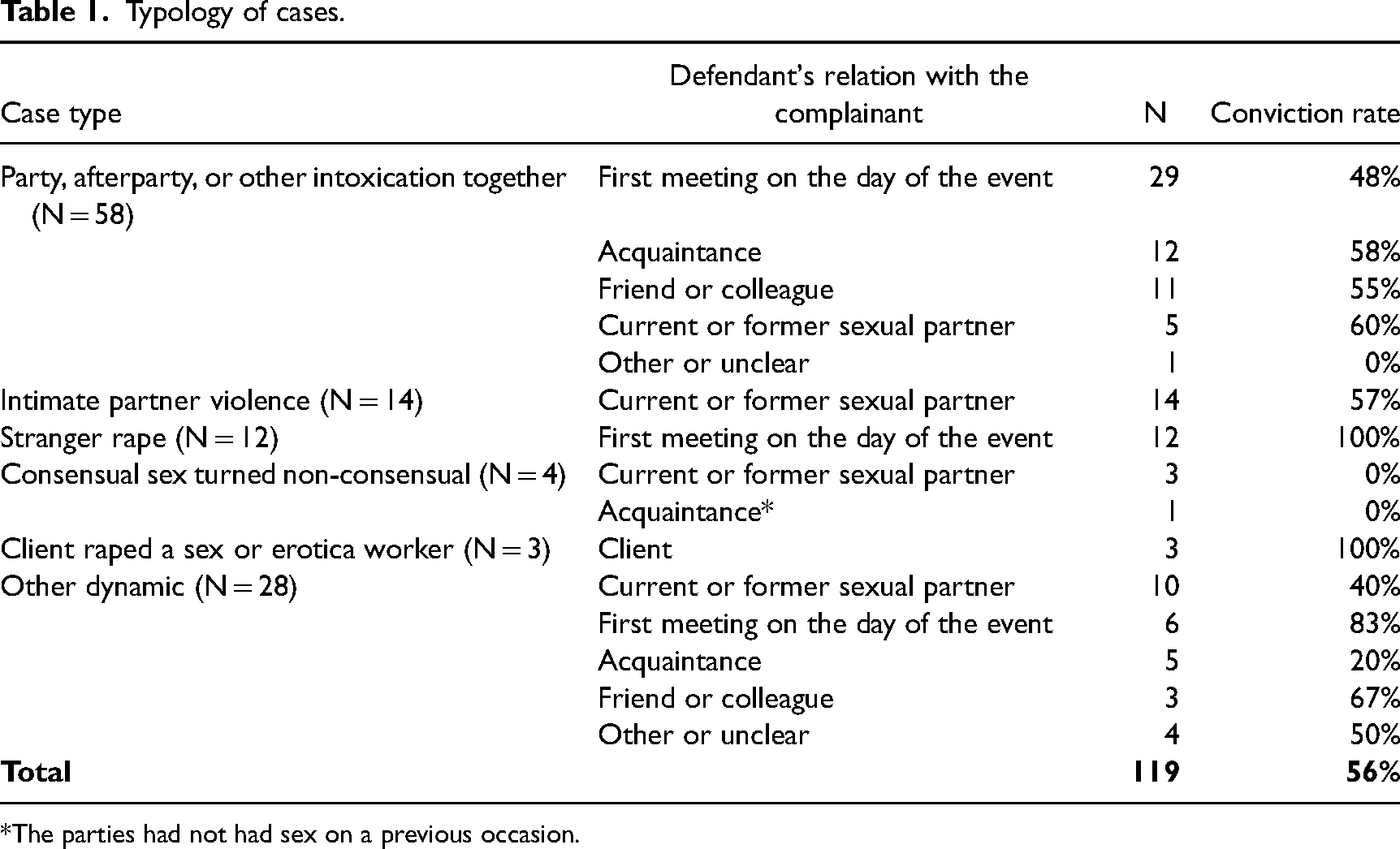
The parties had not had sex on a previous occasion.
The method and its limitations
The data was coded into and analysed in a spreadsheet using qualitative content analysis (see Elo et al., 2014; Miles and Huberman, 1994). The judges’ stated reasons were interpreted as arguments about the reliability of a piece of evidence, about the significance of a piece of evidence for an inference about guilt or about the correct interpretation of the law. Similar arguments could be combined, and arguments were grouped thematically. The generation of arguments was data-driven, with their combination and categorisation informed by theories of judicial reasoning, empirical research on rape and a practical interest in forming arguments and categories with sufficient data points. For example, arguments about contacting the police, a doctor or the emergency services after the suspected rape were combined into arguments about contacting the authorities, as which authority was contacted seemed less relevant than the speed of contact. However, arguments about contacting the authorities were not combined with arguments about contacting a witness, both because arguments about contacting the authorities were frequent enough to form a group of arguments on their own and because other types of witnesses were generally not considered as trustworthy or contact with them as significant as contact with the authorities.
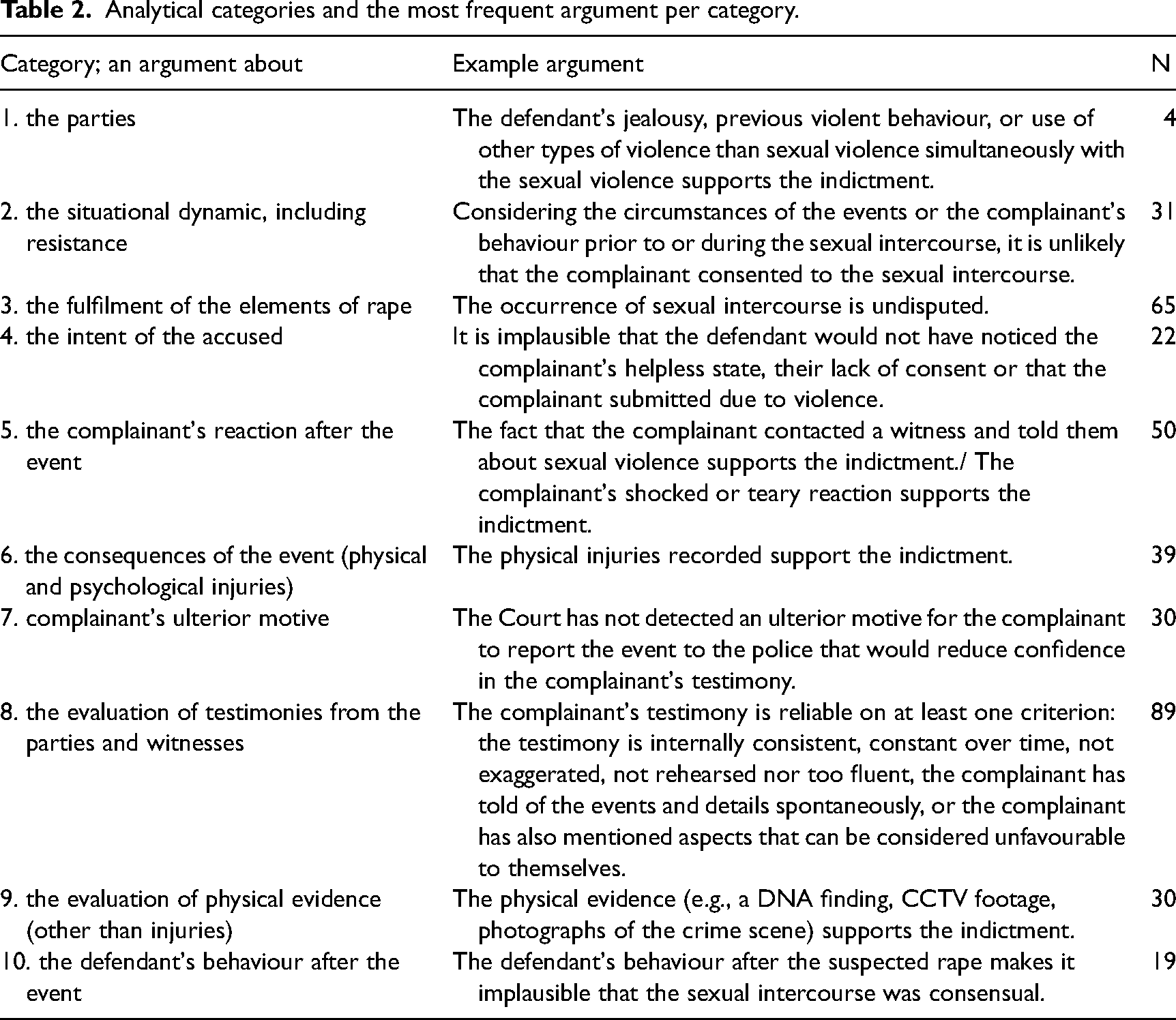
The categories and the most used argument from each are listed in Table 2. The frequencies in the table and in the rest of the article are presented as the number of District Courts judgments that the argument appears in (out of 119), unless otherwise stated.
Analytical categories and the most frequent argument per category.
The reading of the judgments was closest to the interpretive or hermeneutical tradition, interpreting the text in its immediate and wider context, sensitive to the preconceptions of the researcher (Asdal and Reinertsen, 2022: 86; Ricœur, 1981; Schleiermacher, 1990: 95). What judges do not write can also be significant; ignoring a party's claim can be an argument for its irrelevance (Jokila, 2010: 237–238). Silences have been interpreted in this way when the parties’ claims have been apparent from the judgments, although these types of ‘arguments’ are easier to miss, and therefore the chance of mistakes in coding is higher. In addition, the court's arguments or lack thereof (regardless of claims made by the parties) have been consistently coded for two items commonly addressed in rape myth literature: a delay in reporting the rape to the authorities, and the complainant's state of mind soon after the suspected rape.
As the research permits allowed only me to handle the data, the coding was done by one person. Naturally, there is a risk of bias and inconsistency. Each judgment was re-coded after the entire dataset had been coded to increase consistency, and during the analysis the original wordings of the arguments were encountered without the rest of the context provided by the case. If the meaning of an argument appeared to change in the absence of context, the meaning of the argument was re-evaluated carefully.
Arguments about the parties’ behaviour or the circumstances before, during and after the suspected rape rely on comparing this behaviour with preconceptions about people's behaviour or the circumstances before, during or after rape or non-rape. Thus, such arguments rely on rape-specific background knowledge or beliefs, and the analysis was narrowed down to these arguments. The behaviour being assessed could be proven in one of several ways: it could be undisputed, proven by physical evidence (like CCTV footage), proven by witness testimonies 8 or the party in question might admit to ‘disadvantageous’ behaviour. Background knowledge or beliefs could also be used to conclude that a behaviour-related claim was implausible and thus not proven.
The interpretation only encompasses arguments that judges have made visible in the judgment. But are judges’ written opinions ‘merely afterthoughts of preconceived notions already instilled in the jurists’ minds’, that ‘disclose little pertinent insight concerning how judges arrive at their conclusions or the actual process by which they decide’ (Capurso, 1998: 8)? It is self-evident that the impact of unconscious or unacknowledged factors, such as ‘what the judge had for breakfast’, cannot be uncovered from this type of analysis. However, that is not the aim. Judgments should be viewed as sites of action rather than as recordings of some other process (Asdal and Reinertsen, 2022). Therefore, the judgments and their reasoning do the work of justice in society and any ‘underlying causes are not more true or real than what is spelled out in the documents’ (Laugerud, n.d.).
The method has required generalisation. However, the significance or validity of an argument can only be evaluated in its specific context. Even slight variation can be important, and thus generalisations quickly become imprecise. I have started from the more generalised categorisation to give an indication of the extent of a certain type of argumentation, but pulled out examples to introduce context. The conviction rate, often the dependent variable in rape myth research, was not used as a measure of the significance of arguments, because this would require the standardisation of other variables, which would have been extremely difficult.
Results
The moment of rape: plausibility of the dynamic
Psychological plausibility
In 45 per cent of the District Court judgments, the judges assessed whether a party's description of the events was psychologically plausible (N = 53). Plausibility assessments were qualified; they would ‘support’ or ‘speak against’ a version of events, rather than ‘prove’ or ‘disprove’ it.
Most often an implausibility argument was made in support of the indictment. In particular, the court often considered it implausible that the complainant had participated voluntarily in the sexual intercourse (N = 31). Even though involuntariness was not an element of rape at the time, the voluntariness of intercourse was a common defence. The courts generally considered voluntary participation to be implausible if the complainant had rejected the defendant's advances before, if the complainant resisted verbally or physically during the sexual interaction, if the complainant (whether a man or a woman) was only sexually interested in women (the defendant being a man), if the defendant had been unpleasant or violent towards the complainant before the sexual intercourse, if the age difference between the parties was large, if the intercourse happened outdoors or in a non-private space (especially if a private space would have been available), if the parties were strangers who met on the street, if the intercourse happened without any foreplay, if the complainant had sexual intercourse with several people in short succession, if the complainant's partner was present at the scene but not involved in the sexual activity, if the complainant had wanted to sleep or leave or if the defendant had moved to sleep beside the complainant when he had been given another place to sleep or after she had already gone to bed or had passed out. For example, in case 1, involving a sleeping complainant, the court considered it implausible that the complainant, who had wanted to go home and had undisputedly retired to the bedroom to sleep, would agree to sexual intercourse with a person she had met for the first time that day and had shown no romantic interest in—with the door open to the living room, where others were still partying. Some factors reduced the plausibility of voluntary intercourse when combined with others, such as the intercourse being unprotected when the complainant was a sex worker or a stranger.
Some implausibilities were not directly related to whether the complainant would have agreed to sex, but to the defendant's claims about other events or his own actions (N = 15). Such implausibilities included claims like the complainant inviting the defendant to her home even though someone (a spouse, a parent) was waiting for her there, the complainant attacking the defendant for no reason (causing scratch marks or other injuries) or the defendant's description of himself as passive, surprised or marvelling at the sexual intercourse while the complainant was unusually active. If the court accepted that the defendant had caused the complainant bruises or pain during intercourse, it could then conclude that this would not have been ‘necessary’ had the intercourse been voluntary.
Several factors reduced the plausibility of rape (N = 8). The most common was the complainant's lack of ‘defensive acts’—lack of resistance, failure to shout for help or failure to escape when the situation became threatening or during a ‘lull’ in sexual intercourse—(N = 5), 9 others included the complainant being on top during the sexual intercourse, and the rape happening in a place and at a time where the risk of detection was high. However, sometimes the complainant's lack of defensive acts was deemed irrelevant (N = 5).
Other factors made the voluntariness of the intercourse seem more plausible (N = 11)—even if they did not necessarily make rape implausible. If the complainant's sexual preferences or the parties’ previous sexual encounters were in line with the defendant's version of events, the complainant expressed sexual interest in the defendant, 10 the complainant voluntarily went to or arranged a private space, the defendant respected the complainant's wishes during the intercourse or the defendant stopped the sexual intercourse at the complainant's request rather than due to ejaculation or an external disturbance, these factors made the voluntariness of the intercourse seem more plausible. In the last two types of reasoning the logic seemed to be that if the defendant displayed some respect towards the complainant's wishes, it seemed unlikely that they had started the intercourse against the complainant's wishes; a guilty perpetrator would be indifferent to a complainant's begging (see also case 62–64 below under ‘Disagreement on plausibility assessments’).
Courts also made arguments about what was not implausible (N = 14). 11 These were varied, and could benefit either the complainant or the defendant. For example, in case 86, the complainant had not noticed all the identifying features of the defendant. Considering the violence of the situation, which consumed the attention of the complainant, this did not reduce the plausibility that the defendant was the rapist. The presence of other people at the scene or even in the same bed did not generally make voluntary sex implausible, barring the presence of the complainant's boyfriend or spouse. These arguments could also indicate wariness about the probative value of arguing with background beliefs; in case 59, the court argued that while having voluntary sex in the circumstances described—unprotected intercourse in the lavatory of a restaurant after only a short conversation and no prior signs of sexual interest—was not particularly typical, this alone did not make the defendant's version implausible.
Physical and physiological plausibility
Arguments about the physical or physiological plausibility of the version of events were less frequent, occurring in 28 District Court judgments. By ‘physiological plausibility’ I refer to beliefs related to human physiology, like sleep or perception. These could arguably also be classed under psychological plausibility, but the court did not assign the same role to ‘free will’ in argumentation relating to sleep or perception, and therefore the argumentation more closely resembles argumentation about physical possibilities: things either happen or not, rather than involving human choice.
Arguments supporting (or not undermining) the indictment were slightly more frequent than arguments supporting (or not undermining) the defendant (N = 16 and N = 12 respectively). Most often, they concerned the plausibility of the complainant being asleep. For example, in some judgments the court considered it entirely plausible that the complainant had not woken when the defendant undressed or penetrated the complainant. In other judgments, the court concluded the opposite. In case 6, the court concluded that it was implausible that the complainant, who was sleeping at a stranger's place, would not have woken up before the intercourse started, but plausible that the complainant had dozed off during the intercourse, then woken up and thought that she was being raped. This logic appears contradictory on the face of it. In case 52, where the occurrence of sexual intercourse was disputed, the complainant said that she had woken up when the defendant had touched her during the night, but not when he, sometime later, penetrated her. The court considered it probable that if the defendant had penetrated the complainant, she would have woken, because earlier she had woken to his touch. The judges did not consider that the deepness of sleep varies.
Other factors subject to assessments of physiological plausibility included whether people in the vicinity would have noticed the rape (or voluntary intercourse), 12 or whether the complainant would have noticed certain details about the events. For example, in case 27, the court concluded that the intercourse probably did not involve penile penetration, because the complainant had no recollection of the defendant's trousers being lowered (penile penetration was also not proven by a DNA or sperm sample). The court engaged in counter-factual logic: had the defendant's trousers been lowered, the complainant would have noticed and remembered this. Factors subject to assessments of physical plausibility included whether sexual intercourse was possible with the complainant's clothing still on, the possibility of undressing or dressing an unconscious or unwilling victim, how quickly the actions described could take place or whether the rapist could have been someone other than the defendant. Assessments of physical or physiological plausibility or implausibility were highly contextualised, taking into account what had been claimed about the specific type of clothing worn by the complainant and the type of intercourse, the positioning of people in the room, apartment or other area, the size of the apartment or the complainant's calls for help (or moaning).
Disagreement on plausibility assessments
Of the 12 cases where the appeals or dissenting opinions are included in the dataset, seven involved plausibility assessments. In six of those, the higher and the lower courts disagreed about the plausibility of the events. For example, in case 32–34, the majority of the District Court considered it implausible that the complainant had not woken during the intercourse. They did not elaborate on this reasoning. A dissenting judge and the Appeals Court concluded the opposite, and referred to the complainant's tiredness and intoxication as explanations for her not waking. The one case in the dataset that was decided by the Supreme Court (KKO 2019:84) provides another interesting example: Case 62–64: The case concerned the rape of a sex worker by her client. The defendant was convicted by the District Court, acquitted by the Appeals Court, then finally convicted by the Supreme Court. In addition to the testimonies of the parties, the evidence included medical evidence of physical injuries consistent with strangling and of psychological injuries, and witness statements from a taxi driver and a friend. The courts’ reasoning included typical evaluation of the credibility of the testimonies, including contradictions between them and changes over time, and of the significance of the medical evidence, but I will focus on the plausibility assessments. The Appeals Court found many implausibilities in the complainant's testimony. The Court argued that it would have been difficult for the defendant to lift an unconscious complainant onto the bed (after strangling her to unconsciousness) and to start anal intercourse with her still unconscious. The Court remarked that the defendant could also have begun the anal intercourse on the floor. The Court also considered it implausible that the defendant would have stopped when the complainant regained consciousness and asked him to stop, despite having just before been cruelly violent, and that the parties then showered together. In addition, the Appeals Court stated that the client had not needed to use violence to continue the sexual intercourse, because the parties had intended to continue voluntary intercourse, and that the reason given by the complainant for the defendant's violence was simply that he became aggressive. The Court looked for an explanatory motive for the violence, especially one related to sexual drive. Thus, the Appeals Court referred to both physical implausibility (lifting an unconscious person onto the bed, anal intercourse with an unconscious person) and psychological implausibility (stopping when asked to even though the defendant had just been cruelly violent, showering together after a violent rape, the defendant's motive for becoming violent) in the complainant's story. The Supreme Court explicitly disagreed with these implausibility assessments, but did not elaborate on why. It seems that the Supreme Court simply had different background beliefs against which plausibility was assessed. The assessments were reversed for the defendant's testimony. The Appeals Court did not consider the defendant's version of events completely implausible. By contrast, the Supreme Court described it as ‘exceptional’ if a sex worker had first asked a first-time client to strangle her, then agreed to unprotected anal intercourse and directly after that agreed to unprotected vaginal intercourse without the client washing in between. The Supreme Court thus considered the defendant's version of events psychologically implausible. Again, the Supreme Court did not elaborate. The District Court also remarked that the complainant was not intoxicated, and had no romantic attachment to the client, implying that the defendant's version of events lacked an explanatory motive for the complainant's behaviour.
Afterwards: behaviour (in)consistent with rape
The complainant
In the District Court judgments, contacting the emergency services, the police or a doctor immediately or soon after the event was an important argument supporting the complainant's testimony (N = 37). 13 In six judgments, a delayed contact with a doctor or psychotherapist supported the indictment; though in two of them, the complainant had also immediately called the emergency services, and this supported the indictment. The complainant's willingness to participate in a forensic examination or to gather evidence in some other ways was also given independent weight as evidence supporting the indictment (N = 7). Sometimes the complainant's unwillingness to undergo a forensic examination or consult a doctor did not speak against the indictment (N = 5), even if they had not contacted the police or a witness immediately either. Sometimes the court explained such unwillingness, for example by referring to the lack of serious injuries making a doctor's appointment unnecessary, but at other times the court simply stated that such unwillingness was understandable or provided no justification at all.
A delay in contacting the emergency services, the police or medical services (collectively ‘the authorities’) to tell about sexual violence 14 did not usually play a role in judges’ reasoning (see Table 3). This is probably partly explained by the fact that in most cases that reached the courts, the complainant had contacted the authorities quickly, on the same day (N = 65 or 55%). In three-quarters of the cases (N = 94 or 79%), the first contact had happened within one week. 15 In a vast majority of these (N = 89 or 95%), the District Court either considered the prompt contact with the authorities to support the indictment, or the court made no mention of the speed of reporting or its significance. 16 A delay of a few hours or even up to about a week thus did not seem to count as a delay. In the cases where the complainant first contacted the authorities after more than a week (N = 17), the delay was more often mentioned by the District Court to be irrelevant or explainable (N = 6) than to speak against the indictment (N = 4), although firm conclusions cannot be drawn due to the small numbers in this category. 17
The significance of the speed of contacting the authorities.
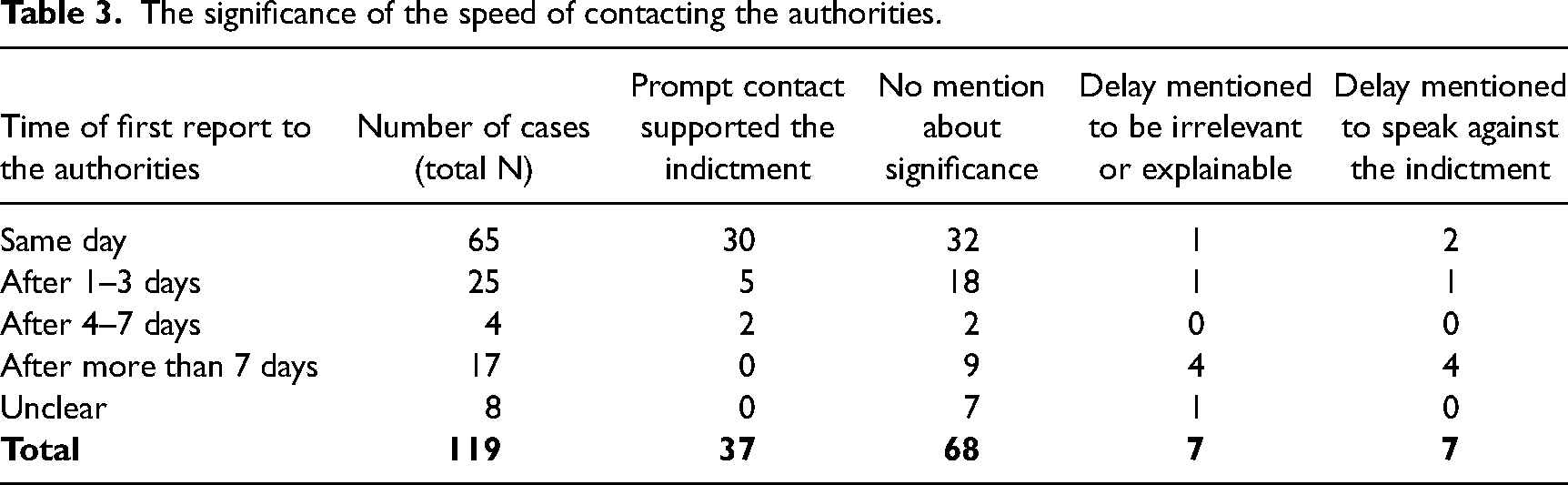
In the judgments where a delay was mentioned to speak against the indictment (total N = 7 or 6%), two different reasons were given (in one judgment, both reasons were mentioned). First, the delay could be considered inconsistent with having been raped, thus weakening the complainant's credibility (N = 5). In case 113, the delay that weakened the complainant's credibility was only one day. In the other cases, the delay ranged from about one week to several years. The second reason given for the significance of a delay was that this had hampered the collection of evidence (N = 3). In this context, the notion of a delay was shorter, as short as 12 h.
If the complainant had contacted the police or medical services, but had not told about the suspected rape on first contact or had left out important details about the events, this could be deemed either detrimental to the indictment (N = 6), 18 explainable (N = 2) or irrelevant (N = 1). The context that explained the omissions was long-term intimate partner violence in both judgments.
A witness had the possibility to observe the complainant and their state of mind immediately after or within about a day of the suspected rape in 101 cases (see Table 4). There was evidence of the complainant's visibly shocked or teary reaction in 72 judgments, and in 50 of these, this observation supported the indictment. 19 In five judgments, such an observation was stated to be irrelevant. This could be, for example, because a physical assault had occurred prior to the rape, and this could explain the complainant's reaction. However, sometimes the judges did not justify their reasoning. In 17 judgments the court ignored the shocked or teary reaction observed. In eight judgments, the description of the complainant's reaction was (in some way) ‘not shocked’ or even indifferent. The complainant being shocked or teary or being not shocked or indifferent were not mutually exclusive; in four cases both states of mind were observed at different times. In two judgments, the lack of shock was stated not to speak against the complainant's testimony. In both cases, the complainant had been shocked immediately after the suspected rape, but was not shocked or indifferent a short while later when being examined by a doctor. In 25 cases, there was no description of the complainant's reaction, even though a witness would have observed this. The complainant's state of mind, whatever it was, was therefore not considered relevant. It is reasonable to assume that in these cases the complainant did not react strongly, because this is likely to have been mentioned. The lack of a strong reaction was thus irrelevant in 25 judgments.
The significance of the complainant's state of mind after the suspected rape.
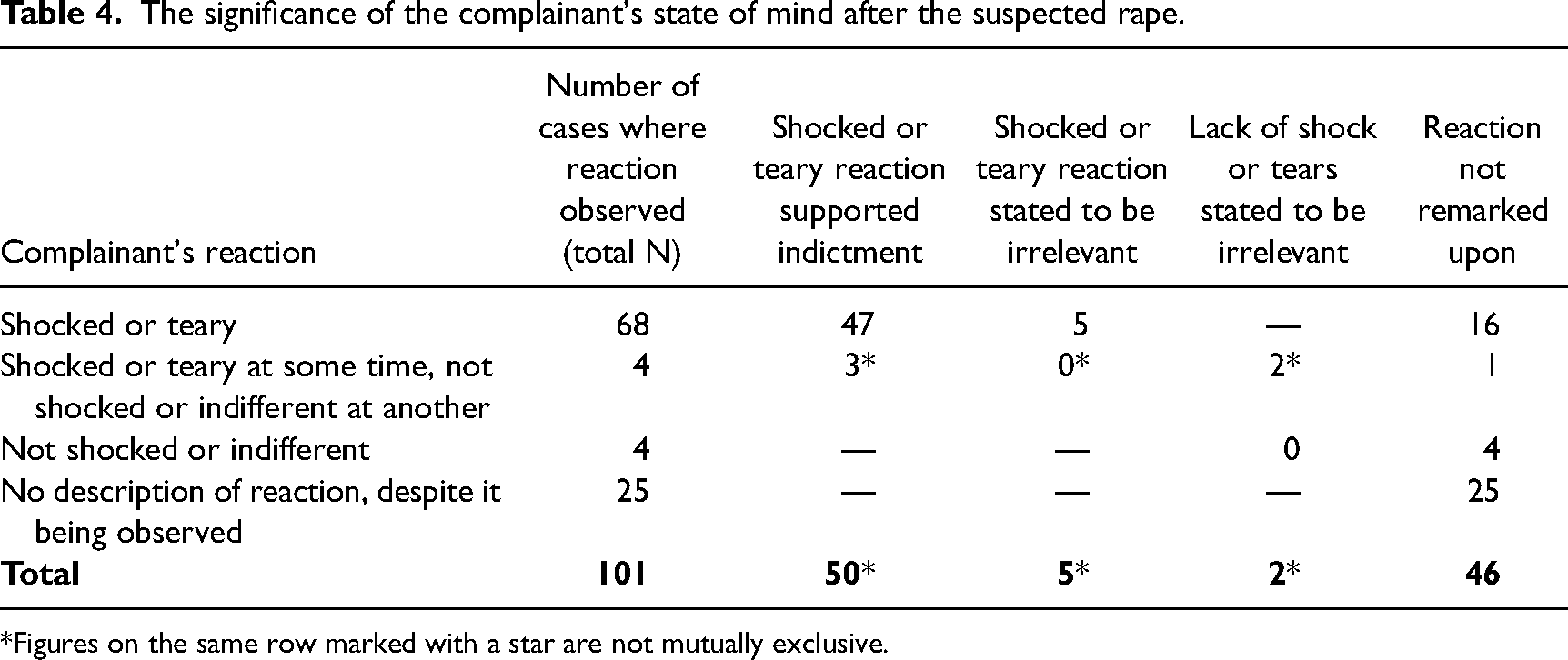
Figures on the same row marked with a star are not mutually exclusive.
The complainant asked a witness other than the authorities for help or told them about the events in 87 cases, and this was another important argument in support of the indictment (N = 50). 20 The witness could be a friend, neighbour or stranger met by chance, and the contact either face to face, by phone or by message. Usually this happened immediately after the event or within a couple of days, but some judges gave probative value to a delayed contact as well. Immediately asking a stranger for help gave stronger support to the indictment than merely contacting a friend for emotional support. The complainant did not necessarily use the word ‘rape’ or describe the events in detail. The delay in contacting the witness or the vagueness of what the complainant told them could be explainable due to trauma, the intimate nature of the issue or the witness's friendship with the defendant (N = 6). However, in 13 judgments, the judges considered the probative value of the contact with a witness to be weak or non-existent, because the complainant had not contacted the witness soon enough, had not told the witness any details about the events, had omitted important details like the occurrence of consensual sex before the suspected rape or had discussed the consequences of the suspected rape (such as injuries) without mentioning rape as the cause until much later.
Waking up half-undressed, or a witness seeing the complainant still half-naked or with their clothes, hair or jewellery in disarray also supported the indictment (N = 7). Leaving the apartment or other scene abruptly or contrary to previously made plans supported the indictment (N = 6), as did ceasing communication with the defendant (N = 2).
Other behaviour that was treated as either irrelevant or explainable (N = 16) or inconsistent (N = 14) included not asking for help from witnesses, not making an escape after the intercourse ended even though an opportunity arose, not asking the defendant to leave, staying at the scene with the defendant after the suspected rape (especially sleeping next to him), asking the defendant for money directly after the suspected rape, meeting or contacting the defendant again, especially if the contact was amicable or sexual, not telling a witness about the suspected rape despite having a natural opportunity to do so, going to a bar instead of contacting the police, the complainant and defendant discussing the possibility of retracting the police report and the complainant not wanting to demand punishment or compensation in the legal process or have the trial held behind closed doors or the judgment declared confidential. Sometimes the court did not specify what part of the complainant's behaviour it considered inconsistent. There was also no clear pattern for when the same behaviour was considered irrelevant or explainable, when inconsistent; the number of cases for each behaviour was very small. The explanations offered by the courts for inconsistent behaviour included the complainant's young age, mental disability or intoxication, pre-existing mental health issues and the trauma caused by the events.
Sometimes the court measured the complainant's behaviour against her own claims of what motivated her actions. These are arguments about internal coherence, although they also rely on an external measure of how motivation turns into action. In case 55, the complainant had not left the apartment, claiming fear of the defendant, even though the defendant had asked her to leave. The court concluded that under such circumstances staying in the apartment could not be considered a typical reaction for a person who was afraid, notwithstanding the complainant being intoxicated.
Disagreement on the significance of the complainant's behaviour
Of the 12 cases where the appeals or dissenting opinions are included in the dataset, all involved assessments of the complainant's behaviour. In 11 cases, the higher and the lower courts gave different significance to the complainant's behaviour. Sometimes this meant that one court considered the complainant's shocked or teary reaction, their state of dress, their actions to secure evidence, or a quick contact with the authorities to support the indictment, when the other court did not mention these at all. (Whether this should count as a disagreement is considered under ‘Discussion’.) In other cases, the courts explicitly disagreed with each other. Case 9–11: The complainant had called a health centre a few days after the event and wanted to talk about some mental health issues. She was given an appointment for the following week with a doctor who had treated her previously. Only at this appointment did she raise the issue of rape as a possible cause of her mental health issues. The majority of the District Court considered this contact with healthcare to support the indictment, and did not mention the delay in mentioning rape. The dissenting judge of the District Court stated that the ‘shortcomings’ in the complainant's actions after the event had hampered the gathering of evidence. The Appeals Court considered it understandable that she would want to talk about the rape only at the in-person appointment with the doctor she already knew. Nevertheless, the Court stated that this behaviour had decreased the doctor's possibilities for making observations about the suspected rape and thus to gather evidence, and therefore contacting the medical services did not strongly support the indictment. Case 87–88: The case involved long-term intimate partner violence and contained multiple counts of physical assault as well as rape. The complainant told the witness about the rape only once the relationship started unravelling, and had mentioned only physical violence to the doctor who examined her injuries. The District Court considered these omissions to undermine the complainant's testimony sufficiently to raise a reasonable doubt about the defendant's guilt in relation to rape. The Appeals Court considered the omissions understandable, considering the traumatic nature of the event and the problematic nature of the relationship, and stated that they did not reduce the credibility of her testimony. The complainant's testimony, supported by her delayed account to the witness and the physical injuries recorded by the doctor, formed sufficient evidence to the prove the rape. Case 117–118: The District Court considered the complainant's shocked reaction when telling the witness about rape to support the indictment. The complainant's indifferent demeanour and lack of shock when being examined by a doctor did not speak against the indictment. By contrast, the Appeals Court did not mention the witness's assessment of shock, and considered the complainant's indifference at the medical examination to support the defendants’ account of voluntary intercourse.
The defendant
The defendant's behaviour was also assessed in the District Court judgments, but this was rarer (N = 25). Such arguments were usually made in support of the indictment (N = 19). For example, behaviour supporting the indictment included the defendant's hasty retreat from the scene or unwillingness to wait for the police, attempting to avoid or resisting the police when they arrived, failing to care for an intoxicated complainant after the sexual intercourse, chasing after the escaping complainant, talking about the rape allegations with a witness but failing to mention that voluntary sex had occurred, failing to deny the rape allegations when confronted by the complainant (usually in a message), leaving out important details about the events when talking to a doctor and threatening the complainant if she spoke to the police. Conversely, the defendant's willingness to wait for the police or immediately denying the rape allegations when confronted by the complainant spoke against the indictment (N = 2). Some actions were considered irrelevant (N = 3), such as the defendant leaving money for emergency contraception. In case 60, the court stated that the fact that the defendant pressured the complainant to withdraw the police report was irrelevant, as he could have done so because he is innocent.
In case 51, the court qualified the probative value of attempting to avoid the police by saying that this behaviour supported the indictment but did not directly give rise to the conclusion that the defendant had committed a crime. Such qualifications were also sometimes attached to the defendant's verbal communications with the complainant or a witness. If the defendant apologised to the complainant or to the complainant's boyfriend or spouse, or admitted to ‘horrible’ behaviour (usually in a message), this usually supported the indictment (N = 6). 21 In two of these judgments, the court qualified this argument by saying that the defendant's words did not, however, prove that he had committed a crime. Sometimes, however, the court did not give any probative value to the defendant's apologies or admissions (N = 2). The court's careful attitude towards the defendant's communications could be because the defendant's wording was too unclear, or the apologies could have an alternative explanation, for example apologising for ‘bad sex’ or for making the complainant cheat on their regular partner. However, the content of the communications did not always explain the court's attitude. Sometimes a simple apology gained probative value, sometimes this was considered too ambiguous.
Disagreement on the significance of the defendant's behaviour
Of the 12 cases where appeals and dissenting opinions were examined, five involved assessing the defendant's actions. In three of them, the Appeals Court gave probative value to the defendant's actions when the District Court gave none, in one the District Court gave probative value to the defendant's actions when the Appeals Court gave none, and in one the courts explicitly disagreed with each other. In case 98–99, the District Court considered the defendant's message that the acts happened ‘a bit without permission’ to refer to the permission (consent) of the complainant, while the Appeals Court considered that this could also refer to the permission of the complainant's boyfriend, as claimed by the defendant.
Discussion
Five points can be made from the data. First, Finnish courts frequently assessed the significance of the parties’ behaviour, in particular the complainant's behaviour, in relation to background knowledge or beliefs, but—as one would expect—on its own coherence or incoherence with background knowledge or beliefs was insufficient proof either way. Some judges stated this outright, others expressed it through the choice of words; evidence ‘supported’ or ‘spoke against’ accepting a version of events, rather than ‘proving’ or ‘disproving’ it.
Second, the fact that the complainant's behaviour could support or speak against a version of events implies that there is an expected behaviour, as argued in rape myth research (Ellison and Munro, 2009a; Smith and Skinner, 2017). There seemed to be broad agreement on the probative value of some of these behaviours. For example, the complainant's shocked or teary reaction soon after the event supported the indictment in 50 out of the 72 District Court judgments (69%) where such a reaction was in evidence. Asking a witness other than the authorities for help or telling them about the events supported the indictment in 50 out of the 87 judgments (57%) where the complainant had done so. Where this behaviour did not gain probative value, this was often because the witness had also made independent observations about the complainant's reaction or the events, and this evidence was more important. Prompt but not necessarily immediate contact with the authorities supported the indictment in 37 out of the 94 judgments (39%) where the first contact was within one week. Although in most judgments (N = 52 or 55%) prompt contact was not given any probative value, this does not necessarily mean disagreement about the potential for such behaviour to have probative value. (The reasons why certain behaviours might gain probative value sometimes but not at other times is further discussed below.) The District Courts also relatively frequently referred to conditions and behaviours thought to be incoherent with voluntary intercourse (N = 31), like the intercourse happening outdoors, without any foreplay, with a stranger met on the street or with a person previously rejected.
The true test, however, is how courts interpret deviation from the expected behaviour. It is difficult to generalise the courts’ interpretations from the data, because the numbers are quite small and there is more variation in the significance given to deviation. For example, a delay in contacting the authorities after the suspected rape spoke against the indictment in seven District Court judgments, but was mentioned as irrelevant or explainable in another seven. In addition, in nine cases where the delay was more than one week, the District Court did not mention the delay at all in their reasoning. The understanding of what counted as a delay also varied; in general, a delay of up to a week did not count as a delay. However, when a delay did speak against the indictment (N = 5), and especially if it was mentioned to undermine the complainant's credibility, this logic displayed a faulty assumption that a rape victim contacts the authorities quickly. The impact of this rape myth (especially in relation to reporting to the police) has been researched among mock jurors. For example, in (Ellison and Munro, 2009c: 371), between 23 and 58 per cent of jurors, depending on the study condition, reported that it would have made a difference to their reasoning if the complainant had reported the rape to the police sooner. The delay in reporting was three days. In a study by (Chalmers et al., 2021: 243–244), a delay of only 40 min raised concern in 13 out of 32 juries, although this concern was challenged in 10 out of the 13 juries. Compared to these results—and this is the third point—outspoken reliance on this rape myth seemed rare among Finnish District Court judges, and the notion of a delay seemed much longer. Another myth that was in evidence in small numbers was the myth that a rape complainant always resists, shouts for help or escapes as soon as possible and does not want to contact the rapist again, at least not on amicable terms. (Also in one case, the Appeals Court relied on the myth that a calm or indifferent demeanour is a sign of an uncredible rape complainant.) However, these myths were explicitly resisted by the courts as often as they were relied upon. These results are in line with earlier research in Finland (Jokila, 2010) and research in Sweden (Wallin et al., 2021).
Nevertheless, there remained some reliance on these myths despite precedent KKO 2013:96, where the Supreme Court stated that no defensive acts or any particular victimised behaviour can be expected, and that long delays in reporting sexual crimes are not unusual. The qualitative methodology of this study also cannot reveal any hidden reliance on rape myths. In a later case, KKO 2022:50, the Supreme Court gave significance to a delay in contacting the authorities, when the complainant did not mention the rape to a doctor on first contact. The complainant's prior mental health issues also reduced the probative value of the evidence of psychological consequences. Analysing this precedent is beyond the scope of this article, but it is cause for concern. It is possible that reliance on at least some rape myths will increase in the future.
Thus, to draw together these first three points, many of the arguments used by judges can be understood through four scripts and whether the events cohered with or deviated from them: the script of voluntary intercourse, the script of the rational, self-preserving rape victim, the script of the traumatised rape victim and the script of the guilty rapist. The script of voluntary intercourse involves a progression of sexual activity from sexual attraction to flirtation to touching, undressing and finally sexual intercourse, where both parties are active and respect each other's wishes, and generally in a private space, although the presence of others is not necessarily contrary to the script. Stranger rape forms the most extreme form of deviation from this script (see also Jokila 2010: 225, 235). The script of the rational, self-preserving rape victim involves resistance during the act (shouting for help, making an escape), immediate action to bring the perpetrator to justice (immediately reporting to the police, visiting a doctor or contacting a friend) and an enduring hostile attitude towards the perpetrator (ceasing voluntary interactions). The victim's teary or shocked reaction can also be part of this script; although not ‘rational’ in the sense of unemotional, the reaction is nevertheless ‘to be expected’ or ‘natural’. The script of the traumatised victim is antithetical to the script of the rational, self-preserving victim: the former can explain deviation from the latter. The traumatised victim may avoid resisting during the act, delay contacting the police and initially seek to maintain a relationship with the perpetrator. They may also initially be calm, rather than upset. The script of the traumatised victim is generally invoked by stating that one cannot expect a rape victim to behave in specific victimised ways, or that the presence or absence of any specific behaviour is irrelevant for the evaluation or explainable. The script is thus written by reference and in opposition to the script of the rational, self-preserving victim, and is invoked only when there is deviation from the latter. The script of the guilty perpetrator includes admitting the culpability of the actions, displaying indifference or hostility towards the sexual partner and seeking to avoid the police.
In general, arguments benefitting the complainant relied on deviation from the script of voluntary intercourse or conformity with the other three scripts, and arguments benefitting the defendant relied on conformity with the script of voluntary intercourse or deviation from the other scripts. However, deviation from the script of the rational, self-preserving victim did not necessarily benefit the defendant if the complainant adhered to the script of the traumatised victim. This means that in general (that is, unless rape myths are relied on) the complainant's behaviour does not acquire a probative value that speaks against the indictment; both the rational, self-preserving behaviour and the traumatised behaviour could be described as expected behaviours. However, only conformity with rational, self-preserving behaviour could acquire independent probative value in support of the indictment.
The premise of explanationist theories that legal fact-finders reason by searching for explanations, and that this is the most relevant type of reasoning (Amaya, 2013: 13; Kolflaath, 2019: 123; Mackor et al., 2021: 447; Pardo and Allen, 2008: 225) also accords with this functioning of the scripts. They have inbuilt explanations: sexual attraction explains participation in sexual intercourse, self-preservation explains the resistance of the victim, 22 being raped explains a prompt contact with the emergency services, the police or a doctor, trauma explains a delay in reporting rape to the police, guilt explains attempts to avoid the police. The lack of an explanation can constitute incoherence. For example, in case 62–64, the Appeals Court looked for an explanation for the defendant to become violent towards the sex worker, could not see one related to the continuation of the sexual intercourse, and concluded that the violence must therefore have been consensual. The defendant becoming violent for the sake of violence was no explanation at all. In other cases, signs of violence showed the involuntariness of the intercourse; the defendant's violence was explained by the complainant's unwillingness and the defendant's desire for intercourse. Courts did not always feel the need to explain, however, as when they simply stated that the complainant's ‘inconsistent’ behaviour did not speak against the indictment.
Not all behaviour used for inferences falls naturally under a broader script. Judges relied on beliefs about sleep, assumptions about visual or auditory perception and other such knowledge rooted in general experience of the world. Some such beliefs were reasonable, such as if the complainant really shouted for help under the conditions described, someone should have heard this. Others, especially beliefs about sleep, appeared illogical.
Fourth, in addition to errors in premise, there could also be errors in logic. In case 6, the court considered it implausible that the complainant, who was sleeping at a stranger's place, would have woken up only after intercourse had started, but plausible that the complainant had dozed off during the intercourse, then woken up and thought that she was being raped. As the court provided no justification, it seems that the judges simply concluded that the complainant must have been sleeping lightly because she was sleeping at a stranger's place. This is simply not true. After a faulty premise, the court then applied it with an unfathomable logic. If something less than intercourse disturbs enough to wake a person, surely intercourse disturbs enough to prevent falling asleep?
The final point to be made from the data concerns variation in the inferences made from background beliefs. There was variation in the probative value gained by the parties’ behaviour, both between cases (between the District Court judgments) and within cases (between the District Court judgments and dissenting, Appeals Court and Supreme Court opinions). There could be several reasons for this variation, some of which are unproblematic. First, the events are rarely pure manifestations of a script or deviation from it. Therefore, background knowledge must be applied partially. For example, the complainant's flirtation beforehand might not reduce belief in the rape narrative (or only very little), because after the flirtation the events diverged from the script of voluntary intercourse—in this case, the deviation becomes more important than the conformity. Second, the influence of background knowledge can be mediated by the other evidence or the legal interpretation of rape. Judges might feel it unnecessary to refer to the probative value of certain behaviours, if there was firmer evidence either for or against the indictment, or the court might have concluded that the events did not fulfil the elements of rape in any case. Third, the details of the case could come into play, as when the complainant's behaviour appeared incoherent even with their own stated motivations, rather than only with a general expectation for behaviour. Finally, sometimes a script is rejected partially or altogether. When the courts made opposing inferences from the same fact-claims, the variation became problematic. In these cases, it seemed that the judges simply held different background beliefs; as in case 32–34, where some judges considered it implausible that a complainant did not wake up when allegedly raped, but others considered it completely plausible. Sometimes one court displayed a reliance on rape myths, while the other rejected these myths. This kind of variation threatens equal access to justice, especially for rape complainants, as their behaviour is closely scrutinised.
These findings also raise some broader questions. Why is the complainant's behaviour used as supporting evidence for the indictment, and can this be justified? The main conclusion from rape myth research is that attaching probative value to the complainant's behaviour is problematic when deviation from a certain type of behaviour is taken as a sign that rape did not happen. However, it does not necessarily follow that attaching probative value to a complainant's behaviour when they conform with a certain expectation is a sign of rape myth acceptance. This logic can also be explained by the requirement, expressed in precedent KKO 2013:96, that supporting evidence be provided, and the conforming complainant can then benefit from a logic that attaches independent probative value to their behaviour. A delay in contacting the authorities gains a different significance from this point of view (also apparent in the courts’ reasoning): the longer the delay, the more likely that some evidence, particularly DNA evidence, will decay, and the more likely that other evidence, such as evidence of physical injuries, could have formed after the fact. The reliability of oral testimonies also weakens over time, as the brain prioritises, re-analyses and supplements memories (see e.g., Loftus, 2005; Ost et al., 2002; Vrij et al., 2014). Consequently, the possibility of finding the kind of supporting evidence the Supreme Court required in precedent KKO 2013:96 diminishes. Under this logic, deviation from expected behaviour would naturally cause a lack of supporting evidence that would be available if the complainant had conformed to expected behaviour. This should not automatically undermine the complainant's credibility, but it would affect the conviction rate (for a critique of using the conviction rate as a measure of rape myth acceptance, see also Gurnham, 2016).
Criticising the requirement for supporting evidence is beyond the scope of this article; however, if the complainant's behaviour did not gain probative value in support of the indictment, proving rape would become even more difficult. Pressure would mount on the complainant's testimony to be internally unrealistically coherent, or for there to be the kind of physical or witness evidence that is often lacking.
From the point of view of explanationist theories of evidence, evaluating the complainant's behaviour is a question of (explanatory) coherence. For example, if the complainant were lying, reporting the incident quickly might be a risk: the physical evidence might prove the complainant's account wrong, and they might not be able to concoct an account that was coherent enough. Contacting the authorities quickly is thus more coherent with the complainant having been raped than with the complainant lying about being raped. The same does not hold for a delayed report: a delayed contact is more coherent with the complainant lying than a quick contact, but it is also coherent with the complainant having been raped. The complainant lying and the complainant being traumatised explain the delayed contact equally well. Therefore, the delayed contact should gain a neutral probative value.
According to Amaya's (2013) definition of coherence, prior probabilities, like the prevalence of lying complainants versus traumatised complainants, do not affect the explanation's strength. Coherence between individual items is a yes-or-no question, and incremental variation happens only in a web of items. This is not, however, how judges argue; some things seem to be ‘more coherent’ with one version than another. This is because few things are impossible. For example, is it plausible that a sex worker would ask the client to strangle her, as the Appeals Court concluded in case 62–64? Such a sexual preference is certainly possible. Thus, the evidence of strangulation could be coherent with voluntary sexual intercourse. The trickiness of arguing only with coherence is that most of the behaviours used for inferences by judges in rape cases are coherent with both guilt and innocence (at least innocence of rape). Is a fact or piece of evidence that coheres with both hypotheses irrelevant, or nevertheless supportive of one hypothesis? We might conclude that a sex worker asking a new client to strangle her seems rare, or as the Supreme Court put it, exceptional, and therefore evidence of strangling supports the sex worker's account rather than the client's. Although the Appeals Court might not be wrong, its reasoning may nevertheless be unjustified. The premise that a scenario is possible, that it can be reasonably explained, is not always sufficient for an inference about its occurrence.
The notion of a prior probability of a behaviour thus influences the judges’ reasoning, although these prior probabilities are usually either estimates or impressions—based on ‘general rules of experience’. The problem of unknown priors that plagues probabilistic approaches and that explanationist approaches seek to overcome therefore remains (see e.g., Wittlin, 2019). Under empirical uncertainty, judges resort to vague statements like ‘long delays in reporting sexual crimes to the police are not unusual’. The vaguer the statement, the more it resembles a belief, rather than knowledge. Actual empirical studies that provide useful knowledge of the appropriate reference class (on the problem of reference classes, see e.g., Pardo and Allen, 2008: 259) are often simply not available. Studies done in other reference classes (in other countries, for example) may improve the level of the belief, but do not automatically qualify it as ‘knowledge’.
Of course, one could say that the unusual behaviour, rather than being a problem of prior probabilities, is a problem of explanation (see Pardo and Allen, 2008: 258–261): unusual behaviour requires an explication of the causes (an explanation), and therefore it acquires a lower probative value, at least if such an explanation cannot be provided. However, accepting the explanation might also rely on a probability approach; is it likely that the sex worker in question had a sexual preference for strangling, considering how rare this is in the general population? (And do we know how rare it is in the general population?) This is the threat of endless regression: the need to explain the explanans. Background beliefs can end the regression, but many of these beliefs are probabilistic in nature.
Conclusion
Explanationist theories of evidence have provided an interesting lens for examining judicial reasoning from background knowledge in Finnish rape cases. In rape cases, (explanatory) coherence is sought directly between the narratives and background knowledge or beliefs by evaluating the parties’ behaviour. Many of the arguments used by courts could be understood as evaluations of coherence or incoherence with four scripts: the script of voluntary intercourse, the script of the rational, self-preserving rape victim, the script of the traumatised rape victim and the script of the guilty rapist. However, the variation in how and whether certain behaviours acquired probative value is a cause for concern. Sometimes judges reached diametrically opposing conclusions about the plausibility of the same narrative, suggesting that some judges hold background beliefs that are wrong, or at least make inferences from it that are unjustifiable. Reliance on faulty beliefs, like rape myths, to argue for the complainant's lack of credibility threatens rape victims’ access to justice. Outspoken reliance on rape myths was, however, relatively rare. Where judges used script-conforming behaviour to support the rape complainant's testimony, this should not be interpreted as an acceptance of rape myths, because this reasoning is also explained by the search for optimum (explanatory) coherence or the Finnish legal principle that a rape complainant's testimony requires supporting evidence. Rape myth research should therefore be sensitive to theories and principles of evidence and use them to interpret results as well as to provide critique—without forgetting a critique of the theories and principles themselves.
Although the search for explanations was apparent, the courts also relied on heuristic probabilistic reasoning. Few behaviours are impossible in a way that would make them totally incoherent with rape (or non-rape). Instead, some behaviours are ‘usual’, others ‘plausible’ and yet others ‘exceptional’. Thus, background knowledge or beliefs about behaviour usually operate to support or undermine a version of events in a probabilistic manner. The ‘probabilities’ applied are rarely based on exact or explicit empirical studies. This, and the variation in judges’ inferences from background knowledge, highlights the nature of background ‘knowledge’, or ‘general rules of experience’ as it is referred to in Finnish judicial practice, as beliefs about the world. Accruing the type of knowledge necessary (and usually unavailable) for probabilistic reasoning is therefore necessary also for explanationist reasoning, to ensure that background beliefs continually move towards ‘knowledge’, and do not remain simple ‘beliefs’.
Footnotes
Declaration of conflicting interests
The author first obtained and analysed parts of the data while employed at Amnesty International Finnish section (2018–2020). The analysis has been done afresh for the present study.
Funding
The author disclosed receipt of the following financial support for the research, authorship, and/or publication of this article: This work was supported by the Olga and Kaarle Oskari Laitinen Foundation, Suomalainen Konkordia-liitto, Finnish Lawyers’ Association, Emil Aaltosen Säätiö and the Library of the University of Helsinki.
