



Abstract
In Singapore, the common law doctrine of res gestae (‘RG’) risks becoming extinct given the statutory inclusions of hearsay evidence. Further, the test for RG is unsettled. This article thus argues that RG is still relevant but must be applied principally. It is relevant because first, it is unwise to uproot a doctrine existing since 1808. Second, comparative analysis of cases from United Kingdom, India, New Zealand and Australia evinces the residual need for RG. Third, a modified approach to applying it can in fact exclude inadmissible evidence. This article further proposes a three-strand test. First, as a preliminary requirement, objectively, there was no concoction involved. Second, the evidence must relate to a fact-forming part of the same transaction but was not contemplated in s. 32(1) of the Evidence Act. Third, the evidence must have sufficient probative value to outweigh its prejudicial effect.
In law especially, where until modern times conscious making of much that was new was quite unthinkable, nothing is made at once, as it were, out of whole cloth.
Roscoe Pound (1921)
Introduction
The first trace of res gestae (‘RG’) being applied in the law of evidence was in 1808, in America. 1 RG is Latin, denoting ‘things done’ in connection with words and/or actions that occur in close time and substance to each other such that they form part of the same transaction (Morgan, 1937: 93). Since 1808, the common law doctrine has evolved. Yet today, the state of RG and its application in common law is unsettled, with some calling to abolish it (Blair, 2013: 356). In Singapore, the state of the common law doctrine of RG—its relevance and application—is unclear for three reasons.
First, the amendments to s. 32(1) of the Evidence Act in 2012, intended to add flexibility to established statutory hearsay exceptions,
2
meant that the relevance of RG became less clear. While the application of RG is disjunctive to s. 32(1) exceptions, the courts may opt to admit evidence under these exceptions instead of under RG. With a wide variety of statutory gateways under s. 32(1), the possibility of RG being invoked is lower. Second, s. 6 is arguably the statutory equivalent of RG, where facts of the same transaction are deemed admissible.
3
This further impedes development of the common law doctrine of RG. Third, valid academic criticisms of the application of RG in case law, without subsequent cases addressing the same, have muddled the lines further. Therefore, this article, inter alia, examines:
through historical analysis, the doctrinal roots of RG; modern-day application of RG in Singapore; the bases for and against retaining RG as a residual test by drawing on cases from jurisdictions including Singapore, United Kingdom, India, America, New Zealand and Australia; a proposed common law test to weed out uncertainty; and potential criticisms of the proposed common law test, before addressing them.
Each aspect will be examined seriatim in each of this article's five parts.
Historical development of RG
Edmund Morgan, then Dean of Harvard Law School in 1937, started his article on RG by observing that ‘a multitude of cases creates chaos in this subject’. 4
Looking further back, in 1891, Albert Sullard Barnes, in examining the origins of RG, commented in his introduction that while the fundamental basis of RG as a principle in Evidence Law is ‘uniformly agreed’ upon, its application is ‘so varied’, judgments ‘so conflicting’, that any attempt at synthesis seems ‘hopeless’ (Barnes, 1891: 1).
Evidently, synthesising both sources, it is clear that the basis for RG was never in issue, but its application was, and still is now. It is through this lens that we explore the early application of RG, for the purpose of demonstrating that it is the application of RG that has always been the issue, not its doctrinal underpinnings.
Application of RG in the 18th to 20th century
The first time the term RG was discovered was in an English trial for treason in 1794. 5 The term was used in a legal discussion by the counsel representing the English government. It was used in relation to the admissibility of a letter which the defence claimed stated reasons for declining certain propositions why certain proposals made by one society was not accepted by the other. 6 Indeed, in the 18th century, in America, RG was invoked to admit evidence that pertained to facts relating to the same transaction. As a preliminary point, Barnes observes that the lawyers did not stop to analyse closely how RG was applied (Barnes, 1891: 5). It is thus ironic that an observation made in 1891 is still apposite today—that the application of RG is not receiving the judicial scrutiny and attention it deserves.
In Scotland, in the 19th century, Gray v Maitland applied RG. 7 The Court of Session (Outer House) held that the res gestae pertained to one occurrence and not two issues which was pleaded. 8 Evidently, the application of RG as one entire transaction of events was not difficult when it related to what RG entails. However, the complexity, drilled down, is really how broadly scoped ‘one transaction’ of events should be. This is arguably what causes confusion because different cases throw up different factual scenarios, and this was so even in the 18th and 19th century, where whether evidence is deemed admissible and falling within the remit of ‘one transaction’ can be a subjective view with no one universal answer. 9
Indeed, Professor James Thayer illuminates that the term res gestae, which first caught on in 1794, could also mean a business, (Thayer, 1881: 10) and this term was ‘a little vague’ because people ‘could not, in the stress of business, stop to analyse minutely’ (Thayer, 1881: 10). In fact, even Stephen, the author of the Digest of Evidence, which the Indian Evidence Act and subsequently the Singapore Evidence Act based the statutes on, observed that the phrase ‘res gestae’ seems to have ‘come into use on account of its convenient obscurity’. 10
Thus, it is evident that historical cases can be categorised in two groups. The first is when the question of whether it is one transaction is obvious. The latter is where it is not immediately clear whether the evidence falls into ‘one transaction’. We deal first with examples of the former.
Where whether the evidence forms part of the transaction is clear and obvious. For example, in Binnie v Black, 11 a personal injury case where one David Binnie, a motorcycle agent, sued one William Black and his daughter for injuries sustained by him in a vehicular accident. RG was raised in relation to one cross-examination question directed at Michael Gordon Black, who was in the defendants’ vehicle sitting beside the second defendant. The question was whether Michael, in his conversation with David Binnie's father the day after the accident, said that if he had been driving the car, no accident would have occurred. The Defendants objected to this question on the ground that it was not part of the res gestae. 12 Yet this objection was repelled by the Commissioner without any justification. 13 This finding was overturned by Lord Morrison, who agreed that the interviews between Michael Gordon Black and the father of David Binnie were not part of the res gestae of the collision and were evidence only of conversations, and in particular these conversations were not evidence proving that the brakes of the car were defective. 14 Here it is clear that conversations with Michael Black were obviously not part of the collision, or the defects in the brakes, which the claim for damages was premised on.
Where it is not immediately clear whether evidence falls within ‘one transaction’. This category of cases goes to the scope of RG and what it entails. Professor James B. Thayer in defining the obscure ‘one transaction’ term gave seven categories of such evidence (Thayer, 1881: 10–11):
Evidence pertaining to the ultimate facts of the case or to a fact in issue; Evidence of a single, fact, event or transaction which a declaration may be partially res gestae or contain details which constitute one transaction; Evidence of several distinct facts, events, transactions, constituting a larger whole; Evidence of one composite whole version of the events; Evidence of surrounding circumstances; Evidence of a total whole ‘embodying the central fact with its entire bulk of circumstances’; and Evidence of a central fact and some of its surroundings, those which are relevant or material to the given inquiry. Who the assailant was—proof of the assailant's identity; The surrounding circumstances; The assault actually happening; and/or Intention to assault.
It is through this lens that we discuss the case of R v Bedingfield. In R v Bedingfield,
15
the victim's reference to the accused who had cut her throat was deemed inadmissible. This was because that reference was not in Cockburn CJ's view, part of anything done, or something said while something was being done, but something said after something done. The tenor of such reasoning was consistent with R v Gibson,
16
which held that words spoken by an onlooker after an assault did not constitute RG. Respectfully, the reasoning of both decisions were suspect because for Bedingfield, the reference to the accused could arguably form the same transaction because the reference could have shed light on:
The same could have been said about Gibson. Yet, this illustrates that the application of RG is problematic and, even more, accentuates the need for a holistic, universal test to avoid applying RG too broadly to include evidence which should have been excluded, or narrowly, to exclude evidence which should have been included. Fortunately, in Ratten,
17
Lord Reid formulated the common law test of concoction for RG. If there was no possibility of concoction or fabrication, then the evidence should be admissible under RG.
18
Indubitably, this was a welcome shift in the law from Bedingfield,
19
which was confirmed in R v Andrews,
20
per Lord Ackner, with whom the House agreed. In Andrews, the House of Lords refined the concoction test further, with the salient passage set out verbatim:
21
The primary question which the judge must ask himself is—can the possibility of concoction or distortion be disregarded?
To answer that question the judge must first consider the circumstances in which the particular statement was made, in order to satisfy himself that the event was so unusual or startling or dramatic as to dominate the thoughts of the victim, so that his utterance was an instinctive reaction to that event, thus giving no real opportunity for reasoned reflection. In such a situation the judge would be entitled to conclude that the involvement or the pressure of the event would exclude the possibility of concoction or distortion, providing that the statement was made in conditions of approximate but not exact contemporaneity.. In order for the statement to be sufficiently ‘spontaneous’ it must be so closely associated with the event which has excited the statement, that it can be fairly stated that the mind of the declarant was still dominated by the event.
Thus, the focus shifted from a narrow application of the same transaction approach to one which excludes evidence only if there was reason to believe it was concocted. In this connection, it is submitted that R v Andrews had threefold significance.
First, it revamped the law doctrinally—the concoction test was now applied universally in deciding if evidence was admitted via RG. Second, it allowed more evidence that would have been precluded by the narrow Bedingfield approach to be admitted. Accordingly, a third significance would be that the judge would have greater access to legally relevant evidence to adjudicate the proceedings, to form a more robust view (Figure 1).
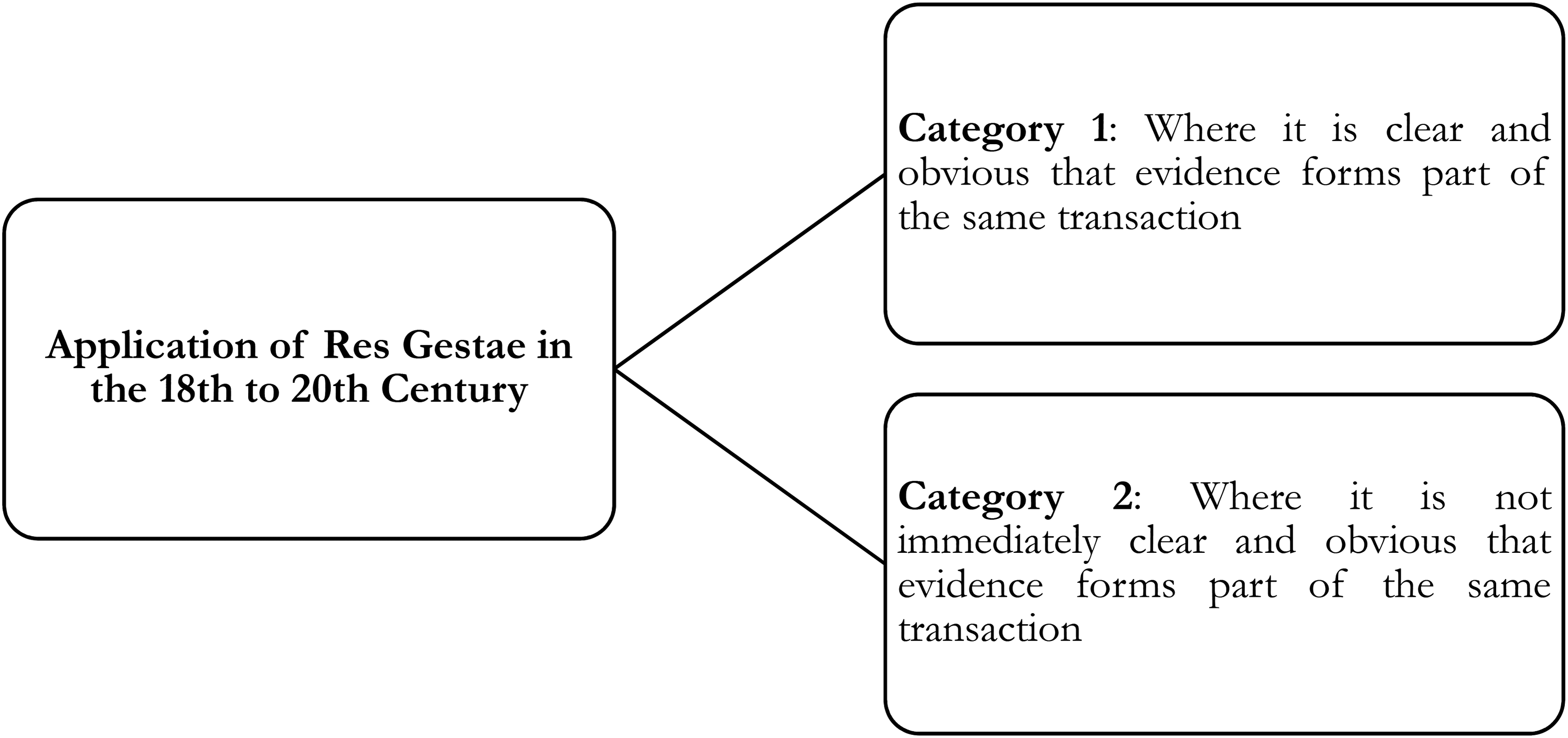
Classification of cases applying RG in the 18th and 19th century.
From Figure 1, the concoction test when applied, would not run into the difficulty of Category 2 type cases. This is because once there was no possibility of concoction, the evidence became admissible under RG. However, one drawback with the concoction test is that it may gloss over the analysis of whether the evidence actually forms part of the same transaction. For example, if legally irrelevant evidence is tendered but there was no concoction, it may still be admitted under RG by virtue of passing the common law requirement. There may not be real engagement with whether the evidence tendered forms part of the same transaction as the crime or event that occurred. Although it may be argued that legal relevance of admitted evidence is a preliminary consideration, before RG is invoked, the reality is that once evidence is hearsay, the test in RG is applied. For example, in Walton, 22 ‘Hello daddy’ was considered by the majority to be hearsay but it was admitted because the possibility of fabrication was low.
Modern-day application of RG in Singapore
This section will primarily be focused on the modern-day application of RG in the context of Singapore courts. In applying RG, the first port of call is s. 6 of the Evidence Act, 23 which stipulates one category of admissible evidence pertaining to relevant facts which, though not in issue, form ‘part of the same transaction’. 24 This is regardless of whether they occurred at the same time and place or at different times and places. 25 On its face, it is arguable that s. 6 embodies RG. Indeed, it may be further inferred that any facts forming part of the same transaction arguably includes Professor Thayler's seven categories. This is because first the Evidence Act itself is an inclusionary evidential scheme. Second, if s. 6 did not contemplate a broad scope, the statute itself would have defined what constitutes facts which form ‘part of the same transaction’. As a corollary, the illustrations to s. 6 are broad too. Illustration (b) allows for evidence of an accused waging war against the Government even though said accused may not have been present at all events potentially incriminating him. 26 Illustration (c) seems to mirror the factual scenario stated above in the Howells State Trial in 1794—letters between the parties relating to libel, even if they do not contain the libel itself, are relevant facts, and thus admissible. 27 Section 32(1) is also relevant—usually courts admit evidence through the 11 statutory gateways here, 28 before looking at whether it is admissible via RG. RG and the hearsay exceptions in s. 32(1) are disjunctive.
The common law doctrine of RG is also applied in Singapore. It must be noted that the broad doctrine has been applied in common law. The purpose of the common law RG doctrine is ‘to allow the admission of evidence of what persons who were not called as witnesses said in reaction to an event or thing as it presented itself to them in circumstances which excluded the opportunity of reasoned reflection and possibility of concoction and distortion’. 29 In Court of Appeal decision, Chi Tin Hui v PP, 30 the Court of Appeal held that oral statements of an accused to a CNB officer in response to questions immediately after his arrest can form part of the same transaction.
However, Professor Pinsler critiques that first, it is a controversial holding if viewed in the strict context of S6 EA (Pinsler, 2017: para. 6.086) since the transportation of drugs ended as soon as the accused was arrested and handcuffed. Second, it is not entirely clear that the common law test of no concoction was satisfied here as there was no absolute guarantee against falsehood or embellishment of evidence in the interest of securing conviction notwithstanding the police's repute (Pinsler, 2002: para. 28). Unfortunately, recent Court of Appeal authority did not pronounce definitively on both the relevance of the common law RG and its application. In Micheal Anak Garing, 31 the Court of Appeal admitted evidence regarding the three earlier attacks because not doing so resulted in a truncated version of events and the attacks happened within a short time span. 32 Arguably the other three attacks in the Court of Appeal's view formed part of the same transaction—to say removing them would result in a truncated version of events is essentially saying all four attacks formed part of the same transaction. However, the Court of Appeal in Micheal Anak Garing did not mention or apply the common law test for RG set out in Ratten, or its application in Chi Tin Hui v PP. This means the common law doctrine of RG set out in Ratten is still good law since it has not been explicitly overruled. In this connection, it would have been opportune for the Court of Appeal to be clearer about how RG should be applied and whether it was applied correctly in Chi Tin Hui v PP. This was after all a case which directly invoked the common law doctrine of RG. If the Court of Appeal meant to admit the evidence under S6, it should also have said so. This leaves the law concerning RG in its modern-day application unsettled on three fronts.
First, does the common law doctrine of RG exist pari passu to s. 6 of the Evidence Act? Second, assuming the common law doctrine of RG exists, what is the applicable test and how should it be applied—was it applied correctly in Chi Tin Hui? In this connection, the difficulties in applying RG as a common law doctrine have remained the same since the 18th and 19th century insofar as cases concern where it is not immediately clear whether evidence admitted forms part of the same transaction. Specifically, the application of RG in Chi Tin Hui which has been validly critiqued by Professor Pinsler but not addressed in Micheal Anak Garing symbolises the same ‘multitude of cases’ which ‘creates chaos’, as Dean Edmund Morgan observed. Third, assuming both statutory and common law option exist, how and on what basis will the Singapore courts navigate between the two?
Taking a step back, from a practical perspective, it is submitted that the primary reason why RG and the common law doctrine of RG is so underdeveloped, is because usually courts do not have to venture beyond hearsay exceptions established in the 11 gateways which cover a comprehensive scope of factual scenarios and evidence which are usually admitted. 33
Nevertheless, certainty in the law is needed where the common law doctrine of RG is concerned. In this connection, it may be argued that to allow certainty, s. 6 of the Evidence Act can replace the common law doctrine of RG. 34 This prevents having both a statutory option and a common law option, which potentially causes uncertainty in the law.
This segues into our discussion of whether RG should be retained as a common law doctrine.
Reasons why the common law doctrine of RG should continue to be applied
As a preliminary point, while s. 6 on its face seems to embody the common law doctrine of RG, they are in fact conceptually distinct. Professor Pinsler adroitly notes that the former relates to a transaction without the element of ‘spontaneity’, unlike the latter (Pinsler, 2002: para. 29). Further, s. 6 treats RG as original evidence which can be admitted once it falls within the category stipulated therein without the need to consider exclusionary rules, such as hearsay (Pinsler, 2002). This is underlined by the fact that s. 6 is placed in the early sections of the Evidence Act governing original evidence, not with s. 32(1), which governs statutory hearsay exceptions (Pinsler, 2002).
Indeed, Professor Pinsler perspicaciously observed that the Singapore courts have ‘yet to analyse and acknowledge the different conceptual bases for res gestae in the Act and at common law’ (Pinsler, 2002). In this connection, as alluded to by Professor Pinsler, the common law doctrine of RG should be retained because it affords scope for exclusion and is conceptually distinct from how s. 6 operates.
If s. 6 is the sole gateway for admitting evidence through RG, then there is considerable risk that once evidence falls within the literal description of s. 6, it becomes ipso facto admissible as original evidence, without any further exclusionary considerations (Pinsler, 2002). Thus, in my view, instead of construing s. 6 and RG equivocally with regard to admissibility of evidence, they should be construed as two different prongs to the same fork—both stab at whether that particular hearsay evidence should be admitted.
This article further sets out below, three reasons why the common law doctrine of RG should be retained:
It is unwise to categorically banish a useful common law doctrine that has existed since 1808, simply because of uncertainty in application (the ‘categorically unwise’ reason); As a corollary, to simply banish the RG doctrine would be to take the easy way out of the chaos. The solution should be to clarify what the common law test is and tweak it accordingly to ensure certainty in application (the ‘proper solution’ reason); and There is empirical proof of the continued relevance of the common law doctrine of RG in the jurisdictions of United Kingdom, Australia, New Zealand, Hong Kong and India (the ‘empirical proof’ reason).
The categorically unwise reason
In this section, we consider the nub of the counterarguments militating against retaining a common law doctrine of RG. Given that RG has been in existence since 1808, arguments will be derived from sources past and present. Professor Chris Blair mounts a three-pronged attack on the common law doctrine of RG. First, he argues that the doctrine is ‘useless’ because the concepts embodied by RG can be explained with reference to other more refined principles of evidence law. 35 Second, it is harmful because it confuses evidentiary principles and deters principled analysis of evidence law. 36 Third, the concept of RG has ‘evolved’ into established statutory hearsay exceptions. 37 We address each counter-argument seriatim.
Regarding the concept of RG being ‘useless’ because it can be explained by other evidential principles, this argument is flawed. Just because RG can be explained in relation to other evidential principles does not mean it is inherently without merit. For instance, the doctrine of RG will indubitably implicate the Court's general discretion to admit evidence. In Singapore, the Court generally has an inherent discretion to exclude otherwise admissible evidence, 38 which includes evidence which would otherwise be admissible by virtue of RG. 39 However, this does not necessarily mean RG is inherently ‘useless’. In fact, it will truly be ‘useless’ to simply banish the doctrine of RG without appreciating its merits. In this connection, the doctrine of RG should, in my view, be seen as part of the jigsaw of evidential principles, which when pieced together with other pieces, form a conjoined, complete jigsaw puzzle.
Regarding the ‘harmful’ argument, it has two sub-prongs—(a) it confuses evidentiary principles and (b) it deters principled analysis of evidence law.
For the first prong, it is not clear exactly how it confuses principles. On its own, the doctrine of RG is clear—evidence pertaining to facts forming part of the same transaction, should be admissible (if there is no concoction). In fact, as established above, what is unclear is its application in cases where it is not immediately clear and obvious that evidence constitutes RG. This has been the trend since the application of RG in the 18th century. Thus, to say it confuses principles, conflates principal foundations with the application of RG. In any event, the confused application of RG does not also mean that it is absolutely ‘harmful’. This is because at the crux of this confusion, is the lack of a rigorous universal test which holds courts accountable to spelling out exactly why the evidence constitutes RG. It is submitted this can be remedied by the test set out in this article below.
Regarding the evolution of RG being incorporated into established statutory options, this argument is possibly the most logical of the three. This, on its face, makes for logical fodder, because having both a common law and statutory equivalent of RG may be confusing.
However, as elaborated above, in the context of Singapore, the conceptual roots in s. 6 of the Evidence Act and the common law doctrine of RG are distinct. In this connection, it is submitted that having a clearly defined test for RG can be beneficial.
Section 6 relates to the preliminary consideration in the admissibility inquiry—whether evidence forms part of the same transaction that renders it legally relevant to be admitted as original evidence. As it is only a prima facie consideration, there are no further exclusionary considerations. Whereas for RG, if the adopted test of having no possibility of concoction is applied, this test functions as an exclusionary consideration that further strengthens the evidential regime in admitting evidence through RG. This means s. 6 and RG can potentially become separate questions in the same inquiry, threaded through the evidence in deciding its admissibility. This inquiry, contextualised in the context of the admissibility of evidence via RG, is set out in Figure 2. 40
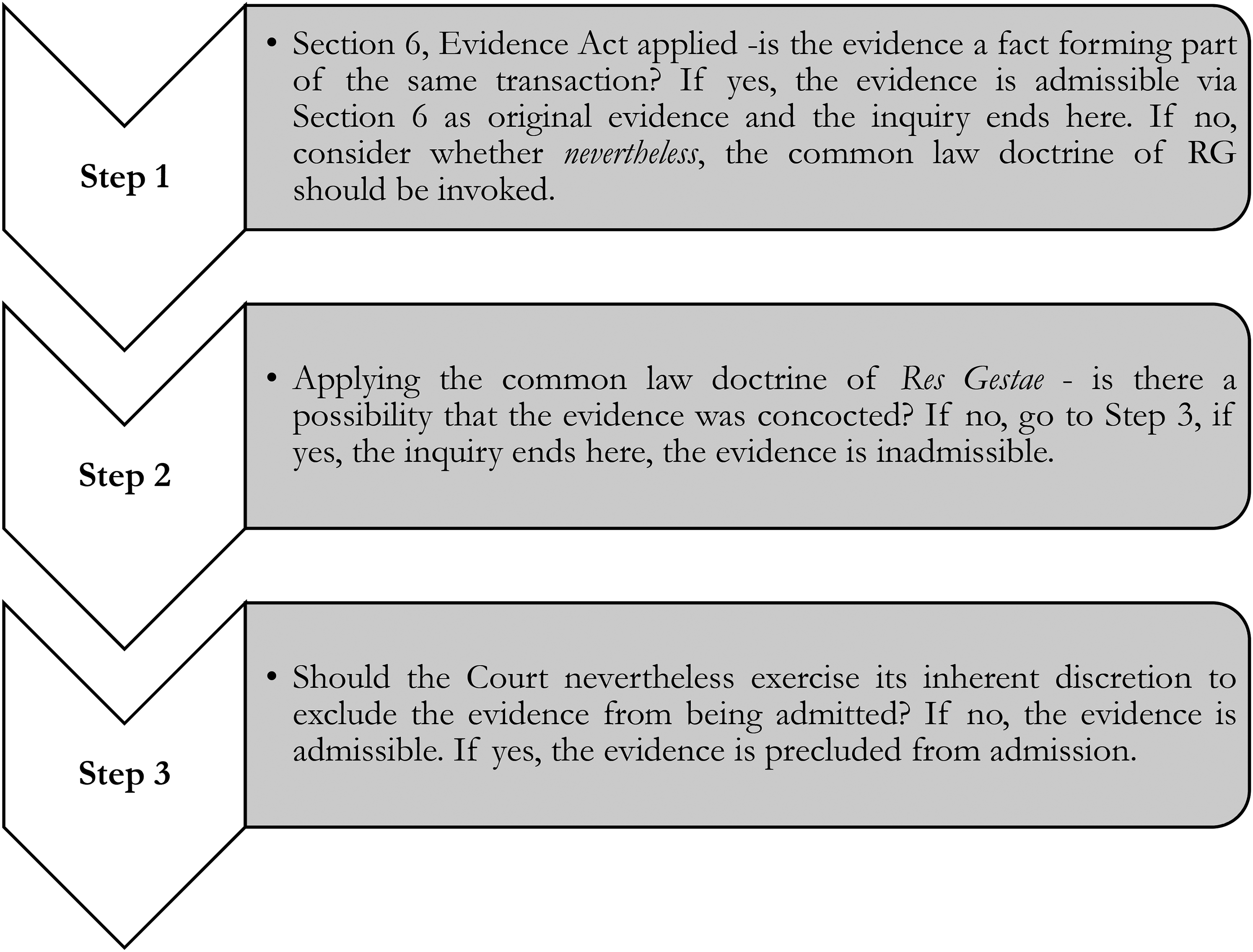
The admissibility process of evidence admitted via s. 6 of the Evidence Act and RG.
In this light, the doctrine of RG has not evolved, but our application of RG has. That is what should be acknowledged, not the banishment of RG as a common law doctrine. In fact, the use of RG in this inquiry, streamlines the use of evidence admitted via s. 6 and safeguards against concocted evidence. This kills three birds with one stone—s. 6 is applied, the risk of concocted evidence is prevented and the use of RG as a common law doctrine is regulated. In this connection, the common law doctrine of RG is neither ‘harmful’ nor ‘useless’ once one gets around to utilising RG by tweaking it, instead of simply throwing the baby out of the bathwater.
The proper solution reason
Thus, as alluded to above, the proper solution is fixing the application of RG is by formulating a rigorous and universal test If the solutions to all existing lacunae in the law are to banish age-old common law doctrines, important cornerstones of legal history and their intended purposes and doctrinal roots would vanish indefinitely. Further, one criticism levelled against the use of RG has been ‘an inclination of judges and lawyers to avoid the toilsome exertion of exact analysis and precise thinking’ (Morgan, 1922: 229). Is this really the case? Ironically, the same inclination to avoid ‘precise thinking’ and ‘exact analysis’ is one which argues for the banishment of a common law doctrine without analysing and solving the crux of the issue, and simply concluding that it has been subsumed in statutes. Indeed, this flies against the spirit of the common law which instead of causing uncertainty, is meant to engender form and consistency when applied cautiously. In this connection, Dean Roscoe Pound’s wizened words regarding the spirit of the common law, of which RG is an integral part of, ring true and should be appreciated verbatim, set out as follows (Pound, 1921: 1 and 212): Although it is essentially a mode of judicial and juristic thinking…it succeeds everywhere in molding rules, whatever their origin, into accord with its principles and in maintaining those principles in the face of formidable attempts to overthrow or to supersede them. In the United States it survives the huge mass of legislation that is placed annually upon our statute books and gives to it form and consistency… In the past century we studied law from within. The jurists of today are studying it from without. The past century sought to develop completely and harmoniously the fundamental principles which jurists discovered by metaphysics or by history. The jurists of today seek to enable and to compel lawmaking and also the interpretation and application of legal rules, to take more account and more intelligent account, of the social facts upon which law must proceed and to which it is to be applied.
Thus, it is opportune to hark back and study RG from ‘within’ again, and not ‘without’ its history, simply fitting all common law doctrines into statutes. On this note, we analyse how RG remains relevant for many jurisdictions.
The empirical proof reason
This reason relates to the continued application of the common law doctrine, RG in the jurisdictions of United Kingdom, Australia, New Zealand, Hong Kong and India, which demonstrate its relevance. The section below sets out:
The law in that particular jurisdiction on RG; A breakdown of the number of cases invoking or considering RG as a common law doctrine in that jurisdiction for the last 21 years (2000 to 2020);
41
A breakdown of the number of cases successfully admitting evidence through RG as a common law doctrine;
42
A breakdown of the number of cases unsuccessfully admitting evidence through RG as a common law doctrine;
43
and A summary of the breakdown of the number of cases for (b), (c) and (d) for all of the above-mentioned jurisdictions for the last 21 years (2000–2020)
44
.
The empirical study has been scoped from the year 2000 to 2020 because the purpose of the study is to illustrate the current relevance of RG as a common law doctrine. Thus, any number of years too small will be insignificant and too wide a study would risk unreliability.
Comparative analysis is important because the doctrine of RG cannot be analysed in isolation. The above common law jurisdictions are also often referred to by the Singapore courts in appellate judgments or judgments implicating novel issues of law.
United Kingdom. In the United Kingdom, the common law doctrine of RG is expressly codified in s. 118(4) of the Criminal Justice Act 2003, which states that a statement is admissible as evidence if:
45
the statement was made by a person so emotionally overpowered by an event that the possibility of concoction or distortion can be disregarded; the statement accompanied an act which can be properly evaluated as evidence only if considered in conjunction with the statement; or the statement relates to a physical sensation or a mental state (such as intention or emotion).
The same position applies in Northern Ireland. Article 22(4) of the Criminal Justice Order 2004 preserves common law rules, including the common law doctrine of RG, with the same three disjunctive requirements set out above.
46
In England, s. 78(1) of the Police and Criminal Evidence Act 1984 nevertheless allows the court to exclude evidence if it ‘appears to the court that, having regard to all the circumstances, including the circumstances in which the evidence was obtained, the admission of the evidence would have such an adverse effect on the fairness of the proceedings that the court ought not to admit it.’
47
This essentially preserves the common law doctrine of RG within the statute, which is different from the position in Singapore. Most evidently, even the test of concoction has been subsumed. Indeed, in recent Court of Appeal case R v Nico Brown, 48 in discussing s. 118(4), reference is still made to cases pre-dating the statute and which applied the common law doctrine of RG (Laird, 2020: 4). Thus, a consideration of applying s. 118(4) of the Criminal Justice Act would necessarily be equivalent to applying the common law doctrine of RG.
In Scotland, RG remains as a common law doctrine. It is defined as evidence relating to the whole event that happened—things said or done at the time by those concerned are part of RG. Accounts of those at any time after the event happened is only an account and do not constitute RG. 49
Twenty-three cases in total invoked or considered the use of the common law doctrine of RG from 2000 to 2021. The breakdown is as follows:
In the United Kingdom Supreme Court, there were no cases which considered or invoked res gestae between 2000 to 2020. In the Court of Appeal (England and Wales), 11 cases considered or invoked res gestae between 2000 to 2020.
50
In the Court of Appeal (Northern Ireland), 2 cases considered or invoked res gestae between 2000 to 2020.
51
In the English High Court, 5 cases considered or invoked res gestae between 2000 to 2020.
52
In the Scottish High Court of Justiciary (Appeal), 4 cases considered or invoked res gestae between 2000 to 2020.
53
In the Northern Ireland High Court, 1 case considered or invoked res gestae between 2000 to 2020.
54
In the Court of Appeal (England and Wales), 7 cases succeeded in admitting evidence through res gestae.
55
No case failed to admit evidence through res gestae.
56
In the Court of Appeal (Northern Ireland), 2 cases succeeded in admitting evidence through res gestae.
57
No case failed to admit evidence through res gestae. In the English High Court, 3 cases succeeded in admitting evidence through res gestae.
58
No case failed to admit evidence through res gestae. In the Scottish High Court of Justiciary (Appeal), 2 cases succeeded in admitting evidence through res gestae.
59
No case failed to admit evidence through res gestae. In the Northern Ireland High Court, 1 case succeeded to admit evidence through res gestae.
60
No case failed to admit evidence through res gestae.
The breakdown for the number of cases which successfully or failed to admit evidence through RG is as follows:
Evidently, in the United Kingdom, the common law doctrine of RG is still very much alive because it has been imported wholesale into statutes, except for Scotland. Even so, in Scotland, the fact that the common law doctrine has still been invoked or considered 4 times in the last 21 years speaks for itself. The approach of England and Wales and Northern Ireland to subsume the common law doctrine wholesale into their statutes may, however, not be entirely wise. This means judicial discretion is entirely limited to the statutes. Yet the spirit of the common law transcends mere words. While doing so conduces for certainty, it comes at the expense of principled expansion where the facts of the case require warrant as such.
Nevertheless, s. 118(4) of the Criminal Justice Act 2003 is merely a label, in considering whether the evidence formed part of the RG, English courts have the tendency to consult the common law cases predating the statute. For example, in R v Nico Brown,
61
the Court of Appeal in applying the res gestae rule harked back to R v Andrews and considered Lord Ackner's approach, set out verbatim: when faced with an application to admit a statement under the res gestae doctrine, the primary question which the judge must ask is whether the possibility of concoction or distortion can be disregarded. To answer that question, the judge must consider the circumstances in which the statement was made and whether ‘the event was so unusual or startling or dramatic as to dominate the thoughts’ of the person who made it; whether the statement was sufficiently close to the event in time that ‘it can fairly be stated that the mind of the [maker] was still dominated by the event’; and whether the person who made the statement had any motive to fabricate or concoct. On the other hand, the possibility of error in the facts stated, if ‘only the ordinary fallibility of human recollection is relied upon’ and there are no special features that give rise to such a possibility, is a matter that goes to the weight to be attached to the statement and not to its admissibility, and ‘is therefore a matter for the jury’.
Similarly, in R v Muna (Ngethe), 62 the Court of Appeal considered the seminal case of R v Andrews in coming to its decision. In this connection, the common law doctrine of RG does not just live but it is alive and kicking hard in the statutes of England, Wales and Northern Ireland.
Australia. In Australia, while s. 65(2)(b) of the Evidence Act 1995 is construed as the statutory codification of RG,
63
the common law doctrine of RG is still relevant. In HML v The Queen, the High Court of Australia, the highest Court of Australia, recognised that upon closer examination, some cases do admit evidence through the common law doctrine of RG.
64
In this connection, that the common law doctrine of RG exists and is distinct from its statutory equivalent was clearly stated in Conway v The Queen,
65
set out as follows: The primary objective which underlies the requirement in s 65(2)(b) of the Act that the representation be made ‘when’ or ‘shortly after’ the asserted fact occurred seems to be to ensure that the matters conveyed are either strictly contemporaneous or, if narrative of a past event, still fresh in the mind of the person recounting that narrative. The expression ‘shortly after’ makes it clear that there need not be anything like the strict contemporaneity required at common law to render the evidence admissible as res gestae.
Indeed, 21 cases in total invoked or considered the use of the common law doctrine of RG from 2000 to 2021. The High Court of Australia, Federal Court of Australia (Full Court) and the Federal Court of Australia were surveyed. The breakdown for the number of cases invoking RG across the different courts surveyed is as follows:
In the High Court of Australia, the highest court of the land, 8 cases invoked or considered the use of common law RG from 2000 to 2020.
66
In the Federal Court of Australia (full court), 4 cases invoked or considered the use of common law RG from 2000 to 2020.
67
In the Federal Court of Australia, 9 cases invoked or considered the use of common law RG from 2000 to 2020.
68
In the High Court of Australia, the highest court of the land, 2 cases successfully admitted evidence through common law RG.
70
2 cases failed to admit evidence through common law RG.
71
In the Federal Court of Australia (Full Court), 1 case successfully admitted evidence through common law RG.
72
No case failed to admit evidence through common law RG but this was because the cases did not invoke common law RG as a gateway to admit the evidence. In the Federal Court of Australia, no case successfully admitted evidence through common law RG. 2 cases failed to admit evidence through common law RG.
73
The breakdown for the number of cases which successfully or failed to admit evidence through common law RG is as follows
69
:
As a preliminary point, an even split of cases admitting and failing to admit evidence through RG in the High Court of Australia, clearly shows the common law doctrine of RG is alive and kicking to the point that it is contemplated seriously by Australian courts. This coheres with the High Court of Australia's observation in HML v The Queen set out above.
While the common law doctrine of RG has been consigned to the fringes, as evidenced by the extremely low numbers which actually invoked it successfully, this does not mean it has been banished, but simply that the courts have not considered alternative gateways once the evidence has been admitted via s. 65(2)(b) or other statutory exceptions. In this connection, it is apposite to remember that the admissibility of evidence is only one aspect of the case—the crux of the courts’ attention is still the pleaded causes of action. Thus, once the admissibility of evidence can be resolved by statutory means, from a practical perspective, there is no incentive to further consider if nevertheless, the evidence should be admitted via RG, especially if it was not pleaded in submissions.
For completion, it is worth noting that in Australia, the situation mirrors that of Singapore—a statutory equivalent of RG exists and is distinct from the common law doctrine of RG. However, nothing definitive has been said about first, whether the common law doctrine of RG will be banished, how the courts should decide between the two and what the current common law test for the common law doctrine of RG should be. Yet minimally, as the empirical stats suggest, the common law doctrine of RG is still very much alive as it has been considered or invoked 21 times in the last 21 years.
India. The jurisdiction of India was included in this article because the Evidence Act in Singapore was largely modelled after the Indian Evidence Act (Siyuan and Chua, 2018: 1). Thus, the application of RG will be most useful to study.
The status of RG in India is the same as in Singapore. Section 6 of the Indian Evidence Act codifies RG. Section 6 is applied as if it replaces the common law doctrine totally. 74 This was the case in Supreme Court of India case—Dhal Singh Dewangan v State of Chhattisgarh. 75 The Supreme Court endorsed that s. 6 embodied the common law doctrine of RG and the essence of the doctrine is that a fact which, though not in issue, is so connected with the fact in issue so as to form part of the same transaction, becomes relevant by itself. 76 The rationale in making certain statement or fact admissible under s. 6 of the Evidence Act is in considering the spontaneity and immediacy of such statement or fact in relation to the fact in issue. 77
A total of 21 cases invoked or considered the doctrine of RG in India, across all of its courts, from 2000 to 2020. The breakdown of cases by court level is set out as follows:
11 cases invoked or considered the doctrine of RG in the Supreme Court of India from 2000 to 2020.
78
3 cases invoked or considered the doctrine of RG in the High Court of Judicature at Allahabad from 2000 to 2020;
79
1 case invoked or considered the doctrine of RG in the High Court of Andhra Pradesh from 2000 to 2020;
80
1 case invoked or considered the doctrine of RG in the High Court of Madras from 2000 to 2020;
81
2 cases invoked or considered the doctrine of RG in the High Court of Kerala from 2000 to 2020;
82
2 cases invoked or considered the doctrine of RG in the High Court of Madhya Pradesh from 2000 to 2020;
83
1 case invoked or considered the doctrine of RG in the High Court of Punjab and Haryana.
84
In total, 17 cases successfully admitted evidence through RG across all courts from 2000 to 2020.
85
Four cases failed to admit evidence through RG across all courts from 2000 to 2020.
86
As a preliminary point, it is interesting to note that all cases which considered RG also invoked it. Also, there is an overwhelming majority of cases which successfully invoked it; 17 of 21 cases translates to a success percentage of about 81%, which is a huge majority. 87 Prima facie, on its own, it indicates that s. 6 of the Indian Evidence Act viz. the doctrine of RG is given constant attention and development. The difference between Indian cases and Singapore cases is discernibly that the former makes clear that s. 6 of the Evidence Act replaces the common law doctrine of RG because it embodies it. Notwithstanding that this may be principally wrong, the Indian courts have ensured certainty in the law regarding RG. In this connection, it is unfortunate that principles have been sacrificed at the altar of certainty. This should, in my view, not be the case for Singapore—to conflate s. 6 of the Evidence Act with the common law doctrine of RG. Instead, as demonstrated in the section below, a stringent common law test for RG should be employed.
New Zealand. In New Zealand, RG is applied as a common law doctrine. Despite previous attempts to codify it in statutes, the New Zealand Supreme Court expressly rejected this in the New Zealand Supreme Court case Rongonui v R. 88 In so doing, the Supreme Court held that there was nothing in the legislative history of s. 35(1) of the Evidence Act to suggest that the New Zealand parliament intended this. Thus, the common law doctrine is still defined as whether the evidence was part of the events in issue. In the Supreme Court's view, the purpose of the common law rule of RG is to ‘prevent witnesses bolstering their testimony by reference to something they had said to the same effect on a previous occasion.’ 89 That RG continues to be a common law doctrine post Rongonui v R was expressly affirmed in recent New Zealand High Court case, Mavor v Police. 90
In New Zealand, 45 cases considered or invoked the doctrine of RG between 2000 to 2020 across all its courts. The breakdown according to each court in New Zealand is as follows:
4 cases considered or invoked the doctrine of RG in the Supreme Court of New Zealand between 2000 to 2020.
91
26 cases considered or invoked the doctrine of RG in the New Zealand Court of Appeal between 2000 to 2020.
92
10 cases considered or invoked the doctrine of RG in the New Zealand High Court between 2000 to 2020.
93
4 cases considered or invoked the doctrine of RG in the New Zealand Employment Tribunal and the Employment Court of New Zealand between 2000 to 2020.
94
1 case considered or invoked the doctrine of RG in the Taxation Review Authority of New Zealand between 2000 to 2020.
95
In total, 13 cases successfully admitted evidence through the common law doctrine of RG across all New Zealand courts from 2000 to 2020.
96
Fourteen cases failed to admit evidence through the common law doctrine of RG across all New Zealand courts from 2000 to 2020.
97
The total number of cases succeeding and failing to admit evidence through RG differs from the total number of cases which considered or invoked RG because some cases only considered or discussed the doctrine but did not invoke RG to admit evidence.
The even spread of cases which succeeded and cases which failed to admit evidence through RG indicates that the doctrine is still being actively contemplated by the New Zealand courts. Strikingly, New Zealand courts have been clear that s. 35 of the Evidence Act did not codify the doctrine of RG and continues to apply the common law doctrine of RG independently. Such clarity can be introduced in Singapore courts regarding whether the common law doctrine of RG continues to exist independently. Thus, inspiration can be taken from New Zealand courts.
Hong Kong. In Hong Kong, the common law doctrine of RG is applied. 98 As a preliminary point, if a statement is admissible as original evidence, there is no need to invoke RG. 99 Regarding the applicable test for RG, in HKSAR v Li Cheung Yin 100 Keith J held that the Hong Kong courts have moved away from the strict requirement that that a hearsay statement must be contemporaneous with the act before it can be admitted. The applicable test now is twofold. 101 First, whether there was spontaneity, which excludes the possibility of concoction, ensuring its reliability. Second, whether there is a logical connection between the statement and the act which is sought to be proved to make the statement relevant to, and probative of, that act.
In Hong Kong, 31 cases considered or invoked the doctrine of RG between 2000 to 2020 across all its courts.
The breakdown is as follows:
2 cases considered or invoked the common law doctrine of RG in the Hong Kong Court of Final Appeal, the Highest Court of the land;
102
12 cases considered or invoked the common law doctrine of RG in the Hong Kong Court of Appeal (which together with the Hong Kong Court of First Instance forms the High Court in Hong Kong);
103
15 cases considered or invoked the common law doctrine of RG in the Hong Kong Court of First Instance;
104
and 2 cases considered or invoked the common law doctrine of RG in the Hong Kong District Court.
105
In Hong Kong, 9 cases successfully admitted evidence via the common law doctrine of RG across all its courts,
106
and 8 cases failed.
107
,
108
In summary, Table 1 sets out the application of RG in the above jurisdictions (Table 1).
Summary of cases invoking RG across all jurisdictions (2000–2020).
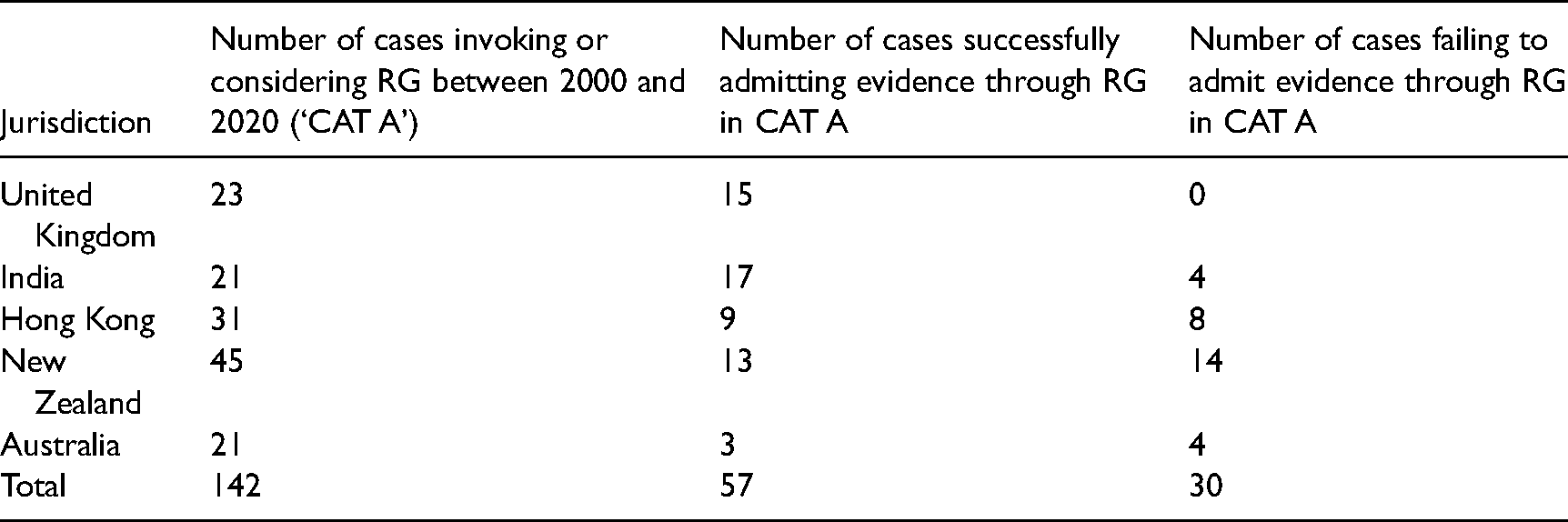
Evidently, RG is still relevant—142 cases invoked it across all jurisdictions in the last 21 years. Indeed, there were substantially more successful cases which admitted evidence through RG across all jurisdictions than those which failed. This minimally indicates the merits of invoking RG as a common law doctrine. Another statistic in support of the continue retention of RG as a common law doctrine is that out of 142 cases across all jurisdictions in the last 21 years, 55 cases (or 39% of cases) only considered or discussed the said doctrine in relation to other evidential issues. Thus, even if RG is not deemed to have any merits on its own, it still has wider relevance in relation to other evidentiary principles. In this connection, the common law doctrine of RG should still be applied in Singapore courts, albeit with a slightly tweaked test.
The proposed common law test
Given the continued need for RG as a common law doctrine, this article further proposes a three-strand test. This test has been formulated upon considering case law from jurisdictions which have been successfully in ensuring clarity in applying RG—such as in New Zealand, with the greatest number of cases considered or invoking the doctrine. 109
As a preliminary point, the common law doctrine of RG is distinct from s. 6 of the Evidence Act, meaning that if s. 6 applies, it does not apply.
The test, encompassing three conjunctive requirements, is set out as follows:
First, as a preliminary requirement, s. 6 of the Evidence Act does not apply. Then we ask if there was concoction involved. This is an objective test—the purpose is to ensure that the evidence was given as it were, and not after reasoned reflection, which would affect its credibility and reliability; Second, the evidence must relate to facts forming part of the same transaction where the event is concerned, but not contemplated in the established hearsay exceptions set out in s. 32(1) of the Evidence Act; and Third, the evidence must have sufficient probative value to outweigh its prejudicial effect. The probative value of such evidence can be guided by how imminently clear the evidence is, as part of the same transaction. This should be an objective consideration.
As a preliminary point, the first strand incorporates the concoction test which remains the purpose of the RG regime. This is because the concoction test, as established in Table 1, is useful in excluding evidence which may have been given after reasoned reflection. However, to say that the purpose of the test—to deter concocted evidence—is the sole requirement would be inadequate in safeguarding against uncertainty for two reasons. First, because while concoction is a salient concern (Law Commission, 2015: 34, para. 3.37), there are other considerations which should be factored into the inquiry, including the probative value of the evidence. Second, because legal tests do not simply incorporate their purposes as the sole strand. This may conflate the purpose of the test with what the test actually requires. The former relates to the objectives of the RG regime, the latter relates to whether the evidence meets the requirement to be admitted.
For the second strand, the purpose is to ensure no clash between the common law doctrine of RG and evidence provided under s. 32(1) of the Evidence Act. Moreover, it preserves the status quo that RG and s. 32(1) are disjunctive. Another benefit from having this strand is that it excludes evidence on two levels. First, for evidence to be legally relevant, it must relate to facts forming part of the same transaction. This excludes evidence which are logically relevant but not legally relevant. In this connection, the common law doctrine of RG preserves the element of spontaneity which is not caught by s. 6 of the Evidence Act. Second, the requirement that it be not otherwise caught by s. 32(1) is another exclusionary consideration.
For the third strand, it is vital to streamline RG in accordance with the test for similar fact evidence. 110 The purpose of having probative value of the evidence outweigh its prejudice is not a novel concept. In fact, in Australia, in the context of sexual offences, evidence which form part of the res gestae of proceedings will only be admitted if the probative value of the evidence ‘outweighs any distress, humiliation or embarrassment which the complainant might suffer as a result of its admission’. 111 Having such a requirement adds an added layer of exclusionary consideration which augments the rigour of the common law test for RG. In this connection, this helps to resolve difficult cases where it is not immediately clear that the evidence forms part of the same transaction. 112 This is because even if the evidence is deemed to form part of the same transaction, this next step in the inquiry will catch any evidence if admitted will cause more prejudice than assist the courts with its probative value. Indeed, this was exactly how the admissibility of evidence under RG was resolved in New Zealand High Court case Greenland v New Zealand Police. The High Court held that the evidence sought to be admitted had no ‘probative value at all in the case the way it has been presented’ 113 to the court and did not assist the court in any way; it was deemed inadmissible. Also, in considering whether an evidence could be admissible under the common law doctrine of RG, the New Zealand High Court in Boyd v Police observed that ‘immediate reactions can be of probative value’. 114 In a similar vein, the second requirement of the common law doctrine of RG in Hong Kong courts also includes considering the probative value of the evidence. 115 In this connection, the consideration of probative value against the prejudicial effect in admitting evidence via the RG gateway is not novel, and merits application in Singapore courts.
For completion, the probative value of such evidence can be guided by how imminently clear the evidence is, as part of the same transaction. This should be an objective consideration, although what is deemed probative turns on the facts of each case.
The countervailing objection is then prejudice, just as in similar fact evidence. Prejudice is something which ‘goes beyond the tendency of evidence to incriminate the accused’.
116
In the context of similar fact evidence, this entails:
117
risk of cognitive error—people tend to draw stronger inferences from evidence of past acts than which is rational; risk of the fact-finder being tempted to convict from an emotional standpoint instead of an objective view of the evidence; fear that the accused may be deprived of the benefit of the presumption of innocence because the fact-finder may give the other evidence more weight than it objectively deserves; it may not be acceptable to take a person's criminal past against him although it may be logical to do so. risk of cognitive error—just because something seems to be part of the transaction, cognitive bias must be accounted for
118
—facts pertaining to any event after the crime happened, if admitted will be inherently prejudicial. They cannot be admitted just because they were similar to the event. risk of the fact-finder being tempted to convict from an emotional standpoint instead of an objective view of the evidence. fear that the accused may be deprived of the benefit of the presumption of innocence because the fact-finder may give the other evidence more weight than it objectively deserves.
In the context of RG, the considerations for prejudice should similarly entail:
In weighing probative value against prejudicial effect, this prevents evidence which only seem to form part of the same transaction from being admitted. This acts as a vital exclusionary concern, given that RG is an exception to admitting hearsay evidence, of which the general rule is hearsay evidence is generally not admissible as evidence. Another upshot to this is in parallel to considering similar fact evidence, the courts do not have to consider whether nevertheless they should exercise their discretion to exclude evidence. This is as any prejudice of admitting the evidence would already have been considered and weighed against its probative value.
Thus, the proposed new test for the common law doctrine of RG is set out in Figure 3.
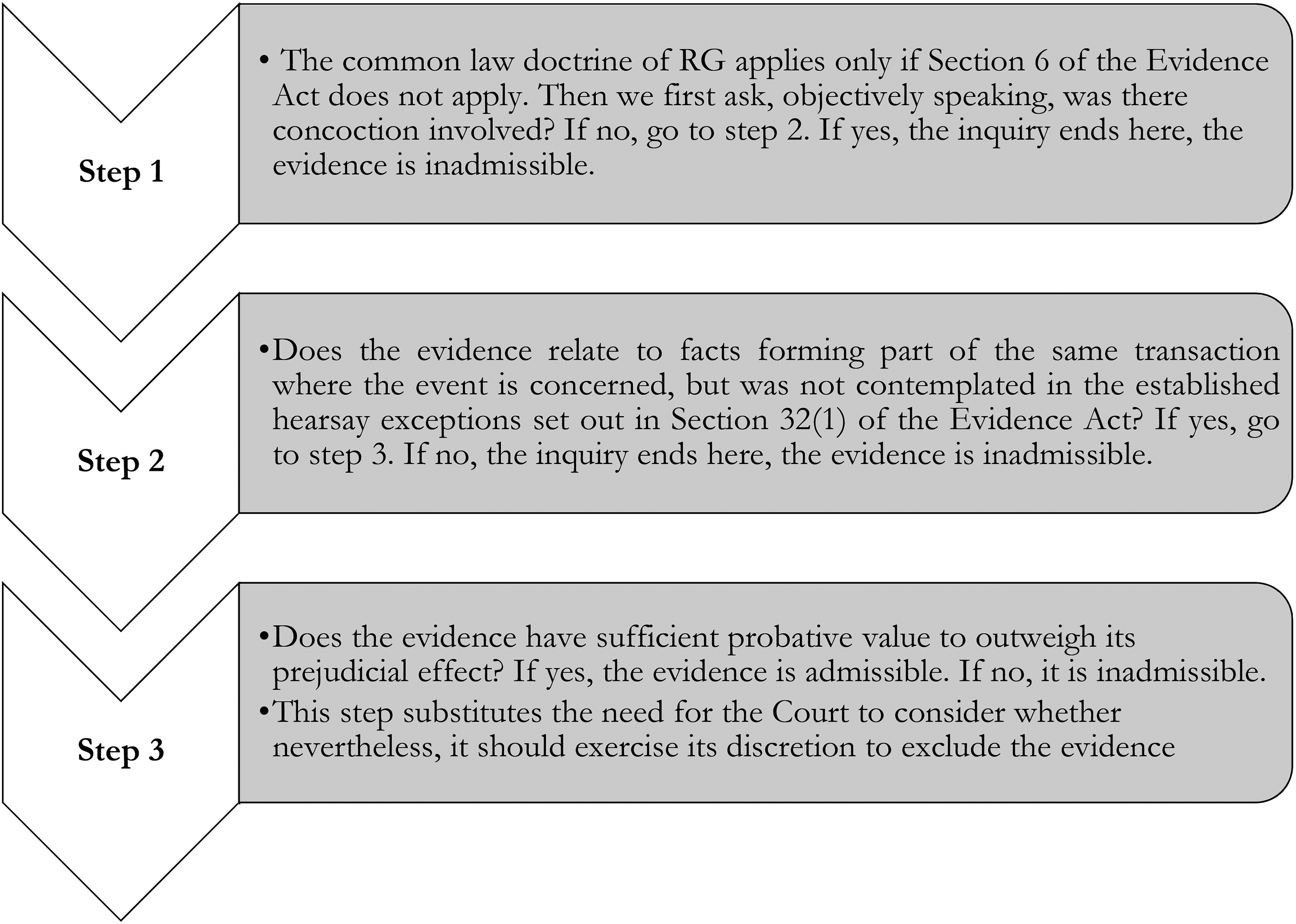
The new proposed common law test for RG.
Summary of this article's conclusions
The following is a summary of this article's conclusions:
Throughout the course of history, from the 18th to 20th century, the fundamental basis of the common law doctrine of RG was never in doubt. What was and still is difficult, is the application of the said doctrine. In particular, there are two categories of cases where RG is applied. First, cases where it is immediately clear that the evidence relates to facts forming part of the same transaction of the event. Second, cases where it was not immediately clear that the evidence is or is relating to a fact which formed part of the same transaction of the event. It is submitted that it is the second category of cases which has deeply troubled judges over centuries, across different jurisdictions. It is categorically unwise to abolish the common law doctrine of RG. It is not harmful nor is it useless, as what is unclear is its application in cases where it is not immediately clear and obvious that evidence constitutes RG. This has been the trend since the application of RG in the 18th century. Thus, to say that it confuses principles conflates principal foundations with the application of RG. Further, empirical evidence has illustrated its relevance in the jurisdictions of United Kingdom, Australia, India, New Zealand and Hong Kong from 2000 to 2020. As a corollary, 57 cases have successfully relying on the common law doctrine of RG to admit evidence in the jurisdictions of United Kingdom, Australia, India, New Zealand and Hong Kong from 2000 to 2020. This is substantially more than the 30 cases which failed to do so. This minimally illustrates the salience of RG as a common law doctrine. In Singapore, the solution is for Singapore courts to clearly state the applicable test for the common law doctrine of RG and whether s. 6 of the Evidence Act operates independently of the common law doctrine of RG. Thus, this article proposes a new common law test, incorporating the merits in the historical development of RG as a common law doctrine. This test entails:
First, as a preliminary requirement, there must have been no concoction involved. This is an objective test—the purpose is to ensure the evidence was given as it were, and not after reasoned reflection, which would affect its credibility and reliability. Second, the evidence must relate to facts forming part of the same transaction where the event is concerned, but not contemplated in the established hearsay exceptions set out in s. 32(1) of the Evidence Act. Third, the evidence must have sufficient probative value to outweigh its prejudicial effect. The probative value of such evidence can be guided by how imminently clear the evidence is, as part of the same transaction. This should be an objective consideration.
On the final note, ‘whither’ and ‘hither and thither’ are archaic Latin terms like ‘Res Gestae’. ‘Whither’ means ‘where’
119
and ‘hither and thither’ means ‘in different directions’.
120
This symbolises the current (unsettled) state of the common law doctrine of RG in Singapore. In what direction are we headed, and where?
For the above reasons, it is submitted that the common law doctrine of RG should be retained in Singapore. The common law test can be tweaked to ensure co-existence with the statutory option. Co-existence in this respect does not necessarily mean uncertainty—other common law jurisdictions have coped well even with statutory ‘equivalents’. Instead of blatantly uprooting the 213-year-old tree which has developed since 1808, why not just trim the overgrown branches, so its development is not sacrificed at the altar of simplicity and convenience? 121
Footnotes
Acknowledgements
The author is grateful to Koh Cheng Jun and Daniel Yeap for providing access to historical sources that he otherwise would not have. All errors remain his own.
Declaration of conflicting interests
The author(s) declared no potential conflicts of interest with respect to the research, authorship, and/or publication of this article.
Funding
The author(s) received no financial support for the research, authorship and/or publication of this article.
