




Abstract
With the growing interest in using generative artificial intelligence (GenAI) for work tasks, empirical research is needed to understand the conditions facilitating and hindering such use. Drawing on the Unified Theory of Acceptance and Use of Technology (UTAUT), this study examines the moderating effect of innovation culture in schools on the relationship between school leaders’ openness to experience and the integration of GenAI in school leadership tasks. This research used a cross-sectional survey design, collecting data from 302 Israeli school leaders in primary and secondary schools. Regression analysis was used to explore the relationships between the variables. Correlations indicated that school leaders with higher openness to experience are more likely to integrate GenAI into their school leadership tasks. The moderation analysis showed that only the presence of a strong innovation culture significantly strengthens this relationship. The moderation analysis also pointed out that, by contrast, in schools with a low innovation culture, school leaders’ openness to experience is not related to integrating GenAI into school leadership work. The study contributes empirically to the emerging discourse on AI in educational leadership by clarifying the role that school leaders’ personality traits and institutional culture play in this change and the relevance of the interaction between the factors.
Keywords
Introduction
The rapid advance and popularization of artificial intelligence (AI), especially of generative AI (GenAI) in recent years, have produced considerable interest in how it may revolutionize the modern workplace, including educational settings (Collie et al., 2024; Quaquebeke & Gerpott, 2023). AI has become widely accessible with GenAI chatbots that provide natural conversation interfaces for inquiries (Cheung et al., 2025). School leaders have played a crucial role in determining how AI tools are incorporated into school routines by the many parties involved in education (Tyson & Sauers, 2021). Yet, our empirical knowledge of AI and school leadership is scarce (Arar et al., 2024; Fullan et al., 2024). An empirical study is needed to understand the factors that support and hamper such use. In particular, little is known about how individual dispositions and organizational conditions jointly shape school leaders’ use of GenAI.
School technology leadership research generally focuses on technologies that directly contribute to teaching and learning (Christensen et al., 2018; Dexter et al., 2016) rather than managerial practices. It often emphasizes instructional tools, digital pedagogy, and student engagement rather than administrative efficiency. Yet, this perspective overlooks the potential of emerging technologies like GenAI. Unlike traditional educational technologies, GenAI is a flexible, adaptive tool that can be tailored to individual needs and contextual goals (Collie et al., 2024), such as managerial practices. Some claim that the use of GenAI is associated with higher work productivity (Al Naqbi et al., 2024). For example, GenAI may help school leaders to develop educational programs, plan social interactions, reflect on decision-making situations, or analyze teacher performance (Berkovich, 2025; Berkovich & Eyal, 2025). A survey of school leaders in Israel indicated that about half of the leaders are in the early majority stage of adoption, with instructional leadership emerging as the most strongly influenced domain (Berkovich, 2025). At present, the use of AI is an act of innovation by early adopters (Kovbasiuk et al., 2025). Innovation and creativity involve attempting to break away from the status quo by proposing novel approaches to problems (Zare & Flinchbaugh, 2019).
Existing research indicates that the degree to which individuals embrace and incorporate GenAI into their jobs relates to their personality traits (Kovbasiuk et al., 2025). Kovbasiuk et al. (2025) reported that of the Big Five classic personality traits (openness, conscientiousness, extraversion, agreeableness, and neuroticism), openness to experience (i.e. the inclination to be curious, imaginative, and flexible) was most strongly associated with the intention to use AI technology. Thus, it is likely that school leaders who score high on openness to experience are more likely to adopt cutting-edge technology and investigate its possible uses in their leadership work.
Yet, individual dispositions do not operate in isolation, and contextual factors may determine whether such tendencies translate into practice. A key contextual factor relevant to this study is school culture, which reflects the shared values, attitudes, and practices of unit members (Kalkan et al., 2020). Innovation culture is the type of organizational culture that is pertinent for exploring change, representing an environment supportive of creativity, experimentation, and risk-taking (Ghasemzadeh et al., 2019). Previous research indicates that various organizational cultures can moderate the effect of personal attitudes and personality traits of leaders and employees on their abilities and behaviors, including those related to technology (Chuttipattana & Shamsudin, 2011; H. Wang et al., 2012). Therefore, it is reasonable to argue that school leaders may feel more supported and inspired to use GenAI solutions in schools with a strong innovation culture that values experimenting and taking risks. This study relies on the unified theory of acceptance and use of technology (UTAUT; Venkatesh et al., 2003; Williams et al., 2015) to examine the moderating role of innovation culture, contributing to the emerging research on AI in educational leadership by linking individual openness to experience with organizational conditions shaping GenAI integration.
Literature Review
Theoretical Framework
The model is based on the unified theory of acceptance and use of technology (UTAUT; Venkatesh et al., 2003; Williams et al., 2015), which explains technology adoption through performance expectancy (perceived job performance gains), effort expectancy (perceived ease of use), social influence (norms and peer expectations), and facilitating conditions (organizational and technical support). In the present study, UTAUT is not applied as a fully specified model with all of its original constructs operationalized and tested. Rather, it serves as a conceptual frame. The present study explores how an innovation culture in schools moderates the link between school leaders’ openness to new experiences and the integration of GenAI in their school leadership work (Figure 1). Drawing from UTAUT, openness to experience is treated here as an individual disposition that colors how school leaders interpret new technologies. It is assumed to shape perceptions of usefulness and manageability, that is, how beneficial GenAI appears for leadership work and how demanding its use seems in practice. In parallel, an innovation culture is positioned at the organizational level. It reflects shared norms, tolerance for experimentation, and the degree of institutional support for unconventional practices. In this sense, innovation culture approximates the facilitating conditions and social influence components emphasized in UTAUT. Thus, it operates as a lens, shaping the extent to which personal dispositions are likely to translate into actual patterns of technology use, though not determining them in any simple or mechanical way.
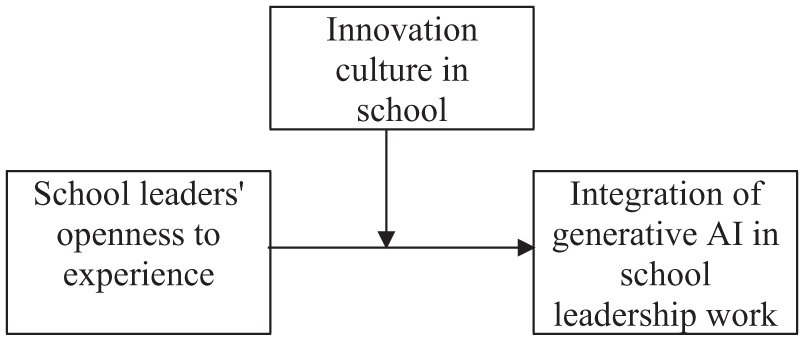
The proposed model.
Artificial Intelligence and School Leadership
In their reflection on the future of leadership, Quaquebeke and Gerpott (2023) argued that AI will completely replace responsibilities that people typically associate with human leaders, such as task-related (e.g. tracking employees’ job progress and offering task-related guidance), relationship-related (e.g. motivating employees according to their preferences and fostering positive work relationships), and change-oriented (e.g. inspiring followers and developing a compelling vision). Educational leadership research has paid less attention to artificial intelligence than general leadership studies and focused mostly on reflective, non-empirical works (Fullan et al., 2024; Y. Wang, 2021a). Scholars studying educational leadership discussed how AI may influence symbiotic human-AI decision-making in school leadership, particularly regarding data literacy (Y. Wang, 2021a, 2021b). According to Fullan et al. (2024), AI and GenAI have the potential to greatly reduce the management and administrative duties of school administrators, but they can also supplant some leadership positions in schools. Indeed, both possibilities may be true.
Data on AI and educational leadership from the Scopus database were subjected to bibliometric analysis by Arar et al. (2024). According to the researchers’ report, the top 10 publication platforms that mentioned educational leadership and AI did not include any publications related to educational administration. These publications included conference proceedings, educational technology journals, psychology journals, and multidisciplinary publications. Tyson and Sauers’s (2021) qualitative study of US school leaders’ experiences with the adoption and implementation of the ALEKS AI program (a learning and student assessment system) is one of the few empirical works on AI and school leaders. The researchers found that teachers’ workload and the perception of technology as effective encouraged the adoption of AI in their classrooms. The new research questions that arose as a result (Fullan et al., 2024) are: what traits characterize school leaders who lead GenAI integration in their work, and how do such traits interact with school culture.
Personality Trait of Openness to Experience
The qualities of individual behavior that explain why some people behave differently under the same set of circumstances are known as personality traits (Koe Hwee Nga & Shamuganathan, 2010). One of the main frameworks in psychology describing individuals’ personality traits is the Big Five (Mammadov, 2022): conscientiousness, extraversion, agreeableness, neuroticism, and openness to experience are considered universal personality traits (Presenza et al., 2020). Conscientiousness manifests in strong self-discipline, dependability, and a tendency toward organization. High conscientiousness suggests being organized, with a strong sense of duty and goal orientation, whereas low conscientiousness indicates a more impulsive attitude (Presenza et al., 2020). Extraversion is expressed in external orientation, sociability, and high energy. Highly extroverted people are gregarious and thrive on social connections, whereas low extroverted (or introverted) people value isolation and introspection (Mammadov, 2022). Agreeableness suggests an inclination toward collaboration, friendliness, and empathy. Those with low agreeableness may be more competitive or cynical, and by contrast, highly agreeable people are kinder and more trustworthy (Presenza et al., 2020). Neuroticism is related to the propensity for negative feelings and emotional instability (Mammadov, 2022). Low neuroticism implies composure and resilience, whereas high neuroticism is associated with worry and mood swings. Openness to experience is manifested in imagination, inventiveness, and a desire to try new things. Low openness reflects a preference for routine, whereas high openness is an indication of curiosity and an appreciation of novel concepts (Presenza et al., 2020).
Openness to experience is particularly important for innovation and, therefore, was selected as the focus of the current exploration. In UTAUT, individual differences matter to the extent that they shape how technologies are evaluated (Arpaci et al., 2022). School leaders’ openness to experience can therefore be understood as influencing how GenAI is perceived in leadership work, particularly in its potential usefulness and the effort required to use the technology. More open leaders may be more willing to explore AI tools, which strengthens the expectancy that UTAUT identifies as central to technology integration. According to Kovbasiuk et al. (2025), openness to experience is the Big Five classic personality trait most significantly linked to the intention to adopt AI technology. It is considered to be associated with exploring new ideas, using creativity to solve new problems, and developing creative approaches to organizational processes, products, and strategies (Chang et al., 2014). It is a consensus view in the business literature that to pursue an innovative idea, people must have particular attitudes and behaviors (Green & Binsardi, 2015) like being creative and daring, able to generate, identify, assess, and seize new opportunities, and able to act quickly in an environment with limited resources and uncertainty (Presenza et al., 2020). Chang et al. (2014) suggested that openness to experience is a personality trait that describes people who are generally innovative, creative, intuitive, and intellectually curious in their attitudes and behaviors. Individuals with high openness to experience, in addition to having a propensity for the unusual and non-traditional ethical, social, and political notions (Rothmann & Coetzer, 2003), are also more inclined to seek out new experiences and investigate novel concepts (Zhou et al., 2024). Openness to experience has been associated with highly curious, proactive, and less rule-bound approaches to life (Zare & Flinchbaugh, 2019).
Educational research provides support for the link between school leaders’ openness and AI use. Walker (1969) explored the personality of teachers in innovative schools and found that in highly creative schools, teachers were more rational and less authoritarian than in traditional schools. Educational research in Germany found that school leaders who demonstrated an open-mindedness to innovation (curiosity, receptiveness to external ideas, and tolerance for uncertainty) were more likely to initiate and sustain digital innovation (Witthöft et al., 2025). Kılınç et al. (2025) found that Turkish principals who displayed a growth mindset (belief in continual improvement) were more likely to be ready to use AI. Another Turkish study found that principals’ mindset open to innovation was linked to favorable attitudes toward AI (Erdoğan et al., 2025), shaping intentions to use and actual use. In light of the above, one can expect school leaders with high openness to experience to be more likely to integrate GenAI in their school leadership work.
The Moderating Role of Innovation Culture in Schools
Innovation, as the application of creative ideas, has been traditionally rooted in the business world and associated with enhancing organizational competitiveness, productivity, and efficiency (Kremer et al., 2019). Organizational innovation is defined as the effective application of new procedures, initiatives, or products that are implemented within an organization following internal decisions (Naveed et al., 2022). The literature suggests that understanding innovation and creativity at work requires a cultural viewpoint (West & Richter, 2024), as culture assists in aligning employee conduct with organizational goals of innovation and satisfying conflicting needs for freedom and control (Khazanchi et al., 2007). Organizational culture is a common set of ideals, presumptions, and beliefs shared by members of an organization (Naveed et al., 2022). The individuals’ behavior is influenced by culture, which enables them to develop and produce something of value for the organization (Fuad et al., 2022). New individuals are socialized into an existing organizational culture as the other actors communicate to them the many layers of cultural elements, such as values, conventions, beliefs, and underlying assumptions (Flores, 2004; Fuad et al., 2022).
Organizational culture may either support or impede innovation (Fuad et al., 2022). Support for innovation is linked with expecting, accepting, and practicing support for efforts to implement new and improved methods of doing things in the workplace (H.-C. Hsiao et al., 2014). Danks et al. (2017) claimed that a supportive, innovative culture predicted organizational innovativeness. Innovation success in organizations depends on a supportive environment that encourages motivation and creativity and removes obstacles (Hofstede et al., 2010; H.-C. Hsiao et al., 2014). Innovative organizational culture makes employees feel supported and inspired to make creative decisions and try new ways to address work issues (Amabile, 1997).
UTAUT illustrates the role of social influence and facilitating organizational conditions in shaping technology use (Venkatesh et al., 2003; Williams et al., 2015). Educational systems in the West, despite their conservative organizational inclinations (similar to other public service systems), have changed in recent decades to accommodate both technological changes and the market and accountability-oriented environments in which they operate (Fuad et al., 2022; OECD, 2016). In schooling, even more than cutting educational expenditures, innovation is about improving the quality of education, learning outcomes, fairness and equality, and efficiency (Fuad et al., 2022). Scholars have argued that schools must develop an innovative culture to undergo a fundamental transformation and become institutions that support knowledge production and stimulate 21st-century learners’ creative thinking (Bereiter & Scardamalia, 2006). Yet, knowledge about an innovation culture that supports school administration as well as teaching and learning processes is still limited (Fuad et al., 2022; Ghasemzadeh et al., 2019). Fuad, Musa and Hashim (2022) conducted a comprehensive analysis of 28 research publications on innovation culture in education and found that less than a quarter of them were empirical explorations of innovation culture in schools. Our empirical knowledge of innovation culture in schools is limited. Among the few empirical works on innovation culture in schools, one can note Cai and Tang’s (2022) study of 1,115 Chinese primary and high school teachers, which found a connection between school support and teacher innovation by satisfying teachers’ basic psychological needs of relatedness and competence. Ebneroumi and Rishehri’s (2011) study focused on the creative school. Using data from 163 administrators, the research found that the characteristics of creative schools comprised four dimensions: new insight into training, a flexible administrative structure, adequate physical space, and an environment of creative leadership with economic, political, cultural, information technology, social, technical, and technological aspects. H.-C. Hsiao et al.’s (2014) study of 322 participants from technical colleges in Taiwan found that support for innovation and organizational innovation were positively correlated and that the relationship between innovation support and organizational innovation was mediated by organizational learning. Existing works suggest that different types of organizational culture can moderate the effects of leaders’ and employees’ personality traits and personal attitudes on their competencies and behaviors (Chuttipattana & Shamsudin, 2011; H. Wang et al., 2012), including technology-related ones (Alsabahi et al., 2021). Fousiani et al. (2024) found that a competitive organizational climate that encourages employees to excel and innovate interacts with leaders’ traits (power construal) and affects employees’ adoption and use of AI for work-related tasks.
Educational research provides indirect support for this moderating model. Prior research found that organizational encouragement to use GenAI strengthens school leaders’ GenAI self-efficacy, which in turn plays a key role in promoting GenAI integration in practice (Berkovich & Eyal, 2025). Similarly, educational research demonstrates that an innovative school climate strengthens teachers’ technology use by legitimizing experimentation, risk-taking, and iterative learning. In a study of Vietnamese public school teachers, Tran et al. (2025) found that innovation climate positively moderates the effect of school leadership style on organizational innovation capability. Therefore, the present study proposes that innovation culture in schools moderates the link between school leaders’ openness on the one hand, and the experience and integration of GenAI in their school leadership work, on the other. A strong innovation culture may reinforce the link between leaders’ openness to experience and GenAI integration, whereas a conservative culture can limit the effect of individual openness on leadership practice. Thus, one can hypothesize:
Context
Israeli society is focused on technology. The IMD World Digital Competitiveness Ranking for 2024 ranks Israel 16th out of 67 nations (Institute for Management Development, 2024), which ranks how successfully countries use and embrace digital technology to change government, business, and society. Israel serves as an ideal context for this study due to its strong emphasis on technological innovation in education (Slakmon, 2017). For instance, recently, the Israeli Ministry of Education launched its 2025 AI initiative, integrating AI into the curriculum across all grade levels (Israeli Ministry of Education, 2025). About 3,000 mentors from 400+ tech companies will assist schools, 70,000 teachers will receive AI training, and 5 supervised AI tools are being introduced. Yet, GenAI is not a rigid formal tool with specific goals but a flexible tool for adapting tasks based on individual needs and contextual objectives. Thus, although national initiatives encourage technological experimentation, explicit frameworks for GenAI use in leadership and governance are still under development. This situation may contribute to variability in adoption practices and place greater responsibility on individual school leaders to interpret, experiment with, or constrain GenAI use at their institutions.
Method
To investigate the study hypotheses, I used a quantitative cross-sectional survey carried out in January 2025 in Israel. The research was approved by an institutional review board (IRB; approval no. 3627). I conducted convenience sampling, using an online poll of school leaders, which is a less expensive and time-consuming sampling approach (Birks & Malhotra, 2006). The inclusion criteria were being a practicing public school leader in either elementary or secondary education and completing all survey questions. Three hundred and two school leaders answered the survey. The sample included 55 department heads, 135 subject heads, 38 school counselors, 16 vice-principals, 9 principals, and 49 social activity coordinators. In Israel, school counselors fill at least one-sixth of the teaching positions, and many serve as part of the management team, often advancing to principalship. Social activity coordinators are teachers with additional leadership responsibility and compensation; they are required to have team management skills and work with other teachers, students, and parents (Israeli Ministry of Education, 2018). Participants had a gender distribution of 18.9% male and 80.8% female; 0.3% (n = 1) not stated. The gender distribution in the sample is similar to that of teachers in the public education system (i.e. 81.9% female; Israeli Central Bureau of Statistics, 2025).
Teaching experience was distributed as follows: 8.2% 0 to 3 years of experience; 16.2% 4 to 6 years; 24.5% 7 to 10 years; 18.5% 11 to 15 years; 18.2% 16 to 25 years; 14.2% 26 years or more. The participants were employed at primary schools (50.7%) and secondary ones (49.3%). Team sizes were distributed as follows: 24.8% of respondents managed fewer than 5 teachers, 24.5% 6 to 10 teachers, 13.2% 11 to 15 teachers, 8.9% 16 to 20 teachers, 4.3% 21 to 25 teachers, 5.6% 25 to 30 teachers, 8.6% 31 to 50 teachers, and 10.9% 51 or more teachers.
Measures
Innovation Culture in Schools
The study used the perceived support for innovation in organizations scale (Siegel & Kaemmerer, 1978). The scale, its adaptations, and themes have been applied successfully in prior research of schools (Dickerson, 2019; Fidan & Oztürk, 2015; Henkin & Holliman, 2009; H. C. Hsiao et al., 2009; Sagnak, 2012). Specifically, the study used the four top-loading reverse-coded items of the Tolerance of Differences subscale (see list of items in the Appendix). The items were selected because they describe the extent to which individuals are permitted to think and act differently without negative consequences, which is considered a key aspect of innovation culture (De Alencar & De Bruno-Faria, 1997). After reverse coding, higher scores reflect greater perceived tolerance for nonconformity and alternative approaches. 1 Participants were asked to mark their agreement on a five-point Likert scale ranging from 1 = Strongly disagree to 5 = Strongly agree. The reliability alpha score of the scale was good (α = .78).
Openness to Experience
The study used the Openness to experience subscale from the short version of the Big Five Inventory (Rammstedt & John, 2007). This two-item subscale includes the items: “I have few artistic interests” (R) and “I have an active imagination.” Respondents were asked to rate their agreement on a five-point Likert scale (1 = strongly disagree to 5 = Strongly agree). The reliability alpha score of the scale was .47, but low reliability is not considered a psychometric issue for the subscale because its psychometric robustness has been established (Rammstedt et al., 2024). Moreover, in a previous study with an Israeli teacher sample, the subscale produced an alpha of .41 (Berkovich & Eyal, 2021). Similarly, low-reliability levels have been reported in other studies using this two-item Openness to Experience subscale (Ryan et al., 2019; Syropoulos & Markowitz, 2021).
Integration of GenAI in School Leadership Work
This scale was composed based on existing studies on the integration of GenAI in teaching (Collie et al., 2024). I gave participants an overview of GenAI before they responded to the survey. “Advanced technology that uses machine learning to create new content, like text, images, and music (such as ChatGPT, Copilot, Claude, Gemini, Perplexity, and so on) is known as generative artificial intelligence (AI).” Then, participants were asked the following question: “For which tasks do you currently use GenAI as part of your leadership role at the school?” The scale presented a list of 19 school leadership tasks in which GenAI assisted in managerial, instructional, social, political, and moral domains. Tasks were chosen to represent the variety of school leadership work functions (Greenfield, 1995) and to be relevant to the roles of various types of school leaders (see the full list in the Appendix). For each task on the list, participants were asked to indicate whether they used AI (1) or not (0). Conceptually, these activities do not necessarily form a single coherent dimension. Combined with the dichotomous response format, this heterogeneity suggests that the scale is better understood as a formative index capturing the breadth of GenAI engagement rather than as a unidimensional latent construct. Meaning it does not represent a reflective measure of an underlying trait, nor does it assume internal homogeneity among the included practices. Thus, the resulting score indicates the scope and diversity of use across tasks. Content validity was established through review by two independent researchers, who determined that the items appropriately represented constructs related to educational leadership and GenAI use in schools (Berkovich & Eyal, 2025). A pilot study with 48 school leaders provided preliminary evidence of face validity, with participants rating the instrument on a seven-point Likert scale for GenAI integration in school leadership (M = 5.53) and perceived predictive validity (M = 5.25; Berkovich & Eyal, 2025). Test-retest reliability was examined across two administrations 1 week apart, demonstrating good stability for the scale (ICC = 0.70; Berkovich & Eyal, 2025). Because the GenAI integration measure was conceptualized as a formative index, factor analytic procedures were not conducted, and internal consistency coefficients were not calculated. To further test the internal structure of the GenAI integration index, domain-level scores were calculated for managerial, instructional, moral, social, and political activities. To examine inter-domain correlations, the number of GenAI-supported tasks selected within each domain was summed to create domain-specific scores. Inter-domain correlations ranged from 0.56 to 0.71 (all p < .001), indicating moderate to strong associations among domains. This pattern suggests that the domains reflect related facets of GenAI engagement while retaining sufficient distinctiveness, supporting the conceptualization of the measure as a formative index. Accordingly, the interpretation of findings centers on patterns of engagement across domains, rather than on assumptions of internal consistency.
Data Analysis
First, although the data are cross-sectional, the risk of common method variance (CMV) is very low. The study used different types of measurements (yes/no counts vs. Likert scales) for organizational culture and personality traits, which reduces the likelihood that a single method artificially inflates correlations (Podsakoff et al., 2003). Moreover, Harman’s single-factor test indicated that the largest factor in the analysis explained only 23.98% of the variance, well below the problematic 50% level in the literature (Podsakoff et al., 2003). Second, the regression assumptions were checked before conducting the analysis. The independent variables followed a normal distribution (skewness between −2 and 2, and kurtosis between −7 and 7; see Byrne, 2016). Finally, there were no violations of the multicollinearity criterion, as variance inflation factor (VIF) scores were below 2.5 (see G. J. Chen, 2012).
To explore the hypotheses, moderation analyses were conducted. The PROCESS macro for SPSS (Model 1; Hayes, 2018) was used to check whether innovation culture in schools moderated the relationship between school leaders’ openness to experience and the integration of GenAI in leadership tasks. Control variables (demographic and school characteristics) were entered. All continuous focal predictors were mean-centered before analysis to facilitate the interpretation of interaction effects. Control variables were left uncentered. To obtain robust confidence intervals, bootstrapping with 1,000 resamples was applied. Effects were considered statistically significant when the 95% bootstrap confidence interval did not include zero.
Findings
The relationships, means, and standard deviations between the research variables are shown in Table 1. The table shows a positive correlation between school leaders’ openness to experience and integration of GenAI in school leadership work (r = .167, p < .01). This supports H1.
Correlations and Descriptive Statistics (N = 302).
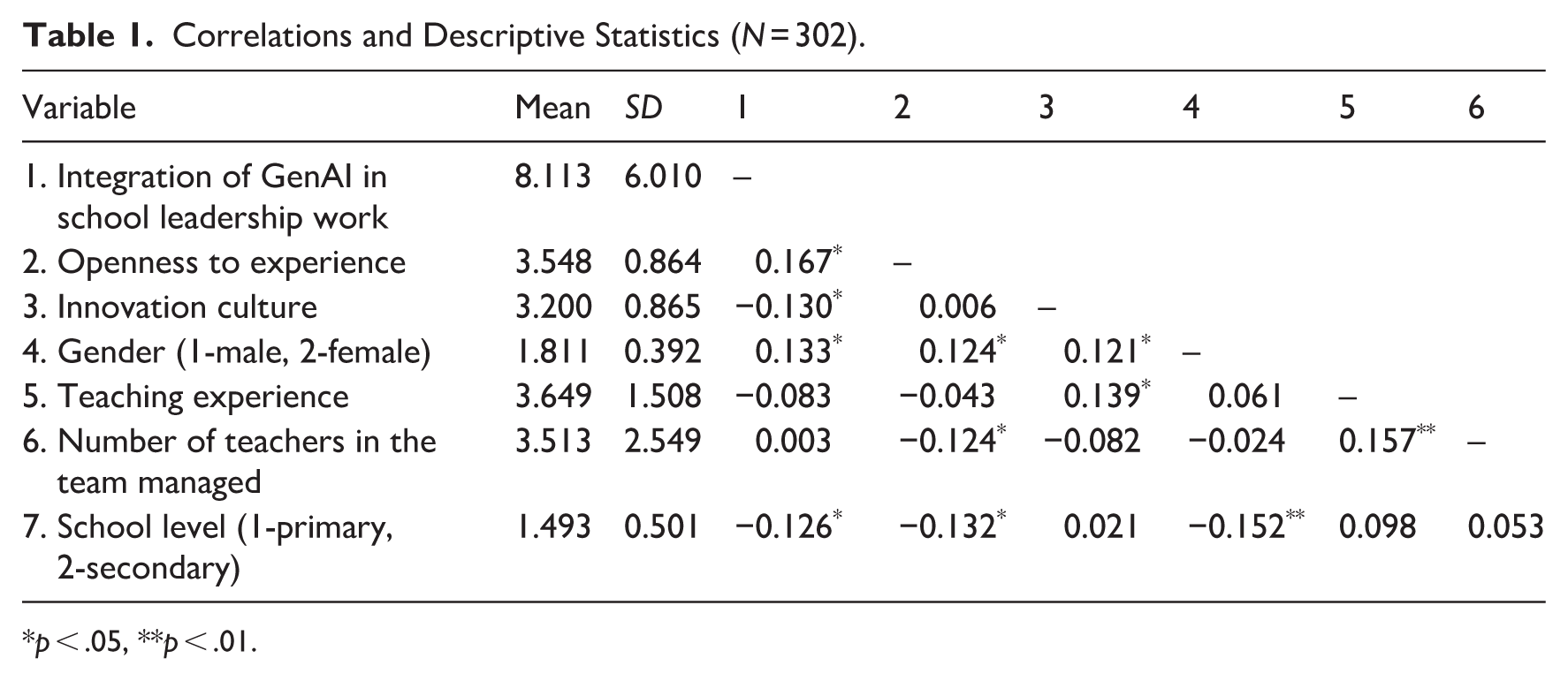
p < .05, **p < .01.
The effect of school leaders’ openness to experience on their integration of GenAI in school leadership activity was then evaluated using a regression model (Table 2). This model mean-centered predictors (school leaders’ openness and innovation culture in the school) to examine how their interaction influenced the integration of GenAI in school leadership work. The model included only the significant controls (gender and school level), which were not centered. The model explained 9.3% of the variation in school leaders’ integration of GenAI in school leadership work (F(5, 295) = 6.06, p < .001).
PROCESS (Model 1) analysis predicting school leaders’ integration of GenAI in school leadership work (N = 302).
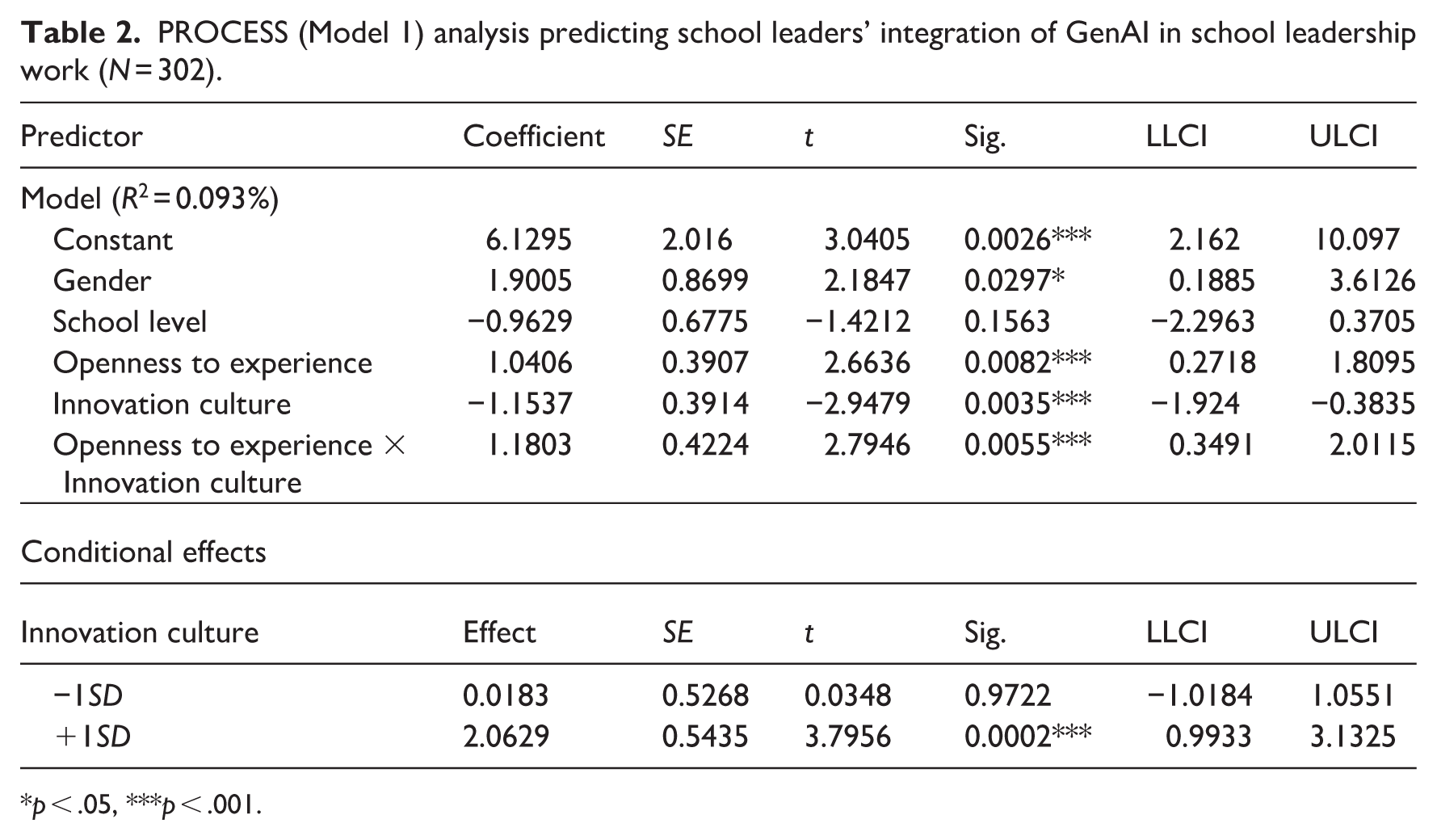
p < .05, ***p < .001.
Thus, the findings of the regression analysis support the hypothesis by suggesting that school leaders’ openness to experience interacted with the innovation culture in the school to predict school leaders’ integration of GenAI in school leadership work (p < .05). Next, I computed regression lines at high and low levels of innovation culture in the school (−1 SD above and +1 SD below the mean) and showed the interaction effect. The nature of the interaction effect is shown in Figure 2. School leaders’ openness to experience showed a clear positive association with the integration of GenAI in their leadership work under conditions of high innovation culture (p < .001). In contrast, when innovation culture was low, this relationship weakened and was no longer statistically significant (p > .05). This supports H2.
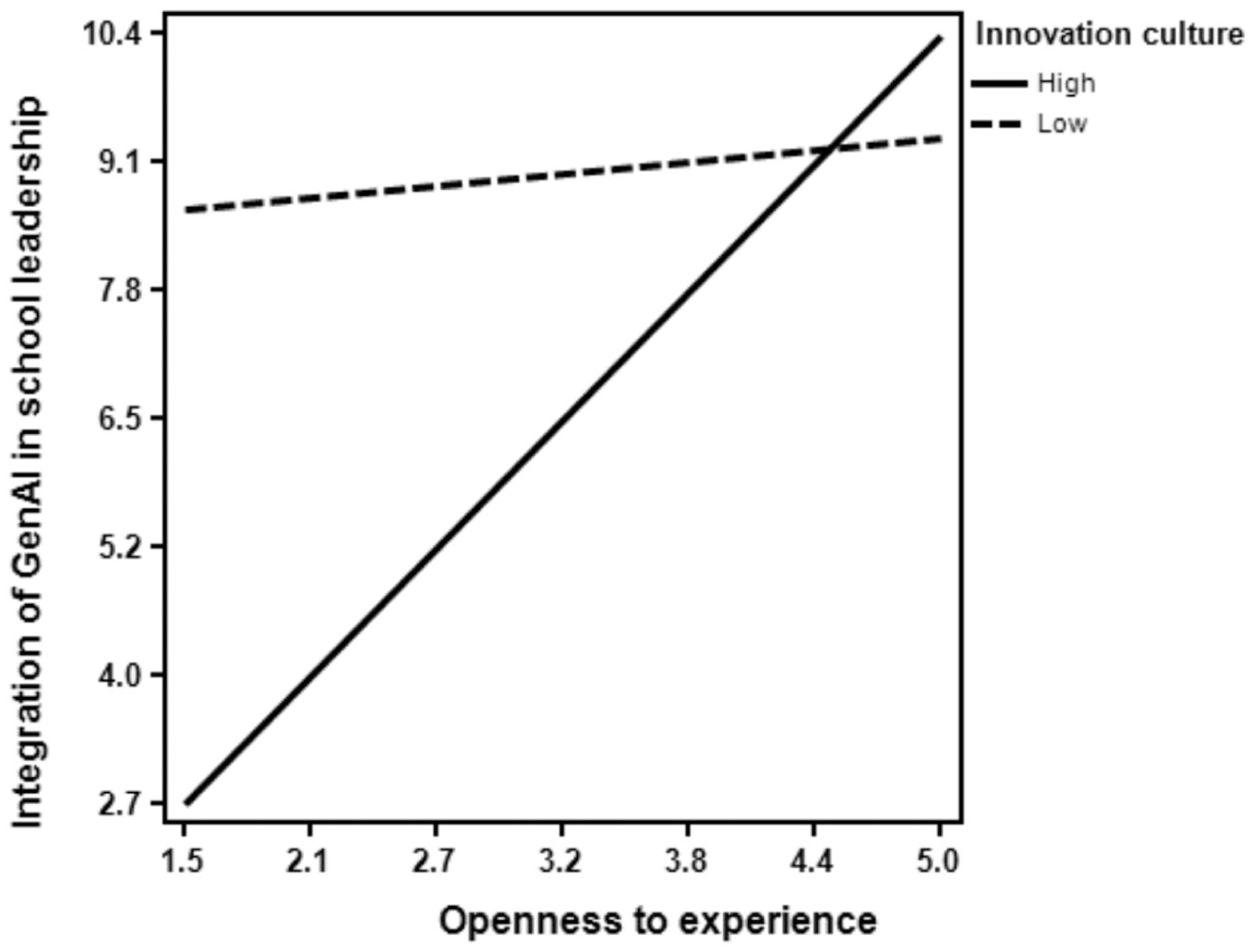
The moderating effect of innovation culture.
Additional analyses examined whether the proposed model demonstrated differential effects in specific domains of GenAI use in leadership work (managerial, instructional, moral, social, and political). Analyses predicting each domain separately replicated the results reported above. A further set of analyses explored whether the inclusion of less traditional school leadership roles influenced the findings. After excluding school counselors and social activity coordinators and retaining only traditional school leadership positions (n = 231), the results again replicated those reported above.
Discussion
This study contributes to the limited empirical research on AI and school leadership (Arar et al., 2024; Fullan et al., 2024) by offering initial evidence that personal and contextual factors may interact in shaping how GenAI is incorporated into leadership practice. The study clarified the relationships between school leaders’ openness to experience and integrating GenAI into school leadership work, and the moderating effect of innovation culture within schools on these relationships. This knowledge is particularly valuable in light of claims about the ability of GenAI technologies to revolutionize the way educational organizations operate (Collie et al., 2024; Ng et al., 2025) and to increase work productivity (Al Naqbi et al., 2024). At the same time, the correlative findings require careful interpretation. The reliability of the openness subscale was modest, the observed effect sizes were relatively small, and the explained variance was limited. Thus, the results should be read as preliminary indications of conditional associations between individual dispositions and organizational context. The study findings offer several important insights.
First, the study shows that school leaders who exhibited high levels of openness to experience were more likely to integrate GenAI into their school leadership practices to a greater extent. This finding aligns with existing literature indicating that openness to experience is a key trait associated with the willingness to adopt innovations or explore changes (Presenza et al., 2020; Zhou et al., 2024). The personality trait of openness to experience is characteristic of early adopters of new technology, as in the case of intent to use AI at work (Kovbasiuk et al., 2025). The present study expands existing research by demonstrating that openness to experience not only correlates with the intent to use AI at work but also with actual reports of AI use in job tasks.
Second, the study demonstrates the contributory role of innovation culture in school as a moderating factor in the relationship between leaders’ openness and integration of GenAI into school leadership work. Despite the importance of innovation culture in schools at this time of accelerated changes in society and education (Buddeberg & Hornberg, 2017), it has been seldom explored empirically (Fuad et al., 2022). Substantively, under a high innovation culture, a one-point increase in openness was associated with approximately two additional GenAI-supported leadership tasks. This suggests a modest but practical effect. In schools with a weak innovation culture, the association between openness to experience and integration of GenAI was non-significant. This suggests that although personal attributes like openness play a crucial role in driving the adoption of technology, they may not be sufficient in environments that lack structural and cultural support for innovation. Lack of tolerance for new ideas and untried practices (Siegel & Kaemmerer, 1978) can make otherwise early adopters shy away from new technologies, holding schools back relative to other work organizations that are more naturally prone to risk-taking. Public organizations are considered more enduring and more difficult to change by nature (Carol Rusaw, 2007), therefore it is even more important to develop an innovation culture in such organizations.
This study has several limitations. First, openness to experience was measured using the two-item subscale of the BFI-10. Although this instrument is commonly used in large-scale surveys, the internal consistency observed in the present sample was low, which increases measurement error and likely weakens the effects. Therefore, the findings should be considered with caution, and future research is necessary. Second, its reliance on self-reports may have led to biases. For example, participants may have enhanced their reports on openness to new experiences or AI adoption patterns. To validate the findings, future research should include school leaders’ GenAI history. Third, the primary focus of the study was on the adoption of AI in school leaders’ work and not on how the integration of AI in their work affected teachers, students, and parents. Future studies should examine how the adoption of AI by school leaders influenced schooling processes and stakeholders’ attitudes and behaviors. Fourth, the study was carried out in Israel, and the results may not apply to other countries. For example, comparative research of personality traits in 56 countries indicated that individuals in South America and East Asia were significantly different in openness traits from people in other nations (Schmitt et al., 2007). Replicating the study in various national education systems and geographic areas is advised. Fifth, the study used a convenience sample, which limits generalizability. The sample included a wide range of school leadership roles and displayed heterogeneity in the breadth of role authority and decision-making power. The overrepresentation of female respondents, which is proportional to their gender representation in the public system, constrains the extent to which results can be generalized to other systems. Sixth, the proportion of variance in leaders’ behaviors explained by the model was relatively small (9%). This magnitude is, however, comparable to that reported in several prior studies, which have incorporated predictors such as openness to experience (George & Zhou, 2001) or organizational culture (Taghipour & Dezfuli, 2013) and similarly accounted for only modest levels of variance in creative or innovative employee behavior.
Policy Implications
At the policy level, the findings indicate that individual dispositions alone are not sufficient to ensure meaningful AI integration in school leadership work. The results suggest that a supportive innovation culture is essential for facilitating its successful integration. These findings point to a need for focused school- and education system-level initiatives to improve innovation culture in schools, which is much needed given the rapid pace of technological changes in AI affecting schools in the near future (Fullan et al., 2024; Y. Wang, 2021a, 2021b). In addition, policymakers must encourage educational institutions to devise policies and support networks for the implementation of AI in school leadership work.
Practice Implications
From a practice-oriented perspective, the insights derived from this study attest to the need for leadership training programs that would develop leaders who cultivate innovation, expose participants to new ideas, and promote a flexible mentality that would enable them to develop a culture that supports innovation in their schools. In addition to broader leadership capacities, practical competence with AI tools is becoming increasingly relevant. The study suggests the need for changes in formal and on-the-job training in AI literacy for school leaders as the integration of GenAI in school leaders’ work becomes more extensive (Bellibaş et al., 2025). While this change is pressing, it must be implemented with great responsibility to prevent harm and ensure that human judgment and accountability are preserved (Z. Chen, 2024). Last, in addition to being influenced by an innovative culture in schools, school leaders also play a central role in shaping that culture. This suggests that a stronger innovative culture that encourages higher GenAI use may evolve if leaders act together and focus their efforts on this matter.
Implications for Future Research
This study has several implications for research on GenAI and school leadership. First, the findings suggest the relevance of UTAUT to exploring educational leaders’ use of technology. The leaders’ individual differences and their interaction with organizational conditions warrant further exploration. Incorporating additional individual differences (cognitive flexibility, uncertainty tolerance, etc.) can be particularly fruitful. Second, research can benefit from using multilevel datasets and designs that capture school-level variance to examine how innovation culture at the organizational level and other collective aspects, like psychological safety, influence the use of GenAI in school leadership work. Third, the modest magnitude of the effects suggests that openness to experience and innovation culture, on their own, function more as enabling conditions that may support experimentation when other supports are in place. Sustained and meaningful integration of GenAI in school leadership work is likely to depend on additional structural arrangements, policy frameworks, and professional learning opportunities that extend beyond the variables examined here. Further research is advised.
Footnotes
Appendix
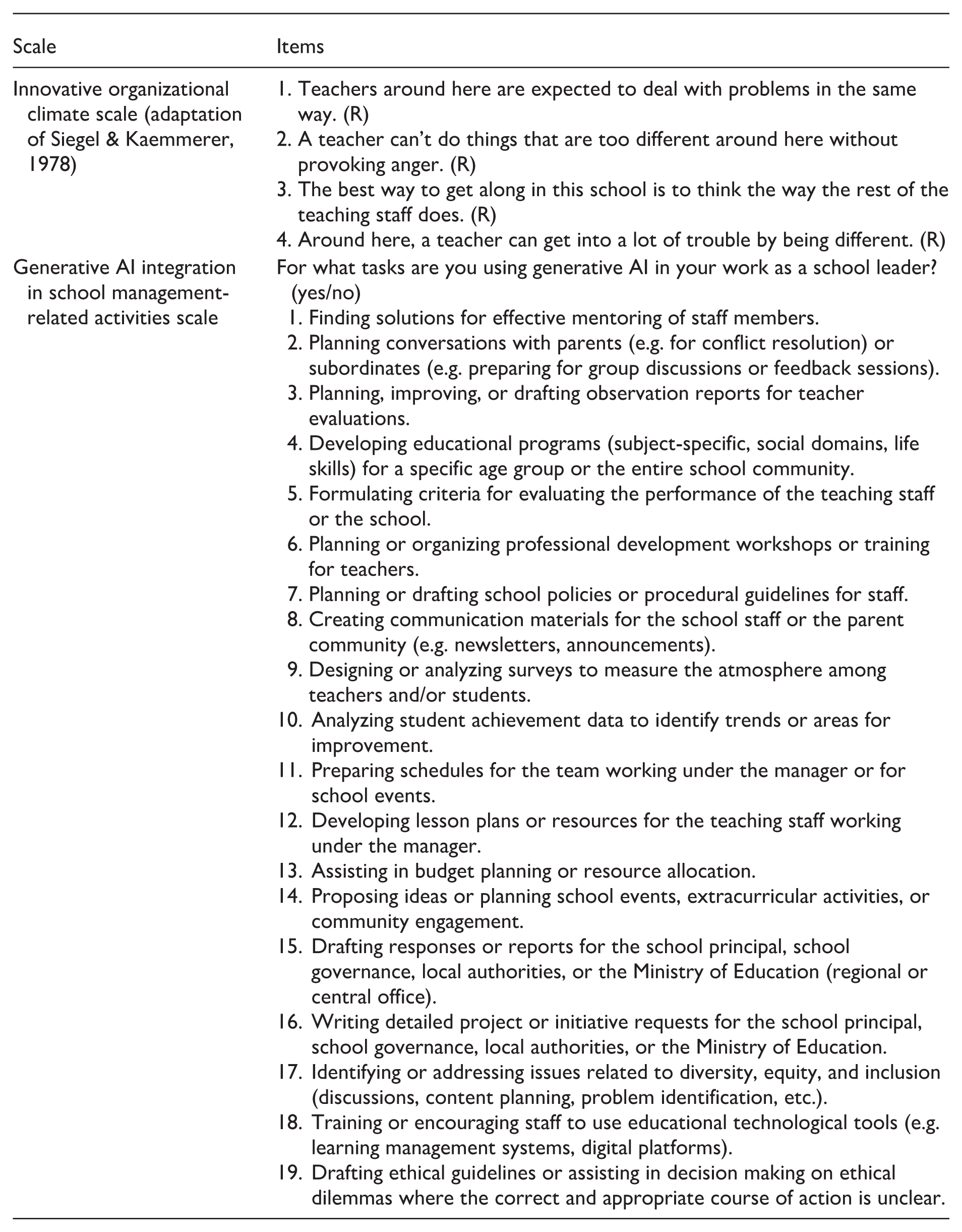
| Scale | Items |
|---|---|
| Innovative organizational climate scale (adaptation of Siegel & Kaemmerer, 1978) | 1. Teachers around here are expected to deal with problems in the same way. (R) 2. A teacher can’t do things that are too different around here without provoking anger. (R) 3. The best way to get along in this school is to think the way the rest of the teaching staff does. (R) 4. Around here, a teacher can get into a lot of trouble by being different. (R) |
| Generative AI integration in school management-related activities scale | For what tasks are you using generative AI in your work as a school leader? (yes/no) 1. Finding solutions for effective mentoring of staff members. 2. Planning conversations with parents (e.g. for conflict resolution) or subordinates (e.g. preparing for group discussions or feedback sessions). 3. Planning, improving, or drafting observation reports for teacher evaluations. 4. Developing educational programs (subject-specific, social domains, life skills) for a specific age group or the entire school community. 5. Formulating criteria for evaluating the performance of the teaching staff or the school. 6. Planning or organizing professional development workshops or training for teachers. 7. Planning or drafting school policies or procedural guidelines for staff. 8. Creating communication materials for the school staff or the parent community (e.g. newsletters, announcements). 9. Designing or analyzing surveys to measure the atmosphere among teachers and/or students. 10. Analyzing student achievement data to identify trends or areas for improvement. 11. Preparing schedules for the team working under the manager or for school events. 12. Developing lesson plans or resources for the teaching staff working under the manager. 13. Assisting in budget planning or resource allocation. 14. Proposing ideas or planning school events, extracurricular activities, or community engagement. 15. Drafting responses or reports for the school principal, school governance, local authorities, or the Ministry of Education (regional or central office). 16. Writing detailed project or initiative requests for the school principal, school governance, local authorities, or the Ministry of Education. 17. Identifying or addressing issues related to diversity, equity, and inclusion (discussions, content planning, problem identification, etc.). 18. Training or encouraging staff to use educational technological tools (e.g. learning management systems, digital platforms). 19. Drafting ethical guidelines or assisting in decision making on ethical dilemmas where the correct and appropriate course of action is unclear. |

Ethical Considerations
The study received ethical approval from the author’s university Ethics Committee.
Consent to Participate
Informed consent was obtained from all participants before data collection.
Funding
The authors disclosed receipt of the following financial support for the research, authorship, and/or publication of this article: This work was supported by the Open University of Israel’s Research Fund.
Declaration of Conflicting Interests
The author declared no potential conflicts of interest with respect to the research, authorship, and/or publication of this article.
Data Availability Statement
Data will be available upon reasonable request.