



Abstract
The COVID-19 pandemic has profoundly affected countries worldwide, including Europe. We gathered the opinions of a sample of 58 childhood and adolescent experts about the impact of the pandemic on these age groups, with a particular focus on proposing strategies to prepare the education system for future pandemics. Their responses were examined using lexical analysis via the Iramuteq software. Our findings highlight the need to prioritize the well-being and mental health of children and adolescents. These efforts entail giving them a voice in decisions that affect their lives and bolstering support systems, particularly for the most vulnerable individuals. Furthermore, we advocate for a coordinated approach involving education, social services and healthcare providers to effectively respond to the challenges posed by pandemics.
Introduction
The COVID-19 pandemic had multiple consequences, reshaping people’s lives in profound ways. It has represented one of the most significant crises since World War II, challenging humanity on an unprecedented scale (Ang, 2022; Ibert et al., 2022). Over time, public attention has gradually shifted away from COVID-19, as it no longer dominates headlines and other global crises have emerged with their own devastating effects (United Nations, 2021). Despite this shift, it remains essential to maintain a critical focus on the pandemic’s long-term consequences, which continue to affect our societies and offer lessons for better preparedness in future health emergencies.
The global crisis caused by COVID-19 affected not only health systems but also economies, social structures, and education worldwide (Alizadeh et al., 2023; Maqbool et al., 2023). Marginalized groups—such as migrants, women, and especially children and adolescents—faced disproportionate challenges (United Nations, 2021). While lockdowns were effective in controlling the virus, they exacerbated pre-existing inequalities and vulnerabilities (Mofijur et al., 2020). Among the most significant areas impacted were health, education, social welfare, and mobility, with consequences including increased psychological distress, poverty, educational disruption, and weakened social capital (Alizadeh et al., 2023). In fact, the World Bank (2020) reported the first global rise in extreme poverty since 1998, from 614 to 733 million people (Committee for the Coordination of Statistical Activities, 2021; World Bank, 2020).
Children and adolescents experienced particularly deep and multidimensional impacts, affecting their emotional, physical, academic, and social well-being (Berasategi et al., 2022; Jones et al., 2023; Viner et al., 2022). Professionals in pediatrics, psychology, and education have emphasized a critical deterioration in well-being and mental health among young people (Borel et al., 2022; Spiteri et al., 2023), highlighting the need for further research to design effective support strategies for future crises (Moss et al., 2023). Understanding these interconnected effects requires a multidimensional framework that considers how health, education, family, and community contexts interact to shape children’s experiences (Ben-Arieh et al., 2001; Bradshaw & Mayhew, 2005; Hanafin et al., 2007; Land et al., 2007).
Within this framework, several structural challenges became evident: the persistence and exacerbation of socioeconomic inequalities, rising school dropout rates, academic underachievement, limited digital access, and the difficulty of creating supportive home learning environments (Azorín, 2020; Haffejee et al., 2023; Pepe & Farina, 2023; Pokhrel & Chhetri, 2021). Teachers also struggled to adapt to new pedagogical formats and digital tools, while education systems revealed insufficient capacity for distance learning. These shortcomings underline the urgent need to strengthen educational resilience and equity in preparation for future disruptions.
School closures, adopted as a primary measure to limit virus spread, had an unprecedented global impact on education systems (Kumar & Bhatia, 2023). By March 2020, 1.57 billion students—nearly 90% of the global population—were affected, and disruptions persisted for many months (UNESCO, 2020). These closures generated anxiety, uncertainty, and distress among students, who faced canceled exams, social isolation, and reduced motivation due to the loss of daily structure and peer interaction (Hume et al., 2023; Spiteri et al., 2023; Uğraş et al., 2023). This situation underscored the essential role of schools as spaces not only for learning but also for emotional and social support, calling for comprehensive approaches to student well-being.
In many households, children spent significant time on schoolwork without adequate parental support, either because parents were overwhelmed by work responsibilities or lacked the necessary skills to assist (Roig & Nebot, 2020; Vivanco-Saraguro, 2020). This situation often became a source of family conflict and emotional tension (Burgess & Sievertsen, 2020; Cluver et al., 2020; Idoiaga et al., 2020a; Rodríguez-Pascual et al., 2022). Parental involvement is crucial not only for academic outcomes but also for children’s self-concept and emotional development (Álvarez et al., 2015). Moreover, the absence of school routines disrupted children’s emotional stability, underscoring the need for policies that integrate educational, psychological, and family dimensions (Hanno et al., 2022).
In summary, the COVID-19 crisis has posed major challenges to the educational and emotional well-being of children and adolescents. Consequently, there is an urgent need for studies that not only identify these challenges but also formulate actionable strategies to promote equity, quality education, and psychological well-being in future pandemic scenarios. The present study contributes to this effort by analyzing the perspectives of 58 experts in childhood and adolescence, identifying key proposals to strengthen the education system’s capacity to respond effectively to future crises.
Method
Sample
To recruit the sample a database was created with experts on childhood and adolescence working in: Spanish universities, NGOs working directly with children and adolescents, government services dedicated to the protection of children and adolescents and research centers on childhood and adolescence. In addition to this direct invitation to participate sent by email to respondents, the sample has been extended incidentally by asking respondents to forward the questionnaire to other colleagues, applying a “snowball” strategy. In addition, it was also disseminated on the social network Twitter as well as at face-to-face events where our project was represented and where the audience included potential participants. These latter strategies for disseminating the questionnaire have broadened its scope but have had the counterpart of less control over the recipients reached by the research. The inclusion criteria were flexible, given the essentially exploratory nature of the instrument and the breadth of the questions asked of the interviewees, which referred to broad aspects of the pandemic scenario. We sought to include, above all, highly educated people with or without management responsibilities in the aforementioned institutions who had experience in working directly in the pandemic context with the child population, both in the field of research and in social and educational intervention. The wide dissemination of the questionnaire, also using a “snowball” criterion, may explain, for example, the presence in our sample of a small group of “administrative technicians”; this generic occupational category includes in the Spanish administrative context also technical staff who work directly with the child population, usually within intervention programs, reception institutions or associations, such as social workers or technicians in sociocultural animation or social integration. Although their academic category is not that of experts, they have not been excluded from the sample because their experience in working directly with the child population in the pandemic scenario can provide a valuable perspective for the study.
Finally, this study involved 58 experts in the area of childhood and adolescence, 71% of which were women (n = 41) and 29% men (n = 17). The mean age of the participants was 50.2 years. Geographically, 16% were from Andalucía (n = 9), 2% from Asturias (n = 1), 2% from the Balearic Islands (n = 1), 2% from the Canary Islands (n = 1), 2% from Castilla and Leon (n = 1), 17% from Catalonia (n = 10), 5% from Valencia (n = 3), 2% from Galicia (n = 1), and 53% from Madrid (n = 31). In terms of their professional roles, 45% were university teachers (n = 26), 3% were researchers (n = 2), 10% were consultants (n = 6), 21% worked for NGOs (n = 12), 12% were administrative technicians (n = 7) and 9% indicated other roles (n = 5).
Procedure
An online open exploratory questionnaire was distributed to these participants, considering their expertise in the field of childhood and adolescence.
All the experts were provided with information about the study and gave their consent to participate, none of whom received any reward for participation. This research has obtained the approval of the Ethics Committee of the UPV/EHU (M10_2021_370).
In a more extensive questionnaire, the experts were asked the following question: “Due to the different consequences of the COVID-19 pandemic for the child and adolescent population, we would like to collect for each area three concrete proposals that would be necessary to implement in the future to alleviate the consequences of future pandemics or crisis and the reasons for them (Again, the length is free but we would be grateful if you could keep it to at least 3–4 sentences).”
Data Analysis Method
To analyze the socio-educational proposals put forward by the experts, the Reinert (1983, 1990) method was employed using Iramuteq software for lexical analysis (Marchand & Ratinaud, 2012). This method has frequently been employed to analyze the responses from open-ended questions (De Souza et al., 2018; Legorburu et al., 2022; Idoiaga Mondragon et al., 2021; Larruzea-Urkixo et al., 2021), and it has consistently been shown that the use of this method eliminates problems of reliability and validity in text analysis (Klein & Licata, 2003).
Using this method, which follows a descending hierarchical cluster analysis format, the analyst obtains a series of classes and statistical cues in the form of typical words and text segments (Idoiaga & Belasko, 2019). Specifically, the software identifies the words and text segments with the highest Chi-square values, that is, those words and text segments that best identify each class or idea that the participants have repeatedly mentioned.
First, the software creates a dictionary of ‘‘whole words’’ (nouns, verbs, adjectives, and adverbs). Then, the initial text corpus is broken down into segments that have the approximate length of one or two sentences (40 words; Kronberger & Wagner, 2000). The corpus is analyzed in terms of the presence of whole words in the segments. The segments and reduced forms are used to create a contingency table, which shows the distribution of vocabulary per segment. From this contingency table the program generates a squared distance matrix, indicating that two segments are in close proximity if they share some of the analyzed words (Reinert, 1996).
Subsequently, following the Reinert method, the software runs a descending hierarchical cluster analysis on this distance matrix, which yields classes of segments that best differentiate the vocabulary. In so doing, this software assists in the interpretation of texts. It extracts sets of words that are referred to as classes, which co-occur and are best differentiated from other classes. The software does not name these classes but instead assigns them with a number.
In accord with previous research using the Reinert method (Camargo & Bousfield, 2009), the raw data were entered into the Iramuteq software, and the most significant items of vocabulary in each class were selected based on three criteria: (1) an expected value of the word greater than 3; (2) evidence of an association based on the Chi-square statistic, tested against the class (χ² ⩾ 3.89; p = .05; df = 1); and (3) the word appearing mainly in that class with a frequency of 50% or more. Iramuteq software also determined which text segments were associated with each class or group of words and classified them according to their Chi-square value. In this study, we retained the text segments with the most significant Chi-squares of each class.
This approach provides the basis for “interpreting” the classes as lexical worlds. The Reinert method produces statistical, transparent, and reproducible data until the final point of interpretation, where the analyst then assigns a label. Finally, the researchers will give a title to the group of words and text segments grouped by the software (Schonhardt-Bailey, 2013). In this final phase, to create the labels or titles of each class, this research used a systematic process. During this process, two of the researchers independently named each class based on the words and associated quotations, after which a third researcher created a final label that was approved by all three researchers.
Results
The full corpus contained 2,487 words, of which 830 were unique. The Reinert method’s descending hierarchical analysis divided the corpus into 167 segments and six classes. The results of this analysis can be observed in Figure 1.
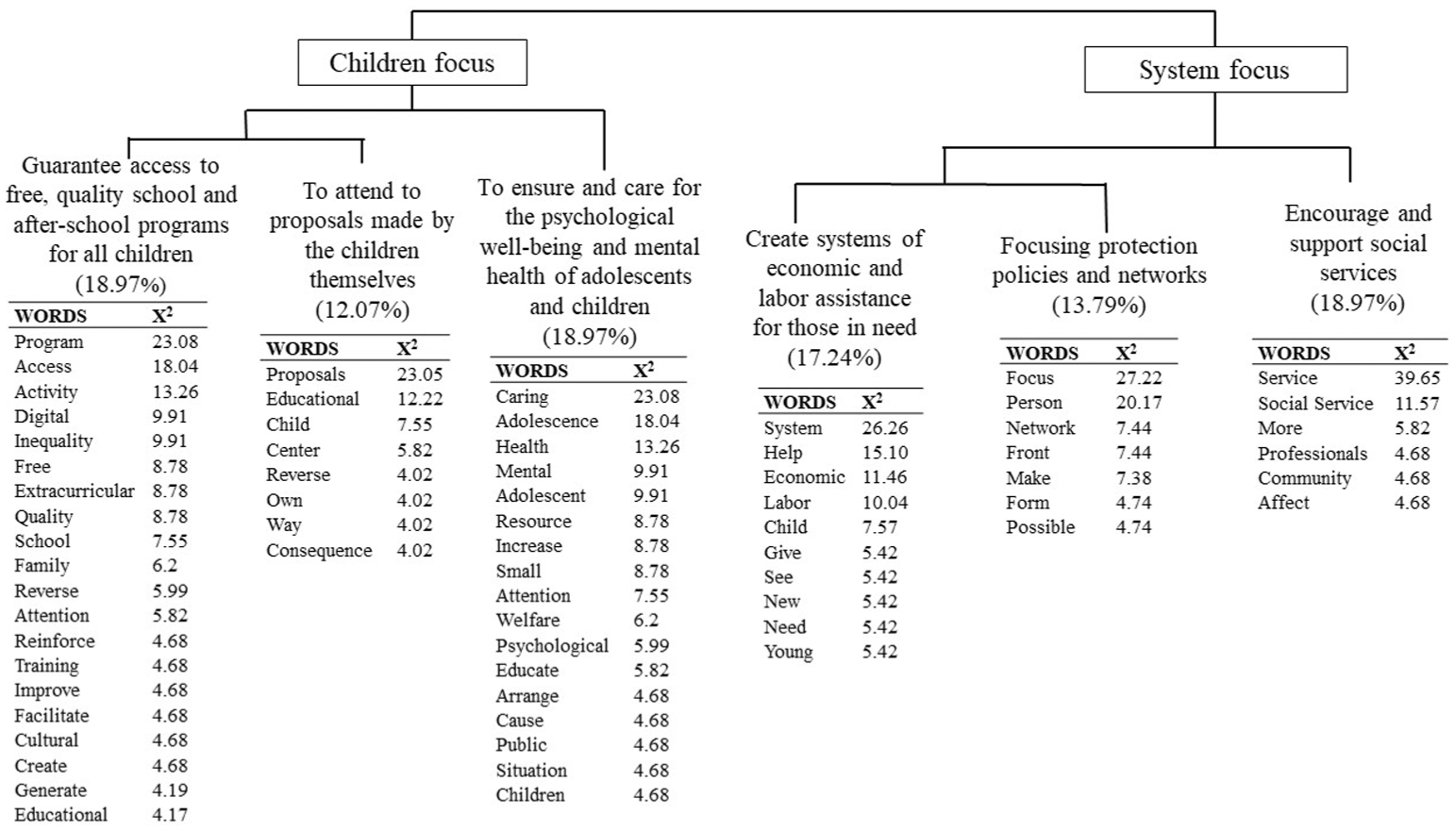
The hierarchical clustering dendrogram of the corpus extracted from the experts’ proposals, showing the words with the greatest association for each class χ2(1), p < .001 revealed by the Reinert method.
The analysis identified the primary recommendations offered by the experts to mitigate the consequences of the pandemic. Each reason or argument is represented by a set of typical words and text segments, denoted as a class. The results revealed six distinct classes. Three of these are primarily concerned with children’s needs and were labeled as: “Ensure access to free, quality school and after-school programs for all children,” “Acknowledge suggestions made by the children themselves,” and “Ensure the psychological well-being and mental health of adolescents and children.” In contrast, the other three classes emphasize the requisite systemic or policy changes and were labeled: “Create economic and labor support systems for those in need,” “Prioritize protective policies and support networks,” and “Encourage and support social services.”
Among the classes which set out proposals centered on children, the first is “Ensure access to free and quality school and after-school programs for all children,” which emerged with a weight of 18.97%. Within this class, the experts reflect on the importance of all children having access to educational programs in both formal and non-formal education and leisure environments. To provide a context for these words, the characteristic text segments should be observed. The following are the most significant quotations (that is, the quotes with the highest chi square) of this class:
Launch ambitious programs to level educational opportunities to try to reverse the inequalities created or exacerbated by the pandemic. Not only in the educational field itself (school materials, digital access, etc.). But also by facilitating access to quality extracurricular activities for low-income families. (X2 = 125.03; Teaching and research professional of a university or research center, Male, Andalucía).
For children, free technology access projects and increase the necessary resources for possible telematic training scenarios, educational scholarships, energy at home etc. For families with children, job insertion programs for families with dependent children. (X2 = 64.95; Teaching and research professional of a university or research center, Female, Valencia).
In many cases, extracurricular activities are the gateway to other cultural and educational experiences, in this sense, the offer of complementary and extracurricular activities should be increased, and attention programs should be encouraged. (X2 = 55.79; Teaching and research professional of a university or research center, Female, Andalucía).
To reinforce attention to the educational inequality generated by Covid-19, guaranteeing their access to a quality public education with the technological resources necessary for the educational development of children. (X2 = 55.59; Staff of a non-profit organization [NGO], Female, Madrid).
Personalization of educational attention, eradication of child abuse, free and compulsory school canteens for the entire school population in pre- and compulsory education stages. (X2 = 26.32; Teaching and research professional of a university or research center, Male, Valencia).
The second class focused on children, “Acknowledge the suggestions made by the children themselves” emerged with a weight of 12.07%, emphasizing that as a society we pay little attention to children and adolescents and give them few opportunities to propose resources of interest to them. These are some of the most significant quotations of this class:
It is necessary to allow greater child participation in schools to listen to the proposals that children and adolescents themselves have on how to reverse the worst educational consequences of the pandemic. (X2 = 67.57; Teaching and research professional of a university or research center, Male, Valencia).
To reinforce capacities and competences for online education in case we have to face new pandemic episodes with increased child participation. (X2 = 57.67; Teaching and research professional of a university or research center, Male, Valencia).
Consolidate the importance of the educational community, including children, to establish mechanisms for joint reflection among social actors in the school environment and spaces for reflection that require co-presence. (X2 = 19.96; Freelance professional; Male; Madrid).
Recovering spaces for sensory stimulation for children from 0 to 6 years of age. It is necessary to implement psychomotor and stimulation programs to alleviate the deficiencies in this age group and to develop spaces that allow group socialization in the open air. (X2 = 19.96; Freelance professional; Male; Madrid).
The third class detailing child-centered proposals arises from the two previous classes, pointing to the importance of “Ensuring the psychological well-being and mental health of adolescents and children” and emerged with a weight of 18.97%. This class emphasizes the importance of children’s well-being, especially in terms of mental health and psychological wellbeing. The following are some of the most significant quotations of this class:
Availability of psychological care financed by social security for emotional stress situations in adolescence as a cause of the covid pandemic and the trauma caused by it. (X2 = 67.33; Freelance professional; Male; Madrid).
Increase in resources for children and adolescents’ well-being, increase in the number of professionals in all areas that serve the child and adolescent population, including teachers, psychologists, doctors, social workers, sociocultural animators, and integrators etc. (X2 = 66.80; Administration; Female; Madrid).
Suppression of homework at home, the burden on families is excessive. Presence of a protective welfare figure in schools to address emotional and mental health situations. (X2 = 55.25; Freelance professional; Female; Madrid).
On the other hand, the experts also offered suggestions on how to change the child protection system. The first of these classes was labeled, “Create economic and labor support systems for those in need,” which emerged with a weight of 17.24%. In this class, the experts propose various ways of improving the healthcare (including mental health), education, and resource systems. Some of the most significant quotations of this class are:
Financial aid for children and young people with educational and labor insertion problems as a result of the situation generated by the pandemic, development of accessible and universal diagnostic, treatment and health follow-up systems for physical and mental problems. (X2 = 78.98; Teaching and research professional of a university or research center, Male, Madrid).
Increased resources in the public education system so that it does not become a disadvantaged system, strengthen policies to support parenting and the reconciliation of family and work life by providing financial aid to families based on their income. (X2 = 65.99; Teaching and research professional of a university or research center, Female, Madrid).
Our system lacks resources, but also more flexible attitudes on the part of the teaching staff and a lack of capacity to adapt to challenges of this magnitude during the pandemic, and we have also seen that the system provides very little space for citizen participation and even less for the younger population. (X2 = 42.42; Teaching and research professional of a university or research center, Female, Cataluña).
The next class concerning system-focused proposals was labeled “Prioritizing protection policies and networks” with a weight of 13.79%. In this class, the experts call for the need for institutional policies and public networks to address the consequences of the pandemic for wellbeing, concerning both Covid-19 and future pandemics that may affect the population. The most significant text quotations of this class are:
To put the structural precariousness of families at the center of policies. It is not possible to deal with the consequences of the pandemic if we do not focus on what generates precariousness and poverty and tackle this problem. (X2 = 55.92; Freelance professional; Female; Madrid).
The pandemic has shown that the public policies that were being implemented before were already insufficient and that we are far from being prepared to face the emotional and psychosocial consequences of any pandemic. (X2 = 48.02; Teaching and research professional of a university or research center, Female, Cataluña).
This will not be the last pandemic and we must learn for the future so that outdoor socialization spaces can be preserved as much as possible. Policies should be aimed at reducing the isolation felt by many people while building protective emotional networks. (X2 = 43.07; Freelance professional; Female; Balearic Islands).
Many of these networks were set up naturally during confinement and efforts should be made to preserve them. (X2 = 43.07; Freelance professional; Female; Balearic Islands).
The last class concerning system-focus proposals arose from the two previous classes and was labeled “Encourage and support social services,” emerging with a weight of 13.79%. In this class, the experts discuss the importance of social services and offer suggestions on how to improve their quality and accessibility. The following are some of the most significant quotations of this class:
To increase the public and community network of social and educational services it is very important that all people, especially the most vulnerable groups, have access to education and other cultural and educational services in the school. (X2 = 61.72; Teaching and research professional of a university or research center, Female, Andalucía).
It is necessary for social services to work with educational, health, and housing services. We must seek greater participation and political representation of children and adolescents in all matters that affect them. (X2 = 57.97; Staff member of a non-profit organization [NGO] or third sec, Female, Madrid).
We should take examples of good practices in social services within countries such as Germany and Estonia. (X2 = 51.22; Technical or professional subcontractor of the public administration, Female, Andalucía).
Stop the privatization of social services related to social rights by increasing the funding of these services and by opening pools of workers for activities and workshops for children and adolescents. (X2 = 51.22; Technical or professional subcontractor of the public administration, Female, Andalucía).
Discussion
The findings of this research offer valuable insights from experts in childhood and adolescence. They have helped identify the effects of the pandemic within the educational sphere and offer recommendations to improve the educational system in preparation for future pandemic scenarios. The main proposals put forward by these experts to mitigate the consequences of the pandemic within the educational domain can be categorized into two main clusters. The first cluster concerns the specific needs of children, including aspects such free time activities, attentiveness to proposals voiced by the children themselves, ensuring their psychological wellbeing, and providing after-school programs. The second cluster focuses on urgent systemic responses, which include establishing adequate economic and labor support systems for those in need, promoting protective policies and networks, and encouraging and supporting social services.
The experts in our study emphasized the importance of placing children at the center of the proposals and creating them with a thorough consideration of their needs, while also actively involving children in the decision-making process. They stressed the necessity of promoting greater child participation within schools to listen to the suggestions and insights that children and adolescents themselves can offer on how to mitigate the adverse educational consequences of the pandemic. This perspective aligns with Article 12 of the United Nation’s Convention on the Rights of the Child (United Nations, 1989), which recognizes children’s right to have a say in matters that affect their lives. Various authors have also advocated for the meaningful and essential contributions of children on issues that directly concern them, including the COVID-19 scenario (Idoiaga et al., 2020a, 2020b; Idoiaga Mondragon et al., 2022, 2024; James & Proud, 1997; Llena & Novella, 2018; McMellon & Tisdall, 2020; OCDE, 2020; Martínez Muñoz et al., 2020; Unicef, n.d.).
In addition, the experts highlight the significance of ensuring the quality of education, particularly in challenging and adverse situations. As confirmed by other studies, the school closures had a negative impact on students (Hume et al., 2023; König & Frey, 2022; Mazrekaj & De Witte, 2023; Zhong et al., 2024), necessitating the development of programs aimed at mitigating the negative consequences of future pandemics. Such support entails not only the provision of material and digital resources for all students but also the promotion of initiatives designed to level the playing field within education and address the inequalities created or exacerbated by the pandemic (Casey & McKendrick, 2023).
In this regard, offering training to parents in digital competences becomes essential, along with providing additional tutoring for students who require extra support for understanding their schoolwork (Austin et al., 2023; Bayrakdar & Guveli, 2023). These efforts will enhance the quality of education and ensure that students can thrive in the face of such challenges. Moreover, experts point out in the necessity of launch ambitious programs to level educational opportunities to try to reverse the inequalities created or exacerbated by the pandemic, not only in the educational field itself (school materials, digital access, etc.) but also guaranteeing all the students access to a quality public education with the technological resources necessary for the educational development of children.
Another crucial aspect that requires attention is ensuring access to high-quality extracurricular activities for low-income families. It is noted that in many instances, extracurricular activities serve as a gateway to other cultural and educational experiences (Finnerty et al., 2021; Richmond et al., 2022). Therefore, it is recommended to expand the availability of complementary and extracurricular programs while promoting support initiatives. Various studies show that participation in extracurricular activities has a positive impact on academic and professional success in COVID-19 pandemic (Ilari et al., 2022; LaForge-MacKenzie et al., 2022).
In this context, it is of utmost importance to place the well-being and mental health of children and adolescents at the forefront of the issue and recognize its significance. It is crucial to acknowledge that in situations like the pandemic, the mental health and well-being of adolescents can decline, and children and adolescents are at a higher risk of experience elevated rates of depression and anxiety during and after such a crisis (Deng et al., 2023; Madigan et al., 2023; Wang et al., 2022). Interventions such as support services, additional educational support, and psychological services have been shown to effectively mitigate mental health issues among children and adolescents (Reupert et al., 2022; Stewart et al., 2022).
Second, the experts highlight the essential role of institutional policies and public networks in addressing the consequences of the pandemic. In this regard, it is imperative to place precarious and vulnerable families at the center of policy initiatives, with particular emphasis on identifying and mitigating the root causes of instability and poverty while providing necessary support. This comprehensive approach should involve the education system, social services, and the broader social context. Moreover, various other studies also highlight the necessity for governments to respond effectively to the pandemic and prepare for potential future adverse events (Ţigănaşu et al., 2023). Such a response entails the adoption of equitable policies, identifying the required changes within socially affected contexts, and taking responsive measures. Moreover, collaboratively designed approaches are crucial to increasing social resilience (Alizadeh & Sharifi, 2022).
In this context, the promotion and support of social services emerge as a key focal point. The state played a central role in implementing policies to support individuals and businesses, fostering a recovery process that is more resilient, inclusive, and sustainable (United Nations, 2021). UNESCO has also highlighted the increasingly evident role of social and health services both during and after the pandemic (UNESCO, 2023). These services will play a vital role in facilitating economic recovery by supporting the social inclusion of the most vulnerable in local communities worldwide. Public social services must continue to guarantee support for those in need. Drawing from the experiences thus far, several recommendations can be formulated to dealing with the aftermath of the pandemic: (1) Recognize social services as essential services, (2) Invest in social services to better prepare for future crises, and (3) Support the social service workforce and implement specific measures for vulnerable groups (European Social Network, 2021). The pandemic underlined the need for social services to be more agile in-service development and delivery. It is therefore important that social services also receive the necessary training to incorporate new approaches and technological tools into their operations (European Social Network, 2021).
Experts emphasize the importance of social services and the imperative need to improve their quality and availability. To expand the public and community network of social and educational services, it is crucial that all individuals, particularly the most vulnerable groups, have access to education and other cultural and educational services offered by non-formal educational settings. Moreover, there is a pressing need for increased coordination among various sectors, bridging social services with educational, health and housing services to create a more robust support system. Increasing the funding of these services to establish pools of workers for activities and workshops aimed at children and adolescents is essential. This approach will help to build a human rights-based system to protect and cherish individuals, devising policies that are grounded in principles of rights, democracy, and the rule of law. By adopting this strategy we can minimize the devastating social, economic, and humanitarian consequences of COVID-19 and build back societies that are resilient and equitable (Committee for the Coordination of Statistical Activities, 2021).
This research presents several limitations that should be acknowledged. First, its exploratory nature implies that the results should be interpreted as preliminary and open to further verification; nevertheless, the open-ended design that allowed experts to respond freely and without a pre-defined script can also be considered one of the study’s greatest strengths, as it enabled a wide range of reflections and insights to emerge beyond rigid analytical categories. Second, the composition of the sample deserves consideration. The research deliberately focused on experts in childhood and adolescence rather than on professionals working directly with children, such as teachers, educators, parents or the children themselves. This choice was coherent with the exploratory purpose of gathering reflections from professionals with a broad and systemic perspective on the consequences of the pandemic, although future research could benefit from comparing these expert perspectives with those of practitioners and families to identify possible convergences or divergences. Third, the sample size and the over-representation of university-based experts should also be mentioned as potential limitations. Although no significant differences were found according to profession, gender or geographical area—suggesting internal coherence in the data—the incidental and non-probabilistic nature of the sample inevitably introduces certain biases that should be taken into account when interpreting the findings. Overall, these aspects confirm the exploratory character of this research and point to the value of developing complementary studies that include more diverse participants and methods to further validate and expand the insights obtained here.
In conclusion, and from a practical standpoint, it is imperative to create environments where all students, particularly those that are vulnerable, have access to educational resources. Digital access is necessary, but not sufficient. Thus, equipping families with digital skills and providing them with are vital steps toward delivering better support for all. Moreover, education programs, both formal and informal, should be designed to grant students access to a diverse range of cultural and educational experiences. Enhancing coordination between healthcare, social services, and education is key. It is also essential to promote holistic health care programs aimed at nurturing the mental well-being and overall health of all students. Moreover, it is crucial to center policies on supporting precarious and vulnerable families, with a specific focus on identifying and addressing the root causes of their instability and poverty. In this regard strengthening the existing capacities and addressing the gaps within core institutions responsible for planning, designing, and implementing social protection systems is of utmost importance. This coordinated response, involving education, social services, and healthcare, is essential to “build back better” in the aftermath of COVID-19 (Committee for the Coordination of Statistical Activities, 2021) and to avoid similar crises in the future. This aligns with the call for strengthening resilience at all levels to foster a more inclusive and sustainable world (United Nations, 2021).
Footnotes
Declaration of Conflicting Interests
The authors declared no potential conflicts of interest with respect to the research, authorship, and/or publication of this article.
Funding
The authors disclosed receipt of the following financial support for the research, authorship, and/or publication of this article: Project funded by the Ministry of Science and Innovation through the 2020 call for R+D+i project grants. REF: PID2020-119011RB-I00/AEI/10.13039/501100011033.

Ethical Considerations
This research has obtained the approval of the Ethics Committee of the UPV/EHU (M10_2021_370).