




Abstract
School climate and its individual components impact students’ health and wellbeing. This research explores adolescents’ perspectives on what would make a better school life in Aotearoa, New Zealand. Responses to an open text question: “if you could change one thing about your school/course to make it better, what would it be?” were analysed using framework analysis across the four school climate domains and by sociodemographic characteristics. Overall, 3,455 of 7,721 participants provided a response to this optional survey question. Participants highlighted multiple opportunities for improving school climate including providing more diverse subjects and extracurricular opportunities, more supportive teachers, greater acceptance of diversity, reducing strictness on uniforms to allow for self-expression, reducing bullying, and supporting healthy peer relationships. Policy and social changes are necessary to make “a good school life” a reality for youth in Aotearoa New Zealand.
Introduction
Schooling has been identified as one of the most important contexts for youth wellbeing and development (Bernat & Resnick, 2006; Lombardi et al., 2019). School climate, as a malleable and multidimensional construct, can be used to encapsulate the array of components contributing to a positive school life (Lombardi et al., 2019; Steinmayr et al., 2018; Wang & Degol, 2016). Wang and Degol (2016) identified four domains contributing to school climate: (1) academic, (2) community, (3) safety, and (4) institutional environment. The academic domain focuses on the overall quality of the academic atmosphere, which includes curricula, teacher training, professional development of staff, and teacher quality (Wang & Degol, 2016). The community domain focuses on the quality of interpersonal relationships within the school setting. The safety domain refers to physical and emotional security, as well as the presence of effective, consistent, and fair disciplinary practices. The institutional domain focuses on the organisational or structural features of the school environment. These domains do not exist independently, but rather cross-over and influence one another.
Each domain separately, as well as overall school climate have various implications on a young person’s health and wellbeing. For example, students who report feeling physically safe at school are shown to have improved classroom engagement, greater academic success, and increased wellbeing (S. Williams et al., 2018). Students who report positive interpersonal relationships at school report greater feelings of safety and connection to school and are less likely to display behavioural problems (Long et al., 2021; Loukas et al., 2006). Furthermore, supportive, warm, and positive teacher-student relationships are associated with improved student mental health, decreased drop-out rates, lower levels of aggression, and increased overall wellbeing (Evans & Field, 2020; Kidger et al., 2012; Marsh et al., 2014). An overall positive school climate may lead to greater standardised school achievement (Steinmayr et al., 2018; Thapa et al., 2013). Ultimately, a positive school climate can help to promote the constructive change necessary for young people to live a valuable and fulfilling life (Cohen et al., 2009).
Young people have the right to have their perspectives heard on matters of importance to them, and to have these perspectives taken seriously (United Nations, 1989). Research consistently shows that young people have unique and important perspectives about their social and physical environments that impact their wellbeing (M. Smith et al., 2026; Sullivan et al., 2021; T. Williams et al., 2024). Understanding youth perspectives about factors in the school setting that impact them is essential to inform efficacious programmes and policies. However, while it is established that a positive school climate is associated with increased student wellbeing, little is known what could improve school climate from adolescents’ perspectives (i.e. using open-ended methods rather than pre-defined questions which can be limited in their focus; Bonell et al., 2019; Enkhtur et al., 2023; Koth et al., 2008). Additionally, context-dependent information is needed, to develop approaches that are appropriate and acceptable to the population of interest (Bonell et al., 2019). Using the framing of school climate as defined as Wang and Degol (2016) this research aims to explore adolescents’ perspectives on what would make a better school life from a large-scale community survey conducted in Aotearoa, New Zealand (NZ). The main arguments of this paper are that: (1) school climate is a useful framework to understand factors for student wellbeing, and (2) it is essential that adolescent perspectives are brought to the fore when seeking to understand how school climate can be improved for student wellbeing.
Methods
Protocol
This was a cross-sectional, small-q qualitative study informed by a pragmatic philosophical paradigm. A pragmatic approach aligned with the research aim to develop practical insights that inform action in real-world contexts. A small-q approach aligned with the outcome data available, which were brief textual comments (e.g. 2–3 words to a sentence) that limited deep inductive and latent analyses and theoretical interpretation. This is in contrast with big-Q qualitative analyses, commonly situated in interpretivist or constructionist paradigms, with explicit theoretical grounding and involving high researcher reflexivity and active roles in meaning-making (Braun & Clarke, 2024). This study drew from Youth19, the 2019 wave of the Youth2000 survey series involving repeat cross-sectional surveys conducted with secondary students in NZ in 2001, 2007, 2012, and 2019. The Youth2000 survey series explores key aspects of adolescent wellbeing, including substance use, sexual health, mental health, family and school relationships, and sociodemographic factors. Surveys are predominantly quantitative, and in some instances open-ended text responses are gathered. The outcome data for the current study were open-ended text responses as outlined below.
Participants
The Youth19 Rangatahi (Youth19) Smart Survey was conducted in 2019 across the Northland, Auckland, and Waikato regions of NZ. Co-educational, single-sex, public, private, and fully integrated schools with more than 50 year 9 to 13 students were eligible for inclusion. Participants were enrolled students from Years 9 to 13 (approximate ages 13–17 years). In total, 45 English-medium schools and 4 kura kaupapa Māori-medium (schools based on Indigenous Māori language, culture, and values) agreed to participate. For English-medium schools with more than 150 students in each year level, 30% of students were randomly selected from the school roll. In schools with fewer than 150 students, at least 30 students were randomly selected. All students from kura kaupapa Māori-medium schools were invited to participate. Students also had the opportunity to withdraw at any point throughout, and all survey questions were optional.
Measures
Outcome measure. As part of a series of questions about the school and learning environment, all students who reported attending school, alternative education, or training course were asked an open text question, “If you could change one thing about your school/course to make it better, what would it be?” and were able to type in responses in their own words. No character limit was given (answers could be as long as students wanted).
Sociodemographic information. Information about participants’ ethnicity, gender, disability, and school decile were also extracted. For ethnicity, participants were asked which ethnic group they belonged to which was classified using Statistics New Zealand ethnic standards level prioritisation (i.e. Māori, Pacific, Asian, Pākehā/European, Other ethnicity; Statistics New Zealand, 2020). For gender, participants specified whether they identified as a boy/man, girl/woman, or whether they identified in another way. Participants who responded to either boy/man or girl/woman, as well as identifying in another way were coded as identifying in another way. Participants were asked “Do you have any long-term disabilities (lasting 6 months or more) e.g. sensory, impaired hearing, visual impairment, in a wheelchair, learning difficulties?” Response options were yes, no, or don’t know. School decile is utilised by the Ministry of Education for funding allocation. It is based upon five indicators of meshblock-level census data: household income, household crowding, parental educational qualifications, proportion of parents on income support benefits, and occupational skill level of employed parents. School decile was grouped into low (deciles 1–3), medium (4–7), and high (8–10), whereby lower decile indicates more socioeconomically impoverished areas.
Procedure
Data were collected in a large space (e.g. gym) in schools during school time. Students were spread out around the room so that others could not see their screen and completed surveys on hand-held internet tablets using Qualtrics Core XM (Qualtrics, Provo, UT). Students were provided with headphones and survey questions could be either read by the students or played aloud, either in te reo Māori (Māori language) or English. All students were prompted to watch an introduction video, followed by consent information. Consenting students continued to undertake the survey and non-consenting students returned to class. Ethics approval for this study was granted by the host institution ethics committee (#022244). An application for data access for the following measures was approved by the Adolescent Health Research Group (AHRG) on 20 July 2022; data were provided by the AHRG biostatistician in Microsoft Excel format thereafter.
Data Analysis
Framework analysis (Gale et al., 2013; Ritchie et al., 2003) was used to understand factors of importance for adolescents across the four school climate domains and by sociodemographic characteristics. This approach involves employing a pre-determined framework to help organise coding in a systematic, comprehensive, and transparent way. It was deemed appropriate as it prioritises producing findings that can directly inform policy and practice, aligning with our pragmatic positioning. Framework analysis is useful when multiple researchers with varying degrees of experience in qualitative analysis are working on the data, where large datasets with many participants are being examined, and where the purpose is to gain a holistic, descriptive overview of the data (Gale et al., 2013). Additional considerations were our interest in understanding factors of importance across the school climate framework and that participant comments were mostly brief (i.e. a few words to one sentence/statement) and so were not well suited to in-depth thematic analysis. Stages of data analysis were: (1) data familiarisation, involving multiple readings of data and discussions between co-authors, (2) deductive and inductive open coding (i.e. coding all content including substantive topics, values, emotions, and drawing from literature and discussions between co-authors), (3) refining the working analytical framework (i.e. grouping similar codes where appropriate, agreeing on codes to apply for full dataset), (4) applying the analytical framework, (5) charting the data into the school climate domains, and (6) interpreting the data.
Results
Participant Characteristics
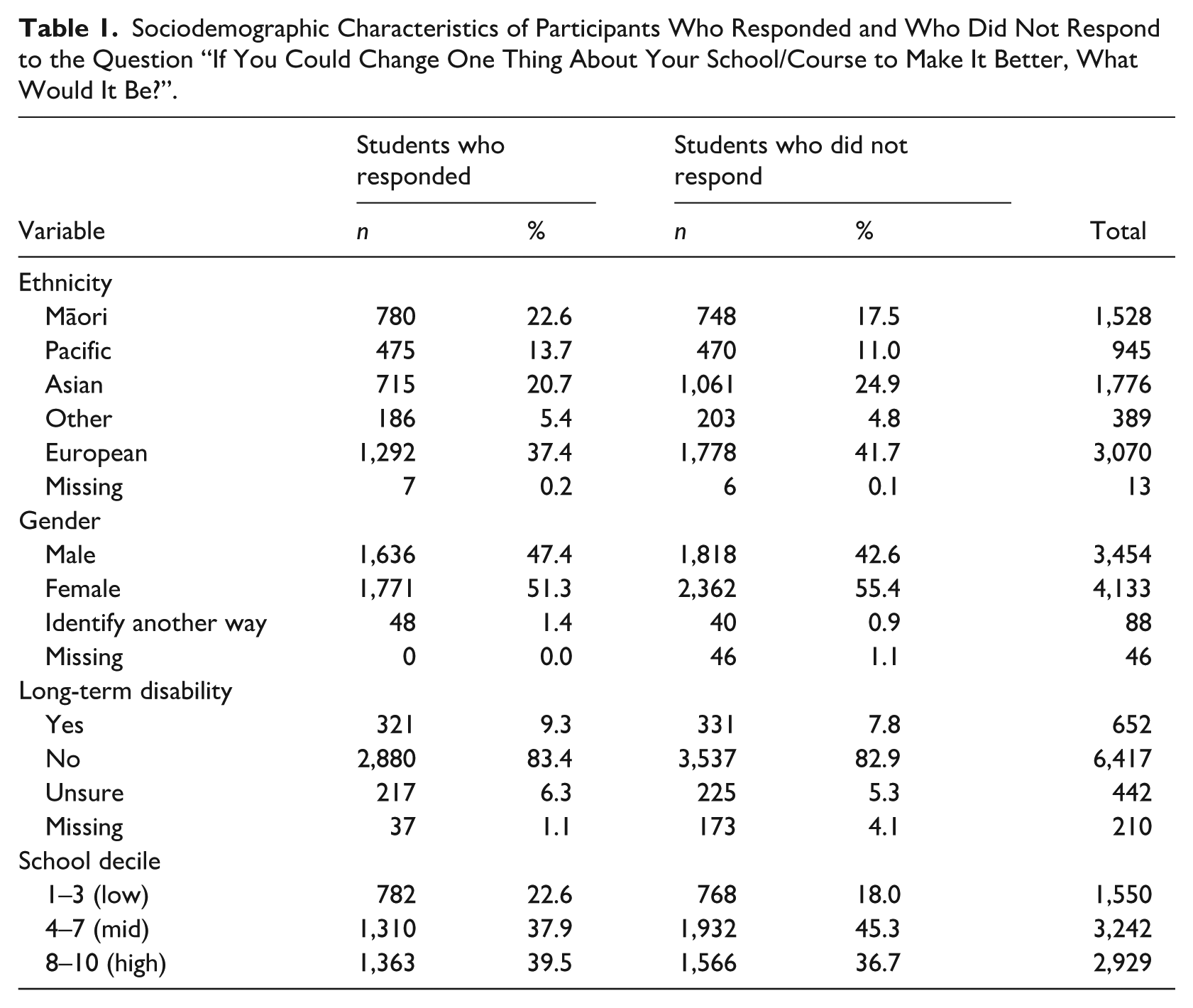
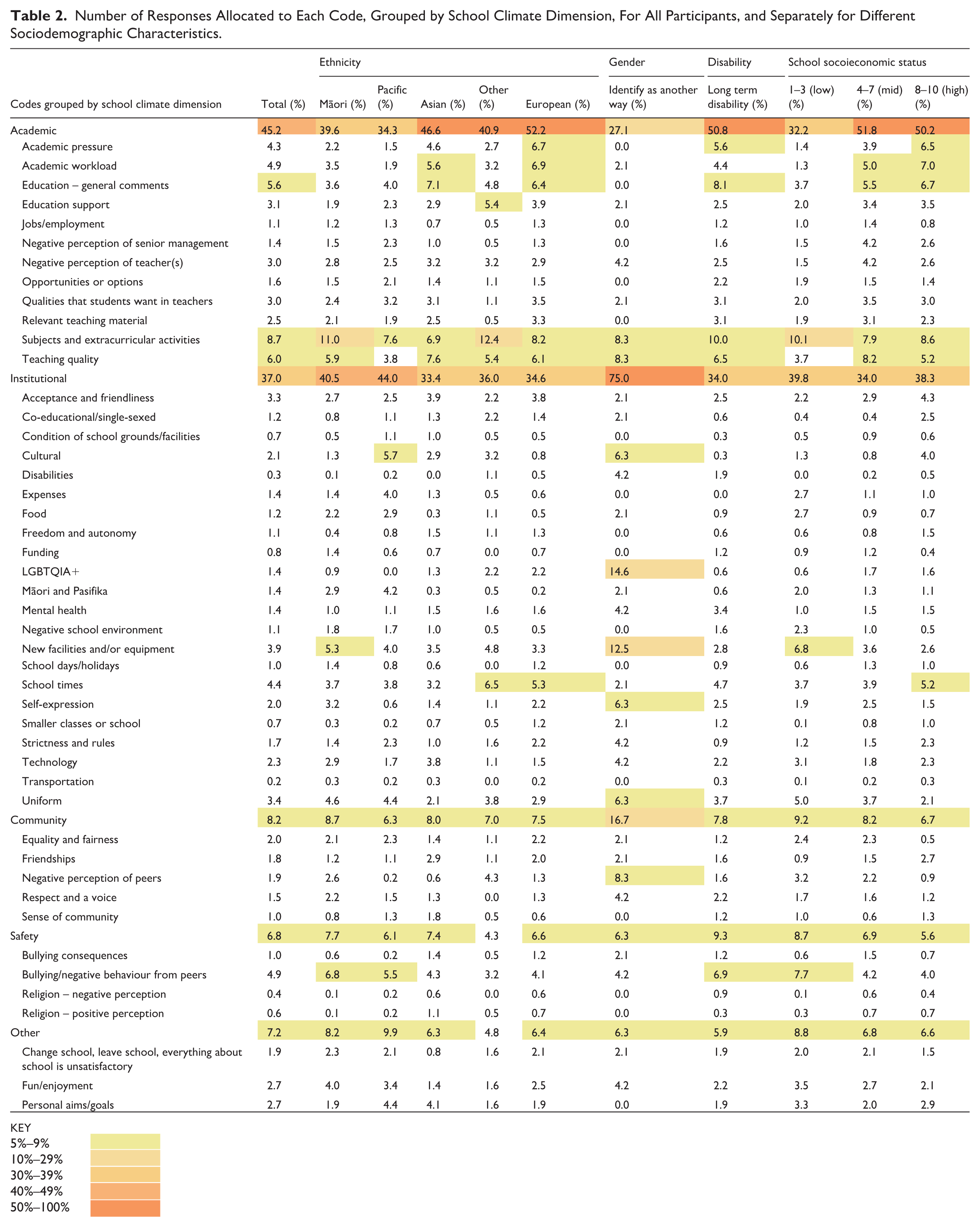
A summary of sociodemographic characteristics for participants who responded to the open ended question about what would make their school/course better and who did not respond is provided in Table 1. Slightly more participants who identified as Māori and slightly less participants who identified as Asian responded to the question, otherwise sociodemographic characteristics were relatively similar between the groups. Table 2 shows proportions responses allocated to each code, grouped by school climate dimension, for all participants, and separately for different sociodemographic characteristics. We recognise that the four domains of school climate overlap, therefore some aspects that go across multiple factors, such as teaching quality, will only be discussed in one domain.
Sociodemographic Characteristics of Participants Who Responded and Who Did Not Respond to the Question “If You Could Change One Thing About Your School/Course to Make It Better, What Would It Be?”.
Number of Responses Allocated to Each Code, Grouped by School Climate Dimension, For All Participants, and Separately for Different Sociodemographic Characteristics.
Academic Factors
This topic focused on the different aspects that can impact on a student’s academic experience and made up the majority of responses (1,560 comments, 45.2% of total respondents). Most of the comments within this topic focused on subjects and extracurricular activities (300 comments, 8.7%), teaching quality (207 comments, 6.0%), general comments on education (192 comments, 5.6%), academic workload (171 comments, 4.9%), and academic pressure (150 comments, 4.3%). Regarding subject choice and extracurricular activities, students commented on the need for a wider range of options including more diversity in subjects and extracurricular activities offered (e.g. “More diverse out of class activities would help too in getting students involved”), and being taught material that was relevant for their future, such as financial literacy and current affairs as exemplified by one student: “More practical work in subjects as well as more creative options or teaching more important life skills than what they do now.” Comments on teaching quality included wanting to have “better” teachers, in some cases referring to wanting teachers to be fairer, to be more accepting of diversity, to employ more effective and inclusive teaching strategies, to have better subject knowledge, or to have a better understanding current issues facing youth, for example: “More respect of the personal situations of their students. Teachers need to have an understanding of the factors that might be affecting their students that will affect their school work.” Some students indicated a desire for better academic support for themselves and others, seen in the quote “teachers wanting to help me and my classmates, without making us feel as if we are annoying them.” General comments on education included comments around streaming (i.e. grouping students by their perceived ability level). Some students wanted streaming to stop, while some had a desire to have streamed classes. Comments on academic workload and academic pressure included concerns regarding the overwhelming volume of school work and the need to ensure “balance between workload, sports and other after school activities” with students noting a desire to make things “more manageable for students with co-curricular activities.”
Institutional Environment
The next topic included comments on the institutional environment of school (1,280 comments, 37.0% of all participants). This focused on different organisational or structural features. This included comments on structural features of school, such as school times (151 comments, 4.4%), new facilities and/or equipment (135 comments, 3.9%), and uniform (116 comments, 3.4%). Regarding school times, students included in this code reported wanting school to begin later in the day. Reasons for this included a lack of sleep, being unable to learn effectively early in the morning or feeling fatigued at the end of the day, seen in the quote “start school at 945am to 420pm so students aren’t too tired to learn in the mornings.”
Alongside comments regarding uniform were comments on the need for self-expression (68 comments, 2.0%). Overall, comments about uniforms were negative, and largely around the lack of opportunity to embrace diverse identities. Students were nuanced in their responses, not necessarily suggesting removal of uniforms altogether, but instead reflecting on how these rules were unnecessarily stringent, didn’t allow for self-expression, and weren’t relevant to learning outcomes, as demonstrated by these two comments: “Accepting people’s uniqueness. Like allowing fun hair colours, jewellery, tattoos and so on. Things that allow us to express ourselves while still staying in uniform.” and “school [shouldn’t] care about my earrings or hair being down because it doesn’t affect my learning.”
Organisational features included comments on acceptance and friendliness (114 comments, 3.3%) and being welcoming of diverse experiences, including comments about acknowledging and embracing different ethnicities and cultures, with general comments for cultural factors (74 comments, 2.1%) and specific cultures, such as Māori and Pasifika (48 comments, 1.4%) as well as for diverse gender and sexual identities (49 comments, 1.4%). Generally, students desired greater acceptance, inclusivity and respective school environments for students from diverse identities. This included a desire to have more opportunities to participate in cultural groups, celebrations and events, and learn about different cultures. For example, some students expressed a desire to participate in events like Polyfest, a regional Secondary Schools Māori and Pacific Islands cultural festival (https://www.asbpolyfest.co.nz/). Notably, these comments came from both Pacific students as well as from students who identified as being of European ethnicity. There were also a smaller number of participant comments on the physical structure of their school, with comments spread across sociodemographic groups. This included comments on the need of new facilities and/or equipment (135 comments, 3.9%), the condition of school grounds and facilities, (24 comments, 0.7%), smaller classes or school size (25 comments, 0.7%).
Community Factors
Overall 8.2% of participants provided comments on the quality of interpersonal relationships with school (n = 282 comments). Within this code, many of the comments focused on the need for increased equity and fairness within these interpersonal relationships (68 comments, 2.0%). This included comments regarding wanting more recognition for achievements outside of sports, wanting less favouritism from teachers and not wanting to teachers to treat others differently based on ability. There were 2 codes specifically related to peers, which included 66 comments (1.9%) regarding a negative perception of other students (predominantly focused on people being disrespectful, disruptive in class, or acting “cool” or “tough,” e.g. “People to stop acting tough and all up themselves”) and 63 comments (1.8%) on the importance of friendships, including wanting to have some or more friends, and to be in the same classes with friends.
Safety Factors
A total of 236 comments (6.8% of all participants) mentioned safety in the school setting. The majority of these comments focused on a desire for bullying to stop, either for themselves, their friends or more generally (169 comments, 4.9%). A small group of students (33 comments, 1.0%) voiced their concerns regarding the degree of punishment and consequences for those who bully. Most of the comments captured in this topic mentioned wanting more significant repercussions for bullying. Some responses had emotive language and read as though they came from students’ personal experiences, “to make it so that victims are allowed to take revenge on bullies, because most bullies don’t really care about detentions and dropping out of school.” Others reported they wanted bullying to be taken seriously by their school or staff, “care for actual issues like bullying rather than their reputation.” Other comments in the code regarding safety regarding positive perceptions of religion within the school setting (20 comments, 0.6%) and negative perceptions of their school’s focus on religion (14 comments, 0.4%), which were largely centred on being more accepting of diverse religions and not focusing on one religion (e.g. “I would want my school to put less pressure on its students to follow a certain religion”).
Other Comments
A small proportion of students had comments that did not fit within the four components (248 comments, 7.2%). This included comments on wanting more fun/enjoyment in school (92 comments, 2.7%), support to achieve personal aims/goals (92 comments, 2.7%), and a desire to change school, leave school altogether, or comments that everything about school is unsatisfactory (64 comments, 1.9%).
Differences by Sociodemographic Characteristics
There were some distinct differences in the proportion of comments made across the four school dimensions by sociodemographic characteristics. Academic issues were more frequently mentioned by participants from schools of a medium-high socioeconomic status, those with a long-term disability and those identifying as Pākehā/European ethnicity. There was a striking difference regarding institutional characteristics by sociodemographic characteristics, with 75% those who specified their gender as being non-binary highlighting issues across this dimension, compared with 34% to 44% of participants in other sociodemographic groups. Looking at the codes in this category, participants who reported their gender as being “another way” had a greater proportion of responses in the cultural, LGBTQIA+, facilities and equipment, self-expression, and uniform codes.
Discussion
The purpose of this research was to identify key topics of importance to rangatahi (youth) within NZ about what would make school life better for them. As illustrated by the volume of codes developed from participant comments, it is clear students have many and varied ideas about what they would change about schooling to make it better. Our results highlight that students have strong insights and perspectives on what would make their school life better and that this topic was important to them. Taken together, our findings highlight the important role that schools, teachers, and support staff have in supporting individual youth diversity and success, as well as leading the way in modelling appreciation of diversity across groups (e.g. cultural, ethnic, religious), recognising the complexities and competing priorities in adolescents’ lives, and ensuring that young people feel that they and their wider student community feel safe, understood, and that they belong. However, there is clearly no one-size-fits all approach and making school a better place for rangatahi is more nuanced than this. The topics identified within this research are complex and interrelated, indicating that diverse approaches are needed when implementing interventions. Despite this complexity, our findings generally aligned with the school climate dimensions and thus we present our key reflections for each dimension in the context of extant literature below.
School Climate: Academic Factors
Academic support and positive teacher-student relationships are recognised contributors to school satisfaction and a positive school climate (Zullig et al., 2018). Having access to a wider array of subjects that were relevant to gaining employment and current affairs, alongside opportunities to participate in diverse extracurricular activities was important for participants. Alongside this, greater educational support and improved teacher quality were highlighted, and comments traversed pragmatic outcomes (e.g. regarding specialist teacher support) and social issues around teacher attitudes and teacher-student relationships. National reports suggest 64.6% of 15-year-old NZ students have basic proficiency in mathematics and English, and 35.4% struggle to read and write (Hughson & Hood, 2022). Supports for students with dyslexia, dyspraxia, or autism who have additional learning needs are generally poorly funded, under-resourced, or non-existent in NZ (Hughson & Hood, 2022), highlighting an urgent need for policy-level directives to increase student support.
Our research highlighted numerous social issues in this area, with young people reporting a lack of teacher acceptance of diverse identities, and the presence of racism within the wider school community. Student reports align with the research of Hynds et al. (2017) who reported low levels of culturally responsive teaching practice and low expectations of achievement for Māori students in NZ schools. While affecting individual students, such practice also affects the wider community, as evidenced in the current study where participants highlighted racism towards others as a key issue for improvement. This has wider repercussions for the school community; for example, Brown and Chu (2012) note that witnessing discrimination from teachers at school can reduce students’ “sense of community” and academic achievement.
Academic workloads and academic pressure were distinct, but related challenges highlighted by participants. Academic stress and burnout among students can result from myriad drivers including school workloads, examinations, and expectations held by teachers, parents, or students themselves (Walburg, 2014). A multi-national study by Walburg (2014) revealed that school-related stress among adolescents exists cross-culturally and that academic stress can reduce academic achievement, increase anxiety, depressive symptoms, suicidal ideation, and school dropout rates. Conversely, this review also found that supportive schools with teachers who positively encouraged students were associated with lower levels of academic stress, while negative school climates were linked to increased levels of academic stress (Walburg, 2014). Several students in this research commented on the impact their school workload has on their mental wellbeing. This is consistent with findings from the Organisation for Economic Co-operation and Development (OECD) survey of 540,000 students aged 15 to 16 years across 72 countries which reported those higher levels of academic stress had lower levels of wellbeing (Pascoe et al., 2020).
School Climate: Institutional Environment
School policy and environmental factors were highlighted by over a third of respondents to the survey question overall, and by three-quarters of participants who identified as being other than boy/man or girl/woman. Infrastructural elements such as building conditions, air quality, heating, and overcrowding have been linked to students’ attendance and academic performance (Wang & Degol, 2016). In 2019 the NZ Government implemented The School Investment Package, which provided state schools with up to NZ$400,000 or NZ$693 per pupil to progress upgrades at schools to enhance the schooling environment for students. These improvements included classroom upgrades, roofing and guttering, energy-efficient lighting and heating, sporting facilities, and resurfacing courts and pavements (New Zealand Government, 2022). However, issues still exist and there are opportunities for more targeted approaches. For example, some students reported a need for facilities that are safe and comfortable for LGBTQIA+ students to use. This aligns with findings from Ellis and Bentham (2021), whereby necessary school facilities like bathrooms and changing rooms are set around a gender binary which is not representative of all.
Policies around school times were raised by students, who noted challenges to learning due to early start times as well as competing work and extracurricular priorities. Delayed sleep phase syndrome onset typically occurs during adolescence (Crowley et al., 2007), which is likely exacerbated by environmental factors outside the school setting (including screen use and employment; Tarokh et al., 2019). Combined, these biological changes, environmental factors outside of the school, and early school start times collude such that adolescents are likely coming to school with insufficient sleep, negatively affecting their ability to learn and participate fully in school activities. School uniform policy was also disliked by students, who felt this was irrelevant to their ability to learn, and in some cases hindered learning and participation due to feeling uncomfortable.
Accessibility to resources like mental health support, careers advice, and food in the school setting were areas students reported could be improved. Mental health is related to school enjoyment and academic achievement (M. L. Smith et al., 2016). This is particularly relevant to the NZ context, where rapid and inequitable declines in adolescent mental health has been identified (Sutcliffe et al., 2023). School support staff, particularly nurses and counsellors, are a vital component of schools supporting students with mental health and are essential in early intervention (Bohnekamp et al., 2015; Manthei et al., 2020). In NZ, school nursing services and their funding are varied (Buckley et al., 2012), school counsellors in many schools are oversaturated with clients (Manthei et al., 2020), and there is insufficient staffing support for careers guidance (Yates & Bruce, 2017). Multiple countries, including the United States, Australia, Canada, and the Netherlands, are working towards more effective methods for delivering career education (Yates & Bruce, 2017). Yates and Bruce (2017) suggest adopting a whole-school approach, whereby careers advisors collaborate with teachers to deliver career education, which links in with participant desires for more real-world learning that helps them achieve their employment aspirations. Approximately 1 million free lunches are provided weekly to over 236,000 students in schools and kura facing the greatest socio-economic barriers across NZ through the Ka Ora, Ka Ako/Healthy School Lunches programme. Evaluation of the programme has shown increased school attendance in schools receiving the programme, and indications of a graded impact, whereby schools in areas of the greatest hardship had greater increases in school attendance (Standard of Proof, 2024).
School Climate: Community Factors
Across all school climate dimensions, reference to wanting a greater sense of belonging, acceptance, and supports was noted, often in the context of other needs (e.g. improved teaching practice and teacher-student relationships). Students wanted for themselves and their peers to be accepted for their sexuality or gender identity, culture, friends, religion, or through the way they choose to express themselves. Inequities in academic achievement and school participation exist for sexual and gender minority students (Lucassen et al., 2019; Russell et al., 2001). A supportive climate for sexual and gender minority has shown to be associated with less risk of suicidality and depressive symptoms (Ancheta et al., 2021), and a sense of belonging and teacher expectations of success are significantly related to school achievement for sexual and gender minority youth (Fenaughty et al., 2019). However, Pampati et al. (2020) and Ullman (2022) showed transgender students reported a decreased sense of school connectedness and were less likely to report feeling “part of their school.” Similarly, in this study responses in the “LGBTQIA+” subtopic showed some students reported feeling isolated and excluded from their school based on their sexuality or gender. School-based groups may enhance belonging and increased school engagement for LGBTQIA+ students who are not involved in these groups (Colvin et al., 2019; Day et al., 2018). Multiple Canadian provinces have passed legislation to encourage inclusive practices within schools (Peter et al., 2016). In 2014, only 5 of the 48 secondary schools surveyed in NZ had such groups (Pollock, 2016). In 2020, the NZ Ministry of Education updated the national curriculum for relationships and sexuality education to include the promotion of groups to support students’ school belonging (Fitzpatrick et al., 2022); however, whether these groups are effective and safe is to be determined. Moreover, it is noteworthy that at the time of writing, the current coalition Government in Aotearoa has agreed to “refocus the curriculum on academic achievement and not ideology, including the removal and replacement of the gender, sexuality, and relationship-based education guidelines” (New Zealand First, 2023). This approach is clearly in conflict with the desires shared by youth in the current study.
Students also noted that they wanted schools to recognise and celebrate cultural and ethnic diversity. Being subjected to racism or not being within a culturally responsive environment can contribute to students’ decreased feelings of school belonging (Barber, 2016). Berryman and Eley (2019) reported that Māori secondary school students stated cultural elements like kapa haka [Māori performing arts], carrying mana [authority, agency, pride, strength], and having cultural pride aided in affirming their school belonging. A. D. Williams et al. (2018) found that Māori students with a strong sense of cultural identity had improved wellbeing and reduced mental health difficulties. Furthermore, Aldridge et al. (2016) stated that when schools accept cultural differences and work on promoting positive relationships between peers, students’ sense of cultural and ethnic identity is improved.
School Climate: Safety Factors
Safety was brought up in multiple contexts, from school bullying to exposure to unsafe behaviours. Experiencing bullying can have deleterious impacts on youth wellbeing and learning capabilities, and truancy, experiencing depressive symptoms, and suicidal ideation (Boyd, 2012). Risk factors for bullying include a negative school climate not associated with positive relationships between peers and teachers, overly harsh punishments, and a lack of student guidance (Orpinas & Horne, 2006). Protective factors were a positive school climate which offers opportunities for students, encourages academic excellence, and supports community (Orpinas & Horne, 2006). Notably, a positive school climate for gender and sexual minority youth has been associated with less bullying overall, thus is beneficial for all youth (Gower et al., 2018). These protective and risk factors correspond to findings in this research about the importance of rules, opportunities, and having a sense of community, demonstrating the interrelationships between these topics, and the important role of the overall school climate in supporting youth wellbeing. National surveys in NZ have shown minimal changes in the rates of bullying over the past decade (Boyd, 2012; Bullying Free NZ, n.d.). From a survey of 860 NZ teachers, Green et al. (2013) revealed that fewer than half had attended training or workshops on anti-bullying programmes. Sustained improvements are likely to require consistent action over a prolonged period (Boyd, 2012).
Implications for Adolescent Wellbeing and School Nursing
Young people’s responses to “what would make school life better?” provides valuable insights into how to improve a range of educational, social, and health outcomes for adolescents in the school setting. While school climate has been identified as pertinent to young people in previous large surveys (Bradshaw et al., 2014; Ryberg et al., 2020), this has predominantly been via use of school climate surveys, rather than drawing from perspectives of young people directly. The role of school climate as described by young people currently provides levers for change among a large and diverse group of adolescents in Aotearoa. Key areas for action include: providing a wider curriculum that aligns with current issues and preparation for adult life (e.g. employment, financial literacy), increasing diversity in extra-curricular opportunities, demonstrating and supporting inclusivity for diverse young people and their communities, increasing teacher professional development, enacting school policies that are student-centred (e.g. around school start times and uniforms), implementing efficacious anti-bullying policies, and improving school physical infrastructure and support services (e.g. counselling, school nurses, pastoral care, etc.). To achieve this, schools need to garner political support for transformational change that is well-resourced and adequately staffed with ongoing professional development opportunities. This must be supported by policy directives to create inclusive and engaging curricula, as well as support from the wider community and society (e.g. by accepting and engaging with policies that support inclusivity of diverse youth). Support services (e.g. school nurses, counsellors, etc.) play an integral role in achieving these aspirations, both through their direct work with youth (and understanding the breadth of factors impacting them), and as key leaders within the school community. Sufficient supports (e.g. funding) and mechanisms (e.g. leadership roles within schools) to facilitate leadership in this space are needed (Buckley et al., 2012; Denke & Winkleblack, 2020; Gratz et al., 2023; Shattuck et al., 2024).
Strengths and Limitations
A strength of this research is that the Youth19 dataset is a large, representative sample of youth across three major NZ regions, which contain 47% of the country’s youth population including NZ’s most culturally diverse city (Fleming et al., 2020). The survey used open-ended questions, allowing adolescents to articulate their answers in their own words, and a robust and iterative approach to data analysis was employed. Limitations are that only students who were present on the survey day could participate, and students were allocated one school period (approximately 50 min) to complete the survey, which may have limited time for in-depth responses. Responses to the open-ended question were generally short, so it was not possible to undertake thematic analysis and generate deep theoretical insights. However, our methods were congruent with the pragmatic underpinning of the research, with a focus on identifying practical issues of relevance to real-world contexts. Future research would benefit from undertaking focused qualitative research to develop deeper understandings of issues of relevance for diverse youth. Detail and depth of survey responses also varied considerably, from short statements to 1–2 sentences. Accordingly, our analytical approach generally focused on overall findings, rather than developing detailed insights for specific groups as we did not want to inadvertently privilege groups. Future research could focus more on perspectives of differing population groups using qualitative methods (e.g. focus groups) and take an intersectional approach to generate a more nuanced perspective of student needs. Surveys were undertaken prior to COVID-19. Academic workload, mandatory lockdown, and fears of contracting COVID-19 negatively affected students’ wellbeing (Yang et al., 2021) and it is possible the issues reported in this study have been exacerbated.
Conclusions
Young people have a fundamental right to be heard on issues that affect their lives – including their experiences within school settings. This study applied the established school climate framework to centre adolescents’ voices and explore their perspectives on what would make school life better. By foregrounding student insights, the research highlights actionable opportunities for creating more inclusive, supportive, and engaging educational environments for youth. Adolescents have important insights and desire change across a diverse range of school aspects. Policy and social changes are necessary to make “a good school life” a reality for youth in NZ. To achieve this, schools require myriad supports to improve physical and social environments, including for better infrastructure, professional development for teachers, extra capacity for specialist support staff, support for school leadership teams to adjust existing, and develop new, policies to be more inclusive and supportive.
Footnotes

Ethical Considerations
Ethics approval for this study was granted by the University of Auckland Human Participants Ethics Committee (UAHPEC #022244).
Funding
The authors received no financial support for the research, authorship, and/or publication of this article.
Declaration of Conflicting Interests
The authors declared no potential conflicts of interest with respect to the research, authorship, and/or publication of this article.