




Abstract
School self-evaluation (SSE) or data-based decision making is now a common feature of mainstream education in an increasing number of jurisdictions. The participation of stakeholders including students, is promoted internationally as a key feature of effective SSE. Despite this, very little research has been carried out on how education systems might involve students in SSE and even less research has explored how student involvement can move beyond mere tokenism. Similar to many other jurisdictions, Irish schools are encouraged to include students in SSE. However, the research to date would indicate that while students are frequently consulted through the use of surveys they have little or no involvement in decisions that are made as part of the SSE process at a whole school level. This case study explores an atypical approach to student engagement in SSE which was tested in one Irish post-primary school where students participated as co-researchers along with their teachers in the SSE process. In doing so, student participation in SSE shifted from student as data sources to students as co-researchers. Students became members of the SSE Team, responsible for consulting with the wider staff team, student body and parents. They were actively involved in the completion of a whole school self-evaluation report on assessment and the development of a school improvement plan. The study outlines the key stages of the project and how student participation evolved through the process. Interviews conducted with both the teacher and student members of the SSE Team illuminates the experience of the students and staff on the SSE team. The findings indicate that this approach resulted in significant positive outcomes for the school and the individuals involved, but there were also a number of challenges. Student involvement resulted in greater awareness among, and participation of the wider staff team in the SSE process. However, it required more resources and time than is usually the case for an SSE process in Irish schools. The research suggests that this level of participation by students may require a more systematic and sustained engagement of students in decision making at a classroom level in order to build capacity of students to contribute to decision making at a whole school level on an ongoing basis. This study may have an application in jurisdictions aiming to include students in SSE, particularly at a higher level, and it also provides a glimpse into the deliberate planning and structures required if schools are to move beyond an instrumentalist, compliance model of ‘student voice’ towards a more authentic model of inclusive democracy.
Introduction
School self-evaluation (SSE), described as an evidence-based improvement mechanism has acquired increasing traction in most education systems and has become an expectation or a legal requirement for schools in many jurisdictions (OECD, 2013) and is compulsory in two-thirds of European countries (European Commission/EACEA/Eurydice, 2015). While there are many differences in how SSE is conceptualised and operationalised across jurisdictions, the participation of stakeholders including students, is generally seen as a key feature of effective SSE. However, student participation in SSE is under researched and there are few studies exploring the specific involvement and contribution of students in the process.
In theory, SSE is intended by policy makers to promote democratic forms of school governance through inclusion of a range of stakeholder perspectives. Yet while SSE is championed as a mechanism for school improvement and a vehicle of empowerment by its proponents it has equally drawn scathing criticism from scholars who see it simply as another manifestation of the managerialist agenda of low trust accountability and diminished professional autonomy (Ball, 2012; Thrupp & Willmott, 2003). Wrigley (2003) claims that the school improvement movement is in practice antidemocratic. Discussing the impact of compliance and audit on educational organisations and systems, Mockler and Groundwater-Smith (2015) similarly claim that these are counterproductive to democratic or transformative educational practices and that they make ‘uncomfortable bedfellows’. Various commentators have highlighted the damaging effects of so called school improvement policies, suggesting it has led to tight controls on the curriculum, teaching to the test, disempowering reductionism and problematic use of standardised testing (Biesta, 2009; Taubman, 2009; Wrigley, 2019).
Various studies have explored approaches used by schools to involve key stakeholders, such as students, in the evaluation process (Brown et al., 2019, 2021; OECD, 2013). These studies report that efforts to promote student voice, distributed leadership and an inclusive democracy within schools certainly exist but largely in ways that are either prescribed and top down or simply tokenistic. Brown et al. (2021) highlighted the recommended roles for students in national SSE guidelines of four European countries: a role as informants (Ireland); a role in representative membership of the SSE team and informants (Portugal and Turkey); no national guidelines on the role of students in SSE (Belgium). Approaches where students are used as sources of evidence for quality assurance regimes have been criticised as a subversion of the student voice ‘project’ that feeds an instrumentalist, compliance agenda (Biesta, 2009) and often serves to legitimise decisions made by adults (Mockler & Groundwater-Smith, 2015). A major challenge to the authentic integration of student voice in SSE is the power imbalance at the heart of school relationships and the possibility of a genuine partnership approach to student involvement remains contested.
The current research presents a case study of an atypical approach to student engagement in SSE which was tested in one Irish post-primary school (second level school with students aged 13–18) where students participated as co-researchers along with their teachers in the SSE process. In doing so, student participation in SSE shifted from student as ‘data sources’ to students as ‘co-enquirers’ (Fielding, 2011a). Students became members of the SSE Team, responsible for consulting with the wider staff team, student body and parents, towards the completion of a self-evaluation report and the development of a school improvement plan. This study explores the experience from the perspectives of the students and staff on the SSE team. It highlights one example of ‘what an explicit commitment to democratic ways of learning, working and living together might look and feel like’ (Fielding, 2011b). The findings may have relevance for countries aiming to improve the level of student participation in SSE and other decision making processes at a whole school level.
Student participation in school improvement
Participation of stakeholders in decision making is a widely promoted value in many domains. Flynn (1992) provides arguments in support of participative approaches, which can be applied to the involvement of students in SSE, which include: ethics, expediency, expert knowledge and motivating force. Student participation and student voice is frequently promoted as a right (Fleming, 2016), legitimised by the UN Convention on the Rights of the Child which promotes consultation with children on all matters that affects them (United Nations, 1992). Lundy (2007) further elucidates on the Rights of the Child, claiming that children and young people should not only be afforded an opportunity to express their views but should be actively facilitated to do so. Further, their views should be listened to by relevant others and acted upon. Positioning the student as ‘speaker’ rather than learner (Biesta, 2010) suggests that student voice is an important right for all students throughout their education, rather than representative democracy which ‘privileges those who are already politically mature’ (Fielding, 2011a).
However, involvement of students in school improvement can mean many different things in practice. Attempts to include Irish students in SSE rarely goes beyond exploring students’ views via questionnaires (O’Brien et al., 2019). Operational norms in Irish schools indicate that an SSE Team is typically comprised of authority figures such as teachers and members of school management, who consult other stakeholders such as parents and students, but who ultimately are the key decision makers in the process (Brown et al., 2019; O’Brien et al., 2017, 2019).
Mounting evidence indicates that school reform requires a much greater role for students in leading change and argues that such practices will also lead to improving the social and academic capacities of students as well as teachers’ abilities to work with students in a change process (Brasof, 2015). According to Chapman and Sammons (2013, p. 22), ‘a wider range of perspectives is likely to offer more detailed and complex insights into the depths of the organisation’. They suggest that students have a detailed knowledge of what happens in individual classrooms and a unique perspective on the experience of teaching and learning conditions. Although, MacBeath (2006) argues that students do not merit a privileged status against the voices of parents or teachers.
Criticism of student involvement in school improvement
While the concept and practice of student voice appears to have gained significant traction in the education community, there remains many critics and sceptics of this phenomenon. Brown et al. (2019) categorised resistance, objections and drawbacks to student voice in schools under three headings: the idealistic nature of student voice; the divisive nature of student voice and the threatening nature of student voice. Concerns in relation to reliability and validity (Burr, 2015); immaturity and ability (Jones & Bubb, 2005; Rudduck & Fielding, 2006); and lack of realism (Bragg, 2007) have been highlighted. Critics also raise the question of ‘whose voice’ as it would be incorrect to view students as a homogeneous group with a single view on any given issue. Gunter and Thomson (2007) acknowledges that students differ in their ability to speak, argue and influence, raising questions of equity. Research also suggests that students may not want to be consulted and prefer that teachers made the decisions (Bergmark & Kostenius, 2009).
Mockler and Groundwater-Smith (2015) argue that standardisation and bureaucratisation have not only reduced the opportunity for student voice in education but claim what little opportunity there exists is ceded to the elites. Some teachers choose to listen to students who might confirm their information bias (Keddie, 2015). Others are ideologically opposed to the idea of student voice, believing that the teacher holds a position of authority, and as a professional, is best informed to make decisions in the classroom (Burr, 2015) and to inform whole-school decision making (Flutter, 2007). Some teachers do not wish to invite negative feedback on their teaching (Mitra, 2008). Teachers’ attitudes to consulting students are generally more positive and constructive when the information gathered is associated with classroom-based improvements, relevant to their own classroom needs rather than accountability or compliance (Jimerson, 2014). Eagle and Brennan (2007) contend that a simplistic application of ‘the customer is always right’ slogan within an education setting would be corrosive to the educational process and is likely to have results that are contrary to the best interests of the students themselves.
Student voice in SSE in Ireland
The Department of Education and Skills’ (DES) have clearly encouraged student participation in SSE since the process was introduced as a mandatory requirement for Irish schools in 2012 (Department of Education and Skills, 2016). Recent research would suggest that some schools in Ireland are now more open to including the views of students in SSE than they would have been in the past (Cosgrove & Gilleece, 2012; Harvey, 2015). In a study exploring data-used by Irish schools for the purpose of SSE, 12 out of 13 schools had consulted students on their attitudes to numeracy, literacy, teaching and learning and student behaviour. In all cases, students completed surveys which informed the schools’ SSE reports, and were used to establish baseline data for target setting and improvement plans (O’Brien et al., 2019). Similarly, a study by Young et al. (2018) indicated that Irish school leaders and teachers were very positive about involving students in consultation about curriculum content and goals. Brown et al. (2019) analysed a sample of 20 post-primary school websites from across Ireland and concluded that while student voice is a common theme in both the rhetoric and the reality of many schools, a great deal of inconsistency was found across the schools involved in the study. Out of 20 schools, 12 referred to the importance of student voice as a value or guiding principle, 13 involved students in SSE processes and only 3 referred to the involvement of student voice in policy development.
Overall, it could be argued that staff in Irish schools have adopted a benign stance to the involvement of students in SSE which may not be surprising, given the low-stakes system of accountability in the Irish mainstream education system and the perception that SSE is primarily an improvement rather than an accountability mechanism (O’Brien et al., 2019). However, Brown et al. (2019) suggest that the lack of resistance from school staff may also be due to the fact that SSE: generally focuses on whole school practices rather than individual teachers; is a controlled process where school staff decide on the focus of the evaluation, what questions to ask, what feedback from students is included in SSE reports and what aspects of the evaluation report is shared with the school community. Further, the study stated that there was no evidence that students are involved in the decision making or action planning stages of SSE.
Students as co-researchers in a school improvement process
Engaging students as co-researchers in SSE could be described as an atypical approach to student engagement in SSE. This approach is described as atypical as it is a highly unusual approach within the SSE landscape in Ireland and differs considerably from the more usual approach where students are involved as data sources. This study explores the experience of students engaging as co-researchers alongside their teachers, as members of a whole school SSE Team. Students as co-researchers, situates them as ‘joint contributors and investigators’ (Given, 2008). This approach validates the experiences and perspectives of students, conferring on them the status of collaborator rather than mere sources of information in the SSE process. Mockler and Groundwater-Smith (2015) presented findings on the ‘Students as Co-researchers Project’ which extended over a 4-year period, and aimed to reform the nature of the relationship between students and teachers. This initiative was underpinned by belief that respectful dialog was central to reform and the project was described as ‘a radical interruption to the normal asymmetries inherent in school relations’ (p. 54). In practice, the students formed a ‘Steering Committee’ and became participant-researchers investigating aspects of the school. Students were taught research skills such as gathering and analysing data, teacher observation and presenting findings to the whole staff team. Despite many positive outcomes, the authors acknowledged the challenging nature of the initiative and the practical, structural and cultural barriers, stating that the project was both ‘applauded and rejected’ by school staff. From their study of student participation in the research process as a contribution to school improvement, Bergmark and Kostenius (2009) propose ways to share power with students by inviting them to set the agenda, letting them influence ‘from the beginning’ of a project, providing supports in order to for students to carry out their responsibilities and encourage student initiative.
Student as co-researcher project
Building on previous research into models of support for schools engaging in SSE, the Centre for Evaluation, Quality and Inspection (EQI) at Dublin City University, developed an intervention to support an individual school to further enhance it work on ‘student voice’ and in particular its capacity to engage students, more meaningfully, in SSE. The project was implemented in a large, post-primary school with over 1,000 students, and approximately 80 staff. The school, and specifically the SSE Co-ordinator, had been involved in a number of SSE training programmes provided by EQI and had developed the capacity and confidence to undertake the project. In addition, the school had a positive track record in promoting student voice, which was a priority for the Principal and senior management team. School management selected assessment as the focus of the SSE process. This involved the establishment of an SSE team including 7 students and 5 teachers.
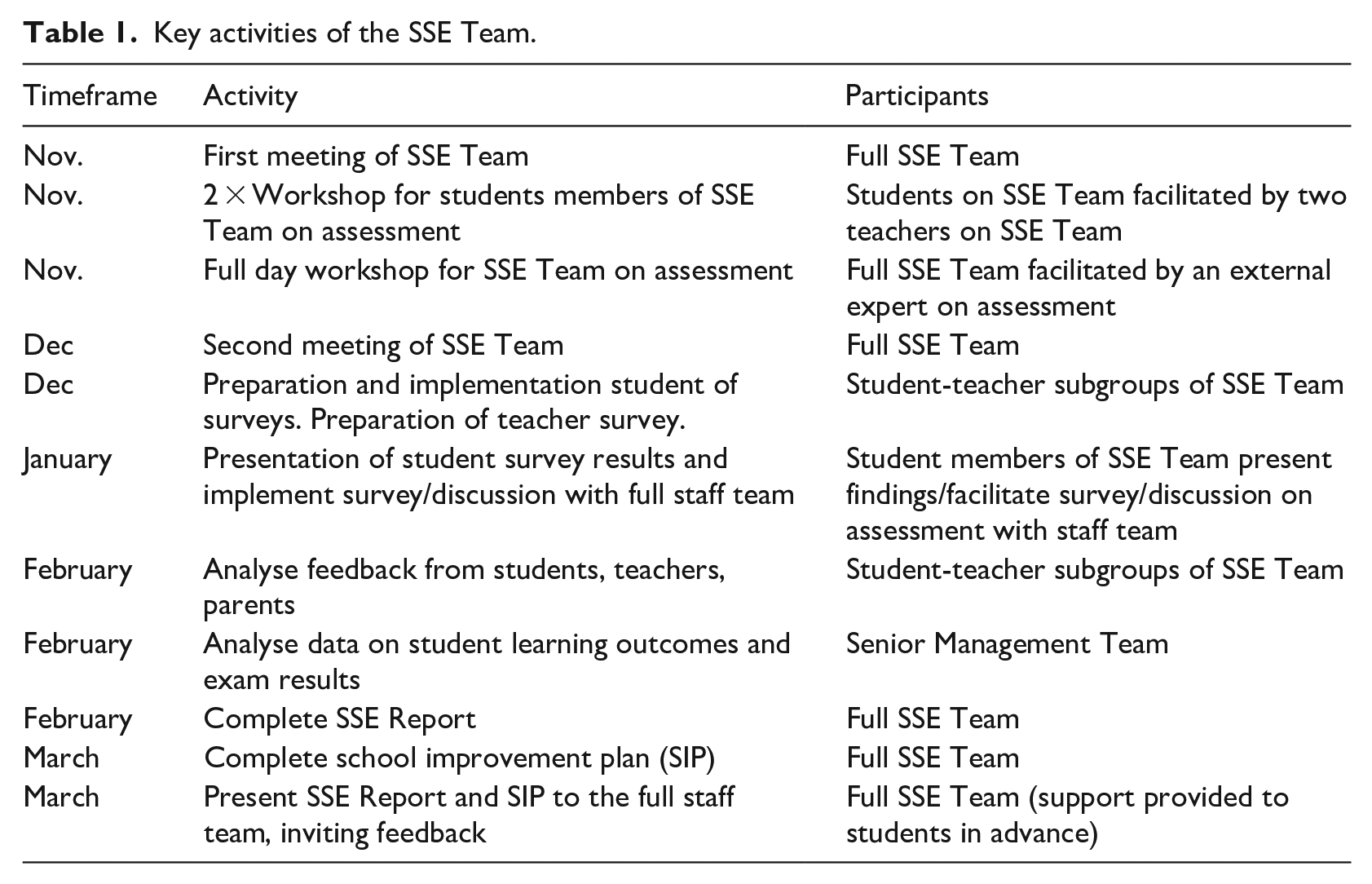
A very detailed project plan was developed including deadlines for each stage of the project. The SSE co-ordinator, under the guidance of EQI, led the SSE team and the project at school level. The key activities of the SSE team are outlined in Table 1. The work of the SSE Team concluded with the development of the School Improvement Plan.
Key activities of the SSE Team.
Methodology
A case study methodology is used as the study required a detailed analysis of an atypical intervention in an individual school, rather than a search for general truths (Newby, 2014). It is exploratory and descriptive in nature. Data was collected by conducting in depth interviews with members of the SSE Team involving five students and four members of staff (teachers and management). The interviews were audio recorded and transcribed verbatim. In order to ensure credibility, a rigorous and systematic approach was used to reduce and interpret the data. The data was analysed following Braun and Clarke’s (2006) six step approach to thematic analysis using the qualitative data analysis software Nvivo Pro. This involved reading the transcripts and recording initial codes, developing categories, coding on, data reduction and consolidation. Both a deductive and inductive approach to thematic analysis was employed. The former was informed by themes from the literature review (e.g. trust; impact on teachers; speaking in the group; training), while the latter resulted in the identification of codes that had not been preconceived by the researchers (e.g. awareness among the wider student body; teambuilding; disengagement). In total, the data analysis resulted in 34 categories. An identity code was established for research participants with staff referred to as T1 to T4 and students as S1 to S5. Full consideration of research ethics was afforded to this research study which received ethical approval from Dublin City University Research Ethics Committee.
Findings
Selection of SSE Team members
The SSE team included five teachers: the SSE Team Leader, two members of school management, as well two other teachers who had volunteered to participate. Three of the five teachers had previously engaged in SSE, and were familiar with the process, whereas for two teachers it was a new experience. An open invitation was offered to senior cycle fifth year and Transition Year Students (approximate age 16–17 years). These year groups were selected by school management as it was felt that the students would have the sufficient experience, maturity and ability to participate fully in the process and also did not have the distraction of final year high stakes Leaving Certificate examinations. From these cohorts, 16 students expressed an interest in the project, all of whom participated in a workshop that explored the theme of assessment and also the details of the project, including the role of students and the time commitment. Following the workshop, seven students volunteered to continue with the project and all seven became members of the SSE Team. Therefore, at the start of the project the SSE Team consisted of 12 participants.
Student motivation to be involved
Students were motivated to volunteer for the SSE Team for different reasons, one cited an interest in data analysis that related to future college and career interests. Some expressed an interest in learning more about educational practices while others welcomed the opportunity for a new experience. Other students were motivated by the opportunity to represent the student body.
I saw it as a way to represent other students, directly to the Board of Management . . .. and I felt like the way it was described to us, it was going to make a change in our school and I thought like it was important for the students to be involved. (S2)
The motivation of participating students appeared to be at odds with participants’ perspectives on the student body more broadly. Team members frequently referred to the lack of student interest in or even awareness of SSE, which was described as ‘very much a teacher notion’ (T3). Participating students presented on SSE to the wider student body in assemblies but as one student claimed his classmates were ‘uninterested’ and ‘very caught up with other things in life’ (S2) while other students suggested that fellow students may not have understood what they were talking about, considering that the wider student body had no training is assessment.
Teething problems
A number of interviewees reported some initial difficulties when students and teachers first started to work together on the SSE Team. These included a lack of clarity about the student role, and a lack of confidence among students to speak up. It was evident that the role of co-researcher needed to be explored by team members.
it wasn’t about those Student’s opinions, they were researchers and that was an issue that we had with them at the beginning, that we had to clarify, you know? It’s not about them seeing just their voice in this. It’s about them being part of the process that allows us to present everybody’s voice, whether it was the, you know, second year’s, the fifth year’s, the Teacher’s, the Parent’s (T4)
It was clear that students initially believed that they were involved in order to inform teachers about their perspective on assessment, and while that was partly the case, as co-researchers they also had a role in facilitating consultation with other stakeholder groups and reflecting the voice of all key stakeholders in the final SSE Report.
Students were initially unsure about speaking openly and honestly in front of the teachers.
Okay, so from the first. . .the initiative itself was that ‘We’re going to include you guys, so that you guys can be part of it.’ I remember our first meeting. . .. I was very anxious, because I knew there was a line, despite what being said, about how honest I could actually be (S4)
It was apparent that students raised concerns about the process with a teacher on the SSE Team outside of the team meetings. Both students and teachers agreed that it would have been useful if there had been a formal structure established at the start where students could voice concerns and have issues dealt with outside of team meetings.
Training and team building
Two workshops on assessment were provided by teachers on the SSE Team to students on the team. Students found these useful and many admitted that the topic of assessment was ‘complex’ (S3). Asking teachers to facilitate these workshops forced the teachers to be clear about their own understanding of assessment which was also seen as important for the process. A 1-day workshop for the full SSE Team was facilitated by an external expert in assessment which appeared to support a shared understanding of not only the issues relating to assessment but also the roles of team members. Many participants referred to the significance of this workshop in moving forward the work of the team. Students confirmed that their understanding was deepened through the team-based active tasks that took place as part of the workshop in particular.
I learned a lot. Like it’s a lot more than you would have learned if you were just told about it. Because we got to see in-depth how it is, why it’s in place and everything. Whereas in Junior Cycle you’re just told ‘This is what’s happening, just do it.’ (S5)
It is interesting to note that all the students in the SSE Team had experienced the new Junior Cycle, which was a major curricular reform that has been introduced to Irish schools from 2014 and which aimed to promote assessment as a support of learning and teaching rather than solely a means to making summative judgements (MacPhail et al., 2018). Students were unclear about reasons for the reform and were fascinated to learn about and understand how the changes to teaching and assessment in particular were intended to support their learning.
The workshop proved to be a significant team building exercise, despite the fact that the original plan for the workshop was solely for the purpose of developing shared understanding of assessment. However, it was apparent that issues of roles, trust and respect and communication were raised at the workshop, and were responded to by the facilitator.
She (facilitator) made us go through the motions, and do the rules, make up the rules and talk about. . .create a sort of - why are things like this, stating the obvious, and the common sense, and all the rest. You kind of have to go through the rules about respect and civility and not holding against someone, when you walk out the room, and it’s not personal and all that. (S3)
A number of participants referred to the importance of an external person to facilitate this discussion, and some suggested that the facilitation of the process from the start by an external person may have ensured a better working relationship between members of the team from the start of the process.
Roles of the SSE Team and impact of including students on the SSE Team
The SSE Coordinator led the process and tried to ensure that meetings and tasks were completed within the allocated timeframes. She also facilitated the meetings and tried to ensure that all members of the team had opportunities to contribute ideas and make comments. The members of the Senior Management team tried to ensure that the decisions made were realistic and consistent with the overall vision, plans and obligations of the school. All members of the team were involved in the design and implementation of surveys, although teacher-student sub groups were formed to gather and analyse data from the wider student, parent and teacher groups.
As intended from the design of the project, students provided a student perspective and staff provided a staff perspective on all matters, which resulted in a dialog that emphasised listening and understanding.
It was great to hear their voice and to hear exactly what their thoughts and everything were. It definitely changed how I looked at things, I suppose we always see them as students. And they’re not passive, but you know, I think when you give them the chance to step up, my God do they step up. (T3) So I think they need to hear from the students how it feels from their perspective and what actually works. So I do think it’s. . .and vice versa, because we don’t understand everything from their point of view, that there are things they definitely know, that we don’t, from age, from experience, but from training. So I definitely think it needs to be in tandem, definitely. I don’t think there’s any point in doing it without the students. (S3)
The inclusion of students reportedly brought a new impetus to the SSE process in the school. This had been one of the key reasons why school management decided to include students as it was hoped that their inclusion might also bring more attention to the process among the wider staff team.
So more energy about this one. . . fresh, just proper collaboration. . ..it definitely reinvigorated the whole thing. It freshened it up completely. It made it kind of an exciting project. Like because we were gathering data on an issue, a teaching and learning issue that was so relevant to teachers and so relevant to students, it was very real, like very tangible and it was just interesting as a result of that. (T4)
While the main role of the SSE Team members was as researchers they were also ‘the researched’ (T4) in that the students also participated in the student focus groups and surveys, and the teachers participated in the teacher surveys. Therefore, all involved had opportunities to anonymously evaluate and make recommendations to the SSE Team. All members worked collaboratively, to draft the SSE report based on stakeholder consultation and also the school improvement plan. Students had a specific role in relation to communication and consulting with the wider staff team as is outlined below.
The Impact that student participation in the SSE Team had on the wider staff body
One of the most significant impacts of student involvement appeared to be on the wider staff team. Research by O’Brien et al. (2019) claimed that engaging the wider staff team in SSE is particularly challenging. As this approach to SSE had not (to the best knowledge of all involved) been attempted previously in Irish mainstream education, it raised a great deal of interest and attention among the staff team. Students, with assistance from teachers, made initial and final presentations on SSE to the full staff team and also presented the findings of the student survey, facilitated staff to complete the staff survey and engage in a discussion on assessment. The latter appeared to have the greatest impact on the staff team. However, it was clear that views were mixed.
some staff thought that it was excellent that we were finally doing something about student voice in more than a wishy washy, vague way and actually incorporating students into the process of growth, development and change in their everyday reality. Whereas other members of staff were really concerned about the extent to which a student could make an academic contribution, if they could comprehend the concept or that they might gain access to data or information about the school that they were uncomfortable with. (T1)
While the school had a track record of promoting student voice, many teachers were reportedly surprised about the level of student involvement in decision making at a whole school level. A number of teachers spoke about previous efforts to engage staff in SSE and claimed that they are generally not interested when survey results are presented but claimed the dynamic was different when the students presented survey findings.
I thought it was brilliant. . . when we put the students in front of our staff at a staff meeting to explain the process and what they had done. And hearing the results of a survey, like we have often presented survey results to staff but hearing the students deliver what came back from the student surveys was very powerful. . .. it was amazing to see, teachers like they were sitting up, they were listening, the read in the room, was really positive.(T3)
Apart from the SSE process, the feedback from students on assessment appeared to have impacted immediately on the staff team as it was reported that there was a noted improvement in the type of feedback teachers gave students on their mock Leaving Certificate exam, than would previously have been the case. Students on the SSE Team were less aware of the impact of their involvement, on the wider staff team but felt that it was important for the staff team to hear their views.
Respect, opportunities to speak and make decisions
In general, the students and staff that were interviewed agreed that students were treated respectfully during the process, and that they were given opportunities to speak and make decisions.
I think they definitely valued our opinions, you know, equally as the teachers. (S1) I wasn’t intimidated or anything. Like I felt very comfortable. Like when you first came in you were a bit like ‘Whoa, this is a change.’ But I think by the second meeting that was fine. (S5)
A number of students reported that it was difficult at times to say as much as they wanted to say at SSE Team meetings due to time pressures, an awareness among students that teachers knew more about the SSE process and at times students felt unsure about questioning or challenging teachers. Students were very aware of the power dynamic despite the respect shown to students.
staff were trying to see us as equals, but of course, because of the fact that they are still our teachers, we’re never going to be equal in the full sense of the word. (S4)
However, it was not a positive experience for all students as two students left the SSE Team at an early stage in the process as they ‘were unhappy with how things were going, they just felt in meetings they didn’t have a voice as much as they wanted to’ (S4).
The SSE Team members who were interviewed generally agreed that students had opportunities to feed into the evaluation report and the school improvement plan, but there was also a clear sense that all their recommendations were not included as they had to be balanced against the other competing pressures and the feasibility of introducing major changes over the coming years.
they had to be pared right back. . . like I’d say maybe they’re a bit disappointed by it, by how little it is. I think they were thinking really, really big and really fast, you know? At the beginning of the process it was like ‘We can change the world’ and that’s just not how change happens, you know? (T4)
Students also raised disappointment about the format of the report and plan, which was completed using the sample templates provided by the Department of Education and Skills (2016) for SSE. Students felt that the language used in the final documentation was very formal, and presented in a way that was not student friendly. Teachers on the team reported that they believed that they needed to finalise the documentation in the format expected by the DES Inspectorate.
Discussion
The inclusion of students as co-researchers with their teachers on the SSE Team was an ambitious project for the school involved and atypical of the approach to student participation in SSE among Irish mainstream schools. Building on its experience of promoting student voice, the school tried to implement an approach to school improvement that redistributed power and privilege and as such was a ‘radical interruption’ (Mockler & Groundwater-Smith, 2015) to the normal school decision making process. Students were actively facilitated and prepared to participate, they generally felt respected, their views were listened to by relevant others and acted upon (Lundy, 2007). The student perspective brought valuable insights to the process (Chapman & Sammons, 2013). While the project had many positive outcomes for the SSE Team members and the wider staff team, it was apparent that a number of challenges arose which were similar to those identified in the literature (Brown et al., 2019). The task of completing an SSE cycle in accordance with Department of Education and Skills (2016) guidelines was achieved to the point of developing an SSE Report on assessment practices within the school and a school improvement plan to further develop assessment systems and approaches at a whole school level. It was not possible, within the timeframe of the study, to measure or assess the degree to which the school implemented actions arising from the SSE process as these were due to be implemented over the following years.
Student involvement as co-researchers in SSE moved student participation, we would argue, from the usual level 4 (assigned but informed) or 5 (consulted and informed) to level 6 (adult-initiated shared decisions) of Hart’s (1992) ladder of participation. In terms of Fielding’s (2011a) hierarchy of patterns of partnership between students and teachers, students could be described as ‘co-enquirers’ or even ‘joint authors’, although the decision to focus on assessment was made by school management and the process was planned and managed by the teachers involved.
Of concern is the allocation of resources which appear to benefit a relatively small number of seemingly articulate, confident ‘politically mature’ (Fielding, 2011a) students, raising questions about the equity of representative structures (Gunter & Thomson, 2007). Yet the findings suggest that the wider student body appeared disinterested in the SSE process (Bergmark & Kostenius, 2009). While students were certainly engaged in the process and their recommendations were included in the improvement plan, there appeared to be an element of naivety in the expectations of students regarding the level of change that was possible given the competing pressures within the school (Bragg, 2007).
The resources, mainly in terms of time, required to involve students as co-researchers was considerably greater than the resources typically required to engage students as data sources (O’Brien et al., 2019). It is clear that the experience resulted in considerable learning for the students involved. They had participated in decision making at a whole school level, developed an understanding of the relationship between learning and assessment, applied a range of data use skills and facilitated consultative workshops with teachers. One wonders why such powerful learning opportunities are not more typical in schools, suggesting the need to systematically build the capacity of student voice for decision making at a classroom level, rather than occasionally invoking it for accountability purposes. A focus on participative democracy emphasises student voice, not so much through representative structures but rather through a whole range of daily opportunities in which young people can listen to others and be listened to. This reflects Fielding’s (2011a) notion of ‘fellowship’ which values inclusion and social justice and one which might better prepare the foundations for students and staff to engage in a more authentic model of inclusive school improvement.
It could be argued that student engagement in school improvement and SSE in particular would be enhanced if the structures, format and language of documented outputs were more ‘student friendly’ as opposed to the bureaucratic, adult language of ‘target setting’ and ‘evaluation criteria’ which Mockler and Groundwater-Smith (2015) claim are more about accountability and standardisation rather than student voice. Some participants suggested that the process be renamed in order to capture the interest and imagination of students rather than using the less appealing term ‘school self-evaluation’. It was clear that while students recognised their input in the decision making and final documents, they felt that it had been changed to ‘adult language’ which can stray from the intentions behind students’ words (Mitra, 2008).
Of significance was the overwhelmingly positive impact of students on the wider staff team. This element of the project appeared to achieve what has been extremely difficult to achieve in many SSE processes, in that it raised greater awareness and engagement of the wider staff team than has been evident in other research (O’Brien et al., 2019, 2020) and which may subsequently, have a more positive impact on the implementation of actions by the staff team.
Conclusion
This case study attempted to explore ‘what an explicit commitment to democratic ways of learning, working and living together might look and feel like’, (Fielding, 2011b) in one Irish post-primary school. The findings indicate that the involvement of students on the SSE team was, overall, a positive experience for the students and teachers involved. All stages of the SSE cycle were completed within the given timeframe of 1 year, and all required outputs of the SSE process were achieved by the SSE Team including the completion of an SSE Report and a School Improvement Plan. A number of recommendations were made regarding possible improvements to the process in future iterations which included the design of a more student friendly SSE process, the inclusion of a safe process for students to raise concerns and the facilitation of the entire process by an external facilitator. The research highlighted the importance of careful planning, training for SSE team members, team building and group development processes.
However, the study raises a more fundamental question about the importance of developing the ability of all students to speak and to participate in decision making as a common feature of classroom practice. This may promote an inclusive approach to student voice and participation while at the same time developing the capacity of students to participate more regularly in decision making at a whole school level.
While this case study highlights potentially useful findings for schools and organisations aiming to increase the level of student participation in school improvement processes, it is clear that further research is required, particularly in relation to the participation of students as partners in decision making rather than as data sources.