




Abstract
Organizational building is essential if school leaders are to promote school improvement, but it can be difficult to combine with school leaders’ requirements to satisfy teachers’ personal and relational needs. The the aim of this study is to explore critical aspects when combining organizational building with requirements to satisfy teachers’ personal and relational needs in efforts to strengthen improvement capacity. The paper draws on a 3-year collaborative research project between a research team at a Swedish university and a municipality. It is based on data acquired in 137 interviews with 535 respondents in 28 public school and preschool units. The results highlight the importance of combining organizational building with efforts to improve teachers’ understanding of, motivation to promote, and adaptation to, the goals of the school organization. The significance of the study lies in clearly distinguishing the need to link organizational building and requirements to meet teachers’ personal and relational needs. Continually telling the story of the school and thus enabling teachers to personally connect to the improvement history is suggested as an innovative school leader strategy.
Introduction and aim
As identified by Hopkins and Woulfin (2015), school systems across the globe face similar challenges in organizational building that could support school leaders and teachers in their improvement work. This paper will hopefully contribute to an understanding of this challenge by clarifying the need for school leaders to combine the building of a local organization, for example, groups and working routines for the teachers (e.g. Leithwood et al., 2004), with satisfaction of teachers’ personal and relational needs related to autonomy, personal interests, and efficacy (e.g. Brown & Wynn, 2009; Kwakman, 2003). Previous studies have shown that school leaders are in a difficult situation that requires them to balance these demands with care (Kelchtermans et al., 2011; Liljenberg, 2015; Mascall & Leithwood, 2010), but also that they tend to prioritize the social and relational aspects of their work (Blossing & Liljenberg, 2019; Nelson et al., 2008). Illustrative examples of teachers’ personal and relational needs could be when teachers’ individual needs to attend training courses are prioritized, although they are not in the interest of the school as a whole, or when individual teachers’ wish to work with certain colleagues is given priority although knowledge and competence needs to be spread throughout the organization. Thus, it is essential for school leaders to pay attention to this potentially distorted orientation, to avoid falling into the trap of prioritizing teachers’ individual needs so strongly that organizational needs are neglected (Adolfsson & Alvunger, 2017; Blossing et al., 2015; Stoll, 2009).
Hopkins (2005, pp. 2–3) defines school improvement “as a distinct approach to educational change that enhances student outcome as well as strengthening the school’s capacity for managing change.” Hopkins argues that schools need to focus on the teaching-learning process and the conditions which support it. In line with this, since the 1970s researchers have concluded that teachers’ relations, school culture, and workplace conditions are conditions that influence the possibility to improve schools (Hargreaves, 1994; Little, 1982; Lortie, 1975/2002). However, as Zoltners Sherer and Spillane (2011) conclude, although the empirical knowledge base about measures to implement change offers numerous insights, leading and managing change is still a challenging and uncertain process. Some scholars regard structural elements, such as time and work plans, as crucial for school improvement (Meyers et al., 2012; Spillane & Coldren, 2011), while others focus on social and relational aspects, such as trust and shared responsibility (Louis, 2007; Nguyen et al., 2019; Tschannen-Moran, 2009). Others still suggest that appropriate leadership styles are crucial for successful improvement processes (Hallinger, 2003).
All of these elements may be significant, and consequently school leaders may have a significant role to play in building capacity for improvement in the school organization (Hopkins, 2005). Accordingly, the aim of this study is to explore critical aspects when combining organizational building with requirements to satisfy teachers’ personal and relational needs in efforts to strengthen improvement capacity. Results are presented based on a collaborative project involving a Swedish university and a local municipality, initiated to strengthen the improvement capacity of all public schools and preschool units in the municipality. A specific research question addressed is: What is critical in combining local organizational building and requirements to satisfy personal and relational needs of the teachers in order to strengthen the improvement capacity in the organizations?
We argue that the Swedish case may be of particular interest for this research question. In Sweden 94% of all 3- to 5-year-olds attend preschools. Swedish schools are to a high degree inclusive with only 1% of the students in special primary schools. Most students, 85%, attend public schools and 15% attend independent schools. All schools and preschools are tax financed and governed by national curricula. A school leader manages each school and preschool, and together with the teachers, the school leader has the responsibility of fulfilling the requirements stated in the national curricula and for improvement (Lundahl & Alexiadou, 2016). Swedish schools and preschools also have a long history of collaborative working structures. As early as the mid 1970s, governmental documents (SOU 1974:53, 1974) were based on the idea that collaborative working structures could contribute to school improvement. An idea that contributed to the implementation of teacher teams and teacher team leaders in the 1980s. Research ever since have reported about benefits as well as challenges related to these structures (e.g. Adolfsson & Håkansson, 2019). Blossing and Ekholm (2008), after studying 35 Swedish schools over a 20-year period, claim that organizing teachers into teams had, over time, increased the schools’ capacity to improve on an organizational level, although it had not to the same extent led to learning on a teacher and classroom level. Their results show that an introduction of collaborative structures alone has little potential to build capacity for school improvement. Moreover, evaluations reported by the OECD (2015) and the Swedish National Agency for Education (Skolverket, 2019) show that not all schools and preschools manage to fulfill the requirements stated in the national curricula. Sweden has also shown decline in results in international school tests such as PISA. This decline has put focus on teachers’ instruction and assessment for students’ goal fulfilment.
Theoretical framework
To address the research question, a theoretical framework that facilitates conceptual analysis of organizational building, social relations and their interactions is needed. To varying degrees, all organizational and social theories problematize these interactions, but organizational development (OD) theory is particularly suitable as it provides a structural perspective of organizations, without overlooking human interactions and processes. OD is rooted in open system theory and treats organizations as living systems (Burke, 2008). In the era of new public management when leadership is looked upon in an individual perspective, Burke (2018) emphasizes the importance of the leader’s influence on the organization and what the manager and team can achieve together.
In an OD framework, Schmuck (1995) understands schools as systems of human beings engaged in different tasks. As teachers and school leaders switch from one task to another they move between different subsystems of the organization’s infrastructure, for example, as suggested by Ekholm (1989) between the grouping-, the goal-, the communication-, the decision-, the responsibility-, the norm-, the reward-, and the evaluation system. The most visible is the grouping subsystem, exemplified by a teacher working in both a teacher team and school improvement team. However, the subsystems are intimately linked, as s/he may have differing responsibilities, work toward different goals and use different ways to communicate both with other group members and external groups in these teams. Thus, minimizing conflicts between goals and responsibilities, fostering productive social relations among teachers and other staff, and developing their competence to communicate (and address) the organization’s goals, deficiencies, and improvement actions may be crucial elements of effective improvement strategies. In structural terms, improving integration of the subsystems in the infrastructure of the school should enhance schools’ improvement capacities. In social terms, the OD framework understands organizational structure as socially constituted, and thus improving a school’s capacity means taking personal and relational needs into consideration when building the local school organization.
Taking a socio-structural perspective of change, Blossing et al. (2015) have developed a framework, with its root in OD theories (Burke, 2008; Schmuck & Runkel, 1994; Schmuck, 1995), to capture improvement capacity in school organizations. The framework includes four aspects connected to: (1) infrastructure, (2) improvement processes, (3) improvement roles, and (4) improvement history. The infrastructure relates to Ekholm’s (1989) model with subsystems presented above. Improvement processes focus on situations which drive the improvement work forward, for example, evaluations or school site visits. In the frame of OD, processes are defined as shorter so-called micro processes, being parts that make up longer and more complex macro processes (Schmuck & Runkel, 1994). Improvement roles are to be understood as an extended leadership for change. It deals with which roles it is possible to take on and their importance during an improvement process. Improvement work is also closely linked to the history of the organization. Pettigrew (1985) concludes that in most cases, improvement processes lack in taking a historical perspective of the organization as well as in taking in the history of the surrounding society. These connections are of major importance in understanding changes, for instance in organizational culture, and how these changes affect the improvement work.
Method
The empirical data were obtained from a qualitative study linked to a 3-year collaborative research project involving researchers from a Swedish university and a local municipality, covering all public schools and preschool units (n = 28) within the municipality. Schools and preschool units were included as leaders in schools and preschools (both entitled school leaders in this paper) are responsible for developing their local organizations to improve learning for all students and meet the requirements of the national curricula.
The aim of the collaborative research project was to enhance school leaders’ actions for capacity improvement of their school organizations. An essential task for the researchers participating in the project was to review and analyze the improvement capacity of all schools and preschool units, and write a report for each organization including advice for further improvement. The reports were regarded as starting points from which the school leaders could plan their actions to enhance their respective school organizations’ improvement capacities. To support the school leaders in their improvement processes the school directors and the research leader organized regular workshops where they, together with the school leaders, processed data and worked as critical friends to each other.
To review and analyze the improvement capacity of the organizations the researchers interviewed school leaders and teachers in the 28 organizations (Table 1). In total 169 audio-recorded interviews with 535 respondents, 40 school leaders and 495 teachers, were conducted. School leaders were interviewed individually or in pairs/trio if any of the school leaders were new in their position. Teachers were interviewed in groups of 3–5 people. Participants in the group interviews were selected to cover wide ranges of work experience (years of employment), teaching subjects, grade levels and leadership assignments in their organizations, with participants from all teacher teams in the school or preschool unit. Detailed questions were asked (inter alia) based on the model for assessing improvement capacity of an organization constructed by Blossing et al. (2015). The interviews lasted for approximately 90 minutes on average.
Interviews in schools and preschool units.
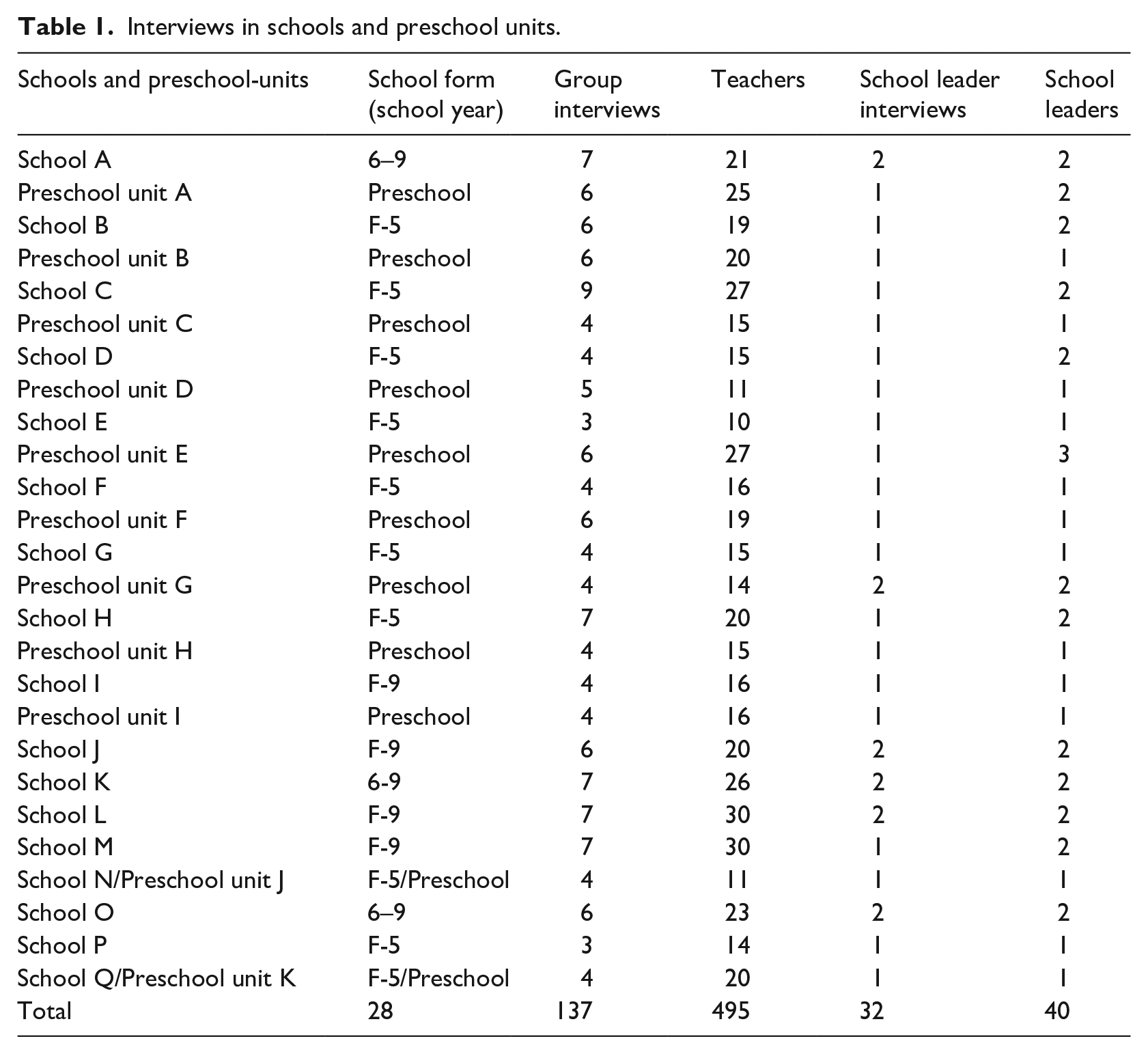
In the first step of the analysis, the researchers listened several times to the digital recordings and transcribed verbatim central parts of the interviews. Based on notes and digital recordings independent summaries of the interviews were written with sections covering each of the four aspects in the improvement capacity model. The summaries were intended to closely reflect the interviewees’ comments in the recordings and thus retain the interviewees’ voices as far as possible. After this step, the researchers worked back and forth with the primary sources to reach agreement on a common summary of views expressed by representatives of each school and preschool unit. The common summary, together with theoretical and methodological considerations, was packaged into a report (approximately 15 pages) for each school and preschool unit.
In the second step of the analysis the NVivo.11 program was subsequently used to organize the reports for further analysis. In this step of the analysis the researcher used the OD theory-based framework of improvement capacity and the four-aspect structural model developed by Blossing et al. (2015) to evaluate the schools’ and preschool units’ improvement capacities. Regarding the first aspect, the infrastructure of the local school organization, the analysis was limited to the grouping subsystem constituting the organizational structure and the work in the groups. To find answers to the research question, the researchers asked the following questions to the data trying to capture teachers’ and school leaders’ sense-made ideas about groups, processes, roles, and history in the organization visible through the duality between structure and agency: What autonomy do teachers have in relation to improvement work? To what degree do structures determines the improvement work of teachers? Mapping the improvement capacity of each school organization using this framework generated detailed descriptions of dilemmas in the organizations, enabling identification of potentially critical combinations when organizational building did not match requirements to meet teachers’ personal and relational needs and vice versa.
Despite the richness in the amount of empirical data and the strategic choice of respondents for the interviews, the study has limitations. Firstly, the study is conducted in a single municipality giving schools and preschool units the same local education authority to relate to. Secondly, the study only relies on interview data. Observations could have provided additional perspectives and brought forth confirmations as well as contradictions in relation to the interviews. Regarding ethics, it was the school directors of the municipality that had made contact with the research leader as they wanted to enhance school leaders’ actions for capacity improvement of their school organizations. As the collaborative research project lasted over 3 years and also included support to the school leaders highlighting critical situations identified in the review and analyze of the improvement capacity in the schools and preschool units became less problematic for the researchers.
Results
In the following section, the results are presented under four headings: grouping system of the school organizations, improvement processes, improvement roles, and improvement history of the organizations. Focus is on critical situations identified in most organizations. The result section is ended by a summary of the findings.
Grouping system of the school organizations
In the analysis of interviewees’ comments, critical aspects in their schools’ improvement capacity related to the grouping system was identified. In recent years, all schools and preschool units in the municipality had developed local grouping systems that included several forms of collaborative working groups for improvement. However, not all groups primarily focused on improving support for student learning. The groups most frequently mentioned were the teams that teachers were divided into (based on the groups of students they taught) in both schools and preschools. These teams provided suitable conditions for teachers to collaborate, but in many cases other matters were discussed in meetings of the groups. Teachers in one of the teams in School C talked about the challenges they faced in addressing teaching practices as follows:
Actually, we have an agenda that we should follow. . . . But we have to solve many different things. It has not really become the kind of meeting that was intended. Most of the time it ends up with a lot of information exchange. . . . An hour passes quickly, we don’t get as much done as we expected. (School C)
Although school leaders and teachers had good access to digital tools and shared digital fora that could be used for communication, dissemination of information took up much time in the teacher team meetings, thereby further restricting possibilities for the teams to improve teaching practices collaboratively, as intended. This tendency was so strong that when teachers were asked to describe the purpose of the teacher teams in the group interviews, almost all of them said it was for the school leader to provide information for the teachers and vice versa, as illustrated by this quotation from a teacher team leader in School B:
We [the teacher team leaders] take things with us that we’ve discussed with the school leader or the school leader wants the team to discuss . . . In my opinion we had a discussion in the beginning where we agreed that we should follow a fairly similar structure at the meetings and what we should prioritize. But what is it that we should actually prioritize? Should we prioritize the things that come from the school leader or should we prioritize student care, or something else. And who decides? I feel that I haven’t got a clear answer to this. (School B)
The large amounts of time taken up by exchange of information in the teacher team meetings can be interpreted as hesitation to collaborate and a manifestation of excessive prioritization of teachers’ wishes for autonomy. If so, the emphasis on distribution of information effectively changed school leaders’ roles to provision of a service for teachers rather than leadership of efforts to meet needs of the entire organization.
Improvement processes
The interviews showed that new improvement projects with short-term perspectives were introduced too often in the organizations. Sometimes this was a result of teachers’ individual interest in a specific matter, but more often teachers expressed opinions that improvement projects were introduced in response to central reforms and changes in steering documents and curricula, or decisions taken at local education administration (LEA) level. The school leaders shared to some extent teachers’ perception that improvement processes were introduced as results of external decisions.
Additionally, the frequency of the introduction of new projects contributed to a dominance of micro-processes within the organizations. As previously initiated processes were not completed before new ones were introduced, teachers expressed a feeling of deficiency and “another thing to keep up with.” In the interviews, teachers in School D expressed their understanding of initiatives coming from the LEA level as follows:
The municipality’s a bit like this, I think, first it’s Swedish, then it’s mathematics, and then comes. . .
Now, it’s been entrepreneurial learning for a while.
The municipality wants to be at the forefront of everything. Every year something new comes and we’re first to jump on the bandwagon. I wish they were better at following up and finishing the things they started before starting something new. (School D)
New projects were only introduced in a few schools when the organizations were ready. The “short-term focus” that dominated the improvement processes gave teachers no time to build macro-processes resulting in lasting knowledge that could improve teaching practices. Normally, a new improvement process was introduced at the beginning of a new school year, accompanied by an external lecture, and shortly thereafter handed over to the teacher teams to organize and take responsibility for, based on their individual ideas. Some teachers perceived this freedom as an advantage as they could decide by themselves how to proceed, based on their ideas and the students’ interests. However, others regarded the extensive freedom as a disadvantage as it exacerbated aimlessness or variations in directions of the improvement process within the organization. They claimed that this hindered attempts to develop a common knowledge base, and in the longer run provision of equal education for every student. Another disadvantage, stated by the teachers, was the lack of explicit expectations from the school leaders, as noted by two teachers in the following excerpt from Preschool unit F:
We often don’t get any inspiration, just now it’s this area that you should work on. Well. . . It isn’t like we start with a discussion and think together about how we should approach the area. . . . Sometimes we get a lecture connected to the area that we’re going to work on, but apart from that [nothing]. I think it would be good to discuss it at joint meetings. What do you think? How should we proceed? Do you have any ideas that you can share with others?
I think she [the school leader] needs to bring it together a bit more. She dumps it in our lap. . . . (Preschool unit F)
Altogether, the results show that the school leaders largely left the design of the improvement process to the individual teachers and teacher teams, resulting in high likelihoods of variations in interpretations within and among the organizations. A bottom-up approach is often recommended, to engage teachers in school improvement processes. This could at least partly explain the school leaders’ apparent reluctance to guide the processes. However, the teachers’ responses and inconsistency in school leaders’ descriptions of ongoing improvement work indicate that the lack of a long-term improvement plan for the entire organizations may limit school leaders’ possibilities to support and encourage teachers to take further steps in the improvement process, and hinder organizational capacity building.
Improvement roles
Various roles were identified in the organizations that provided signs of distributed leadership. For a long time, teachers in several schools and preschool units had been assigned a part-time role as teacher team leader or teacher team coordinator. Both school leaders and teachers expressed thoughts that this was an important role for fostering good relations between school leaders and teachers, and increasing possibilities to improve the organization. School leaders and teacher team leaders met regularly, once every week or 2 weeks, in the management group. The school leader School I described her work with the teacher team leaders in the management group as follows:
The focus is on common issues, the things we need to discuss that concern everyone. It’s also my forum to discuss and clarify our goals, the approach we should follow in everything we do. . . . Where do we stand in our learning, what do we need to focus on? Or when we recruit, I ask, what do we want? Is subject qualification the most important thing or something else? I very much use them as debating partners. (School I)
Another common part-time role in the schools was “first teacher” (see Alvunger, 2015), which was often assigned to eminent and committed teachers, together with an increase in salary. The first teachers in the municipality had diverse tasks. In some schools they led collegial learning groups, in others they were connected to a specific subject, while others addressed general issues, such as entrepreneurial learning and learning assessment. Such assignments contributed to a distributed leadership, but shortcomings were also identified. Notably, the associated duties were rarely described or clearly communicated by the school leader, as noted in the following quotation from a first teacher in School K:
When I got the assignment there were no directives, just ten short points. It’s still like that. . .Mostly I should be a channel between the school leader and the teams. (School K)
Consequently, teachers taking on new roles had the opportunity to pursue their own agendas in the assigned roles, which were not always consistent with the organization’s needs and overall goals. Moreover, without clear role descriptions connected to the organization’s needs, the mandate, and responsibilities associated with the roles became blurred. Teachers were uncertain about the responsibilities of teacher team leaders and first teachers for improvement. Another problem was that results of the assigned roles were rarely evaluated.
Improvement history of the organizations
The fourth aspect concerns the history of the organization, especially its improvement history. In several of the interviews, weaknesses in awareness of the organizations’ improvement history were identified. In both schools and preschool units with high turnover of school leaders and teachers, learning from this history was problematic. School leaders and teachers who started working in a new school or preschool unit had limited time to gain understanding of the organization before they had to act and make decisions regarding not only its daily practices but also its future. A problem that the new school leaders raised in the interviews was a lack of documentation about the improvement history. For example, the school leader in Preschool unit H who had started leading the unit 2 months previously said:
Generally, there is very little documentation. The systematics have disappeared along the way. When we talked about it, I discovered that only one department had documented their work over the year. (Preschool unit H)
Another problem related to taking account of the organizations’ improvement history was the frequency of top-down initiatives originating from the LEA. Rather than taking account of the local improvement history the teachers argued that the LEA responded to trends, and was quick to embrace a new idea as suitable for everyone, as illustrated by the following excerpt from School F:
The only way I can describe it is that it’s like, Hi, ho now we jump into this. Now we’re going to read this book and then we’ll do some action research and after that it was “Big Five.” It’s like someone just comes up with something and so . . .
At the same time, it’s fun, you become aware of something new and get a new focus area. (School F)
The second teacher’s response shows that some of the teachers were interested in new trends and had very open attitudes to new ideas, as well as the LEA. As the following quotation shows, individual teachers’ interests and ideas about what they would like to work on for professional development had also initiated (bottom-up) improvement processes. However, in these processes too, there was a clear lack of connection to the organization’s improvement history. Moreover, there was little connection to organizational building, as only a few teachers were involved in such projects and engagement of the rest of the organization was not initially considered. In the interviews, a teacher in School F described the start-up of a project that she had participated in like this:
“Writing to read” was a project that we started at this school. We had another principal, before the former one, who asked if anyone was interested in it. We were invited to a lecture at the LEA where they presented the project. People from several schools attended, and those who were interested could sign up. It was exciting, this was in March-April and the project was planned to start in the fall. So, we thought, how do we manage to get ready? . . . But a few classes were involved, we worked on it a lot and had meetings every week. (School F)
Summary
The research question addressed in this study is: What is critical in combining organizational building and requirements to satisfy personal and relational needs of the teachers in order to strengthen the improvement capacity? Summarizing, the critical situations from the four aspects of improvement capacity highlight firstly the need to strengthen the organizations’ grouping system. This implies a need to improve interpersonal relations in the groups as well as teachers’ knowledge of, and attitude toward, collaborative efforts to meet the core goal of enhancing student learning. Secondly, the results also highlight a need for a framework that fosters appropriate long-term macro-improvement processes, implying thirdly a need to clarify responsibilities and mandates associated with assigned roles throughout the organization (thereby assisting efforts to meet needs of the organizations and track results). Finally, the results fourthly highlight the importance of basing any developmental initiative on the experience and history of previous improvement processes in the local organizations.
The critical situations identified above can be interpreted as difficulties in the combination of organizational building and requirements to meet the teachers’ personal and relational needs. Extracting the four situations and reformulating them in terms of organizational building and teachers’ personal and relational needs gives the following points:
Work in the groups, with teachers’ understanding of the work.
Building a school organization involves placing teachers in appropriate groups to carry out organizational tasks. However, analyses indicate a failure to consider both the teachers’ personal needs regarding their understanding of the groups’ tasks and how the teachers could satisfy their relational needs in the work.
Coherent, long-term improvement processes, with teachers’ freedom to direct their own improvement processes.
Building a school organization also involves creating whole school improvement processes so the improvements reach all students. However, school leaders seemed to favor accommodation of teachers’ personal freedom, at the expense of maintaining a focus on the needs of the organization.
A distributed leadership to meet the needs of the organization, with teacher’s motivation to accept new roles for their personal development.
Distributed leadership is crucial for effective organizational building, as it distributes responsibilities and abilities, thus creating more extensive and comprehensive capacity than separate individuals possess. However, school leaders seemed reluctant to define the organizational responsibilities associated with improvement roles clearly, and too often left the teachers to set personal agendas.
Sustainable development from the bases of the schools’ and preschool units’ improvement histories, with the LEAs’ and teachers’ adaptation to instructional trends.
Consideration of an organization’s improvement history is essential for its sustainable improvement. Inter alia, retaining routines or models that have been successful in the organization’s experience is important. However, in the investigated schools and preschool units, LEAs’ and teachers’ wishes to follow trends dominated, without reflection on whether or not they connected to the organization’s improvement history and thus followed a comprehensible and presumably sustainable developmental line.
Discussion
The aim of this study was to contribute to an understanding of the need to combine organizational building with requirements to satisfy teachers’ personal and relational needs in order to strengthen improvement capacity in school organizations. Empirical data were collected from interviews with school leaders and teachers in a Swedish municipality participating in a collaborative research with a research group at a Swedish university. Findings enabled identification of four potentially critical combinations of organizational building and requirements to meet teachers’ personal and relational needs.
With respect to organizational building and working in groups, the schools and preschool units included in the study had established a grouping subsystem that provided good opportunities for teachers to collaborate. However, these structures had not led to a radical change in teachers’ ways of working together. The topics discussed in meetings of the groups arose mainly from the individual needs of the teachers (e.g. Kwakman, 2003) rather than the organizational needs or need to improve teaching practices (e.g. Leithwood et al., 2004). Although some of the school leaders were aware of the shortcomings in teachers’ collaborative practices, they neither interfered nor made rearrangements to address the shortcomings. The reluctance of school leaders to interfere with teachers’ practices can be rooted in a “relational agreement” to let professional groups manage their own work (Blossing & Liljenberg, 2019; Kelchtermans et al., 2011). However, school leaders satisfying teachers’ personal and relational needs in this manner may lead to teachers failing to meet students’ rights to receive the best possible education.
Regarding coherent and long-term improvement processes, previous studies have shown that school leaders encounter many difficult situations, involving expectations and requirements of diverse stakeholders (Liljenberg, 2015). In recent years, stakeholders have demanded rapid changes and more or less directly exerted influence in school. Thus, there have been significant risks of rapid fluctuations. Nevertheless, there is clear evidence of long-term improvement in teaching practices in the classrooms (e.g. Fullan, 2016; Hopkins & Woulfin, 2015). There is also clear evidence that even in a distributed leadership setting, school leaders need to lead improvement processes to secure goal orientation (Jones & Harris, 2014). To satisfy personal and relational needs of teachers, school leaders must involve them in all steps in the improvement process, from initiation to implementation and institutionalization (Fullan, 2016), thus enabling a bottom-up input. However, it is important to ensure that this is not based on individual needs, but strongly anchored in the organization’s needs. For school leaders it is important to keep track of the improvement process in the organization, note signs of resistance and meet needs and challenges that arise to keep the organization on track.
When it comes to a distributed leadership to meet the needs of the organization school leaders must work closely with other leaders. In the schools and preschool units considered in this study, and many other schools around the globe, new leadership roles for teachers have been introduced (e.g. Alvunger, 2015; Nguyen et al., 2019). This may have beneficial effects through increasing their influence and engagement, but there is also an obvious risk of school leaders using leadership roles to show appreciation to hard working or talented teachers, rather than to improve the organization. Similarly, teachers that receive these roles might perceive them as opportunities to improve their teaching practices or prospects of getting a school leader position in the future, rather than supporting efforts to achieve organizational goals. In addition, the involvement of numerous people and need to compromise may hinder efforts to achieve organizational goals, especially when (as found in this study) responsibilities associated with these roles are not adequately described and the results are not evaluated.
Finally, concerning sustainable development from the bases of the schools’ and preschool units’ improvement histories, a lack of documentation of the improvement process in the schools and preschool units identified in the study contributed to difficulties in taking a historical perspective. The increasing turnover of school leaders may exacerbate this problem (OECD, 2015). However, the lack of a historical perspective also contributed to eagerness of the LEA and some teachers to follow new instructional trends. From the school leaders’ perspective, it may be tempting to accept teachers’ wishes to start new projects with their closest colleagues. However, to strengthen improvement capacity school leaders need to ensure that everyone is involved in the improvement process, while retaining routines and models with proven utility for this purpose (Fullan, 2016). Failure to learn from history might lead to just one more “change” rather than lasting “improvement.”
Most importantly, to satisfy the personal and relational needs of teachers, all of these considerations must be combined with working practices that allow teachers to express their understanding of the infrastructure, the groups’ work, the curriculum, students’ results and reports, and the improvement process. According to OD theory, building an organization essentially entails organizing social relations in line with the organization’s mission (Burke, 2008; Schmuck & Runkel, 1994; Schmuck, 1995). Social relations in this context involve intense, engaged communications between the professionals in the organization. Thus, teachers must be involved in group-relations in which colleagues clearly listen to each other, especially when new roles, such as “first teachers” are introduced (Alvunger, 2015). Entering new roles leads to seeing things in the organization from a different perspective, which is often very interesting to discuss with others in the same position.
Ideally, for building an organization while satisfying teachers’ personal and relational needs, the teachers should feel deeply personally committed to achieving the goals of the organization. This is most likely to be experienced by teachers who have worked for a long time at the same school, and thus are aligned with the school’s improvement history through personal experience. However, waiting until every teacher develops personal commitment to the organization’s goals through long working experience at their school is not possible. Instead, the school leader needs to instill such commitment in all the staff by vividly and coherently describing the previous efforts to improve the school, the results and the ongoing trajectory.
Conclusion
The significance of the study lies in highlighting the need to combine organizational building with requirements to meet teachers’ personal and relational needs. The personal and relational needs of teachers appeared to be prioritized by leaders of the schools and preschool units included in the study. This could compromise the important school leader’s task of building an organization, with goal orientation and infrastructural conditions that strongly support professional learning. Moreover, there are risks of personal needs expressed by teachers, or teachers’ representatives, being more highly regarded in the current “post-truth” era (Peters, 2017) than evidence-based findings of research focusing on the problems of building school organizations strongly oriented toward promoting student learning. In summary, results of this study highlight four critical elements of strategies to maintain a good balance between meeting needs of the organization and teachers’ needs:
Basing work in the teacher groups on the curriculum and documented students’ results.
Tracking improvement processes by introducing process documentation with aims, goals, timetables, and evaluation points.
Clarification of organizational roles through documentation in the form of work descriptions.
Documentation and continually telling the history of the school or preschool unit to promote planning rooted in the experience of the local organization.
These four points focus the school organizational perspective and have to be combined with a focus to satisfy personal and relational need. Thus, particularly important is to establish practices that enable teachers to express their understanding of work in teacher groups, the curriculum and the students’ results; the possibility to direct improvement process; and motivation to take new roles. Continually telling the story of the school, helping teachers to personally relate to the improvement history, is suggested as an innovative school leader strategy.