




Abstract
The effective schools literature has shown that school-contextual aspects matter for students’ academic and social outcomes. A potential link here may be the quality of the relationships between teachers and students, but few studies have investigated whether features of school effectiveness are in fact associated with students’ perceptions of teacher caring, which is the main purpose of this study. Based on recently collected data from 150 senior-level school units in Stockholm, school effectiveness in terms of teacher-assessed ‘school leadership’, ‘teacher cooperation and consensus’, and ‘school ethos’ (n = 2073) was analyzed in relation to perceived teacher caring as reported by students (n = 8022). Two-level linear regression analyses showed that all three aspects of school effectiveness were predictive of higher levels of perceived teacher caring among students. The findings suggest that these features of school effectiveness constitute an important foundation for promoting the quality of teachers’ relationships with their students.
Introduction
Processes that take place in the school context and in educational settings, in general, are fundamentally relational. These relationships are established at different levels, for example, between students and between teachers, as well as between students and teachers. The relationship between students and teachers has been a worldwide research topic of interest for many years, and a vast amount of studies have confirmed its role as a predictor of students’ academic outcomes and social adjustment (Roorda, Koomen, Spilt, & Oort, 2011; Thapa, Cohen, Guffey, & Higgins-D’Alessandro, 2013; Wentzel, 2009). A key aspect of the student–teacher relationship concerns the students’ perceptions of how their teachers care for them (Muller, 2001; Teven & McCroskey, 1997; Wentzel, 2012). Teacher caring has previously been identified as an important factor for increasing student motivation and learning in the literature of effective schools (Comadena, Hunt, & Simonds, 2007; Velasquez, West, Graham, & Osguthorpe, 2013). Making certain that a school’s correspondence with the principles of effective schools actually has the desired impact at the student level is central for efforts to improve schools’ teaching and learning environment.
Building relationships of care with the students is crucial for every teacher, not only because it serves as the foundation for supporting them in their learning and overall developmental process but also as something worth aiming for in its own right (Noddings, 2003). According to a literature review on caring relationships, ‘Numerous studies have also indicated that a caring teacher can positively impact learning outcomes, motivation, and social and moral development’ (Velasquez et al., 2013, p. 163). Some studies moreover indicate that teacher caring has a greater impact on students who are struggling academically (Velasquez et al., 2013) and thus withholds the potential of mitigating the risk factors for school failure. Despite this, however, there is still a lack of knowledge regarding the contextual prerequisites for teacher caring, and further research has been called for (Velasquez et al., 2013).
Internationally, several studies have pointed to differences between schools regarding organizational characteristics that influence the school’s ethos (Rutter, 2000). Studies confined to Swedish conditions have shown that teachers’ perceptions of their work environment in terms of workload, reward, and values differ substantially across schools (Allodi & Fischbein, 2012). There are also large variations in teachers’ views of their mission, their work situation, and their working conditions (Swedish National Agency for Education (SNAE), 2006a, 2017). Earlier research has demonstrated that school staff’s reports on the psychosocial climate at the schools, for example, trust and opportunities for participation, and commonly accepted and clear goals, are associated with student outcomes, including health and truancy (Virtanen et al., 2009). In addition, organizational characteristics, such as school leadership and teacher collaboration, have been found to co-vary with the prevalence of bullying among students (Ertesvåg & Roland, 2015; Låftman, Östberg, & Modin, 2017b). Based on the above reasoning, the aim of this study is to examine how school effectiveness in terms of school leadership, teacher cooperation and consensus, and school ethos – as rated by teachers – is associated with ninth grade students’ perceptions of teacher caring.
The Swedish context
Over the past 30 years, most education systems in the Western world have changed to a much clearer market adaption (Apple, 2011; Ball, 2007). This has been particularly true in Sweden (Björklund, Clark, Edin, Fredricksson, & Krueger, 2006; Lundahl, Arreman, Holm, & Lundström, 2014), which by now has one of the most liberal school markets in the world (Bunar, 2008). The Swedish school market essentially derives from three educational reforms implemented in the 1990s, namely, the decentralization reform, the free school choice reform, and the independent school reform (Ramberg, 2015). The reforms are based on a neo-liberal school policy where concepts like privatization, market adaption, freedom of choice, and competition dominate. Essentially, it meant that students/families became entitled to choose which school to attend, that independent schools received government funds to operate their educational activity, and that the municipalities took over the employer responsibility for the teachers from the state (e.g. Lewin, 2014; Lundahl, 2002). Several studies have investigated the effects of these school reforms. The results show that there has been a marked increase in between-school variance with regard to school results (Fredriksson & Vlachos, 2011; Gustafsson & Yang Hansen, 2017), and some suggest that this is largely explained by the free school choice (Östh, Andersson, & Malmberg, 2013). The fact that the between-school variation is particularly strong in municipalities with a high proportion of independent schools (as in Stockholm municipality) is also consistent with such a conclusion (Böhlmark & Holmlund, 2011). The free school choice has been shown to predict school segregation in Sweden (Yang Hansen & Gustafsson, 2016) and to be a likely contributor to the increased ethnic segregation that has taken place between schools during the past decade (SNAE, 2006b). These findings are in line with the latest Programme for International Student Assessment (PISA) report, showing that the inequalities in the distribution of learning outcomes have increased in Sweden during the past decade (Organisation for Economic Co-operation and Development (OECD), 2016). The reported differences between students and between schools, in terms of sociodemographic conditions and academic performance, highlight the importance to adjust for such background characteristics as far as possible.
Perceived teacher caring
Perceived teacher caring originally emanates from the philosophical history of ideas, and can be said to represent a good act with care for someone else, in this case from teacher(s) to student(s). The term is close to Aristoteles’ notion of ‘goodwill’, which evolved around his discussion of the concept of ethos (McCroskey, 1992; Teven & McCroskey, 1997). Several researchers have shown interest in and identified crucial aspects of the concept. One of these aspects is responsiveness, reflecting the degree to which teachers immediately and assertively react to students’ needs or problems (McCroskey, 1992; Teven, 2001, 2007). Giving praise to students who work hard and do well (Burnett, 2002) and rewarding good behavior, willingness to listen, and ability to reduce anxiety (Bulach, Brown, & Potter, 1998) appear to be other important aspects of how students perceive their teachers’ degree of caring. Involving students and establishing a safe environment also seem to be important components in the creation of a caring environment (Hawk & Lyons, 2008). Thus, in broad terms, perceived teacher caring refers to actions performed by the teacher, which are perceived by the students as something good. It should be noted that it is not the actions themselves or the intention of them that are focused upon here, but rather how these actions are perceived by the students (Teven & McCroskey, 1997).
Effective schools
The bearing idea of effective schools is to look beyond the effects of individual characteristics, such as cognitive ability and social background, where individual risks are seen as carriers and causes of differences in achievements, and instead focus on what can be done at the organizational level of the school to improve student academic and social outcomes. Rutter and his colleagues were pioneers in the research area of effective schools (Rutter, Maugham, Mortimore, Ousten, & Smith, 1979), while nationally in Sweden Grosin (2004) made significant contributions to the field. Based on Rutter et al.’s (1979) empirical studies in England, it was shown that some educational environments were more successful than others in introducing adolescents into adulthood and by managing to counteract negative effects of external factors (such as low cognitive ability and adverse social background). The prominent features of effective schools referred to in the literature differ in some parts, depending on methodological considerations and theoretical starting points. Edmonds (1979) proposed five salient features of effective schools that have been recurring in most studies: a strong administrative leadership, high expectations for children’s achievement, an orderly atmosphere conducive to learning, an emphasis on basic-skill acquisition, and frequent monitoring of students’ progress. From the 1980s, there has been a strong consensus within educational effectiveness research regarding the kind of school-level conditions that are of importance (Scheerens, 2016). More recent studies on effective schools have placed a greater emphasis on school principals in terms of their capacity to articulate a vision for the school and to create the shared meaning and common goals needed to reach this vision (Blair, 2002). The underlying idea is that higher levels in the school structure should provide the necessary conditions for processes at lower levels (i.e. at the teacher and student levels) to come into force. Thus, the degree to which principals have managed to implement ‘effectiveness characteristics’ at their schools can be expected to show in teachers’ degree of cooperation and consensus (Ertesvåg & Roland, 2015) as well as in how the teachers relate to and behave toward the students as reflected in the school’s ethos. Ultimately, this should of course also manifest itself in a more prosperous and successful student body.
School leadership
School leadership can be defined as providing direction and exerting influence in order to achieve the goals that have been set for the school (Leithwood & Riehl, 2003). Strong school leadership is beneficial for school improvement in general since it provides clear directions for improvement and creates structures for efficient collegial work (Ertesvåg & Roland, 2015). A number of scholars have suggested that the formal leadership of principals affects a variety of educational outcomes (Louis, Dretzke, & Wahlstrom, 2010) and that the school leadership is of great importance for the development of the school as a whole (Grosin, 2003). Empirical evidence regarding the effect of leadership on students’ academic outcomes suggests that associations exist but that the effects are modest (Hattie, 2008; Leithwood, 2007; Muijs, 2011). According to Hattie (2008), the school’s leadership has a greater impact on how teachers perceive their work situation. In a similar way, Leithwood and Riehl (2003) argue that school leadership effects are indirect, where ‘leaders influence student learning by helping to promote vision and goals, and by ensuring that resources and processes are in place to enable teachers to teach well’ (p. 3). Although the effects of leadership largely occur indirectly, some features of effective leadership seem to be crucial. Setting direction by identifying and articulating visions and goals for the school and creating the shared meanings needed to realize these visions are often put forward as important components of effective leadership as are high performance expectations on the staff. This involves helping the staff develop by offering intellectual stimulation and by providing individual support if needed. Building collaborative processes and strengthening the school culture are additionally important characteristics of an effective leadership (Leithwood & Riehl, 2003). Thus, school leadership is crucial to how the organization works at all levels of the school’s structure.
Teacher cooperation and consensus
Teacher cooperation and consensus are interrelated in many ways as it requires cooperation and interaction to reach consensus on educational issues (Ertesvåg, 2014). Scholars have argued that it is difficult to examine the effects of teacher cooperation since they are many times ‘. . . mediated by other working conditions’ (Kelchtermans, 2006, p. 234). However, in a recent systematic review, it was shown that there are clear benefits from teacher collaboration on conditions related to the student level, the teacher level, as well as the school level (Vangrieken, Dochy, Raes, & Kyndt, 2015). Research on teacher cooperation emphasizes in particular the importance of everyday interaction and opportunities to meet regularly to plan educational content as well as sharing stories, materials, or experiences (Van Waes et al., 2016). As shown in a study by Johnson (2003), most, but not all, teachers regard collaboration as something positive since it offers an exchange of support, contributes to stronger teacher morale, and increases possibilities of learning from each other. The benefits from teacher collaboration at the student level are reported to be improved student understanding and learning (Vangrieken et al., 2015). It has also been shown that teachers’ participation in professional cooperation affects teaching practices and student learning positively (Vescio, Ross, & Adams, 2008). Despite the fact that the effects of teacher cooperation often seem to be mediated by other circumstances, it is clearly an important aspect of school effectiveness since it refers to an arena for exchange of ideas, developing and discussing new materials, as well as receiving feedback from colleagues. Moreover, since issues of teacher cooperation and consensus must be considered as very complex and situational (Van Gasse, Vanlommel, Vanhoof, & Van Petegem, 2017), it is reasonable to assume that there is substantial variation between schools, which is also indicated by empirical studies (Ertesvåg, 2014).
School ethos
School ethos broadly refers to the norms, values, and beliefs, which permeate the school and manifest themselves in the way that students and teachers relate, behave, and interact toward each other (Rutter et al., 1979). School ethos is closely related to the concept of school climate, but while school climate often tends to be operationalized through student assessments (Koth, Bradshaw, & Leaf, 2008; Låftman et al., 2017a), we apply the term school ethos to emphasize our focus on conditions at higher levels of the school structure. Aspects of school climate (as well as of school ethos) involve the common beliefs, values, and attitudes that are produced and enforced through social relationships between students, teachers, and other school staff (Koth et al., 2008). Glover and Coleman (2005), who reason on the concepts of school climate, school culture, and school ethos, describe ethos in terms of ‘student and teacher cohesion, a strong academic emphasis, positive teacher expectations of pupils, positive teacher attitudes towards students, a stress on positive rewards and consistent, and shared values and standards’ (pp. 257–258). A similar definition is made by Halstead and Taylor (2000, p. 176), who suggest that school ethos as a term mainly encompasses the attitudes and expectations of teachers, the learning climate, the way that conflicts are resolved, the physical environment, the nature of student involvement in the school, discipline procedures, anti-bullying and anti-racist policies, the schools’ underlying philosophy and aims, and the system of caring. High expectations from teachers are, for example, associated with more school engagement, higher self-expectations, and better academic achievement among students (Agirdag, Van, Houtte, Van, & Avermaet, 2013; Archambault, Janosz, & Chouinard, 2012; Brault, Janosz, & Archambault, 2014; Hattie, 2008).
Aim of the study
In this study, we examine whether three teacher-rated key dimensions of school effectiveness – school leadership, teacher cooperation and consensus, and school ethos – are predictive of students’ perceptions of teacher caring.
The following hypotheses are formulated:
H1. Students’ perceptions of teacher caring vary across schools.
H2. Teachers’ ratings of their school’s effectiveness are positively associated with students’ perceptions of teacher caring.
H3. School variation in students’ perceived teacher caring is at least partly accounted for by differences in school effectiveness.
H4. The associations between teachers’ ratings of their school’s effectiveness and students’ perceptions of teacher caring remain when adjusting for individual and school-contextual characteristics.
Data and method
The data are derived from the Stockholm Teacher Survey (STS) of 2014 and 2016 and from the Stockholm School Survey (SSS) of 2014 and 2016, as well as added data derived from the SNAE. The Teacher Survey was performed through a web-based questionnaire to all senior-level teachers in the participating school units from the 2 years. The purpose was to collect school-contextual information via teacher-rated indicators of working conditions and features of school effectiveness at the school and to link this (i.e. school mean values of teacher ratings) to outcomes based on student-reported information in the same school units. The response rate of the STS was 54 percent. The SSS is a sample of ninth graders (aged 15–16) in all public and many of the independent schools in the Stockholm municipality, with questions on, for example, school climate, teacher support, bullying, and health. The survey was conducted during class time and the response rate was 83 percent. After combining the different data sources, our data material consists of 10,288 responding students and 2073 responding teachers in 150 school units. Mean values of teachers’ responses were calculated for each school and linked to individual student data. In this study, we excluded students with internal non-response on any of the included variables, which resulted in a study sample containing information from 8022 students (internal attrition 22%) distributed over 150 school units.
Individual-level measures
Dependent variable
Perceived teacher caring is the dependent variable in this study. It is measured by an index consisting of seven questions of whether teachers give praise to students who do well (two items), provide direct support if needed, intervene if someone is being harassed or bullied, explain what is allowed and what is not, involve students in the planning of educational content, and provide positive feedback to parents. The variable is normally distributed and has a good model fit (root mean square error approximation (RMSEA) = .06; Tucker–Lewis index (TLI) = .93; comparative fit index (CFI) = .95) and reasonably high internal consistency (Cronbach’s α = .74).
Control variables
Grades were operationalized as the summation of the student’s self-reported grades in the core subjects Swedish, English, and mathematics from the previous term. Grades in letters were given numerical values (A = 5, B = 4, C = 3, D = 2, E = 1, and fail (F) or no grade = 0) resulting in an approximately normally distributed index ranging between 0 and 15.
Gender was constructed from the question ‘Are you a boy or a girl?’
Family type was measured by the question ‘Which persons do you live with?’ and the respondents could mark one or several options. Those who ticked both boxes ‘Mother’ and ‘Father’ were classified as living with two custodial parents in the same household, and contrasted to all others.
Parents’ education was constructed from the question ‘What is the highest level of education of your parents?’ with the following response categories to be ticked separately for the mother and the father: (a) ‘Less than 9 years of schooling’, (b) ‘Compulsory school’, (c) ‘Upper secondary school’, (d) ‘University’, and (e) ‘Don’t know’. The variable was constructed by identifying students who reported that (a) ‘both parents have a university education’, (b) ‘one parent has a university education’, (c) ‘no parent has a university education’, and (d) ‘do not know or missing’. The last category was constructed in order not to lose too many observations.
Migration background was measured by the question ‘How long have you lived in Sweden?’ with the response categories (a) ‘All my life’, (b) ‘10 years or more’, (c) ‘5–9 years’, and (d) ‘Less than 5 years’. This variable was dichotomized into the following categories: Lived in Sweden 10 years or more (a + b), and Lived in Sweden less than 10 years (c + d).
Year of investigation was also adjusted for because our analyses were based on pooled data from 2014 and 2016.
School-level measures
Independent variables
School effectiveness was measured through three teacher-rated indices, developed through exploratory factor analysis (EFA) and confirmatory factor analysis (CFA) in Mplus. The indices in turn are based on items formulated from a theoretical idea that they should measure the dimensions asked for. Initially, we carried out the EFA for checking and confirming that the items were related as postulated. Then, CFA was performed to assess model fit statistics for the different indices.
School leadership includes 10 items that represent how well the school is led in terms of the management (e.g. ‘The management has an interest in pedagogical questions’, ‘The management has high expectations of me as a teacher’, and ‘This school is led in a good way’). The index has a good model fit (RMSEA = .06; TLI = .99; CFI = .99) and high internal consistency (Cronbach’s α = .91). Teacher cooperation and consensus was operationalized through seven items, indicating how good and vital the teachers assess the cooperation and consensus at the school (e.g. ‘I can discuss work problems with my colleagues’, ‘Teachers meet regularly to discuss and plan lessons’, and ‘There is consistency in the approach to school goals among teachers’). The model fit is reasonably good (RMSEA = .10; TLI = .95; CFI = .97) and the measure has high internal consistency (Cronbach’s α = .85). School ethos, finally, is represented by nine items, capturing the school’s overall ethos (e.g. ‘At this school we actively work on issues such as violence, bullying and harassment among students’, ‘This school provides a stimulating learning environment’, and ‘Teachers have high expectations on student performance’). The index has a good model fit (RMSEA = .05; TLI = .98; CFI = .98) and high internal consistency (Cronbach’s α = .92). For all three measures, higher index values indicate a better correspondence with the principles of effective schools. All items were rated by teachers on a 5-point Likert-type scale (‘strongly disagree’ to ‘strongly agree’). We divided each of the three indices into thirds in order to identify schools with ‘weak’, ‘intermediate’, and ‘strong’ correspondence with the principles of effective schools. This was done in order to take possible non-linear associations with perceived teacher caring into account. However, the analyses were also performed with continuous (z-standardized) scales (data not shown). The three indices were highly correlated (r = .76–.81) and were therefore not included simultaneously in the models (Hox, 2002).
Control variables
The analyses also adjust for three variables at the school level derived from official statistics from the SNAE for grade 9. Average parental education is a measure of the school’s average parental education level. Proportion of students with foreign background refers to the proportion of students at the school with both parents born abroad. School type refers to public or independent school.
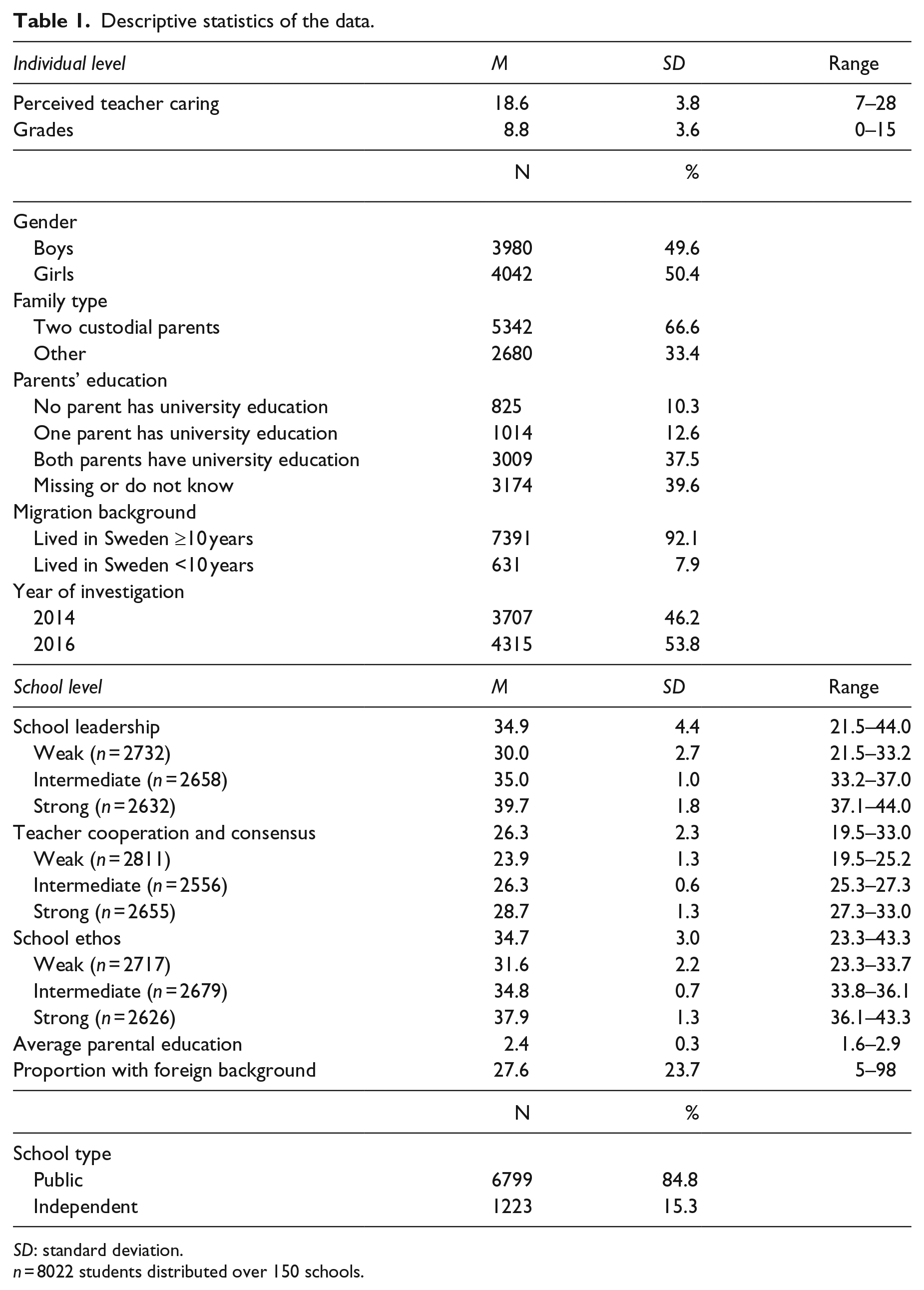
Descriptive statistics of all variables used in the analyses are presented in Table 1.
Descriptive statistics of the data.
SD: standard deviation.
n = 8022 students distributed over 150 schools.
Statistical method
The method used was multilevel modeling which handles hierarchical data, for example, students who are nested in schools. Two-level linear regression models were performed using Stata’s xtmixed command. By estimating an ‘empty model’, we assess whether there is statistically significant variation in perceived teacher caring across schools. Such a model does not contain any independent variables but allows the variation in perceived teacher caring to be separated into two different components, one for each level (individual, school). Model 1 shows the estimates for the dependent variable and Model 2 adjusts for all individual-level variables. Model 3 adds the schools’ average parental education and the proportion of students with foreign background, and Model 4 further adjusts for school type.
Ethics
Data from the SSS were collected anonymously and are, therefore, not considered an issue of ethical concern according to a decision by the Regional Ethical Review Board of Stockholm (2010/241-31/5). The STS has been approved by the Regional Ethical Review Board of Stockholm (2013/2188-31/5; 2015/1827-31/5).
Results
Figure 1 illustrates how perceived teacher caring varies across thirds of the three aspects of school effectiveness. The mean values of perceived teacher caring for all three aspects differ in a gradient manner, with the lowest values reported by students in schools characterized by a weak correspondence with the principles of effective schools and the highest values reported by students in schools with a high degree of effectiveness.
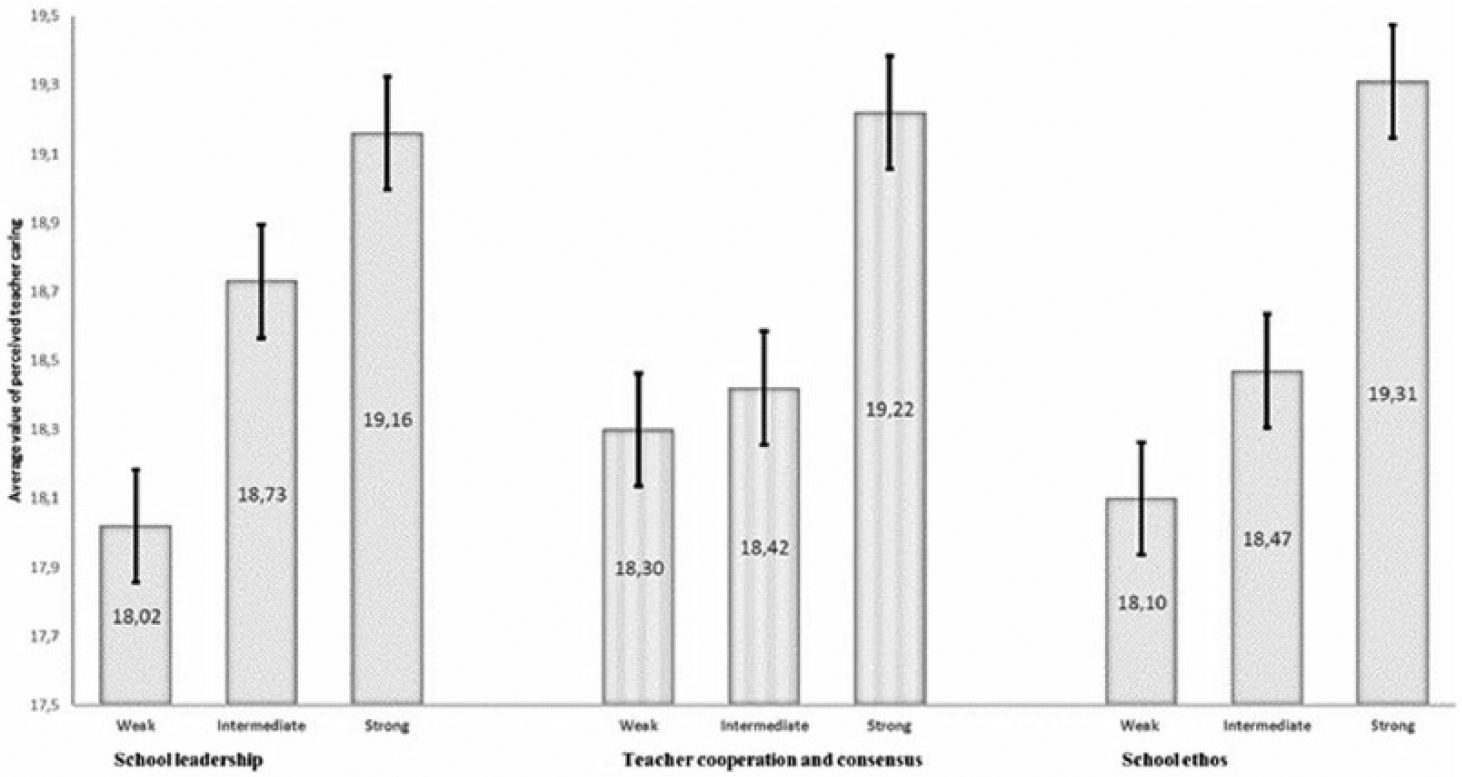
Perceived teacher caring by thirds of school leadership, teacher cooperation and consensus, and school ethos. Mean values and 95 percent confidence intervals (n = 8022).
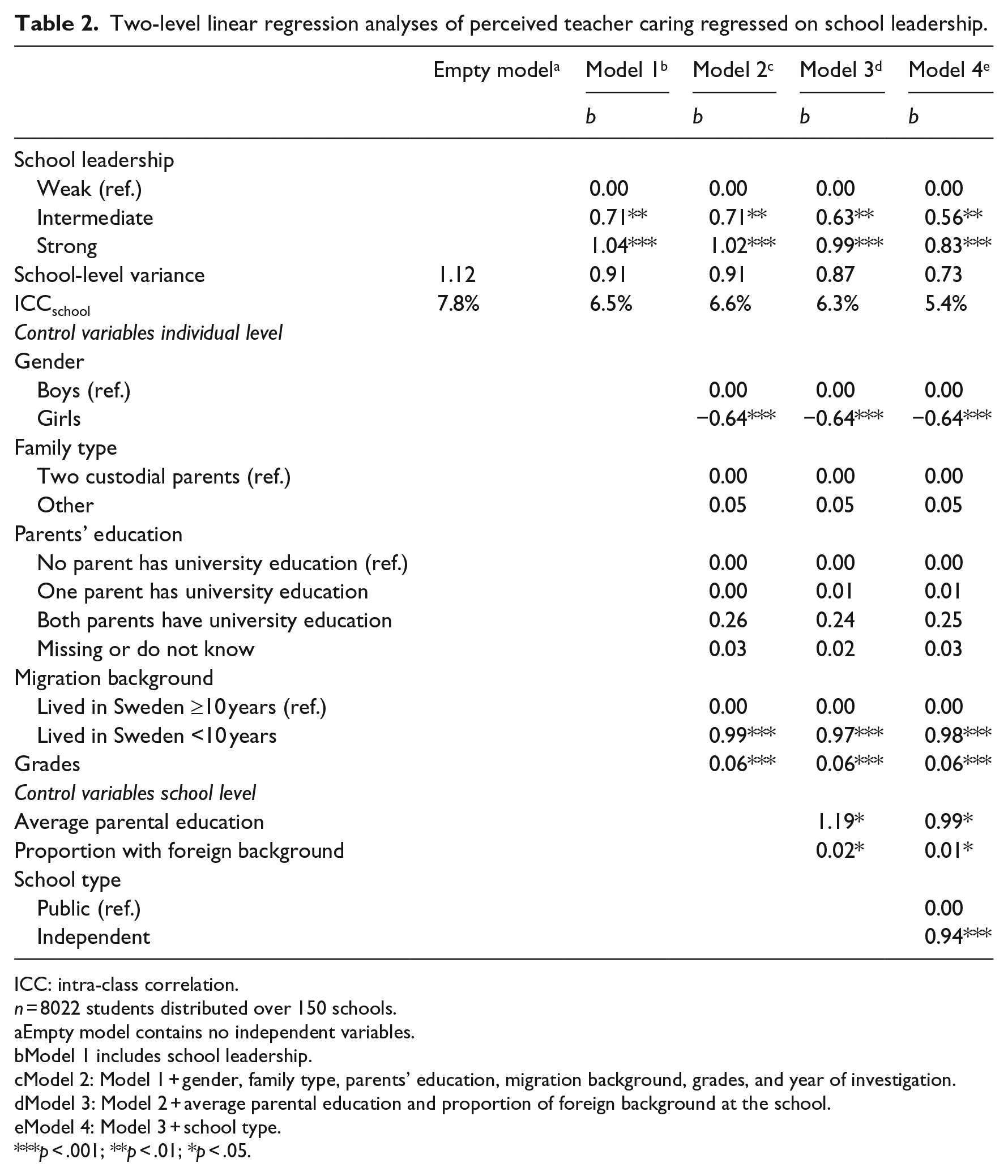
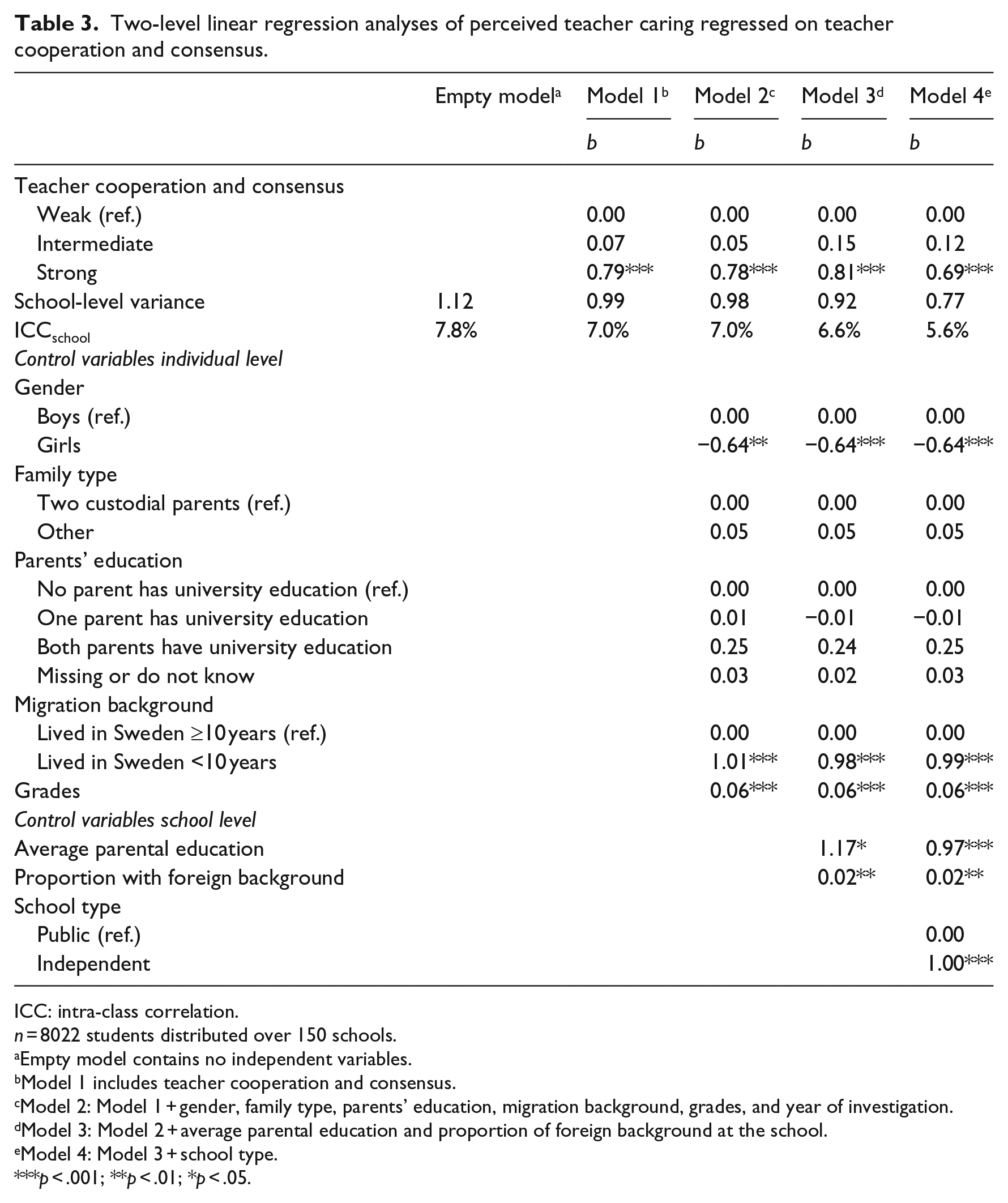
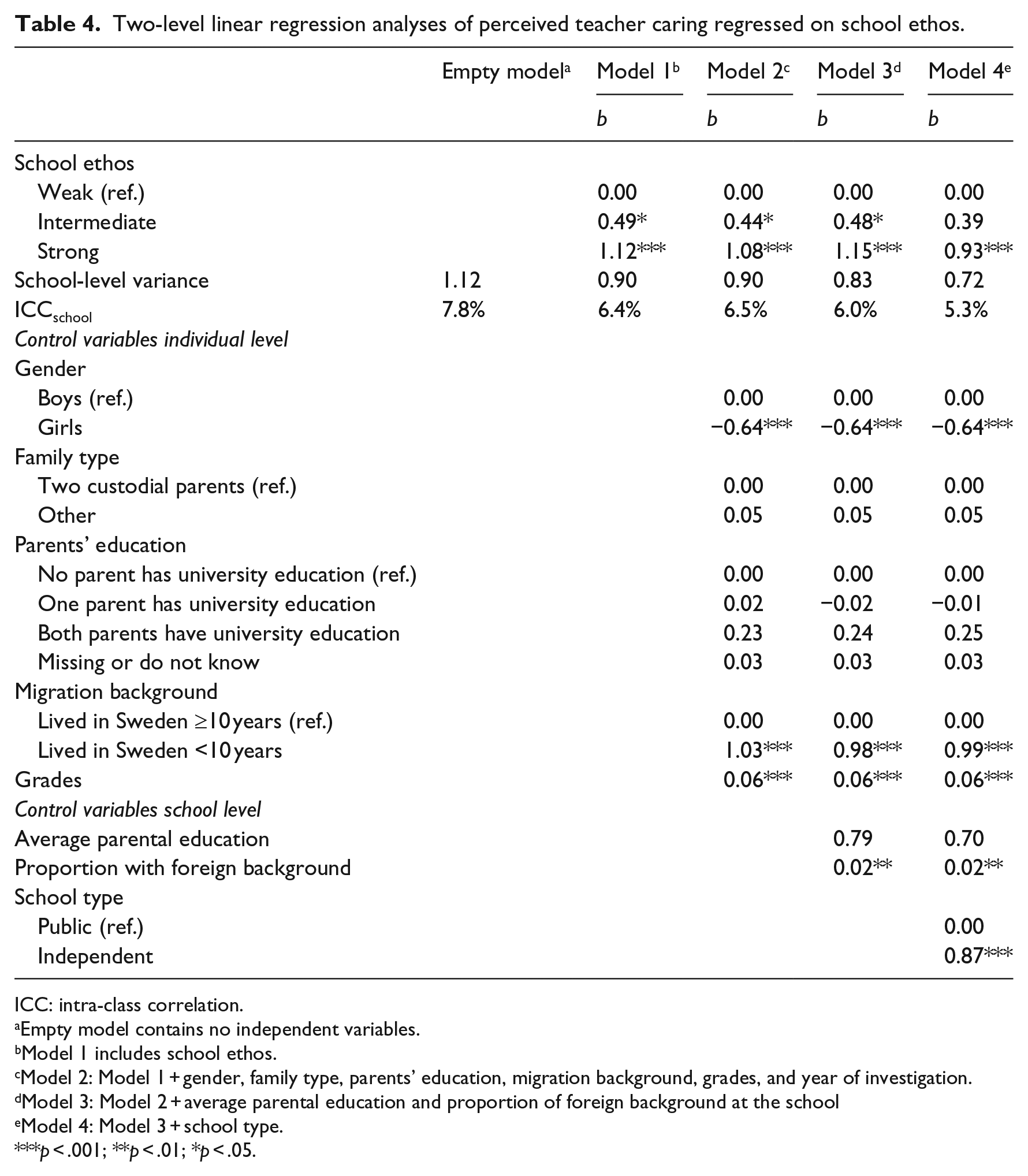
In order to assess whether the pattern remains in a multiple regression framework, two-level random intercept linear regression models of perceived teacher caring were performed. Tables 2 to 4 present results from analyses where perceived teacher caring serves as the dependent variable and school leadership (Table 2), teacher cooperation and consensus (Table 3), and school ethos (Table 4) serve as the independent variables. Control variables and their estimates are also reported in Table 2 to 4.
Two-level linear regression analyses of perceived teacher caring regressed on school leadership.
ICC: intra-class correlation.
n = 8022 students distributed over 150 schools.
Empty model contains no independent variables.
Model 1 includes school leadership.
Model 2: Model 1 + gender, family type, parents’ education, migration background, grades, and year of investigation.
Model 3: Model 2 + average parental education and proportion of foreign background at the school.
Model 4: Model 3 + school type.
p < .001; **p < .01; *p < .05.
Two-level linear regression analyses of perceived teacher caring regressed on teacher cooperation and consensus.
ICC: intra-class correlation.
n = 8022 students distributed over 150 schools.
Empty model contains no independent variables.
Model 1 includes teacher cooperation and consensus.
Model 2: Model 1 + gender, family type, parents’ education, migration background, grades, and year of investigation.
Model 3: Model 2 + average parental education and proportion of foreign background at the school.
Model 4: Model 3 + school type.
p < .001; **p < .01; *p < .05.
Two-level linear regression analyses of perceived teacher caring regressed on school ethos.
ICC: intra-class correlation.
Empty model contains no independent variables.
Model 1 includes school ethos.
Model 2: Model 1 + gender, family type, parents’ education, migration background, grades, and year of investigation.
Model 3: Model 2 + average parental education and proportion of foreign background at the school
Model 4: Model 3 + school type.
p < .001; **p < .01; *p < .05.
The results show that students in schools with an intermediate and strong school leadership rate perceived teacher caring higher compared with those in schools with a weak school leadership (Table 2). The estimate for intermediate school leadership is 0.71 (p = .002), indicating that students average ratings lies 0.71 units higher on the index of teacher caring compared to schools with a weak school leadership. Among students in schools with a strong school leadership, the corresponding estimate is 1.04 (p = .000). However, there is no statistically significant difference in perceived teacher caring between students in schools with intermediate versus strong teacher ratings of the school leadership (data not shown). The estimates do not change considerably when controlling for individual-level variables (Model 2), but decrease slightly when adding the school-level variables (average parental education level and proportion of students with foreign background) in Model 3. The most pronounced reduction takes place in Model 4 where school type is also adjusted for. Still, in the fully adjusted model, the estimates remain statistically significant, indicating a robust association between school leadership and perceived teacher caring. The intra-class correlation (ICC) of the empty model shows that 7.8 percent of the variation in perceived teacher caring occurs at the school level. In Model 1, the ICC decreases to 6.5 percent, indicating that about 17 percent of the between-school variation in perceived teacher caring is accounted for by differences in school leadership (1-(6.5/7.8) = 0.17).
Regarding teacher cooperation and consensus (Table 3), no substantial difference in students’ perceptions of teacher caring is evident between the weak and the intermediate categories. There is, however, a clear and statistically significant difference between schools with strong versus weak ratings of teacher cooperation and consensus (b = 0.79, p = .000) (Model 1). A separate test also revealed statistically significant differences between the intermediate and the strong categories across the four models (data not shown). Controlling for individual-level conditions (Model 2) and the schools’ average parental education and proportion of students with foreign background (Model 3) does not affect the initial estimate to any substantial degree. When further controlling for school type (Model 4), the estimate somewhat decreases (b = 0.69, p = .001). The ICC of Model 1 is 7 percent, indicating that the amount of school variation in perceived teacher caring accounted for by teacher cooperation and consensus among teachers corresponds to about 11 percent.
The results for teacher-assessed school ethos are presented in Table 4. In Model 1, a clear gradient is seen when moving from the weak to the intermediate category (b = 0.49, p = .024) as well as from the weak to strong category of school ethos (b = 1.12, p = .000). A significant difference between schools with intermediate versus strong teacher ratings of school ethos was also found (data not shown). When controlling for school type (Model 4), the estimates decrease to 0.39 (p = .065) for intermediate school ethos and to 0.93 (p = .000) for strong school ethos. About 18 percent of the variation in perceived teacher caring between schools is accounted for by the level of school ethos.
Discussion
The aim of this study was to examine whether three teacher-rated features of school effectiveness – school leadership, teacher cooperation and consensus, and school ethos – were related to students’ perceptions of teacher caring. Similar to previous studies (Allodi & Fischbein, 2012; Rutter, 2000; SNAE, 2006a, 2017), which have demonstrated variation between schools in how teachers perceive their work situation and work environment, we found that teachers’ ratings of their school’s leadership, teacher cooperation and consensus, and ethos differ substantially between schools. We also found variation in how students perceive teacher caring across schools, confirming our first hypothesis.
School leadership and teacher cooperation have previously been shown to be important predictors of the prevalence of bullying at the school level (Ertesvåg & Roland, 2015; Låftman et al., 2017b). This study adds to these findings by showing that features of school effectiveness are also related to perceived teacher caring at the student level. In schools where teachers rate features of the school effectiveness as high, the students’ rate teacher caring as significantly higher as well. This confirms our second hypothesis.
Previous research has shown that teacher caring is positively related to students’ school motivation and learning outcomes as well as their social and moral development (Velasquez et al., 2013). Earlier studies have also shown a dramatic increase of the between-school variation in learning outcomes and socioeconomic factors in Sweden since the 1990s (Fredriksson & Vlachos, 2011; Gustafsson & Yang Hansen, 2017; OECD, 2016). This increase can partly be explained by the free school choice (Östh et al., 2013; Yang Hansen & Gustafsson, 2016) and the increased proportion of independent schools (Böhlmark & Holmlund, 2011). This study adds to these findings by showing that there are differences in how teachers assess features of their school’s effectiveness, and how students’ perceive the degree of teacher caring at their school.
Our findings underscore the importance of not only focusing on between-school variation with regard to students’ background and their learning outcomes but also to look at between-school variation in teachers’ assessments of organizational aspects of the school. The school’s effectiveness in terms of school leadership, teacher cooperation and consensus, and school ethos has a direct association with students’ perceived teacher caring, with conceivable consequences for the pursuit of a more equal education system. Since the equality of the education system must be seen as an important societal goal, not least in view of the previously presented increased differences between schools, our results indicate that creating better opportunities for a more equal school leadership, teacher cooperation and consensus, and school ethos between schools would result in a more equal education at the student level.
Our results also show that features of school effectiveness partly account for the between-school variation in perceived teacher caring as postulated by the third hypothesis. The effects are non-negligible: school leadership accounts for 17 percent of the between-school variation in perceived teacher caring, teacher cooperation and consensus for 11 percent, and school ethos for 18 percent of this variation.
The fourth hypothesis, finally, investigated whether the associations between school effectiveness and perceived teacher caring remain after control for individual students’ grades and family background as well as the sociodemographic composition and accountable authority of the attended school. This hypothesis was also confirmed with the estimates of school leadership, teacher cooperation and consensus, and school ethos, all retaining their statistical significance in the fully adjusted model.
Strengths and limitations
The main advantage of this study is the design with two separate data sources linked together, which decreases the bias related to common measures variance. While the response rate among students in the SSS was reasonably high (83%), the attrition was more substantial among teachers in the STS (response rate 54%).
The difference in response rates between the students’ and the teachers’ survey is likely due to the fact that the students completed it during school time while the teachers conducted a web survey. A reasonable assumption is that the teachers who were most stressed and least satisfied with their work situation were less likely to participate in the survey, leading to upwardly biased ratings of the aggregate school effectiveness aspects. If anything, we believe that this leads to an underestimation of our results.
Previous studies have pointed to the limitations of using self-reported grades as we have done in this study (Cassady, 2001). However, a comparison of our self-reported measures of grades in Swedish, English, and mathematics, with the corresponding statistics for all Stockholm ninth grade students in 2014 and 2016, showed that the distributions did not differ to any substantial degree. Furthermore, our measure of parental education was imperfect due to many missing values. Here, a separate category of ‘missing/don’t know’ was included in the statistical analyses in order to not lose too many observations. When interpreting the results from our study, it is, therefore, important to bear in mind that we were not able to fully adjust for parental education in our analyses, since a non-negligible proportion of the students were classified into this additional category.
Finally, the generalizability of the results might be limited in scope since the data consist of information derived from ninth grade students and senior-level teachers in Stockholm. Future research should cover other grades or age groups, and other geographical populations. Further studies should also look more into implications of school effectiveness for other aspects of the schoolwork environment as perceived by students, as well as potential links to students’ achievement and health.
Conclusion
This study has shown that school effectiveness, as reported by teachers in 150 senior-level school units in Stockholm municipality, is strongly associated with ninth grade students’ perception of teacher caring, in the corresponding schools. School leadership stood out as an especially important predictor. In other words, promoting school effectiveness, in terms of good school leadership, a vital teacher cooperation, and a strong school ethos, is beneficial not only for teachers, but it could also affect how the students perceive their teachers, something which, in turn, most likely influences the students’ academic and social development. Specific efforts aimed at schools with low-rated ‘school effectiveness values’ could, therefore, contribute in the pursuit of a more equal education system. A promising task for future research within the field of school effectiveness is to further investigate the link between perceived teacher caring and the academic and social outcomes of students.
