



Abstract
While the impact of trauma on the well-being of forced migrants has been widely researched, there is still a notable lack of understanding regarding the consequences of collective trauma experiences within this population. This scoping review aims to explore and understand the current state of literature regarding collective trauma among forced migrants. A systematic review of the literature was conducted using Academic Search Complete, Ethnic Diversity Source, PsychINFO, Psychology and Behavioral Sciences Collection, Social Work Abstract, and SocINDEX. Of the 78 studies identified, 19 met inclusion criteria: peer-reviewed journal article; published between 2002–2022; written in English; involved forced migrants; and explored collective trauma. Six major themes were identified: (1) exploration of collective trauma; (2) impacts of collective trauma: (3) intergenerational trauma; (4) resilience and resistance; (5) practice and policy failures of the West; and (6) solutions to healing. Results support the inclusion of collective trauma in future research on forced migrant populations and advocate for interventions grounded in collective healing.
According to the United Nations High Commissioner for Refugees (UNHCR, 2024), there were 122.6 million forcibly displaced people globally in June 2024. These forced migrants are comprised of individuals who have involuntarily fled their homes due to egregious human rights violations often carried out by governments, militaries, or other forms of state-sanctioned violence (European Migration Network, n.d.). While the term “forced migrant” lacks a specific legal definition, it encompasses a wide range of displaced persons, such as refugees, asylees, internally displaced persons (IDPs), and others who have experienced forced displacement or have no legal status in their host country (Hamlin, 2022). The impact of trauma on forced migrants is well-documented, with decades of research showing high rates of trauma exposure and its negative effects on mental health (Blackmore et al., 2020; Bogic et al., 2015; Fazel et al., 2005; Mesa-Vieira et al., 2022; Sangalang et al., 2019). However, much of the current research has focused on individual-level trauma and healing, often viewed through a Western lens (Mitschke et al., 2017). While individual trauma significantly affects well-being, trauma experiences are deeply intertwined with cultural background and worldviews (Kirmayer & Ramstead, 2016). Western-centric approaches to mental health are often misaligned with the collective cultural identities of many forced migrant communities (Kira et al., 2012, 2022; Magan et al., 2023). This cultural disconnect hinders the effectiveness of trauma-informed interventions, as they fail to account for the collective lens through which trauma is viewed in these populations (Im & Swan, 2021).
Forced migrant communities, which are often grounded in collectivist values, experience trauma both individually and communally (Somasundaram, 2014). A collectivist community is one in which the values are based on collectivist culture where there is a strong emphasis on the group or community, rather than their own personal desires (Suh & Lee, 2020). In such collectivist cultures, trauma is not solely an individual experience but one that deeply affects entire communities. Collective trauma—stemming from events like war, genocide, or oppression—negatively impacts not only those directly involved but also those who share cultural, ethnic, or social connections with them. It “damages the bonds attaching people together” and causes injury to the community's social fabric (Erikson, 1976, p. 153; Somasundaram, 2014). As a result, the trauma is felt at both the individual and collective levels, particularly in communities where cultural heritage, language, and traditions are under threat (Abramowitz, 2005).
Collective trauma is experienced throughout the migration process, including while fleeing, during displacement, and post-migration (Salinas & Salinas, 2021). Communities with high levels of collective trauma are also at greater risk of intergenerational trauma. This occurs when trauma is “inherited” by subsequent generations, resulting in negative physical and mental health outcomes, changes in socioeconomic conditions, and altered parenting styles (Bezo & Maggi, 2018; Burke et al., 2021; Sangalang & Vang, 2017). Research affirms the far-reaching impacts of intergenerational trauma, with studies showing that children of trauma survivors often suffer mental health consequences despite not directly experiencing the traumatic events themselves (Flanagan et al., 2020; Hudson et al., 2016).
The detrimental effects of collective trauma have been extensively documented among other minoritized communities, such as Black Americans (Sweeting et al., 2023) and Indigenous populations (Gone et al., 2019). These studies show that collective trauma leaves enduring imprints on group consciousness and causes widespread social and psychological harm (Alexander et al., 2004). However, less is known about how collective trauma manifests in forced migrant populations, and there remains a need for further research to understand its unique implications for these communities.
The collective trauma experienced by forced migrants often occurs as a result of political, cultural, or ethnic violence, and the repercussions are felt across generations. For example, acts of cultural genocide are perceived as attacks on the broader collective group, not just on individuals, as they threaten the very fabric of community life, traditions, and identity (Abramowitz, 2005). The communal nature of these experiences often makes the trauma more profound, with far-reaching impacts on families, communities, and cultural structures. The breakdown of traditional social structures in the face of collective trauma can leave significant gaps in a community's ability to cope with stress and recover from the traumatic experiences (Somasundaram, 2014).
Intergenerational trauma is particularly significant in forced migrant communities, as the experiences of one generation can continue to affect future generations. In a systematic review of intergenerational trauma among asylum-seeking and refugee families, Flanagan et al. (2020) found that second-generation children, who did not directly experience traumatic events, still exhibited higher levels of mental health issues, reflecting the trauma their parents endured. While there is growing recognition of the impact of collective trauma and its intergenerational effects in refugee populations, the concept of collective trauma among forced migrants remains underexplored and is largely anecdotal.
The purpose of this scoping review is to establish a foundational understanding of the current state of knowledge regarding collective trauma among forced migrant populations. This review aims to explore general themes related to collective trauma, identify typological concepts, and examine interventions and solutions that have been used to address and heal collective trauma. By synthesizing available literature, this review will contribute to a more comprehensive understanding of collective trauma among forced migrants and offer insights for developing culturally tailored interventions. Such knowledge will help inform holistic policies and programs to address the multifaceted mental health needs of these communities, grounded in their collective cultural identities.
Methods
Scoping reviews can help develop an understanding of a topic or population that is under-researched and difficult to study (Sucharew & Macaluso, 2019). Additionally, a scoping review allows for flexibility in the inclusion of diverse methods and research designs, compared to systematic reviews that tend to focus on specific types of research, for example, only including quantitative studies (Grant & Booth, 2009). Following the scoping review guidelines outlined by Arksey and O’Malley (2005), this scoping review will undertake the following steps: (1) articulate research questions; (2) identify relevant studies; (3) select eligible studies; (4) chart data; and (5) synthesize and analyze findings.
Step 1: Articulate research questions
The scoping review aims to answer two main research questions: (1) What is the current understanding of collective trauma in the forced migration context?; and (2) What are current proposed solutions to heal collective trauma among forced migrants?
Step 2: Identifying relevant studies
In order to meet inclusion for the review, an article needed to: (1) explore the concept of collective trauma; (2) include forced migrants in the sample population or conceptual discussion; (3) be published in a peer-reviewed journal; (4) written in English; and (5) published between 2002–2022 to provide a 20-year review of the literature. An article was excluded if: (1) collective trauma was not mentioned or explored; (2) forced migrants were not included in the sample population; (3) was not published in a peer-reviewed journal (e.g., dissertation, thesis, or report); (4) not written in English; (5) published outside the range of 2002–2022, and (6) there was only a discussion of intergenerational trauma outside the context of collective trauma. Methodological limitations in terms of study type or design were not part of the inclusion or exclusion criteria.
Databases used for searching were Academic Search Complete, Ethnic Diversity Source, PsycInfo, Psychology and Behavioral Sciences Collection, Social Work Abstract, and SocINDEX. All databases were searched for relevant articles in October 2022. Relevant search terms and combinations of search terms were developed to identify articles eligible for inclusion. The following terms were used in multiple combinations in order to best identify articles: (“collective trauma” or “cultur* trauma” or “historical trauma” or “group trauma” or “social trauma”) AND (“migrant” or “refugee” or “asyl*” or “immigrant” or “internally displaced”). Additionally, citation mining—a method of utilizing reference lists of found articles in order to identify other relevant articles—was completed by searching all reference lists of the studies included. This helped to ensure that any relevant studies that were not captured in the original search due to limitations associated with database indexing or search terms used were included in the study (Levac et al., 2010).
Step 3: Select eligible studies
Covidence—a data management system used for reviews of the literature—was asked to collect, chart, and select appropriate articles for review. As shown in Figure 1, there were an initial 78 studies imported for screening with six duplicates removed. Two reviewers then completed the title and abstract review. Any disagreement on inclusion of articles was discussed and a consensus was made. After the initial review, 21 articles were moved to full-text review. Two reviewers independently assessed the full-text articles for inclusion. The same process was repeated where any articles with disagreement were discussed, and a consensus was reached. A total of eight articles were removed during the full-text review stage due to not investigating collective trauma (two articles) and not focusing on forced migrants (six articles). A total of 13 articles were identified from the full-text review. An additional six articles were identified through citation mining (Aranda et al., 2015; Bokore, 2018; Guribye, 2011; Nagata et al., 2015; Salinas & Salinas, 2021; Womersley & Arikut-Treece, 2019). Therefore, a total of 19 articles were included in the review. Due to the differing methods used across articles and the nature of the scoping review method, a risk of bias assessment among articles was not applicable.
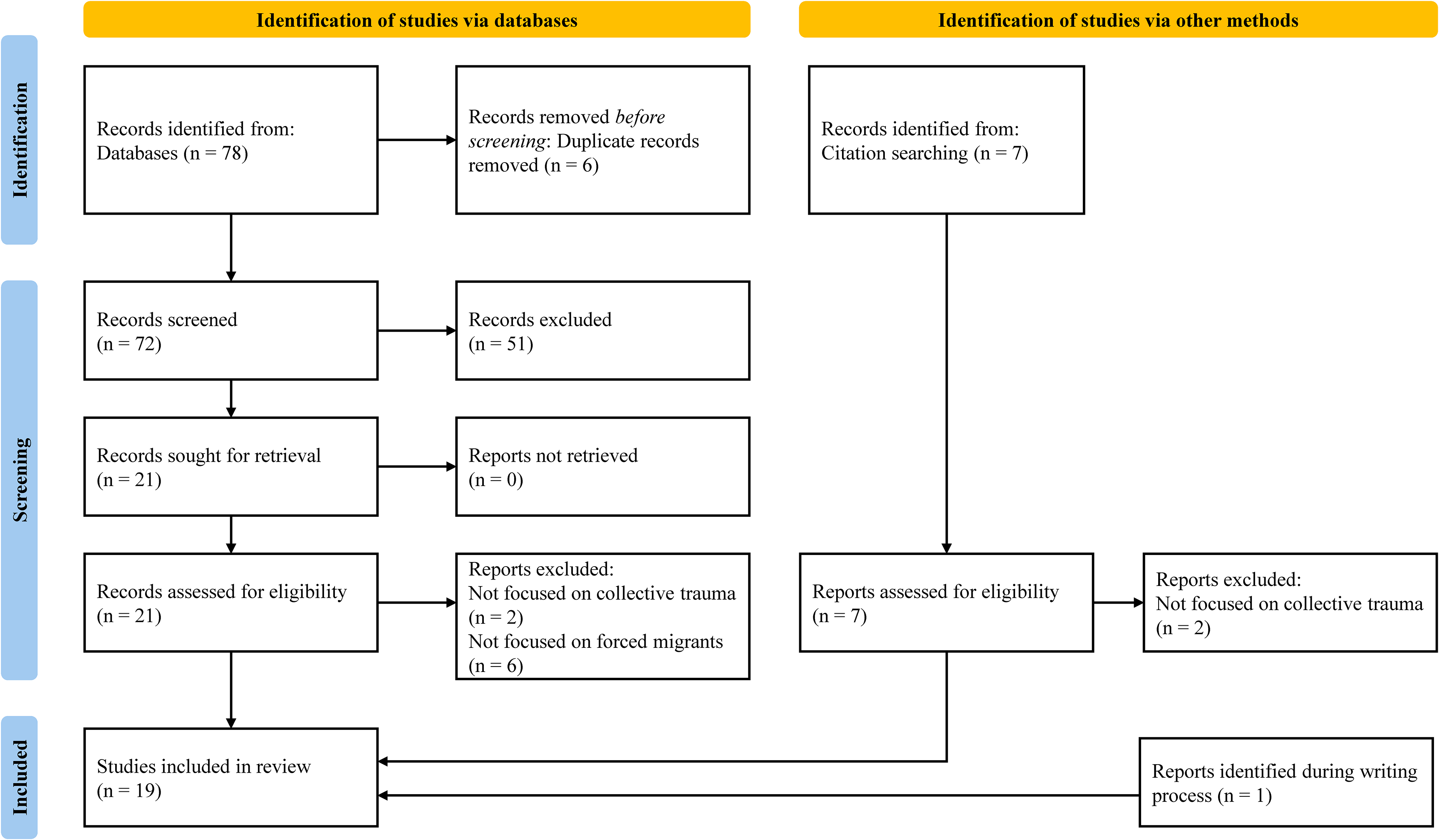
PRISMA chart.
Step 4 and 5: Chart and synthesis data
These 19 studies were then charted using Excel with relevant information being noted regarding sample population, study methods, study location, and outcome measures. All articles were thoroughly read and coded using an inductive approach that allowed for major themes to emerge from the data (Vaismoradi et al., 2013). After all articles were coded, codes were combined to find general themes. Coding and themes focused on the two overarching research questions set out for the study. All articles were then read through a final time to ensure that developed themes fit the data. The six major themes that emerged were: (1) exploration of collective trauma; (2) impacts of collective trauma on forced migrants; (3) intergenerational trauma; (4) resilience and resistance; (5) practice and policy failures of the West; and (6) solutions for healing.
Results
Study characteristics
As shown in Table 1, out of the 19 total studies reviewed, four studies were qualitative (Aranda et al., 2015; Atallah, 2017; Im & Neff, 2020; Salinas & Salinas, 2021), two were quantitative (Karenian et al., 2011; Tay et al., 2021), three were mixed methods (Jorden et al., 2009; Maleku et al., 2022; Womersley & Arikut-Treece, 2019), and the 11 remaining were non-empirical studies. Studies were diverse based on ethnic, cultural, and national and regional stratification as described by the authors and included Bhutanese (Im & Neff, 2020; Maleku et al., 2022; Salinas & Salinas, 2021); Somali (Bokore, 2018; Jorden et al., 2009); Palestinian (Atallah, 2017); West Papuan (Tay et al., 2021); Armenian (Karenian et al., 2011); Iraqi Yezidi (Womersley & Arikut-Treece, 2019); Latinx (Aranda et al., 2015); Sri Lankan (Somasundaram, 2010, 2014); Pakistani and Bangladeshi (Adhikari, 2022); Tamil (Guribye, 2011); South Asian (Guzder, 2011); Filipina/o/x (Hanna, 2017); Russian Mennonite (Krahn, 2013); Japanese Americans (Nagata et al., 2015); Hmong (Vue, 2021); and Central Americans (Wurtz, 2020). Most studies were conducted in high-income countries including the United States (n = 7), Canada (n = 4), Greece (n = 1), and Norway (n = 1). Additionally, several studies were conducted in low-and middle-income countries (LMICs) including India (n = 1), Palestine (n = 1), Sri Lanka (n = 1), Papua New Guinea (n = 1), Iraq (n = 1), and Mexico (n = 1). Publication dates ranged from 2009 to 2022.
Characteristics of included studies (n = 19).
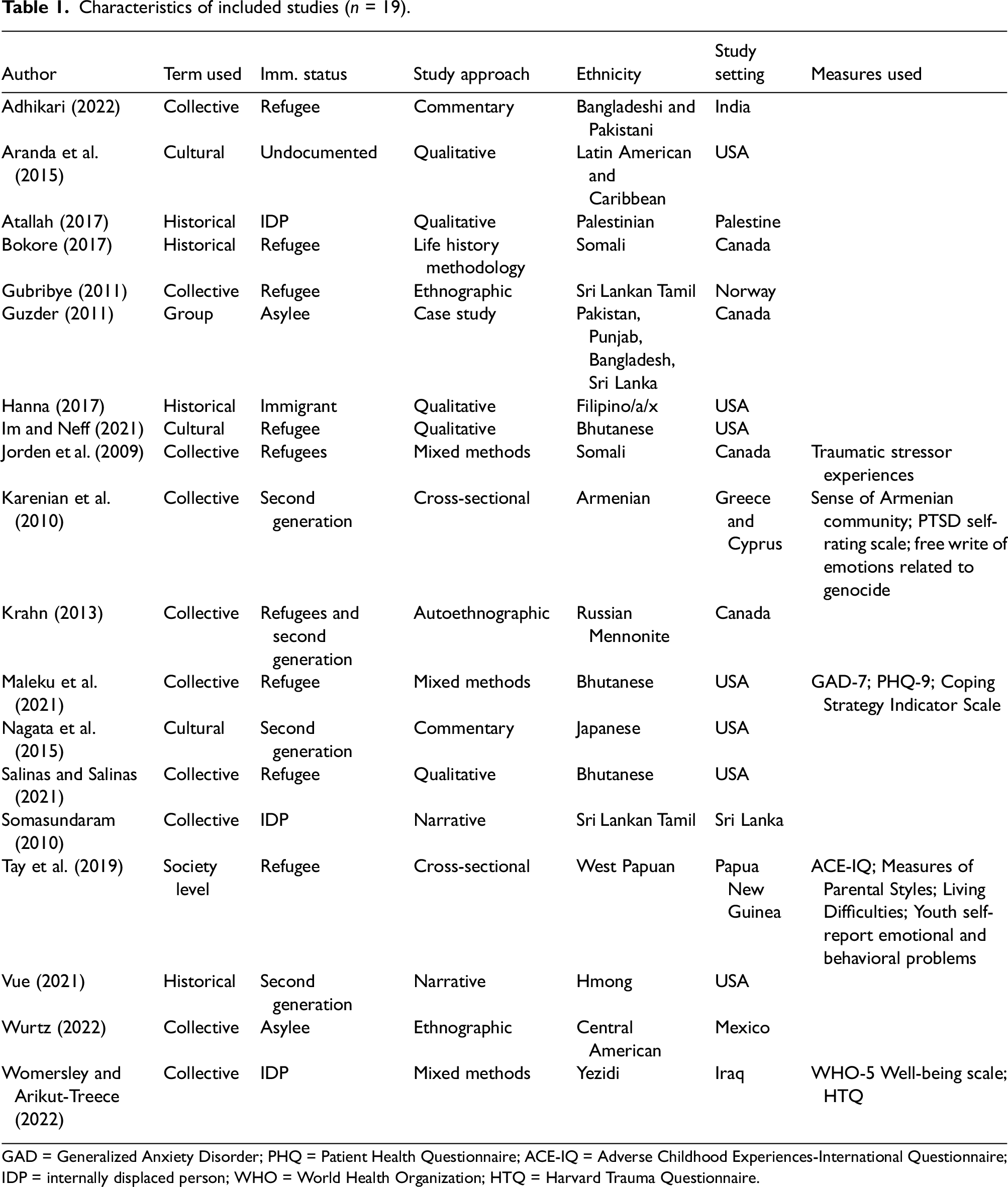
GAD = Generalized Anxiety Disorder; PHQ = Patient Health Questionnaire; ACE-IQ = Adverse Childhood Experiences-International Questionnaire; IDP = internally displaced person; WHO = World Health Organization; HTQ = Harvard Trauma Questionnaire.
Theme 1. Exploration of collective trauma
Articles used the terms collective (n = 10), cultural (n = 3), historical (n = 4), group (n = 1), and society-level (n = 1) trauma to describe experiences of collective trauma among forced migrants. There were no observable patterns in the term used based on immigration status, study approach, ethnicity, or study setting. The inability to fully differentiate between individual and collective trauma experiences was noted by several authors included in the review. For example, among Somali refugees who had experienced traumatic events like war, famine, and ethnic discrimination, authors noted how it was impossible to parse experiences out as either collective or individual (Jorden et al., 2009). Aranda et al. (2015) observed that undocumented youths’ experiences intertwined cultural and personal traumas as they navigated their dual identities as both American and undocumented, affecting them individually, within their families, and collectively. Hanna (2017) discussed the merging of collective and personal trauma and the need for healing from these experiences on the collective level.
Interestingly, several articles in the review observed that forced migrant communities often interpreted traumatic experiences, typically regarded as individual events from a Western perspective, as shared collective experiences. For example, Bhutanese refugees have faced traumatic experiences like forced displacement and loss of citizenship that could be interpreted as both individual and collective events, however, the collective impact was seen as more substantial than the impact at the individual level due to their communal culture (Maleku et al., 2022). Similarly, Yezidi women referred to the suffering of any community member as the suffering of all and described their trauma on a group level (Womersley & Arikut-Treece, 2019). Somasundaram (2010) stressed a blurred line between the individual self and outside community and that “the well-being of the individual member is experienced as the well-being of the family and community” (p. 25).
Theme 2. Impacts of collective trauma
Due to a lack of rigor and quantitative methods used within studies, this review cannot assess the direct impact of collective trauma on individual outcomes like post-migration difficulties, employment, and mental and physical health. A cross-sectional study by Jorden et al. (2009) found no direct link between collective trauma and depressive or trauma symptoms, but it did reveal that collective trauma had significant negative effects on cultural adaptation among Somali refugees in Canada. Among West Papuan refugee children, society-level violence and stressors showed direct negative associations with children's emotional and behavioral problems (Tay et al., 2021). Qualitative studies discussed a connection between collective trauma and adverse mental health experiences. For example, Bhutanese elders in the United States expressed feeling that their inability to practice preferred cultural and religious customs led to increased distress and a decreased ability to cope (Im & Neff, 2020). Among Yezidi women in Iraq, participants described the impact of collective trauma events as having negative impacts on mental health (Womersley & Arikut-Treece, 2019). Guzder (2011) described a connection between suicidal ideation among South Asian asylees in Canada and their experiences of historical trauma, specifically among women in a patriarchal society. Bhutanese Nepali refugees stated that the adversities they experienced due to ethnic cleansing and their lack of homeland led to a lower sense of belonging and poor mental health outcomes (Salinas & Salinas, 2021). Somasundaram (2010) argued that collective trauma experiences caused a breakdown of the collective trust in communities, which weakened social ties within the community and led to isolation. However, the strengths of collective culture and social support could be a potential protective factor.
Theme 3. Intergenerational trauma
Intergenerational trauma was explored within most articles and seen as a key aspect of collective trauma. Specifically, a group of articles included participants who identified as members of the 1.5 generation—individuals who come to the United States as children—or second-generation immigrants and explored the ongoing impacts of collective trauma across subsequent generations, which highlighted the intergenerational nature of collective trauma transmission. Karenian et al. (2011) found that second, third, and fourth-generation descendants of Armenian refugees continued to show signs of distress—though lessening within each subsequent generation—due to historical experiences of genocide faced by their ancestors. Im and Neff (2020) highlighted the harmful impact on Bhutanese elders when younger generations distanced themselves from traditional language and culture, creating generational divides that hindered collective integration and healing processes.
Survivor silence was a prominent theme in discussions of intergenerational trauma. Children of Japanese internment camp survivors noted that their parents spoke about their camp experiences indirectly and cryptically, often using the camps as reference points for “before” and “after” (Nagata et al., 2015). This silence was seen as a way to protect children from the atrocities their parents had experienced (Nagata et al., 2015; Vue, 2021). However, it led to children feeling that their parents were emotionally unavailable, resulting in a form of trauma from the lack of warm parenting (Krahn, 2013).
Theme 4. Resilience and resistance
Although collective trauma was, overall, discussed as a negative experience for forced migrants, many of the included articles reported that post-traumatic spaces allowed for resilience to emerge. In an ethnographic examination of the Tamil refugee community in Norway, community members viewed personal sacrifice not as a source of suffering, but rather a source of resilience and strength for the larger community (Guribye, 2011). Second generation Hmong college students noted that though they continued to see and experience the trauma their parents endured, they also saw resilience in both themselves and their parents (Vue, 2021). Similarly, second-generation Russian Mennonites saw their parents’, specifically their mothers’, experiences of trauma and survival as resilient, and attributed their ability to assimilate post-migration to their mental strength (Krahn, 2013).
Among groups actively experiencing collective trauma, articles discussed the idea of resistance as a form of resilience. For example, Palestinians living in the West Bank resisted Israeli forces through actions like hanging laundry in the color of the Palestine flag and keeping the keys to their homes in Palestine (Atallah, 2017). Japanese Americans showed resistance in internment camps by answering “no” to loyalty questions and resisting draft orders (Nagata et al., 2015). These groups viewed this resistance as a way to keep their culture intact when presented with trauma that could easily dismantle it.
The intersection of gender and forced migration status was reported to increase structural vulnerabilities. Although these vulnerabilities increased health risk behaviors, studies also viewed these risky behaviors as acts of negative resistance. For example, South Asian women living in Canada reported increased suicide attempts due to their heightened vulnerability attributed to the gendered hierarchy of their culture (Guzder, 2011). These suicide attempts were seen as a way to resist the patriarchal hold on these women and as a way for them to show their independence. Atallah (2017) described the experience of resistance to a similar patriarchal hierarchy in the West Bank among Palestinian IDPs. Women shared stories of listening in on male conversations and conducting strikes in order to potentially gain small amounts of power in their oppressed situation. These acts of resistance were key aspects to cultivating positive adaptation across generations to reduce the severity of intergenerational trauma.
Theme 5. Practice and policy failures of the West
Experiences of collective trauma in the forced migration context included experiences of colonization, oppression, and genocide, often stemming from or involving Western political and military forces. The enduring impact of colonization, often from the West, was seen throughout the collective and historical trauma stories of most study participants. Colonial partitioning and border creation in Somalia dismantled tribal governance and Islamic traditions, leading to ongoing collective trauma. This trauma continued to affect Somalis after resettlement through the persistent disruption of their social and political structures (Bokore, 2018). Similarly, Vue (2021) described how Hmong refugees in the United States, involved in the “Secret War” during the Vietnam War, faced ethnic genocide and forced relocation to Thai resettlement camps, followed by resettlement to the United States. These events have caused ongoing collective trauma for the Hmong people and their culture.
While collective trauma often originated pre-migration, articles explored how additional trauma accumulated in post-migration spaces through host country immigration policies, lack of social and economic support, and persistent discrimination. Japanese Americans’ experiences in internment camps are by far the most extreme version of discrimination and oppression that have negatively impacted generations of Japanese Americans (Nagata et al., 2015). Similarly, Hmong refugees and their children reported experiences of racial oppression post-migration in the United States, potentially exacerbating collective trauma experiences and the transmission of intergenerational trauma across generations (Vue, 2021).
Punitive and discriminatory immigration policies also had detrimental impacts on study participants. Aranda et al. (2015) explored how the continually changing landscape of immigration policy had profound impacts on undocumented young adults and their ability to successfully integrate in the United States. Additionally, their undocumented status kept them marginalized and at the fringes of society, causing its own form of collective trauma through legal rejection. Confusing and everchanging asylum laws at the United States–Mexico border was discussed as harmful to Central American asylum seekers (Wurtz, 2020), and among South Asian women attempting to gain asylum in Canada (Guzder, 2011) as they were asked to recount traumatic experiences and live with prolonged periods of uncertain legal status.
A lack of financial and welfare support post-migration was reported to exacerbate pre-migration trauma as well as create new experiences of collective trauma. Somalis in Canada reported ongoing post-migration difficulties including high levels of addiction to Khat and alcohol among men and high levels of youth and gang violence (Bokore, 2018). Bhutanese refugees reported feeling like the attempt to integrate into the United States’ “closed door” (p. 767) culture, when they identified their own culture as collective, limited their ability to adjust post-migration (Salinas & Salinas, 2021). In contrast, Guribye (2011) points to the strong welfare system that supported refugees in Norway—that is different from many other high-income countries—as key to promoting healing and long-term success for refugees. Specifically, Tamil refugees in Norway were found to be highly successful and have a reputation as “super immigrants” (p. 386). The community reported that their experiences of collective trauma helped forge a shared identity among the community post-migration. This identity, in tandem with post-migration social and economic supports in the host country, helped foster a space of collective post-traumatic growth within the community.
Theme 6. Solutions to healing
Many articles within the review explored potential ways that communities, families, and individuals worked towards healing collective trauma and discontinuing patterns of intergenerational trauma. While specific interventions varied widely, studies highlighted the need for collective healing at the family, group, community, and policy level. Somasundaram (2010) argued that when equilibrium could be maintained through healing at the family or community level, improvement at the individual level would follow. While most interventions were developed in high-income countries, a few were identified in the context of LMICs. These interventions included mental health training of community health workers to increase awareness of collective trauma experiences (Somasundaram, 2010), promoting continued resilience when under occupation (Atallah, 2017), development of interventions to address conflict and disharmony in families exposed to trauma (Tay et al., 2021), group-based interventions (Womersley & Arikut-Treece, 2019), and collective mobility (Wurtz, 2020). Interventions in places of resettlement focused on (1) implementation of policies that acknowledged past trauma and reduced continued marginalization; (2) culturally sensitive interventions developed for specific forced migrant subgroups; and (3) creation of physical spaces to promote collective action and healing.
Policy level initiatives were stressed as key to creating successful resettlement that acknowledged the collective atrocities forced migrants had experienced. Examples of policy initiatives included the creation of systems that allowed for increased time and resources to successfully transition post-migration, as well as the investment in trauma-informed and culturally informed services (Bokore, 2018). The need for governmental acknowledgement of oppressive experiences and state-sanctioned violence was emphasized as an important component of collective healing (Somasundaram, 2010). The Japanese American community viewed reparations for internment camp survivors and their families as a key step to recovery (Nagata et al., 2015). Somasundaram (2010) similarly emphasized the importance of acknowledgement of the state-sponsored violence experienced by the Vanni community in Sri Lanka, which continued to be perpetuated by the governments’ silence and manipulation of collective memory around trauma experiences.
Researchers highlighted the critical role of incorporating cultural context in interventions aimed at addressing collective trauma. For example, Bhutanese refugees noted the benefit of traditional religious rituals with extended family and community (Maleku et al., 2022). Group-based interventions were seen as more culturally appropriate compared to individual therapy due to the collective culture and need for collective healing (Maleku et al., 2022; Womersley & Arikut-Treece, 2019). Additionally, the need for the development of interventions created specifically for forced migrant communities was stressed versus the use of Western-style interventions that are “adapted” (Im & Neff, 2020; Maleku et al., 2022).
Studies highlighted the importance of having a physical, communal space to come together to collectively heal. Guribye (2011) described the key role non-government organizations (NGOs) played for the Tamil community in Norway to build community support and experience post-traumatic growth. Im and Neff (2020) additionally pointed to the value of a physical space where Bhutanese elders could come together to celebrate their cultural and religious traditions as a community. Similarly, another community of Bhutanese identified the need for safe, shared spaces for community members to partake in storytelling, share concerns, and build social networks (Salinas & Salinas, 2021). Authors also stressed the importance of service providers who work with these communities to engage in collaborative and symbiotic relationships, where the lived experiences of forced migrants are centered to create mutually beneficial relationships that foster trust and thus contribute to healing post-migration (Bokore, 2018).
Discussion and implications
This scoping review synthesizes current knowledge on collective trauma among forced migrants, emphasizing the need for a more holistic approach that acknowledges collective experiences of loss, oppression, and marginalization to foster communal healing. Although the overlap between individual and collective trauma has been identified (Hübl, 2020; Jansen et al., 2015), limited research addresses how the high prevalence of mental health challenges could be better managed through family- and community-level interventions, along with changes in policy and societal structures. Our review suggests that rather than isolating individual and collective trauma, future studies should focus on how communities process and heal from traumatic events, shifting away from individual-level diagnoses and treatments (Aranda et al., 2015; Hanna, 2017; Jorden et al., 2009).
Although the methodological rigor of studies limits conclusions about the impact of collective trauma on forced migrants, they suggest negative effects on mental health (Womersley & Arikut-Treece, 2019), behavioral problems in children (Tay et al., 2021), and levels of distress (Im & Neff, 2020). These findings align with broader literature showing that collective trauma negatively affects mental distress (Gone et al., 2019), including an association between the frequency of historical trauma-related thoughts and the severity of mental health problems in Iraqi Kurds (Skrodzka et al., 2021).
The scarcity of research on collective trauma, compared to the abundance on individual-level trauma, is a common issue across populations. Particularly among Western scholars who engage in research alongside forced migrant populations, scant research in this area highlights a chasm between how communities with a history of forced migration conceptualize their past traumatic experiences and Western researchers’ lack acknowledgement or understanding of individual vs. collective trauma. This mismatch between the lived experiences of participants and academic researchers’ mental health agendas has stifled the production of knowledge in this area, creating a fragmented and incomplete understanding of collective trauma and how post-migration spaces can assist these newcomers with post-traumatic healing and growth.
The second research question aimed to identify ways for migrants to heal from collective trauma experiences. Multiple articles discussed solutions to heal with a central theme highlighting the need to identify interventions and solutions beyond individual counseling and therapy and develop and implement community, group, or family level interventions (Im & Neff, 2020; Maleku et al., 2022; Womersley & Arikut-Treece, 2019). This approach is consistent with healing collective trauma within other populations, with a focus on the need for communal and family healing and equilibrium (Cypress, 2021; Somasundaram, 2014). For forced migrants living in displacement, refugee camps, or in LMICs, group therapy has been found to both improve wellbeing outcomes and maximize limitedly available resources (Mahmuda et al., 2019). Jansen et al. (2015) argues for alternative and updated paradigms where “individual distress is understood as a symptom of social distress” (p. 1). In other words, that heavily investing resources in the healing of the community at large will improve individual level functioning and move towards the stability of society as a whole.
Additionally, it is important to acknowledge the need for intervention work among forced migrant populations to be community-led, community-driven, and grounded in the needs of specific forced migrant populations. For example, multiple articles advocated for the inclusion of religious and cultural ceremonies that are already imbedded into cultural and community norms (Im & Neff, 2020; Maleku et al., 2022; Somasundaram, 2014). Interventions should not adopt Western counseling and therapy intervention models for forcibly displaced communities, but rather recognize the need for the development of culturally grounded solutions built to address the specific needs of the community, including collective trauma experiences (Im et al., 2021).
In this review, the development of physical community spaces was found to be imperative to the successful healing of collective trauma. Tamil refugees in Norway (Guribye, 2011) and Somali refugees in Chicago reported on the importance of a community space in providing a sense of belonging and connectedness to their community and culture (Magan & Padgett, 2021). Community-based ethnic organizations (CBEOs) play a critical role in bridging the gap between forced migrant communities and formal social service providers (Gonzalez Benson, 2020; Kirsch et al., 2023). By providing increased funding to forced migrant communities to develop their own spaces, including CBEOs, they can gain agency and the ability to gather as a community and work towards healing collective trauma.
Authors emphasized the need for policy reform in both pre- and post-migration phases, highlighting the ongoing increase in forced migration due to the current geopolitical context, a trend expected to continue (Bokore, 2018; Palattiyil et al., 2022). Despite this, governments often evade responsibility for their roles in conflicts driving forced migration and fail to implement supportive policies for the affected migrants (Nagata et al., 2015). The impacts of such policies are profound and enduring, affecting millions during and after conflicts and extending through generations. This review provides evidence that the effects of forced migration are not limited to the immediate aftermath of conflict but continue to shape the lives of migrants and their families long-term. However, research in Western contexts often focuses more on the economic or labor market impacts of migration, rather than the human experiences of forced migrants (Becker & Ferrara, 2019; Verme & Schuettler, 2021). In the United States, the politicization of immigration policy has left refugee-serving agencies and communities in a state of uncertainty, with fluctuating federal policies affecting funding and support (Kirsch et al., 2023). Given these challenges, there is a critical need for increased policy-level research that centers on the lived experiences of forced migrants. This focus would promote better systems and policies to support those affected by forced migration.
Limitations
Several limitations should be noted. Though an attempt to conduct a comprehensive review was completed, it is possible that some relevant articles were missed. The search was also limited to peer-reviewed published articles due to author constraints, which may have excluded valuable findings in such items as dissertations or book chapters. Decisions on which articles met criteria, though agreed upon by the two reviewers, are subjective and may have led to the exclusion of articles others would have seen fit to include. The decision was made to exclude articles that discussed immigrants outside the forced migration context, which limits the ability to generalize findings to all immigrant groups. The decision was made to conduct a scoping review rather than a systematic or metanalytic review due to the emerging nature of the concepts, which limits the ability to generalize broadly. Despite these limitations, this is believed to be the first review of collective trauma among forced migrants. It sheds light on this crucial concept to enhance understanding of migrants’ trauma experiences globally and its impact on their healing process.
Conclusion
Collective trauma experiences are inevitable when communities are forcibly displaced. However, the lack of its inclusion into the trauma literature impedes social sciences’ current aim to heal and successfully integrate forced migrants following displacement. This review illustrates a pattern of collective trauma that impacts forced migrants in both the pre- and post-migration contexts and emphasizes the need for continued investigation of the concept to increase understanding. This gap may be a key missing link in developing and implementing culturally grounded interventions for forced migrants. Future research into trauma related outcomes among refugees, asylees, and other forced migrant populations should begin to incorporate the concept of collective trauma to continue to develop a deeper and more comprehensive understanding. Additionally, future intervention work must shy away from solely focusing on individual level interventions based on Western models and actively acknowledge and work to heal collective trauma in partnership with forced migrant communities.
Footnotes
Acknowledgements
The authors thank the mentorship of Dr. Arati Maleku in assisting with early drafts of the manuscript.
Declaration of conflicting interests
The authors declared no potential conflicts of interest with respect to the research, authorship, and/or publication of this article.
Funding
The authors received no financial support for the research, authorship, and/or publication of this article.
