




Abstract
The comparative study of voice hearing is in its early stages. This approach is important due to the observation that the content of voices differs across different settings, which suggests that voice hearing may respond to cultural invitation and, ultimately, to learning. Our interview-based study found that persons diagnosed with schizophrenia in China (Shanghai), compared to those diagnosed with schizophrenia in the United States, Ghana, and India, reported voices that were strikingly concerned with politics. Compared to participants in the United States in particular, voices seemed to be experienced more relationally: Shanghai participants reported voices notable for a sense of benevolent persuasion rather than harsh command, and knew the identities of their voices more so than in the United States. The voices were striking as well for their religious content, despite the previous prohibition of religion in China. Our findings further support the hypothesis that voice hearing seems to be shaped by context, and we observe that this shaping may affect not only conceptual content but the emotional valence of the experience.
Introduction
Anthropology and psychiatry have found that to some extent, the hallucinations associated with serious psychotic disorder are “pathoplastic,” meaning that they are shaped by expectation and meaning from the experiencer's context and personal history (Gold & Gold, 2012; Larøi et al., 2014; Luhrmann & Marrow, 2016). They understand that, as Kroll and Bachrach (1982) describe, in the medieval world hallucinations might have been filled with angels and demons and understood through a religious lens, more so than in modern times. Those who experience hallucinations in one cultural-historical context might experience different hallucinatory content from those in another.
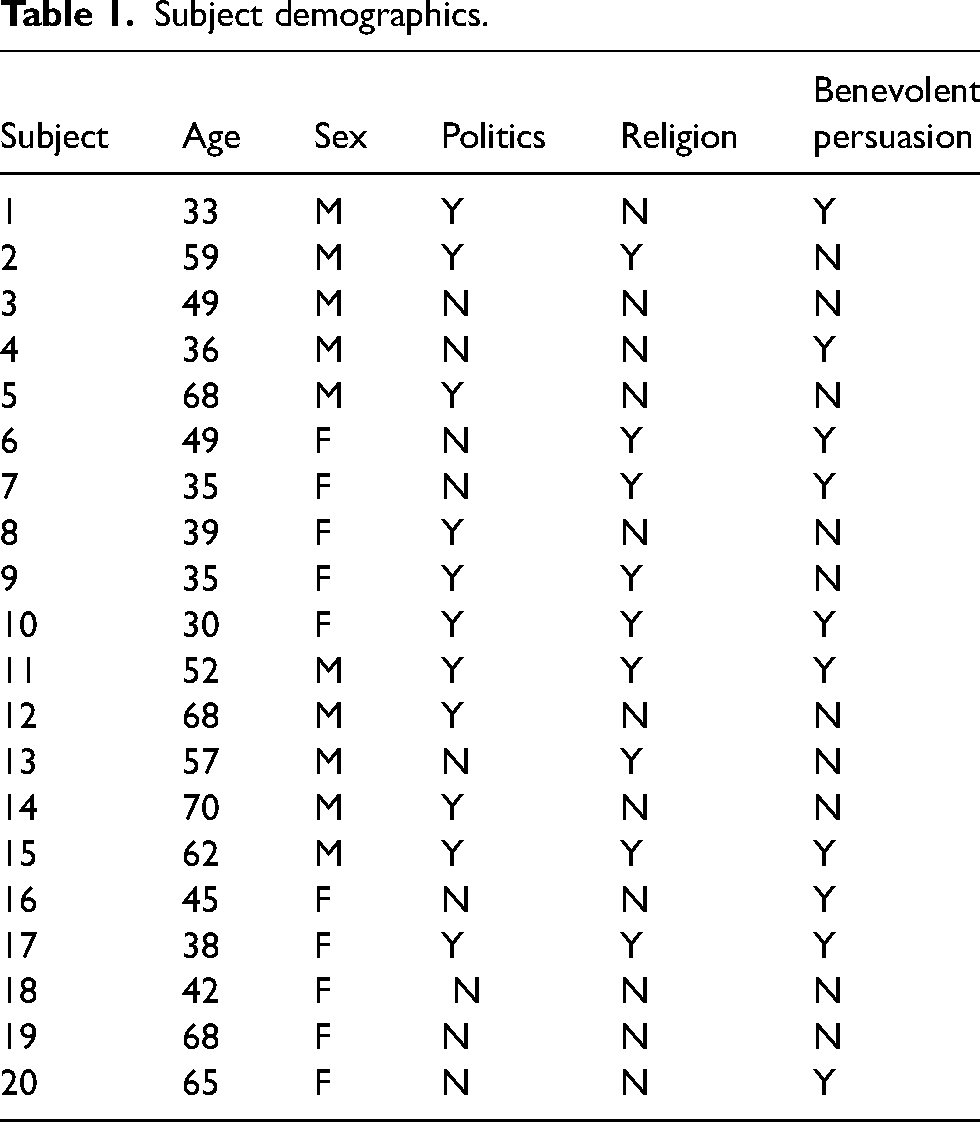
Subject demographics.
One study, for instance, found that religious themes in psychotic experience were most common in predominantly Catholic national contexts, followed by Protestant and Islamic ones, and were relatively rare in Buddhist ones (Stompe et al., 1999). In the 19th century, around half of those diagnosed with schizophrenia in a London hospital reported religious preoccupations; a century later, at the same hospital, less than a quarter did (Klaf & Hamilton, 1961; see a related case in Śkodlar et al., 2008). 1 In Chinese and Sinophone communities, religion—from Daoism, Buddhism, ancestral spirits, and spirit mediumship to Pentecostal Christianity—has been described as salient to mental health as part of both illness experience and help seeking, especially in Hong Kong and Taiwan (Kleinman, 1980; Ng et al., 2012; Tsai & Chen, 2006; Tseng & Wu, 1985; Yip, 2003). But the content of religious themes varies across place and time. 2
The presence of political themes also varies across contexts. In a study of Chinese, Korean-Chinese, and Korean interviewees diagnosed with schizophrenia across Korea (Seoul) and mainland China (Yanbien), politics was found to be the most common thematic category of delusion for both Chinese and Korean-Chinese participants, but not for Koreans, for whom family was most common (Kim et al., 1993). Political content was not mentioned in a study involving ethnically Chinese participants in Malaysia; among those who reported voices, family (28.5%) and friends and neighbors (33.5%) were the most common themes, pointing to the role of political context rather than ethnicity in the presence of political voices. A study conducted across Shanghai, Taipei, and Seoul found politics to be a notable (though not primary) theme of delusion across all three sites. The emphasis shifted in frequency and specific content across time. In Seoul, for instance, the authors note the dominance of delusions of poverty pre-1945 during the Japanese occupation, delusions of grandeur after liberation from Japanese rule, persecutory delusions involving spies and communists after the 1950 Korean War, and persecutory delusions of secret agents, army, or police during the 1960s–1980s amid military dictatorship. “It seems that delusions regarding politics,” the authors conclude, “are highly sensitive to the current political situation in each country” (Kim et al., 2001, p. 93). Indeed Ng's (2009) study on bipolar disorder in Shenzhen found that Maoist and post-Mao generations described their illness differently, shifting from more political and social accounts to a more individualized ethos centered on self-blame.
A deeper question is whether a shift in context may influence the overall tone of voice hearing and, in particular, the emotional valence of the commands often experienced by persons with psychosis, and thus the distress associated with voice hearing. Some work suggests that it does. A 1989 study found that the hallucinations reported by participants in one hospital in Texas seem to have become harsher and bleaker over a 50-year period. Mitchell and Vierkant (1989) compared hallucinations in patients admitted to an East Texas hospital during the 1930s with those reported in patients at the same hospital in the 1980s (patients were matched for age, race, and sex distribution; there were 150 patients in each group). They found that the hallucinations of the 1930s reflected the intense desire for material goods associated with the Great Depression and those of the 1980s reflected the new technological tools of the 1980s. More strikingly, the command hallucinations of the 1930s were primarily benign and religious (“live right,” “lean on the Lord”) but those of the 1980s were negative and destructive (“kill yourself,” “kill your mother”). The authors suggested that the more negative commands of the later period might reflect a more negative and hostile local environment.
The small handful of comparative studies of voices heard by patients with psychosis suggest that voices heard by patients in the United Kingdom are more negative and more violent than those heard by patients in the other setting compared. Suhail and Cochrane (2002) used case notes to compare the modalities and themes of hallucinations in White British patients, Pakistani patients living in Britain (who lived an average of 17 years in the United Kingdom), and Pakistani patients living in Pakistan. They found that the most dissimilar pair was the White British patients and the Pakistani patients living in Pakistan and that the British patients were more likely to hear commands to kill self or others than the Pakistani patients. Okulate and Jones (2003) reported that commanding, abusive, cursing, arguing, and frightening voices were heard less frequently among their Nigerian patients with schizophrenia than among patients in the United Kingdom (see also Nayani & David, 1996). In a 1960s study of psychosis in northern Ghana, the type of negative, insulting voice so common in the United States and the United Kingdom was only heard by one of the 14 voice-hearing participants interviewed, while more than half described “kindly voices which said such things as ‘I like you … you are good” (Fortes & Mayer, 1966, p. 29).
More recently, Luhrmann and colleagues (2015) compared the experience of hearing voices among people diagnosed with schizophrenia in San Mateo, California; Accra, Ghana; and Chennai, South India. In each setting, they interviewed 20 people diagnosed with schizophrenia who were asked in detail about the phenomenology of their hallucinatory experiences, their relationships with their voices, and their experiences of their voices. They found that their American sample often hated their voices, readily used the diagnostic label of schizophrenia, and could even sometimes recite diagnostic criteria. For them, the primary meaning of an external voice was being “crazy.” In general, the American sample did not know the speakers of their voices, did not interact with them, and their accounts of voice-hearing were filled with violence. Patients in Chennai and Accra, by contrast, did not use a diagnostic label, and they did not experience voice-hearing as necessarily bad. They were more likely to identify voices as people they know, and more likely to describe conversational relationships with their voices. In Accra, half of the patients reported that their dominant external voice was God, that hearing God was a good experience, and (usually) that God told them to ignore the malicious (or demonic) voices. In Chennai, patients were more likely to hear their kin. They often did not like the voices, but the voices usually did not tell them to kill themselves, the way the voices of the Americans often did; the voices told them instead to get dressed, clean up, and do chores. These few studies present the hypothesis that the content of voices heard by those with serious psychotic disorder may be less caustic, on average, for persons in the non-West compared to those in the West, although it should be added that most of these studies compare a relatively small number of patients.
The current study—also based on a small number of patients—supports this hypothesis. More specifically, it suggests that cultural context may shape not only the cognitive content but the emotional valence of commands and of voices more generally. That is, we suggest that cultural context may affect not only who speaks and about what, but with what emotional tones they speak.
Method
We carried out this research in the inpatient unit of the Shanghai Pudong Mental Health Center in China in summer 2017. We recruited participants if they had been diagnosed with schizophrenia (in one case, the patient carried a diagnosis of alcohol-induced psychosis but met ICD 10 criteria for schizophrenia and had heard voices for years) and had reported auditory hallucinations in the past according to hospital record and clinician report. Dr. Fazhan Chen, in consultation with each interviewee’s attending psychiatrist, identified whether individuals would be suitable participants. All were able to consent to and participate in interviews. We chose our interview structure to enable us to compare these interviews with those carried out by Luhrmann et al. (2015) in the United States (San Mateo, California), India (Chennai), and Ghana (Accra). In the current study, Emily Ng conducted the interviews in Mandarin in the presence of Tanya Marie Luhrmann, with real-time translation into English for clarifications and follow-up questions as needed. We included a total of 20 subjects (see Table 1). Ten were men and 10 were women; their average age was 50. The youngest participant was 30, the oldest was 70. Most of the participants had been ill for many years, and had been hospitalized previously, except for the participant diagnosed with alcohol-induced psychosis, for whom this was a first admission.
The interview protocol (see Supplementrial Material) began with an open-ended question in which we asked participants to tell us about themselves. It then explored whether participants had heard, seen, smelled, tasted, or felt things that other people could not. For voices, we used the term shengyin in Mandarin, which can mean both sounds and voices. We asked people where they heard these voices (in their head or through their ears). We asked them whether they knew who the speakers were, whether their voices liked them and whether they liked their voices, and the tone of the voices. We asked for multiple examples of what the voices typically said. We asked whether they heard commanding or critical voices, whether the voices were multiple or singular, and whether the voices talked amongst themselves. All interviews were digitally recorded, transcribed and translated professionally, and checked for accuracy prior to data analysis. At the end of each conversation, we conducted a brief psychosis SCID interview as a partial confirmation of the existing diagnosis.
The research was approved by the Institutional Review Board at Stanford University.
Results
As one might expect, participants reported a broad range of voice-hearing experiences (e.g., Tuttle, 1902). More than half of the participants reported hearing both positive and negative voices (n = 13). In all, many interviewees described positive voices (n = 17), many described negative voices (n = 16), and a few described neutral voices (n = 3). About three-quarters of participants described hearing multiple voices, either speaking together at once or one at a time, or often both; a quarter described only or predominantly hearing a single voice. Almost half (n = 9) of the participants described both male and female voices, some only female (n = 4), some only male (n = 5), and the rest were unsure or ambiguously gendered. More than half (n = 13) described voices of people or figures of whom they knew the identity, including kin whom they knew or had known (n = 5), and religious and political figures. Four described both voices they knew the identity of and those they did not. About a third (n = 6) reported only hearing anonymous voices. A number of participants (n = 8) described some form of multi-modal experience beyond voice, though in some cases it was hard to discern the nature of the experience. Most of these were visual experiences (n = 7), at times paired with touch and/or smell (n = 4). For instance, one participant described seeing angels descend in her house; another described the vision, touch, and scent of a former girlfriend. This kind of varied experience will be familiar to many who have work with those with psychosis who hear voices.
Three themes, however, seem to stand out in this context, and set these interviews off from the others conducted by Luhrmann and her colleagues elsewhere: politics; religious content often related to ancestors and immortals; and benevolent persuasion. Of necessity, there is some interplay between delusions and hallucinations in this material.
Politics
Political voices were strikingly prominent in these interviews. More than half (n = 11) reported voices related to politics, and six of the eight over the age of 50. These participants felt immersed in the political worlds they spoke of. When the same interview questions were asked in the United States, India, and Ghana, participants spoke very differently. In the United States, they tended to describe intrusive, violent voices, often with an unknown or alien quality; in India, they described voices of nagging family members; in Ghana, they spoke of the voice of God and other spirits (Luhrmann et al., 2015). In Shanghai, by contrast, many of our interviewees were caught up in a world of political alliances and in-fighting, especially Chinese politics of the Second Sino-Japanese War era (1937–1945) through the Maoist era (1949–1976). They spoke of themselves and their voices as agents of grand political plans, undertaking important tasks on behalf of prominent political figures.
For example, one man in his late sixties described his father's close acquaintance with Zhou Enlai, the Premier who served under Mao Zedong. He spoke of cell phone calls he received from the Central Committee of the Chinese Communist Party while in the ward. (These cell phone calls appeared to be the voices he heard.) He said that the calls were from high-level government, asking him to help collect information on the Korean War and the resistance against Japan (during the Second Sino-Japanese War). Another man of the same age described hearing voices of the opposite political alliance than himself, who spoke from downstairs at the hospital: “He is anti-Party and anti-socialism … I’m not anti-Party and anti-socialism … [but] they said I’m counterrevolutionary.”
A 70-year-old man heard the voice of a former neighbor, who he at times felt controlled him remotely, and who worked for Chiang Kai-shek, leader of the Chinese Nationalist Party and political opponent of Mao: “She is a spy. She has slept with Chiang Kai-shek, and has slept with the Minister of Defense.” He, by contrast, worked with Mao: “I used to be Chairman Mao's advisor, when I was 13 years old.” Even though she was clearly a questionable character for him, he seemed to feel he could change her mind: “[I] did some thought work [on the spy neighbor,] hoping she would change, telling her not to harm people … She said harming people is not good.” Thought work was a political term of ideological reform, used commonly by the Communist Party during the Maoist era and beyond. The man said he convinced her that harming people was bad, and that his former neighbor indeed changed a lot after his intervention.
Many of these voices came from the Maoist era, including the Cultural Revolution. More than half of those who heard political voices were men in or around their sixties, who were first hospitalized during or soon after the Cultural Revolution: the Cultural Revolution lasted from 1966–1976; their first hospitalizations ranged from 1968 to 1979. They would have been youths during the Cultural Revolution—a time when politics infused every aspect of life, and youths in particular were recruited by the millions to participate in mass politics. These men carried the Maoist world with them through their voices. The voices of the only male participant in the same age cohort who fell ill later, in 1994, combined Maoist politics with politics across other times and spaces: China, the United States, Great Britain, and Japan, ranging from contemporary presidents to historical Chinese politicians from the second century CE: “Obama … Reagan, Sun Yat-sen, Chiang Kai-shek, Mao Zedong, all of them are there, it's a mess … Zhuge Liang, Empress Dowager Cixi, they have all spoken [to me].” He described the voices as chaotic and strange, but not all negative. And unlike the clearer political alliances in the cases above, here, the message felt murkier: “It's a mess, I don’t know either. They talk a bit about politics, the strange and monstrous, the earth exploding … [about] war, that the whole world is going to go to war.”
Aside from these men who came of age during the Cultural Revolution era, the second most common group who heard political voices were women in their thirties. These women would have grown up after the Maoist era ended. Their voices tended to combine political and religious themes.
Religion and spirit worlds
The presence of religious voices is striking in the context of China, where religion was suppressed and prohibited for many years. Even so, nine out of 20 participants—most of them women—described voices linked explicitly or implicitly with Daoism, Buddhism, Christianity, and other Chinese spirit worlds and mythologies. They often interweaved ideas from different traditions—immortality, reincarnation—with figures of deceased kin and ancestors. A 38-year-old woman, for example, said that she was the smallest dragon born in the year of the dragon. Her voices told her that because she was born in the year of the dragon she would be great, and that she had descended from an emperor of the Tang dynasty. A god who had known her in a previous life now spoke to her.
A 35-year-old participant said: “[I] heard the Queen Mother of the West say ‘you are my daughter’ … she said … when I was reborn, I did not let her know that I was going to reincarnate, and [instead I] went directly.” This notion that gods might witness a human's reincarnation and later search for them on earth is not uncommon in these religious traditions (Ng, 2020). Aside from the Queen Mother of the West (a widely known Daoist deity), she heard the voices of many male and female immortals and spirits. She had also seen several deities, and described visiting the realms of angels, immortals, and souls, and the place where she had been reincarnated. A 57-year-old man described the reincarnation of his deceased mother into a young kitten. His mother then spoke to him through the kitten, and asked him to burn incense on her behalf at the temple. A woman in her late forties described hearing deities and immortals who had been with her since ancient times. Much of what she recalled of their speech seemed relatively benevolent, though not entirely. Some voices would tell her she was bad and stupid, but other ones would defend her. “They [the more positive ones] said, ‘you have to fill yourself with confidence’ … ‘believe in your ability, you are the only woman with capability, with talent.’” These voices also told her she would recover from illness in five days. Indeed, most of these religious voices were positive. One man in his late fifties described walking into a Christian church and hearing a voice say: “This illness will get better the moment you believe in God.”
For some participants, spiritual-religious themes, particularly those of immortality and reincarnation, were intertwined with political ones. The 72-year-old man who suspected his elderly female neighbor of being a spy also thought she was 270 years old (reminiscent of Daoist notions of human immortals). The woman who was the smallest dragon born in the year of the dragon knew from “the voices of our ancestors” that she would find greatness. “Our family's ancestor … says I will bring glory for our ancestors, I will be a great dragon in the future.” Her task was a political one: His order is for me to recover Taiwan … He said what's so great about Chairman Mao, you are the descendant of our Li family. The Li family is more powerful, the Li family will be able to recover Taiwan in the future … Do I have such a great skill? … I feel this is something I cannot complete. I’m a girl, I cannot complete this… [but] if I can save China, I am willing to sacrifice myself.
Not all such voices were entirely kind. A man who heard Liu Shaoqi (the first Vice Chairman under Mao Zedong), Yuan Shikai (a Qing dynasty military official born in the 1850s), and a group of female “sister” spirits that they each cultivated also said that these cultivated female spirits had decapitated the heads of many people and threatened to kill him if he did not surrender to them. If he did surrender, they would offer him immortality in return.
Benevolent persuasion
Perhaps the most striking observation about these voices was the relative lack of violent content (with, as we saw, a few exceptions). Only three out of the 20 described being commanded to harm themselves or others. Four mentioned being afraid that they or their family would be harmed by their voices. Half (n = 10) of our interviewees described what we call “benevolent persuasion.” We asked about commanding (Mandarin: mingling) and judgmental/critical (Mandarin: piping) voices during the interview. As in English, the translated terms for command and judgment connote something negative. All but one of these 10 participants said “no” to the question of command (mingling), and then they went on to describe instead a form of positive command—beneficial, if at times irritating.
In Mandarin, this notion of benevolent persuasion is captured by the word quan, variously translated in English as to advise, to urge, to encourage, to persuade, and to comfort. In common usage, it connotes well-intentioned advice, often from family, friends, and others attempting to alleviate or mediate a situation, urging one to make choices good for oneself and for the situation. This resonates with descriptions of nagging voices of kin in Chennai, India (Luhrmann et al., 2015) and with the practical but irritating commands reported by many people with psychosis. They were, however, particularly notable in the Chinese context. As one participant in her late forties put it when we asked whether the voices she heard ever commanded her, for instance to stop doing something, she replied: “No, [they have] not commanded [mingling] me. They’re persuading [quan] me with good, kind words, not commanding me.” When asked what kinds of things the voices persuaded her to do, she said: “[They] persuade you to be good … [They told me] to be strong, to have high morale.”
Not unlike the way people verbally care for others in many Chinese contexts, these persuasions were often concrete suggestions for daily living. Many of our participants considered these “soft” commands beneficial, if at times irritating; for some, they seemed to encourage actions that the participant themselves wished they would do or had done. A 36-year-old man described a female voice that has accompanied him since around the time of his late teens. He found her voice to be “annoying,” always “reminding” him of things. He gave an example: “[She] tells me to sleep well, to be well and keep going … [I] haven’t slept well these few days during afternoon naps; [she] said … if you sleep well during afternoon naps your problem will get better.”
Another man in his sixties described voices from the spirit world who advised him to eat more noodles rather than rice, even though he himself preferred rice. This was because he had stomach problems and noodles were better for his stomach condition. A woman in her forties described the voices of her cousins and uncles. They told her not to worry about doing housework, and not to worry about eating more vegetables and less meat, as she herself preferred vegetables over meat. One participant in her mid-thirties said that a voice suggested that if she buys a new cell phone, she should get an iPhone. Another participant in her late thirties said that as she was watching romantic dramas online, a voice advised her to be more mature, to read more literature and philosophy instead. She said she didn’t consider this a negative scolding so much as a beneficial suggestion to engage in more age-appropriate activities. One participant said that his voices told him to wash his face and his hair a bit more, so that he could be a bit cleaner. He said he did not feel these comments were judgments with negative intonation or intent, nor did he find the suggestions irritating; he considered them positive and well-meaning.
When asked about commands, a woman in her mid-sixties described an anonymous voice who often asked her to sweep the floor. The psychiatrists noted that she was indeed extremely helpful in the ward, sweeping the floor voluntarily. While participants’ descriptions varied, this interchange during the interview exemplifies a common attitude toward such benevolent advisory voices: “This voice is always asking me to participate in work, to sweep the floor a bit at home.” “… would the voice judge what you are doing, saying you’re doing this well, or you’re not doing this well?” “No, it just sometimes advises [quan] me to do more things.” “Does it advise you out of good intention?” “Of course it's good-intentioned!” “… Do you like that voice?” “Of course I do not like it, so annoying!”
Discussion
In 1964, the anthropologist Max Marwick suggested that witchcraft accusations could be seen as a “social strain gauge.” The relationships in which witchcraft accusations were most common in a given society were, he argued, those with the greatest structural tension within those societies (between son and sister's son in a matrilineal society, for example). We suggest that the content of psychotic voice hearing may be similar, acting as a kind of barometer of important aspects of the patient's social world.
The direct comparison of hallucination content between patients with psychosis in San Mateo, California; Chennai, India; Accra, Ghana; and Shanghai, China appears to bear this out. In Chennai, in a social world which anthropologists and others have shown to have great pre-occupation with kin, patients heard voices from kin in a manner more marked than in other settings (e.g., Marrow, 2013; Mines, 1994). In Accra, in a social world which anthropologists and others have shown to be shaped by intense involvement with Christian and demonic spirits, people heard God—and experienced God as a force that would protect them (Asamoah-Gyadu, 2005; Meyer, 1999).
Our current work finds that patients in Shanghai, particularly those who remember the Maoist era, live immersed in a world of politics. This observation is consistent with the observations of other anthropologists who have worked in China, particularly with that population (Kleinman, 1986).
By writing of hallucinations as a social barometer, we suggest that the voices heard in psychosis may reflect what is not just cognitively salient but perhaps also emotionally salient in a particular social world (not only who speaks, but how they speak). The phenomenological core of the voice heard by those with psychosis is an awareness of an often-invisible person who reaches out with intention, commanding, inviting, insisting. The way the patient makes sense of this phenomenological event may be rich with emotional meaning, and some of that meaning may reflect local cultural expectations around the experience. A voice interpreted as that of a parent, that of a mighty god, or that of an alien force may have significant consequences for the person who hears the voice.
Perhaps our most consequential observation in terms of treatment implication is the emphasis on benevolent persuasion, rather than violent threats, in the command hallucinations of our Shanghai sample. We suggest that this interpretation of the sense of command in these voices may be shaped by social practices common across China. The idea of benevolent persuasion is salient in many aspects of Chinese life. One well-known theme in the literature on Chinese child development is the role of the caring but critical parent—or better, parents who express care through commentaries on improvement. Beyond caricatures of the “tiger mom” in Asian American contexts, care through advice giving might be considered a central part of family and social life in many Chinese and Sinophone communities (Markus, 2016). Psychological studies of Chinese students find that they tend toward a problem-focused form of support in which advice giving is a part (Burleson et al., 2006; Feng, 2015). We found that indeed, in Shanghai, positive “soft” commands were common, and as noted, mapped onto a Chinese concept of caring, advisory persuasion, quan. These positive advisory voices outnumbered negative commands among our participants. 3
This brings us to the disturbing observation that in this comparison, we find once again that more violent commands were more common in the U.S. sample. This observation is consistent with studies conducted in the United States and United Kingdom since the 1970s, which have usually found violent or dangerous commanding voices to be more common than non-harmful ones (Beck-Sander et al., 1997; Hellerstein et al., 1987; Junginger, 1995; Luhrmann et al., 2015; cf. Goodwin et al., 1971). Many studies in the United Kingdom and United States have found malevolent voices to be more common; benevolent voices were often also present, but less common (Beck-Sander et al., 1997; Chadwick & Birchwood, 1994; Johns et al., 2002: Larøi et al., 2019; Nayani & David, 1996). In the Luhrmann et al. (2015) sample, 14 of 20 San Mateo participants described voices which told them to hurt other people or themselves, sometimes in disturbing detail. For example: “Usually, it's like torturing people, to take their eye out with a fork, or cut someone's head and drink their blood, really nasty stuff.” Five of the San Mateo participants even described their voice-hearing experience as a battle or war, as in: “the warfare of everyone just yelling.”
We suggest that it may indeed hold true that the United States, and perhaps the United Kingdom, may indeed be an outlier in a global context for the degree of violence in psychotic voices. This is the third non-U.S. sample collected in our systematic comparison of voice-hearing experiences across different countries. We have continued to find that the voice content within our U.S. sample is significantly more violent. It is important to be cautious about this interpretation; our numbers are small, and we know little about the individual characteristics of our sample outside of an admittedly long interview and the medical record. It is possible that our U.S. sample had experienced more trauma than members of our other samples—but we note the previous studies which found results consistent with ours.
Perhaps one contributing factor here might be a striking identification of hearing voices with “being crazy” in the United States (Luhrmann, 2007). Many observers have noted a striking identification between identity and mind in Western settings; that people feel that who they are is what they think as individuals (Makari, 2015; Taylor, 2007). The fear of a mind being “broken” may be sharper in the United States, and that perhaps influences a fear of the voice and perceived violence in the voice. There may be a stronger value of feeling in control of one's self as an independent person (Markus & Kitayama, 1994). Perhaps the greater violence might also reflect a world where violence is omnipresent through film, military, and popular culture in which gun violence is strikingly common (Gusterson & Besteman, 2009).
If that observation holds up, does it have implications? Research on the role of command hallucinations remains inconclusive. Some studies find that the presence of commands has no significant impact on violent behavior in contrast to, e.g., the presence of persecutory delusions (Cheung et al., 1997), while others find that specific command hallucinations to harm others are indeed correlated with violence (McNiel et al., 2000). Questions remain regarding potential mediating relationships between command hallucinations and delusions, other hearer and voice characteristics (e.g., sense of one's own social position), and the relevance of command voices for self-harm versus violence toward others, or toward property (Fox et al., 2004; Rogers et al., 2002; Salim et al., 2021). Nonetheless, studies that do find an association between voices and violence have pointed to the importance of the perceived benevolence/malevolence of the voices, whether as a direct or as a mediating factor for complying with commands (Beck-Sander et al., 1997; Shawyer et al., 2008). This remains an important area for future research.
Conclusion
Larøi et al. (2019) point out that “negative voice-content is the best sole predictor of whether the hearer of an auditory-verbal hallucination will experience distress/impairment necessitating contact with mental health services” (p. 1). We find that a particular style of positive command voices—what we call benevolent persuasion, indicated by the Chinese term quan—is strikingly common among our Shanghai participants, while negative command voices were notably few compared with studies in places like the United States (Luhrmann et al., 2015). Benevolent persuasion often entails a well-intentioned, even caring attitude of the voice toward the hearer. This suggests that cultural context might shape not only the content, but also the valence of voices and the hearers’ relationship with their voices, which may in turn affect levels of distress and impairment, with potential implications for behavior.
We suggest that voice hearing can be considered a social barometer for what is salient to patients in a given cultural-historical setting, and that these interpretations may have implications for the valence of the voices. The striking prevalence of politically oriented voices among participants first hospitalized in the 1960s and 1970s, for instance, speaks to the thickly politicized atmosphere in China at the time, amid the Cultural Revolution. 4 The prominence of spiritual-religious themes among those born after the Reform era of the late 1970s parallels what has often been called a religious revival in China, following the (partial but considerable) removal of previous state restrictions on religious practice and infrastructure. The gender difference between these two groups (more men in the first, more women in the second) also suggests that a person’s position within a society, not to mention their life history, may influence what is salient to them in a given context.
The implications of benevolent commands are complex, and call for further exploration of the intention of voices versus the content of the commands (Larøi et al., 2019). While benign voices have been associated with a higher capacity for self-reassuring meta-cognition (Connor & Birchwood, 2013), a harmful command from a voice perceived to be benevolent may also be more likely to be acted upon than one from a perceived malevolent voice (Beck-Sander et al., 1997). Given the recent therapies that encourage engaging with rather than ignoring voices (Alderson Day et al., 2021; Leff et al., 2014)—including efforts to transform negative voices into positive, supportive ones—research on voice hearers’ own descriptions of benevolent persuasion can provide an invaluable resource for rethinking how to live with voices.
Limitations
This work has been based on a small sample, as it depends on detailed interviews. They are not representative of “China” or the “the United States” at large and may be distinctive in various ways. Further work is needed.
Supplemental Material
sj-doc-1-tps-10.1177_13634615231202090 - Supplemental material for Voice hearing as a social barometer: Benevolent persuasion, ancestral spirits, and politics in the voices of psychosis in Shanghai, China
Supplemental material, sj-doc-1-tps-10.1177_13634615231202090 for Voice hearing as a social barometer: Benevolent persuasion, ancestral spirits, and politics in the voices of psychosis in Shanghai, China by Emily Ng, Fazhan Chen, Xudong Zhao and Tanya Marie Luhrmann in Transcultural Psychiatry
Footnotes
Acknowledgements
We thank the staff at the Shanghai Pudong Mental Health Center for their support, and the interviewees for sharing their experiences.
Declaration of conflicting interests
The author(s) declared no potential conflicts of interest with respect to the research, authorship, and/or publication of this article.
Funding
The author(s) disclosed receipt of the following financial support for the research, authorship, and/or publication of this article: This work was supported by the John Templeton Foundation (grant number 55427).

Supplemental material
Supplemental material for this article is available online.
Notes
References
Supplementary Material
Please find the following supplemental material available below.
For Open Access articles published under a Creative Commons License, all supplemental material carries the same license as the article it is associated with.
For non-Open Access articles published, all supplemental material carries a non-exclusive license, and permission requests for re-use of supplemental material or any part of supplemental material shall be sent directly to the copyright owner as specified in the copyright notice associated with the article.
