




Abstract
As psychological resilience has been increasingly recognized as contextually constructed, mixed methods studies that map out local ecologies of resilience have become increasingly common. However, the direct adaptation of quantitative tools for cross-cultural use based on qualitative findings has been relatively lacking. The current review aims to provide an overview of existing measures of resilience used cross-culturally and to synthesize the protective and promotive factors and processes (PPFP) of resilience identified within these measures into a single resource. A January 2021 search of PubMed for studies of the development of psychological resilience measures that excluded studies of non-psychological resilience yielded 58 unique measures. These measures contain 54 unique PPFP of resilience, ranging from individual to communal-level characteristics. This review is intended to serve as a complementary tool for adapting standardized measures for stakeholders requiring an assessment tool that is attuned to their context for mental health risk assessment and intervention evaluation.
Keywords
Resilience as a theoretical construct
Since its early appearances in mental health literature in the 1970s, the concept of resilience has undergone a dramatic evolution. Although initially conceptualized as an individual's ability to successfully adapt and “bounce back” from adverse circumstances as determined by the interaction of various risks and protective factors, achieving a commonly agreed upon definition has remained elusive (Windle et al., 2011). Despite these difficulties, however, it is important to strive for a high degree of terminological and methodological sophistication for this research to be most useful (Southwick et al., 2014). As such, researchers have valuably pointed out that, despite the diversity of definitions, there is agreement that resilience entails (a) positive adaptation and good mental health, despite (b) exposure to significant adversity or threat (Luthar et al., 2000).
The changing grounds of resilience research have seen a shift away from a strict weighing of risks and protective factors in favor of recognizing resilience as a dynamic process of positively adapting to acute or sustained adverse circumstances (McCranie et al., 2011; Southwick et al., 2014). This contemporary view on positive adaptation further differentiates between promotive and protective factors. Although commonly referenced together as promotive and protective factors and processes (PPFP), promotive factors refer specifically to predictors of higher levels of positive outcomes, whereas protective factors denote predictors of lower levels of psychological symptoms (Patel & Goodman, 2007). Although these factors are intermingling and often co-occurring, promotive and protective factors are not strictly the inverse of each other and the absence of a psychological disorder should not be considered synonymous with positive well-being. Furthermore, these predictors have been shown to vary with context, timing, and the resilient outcome of interest, with some evidence even suggesting that what may be promotive in one context, might be protective in another, as was found when comparing the role of political affiliation among Nepali former child soldiers and Bosnian adolescents (Jones, 2002; Kohrt et al., 2010; Tol, Jordans, et al., 2013).
This emphasis on context captures what is perhaps the most important aspect of contemporary perspectives on resilience: its ecological dimensions, which allows researchers to more effectively achieve cultural relevance in their assessments of the construct (Panter-Brick, 2015). The ecological view situates the individual within their environment, positioning resilience as the interaction of numerous levels of analysis, from the genetic, epigenetic, and developmental, up to the demographic, cultural, economic, and social (Southwick et al., 2014).
This shift has greatly benefited from the framework outlined by Brofenbrenner (1979) in his model of child development, which maps out ecological context as a series of related yet distinct micro-, meso-, exo-, and macrosystems, at the center of which sits the individual. The individual's most immediate contextual level is his or her microsystem, which addresses the interaction between the individual and the immediate environment, such as the home or school. The mesosystem then considers interactions between multiple microsystems, such as the interplay between an individual's supports at home and their school supports. Broader societal structures such as the political and economic systems within which these mesosystems interact are addressed by the concept of the exosystem, all of which is encompassed within the broader macrosystem that includes the overall cultural context and its concomitant customs and ideologies (Betancourt & Khan, 2008).
This macrosystem is distinct from “community resilience,” which is most often used to refer to the broader capacity of systems to adapt in response to shocks or stresses, as opposed to the impact of the cultural milieu on individuals (Bhandari & Alonge, 2020). Although components of community resilience, which range from “participation of women in community decision making” to “water security and management”, are likely to inform the various levels of Brofenbrenner's ecology, they ultimately require separate consideration (Clark-Ginsberg et al., 2020).
The ecological framework and its emphasis on culture highlights the importance of interpreting resilience through the lens of anthropology, which situates individuals within their broader context and stresses the capacity of both the individual and their environment to buffer against the effects of adversity (Ungar, 2013). Although individual traits, beliefs, and capacities play an important role in resilience, the cultural, social, economic, and political systems in which they are enmeshed also have a moderating effect on the likelihood of the individual to experience resilience (Leadbeater et al., 2005).
Shifting the paradigm toward resilience in global mental health
Assessing the relevance of resilience as a construct and its constitutive elements among different populations is not merely a matter of theoretical interest, but of the utmost practical concern to stakeholders who wish to positively impact the communities in which they work. This view is captured in theorists’ determination that the “central mission” of resilience research is the distillation of ingredients for the development and implementation of interventions that can effectively improve mental health trajectories (Luthar & Brown, 2007).
This mission has been embraced more widely within the global mental health space following its specific reference in the United Nations’ Sustainable Development Goals, and there has been a growing appreciation for both the importance of addressing mental health as a global public good and fundamental human right, and for the relative dearth of research and investment in mental health programs, especially in low- and-middle-income countries (Patel et al., 2018). With mental and substance-use disorders now the leading cause of disability worldwide, there must be improved efforts to not only address these problems once they have emerged, but also to support individuals in building the resources to prevent their occurrence such that health systems do not become overburdened by their presence (Wainberg et al., 2017).
Resilience as a theoretical construct is uniquely poised to assist in the prevention of negative mental health outcomes as a bolster against stress and adversity, and its potential has been increasingly recognized in international guidelines that advocate for building on local strengths in a culturally sensitive way (Inter Agency Standing Committee, 2007). Given the ecological nature of resilience, its factors can often be addressed and strengthened in non-clinical settings by trained lay health workers. It is thus particularly amenable to task sharing that bolsters communal resources without overtaxing the existing healthcare infrastructure (Wainberg et al., 2017).
Yet, despite its potential for capacity-building in low- and-middle-income countries, research on risk continues to predominate and resilience has thus far been underutilized in this context, appearing as only a passing reference in the Lancet Commission's 2018 blueprint for promoting mental well-being and preventing mental health problems (Panter-Brick, 2014; Patel et al., 2018). This slow shift indicates the magnitude of the paradigm shift taking place, likened to that of moving attention from poverty to inequality, or from biological to social determinants of health in the global health landscape (Marmot, 2007; Pickett & Wilkinson, 2011). Furthermore, successfully shifting paradigms from risk to resilience entails a methodological overhaul that attends to local ecologies of resilience, including a novel approach to identifying how resilience manifests according to context and the development of measures that are up to the task of doing so in low-resource environments.
Mixed methods approaches to resilience in practice
Despite the continued dominance of a paradigm that emphasizes trauma and risk, humanitarian settings have largely been the crucible within which novel work that shifts attention towards resilience is taking place, demonstrating meaningful bridges between transcultural psychiatry, anthropology, and social work (Panter-Brick & Eggerman, 2012). This interdisciplinary work has highlighted the value of a mixed methods approach when assessing resilience because understandings of the construct of “resilience” itself and its constitutive factors are both culturally grounded. From this perspective, many of the existing measures of resilience and the Western biases that they carry are unlikely to yield information about resilience and its PPFP that can be effectively acted on to the benefit of the new populations of interest.
Preliminary qualitative fieldwork that adopts an anthropological lens is thus invaluable to delineating a local theory of resilience. This has established a hybrid approach that assesses the construct via both an internationally standardized scale and ethnographic work as the standard of practice (Kim et al., 2019; Mendenhall & Kim, 2019). The qualitative arm of this approach adopts a modified version of Nichter's idioms of distress heuristic for consideration of the range of resilient responses that interlocutors might demonstrate. This methodological approach draws from previous cross-cultural assessments of anxiety and depression that attended to their locally resonant expressions, offering a clear framework for how one might establish a new heuristic for idioms of resilience (Rasmussen et al., 2011; Weaver & Kaiser, 2015).
These “idioms of resilience” have been defined as “socially meaningful and culturally resonant means of experiencing and expressing positive adaptation and well-being in the midst of adversity,” and represent an attempt to move beyond a Eurocentric perspective of mental health by de-emphasizing individual factors in favor of highlighting social networks and collective ways of being (Kim et al., 2019: 724). Studies that have conducted qualitative work on resilience have found that these idioms manifest in a variety of ways. They may range from the use of synonyms, such as recruits in the armed forces’ references to force and strength (Southwick et al., 2011), to the telling of narratives and the employment of metaphors, as in the case of the Indigenous People of Atlantic Canada invoking the spirit of historical treaties (Kirmayer et al., 2011). Researchers must thus develop a keen ear for the variety of forms that resilience may manifest in qualitative work.
As mixed methods work has become more popular, methodological exemplars have emerged that set the standard for rigorous, interdisciplinary investigations of resilience. For example, Panter-Brick and Eggerman's work (2012) with youths in Afghanistan employed focus groups, expert review panels, standardized psychometric instruments, novel, culturally specific measures and biomarker analyses to assess both participants’ social ecology of adversity and their individual response to their conditions. The research team worked with more than 1000 children and 1000 adult caregivers in their assessments over the course of a year, ultimately drawing out key insights into not only the cultural values that instill a sense of hope and resilience, but also the ways in which the social expectations embodied in these values create a sense of entrapment for individuals owing to structural limitations on their ability to achieve their culturally prescribed goals (Eggerman & Panter-Brick, 2010; Panter-Brick & Eggerman, 2012). Similarly, Kirmayer and colleagues (2011) developed a rich qualitative understanding of resilience among Aboriginal Peoples in Canada through focus group discussions and key informant interviews in their Roots of Resilience Project, which manualized their research protocol for other investigators interested in adopting a similar approach (Dow et al., 2008; Kirmayer et al., 2011). Almost 70 years from its inception, Werner's 40-year longitudinal study of all 698 infants born on the island of Kauai in 1955 still stands as an exemplar of resilience research through its identification of protective factors on the individual, familial, and communal levels, which were identified through interviews with study participants and caregivers in their home environment (Werner, 1990, 2005).
Elsewhere, mixed methods work has been similarly effective at drawing out salient differences in how resilience is understood and its PPFP depending on the population of interest in ways that would likely not have been otherwise possible. For example, de Berry et al.'s approach to evaluating resilience in Afghan families in Kabul reinforces the importance of letting participants speak for themselves rather than through pre-established measures (de Berry et al., 2003). Nguyen-Gillham's work on resilience in Palestine similarly demonstrates the benefits of a qualitative approach to resilience, successfully employing focus groups to identify “political participation” and “feelings of normality within everyday life” as key determinants of resilience, in addition to factors found to be common in other contexts such as “supportive relationships” (Nguyen-Gillham et al., 2008).
Beyond identifying novel PPFP, mixed methods approaches can generate a more informed understanding of the role that certain attitudes and behaviors play in the production and maintenance of resilience, pointing towards key differences between promotive and protective factors. For example, research has found that ukwamukela (acceptance) was the most significant idiom of resilience among cancer patients in urban South Africa. Although the presence of this attitude may not be surprising within the context of more Eurocentric understandings of resilience, the specific way in which it is understood among this population and its relative importance could not have been anticipated without qualitative fieldwork (Kim et al., 2019). Adopting a multimethod approach that attends to local idioms of resilience can also identify how responses to adversity that may initially appear to be harmful or maladaptive actually serve long-term adaptation to that stressor, as was found through an investigation into the cultural practice of mind-training (lojong) among Tibetan exiles (Lewis, 2018).
Aims of the current review
Despite the preponderance of mixed methods investigations that have conducted ethnographic work alongside the administration of standardized scales, studies that use their qualitative findings to directly inform the adaptation of one of these measures have been relatively less common (Mendenhall & Kim, 2019). However, consideration of these studies is valuable insofar as it provides methodological models of how such studies might be carried out, as well as the challenges currently facing this research. These studies also point towards the value of continuing to employ self-report scales at a time when descriptive ethnographic work and the biological quantifiability of biomarkers are increasingly being employed in assessments of resilience (Moreno-López et al., 2021).
Panter-Brick's work with Syrian refugee youth in Jordan and their non-refugee Jordanian host counterparts offers one of the most well-documented cases of using qualitative work to adapt an existing scale. The research team conducted qualitative work, instrument preparation, focus group discussions, and expert panel review over the course of two months, which informed adaptation of the CYRM for use among members of this specific population. This adapted scale was ultimately found to have face, content, construct, and convergent validity, showing its value as a tool for epidemiological research and indicating a successful adaptation process (Panter-Brick et al., 2018).
Similarly, the Alaska Native Community Resilience Study built upon qualitative work to construct the novel Alaska Native Community Protective Factors Scale to assess community-level protective factors that are specifically associated with reducing the incidence of youth suicide (Wexler et al., 2020). Through an 11-month process of “cultural auditing,” researchers identified the key domains of cultural health, self-determination/local control, services, livelihood and recreation, community relationships, and spirituality and religion as central to the exo- and macrosystems of this population. Although ongoing, this project points to both the potential and the rigor required to “attain insight into the multiple and at times conflicting priorities, relationships, and practices that define Alaska Native community resilience” (Wexler et al., 2020: 7).
Conversely, Mendenhall and Kim (2019) offer insight into the challenges of adapting a scale through their documentation of a failed attempt to adapt the Resilience Scale for Adults (RSA) to cancer patients in urban South Africa through their production of the Soweto Resilience Scale. The researchers ultimately found that linguistic, cultural, and practical issues undermined their efforts, resulting in a measure with quantitatively negligible differences from the standardized RSA.
The failure of this adaptation, however, demonstrates the overarching difficulties that undermine qualitatively mediated scale-adaptation. Aside from the absence of concrete guidelines for such work, efforts to adapt a standardized scale to local conditions can be highly time and resource intensive, which is not always realistic in under-resourced or unstable settings. In some cases, the local research team may prefer a quantitative measure, as in the case of Panter-Brick's local team in Jordan expressing concerns about the “great deal of time and skilled interviewing” that qualitative work entails (Panter-Brick et al., 2018).
Nevertheless, there is potentially great value in adapting self-report measures that are relevant to each community of interest. Culturally adapted scales have not only been shown to function better in validation studies (Ali et al., 2016; Weobong et al., 2009), but may also facilitate greater community-based assessment and care, particularly when employed by community health workers with similar cultural experiences and explanatory models as the patients they are serving (Kaiser et al., 2019; Kaiser & Kohrt, 2019). Administering self-report measures may also be a more feasible approach for evaluating an individual's current state than the growing emphasis on assessing biomarkers such as serum levels of C-reactive protein and brain activity in resource challenged settings (Moreno-López et al., 2021; Panter-Brick et al., 2008). Even when gathering this objective data is feasible, the subjective perspective gleaned from self-report scales can serve as a valuable complementary data set.
It is clear that a middle ground between non-contextual standardized measures and the gold standard of rigorous mixed methods work is needed. Such a middle ground would expedite the scale-adaptation process without an undue sacrifice of rigor, relying on existing ethnographic work, when available, and a preliminary qualitative phase to establish a local vocabulary of resilience without demanding the resource investments of the most rigorous models.
The current study aims to assist in the development of this middle ground by providing a broad overview of existing measures of resilience with particular emphasis given to measures that have been used outside US and European cultural contexts. A secondary aim of this review is to aggregate the PPFP of resilience identified across this collection of cross-cultural measures into a resource for investigators adapting a standardized measure. Although reviews of resilience measures have been conducted elsewhere (Satapathy et al., 2020; Windle et al., 2011; Zhou et al., 2020), these have been primarily concerned with psychometric properties of measures, as opposed to their capacity for cross-cultural use and their ability to inform the development of context-sensitive scales with greater cultural relevance to the population of interest.
Methods
Search strategy for resilience measures
Initial screening was performed by searching PubMed for “resilienc* AND valid*” paired with a keyword of “scale, instrument, measure, tool, questionnaire, or survey.” No limits were placed on the publication date of studies. These search criteria were established by the authors of this review. This search identified 1364 studies of potential relevance. Among these, 183 warranted further investigation, leading to the identification of 58 unique measurement scales employed in studies conducted between 1986 and 2021 (Figure 1). Searches were performed between February and March 2020, and repeated in January 2021. This repeat screen of PubMed yielded 366 new results, many of which were concerned with resilience in the face of the novel SARS-CoV-2 pandemic and relied primarily on existing resilience measures.
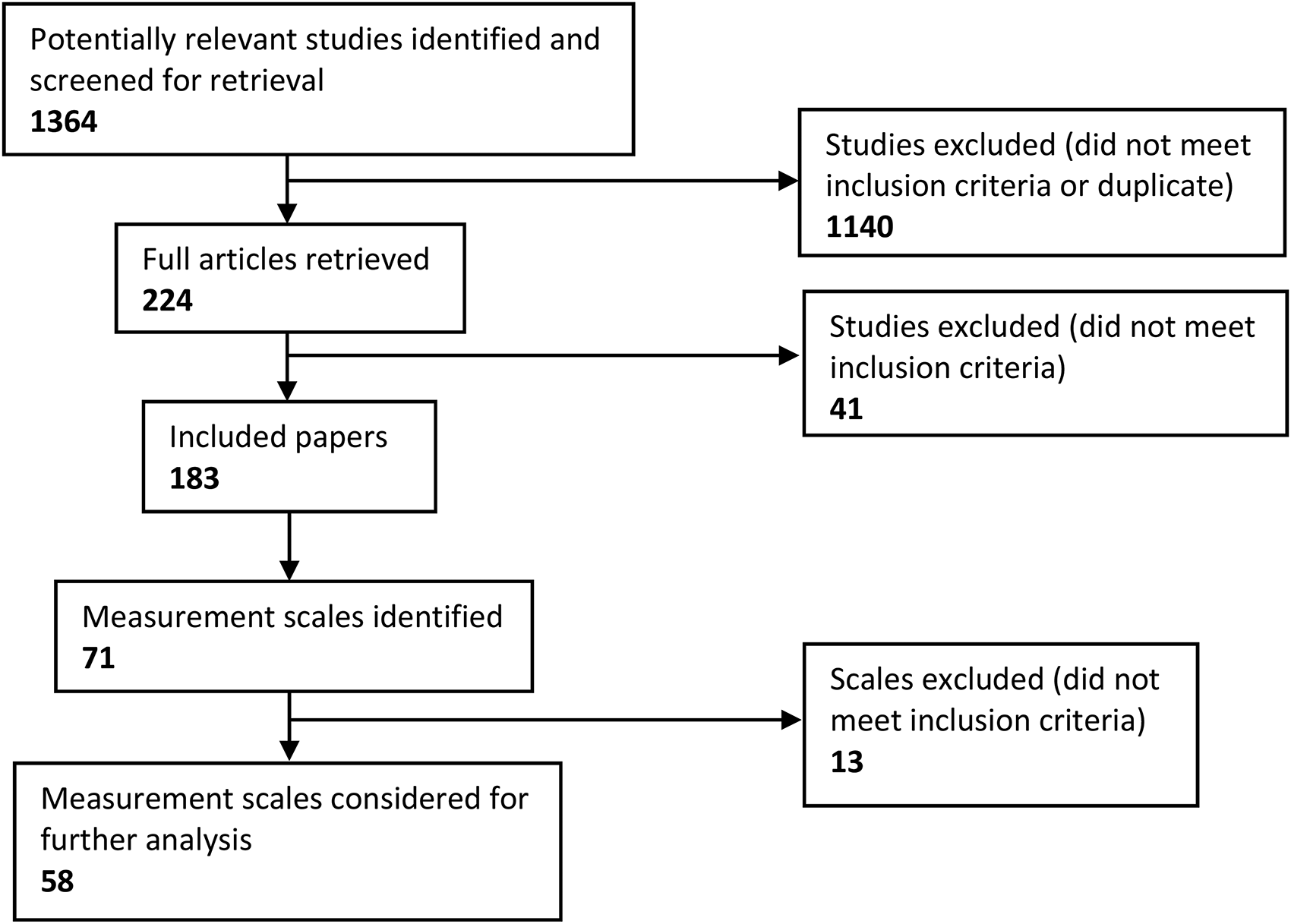
Flow diagram of review process.
Inclusion and exclusion criteria for resilience measures
Resilience measures were included in this review if they had been published as a peer-reviewed journal article, if the population of interest was human (as opposed to animal models), and if the form of resilience identified was specifically referring to psychological resilience, as opposed to orthopedic or bioengineering resilience. All population groups were considered for inclusion, regardless of how specific the study might have been with regards to age, occupation, socioeconomic status, or specific stressors to which individuals were exposed, as well as populations in both “normal” (i.e., non-treatment) circumstances and clinical settings. Moreover, this review was specifically concerned with studies that had explicitly considered the development, adaptation, or validation of a resilience measure in a novel context, in contrast to other reviews that have looked at the role of mixed methods studies of resilience more generally (Tol, Jordans, et al., 2013) or the psychometric properties of existing scales (Satapathy et al., 2020; Windle et al., 2011; Zhou et al., 2020).
Measures were excluded if the full-text of the article was not retrieved or if it had originally been written in a non-English language. Measures were also excluded if they were exclusively concerned with the creation and validation of a new version of an existing measure that was not being introduced to a markedly different population of interest. This exclusion criterion was primarily meant to screen out multiple versions of the same measure that had simply reduced the number of items in subsequent validation studies. Although useful for reducing participant burden, these shortened measures would not offer any meaningful insight into factors of resilience that the original had not already provided.
This review was largely informed by the PRISMA 2020 guidelines for reporting systematic reviews with few exceptions, such as the absence of independent peer review of the results (Page et al., 2021). In addition, there was no formal assessment of the risk of bias in the included studies. As such, this list might not be exhaustive of all existing resilience scales or populations in which the listed scales have been validated because of the sheer abundance of studies. This review is intended to offer a sufficient outline of existing measures in the field and indicates which have been employed in cross-cultural settings with the greatest frequency.
Existing measures of resilience
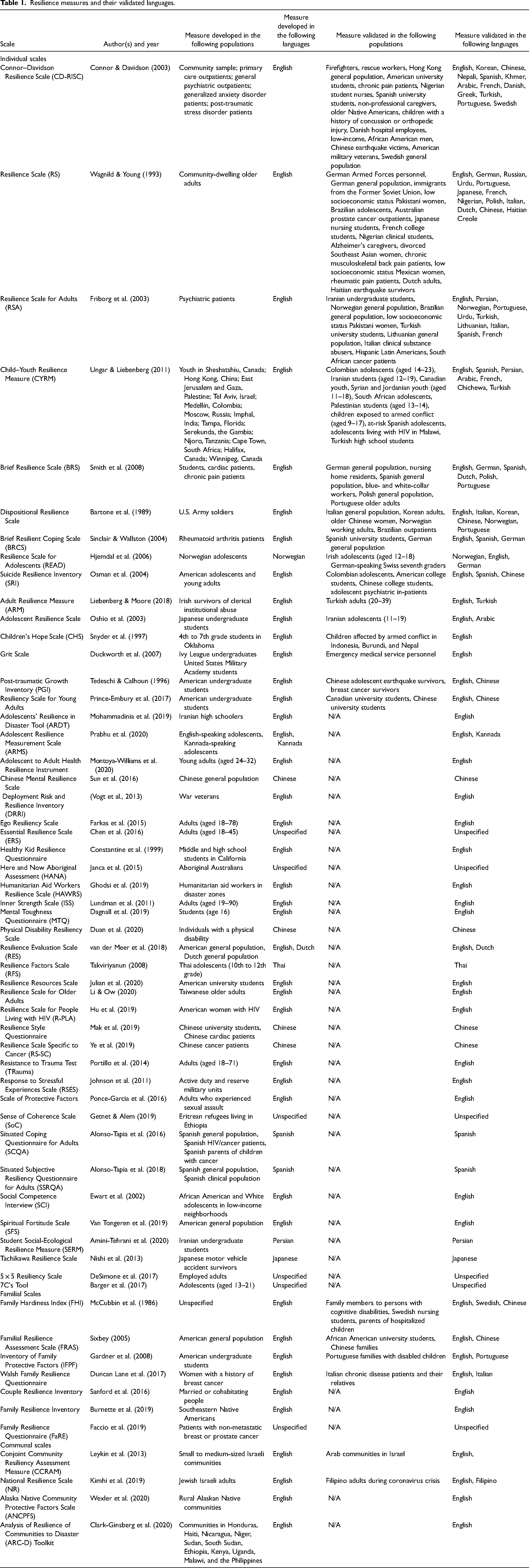
Among the 58 unique scales identified in Table 1, five had clearly undergone the most field testing in diverse populations and showed the greatest potential for culturally sensitivity. These are the Dispositional Resilience Scale (DRS), the Resilience Scale (RS), the RSA, the Connor–Davidson Resilience Scale (CD-RISC), and the Child–Youth and Resilience Measure (CYRM). Each of these five scales adopts a slightly different understanding of resilience and uses its own factors in assessing its presence or absence. Consequently, their review captures the breadth of contributors to resilience among even the most commonly used scales and provides a foundation for populating a pool of resilience factors to be drawn from in the construction of new measures. Table 2 outlines the highlights of this review and follows on from work by Windle et al. (2011) in their earlier methodological review of measures.
Resilience measures and their validated languages.
Factors of resilience in the five most common measures for cross-cultural use.
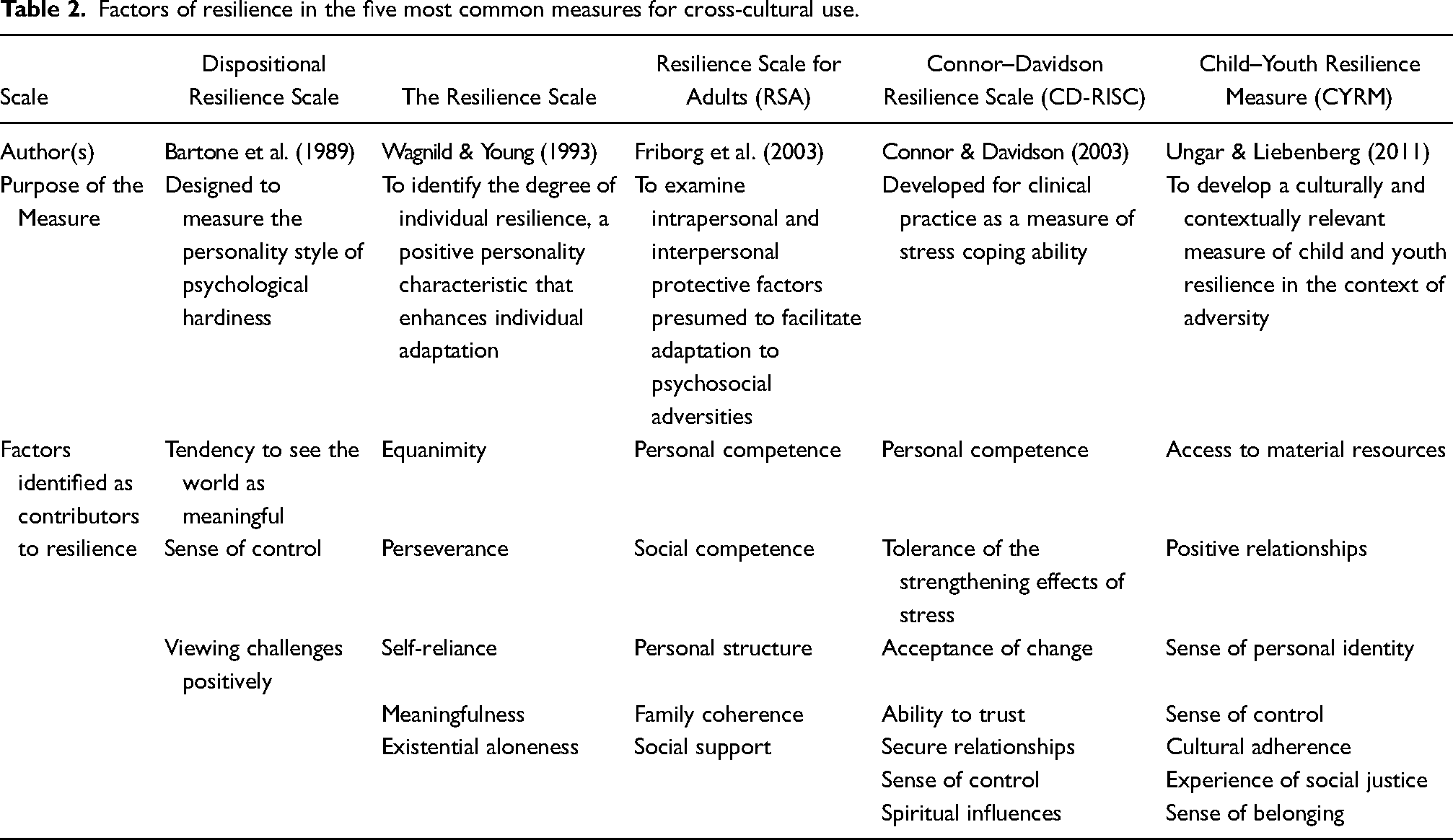
Among these scales, the CD-RISC and the CYRM have been identified as having the greatest potential for cross-cultural use and thus warrant the greatest attention in this context (Miller-Graff & Cummings, 2017; Panter-Brick et al., 2018). The CYRM (and its adult counterpart, the Adult Resilience Scale) is worth additional attention because of the specific intention of its developers to create a resilience scale with relevance and utility across cultural contexts. This consisted of employing an international team of investigators to gather qualitative data on resilience in 11 countries, including Canada, China, Russia, and Tanzania, which was integrated into a single, 28-item scale (Ungar & Liebenberg, 2011). Furthermore, the authors provide a detailed manual that specifically outlines the four steps necessary to contextualize the measure: (a) convening a local advisory committee, (b) exploring resilience in the local context, (c) determining additional items for the measure, and (d) evaluating the items in the measure. The manual also offers a detailed appendix that outlines the purpose of including each item of the standardized scale such that phrasing can be modified based on context while retaining the original intent of the item (Resilience Research Centre, 2018).
This explicit emphasis on the active adaptation process based on context places the CYRM as the most amenable to cross-cultural administration, as demonstrated by its use with Syrian youth in Jordan (Panter-Brick et al., 2018). Nevertheless, this process can be costly, time-consuming, and is simply not feasible in certain circumstances, as previously discussed. This suggests that there is value in developing resources that complement a standardized scale such as the CYRM to facilitate and expedite their adaptation to new contexts. The following review of resilient PPFP represents one attempt to add to the repertoire of tools that already includes the CYRM and its manual.
Promotive and protective factors and processes of resilience
Despite (or perhaps as a result of) the proliferation of resilience measures, the specific PPFP that contribute to resilience remain as opaque as a cross-cultural definition of the concept itself. As Ungar (2019) outlined, the process of aggregating a list of factors and processes that contribute to resilience has been ongoing for more than 50 years and has still not been exhausted. This process is likely interminable by its very nature, demonstrated by the identification of novel factors through qualitative work in new contexts (de Berry et al., 2003; Eggerman & Panter-Brick, 2010; Kirmayer et al., 2011; Nguyen-Gillham et al., 2008).
Table 3 represents an attempt to synthesize these diverse factors into a single resource, drawing not only from the factors considered in the most widely used and thoroughly validated measures in Table 2, but also from studies that may have adopted less widely used measures but that demonstrated a particular concern for cultural adaptability. Factors are organized according to the ecological level of analysis on which they appear to operate, some of which have been empirically located at their particular level and others which do not yet have such support (Tol, Song, et al., 2013). Table 3 is not exhaustive and is instead intended to serve as a jumping off point for fieldworkers requiring an adapted assessment tool but lacking the resources to conduct a large-scale mixed methods study.
Promotive and protective factors and processes of resilience according to ecological level.
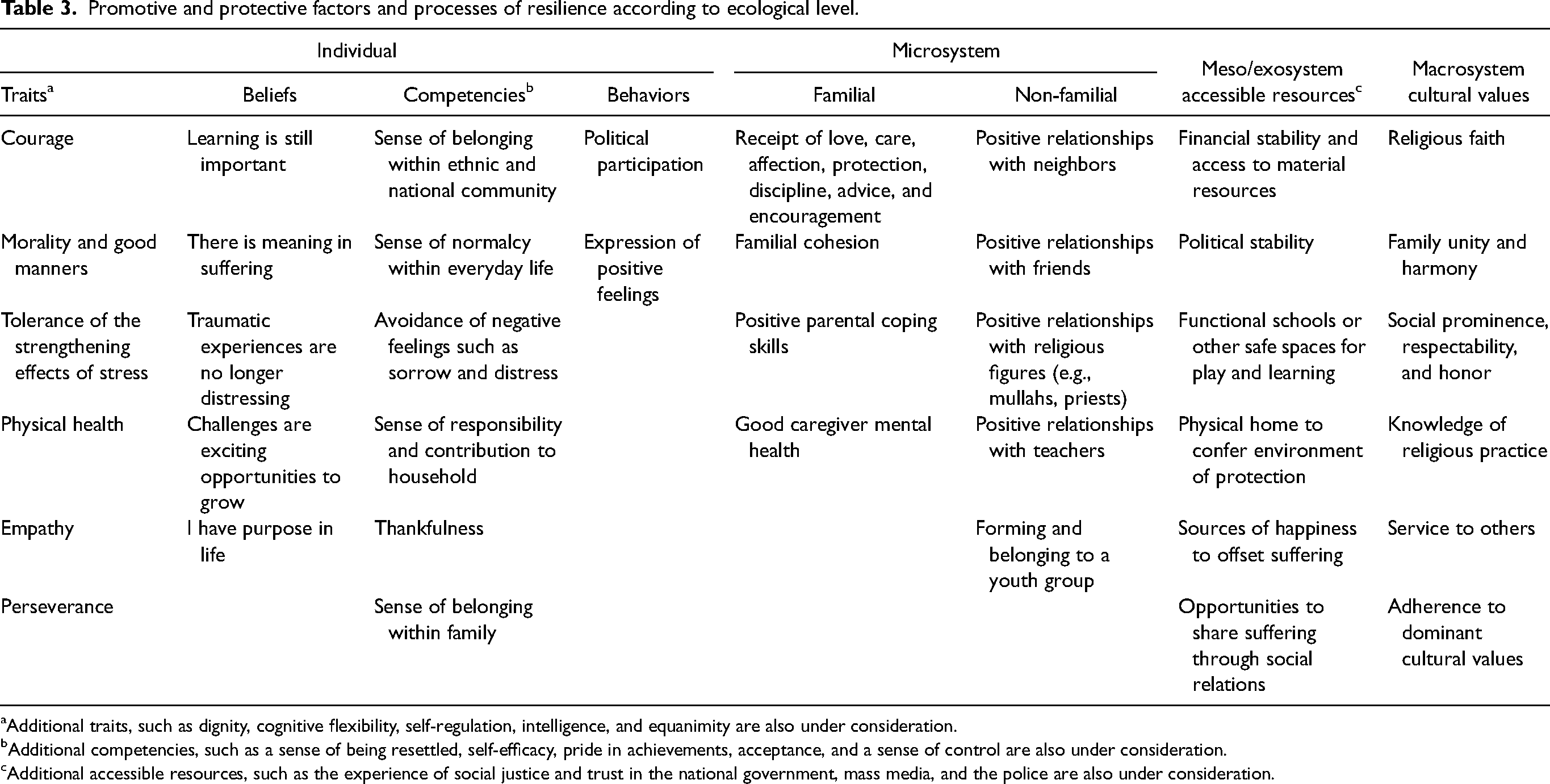
Additional traits, such as dignity, cognitive flexibility, self-regulation, intelligence, and equanimity are also under consideration.
Additional competencies, such as a sense of being resettled, self-efficacy, pride in achievements, acceptance, and a sense of control are also under consideration.
Additional accessible resources, such as the experience of social justice and trust in the national government, mass media, and the police are also under consideration.
In constructing this resource, we recognize the criticism rightly levied at earlier stages of resilience research that were primarily concerned with generating “shopping lists” of PPFP to “plug into regression models” (Panter-Brick, 2014: 441). Although such shopping lists have minimal value to inform the development of effective assessment tools and interventions when taken out of context, they may benefit qualitative fieldworkers as a point of reference for initial data collection and facilitate the identification of key resilient themes. Factors themselves must be considered within the cultural and linguistic context of the population of interest, recognizing that the subtext and implicit meaning of each term is likely to differ across groups and should not be taken at face value.
As such, the best use of Table 3 remains the subject of further investigation. The specific ways in which this resource can be incorporated into preliminary fieldwork must still be assessed, but will likely involve incorporation into key informant interviews or focus group discussions as an item bank to facilitate identification of relevant PPFP.
Table 3 also allows for cross-referencing against existing qualitative studies of the population of interest to provide the necessary sociocultural context for identifying salient PPFP, a practice that has precedent in Vindevogel et al.'s study of resilient outcomes in war-affected communities in Uganda (Vindevogel et al., 2015). Similarly, Montoya-Williams et al. (2020) succeeded in retrospectively constructing and validating good psychometric properties of the novel Adolescent to Adult Health Resilience Instrument based entirely on existing cohort data. Although these efforts demonstrate the possibilities for constructing population-specific measures by protracting or forgoing the qualitative phase entirely, such work must be approached with a respect for intersubjectivity, in which outside investigators recognize the biases that we bring to each new cultural context, and exercise the reflexivity to recognize when we are projecting the PPFP of our own culture onto another (Kaiser & Kohrt, 2019).
Furthermore, given the contextual nature of these factors and their status as either promotive or protective, empirical fieldwork and psychometric validation are necessary for clarifying and affirming which factors are most relevant in each context and the sorts of outcomes that they support such that interventions can be best tailored to the population of interest. Despite the importance of these validation processes for maintaining a high level of rigor in the field, an in-depth consideration of psychometric testing remains beyond the scope of this review, which has been primarily concerned with the cultural dimensions of measures. Interested readers are advised to reference Windle et al.'s summary of their quality assessment of resilience measures (Windle et al., 2011: 13).
Limitations
To the authors’ knowledge, there has been no prior attempt to aggregate previously established PPFP of resilience into a single resource. However, this resource is limited by the omission of a number of items from the PRISMA 2020 guidelines for reporting systematic reviews (Page et al., 2021). These primarily include the peer review of study screening and data extraction by reviewers independent of each other, whereas this search was instead performed independently by the first author based on criteria agreed upon by both authors. In addition, screening was focused on PubMed and did not include additional databases that may have yielded additional results, such as PsycINFO. Finally, included studies were not assessed for the risk of bias. The collective impact of these omissions is that the current review may not have successfully identified all resilience measures employed cross-culturally. The decision to focus specifically on PPFP appearing in resilience measures also necessitated the exclusion of PPFP identified in exclusively qualitative studies that did not translate their findings into a quantitative instrument. Consequently, there is the possibility that some PPFP of resilience are absent or miscategorized in Table 3. Nevertheless this review and the resources contained within remain valuable and unique reference materials for researchers setting out to more accurately understand and assess resilience in populations in which the construct has not yet been studied.
Recommendations for further research
Further research is needed to empirically assess and validate how to most effectively use Table 3 to inform qualitative research, to identify the most salient PPFP within each population of interest, and determine whether they are promotive or protective in that context through the collection of longitudinal, rather than cross-sectional, data and advanced statistical modeling.
Such determinations are essential to the field's ultimate goal of developing effective interventions insofar as they offer valuable insight into the pathways by which each factor leads to specific outcomes. Prior research that has followed this line of thinking in the realm of adolescent resilience has translated investigations into promotive factors directly into an intervention that aims to prevent youth violence. Through focusing on promotive factors that support and build youths’ assets and resources, researchers were able to improve both individual's self-reported behaviors and community-level outcomes (Zimmerman et al., 2013). Distinguishing between promotive versus protective factors in each community of interest thus shows promise in enabling interventions to be more effective than catch-all resilience-building programs might otherwise allow and is an area ripe for further research.
Finally, sophisticated statistical modeling techniques can breathe new life into the use of self-report measures by going beyond the standard prescription to directly sum items to gain a total resilience score (Resilience Research Centre, 2018). For example, network analysis of previously published CYRM results drew out key similarities and differences in both the distribution and centrality of resources essential to resilience across 14 different countries (Höltge et al., 2020). Contemporary modeling techniques thus improve the yield of resilience measures beyond what has previously been possible and demonstrates an expanding horizon for our understanding of both general and contextual resilience.
Conclusion
Because research into psychological resilience has progressed to an ecological view that recognizes the need for contextualizing the construct and its promotive and protective factors, mixed methods assessments of resilience across cultures have assumed greater importance. Studies that use their qualitative findings to directly inform the adaptation of an internationally standardized measure, however, are relatively less common. This is likely due to the time and resources necessary to carry out the adaptation process successfully.
By providing a systematic review of cross-cultural measures of resilience and their identified PPFP, this review has provided a resource for contextualizing measures for use among communities in which the construct has not previously been studied. It is the authors’ hope that, through the field's continued refinement of its understanding of resilience and its PPFP, there will be opportunities to develop more-targeted interventions to support communities and provide them with the resources most relevant to bolstering them against adversity.
Footnotes
Declaration of conflicting interests
The author(s) declared no potential conflicts of interest with respect to the research, authorship, and/or publication of this article.
Funding
The author(s) disclosed receipt of the following financial support for the research, authorship, and/or publication of this article: Support for this research was provided to the first author, AT, by the UC San Diego School of Medicine's Global Health Academic Concentration, UC San Diego's Global Health Institute, and UC San Diego's Friends of the International Center.
