




Abstract
Unaccompanied refugee minors (URMs) are a group in an especially vulnerable situation with heightened psychological suffering due to both stressful life events and current daily stressors. Research has shown that certain coping strategies such as avoidance can be adaptive in the face of ongoing stress. We conceptualize social support as an essential coping resource that these strategies tap into. Since the interrelations between these factors are often not clear in the literature, this study strives to identify and link URMs’ coping strategies, the respective coping resources and the various stressors they target, shortly after arrival in a high-income country. Seventy-nine URMs from various backgrounds were recruited in two first-phase reception centers in Belgium. In addition to self-report questionnaires to assess stressful life events and current daily stressors, we conducted semi-structured interviews, with cultural mediators if required. Thematic analysis was applied to the participants’ accounts and resulted in the identification of four coping strategies: avoidance and distraction, continuity and coherence, selective reliance, and positive appraisal and acceptance. The relation between these coping strategies, the various coping resources used, and the specific stressors at which they aim are discussed. We conclude that avoidant coping and contact with the ethnic community, particularly the peer group, are fundamental strategies for successful coping. Practitioners need to support URMs in their coping efforts by providing and facilitating appropriate coping resources.
Unaccompanied refugee minors (URMs) are young people who have been separated from both parents and other relatives and are not being cared for by an adult who, by law or custom, is responsible for doing so (United Nations High Commissioner for Refugees [UNHCR] et al., 2019). They form a substantial subgroup of the refugee population—42% of all minors who arrived in Europe in 2018 were unaccompanied (UNHCR et al., 2019), and according to a conservative estimate by the UNHCR, there were 138,600 URMs world-wide in 2018 (UNHCR, 2019). As well as their young age, they have been described as especially vulnerable since they have often experienced adverse and traumatizing events in their home country and during flight, and are at the same time confronted with certain daily stressors, once arrived in the country of destination (Vervliet, 2013). On top of this, during their migration process and as adolescents, they lack the important protection and support of their parents in this challenging period of their lives, as shown by Bean et al. (2007).
The study by Bean et al. (2007) also demonstrates that URMs suffer from poorer mental health compared to their accompanied counterparts or their local peers: Many experience post-traumatic stress symptoms such as nightmares or intrusive memories, as well as anxiety and depression (Vervliet, 2013). There is a lot of variation within this population, however, and research has shown that some minors withstand adverse experiences more so than others (Sleijpen et al., 2016). Although it is important to recognize the stressful and vulnerable situations that URMs are confronted with, it is as important to highlight the enormous resilience and agency that researchers have observed in this population (Sleijpen et al., 2016).
Coping
One concept that offers a window into the elements that determine the psychological health of URMs is the concept of coping, which we define as an individual's conscious response, cognitive or behavioral, to negative affect resulting from external negative events (Parker & Endler, 1992). Yet, existing frameworks still disregard certain particular aspects regarding the coping behavior of URMs, for example, the importance of avoidance as a coping strategy, the use of social support as a coping resource, and the need for a differentiation of various stressors and how different stressors are targeted by different strategies. In this study, we integrate these factors into our data analysis, resulting in a new conceptualization of coping. Sleijpen et al. (2016) synthesized various qualitative studies demonstrating how avoiding difficult thoughts or feelings constitutes a major coping strategy for young refugees. These coping strategies are especially relevant in a context that is mainly perceived as uncertain and in which certain basic needs such as safety and stability are not (yet) met (Groark et al., 2011). Such an environment can have a significant impact on the processing of psychological trauma, as feeling safe is an essential precondition for healing (Herman, 2015). Conventional categorizations might thus denigrate and pathologize avoiding, distracting or silencing, even when these are actually meaningful coping strategies (Kevers et al., 2016).
Social support
Next, it is important to recognize that models of coping with and healing of traumata that focus on individual psychological processes alone do not capture the outstanding significance of the social context (Herman, 2015; Sierau, Schneider, et al., 2019). Critics claim that individualizing definitions are imposed on the meaning systems of the afflicted since the social environment is often part of the coping behavior, particularly in an intercultural context where mainstream perspectives may not hold true. L. Chase and Sapkota (2017), for example, found that family, friends, and neighbors play a critical role for Bhutanese refugees coping with stress. More specifically, social support—defined as the potential positive aspect of interpersonal relationships (House et al., 1988)—has been emphasized as the most important factor of psychological vulnerability or resilience in children during wartime (Sleijpen et al., 2016). In the case of URMs, there is evidence that social support from peers forms a vital resource to cope with stress (Omland & Andenas, 2019). In a more long-term perspective and relevant for therapy and treatment, it is noteworthy that healing from traumata is an interpersonal process and requires a certain level of social connectedness, as this can enhance the feeling of safety (Herman, 2015). Especially in this context, this goes to show that coping strategies depend on resources located in the social space (De Haene et al., 2007). In this study, we conceptualize social support as a coping resource that a number of coping strategies tap into (Parker & Endler, 1992).
In order to analyze the social support that is relevant for URMs and their context, previous research indicates that it is useful to distinguish between four different kinds of social support (Mels et al., 2008): (a) emotional support (indicating that a person is valued and accepted), (b) informational support (helping to define and understand problematic events), (c) social companionship (spending time with others in recreational activities) and (d) instrumental support (provision of financial aid, material resources, and services). Moreover, there is a difference between the amount or kind of social support a person actually receives and their perception of it. For this study, we focus on the latter since it is more relevant for the individual's subjective well-being (Mels et al., 2008).
Differentiation of stressors
Scholars have acknowledged that along with traumatic experiences, current daily stressors (including social and material stressors) play a central role in the development of mental health suffering in a migration context (Riley et al., 2017). The everyday stress that migrants and refugees experience before and throughout the displacement process has been shown to have a different quality and impact on mental health than traumatic events as daily stressors create chronic, continuous stress, while traumatic events typically occur sporadically but acutely (Miller & Rasmussen, 2014). As URMs are confronted with both daily stressors and traumatic experiences (Vervliet, 2013) it can be said that “different situations clearly call for different coping strategies” (Kocijan-Hercigonja et al., 2009, p. 45). Whereas research has shown that this warrants an ecological approach (Villanueva O’Driscoll et al., 2017), there remains an important gap in the literature concerning the differentiation of the various stressors: it is not clear yet how young people themselves cope with these different types of stressors and how best to support them in doing so (Seglem et al., 2014). In this study, we strive to provide insights into this relevant aspect.
Research questions
Whereas researchers have identified a range of coping strategies that URMs employ, there is still a need to improve our contextual understanding of these processes (Sleijpen et al., 2016). In particular, there is yet insufficient knowledge about the interplay between the minors’ coping strategies and the coping resources they use, as well as how those different coping strategies relate to different kinds of stressors (Seglem et al., 2014). With this study, we strive to identify: (a) what coping strategies URMs employ in the moments just after their arrival in a high-income country, (b) what coping resources these strategies rely on, and (c) what stressors they address.
Considering the highly complex and multifaceted situations that URMs find themselves in, as well as the heterogeneous nature of this population, we argue that more in-depth, qualitative investigation of coping strategies is needed, as this allows us to utilize meaning systems that are relevant to them (Sleijpen et al., 2016). Combining qualitative analyses of the minors’ narratives with descriptive results of quantitative measures will provide us with an opportunity to analyze the context in depth.
Method
Setting
This study focuses on the Belgian part of a wider research project investigating the psychological well-being of URMs in various European countries and in Libya. The reception system for unaccompanied minors in Belgium is phased in three stages. The first author conducted the interviews for this study in two first phase reception centers that the minors passed through during their settlement process. Officially, minors stay in these first-phase reception facilities for a period of up to 30 days; however, the average stay in this sample was 46 days. The centers manage an open-door policy and offer internal healthcare and psychosocial support. The staff organize activities such as excursions and sports on a daily basis in which the minors are expected to participate. For a thorough analysis of the Belgian care system, see also Derluyn (2018).
Participants and procedure
We included all minors present in the centers who were willing to participate. In order to represent the population of URMs in Belgium at the time of measurement, we made a selection with regard to their nationality and gender once the sample reached saturation of a given group. Due to concerns that younger URMs might not be able to understand the meaning of their participation and would therefore not be able to give informed consent, we included only children above 14 years of age (two exceptions were made in accordance with the responsible social workers). Preceding the interviews, two weeks of participant observation in the reception centers gave the first author the opportunity to gather field observations and to build rapport with the minors. He also took part in various activities such as excursions, sports, or language classes, and introduced the research project at weekly information events before asking the residents if they wanted to participate. About two-thirds of the residents approached agreed to participate. Some of the minors who explicitly declined stated that they did not want to be reminded of past events, and others said they did not have time or they did not give a reason. The purpose of the research and the conditions of their participation were explained to the minors, if necessary with the help of a cultural mediator who was later also involved in the interview. The participants were informed that their participation in the research was voluntary, that we would treat the data confidentially and would anonymize the data, that there would be no consequences for them and that they could stop their participation at any time. The semi-structured interviews, which we conducted between November 2017 and March 2018, took place in the premises of the centers and took 100 min on average. They included open questions about well-being, itinerary of the journey, coping strategies, arrival in the new country, living conditions, social support and their future, as well as quantitative measures. The interviewer's professional training as a clinical psychologist and work experience with URMs facilitated thick, complex narratives, and emphasizing topics like well-being created further trust in the backdrop of ongoing asylum procedures (Omland & Andenas, 2019). All participants gave their written consent to participating in the study, and the interviews were recorded with the participants’ consent. Ethical approval was given by the ethics committee of the Faculty of Psychology and Educational Sciences at Ghent University.
Measures
Sociodemographic background, including gender, age, country of origin, time on the move, time in Belgium, contact with parents, and education, was assessed via the semi-structured interviews. We also used the following standardized self-report questionnaires to assess and describe the various stressors affecting the mental health of the participants.
Stressful Life Events (SLE) (Bean et al., 2004)
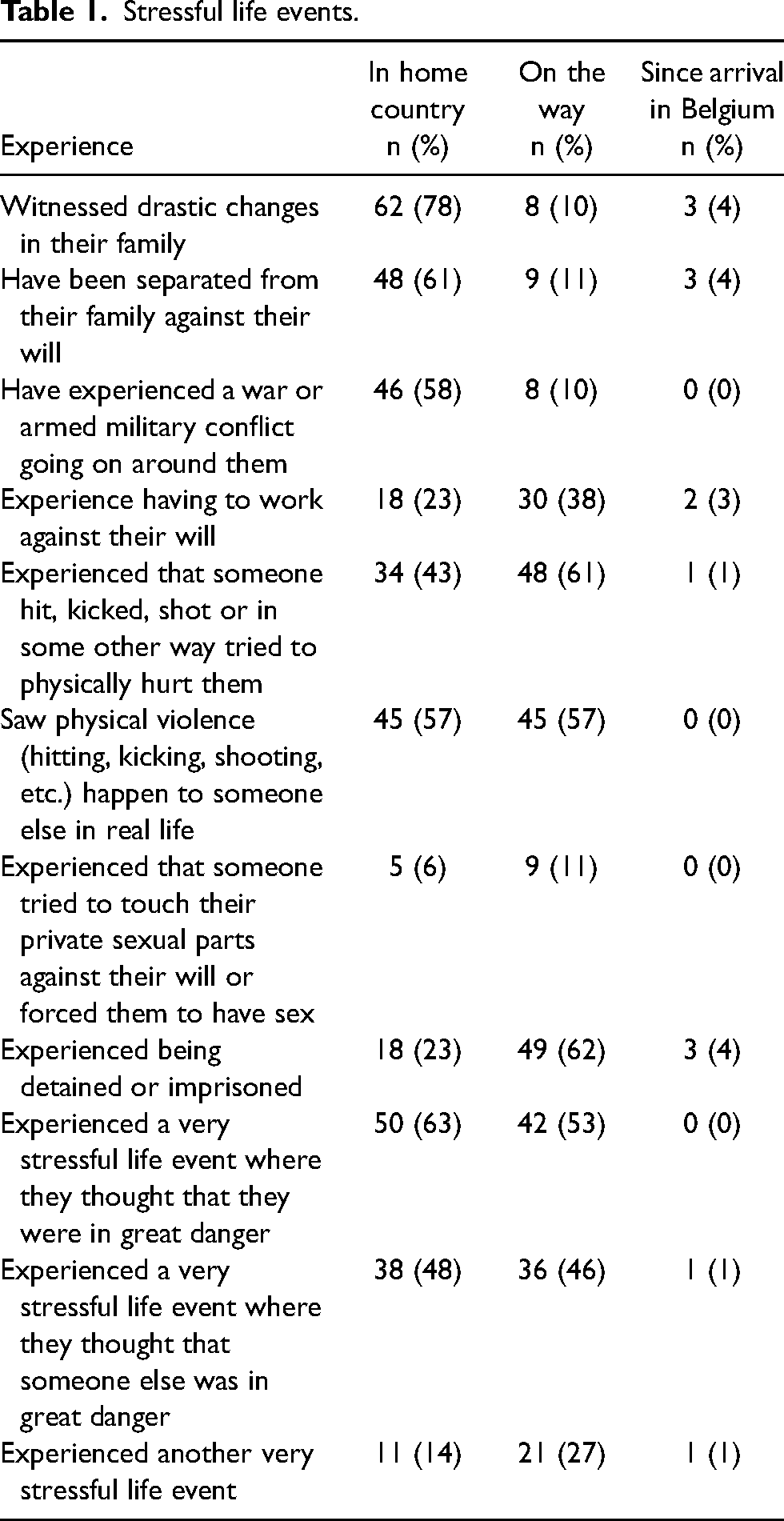
This 12-item questionnaire measured if and how many traumatic events the participants had witnessed throughout their lives. We changed item 1 in order to include events over the course of their entire lives rather than just during the last year (“Have there been drastic changes in your family?”). Items 3 (“Has someone died in your life who you really cared about?”) and 4 (“Have you had a life-threatening medical problem?”) were omitted because they were covered sufficiently by the other items, resulting in a limited amount of questions as the interviews tended to be too long and exhausting for the participants. Adding an open question about any other traumatic events, 11 items remained and we extended the answer options to specify where the event had taken place (“In my home country,” “On my way to this country,” “Since my arrival in this country”). See Table 1 in the results section for the complete list of items.
Stressful life events.
Daily Stressors Scale for Young Refugees (DSSYR) (Vervliet, 2013)
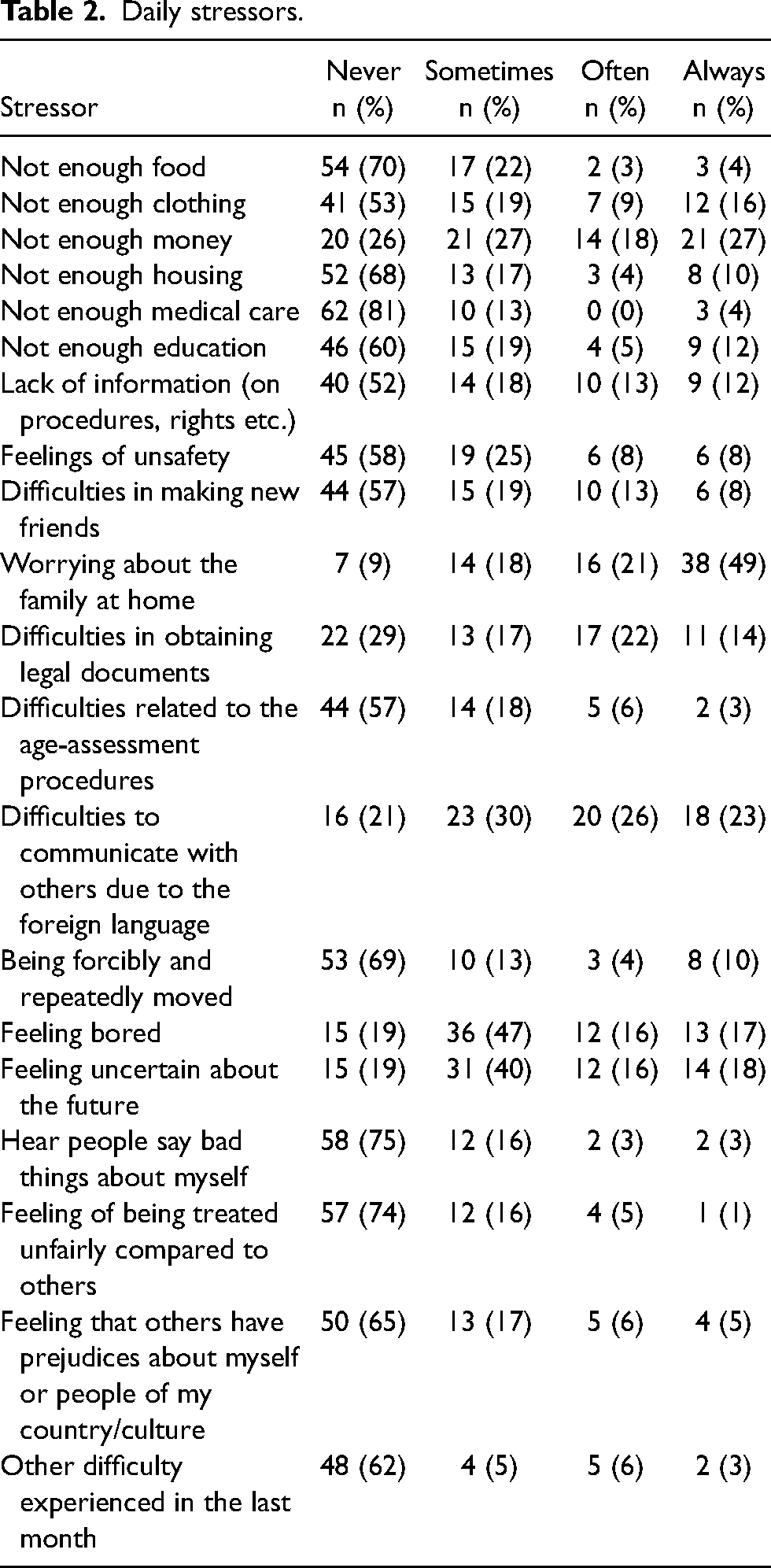
This 15-item questionnaire assessed social and material daily stressors in the four weeks prior to the interview. We omitted items 2, 3, and 5 because we covered these items extensively in the qualitative interviews. Item 9 has been split into two items to differentiate between “not enough food” and “not enough clothing.” Item 11 has been changed to “feeling bored” as this is supposedly easier to understand. Six items have been added to assess the impact of “not enough education,” “lack of information,” “worrying about my family at home,” “difficulties related to the age-assessment,” “difficulties to communicate with others due to the foreign language,” and “being forcibly and repeatedly moved.” Participants answered each item on a 4-point Likert scale (never, sometimes, often, always) plus the option to indicate “I don’t know/I don’t want to answer.” See Table 2 in the results section for the complete list of items. All questionnaires were translated into the languages present in the population (Albanian, Arabic, Dari/Farsi, English, French, Pashto, Serbo-Croatian, Somali, and Tigrinya).
Daily stressors.
Data analysis
Descriptive results from the quantitative questionnaires were calculated using SPSS Statistics 25 and MS Excel 2016. We used NVivo 12 for the qualitative analysis. In order to identify ways of coping that are relevant for the participants, the qualitative data was analyzed using thematic analysis following Braun and Clarke's (2006) guidelines. Viewing the narratives as co-constructed by the minors and the researcher (and in most cases the cultural mediator as well) helped us to understand the participants’ realities against the background of this specific context (Willig, 2013). To begin, the first author read the interviews thoroughly, paying specific attention to meaning units corresponding to the first research question. This inductive approach was followed by an initial coding, also by the first author, which resulted in codes such as “keeping busy,” “putting things in perspective,” or “praying and religious faith.” Next, by interpreting the latent meanings of the participants’ responses, all researchers grouped the codes into various clusters of coping strategies, repeatedly adapting and reviewing them in regular team discussions throughout the writing and analytic process (Willig, 2013). For each coping strategy, we subsequently identified the respective coping resources, the kinds of support and targeted stressors in the narratives. The different kinds of support aligned with existing theory (Mels et al., 2008), which proved to be meaningful for our analysis.
Results
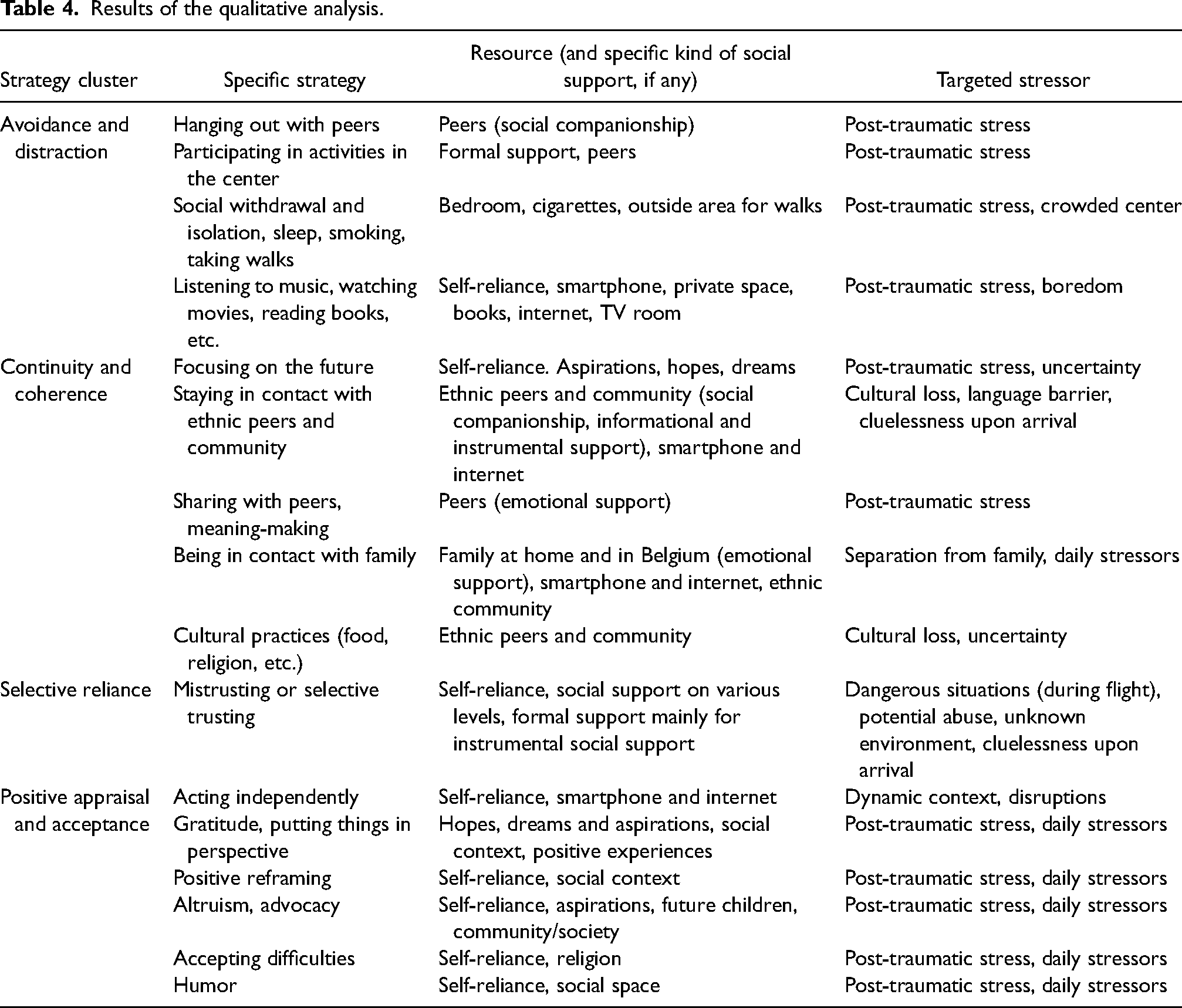
Table 3 provides an overview of the participants’ sociodemographic information. The minors who participated in this study had experienced nine different traumatic events on average, not only before but also during and sometimes even after their flight (see Table 1). They also reported a range of current daily stressors related to the living conditions in the country of destination (see Table 2). In daily life in Belgium, their biggest concerns were being separated from and worrying about their families and friends back home (or elsewhere) as well as worries about legal documents and feeling uncertain with regard to the future. Acculturation issues increased stress as well, such as difficulties due to a language barrier and an unfamiliar environment (e.g., strange food, a rigid daily schedule). Other stressors were caused by the living conditions in the reception facilities such as noise and a lack of privacy (e.g., having to share a bedroom). In response to these stressors and symptoms, the participants made use of numerous coping strategies. A thematic analysis of the participants’ narratives resulted in four main clusters of coping strategies: (a) Avoidance and distraction, (b) continuity and coherence, (c) selective reliance, and (d) positive appraisal and acceptance, grouping several specific coping strategies, as visualized in Table 4.
Sociodemographic data.
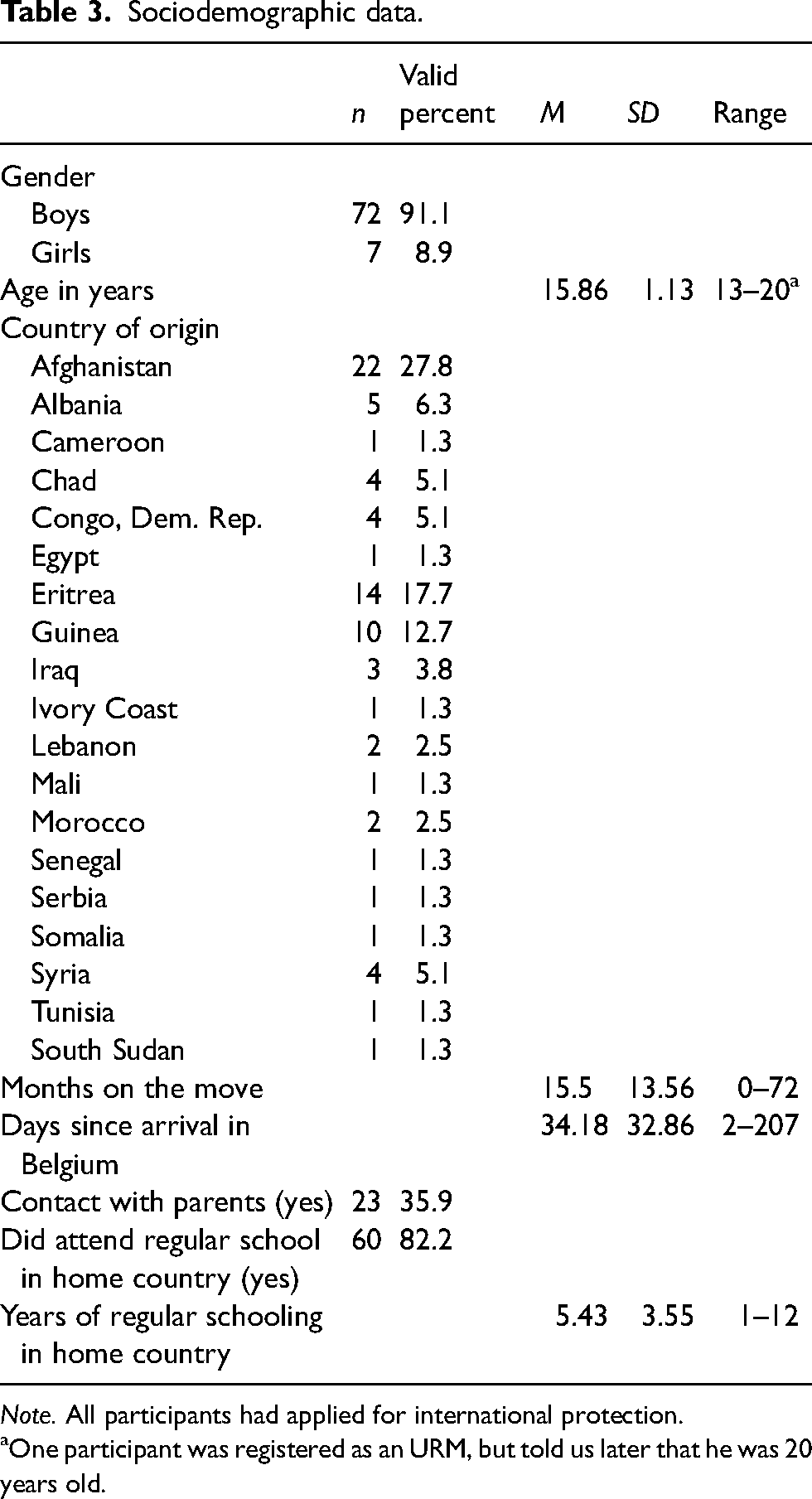
Note. All participants had applied for international protection.
One participant was registered as an URM, but told us later that he was 20 years old.
Results of the qualitative analysis.
Avoidance and distraction
When it came to coping with difficult memories, thoughts, or feelings originating from stressful life events, it became clear that many of the participants tried to avoid them or distract themselves from them. While they made use of a wide range of specific strategies to achieve this, one of the most prominent ones was finding someone to hang out with and to look for social support in the form of social companionship. Often, participants would simply sit down and talk, do sports, or play games with peers, whose company resulted in being a crucial coping resource here: “If you are alone, then you think about those past experiences, but when you’re with your friends, then you forget these things” (16, male, Eritrea). If available, family members or volunteers in Belgium would constitute another important coping resource. However, even though they would spend a lot of time together, there seemed to be an implicit agreement not to talk about difficult experiences of the past. Peer support was mostly a matter of social companionship, as the relationships with peers usually did not go beyond a superficial quality. They were not processing, but avoiding the memories: “I don’t want to share my situation, my secret with them. Yeah, they are my friends, but I don’t want to talk about my problems” (15, male, Afghanistan). Likewise, some minors appreciated the activities offered by the reception center for the fact that they offered distraction and allowed them to control intrusive thoughts and put difficulties out of their mind at least temporarily. In this way they also drew on formal support as a coping resource.
Other distraction strategies targeting traumatic events included going for a walk and smoking cigarettes, rather than spending time with others. Linked to this, some participants also fell back to social withdrawal and isolation in an attempt to relax. This strategy was especially common during the first few days after arrival and targeted both traumatic stress and current daily stressors such as the new environment and the stress and noise in the center. It shows how privacy and living conditions that allow the minors to retreat can be valuable coping resources as well. The participants further often reported that they would just try to sleep in order to suppress traumatic stress. Other participants resorted to busying themselves with a smartphone, listening to music, watching movies or reading books. Even though these strategies mostly targeted post-traumatic stress, they also helped the participants to deal with current daily stressors such as boredom and uncertainty: “I like listening to music a lot, to forget! To stop feeling upset” (16, male, Cameroon). Literally any activity seemed to have this quality of avoidance and distraction and in view of that, boredom and idleness had disastrous consequences since intrusive thoughts or worries would plague participants as soon as they were not occupied with something else: “If I think too much, if I sit down and there's nothing to do, I start thinking and these things come to my mind” (15, male, Guinea). Yet another distraction strategy was to focus on the future instead of the past. For this strategy, the participants relied on internal coping resources such as their aspirations, hopes, and dreams. The stressors targeted by this strategy were both traumatic memories from the past and the stressful and uncertain situation they were currently facing.
Continuity and coherence
As well as the avoidance of or the distraction from stress, participants looked for continuity in their lives and social networks and for coherence in their experiences. Here, the targeted stressors were mostly the multiple losses they had experienced. Being in contact with peers of the same ethnic origin, who speak the same language, and who in some cases even come from the same village or region, seemed to help participants deal with the loss of culture and the suddenly and drastically changed context. The coping resource was the social companionship of ethnic peers: “I go to friends and we talk about the past, sometimes we talk about politics and we talk about the president of Afghanistan and about our country, so that helps me” (17, male, Afghanistan). Even though participants stressed that they would get along well with everybody, many reported that staying in one's linguistic group was an essential coping strategy to deal with current daily stressors such as the language barrier and the resulting difficulties. In this way, peers of the same linguistic background served as an important coping resource for informational or instrumental support, especially when interpreters for this language were scarce as was the case for Eritreans: “We’re all human but you can communicate more easily if they’re from Eritrea because there is a language problem to communicate with the others” (17, male, Eritrea).
For some, the strategy to stay close to one's peers also targeted traumatic experiences and the resulting post-traumatic stress by way of providing comfort and a way to normalize them. By biding time with others who had undergone similar adverse experiences (some had traveled together), participants were able to share their burden, with or without voicing the traumatic experiences, thus facilitating a sense of coherence in their lives and making meaning of their extraordinary experiences and situation. For this strategy, the coping resource was located in the emotional support given by peers, which in this case went beyond the superficial quality of social companionship: “It seems to me that Ali has a suffering similar to me, so when we share together I feel more relaxed” (14, female, Syria). A related coping strategy was maintaining contact with the family. Targeting the stress resulting from the separation from their families, many participants strived to create a sense of continuity in spite of the physical distance. If possible, staying in touch with their family via phone or internet allowed them to preserve their previous social network and part of their lifeworld despite the changed context. Consequently, having access to a phone and internet connection was an important coping resource for this strategy, as well as intermediaries who would sometimes forward messages to remote areas. On top of this, smartphones would often serve as repositories for memories such as family photos: “Then I had the cell phone and I was able to talk to my family, so I felt better. Daily I talk with mom and my sister” (14, female, Syria). Those who had next of kin in Belgium relied extensively on these coping resources as well. Field observations showed that participants benefited hugely from these contacts and thrived enormously when they were available, for example, they were able to expand their social network in Belgium immediately. Further, the strategy of finding continuity in a radically different context extended to coping resources in the ethnic and diaspora community and wasn’t limited to the immediate local environment. Physical connections certainly played a more central role, but participants also drew on peripheral coping resources through the internet and social media: “We met on Messenger, he's an older guy but he's Guinean and he has documents, we have stayed in touch” (15, male, Guinea). Beyond the social sphere, this coping strategy even tapped into broader coping resources such as cultural practices (e.g., food, religion), targeting cultural loss and associated feelings of uncertainty.
Selective reliance
Many participants reported how they managed to come to Belgium only by taking matters into their own hands, circumnavigating border controls and authorities, and deciding by themselves where they should go. Considering their young age, it became clear that many of the participants had already achieved a high level of independence, thanks to their challenging life trajectories. Consequently, minors would rely on themselves rather than depend on others. In the period shortly after arrival, there was a sense of mistrust towards adults and authorities among some participants, and in some cases towards peers as well. It seemed that the minors had learned to be suspicious and to be very careful when choosing whom to trust. This is not surprising considering the oppressive regimes and environments many of the participants had fled from and bearing in mind the abusive situations many had gone through on their way to Belgium. Mistrusting or selective trust as a coping strategy was directed at the dangerous life situation and the potential abuse they could suffer. At this stage, participants relied on themselves and their experience as a coping resource: “Yeah I met him, I am always afraid of him, because I don’t know him and I don’t know why he is good, why he is kind” [talking about his guardian] (16, male, Iraq).
However, many participants showed a clearly noticeable capacity to adapt to the new context quickly and to identify people who could help them. Interestingly, participants mostly perceived social workers or guardians in the first place as a coping resource for informational or instrumental support (like food and shelter). Only with time did they start to trust staff, and began viewing them as a coping resource for emotional support. Another important coping resource in this regard was informal support networks such as NGOs and volunteers: “She's a volunteer, it's her who helps me, sometimes I go spend a weekend with her and we have a good time. That makes me forget many things – she is like a mother to me, you see?” (16, male, Cameroon). An additional coping behavior in this cluster is acting independently. It is worth noting here that the minors only stay in the first reception centers for a short period. It seemed that some participants anticipated this and consequently they would not invest in social connections, but instead mostly relied on themselves. This coping strategy was directed at the dynamic and ever-changing life situation, whereas the coping resource was located in themselves. “I need to help myself” (17, male, Afghanistan). In this context, too, digital media represented an important coping resource as they enabled a certain degree of independence. For example, one participant began learning French through an application while waiting to be enrolled in school.
Positive appraisal and acceptance
Another recurrent theme was the positive appraisal of adverse life events or their current situation, as well as the acceptance of difficult life experiences. First, this theme includes a discernible sense of gratitude and of finally having arrived in a safe place after a long and perilous journey. As some participants still seemed to feel restless and overwhelmed by the fact that they had actually reached their destination, it seemed that the respondents coped with both past trauma and current daily stressors by putting things into perspective, for example, by comparing themselves to others less fortunate or to their own situation in the past and by counting their blessings. One coping resource for this strategy is located in the individual and includes hopes, dreams, and aspirations for the future that have been mentioned in relation to distraction strategies. Another one is found in the positive experiences they use for comparison. Further, this coping strategy demonstrates the importance of the social space that allows for the construction of a positive narrative to happen: “I sleep well, I go to school. It's all you need. It's good what I have. I mustn’t complain because many people don’t have what I have today” (17, male, Iraq).
Participants who coped by regarding adverse experiences as lessons of life showed an extraordinarily strong interest in the political situation in their home countries and displayed a heightened sense for justice with regard to the atrocities they had witnessed in the past. Notably, many participants developed a strong sense of altruism. They aspired to help others in need and to give back what they felt they had had the privilege to achieve: “I want to found a center. Like an orphanage, but in Guinea. Found an orphanage to receive orphans” (14, female, Guinea). This sense of solidarity and reciprocity and the prospect of giving something back to others, or to pass something on to their own children in the future, seemed to provide meaning for difficult life experiences and culminated in an empowering, activist stance in some participants. When asked for their consent, some participants also emphasized that they were happy to take part in the research for the reason that it would help other minors in the future. Advocating for one's rights and standing up for oneself and fellow sufferers targeted and allowed minors to contest political injustice and to defy a context marked by powerlessness and lack of control. Participants drew on internally located coping resources (personal plans and ideas) as well as the social space in which this strategy is embedded.
Rather than reframing adverse events, some participants seemed to cope with hardships of the past by accepting them as a part of their lives that they need to move on with. Coping by acceptance mostly seemed to be directed at stressful life events, the coping resource being located in the individual: “It is actually a part of life now – I don’t think I will completely forget these experiences” (16, male, Afghanistan). Closely linked to this, religious faith seemed to play a significant role here as it helped young refugees in accepting their fate, viewing it as God's will and as part of a bigger scheme, often with the goal of normalizing traumatic events of the past. This strategy can be said to be located in the spiritual sphere or the religious community: “I can’t say I will be relieved completely but I say ok, God made them, he brought them to the earth they were my family and now they’re gone, so the one who made them he took them away” (15, male, Eritrea). Finally, many minors also coped with humor. As they laughed and made jokes about their previous misfortunes, this coping behavior targeted mostly difficult experiences of the past. The coping resource is then arguably both the individual, as well as the social space that allows these jokes to be made: “Now, I talk jokingly about the problems I had. It doesn’t bother me anymore” (18, male, Senegal).
Discussion
In this study, we aimed to shed light on the coping strategies that URMs use when they arrive in a high-income country and how these relate to the respective coping resources and the targeted stressors. Our analysis resulted in four clusters of coping strategies. Avoidance and distraction have been particularly prominent in the coping repertoire of the participants. Arguably, they become meaningful coping strategies in this specific context as they compensate for a lack of perceived social support upon arrival (Bal et al., 2003) by answering basic psychological needs such as having control over one's life and distress avoidance (Grawe, 2004). To a large degree, these strategies depend on social companionship from peers though, showing that social support is still a part of the equation.
Although it can be considered as ordinary and normal behavior, the continuous contact with and support from people of the same ethnic background turned out to be particularly significant for coping strategies targeting current daily stressors such as cultural loss (Mazumdar & Mazumdar, 2009). Facilitating the upkeep of cultural practices (e.g., food, religion), the maintenance of ethnic contacts may be meaningful as it promotes a feeling of continuity (Smeekes et al., 2017). Our findings further indicate that the continuous contact with the family at home or with a kin network in Belgium forms a crucial factor facilitating a feeling of safety through emotional support (Herman, 2015). As Sierau, Nesterko, et al. (2019) and Sierau, Schneider, et al. (2019) suggest, the lack of contact with family members can actually lessen the perceived social support from other sources as well, creating a devastating impact on URMs’ coping ability. In addition to that, it has been shown that URMs might not rely on their family for support even when they are in touch with them, as they do not want to burden them with their problems or because the family at home might not be able to relate to their experiences (de Anstiss & Ziaian, 2010). This may further explain why the support from (ethnic) peers was so significant for the coping strategies of the participants (Omland & Andenas, 2019).
Unlike other studies suggest (Sleijpen et al., 2016), most participants in this study did not rely on local peers for social support. This might be due to the specific setting as the ethnic identity can become more salient in a changed and diverse context (Kovacev & Shute, 2004). Further, the structure of the reception system and the formal activities that are usually organized exclusively within the group of newcomers likely reinforce this dynamic. Since they had not yet been exposed to local peers, acculturation strategies had not yet become relevant for their coping repertoire (Berry et al., 2006). Further, as Kovacev and Shute (2004) argue, the separation strategy that prevailed in this context may also protect the participants from confrontation with a new and sometimes radically different culture and from potential experiences of discrimination and exclusion.
Consistent with a previous study with URMs in Ireland (Ni Raghallaigh, 2013), some participants coped by exercising caution in trusting others and it seems likely that this strategy developed due to circumstance. For instance, the concept of a guardian, psychologist, or social worker (often referred to as “assistants” or “monsieurs” by the minors) was possibly still unfamiliar at this early stage of their trajectory. Even though the first phase reception centers in Belgium do offer psychological counseling, URMs may still experience this as stigmatizing and strange since they come from diverse regions where the expression, understanding, and treatment of stress symptoms may be culturally different to how they are approached in Europe (L. Chase & Sapkota, 2017; Villanueva O’Driscoll et al., 2017). What's more, by hampering the perceived social support, feelings of mistrust may limit the access to received support and available coping resources (Ni Raghallaigh, 2013). Offering a more positive perspective, mistrusting and keeping silent can also be interpreted as developing autonomy and as part of a healing process (E. Chase, 2009; Kevers et al., 2016; Kohli, 2006). Not seeking help from adults may also be related to the developmental phase in the youngsters’ lives, since the peer-group becomes increasingly important for any person going through adolescence—independent of the migration context (Kohli, 2006). However, whereas developing autonomy has been said to be universal for adolescents, researchers have argued that it is accelerated in URMs (Sierau, Nesterko, et al., 2019). Considering the cultural context, the fact that boys did not disclose their feelings may also be due to certain behavioral and cultural norms inhibiting the expression of emotions among peers (de Anstiss & Ziaian, 2010).
In addition to the participants’ personal development, it is important to consider the political dimension of the research context. On the one hand, as the minors had just arrived in Belgium it is likely that—despite repetitive informed consent—in their perception, the researcher was linked in some way to asylum authorities. This might have led some of them to tell tailored, “thin” stories, that is, in an atmosphere of mistrust, they were not disclosing all the nuances and details to protect themselves (Kohli, 2006). On the other hand, even though the researcher made an effort to present himself as independent from other institutions, and participants may have understood the purpose of the research and the role of the researcher, our findings need to be seen in light of this power imbalance, since the researcher (an adult, European, White, professional) was likely perceived as a member of the dominant group who might be able to help them. For instance, this may have led participants to emphasize their vulnerability and need for care. In terms of our findings, this may have caused participants to disclose coping strategies that are socially desirable (e.g., social activities) but not others (e.g., substance abuse).
Whereas many coping strategies depended in one way or another on the social support of others, some participants lent support to others in the surroundings reciprocally, a phenomenon that researchers have also described as “altruism born of suffering” (Staub & Vollhardt, 2008). Similarly, Johnson et al. (2004) have described advocacy for one's ethnic group as a coping strategy in South Asian immigrant women in Canada and it may help minors to feel connected to something bigger, to step out of the dependent position of the aid recipient and to turn their aversive experiences into an asset. This provides a distinguished example highlighting the potential of coping resources located in the social sphere and within the (ethnic) community.
Besides coping resources in the social sphere, our results indicate that certain factors outside it play a significant role as well. In line with previous research (Derluyn & Ang, 2020), our results show that having access to a smartphone or internet connection can be a relevant coping resource, as it constitutes a necessary precondition for many coping strategies that helps URMs to distract themselves, stay in touch with close ones or establish new networks, and learn languages, among others. The ubiquitous presence of smartphones and social media use in participants’ narratives as a means of support confirms that there is a discrepancy between the universal value of digital media to URMs and the low consideration of these in care practices (Kutscher & Kreß, 2018).
With regard to the third research question, the fact that some coping strategies targeted specific stressors can be interpreted as evidence that current daily stressors and traumatic stress are indeed of a different quality and therefore require different coping strategies. This finding further makes sense in the backdrop of research showing that avoidance is an adaptive coping strategy to tackle traumatic stress, but is not adaptive for current daily stressors (Verelst et al., 2020). On the other hand, the existent overlap (e.g., the contact with peers can be said to target both traumatic stress and current daily stressors) could also indicate that these different stressors are entangled and inherently hard to distinguish (Miller & Rasmussen, 2014). Nevertheless, it is clear that unaccompanied minors’ coping strategies need to tackle both kinds of stressors and mental health care professionals have acknowledged that before offering therapeutic interventions, achieving a sense of safety and control is fundamental for refugees (Groark et al., 2011).
Lastly, it is noteworthy that some strategies would actually fit in various clusters. For instance, rather than offering distraction, having hope for the future might also be seen as a form of positive appraisal. Moreover, our analysis showed that some coping resources were employed by various strategies and showed some overlap. Education, for instance, may allow minors to put the in-limbo situation and the related uncertainty in perspective. At the same time, language classes may offer distraction from traumatic memories and may also offer value as a future-directed behavior. Similarly, the relation between coping strategies and coping resources was not always clear-cut. For the cluster “selective reliance,” for example, there was no easy way to distinguish different coping resources since some of these strategies are defined precisely by the lack of support from others. However, it still seemed to be a specific strategy cluster. For coping strategies related to positive appraisal on the other hand, any social contact in the surroundings could serve as a coping resource, for example, the researcher would serve as a witness allowing for the positive construction of the participants’ narratives (Sermijn et al., 2008).
Limitations
Considering the turbulent context and the fact that the minors’ living circumstances and coping strategies are subject to constant change, the cross-sectional design of this study may have prevented us from identifying different kinds of coping and social support that may be at play during different periods of the migration journey and during different stages of recovery from trauma (Schweitzer et al., 2007). Whereas this research points to specific coping strategies for both past trauma and current daily stressors, the differentiation was not always clear-cut. One caveat of the interview guide used for this study was that it was not always made clear exactly which stressors the coping strategies targeted. Further, while our approach to categorizing different kinds of support seemed meaningful and coherent with participants’ accounts, it would be interesting to approach the issue from a more local perspective, for example by asking them explicitly how they look at this or by means of a “participatory ranking method” (Vindevogel et al., 2015). Lastly, biasing the results of this study, the high level of mistrust might have led some minors in the reception centers not to participate in this study. We also need to recognize that not wanting to be reminded of difficult memories was another reason why many minors decided not to participate in this research in the first place. This selection bias may have skewed our results due to a (possibly) relatively untroubled group of participants. Future studies should take these variables into account and need to look at coping strategies from a longitudinal perspective. Particularly from a trauma perspective, it would be interesting to study the long-term impact of avoidant coping strategies.
Recommendations
Regarding care practices, professional training needs to include sensitization for these youths’ different coping styles so that interventions to support them can, as much as possible, be tied to their existing coping strategies, such as avoidance and distraction. This is important to ensure that support is tailored to individual situations, needs, and capabilities and that the potential of young people is utilized. Keeping in mind the diversity of coping behaviors, practitioners can also help URMs by providing quiet and calm places to those who deal with stress by retreating. Further, the young people's coping resources, including their communities and informal support networks are important to consider: both practice and policy should accommodate URMs’ coping efforts by facilitating continuous contact with peers and family—in Belgium or elsewhere—as these constitute a major source of support. Moreover, practitioners should differentiate specific stressors, for example, cultural continuity interventions (such as providing opportunities to visit or call ethnic peers) can help URMs deal with daily stressors such as social isolation and cultural loss, while therapeutic interventions can help tackle traumatic stress. Considering the fundamental role that smartphones, digital media, and the internet play in the lives of URMs, practitioners should facilitate access to these resources and provide assistance in their use as needed.
At the same time, practitioners must offer emotional support in a way that is perceptible and acceptable by the minors, providing an environment that facilitates trustful relationships. URMs may further benefit from comprehensive, tailored information on the roles of social workers and psychologists. Since they perceive professionals in the first place as sources of instrumental and informational support, this can be used as a gateway to rapprochement and other kinds of support. Further, the minors’ efforts to reach out and actively build social networks outside the reception centers deserve support, for example, by creating spaces for interaction with relevant contacts such as local peers and volunteers. Likewise, the reception system requires policies that organize it in a way that promotes contact with locals.
Conclusion
This study shows that URMs have a plethora of coping strategies at their disposal but may benefit from more tailored support. After arrival, avoidant coping strategies are particularly valuable, and, as many of the coping resources are closely linked to their social environment, the impact of social support on the psychological well-being of URMs cannot be underestimated either, especially connections with ethnic peers and their ethnic background. The fact that these strategies target different stressors and draw on a variety of coping resources indicates that policy makers and practitioners need to look at coping strategies from a broad perspective and can help mobilize coping resources within and outside of reception structures to promote the mental health of URMs.
Footnotes
Acknowledgements
The authors would like to thank all participants for sharing their stories with us, as well as all colleagues who contributed to this work with their valuable comments.
Declaration of Conflicting Interests
The author(s) declared no potential conflicts of interest with respect to the research, authorship, and/or publication of this article.
Funding
The author(s) disclosed receipt of the following financial support for the research, authorship, and/or publication of this article: This work was supported by the European Research Council under grant CHILDMOVE; project number: 714222.
