




Abstract
Previous research has shown that worldviews can serve as a coping response to periods of difficulty or struggle, and worldviews can also change on account of difficulty. This paper investigates the impacts worldviews have on the nature and trajectory of meditation-related challenges, as well as how worldviews change or are impacted by such challenges. The context of meditation-related challenges provided by data from the Varieties of Contemplative Experience research project offers a unique insight into the dynamics between worldviews and meditation. Buddhist meditation practitioners and meditation experts interviewed for the study report how, for some, worldviews can serve as a risk factor impacting the onset and trajectory of meditation-related challenges, while, for others, worldviews (e.g., being given a worldview, applying a worldview, or changing a worldview) were reported as a remedy for mitigating challenging experiences and/or their associated distress. Buddhist meditation practitioners and teachers in the contemporary West are also situated in a cultural context in which religious and scientific worldviews and explanatory frameworks are dually available. Furthermore, the context of “Buddhist modernism” has also promoted a unique configuration in which the theory and practice of Buddhism is presented as being closely compatible with science. We identify and discuss the various impacts that religious and scientific worldviews have on meditation practitioners and meditation teachers who navigate periods of challenge associated with the practice.
Worldviews constitute a vital and multifaceted aspect of individuals’ culturally embedded responses to challenging experiences. Worldviews are operationalized here as a “set of beliefs” and tacit assumptions about reality, including “what objects or experiences are good or bad [or] desirable or undesirable”; worldviews also inform beliefs and behaviors “about what can be known or done in the world,” such as “what goals should be pursued” (Koltko-Rivera, 2004, p. 4). Worldviews can provide a coping resource, informing the ways that individuals understand and respond to difficulties (Chun et al., 2006; Park & Folkman, 1997). Periods of crisis, trauma, and stress are often followed by a re-evaluation of worldviews (Edmondson et al., 2011; Fenelon & Danielsen, 2016; Janoff-Bulman, 1989), and a period of struggle or doubt about one's worldview can itself be a contributor to distress (Ellison & Lee, 2010). Attitudes toward religion and science are among the worldviews that inform people's responses to many kinds of challenges (Gullatte et al., 2010; Pearce, 2013).
This paper investigates how the worldviews and explanatory frameworks of Buddhist meditators in the West impact and are impacted by periods of challenge, including distress and functional impairment, arising as a result of meditation (Lindahl et al., 2017). In contemporary North America and Europe, and increasingly in Asia as well, meditation is associated not only with religious contemplative practices, but also with psychology, health, and wellness. Beliefs and attitudes about both religion and science are an important backdrop for how meditation practitioners and teachers alike interpret and respond to meditation-related challenges.
Buddhist traditions emphasize how meditation practices are grounded in their principal worldviews and normative values. As a component of the Buddhist path, meditation practice operates in relationship to specific cosmologies, doctrines, and philosophical tenets, in particular those that Buddhists consider to be constitutive of “right view” (Pali sammā-diṭṭhi). Even in the early discourses from the Pali canon, a wide range of concepts is associated with right view: ethical determinations; theories about the conditions that sustain human experience; the origin and cessation of suffering; the relationship between sense perception and affective states like clinging and craving; and the fundamental ignorance that underlies what Buddhists call the chain of dependent origination (Sammādiṭṭhi Sutta [MN9], in Ñāṇamoli & Bodhi, 1995). Buddhist meditation is also embedded in numerous other descriptive and prescriptive notions about the structure and dynamics of the mind, maps of the body, notions of ideal affective and cognitive states, progressive stages of contemplative development, conceptions of past lives and future rebirths, the role of karma, and specific doctrines and philosophical positions such as impermanence, not-self, and emptiness, among others (Shulman, 2014; Vetter, 1988). Arguably, the principal objective of Buddhist meditation is a change in the practitioner's view from “wrong” to “right,” although, according to Fuller (2005), this change is should not necessarily be understood to entail a certain kind of propositional knowledge; rather, the change is from a mind beset by a fundamental ignorance that perpetuates craving, attachment, and suffering, to the elimination of those qualities.
Scholars of Buddhist Studies have also demonstrated various ways in which meditation can be understood as operating in relationship to specific Buddhist doctrines. With respect to Theravāda Buddhist sources, Collins (2013) explains that “the meditator successfully introjects the [doctrinal] categories and sees the world and experience of it “through” them” (p. 115). In his study of the monastic education of the Gelug lineage of Tibetan Buddhism, a lineage renowned for its intensive doctrinal study and philosophical debate, Dreyfus (2003) draws upon a Tibetan schema that connects study and meditation: the “three acumen” of studying, thinking, and meditating (Tib. thos bsam sgom gsum). His ethnographic account of Gelug monasticism shows that studying and thinking are emphasized; only rarely will a monk apply scholastic learning of Buddhist doctrines in the context of intensive meditation practice (pp. 165–169). Nevertheless, in his highly influential writings, the progenitor of this lineage, Tsongkhapa Lobsang Drakpa (1357–1419), presents an extensive case for how the efficacy of meditation is fundamentally dependent not only upon a correct understanding of the philosophical view of emptiness but also upon how one navigates the relationship between the analytical contemplation of emptiness and the cultivation of meditative absorption during a meditation session (Tsongkhapa, 2002, p. 331 ff.).
However, Buddhist meditation has also recently, and increasingly, come to be portrayed as a method of first-person introspection or as a “science of the mind” (Wallace, 2003; Wallace & Hodel, 2008). McMahan (2008, 2011) and Lopez (2008) among others have traced the historical development of a phenomenon termed “Buddhist Modernism,” which has involved a “detraditionalization” and “psychologization” of Buddhism, accompanied by the adoption of a “rhetoric of the authority of science” by Buddhist teachers in Asia and the West. In the contemporary meditation marketplace, numerous books extoll the correspondence between Buddhist teachings and modern science, and the proliferation of scientific research on the effects of meditation is often taken as an indication that meditation is intrinsically empirical or scientifically validated. Thompson (2020) has described how this compatibility narrative is indicative of “the myth of Buddhist exceptionalism,” which he describes as “the belief that Buddhism is superior to other religions in being inherently rational and empirical, or that Buddhism isn’t really a religion but rather is a kind of ‘mind science,’ therapy, philosophy, or way of life based on meditation” (p. 2). Thus, practitioners of Buddhist meditation in the West are typically exposed to the worldviews and explanatory frameworks derived from Asian Buddhism, on the one hand, and the modern sciences on the other.
The present investigation is an analysis of data gathered in the Varieties of Contemplative Experience (VCE) research study (Lindahl et al., 2017). In the current analysis, we focus on what participants in the VCE study said about how worldviews can 1) impact the onset and trajectory of meditation-related challenges; 2) mitigate or contextualize meditation-related challenges; or 3) influence how to respond to challenges or appraise their potential significance; as well as 4) how meditation practitioners navigate adaptations and changes to their worldviews in the context of meditation-related challenges.
Methods
The VCE study is a mixed-methods investigation of the range of meditation-related challenges reported by Buddhist meditation practitioners and meditation experts in the West. Purposive sampling was used to recruit 60 meditation practitioners and 32 meditation experts 1 for a semi-structured interview that queried three primary areas: phenomenology, influencing factors, and remedies. Practitioners subsequently participated in a follow-up survey that contained additional demographic questions, quantitative ratings of influencing factors and remedies identified through preliminary qualitative analysis, and a causality assessment. While meditation practitioners interviewed in the study reported their own meditation-related challenges, how they interpreted them, and what kinds of support was helpful or unhelpful, experts (meditation teachers and clinicians) addressed these topics as they had observed them in their students or patients.
As reported previously in Lindahl et al. (2017), meditation practitioners were equally distributed across Theravāda, Zen, and Tibetan lineages, were 57% male and 43% female, and were dominantly white and from the United States. Practitioners had a range of lifetime meditation hours at time of interview. A small percent (8%) were beginners with less than 1,000 hours of practice experience; about half were either intermediates with 1,000–5,000 hours (22%) or advanced-intermediates with 5,000–10,000 hours (27%); and nearly half (43%) were experts with more than 10,000 hours of prior meditation practice. Sixty percent of the participants who gave practitioner interviews also self-identified as meditation teachers. Practitioners reported a range of severity, durations, and impacts associated with their meditation-related challenges. The majority (73%) reported moderate to severe functional impairment. Impairments typically lasted from one to three years, but ranged from transient (lasting from as short as a few days) to enduring (more than 10 years). For a comprehensive description of the study methods, participant demographics, and overall results for phenomenology and influencing factors (risk factors and remedies), see Lindahl et al. (2017).
The research methodology for the VCE project was approved by the Brown University Institutional Review Board.
Analyses
The mixed-methods analyses for the present paper are grounded in the exploratory sequential design (Fetters et al., 2013) of the VCE study, with an aim of complementarity (i.e., with qualitative and quantitative components aimed at answering a common question) (Palinkas et al., 2011). After completion of qualitative interviews, practitioners’ survey responses reported on the perceived helpfulness of change in worldview and change in goal as remedies for their meditation-related challenges. Two categories identified in the original VCE analysis served as a starting point for the present qualitative analysis: the “worldviews and explanatory frameworks” influencing factor category, and the “change in worldview” phenomenology category. However, it soon became clear that significant data pertaining to religious and scientific worldviews, both explicit and implicit, could be found beyond what had been captured by these original coding structures. The present analysis employed a combination of theory-driven and data-driven coding to broaden the scope of the inquiry beyond these two categories. This yielded a total of 14 themes (reported, with definitions, in Supplementary Document 1). Themes were identified and applied to excerpted data by multiple coders (DC, JL, RP), and discrepancies were discussed until consensus was reached. These themes comprise the basis of the present project on the impacts of religious and scientific worldviews in the context of meditation-related challenges; for an overview of how the discourses of religion and science function in the study more broadly, see Palitsky et al. (under review).
As identified above, there are many discussions of the importance of worldviews in the context of Buddhist doctrinal education and Buddhist meditation practice. The purpose of this paper is not to provide a historical analysis of the myriad ways in which Buddhists across traditions, lineage, and time have conceptualized this relationship. Instead, as a study grounded in qualitative methodologies, we present the key concepts from Buddhist traditions that the participants in our study chose to invoke as particularly relevant when reporting on their meditation-related challenges and how they navigated them. Given the unique context of Buddhist meditation in the West, especially among converts to this tradition or practitioners who don’t even necessarily fully identify as Buddhist, this approach enables us to understand which concepts from Buddhism remain salient for such practitioners during periods of difficulty and often distress. This approach also facilitates the identification and investigation of worldviews from beyond Buddhism that are invoked by meditation practitioners and teachers in the process of navigating meditation-related challenges.
Results
Qualitative results
Preparatory worldviews
One positive role attributed to worldviews was their potential value as preparation for meditation practice as well as for meditation-related challenges. Meditation teachers discussed the general importance of engaging in meditation practice as part of a broader education in Buddhist teachings or “right view.” A potential liability one teacher identified is that practitioners “who take meditation out of learning” won’t have a “context” for understanding their challenging experiences. Many teachers thus emphasized study, learning, and context as protective against challenges, or at least for mitigating secondary distress that could accompany them. A teacher in a Tibetan Buddhist lineage explained that “meditation without a proper view is blind. […] You practice against the material that you’re studying and learning about [and] you test your understanding, philosophy, view against what you’re practicing.” He believed this approach was necessary “if you’re going to progress relatively safely and successfully on the path.”
One teacher who had taught meditation in Asia as well as in Europe and the United States explained that simply being immersed in a Buddhist cultural context offered Asian practitioners resources—such as going for refuge to the Buddha, or appraising challenges as the disturbances of the demon Māra. By contrast, these are often not available or accessible to those who take up meditation without that cultural background. Without the broader “educative process” of Buddhism, he thought “there's nothing to fall back on” when navigating challenges.
Practitioners often attributed a protective role to certain worldviews in the prevention of meditation-related challenges and described how they could be intentionally deployed in order to contextualize challenges within a Buddhist worldview. One Tibetan Buddhist practitioner who had a prolonged period of “intense thoughts and visual images” that arose involuntarily during the foundational practices of his tradition (Tib. ngondro) explained how he “knew I had to keep practicing” and to not “freak out, just stay with it.” The teachings of his tradition prepared him to understand that “this is an incredible purification process if I can allow that and stay with it. If I freak out, I could go crazy.”
Absence of framework for understanding challenges
Practitioners also described how not having appropriate frameworks prior to their meditation-related challenges made their experiences more difficult. One practitioner who had challenges during a 10-day vipassanā course said that “they didn’t really offer me any framework at all, either a positive one or a negative one, about how to interpret this experience.” Some teachers also acknowledged that unusual meditation experiences could become frightening and distressing “particularly if [practitioners] don’t have a framework and it comes on suddenly.”
Multiple practitioners explained how they went through periods of trying to understand whether their challenges were normal or exceptional. One Theravāda practitioner who experienced somatic challenges that lasted for many years was confused by his symptoms, asking “what is this and is there anything that I’m supposed to do with this?” Many practitioners thought that having more information about challenges up front would have been helpful for contextualizing and normalizing them. One woman who had traumatic memories resurface while engaged in ngondro “got really pissed” because no one had warned her that could happen. She explained how another practitioner told her, “Oh, it's just part of the purification. If you’ve been keeping any secrets from yourself, they’re going to come up now.” She wished that “there had been more of a caveat beforehand” because she found herself “really floundering, particularly in the beginning, trying to understand what was going on.” Another practitioner who struggled with depression and suicidal ideation during ngondro also felt that she “wasn’t prepared for it, and it wasn’t explained to me in psychological terms that I could understand.”
Worldviews that normalize meditation-related challenges
Practitioners often referenced how worldviews could normalize challenging experiences by framing them as normal if not normative aspects of contemplative development. Numerous emic frameworks were either made available or were already salient to practitioners for making sense of challenging experiences related to meditation. These include concepts that cut across Buddhist traditions such as navigating the hindrances; insights into not-self, emptiness, impermanence, dependent-origination, and suffering; the influence of karma from present and past lives; or the purification of karma or other obstacles.
Some practitioners in Theravāda traditions framed challenges in relation to specific stages of the “progress of insight” (Mahāsi Sayadaw, 1965). Concepts more specific to the approach of vipassanā meditation as taught by S. N. Goenka were also cited by practitioners engaging with that tradition, most notably the appraisal of transient somatic experiences as “sensations” and cognitive and emotional experiences as “impurities” and “saṅkhāras.” Zen practitioners also made sense of meditation experiences by drawing upon tradition-specific language such as the “great doubt,” “makyō,” “kenshō,” “satori,” or “sudden enlightenment experiences.” One practitioner from a Zen tradition referred to meditation sickness (Chn. chan bing) as an explanation for his enduring challenges. Finally, practitioners in Tibetan Buddhist traditions referenced a range of tradition-specific concepts, including “meditation experiences” (Tib. nyams), movements of subtle body energies, and a medical condition called “rlung disorder.” Notably, while many of these appraisals normalize meditation-related challenges, “meditation sickness” and “rlung disorder” also recommend additional responses and interventions beyond meditation practice. These various appraisals for different types of potentially challenging meditation experiences have been reviewed at length in Lindahl et al. (2021) and Cooper et al. (2021) and also appear in a range of Buddhist textual sources (e.g., Ahn, 2021; Goenka, 1987/2000; Greene, 2021; Lingpa, 2015; Mahāsi Sayadaw, 1965).
Being able to communicate about shared frameworks was also important because it is easy for meditators to feel isolated or alone, believing, as one practitioner put it, “‘Oh, I’m the only one who had this problem,’ whereas a lot of the problems are actually very widespread.” Simply learning about others’ challenges served a normalizing function, as practitioners found it “very comforting to know that I wasn’t alone.” Numerous meditators expressed sentiments similar to a Tibetan Buddhist practitioner, who thought that “what was helpful was knowing somebody who had gone through a similar process and kind of knew what was going on.” One practitioner of Tibetan Buddhism explained that learning from her teacher about the range of meditation experiences (nyams) “gave me a lot of confidence.”
Worldviews and explanatory frameworks were often acquired through interpersonal interaction, including with meditation teachers, other meditators, or psychologists and psychiatrists. One teacher described how he gathers practitioners for a group interview because it “gives people a chance to hear what other people are going through, and I think some people find it quite helpful because it normalizes what can happen to you and they get some different perspectives.” Another teacher emphasized that “the most important thing” for a meditator-in-distress to know is “that other people have this experience and that it is not a mistake.”
Some teachers recognized a need to adjudicate between religious and scientific frameworks in the process of normalizing meditation-related challenges. One meditation teacher who was also a mental health clinician explained how it was important to consider whether a meditation-related challenge indicated “an underlying neurological condition [or] an underlying trauma” that would require being “very cautious.” He went on to explain that ascertaining the best way to respond to challenges “requires a great deal of discernment” because he wouldn’t want “to normalize something if the wheels are starting to fall off. And just say, ‘Oh, that's just part of meditation.’” Nevertheless, he also thought it was important for meditators to understand that “of course meditation is going to rock your world a little bit, […but] while it might be unsettling, it doesn’t mean that anything is wrong” (see also Lindahl et al., 2020).
Other teachers also explicitly used scientific frameworks as a means of normalizing unusual meditation experiences. A Zen practitioner who was also a teacher in his community explained how appraising meditation experiences in terms of key Buddhist teachings like “emptiness, impermanence, and no-self” is sometimes less useful because those terms could be “very hard to conceptualize.” Instead, he described drawing upon scientific ideas like “electron microscope images or movies of cellular activity so people can sort of intellectually get that sense of: ‘everything is in motion.’” Another meditation teacher and clinician drew upon neuroscientific frameworks to explain what he called “‘Alice in Wonderland effects’: changes in temperature, the body dissolving, lights, colors, sounds,” which “some people get freaked out by.” He thought these experiences arose when meditators began paying attention to “neurological activity that we’re not [ordinarily] attending to.” He found that “most people calm down with that sort of explanation.”
Worldviews as risk factors for meditation-related challenges
Worldviews contributed directly and indirectly to meditation-related challenges in various ways. Practitioners who had high expectations for meditation or enlightenment (idealization), who entertained purification narratives that present difficulties as indicative of progress (purification narratives), or whose beliefs led to an urgency and striving around practice (effortful orientations) all tended to engage in continued practice despite adverse consequences. These practitioners regularly also described prolonged or exacerbated challenges. Specific Buddhist doctrines and teachings were also sometimes catalysts for challenging experiences. In other circumstances, practitioners experienced additional confusion and distress when presented with psychiatric appraisals of their challenges.
Idealization
Meditators who held highly abstracted or wholly positive expectations about meditation or enlightenment sometimes associated these expectations with problems. One mental health professional and meditation teacher remarked that meditators often think, “‘All I need to do is get a meditation practice and that’ll settle me down.’ And that's when we really have to proceed cautiously, because I have seen where that almost accelerates the loosening of cognitive thinking.” A Theravāda teacher also observed that “there's a lot of spiritual ideals that are actually hurting people. Spiritual ideals about what a ‘good Buddhist’ should do and should be able to do.” In particular, she noted how in Theravāda monastic traditions, “you’re trying to get off the wheel and not be incarnated anymore,” which sets forth “spiritual ideals that may not be realistic if we’re gonna actually be embodied.” For some practitioners, idealizations projected onto their teachers were associated with challenges. One woman on a long-term retreat in a Tibetan Buddhist lineage explained that “I think I had that mistaken concept or notion that, if I just followed everything that my [teachers] were saying, that everything would be okay.”
Many practitioners described how a privileging of the absolute over the relative, or a singular focus on meditation and enlightenment as the “only thing that was valuable,” was “really limiting.” One teacher reflected, “We think we can hopscotch over all of these worldly, relative, psychological issues and take refuge in the absolute, and it just doesn’t really work for most of us.” Similarly, a Theravāda practitioner found that while concentration practices can lead to “really deep experience with your breath” and insights into “seeing physical phenomena change,” the drawback was that “you could be ignoring the whole rest of your experience in terms of your emotional world and your psychological world, […] you’ve totally bypassed the rest of your makeup.” One Zen practitioner explained how he had “an identification with wanting to become enlightened,” which “created plenty of difficulties.” One way in which this manifested was “being hard on myself for thinking.” He reflected that it was “very unsettling for a year and half for thought to be a demon or bad thing within my experience, [something] to be eradicated.”
The impacts of overapplying idealized religious goals could extend beyond meditation to affect other dimensions of practitioners’ lives. One Tibetan Buddhist practitioner reported “doing the higher spiritual thing” with the attitude that “meditation's the most important, this other stuff is temporary and peripheral, and it's not worth paying attention to.” Similarly, a Zen practitioner noted how she employed mindfulness to cope with work-related stress and trauma: “My body was starting to send signals that I was not able to tolerate this anymore and yet I stayed in these situations. […] The practice may have allowed me to stay in something longer than I should have.” Ultimately, she reconsidered this approach after a series of panic attacks.
Purification narratives
Many practitioners made meaning out of challenging or unusual experiences by applying various notions of purification to them. Purification narratives describe a process through which undesirable elements are eliminated or overcome in order to attain a superior state. Numerous meditation practitioners and teachers employed a range of metaphors to characterize the purification process as purgative or eliminative (“arising,” “coming up,” “surfacing”), as cleansing (“clearing,” “cleaning”), or as deconstructive (“breaking down,” “dismantling,” “burning,” or “dissolving”) (see also Lindahl, 2017). What exactly was purified through these metaphors ranged from specific referents such as karma, unconscious habit patterns, or constrictions in the physical or subtle body, to more vague references to “impurities” or simply “stuff.” Comparing purification with medicines, one practitioner explained that “meditation is not a sedative; it's a laxative” that serves to “forcefully break loose knots.” Meditation was also described as “bringing up and rooting out and kind of leaching out old habitual mind patterns, habitual karmic patterns” or unblocking “constrictions or obscurations within the subtle body.” Many other practitioners and teachers viewed all physical, mental, and emotional difficulties as “something that I had to work through,” or a “sign of the subconscious and the unconscious being opened up.”
Purification narratives could promote practice-amidst-difficulty in two ways. On the one hand, purification frameworks characterize challenging or distressing experiences as desirable consequences of meditation practice (e.g., because the purification is working). On the other hand, purification frameworks also suggest that the interruption of meditation practice will lead to undesirable consequences (e.g., an incomplete purification). One novice practitioner attended multiple 10-day vipassanā retreats in close sequence because he was taught that “when the mind is free of impurity, all that's left is joy” and he saw diligent practice of vipassanā as a means of “getting stuff out.” On account of his belief that “I’m going to feel miserable like this until I’m enlightened,” he concluded that “I should just dedicate my life to this because otherwise I’m going to be completely miserable.” Purification narratives often encouraged a “push-through-it kind of mentality” where more dedication and commitment to practice were regularly the answer to challenges. One practitioner on a solitary retreat initially “wanted to blaze and purify as much negative karma as possible,” but later determined that she should have gone more slowly and “shouldn’t have been so much a sprinter. […] Perhaps if I had been a little bit less intense and a little bit more moderate, my body might’ve fared better.”
Effortful orientations
As the previous example also illustrates, practitioners and teachers alike acknowledged that intense effort, dedication, or “striving” were simultaneously encouraged and valued but also could lead to or exacerbate meditation-related challenges. As one Zen practitioner characterized his practice in a monastic context, if there was a question of “‘Gas or brake?’ it was almost always gas. If there were a problem it would be like, ‘More gas. Step on the gas, more. You’ll burn through that.’” A Theravāda teacher reported having seen numerous meditators in his retreats “very determined to make a lot of strong effort in such a way that they get imbalanced.” Numerous teachers recognized striving or “overdoing it” as a problem and would encourage backing off from meditation practice in certain circumstances. Teachers noted that there was a widespread “feeling that more is better—and more is not better.” Nevertheless, one teacher in a Tibetan Buddhist tradition pointed out the tension that exists between cautions to adopt a “middle way” or a “non-striving” approach, while the Buddha, saints, and yogis like Milarepa are extolled as “very powerful, disciplined,” and “balls to the wall” practitioners. Some practitioners learned to trade highly effortful approaches for gentler ones. One monk practicing in a Theravāda lineage found that “turning toward pain and difficulty made it worse, and backing off helped.”
Challenges associated with Buddhist teachings
Several practitioners reported that teachings and meditations on emptiness (Skt. śūnyatā) and not-self (Pali anattā) led to challenging and distressing psychological states. One woman attended a Theravāda Buddhist retreat that emphasized the teachings on anattā. These triggered a distressing shift in her sense of self that lasted nine years. “I was gone, I was lost—there was nothing there. I didn’t believe I even had a shadow. I didn’t believe anyone could even really see me; it was terrible.” One woman who was new to the practice of Tibetan Buddhism described being on a retreat where participants were practicing a meditation on emptiness. This resulted in a “kind of trance” and feelings of dissolution that were followed by fear, paranoia, and grandiosity; she was eventually diagnosed with a transient psychotic episode. Other practitioners found insights into emptiness to be “disenchanting” or to have a “flipside” in which “the equanimity would slip into indifference.”
One practitioner on her first 10-day vipassanā retreat in the tradition of S. N. Goenka recognized that although “there are people who really need to focus on the temporary nature of all things,” these teachings reminded her of “an intense understanding, already, of the temporary nature of all things” from earlier in her life, the return of which she found destabilizing and “scary.” Finally, another practitioner, who was practicing as a monk in Burma, recounted that at one stage in his practice he became obsessed with the possibility that he had violated one of the monastic regulations (Pali vinaya). He described it as “a very psychologically chaotic time” that was tied up with “worries about vinaya. […] Instead of it feeling like I’m headed for greatness and frustrated that it wasn’t happening yet, it just flipped into ‘I’m broken and irreparable and I just need the best way to die that it won’t disillusion other people in the dharma.’”
Challenges impacted by psychiatric appraisals
Some meditation-related challenges were sufficiently severe that practitioners sought out—or were involuntarily enrolled into—psychiatric treatment. While some found this necessary and helpful, psychiatric appraisals of meditation-related challenges could also have negative impacts. One practitioner was involuntarily hospitalized after her meditation practice led to prolonged periods of sleep loss, inability to communicate, and what she described alternately as hallucinations and as “seeing things psychically.” Although she recognized that her experiences were difficult for her to control and that she needed additional support, she thought that they could be interpreted within the context of Buddhism as “seeing energy” and “maybe what they would call the sambhogakāya in Tibetan Buddhism.” However, she was distressed by stigmatizing interactions with her doctors. “I was really upset because I thought, ‘These people think I’m crazy. They’re treating me like a crazy person.’ That made me more agitated.”
Changes in worldview
Some meditation practitioners described changes to their worldviews arising either as a direct result of meditation practice and related phenomenology or as result of how they negotiated a trajectory of meditation-related challenges. Challenges drew some closer to a Buddhist worldview and others away from Buddhist worldviews or to disaffiliation from Buddhism altogether. In addition, some practitioners revealed changes in how they conceptualized the relationship between Buddhism and science, and a few adopted specifically scientific worldviews as a framework for understanding their experiences.
Many practitioners explained how, through the course of meditation practice, their experience came to be more aligned with Buddhist teachings and doctrines. Such changes were positive for some, while for others they had negative or distressing dimensions. One practitioner of Theravāda Buddhism described how “I don’t think I could ever believe, anymore, that the self is fixed or permanent or anything, but somehow some of the habits can be quite overwhelming.” Some meditation teachers noted how, in certain traditions, fear and distress could be linked with changes in worldviews, and specifically with changes in one's sense of self or world (see also Lindahl et al., 2022). One Theravāda teacher explained that a recognized challenge is “the fear when you realize that the way you are perceiving the world is incorrect, and that everything is changing, there is nothing substantial there.” One Zen teacher also described seeing that some practitioners he has worked with “can get some glimpse of emptiness, some realization of it, but […] then they can get stuck in kind of a place where nothing matters.”
Meditation-related challenges could also precipitate a shift away from Buddhism and Buddhist worldviews. One practitioner of Tibetan Buddhism underwent challenging experiences during an intensive retreat, which continued into her daily life for years to come. For “the first six months to a year,” she explains, “my interpretation was I was having […] physical and emotional nyams, and things that weren’t particularly helpful for the path needed to be ignored.” This view was encouraged in her interaction with her teachers. Yet as her challenges endured beyond retreat, she arrived at “a dark, terrifying, distressing, depressing place that sometimes I wasn’t sure if I was sane.” Over time, she was able to “deconstruct some of the belief systems and some of the techniques that got so finely tuned that they were sabotaging my ability to be a human.” Ultimately, changing her views and her approach to meditation was possible on account of a shift in which the locus of authority was no longer the external teacher or his teaching, but herself: “I trust myself now, in ways that I never have—and didn’t even realize that I wasn’t able to in the past.” Other practitioners found themselves explicitly rejecting the frameworks they were given by teachers. One Zen practitioner explained how in response to disclosing his meditation-related challenges, the advice he received was “‘Can you see that [working with challenges] as your path?’ And the fact is: no. No, I can’t see that as my path. Why should I see that as my path?”
Many practitioners also explained how their conception of the path of meditation, as well as its goals, had shifted during their practice or on account of their meditation-related challenges. One practitioner explained how he no longer goes to receive Buddhist teachings “with any particular idea that anything particular is going to happen. […] I think that the whole idea of trying to get somewhere, that kind of evaporated.” Similarly, a Zen practitioner once believed that he “would have this experience that was going to make it all make sense or be right or be good or have this experience and I would be enlightened, and I would be done. And that's gone.” A number of other practitioners also reported no longer feeling committed to the pursuit of enlightenment. As a former Tibetan Buddhist nun explained: “I kind of now put enlightenment in the same category as heaven. […] It seems pretty un-meaningful to me now, but at the time I thought that was a goal to pursue.” One Tibetan Buddhist described how his goal shifted from pursuing enlightenment toward wanting “some feeling of health and interconnectedness with other people.”
Overall, few practitioners described moving away from a Buddhist towards a scientific worldview and, inversely, few expressed a clear rejection of a scientific worldview in preference for a Buddhist worldview. More common was a movement toward a mixed approach in which Buddhist and scientific worldviews were both entertained. One practitioner who had difficulties during and following a 10-day vipassanā retreat explained how: At the time these experiences happened, my interpretation was something like, “Oh, they’re just natural stages on the path of Buddhist practice.” And then, when I started interacting with my parents, I sort of thought they might be natural stages on the Buddhist path, but then also had this other idea introduced of maybe they’re somehow harm—like dangerous, pathological experiences—but I wasn’t really sure. And then the psychiatrist was leaning more towards like: this is pathological. But I didn’t really know if I believed that.
Ultimately, he engaged with the psychiatric framework out of a pragmatic concern, explaining, “I was at least convinced of the possibility that that might be correct, and therefore that it might be a good idea to take the medication.” He didn’t end up viewing his challenges as either pathological or as “a stage on the Buddhist path”—rather, he saw them as something that can “happen to people on retreats, and it's not indicative of mental illness.”
Navigating worldviews
Meditators described navigating different worldviews and explanatory frameworks, over time and through interpersonal relationships, as they coped with their meditation-related challenges. Navigating worldviews could be particularly tricky when practitioners and their teachers disagreed about the nature and cause of meditation-related challenges or when explanatory frameworks failed to fully account for meditators’ experiences.
Worldviews and explanatory frameworks were sometimes described as having limited utility when practitioners felt that their experiences exceeded or didn’t fully match a given framework, which could lead practitioners to question the validity of either the worldview or of their own experience. A Theravāda Buddhist stated that, for him, “‘kundalini awakening’ was the best approximate map for what was going on, but at the same time I also realized that in my case the map was only partially helpful,” because while the maps suggested a particular order and progression to the experience, for him, it was “always chaotic.” Similarly, another Theravāda practitioner found that the “stages of insight” model did not adequately describe his challenges. Although he acknowledged that “those stages are real,” that model for him was not “anywhere near an encompassing framework for what I’m describing.”
Practitioners from non-Theravāda Buddhist lineages sometimes found or were recommended the Theravāda maps of the stages of the progress of insight but found them limiting. For instance, one Zen practitioner discussed his challenges with a Theravāda teacher who “does understand the fear part” but “doesn’t understand the instability.” A Tibetan Buddhist practitioner described how in her lineage there was “often a reluctance to say very much about [energy-like somatic experiences],” which made her feel “like I was being kept in the dark.” Consequently, she started reading about models for stages of the path from other traditions but found that Theravāda and Tibetan maps didn’t align with each other, nor did they align with her experience. She found this to be “really confusing and frustrating” and felt that “it wasn’t helpful at all.”
Buddhist meditation practitioners and teachers alike identified instances of disagreements about the appropriateness of applying emic Buddhist worldviews in the appraisal of challenging experiences. For instance, one Theravāda practitioner described how when she went back to her meditation teachers having learned about the “kundalini awakening” framework, “I was like an excited little kid—‘I know now!’ And they said they don’t believe in kundalini releases.” A practitioner on a vipassanā course also described being dismissed when she suggested her experiences seemed to fit the framework for bhaṅga-ñāṇa—the “knowledge of dissolution” stage of the progress of insight: I said, “You know, my body's breaking up. I think it might be bhaṅga.” And she just went, “Bhaṅga?! Bhaṅga! You? Ha ha ha!” And just started laughing, and she said, “Don’t be so ridiculous. Come see me privately tomorrow at lunch.” So I just sort of crept away, quite humiliated.
Disagreements in how to approach meditation-related challenges could also result from conflicting frameworks. Sometimes discrepancies had to do with the degree to which challenging experiences were approached with religious versus psychological or scientific frameworks. One practitioner tried working with Western teachers to resolve her meditation-related challenges but found them “absolutely not helpful.” She stopped working with them in particular because “they want to psychologize” challenges, which she attributed to having a “naïve view” about meditation.
More practitioners, however, voiced that they felt there was inadequate integration of psychological frameworks within their practice environments. Multiple practitioners in Tibetan Buddhist traditions reported that their teachers—both Asian and Western—didn’t understand PTSD or mental health issues and that they were encouraged to work with those challenges in the context of meditation practice alone. As one practitioner put it, “Have you ever tried to just kind of talk to a traditional Tibetan rinpoche about PTSD? I mean, there's just a massive disconnect.” He went on to explain how his teachers’ “language did not include modern psychology language. So, typically, I was encouraged to pray to alleviate some of the suffering that I was going through.” Practitioners and their teachers sometimes disagreed about the potential seriousness of meditation challenges. A practitioner who had been on retreat remembers, “I literally thought I was going insane.” She didn’t understand why her teacher insisted she continue to meditate: “It was always […]: ‘Just keep going, keep doing whatever you’re doing.’”
Despite preferences for psychological frameworks to be part of the conversation, practitioners could also be resentful when teachers assumed that a trauma history or a mental illness was the root cause of meditation-related challenges. A practitioner, who had been sent by her teachers from retreat to a psychiatric hospital, recounted that later her teachers said, “Well, it seems like there might have been some sort of trauma—did you have some sort of trauma in your life?” And I haven’t thought of any. I can’t think of one thing. This [being hospitalized] was the most traumatic thing that happened in my life.
Meditation teachers in the study also disagreed about the extent to which Buddhist meditation traditions in the West should cater to psychologically-minded participants, with some asserting that psychological training for teachers was necessary and complementary while others held the position that Buddhist meditation is distinct and is not for working on psychological issues.
Other practitioners occasionally struggled to navigate psychiatric frameworks in the context of working with meditation-related challenges. Some practitioners rejected the application of psychiatric frameworks to their experience outright. Two meditators who underwent what doctors viewed as transient psychotic or manic episodes instead saw their experiences not as mental illness but as spiritual awakenings or insights. In other cases, practitioners either entertained or rejected psychiatric frameworks not on account of their putative accuracy or truth value, but out of more pragmatic concerns about how engaging with a psychiatric worldview might impact their trajectory for better or worse. One practitioner who described herself as “skeptical—very, very skeptical—of spiritual experiences” was surprised, and scared, to find that the best framework that fit her own meditation challenges was “kundalini.” During her challenges she also considered how the DSM might classify her experiences, but ultimately rejected that approach because “that was not what I wanted to hear at the moment. […] It felt like me being categorized and: ‘Oh, you got that disorder’—that didn’t feel like I could jump out of it.” In contrast, a Zen practitioner described how having considered both Buddhist and psychiatric ways of working with his meditation-related challenges, he was “stuck between maps, basically. But the one that I’m using to be a functioning person right now is definitely a psychiatric one that includes psychopharmacology.”
Survey responses
Survey data showed that changes in worldview and changes in goal were helpful remedies for addressing meditation-related challenges. On average, participants rated the helpfulness of change in worldview at 2.04 (SD = 1.13), which corresponds with a designation as “moderately helpful.” The average helpfulness rating for change in goals of practice was 1.75 (SD = 1.20), which falls between “somewhat helpful” and “moderately helpful.” Notably, no practitioners who tried a change in worldview or a change in goal as a remedy found either to be harmful to any degree, and the modal rating for both remedies was “very helpful,” the highest possible rating (see Figure 1).
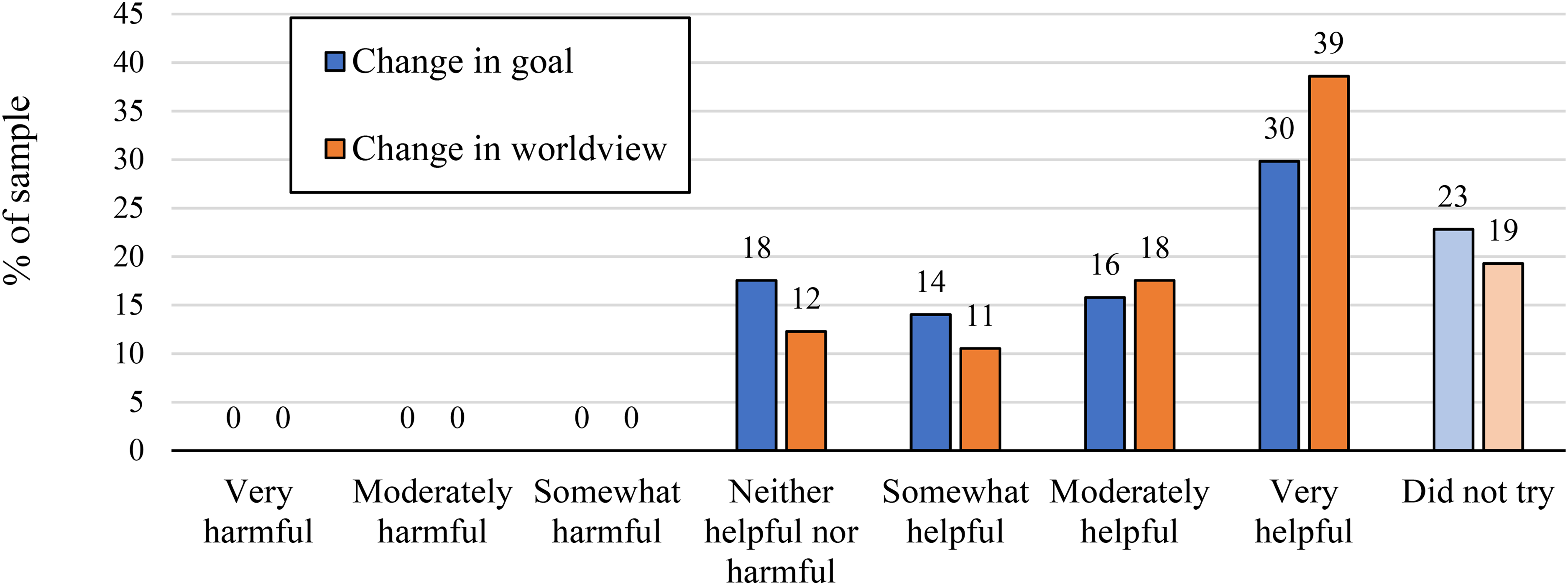
Ratings of change in worldview and change in goal as remedies. Complete data for rating these remedies were available for 57 out of 68 practitioners. Response options ranged from very harmful to very helpful. The zeros on the graph refer to the number of participants who selected each response.
Discussion
Practitioner worldviews and the landscape of Buddhist meditation in the West
Buddhist Studies scholarship has repeatedly pointed out that Buddhist meditation practices were developed within specific historical contexts in which certain cosmologies, anthropologies, and soteriologies were either communicated explicitly or taken as givens. Furthermore, meditation practices are not simply an unbiased means of direct introspection; rather, they are methods for cultivating specific experiences and for contemplating experience in accordance with Buddhist norms and doctrines (Collins, 2013; Shulman, 2014; Thompson, 2020). Meditation traditions are also transmitted within social and institutional contexts that shape how experiences are cultivated and how they are valued and appraised (Cook, 2010; Dreyfus, 2003; Sharf, 1995).
Being a study comprised primarily of Western meditation practitioners who nearly exclusively (97%) were not raised Buddhist, the participants in this study are immersed in particular doctrinal, cultural, and institutional contexts. Tendencies associated with “Buddhist modernism,” especially the “psychologization” of meditation (McMahan, 2008), were particularly relevant. Some practitioners confronted how the motivations and goals that they previously formulated in psychological terms diverged from Buddhist notions that were more religious in nature. Given the pervasive influence of science and psychology, as well as the blurred boundaries between religious approaches to meditation and psychological applications of meditation practices, such as Buddhist-derived mindfulness (Brown, 2016; Palitsky & Kaplan, 2021), it is not surprising that psychological and psychiatric frameworks were entertained alongside or in some cases to the exclusion of Buddhist frameworks when appraising meditation-related challenges. More than half of the practitioners in the VCE study were themselves meditation teachers, monks, or nuns in Buddhist communities, and many of them, too, advocated for the importance of psychological frameworks and methods for navigating meditation-related challenges. The teachers who provided expert interviews also often raised these concerns in the contexts of describing both how to respond to meditators-in-distress and how to identify more effective standards for their own training and expertise. Although Buddhist traditions provided a range of resources for appraising certain experiences as potentially normal, if not normative, parts of the path, other pragmatic considerations often influenced the process of appraising meditation-related challenges, and these considerations often entailed engagement with psychological or psychiatric frameworks and associated methods for symptom reduction or alleviating distress (Lindahl et al., 2020).
Worldviews and meaning-making in the context of meditation-related challenges
Worldviews serve a variety of important functions, which may be particularly salient in the context of meditation-related challenges. Worldviews provide a common frame of reference, enabling shared understanding and connection among individuals (Jost et al., 2008); they lend coherence to the processes of daily life (Heine et al., 2006); they impart values and significance (Taves et al., 2018); and they buffer against existential threats (Greenberg et al., 1997). They also help individuals cope with challenging life events by offering a cause and a purpose for their suffering and orienting them toward ways of responding (Berger, 1990; Jackson, 2002; Kleinman et al., 1997; Sullivan, 2016).
Meditation-related challenges thus constitute a double disruption. They can be distressing in their own right, and they can also undermine practitioners’ confidence in the worldviews within which meditation practices and communities are situated, especially when the assumptions or injunctions of these worldviews do not accord with practitioners’ experiences, or when these worldviews appear to actively exacerbate challenges. In such cases, the frameworks and coping strategies that might in other circumstances be alleviatory can themselves become distressing, turning previously viable coping strategies into liabilities. Among religious individuals, this phenomenon has been described alternately as “negative religious coping” (Pargament et al., 2000) and “religious and spiritual struggle” (Exline, 2013), and predicts a range of negative psychological outcomes. Other research has found that it is particularly distressing and destabilizing when a source of comfort becomes a source of threat (Goldsmith et al., 2011; Stein, 2016).
Scientific and religious worldviews may also afford distinct meanings to meditation-related challenges. Biomedical and psychiatric frameworks often presented meditation-related challenges as a kind of dysregulation or dysfunction. Although biomedical and psychiatric explanations tend to reduce blame on the sufferer, they can also make recovery seem less feasible and sometimes result in increased stigma for the individual (Kvaale et al., 2013). Such interpretations may be contrasted with “redemptive” views of suffering, which suggest that the purpose of challenges is growth and self-improvement (McAdams, 2005; Palitsky et al., 2019; Sullivan et al., 2018). Buddhist interpretations of meditation-related challenges applied by practitioners and teachers alike included both blaming and stigmatizing elements, such as attributing challenges to errors on the part of the practitioner, as well as redemptive elements, such as purification narratives.
Practitioners in the VCE study described various attempts to reconcile their experiences with both religious and scientific worldviews, oftentimes adjusting either their interpretations of their challenges or their relationships to their worldviews. This is consistent with meaning-making after other serious disruptions to people's lives. Park (2005) outlines a process of meaning-making after severe stressors, in which individuals iteratively adjust their interpretations of a stressor, as well as their global meaning frameworks, as they cope. She also describes how discrepancies between people's interpretation of a stressor and their broader worldview contribute additional distress. Practitioners’ descriptions of navigating worldviews, as well as their changes in worldviews, offer multiple examples of attempts to make sense of meditation-related challenges that are consistent with Park's model. When the appraised meaning of a stressor challenges global beliefs or goals (e.g., meditation-related challenges are distressing, even though meditation should alleviate suffering), people may change either their global beliefs or their interpretation of the stressor to relieve distress (e.g., meditation-related challenges are part of a purification process that ultimately leads to freedom from suffering). When the adjusted interpretations or global meaning frameworks are concordant (for instance when normalizing frameworks provide satisfactory explanations), they are retained. However, when appraisals and global meaning structures remain discrepant (as in the case of a mismatch between practitioners’ phenomenology and their frameworks), individuals experience further distress and attempt to find alternative explanations for their experience, as well as adjustments to their global meaning frameworks. Finally, the VCE survey data show that changes in worldview were rated as helpful (and not at all as harmful), suggesting that active engagement in the meaning-making process is an important dimension of coming to terms with challenging experiences.
Limitations
The VCE study was conducted in a non-representative sample of Western Buddhist meditation practitioners and meditation experts selected for their ability to report on meditation-related challenges. These findings about the impacts of worldviews may not necessarily generalize to Asian or Asian-American Buddhist communities, to mindfulness-based programs, or to other contemplative practice traditions, past or present.
Conclusions
Previous research has underscored the importance of supporting meaning-making after life stressors and has highlighted the value of meaning-focused interventions such as narrative therapy or cognitive processing to support this process (O’Connor, 2003; Singer, 2004). In the context of meditation-related challenges, it may be similarly useful to acknowledge the need for satisfying meanings. Engagement with worldviews, whether scientific, religious, or otherwise, may have positive or negative impacts on the trajectory of meditators working through challenges. Being attentive to the influential role that worldviews (and changes in worldviews) can play may help to alleviate and prevent unnecessary distress. As meditation enters the mainstream and is presented not just as a religious practice but now also as a mode of health care, it is crucial to understand the range of meditation-related challenges, their interpretations, and the impacts of those interpretations on the lives of practitioners.
Supplemental Material
sj-docx-1-tps-10.1177_13634615221128679 - Supplemental material for The roles and impacts of worldviews in the context of meditation-related challenges
Supplemental material, sj-docx-1-tps-10.1177_13634615221128679 for The roles and impacts of worldviews in the context of meditation-related challenges by Jared R. Lindahl, Roman Palitsky, David J. Cooper and Willoughby B. Britton in Transcultural Psychiatry
Footnotes
Declaration of conflicting interests
The author(s) declared the following potential conflicts of interest with respect to the research, authorship, and/or publication of this article: W.B.B. is a MBSR and MBCT teacher and has received financial compensation for this role. W.B.B. is the founder of Cheetah House, a Rhode Island non-profit organization that provides information about meditation-related challenges, individual consultations, and support groups, as well as educational trainings to meditation teachers, clinicians, educators and mindfulness providers. J.R.L.’s spouse is the founder of Cheetah House. J.R.L. has also received compensation for providing educational trainings on meditation-related challenges. This interest has been disclosed to and is being managed by Brown University, in accordance with its Conflict of Interest and Conflict of Commitment policies. The other authors declare no conflict of interest.
Funding
The author(s) disclosed receipt of the following financial support for the research, authorship, and/or publication of this article: This work was supported by the International Research Network for the Study of Science and Belief in Society (grant name = Dynamics of Science and Religiosity in the context of meditation-related challenges).

Supplemental material
Supplemental material for this article is available online.
Notes
References
Supplementary Material
Please find the following supplemental material available below.
For Open Access articles published under a Creative Commons License, all supplemental material carries the same license as the article it is associated with.
For non-Open Access articles published, all supplemental material carries a non-exclusive license, and permission requests for re-use of supplemental material or any part of supplemental material shall be sent directly to the copyright owner as specified in the copyright notice associated with the article.
