




Abstract
Newspapers are influential sources of information and opinion on mental health, but careless reporting may reinforce stigma. This review examined portrayals of mental disorder in Saudi Arabian newspapers. A cross-sectional sample (N = 200) of relevant articles was obtained from four of the most popular newspapers. These were categorised for descriptive and thematic analysis, using an established framework. The theme of highest frequency was advocacy, actions, and concerns; such articles were likely to have a positive impact by raising public awareness. Similarly, numerous reports with the theme of treatment and recovery informed readers of developments in mental health care, potentially breaking down barriers to seeking help. The theme of blame was found in a quarter of the articles; in addition to discussing environmental and genetic factors, there were several commentaries or reports on spiritual possession, which could perpetuate stigmatising ideas. While portrayals of mental disorder in Saudi newspapers show similarities to media coverage in other countries, distinct cultural perspectives were evident, including the prevailing notion of the ‘evil eye’. The authors recommend collaboration of mental health experts, patients and family carers to devise guidelines for more accurate reporting of mental disorder by Saudi media.
Introduction
Stigma has a profound influence on the experience of mental illness. Our understanding of this phenomenon owes much to the seminal work of symbolic interactionist Erving Goffman, who described stigmatisation as a process whereby undesirable attributes or “marks” diminish “a whole and usual person to a tainted, discounted one” (Goffman, 1990, p. 12). People suffer not only from the symptoms of mental disorder but also from their deviant status (Rüsch et al., 2005). They are associated with danger, while their vulnerability, social inclusion and rights are overlooked. Indeed, mental health service users commonly report that the effects of stigma are more devastating than the illness (Corrigan, Watson, Gracia, Slopen, Rasinski, & Hall, 2005).
The destructive effects of stigma are experienced at two levels: public (or social) stigma, and self-stigma. Corrigan and colleagues (2005, pp. 179–180) defined public stigma as “the phenomenon of large social groups endorsing stereotypes about and acting against a stigmatised group: in this case, people with mental illness,” while self-stigma is “the loss of self-esteem and self-efficacy that occurs when people internalise the public stigma.” Consequently, people with mental disorder turn stigmatising attitudes and stereotypes against themselves. Public stigma is often expressed in the form of prejudicial attitudes or discriminatory behaviour towards people with mental disorder, with adverse effects on interpersonal relationships (Thornicroft, Brohan, Rose, Sartorius, & Leese, 2009), employment (Crowther, Marshall, Bond, & Huxley, 2001), criminal justice (Corrigan, 2004, housing (Kirby & Keon, 2006) and health care (Ross & Goldner, 2006). Carers of people with psychiatric illness also suffer from stigma by association (Ostman & Kjellin, 2002). Such attitudes and behaviour may impede recovery (Padmavati, 2014). Thornicroft (2006) defined stigma as a triad of erroneous knowledge (ignorance), attitudes (prejudice) and behaviour (discrimination).
Stigma towards mental disorder is strong in the Arab world (El-Gilany, Amr, & Iqbal, 2010), where mental illness is widely perceived as an incurable affliction, requiring institutional segregation. Customary attitudes prevail in Saudi Arabia, the largest and richest country in the Middle East. This relatively recent country was founded in 1932 by Abdulaziz bin Saud, and the Saudi dynasty has continued its reign. While the vast Arabian Desert is sparsely populated by nomadic tribes, Saudi Arabia is steadily urbanising. Of the total population of over 30 million, 67.2% are of Saudi nationality, and 32.8% expatriates (Central Department of Statistics & Information, 2015). The official religion of Islam dominates Saudi culture, which maintains traditional social mores based on Shariah (Islamic law). Riyadh is the capital city and Jeddah is a large port, but Medina and Mecca are also significant as home to the mosques that millions of Muslims from around the world visit during the annual pilgrimage known as the Hajj (one of the five pillars of Islam).
Until Shahar Psychiatric Hospital opened in Taif in 1952, there were no mental hospitals in Saudi Arabia; previously, those perceived as insane were incarcerated in prisons. Shahar was built for 250 patients, but demand exceeded supply as chronic cases accumulated. Progress in Saudi mental health care was slow, with merely three psychiatrists serving the whole country in 1977 (Dubovsky, 1983). In the 1980s, the Ministry of Health began to expand Shahar towards the current capacity of 690 beds, new institutions were built for drug addiction, and psychiatric units opened in some general hospitals. According to the Ministry of Health (2015) there are now 23 psychiatric hospitals with a total of 3000 beds. Although the psychiatric bed ratio in Saudi Arabia is gradually increasing, al-Habeeb and Qureshi (2010) noted a lack of psychiatric clinics in general hospitals, insufficient numbers of psychiatrists, nurses and clinical psychologists, and an absence of community services such as halfway houses, day-care and rehabilitation centres. Primary health care centres have become the first point of access for mental health problems (Koenig, Al Zaben, Sehlo, Khalifa, Al Ahwal, Qureshi, & Al-Habeeb, 2014), and the Saudi mental health system has made tremendous strides in a short time.
However, cultural beliefs and limited awareness of modern treatment inhibit people from seeking psychiatric help (Al-Krenawi, 2005). Fears of family shame may be reinforced by media portrayals of mental disorder. Research has shown the powerful influence of mass media in the framing of public knowledge, attitudes and behaviour on contemporary topics (McCombs, 2004). Effects of media coverage of mental disorder on stigma have been studied in other countries and cultures. Wahl and colleagues (2002) compared reporting of articles related to psychiatric patients in six newspapers in the USA between 1989 and 1999, finding that while there was less emphasis on dangerousness by 1999, this remained the most common theme. In a study of all major newspapers in the USA in 2002, Corrigan and colleagues (2005) found that 39% of articles highlighted dangerousness or violence associated with mental disorder, and as these were mostly news items in the front pages, such coverage was likely to perpetuate stigma. A copious review of Canadian newspapers (Whitley & Berry, 2013) showed that whereas danger, violence, and criminality were direct themes in 40% of articles on mental disorder, treatment was discussed in merely 19%, and quotes from patients were scarce. Such findings indicate a need for more balanced and informative coverage of mental health problems in the popular press.
To date, there has been little research on the effect of media portrayals of mental disorder in the Arab context. Newspapers are a major source of information for Saudi society, and the tone and content of articles on mental health may have considerable impact on perceptions of people with mental disorder, particularly in a conservative culture bound by social and religious mores.
Method
This review comprised all articles on mental disorder in a sample of popular Saudi newspapers over a one-year period (2013). Of the 15 daily newspapers printed in Saudi Arabia (Saudi Press Agency, 2013), two are published in English and all others in Arabic. Two newspapers were excluded: Al-Eqtisadia because it specialises in economics, and Al-Sharq Al-Awsat because it has a Pan-Arab rather than a Saudi focus. Two Arabic newspapers were selected for this review, based on the Arab media outlook report for the years 2009 to 2013 (Dubai Press Club, 2010). This report showed that Okaz had the highest print readership in Saudi Arabia (Daily Circulation [DC]: 250,000), while Al-Jazirah had the highest online readership (this is a separate entity from the satellite news broadcasting company of same name) (DC:123,097). Both newspapers in English language (Saudi Gazette, DC:50,000 and Arab News, DC 51,481) were selected because medical and nursing education in Saudi Arabia is conducted in English: students are bilingual and may read such newspapers instead of or additionally to those in Arabic.
The selected newspapers were searched systematically. As online archives were basic, an advanced electronic search strategy was impeded; for example, an automated restriction to year 2013 was possible in only one newspaper (Al-Jazirah). The remaining three archives were searched without time limit, and reviewer LS screened the articles manually to limit to the relevant period. Search terms in English and Arabic were selected as being common terms used by the public and health care practitioners for mental illness. The main terms were “mental” and “psych”, with additional searches for common mental disorders (including schizophrenia, depression, obsessive-compulsive disorder and suicide) and lay terms (such as “crazy,” “mad,” and “lunatic”). All terms were searched using English and Arabic translations. Excluded were articles relating to neurological disorders, or on suicide with political or terrorist motives.
A total of 1243 newspaper articles were retrieved from the four online newspaper sources. To reduce this to a manageable data set, the first 50 articles and their comments section from each newspaper were included in the analysis. These 200 articles were categorised descriptively (length, section of newspaper, type of mental disorder discussed, and opinion sources) and thematically. Thematic analysis followed the framework devised by Corrigan and colleagues (2005), which developed from previous work by Wahl and colleagues (2002). Four core themes of dangerousness, advocacy action and concerns, treatment and recovery, and blame (each with subcategories) were applied. Following Wahl and colleagues (2002), articles were also judged on their potential impact on stigma, categorised as positive, neutral, negative, or mixed.
Analysis was primarily conducted by reviewer LS. As a Saudi Arabian who graduated in psychology in that country, LS is sensitised to Arab cultural beliefs as well as Western concepts of mental disorder. Categorisation was verified through independent review of a random sample of 50 articles by co-authors NM and IN, with any conflicting judgments resolved through discussion.
Findings
Articles related to mental disorders most frequently appeared in a regional news section (see Table 1). Reports typically referred to mental disorders generically, using terms such as “mental illness,” or “psychiatric problems,” although almost half of the articles mentioned specific disorders (most frequently depression, substance misuse and schizophrenia). Merely 11 articles (5%) presented opinions from people who had experienced mental disorder (see online supplement, Table 2).
Over half of the articles were considered to convey a positive message that may counter stigmas about mental disorders, but a quarter of the articles appeared likely to reinforce negative attitudes (see online supplement, Table 3).
Thematic content of articles.
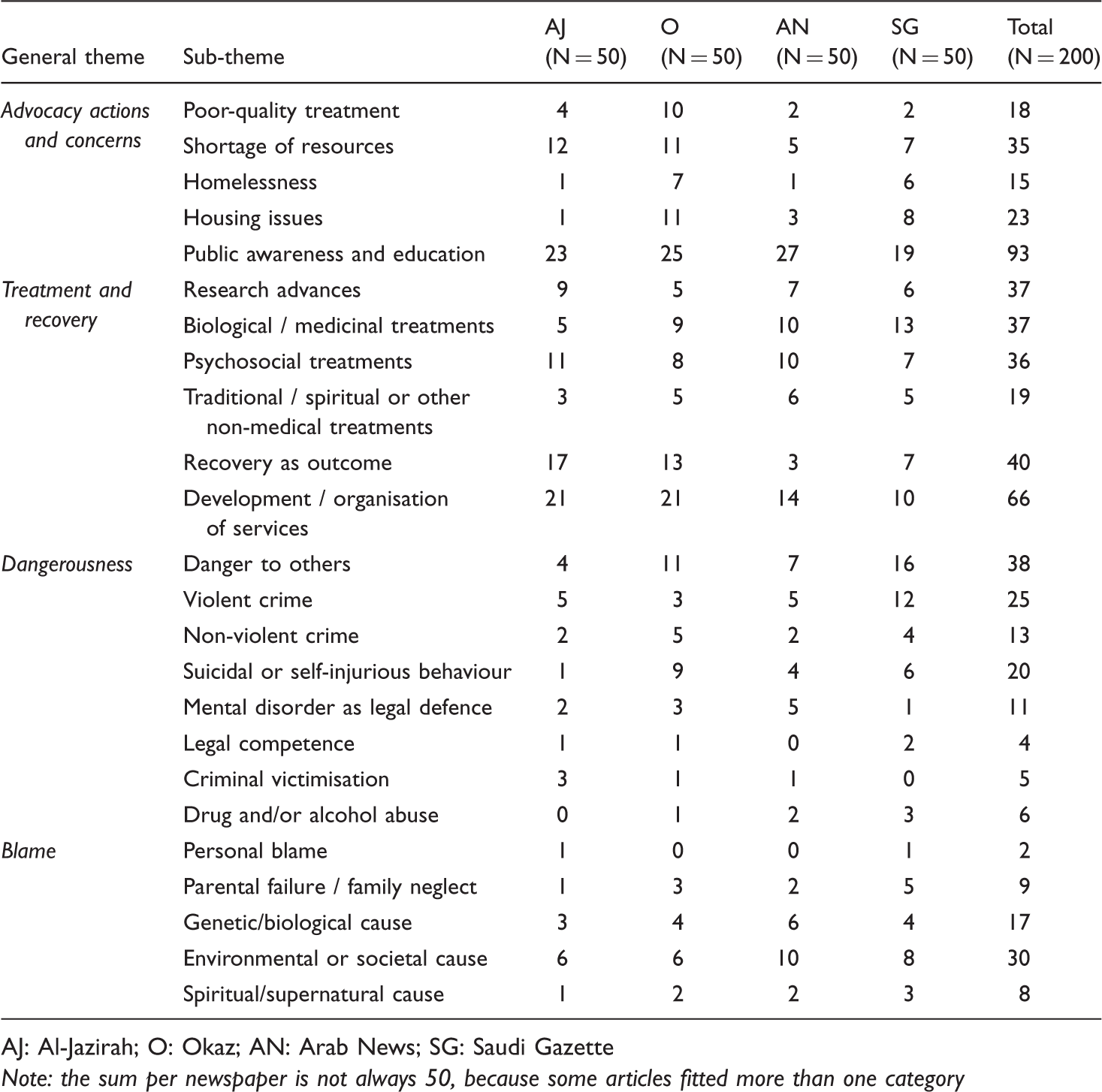
AJ: Al-Jazirah; O: Okaz; AN: Arab News; SG: Saudi Gazette
Note: the sum per newspaper is not always 50, because some articles fitted more than one category
Advocacy actions and concerns
Articles with advocacy actions and concerns as a main theme mostly presented a positive intent to support people with mental disorder. The largest sub-theme under this category was public awareness and education, which had the highest frequency across all four newspapers. Articles of educational purpose described public awareness campaigns, dispelled popular myths, and presented mental health statistics. Many of these articles also promoted the rights of people with mental disorder. A quote typifying this theme was in an article “Facing mental illness by breaking the shame and activating awareness” (translated by LS), which presented views of mental health practitioners: Psychiatrists and mental health specialists called for mental illnesses to be given more prominence in public awareness programmes in light of the increase in abnormal mental disorders that require pharmacological interventions such as depression, anxiety disorder and sleep disorders, noting that the lack of awareness regarding mental illness and the shame associated with the diagnosis of these diseases form the most important obstacles leading to misdiagnosis and depriving patients of access to appropriate treatment. (Dawoud, Okaz, 20/4/2013) Al-Amal Hospital for Mental Health is home to many female patients suffering from different mental ailments, such as schizophrenia, depression, paranoia and others. These women were living normal lives with their families, but fell prey to mental illnesses and required treatment. Some of these women have recovered, but their families are refusing to accept them back into their homes. Such women have no other alternative but to remain in the hospital, which in turn affects their mental status and may cause a relapse of their conditions. In addition, such a situation puts great pressure on the hospital, which has only 74 beds and a large waiting list. (Saudi Gazette, 5/9/2013) Mental patients are not insane, but they are individuals who have experienced difficult circumstances and are incapable of coping with them. They are in need of special care and, as part of society, they have the right to be rehabilitated and accepted… Many families admit their patients into the hospital, and neglect to visit them for long periods. Some patients are completely rehabilitated and can leave the hospital and lead a normal life (Saudi Gazette, 5/9/2013).
Treatment and recovery
A large number of articles in this theme related to development and organisation of services. Several reports described new mental health facilities, and the national mental health survey. An article “100 experts research the rights of mentally ill patients” (translated by LS) discussed the launch of a forum for mental health service administrators: Dr. Abdul-Hamid Habib, secretary-general of the National Commission for the care of mentally ill patients and their families, explained that the purposes of the forum are to define the rights of the mentally ill and the means and the scales used to defend them, and to ensure that mentally ill patients adequately receive their rights. He noted that the forum addresses hospital administrators, patient relation officials and the heads of nursing in mental health hospitals in the Kingdom, and hoped that the forum would produce recommendations that are in the best interest of mentally ill patients and their families. (Al-Bilahidi, Okaz, 28/1/2013) The treatment of addiction in Saudi Arabia has evolved and now encompasses all aspects of treatment in an integrated manner including psychological, behavioural, social and recovery guidance as well as religious guidance. (Al-Harthi, Al-Jazirah, 2/2/2013; translated by LS)
Dangerousness
The theme of dangerousness was found in a third of the articles. A common message was that people with mental disorder pose a greater threat to themselves than to others, but many articles portrayed them as violent, unpredictable and a danger to their community. This belief is exemplified by an article “Three divorced wives and the fourth one on the way,” which tells of a man with a series of failed marriages resulting from his mental illness. Having shared the testimonies of the three wives, who all suffered verbal and physical abuse at the hands of this man, the author made the following recommendation: I hope the authorities blacklist this man and his like in the future so that families know what they are getting into. My advice to the authorities is to make psychological and drug tests obligatory for all prospective husbands. (Al-Thubaiqi, Saudi Gazette, 30/4/2013) Sexual abuse would in no way be deterred by performing hysterectomies on mentally ill patients. It would only prevent pregnancies. It is illogical. (reader’s comment on Saudi Gazette article, 12/4/2013)
Blame
The theme of blame appeared in less than a quarter of the articles. The most commonly reported causal factors for mental disorder were environmental and genetic / biological, followed by parental failure and family neglect. A few articles suggested spiritual or supernatural causes or personal fault. Despite the negative connotations of the theme, it was included in several positive articles urging compassion and understanding for people with mental disorders, rather than blaming the sufferer. An emphasis on changing attitudes to mental illness by improving knowledge was found in the report “A wife but she is incomplete!” (Al-Muhaymid, 6/7/2013; translated by LS), which doubted the validity of genophobia (fear of sexual intercourse) as a mental illness in women. The author expressed his surprise at a television programme An Issue of Public Opinion, which dedicated an episode to this condition. The author discussed the attribution of blame in relation to mental disorder: Such cases are usually handled lightly and often with mockery. The female patient is usually ridiculed and accused of being spoilt or overreacting when claiming a fear of intercourse. This is apparently not the case. It is likely that she is experiencing a mental disorder and needs professional care and treatment. Indeed, because of such ignorance, some women may be exposed to wrongful treatment by some physicians who believe it to be a physical disease rather than a mental one, thus further exacerbating their fear and anxiety symptoms. The taking of a woman’s virginity through surgery as treatment, which is not a surgery sanctioned by the medical profession, is occurring increasingly in developing countries. This unfortunately only makes things worse and more complex, and doubles the fear, anxiety and pain experienced by these women. (Al-Muhaymid, Al-Jazirah, 09/11/2013; translated by LS) Excessive fear of the evil eye and those who cast it is common among certain people. Such beliefs serve to benefit charlatans who prey on the minds of such victims. We see a certain class of society standing at the gates of these charlatans, driven by illusion, disillusion and fear of the evil eye and those who cast it – and the devil whispers to them, leading them to believe that their mental disorders are caused by the evil eye while they benefit from exploiting them. (Al-Fuzan, Al-Jazirah, 6/7/2013; translated by LS) Yes, the evil eye exists and I do not deny that, but I do refuse to connect every mental or physical disorder to the evil eye… and I do reject excessive intimidation and fear from the evil eye… and I do condemn the seeking of treatment from spiritual healers to be cured of the evil eye, because it has not been proven that the prophet Mohammed (PBUH) or his companions ever took it upon themselves to perform rukya with the intention of treating others as a profession and a form of livelihood. Instead, they performed rukya on themselves and others using Quranic verses and prayers only and free of charge. This is what the Islamic sharia recommends to prevent patients from being exploited and robbed. (Al-Fuzan, Al-Jazirah, 6/7/2013; translated by LS).
Discussion
The wide range of articles examined in this review shows progressive intent to portray mental health problems more positively and accurately, alongside reports likely (if unwittingly) to reinforce stigmatising attitudes. In physical or digital format, newspapers perform vital roles in informing and educating society and, with regard to mental health, conflict may arise between the need to dispel myths about mental disorder, and the primary mission of a newspaper to report events. A violent incident involving a mentally disturbed person should not be censored, but the popular press should be careful not to perpetuate stereotypes about people with mental illness being dangerous and in need of incarceration.
Articles on mental disorder were reported mostly in regional news, sometimes accompanied by opinion pieces. Three quarters of articles referred to mental disorder generically, and this has implications for lay understanding. Previous research suggests that reports of adverse incidents lacking a psychiatric diagnosis are likely to perpetuate a societal belief that unpredictability and violence are common to all types of mental disorder, thus reinforcing stigma (Wahl et al., 2002). Meanwhile, most of the commentary on mental disorder was from practitioners, and although such views were sympathetic they often conveyed paternalistic attitudes. The absence of narrative from people with mental disorders is a missed opportunity to allow readers to learn from actual experience and to relate to sufferers as fellow human beings. Studies in Western culture have shown similar imbalance (Whitley & Berry, 2013; Nairn & Coverdale, 2005; Corrigan et al., 2005).
The prominence of articles in the theme of advocacy action and concerns is encouraging, showing interest in mental health and in the welfare of psychiatric patients in Saudi Arabia. The many articles on public awareness and education tended to be written for a naïve readership, assuming little knowledge about mental disorder. Increasing awareness of mental health appears to have led to public demand for better services, choice and rights. Accordingly, the Saudi government has been revising mental health legislation to expand provision and to protect the rights and dignity of patients and their carers (Koenig et al., 2014). Furthermore, the Prince Salman Center for Disability Research (Al-Odaib & Al-Sedairy, 2015) supported among its many projects the first Saudi National Mental Health Survey (2010), which collates a wealth of data on the prevalence, morbidity and impact of mental disorder in each province of Saudi Arabia.
Several articles attributed mental disorder to spiritual and supernatural factors. In Islamic belief, God governs all aspects of human experience including health. Some religious leaders consider illness as “a mechanism of the body that is serving to cleanse, purify, and balance us on the physical, emotional, mental and spiritual planes” (Rassool, 2000: 1479). Mental disturbance is often thought to arise from weakness in faith, as penance for wrongdoing or a test of conviction. Muslims’ firm belief in kadr (destiny) enables them to accept Allah’s desire and to be more optimistic about healing (Rassool, 2000). American psychiatrist Dubovsky (1983) regarded such passivity as an obstacle to treatment, but Saudi psychiatrists argue that a Western model cannot be imposed in defiance of the cultural and religious context (Koenig, Al Zaben, Sehlo, Khalifa, & Al Ahwal, 2013).
Belief in possession by supernatural forces such as jinn (demons), seher (magic) or hasad (the “evil eye”) are widespread among Muslims in general, and are reportedly more common among women, the elderly and the less educated (Ciftci, Jones & Corrigan, 2013). Such ideas predate Islam. Thematic analysis of Arabic texts and four English translations of the Qu’ran (Islam & Campbell, 2014) showed no direct relationship between spiritual possession and mental disorder in holy scripture. Madness is mentioned frequently in the Qu’ran, but mostly related to the taunting of Prophet Mohammed and his followers by disbelievers. Islam was the earliest of the major religions to preach sympathy and care for the mentally sick, who would not be accountable for their misdeeds (Islam & Campbell, 2014). However, putative links between madness and spiritual possession are discussed in the Hadith, a compilation of Mohammed’s sayings and accounts of his daily living and practice, comprising the second-most important source of divine guidance after the Qu’ran. Belief in demoniacal possession is officially denounced as contrary to Islam and its teachings (Grotberg 1990), yet persists in Saudi culture (Al-Habeeb, 2003). Such attributions show the complexity in understanding and responding to mental disorder in Saudi culture, and emphasise the need for culturally-sensitive campaigns to reduce stigma.
Articles on the theme of treatment and recovery most frequently related to new psychiatric services, but traditional or spiritual approaches were also prominent. In Saudi Arabia, where Bedouin traditions co-exist with Islamic belief, faith healers are often consulted before professional health practitioners (Alosaimi, Alshehri, Alfraih, Alghamdi, Aldahash, Alkhuzayem, & Albeeshi, 2014). Exorcism is attempted through thrashing or cautery (Koenig et al., 2014). Comparing Saudi and British attitudes towards causes and treatment of auditory hallucinations, Wahass and Kent (1997) found that 34% of a Saudi public sample attributed such symptoms to Satan or demons, 9% to brain damage and 31% to stress (for the British sample the figures were 5%, 38% and 74% respectively); for treatment 66% believed that religious intervention was needed, 33% suggested psychological therapy, and merely 5% medication (the British responses were 11%, 55% and 22%). While UK respondents had low endorsements of social rejection of people with mental disorder, Saudi participants had a wide range of views on the idea of social rejection. In general, social rejection was more likely to be considered acceptable by participants with lower educational backgrounds in the Saudi sample. Such cultural differences have important implications for the care of Arabian patients in Western countries and for the successful use of Western intervention methods in other cultures (Wahass & Kent, 1997).
A third of the newspaper articles reviewed here associated danger, violence and crime with mental disorder, despite established evidence that people with mental disorders are more likely to be the victims of crime rather than the perpetrators (Thornicroft, 2006). As observed elsewhere, including Western countries (Wahl, 2003), Saudi newspapers appear to accentuate or sensationalise deviant acts by people with mental disorder. The theme of blame emerged in a quarter of the articles, mostly attributed to environmental or genetic causes rather than personal fault. While it is positive that blame was not widely attributed to personal fault, it adds weight to the concerning perception that mental disorders are viewed as fate rather than a challenge the individual can manage.
Limitations of this review should be considered. The sample of articles was from four newspapers and may not be representative of broader patterns of media portrayals of mental disorder in Saudi Arabia. Magazines, novels, television and films were not examined, and these could have as much influence as newspapers. To some extent, categorisation of articles was subjective, although uncertain cases were discussed and categorised as neutral where appropriate (see online supplement). For depth of analysis the authors restricted the sample to a manageable amount, but using the first 50 articles from each source could have caused temporal bias. Seasonal changes are less marked at Saudi latitude; however, there are cultural events such as Ramadan that could influence media presentations. Analysis was attuned to a Western model of psychiatry with articles rated positively if they portrayed mental distress or disturbance as a reversible state, amenable to psychiatric or psychological intervention, instead of a fixed state or moral fault. This approach could be criticised for perceived assumptions of Western or technocratic hegemony. Interpretation was to some extent subjective, and this could have significant impact on the analysis. Formal testing of inter-rater reliability was not performed here. However, as well as a random sample of 50 articles independently reviewed by the two co-authors, any other articles on which the reviewer was uncertain were discussed by the team. The a priori thematic framework may have restricted the breadth of interpretative analysis, although this was adapted for the Saudi context with the important addition of the spiritual and supernatural sub-theme.
This review has implications for tackling stigma in a global and cultural context. It supports recommendations by previous researchers on the need for more accurate and less stigmatising portrayals of mental disorder in the popular press. This is challenging, partly because newspapers do not simply determine opinion; instead, there is a reciprocal relationship whereby editors are keen to reflect the outlook of readers (Merrill, 2003). A systematic review of 19 randomised trials of mass media interventions to tackle stigma towards mental disorder (Clement, Lassman, Barley, Evans-Lacko, Williams, Yamaguchi, Slade, Rüsch, & Thornicroft, 2013) showed mixed results. While there was insufficient evidence that the various interventions reduced discrimination, prejudice fell from the level typically found towards schizophrenia to that found towards depression. Guidelines on specific conditions may be more effective. For example, with evidence linking sensational reports of suicide to imitative behaviour, a systematic review of media reporting guidelines (Bohanna & Wang, 2012) showed that adherence mitigated this phenomenon. Success has also been found following reporting guidelines issued by various agencies to present a less stigmatising view of dementia (Doyle, Dunt, Pirkis, Dare, Day, & Wijesundara, 2011).
Research on media presentations of mental disorder is developing, and Whitley and Berry (2013) highlighted the need for consistency in search terms, eligibility criteria, coding schema and analysis. More research is needed on the experience of Saudi Arabian people with mental health problems, including use of Arabic versions of standardised instruments to measure internalised stigma (Kira et al, 2015). Programmes to improve media coverage of mental disorder are yet to be designed, implemented or evaluated in the context of Saudi Arabia.
We recommend collaboration of mental health experts, patients and family carers to devise reporting guidelines for Saudi media organisations to present psychiatric disorder humanely and accurately. In a land of strong religious adherence, concepts of mind and suffering from a faith perspective should be considered, towards developing shared meanings of mental distress. No single model has absolute authority, and practitioners and researchers should not unduly invalidate prevailing belief systems. Religious leaders could play an important role in devising media reporting guidelines appropriate for Arab or Middle-Eastern culture. Such guidelines should be evaluated, thereby informing further development and contributing to the broader evidence base. Finally, the review conducted here should be repeated periodically to monitor progress.
Footnotes
Declaration of Conflicting Interests
The author(s) declared no potential conflicts of interest with respect to the research, authorship, and/or publication of this article.
Funding
The author(s) received no financial support for the research, authorship, and/or publication of this article.