




Abstract
This article intends to explore the dynamic interplay between queer nightlife, societal changes, and drug use over the last century in Portugal by taking Lisbon as a case study as well as selecting critical historical periods, namely the Années Folles of the 1920s; the authoritarian Estado Novo (1926-75); the post-revolution phase (1975-2000), and the first two decades of the new millennium (2000-2020). The article therefore presents a socio-historical review of queer nightlife in Lisbon over the last century (1920-2020) to understand the evolution of LGBTQ + nightlife in Lisbon from a comprehensive perspective.
Introduction
On June 29th, 1969, a group of LGBTQ + people began a series of spontaneous protests at Stonewall Inn, a gay bar that opened in 1967 in Greenwich Village, New York. These riots marked the beginning of sexual and gender liberation in Western countries, resisting against the institutions and social norms that were systematically oppressing and brutalizing LGBTQ + communities. Consequently, when writing the history of the LGBTQ + movement, it is critical to highlight the cultural and social relevance of nightlife in individual and collective emancipation (Canaday, 2014; Lin, 2021; Ghaziani, 2023). Bars, nightclubs, raves, saunas, and cruising spaces were—and continue to be—crucial for the construction of LGBTQ + identities and communities (Andersson, 2023; Cattan and Vanolo, 2014), as well as for the embodiment of (sub)cultural practices (Costa and Pires, 2019; Ghaziani, 2023; Greene, 2022). These spaces offer safer and risk-free zones for people of all ages to perform and affirm gender and sexual diversity (Adeyemi et al., 2021; Bitterman and Hess, 2021; Ekenhorst and van Aalst, 2019; Lin, 2021; Pires et al., 2022; Valentine and Skelton, 2003). According to Judith Butler (2017: p. 92), “(…), there is no gender identity behind gender expressions; that identity is performatively constituted by the very “expressions” that are said to be its results.” In this context, we can assume that nightlife environments create and are created as privileged spaces for queer performativity.
The emergence and evolution of LGBTQ + nightlife are related to a country’s political and sociohistorical developments. In the case of Portugal, “(…) when analyzing the LGBT movement, the experiences of night spaces are left to a footnote” (…) “The history of a city (and a country) is also that of its night spaces” (Marques, 2017: p. 5). In this “absence,” pointed out by Marques, we find the raison d'être of this article that follows.
Objectives and methodology
This article intends to explore the dynamic interplay between queer nightlife, societal changes, and drug use over the last century in Portugal. We use Lisbon as a case study, spanning four critical historical periods. These periods correspond to essential moments in Portugal’s LGBTQ + history: (i) the Années Folles of the 1920s, or the golden years after the end of the First World War; (ii) the beginning of an authoritarian period, as a consequence of the coup d'état that took place in Portugal on May 28, 1926; (iii) the victory of freedom over fascism, brought by the 1974s Carnation Revolution (1975-1999); and (iv) and the first two decades of the new millennium (2000-2020). The reason for conducting this socio-historical analysis up to the present is twofold. First, a lack of diachronic studies allows us to understand the evolution of LGBTQ + nightlife in Lisbon from a comprehensive perspective. Second, this article responds to the need identified by The European Network Against Racism for historical analytic dimensions in understanding exclusion or segregation (ENAR, 2020). More specifically, our methodological starting point is aligned with Daniel R. Huebner (2021)’s interest in how Queer Historiography researchers can acknowledge “the reconstruction of the past without reducing it to what they already wanted to find” (Huebner, 2021: pp. 544). In this sense, this article is within the parameters defined by Historical Sociology, which “identif [ies] those categories of cases or classes of episodes that capture the intrinsically historical dimensions of social change and reproduction” (Clemens, 2007: p. 544). This research, centered on the Historical Sociology of the LGBTQ + nightlife in Lisbon over the last century, has primarily consisted of an extensive literature and archive review, including books, scientific papers, and mass media pieces.
The identification of the sources was based on an online literature and archive review by using a combination of keywords in three main axes – gender diversity and sexual orientation AND nightlife environments AND drug use. This search was done on Google and in the Hemeroteca Digital de Lisboa – a digital archive compiling periodic institutional and media publications since the 1800s. The review mirrored the historical silence around queer nocturnal subcultures. Nevertheless, we identified relevant sources for the four periods under analysis. In the first period, we included references from António Botto and Judith Teixeira (queer poets), the journalists Reinaldo Ferreira (also known as Repórter X) and Adolfo Coelho, and the PhD dissertation of the doctor José Marques da Silva. As França (1983) recalls, the Portuguese literature of the 1920s was rich in forms and themes. Emerging literary movements represent a great repertoire of sociocultural references. For example, Costumbrismo which vividly captured the daily life, mannerisms, and traditions of the Ibero-American cultures through detailed descriptions in literature, journalism, and the fine arts. The literature and art produced during this era are invaluable for sociocultural and historical research, offering in-depth descriptions, sketches, and portrayals across all social strata. They are also deeply infused with their era’s political and religious ethos, providing a comprehensive lens to understand the complex fabric of the societies they represent (Gilman, 2014; Olson, 2012; Rodríguez-Galindo, 2021; Standiford, 1949; Teixeira et al., 2021).
For the second period (1926-1974), we used secondary sources, specifically the sociological historical work published by Susana Pereira Bastos (1997), São José Almeida (2010), and Raquel Afonso (2019). We then used the book “Histories of Lisbon´s Gay Night” by Rui Oliveira Marques to describe the third period (1975-1999). The analysis was complemented by other scientific sources from cultural studies and media pieces we found during the review. Finally, for the fourth period (the 2000s), we analyzed scientific papers on queer nightlife and queer drug subcultures, media pieces, and the empirical knowledge of the authors.
Our analysis is presented in a historical sequence, and we occasionally reference outdated terminology to illustrate how concepts evolved inside and outside academia. This paper additionally includes some historical quotes that may be triggering for readers affected by anti-LGBTQ + hostility; we unequivocally disagree with these statements. 1
Queer visibility and social degradation during “les Années Folles”
The end of World War I brought the cosmopolitan and hedonistic flows from other European countries (particularly France) and the United States of America to Lisbon. The 1920s were marked by intense urban and social transformations that allowed young adults, particularly those with higher social status, to contest and transgress the conventional moral standards by experimenting with new forms of leisure, arts, consumerism, and social performances (Magalhães, 2021; Vaz, 2021). The city’s moral voices perceived post-war modernism as a threat to the hegemonic Judeo-Christian convictions and the patriarchal family model. Conservative men with privilege and power abhorred the women’s fashion expressions imported from Paris, such as the “garçonne style,” a boyish – perhaps more androgyne-look that challenged traditional femininity standards. This new fashion was identified as a sign of moral and sexual degradation (Vaz, 2021). “The same can be said of the assessments they make of modern man, normally described as homosexual, with effeminate gestures, subservient to all the latest fashions, slaves to unhealthy pleasures” (Barros, 1990: p. 73).
New ways of leisure and new forms of eroticism were explored, particularly by straight men who enjoyed the cabarets and new cafes that were blooming in Lisbon at the time (França, 1983; Vaz, 2009). However, non-normative sexualities were hidden and relegated to the private sphere. The presentation of non-normative gendered bodies, such as transgender individuals, in public spaces was very risky at the time, as was the clear manifestation of interest in other people of the same sex. The self-biographical homoerotic poetry of António Botto (1922), first published in the book Canções, reveals that the darkness of “the night” allowed homosexuals to experiment, express, and freely live their sexualities (Botto, 1999). (…) If daylight Covers you with shame, Let us wait for the night locked in a kiss. (…) (António Botto, 1999: p. 22)
While the cafe, A Brasileira in Chiado. Offered a cultural outlet for the intellectual elite, including poets such as António Botto and Judith Teixeira (referred below in the text), nightclubs (particularly Bristol-Club) and their new sonorities (jazz bands) and dance styles (Charleston, fox-trot) were the higher expression of the new bohemia in Lisbon (Barros, 1990; Vaz, 2021). These spaces seemed to offer a modernist stage for homosexuals’ existence and public expression. “These spaces also allowed for framing and giving social visibility to alternative gender performances, with the glamorization of the figure of the homosexual and the transvestite - typical characters of the fauna of clubs, legitimized by the need for novelty and sophistication in the performance of modernity” (Roxo, 2009: p. 259)
Reinaldo Ferreira, or Reporter X, a prominent Portuguese literary journalist, playwriter, and movie director, documented Lisbon’s bohemian habits and nightclub environments during “Les Annés Folles.” His movie, “O Táxi n° 9297,” was the first in Portugal to include an explicitly homosexual character: Don Alfonso, who was also a morphine user (this was the first screen of a person injecting drugs in the country). In his book, first published in 1933, he documented his problematic use of morphine. He also narrated how Maria L., a woman nicknamed marimacho (a Portuguese derogatory equivalent of a tomboy) by her peers, was introduced to cocaine by her will. He described her as an active participant in the Bristol-Club, dressing in masculine clothes and a monocle that suggested she could be in an intimate relationship with another woman. “I spoke to her almost emotionally... she reminded me of all the stupidity of my careless youth, the nights out without restraint, the adventures without borders... We had been good comrades.” (Ferreira, 2006: p. 88).
Judith Teixeira, a prominent poetess active between 1922 and 1927, was the first woman in Portugal to write lesbian poetry, including erotic poems. She was known as a bohemian involved in the public sphere. Although we could not find information regarding her drug use, in her poem “Fim” (The End in English), she wrote, “The pain howled inside me... I only lose its sound and color... In orgies of morphine!” (Teixeira, 1923: p. 39).
In 1923, Teixeira’s books (along with António Botto and Raul Leal’s books) were seized, publicly burned, and censored by the emerging conservative, pro-fascism movements. This erasure, known as “Literatura de Sodoma” (Sodom Literature), pushed her into oblivion and invisibility, and her literary work was only given the deserved public recognition in the last two decades.
These literary references suggest that morphine and cocaine (new drugs in Portugal at the time) could have been used to reinforce the experimentation of libertarian body performances, flirting, and uninhibited social interactions (Pires, 2023).
However, social alarm around the so-called cocaine degradation reinforced the perception of club life as morally decadent (Pires, 2023). Such reactionary narratives were harsher towards nightclubs, describing them as places of libertinism, lust, and vice (Barros, 1990; Vaz, 2021). This revived the institutionalized homophobia and hate speech used in the previous decade (Curopos, 2018). A growing and profoundly gendered public discussion around cocaine-related harms preceded punitive, prohibitionist drug laws. For example, Law n° 12,469, 12th October of 1926 penalized drug use by implementing quick trials, and forbidding the entrance of the listed people in the nightclubs. Portuguese journalist Adolfo Coelho wrote in early 1930s that “other cocaine enthusiasts are the countless homosexuals who, to the shame of this country, swarm in the numerous clubs and dance halls of the specialty. Cocaine users, disgustingly dressed in feminine clothes, made up and grotesque, constitute one of the most chilling signs of the decadence of a race” (Coelho, 1931: p. 115).
Hygienist and eugenics ideologies predominated in Western societies throughout the nineteenth and twentieth centuries, defining same-sex eroticism and relationships as homosexualism – a pathologizing medical and juridical construct (Moita, 2001; Stevens and Hall, 1991). Therefore, homosexuals suffered social and institutional repression under the dichotomy of sickness and vice, deeming them as immoral, deviant, and sick (Kinsman, 1991; Pereira, 2015). Dominant prejudices influenced the social narratives around drug use. The medical work led by Doctor Marques da Silva (1926) and the literature documentary authored by Afonso Coelho (1931) documented biased analysis of the drug-related harms in Portugal in the 1920s, correlating drug use with sexual deviance, particularly among women and homosexual men. “The cocaine addict has a veil in front of his conscience; he is not only capable of reprehensible, immoral, stupid, or extravagant acts, but he also commits them publicly without realizing their seriousness. The perversion of the genital sense is still a consequence of the genital excitation produced by the first pinches. The large number of homosexuals appearing in our cities today are cocaine addicts” (Marques da Silva, 1926: p. 101).
Mainstream culture created an association between the uses of “other” drugs (in this case, cocaine, and morphine) and homosexual people, othering two social outcasts. During Les Années Folles, a growing reactionary movement gave attention to homosexual people to depict the new urban habits, political thought, culture, and lifestyle as outrageous. Conversely, attitudes towards nightclub culture and drug use, reinforced pathologization and increased social stigma and discrimination against homosexuals. Negative beliefs about the sexual agency of these people were used to reinforce the social alarm around these night cultures and the use of drugs.
From 1926 to 1974 - repression and queer invisibility during the dark age of the Portuguese dictatorship
The end of the Republican regime in 1926 led to a Catholic, nationalist dictatorship in Portugal, Estado Novo. Homosexuality was considered a “dangerous state” that “subverted masculine values of honor, confused gender identities, disturbed the codes used to manage relations between the two sexes, and refused the institution of family – pillars of Estado Novo” (Bastos, 1997: p. 151).
Homosexuality was “tolerated” depending on an individual’s social class. As Afonso (2019) explains, this created a double standard. Homosexuals who were wealthier, professionals, and artists had to remain private about their sexuality; homosexuals from lower classes lived in more anonymity than their wealthier counterparts, meaning they were subject to social scrutiny and discrimination. Notably, homosexuality in this period refers generally to men (Almeida, 2010: p. 101), while female homosexuality was not judged in the same way.
Legally, homosexuals were considered vagrants 2 , a juridical concept synonym of social deviance, which included individuals experiencing homelessness, street-based sex workers, “pimps,” and people labelled as alcoholics (Bastos, 1997). Vagrants often experienced public shaming and police brutality, and they were forced into prisons and psychiatric hospitals for “moral regeneration” through punishments and abusive electroconvulsive therapy.
Marginalized from public life and legitimacy, homosexual men met each other on beaches and parks, bars and private parties; they also found sanctuary in stigmatized bars and cafés, and they cruised in public toilets and urinals (Afonso, 2019; Almeida, 2010; Marques, 2017). Daytime spots, such as A Brasileira Café, were well-known for meeting other homosexuals. This café attracted many artists and cultural figures whose homosexuality was “tolerated” by the regime. At night, some public spots or cruising areas, such as Eduardo VII Park, were preferred for meeting other homosexuals (Afonso, 2018). During the 60s, in the last years of the fascist regime, the first semi-clandestine gay bars opened as a prelude to the national liberation that would bring about the Carnation Revolution of 1974. They were Bar Z (Almeida, 2010) and o Bric-a-bar (Freitas, 2015), both located at Príncipe Real, an upper-class neighborhood near Bairro Alto – a neighborhood, at that time, marked by high rates of urban poverty, marginalization, and social exclusion.
The lack of references regarding queer nocturnal sociabilities and drug subcultures is a symptom of the clandestinity, secrecy, and forced invisibility of LGBTQ + people during the Estado Novo.
From 1975 to 1999 – from the queerness after dark to the AIDS darkness
The democratization of Portugal fostered an environment where nocturnal queer life could flourish, further developing the social scenes that began in the last years of the dictatorship. On November 11, 1975, Carlos Ferreira, famous for his “transvestite performances” as Guida Scarlatty, opened Scarllaty Club on Rua Sao Marçal, near Martin Moniz Square. Six months later, Finalmente Club opened its doors on May 2, 1976, at 38 Rua da Palmeira, near Praça das Flores, on the first floor of a two-story building on the verge of demolition in the late 1960s. Finalmente quickly became “Lisbon’s only transvestite cathedral” (Horta, 2016). The opening of Finalmente and Scarllaty Club reflected a flourishing drag scene in Lisbon after the revolution. Other drag show venues included Memorial, Travelou, Rocambole, Alcazar, and Drop’s, all emerging as a cry for freedom and sexual liberation in post-revolution Lisbon (Freitas, 2015), as homosexuality remained in the Portuguese Penal Code until 1982.
Both Príncipe Real and Bairro Alto neighborhoods were—and continue to be—the hubs of Lisbon’s LGBTQ + nightlife from the early 1980s to the present day. As journalist Marta Martins Silva (2016) writes, “After the [Carnation] revolution, men dressed as women ceased to be exclusive to theater plays and invaded night spaces, as a cry for the liberation of homosexuals.” Indeed, by the end of the 1970s, drag shows had become very trendy and mainstream. People from all classes and sexualities attended these events, but not without public criticism from lingering subscribers to the 1920s heteropatriarchal morality. In the mid-1970s, a new genre narrative emerged: subversive, iconoclastic, and critical. The arts, music, and cinema began revising Portuguese cultural patterns and reconsidering traditional values and their reference forms. The film Fatucha Superstar produced by João Paulo Ferreira in 1976) illuminates this trend: it (re)represented the appearance of Our Lady of Fátima in a punk and irreverent style dancing “disco sound”, recalling the queer filmmaking of John Waters and Divine. It is worth noting that this type of cinema would generally be projected in gay nightclubs and other underground places, highlighting the importance of nightclubs for marginalized groups to be able to express themselves and manifest their agency. At this time (May 1974), the first LGBTQ + association emerged in Portugal: the Movimento de Acção dos Homossexuais Revolucionários (MHAR). Despite being repressed by the most conservative sectors of the Portuguese army (Cascais, 2020), almost a decade later, it consolidated as the first LGBTQ + association in Portugal.
In January 1981, Trumps Discotheque opened and became a vital token of gay nightlife in Príncipe Real, a venue frequented by “an elite including artists, fashion designers, TV presenters, musicians, and writers” (Silva, 2017). The same clientele had participated in Lisbon’s most famous LGBTQ + friendly nightclub, Frágil, since its opening in 1982 on Atalaia Street in Bairro Alto. Both Trump and Frágil were part of an emerging club culture, which inspired the urban youth and young adults from the social and cultural elites, transforming Lisbon’s nightlife leisure (Marques, 2017). Although most of these spaces were not explicitly gay clubs, they offered a public and non-marginalized platform to transgress sex/gender hegemonic norms. “When there were no internet or cell phones, many meetings were scheduled in these spaces of sociability, or they happened spontaneously” (Freitas, 2015, p. 213). These spaces were trendsetters, introducing international sonorities in the dancefloors (disco sound, pop-rock) and giving a stage for emergent artists (Martins and Guerra, 2018).
António Joaquim Rodrigues Ribeiro “Among other flamboyant and rare birds, it is [António Variações’] voice, recognizable in style as Portuguese and suggestive of folkloric feminine tradition, that is queerly situated in Lisbon’s progressive post-revolution nightlife” (Silva, 2018: p. 126).
The figure of António Variações embodies the socio-cultural changes of the mid-1980s and early 1990s, both in Portugal and across Europe. His musical style echoes the music of David Bowie and the Glam Rock. However, his inspiration was the fado singer Amalia Rodrigues (Branco, 2017), thus making not only an artistic, but also a political and cultural statement that connects with gender repression materialized in this genre’s songs (Pepe, 2013; Silva, 2018). Antonio Variações would bring to Portugal—particularly Lisbon—a visual revolution, breaking or questioning fashion and its connection with specific genres. As Guerra (2017) points out, Antonio Variações should be read as a good barometer to understand the social changes of Portugal’s recovery after the dictatorship. António Variações died in 1984, allegedly from AIDS, and the HIV pandemic became a widespread concern. His death marked the emergence of AIDS-phobia and panic, the renewal of homosexual pathologization, and the desertion of gay venues. Lisbon’s small and hidden gender/sexual liberation gardens were drying out (Marques, 2017), and the glamorization of the late 1970s drag shows was lost. This ushered back in the stigmatization and the long-term precariousness of drag artists (Freitas, 2015).
In response, psychoactive substances reinforced the emancipatory character of 1980s gay nightlife, used as tools for gender and sexual performativity. As Marques (2017: p .32) argues, “at night, the use of drugs [amphetamine, cocaine, and poppers] and alcohol was particularly high. Sex seemed to have no taboos, bisexuality was natural, and hook-ups at the end of the night were the norm”. The above reference to a space of gender and sexual (self-)emancipation is not excessive. In the 1980s, LGBTQ + nightlife scenes in Príncipe Real and Bairro Alto neighborhoods contrasted with daytime repression of homoaffectivity, influenced by the catholic solid character of Portugal (Giorgi, 2018). Only in 1982, the reference to homosexual acts as a “vice against nature” was removed from the Penal Code, resulting in the decriminalization of non-heterosexual practices among people 16 years old or older when consented and in privacy (Pereira, 2023). Yet, gay liberation and activist movements remained embryonic in the 1980s due to the lack of political and social support (Cascais, 2022; Marques, 2017). “The predominant anti-fascist and anti-capitalist ideology tended to disqualify as bourgeois and decadent the gay and lesbian subculture that prospered, on the other hand, very connected to the circuit of bars and drag shows” (Cascais, 2022: p. 139).
Beyond the mourning and the trauma of this period, there were also important manifestations of LGBTQ + community. Since many community members who were diagnosed with HIV were isolated and mistreated in hospitals, their peers took care of them, despite the ever-present social stigma and fear in their lives. While some of the promoters and guests of Lisbon’s gay nightlife were dying from AIDS in society’s shadows, others became visible, caring for their friends. It is curious (but not surprising) to note that two of the most prominent women of Lisbon nightlife in the 1980s became visible for their care of gay people and HIV activism: Rosa Maria (co-founder of Trumps) and Margarida Martins (door staff at Frágil). The latter pioneered the awareness campaigns to prevent HIV in Portugal and, in 1992, cofounded Abraço - the first Portuguese NGO to support and advocate for the rights of people infected with HIV.
In Portugal, LGBTQ + advocacy began with HIV/AIDS-related social and political activism—not the other way around, as in most other countries (Pereira, 2023). In an interview, João Carlos Tavares, a spokesperson of the Homosexual Working Group of the Revolutionary Socialist Party, stated that “at that time [1991], a person was gay at night. During the day, there were no gays” (Pereira, 2023: pp.22). Activists and small movements began to emerge, and gay bars were strategic places to raise awareness and empower and politically activate queer communities. In fact, ILGA (the Portuguese branch of the International Lesbian and Gay Association) is the oldest civil rights association for queer people in Portugal, founded in 1996 by HIV activists. That same year, a new highly effective antiretroviral therapy became available. This pharmaceutical advancement transformed HIV from a lethal disease into a chronic condition, and queer nightlife returned with the opening of a renewed Trumps club (Marques, 2017). The following year, Lisbon had its first queer-focused public event, integrated into the city’s summer parties (arraiais).
Notwithstanding the impacts of HIV/AIDS in (re)pathologizing and (re)stigmatizing queer communities, we can consider the post-revolution nightlife as crucial for their sexual and gender liberation. However, it is worth noting that such spaces were mainly directed to (cis)men, as lesbians were seen as a less lucrative public for nightlife spaces, reproducing traditional gender roles even in these contexts. There was also less literacy and vocabulary to understand sexual and gender diversity, and simplistically, drag artists and homosexuals were all categorized as gay men (Afonso, 2019).
From the renaissance to the commodification the queer nightlife in the 2000s
“Principe Real’s role as a gay ghetto, as a refuge and expression territory for those who repressed themselves and were invisible outside, seems to have passed away. The younger LGBT crowd, who no longer witnessed open discrimination and homophobia, are even strangers to bars behind closed doors and the secrecy of relationships” (Marques, 2017: p. 94).
Every summer, Lisbon celebrates Portugal’s oldest Pride rally (2000) and Arraial Pride, a queer event included in Lisbon’s summer parties (1997). Legal recognition of same-sex stable unions (2005), marriage (2010), and adoption rights (2015), together with legal protections against discrimination, helped diminish some oppression against queer communities. Still, it took Gisberta Salce Junior’s murder in 2006 to shake off the forced invisibility of trans people. Trans people were always present in queer nightlife, sociabilities, and relationships. Queer people became more visible, recognized, and celebrated in the earlier 2000s; public displays of affection are still regarded as less acceptable or valid, including non-monogamy kinships (Cascais, 2022; Oliveira et al., 2013).
Following dating websites and classified advertising, the technological revolution of smartphones brought a similar revolution in the socializing practices adopted by the LGBTQ + community in the late 2000s. A growing number of applications (apps) for mobile devices were created to promote and facilitate quicker, discreet, and anonymized communication, affecting the hook-up dynamics among queer people – particularly gay men. Notwithstanding, their popularity did not make queer nightlife environments obsolete, since they did not substitute their social function (Freitas, 2015; Lin, 2021; Santos, 2006, 2020). As the first author notes… “This means that, ultimately, they are not exclusive per se, but are a reflection of what gay youth cultures allow, anonymously, to express it without guilt” (Santos, 2020: p. 27).
The development of the industry of dating apps leads us to a plurality of ecosystems, each targeting a specific kind of user. Lesbians and gay men tend to use different apps, and the latter group’s apps tend to be more inclusive, as transmen and transwomen, as crossdressers are welcome to socialize and meet partners under potential anonymity. Still, even though they are more inclusive, they are rife with derogatory stereotypes that then exclude certain bodies. The global, subcultural dimensions of queer nocturnal scenes tend to be amplified by hook-up apps and other social media, the growing international mobility of queer people, and the touristification of the cities. As a result, in recent years, queer nightlife in Lisbon imported trends from other European cities and revitalized some environments such as back/darkrooms and saunas (Freitas, 2015). Sonorities kept elements of the 1980s gay nocturnal subcultures, but also adopted house and techno. “At House parties, sexuality, and sensuality assume all their dimensions, from heterosexuality to homosexuality. This connection with the gay culture always existed in House parties. These are environments where sexuality is freely expressed and visible; it is common to hire drag queens or dancers with a visual connection with disco-sound aesthetics” (Silva, 2005: p. 68).
According to the author, polydrug use of alcohol, cannabis, cocaine, and MDMA was the norm. Queer nocturnal and hook-up communities - specifically, the group of men who have sex with men using hook-up apps – were accompanied by the use Portugal of different synthetic cathinones since 2012, GHB in 2019, and methamphetamine in 2020 (Pires et al., 2022). The use of these drugs among queer communities in other countries was already documented. Nevertheless, in Lisbon, their use has increased during, and especially after, COVID-19. It is worth noting that this perception emerges from the experience of community-based organizations working with queer communities; most national (and international) epidemiological studies in the drug field exclude the experiences of queer people by uniquely disaggregating data in terms of binary sex (Male/Female). GHB-related overdose among nocturnal queer communities is particularly challenging for Lisbon’s queer nightlife promoters. While queer underground raves’ organizers tend to embrace harm reduction as an approach to handle these situations, more traditional gay venues are adopting explicit zero-tolerance policies towards GHB use, denying access to or evicting people who use GHB from their spaces. This ultimately increases the usage risks for people who take GHB (Pires et al., 2022). This difference between underground and traditional organizers reveals age and gender tensions among different generations of queer people.
Moreover, as Portuguese journalist Henriques (2011) mentions, venues in Principe Real and Barrio Alto adopted a new survival strategy: they embraced the “pink money,” in other words, became straight-friendly venues, even if that came at the cost of displacing of their original, queer patrons. Some of the people Henriques interviewed were worried about Principe Real possibly becoming Lisbon´s gay district, like Chueca in Madrid. This piece was written just before a process of (heteronormative) studentification and touristification of Bairro Alto’s nightlife (Nofre et al., 2017; Nofre and Malet-Calvo, 2019), but it already anticipated Principe Real’s gaytrification (Costa and Pires, 2019). In the following years, the website Dezanove.pt published some pieces sharing that the Lisbon Gay Circuit 3 was available for tourists. Increasingly, queer venues were used in urban transformation and affirmation of Lisbon as a queer-friendly destination, with the support of Lisbon’s municipality. However, when the city started suffering the effects of touristification in the early 2010s, the smaller venues that gave a stage for underground queer parties (e.g., Mina Suspension, Kit Ket) were bought out and transformed into more lucrative bars and hotels. Impacted by housing crisis, queer feminist collectives were pushed to semi-abandoned warehouses on the outskirts of the city (Welsh, 2019), where they continue to resist heteronormative and homonormative scenes. In 2021, Mina (Suspension) and Radio Quântica, led by the Djs Marum, Violet, Bleid, Phoebe, and Photonz, founded Planeta Manas, a cultural center and club for queer people to party and perform. These self-organized rave-like events, many times part of the DIY culture, come to fulfill the gaps in the night (gendered) musical, performative and cultural ecosystem of Lisbon. By centralizing care policies and intersectionality, their event planning is helping create new ethics of having fun. In addition, with the support of some clubs in Lisbon (e.g., MusicBox, Damas), several queer collectives promoted by Brazilian artists are bringing new sonorities and party sociabilities to the underground queer nightlife scene in Lisbon, cultivating environments that embrace more gender, sexuality and racial identity/attribution diversity. The Brazilian diaspora, which brought new narratives with their exile, consequence of the rise of the ultra-right wing in 2018, among other migrant collectives, have advanced Portugal’s nightlife, by introducing new songs, choreographies, and rhythms, while questioning the non-confirmative body-spatial-right. This shift highlights the role of transgender people and LGBTQ + migrants in the creation of new queer subcultures in the city (Costa, 2020; Da Silva 2019).
COVID-19 marked the beginning of the 2020s. The pandemic exposed the precariousness of the nighttime economy, and the lockdown severely affected people working in this sector (Nofre et al., 2021). In the middle of this acute crisis, queer communities were remarkably more adept at creating resilience and care networks to support their peers in need (Fernandes 2022; Santos, 2022).
We also want to consider recent reactions against threats still present. On February 10, 2023, a television reportage at RTP1 6 denounced the severe precariousness, labour exploitation, and harassment faced by several drag artists at the allegedly “dream work” offered by the Drag Taste enterprise in Lisbon. In that same month, a group of queer people publicly denounced a well-known queer-friendly nightlife venue at Porto for its lack of appropriate protocol to deal with homophobic harassment. Such efforts towards respecting social rights, in nightlife and beyond, strikingly contrast with the re-emergence of reactionary ideologies fond of Estado Novo. Meanwhile, the future of queer nightlife in Portugal remains to be written Figure 1. Map of relevant venues for queer communities in the last 100 years.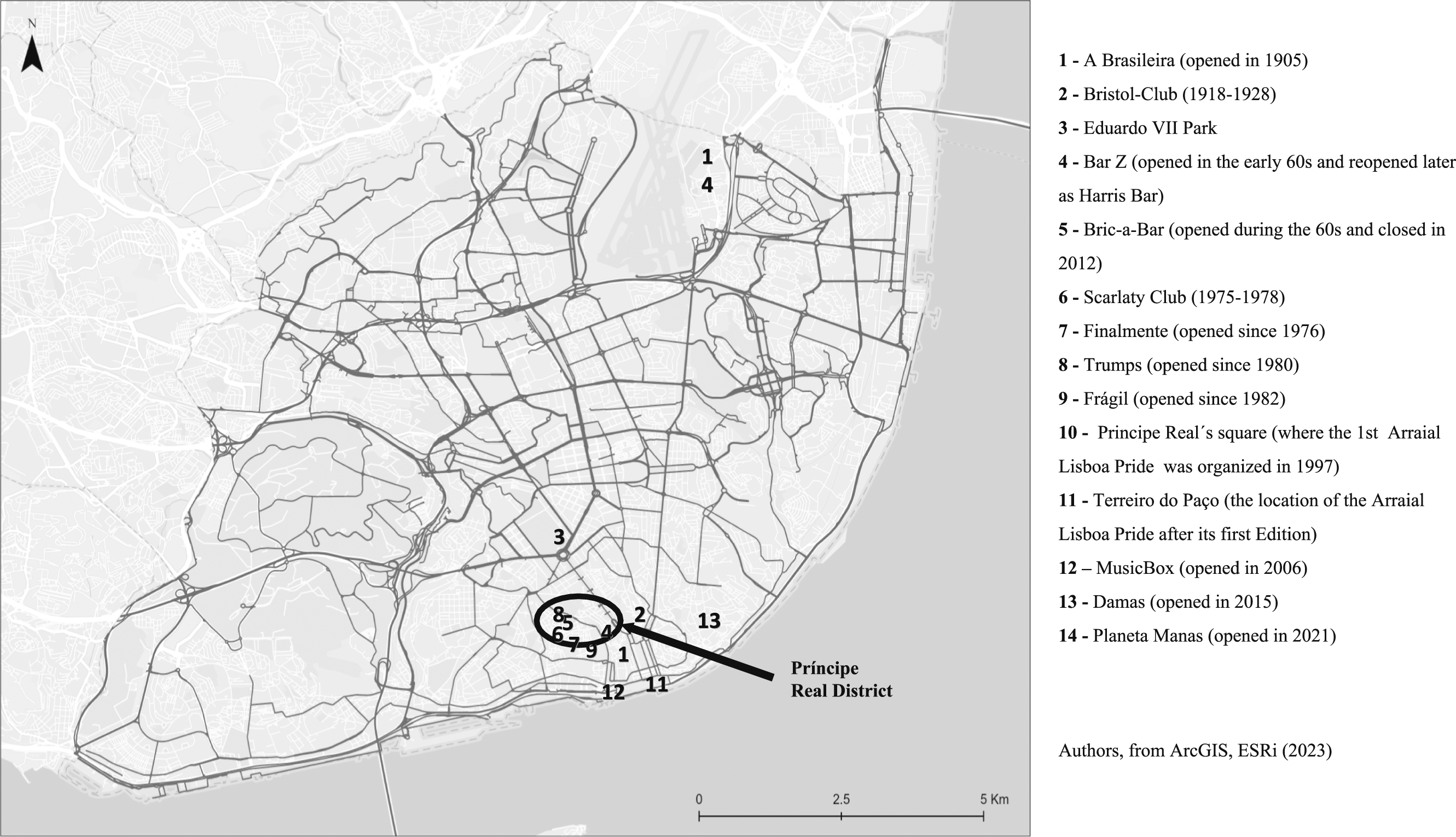
Concluding remarks
This article has shown a comprehensive explanation of the dynamic interplay between queer nightlife, societal changes, and drug use over the last century in Portugal by taking Lisbon as a case study as well as selecting three critical historical periods, namely the Années Folles of the 1920s, the Estado Novo (1926-74), the post-revolution phase (1974-2000), and the first two decades of the new millennium (2000-2020). The article has shown how, due to the long-term influence of the Judeo-Christian values, the inherited patriarchal social structure, and the lack of post-revolution political support, queer social movements and the creation of an identity culture started later than in kindred countries (Almeida, 2022; Pereira, 2023), which also led to a late birth of the nocturnal queer scene. However, dramatic urban changes in the city, primarily led by rampant touristification, are currently putting Lisbon’s queer nightlife scene at serious risk. The expansion of the tourism-oriented nighttime leisure economy in central Lisbon had negative spatial, social, and cultural impacts among underground queer environments. Moreover, these are also menaced by daily precariousness, repression, and oppression that primarily affects social groups disproportionately impacted by intersectional inequalities, with particular incidence on LGBTQ + racialized working-class people. While gay bars continue to be seen as the token of urban queer spaces, younger people are crafting their own queer spaces to resist the exclusionary character of traditional gay-centered environments. Valentine and Skelton (2003, pp. 863) highlight the paradoxical character of queer spaces. On the one hand, it can be a positive, liberating, and supportive space that offers a sense of identity, community, and belonging.
On the other hand, it can simultaneously be a dangerous site where young lesbians and gay men can encounter a range of social risks and be subject to abusive relationships and social exclusion. Therefore, queer nightlife can be, at the same time, a relevant context for self and collective identification and community building. Still, by crystalizing a specific subculture, it can oppress and exclude those who don´t fit into the idealized and dominant queer identity and expression.
Currently, diverse groups of queer people are creating alternative, often underground, queer nightlife spaces. For this reason, we can affirm that Lisbon’s nocturnal queer landscape is a polyculture with multiple visible and invisible geographies beyond the “gaytrified” Principe Real neighborhood. But be that as it may, and despite the emergence of a more diverse social and cultural offer for urban queer people, including daytime activities, nightlife, and the club culture continue to be crucial to craft queer subjectivities (Florêncio, 2023) and a source of social wellbeing, community-building and psychological mutual support (Nofre, 2021). At this point, it is crucial to add that in the process of creating their nocturnal safer spaces and sociabilities, queer communities also craft specific drug subcultures. Drugs may be used “as technologies of the self” for sexual and gender liberation (Drescher, 2015; Pienaar et al., 2020; Pires et al., 2022), and “drug-fuelled” clubbing may play a role in the individual and collective process of “becoming-queer” (Florêncio, 2023: p. 865).
Finally, we conclude this paper by asking what could be the future of queer scenes in a city where the extreme commodification of nightlife has emerged as a strategy to attract tourists? Lisbon’s queer nightlife offers a vast range of research questions that are still awaiting their respective answers.
Footnotes
Acknowledgements
We sincerely thank Allie Mikolanis for proofreading our paper.
Declaration of conflicting interests
The author(s) declared no potential conflicts of interest with respect to the research, authorship, and/or publication of this article.
Funding
The author(s) received no financial support for the research, authorship, and/or publication of this article.
