




Abstract
Drawing on interviews with 17 K-pop fans from Australia and the Philippines who identity as LGBTQ+, this article explores and theorizes the role of K-pop fandom in the production of knowledge concerning gender and sexuality. Through an analytical approach sensitive to the affective discourse produced by fans, this article establishes that K-pop fandom operates as a queer space which normalizes queer sexuality and gendered performance through the production of feelings of security, attraction, and relief. Further, analysis of the LGBTQ + fans’ discourse uncovers that the androgynous gendered performances of K-pop idols facilitate fans’ queering of heteropatriarchal and heteronormative ideologies.
Introduction
The global impact of Korean popular music (hereafter, K-pop) fandom has motivated a wealth of previous literature that critically investigates how fans around the world draw upon K-pop to make sense of their gendered identities and sexual desires (Baudinette 2023; Jung 2011; Oh 2015). A growing body of research especially emphasizes that the gendered performances of male K-pop idols have played a significant role in providing heterosexual female fans in South Korea with new forms of “soft” masculinity to consume (Jung 2011). Producing communities centered on desires for these male K-pop idols, these women situate their desires for soft masculinity as part of a broader rejection of the misogynistic ideologies underpinning South Korean heteropatriarchy (Jung 2011; Kwon 2019). Likewise, the emergence of “girl crush” concepts among female idol groups have been instrumental in providing Korean female fans with empowered representations of forceful femininity that challenge hetero-patriarchal logics which disenfranchise women within society (Chang 2020). Significantly, scholars working at the intersections of Asian cultural studies, gender and sexuality studies, and fandom studies have argued that fans in other national contexts similarly engage with K-pop as a resource to challenge heteropatriarchy in local contexts (Baudinette 2020; Jung 2011; Kang 2017; Lee et al., 2020; Oh 2015).
Moving away from the previous scholarship’s almost exclusive focus on heterosexual female fans, this article draws upon an exploratory investigation of 17 LGBTQ + fans’ engagement with K-pop fandom to theorize how K-pop informs understandings of queer sexuality and queer gendered performance. Whereas we utilize the term LGBTQ + as a useful umbrella term for those whose gendered identities and sexual experiences differ from the default heterosexuality produced under systems of heteropatriarchy, throughout this article we understand queer to represent a deconstructive and anti-normative force which challenges heteronormativity. Following Eve Kosofsky Sedgwick, we thus understand queer to refer to “the open mesh of possibilities, gaps, overlaps, dissonances and resonances, lapses and excesses of meaning when the constituent elements of anyone’s gender, of anyone’s sexuality aren’t made (or can’t be made) to signify monolithically” (Sedgwick 1993: 8). Our investigation is thus focused on making sense of K-pop fandom as a transformative space for those whose gendered and sexual experiences deviate from, and strategically challenge, compulsory heterosexuality. We therefore focus on LGBTQ + fans’ affective experiences of K-pop so as to expose the transnational Korean Wave’s potentials as a queer force within heteronormative contexts. We do this as part of a political commitment to celebrating how LGBTQ + individuals repurpose media produced for heterosexual audiences as part of a broader queer praxis of carving out a world for themselves (Kuo et al., 2022: 160), despite recognizing that South Korean society and the broader K-pop industry remain largely homophobic. This article thus ultimately argues that K-pop fandom possesses subversive queer potentials, grounded in fans’ consumption of K-pop idols’ playful gendered performances.
A note on the anglophone research contexts of the study
We specifically investigate the experiences and beliefs of K-pop fans identifying as LGBTQ+ from Australia and the Philippines who participate in Anglophone (that is, English language speaking) fandom spaces. While the choice to recruit from these two societies partly relates to the first author’s pre-existing research on K-pop fans within these contexts (see Baudinette 2020, 2023), there are also theoretical reasons why these two contexts represent fruitful sites for investigating the queer potentials of transnational K-pop fandom. Despite differences in socio-economic condition and cultural development, Australia and the Philippines are united by their positioning as Anglophone fandom spaces which have a “contested” relationship with East Asia. As Philippine theorist Neferti Tadiar (2004) notes, reading the Asia-Pacific cultural system through careful attention to how purportedly “Western” societies such as Australia interact with the political economy of the Asia-Pacific is generative of theory. Further, Tadiar (2004) notes the centrality of the Philippines to this broader cultural system, with Australia and the Philippines united by their economic domination in the Asia-Pacific region by Japan, the US, and rising markets such as China and, importantly, South Korea.
Australians have represented enthusiastic participants in the global fandom for K-pop and draw upon Korean popular culture to make sense of their place in the world (see Baudinette 2020; Keith 2019). Fans are often drawn to Korean popular culture due to their perceptions of its “difference” from mainstream Australian culture (Keith 2019). K-pop fandom has also exploded in the Philippines, leading to a rising appreciation for East Asian media (Capili 2014). As two Anglophone fandom spaces united by a previous cultural domination by US media, Australia and the Philippines represent interesting sites to explore the transnational queer potentials of the Korean Wave. The first author has identified that LGBTQ + fans in both Australia and the Philippines have been active in drawing upon K-pop as a site to make sense of their identities in relation to the rising significance of East Asian popular culture in these heretofore US-dominated media landscapes (see Baudinette 2020, 2023).
The current study augments this previous work by specifically attending to how these fans make sense of gender and sexuality through K-pop consumption, with a commitment to exposing the positive influences that participating in K-pop fandom has played for LGBTQ + individuals. To strategically address this article’s aim of providing an initial theorization of the role of K-pop fandom in informing LGBTQ + consumers’ understandings of gendered and sexual knowledge, our analytic approach particularly emphasizes similarities across our two participant cohorts’ reported experiences. That is, we draw inspiration from Gayatri Spivak’s notion of “strategic essentialism” and the need to occasionally privilege certain identity categories over others analytically in the exploration of marginalized subjects (see Spivak 1996). This is crucial, we believe, since the experiences of LGBTQ + fans have been largely unexplored in previous scholarship. We recognize, however, that Australia and the Philippines represent culturally, ethnically, linguistically, and socio-economically distinct contexts and highlight when our informants’ experiences are particularly responsive to local concerns and experiences. This is particularly true when we investigate the intersection of racialized desire with respect to our findings. Nevertheless, systematic investigation of the structural and cultural differences between LGBTQ + fandom for K-pop in Australia and the Philippines is beyond the explicit scope of this exploratory study, forming the focus of work by the research team to be published elsewhere (see Baudinette and Scholes, forthcoming).
A summary of the prior research into LGBTQ + fans of K-pop
Since the mid-2010s, the popular media of South Korea has emerged as a significant force within global culture. Korean popular culture fandom has spread from East and Southeast Asia to North and South America, Europe, and Australia via a transnational phenomenon termed the Korean Wave (Choi and Maliangkay 2014). The Korean Wave has been primarily driven by enthusiastic users of social media (Jin 2016), the majority of whom represent young heterosexual women, with these fans representing highly engaged media consumers who draw upon their affective consumption with media to interpret the world and their positioning within it (see Sandvoss 2005). Passionately consuming K-pop, fans in both South Korea and around the world alike participate in a variety of transformative practices centered on the celebration of not just the music produced by their favorite groups, but also the visually spectacular “idol” performers who sit at the heart of the genre itself (Choi 2023). By transformative practices, fans do more than passively listen to music or consume K-pop content such as music videos or variety show content, but instead produce fan works and engage in discourse (often online), forming communities grounded in fannish affect in the process (Epps-Robertson 2023: 213-214). While significant differences exist between Korean and international fans in how they express and interpret their fandom (Epps-Robertson 2023), Stephanie Choi (2023) usefully highlights that at heart fandom for K-pop idols around the world involves various forms of “intimate labor” where fans actively and consciously engage in practices designed to support their idols’ careers. In return for this support, Choi (2023) argues, fans receive a sense of purpose and well-being that then motivates them in their day-to-day lives.
Due to the strongly hetero-patriarchal nature of South Korean society, coupled with pre-conceived expectations from industry participants and commentators (including academics) alike, K-pop fandom has almost always been conceptualized in heterosexist terms in the Korean context (see Yeon 2021: 3; see also Baudinette 2023). Nevertheless, a small body of scholarship has revealed the importance of K-pop fandom for LGBTQ + consumers in South Korea (Kwon, 2019; Shin 2018; Yeon 2021), with a particular focus on their transformative fan practices. It is important to note that much of this scholarship centers on fandom for male K-pop idols and there is a paucity of scholarly investigation of the queer potentials of fandom for female K-pop idols (both within Korea and in international contexts).
Of importance to our study is Layoung Shin’s ethnographic investigation of the relationships between commercial media, queer subjectivity, and mainstream culture in South Korea (Shin 2018). Shin demonstrates in their study of fancos – a subculture where women perform K-pop boy band covers (Shin 2018: 88) – that the consumption of K-pop provides the grounds for women to construct queer desire, identity, and community (2018: 90). These fancos performances not only imitate the choreography of the band, but also mimic the band members’ appearance, gestures, speaking styles, and appellations and thus represent a sophisticated form of performative cross-dressing (Shin 2018: 94). According to Shin, the identifications that women build with male idols through fancos are not based in heterosexual desire for the idols but instead facilitate the expression of same-sex desire between the fans themselves. Through interviews with queer identified fancos participants, Shin highlights that fancos represents a space where young women safely express their queer desires, sexual attractions, and gender performances in South Korea’s heteronormative society (Shin 2018: 99).
Likewise, previous research into the international contexts of Australia (Baudinette 2020, 2023), the Philippines (Guevara 2014), and the US (Kuo et al., 2022; Lee et al., 2020; Oh 2015) similarly reveal how K-pop is utilized by LGBTQ + fans to queer gendered knowledge. Within Western culture, the ideal masculine form is centered on the notion of a white, middle class, heterosexual man against which many consumers outside of South Korea juxtapose their K-pop fandom as part of making sense of themselves (Baudinette 2020; Oh 2015: 64). For fans active within transnational K-pop fandom, male K-pop idols’ performances disrupt the hegemonic understandings of gender in Western society (Oh 2015; see also Lee et al., 2020). When K-pop consumers are presented with a diverse range of gendered images such as the “soft” masculinity of (some) K-pop idols, it ultimately provides them with alternative gendered representations which they believe that they would not encounter within Western media (Oh 2015: 64). That being said, Oh (2015) highlights a concern that the queer potentials of K-pop masculinity can be marred by fetishistic and Orientalizing tendencies among foreign fans, a concern echoed in the work of Lee and their colleagues (Lee et al., 2020). On the other hand, work by the lead author has found that among White Australian fans of K-pop who identified as LGBTQ+, exposure to K-pop performance instead deconstructed and challenged Orientalizing viewpoints common to Australian perceptions of Asia (Baudinette 2020: 327-328).
Through their investigation of LGBTQ + Asian American consumers of K-pop, Kuo and their colleagues argue that the soft masculinity of idols is specifically mobilized by LGBTQ + Asian American men in carving out a space of desirability within a social context where white masculinity is explicitly privileged (Kuo et al., 2022: 148-149). Kuo and their colleagues argue that celebrating the gendered performances presented in K-pop allows marginalized communities such as LGBTQ + Asian American fans to creatively inject their own selves into a dominant media culture built upon their routine exclusion (Kuo et al., 2022: 150). This is a finding that the lead author has also encountered in their previous work on fandom in the Australian context with respect to Asian Australian fans (Baudinette 2020: 327). Furthermore, the LGBTQ + Asian American fans of K-pop who participated in the study conducted by Kuo and their colleagues also affirmed the necessity of queer visibility when exploring their desires through K-pop consumption (Kuo et al., 2022: 159). These fans noted that the common fan practice of watching K-pop idols engage in same-sex “skinship,” whereby idols perform homoerotic acts on stage by touching each other intimately to stoke the imaginations of their fans, normalized same-sex affection (Kuo et al., 2022: 160). The normalization of this affection between K-pop idols helped LGBTQ + Asian American fans develop and realize their own queer sexualities, providing them with affirming depictions of specifically Asian queer intimacy which they believed were absent within US media (Kuo et al., 2022: 160).
K-pop idols’ engagement with skinship also encouraged these LGBTQ + fans to create fanfictions and fan art that explore their diverse sexualities (Kuo et al., 2022, see also Baudinette 2023; Oh 2015). In their study, Kuo and their colleagues found that the fan labor of producing homoerotic fanfictions helped LGBTQ + fans create queer content that materialized or legitimized their fantasies and desires (Kuo et al., 2022: 160). Importantly, the LGBTQ + Asian American fans who participated in Kuo and their colleagues’ study argued that producing and consuming fanfictions centered on queer romance allowed them to leverage their agency to resist problematic media representations of Asian LGBTQ + subjects in US media (Kuo et al., 2022: 162). It is important to note that, within the Korean context, both skinship and the writing of fanfictions are typically not considered “queer” and instead are viewed as expressions of heterosexual female desire for male K-pop idols (Baudinette 2023; Kwon 2019). Thus, Kuo and their colleagues’ findings concerning the queer potentials of K-pop fandom highlight how certain fan practices become understood as queer outside of the Korean context, a point that the lead author has mentioned within their own previous cross-cultural analyses of idol fanfiction culture (see Baudinette 2023: 258-259).
Finally, both the first author’s earlier investigation of Australian K-pop fans Baudinette (2020) and Alona Guevara (2014) work on Philippine fan contexts highlight that LGBTQ + individuals specifically view K-pop fandom as a safe space to push back against societal heteronormativity. Guevara (2014) specifically focused on LGBTQ + teens in the Philippines who participated in the practice of “cover dancing,” mimicking the performances of their favorite K-pop groups, as a site to playfully explore their queer desires. Guevara (2014) importantly highlights that LGBTQ + teens in the Philippines draw upon the communities that emerge around cover dance as a supportive space to manage the stresses they experience facing homophobic pressure in their everyday lives. For Guevara (2014), LGBTQ + teens’ participation in K-pop cover dancing had little to do with the construction of gendered knowledge per se, but instead related to the creation of safe spaces in a society within which queer sexuality is routinely silenced. Likewise, the first author’s investigation of the role of East Asian media in producing cosmopolitan, “Asia-literate” identities within the Australian context serendipitously uncovered that an important part of the cosmopolitan ethos produced through fandom for Japanese and Korean media in Australia was an acceptance of LGBTQ + experience (Baudinette 2020: 328). The first author argued through their interviews with LGBTQ + fans that K-pop fandom ultimately operated as a safe space for Australian youth to push back against the discrimination facing sexual minorities.
Research design and methods
Methodological approach
The gendered and sexual knowledge produced through fans’ media consumption is highly personal (Chin and Morimoto 2013), requiring an in-depth qualitative approach to data collection and analysis that facilitates contextualized description of the inherently subjective processes of knowledge production. As such, we drew upon the qualitative theoretical traditions of critical cultural studies in the development of this research project. At heart, the discipline of cultural studies represents an interdisciplinary approach to the analysis of “lived experiences, social practices and cultural representations… considered in their network-like or intertextual links, from the viewpoints of power, difference and human agency” (Winter 2014: 247). Recent years have seen the emergence of an “affective turn” in cultural studies that centers the role of intense emotional responses within the generation of cultural knowledge (Gregg 2006). Through its engagement with the affective turn in cultural studies, the analysis presented below specifically explores the role of intense emotionality in shaping knowledge concerning gender and sexuality among LGBTQ + fans of K-pop.
Data Collection and Participants
Australian participants’ demographic details.
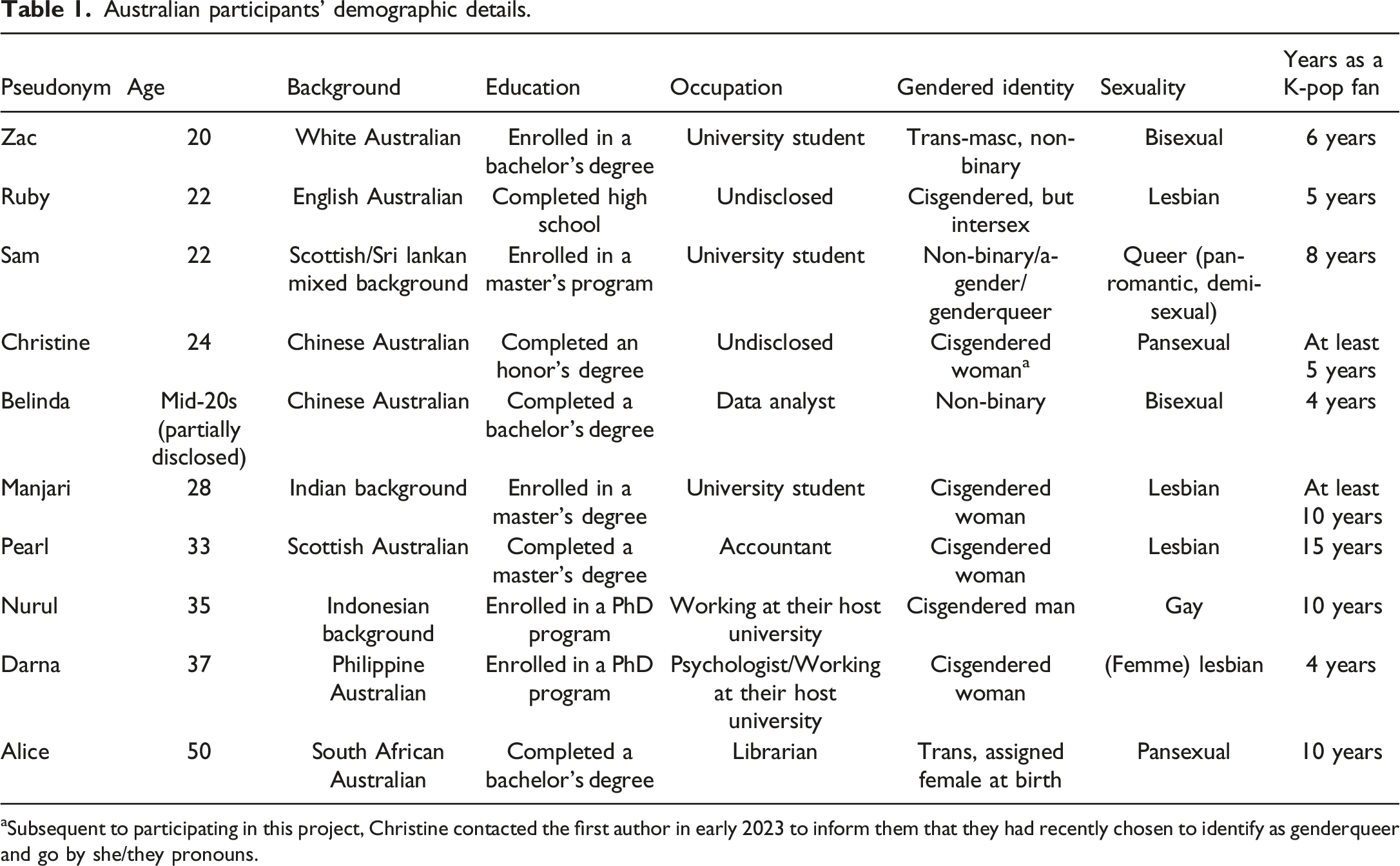
aSubsequent to participating in this project, Christine contacted the first author in early 2023 to inform them that they had recently chosen to identify as genderqueer and go by she/they pronouns.
Philippine participants’ demographic details.
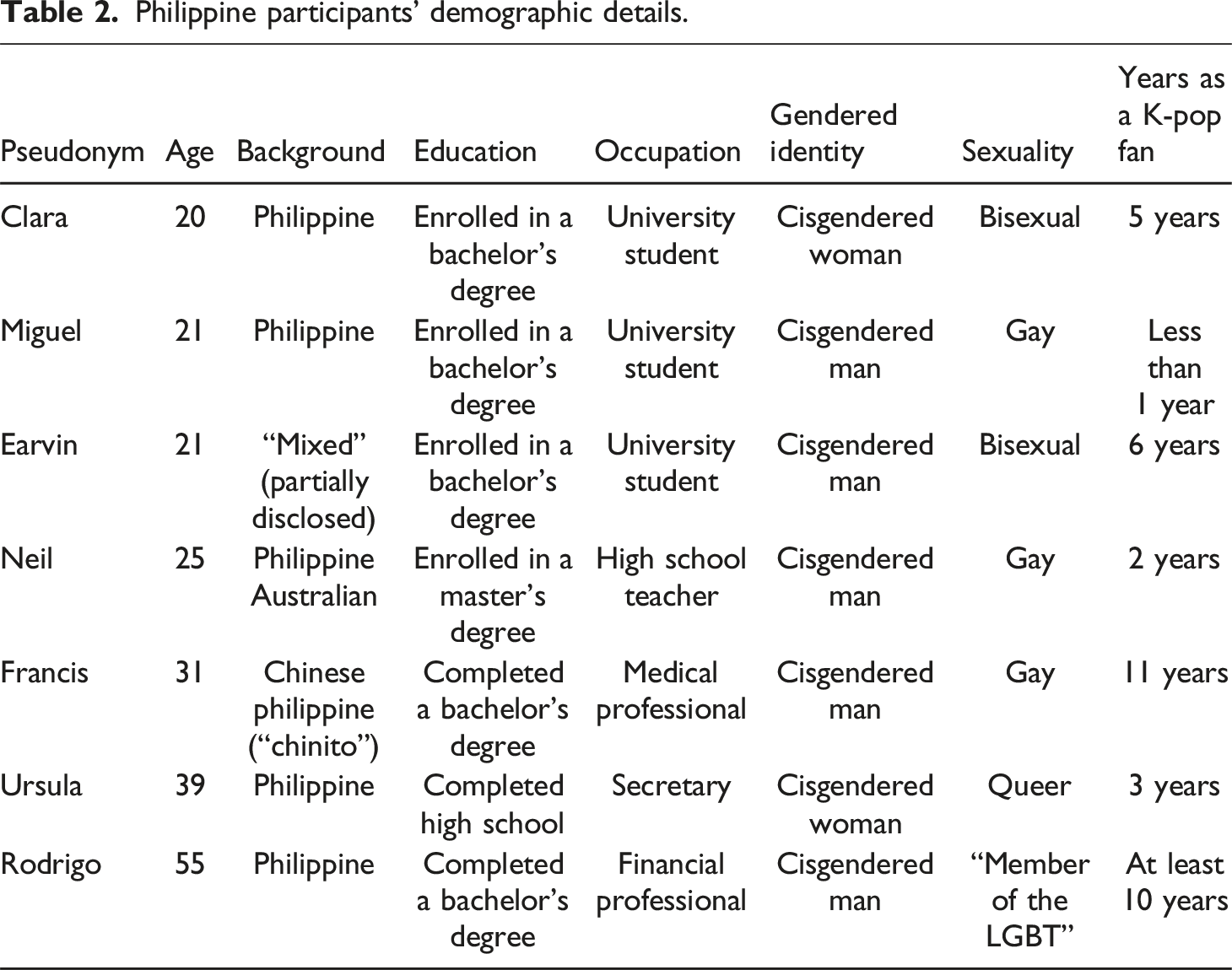
Each participant was invited to conduct a semi-structured interview in English with the second author. These interviews were recorded with the participants’ informed consent and transcribed by an external transcription service only after we had wiped all identifying material from the audio recordings so as to align with the best practices advocated by our institution for managing sensitive data. The semi-structured interviews lasted between 45 min to an hour and a half. Interviewees were asked to reflect on their personal histories of consuming K-pop, what it means to consume K-pop in either Australia or the Philippines, and, importantly, how their fandom for K-pop is tied to their identities as members of the LGBTQ + community. Throughout these discussions, the second author consistently raised questions designed to elicit data on the affective nature of the participants’ fan experiences, focusing on uncovering the feelings which sit at the heart of their fandom experiences. Finally, these interviews concluded with targeted questions concerning how engaging with K-pop has led to transformations in the participants’ understandings of gender and sexuality, as well as questions examining the role of K-pop fandom spaces both in person and online in shaping LGBTQ + experiences. The interview schedule can be found in Appendix 1.
Data analysis
The resultant data was holistically analyzed through Critical Discourse Analysis (CDA). We deployed CDA as a form of “explanatory critique” that evaluates social discourse to interrogate how “existing realities… [are] effects of structures or mechanisms or forces that the analyst postulates and whose reality s/he seeks to test out” (Fairclough 2011: 9). In this study, we postulated a queer potential underlying the Korean Wave and our discursive analysis therefore focused on uncovering and theorizing this queer potential. CDA possesses a commitment to identifying broad discursive formations produced to make sense of the world (Fairclough 2011: 10). As such, the identification of key words and phrases produced during interviews are important to guiding the overall development of theory in CDA while also centering the vocabulary and ideas that informants themselves deploy to make sense of the world (Fairclough 2011: 11). Our coding of the interview transcripts therefore paid particular attention not only to the content of the participants’ discourse, but also to how emotive language was utilized to respond to and shape their understandings of gender and sexuality.
Our analysis of the data was facilitated by the use of the NVivo qualitative data analysis software. Following the “in vivo coding” guidelines developed by Kristi Jackson and Bazeley (2019), we began with a “descriptive” coding phase focused on identifying key words – many of which represented emotive phrases - upon which to build an awareness of the views and values of our informants concerning gender and sexuality. We followed this by “coding on” the data, organizing our descriptive nodes into hierarchical knowledge trees to both flesh out the broader discourses produced across our interviews, as well as to relate the descriptive codes to key arguments we had identified within the prior scholarship on LGBTQ + fans of K-pop. A final analytical coding stage, where data was coded with respect to our queer and affective analytical methods, involved specifically identifying where the discourses produced by our interlocutors specifically presented a challenge to heteronormative ideologies.
K-pop fandom as a queer space: exploring desire via safe and supportive networks
Broadly speaking, the 17 participants were united in their belief that transnational, Anglophone K-pop fandom represented a LGBTQ + friendly environment. The following comments are particularly illustrative: K-pop fandom in general is very welcoming. No matter what group you stan, no matter what idols you like listening to, you’ll always have a set of people who will be welcoming you with open arms… I have not seen fans treating those who are part of the LGBT any different… they really try and empower the community. (Earvin) I’ve never felt so welcome in any community ever in my life, to be honest. [As an older trans woman], I don’t feel like I’m the odd one out in this fandom at all… I found it to be very non-discriminatory, I found that people were very free and open in their gender expressions… it was a very welcoming and open-minded environment. (Alice)
As fans primarily engaging with online fandom spaces via the English language (in part due to the ongoing impacts of the COVID-19 pandemic), our informants particularly viewed fandom as it was encountered and expressed on online spaces such as Twitter, Tumblr, and (to a lesser extent) Facebook as always already representing a safe space for LGBTQ + communities. For participants such as Manjari, Neil, Pearl, Sam, and Ursula, these were online spaces with which they had been previously engaging as fans of Japanese popular culture and they noted that sites such as Tumblr were already commonly deployed by LGBTQ + individuals to explore their queer desires and identities (see Cavalcante 2019). Many of our interlocutors also noted that online K-pop fandom spaces were significant because they were the first sites where they encountered other members of the LGBTQ + community with whom they were able to develop friendships. Zac, Christine, and Clara specifically noted that when they were younger and just getting into K-pop at the same time as learning that they were not heterosexual, it was almost impossible to meet like-minded LGBTQ + individuals in real life. Online fandom spaces were thus vital to learning about their new, and at times confusing, queer sexuality. The participants in the Philippines, who were interviewed just after the Philippines had faced a contentious presidential election, also noted that K-pop fandom spaces online provided them opportunities to connect with those interested in LGBTQ + politics and activism.
As our interlocutors viewed K-pop fandom as a welcoming space which was sympathetic to their LGBTQ + identities, it is unsurprising that their engagement with fellow fans produced a sense of community grounded in feeling secure “to be openly queer,” as Darna put it. This feeling of security is significant since all our participants actively positioned K-pop fandom spaces as more positive environments than mainstream society, which was dismissed as homophobic and openly hostile to members of the LGBTQ + community. Zac’s narrative of how K-pop fandom online allowed them to make sense of themselves as a trans-masc, non-binary lesbian is representative of the participants’ beliefs in K-pop fandom as a space where LGBTQ + individuals could feel safe to explore queerness in all its forms: One of the things I’ve always really appreciated about the fandom is… I’ve always been very accepted. So, in the context of my identity as a queer person, it was through K-pop fandom spaces that I felt safe, that I actually went about exploring [queerness]. Before I had the opportunity to sort of do it in person with people that I know [offline], it was online with strangers within the K-pop community, saying “Hey, I want to try this set of pronouns,” or “I want to try out this label,” or “This is how I define my sexuality.” (Zac)
Likewise, some participants argued that engaging with K-pop fandom explicitly taught them about sexuality. Reflecting on her reading of fanfictions, for instance, Manjari explained that reading a narrative written by another fan where one of the members of a K-pop boyband was re-imagined as a trans woman allowed her, as a cisgender lesbian woman, to learn about the experiences faced by trans people in everyday life. Manjari – along with Belinda, Christine, Clara, Darna, and Pearl – suggested that reading homoerotic fanfiction deepened understandings of queerness more broadly and represented a space where LGBTQ + fans could playfully explore their own desires as queer people, echoing a finding previously presented in the study conducted by Kuo and their colleagues (2022) where K-pop idol fanfiction was understood as an explicitly queer phenomenon. Miguel, who had only recently encountered K-pop at the time of his interview, explained that his fandom was sparked by the appearance of a male K-pop idol in a “Boys Love” web series focused on exploring romance between men in South Korean society. His fandom for K-pop was thus tied to his interest in learning more about LGBTQ + issues in South Korea and he suggested during his interview that he consistently learnt from fellow fans of this K-pop idol “about LGBT life… about how gay people live in a society that is against them.” Through feelings of security, these LGBTQ + fans came to view K-pop fandom as a safe space whose affective potential lay in provisioning them with the agency to actively explore gender and sexuality.
Our participants were particularly candid that one of their primary reasons for becoming K-pop fans was due to their appreciation of the visual aesthetics of the genre, with two inter-related discourses concerning feelings of attraction emerging throughout our interviews. All of the female and trans/genderqueer/non-binary participants from both Australia and the Philippines mentioned that they were attracted to what Darna called K-pop’s “androgynous” style or what Manjari termed a “queer aesthetic.” As LGBTQ + individuals who felt disillusioned and/or dissatisfied by the gendered politics of mainstream media in either Australia or the Philippines, K-pop idols’ transgressive fashion and gendered performances represented an attractive model to emulate in their everyday lives.
For the gay and bisexual male informants, however, K-pop fandom mostly represented a revolutionary space where they could explicitly vocalize their sexual attraction to other men and join together with like-minded fans – Rodrigo importantly insisted that heterosexual women and queer men were united in this regard – in the production of discourse that normalized their sexual desires. Our interviews with all 17 participants touched on favorite K-pop groups and/or idols, but it was only the cisgender male interviewees who consistently linked their discussions of favorite idols to their sexual attraction to men who were variously described as “sexy,” “handsome,” “stunning,” and “beautiful.” In candidly sharing their attraction to these men, fans such as Neil, Miguel, and Rodrigo also explicitly argued that K-pop fandom represented a space specifically geared towards discussing queer sexual desires. Perhaps because all of our cisgender male interlocutors were active within Southeast Asian contexts – the Philippines or, in Nurul’s case, Indonesia – where the public presentation of male-male desire is positioned as deviant, dangerous, or immoral, K-pop fandom was valorized as an alternative “queer counter-public” (see Berlant and Warner 1998) where they could develop a counter discourse. This particularity of the Philippine case represents one of the biggest differences between this cohort and fans based in Australia, although we note that this difference may also simply derive from the fact that we did not recruit enough cisgender male informants from Australia to make useful, cross-cohort comparisons.
Finally, K-pop fandom was often explicitly presented by our LGBTQ + interviewees as a space where they could experience a feeling of relief when times were especially tough. As a young man who struggled with bullying in high school due to his supposed effeminacy, Francis shared a representative example of how participating in K-pop fandom helped him manage the pressures involved in living as a gay man in the Philippines. Francis specifically discussed how his daily chats with fellow K-pop fans after experiencing bullying at school helped me deal with being treated as something wrong by the people around me… like, it was this fandom that I could turn to whenever everything was too much, when I really questioned whether I was right to be LGBT… <laugh> I had so much relief when my K-pop friends [online] told me that it’s all okay… going beyond the norm is very hard, you know, especially during my younger years… there was hesitancy on my part to really express my true sexual orientation, but [through K-pop fandom] I became stronger and [now] fully accept who I am. (Francis)
As Francis’s narrative highlights, the sense of relief engendered by K-pop fandom’s supportive environment was subsequently drawn upon as a source of empowerment which eventually led to an acceptance of LGBTQ + identity. Indeed, while not a term commonly utilized by the participants themselves, the idea that K-pop fandom was empowering for LGBTQ + individuals struggling to navigate the ideologies which structure heteronormative society was often implied when our participants discussed K-pop fandom as replete with feelings of relief. As Pearl put it in a somewhat tongue-in-cheek manner with reference to her enjoyment of homoerotic fanfictions, “okay, so this is what the rest of the world should be… that’s a huge load off my mind!”
K-pop’s queer aesthetics and the production of gendered and sexual knowledge
K-pop fandom, as a queer space, actively facilitated the 17 LGBTQ + participants’ transformative explorations of gender and sexuality, although all of them emphasized that encountering K-pop did not itself play any role in the initial awakening of their queer desires. Rather, the queer potentials of K-pop fandom most clearly emerged through these fans’ subsequent deployment of K-pop as a resource to make sense of their gendered and sexual identities within heteronormative social contexts that rigidly imposed gender ideologies grounded in heteropatriarchy. That is, K-pop became a tool which our 17 interlocutors strategically utilized to challenge the heteronormative knowledge systems which they were encountering in mainstream society while trying to make sense of their queer desires and identities. In many ways, then, our interlocutors took a cultural product from Korea and “queered” it through their active use of K-pop as transformative and empowering tool to deconstruct heteropatriarchal ideologies in their local contexts. Our participants’ understanding of K-pop as queer thus speaks to the potentials of Korean popular cultural transnational circulation to unlock heretofore hidden queer potentials that have not always been recognized within the South Korean context (see Baudinette 2023: 257-261).
For the cisgender male gay and bisexual Philippine fans, for instance, the gender performances which K-pop idols presented them played a crucial role in destabilizing common assumptions concerning ideal manhood that circulated within Philippine society. This was a finding that was largely absent from the Australian cohort. The following two comments from Philippine fans are illustrative: South Korean men are allowed to possess some kind of masculinity that is very… feminine, so to speak. I mean, men in South Korea are allowed to wear make-up, and that is considered very beautiful, while here in the Philippines if a certain male, a certain guy wears make-up or exudes some sort of feminine aura, they automatically mock that person… I mean, here in the Philippines, we… <slight laugh> so our idea of masculinity is very strong, very brute and we have this macho identity that a man must exude in order for him to be considered as someone who is worthy of emulation and respect, while in K-pop… with their openness and their aesthetics, their idea of identity is different… because of K-pop I became more in touch with my sexuality, I became more aware of what I like about guys… I came to appreciate that softer side to masculinity and that it’s okay to be a little effeminate. (Neil) K-pop culture has this, how do I say it… there’s no difference between male and female. Both can be androgynous, in a way, and I think by looking at that, [LGBTQ+] fans can see themselves, or can identify themselves, to those idols they can express themselves… like, those [male] idols can dress a bit feminine, and women can absolutely dress masculine. So that’s one of the advantages of having K-pop culture… for the LGBTQ communities. Like, Filipinos can accept it… it can influence towards the acceptance… of these people towards our community… that the way we think about [gay men] being a bit feminine, that’s not a bad thing. (Francis)
Pushing back against what Neil – as well as Earvin and Rodrigo – termed a culture of machismo in the Philippines which positioned same-sex desiring men as moral threats to society due to their supposed gender inversion, our cisgender male gay and bisexual Philippine participants positioned K-pop as a key resource to denaturalize hegemonic ideologies of masculinity in the Philippines. More than representing a resource to insist upon the normative masculinity of same-sex desiring men, however, our participants’ attraction to and appreciation of K-pop idols’ androgynous style instead provided them with a clear example of the desirability of a masculinity which was more in tune with femininity. These men’s engagement with the stylistics of K-pop performance and their belief in K-pop idols’ androgyny thus unsettled the dualistic understanding of gender which clearly separated masculinity and femininity within the Philippines. As the examples from Neil and Francis’s interviews demonstrate, this destabilization of the naturalness of macho masculinity was then mapped onto an insistence on the normality of queer sexuality and LGBTQ + identity more broadly. K-pop fandom, then, shaped these gay and bisexual male fans’ understandings of themselves as masculine Philippine subjects who were neither deviant nor dangerous to the status quo and whose challenge to macho masculinity as same-sex desiring men was a source of empowerment.
In the previous section, we revealed that our trans/genderqueer/non-binary participants similarly considered the queer aesthetics and androgyny of K-pop styling as particularly attractive. These fans likewise spoke candidly about how the aesthetics of K-pop played a key role in helping them realize that they could not locate their own gendered identity within the binary conceptualizations of gender that structured mainstream, heteronormative society (in Australia, particularly). While not going so far as to consider K-pop idols as non-binary or genderqueer – although Alice did pun that male K-pop idols were “trans… in the sense that they are transgressive!” – these fans did insist that consuming K-pop helped them question the naturalness of the gender binary itself. Sam’s comments about their K-pop preferences are illustrative: With more [contemporary] groups… they are quite gender non-conforming in a way. They’ll have more masculine clothes for female groups… [male groups] might wear the skirts, like the half-skirts… actually… most of the time with the girl groups, my favorite one is just <laughs> the one who sort of plays around more with masculine clothes and sort of traditional masculine energy, but that’s just because I’m queer and attracted to strong women <laughs>! (Sam)
Following a prompt from the second author concerning how these preferences informed Sam’s understanding of themselves as agender/non-binary, they explained that when you consider, being non-binary or agender or something like that, you still have to think about how you... you know, what clothes you wear or how you express yourself… are you perceived [by others] as masculine or feminine or anything like that? And for me, watching some K-pop or certain K-pop idols who, you know, just have that energy… they kind of play with [gender]… and so it made me sort of comfortable with how I choose to express myself. So, I consider myself as agender… I was sort of struggling with the idea that I still wear a lot of feminine clothes and I’m perceived [by others] as feminine but after watching K-pop it’s like, does it really matter, you know?
The other trans/genderqueer/non-binary participants (Alice, Belinda, Zac) and certain of the cisgender female participants (Christine, Darna, Manjari, Ursula) shared similar narratives whereby K-pop idols’ playful gendered performances informed their own non-binary understandings of gender. For Manjari, her investment into what she termed K-pop’s “queer aesthetics” was also instrumental to her growing acceptance of her queer sexuality and identity as a lesbian woman. Simply put, regardless of whether our participants were cisgender, and regardless of whether they were based in Australia or the Philippines, all fans were united in drawing upon the gendered performances of K-pop idols as a space to reject heteropatriarchal conceptualizations of gender. They did this despite recognizing that the K-pop industry itself was remarkably conservative in its gendered ideologies even though the outward playfulness of idols’ gendered performances might suggest otherwise. Like the participants in the study conducting by Kuo and their colleagues (2022), our LGBTQ + fan interlocutors positioned their consumption of K-pop idols as carving out a space for themselves and injecting a sense of queer visibility into the heteronormative K-pop industry.
Finally, it is significant to note that for the Philippine informants and those who identified as Asian Australia (Belinda, Christine, Darna, Manjari, Nurul, and Sam), K-pop resonated with them because it provided them representation which they understood as both queer and Asian. While often drawing upon simplistic (and perhaps slightly fetishistic) stereotypes of Korean men and women to express their queer desires, these informants found K-pop a more accessible form of supposedly queer pop culture than that produced in the West since the gender transgressive performances these fans believed were central to the genre were performed by Asian idols. Within the Australian context, where queer representations are overwhelmingly dominated by White culture, K-pop played an important role in providing Asian Australian fans with affirming depictions of “Asian” aesthetics which they described as empowering. This is a finding which mirrors that reported in Baudinette (2020) and in the work of Kuo and their colleagues (2022) in the American context. Among the Philippine interviewees, while there was broad recognition of the differences between East and Southeast Asian racialization (particularly in terms of skin color), our fannish interlocutors still tended to focus on affinities between K-pop idols and themselves rather than differences. On the other hand, White Australian informants focused their narratives on how their engagement with K-pop had led them to desire Asian celebrities as markers of difference, even as they celebrated the broader queer potentials of the genre. Broadly speaking, both cohorts participated in the production of queer desires that were racialized as Asian, although the tendency to occasionally reproduce simplistic stereotypes suggests that concerns raised by Oh (2015) about the potential for Orientalizing viewpoints may still be significant in the Australian and Philippine contexts under investigation. This is an area worthy of further research.
Conclusion
Within this article, we explored the narratives of 17 LGBTQ + fans of K-pop from Australia and the Philippines to extend the literature on the role of K-pop fandom in shaping knowledge concerning gender and sexuality by injecting a specifically queer perspective that has been lacking in previous scholarship. Taking an affective approach informed by the interdisciplinary traditions of cultural studies, we argued through our analysis that K-pop fandom not only represented a safe “queer space” where fans could explore LGBTQ + experience, but that K-pop operated as a resource to queer heteropatriarchal and heteronormative ideologies. Specifically, our interviews with the 17 participants exposed that they drew upon the playful gendered performances of K-pop idols to reveal the limits of the gender binary, producing explicitly queer discourses of gender and sexuality that were grounded in feelings of security, attraction, and relief. As a small-scale explorative study of the queer potentials of the Korean Wave, our analysis of fan discourse reveals that K-pop fandom operates as a space within which heteronormative gender and sexual ideologies can be explicitly challenged and denaturalized by social subjects whose sexualities and gendered identities are constructed as deviant by mainstream society. Simply put, K-pop fandom functioned as an empowering space for LGBTQ + fans who desired to legitimate their desires within social spaces that were actively hostile to queer experiences.
It goes without saying that this article has explicitly focused on the positive impacts of K-pop fandom on LGBTQ + fans active in Anglophone contexts somewhat divorced from the South Korean context. This focus derives from our commitment to emphasizing the transformative potentials of K-pop for marginalized subjects such as our informants who view the transnational Korean Wave as a resource to make sense of themselves in their local, heteronormative social contexts. But we must acknowledge that our interviewees also shared their concerns about potential negative impacts of K-pop fandom on LGBTQ + communities, specifically within South Korea where there is a rising trend towards public homophobia and anti-trans discourse. While some of our interviewees viewed the production of fanfiction focused on reimagining K-pop idols in same-sex relationships positively, for instance, others were concerned that such fan work contributed to the circulation of delusional fantasies which actively harmed LGBTQ + communities. Likewise, some participants viewed the playful gender performances of K-pop idols and the recent trend of K-pop performers waving pride flags at concerts as representative of an emerging trend towards simplistic exploitation of LGBTQ + consumers on behalf of heteronormative K-pop production companies who had little interest in truly contributing to queer emancipation. These concerns are extremely valid and are worthy of extended investigation in future scholarship. We hope that our explorative study – with its focus on the transformational potentials of the Korean Wave as a queer resource – opens up a space for nuanced discussions in future scholarship which, while complicating the queer potentials of K-pop fandom, continues to recognize the positive impacts that consuming K-pop plays for many LGBTQ + fans around the globe.
Footnotes
Declaration of conflicting interests
The author(s) declared no potential conflicts of interest with respect to the research, authorship, and/or publication of this article.
Funding
The author(s) disclosed receipt of the following financial support for the research, authorship, and/or publication of this article: This research project was Supported by the Academy of Korean Studies, Korean Studies Grant No. AKS-2022-R033.

Interview schedule
Questions are prompts – depending on responses, other questions may arise.