




Abstract
This paper explores the potential of entertainment education (EE) in teaching about sexuality, especially in terms of (1) addressing gaps and instigating an approach that is more (2) youth-centred and (3) norm-critical than conventional sex education. Based on the analysis of five projects in the Netherlands (escape room, educational theatre performance, interactive website, offline game, VR production), we argue that these methods attend to often-overlooked themes. Moreover, they allow for higher levels of student activity and student responsibility: elements of a youth-centred approach. Yet, EE-initiatives are not by themselves more norm-critical, and we observed inequality practices such as heteronormativity and victim-blaming. In our conclusion, we define crucial conditions for realising the potential of EE in teaching about sexuality.
In this paper, we explore the potential of entertainment education (EE) for school-based sexuality education. This exploration is inspired by two dynamics: recent critical analyses of conventional sexuality education, and the increase of EE-initiatives in school-based sexuality education. Our focus is on the Netherlands, because even though Dutch school-based sexuality education is often praised for being comprehensive, liberal and positive (for a critical review, see Krebbekx, 2020), Dutch pupils themselves are not very satisfied with the sexuality education they receive. In a representative survey among young people aged 12–25, sexuality education was rated 5,6 on a scale of 0–10 (De Graaf et al., 2024). Young people indicate that they would like sex education to be more diverse and critical of norms (Cense, 2019). Also, they want more time to be devoted to sexuality education and for its content to be more elaborate, with more attention being paid to feelings, pleasure, online sexuality, different forms of diversity, and gendered social norms alongside the received focus on biological facts (Cense, 2019; Cense et al., 2020; Naezer et al., 2017). Furthermore, young people prefer more diverse and interactive teaching over simply listening to a teacher (Cense et al., 2020).
This critique aligns with international analyses demonstrating that sex education is often adult-centred rather than student-centred (Allen, 2011; Setty and Dobson, 2022), can reproduce restrictive norms, and may have sexist, heteronormative, ageist, and racist tendencies (e.g. Bay-Cheng, 2003; Bredstrom and Bolander, 2019; Krebbekx, 2019; Naezer et al., 2017; Naezer and Van Oosterhout, 2021; Whitten and Sethna, 2014). These concerns have recently led to calls for more social justice and a norm-critical approach to sex education (Bengtsson and Bolander, 2020; Goldfarb and Lieberman, 2021) that attends more closely to how the workings of power and social norms influence choices. These calls also recognise a need to foreground sexual pleasure (as opposed to disease prevention) and shift towards more youth-centred teaching (e.g. Allen, 2011; Setty and Dobson, 2022; Unis and Sällström, 2020).
Promising in this regard is the development of innovative forms of sexuality education based on EE, an approach that aims to both entertain and educate, in order to increase audience members’ knowledge, create favourable attitudes, shift social norms, and change overt behaviour (Singhal and Rogers, 2003: 5). Especially ‘third generation’ forms of EE, which are characterised by ‘active learning’ strategies and a focus on social justice (Tufte, 2010), have been associated with student-centred and norm-critical learning.
In this article, we analyse five Dutch EE-initiatives for school-based sexuality education, and explore the extent to which these initiatives can contribute to addressing the concerns that have been expressed in relation to more conventional types of education. First, we discuss the setup of, and some concerns about, sexuality education in the Netherlands. We then discuss how previous research on EE suggests that EE-initiatives might play a role in addressing those concerns. Based on empirical research involving five Dutch EE-initiatives, we discuss the potential of such initiatives to (1) address gaps and instigate an approach that is both (2) youth-centred and (3) norm-critical. In our conclusion, we reflect on the conditions under which EE-initiatives can contribute to sexuality education.
Sexuality education in the Netherlands
There is no national curriculum for sex education in the Netherlands. Instead, the government has formulated general learning outcomes in this area. 1 Rather than being structurally integrated into education, sex education in primary and secondary schools seldom exceeds a few class hours during a student’s experience of primary and secondary school, or takes the form of a short ‘project’ (Inspectie van het Onderwijs, 2016). In secondary education, sex education is usually integrated into other school subjects, namely, biology, civics/social studies, philosophy/theology, mentoring classes, or health and care (Inspectie van het Onderwijs, 2016).
In recent studies, several concerns have been raised. The first considers gaps in content. Researchers indicate that contemporary sexuality education largely focuses on reproduction, contraception, and STDs (De Graaf et al., 2017; De Graaf et al., 2024) rather than topics such as sexual pleasure and relationships; sexual and gender diversity/inequalities; and online/digitally mediated sexuality. Sexual pleasure and relationships are often absent in both primary (Van Ditzhuijzen and Reitzema, 2020: 4) and secondary education (Cense et al., 2020). Moreover, teachers find it difficult to use a ‘discourse of erotics’ and discuss sexual desire, pleasure, and relationships (Van de Bongardt et al., 2013). Girls’ pleasure is especially marginalised. Tellingly, it was only in 2020 that an anatomically correct image of the clitoris was included in one of the Dutch biology books used in secondary education (Jongeling, 2019).
Sexual diversity is another conspicuous gap. Statistics concerning the teaching of sexual diversity vary (Inspectie van het Onderwijs, 2016; Van Ditzhuijzen and Reitzema, 2020), but several studies have shown that LGBTQI + youth in particular miss fuller treatment of gender and sexual diversity in curricula (Expreszo and COC Youth Council, 2016; De Graaf et al., 2017: 50; De Graaf et al., 2024). If the subject is discussed, it is generally discussed as a ‘topic apart’ within an overwhelmingly cis- and heteronormative programme (Duits, 2020; Meerhoff, 2016), a norm that is also reproduced in mundane, daily practices in schools (Krebbekx, 2018). Also, teachers consider sexual diversity an especially difficult topic to address in class (Van de Bongardt et al., 2013). It has been signalled that intersex people and bodies are made invisible – or even that their existence is denied – in sex education (Van Lisdonk et al., 2020: 72; Deelen, 2020).
A final topic that is largely absent from sexuality education is online or digitally mediated sexuality (Cense et al., 2020; De Graaf et al., 2024). Education that does discuss digitally mediated sexual practices, such as sexting, is often negative and aimed at abstinence (Naezer and Hindriks, 2020; Naezer and Van Oosterhout, 2021). This hinders young people’s sexual freedom and facilitates online sexual violence, such as non-consensual image-sharing, by reproducing the idea that sexting is ‘stupid’ and ‘naïve’ and that (potential) victims are responsible if images are spread without their consent (Krebbekx, 2023; Naezer and Van Oosterhout, 2021).
In addition to identifying these gaps, critics have pointed out that while young people are sex education’s ‘target audience’, it often fails to adequately engage with their experiences (Allen, 2005, 2011; Setty and Dobson, 2022). This also holds for Dutch sex education, which can be characterised as adult-centred rather than youth-centred: parents and school teachers are positioned as the main sources of ‘good knowledge’, which they transfer to young people in ways and at times that they consider appropriate (Krebbekx, 2019; Naezer et al., 2017). This is problematic, because sex education that fails to take young people’s own needs and expertise into account risks being experienced as unhelpful and irrelevant (Allen, 2011).
Finally, concerns have been expressed about the lack of critical awareness of social inequalities in sexuality education: gender and sexual inequalities (Krebbekx, 2018; Naezer and Van Oosterhout, 2021; Unis and Sällström, 2020) as well as inequalities based on ethnicity/race, class, and secularism/religion (Cense et al., 2020; Krebbekx, 2019). Because of the lack of awareness of such inequalities, it might be that they are reproduced in sexuality education (Krebbekx, 2018, 2019; Naezer and Van Oosterhout, 2021; Van de Bongardt et al., 2013).
Entertainment education initiatives in sex education
The evolution of EE commenced primarily through radio and television soap operas addressing health-related topics (Singhal and Rogers, 2003), including ‘safe sex’ (Bouman, 2003; Orozco-Olvera et al., 2019). Over time, EE became a widely employed strategy that evolved along various paths. Tufte (2010) distinguishes three generations: first generation initiatives that aim to change individual behaviour through mass media messages (‘social marketing’); second generation initiatives that have a more participatory character and aim to change social structures alongside individual behaviour; and third generation initiatives that aim to strengthen people’s ability to identify social norms, inequalities, and power imbalances, and to advocate for social justice.
Of particular interest for our study is that second and third generation EE-initiatives often employ some type of ‘active learning’ (Tufte, 2010). This involves the engagement of students in hands-on, interactive activities and tasks, including (digital) games (Coleman and Money, 2019). An active learning approach posits that: ‘experience provides a rich resource for learning that helps learners understand and retain knowledge in unforgettable ways’ (Smart and Csapo, 2007: 452, italics in original).
Several scholars have argued that active learning strategies are student-centred rather than teacher-centred, as they prompt students to personally and actively engage with certain content (Coleman and Money, 2019; Smart and Csapo, 2007). Indeed, this personal and active engagement is one of the core elements of student-centred learning, next to student responsibility (Cannon and Newble, 2000: 16). This suggests that EE-initiatives, especially those that employ active learning strategies, contribute to a more student-centred approach in (sexuality) education.
Another noteworthy characteristic of especially third generation EE-initiatives is their critical approach. Although these initiatives are still relatively young, and there is not yet a rigorous body of scholarly research regarding the extent to which they accomplish the aim of structural social change (Borum Chattoo, 2021), there is some empirical evidence that this type of entertainment education has the potential to reverse and rearticulate social norms, for instance, norms regarding sexual diversity (Brown, 2020). This is an exciting development that suggests EE-initiatives may shape an approach to (sexuality) education that is more norm-critical than conventional types of education.
The suggested links between EE and youth-centred, norm-critical education are promising and raise the question of whether EE-initiatives in the field of sexuality education can contribute to addressing the concerns surrounding more conventional types of sexuality education. Do developers of EE-initiatives take these issues into account and what is these initiatives’ potential when it comes to (1) addressing gaps and instigating an approach that is both (2) youth-centred and (3) norm-critical?
Method
Overview of included sex education projects.
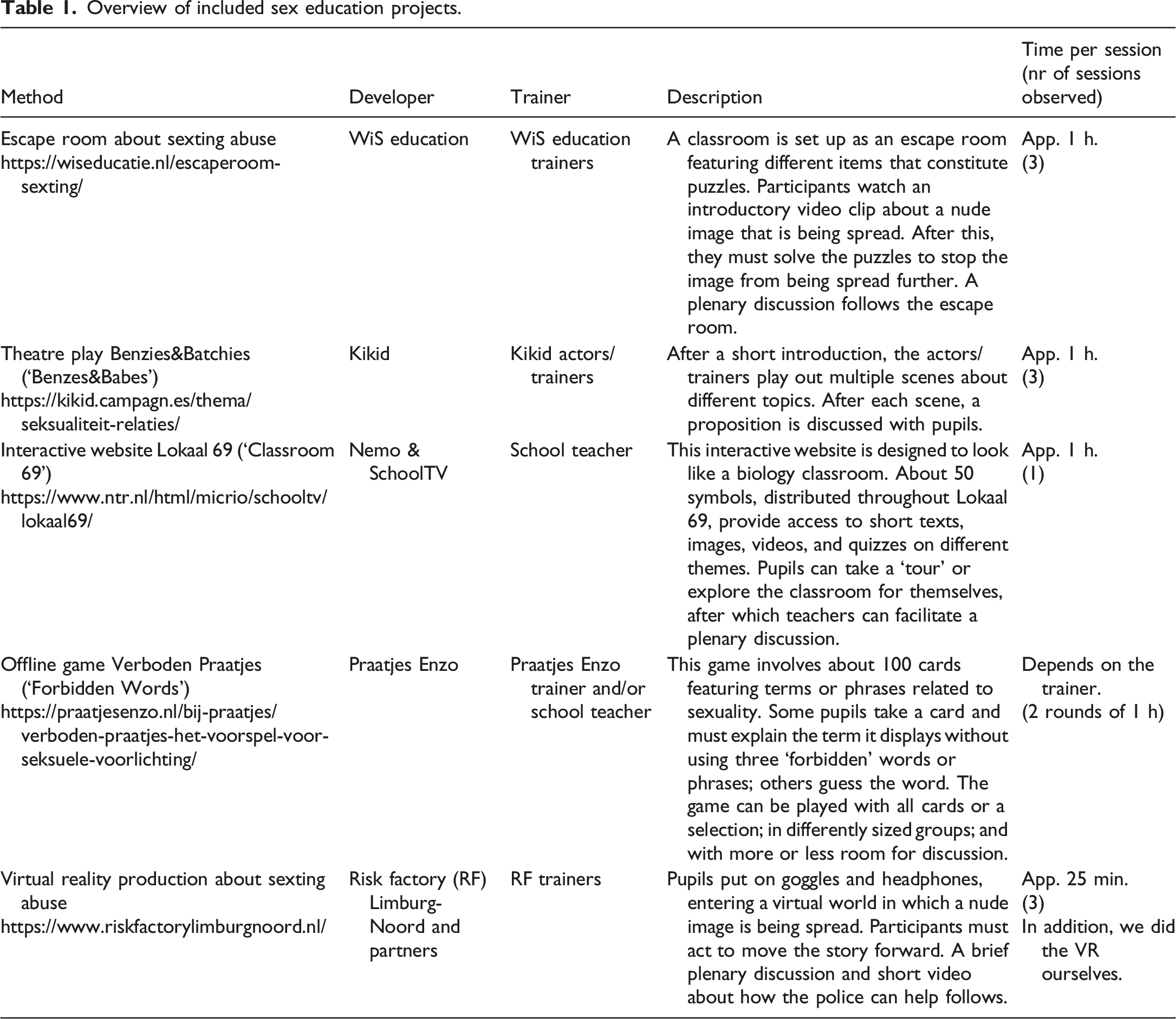
The escape room is played in schools. A classroom is set up as an escape room, with different items constituting puzzles. Participants watch an introductory video clip about a nude image that is being spread. They must then solve the puzzles to stop the image from being spread further. After the escape room, a trainer chairs a plenary discussion.
The theatre show Benzies&Batchies also takes place in schools. After providing a short introduction, the actors/trainers play out multiple scenes that broach topics such as flirting, stereotypes, beauty standards, sexting, porn, sexual boundaries, sexual intimidation, consent, and sexual diversity. After each scene, a proposition is discussed with the pupils.
Lokaal 69 is an interactive website designed to look like a biology classroom, which pupils access using a laptop during class. About 50 symbols, distributed throughout Lokaal 69, provide access to short texts, images, videos, and quizzes on different themes. Pupils can take a ‘tour’ of the classroom or explore it for themselves, after which teachers can choose to facilitate a plenary discussion.
Verboden Praatjes is a card game that can be played in schools. It involves about 100 cards featuring terms or phrases related to sexuality. Having taken a card, a pupil must explain the term it displays without using three ‘forbidden’ words or phrases; other pupils must guess the word. The game can be played in different forms: with all cards or a selection; in smaller or bigger groups; and with more or less room for discussion.
The VR experience takes place in a location owned by the organisation that co-developed this method. Pupils and their teacher(s) travel there to participate in it. After a short introduction by a trainer, pupils put on goggles and headphones, and enter a virtual world where a nude image is being spread. Participants must perform several actions to move the story forward. Afterwards, there is a brief plenary discussion chaired by a trainer, and a short video about how the police can help.
In our empirical research, we used two research methods: participant observation and interviews. Regarding the first, we observed one to three sessions of each initiative. The sessions took place with schools in different parts of the Netherlands. One school offered primary education and four secondary education (one provided pre-vocational education, vmbo, and three provided general/pre-university education, havo/vwo). White pupils were overrepresented in all schools. In total, 12 h of participant observation were conducted (1–3 h per method).
Concerning the second method, we conducted semi-structured interviews with the projects’ developers/managers (four women, two men, all White) and 16 young people who participated in these educational sessions (3–4 participants per method). Half of these young people were interviewed individually, the other half in small groups of two or three. Participants were aged 11–16. Three were in the final year of primary education, the other 13 in secondary education (three were in pre-vocational education, vmbo; eight in general secondary education, havo; and two in pre-university education, vwo). We did not ask participants about their gender or sexual identity, but 11 presented as girls and five as boys, and two participants mentioned that they identified as bisexual. All participants were White.
This means that although there is some diversity among pupils that were interviewed, the group is not representative. Moreover, the interviewees volunteered to speak to us based on self-selection, meaning that we probably interviewed young people who find talking about sexuality relatively easy and/or important. While one might expect this to mean that their evaluations of the EE-initiatives were relatively positive, we noticed that interview participants were also critical, as they had high standards for sexuality education. We analysed our data using a combination of deductive and inductive coding.
Addressing gaps
All developers mentioned that concerns about the content of conventional sexuality education were one of their main reasons for developing their project. Indeed, all EE-initiatives involved discussing topics that receive little or no attention in conventional sex education: sexual pleasure and relationships, sexual and gender diversity/inequalities, and online/digitally mediated sexuality. For example, the game Verboden Praatjes asks pupils to describe words and phrases related to sexual pleasure (e.g. aroused, horny, orgasm); relationships (e.g. seducing, living together, intimacy, breaking up); sexual/gender diversity (e.g. heterosexual, bisexual, gender fluid, intersex); and digitally mediated sexuality (sexting).
Young people recognised and appreciated this: ‘There’s one chapter in the biology class about sexuality, […] where we learn about reproductive organs, […] but not about how to deal with sexuality in your actual daily life. […] With this game, we learned about the things that are related to your life and that you should know about’ (G1). To some extent, EE-initiatives might thus contribute to filling gaps in conventional curricula. The fact that ‘new’ topics and perspectives are relatively well represented in these innovative methods might be connected to some of them being still comparatively new; future research will have to establish whether these methods are being kept up to date.
That said, only two initiatives included all topics that are underrepresented in conventional sexuality education; the three others largely focused on one or a limited number of those topics. This means that the inclusion of one of these EE-initiatives in the curriculum does not necessarily fill all the gaps.
Moreover, it is important to evaluate what exactly is communicated during the meetings in which these methods are put into practice. For instance, sexual diversity may come up during a meeting, but if pupils, teachers, and/or trainers voice only negative opinions, then the meeting will not foster respectful attitudes among students with regard to sexual diversity. In general, the EE-initiatives seem relatively progressive in terms of content. 3 For instance, the central assignment given to participants in the escape room and VR production about sexting abuse is to become an active bystander and stop a friend’s nude image from being spread. This differs from many other campaigns and educational materials, which focus on the responsibilities of (potential) victims and advocate abstinence, even though such an approach is problematic in that it limits young people’s sexual freedom and facilitates non-consensual image-sharing, victim-blaming, and slut-shaming (Naezer and Hindriks, 2020; Naezer and Van Oosterhout, 2021).
Still, not all pupils may pick up on the main message that a method communicates, especially when it is different from what they have been taught previously. When we asked in an interview what was the escape room’s main message, one girl (E2) said: ‘That you shouldn’t send nude pictures. […] And that people whom you believe to be trustworthy, are sometimes not that trustworthy’. Rather than referring to the escape room’s call to become an active bystander, this girl thus interpreted the escape room as advising abstinence. Similarly, several participants in the VR production stated that its main message was one should ‘never make or share nude images’. An elaborate discussion and repetition may be needed for young people to really understand a message, especially when it is novel to them. Moreover, trainers must thoroughly understand and truly endorse the main message; this was not always the case.
Also, one single meeting could never cover all aspects of encompassing themes such as sexual pleasure, romantic relationships, sexual and gender diversity/inequalities, and online/digitally mediated sexuality. Limiting the education on these issues to a single method and meeting may even become counter-productive, reinforcing the sense of apartness that sometimes surrounds certain practices (e.g. online sexual practices), feelings (e.g. girls’ sexual pleasure), identities (e.g. non-heterosexual and non-cisgender identities), and entrenching other practices, feelings, and identities as normative (Meerhoff, 2016).
Becoming youth-centred
Educational methods that are based on a youth-centred approach do not just take youth as objects of pedagogy, but involve them as active agents (Elliott, 2014). According to Cannon and Newble (2000: 16), two elements are central: student activity and student responsibility. Although none of the developers explicitly qualified their initiative as being youth-centred, both of these elements were present in the EE-initiatives.
Student activity
All five EE-initiatives encourage student activity. First of all, young people are invited to use and share their own knowledge, experiences, and opinions. The educational theatre performance and the escape room, in which plenary discussions are a standard part, provide ample room for such conversations. Participants’ voices are especially integral to the educational performance, in which scenes and plenary discussions alternate. According to the project manager, theatre helps young people to (literally) envision certain situations, making it easier for them to relate to those situations and reflect on their own experiences. Indeed, we observed lively conversations that were sometimes very personal and vulnerable.
Participants’ knowledge, experiences and opinions are also activated in other ways. In the VR production and to a lesser extent the escape room, participants must make important decisions based on their own ideas and knowledge about sexting (-abuse). In Lokaal 69, quizzes about sexual diversity, porn, and sexting challenge participants to use their own knowledge as well. In our observations, we noticed that participants were enthusiastic about these quizzes: they responded eagerly and discussed the questions among each other, even though this was not required. Similarly, the offline game Verboden Praatjes is based on young people sharing their knowledge of certain words and themes, thereby activating this knowledge.
In assigning young people’s knowledge a central role, the EE-initiatives recognise that young people might have some sexual experience and that their previous and current sexual experiences are potentially meaningful sources of knowledge. The invitation to use and share this knowledge translated into high levels of active engagement among participants.
Secondly, student activity was stimulated through a focus on ‘experience’. Rather than being passive sessions that primarily involve listening, the EE-initiatives are all about doing. All developers emphasised that this experiential component is core to their method. Indeed, our observations and interviews confirmed that participants highly appreciated this experiential component.
In particular, three aspects of experiential learning stood out in the five EE-initiatives: playful (inter)action, variation, and affect. Playful (inter)action is most obvious in methods that entail a (serious) game: the escape room, VR production, and offline game Verboden Praatjes, which each depend heavily on (inter)action. This (inter)active element comes across in these notes, which we took while observing an escape room session: Pupils walk around the classroom searching for clues to solve the puzzles. They browse through the books, notebooks, and folders that have been provided, check items with a flashlight, search through the jackets and bags that are part of the escape room, try to open locks, and watch the videos that are provided on a tablet. They ask each other questions and make suggestions. Two pupils give each other a high five after having solved a puzzle. Remarks, laughter, and silent focus alternate, until the puzzles are solved, the pupils have ‘escaped’. The atmosphere feels positive and lively.
As these and other field notes make clear, the meetings we observed were often lively and rich in verbal and non-verbal (inter)action, with pupils interacting with the teaching materials, each other, and the trainers.
Such high levels of playful (inter)action elicited active involvement and focus: ‘In class, I’m usually like this [closes eyes and snores]. Listening to the teacher. But with the VR, you move, you’re doing things, so you don’t get as tired’ (V3). Comparing the escape room to a conventional class, one interviewee (E3) made a similar comment: ‘A presentation from the teacher quickly becomes… My mind drifts. […] But now, because I had to solve puzzles, I stayed focused’. Our observations and interviews thus underline the importance of playful (inter)action to experiential learning, which contributes to the active engagement of young people.
Next to playful (inter)action, variation is another aspect of experiential learning that contributes to student activity. All EE-initiatives varied speakers, stories, situations, materials, and activities, to different degrees, making the sessions dynamic and interesting for participants: ‘This [educational theatre performance] was not based on one person telling one story’, one interviewee told us. ‘It was a mix of all kinds of things. That was cool.’ About the different items on interactive website Lokaal 69, a participant (L1) said: ‘It makes me curious: what would come next? What is behind that symbol?’
We observed how this variation often involved humour and surprise, which triggered alertness. See, for example, these fieldnotes about the educational theatre performance: The first scene starts. All pupils seem to pay attention, except for one boy, who sits slumped in his chair and seems rather uninterested in the performance. Then, a joke is made. All pupils laugh, including this boy. […] A new scene starts with a sudden scream of an actor: ‘Shit!’ Everybody in the room jumps up. We are all alert again, sitting up straight and watching the remainder of the scene with full attention. Even the boy who sat slumped in his chair is sitting up straight now. […] In a later scene, a joke is made, resulting in laughter among the audience. The boy whom at the beginning seemed uninterested claps his hands in response to this scene.
The humour and surprise that are built into this theatre production (and, to different extents, other EE-initiatives), kept participants alert, including those who might otherwise have ‘dozed off’. This accords with earlier studies emphasising humour’s importance in engaging students in sexuality education (Allen, 2014; Kolenz and Branfman, 2019).
A final aspect of experiential learning that characterised the EE-initiatives and that contributed to high levels of active engagement, next to playful (inter)action and variation, is how young people were impacted on not only the cognitive level, but the affective level too. The sessions evoked all kinds of feelings and emotions, some positive (such as the excitement and sense of fun described above) and some negative (e.g. feelings of discomfort, sadness, or anger). In interviews, young people also referred to this affective dimension. For instance, one girl (T3), who attended the educational performance that broached image-based abuse, described how theatre differs from a lecture on this topic: ‘[Because of the performance], you actually get to see the impact on people. […] You feel how it can affect people’. This girl felt that the performance had offered her and her peers the chance to experience to some extent how it feels to fall victim to image-based abuse. As in film, this intersection of affect and spectacle can create a pedagogical moment that ‘has potential for encouraging conversations about the pleasures and difficulties that relations and sexuality can produce’ (Clarke, 2013: 273).
The activation of knowledge and the ‘experiential component’ are thus important elements of the EE-initiatives studied here. By encouraging young people to use their own knowledge and by affording experiential learning, the initiatives contribute to student activity, which is one of the two core elements of a student-centred approach as defined by Cannon and Newble (2000: 16).
Student responsibility
A second element that is central to a youth- or student-centred approach, next to student activity, is student responsibility. This refers to students being responsible for and in control of their own learning (Lea et al., 2003: 327). Three methods (Lokaal 69, escape room, and VR) stand out in this regard. Lokaal 69 is especially notable, providing young people with ample opportunities to take control: on the website; they can choose whether to inform themselves about many different themes, from a multitude of perspectives, including peers’, whose materials (e.g. YouTube videos) feature on the website. Participants can search for information at their own pace, deciding for themselves how much time they spend on each topic. Young people indicated that they appreciated this and that it afforded them a sense of agency: ‘If a certain topic was interesting to you, you could look up a bit more about it’ (L1).
To a lesser extent, the escape room and VR initiative provide these opportunities too. In the escape room, young people can choose how much attention they pay to certain pieces of information. For instance, some participants studied a bulletin board with information about sexting rather extensively, while others scarcely noted it. Participants thus have some opportunities, within set limits, to decide by themselves which information they want to study more thoroughly. In the other two methods (the offline game Verboden Praatjes and educational performance), participants had little or no control over meeting’s content and pace.
While young people appreciated opportunities to control their learning, the opportunity to bump into certain information ‘accidentally’ can also be important; several research participants confirmed that they liked learning about words and themes that they had never heard of before. The methods analysed here allow for this to varying degrees. While the escape room and VR production largely focus on sexting abuse, the theatre production addresses several topics. The offline game Verboden Praatjes and interactive website Lokaal 69 broach a multitude of topics (including those overlooked in more conventional sex education), increasing the chance that young people encounter ‘unexpected’ information.
A second way in which EE-initiatives may foster student responsibility is by giving young people a role as developers and/or trainers. Two methods (the escape room and the educational theatre production) actively involved young people in the process of (further) developing the method. This does not apply to all methods, however. Only one, the theatre production, relies on relatively young trainers (aged 18–25) to chair the sessions.
Becoming norm-critical
Some developers emphasised the importance of developing norm-critical and inclusive educational materials. That said, we also encountered several instances of well-known problems such as heteronormativity, gender stereotyping, sex (ting)-negativity, and victim-blaming on the part of developers, trainers, and pupils. We observed that trainers varied markedly when it came to their awareness of norms and skills for countering oppressive norms.
For instance, the interactive website Lokaal 69 includes several items about sexual, gender, and sex diversity, and generally uses inclusive language. Consider the following item about ‘the first time’: When you think about the first time, you may think about intercourse; penetration (penis-in-vagina sex or penis-in-anus sex). But there are many different ways to have sex. The first time is what you define as such: the first kiss, caressing under one’s clothes or making love. It’s all about the both of you having a good time. And whether that includes penetration or not is unimportant.
Although this is a rather inclusive definition of both ‘the first time’ and ‘penetration’, 4 when a pupil asked the teacher what penetration means, the teacher answered: ‘That is when the penis goes into the vagina; when there is actual sex’, thereby reproducing a heteronormative account of sex (Allen, 2011; Bay-Cheng, 2003).
Other methods offered opportunities for encouraging a discussion about social norms, taboos, and inequalities too, but trainers did not always take advantage of them. We observed this on multiple occasions, the following session of Verboden Praatjes being a telling example: During this session, six pupils participate. The atmosphere feels good: pupils talk, laugh, and seem excited to play the game. Some jokes are being made. The game starts and pupils start explaining and guessing the words on the cards. My attention is caught by cards about ‘intersex’ and ‘gender fluid’: a great opportunity to discuss sex and gender diversity. The opportunity is missed, however, and after the words have been guessed, the game immediately continues. Moreover, the trainer did not correct the inaccurate way in which the words were described.
As this observation demonstrates, a method may offer opportunities for encouraging norm-critical thinking by bringing up themes such as non-normative bodies and identities, but whether and how this is translated into a discussion about social norms depends on the trainer.
During our observations and interviews with pupils, it became clear that several trainers and teachers were unaware of oppressive norms and/or lacked the skills to counter them. This contributed to an unsafe environment, especially for marginalised youth. Many interviewees expressed worries about how peers (and trainers/teachers) might evaluate their input. The risk of being ridiculed, or judged, weighed particularly heavy on girls, who risk slut-shaming responses, and lgbtqi + youth, who risk phobic reactions to their gender and/or sexual identities (Fischer et al., 2022).
Indeed, after one of our observations at the educational performance, two interviewees explained how this class’s dynamics had made them feel unsafe. One of them (T2) had recently been a target of image-based abuse. When this form of abuse had been raised as a topic during the performance, it elicited victim-blaming responses. Hearing and seeing these responses made our interviewee feel angry, sad, ashamed, and unsafe. Another research participant (T3) indicated that she felt uncomfortable when her classmates started laughing and whispering her name as the issue of sexual diversity came up in the performance. Although both these research participants appreciated how the actors/trainers managed the conversation, they nonetheless felt unsafe because of their peers’ reactions. This illustrates the difficulties posed by an approach to sexual education that critically engages with normalising judgments, sexual diversity, and double standards (Unis and Sällström, 2020).
Conclusion
In this paper, we examined the extent to which EE teaching strategies can contribute to addressing current concerns about sex education. In discussing a range of EE-initiatives in sexuality education, we analysed their potential to (1) address gaps and establish an approach that is both (2) youth-centred and (3) norm-critical.
Based on our analysis of five initiatives, we conclude that EE-initiatives do respond to these concerns to a certain degree. First, they foreground themes that are often overlooked in conventional sexuality education, such as sexual pleasure and relationships, sexual and gender diversity/inequalities, and online/digitally mediated sexuality.
Second, the EE-initiatives generally adopted a youth-centred approach. They facilitate student activity, by stimulating participants to activate their own knowledge and by letting them ‘experience’ themes, using playful (inter)action, variation, and affect. Moreover, the observed initiatives enhance student responsibility by providing them with new opportunities to take control of their own learning process, and, to a limited extent, by involving young people as developers and/or trainers.
Third, however, we found that EE-initiatives are not necessarily more norm-critical than conventional sexuality education. Youth will both defend and challenge inequality practices such as heteronormativity, sexism, and victim-blaming. Whether there is space for challenging these norms and giving voice to pupils in marginalised positions depends on the broader school climate as well as the trainers’ attention, skills, and interventions. A safe and inclusive school environment is thus essential to enable young people to benefit from sexuality education classes, irrespective of whether conventional or innovative, EE-based methods are employed. Moreover, it is crucially important that EE-initiatives are embedded within comprehensive programs that undergo regular quality checks to monitor both their effects and content. Since teachers and trainers play a central role, it is vital that they have the requisite knowledge and training. Our data confirm earlier analyses, suggesting that there remains room for improvement on all these levels.
Footnotes
Acknowledgements
We would like to express our gratitude to the project developers, trainers, teachers, and schools who facilitated the empirical part of this study. A special thanks to the project developers/managers and pupils who shared their thoughts and feelings with us in an interview. Finally, we would like to thank the editors and reviewers for their helpful feedback.
Declaration of conflicting interests
The author(s) declared no potential conflicts of interest with respect to the research, authorship, and/or publication of this article.
Funding
The author(s) disclosed receipt of the following financial support for the research, authorship, and/or publication of this article: The empirical part of this study was funded by the Dutch Scientific Society for Sexology (NVVS; SOS Fellowship), and the work of the second author was funded by the Netherlands Organisation for Scientific Research (NWO, VI.Veni.211S.047).
