




Abstract
This paper presents findings from a project exploring how lesbians make community in the ‘ordinary city’ of Southampton on the South coast of England. In the context of trans-exclusionary debates and the supposed demise of lesbian spaces, we sought to discover how self-identified lesbian people in Southampton conceptualised the location and boundaries of their community. The study used collaborative participatory mapping techniques, which resulted in a diffuse and multi-layered understanding of lesbian community in the city. The paper focuses on three key themes: (1) crafting ‘safe’ spaces; (2) terminology: naming ‘lesbians’ and (3) finding and creating places of community. The paper concludes that finding a space to articulate an explicitly lesbian identity can be fraught, but is deeply valued, continually becoming, and carefully negotiated both between peers and within urban space. Collaborative mapping is shown as a valuable tool in delivering more inclusive participatory research that can help foster transformative and emancipatory research into LGBTQ communities and spaces.
Introduction
There has been wide-ranging research into LGBTQ life in large global cities but far less attention has been paid to how LGBTQ people construct communities in ‘ordinary cities’. That is, cities which are not renowned for their LGBTQ scenes or regarded as a place where LGBTQ people would typically migrate to find belonging or LGBTQ community. Likewise, work on lesbian experience is still relatively scarce, with most academic work emphasising gay men’s lives, or LGBTQ communities more broadly, resulting in the specificities of lesbian life, connections to space and practices of community formation being subsumed or overlooked (though the past three decades have seen the emergence of studies seeking to put lesbian lives on the map, see Browne 2021; Valentine 2000 for an overview). Our research considers lesbian experiences of Southampton; a relatively small city on the South coast of England, home to two Universities with a student population of 43,000 (Southampton Data Observatory, 2023) and a total population of just under 250,000 (ONS, 2022). In many ways, Southampton’s LGBTQ scene is typical of other small cities and large towns across England, with a recently (in 2016) established Pride and a limited LGBTQ scene centred on one pub, one club, and one community performance and arts space. Census data suggests that 4.93% of the population of Southampton describe their sexuality something other than heterosexual which is higher than the proportion for England as a whole (3.17%) (ONS, 2023). Southampton’s proximity and transport links to Brighton and Hove (the ‘gay capital of the UK’, Browne and Bakshi, 2011: 180) and London mean LGBTQ residents have access to diverse leisure and dating scenes outside the city, which could result in a reduced investment in building LGBTQ community in Southampton. Previous research on lesbian lives in small towns has found that a fragmented community and few or no lesbian-only spaces are not automatically barriers to a sense of belonging, acceptance, and perceptions of safety (Browne, 2008; Brown-Saracino, 2011, 2017). However, lesbian people remain at greater risk of isolation than straight women or gay men (Ellis, 2007; McLaren, 2009) and consistently report lower levels of happiness and life satisfaction compared to their straight peers (Southampton Data Observatory, 2021). In the context of trans-exclusionary debates in Britain over the meaning of lesbian, the right to lesbian spaces, and sensationalised stories around the demise of lesbian spaces (Foeken and Roberts, 2019; Held, 2015; Nash, 2011; Rossiter, 2016; Walker, 2009), we sought to discover how self-identified lesbian people in Southampton conceptualised the location and boundaries of their community, what their experiences of belonging (or exclusion) were, and how safety in the city was resultingly framed.
Early studies in LGBT urbanism built upon the foundational work of Weston (1995) who had highlighted the migratory desires of lesbian and gay people towards the gay enclaves of large metropolitan cities. Much existing UK research has focused on the construction of LGBTQ community via the formation of ‘gay villages’ in London, Brighton and Hove, and Manchester, including by people drawn to these LGBTQ hubs from towns and cities around the country (Binnie and Skeggs, 2004; Browne and Bakshi, 2011; Rooke, 2007; Skeggs, 1999). However, an expanded epistemological focus beyond the hyper-visible gay villages of a few ‘grand cities’ in the global north is required in order to better understand the complexities and variations of LGBTQ life. Subsequently, a rich and diverse body of work has significantly advanced studies into the geographies of LGBTQ life through examinations of how queer lives take place and make place in so-called ‘ordinary cities’ (Brown, 2008; Brown-Sarcanio 2015; Forstie, 2020a; Myrdahl, 2013; Stone, 2018) and in cities in the Global South (Holland-Muter, 2019; Khuzwayo, 2023; Ombagi, 2023; Tucker, 2023). This work highlights how queer life emerges in a multitude of sites beyond the marked ‘gay village’: looking at diffuse queer networks beyond the metropolitan centre (Tongson, 2011). These advancements have helped challenge hierarchal constructions of margins/periphery, and rigid delineations between sites of inclusion/exclusion. This scholarship is particularly pertinent to studying lesbian geographies, with Podmore’s (2006, 2016) work on lesbian urbanisms highlighting the subtle geographic differences between the spatialities of community formations of lesbians and gay men. Specifically, that the hyper-visible commodified gay village may not necessarily be fully inclusive of lesbian subjectivities, and lesbian place-making may take place through diffuse networks, and shifting relational geographies (see Ghaziani, 2015; Nash and Gorman-Murray, 2015; Rothenberg, 1995).
Our paper contributes to this wider body of scholarship on lesbian lives; we are interested in exploring how lesbians make place and find community in an ‘ordinary city’ where there are few visible designated or permanent lesbian spaces. While large cities may offer a degree of anonymity or ‘indifference’ where ‘being gay is ordinary’ (Rooke, 2007: 248), Southampton has no ‘gay village’ to research, nor is there a geographically specific hub where LGBT life in the city might cluster. While visitors to Brighton and Hove, London, or Manchester can pick up maps in most tourist information venues to guide them to and through the ‘gay village’, Southampton’s sparse community spaces, and limited social spaces for LGBTQ people mean it is a city which has to be worked at. LGBTQ community life is often understood through an element of visibility, of being visible to one another via the public display of intimacy, certain aesthetics, recognition of a shared look, or the declaration of identity in a ‘coming out’ (Brown-Saracino, 2011, 2017; Formby, 2020; Held, 2015). These individualised acts are imagined as the declarative ticket which opens the door to a welcoming, established and above all concrete community of other LGBTQ people (see Homfray, 2007, e.g.) although much work calls into question the utopianism of such conceptualisations (Brown and Bakshi, 2011; Held, 2015; Weston, 1995). Yet without a visible gay village to step into, how do lesbian people in Southampton move from ‘invisible’ and individualised positions to shared and ‘visible’ spaces with other lesbian people?
Alison Rooke has noted that sexuality is not only expressed during special outings to hubs of LGBTQ life but is ‘found in routine movement through space’ (2007: 233). In our research, we sought to examine the routine movement which produces a ‘personalised, yet shared, matrix of attributes and relations’ (Mason, 2001: 29) that shape the experience of Southampton for lesbian people. We looked to the ways spaces were identified by lesbian people as ‘for’ them, spaces in which a sense of belonging was felt, and how these cumulatively produced a belief in a tangible community of or for lesbians in Southampton. Noting the impossibility of specifying what constitutes a ‘true’ experience of belonging or ‘authentic’ lesbian space, we refer to the ‘individual experiences, perceptions and attachments to places’ (Valentine, 1993: 114) as a way to understand the intertwined strands of space, belonging, and community. We sought to identify lesbian spaces and events in expert interviews and through a collaborative mapping of the city with lesbian people. In so doing, we recorded the process by which lesbian spaces and communities in the city may become shared and visible.
Methodology
The project took place in 2022 and engaged lesbian people living within 45 min travel of Southampton, organisers of social groups aimed at lesbian people in the city, and business owners who offer space to lesbian events, groups, or otherwise identify themselves as LGBTQ+ friendly or welcoming. We hosted three discussion events (2 offline in city centre venues, one online on Zoom) with between two and seven self-identified lesbian people at each event (12 in total). Discussion event participants were recruited through personal networks of the research team, posters placed in city centre venues which were open to or welcoming of LGBTQ people, via public posts on the PI’s social media accounts, and in local community Facebook groups (including both LGBTQ or lesbian specific groups, and general interest groups). As such, lesbian people who had not managed to identify entry points to any sort of community engagement were likely not reached by this recruitment strategy and are not represented in the findings which follow.
Noting the impossibility of either drawing clear lines around a definition of lesbian, the historical and political contestations over the term lesbian which may exclude people who fear they are not lesbian ‘enough’ (Megarry et al., 2022; Taylor, 2007; Vaccaro, 2009; X, 2017), and the problems which can come from being unable to identify what frame participants may be drawing on when identifying themselves as lesbian (Weston, 2009), we offered a description of lesbian which clarified who was being invited to participate. Drawn from Campbell X’s ‘lesbian nation’ (2017) it includes all women, trans and cis, who describe themselves as lesbian, gay, bisexual, pansexual, queer or otherwise non-heterosexual, and trans and/or non-binary, genderqueer, or genderfluid people who describe themselves as lesbian. During recruitment for the project, a small number of people responded to the PI’s social media posts complaining that the definition of lesbian offered was ‘meaningless’ or ‘offensive’. In the current climate, this response was not unexpected. It is likely that people who subscribe to a biological essentialist view of womanhood, or a trans-exclusionary definition of lesbian, were alienated by this framing and chose not to participate in the study.
Concurrently with running discussion events, we invited business owners and community organisers to participate in one-to-one semi-structured interviews. We identified potential respondents for these interviews through a combination of systematic exploration of businesses and groups advertised in and around Southampton as for (or welcoming of) lesbian people and contacting venues identified by participants. In total, we identified 13 potential venues or groups and contacted them in-person and via email. We secured five expert interviews; two interviews were with individuals who organised two different lesbian social groups in the city, and three interviews were with owners or representatives of businesses in the city (a book shop, a performance and art space, and a coffee shop). There are two explicitly LGBTQ-focused venues in the city (a club and a pub) but neither responded to our invitations to participate. Interviews were audio recorded and transcribed verbatim.
Summary of participant demographic information.
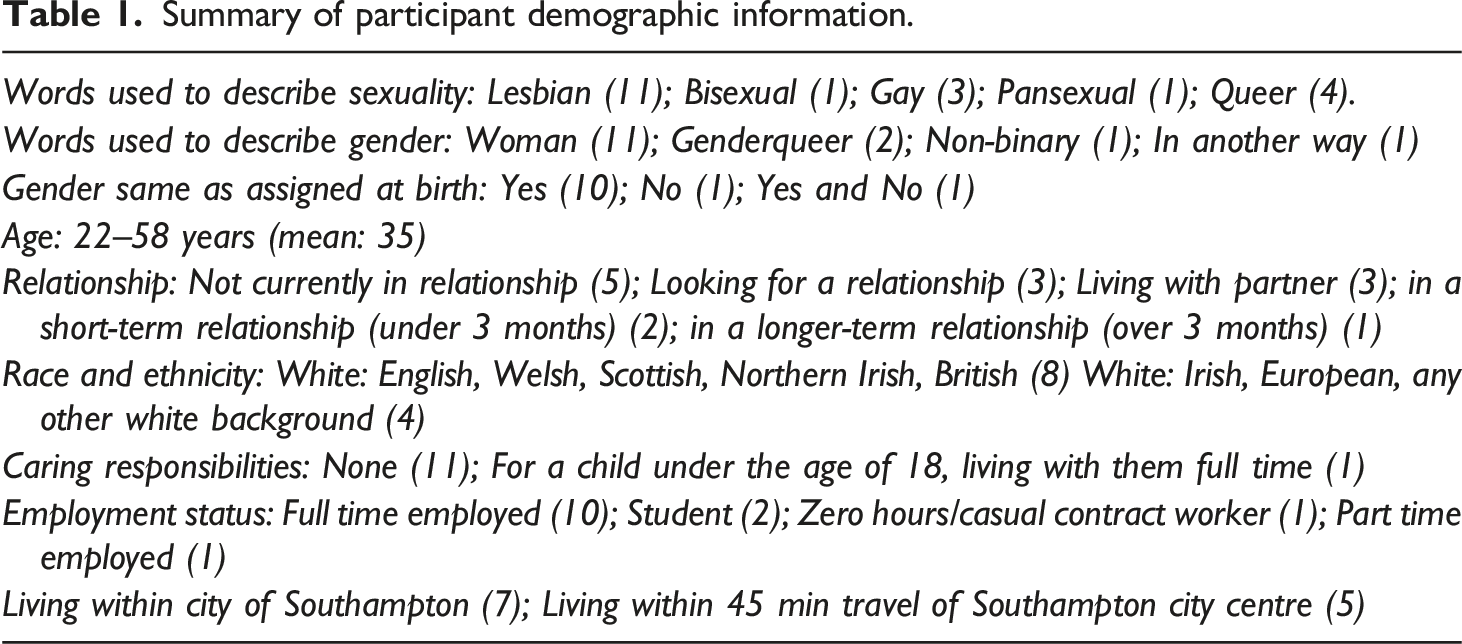
The PI’s personal experience as an attendee of lesbian social events in the city, and the city’s wider demographics suggest this sample has some clear omissions: most particularly of lesbians who were older, unemployed, and Black, Asian, mixed or from other ethnic groups. While Southampton is a predominately white city (81%, ONS, 2022) the PIs personal experience points to a more racially diverse lesbian scene than this sample reflects. This does not mean racist exclusions and marginalisation do not exist on this scene, rather large cities such as London and Brighton have venue capacity and LGBTQ population density to offer exclusive spaces for Black, Asian or mixed lesbians, something Southampton lacks. The PI used their regular attendance at in-person lesbian social events as an opportunity to share the call for participants. During one of these events, the PIs mention of the study prompted an extended discussion amongst a group of older lesbians on lost lesbian spaces across the South and historic experiences of discrimination. Yet these generational experiences of exclusion and changing orientations to the city were simply not replicated in the discussion events and this is a notable limitation in the findings which follow. The demographics of the research team (all white and under 50) and the project being identified as a university research project (rather than one emerging from peer-led community organisations) are likely factors in this underrepresentation. The short timeframe of funded data collection (3 months) also impacted on accessing people who had restricted availability or irregular working hours. We note, below, the implications this has for understanding these data.
Mapping was selected for this project following the format of the ‘safety map’ by Shields (2016): following Mason (2001), this installation ‘crowdsourced’ knowledge and captured previously unreported experiences of hate crime in Brighton and Hove. In our discussion events, participants were presented with a map of Southampton and invited to annotate it using coloured post-it notes, stickers, pens, and highlighters. For Zoom events the map was presented via Jamboard, and in hard format (on an A1 sheet) for the in-person events. Focusing on more than just experiences of hate crime, we arranged prompt cards around tables (or displayed on an image shared to all participants in the Zoom) which asked participants to reflect on: safety; activities; access; lesbians (or your community); pandemic; and anything else. These written prompts were developed from the core debates we identified in the literature (above) regarding the production of community, belonging, safety and shared space, and were supplemented with verbal prompts and encouragement from the group facilitators as participants began to add material to the maps. We found that in in-person events participants were initially hesitant to write down or ‘fix’ their comments on the maps, uncertain as to what type of responses were welcome. Providing written prompts allowed time for silence, reflection and thinking, while the physical interaction with pens and stickers provided objects with which participants could engage while they felt out the expectations of the event and translated personal experience to a written note or verbal comment. This time also supported the building of rapport and comfort in the discussion event venue as participants were free to eat and drink, sit apart from others, or ask facilitators questions before engaging with the map, or other participants. This transition from quiet reflection to group discussion was more challenging on Zoom. One particular issue was that speaking and questioning was automatically an engagement with everyone in the group as it was broadcast through Zoom: this inhibited how conversation flowed and produced a sometimes facilitator-dominated discussion. Participants seemed to look to us to invite specific people to respond and to determine in what order people should speak, without being able to rely on the implicit social cues possible in-person (a common issue when conducting any sort of online discussion event). In addition to the annotated maps, data was collected through field notes made by facilitators which noted elements of discussion which stood out and their impressions of what participants wanted to emphasise. Maps and mapping have a long and varied history which includes violent domination, the imposition of concrete boundaries, imaginative shaping of space, and the production of guide maps which sit outside of stable geographic contexts (Anderson, 2006: 164, 171, 185; Rooke, 2007: 233). Our methodology was inspired by work around participatory collaborative mapping and counter-cartographies, which seek to centre the voices of marginalised communities in order to disrupt and queer dominant maps, borders and boundaries (Ferreira and Salvador, 2015). The collaborative mapping provided space for participants to chart their complex relationships to urban space and lesbian community formation, opening-up the study into a variety of complex and diffuse sites across the city.
Our methodology responds to Rooke’s call to imagine cities in ways which encompass ‘the lived, perceived and conceived urban spaces and spatiality of queer lives’ (2007: 233). Rooke notes the gay village is ‘a visible and material expression of lesbian and gay cultures’ but that alongside these clearly demarcated areas, another gay city exists, one that through everyday interaction, movements and norms, shapes how ‘lesbian and gay individuals comport themselves in…social and cultural spaces’ (2007: 233). Interaction with the map acted as a proxy for movement around the city; we could observe the processes by which individuals share their everyday movements and collaboratively produce public spaces as ‘lesbian’ from the undifferentiated heterosexual space of the city. The method also made visible the ‘safety mapping’ of social and physical environments which lesbian and gay people continually undertake in public space (Mason, 2001: 32): we witnessed the sometimes-difficult collaborative and negotiated process of finding and defining community and of determining and agreeing the characteristics of a ‘safe’ space. Our expert interviews focused on uncovering the way organisers and owners of clearly demarcated lesbian events or LGBTQ-friendly venues regarded their role in the shaping or support of lesbian community, and who they understood as participants in such a community. Jointly, this data allowed us insight into how respondents and participants imagine – or map – the lesbian city and the community which [may] emerge in and through it. We do not claim that the maps produced in this study represent a stable, coherent or authoritative version of lesbian life in the city, rather they retain the valuable subjective, affective and evolving experience of a group of lesbian people collaboratively recounting the city. In particular, we note that the lack of Black, Asian and mixed-race participants in the study risks re-embedding the racialised exclusions which so many queer spaces still uphold (c.f. Held, 2015; McCormich and Barthelemy, 2021).
To analyse and synthesise the data produced from discussion events and interviews, the research team used an inductive approach. Beginning with discussion and reflection on the elements of the data which stood out to each of us, we talked through our interpretations of specific elements and overarching impressions of the data as a whole. We paid particular attention to the multi-layered and contested meanings of city spaces and lesbian belonging by examining the contributions made by discussion participants against the intentions and beliefs about events, spaces and community membership reported by the interview respondents who curated them.
Reflecting on the city through maps was a collaborative process between participants and facilitators, driven by the recounting of affective relations to the city spaces. The synthesis of data produced in discussion events and interviews continued this interpretative and iterative co-production of knowledge about space, belonging, and community. We built a thematic map from the material we identified as significant. Here we report the findings from three key themes: (1) crafting ‘safe’ spaces; (2) terminology: naming ‘lesbians’; and (3) finding and creating places of community. These findings represent our ongoing participation in a process of collaborative imagining, and making visible, of the city as a site of community and locus of belonging, as it exists for [some] lesbian people.
Findings
Creating ‘safe’ spaces: External threats and homophobia
One of the topics that was repeated across our discussion groups and interviews was the need for lesbian spaces that felt ‘safe’. The process of evaluation and categorisation which produces spaces as safe is common to minoritised and victimised groups. Participants in our study readily labelled particular venues and general areas of the city as ‘safe’ or ‘unsafe’ indicating this as their primary orientation to space. Participants mapped personally significant places on the map – including ‘my house’ – as locations which provided safety and space for intimacy and stability. Homes offer private, sustaining spaces which hold transformative potential, as well as being sites of everyday, ordinary existence and belonging (Blunt and Dowling, 2006; Gorman-Murray, 2017; Pilkey, 2014). Facilitators then directed participants to discussion of their feelings around public space, and the movement outwards to shared space. For our participants, stepping outside of the boundaries of home was a sometimes a stark transition to ‘unsafe’ public space. Participants spoke about a sense of hyper-visibility and vulnerability when walking along roads in their suburban neighbourhoods whilst holding hands with a same-sex partner. Fearing homophobic recriminations could follow them home to their front door, they preferred to travel into the city centre before relaxing into public displays of affection. These accounts point to a ‘sense of difference’ in participants’ everyday lives where decisions about practices of intimacy are carefully regulated according to the geographical space (Formby, 2020: 71). The anonymity of the city centre produced this space as ‘safe’. Through experience and repetition, it was identified as the [only] public place in which community can reliably be ‘done’ (Formby, 2020: 72, 80)
However, the divisions of safe and unsafe space were not simply patterned across anonymity and visibility; when making evaluations about which public venues were safe participants often sought to identify who owned or operated spaces around the city. In common with Skeggs’ (1999) work on Manchester’s gay village, safety and belonging were determined following scrutiny of the operators and uses of a space, rather than a simple designation of a space as ‘for’ LGBTQ people. While anonymity offered safety in some locations, identifiable venue owners and event organisers who could be relied upon to act to protect known (lesbian) patrons from homophobic threats and heterosexualised aggression were actively sought out and celebrated by participants for ensuring spaces remained safe. Safe space was therefore seen as something that had to be worked at and constantly reproduced. As already noted, participants were exclusively white; Held (2015) and Gibson and MacLeod (2012) amongst others have written about the exclusion and vulnerability resulting from refusal of recognition for Black, Asian and mixed-race lesbians owing to a norm of whiteness characterising what a lesbian ‘looks like’. Recognising other patrons, and venue and event owners as ‘like us’ and/or explicitly LGBTQ-identified draws on implicit markers of sameness judged through appearance and, in some cases, politics (see following section). Furthermore, spatial imaginaries of safe/unsafe areas are often framed via racist constructions of white safety and Black/brown danger (see Holland-Muter, 2023 for a discussion of how this is resisted by Black lesbians in Cape Town). In discussion events, no participants explicitly spoke of race and racism: these silences point to how safety was evaluated solely through a personal lens, without reflection on the intrinsic protections whiteness may offer in navigating these spaces.
As Browne (2008) has argued, urban environments have been oversimplified as universally safe (er) for queers, but strategies of safety, including being known by LGBTQ people in a specific location and sustaining intimate community, remain constant across urban and rural environments. Southampton’s small size (precluding the possibility of finding a venue which would, e.g. allow for anonymity) and limited range of venues seemed to be a factor in prompting people to engage with spaces they felt were not consistently ‘safe’. For example, as more venues were mapped, conversation began to centre on the city’s gay-owned LGBTQ pub and club, sites which all participants were aware of, and most had visited. A handful of participants described them as attracting heterosexual stag and hen parties resulting in what they termed an ‘aggressive’ and ‘violent’ atmosphere and acting as a lightning rod for people wishing to target LGBTQ people for violence and harassment. This is in common with research on other UK cities with small gay scenes, such as Newcastle, where queered sites are ‘reduced and compromised’ by incursions from heterosexual patrons, resulting in compromised feelings of safety for lesbian people (Casey, 2004: 457). Other research has similarly found that branding of gay bars and clubs as ‘for all’ and offering consumption of a cosmopolitan sexual otherness compromises safety and security of non-heterosexual people and undermines a sense of community (Binnie and Skeggs, 2004; Branton and Compton, 2021). Economic pressures of operating a gay-only venue in a city with a small LGBTQ population would point to possible reasons for choosing to brand these venues, as the club puts it on their social media pages, as for ‘the gay community & their friends’, rather than enforcing an exclusive door policy. In the intersection between maintaining a LGBTQ-only space which can enable non-heterosexual community ties in a space of safety from homophobic violence, and door policies needed to ensure financial viability of a venue, lesbian people in Southampton face a contracted choice of social space. Participants’ continued patronage of these spaces despite misgivings about safety and experiences of hostility can be understood as asserting a claim to Southampton as an everyday space of belonging for lesbian people, and a divestment from an ‘urban utopia’ (Browne, 2008: 30) of anonymous queer life which might be accessed in nearby Brighton and Hove. Ultimately, this was a decision made by weighing the risks and benefits of engaging with imperfect spaces; further research is needed to understand the manner in which Black, Asian and mixed-race lesbian people navigate these spaces given the ways in which many queer spaces continue to uphold racialised hierarchies.
In discussion groups, subjective experiences of fear, discomfort and marginalisation in ostensibly LGBTQ-friendly venues became the dominant account of what these spaces meant, with participants who had previously had positive experiences there deferring to the emotive accounts of those who had had negative experiences, asking where the injured parties would instead recommend going to socialise. We also heard, in expert interviews, how organisers’ similarly negative personal experiences of such venues prompted them to seek out and negotiate protected access to venues in the city which had not historically hosted or identified themselves as LGBTQ friendly. In one case, organisers of a lesbian social group reported negotiating a change in staffing and door policies with a bar venue’s management in order to provide reassurance to attendees of their safety. In discussion groups, a number of participants placed stickers on the map flagging this venue and identifying it as ‘safe’ or ‘friendly’. Eleanor Formby (2020: 7) argues that space and intimacy are intertwined: repeated practices of intimacy produce spaces as safe, while belief in a space as ‘safe’ creates the conditions necessary for sexual minority people to engage in practices of intimacy. This seemed to hold true for the discussions and processes of evaluating spaces which we captured in this project; despite explicit statements from participants that their choices of venue were informed by pre-existing conditions of safety or a sense of belonging, the above example demonstrates the degree to which the choice of venues and designation of them as ‘safe’ or ‘community focused’ by participants was primarily a consequence of the knowledge shared about them and subjective experience of repeated belonging and community intimacies, rather than any objective material conditions of these locations.
Naming ‘lesbians’: Exclusion, not belonging and division
Participants gave accounts of stepping into unknown places without knowing if they would be welcome, with people they did not know if they could trust, in the hope of fulfilling a deeply felt longing for connection and belonging. While anxiety of exclusion was particularly stark for participants who identified themselves as gender non-conforming or non-binary, women in the research also expressed fears of lacking legitimacy in lesbian space. Language emerged as a key point of orientation in navigating this vulnerability: participants reported using ‘lesbian’ as a way to find where they might fit but also expressed considerable anxiety about their legitimacy to claim membership in such spaces. The reasons cited for this anxiety were wide ranging and included having recently come out, not having lesbian friends, or feeling uncertain about the social expectations of lesbian events or venues. Some participants discussed their feeling that limited LGBTQ venues in the city only offered space for young people, people who drank, and people who were happy to be in mixed (variously: not women only, not lesbian only, or not LGBTQ only) spaces. Other participants were concerned they would not be welcome at lesbian events having only recently identified themselves in that way or anticipating that other attendees would already know one another. Discussion group participants spoke about looking for cultural cues – and clues – to evaluate who was the intended or expected patron of an event or venue marked as ‘for’ lesbian people, in the hope of confirming they would be welcomed to the space or event. At the heart of this, there was an apparent awareness of the polysemic nature of ‘lesbian’. As one participant reflected: ‘lesbian may not mean the same thing to me as to you’. Indeed, the demographic data we gathered confirmed the heterogeneity of a group who might otherwise appear homogenous; all but one participant used the word lesbian to describe their sexuality, but additional terms were significant and indicate the additive, rather than exclusive, nature of identity or sexuality 1 labels. Similarly, 11 out of 12 participants used ‘woman’ to describe their gender, but again additional terms (including genderqueer and non-binary) had salience.
Language in this project is and was slippery. During data collection, there were some moments of discomfort and difficulty as people identified language with which they felt comfortable or uncomfortable. Participants discussed the meanings of words including queer, dyke, and lesbian; there was no consensus on the meaning or value of these and an enormous amount of social, political and personal weight accompanied all the reflections we heard. One participant suggested their previous use of ‘queer’ rather than ‘lesbian’ as a descriptor for themselves was ‘cowardly’ because they sought to sidestep what they perceived as negative associations with the word lesbian rather than confronting and rejecting them. Participants generally agreed that ‘lesbian’ was a word which had been used to attack or shame them with connotations of, as one participant summarised it: being ‘fat, ugly, man hating’. Despite this, they retained a clear affiliation with it. In expert interviews, we heard how carefully ‘lesbian’ had been considered by event organisers and what they hoped this would convey about who was welcome. One lesbian social event organiser spoke about attempting to make their criteria explicit without inadvertently gatekeeping or excluding people they have not met or imagined: ‘my idea of what they are could be quite different, so…it’s for you to answer…it’s for you to feel like it’s your space’. In another expert interview, respondents lamented this lack of specificity saying: ‘it wasn’t clear if it was trans or queer inclusive, it was very much “this is for lesbians, this is for women, this is for women who are lesbians”’. In response, they chose the word ‘sapphic’ as their group’s descriptor. They explained their decision thusly: we wanted to make it very clear that it was open because the last thing you wanna do when you’re nervous about going and joining a group is having to go ‘excuse me am I allowed to come and join the group?’ so we wanted to make it as easy to understand as possible and as open as possible.
Despite the best intentions of these organisers, for many of our participants the term ‘sapphic’ did not deliver the clarity which ‘lesbian’ was alleged to lack. In discussion groups, two people labelled the location of the sapphic group’s meet ups and were met with extensive queries on what this meant, who it was for, and why ‘sapphic’ was different than lesbian. In their response, these participants placed emphasis on the inclusion of people with diverse gender identities. From here, discussion continued as some participants expressed a lack of knowledge on trans and non-binary identities and how this relates to lesbian and LGBTQ spaces more generally. We witnessed sometimes tense but typically careful, open conversation between participants who appeared to work hard to create space for understanding, reflecting as they did on how varied the people gathered under the term ‘lesbian’ might be.
Current media and political discourse around lesbian identity and women-only spaces is characterised by sensationalised debates over trans women’s legitimacy and access to spaces (Hines, 2020; Rossiter, 2016; Walker, 2009) and dichotomous framings of ‘lesbian women’ versus ‘queer people’ (Megarry et al., 2022), with a narrative that lesbian space is under threat. Following some hostile responses to project recruitment online, we anticipated the possibility of a repeat of such claims to authority over the meaning of lesbian; in discussion events, however, this did not materialise. Rather, participants seemed to be tentatively seeking confirmation of their own legitimacy inside ‘lesbian’ and identifying who was claiming that space alongside them. Thus, while some research – and discourse – claims that it is the demise of the term ‘lesbian’ which is driving the loss of lesbian space (Forstie, 2020b; Megarry et al., 2022), the findings of this project do not support this. While some participants identified beyond ‘lesbian’ as a primary term or used other terms in addition, the word lesbian was central in their orientations to community and identifying spaces which might be safe and welcoming. The participants in our study rejected understandings of lesbian as something with hard boundaries. It is beyond the scope of the project to understand whether the heightened online discourse regarding women’s spaces, definitions of lesbian, and trans lives, is not reflective of everyday, co-present interactions but, in the discussions we observed, the everyday experience of identity and belonging was more fluid and open to reworking and contestation. However, discussions on the inclusivity of ‘lesbian’ or ‘sapphic’ pointed to the impossibility of labelling a space or event in a way which does not appear to, or is not felt to, fix participation to a particular group or exclude others. Although this finding is likely informed by the definition offered in our recruitment material and the participants we then attracted, it is worth noting that this framing appeared to resonate with the participants and respondents who articulated a wish to retain the word lesbian as a descriptor of identity and allow it to be a broad umbrella under which people could find the community and affiliation. The discussions we witnessed, and the care and anxiety expressed by participants to understand meanings of lesbian as they were felt by others, suggest that the question of what lesbian means is far from settled. Lesbian community was thus characterised by tentative belonging, contested authority, and competing discourses of legitimacy which participants were largely uncertain of their right to claim. Despite this uncertainty, a desire for belonging drove a continued investment in and orientation to the category of lesbian and we saw this during discussion events in the process of reflection on the term.
Finding places of community: Lesbian in-jokes and shared knowledge
In light of the changes to socialising and normalisation of online event attendance brought about by COVID-19 lockdowns in the UK during 2020 and 2021, we included prompts in discussion groups aimed at understanding how online resources and spaces contributed to a sense of community. The hesitant and uneven flow of discussion in our online events was consistent with the lower preference all participants indicated for online socialising and event attendance. Expert interview respondents corroborated this impression with respondents reporting a significant drop-off in engagement with online platforms including Facebook groups, Discord and online-streamed events during 2022 compared to a 2020 peak. With the exception of one participant, all discussion group participants identified offline spaces as the primary location for their social and cultural lives. While online spaces and groups were used by all our participants to varying degrees during the pandemic to maintain a sometimes thread-like connection to self-identified community, they were generally discarded once restrictions on face-to-face meeting were lifted.
We questioned participants on why in-person interaction was more desirable than online interactions. Participants repeatedly spoke about pursuing friendships, seeking opportunities to engage in varied activities with other lesbians, having opportunities to engage in unstructured conversation, seeing other lesbians and being seen by them, and sharing cultural knowledge – such as which barbers could be relied upon to be welcoming of people who do not present as men or which pubs had a ‘queer’ clientele. The value placed on this intra-cultural knowledge was clear in the data collection process. Interview respondents questioned us on what we had learnt so far and made emphatic requests to receive our findings at the end of the project. In discussion events, participants switched from labelling the maps with spaces personally significant to them, to questioning one another on the venues they identified and exchanging tips on where lesbian community might be found. The conversation here moved to sharing of acknowledged intimate, subjective experiences of space, and a flexible sub-cultural knowledge accrued across lifetimes. This was exemplified in the first discussion event where one participant labelled Ikea on the map, providing no further detail (see Figure 1); other participants queried its significance to lesbian community and experience in the city. The participant explained that shortly after moving to Southampton she and her partner went to shop for furniture for their shared home and argued over interior design choices. This was, participants jokingly agreed, a rite of passage for any serious relationship and part of a lesbian habitus encompassing domestic concerns and publicly visible relationships. Ikea became a cultural touchstone for the rest of the event; a shared in-joke acting as shorthand for the trajectory of lesbian relationships, intimacy, practicality, and oftentimes the wished for ‘achievement’ of lesbian community: a committed intimate relationship which could withstand a quarrel in a furniture store. Another participant took stickers and placed hearts on the map in places they had first met and first kissed their partner. There was no suggestion these places had significance beyond their personal relationship story, but they offered something of the texture of the city as a multi-layered space of experience, individual biography, and intimacy. Post it notes on city map showing ‘IKEA'.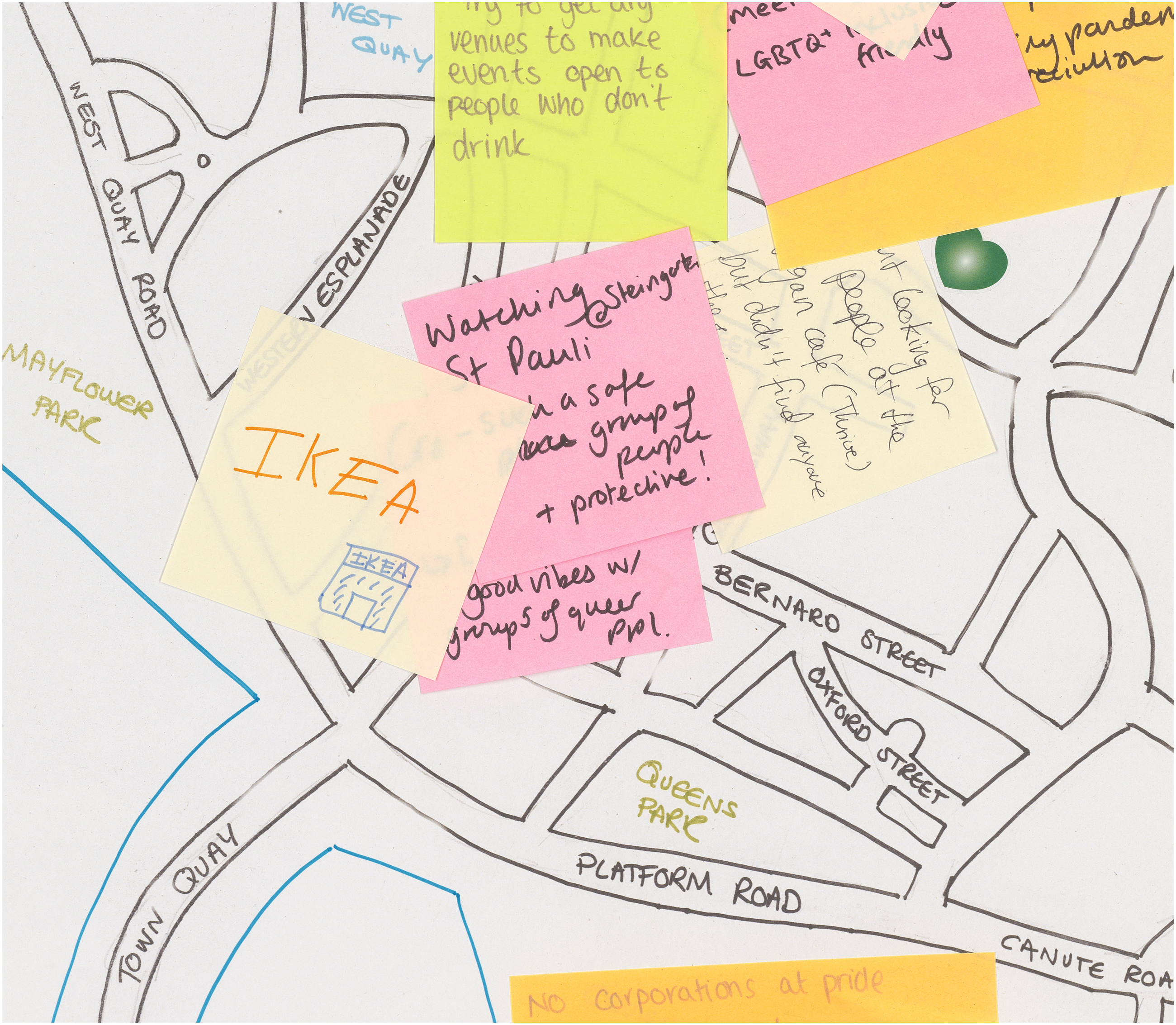
At the end of the in-person discussion groups, participants drifted slowly away from the tables we had laid out the maps on but continued talking, swapping contact details, and using map apps on their phones to record specific places which had been talked about. They referred back to discussion of Ikea, joking they would see each other there later, or even suggesting they might swing by that afternoon to see if they could meet some lesbians. In-person, this process spilled readily beyond the bounds of the discussion event, but the clear ‘end’ of the Zoom discussion curtailed possibilities for participants to continue conversations or follow up with questions about specific events or venues.
In the course of this project, it seemed that it was in the back and forth between lesbian-identified people, through the sharing experience, and certainly through laughter anchored on in-jokes that a sense of community and feeling of belonging emerged. We found this was an organic, boisterous, and sometimes starkly vulnerable process (as participants shared stories of fear and violence) which was less available via digital technologies because of the more tightly controlled temporal boundaries of communication and the material conditions of video conferencing. Specifically, its attendant missing social cues and additional cognitive demand (resulting in what is colloquially referred to as Zoom fatigue; Ramachandran, 2021) which make unstructured conversation more challenging to achieve. Temporary online spaces of the sort created by Zoom events obstructed ongoing conversations, reduced opportunities for mutual recognition, and failed to designate a distinct space as a place in which lesbians could be found in future. This may point to one of many inequalities in access to belonging and community given financial, temporal, and health resources all contribute to the accessibility of physical spaces and events held therein.
The architecture of online spaces did not appear to facilitate the same opportunities for intimacy or mutual recognition which participant responses identified as the central function of community. What digital technologies did offer was a way to resource access to events and scope out spaces before physically visiting them. Apps and online platforms were spoken about as a means to an end, tools such as Facebook events and Google maps were used to orientate participants to in-person spaces and events which allowed for the building of emotional, social, lasting bonds which were imagined to cover all areas of life. While online interactions were deemed valuable – including the wider accessibility of events or performances when they are live streamed – they represented ways to ‘keep in touch’ and maintain continuity of contact, rather than the goal or primary location of community belonging.
Conclusions
This study set out to explore how lesbians make community in an ‘ordinary city’: a city without a gay village, and few fixed spaces that are designated as lesbian. Our use of participatory collaborative mapping helped produce a diffuse and multi-layered understanding of lesbian community in Southampton. Rather than begin our study with a focus on a specific site (a bar, a club), we instead let participants guide us through their city. Interaction with the map allowed us to observe the process by which individuals share their everyday movements and memories, and collaboratively produce public spaces as lesbian from the undifferentiated heterosexual space of the city. As such, the study managed to capture the ‘everydayness of sexuality as lived practice’ (Rooke, 2007: 233); where the site of a first kiss became a site of belonging, marked on the map. Participatory collaborative mapping helped us uncover places that would not make it onto an official map of LGBTQ life in the city, it took us to places we had not anticipated, to places unlikely to be recommended as a location to visit in search of lesbian social contact, but nonetheless central in the subjective lived experience of being lesbian in the city and of achieving a sense of place.
As participants layered notes on the map, they read one another’s contributions and questioned each other on the significance of a location or experience. As people recounted their experiences, we listened to a series of interlinked conversations, shared jokes, and sometimes heated debates which paralleled the experience of lesbians searching for spaces and shared community in the city. Through these interactions, it became apparent that finding a space to articulate an explicitly lesbian identity in Southampton can be fraught, but it was something that participants valued immensely and were willing to invest time and emotional energy in. We witnessed participants actively seeking connection as they talked about and carved physical, virtual, and imaginative spaces of belonging in a mapping process that was drawn and redrawn in a collaborative process of community creation.
The collaborative mapping was more than just a tool for data collection; it facilitated conversations that participants continued after the conclusion of discussion events, sharing recommendations, stories about lesbian spaces, and swapping phone numbers. These organic moments of community emerged in the margins of our official fieldwork. By creating a safe [r] space for lesbians in Southampton to share their experiences of the city we created possibilities for these connections to be forged and continued. A key implication of this project is how collaborative mapping can offer a tool for delivering more inclusive participatory research that can help foster transformative and emancipatory research into LGBTQ communities and spaces.
We make no claim that the maps produced represent a coherent and fixed lesbian community. Rather, the maps produced are always partial, always fragmented, and always in a process of becoming – much like processes of community formation itself. The homogeneity of our research sample in terms of age and race has clear limits on the conclusions we can draw. Yet participatory collaborative mapping is a method that has much to add to existing scholarship on sexuality and space and queer urbanisms, with counter-cartography offering ways to trace the contours of a multitude of queer lives in the city. Future work may benefit from using participatory collaborative mapping to produce a nuanced, local picture of queer life. Cumulatively, we suggest work engaging different generations, participants from different class positions, and Black and Asian queer people will offer an important tapestry of knowledge on LGBTQ communities across (and within) spaces.
In times of social change and crisis, networks of connection and community become particularly important for lesbian and gay people (Ellis, 2007). The precarity of a sustained period of fiscal austerity and reductions to social welfare have been compounded by the pandemic and subsequent cost of living crisis in the UK, which is accelerating most acutely in queer capitals such as London, Manchester, and Brighton and Hove. These conditions are constricting the choices of economically precarious and working-class LGBTQ people regarding where they choose to settle, and their opportunity to travel to queer scenes in large [r] cities. As such, the granulated experiences of lesbian, gay, bisexual, trans, and queer people in small cities is essential to understanding contemporary queer life in Britain. Our research points to need for more work looking at a variety of cities and towns, in order to grasp the multitudinous experiences, demographic differences, unique histories, and varied spaces, which produce, as we have shown, distinct relational geographies of urban life.
Footnotes
Declaration of conflicting interests
The author(s) declared no potential conflicts of interest with respect to the research, authorship, and/or publication of this article.
Funding
The author(s) disclosed receipt of the following financial support for the research, authorship, and/or publication of this article: This work was supported by the University of Southampton (WSI Stimulus Fund).
Note
Elizabeth Reed, Sociology, Social Policy and Criminology, University of Southampton-Highfield Campus, Murray Building, Southampton SO17 1BJ, UK. Email: 
Laura Paddon, Geography and Environmental Science, West Highfield Campus, University of Southampton, University Road, SO17 1BJ, UK. Email: