




Abstract
With its emphasis on practices like social distancing and periods of intermittent isolation, the COVID-19 pandemic likely presented unique challenges for individuals who engage in consensual nonmonogamy (CNM). Interviews with 16 practitioners of CNM in the United States conducted in May–July, 2021 revealed five themes about how COVID-19 impacted their relationships: (1) slowing down relationship activity and progress; (2) speeding up relationship changes and milestones; (3) providing the opportunity for reflecting on nonmonogamous identities and relationships; (4) facilitation of clarifying intentions around nonmonogamous relationships; and (5) offering unique opportunities to apply skills from safer sex negotiations to navigating safety with precautions related to COVID-19. Findings illuminate how members of a community whose intimate practices were uniquely impacted in a time of limited sociality made meaning of their experience and charted the course for relationship trajectories.
Introduction
As a global pandemic can have a profound effect on the pace and pattern of our daily lives, changing the ways we work, learn, research, teach, relax, and connect with others (Langhout et al., 2021; Vaccarino-Ruiz et al., 2021), it has also deeply impacted our intimate, romantic, and sexual lives (Estlein et al., 2022). The COVID-19 pandemic has affected our intimate relationships in complex and varied ways, both in how individual relationships may face challenges alongside opportunities (Feiring et al., 2023), but also in the disparate outcomes seen by specific communities (Estlein et al., 2022; Gamarel et al., 2022; Sachser et al., 2021; for review, see Bevan et al., 2023). Although the pandemic may have created relationship conflict and stress for some (Estlein et al., 2022; Feiring et al., 2023; Luetke et al., 2020), it has also provided opportunities for partners to discover creative and positive ways to connect (Lehmiller et al., 2021). A notable body of empirical research on the impact of COVID-19 on relationships has been conducted, yet this work has tended to focus on individuals in heterosexual, monogamous relationships and neglected the study of diverse intimate forms (for exceptions that focus on same-gender relationships, see Gamarel et al., 2022; Labor and Latosa, 2022). The purpose of this study was to explore the varied impacts of the COVID-19 pandemic for individuals in consensual nonmonogamous and polyamorous relationships.
Intimate relationships have been challenged in many ways during the COVID-19 pandemic, particularly during the first year which saw significant restrictions for social interactions (for review, see Estlein et al., 2022). Research conducted during that time noted that there could be challenges from either shared confinement for cohabitating partners or from separation for partners who live apart (Luetke et al., 2020). Studies revealed diversity and complexity with regard to the impact of COVID-19 on such factors as sexual desire and activity (Fuchs et al., 2020; Gauvin et al., 2022; Gleason et al., 2023; Lehmiller et al., 2021; Panzeri et al., 2020; Pollard and Rogge, 2022; Wignall et al., 2021), relationship quality (Gamarel et al., 2022; Mitchell et al., 2023; Pieh et al., 2020; Rodríguez-Domínguez et al., 2022; Sachser et al., 2021; Williamson, 2020), communication (Labor and Latosa, 2022), relational processes (Jones et al., 2021), and general changes in the experience of intimacy within relationships (Löfgren et al., 2023).
At the same time, the COVID-19 pandemic has likely created opportunities in intimate relationships. The pandemic created a new context to connect, communicate, and reinvent intimacy among partners (Lopes et al., 2020). Particularly for those at home with a partner, perhaps with fewer social obligations and more hours together, this could be an opportunity for conversation, sharing, and building mutual support. We may see new kinds of sexual exploration here, such as new toys, positions, or activities (Lehmiller et al., 2021). Similarly for partners who live apart, we may see other kinds of exploration, like trying video chatting (Eleuteri and Terzitta, 2021) or other technological adaptations (Feiring et al., 2023). Research conducted in the early period of the pandemic also suggested that some people were having more sex and more enjoyable sex than they were having before the pandemic (Lehmiller et al., 2021).
The vast majority of research conducted on relationships in the context of COVID-19 has taken the form of quantitative survey research with larger samples of individuals in monogamous relationships with people of a different gender (i.e., heterosexual, monogamous forms of intimacy). To our knowledge, the only study that has focused specifically on nonmonogamous relationship is Manley and Goldberg (2021), which looked at the experiences of nonmonogamous parents during the COVID-19 pandemic. They found that these parents responded in creative ways to address obstacles and maintain relationships during the May–December period of 2020. Montanaro et al. (2022) also noted the struggle that nonmonogamous respondents in their study faced regarding safety and suggested that more research is needed on nonmonogamous experiences during the pandemic.
Individuals who practice consensual nonmonogamy (CNM) have more than one sexual, romantic, or intimate partner (Copulsky, 2019). CNM is distinct from cheating in that partners know about and agree to this arrangement. Although the term nonmonogamy can also be used to describe infidelity, this paper focuses on consensually nonmonogamous relationships. CNM individuals may or may not also identify as polyamorous, signifying a relationship identity or orientation in which they experience intimacy or commitment with multiple partners simultaneously (Copulsky, 2016; Robinson, 2013). People in polyamorous and nonmonogamous relationships are likely to have distinct experiences of relationships during the pandemic.
CNM communities bring distinct conceptualizations of their relationships and identities, which may be helpful for thinking about COVID-19’s relational impacts. Some nonmonogamous people think of their intimate practice as a kind of orientation—a sense that they are naturally suited for nonmonogamy, even if they are not currently in a nonmonogamous relationship (Robinson, 2013). Others think of nonmonogamy as more of a contextual choice or intentional practice—a decision made based on the specific life circumstances they face (Copulsky, 2019). Therefore, people may make a choice to stop being nonmonogamous because seeing multiple partners feels like a health risk, or they may continue to identify as nonmonogamous even while having only one partner.
The experiences of people in CNM relationships are shaped by facing distinct challenges and stigma, along with drawing on unique strengths. Being in a polyamorous relationship can be a source of stigma (Conley et al., 2017; Séguin, 2019). People may feel like they need to hide their relationships, or they may face negative reactions from friends and family or at work or school. Changed circumstances during the pandemic could introduce sources of stigma, and this could compound stress from COVID-19. However, having partners who have other partners can also provide an extended network of support (Sheff, 2016) or might have facilitated the ability to form “pods” or “bubbles” which was common in the first year of the pandemic.
CNM people have experience negotiating agreements and risk (Rodrigues et al., 2019). This includes thinking specifically about how their partner’s physical intimacy with others, and the precautionary measures they take with testing and barriers, affects the risk of spreading infection. Nonmonogamous communities also emphasize the value of honesty and communication (Klesse, 2006). Where the pandemic may shift how many people conceive of sexual risk (Bowling et al., 2022), nonmonogamous people may already be well-prepared to negotiate shared decision-making about COVID-19 risk and safety behaviors.
The current study
The purpose of this study was to consider the ways in which individuals who practice consensual nonmonogamy navigated the COVID-19 pandemic. Grounded in an interpretive epistemology (e.g., Tappan, 1997), we used qualitative methods to gain a rich, nuanced understanding of the experience of a group of individuals whose intimate practices typically fall outside the normative focus of relationship science (Hammack et al., 2019). We sought to address the core question: How has the COVID-19 pandemic influenced the experiences of people in nonmonogamous relationships?
Method
Positionality
The authorship team shared identities such as White racial identities, assigned sex as male, and sexual identities they describe as queer, bisexual, and gay. Both authors were involved in nonmonogamous relationships at the time of the study, and the first author (who conducted all interviews) disclosed this information at the start of each interview.
The research team was based in the western United States and consisted of a group with substantial collective personal and research experience with nonmonogamous relationships and communities, as well as sexual diversity more broadly. The first author developed the interview protocol in consultation with the second author and others in our research lab. The research assistants and lab members also represented a range of other identities and experiences, including those related to age, gender, and sexual orientation.
This project is grounded in an interpretive, constructivist epistemology, in which the empirical goal was to identify the meanings people make of their own lives and experiences (e.g., Madill et al., 2000; Tappan, 1997). This epistemology does not assume the existence of an underlying “truth” to be excavated in narrative data but rather an interpretation of lived experience to be documented. As such, we used reflexive thematic analysis, described in more detail below. Throughout the interview process, the first author also engaged in reflexive memo writing, reflecting on the interview process, reactions to the interviews, and elements that were resonant or contrasting among the participants’ experiences.
Sample
Participants were recruited through social media communities focused on consensual nonmonogamy and the first author’s networks in these communities. Eligibility was limited to individuals who were at least 18 years old, self-identified as having been in a polyamorous or nonmonogamous relationship during the COVID-19 pandemic, and were currently residents of the United States. Those meeting these requirements were directed to an online survey, where they completed an informed consent form and a short demographic survey. No compensation was provided for completing the survey or participating in the interview. All procedures were reviewed and approved by our institutional review board.
Fifty-one respondents completed the demographic survey to express their interest in taking part in the study. The first author selected potential interviewees using a purposive approach to sample for diversity within the broader community of individuals who responded. As many who initially responded were young, White, and identified as women, respondents who were older and identified as men, nonbinary, and non-White were prioritized for invitations to interview. Invites were sent to 24 people, and interviews were scheduled and completed with 16 individuals. Final sample size was determined by this intent for diverse participation and a consideration for saturation of thematic content (Guest et al., 2006), which was assessed through reflexive memo writing and consultation among the authors during data collection. At the approach of the sixteenth interview, identification of new themes and perspectives declined sufficiently for us to cease further data collection.
Participant demographics.
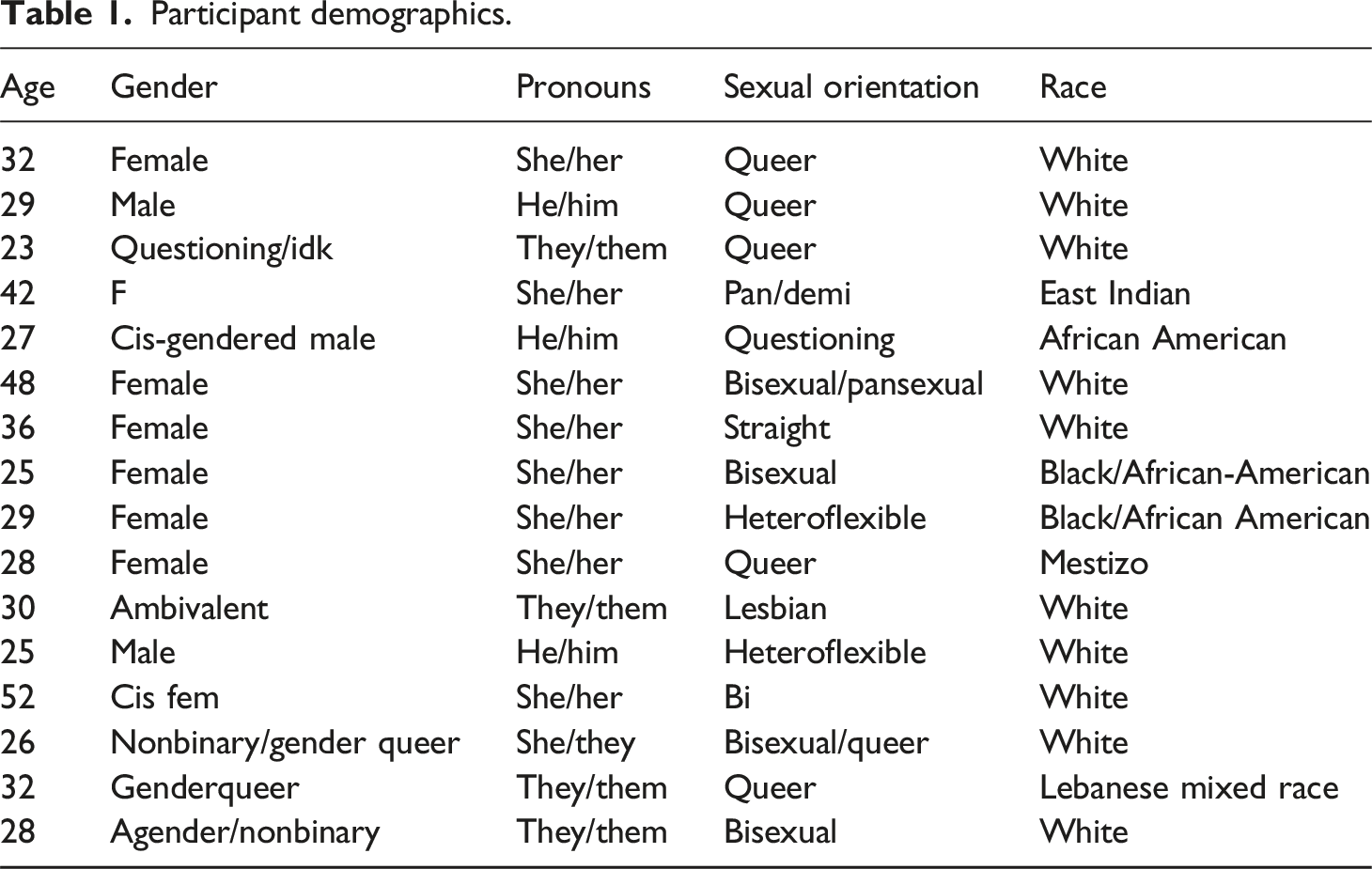
Participants came from the US South (3, 19%), Northeast (5, 31%), Midwest (1, 6%), and West (6, 38%). The sample disproportionately represented the state of California (4, 25%) and city of New York (3, 19%). All participants were from urban areas. The sample included a range of professional backgrounds, including health care, IT, research, social work, and students.
All participants identified as having been in polyamorous or nonmonogamous relationships during the COVID-19 pandemic, yet specific relationship identities and experiences varied substantially within the sample. Participants described many relationship structures, including triads and vees. Partnerships used both hierarchical and non-hierarchical approaches, along with drawing on models such as “solo polyamory” and “relationship anarchy” (see Flicker et al., 2021). Participants also had experience in cohabitating, local, and long-distance relationships, including moving into and out of shared homes with partners during the pandemic. Relationships included long-term commitments, marriage, coparenting, newer relationships, casual dating, kink, and nonsexual intimacy. Participants saw relationships start, end, and transform over the course of the pandemic.
Procedure
Interviews were conducted in English and recorded through Zoom. The length of interviews ranged between 41 min and 107 min, with a mean length of 74 min. Interviews were conducted between May 19 and July 21, 2021, a 2-month period that was after vaccinations were widely available in the United States but spanned many states’ official reopenings and liftings of restrictions. All participants were reminded at the beginning of the interview that their participation was voluntary and informed that they could end the interview at any time or skip any of the questions.
The interviews followed a semi-structured format (see Appendix). Interview questions addressed what life during the pandemic has looked like in general for participants, their personal history with nonmonogamy, how the pandemic has affected their relationships, places where they have experienced conflict and challenges or benefits and opportunities, and their hopes and plans for the future. Early questions explored participants’ relationships in general during this time, including how many people they had been involved with and in what ways. Subsequent questions narrowed in on specific relationships. Participants were also encouraged to reflect on how other parts of their identities influenced their relationships during the pandemic.
Analysis
Interview transcripts were initially generated from Zoom’s automatic captioning. Transcriptions were then corrected and redacted by a team of three undergraduate research assistants before the first author performed a final review of each transcript. Research assistants also listened to new interviews as they were conducted. The first author met periodically with this research team while interviews were ongoing and then after they were complete. The group discussed ideas that stood out from specific individuals and noticed repeating patterns among participant experiences. The research assistants also provided written memos of their observations.
We employed the reflexive thematic analysis approach outlined by Braun and Clarke (2006, 2021). After completing the interviews and listening to the recordings, the first author developed an initial list of codes, which was informed by the research team memos. These codes were partially informed by prior review of the literature on nonmonogamous relationships and the impact of the COVID-19 pandemic on intimate relationships more broadly. However, thematic analysis was primarily inductive, identifying patterns and themes from the bottom-up, driven by the data rather than a theoretical model or specific hypothesis. Following the approach of reflexive thematic analysis, we did not seek inter-rater reliability between coders (Braun and Clarke, 2019, 2023).
Analysis proceeded through multiple readings and iterative coding of the interview transcripts. The first author worked to identify quotes that spoke to the codes while continuing to consider the broader contexts of these interview excerpts. Through ongoing engagement with these texts, the developing codes were repeatedly adjusted and clarified. Additional feedback from the research team was also incorporated in this work through meetings and written notes.
The authors met throughout the analysis process to discuss and review codes and organize them into thematic categories. In this stage, we returned to our data to check that our themes were accurately representing the interviews. We also checked that our themes and coded selections maintained a focus on our research question about connections between COVID-19 and nonmonogamous relationships, rather than broader issues related to either nonmonogamous relationships or the pandemic alone. In developing our themes, we focused on identifying shared patterns of meaning across multiple participants’ stories. As our final codes illustrate, our themes also highlight some diversity and contrast among these experiences. Although we defined the five themes we focus on here early in our writing process, we continued to tweak the precise naming of our themes as the writing process itself provided additional opportunity to grapple with the meaning of our participants’ experiences. In this way, initial codes were refined into the final themes reported here.
Data excerpts which illustrate themes are presented anonymously here. These excerpts have been edited to remove stammers and filler words, aiming to improve readability without changing the meaning conveyed.
Findings
Theme 1: COVID-19 slowed down relationship activity and progress
Participants spoke of several ways that the pandemic had slowed down activity and change in their relationships, or slowed down their exploration of nonmonogamous identities and communities. These included not meeting new people, dating fewer people, seeing partners less often, and having less sex. Also included here is relationship progress that happens in a social context, like introducing a partner to family. Although single and monogamous people may have seen similar impacts on dating, intimacy, and relationship milestones, participants described how these changes were felt distinctly in nonmonogamous relationships and identities. For example, one participant described how the pandemic had delayed an event that is unique to nonmonogamous relationships, getting introduced to metamours (i.e., a partner’s partner with whom one is not involved).
Most often these effects of relationships being slowed down were narrated as a direct result of safety concerns, as participants chose to limit the number, frequency, and physical closeness of their contacts with other people to reduce the risk of spreading COVID-19. This was particularly hard for nonmonogamous individuals who wished to see multiple people living separately, aware that exposure to one person could increase risk to others. Although safety concerns were nearly universal in posing some kind of barrier to seeing partners or dates, participants described varied approaches to dating during the pandemic. For example, while some chose to stop meeting new people entirely, others continued dating but did so more cautiously. Precautions included masking and social distancing along with going on fewer dates, spacing out contacts with different people, and testing between meetings.
However, safety was not the only reason for relationships slowing down during the pandemic. One participant spoke of how policy decisions from the state government around who and when it was permissible to visit socially were not written with the possibility of nonmonogamous relationships in mind. This participant and others spoke of increased scrutiny from roommates and family about where and with whom they were spending their time. This scrutiny could be difficult for nonmonogamous individuals who did not want to disclose their relationships, or it could put pressure on them to do so. Participants also described how stressors like health concerns and childcare responsibilities could strain intimacy and disrupt sex lives even within cohabitating relationships.
Facing obstacles that slowed the activities of relationships could be particularly upsetting for nonmonogamous people who have built an identity or lifestyle around cultivating relationships with more than one partner. For example, one participant spoke about their experience of not being able to date multiple people in relation to their nonmonogamous identity: You want to explore and you want to meet new people and get your needs met and explore play with different types of people and all these benefits that come with being nonmonogamous or poly or whatever you want to call it… But it’s such a punch to the gut to be like, you want to have multiple partners, you want to, you know, go on all these dates and meet all these people and play with multiple people and have these adventures. Well, too bad. That’s not safe and you shouldn’t be doing that and shame on you.
For this participant, nonmonogamy and kink were closely intertwined parts of their identity and relationships, and they referred to seeking both dates and kink “play” with multiple people. Not being able to pursue these activities was difficult because it is a central part of their identity and a way to meet their needs. Like other participants, they named safety concerns as a barrier to visiting partners, also pointing towards social pressure to follow safety precaution and social shame for breaking those rules.
Participants also described how experiences during the pandemic had come to slow the development of their nonmonogamous identities and relationship styles. For example, one participant spoke of the challenges to explore polyamory early in the pandemic: It had such a huge impact on my entry into polyamory. Because…it was really at the beginning of the pandemic where I was like, yeah this is totally like home for me. I wonder if there wasn’t a pandemic, I feel like I would have very likely obviously been just more kind of out there. Just going on a bunch, I feel like I hear stories of people who initially when they’re nonmonogamous they are just going on as many dates as possible.
This participant’s narrative reveals a sense of missed opportunity early in his discovery of polyamory. He frames the pandemic as limiting possibilities he understands typically occur as one begins to practice polyamory. He also described how the pandemic had made him more selective in who he dated and slowed down physical intimacy within relationships, changes he said were something that will have “stuck with me beyond the pandemic.” He makes meaning of this sense of lost opportunity by suggesting it facilitated greater selectivity of partners, thus narrating value in being more patient and measured in new relationships. In this way, his entry into polyamory shaped his thinking about nonmonogamy and his future approach to nonmonogamous relationships.
Theme 2: COVID-19 sped up relationship changes and milestones
In direct contrast to the first theme of slowing down relationships, nonmonogamous people also experienced the pandemic speeding up relationship changes and milestones. This included ways that COVID-19 accelerated processes like starting, restarting, and ending relationship; moving in together; and having longer, deeper, and more serious conversations. Relationship experiences were varied, both between individuals and between one individual’s multiple relationships, such that a participant might have narrated slowing down on dating new people even while another relationship escalated.
Participants named several reasons for relationships speeding up during the pandemic. Sometimes changes were practical decisions made around circumstances of the pandemic, like moving in together because of a loss of work or housing. Other changes were caused by circumstances of how people interacted during the pandemic, with participants wanting to make the most out of infrequent contact or finding themselves spending more of their time with a smaller circle of people, particularly those with whom they lived. The emotional experience of the pandemic led to changes as well, with participants feeling stressed, lonely, and scared, and seeking comfort and connection with partners. Participants also described ways the pandemic had brought them to the decision to end relationships, either by amplifying problems in the relationship or giving them space to see those problems more clearly.
Many participants shared a sense that it could be hard to tell which changes were caused by the pandemic and what would have happened otherwise, or that some relationship changes would have happened eventually but occurred sooner because of the pandemic. For example, one participant described a change in her relationships after she moved in with her partner and metamour: And then I would say it was about two months later my meta kind of became my partner. And we expanded into a triad. So that’s been the major change. It was probably sped up, maybe by COVID, but I don’t necessarily know that was going to be a different outcome because we were kind of cute with each other here and there before that. Maybe just them being so close for a couple of months just kind of like cooked our goose.
This participant narrates an acceleration process of the expansion into a triad as facilitated by the pandemic but as a likely outcome regardless. Thus, the pandemic is framed as providing a context that affects the process, though not necessarily the outcome, of a set of intimate dynamics.
Importantly, participants did not always frame relationship changes that had been accelerated by the pandemic as positive events. This is true both in the sense that relationship changes could include the decision to end a relationship but also in the sense that participants might realize in retrospect that it was a mistake to pursue or progress a specific relationship. For example, one participant described getting back together with a partner with whom she had previous split up: I had broken up with him, we were on a break, and that letting him back in, really lowering my threshold for what I would accept to the point that it actually ended up being really dangerous for me, I think was because of the situation I was in or the global situation, right, the stressors we were under.
This participant narrated that stress and loneliness from the pandemic caused her to lower her standards and get back together with someone who would ultimately prove to be dangerous before she ended the relationship. In this case, speeding up the relationship was framed as a mistake in the participant’s meaning making process.
Nonmonogamous participants may also be less likely to see certain kinds of relationship changes like moving in together as relationship progress, in general, in contrast to normative models that see the goal of relationship as moving through escalations of exclusivity, cohabitation, marriage, and children. For example, one participant described having a partner move in after he was asked to leave a home that he shared with someone who was high risk and worried about limiting COVID-19 exposure. She said this was “an adventure, because it wasn’t what we had intended.” She later elaborated on the challenges: The fact that it was so sudden did not help. And the fact that things were so scary in the world did not help. Those first two or three weeks were rocky. But then yeah it turned into a nice comfortable pattern through the summer.
In this account, the decision to move in together was based on circumstances rather than this being a desired next step in the relationship, as this participant and her partner did not hold a goal of escalating their relationship so their lives would be intertwined in this way. Sharing a home was instead seen as a challenge and stressor in the midst of other problems, even as it also offered a solution to housing difficulties and eventually provided some comforts.
Even when participants saw clearer benefits from ways that the pandemic had sped up their relationships, these events still took place against the stark backdrop of COVID-19. For example, one participant spoke about how she and a partner found intimacy in deeper conversations: We talk a lot more. We talk about things that we didn’t talk about before and really getting to know each other in ways that would not have been possible if we weren’t all scared for our lives.
This participant’s narrative reveals a sense that the pandemic provided a context for deeper connection and conversation, thus accelerating intimacy. Where this narrative also captures the theme of reflecting, we think it conveys an important sense in which relationships could experience growth in intensity without shifting in a more outwardly visible way. It is reaching new depths of intimacy that is sped up here, not a measurable milestone like moving in together.
Theme 3: COVID-19 led to reflecting on identities and relationships
Many participants shared ways in which the pandemic had created a different sense of “slowing down,” not in limiting the activities of dating or delaying relationship progress, but instead by providing space for reflection. Sometimes this space was opened by time freed up from dating and pursuing relationships, though some participants also had more availability in their lives around work, social, and other commitments during the pandemic. However, where the previous kind of slowing down was more often experienced as a barrier to relationships, these openings for reflection were embraced as opportunities for growth. These opportunities allowed participants to explore many aspects of their lives, including offering deeper understanding of their nonmonogamous identities and relationships.
Often these opportunities were experienced on the individual level, as participants had the time and space for self-reflection. Participants examined many parts of their lives including gender identity, sexual orientation, career and retirement plans, and desires for children. Participants also examined their current nonmonogamous relationships and their nonmonogamous interests and identities. For example, one participant who was new to polyamory described how the pandemic impacted his learning process: I think the pandemic, I know for me and for some opened the door for folks to get really into different hobbies or things because they were alone a lot more and had more space, and that was definitely true for me. And I think it led to me having a lot of space to read and research and really get into kind of like polyamorous world I guess in my mind. I think at the start of the pandemic it gave me a lot of space to really, in the sense of ideas, really explore, I think, nonmonogamy and read a couple books and kind of just really sink into it, which is good.
This participant narrated an experience of opportunity provided by the unique context of the pandemic, creating a space for him to research polyamory and explore what nonmonogamy could look like for him. Along with accessing material like books, he was able to spend more time thinking through these ideas, which he narrates as a positive experience for his growth and development.
The pandemic also created spaces for partners to reflect on their nonmonogamous relationships together, building intimacy through their conversations. For example, one participant reflected on how the pandemic had impacted her relationship with a partner with whom she shared a home: We like each other a lot so we are happy to be with each other all the time and not necessarily have to be out or anything. I mean overall it’s been very good and we’ve been working on our communication skills and working on how we see ourselves as a nonmonogamous couple and been able to talk more about it and it’s been able to like slow down time essentially so that we are able to actually have those conversations.
This participant named this space created by the pandemic as an opportunity to work on communication skills and clarify the understandings she and her partner hold about their relationship as a nonmonogamous couple. She also credits the opening for these reflective conversations specifically to a sense of time being slowed down. Her narrative thus positions the pandemic as a moment of opportunity for growth through reflection.
Theme 4: COVID-19 led to clarifying intentions around relationships
The circumstances and experiences of the pandemic provoked many participants to clarify their intentions around their current and future nonmonogamous relationships or expression of their nonmonogamous identities. These intentions often came out of periods of greater reflection, where having space to think more about nonmonogamous identities and relationships led participants to committing to particular courses of action that would bring them closer to their goals or into closer alignment with their values.
Although we see this theme as closely related to the previous theme, we also draw an important distinction between the two. Reflecting is an internal process in which a person engages, often alone but sometimes in conversation with others, through which they work to increase awareness and self-knowledge. Clarifying intentions may be the result of that process, but reflecting does not always lead to this outcome. Here a person reaches a decision point about what plans they want to make or actions they will take, often articulating these intentions to partners and others around them.
For some participants, this experience meant developing clearer intentions about what they wanted from specific relationships. For example, one participant described a conversation with a partner about their long-term expectations for the relationship: He at one point asked me, like, what I was looking for, what my long-term expectations were, and I think because of everything going on with the pandemic I had the clarity to tell him, like, I’m not just looking for a casual fling. I am looking for something more long-term, you know, could you see yourself in a position where someday you would want a long-term, not monogamous but committed relationship? And he was like, “No, I think we’re actually looking for different things.”
This participant’s narrative credited the pandemic with giving her the clarity to know what kind of nonmonogamous relationships she was looking for—something more long-term and committed than a casual fling. She refers not just to the impacts of COVID-19 on this specific relationship, but to the broader context of “everything going on with the pandemic” as a source of clarity. The participant and her partner were therefore able to recognize that they wanted different things from the relationship, and this experience gave them a clearer sense of how they wanted to move forward from this point.
Rather than find clarity around desires for specific relationships, other participants determined new intentions for how they want to practice their nonmonogamous identity, particularly in the face of the challenges of COVID-19. For example, a participant described how she had come to a place where she wanted to be more open about her nonmonogamous identity in the future: I feel a lot more comfortable living my truth. I no longer have the patience to hide parts of my identity that are not comfortable to others. Because at the end of the day, God forbid, any of my partners at any point that I knew them passed away, what would that mean for me? I wouldn’t be able to tell people I loved this person and I’m grieving for them, and that’s not something I’m okay with. I’ve come to the realization that I need to be living my truth, whatever that looks like, whatever the consequences are.
Seeing loss caused by COVID-19, this participant narrated how important it was to her that she would be able to publicly grieve her partners if she lost them. This gave her a clear intention to no longer hide her identity from others, an intention related to her social identity around nonmonogamy rather than directly to what relationships she was in.
Theme 5: CNM people applied unique skills to navigating COVID-19 safety
Prior experiences with negotiating safer sex in nonmonogamous relationships offered participants unique and beneficial preparation for handling safety around COVID-19. Participants highlighted several parallels between how nonmonogamous people navigate sexual health when dating multiple partners and the kinds of safety considerations they faced navigating COVID-19. For example, one participant referred to discussions of COVID-19 precautions as “a whole safer sex conversation.” These parallels include the use of specific tools, models for thinking about safety, and skills for communication.
One form of protection used for both sexual health and COVID-19 prevention was barriers, including condoms and dental dams to prevent the spread of sexually transmitted infections (STIs), masks and face shields to prevent COVID-19, and gloves occasionally used for both. Preventative measures like vaccines (for HPV, Hepatitis A and B, or COVID-19), regular testing (for STIs or COVID-19), and limiting contact after exposure (through isolation, abstinence, or increased use of barriers) were also commonly employed in both contexts. Although participants did not explicitly name every one of these barrier methods and types of vaccines, several did identify the overlaps in these broader concepts. One participant described asking potential partners questions about safer sex and pandemic precautions: Before this it would always just be like questions about, like, oh not so much your whole sexual history but, like, oh are you clean, like when’s last time you had an STD test, and things like that. Now I’m just more like, oh so have you had a COVID test, have you been around people who’ve been positive for COVID, and do wear your mask, are you vaccinated, are you not vaccinated?
This participant discussed barriers, testing, and vaccination, highlighting similarities in questions about risk related to both STIs and COVID. This participant’s narrative reveals the way in which discussions related to COVID-19 safety were experienced with ease, given comfort and familiarity discussing sexual health issues with partners.
People in nonmonogamous relationships typically have a model for thinking about how exposure to one person creates risk to other people with whom that person comes in contact (Wosick-Correa, 2010). This model is learned from safer sex considerations but also applicable to COVID-19. A participant described how this gave nonmonogamous people an advantage compared to monogamous people: Our experience with having safer sex conversations regularly in adulthood facilitated being able to communicate about COVID and COVID risk factors more easily than some of the monogamous folks that we knew. You know, who were really struggling with even trying to understand what’s risky behavior and why you need to share with other people when you have engaged in risky behavior, and so forth.
As this participant highlights, a key component of this model for thinking about exposure is understanding that assessing the risk of seeing or having sexual contact with one person requires some understanding of who else the person is seeing or having sexual contact with. This is also tied to a model of consent that includes being fully informed.
There are parallels in the strategies people use in both nonmonogamy and the pandemic to manage exposure risk in order to protect one’s health and the health of partners. During the pandemic, many people formed pods or bubbles, deciding to limit who they would spend time around or who they would spend time around without masks. This is similar to “polyfidelity” or “closed” nonmonogamous relationships, where individuals may have multiple partners within a group but agree to not date anyone outside that group. It is also similar to some agreements around “fluid bonding,” where nonmonogamous partners agree to only have barrier-free sex with certain people and use condoms or other measures outside that group (Wosick-Correa, 2010). One participant described the value of having these concepts as they navigated the pandemic: I would say that coming from a place of high communication about, I don’t know, whatever the term you want to use, “fluid bonding” or whatever, I think coming from a place where that’s already part of my culture, part of my day, I think it probably more informed my COVID response and interactions.
This participant narrated how existing cultural practices associated with nonmonogamy that emphasize direct communication about sexual health were helpful as she navigated risks associated with COVID-19. Such narratives appeared to give participants a sense of confidence and pride in their ability to navigate the challenges of COVID-19.
Many participants talked about the way that nonmonogamous relationship experiences had given them the communication skills necessary to talk openly about these topics, set clear boundaries, and reach agreements about how they would approach safety during COVID-19. Open communication included a comfort with disclosing ones’ own testing status and exposure risks and being willing to ask directly about this before meeting someone. Boundaries included knowing what steps one would want a partner to take before meeting, like getting a negative test, and agreements included reaching decisions together (e.g., both partners getting tested). Participants might even have scripts for how to talk about these issues related to safer sex that they could adapt to the COVID-19 context. For example, a participant described the kind of conversations many people need to have during the pandemic: I think it called on people to become very good at being like, this is a boundary I have, and like this is how, this is what I’m willing to do, and like this is how I spend my time with other people, how do you feel about how I spend time with other people? Things that in a normal world you wouldn’t have to talk to but I think nonmonogamous people were more equipped for because it’s more normal for them.
This participant’s narrative echoed others in noting the advantage in navigating boundaries and parameters associated with interaction and health that practitioners of nonmonogamy had during COVID-19. This narrative framing provided participants with a sense of competence and skill that likely facilitated a more positive response to the challenges of COVID-19.
Discussion
The COVID-19 pandemic presented a major challenge for human sociality and relationships. With new concepts like “social distancing,” “pods,” and “bubbles,” individuals were forced to navigate a context in which they limited social interactions for the good of public health. This broad shift in social possibility created a new context to experience intimacy with current partners and to imagine intimate possibilities for one’s future.
While the study of romantic relationships during COVID-19 has been remarkably prolific after only a few years, research has focused almost exclusively on individuals either explicitly or presumably engaged in dyadic monogamy (see Bevan et al. 2023). Only one other study to our knowledge has focused on the experience of individuals who practice consensual nonmonogamy or polyamory. Manley and Goldberg (2021) studied nonmonogamous parenting experiences during the May to December period of 2020. Our work examined broader impacts of COVID-19 on nonmonogamous relationships during the May–July period of 2021, thus contributing to the literature on intimate diversity or non-normative relational forms (see Hammack et al., 2019).
Manley and Goldberg (2021) identified several participant experiences that are similar to those in our study. They described how the pandemic led to participants spending more time with some partners, particularly cohabitating partners, and less time with other partners, particularly non-cohabitating partners. Much like our study, they found a variety of what we have described as “slowing down” and “speeding up” effects, including that individual participants experienced varied effects across their multiple relationships. These findings are important for understanding the complexity and nuance of lived experiences during the pandemic, particularly as these kinds of mixed experiences are difficult to capture in quantitative data that reduces experiences to a singular outcome measure per individual or averages across respondents.
Manley and Goldberg (2021) also discussed ways that nonmonogamous individuals navigated challenges like safety and sharing limited space during COVID-19. Their participants identified unique strengths drawn from their nonmonogamous relationships in communication skills around needs and boundaries. Although this is similar to what we found around navigating safety, the parallels to issues of safer sex with multiple partners were less explicit. Our findings thus build upon previous conceptualizations of CNM communities developing unique strengths in individuals who practice consensual nonmonogamy (Klesse, 2006; Sheff, 2016). The practice of explicit and intentional communication around sexual safety that often accompanies CNM relationships facilitated the management of COVID-19 safety practices.
The COVID-19 pandemic appears to have impacted relationships in very diverse ways, for reasons that are difficult to isolate in quantitative survey research, which has formed the vast majority of empirical work thus far. In spite of theoretical perspectives that have emphasized potential harm (Pietromonaco and Overall, 2021, 2022), empirical work suggests significant variability and nuance in self-reports of relationship quality (Estlein et al., 2022; Gamarel et al., 2022; Mitchell et al., 2023; Pieh et al., 2020; Rodríguez-Domínguez et al., 2022; Sachser et al., 2021; Weber et al., 2021), relationship stress (Feiring et al., 2023; Jones et al., 2021), sexual experience and satisfaction (Gauvin et al., 2022; Pollard and Rogge, 2022; Wignall et al., 2021; Williamson, 2020), communication (Labor and Latosa, 2022), and other intimate processes (Jones et al., 2021). While some research discovered a link between fear of COVID-19 and negative impacts on relationships (Martin et al., 2022), other research found that fear could enhance relationship functioning (Rodrigues and Lehmiller, 2022).
Our study sought to address both the lack of attention to individuals in nonmonogamous relationships, whose intimate practices required unique considerations in a larger context of reduced sociality, as well as the lack of qualitative inquiry on the impact of COVID-19 on intimacy. Among a sample of individuals in the United States who identified as practitioners of nonmonogamy or polyamory, we identified five themes in their narratives of the impact of COVID-19. These themes revealed the dynamic complexity the pandemic created for relationships in general and the unique benefits practitioners of nonmonogamy had with regard to prior skills which facilitated their navigation of the pandemic.
Two of our five thematic findings spoke to the pacing of relationship dynamics. We found that the social rupture of the pandemic provided a context for both the slowing down and speeding up of dynamics. For those who limited their interactions with some partners, a narrative of deceleration represented their experience. For those who spent considerably more time with partners, they often narrated an acceleration process of intimacy. Importantly, however, these relationship changes were not always framed as desired or positive outcomes. Nonmonogamous communities have previously critiqued the “relationship escalator” as a normative model that pushes relationships through stages like cohabitation and marriage, suggesting instead that relationship can be fulfilling without following a predetermined or linear path (De las Heras Gómez, 2019).
Two of our five thematic findings addressed issues of communication. Our participants narrated the opportunity to both clarify intentions in dynamics and to navigate safety through explicit communication among partners. Given the high degree of communication typically practiced among individuals in nonmonogamous relationships, participants narrated these communication experiences as opportunities more often than challenges. Although previous research noted that nonmonogamous relationships may struggle with safety concerns during COVID-19 (Montanaro et al., 2022), we identified several areas where our participants employed skills developed through experience with nonmonogamy.
One of our themes focused on the intrapersonal experience of reflection. With the dramatic reduction in social interaction, individuals experienced the unique opportunity to spend more time considering their current and imagined future relationship dynamics.
Findings from this study illuminate distinct experiences of the COVID-19 pandemic for individuals in nonmonogamous and polyamorous relationships. Consistent with previous scholarship showing varied effects of the pandemic on intimate relationships (e.g., Estlein et al., 2022; Feiring et al., 2023; Löfgren et al., 2023), nonmonogamous relationships saw both unique challenges and unique opportunities during this time. Our participants spoke both about ways that managing multiple relationships strained emotional resources that were already limited and about ways that drawing on multiple partners offered additional support during the challenges of COVID-19. These participants spoke as well about ways that previous nonmonogamous experiences uniquely prepared them for navigating difficult conversations around safety and risk, but also how the circumstances of a pandemic could limit the ability to safely date multiple partners.
Individual participants often also described ways that their stories were shaped by their individual experiences around identities and characteristics such as race, gender, sexuality, age, profession, and geographic location. In general, membership in marginalized groups was seen as exacerbating the many challenges related to navigating the COVID-19 pandemic. However, we did not notice patterns along these specific lines in regard to our five themes. The relatively small sample size of this study may have limited these kinds of observations about group experiences.
It is important to note that the narrative accounts obtained in our study occurred at a specific moment in time (May–July, 2021), in a particular cultural and historical setting in which vaccinations for COVID-19 were widely available and jurisdictions in the United States were easing restrictions and “reopening.” Interviewees spoke sometimes of the pandemic in the past tense, as something we had gone through and moved on from, yet other times referred to the pandemic as something we were still living through. Participants might even slip from one frame to the other. For example, during one interview, a participant said, “Not during the pandemic, no, even though we’re kind of, we’re still in it.” First they framed the pandemic as something that had passed and then altered this characterization to frame the pandemic as something ongoing.
We highlight here that our interview data captures a particular moment in time, and we do not suggest that our findings might generalize beyond our sample. Grounded in a constructivist, interpretive epistemology, we sought to document and make meaning of individual experience, not to produce generalizable knowledge. Future work might consider how shifts in the meaning of COVID-19 impact the experience and intimate practices of individuals engaged in a diversity of relationship configurations, including nonmonogamy and polyamory, same-gender relationships, and other forms of intimate diversity (Hammack et al., 2019).
We see this work as contributing to an understanding of nonmonogamous relationships and nonmonogamous identities as contextually situated in interpersonal dynamics interwoven with historical moments of time. Just as many experiences of the pandemic were shaped by technological affordances that allowed for Zoom meetings to replace office work and classroom sessions, many of our participants drew on online resources and forms of contact with partners that were much more readily available in 2020 than even a decade earlier (see Gibson, 2021; Riva et al., 2020). In navigating their relationships, participants also drew on language that has grown more popular in recent years, like “kitchen table polyamory” (where metamours interact socially; Thompson, 2022) and “solo poly” (where an individual maintains more personal autonomy in all their relationships; Sheff and Tesene, 2015).
Varied conceptualizations of nonmonogamy as an orientation or practice could also shape how the pandemic impacted individuals’ ongoing identification with nonmonogamy. For example, one participant described choosing as a result of the pandemic context to be in an exclusive sexual and romantic relationship with one partner. Still, they identified with nonmonogamy, saying “I still identify as polyamorous and I’m just in a closed relationship.” Manley and Goldberg (2021) also described ways that participants who had closed their relationships during the pandemic “kept CNM alive” by continuing to think about future nonmonogamous possibilities. For others who identify with nonmonogamy based more directly on maintaining multiple intimate relationships, an interruption to this practice could interrupt their sense of identity as well. We expect these individuals would be less likely to self-select into our study. Although some of these individuals may have resumed engaging in multiple relationships as conditions improved or they adapted to the effects of COVID-19, the pandemic could also impact these relationships in longer-lasting ways. As another of our participants observed: “I do think some people went monogamous and will never come back to poly.”
In showing nonmonogamous and polyamorous relationships in their complexity, we seek to support the ongoing project of humanizing nonmonogamous individuals and destigmatizing nonmonogamous relationships. In our study, participants identified unique struggles of nonmonogamy that came from both direct characteristics of nonmonogamy, such as the safety of close contact with multiple people, and from our current social context, such as the safety of revealing their relationship structure to less accepting family members. These challenges were sometimes intertwined, like when a government policy for visiting others is written without nonmonogamous relationships in mind. Raising awareness and acceptance of nonmonogamous relationships might address the particulars of serving nonmonogamous individuals during the COVID-19 pandemic but also the broader issue of supporting diverse relationship structures.
Footnotes
Acknowledgments
We would like to thank our colleagues in the Sexual and Gender Diversity Lab. Graduate students Sam D Hughes and Logan L Barsigian gave support in developing this project. Undergraduate research assistants Arya Gandhari, Lauren Feder, and Sofia Vanderlaan helped immensely to review literature, transcribe interviews, and generate initial impressions of themes. We would also like to thank Dr Heather E Bullock and the anonymous reviewers at Sexualities for their feedback on this manuscript. Daniel would like to thank his partner Sarah Burnette Hemphill, both for her support with this project and throughout the pandemic.
Declaration of Conflicting Interests
The author(s) declared no potential conflicts of interest with respect to the research, authorship, and/or publication of this article.
Funding
This research received no specific grant from any funding agency in the public, commercial, or not-for-profit sectors.
