




Abstract
It is well known that sex workers experience high levels of stigma. This research examined the techniques sex workers use to ameliorate the emotional and practical impacts of that stigma. Twenty female sex workers with varying roles of escorts, porn actresses, camgirls and content creators were interviewed. Our participants revealed that they used avoidance techniques, such as selective disclosure and the construction of alternate personas. Interestingly, they also reported that they employed positive techniques, such as being unapologetic and deriving confidence from their profession. We suggest that teaching stigma management techniques could be an important tool for sex work organisations to support both established and newer sex workers.
Keywords
Introduction
Stigma is a type of labelling that has far reaching consequences for the recipients (Pescosolido et al., 2008). Stigma involves stereotyping and discriminating against individuals or a group, based on distinguishing characteristics that are either ascribed due to characteristics one is born with (such as race), or achieved due to characteristics you earn (e.g. through doing sex work) (Goffman, 1963). Goffman further identified stigma as, a ‘situation of the individual who is disqualified from full social acceptance’ (Goffman, 1963: preface). Ergo, stigma is not simply a label (although this is an important quality) but is also a state of ostracism from the normal, a ‘situation’. Concerningly, targets one’s ability to access resources, such as education, healthcare and employment (Crocker et al., 1998), and tunnels its way into policies, shaping institutions (Hatzenbuehler et al., 2013). This systemic marginalisation leads the stigmatised to experience to more physical and mental health issues (Meyer, 2003), further exacerbating social inequalities (Link and Phelan, 2001). In addition to this, stigma has a radius of effect. For example, although it may initially be the individual who experiences stigmatisation, damaging effects also become ascribed to those who associate with that person through a mechanism Goffman called stigma by association. However, Fitzpatrick (2008: 294) discussed a remarkable shift in some people’s of stigma, whereby previously criminalised stigmatised identities such as homosexuality have become not only socially acceptable but can even acquire cultural cache. This shift has yet to be seen in relation to sex workers.
Stigma towards sex workers is well documented (Weitzer, 2017) and has far reaching effects (Treloar et al., 2021) Sex work is the exchange of sexual services for money and ranges from erotic displays without physical contact, to sexual intercourse (Harcourt and Donovan, 2005). Sex work can be divided according to domain: outdoor sex work is usually street-based and occurs in public places, whilst indoor sex work takes place in a variety of venues such as strip clubs and hotels. Online sex work has expanded in recent years: webcam models erotically perform online, content creators sell explicit photos and videos (Krüsi et al., 2016). Outdoor sex workers are a minority, with only around 2.1% of sex workers estimated to be working outdoors (Sanders et al., 2016). Due to the secretive nature of sex work, as well as the diverse and changing nature of the industry (Pateman, 1999) there is a great deal of uncertainty about these numbers, particularly those relating to online mediated forms of sex work (Lanau and Matolcsi, 2022; Scoular et al., 2022). This can lead to policy created on partial pictures (Lanau and Matolcsi, 2022), particularly when sex workers voices are neglected (Klambauer, 2018).
We now turn to a discussion of the complexity of how stigma is experienced by sex workers and, more importantly, exploring the ways that stigma is resisted by sex workers.
Stigma towards sex work and sex workers
Sex work stigma affects both peoples’ views of sex workers and their discriminatory actions towards them. Irrespective of the legality of sex work in individual countries, it is regarded as a low status occupation almost everywhere around the world (Benoit et al., 2017). Participation in sex work has been used as justification to remove children from their mothers’ care, refuse bank loans, and terminate property tenancies (Benoit et al., 2019; Fick, 2006; Jeffreys, 2006; Klambauer, 2018; Nichols, 2010). Sex workers are often branded with derogatory labels such as ‘hooker’ and ‘whore’ (Sallmann, 2010).
Media representations of the sex industry reiterates and reinforces sex work stigma (Rekart, 2005; Weitzer, 2017). For example, Weitzer (2017) noted that the vast majority of mass-media representations of sex work reinforces the view that it inevitably involves abuse and coercion. This is mimicked in some academic literature which repeats claims that motivations for entering the sex work industry are primarily ‘violence, family breakdown, debt, addiction, housing [instability], mental health [issues] and low education’ (Balfour and Allen, 2014: 17). Thus, it is unsurprising that when asked about attitudes towards sex workers, common responses are ones of compassion and/or dismay (Ernst et al., 2021).
Nagle (1997) has discussed how much the conversation surrounding sex work fails to distinguish between voluntary and coerced sexual exchange, something also highlighted by sex work activist Charlotte Rose, ‘People think they know what’s right for sex workers because they’re reading statistics under trafficking or coercion’ (Witton, 2020). These attitudes are found at all levels, including state level. A 2014 European Parliament resolution stated that, ‘Prostitution is a form of slavery incompatible with human dignity and fundamental human rights’ (Bettio et al., 2017). Some academic literature has been seen to ignore the intricacies of sex workers’ lived experience and to group sex workers in with other stigmatised members of society. An example is Rekart (2005) who began their paper thus, ‘Sex work is an extremely dangerous profession. The use of harm-reduction principles can help to safeguard sex workers' lives in the same way that drug users have benefited from drug-use harm reduction’ (p.2123). Nevertheless much, often more recent, scholarly literature is more refined, often due to the positionality of the authors as sex workers themselves (e.g. Grant, 2014; Smith and Mac, 2018).
One way in which literature reflects complexities is to acknowledge the lack of homogeneity of sex workers as a group. Weitzer (2010, 2012) argues that sex workers from different sectors experience different levels of stigma and thus manage the stigma differently. For example, camgirls are less stigmatised than full-service escorts who are stigmatised less than street workers. Bruckart and Hannem (2013) explore how sex work stigma is embedded in societal structures and reflected in institutional policy and practice. They observed an ‘othering discourse’ weaved throughout society, especially the police force, determining what kind of person a sex worker is, what their ‘discreditable attributes’ are (Goffman, 1963, preface), and what level of risk management should be associated with them. This production of discourse around sex work by non-sex workers alienates the labourer from the process of their own representation (Nagle, 1997).
This awareness of hierarchy in sex work has been termed ‘whorearchy’, first noted in ‘Working Women’ by Carmen and Moody (1985; as cited in McClintock, 1992) and was used as the umbrella term for examining the relative stigmatisation of different types of sex work. A popular sex worker run blog ‘Tits and Sass’ discuss that it is not only non-sex workers that participate in the whorearchy, even those who work within the industry have been seen to perpetuate this approach (Kat, 2011). There are many factors that affect what rung of the whorearchy a sex worker is perceived to occupy. Sawicki et al. (2019) explains that it is distributed according to the intimacy of contact with the client, the greater the contact, the lower the status of the sex worker. The closer to the bottom of the ‘whorearchy’, the greater the stigma (Fuentes, 2022; Graceyswer, 2020).
Motivation for sex work can also affect stigmatisation. For example, Rivers-Moore (2010) identifies motherhood as a mitigating factor. Women who do sex work to support children are less stigmatised, but entering sex work to support oneself is deemed ‘unnecessary…selfish and worthy of contempt’ (Rivers-Moore, 2010: p.724).
Thus, individuals are not only subject to the stigma attached to being a ‘sex worker’, but also experience additional burdens as a result of intersections and layering of multiple identities. For example, the racial fetishisation of BIPOC (McClintock, 1992; Miller-Young, 2007, 2015), BBW (Big Beautiful Women, a euphemism for overweight women) (Jones, 2018), people who are trans (Anzani et al., 2021) or even the age discrimination faced by sexually active older people (Towler et al., 2021). These groups have multiple burdens to manage.
Research has demonstrated that internalisation of stigma has a detrimental effect on wellbeing, not only in terms of individual mental health (Meyer, 2003), but also in the way that sex workers access support (Lazarus et al., 2012; Vanwesenbeeck, 2005). For example, Ma and Loke (2019) interviewed 22 female sex workers and found that while participants had experienced stigma in a variety of settings, health care related environments were where participants felt most discriminated against. Ma and Loke found that this then resulted in sex workers avoiding seeking appropriate and timely healthcare. Context then, is an additional pertinent factor.
Managing sex work stigma
Although Ma and Loke (2019) and others have found that most sex workers experience adverse effects because of sex work stigma, there is a limited amount of research on the techniques sex workers use to limit the internalisation of that stigma, the focus of this paper. The literature on how other marginalised populations manage stigma is more extensive. For example, Jaspal (2022) reviews stigma management techniques used by gay people, including strategically coming out. In common with coping techniques seen in other marginalised populations, there is research which reports that sex workers selectively disclose their occupation, ‘weigh[ing] the risks and benefits of revealing their identity’ (Ma and Loke, 2019: p.9). In a study of Hong Kong based sex workers, most concealed their occupation from others, and instead ‘accommodate the whore stigma mainly through closeting, and manoeuvre between a stigmatized working persona (the whore) and a public self of good woman/wife/mother’ (Kong, 2006: p.423). Similarly, a study in Australia found that some sex workers concealed parts of their work from their intimate partners but revealed other parts, and that choosing what to disclose was an ongoing process of negotiation (Murphy et al., 2015).
In this paper, we were interested in identifying and exploring these and other management techniques and strategies. Extant literature has isolated two common techniques, both of which rely on compartmentalising of some sort. Either compartmentalising their lives, as in the case of selective disclosure, or of compartmentalising their psyche, as in the use of separate personas. These techniques enable sex workers to limit the discrimination they experience or the impact that discrimination has upon them, and have been reported in multiple studies that argue against the notion that all sex workers have no choice but to experience stigma (Abel, 2011; Benoit et al., 2017; Koken, 2012; Sanders et al., 2016; Weitzer, 2017).
Selective disclosure
The strategy of choosing whether to conceal or reveal can be thought of as ‘selective disclosure’ and has been observed in some studies (e.g. Benoit et al., 2017; Ham and Gerard, 2014; Weitzer, 2017). Ham and Gerard (2014) interviewed 50 indoor sex workers and five outdoor sex workers and found that most employed selective disclosure to protect themselves from financial and social consequences. Selective disclosure was identified by Goffman (1963) as a stigma management technique. As Ham and Gerard (2014: p. 42) write, ‘The issue is not that of managing tension generated during social contact, but rather that of managing information about his failing. To display or not to display; to tell or not to tell; to let on or not to let on; to lie or not to lie; and in each case, to whom, how, when, and where’. Other research finds that the decision of whether ‘to tell or not to tell’ is a decision that sex workers make depending on the stigma they anticipate (Koken, 2012; Quinn and Chaudoir, 2009).
The implication of this strategy is that many sex workers experience isolation from family and friends (Koken, 2012).
Use of personas
Interviewing 50 indoor sex workers, Sanders (2005) found that some sex workers took the practice of compartmentalisation further by adopting two distinct personas: their professional identity and their private identity. This strategy was employed both to prevent clients from discovering genuine personal information and to facilitate psychological separation from their work to avoid negative emotional consequences. The study also suggested that sex workers delineated reactions to their professional and private identities and therefore were less personally affected by discrimination directed against their profession. This draws comparisons to Goffmans (1963) 'dramaturgical theory' whereby individuals adopt a 'frontstage self' (a persona that they show the world) and a 'backstage self' (a private and personal self) in order to reduce or even eliminate the damaging effects of stigmatised identities. This management technique obviously incurs costs in terms of emotional labour for the sex worker themselves.
Existing research therefore documents at least two management techniques that sex workers employ to limit the negative impact of stigma. Both selective disclosure and the use of personas can be thought of as ways to avoid experiencing stigma by curtailing its reach through imposing boundaries. We expected to find similar strategies at play, but we were particularly interested in sex workers who used positive elements of their experience of sex work to directly rebuff and reject stigma, rather than to simply sidestep it.
A small number of studies suggest that participation in the sex industry can result in higher levels of confidence and self-esteem (Benoit et al., 2017). Increased self-esteem has primarily been found in research focussing on indoor sex workers such as in strip clubs (Bouclin, 2006) and independent escorting (Bellhouse et al., 2015). Bellhouse et al.’s participants were 55 indoor female sex workers who were asked how their profession impacted them. Although some reported negative impacts on their lives, others reported that their sexual confidence and self-esteem had improved since entering the sex industry. No research to date has explored how, or indeed whether, these positive outcomes are utilised by sex workers to resist stigma. As well as the well-reported technique of selective disclosure, more active measure to resist stigma have been reported in other marginalised populations. For example, LGBTQ+ people’s construction of a positive group identity (Jaspal, 2022), HIV-positive people’s use of legal channels (Abrahams and Jewkes, 2012), and trans* and non-binary people’s use of advocacy (Sealman and Poteat, 2020). We wondered if, similarly, sex workers might exploit their positive experiences of sex work in their fight to resist stigma.
Taken together, the literature indicates that sex workers experience a great degree of stigma, and that it has significant practical and psychological impacts. We were interested in how individual sex workers managed that stigma. In line with previous research, we expected to find that they used techniques of selective disclosure and personas, and were interested to see how those impacted on their lived experience of stigma. We also wanted to see if our participants reported any other techniques besides those previously identified in the literature (such as the use of positive experiences of sex work). A qualitative methodology was used since we were interested in the lived experience of sex workers.
Method
Participants
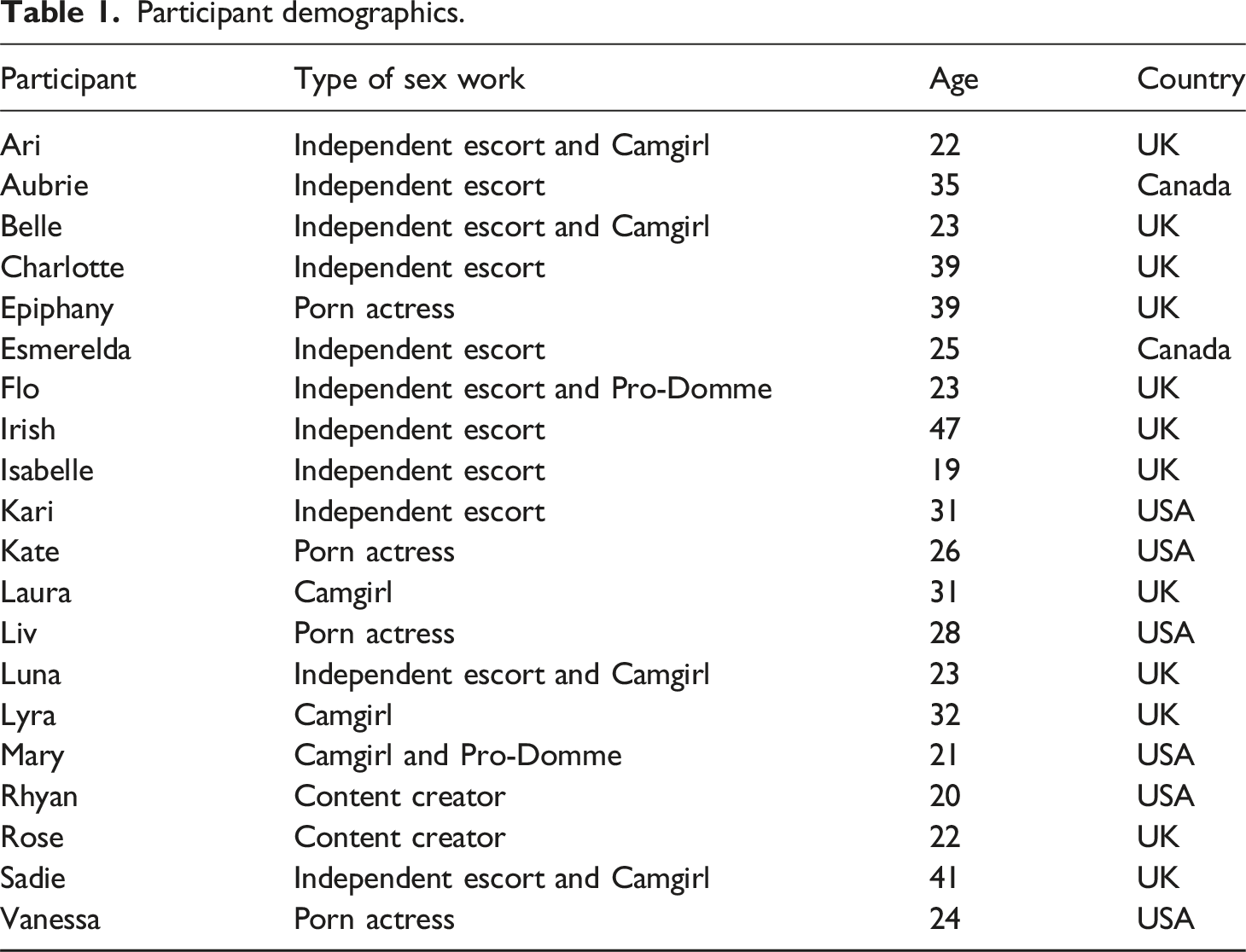
Twenty sex workers were recruited via an advert on Twitter which was retweeted by account owners who regularly post on the topic of sex work. Twitter was used as the recruitment tool due to the growing number of sex workers utilising this platform to gain clients and discuss their work (Wang and Ding, 2022). Additionally, as many countries were in lockdown due to Covid-19 at the time of data collection, other means of recruitment (i.e. meet-ups and rallies) would not have been possible.
The advert asked for responses from cis-gender female sex workers who worked indoors or online, in order to recruit a relatively homogenous sample, as is preferrable when conducting qualitative research (Creswell, 2013). Potential participants could follow a link on the advertisement to enquire about the research topic, speak to a researcher prior to the interview and consent or decline to take part.
Participant demographics.
Procedure
The study was approved by [redacted] Ethics Committee.
A semi-structured interview schedule was generated through reviewing previous literature and discussion amongst the research team. The interview covered various elements of the participants’ experiences and focused on entering sex work (e.g. what was your motivation for entering the sex work industry?), disclosure (e.g. since starting, have you told any friends/family about your job?), experiences of stigma (e.g. have you experienced first-hand stigma?) and stigma management (e.g. how do you manage negative responses?).
[Redacted] conducted the first interview jointly and then [redacted] conducted a further 10 interviews on her own and [redacted] conducted a further nine interviews on her own. Interviews lasted an hour and a quarter on average (M = 73 min). Interviews were conducted either by video call (5), audio call (13), face-to-face (1) or via email (1). These methods of collecting data were conducted within the context of the COVID-19 pandemic. The data collected was rich and detailed, in line with Deakin and Wakefields’ (2013) observation that only significant differentiation between online and face-to-face interview is geographical proximity. We approached the work from a constructivist perspective, specifically by seeking to understand participants' experiences as a subjective truth. In other words, we regarded the subject's experience as valid and has meaning despite it being, by definition, a subjective reality. Participants’ accounts were viewed not as reflecting the ‘true’ nature of things, but as being a process of creating rather than simply capturing meaning (see Braun and Clarke, 2022). As feminist researchers we were acutely aware that researcher-researched relationships could be considered exploitative (Campbell and Clarke, 2019). To attempt to ameliorate this power imbalance, we invited women to speak as experts through experience and framed the interview as a ‘conversation’.
Interviews were audiotaped and later transcribed manually or using the programme oTranscribe. Participants chose their own pseudonyms and any identifying information in transcripts was removed.
Analytic method
We analysed the data by hand following the six-step method of Thematic Analysis as outlined by Braun and Clarke (2006): immersing oneself in the data, generating codes, identifying themes, reviewing and naming themes and then interpreting the data into the analysis. We first immersed ourselves in the data by reading and re-reading, whilst taking preliminary notes. The first and second author took notes of their first impressions during transcription and again when we worked through the transcriptions together. We then discussed our preliminary ideas and looked closer at the data on the following readings. We identified what we considered to be interesting elements of the data and ascribed codes to them. These codes were then organised to identify themes that were felt to best capture the participants’ experiences and spoke to the research question. We used an inductive approach in which themes were actively constructed from the data (see Braun and Clarke, 2022 for further detail).
Reflexivity
The authors have personal interest and experience in advocacy around the de-stigmatisation of sex work. All three authors were white, upper working, to lower middle class cis women, with English as our first language, and thus demographically similar to our sample. These insider status characteristics means that we were likely to have a deeper understanding of sex worker culture than outsiders, and thus may have made assumptions about practices by relying too heavily on our own knowledge. By definition, these assumptions are unconscious and hidden from introspection (Campbell and Clarke, 2019).
We were sensitive to the labour involved with participating in research and particularly research fatigue among sex workers, however, apart from participant Charlotte, an active campaigner and advocate for sex workers, no other participants had previously participated in research.
Analysis
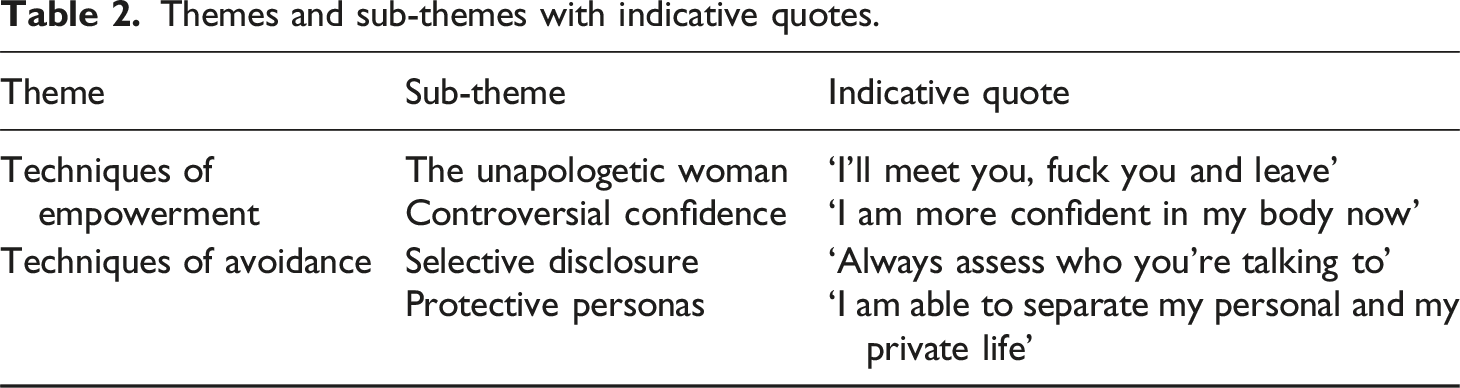
Themes and sub-themes with indicative quotes.
Techniques of empowerment
In our interviews we found that some sex workers gained a sense of power through their work, despite it being viewed generally negatively (Benoit et al., 2017). The sex workers we interviewed did this by rejecting societal views of how sex workers should feel either by focussing on the positives they experience from sex work (controversial confidence), or by cognitively challenging the assumptions underlying the stigmatising attitudes (the unapologetic woman).
The unapologetic woman
Most participants indicated pride in sex working, were unapologetic about their job, and enjoyed capitalising from a stigmatised occupation. Grant (2014) states that sex workers should not be expected to defend the existence of sex work – something that is very much echoed through our 'unapologetic woman'. These women did not defend or apologise for their work, nor their attitudes towards it, they just were, in a world that they perceived often to prefer they were not. These participants claimed independence by reversing the traditional patriarchal power dynamic (which assumes women are subservient to men) to flip gender roles and reject the societal views that determine them as vulnerable victims. This view was exemplified by Irish’s approach to her work: ‘I’ll meet you, fuck you and leave’ (Irish, 45, Independent Escort). Interestingly, ‘fuck’, an active verb, is used as opposed to ‘have sex’ or ‘sleep with’: terms that hint at a collaborative effort. The word ‘fuck’ is noted as having connotations of male aggression and supremacy (Hobbs, 2013; Schubart and Gjelsvik, 2016). Through Irish use of ‘I’ she was not saying ‘we’ will fuck, she dictated the action, saying ‘I’ will do this action to you, not for you, or with you. Thus, Irish’s choice of language indicates that placed herself as hierarchically superior, she was the epitome of our ‘Unapologetic Woman’.
Irish indicated her attitude further when asked if she had ever experienced sex work stigma directly: Yes! This was like last year, I had a hook up with some guy, […] it came out, ‘Oh, I’ve done sex work recently’, and he literally backed away in horror, kind of scrambled away. [I kept saying] ‘Do you think you might be whorephobic?’ […] I kept saying whorephobic as many times as I could to make him as uncomfortable as I could [laughs]. (Irish, 45, Independent Escort)
By labelling her partner as ‘Whorephobic’ Irish redirected the shame towards him instead of herself (Sundén and Paasonen, 2018). This shame and disquiet often comes about when sex workers become visible (Smith and Mac, 2018), leading to Irish’s need to utilise stigma deflecting techniques to redirect the shame. Easterbrook-Smith (2022) has explained that there is often a discourse whereby those sex workers who face a disproportionate amount of stigma are blamed for their own ill-treatment. For example, by being visible to public retribution, outdoor workers, or even those that shamelessly announce their involvement in sex work, face higher stigma.
This technique of redirecting towards the male clients by Irish was also demonstrated by Flo when describing how she reacted to encountering clients outside of her escorting environment: One of them actually tried to speak to me once, and he was like, ‘Oh you know you’ve got a really familiar face’. And I was standing there like, ‘Go on. Go on. Say it’ [laughs] […] And I’ll be honest I like it when that happens. I like having that power to make people squirm. (Flo, 24, Independent Escort, and Pro-Domme)
Flo reported reacting shamelessly when clients identified her outside of her work. One might anticipate that Flo would feel nervous and insecure when being recognised. However, Flo reversed the client/sex worker power dynamic to position the client as inferior in the interaction. She claimed to enjoy making her clients feel uncomfortable outside of work. Vanessa, had the same approach where she deliberately confronted people who hold negative attitudes towards sex work: I just don't let it [stigma] bother me, and I try to do the reverse and throw it back in their face a hundred times harder and really upset them [laughs] […]. ‘You don't like me? That's fine. I don't care. I'm just going to make you hate me more!’ […] just try and shut me down, you know? [laughs] I’m almost kind of looking for a fight [laughs]. I swear, I just try to throw it more in their face because it's fun. Like, if you're gonna be so closed minded about something, like, if it's going to upset you, I'm going to make it upset you. (Vanessa, 24, Porn Actress)
Much like Irish and Flo, Vanessa switched the site of stigma from herself to the people who object to her profession. In this case she denigrated their ‘closed mindedness’.
Irish, Flo and Vanessa responded to stigma through being unapologetic about their work and by redirecting stigma towards the people from whom it originates. Ira Levine, a long-time adult industry worker, explained that sex workers have an added benefit of the 'freedom of being a leper' – where there is an advantage to sex work, in the form of being viewed as past social conformance (Chapkis, 1996). This rejection of stigma is what we have termed ‘The unapologetic woman’.
Controversial confidence
Under the wider theme of ‘techniques of empowerment’, ‘controversial confidence’ builds on the technique of ‘unapologetic woman’ by not just challenging and neutralising stigma but actually positioning sex work as something positive. Much literature on the topic reports that sex workers have low self-esteem and low levels of confidence (e.g. Carrasco et al., 2016; Sallmann, 2010; Wong et al., 2011). Limited research reports sex workers experiencing positive outcomes from their profession (Benoit et al., 2017; Romans et al., 2001). Yet, many of our participants reported that doing sex work made them feel more confident rather than less. This was conveyed by Luna: ‘…then you get the “oh you're a slut” and I'm like “yeah I am, my name is literally Luna the Slut” [laughs] [...] I'm a proud slut! I'm a dick sucking queen and I will make you cum. A slut [laughs]’. (Luna, 23, Independent Escort, Camgirl and Content Creator)
Luna highlighted typically negative characteristics as assets rather than liabilities (Logie et al., 2017) reversing the power dynamic. This is discussed in a popular blog run by a sex worker under the name ‘Graceyswer’ who details the struggles of sex work through her own experiences: ‘I realised that being called whore wasn’t really that effective anymore, and my reply was more along the lines of “yeah, and what, mate?”’ (Graceyswer, 2020).
Our data suggests that the common conception that negative judgements necessarily impact sex workers is not always the case. Luna’s shameless confidence signalled that she rejected the negative connotations of being labelled a ‘slut’ and instead embraced the term, she felt that she was a ‘queen’, and ‘proud’. Other interviewees might not have put it so starkly, but they still indicated that they had positive views of themselves: ‘…like the people who you were so worried about judging you, you also realise everybody is in their head about that, and at some point it just doesn't matter anymore. [...] I have this conversation with my mum too, when she was being very [anti-sex work] and judgemental about some things, and I was like, “I really like myself.” Not in a conceited way but, I think I'm a good person, and if you don't want to know me, you're going to miss out’. (Kate, 26, Porn Actress)
By stating that other people’s opinions do not matter ‘anymore’, this implies that gaining ‘controversial confidence’ was a process of growth for Kate. Similarly Epiphany stated ‘porn makes you feel good about yourself, and I always find myself feeling extra sexy and walking around with a spring in my step!’ (39, Porn Actress). These participants demonstrated an unapologetic attitude towards sex work and a form of confident, positive attitude that has rarely been reported in previous research.
Techniques of avoidance
Due to the stigmatisation that sex workers receive, many choose to try to avoid the repercussions, both psychological and practical, by avoidance tactics, either by selectively disclosing to friends and family, or by constructing an alternate persona (Pachankis, 2007). Similar to ‘techniques of empowerment’, ‘techniques of avoidance’ has two sub-themes which share similarities due to both being avoidance measures: ‘selective disclosure’ is choosing whom to disclose to and what to disclose about, ‘protective personas’ involves psychological compartmentalising.
Selective disclosure
By sex workers deliberately concealing their profession, they can potentially ‘pass’ (Koken, 2012). Ma and Loke (2019) found that concealing sex worker identity reduced, if not eliminated, gossip, shame and embarrassment. Selective disclosure, as the term suggests, reflects the fact that decisions to reveal sex worker status are usually not ‘all or nothing’ acts. This has also been found for other marginalised communities, such as LGBTQ+ people, (Feinstein et al., 2020) whereby the positives of disclosure are weighed against the negatives (such as increased targeting). Sex workers may reveal their status to some people and not others, and they may claim to be doing less stigmatised types of sex work than they are actually engaged in. In the literature on LGBTQ+ people’s stigma management this can be known as ‘outness level’ (Balsam and Mohr, 2007: p.307). I've told my friend that I met the guy, but I told all of my other friends that I just do camming. I've not told any of them that I have you know, performed sexual acts on a guy for money. I've just kept it as a screen, I haven't told them that I do it in person. (Belle, 24, Independent Escort and Camgirl)
Belle clearly demonstrated active engagement in a protective strategy that avoids stigmatisation for the part of her profession that society perceives as more taboo. She was clearly aware, even if not consciously, of the concepts underlying the previously discussed ‘whorearchy’ (Fuentes, 2022). This links to Easterbrook-Smith’s (2021) concept of ‘conditional acceptance’. Where, despite sex work being stigmatised generally, there is a certain amount of acceptance for less visible forms, or via forms of sex work that require less contact with clients, as where Belle admitted camming, but not full service.
Luna also described situations in which the hierarchy of sex work has factored into decisions around selective disclosure: ‘[My mum] knows that I do Onlyfans [a subscription-based online camming site] and videos and camming. I haven't told her that I do escorting because she is very old school. She'd still love me, but I know it would hurt her, so I haven't bothered to tell her’. (Luna, 23, Independent Escort and Camgirl)
Here, Luna perceived escorting as less socially acceptable than content creating. This signals that sex work stigma is not present or absent, but can vary according to the type of work, and that sex workers are well aware of that distinction.
Although participants navigate sex work stigma through selective disclosure to avoid negative judgement, other participants found this difficult and experienced negative emotional consequences. One participant said, ‘I had to lie about my job before […] but I hate it, I fucking hate it that I have to lie!’ (Sadie, 41, Independent Escort, Content Creator). Another participant similarly reported, ‘I love my job so the fact I can’t tell anyone fucking sucks’ (Mary, 21, Pro-Domme). Both participants clearly felt that selective disclosure is restrictive, Mary particularly wanted to be able talk about the positives of her profession.
Protective personas
Another technique of avoidance that many participants successfully implemented was to create a separate psychological identity for their sex work. Research suggests that sex workers have their every-day, non-work identity (personal persona) and their sex-worker identity (work persona) (Benoit et al., 2017; Sanders, 2005; Weitzer, 2017). Most participants discussed some type of separation in identity, but it was noticeable that not all executed it to the same degree. Some participants created an entirely alternate persona that allowed them to disassociate from work ‘I order lingerie for Belle. I love lingerie, but they are Belle’s’ (Belle, 23, Independent Escort and Camgirl). Others used their work persona as a costume: ‘I instantly become an actress and realise that I have to keep a mask on whilst working’ (Ari, 22, Independent Escort and camgirl). Some participants recognised that they had two personas and although these are used for different aspects of their lives, they overlap and work together: ‘It’s me, just a bit more!’ (Sadie, 41, Independent Escort and camgirl).
Our participants used different practical strategies to enact their sex-worker persona. Kari wrote stories about polyamory and sex work to destigmatise these topics to readers. In these she used her own experiences to inform the stories, but wrote under a pseudonym to distance herself from the character: Erm, yeah, I’d say the loneliness is certainly a factor [in sex work]. But I felt a lot more of that before I created my pen-name […] I was like, okay I can’t, erm, talk about this with just anyone, but I do have to talk about it. And so, it kind of became like, a lifeline to erm, connect with the community. (Kari, 31, Independent Escort)
This hints at the multiple, often contradictory functions of pseudonyms. Rather than creating distance, Kari’s use of a pseudonym enabled her to connect with others. Kari’s use of the term ‘created’ rather than ‘started using’ shows how the process was deliberate. Many workers place extreme care and thought into their names, having meanings or links associated with them (Allen and Wiles, 2015). Barton (2006) found that exotic dancers separated their real self from their stripper self through stage names. Construction of a persona involves more than just a name though. In Sadie’s case there were marked differences between her personas: Sadie has it easy but [real name] not so much. […] Sometimes I can't be bothered to work, but that's when Sadie kicks in and takes over [real name]'s issues and basically says 'get your ass into gear, you won't make money if you're not there!' And I like having that persona, I'm able to separate my personal life to my private life and it's actually really nice because one persona takes over at different times. Sadie is very much me but more flirtatious and outgoing. It's just me, but a bit more! And Sadie just has that extra flirtatious side and has more confidence! (Sadie, 41, Independent Escort and Camgirl)
For Sadie, her working persona was ‘a bit more’, and possibly by default, her ‘real self’ is actually ‘a bit less’ due to her editing out aspects of her identity. Thus, sadly, people in Sadie’s life who are given access to only one of her personas are missing out on her multifaceted nature. Belle went even further in the distinction between her real self and working self: So obviously, Belle is my sex worker name, and then I’ve got my real name, so yeah so, I think being able to separate the two things, you know, like, I do see it as it being Belle and [real name]. And, so when I get dressed, to go and meet a guy, Belle wears Belle’s clothes, and I order lingerie for Belle. I love lingerie, but they are Belles, that’s what Belle wears, and, [real name] wears different because, you know, we’re two different people. And if something bad happens to Belle, that’s a different part of my brain that deals with those issues and I have this stronger and more powerful persona when it comes to Belle so it’s much easier. (Belle, 24, Independent Escort and Camgirl)
As noted in the introduction, Sanders (2002) described this as ‘deep acting’. It is ‘deep’ because it relies on a whole different person, identity, personality, even expression (e.g. different clothing). Belle made a biological distinction between her two personalities: ‘that’s a different part of my brain’, which goes a step further than the psychological distance explained by Hochschild (1983) in which depersonalisation is simply a method of distancing one's emotions while on the job. Belle’s language: ‘different’, ‘separate’ and ‘dissociate’, furthers this physical distinction, drawing on work by Goffman pertaining to the frontstage and backstage self. Belle held two identities in which to perform emotional and erotic labour.
Discussion
We were interested in seeing how sex workers managed stigma in general. We were particularly interested to see if, alongside avoidance strategies, we would also see strategies which resisted and rejected stigma. Our data supported previous findings that sex workers weigh up the risks and benefits of disclosing their profession (Benoit et al., 2017; Weitzer, 2017), which we term ‘Techniques of avoidance’, namely the use of secrecy and multiple identities as stigma navigation strategies. However, our participants reported using what we term ‘Techniques of empowerment’ to a greater extent than previous research has documented. It should be noted that all of these techniques require emotional labour (Hochschild and Machung, 2012).
Despite the scale of the sex industry, sex work is shrouded in secrecy (Pateman, 1999) and sex workers’ use of avoidance techniques to avoid stigma contributes to this continued secrecy/shrouding (Koken, 2012). Of course, many sex workers do not enjoy the privilege of being able to view their work as political or transformative (Perrucci, 2000). It is unsurprising that sex workers use selective disclosure since, by establishing clear water between the sex worker and others, it is the safest technique for avoiding judgement. Coming out and passing strategies have been well recognised as stigma management techniques used by other minorities (e.g. Owens, 2017). However, our participants reported a nuanced approach to disclosure which was not ‘all or nothing’. They were obviously aware of the subtle nature of ‘whoreachy’ and chose to reveal their involvement with different types of sex work to different people in their social and familial circles. This demonstrates that decisions about disclosure are not simple yes/no decisions which in turn imply that there is an emotional labour toll to be felt from this ‘dance of disclosure’. Interestingly, our participants did not speak about this as a drawback, almost as if they saw it as necessary to such an extent that it was not seen as a burden.
Another avoidance technique which we identified in our participants’ accounts was the use of psychological barriers. In addition to separating themselves from others by selective disclosure, they separated different aspects of the self internally. The sex workers we spoke to shifted between these personas quite fluidly. This technique has been identified in sex worker’s repertoires before, for example, Robillard (2010: 537) called it a ‘second set of defence parameters’. Not all our participants talked about this, however, some seemed to aspire to a ‘singular, authentic selfhood’, an aspiration observed by Simpson and Smith (2021) in their work with student sex workers. It may be that this reflects a younger, more aggressive, militant approach to sex work which leads us to talking about techniques of empowerment.
Many of our participants talked about how, rather than trying to avoid stigma, they resisted it and even experienced positive repercussions as a result of their profession. There is a prominent narrative which paints sex workers as vulnerable, disempowered women, and yet, participants such as Irish perceived their clients to be hierarchically below them. This perspective positions sex-workers as the wielders of power (Huysamen, 2019). We note, however, that sex work is fundamentally a job, not a mode of empowerment. Our participants noted the irony that no-one would ask retail workers, cashiers, or builders if they were empowered in their jobs. Thus, although at first glance an empowerment technique appears to resist stigma, it is inherently stigma-based.
Chapkis (1996: p.20) has stated that, ‘To act defiantly from within the sexual order by making subversive use of that culture is understood to be impossible’. However, this is arguably what is attempted by the participants in the study, whereby they repel the stigma imposed on them, by being unapologetically confident about the work that is so stigmatised by society. Comparing our findings with research on other stigmatised minorities, Logie et al. (2022) conducted a scoping review to document if and how empowerment-based perspectives were included in studies related to race, gender, HIV and sexual orientation. They found that a minority of studies looked at empowerment-based factors, and when they did, they tended to focus on more individualised and less aggressive techniques of seeking social support or cultivating psychological resilience. Logie et al. suggest the stigma research field would benefit from considering expansion of empowerment strategies to include activism and solidarity. We would advocate for including even more militant strategies of unapologetic and defiant resistance.
By embracing agency in this way, sex workers are able to uncover and subvert the messages of exploitative structures (Kempadoo and Doezema, 1998). They transcend the stereotype of being sexual objects for men's pleasure (Erchull and Liss, 2014) and are instead sexual beings with economic resources and social mobility (Rivers-Moore, 2010). This is not to say that these women are empowered by sex work, but instead that they are using sex work as a vehicle of empowerment.
By these women openly rejecting the ‘rescue industry’ (Smith and Mac, 2018), and desiring to be left alone (Pascoe, 2019) they lose their victim status and ideological sympathy (Pheterson, 1993). This somewhat complicates the power debate surrounding sex work, whereby those involved are not ‘disempowered sisters’ (Van der Meulen, 2013: p.87) in need of rescuing, but are instead unapologetic women who do not see themselves as needing saving.
The final observation about our participants’ responses that we wish to discuss is a particularly positive one. We noted that, rather than seeing sex work as a necessary evil, the stigma of which needed to be mitigated through avoidance or refutation, many of our participants saw sex work as a source of personal pride. Participants reported feeling increased confidence in their skills, their bodies and their personalities as a result of involvement in sex work. Although this is less discussed in the literature than negative impacts, it has been observed by some other researchers (e.g. Koken et al., 2004).
It was notable that many of our participants approached the interviews with a lot of humour. Vanessa (24, sex worker) laughs at people who try to impose their ‘close-minded’ views upon her. This is not simply a coping strategy (Sanders, 2004), it is an expression of confidence and ease with her chosen occupation. This confidence, while we’ve termed it ‘controversial’ because it contradicts the dominant narrative of sex work, can and should be interpreted as a feminist tactic of resistance to stigma (Sundén and Paasonen, 2018).
Limitations
Much like other researchers who have looked at questions of stigma and sex work (e.g. Simpson and Smith, 2021) it is likely that we found our participants reporting more confidence and positive experiences from their work because of the characteristics of our sample. None of our participants were trafficked or pimped, they were all working in self-directed capacities. Our respondents were all able-bodied, educated, cis-gender women with the attendant privileges those identities bring. They were certainly able to navigate their work in ways not available to all sex workers and thus techniques were available to them which are not available to other sex workers.
Participants were recruited from the UK, Canada and North America thus their experiences, and how stigma has impacted them, may not necessarily translate to other countries where attitudes, and indeed laws, may be different.
Future research and implications
Globally, sex worker organisations advocate for rights and recognition for their members (Parent et al., 2013). Research has found that the more empowered sex workers feel, the more likely they are to be able to advocate for themselves and their colleagues (Benoit et al., 2017). Legal and societal empowerment goes hand-in-hand with individual empowerment. It is interesting that none of our participants reported learning stigma management techniques from the many third sector organisations that exist to support them. It may be that these organisations are very effective at advocating for their members at macro levels, but there is a lack of training offered at the personal level. We looked at a number of UK and US based organisations and saw that they offer a variety of support such as legal help, political advocacy, sexual health help or signposting for sex worker friendly counselling. This all seems to be restorative rather than preventative strategies. In other words, these strategies seem to be focussed on supporting sex workers to deal with the effects of stigma, rather than avoid stigma in the first place. The coping strategies that we have identified in this paper seem to be overwhelmingly developed on the basis of personal experiences. We would advocate for organisations to consider how to equip their individual members with tools to manage the stigma which they will invariably face, whilst acknowledging that this is no small task for marginalised individuals themselves, who form the majority of the staff of these organisations, to perform.
As noted, our sample were relatively privileged due to their identities, we would be interested to see if the same stigma management techniques are found in male and trans sex workers.
Conclusion
In highlighting the roles of selective disclosure and alternative identities our research mirrored much of the existing research on sex workers’ management of stigma through the use of avoidance tactics. However, alongside those avoidant techniques we found evidence of resistance, both in the form of a lack of apology, and in confidence derived from engaging in sex work. These findings oppose discourses that position sex workers as victims lacking in agency. Instead of painting a grim picture where targets of stigma are doomed to lives of disappointment and despair (Shih, 2004), our participants reported being able to side-step, resist and reject stigma.
Footnotes
Declaration of conflicting interests
The author(s) declared no potential conflicts of interest with respect to the research, authorship, and/or publication of this article.
Funding
The author(s) received no financial support for the research, authorship, and/or publication of this article.

Data Availability Statement
Due to the confidential nature of the interviews the authors regret to say that raw transcripts are not available.