




Abstract
There has been an increase in discussion concerning the integration of sexuality education and the prevention of sexual violence. Furthermore, this is a concern at the level of different pedagogical professions in Germany, since sexuality education and sexual violence prevention have developed as largely separate fields. Both sexuality educators and sexual violence professionals work with a broad target group to prevent sexual violence, including children, young people, as well as parents and professionals working in social work or education. They collaborate at times, but they also engage in debates about their respective pedagogical approaches. Based on group discussions with 12 teams specializing in the two fields, this article analyzes how their tacitly shared knowledge (collective orientation) underpins their different pedagogical strategies. This should be considered to improve their long-term inter-professional cooperation.
Introduction
Several scholars from countries including Australia, New Zealand, the USA, and Germany argue against the need to separate education about sexuality and sexual violence (Cameron-Lewis and Allen, 2013; Carmody, 2015; Kavemann, 2016; Lamb, 1997). So far, studies have focused on conceptual issues and the development of programs for young people that integrate sexuality education and sexual violence prevention (Cameron-Lewis and Allen, 2013; Carmody, 2003, 2015; Carmody and Ovenden, 2013; Fava and Bay-Cheng, 2013; Lamb and Plocha, 2011; Lamb and Randazzo, 2016). Additionally, some of the public health literature also addresses programs, whether labeled as sexuality education or prevention interventions, by scrutinizing the effects and mechanisms of a gender critical approach to the prevention of intimate (sexual) partner violence among youth (Haberland, 2015; Lowe et al., 2022; Makleff et al., 2020). However, there is a dearth of empirical studies that employ a comparative approach and specifically focus on sexuality educators or professionals with expertise in sexual violence (Beres, 2019; Marine and Nicolazzo, 2020). Given that sexuality educators and professionals who have expertise in sexual violence implement programs and train other professionals, including teachers, gaining a comprehensive understanding of their perspective on the relationship between sexuality and sexual violence is crucial. Therefore, this article aims to expand the discourse by investigating the distinct professional milieus of sexuality education and sexual violence prevention 1 in Germany. It does so through analyzing the differences in perspectives of the two professional groups as a factor influencing conceptual advancements and inter-professional cooperation.
At the practitioner level, there have been tensions between sexuality educators and sexual violence professionals in Germany for quite some time, resulting in mutual criticism. These tensions surfaced at the 2017 ‘Sexual Pedagogy Meets Prevention of Sexualized Violence’ conference in Frankfurt. There, Kavemann, a renowned researcher in the field of sexual violence, identified the key issue: perceived sexual hostility by sexual violence professionals and risk trivialization by sexuality educators. She urged to integrate both fields, indicating a conceptual gap. A challenge that Henningsen, a scholar in sexuality education, also acknowledged when trying to align protective actions with sexual empowerment (Neutzling, 2017: 19). The practical ramifications of these tensions have yet to be recorded. According to Henningsen (2019), the difference between the two professions is underpinned by the complex relationship between sexuality and violence. In the current study, we empirically address this issue by examining the milieu-bound, implicit orientations of 12 teams that specialize in sexuality education or sexual violence prevention.
We begin our study by outlining the shortcomings, challenges, and programmatic solutions associated with combining sexuality education and sexual violence prevention in various international discussions. We then discuss the development of sexuality education and sexual violence prevention in Germany. The results of our analysis are provided as a typology that illustrates the encompassing abstract orientation pattern for each professional milieu, along with differences within each milieu through subtypes. Moreover, it was guided by the notion that sexuality and sexual violence are ‘sensitizing concepts’ (Blumer, 1954: 7). As opposed to starting from defined terms, we tried to determine the milieu-specific patterns in which the participating teams deal with sexuality and sexual violence. However, our prior knowledge is based on a broad concept of sexual violence, which includes unwanted sexual advances, rape, and abuse, and is applicable to various constellations and contexts (e.g., relationships, families, organizations).
Sexuality education and prevention of sexual violence or sexual abuse: Critique and claims
Sexuality education is often criticized for emphasizing the prevention of sexually transmitted diseases, unwanted pregnancies, and sexual assaults (Allen, 2007; Bay-Cheng, 2003). The exclusive focus on risks, especially on offending and victimhood, is considered problematic because it ignores the complexity of sexual relations as well as the connection between pleasure and danger (Fine and McClelland, 2006). Additionally, Lamb and Plocha (2011) argue that sexuality education curricula fail to address sexual abuse and coerced sexual acts beyond providing resources to victims. They argue that these curricula are particularly suitable for educating students about both sexual abuse and pleasurable sexuality. According to Fava and Bay-Cheng (2013), sexuality education does not adequately meet the needs of adolescents who have experienced childhood maltreatment such as sexual abuse, and trauma interventions do not promote positive sexual development.
However, promoting desire and pleasure as a part of sexuality education is assumed to be empowering, especially for girls and women (Fine, 1988; Tolman, 2002). Nevertheless, promoting pleasure is also associated with a normative trend. Allen and Carmody (2012) criticize a limited view of pleasure as mere physical sensations and acts, which can lead educators to teach standardized ways of approaching it. Additionally, the notion that there is a necessary relationship between sexual pleasure and empowerment fails to consider that corporeal pleasure can also be associated with experiences of sexual abuse (Allen, 2012).
According to Carmody (2003: 199), prevention strategies in Australia and other Western countries have emphasized the importance of ‘women managing the risk of the unethical behaviour of men.’ She argues against essentialistic gender stereotypes and suggests that the dominant gender order should be regarded as both restrictive and fluid towards the relationship between women and men, as well as between adults and children. By promoting ethical relationships based on Foucault’s notion of rapport à soi, she links prevention of sexual violence with sexuality education for youth (Carmody, 2015; Carmody and Ovenden, 2013). Several other scholars have proposed similar approaches (Cameron-Lewis and Allen, 2013; Lamb, 1997; Lamb and Randazzo, 2016).
Development and current state of sexuality education and sexual violence prevention in Germany
In Germany, sexuality education and sexual violence prevention have diverged into largely distinct professional domains. Kavemann (2016: 3–4, authors' translation) observes that these two areas have been ‘separately negotiated,’ making ‘harmonization’ difficult. Similarly, Sielert (2018: 64, authors' translation), an influential sexuality education scholar, characterizes the situation as marked by ‘fear of contact’ and ‘alienation.’ These characterizations can be substantiated when assessing both fields’ developments.
Sexuality education began to institutionalize in the 1980s, largely driven by the need to prevent sex-related risks, specifically AIDS, unwanted pregnancies, and child sexual abuse. Despite this, as Sielert (2015: 11, authors' translation) highlights, a paradigmatic shift toward a ‘sex-friendly’ approach—as opposed to a repressive one—took root as a consequence of the liberalization prompted by the sexual revolution. In retrospect, a notable side effect of this programmatic trend appears to have been difficulties in addressing sexual violence. For example, the Institute for Sexual Pedagogy, established in 1988, struggled with addressing sexual violence, initially excluding it, then treating it as a special topic, before finally integrating it as a regular part of the curriculum (Schmidt et al., 2017: 300–302). Moreover, sex-liberal, pedagogical discourses of the 1970s to late 1980s have recently faced criticism for portraying sexuality in exclusively positive terms, failing to reflect power structures, and reducing violence to merely physical acts (Baader, 2017). Endeavors to prevent the reduction of sexuality to its associated dangers have remained a vital part of professional discourse. Notably, the ongoing public discussion of sexual violence in educational and church institutions since 2010 spurred professionalism in sexuality education, while triggering concerns about maintaining the sex-friendly approach (Henningsen, 2019; Schmidt et al., 2017; Sielert, 2014).
There are various sectors of the education system where sexuality education is provided now, including day care centers, schools, children’s services, and continuing education institutes. Various organizations run such programs, including ‘pro familia,’ the leading non-governmental organization in the field of sexual and reproductive rights, as well as non-governmental welfare organizations such as ‘Arbeiterwohlfahrt’ and ‘Caritas’ (Ketting and Ivanova, 2018). A 2013–2014 survey of sexuality educators found that, despite sexual violence being perceived as a dominant social issue, their work focuses on ‘sexuelle Bildung’ (Henningsen, 2016). This concept means ‘accompanying the sexual socialization of individuals of all ages, focusing on enabling sexual and reproductive self-determination’ (Böhm, 2022: 33, authors' translation). It emphasizes the positive aspects of sexuality rather than risk mitigation (Valtl, 2013).
In the area of sexuality education, sexual violence prevention has been receiving increasing attention; however, it originated as part of the movement against violence against women and was pioneered by self-help groups. Since the 1980s, sexual violence against girls within families has been increasingly observed, resulting in the establishment of specialized counseling centers. There has been an increase in the identification of boys as victims in the following years, and other settings and target groups have followed (examples include sexual violence within institutions, among children and adolescents, as well as against individuals with disabilities) (Gebrande, 2017; Kavemann et al., 2016). Although most counseling centers offer prevention services today, only a few specialize exclusively in prevention (Kavemann and Rothkegel, 2012).
A major contribution of second-wave feminism has been the recognition of sexual violence as a ubiquitous phenomenon embedded in social power relations. Nevertheless, feminist concepts of sexual violence were also criticized, since they were considered anti-pleasure (Kavemann et al., 2016). Moreover, Lenz (2010: 770–771) observed that the critics interpreted the fight against sexual violence as restricting sexual freedom. The feminist perspective, however, emphasizes the distinction between sexuality and sexual violence. Glammeier (2018) argues that this change caused several prevention and training programs to lose sight of the link between sexuality and sexual violence. Nevertheless, there have been increasing efforts to include sexuality education in preventive measures and programs (Kavemann, 2016; Kavemann et al., 2018).
Methods
This study investigates sexuality education and sexual violence prevention as distinct professional milieus through group discussions with expert teams. Data were collected and analyzed using the documentary method (Bohnsack, 2014b, 2017), which roots in Mannheim’s (1952, 1982) sociology of knowledge. Mannheim, notably, cleaves to a radical understanding of the social determination of knowledge, claiming that ‘all knowledge becomes existentially determined’ (Remmling, 1961: 23). This means engaging in everyday life in specific socio-historical contexts, including various professional environments, structures our knowledge of the world. Adapting Mannheim’s principles, Bohnsack devised the documentary method to uncover milieu-specific perspectives typically opaque to outsiders (for an English introduction see Bohnsack, 2014a, 2018; Philipps and Mrowczynski, 2021). The method aims to understand the ‘internal logic of unknown milieus’ (Bohnsack, 2018: 205), or ‘collective orientation,’ a concept ingrained within milieu members yet difficult to articulate due to deep habitualization. To analyze these implicit perspectives, Bohnsack employs Mannheim’s principle of understanding a specific cultural entity not simply in and of itself (objective meaning) but also as an expression of a viewpoint (documentary meaning). This approach involves exploring the habitual commonalities within a milieu, revealed in everyday interactions like conversations. Accordingly, this paper does not take the accounts of the participating sexuality education and prevention teams at face value. Instead, it considers them as milieu-specific constructs, aiming to explore their shared viewpoints and the inherent logic behind their depictions of sexuality and sexual violence.
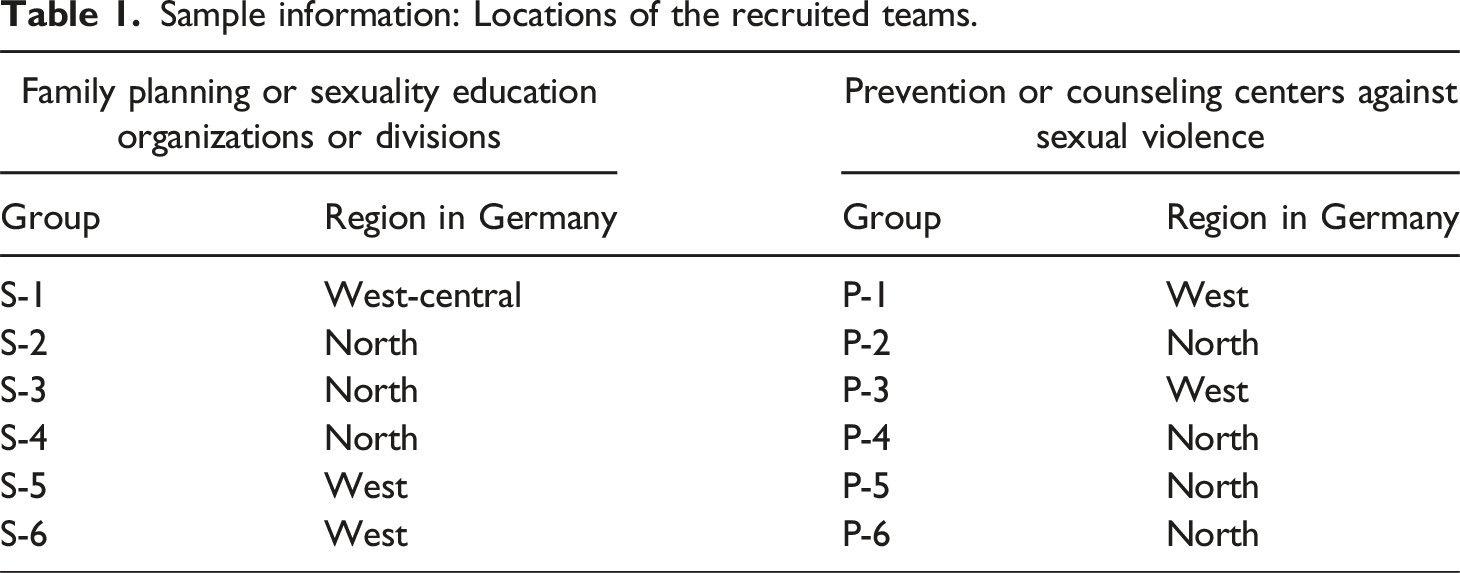
Sample information: Locations of the recruited teams.
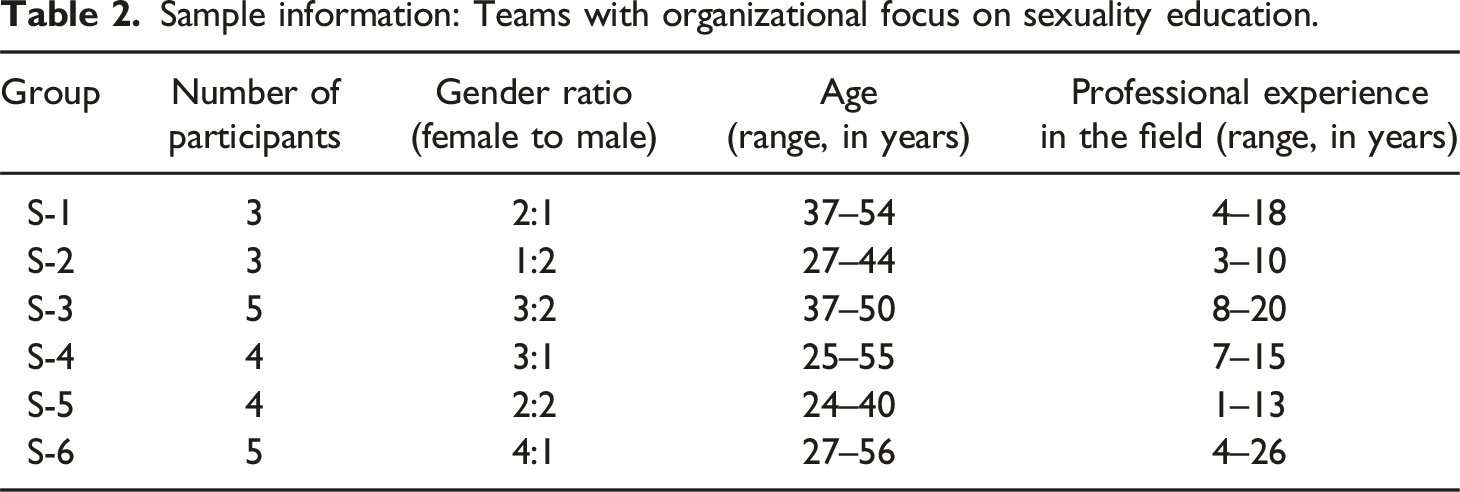
Sample information: Teams with organizational focus on sexuality education.
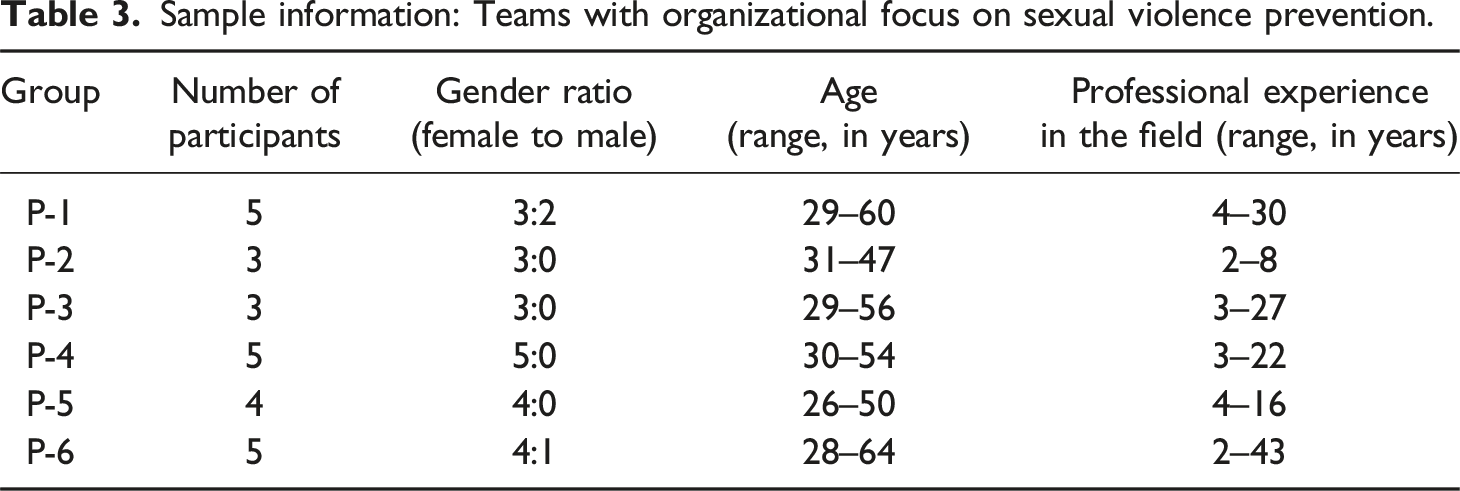
Sample information: Teams with organizational focus on sexual violence prevention.
The group discussions took place at the respective organizations’ premises. Using a semi-structured guideline, the groups were encouraged to engage in a naturally flowing conversation. We began with an open, unspecific request (“tell us about your work”) and intervened only with questions directly related to the ongoing conversation (immanent questions). This initial stage was designed to allow team members to discuss issues important to them. We then posed more specific (exmanent) questions regarding working methods, professional fundamentals and beliefs, professional identity, the institution and the profession’s history, and their educational background. This second stage addressed the topics we deemed relevant. The group discussions, lasting approximately 2 hours on average, were transcribed verbatim and pseudonymized. Sociodemographic data of the participants were collected through a short questionnaire.
The transcripts of the discussions were analyzed using a three-step procedure in line with Bohnsack’s (2014b) guidelines. First, all topics raised in the discussions were sequenced chronologically, and particular sections exhibiting a high level of interaction as well as detailed and vivid descriptions were identified. These ‘focusing metaphors’ (Bohnsack, 2010: 105) indicate collective orientations most conspicuously. From these key sections, discussion segments referring to how the teams address sexuality and sexual violence were selected for detailed analysis. Additionally, passages with thematic relevance were selected. The second step involved sequential analysis of these sections to determine what was explicitly discussed, how it was collectively constructed, and which orientation patterns the accounts indicated. This involved analyzing the researchers’ questions and other interventions, as well as the discourse organization among team members to ensure collective sharing of the orientation pattern (Przyborski, 2004: 47–76; 286–287). The third step entailed a comparative analysis to abstract and specify the structure of collective orientations (Bohnsack, 2007). We compared the sexuality education and prevention teams to abstract types, that is, overarching profession-specific orientation patterns. We also compared them to each other to empirically substantiate differences and characteristics. In a reverse analytical process, we worked out contrasts within each milieu and categorized the teams into subtypes.
In the results section, we present the typology which focuses on the orientation patterns in terms of their structure. Therefore, we do not address how they are interactively produced by the individual teams. Quotations from individual teams exemplify the respective subtype. A student assistant with comprehensive knowledge of both German and English everyday language (JS) translated these quotes in discussion with a project team member (FS). We refined nuances through a re-translation (performed by TG). The quotes in this article were translated into English to allow for comprehensibility. The original German transcript was translated as literal as possible. In exceptional cases where a literal translation would have been illegible, phrasings were chosen that are more readable and understandable, while still reflecting the sense of the original as accurately as possible. Grammatical errors of participants have not been corrected.
To enhance the quality of the research process, two measures were taken, in addition to continuous feedback from the project members (BC, ML, MW, AD) to the team member responsible for interpreting the data (FS). First, the data analysis was conducted in part in an interpretation group, which included both project team members (FS, AD) and non-members. Regular meetings in this group focused on exploiting the diverse perspectives available, helping to unlock the meaning of the data and challenge one-sided interpretations (see Berli, 2021 for an understanding of the functions and practices of interpretation groups in Germany). Secondly, between 2018 and 2021, six meetings were held with the research project’s advisory board, comprising six representatives from the fields of sexuality education and sexual violence prevention. This board critically accompanied the research process and ensured the results were meaningful to sexuality educators and prevention professionals.
Results
Teams specialized in sexuality education: Focus on sexuality as something positive
The orientation pattern of the sexuality education teams emphasizes the positive aspects of sexuality. This affirmative approach towards sexuality is perceived to be a critical component of sexuality education and is designed to empower their clients as sexual subjects. Sexual subjectivity is constructed in distinction to restrictive social constraints and norms. However, the manner in which sexual subjectivity is developed and sustained differs across sexuality education teams. This is reflected in the way they address the issues related to crossing boundaries, assault, and violence. We identified three subtypes for a total of six sexuality education teams. The teams frame sexuality as a pleasurable (3 teams), beautiful/positive (2 teams), or explorative (1 team) experience, and thereby propose specific prevention strategies.
Subtype 1: Bodily pleasure
The first subtype is characterized by framing sexuality as a pleasurable sensation and an intentional act. On an embodied level, sexuality education aims to strengthen an individual’s sexual subjectivity. Therefore, an individual’s sensuality serves as a key point through which socially determined, habitual actions, or gender stereotypes are juxtaposed. Accordingly, pleasure or lack of pleasure provides an insight into what subjects want and do not want.
The close link or interplay between pleasure and intention, as conceptualized by these groups, raises the underlying question concerning the limits of sexual subjectivity. According to them, sexual subjectivity terminates when choices are not available or denied. Moreover, a pleasurable sexuality extends beyond sexual border violations, assaults, and abuse; any ambivalences in this regard remain unaddressed. When conceptualizing crossing boundaries and assault on a pragmatic level, sexuality is primarily conceived from the perspective of the individual: the other party, including their intention, is secondary. The following quote illustrates this point particularly well. To aid comprehension, we offer the following transcription notes beforehand: The speaker codes refer to the participants’ gender, with ‘f’ for female and ‘m’ for male. Pauses of one or 2 seconds are marked by (.), respectively, (..). Capital letters indicate a special accentuation. Broken off phrases are signaled by /. Interruptions and overlapping by another speaker are shown by the symbol └. Expressions in squared brackets are in English in the original German transcript as well. Df: … those are simply fluent things, such a crossing of boundaries. It can actually also start off that a couple maybe/ both would like to have sex, then uh they kind of do petting, and um then kind of go further too, and then one of them might not want to anymore, right? And that then just somehow, too/ is talked about in sexuality education, too, that of course it should be clear that they uh say no and stop. Because, unfortunately, I simply believe that so many adolescents aren’t aware that they’re allowed to. And that they’re allowed to say no and that they just kind of, even when already/ when you’re already kind of at it, you’re still allowed to say no. Af: Even if you said yes at first, you’re still always allowed to say no. Df: └Right? And this, I think, is always a part then. Well, it/ it’s not thematically about, now it’s about sexual violence here, but it’s just also a part of um (.) how do I treat the own body and uh/ Bm: And the other person’s body. That is just also something that I actually bring up with the BOYS quite often that if/ if it’s going too fast or they notice my partner is having pain or they themselves kind of notice they don’t feel good that then, for starters, it’s important to stop, to see how is the other person doing? How am I doing myself? To TALK and then to see what one can still make out of the situation. (S-6)
The examples chosen by this group highlight how the boundaries of the subject and those of the other party should be maintained. In this context, boundary violations are not treated as intentional and aggressive acts, but rather as a conceived lack of embodied sexual subjectivity. In these groups, the ‘subject’ is always conceptualized as an incorporated and sensual one. This is a result of the way they define and identify boundaries through the body (S-3: ‘yours belongs to you, your body, and mine belongs to ME’; S-4: ‘And especially in the area of sexuality […] you should somehow take care of yourself and your body’). The groups emphasize the awareness of physical boundaries as a critical point, where sexuality education and sexual violence prevention converge. However, creating a supportive framework for sexuality is prioritized by encouraging individuals to act according to their own sexual needs and desires as well as to assert their boundaries.
Subtype 2: Fixing a deviation
In contrast to the first one, the two groups belonging to this subtype discuss their educational approach towards clients who have experienced or perpetrated sexual assault or abuse. Despite being included within the category of sexuality as a whole, sexual assault and abuse are considered to be flawed expressions of it. This is reflected by a specific choice of words used: they are described as the ‘shady side’ (S-2) or ‘dark side’ (S-5) of sexuality. While they are acknowledged as a part of sexuality, both groups remain opposed to reducing sexuality to its negative aspects.
In line with the previous subtype, a critique of social discourse on sexuality is shared, claiming that it reproduces restrictive gender stereotypes, whereas, in their view, sexuality education focuses on sexuality as something desirable and empowering, as well as seeks to create an open and joyful educational framework. Consequently, when handling clients who have experienced or perpetrated sexual assault or abuse, it is essential to focus on sexuality as a positive experience.
It is ideal to counter the effects of sexual abuse experienced by female victims by promoting a positive view of sexuality. Both groups consider this is as a corrective stance against the prevailing social discourse. Having a negative perception of sexuality is attributed to a lack of education or negative social influences: Bf: … I also find it um terrible then, when the people who have then experienced some kind of sexual or sexualized violence, also can’t enjoy sexuality positively anymore. Of course, it takes a/ so, um it takes time, it’s a process, but I have the feeling, (.) um like through experience somehow as well, um that the people by what they’re being told in society, what/ what they absorb, think: “Okay, I also CAN’T experience that positively anymore for now. I’m not allowed/ just CAN’T.” (S-5)
Bf’s colleague agrees with her point, while adding that there is less sexual expression conceded to girls and women. This denial is reflected on as the key issue while working with perpetrators: Am: … but um the biggest problem with the assault was that the uh girl wasn’t perceived as a human anymore because women or girls who offer too much sexuality aren’t humans anymore. So, th/ they are an object that you’re allowed to use. Bf: Or want that as well. Am: Yes. And they want that as well. Those are just the things there as well that/ those gender roles that kick in there as well then. (S-5)
The restriction of female sexuality through gender stereotypes is of primary concern in this case. The critique refers to a reversal of a supposedly positive experience of sexuality into a justification for sexual assault. Correspondingly, both groups consider sexuality as ‘beautiful’ (S-2) or ‘open and positive’ (S-5) in order to serve preventive purposes. The purpose of pointing out a desirable ideal is aimed to prevent adolescents from committing assaults as a result of copying ‘crazy ideas’ (S-2) from pornography or disregarding their own sexual desires (S-5).
Both groups focus on an educable subject that should not be left to its own devices or exposed to adverse social influences. The advocacy in favor of a positive sexuality corresponds to the correction of a deviation. Consequently, a positive sexuality provides an ideal representation of what sexuality should be.
Subtype 3: Sexual exploration
While groups of the first two subtypes portray sexuality as a pleasurable, beautiful, or positive experience, one of the groups adopts a broader approach. They believe that public awareness of sexual abuse has led to an out of scale discourse of risks, resulting in inadequate and restrictive safety measures. Thus, they conceptualize sexuality education as a counterbalance to promote a confident approach towards a variety of sexual expressions. This refers to being aware of sexuality as something positive but also taking into consideration its unpleasant or difficult expressions.
This approach is directed toward parents and educators who, out of fear or insecurity, disregard children’s and adolescents’ sexual development. This group believes that focusing on risks can transform expressions of sexuality into problems or even pathologize them as sexual assaults. Conversely, crossing a boundary is regarded as a fundamental aspect of sexual interactions: Af: … that you also say: any type of contact you make with each other can involve crossing a boundary. So the classic is: you can’t kiss somebody/ without passing the boundaries, you/ you’re really CLOSE to somebody. And um not all of these topics will be/ may I/ may I do that, may I do that, will be asked beforehand. That means it belongs to contacts with each other as well to/ to cross boundaries. But, of course, with the question: does the other person want it and/ and how/ how do you react when the other one doesn’t want that? So that means that’s also a part of it. Um and the second thing is that sometimes things can also go wrong but you learn from it and it’s not a sexual assault yet because of that. So it can simply not be so nice sometime, but that doesn’t necessarily mean that it uh wasn’t wanted and therefore has really, really dramatic consequences. And/ um and to just say there that this also belongs to a normal/ corporeality and sexuality (S-1).
This group’s approach is exemplified by Af, who argues that consent cannot be given for every step of a sexual interaction on a practical level. It emphasizes the experimental character of a sexually charged situation, where all possible reactions, including adverse ones, must be taken into consideration. When sexual interactions are conceptualized in this manner, making mistakes is always an option, leading to less comfortable or exciting experiences. In contrast to sexual assaults, these errors are considered to be fundamentally different from intentional harm.
The underlying logic suggests that sexual interactions cannot be defined in advance, but must be explored. Moreover, sexual subjectivity is conceptualized as an exploratory process, not to be regulated beforehand by commonly held assumptions about dangers. This group believes that restricting this process due to preventive measures would result in restriction of sexual development towards a ‘fulfilled’ (S-1) sexual life. In another section of the discussion, this ‘error-tolerant’ (S-1) approach to sexuality is linked to preventive purposes. According to a participant, it is a positive, realistic approach to sexuality that facilitates the identification and discussion of inappropriate behavior.
Teams specialized in sexual violence prevention: Focusing on the relationship between sexuality and sexual violence
While the teams specializing in sexuality education focus on sexuality as something positive, the groups dedicated to sexual violence prevention focus on the relationship between sexuality and violence. In addition to theoretical considerations, it is embedded in the way they promote sexual violence prevention in connection with sexuality education, and vice versa. All teams focus on sexual violence as a social issue that needs to be addressed, since it is often neglected, repressed, or overlooked. Additionally, three subtypes could be distinguished based on how sexual violence was portrayed in contrast to sexuality. There has been an effort to clearly delineate both phenomena (2 teams), discussed as being connected on a socio-structural level (3 teams), or their boundaries are conceived as blurred (1 team).
Subtype 1: Sexuality as a means to power
The two groups of this subtype focus on the fundamental difference between sexual violence and sexuality. According to both groups, sexual violence is characterized by an imbalance of power between the victim and perpetrator, in which sexuality is used as a tool to exercise power. Although both groups find it difficult to distinguish between sexual violence and sexuality, they describe both phenomena as similar in terms of their form. One group, for example, rejects a specific definition of what sexuality should be like: Af: … that’s a construct, I think, um to say it [sexualized violence, authors’ note] doesn’t have anything to do with sexuality. That’s eyewash. […] And it is a difference, though, if it’s a sexual experience where the sexual experience is in the foreground, or else um if it’s a form of violence and where sexuality is used as a MEANS, as a club. Cf: └Hm (approving). Af: Right? (.) Right. Cf: I was just about to say, too, when you said, somehow it’s about power and dominance. Power and dominance can also be consensual and sensual but uh/ Af: └Yes. └Exactly. (laughing) Because that’s where it gets exciting (laughs). Cf: Uh here it is just clearly about violence as well, right? About when someone Af: └Yes. Cf: clearly says, “no” or has “no”-feelings or is being tricked and that is the big Af: └Yes. └Yes. └Yes. Cf: difference there. Af: Yes and I think that is that where it mixes together too. So, that is um (..) I mean, hm (pondering) hold on, when when when people who come from child protection, like us, from that perspective say um it is uh violence with sexual means, then behind that lies a/ a/ a concept of a good sexuality that is loving, that is um, yeah, tender or [soft], and/ so I/ I’m just talking now Cf: For/ for/ Af: as it’s coming into my mind, right. Cf: For me it’s only consensual period. Af: Yes. Bf: └Yes (laughs). Cf: How ever you do it, the main thing is (laughing) you agreed on it that you both Bf: └(laughs) Af: └Yes. Yes. Cf: want that. Bf: └I think to myself/ I think to myself too too/ Exactly. (P-3)
As the quote indicates, it is not exclusively a loving, soft, and gentle sexuality that could be promoted as an antidote to sexual violence. In contrast, the group’s approach towards sexuality is not necessarily determined by a specific concept of sexuality. Power and dominance can be legitimate aspects of sexuality if sexual interactions occur within a consensual framework or, as the other group of this subtype puts it: if it is ‘self-determined’ (P-1). In other words, inflicting pain or humiliation, for example, is not considered to be a sexual or violent act.
Sexuality is viewed as an act of an intersubjective agreement, and this focus supersedes any sensual qualities of sexuality. As opposed to exploring specific bodily perceptions, for example, attention is paid to the process of connecting unambiguously or carefully with one another by asking for consent or preserving boundaries in advance. In this regard, sexuality education is acknowledged to be useful. Nevertheless, the main concern of these groups is to counter a blurred image of sexuality and sexual violence. A practical approach to this is to separate sexuality education and sexual violence prevention or clearly highlight them as different subjects.
Subtype 2: Power as part of sexuality and sexual violence
Groups included in this subtype adopt a more critical view of a strict separation between sexuality and sexual violence. Consistent with the previous subtype, the three groups emphasize that, in sexual violence, sexuality is either the ‘form of violence’ (P-4; P-5) or is used as a ‘medium’ (P-6). Nevertheless, they also believe that sexual violence and sexuality are structurally intertwined. According to them, promoting sexual agency is not sufficient. In contrast, they emphasize that socialization and social determinants, such as gender, disability, and age must be taken into consideration.
Therefore, educating about sexuality and sexual violence requires acknowledging a subject’s limited autonomy and focusing on the supportive and protective requirements for sexuality. The following quote illustrates this orientation. A group argues that sexuality education campaigns are missing an important message when it comes to educating adolescents about pornography: Em: And, right, so there there I’m kind of missing the statement that um most of pornography that is uh being consumed and that exists has um MEN as a target group and also um transports male and female images. And somehow in Bf: └There are/ Em: this regard, exactly, to convey to adolescents, no, you don’t somehow have to Cf: └Consolidates, right? Hm (approving). Em: convey the uh image that men and women normally/ Bf: └But the adolescents know that, so there are very clearly studies about that. Porn knowledge is not uh the knowledge/ I don’t know, I don’t know the percentage. Most of the adolescents know that it’s not the reality and that those are wrong role images. Em: Well, yes but (.) Af: └But/ exactly but um Cf: └It shapes/ shapes the sexual scripts nevertheless and even Em: └Exactly. Cf: when, what do I know, let’s say fifty, sixty, seventy percent can still keep it Bf:└Exactly. Em: └I think that’s already stuck deep in there somewhere. Cf: apart, it’s still something that/ not with all adolescents but with many Em: └The [chip] is inside (laughs). Cf: adolescents it has an effect [on the long run] as well/ it has an effect just like sexist advertising does over the length of time. (P-6)
While the groups of the previous subtype discussed consent and sexual self-determination in contrast to sexual violence, here, the relationship itself is discussed. Consequently, the group concludes that gender stereotypes, as promoted in mainstream pornography, profoundly influence sexual scripts and should be countered. However, the extent and scale to which sexuality is constrained by gender socialization remains open or is the subject of further discussions within the groups of this subtype.
Similar to the previous subtype, these groups pragmatically promote a view of sexual violence as a distinct phenomenon by raising critical awareness of socially determined power relations. While groups of the previous subtype tend to view sexual violence as gender neutral or question the ascribed gender differences, the groups of this subtype stress on gender relations and discuss sexual violence as a sign of patriarchal structures. Thus, gender socialization is presented as a crucial component of sexual violence prevention and sexuality education.
Subtype 3: Blurred boundaries between sexuality and sexual violence
Only one group belongs to this subtype, since they hold a different position compared to the other teams specializing in sexual violence prevention. They explicitly denounce the professional assessment ‘sexuality must be very clearly separated from sexual violence’ (P-2) and its two supportive premises: Firstly, the idea that sexuality is something beautiful, and therefore fundamentally differs from sexual violence. Secondly, sexuality is merely used as a tool in sexual violence.
They elaborate on how sexuality and sexual violence are conflated by referring to emotional and bodily experiences that challenge the strict separation between the two. According to them, idealizing sexuality as something beautiful does not align with practical experiences. For example, adolescents who have sex for the first time may perceive it as an invasive, uncomfortable, or unsuccessful experience. Conversely, from the perspective of this group, sexual violence cannot be exclusively framed as a negative experience. As an illustration, they use the example of a child who, despite being abused by a family member, incorrectly associates it with affection, that is, does not recognize it as an abuse. They ultimately trace the connection between sexuality and sexual violence back to the body. They consider being sexually aroused on a physiological level while being sexually assaulted to be sexuality.
This group’s approach focuses on how clients perceive sexuality and sexual violence. Moreover, they believe that the range of this perception should not be obscured by limited definitions that promote an unrealistic image and exclude ‘creeping transitions’ (P-2) or a complex entanglement between sexuality and sexual violence. Their conclusion regarding victims of sexual abuse is as follows: Bf: └So, I’m just saying the perpetrators pack it together, so Af: Hm (approving), exactly. Exactly. And for the abused child packs it/ then it will be/ it belongs together somehow as well then, right. Love belongs uh is abusive or something like that. Bf: And when WE, so to speak, always separate it in pedagogy and don’t make that link once as well, uh (..) it’s uh difficult, I think. (..) Cf: Yes. (P-2)
The groups of the first subtype demand that the association of sexuality with sexual violence should be countered by emphasizing the differences between the two. In this group, it works the other way around. They repeatedly emphasize how both phenomena connect or overlap, put differences on hold, and aspire to combine sexuality education with sexual violence prevention, and vice versa.
Discussion
This analysis provides an explication of what might underpin different points of view, friction, and debates between sexuality educators and prevention professionals in Germany by interpreting the collective orientations of teams specialized in sexuality education or sexual violence prevention. In some ways, focusing on sexuality as something positive or on the relationship between sexuality and sexual violence might seem like two approaches that fit together easily, but the structure of the collective orientations suggests otherwise.
The sexuality education teams orient their practice towards a logic of inclusion. Their aim is to contribute to the prevention of sexual boundary violations, assaults, and abuse by presenting sexuality as something pleasurable, beautiful, or explorative. Moreover, these groups’ action-leading patterns reflect that children and adolescents should discover sexuality from within themselves, while a pedagogical framework is needed to counterbalance a restrictive or missing social molding.
These teams applied three educational strategies to foster a positive sexual subjectivity: questioning individual pleasures and bodily sensations, pointing out a desirable ideal, and enabling as well as supporting exploration. However, these strategies may also contribute to prevention. The participating sexuality educators include issues of crossing boundaries, committing or experiencing sexual assaults and abuse within their scope of duty as potential or already existing negative experiences among their clients. Nevertheless, prevention is closely linked to promoting a positive sexuality as its ‘antidote.’ As a result of adopting positive sexuality as an ideal, the critique of existing social practices that restrict sexuality while enabling harmful and abusive behavior can be dissolved. The sexuality education teams do not consider the distinction between sexual and abusive phenomena to be an issue.
In contrast, the prevention teams follow a distinction-based rationale. Their understanding of sexual violence is especially tangible in relation to sexuality. The teams discuss the relation of both phenomena. At the same time, this discerning process is described as an educational challenge or task. They provide analytic access in their practice among each other as well as in the way they deal with clients.
The prevention teams adopt different modes to expose sexual violence in relation to sexuality. In the first subtype, sexual violence is confined to a formal similarity to sexual acts, while emphasizing consent or sexual self-determination. In the second subtype, sexual violence is displayed as being infused with social power structures. The exploration of positive aspects of sexuality is relegated to counteracting these power mechanisms. In the third subtype, emotional and physical experiences are conceptualized in a way that blurs the strict separation between sexuality and violence. While all prevention teams include sexuality education as a foundation, connected field, or specific component of their work, a functional, analytical approach prevails. Sexuality educators presumably believe that promoting sexuality as a positive element is missing in this case. Although this positive approach is adopted by some of the prevention professionals, it is not at the center of their collective orientation.
The results show how sexuality and sexual violence are dealt with pedagogically within the context of sexuality education and sexual violence prevention practice, and how they reflect different logics. These logics partly explain the existing accusations. It is, therefore, crucial to consider the different perspectives of professionals specialized in sexuality education and sexual violence prevention when attempting to integrate sexuality education and sexual violence prevention. In addition, the international discussions described at the beginning of this article provide essential insights into nuanced interpretations of desire, pleasure, as well as gender, and the risk and experience of sexual violence. Specifically, the dual-faceted nature of addressing pleasure (Allen, 2012; Allen and Carmody, 2012; Fine, 1988) and gender (Carmody, 2003) could enrich inter-professional debates, as these themes are not indicated by the accounts of the participating teams.
Since the collective orientations we reconstructed are structurally distinct, our study indicates that they are characteristic for each professional milieu. Considering the historical development, we assume that the distinction rationale could stem from the fight against sexual violence by survivors and the women’s movement. They aimed to prevent the merging of sexual violence with sexuality, which might trivialize or justify it. The logic of inclusion likely connects with the view of sexuality as a catalyst for social change in the 1960s and the emphasis on self-determination in the 1980s (Schmidt, 2000). While we successfully reconstructed the structure of the collective orientations, we can only speculate about their social genesis due to our sample’s limitations (Bohnsack, 2007). Specifically, the groups were composed based on their primary professional focus, not on other experiential dimensions. Identifying these dimensions in the participating groups, which were mixed-age and partially mixed-gender, was unfeasible. The noticeably larger number of male participants in the sexuality education teams suggests a potential interaction between gender and professional characteristics. Furthermore, Schmidt et al. (2017) suggest that tensions between sexuality educators and prevention professionals have decreased through the generations and our advisory board reported younger professionals identifying as a ‘hybrid’ of sexuality educator and prevention professional. Consequently, future research should address the relevance of gender and generational differences to the collective orientations in the fields of sexuality education and sexual violence prevention.
Footnotes
Acknowledgements
We are grateful to all our research participants who kindly shared their knowledge with us. Moreover, we would like to express our appreciation to the members of the interpretation group and the advisory board for their assistance and constructive comments. We wish to thank Jasmin Stehr for her invaluable support of our research and for translating the quotes from the group discussions into English, as well as Theresa Grod for her retranslation.
Declaration of conflicting interests
The author(s) declared no potential conflicts of interest with respect to the research, authorship, and/or publication of this article.
Funding
The author(s) disclosed receipt of the following financial support for the research, authorship, and/or publication of this article: This work was supported by the Federal Ministry of Education and Research, Germany [Grant Number 01SR1710B].
Ethics statement
The study was approved by the Ethics Board of the German Educational Research Association. We have taken careful consideration of data protection in providing information about the participants and their organizations in this article. Detailed information about the organizations has been withheld to ensure anonymity.
