




Abstract
This article explores how life schedules and life courses that are organized chronologically become part of normalized heterosexuality in children’s conversations and play. The analysis draws on ethnographic data from a Swedish preschool, focusing on situations where children engage with themes such as romantic love, kisses and weddings. Queer temporal perspectives are applied to challenge how normativity and norm-challenging are perceived, not least in relation to how desirable futures for children are displayed. The article shows that children engage with love discourses in ways that both reproduce and challenge heteronormativity and linear temporalities in normative life course and life schedules.
Introduction
Despite the widespread and lively criticism offered by queer theorists and activists regarding increasing assimilation to normativity of certain (white, middle-class, adult) lgbtq+ people (Dinshaw et al., 2007; Duggan, 2002, 2004, 2008; Edelman, 2004; Warner, 1994), these perspectives are seldom applied to children’s environment and conditions. Hence, when homosexuality and queerness are discussed in relation to, or with, children, a predominant pattern is to talk about family instead of sexuality (Lester, 2014; Robinson, 2002; Sotevik, 2020). One example is children’s picture books, where lgbtq+ people are most commonly represented as parents who are or wish to get married, creating normative narratives (Lester, 2014; Taylor, 2012). Through these narratives, having a normative life, such as growing up to be married and becoming a parent, is perceived as the way to achieve happiness and success in life. However, other ways to live, outside a monogamous relationship and without children, are perceived as a failure (Ahmed, 2006).
In the present article, drawing on ethnographic data from a Swedish preschool, I explore how children introduce and engage with discourses of romantic love in their conversations and play. The article offers a child perspective on how normative life courses and temporalities become part of normalized heterosexuality and potential queerness. By studying children, in for example preschool, we can understand more of what norms, limitations and possibilities there are in the life of children. Following Robinson (2012), I argue that queering the expectations of a (hetero)normative life course is important to all children, not only children growing up with parents or relatives on the lgbtq+ spectrum or children identifying or positioned on the same spectrum in their present or future life. Challenging expectations on living in line with normative life schedules, as well as heteronormativity where straightness is required or assumed, is a way of creating more possibilities for all children.
Research on children engaging with love, wedding play, and Barbie dolls
Narratives of love are predominately heterosexual, also in the early life of children. Through fairytales, popular culture, teachers and parents, children are presented representations and expectations of heterosexuality (Epstein, 1997; Ericsson, 2012; Martin, 2009; Martin and Kazyak, 2009; Robinson, 2013). This does not mean that children passively consume these representations. Children are active in both (re)producing and challenging heteronormativity in their play (Blaise, 2005; Lyttleton-Smith, 2019; Renold, 2005; Taylor and Richardson, 2005; Taylor, 2007; Thorne, 1993). For example, as shown by several researchers, “kiss and chase” play is commonly structured through a heterosexual script, in which girls are supposed to chase and kiss boys and vice versa (Blaise, 2010, 2013; Epstein, 1997; Hellman, 2010; Holford, Renold and Hukki, 2013; Thorne, 1993). Holford et al. (2013) show how the kiss may become part of a joyful social interaction among children, as well as troubling to children who do not wish to take part in the activity. Normative expectations and presumed heterosexual love sometimes make friendship between girls and boys difficult. In her research, Thorne (1993) shows how young boys and girls who play together may be teased by other children for being in love. A similar pattern is noticed by Hellman (2010), who observed that when boys and girls are playing together at preschool, they tend to withdraw from other children and adults to avoid getting comments about being in love.
Robinson (2013) suggests that children’s wedding play is staging one of the life events that constitute a narrative through which normative gender and sexuality are repeated (see also Epstein, 1997). Blaise (2005, 2009) argues that heterosexuality is part of how children perform gender norms, for example, how girls talk about being beautiful so they can attract a boyfriend and get married in the future. Blaise (2005) exemplifies how girls’ play around weddings involves feminine-coded elements including beauty, such as making oneself pretty for one’s wedding, which could mean doing one’s hair and trying on clothes. Blaise points out that the play is not only focused on relationships and love, but also on “the Bride” as a glamorous and desired femininity. However, norm-challenging practices, such as two girls marrying each other, are also present in children’s wedding play (Gunn, 2011).
In this article, children’s wedding play is analyzed with a particular play artifact at the center, the Barbie doll. This product has been widely criticized for encouraging fixation on appearance, and for the normatively feminine body shape, but she has also been described as a role model for equality because the character became a working woman (Taber, Clover and Sanford, 2019; Driscoll, 2005; Sills, 2019). As a character, Barbie has been repeatedly reinterpreted in relation to contemporary discourses and debates regarding gender and feminine body norms (Yaqin, 2007; Kassay, 2019). This may cause adults to be critical of children’s, and specifically girls’, play with Barbie dolls. Barbie is part of a pop cultural context with low status, especially in preschool (Henward, 2010; 2015). Children’s play and toys give rise to emotions and opinions among adults, in this context connected to what ideals and role models are considered suitable and appropriate for children. Numerous studies on children’s use of products, representations, characters, and symbols have argued that children are active in reinterpreting and using these items as resources for creating meaning in their social life (Dyson, 2003; Marsh, 2012; Willett, 2011). In line with these results, studies on children’s play with Barbie dolls have shown that children play with the dolls in ways that might go beyond the commercial or cultural narrative around the artifact (Bae-Dimitriadis and Ivashkevich, 2018). Bae-Dimitriadis and Ivashkevich (2018) show that children bring queer practices, such as same-sex love, and non-stereotype feminine narratives, such as violence, to their play with Barbie dolls.
In summary previous research has shown that children engage with gender and sexuality norms in their play and everyday life. Children are active in negotiation, producing and transgressing these norms. Drawing on these results, there is a need for more research focusing on the child perspective to further explore the complexity of how discourse on love, relationships and temporality are entangled in the contemporary life of young children.
Theoretical framework: childhoods, straight lines, and queer times
Children and childhoods are entangled with temporality in many ways. First, the child is associated with the future and used as an area of projection for political visions and struggles (Castaneda, 2002; Dyer, 2014; Edelman, 2004; Stockton, 2009). Second, the child is important to the constitution of a normative life course and life schedules. The child is positioned as central to the adult’s life schedule through parenthood (Halberstam, 2005). Moreover, children are perceived as being at the beginning of their own life course and expected to become heterosexual adults (Ahmed, 2006; Stockton, 2009). Third, there are discourses claiming that children need protection from things such as labor, money, sexuality, and politics (Dyer, 2014; Gill-Peterson, Sheldon and Stockton, 2016; Robinson et al., 2019), meaning that childhood is largely a period of delay (Stockton, 2009). The presumption that one will grow up on the straight line could make romantic and sexual love desirable (and potentially problematic) to children who are aspiring to leave the innocence of childhood and ‘childishness’ behind them. The child is perceived as both “not-yet-straight” (Stockton, 2009: 7) and “not-yet-adult” (Ahmed, 2006: 83), showing that heterosexuality is both delayed and expected.
Ahmed (2006) describes expectations for a normative life as walking along a trail that is a straight line. Heterosexuality or heterorelationality (Roseneil and Budgeon, 2004) is central to following the line, which means that queer departures could be perceived as off track, astray and delayed. The temporality of the straight line is the direction and movement toward the future, where several central events are expected to occur at a certain time in life (Ahmed, 2006). Freeman (2010) calls this normative and linear direction in time and rhythm chrononormative. Childhood and youth are supposed to be followed by coupling, work and parenthood, and the years, weeks and days to be structured by working schedules and family time (Halberstam, 2005).
Focusing on love and romance, instead of sexuality, has been influential in efforts to improve the rights and options of lgbtq+ people. The ‘sameness’ of heterosexual and homosexual love relationships is focused on in these discourses (Andersson, 2016; Bertilsdotter Rosqvist and Andersson, 2016). The stability and economic and juridical safety that marriage is associated with are thought to support the children of same-sex parents (Rosky, 2016). The struggle for marriage equality has also been criticized by other parts of the lgbtq+ community, which argue that these issues have become part of assimilation to prevalent ideals (Duggan, 2008; Valverde, 2006). On the one hand, same-sex marriage challenges the straight line, as it questions heterosexuality as the goal and measure of a happy life. On the other hand, it preserves marriage as a primary structure, where stability and family life are central. The concept of homonormativity (Duggan, 2002, 2004; Warner, 1994) describes how even lgbtq+ people (are required to) follow the norms of respectability and family orientation central to normalized heterosexuality. Being in a couple that is based on romantic love is the ideal for both heterosexual and homosexual adulthood (Jackson, 2014). Homonormativity is also chrononormative with regard to the temporal aspects of doing the right thing at the right time. The homonormative timeline is therefore similar to the straight line: There is also a homonormative timeline. We pity those who come out late in life, do not find a long-term partner before they lose their looks, or continue to hit the bars when they are the bartender’s father’s age. We create our own temporal normativity outside the heteronormative family (Dinshaw et al., 2007: 183).
Through marriage, an institution that defends family, property and economic rights, “The respectable same-sex couple” (Valverde, 2006: 156) can become part of a new normality. This “new normality” could be understood as the point where homosexuality and heterosexuality do not represent antipoles, but where respectable same-sex couples serve as a contrast to queerness that is not able or willing to assimilate. The legal rights of lgbtq+ people are supported by the state in some countries, such as in Sweden, and the respectable same-sex couple is becoming a trope used in racist discourses (ie homonationalism) that claim to “protect” them from the Others (migrants and immigrants), who are portrayed as a threat to the safety of lgbtq+ people (Haritaworn, 2015; Puar, 2006, 2007). One effect of this is that the difference between lgbtq+ people has increased. The present article should not be read as input into the debate on whether same-sex marriage is an important right or part of problematic assimilation politics (like many others, I prefer to claim it is both, see e.g. Butler, 2002). Instead, my intentions here are to address how political issues and queer theoretical debate are related to children and childhoods as well as how queer temporal perspectives can help us visualize possibilities beyond the straight line.
Research setting and method
The Swedish educational system contains strong discourses on gender equality, expressed in policy documents as well as through everyday practices (Martinsson and Reimers, 2010, 2020). The Swedish curriculum for preschool (Lpfö 18) includes, for example, an obligation to “actively and consciously promote the equal rights and opportunities of all children, regardless of gender” (National Agency for Education, 2019, p.7). Preschools are also obligated by the Swedish Discrimination Act (SFS 2008:567) to prevent discrimination in seven areas: sex, transgender identity or expression, ethnicity, religion or other belief, disability, sexual orientation, and age. When addressing lgbtq+ issues in Swedish preschool there is a strong focus on sexual identity of adults, mainly parents, and more seldom the children’s relations and play (Removed for peer review). Despite the progressive policy for preschool and other education in Sweden, there is also research showing how gender and sexuality norms are reproduced in this setting (Hellman, 2010; Hellman, Heikkilä & Sundhall, 2014; Odenbring, 2014; Odenbring and Hellman, 2017).
The data have been produced during an ethnographical field study in which participatory observations (DeWalt and DeWalt, 2011) were implemented during 3 months in 2017, when one preschool group (24 children between 3 and 6 years of age) was followed. The preschool Firebug, where the field study was conducted, is situated in one of Sweden’s lager cities, in a middle-class area. At this preschool none of the children had same-sex parents, and the teachers did not educate the children about other possibilities than heterosexual love. Among the four pedagogues working with this group, three were trained preschool teachers, one had no formal teacher education but had worked at this preschool for almost 20 years. In this article, for the sake of simplicity, I will call all adults who worked at the preschool “teachers.”
Conducting participatory observations, I followed the children in their everyday life at the preschool during child-initiated play, learning activities introduced by adults, lunch. Different levels of participation where practiced, sometimes joining the activities with full involvement and other times observing from a more distant position. Ethical considerations regarding children’s participation in the study include giving parents information both in verbal and written form, and then collecting their informed consent. The children were informed verbally about the study and their right not to participate. During the field study, the children where continuously asked whether I could observe their play or join their activity; they seldom declined, but when they did it was respected. Also, when the children showed in a non-verbal way that they were uncomfortable with being observed, for example, by turning their back toward me or starting to whisper to one another, I did not carry on with the observations. Consent was in that way an ongoing process during the field study rather than only dealt with initially (Morrow, 2008). To ensure confidentiality, all names of participants are fictitious.
The ethnographic data consist mainly of fieldnotes, but also of occasional photographs of objects. The photographs included in the analysis show images and artifacts that the children interacted with, the intention is to give the reader a more visual insight into the material. The photographs are not analyzed separately but are seen as part of the ethnographic field. I am inspired by Sarah Pink’s writing about ethnographic analysis as an ongoing process that starts in the field and where the researcher’s sensory experiences of the field, in the form of feelings and memories, will influence how field notes are interpreted (Pink, 2015). The fieldnote analysis was inspired by Foucault’s methodology concerning what is normalized and enabled, but also what is left out (Foucault, 1972, 1990). This includes the perspective that subjects, children in this case, do not merely recreate or repeat a current discourse, but are actively producing and potentially challenging it. Discourse analysis (Foucault, 1972, 1990) was adopted to distinguish patterns and repetitions, as well as contradictions, found in the fieldnotes. Concretely, it has meant reading the field notes repeatedly to generate empirically driven themes.
The aim of the fieldwork was to observe how children (re)produce, (re)negotiate, and challenge heteronormativity. The most reoccurring themes were how heteronormative gender boundaries and family narratives were repeated (Sotevik, Hammarén and Hellman, 2019). Love and marriage were not as dominant themes during the months I carried out observations at the preschool but something that recurred in several situations. I found that these occasions were often charged with affect and tension and provoked laughter, teasing, and sometimes conflict among the children. As a consequence of which children participated in the activities where these themes arose, there are more girls than boys in the examples. For the present article, I selected observations of how romantic discourses emerge in children’s talk and play and how these discourses normalize certain temporalities in life and relationships.
Romantic love is both present and absent in preschool
In many ways, the preschool group Firebug represents the aspiration for gender equality within the Swedish education system. Both children and teachers showed gender awareness. Children expressed through their play that girls can be princes and boys be princesses and wear dresses. When the subject arose, the teachers confirmed for the children that, for example, a boy can like the color pink and the movie Frozen. The possibility to transgress gender boundaries could challenge heteronormativity, given that gender binaries are central to the constitution of the normative heterosexual couple (Butler, 1990, 1993). Other possible ways to challenge heteronormativity, such as same-sex love, were not observed as a topic introduced or affirmed by the teachers. Instead, heterosexual narratives were introduced to the children in many ways, not least in the books the teachers read, including classic fairytales such as Sleeping Beauty.
The children themselves talked on occasions about being in love, for example, Wilma, a 5-year-old girl, told me several times during my period at the preschool that she was in love with different boys. One day when playing outside in the yard, Wilma kisses one of the boys on the cheek. He looks happy and the other children laugh; “she kissed him,” a girl named Zara says. Wilma kisses the boy again and seemingly proudly says, ‘we are in love.’ Girls and boys often played together in this preschool group. In contrast to previous research (Hellman, 2010; Thorne, 1993), I never observed children being teased over being in love when playing with a friend of a different sex, but the topic of love did at some occasions cause controversy among the children. For example, when Zara tells me that: “Viola is in love with Alexander and I am gonna tell him now!” Viola gets upset and says: “No! You cannot, he is going to be so angry!” This indicates that love is not only easy and fun among the children, and telling someone that you love them can also give negative response.
At other times in this group, the topic of romantic love was not given much attention. One example of this was on Valentine’s Day, when the teachers arranged an activity for the children to create Valentine’s Day cards: The teacher Fredrika presented the activity in circle time by asking the children if they know ‘what special day this is’ Many children know it is Valentine’s Day, and Fredrika tells them that everybody who wants to make a card can go to the atelier with Kristina. Some of the children join this activity and talk about who they are making their card for. Most children want to give their card to their mom or dad. Wilma says she wants to give her card to Joline. When other children want to join in, Kristina askes Stella and Wilma to tell them what they are doing. ‘Valentine's Day card. Make hearts in different colors’ Stella says and Wilma adds ‘Valentine's Day cards to give to whoever you want.’
Neither the children nor teachers introduced romantic love as a topic during this activity. Wilma’s intention to give a Valentine’s Day card to Joline could be an expression of love, but Wilma does not state that it is romantic love. Given that Valentine’s Day is often associated with romantic love in other contexts, not least commercial ones, why isn’t Valentine’s Day in preschool surrounded with the same connotations? It may be that the teachers think these children are too young to relate to romantic love, and perhaps they feel it would be problematic to impose the expectation of romantic love on children. As described above, the teachers did not introduce the topic of being in love to the children, but introduced romantic discourse and narratives by reading fairytales and books. More surprising is that the children did not pick up the theme, given that romantic love was of interest to them in other situations. Examples of this are provided in the following section, where the children are talking about love and kissing.
The kiss as a marker of love
When children talked about love and being in love, they often did so with excitement, and the act of kissing in particular drew attention and triggered laughter among them. The fieldnote below derives from an afternoon when a group of children were cutting out pictures from magazines that one of the teachers brought from home to the preschool. The activity was initiated by the children during “free play,” namely a time during the day when there is no structured activity initiated by adults. The children collect the magazines and bring them to their table; they start cutting out pictures to make collages: Benjamin is five years old and working on a collage. I ask him, ‘what pictures have you cut out?’. Benjamin points at the pictures on his paper, telling me what it is ‘Deer, pillows and in love’ (Figure 1 Photo of Benjamin’s collage Photo of fieldnote book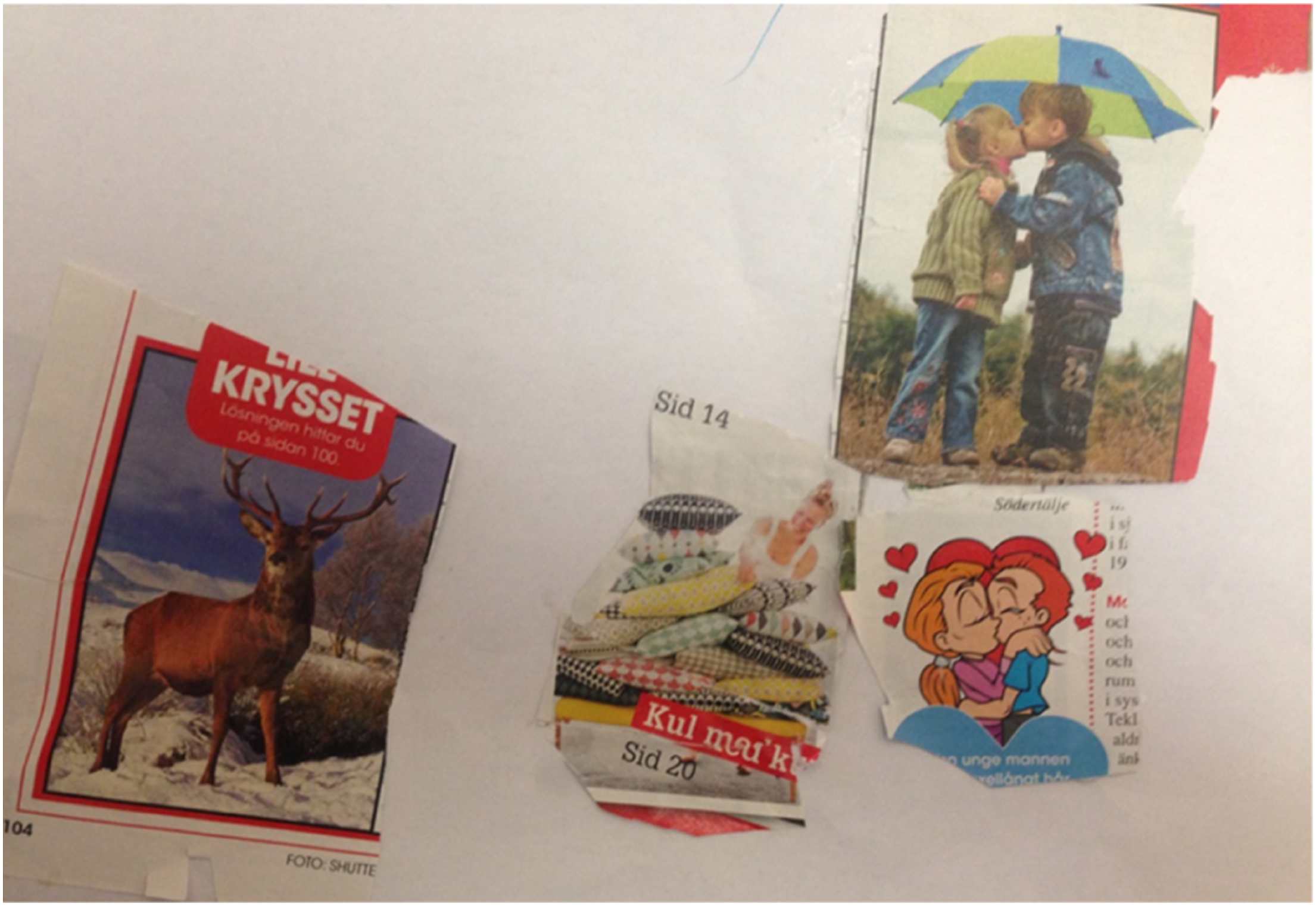
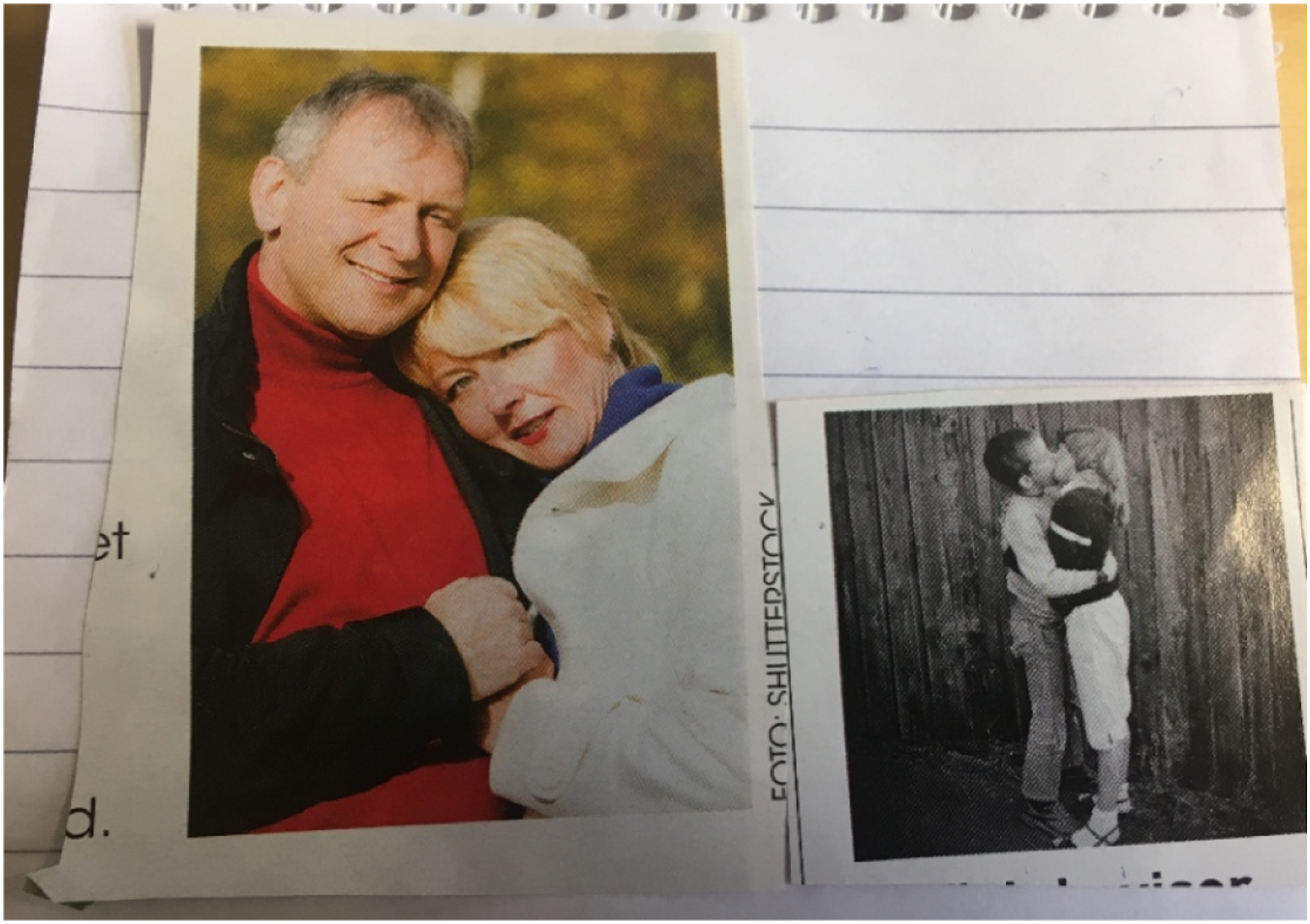
The children in the fieldnotes interpret the symbol of the heart and the bodily performance of kissing and hugging as signs of being in love. To these children, love seems to be interesting, or at least worth noting. The picture of two young people kissing did provoke laughter. As described earlier, when Wilma kissed a boy in the yard, the kiss drew the attention of and a reaction from the children. The laughter may indicate something being exciting or even taboo, in this case knowledge of sexuality among children (see also Blaise, 2010, 2013). Blaise (2010) points out that children’s kissing has to be understood in relation to the context; children kissing their parents goes unnoticed, but a kiss that is perceived as romantic or/and sexual evokes reactions from the children. Trying to understand how children relate to romantic and sexual love is complex. Robinson and Davies (2015: 180) describe the ambivalence between expectations of (heterosexual) love and childhood innocence as sending “mixed messages” to children. Childhood is perceived as a time of preparation for becoming a heterosexual (Epstein, 1997; Robinson, 2013; Stockton, 2009), meaning that children who engage with heterosexuality pass as living an asexual childhood (Robinson, 2012; Surtees and Gunn, 2010). Children involved in romantic discourses are perceived as “cute,” as long as this does not involve sexual curiosity (Robinson and Davies, 2015). A crucial part of childhood is the notion of delaying, for example, sexuality (Stockton, 2009) to preserve a certain kind of “childishness” among children. The children’s interest in romance and kissing could be a way to move beyond prescribed innocence and childishness by engaging in “adult stuff.” Children’s engagement in romantic love discourses strikes a balance between the expectations and normalizations concerning a heterosexual direction and future for the child and is, at the same time, a non-sexual subject. Although the children did not discuss the gender of the people in the pictures, these media representations can be said to represent a heterosexual love narrative where kisses occur between boys and girls. During my observations at the preschool, it did not occur that the children were presented to, or interacted with, similar visual material where same-sex couples were represented.
Being in love: children reproducing and challenging the straight line
The following episode further develops how these children find love an exciting topic and how they engage with presenting both themselves as being in love and romantic couplehood as something desirable. This fieldnote below was written on the same afternoon as described in the previous section. Ines, Joline, Luna and Viola keep working on their collages, and a bit later Viola holds up her paper, pretending to read from it: ‘Dear Luna, do you want to marry me? greetings Alexander’. ‘Can I marry Alexander? Wow!’ Luna says with a big smile. Ines now turns to Viola and asks her ‘Can you say that I'm in love with someone?’ Viola, still pretending to read from her paper: ‘Dear Ines, do you want to marry me, greetings Rosa’. Ines laughs. ‘No, you cannot marry your own sister, it is not possible’, Luna says. Viola pretends to read from her paper again. ‘Dear Joline, Ines is in love with you’. Ines laughs, but no one comments on what Viola said.
In the observation, Luna’s response to Viola pretending to read a letter from Alexander is positive. Alexander is a boy in the same preschool group; he is 1 year older than these girls. They are four and 5 years old, Alexander is five but will soon be six. Ines askes Viola to involve Ines too, showing that this conversation about love is enjoyable and something she wants to be part of. When Viola suggests that Ines could marry Rosa, who is Ines’s 1-year-older sister and in another group at the preschool, Luna objects by saying that it is impossible to marry your own sister. Viola then suggests that Ines is in love with Joline. In this conversation, love in boy–girl and girl–girl pair is made possible. This is the only time during the field study when I heard the children suggesting same-sex love when talking to each other or in play, and the only time it includes the children themselves. I have discussed elsewhere that the children, when I asked them about family constellations, told me that it is possible for a family to have two mothers or two fathers (Sotevik, Hammarén and Hellman, 2019). Suggesting that Ines is in love with Joline does not evoke the same positive reaction as Alexander asking Luna to marry him, but also not the same negative reaction as to Ines marring her sister. Luna appears to have knowledge that it is not possible to marry her sister, establishing that there are boundaries around possible and impossible marriages. There are no objections to the proposed love between Ines and Joline, this love therefore appears possible. It is difficult to determine whether it is the heterosexual narrative, the attractiveness of the wedding or in fact Luna’s feelings toward Alexander that provoke her statement “Can I marry Alexander? Wow!” Moreover, Alexander is not present at the time, which may constitute the difference between this response and the response to the other statement about Ines being in love with Joline, which was made with both these girls present. However, these suggestions hold the potential of queer love being introduced by the children. The gender of the person you love does not seem to be so important here, as no distinction between same-sex love and different-sex love is being made. Instead, the core issue here seems to be romantic couplehood. This suggests that, to these children, having romantic love and a relationship are desirable, both within and beyond heterosexuality.
Chrononormative and queer temporalities of the Barbie wedding
The wedding, as a central event in romantic love, is something that appears when these children play. In this section, some girls’ play with Barbie dolls shows how the temporalities of the play are both normalizing and challenging in relation to a straight life course, or the straight line (Ahmed, 2006). Wilma, Luna, Ines and Viola (4–5 years) are playing with the dolls in the “cozy room,” a small room with a couch. The children have asked the teacher to bring them the box of Barbie dolls placed on a shelf they cannot reach themselves. The teacher has left the room, and the children are picking and choosing dolls out of the box. There are eight dolls, of which seven have long hair and breasts and are called Barbie by the children. One has short hair and is called Ken by the children (Figure 1). The picture is taken after the children finished playing, and I have organized the dolls for the photograph.
Luna picks out a blond doll with long hair and a white dress and the short-haired doll with shorts and a plaid blazer; she names them Maria and Peter. Viola chooses a doll with long red hair wearing a pink dress. In the fieldnote below, Luna and Viola are playing wedding with the dolls: ‘The priest said that now you can kiss each other. Now we are married and we are going home. Now it´s evening and we should go to sleep’ says Luna while playing with the dolls. Luna puts the dolls to bed on the couch. She walks over to the doll box to get another doll and spends a long time looking for a green dress. In the meantime, Viola takes the short-haired doll (Ken) from the couch and says ‘Now I need Ken because my Barbie is getting married’.
The play narrative is based on the wedding, an event represented by a priest announcing that the dolls can now kiss. It is a short act that is not followed by a wedding party. The focus is on the wedding ceremony and on the fact that they are hereafter married. The children reenact parallel stories, where each of them uses one or several dolls who do not interact with the other children’s dolls. How Viola expresses that she ‘needs Ken’ when her Barbie is getting married shows that it is presupposed that dolls representing two different genders are important to implementing the wedding. Although there are other dolls available, Viola argues for her right to use the doll Luna just played with. Luna does not protest this and lets Viola have the doll. This could be interpreted as an acceptance of Viola’s argument that Ken is needed for the wedding play; the children have an agreement to share the Ken doll. A Barbie doll with feminine markers like long hair and a dress needs to marry a doll with masculine markers like a blazer and short hair. These kinds of assumptions are described by Butler (1990) as the Heterosexual Matrix, or the Heterosexual Hegemony (Butler, 1993), meaning that someone recognized as a woman is expected to desire a man, and vice versa. This matrix also builds on the notion that those who desire women are understood as masculine, and those who desire men are understood as feminine, no matter their gender identity; heterosexuality is what is expected when gender is made intelligible. The matrix is part of Butler’s way of describing how normality is created through constant repetition of the expected and desirable. Following this theory, Viola’s argument that she needs Ken is logical, based on her reading of the dolls’ gender expressions and, implicitly, their sexual orientation. In Viola’s and Luna’s play, the wedding event is central, and heterosexuality required, when repeating and producing a chrononormative (and straight) line. The wedding play has temporal elements that show how life events are expected to occur in a certain sequence. These courses of events seem to follow the wedding act: kissing, going home, going to sleep. This play narrative reproduces the home as the central place for the married couple to go to, and the evening as a time for being at home (Halberstam, 2005). However, I also want to show how this heteronormative narrative could be read as both reproducing and challenging chrononormativity and linear temporalities according to the queer temporal theories applied below (Figure 3). Photo of the Barbie dolls used in the play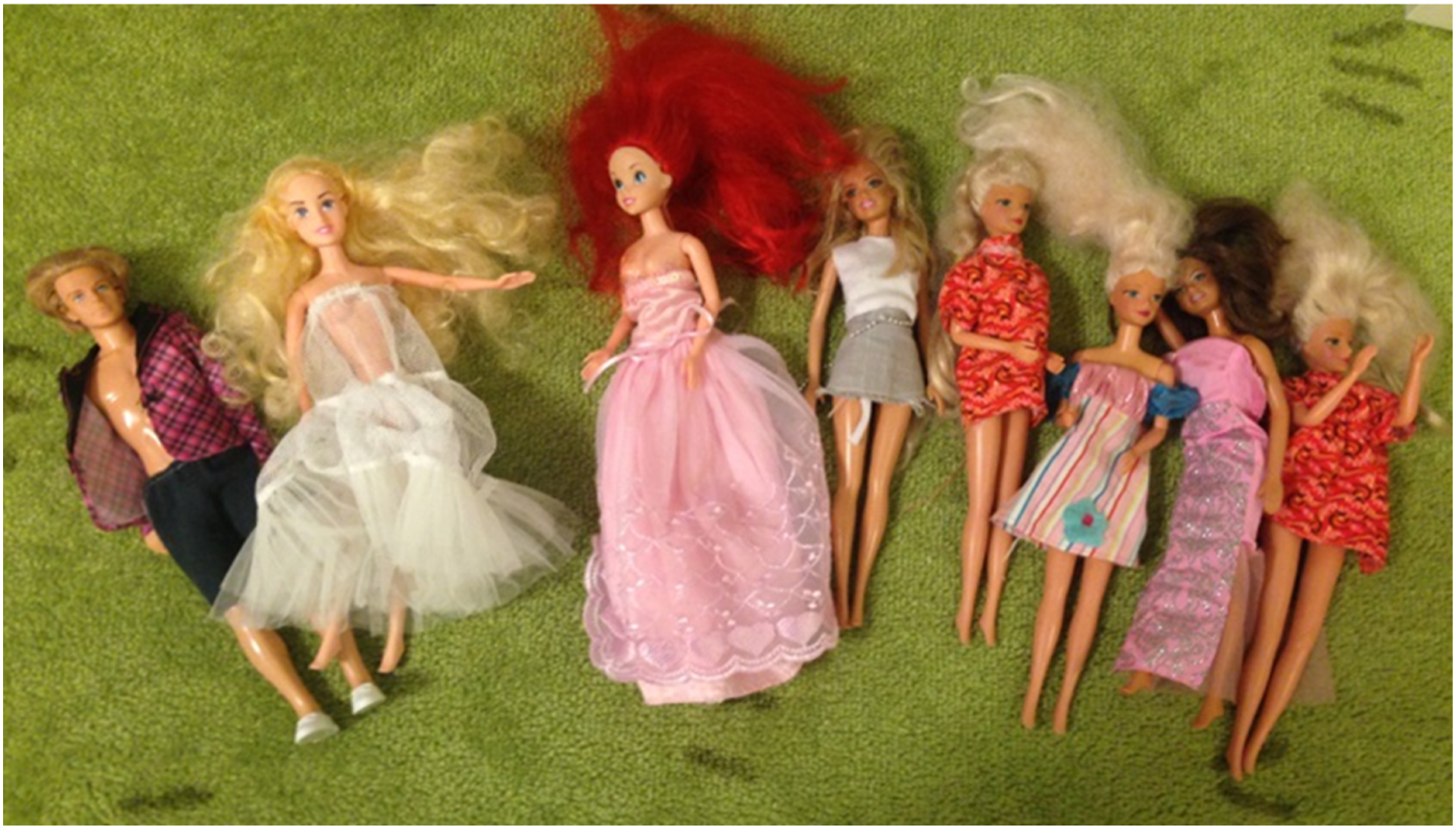
As described earlier, Ken marries two different Barbie dolls when the children are playing, with the reference that Ken is crucial to performing a wedding. In the analysis above, Ken is a symbol of the masculine and could represent different men. In this part, Ken is instead the same person in different events. If time is comprehended as linear (time chronologically leading forward, one event following another), it would mean that Ken is first marrying one Barbie and then another Barbie. This could mean that Ken has divorced Barbie in the white dress before he marries Barbie in the pink dress. This scenario would mean deviation from the expected life narrative, abandoning the monogamous and lifelong love relationship, which constitutes an ideal in Western society. Even if divorce is becoming more common and less stigmatized, it is still often described as an unacceptable event. However, there are also contradictory discourses on divorce claiming that it is a form of progress for women’s equality (Andersson, 2015; Yodanis, 2005). Another possibility is that Ken stays married to his first wife and then gets married to his second wife, making their relationship polygamous. In Swedish society, polygamy and polyamory are far more sensational and questioned than divorce, polygamy also being prohibited by Swedish law. For this reason, people living in polyamorous relationships cannot make legal bounds, such as marriage, to one another. I am not suggesting that the children are staging a polygamous marriage or a polyamorous relationship in their play. Rather, my reading of this wedding event is a way to provide examples of heterosexual relationships that do not always follow the straight line. These examples show how looking for queer temporalities can open up for analyses that go beyond the straight/queer binary and acknowledge other non-normative practices in children play.
Children playing with straight lines and queer times
In the present article, I have explored different ways of understanding how temporality is part of normalized heterosexuality and queerness in relation to children and childhoods. This study is limited to one preschool group, there is every reason for future research to further deepen the understanding of children’s perspectives on love and future romantic and sexual relationships through child interviews. The findings in this article suggest that these children did engage in love discourses in many ways. By highlighting pictures and events of love and kissing in their preschool environment, the children showed that they found this to be an important and exciting topic. When romantic narratives, such as wedding events, emerge in these children’s conversations and play, these narratives are predominantly heterosexual and, thus, reproduce the chrononormative temporality of certain life events occurring along a straight line. However, children introducing same-sex love as a possibility could indicate that love, romance and couplehood are more crucial parts of normativity in the life course than is the sex of your partner. The children challenge the notion that the straight line is the only option for their present and future love relationships; they also reinforce the importance of love and romantic relationships as crucial parts of a life course, meaning that the same chrononormative temporalities as those existing on the straight line are reproduced.
How to understand these results in relation to what is considered normative and non-normative in relation to sexuality, love, and relationships? Having a long-term and stabile romantic relationship is a crucial part of what is perceived as successful adulthood (Andersson, 2006; Halberstam, 2005; Jackson, 2014; Roseneil and Budgeon, 2004). In contemporary Sweden, this could mean living together in a partnership or marriage. Divorce and separation are not unusual, and during a life course several long-term relationships may occur. Also, the ideal of romantic couplehood includes both different-sex and same-sex relationships (Duggan, 2008; Jackson, 2014; Valverde, 2006). These are examples of how relationship norms could in some ways expand but at the same time remain, because romantic coupling is still central to organizing life and family. If it is possible to appear respectable as a lgbtq+ person (given that you have, for example, an intelligible gender, economic and cultural resources, and a long-term relationship), then perhaps this is not living out of line? This more parallel version of homonormativity (Duggan 2002, 2004) is the version of queerness that is most commonly presented to children in, for example, children’s literature (Epstein, 2012; Esposito, 2009; Lester, 2014).
If I am to return to the context of childhood, what can children’s play and talk about love teach adults who meet children, for example in their profession? Although the children played and talked about love, it was not something that the teachers at this preschool paid attention to in their teaching. Here, there had been an opportunity for teachers to use the children’s interest and curiosity about love to discuss different ways of feeling and living in romantic and sexual relationships. Not least in relation to the equality mission that the Swedish preschool has, this is a missed opportunity to discuss lgbtq+ issues in the preschool setting. To create diversity and increased possibilities for children in educational institutions such as Early Childhood Education as well as in society as a whole, we must also ask what possibilities we mean and how something is diverse. Bringing temporality into the analysis of heteronormativity can broaden the picture by looking at what is happening at the same time. In the example where the children talk about which children are in love, same-sex love is introduced as a queer possibility, but at the same time romantic couple relationships and marriage are reproduced as desirable goals. In the play with the Barbie dolls, heterosexuality is normalized but at the same time, seen from another perspective, a potentially queer temporality emerges in the children’s way of performing weddings where Ken is introduced to several wives. I argue that the alternative to a straight line should not only be several or broader lines, but also lead away from those lines and toward what Stockton (2009) calls wayward paths. Departing from the line or path is perceived as going astray (Ahmed, 2006; Stockton, 2009). To deliberately go astray can be challenging, especially for adults who are used to setting frameworks and goals, for example in an educational activity. But to questioning normative directions and temporalities does not have to mean that we have all answer to where we are going but can also consist of a curiosity about what awaits behind the next corner. This lostness could be embraced to acknowledge the unstable and undecidable, instead of establishing that certain futures are more desirable than others. If the path and its destination are limiting, then going astray is not so much a threat as a promise of other possibilities, for both adults and children.
Footnotes
Declaration of conflicting interests
The author(s) declared no potential conflicts of interest with respect to the research, authorship, and/or publication of this article.
Funding
The author(s) received no financial support for the research, authorship, and/or publication of this article.
