




Abstract
Sex has at least two different but related meanings: a biological property that bodies can seemingly ‘have’, and a set of bodily practices that one or more people can ‘have’. In the 1950s, the endocrinologist CN Armstrong stated that biomedical evidence of sex variance and the lack of a clear legal definition of sex highlighted a problem with the criminalisation of homosexual activity. It was not until the 1970s that a clear category of legal sex was enacted in law. In this paper, we consider the Wolfenden Committee (1954–57) and the legal cases of Georgina Somerset and April Ashley (1969–70). As we demonstrate, despite the complexity revealed by biomedicine, the law has not struggled to enact binary categories, due to the normative force of binary and heteronormative social understandings of sex (in all its meanings). We conclude by reflecting upon the many queer ways that people have and do sex outside of the purview of legal or medical definitions.
Introduction
Sex has at least two different but related meanings: a biological property that bodies can seemingly ‘have’, and a set of bodily practices that one or more people can ‘have’. In the mid-twentieth century in Britain, the law was grappling with the criminalisation of particular sexual practices. Although sex as a biological property had been legally recognised in various ways, it was not until the 1970s that a clear category of legal sex was enacted. Crucially, this process involved the law turning to science and medicine, a process afforded by certain technological advances in the mid 20th century. At this time, biomedical institutions were continuing their (ongoing) project of investigating and experimenting on individuals born with variations of sex characteristics (Davis, 2015; Griffiths, 2018a; Reis, 2009). 1 Attempts to define legal sex reveal the extent to which social understandings of sex (in both meanings of the word) are fragile, unstable, and capable of change. There has been much literature about the social construction of gender (Butler, 1990; Fine, 2005; Hines and Taylor, 2018; Kessler and McKenna, 1978) and there is recognition of the likewise construction of sex as a biological property (Butler, 1993; Dreger, 1998; Fausto-Sterling, 1993, 2000). We are indebted to such literature as we explore the latter half of the 20th century, which reveals a turn towards medicine and science for understanding sex in British Law. British Law continues to only recognise two sexes: female and male. We contend that the law fails to reflect the lived experiences and lives of many people who cannot, do not, and will not be easily allocated to binary sex. We explore this history here to align with activists pushing for more expansive jurisprudence regarding sex.
This paper centralises some key moments in time in which the Law grappled with definitions of sex and sex. To begin, we consider CN Armstrong’s 1950s argument that it was problematic to have laws criminalising homosexuality without a legal definition of sex as a biological property, based on biomedical logic. Armstrong believed that the Law ought to define sex, being mindful that it is not always easy to identify to what sex an individual belongs. Furthermore, he held that medical science was able to assist the law in such a definition and suggested an approach that included biological properties of bodies and sexual identities, behaviours, and practices. From this starting point, we turn to pivotal moments in British legal history. First, we question the extent to which the Wolfenden Committee (1954–57), tasked with advising the UK Government on sex work and the legalities of sex between men, knew what sex actually was. We consider the committee’s interest in defining sexual practices and the question of the links between the practices, individual identities, and society. We question how the committee were able to consider what sex between men was, given that, according to Armstrong, there was medical and legal ambiguity about the definition of ‘man’. The next moment we consider is 1969 with the legal cases of Georgina Somerset and April Ashley. Here we attend to how the courts conceptualised both of their sexes; we pay particular attention to Ashley’s case – Corbett v Corbett – as this case enacted a definition of legal sex that set a significant precedent in Britain and further afield.
We consider how these moments in British legal history have continued to influence legal and medical understandings of sex. Importantly, we highlight how this legacy speaks to contemporary issues. Medical and legal understandings of sex, gender, and sexuality continue to impact the lives of people with variations of sex characteristics and/or those outside of (cis)gendered binaries. This history has contemporary relevance particularly as the law continues to fail to reflect the lives of many individuals living in Britain.
A legal quandary? Definitions of sex in the 1950s
In the mid-twentieth century, some sub-specialties of medicine were interested both in sex as behavioural practice, and sex as a seeming biological property. CN Armstrong was an endocrinologist at the Royal Victoria Infirmary and the founding member of the section of endocrinology at the Royal Society of Medicine and later its president. He had an interest in intersex, particularly in how variations of sex anatomy drew attention to the inadequacy of definitions of biological sex, and the consequences for medicine and law. Armstrong considered homosexuality a subcategory of diversities of sex, while also seeing variations in sex anatomy as challenging common-sense notions of biological sex, and thus of definitions of sexuality. In fact, he claimed that resolving this was at this time ‘urgent’, due to the criminalisation of homosexual acts between men: So far the law has never defined sex, which is extraordinary in view of the homosexual laws in this country, and it is sometimes very difficult to say to which sex an individual belongs. (Armstrong, 1955: 1176)
Armstrong’s statement is central to our paper. It is not, however, entirely accurate to say that the law had never defined sex. For example, Henry de Bracton stated in 1260 when distinguishing monstrosity and deformity: ‘[m]ankind may also be classified in another way: male, female, or hermaphrodite’ and that ‘[a] hermaphrodite is classed with male or female according to the predominance of the sexual organs’ (Bracton, cited in Sharpe, 2009: 105). It is perhaps more accurate to say that the law had previously utilised sex as a meaningful category, but without a grounding in medical and scientific practice, something Armstrong believed to be imperative.
In the past, medical examinations of genitals had been relied upon within courts of law when the ‘sex’ of an individual was deemed unclear – often because of their clothing (e.g. Mak, 2012; Manion, 2020; McKenna, 2013). However, for Armstrong, the developments in medicine in this area meant the existence of variations in sex anatomy rendered the boundary between male and female bodies uncertain. He argued that this threw into question any working definition of homosexuality. As homosexuality was at the time defined as a problem (either as crime or disease), Armstrong’s statement highlights that any attempt to find a ‘solution’ to this problem would be structured by this uncertainty over the definitions of both sex (as a property of bodies) and sex (as legally pertinent bodily practices).
In a 1955 article in the British Medical Journal, Armstrong discussed what he called ‘diversities of sex’, under which he included ‘hermaphroditism’ and ‘pseudohermaphroditism’. He also included homosexuality, as ‘a state of affairs in which the libido and sexual urge is directed towards the same anatomical sex and may or may not be associated with recognizable endocrine abnormality’ (2). Figure 1 shows Armstrong’s 1958 visualisation of this ‘spectrum of sex’. Armstrong’s 1958 Spectrum of Sex.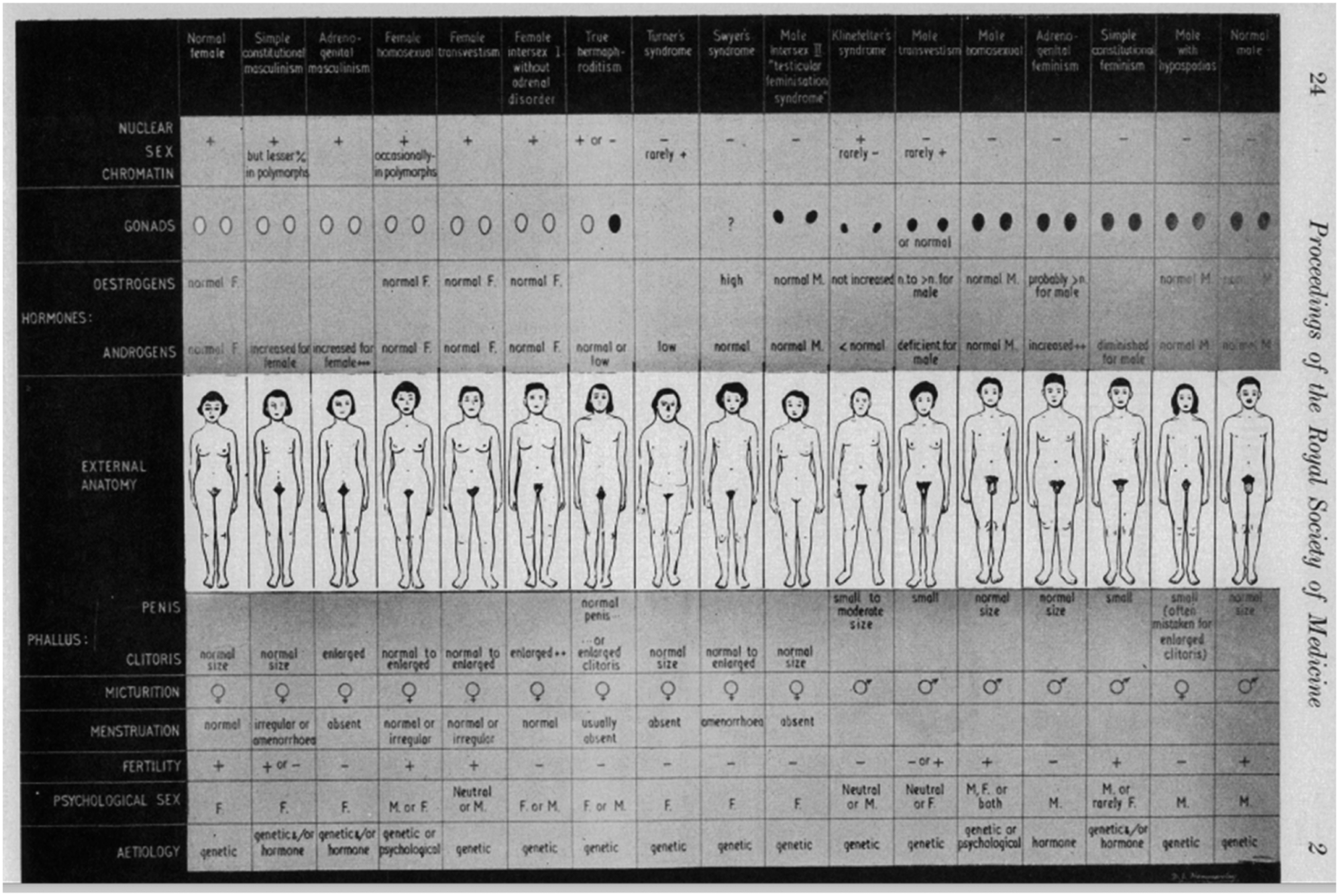
There was no consensus at the time in medicine not only of how to define sex, but also of what exactly should make up this definition. For Armstrong, nuclear, gonadal, hormonal, genital and anatomical characteristics were not sufficient to answer this question, and he also included behavioural and psychological characteristics including sexuality. At the same time that Armstrong was publishing his concern about the quandary within British law regarding the definitions of sex and the laws on homosexuality, a Committee was working to consider the laws Armstrong identified as definitionally problematic.
In 1954, the British Conservative government appointed a Departmental Committee on Homosexual Offences and Prostitution. Chaired by John Wolfenden, it would come to be known as the Wolfenden Committee and the subsequent report, published in (1957), as the Wolfenden Report. The committee was tasked with considering the national laws regarding homosexual offences and prostitution, and recommending changes to these. The publication of the report followed three years of consultation with a very wide cross-section of experts. Historian Brian Lewis explained that the task put to the committee involved and necessitated a ‘thorough investigation into the causes and consequences of sexual deviancy’ and, indeed, he lists that those giving evidence included: police chiefs, policemen, magistrates, judges, lawyers and Home Office civil servants; doctors, biologists (including Alfred Kinsey), psychiatrists, psychoanalysts and psychotherapists; prison governors, medical officers and probation officers; representatives of the churches, morality councils and progressive and ethical societies; approved school headteachers and youth organization leaders; representatives of the army, navy and air force; and a small handful of self-described but largely anonymous homosexuals. (2016: 3–4)
It is important to remember that the Wolfenden committee was not just concerned with sex between men, but with sex work as well. Although the report went on to propose decriminalising sex between two men over the age of 21 in private, at the same time it suggested stricter regulation of street-based sex work. As critics have pointed out, the Wolfenden may have been a step in the right direction for gay liberation, but it also made a clear distinction between acceptable and non-acceptable sex, often drawn over the distinction between private and public (Higgins, 1996; Houlbrook, 2005; Lewis, 2016; see also Jivani 1997; Moran, 1996; Weeks, 2012).
Of course, decriminalising sex between men in private puts into question the definition of the terms: ‘sex’, ‘men’, and ‘private’. Although attention has been given to the public/private space of the ‘public’ toilet and the ways in which this emphasises the fuzziness of the public/private distinction (Houlbrook, 2005), less attention has been given to the definition of homosexual acts themselves. The 1967 Sexual Offences Act (a direct consequence of the Wolfenden Report, albeit 10 years later) suggested that ‘a man shall be treated as doing a homosexual act if, and only if, he commits buggery with another man or commits an act of gross indecency with another man or is a party to the commission by a man of such an act’. The Wolfenden Committee were concerned with these questions: what were homosexuals doing? What was a homosexual act? And how were these acts related to identities? In an interview before the committee, two of the three self-identifying homosexual witnesses were asked ‘Do you think people who indulge in sodomy differ in any way from other homosexuals?’ (Lewis, 2016: 221). Not only did they refute this idea but they also suggested that anal sex was not the most common sexual act between men: ‘it is purely a matter of taste, and that part of the anatomy is no more sinful than the mouth’ (Lewis, 2016: 222). It was clear that penetrative anal sex between men counted as a homosexual act, but there were other sexual practices between men that were harder to classify.
When considering sex between men, the Wolfenden committee was interested in what exactly was meant by ‘sex’; they did not, however, show any particular interest in what was meant by ‘men’. Medical commentators such as Armstrong may have considered this problematic, as legal definitions of sex at this time were not undergirded by the formalism required of medicine; but this was no impediment to the Committee’s investigations nor to the publication of the Report (1957). The recommendations of the Wolfenden Report were finally enacted in the 1967 Sexual Offences Act which legalised sex between two men in England and Wales over the age of 21 in private (excluding those in the military). As previously stated, the legal definitions of ‘homosexual acts’ were broader than just anal sex. Gross indecency acted as a ‘catch all’ for other sexual acts that the court wanted to criminalise. The Wolfenden Committee called upon medical experts to help define sexual practices, and to consider their relationship to identities and the law, but not to address the quandary identified by Armstrong around legal definitions of sex as a property of bodies. In 1969, however, two cases came to court, one of which would inadvertently lead to a medically grounded definition of sex in British law.
Sex in the court room during the 1960s and 1970s
Georgina Somerset and April Ashley were two British women who had been assigned male at birth who were tasked with proving their (female) sex in court in 1969. Georgina Somerset had brought a libel case against the British psychiatrist Clifford Allen for suggesting she was not a woman and therefore was not legally married. She was successful and received an apology from Allen. April Ashley, on the other hand, was unsuccessful in her challenge of her husband’s attempt to nullify their marriage on the basis that her ‘legal sex for the purposes of marriage’ was not female. In both cases, medical science was utilised to determine these women’s legal sex. Not only this, but their sexual practices were also drawn into consideration. Sharpe (2002a) has argued that Ashley’s case was haunted by the ‘spectre’ of homosexuality and homophobia throughout. We argue likewise that Somerset’s case is similarly haunted by a contemporary fear of homosexuality.
Georgina Somerset was born in 1923 and assigned male; in 1957 she underwent a medical procedure and re-registered as female. During this time, the British media as elsewhere were fascinated by what they called ‘sex change’ (Griffiths, 2018a), having reported extensively on Christine Jorgensen’s international celebrity in the late 1950s (Oram, 2011). Somerset herself gained media attention in 1960 from local, national and international newspapers, despite the fact that she distinguished herself from Jorgensen. She married in 1962 and was in fact the first known person to marry in a Church of England church after re-registering their sex. In 1969, however, Allen wrote an article in the medical journal Pulse in which he cast doubt upon Somerset’s legal status as a woman, and therefore the legal status of her marriage. Somerset was a dentist and had access to medical publications, as well as the economic means to take Allen and Pulse to court for libel. During the court case, Somerset consented to medical tests, which revealed a karyotype of XY/XO for the first time (see Somerset, 1992). This was relatively new medical science, as karyotypes beyond XX and XY had only been ‘discovered’ in 1959 (see Griffiths 2018b). Upon the ‘discovery’ of this intersex status, Somerset received an apology, payment for her legal fees, and requested that the files related to the court case were destroyed. The court concluded that Somerset was legally a woman, therefore heterosexual, and thus was legally married. Interestingly, we might read this as confirming Armstrong’s concern; there was something of a legal quandary of how to define Somerset’s marriage and sexual practices, which required the assistance of biomedical knowledge. Here, advances in medical science assisted Somerset’s case and were crucial in the decision.
April Ashley was born in 1935 and assigned male. In 1960 she had what we might now call ‘gender confirmation surgery’ in Casablanca. From 1960 to 1961, Ashley had a brief but very successful career as a fashion model. In 1960, however, she was outed in the British newspaper People: ‘The extraordinary case of top model April Ashley: “Her” secret is out’. At this time, she was in a relationship with Arthur Corbett and in 1963 they married. Their relationship soon broke down and in 1965 Ashley sought to make a claim on some shared property. Corbett responded by seeking an annulment for the marriage through the courts. It is interesting to note that divorce laws were changing during this period in Britain. Prior to the Divorce Reform Act of 1969 (which came into effect in 1971), there were fewer legal justifications for divorce. Corbett sought to dissolve the marriage on the basis that Ashley was not, nor ever had been, a woman, and thus their marriage was void ab initio. Ashley’s contention was, in her own words, that: since the scientific definition of sex is not clear-cut in all cases and since marriage is also a legal and social relationship between a man and a woman, I should be regarded as a woman for the purposes of marriage because, as a result of my operation, I could function in no other way. (1983: 207)
The case was heard in 1969 with a February 1970 decision. Unfortunately for Ashley, Judge Ormrod who presided over this case ruled in Corbett’s favour, stating that Ashley was not ‘a woman for the purposes of marriage’. Ormrod attempted to restrict his ruling to legal definitions of sex in marriage. Nonetheless, it was to have widespread influence on British law as well as in other countries (Sharpe, 2002a).
The case drew on an extraordinary amount of medical expertise. In fact, Ormrod had a medical background which was why he presided over the case (Hutton, 2019). Both Ashley and Corbett called upon medical witnesses who were considered preeminent experts in this field at the time. Armstrong, discussed earlier, supported Ashley and argued that there were five criteria by which to determine sex: chromosomal, gonadal, genital, psychological and hormonal. It is worth noting that Armstrong’s previous suggestion for a medical definition of sex in law did not have a strict delineation between social, psychological, biological or behavioural definitions of sex. Armstrong’s five factor definition therefore provided a broader and more inclusive approach to thinking about sex, one which specifically included an individual’s own sexual practices. Armstrong had also acted as a medical witness for Ewan Forbes, a Scottish man (assigned female at birth) who successfully defended his right to inherit his Baronetcy in 1968 (Playdon, 2021). Like Ashley, his sex was called into question, however, Ashley was not able use Forbes’ case as precedent because it was heard privately (Whittle and Turner, 2007). Ormrod ruled that legal sex was to be defined by a congruence of only three of the five factors: chromosomes, gonads and genitals. This, he argued, was more precise than Armstrong’s criteria as hormones and ‘psychological sex’ are not fixed at birth. Ormrod also stated that if these three criteria were not congruent, ‘greater weight would probably be given to the genital criteria than to the other two’. This is strikingly similar to Bracton’s (1260) ‘predominance of the sexual organs’, more than seven hundred years before Ashley stepped into the courtroom (cited in Sharpe, 2009: 105). Ormrod’s three-part criteria for legal sex became known as the ‘Corbett test’ and while he only devised this definition for this case and it was only meant to concern marriage law, it became widely used across all manner of legal cases.
Ormrod summarised Corbett v Corbett as follows: The case, therefore, resolves itself into the primary issue of the validity of the marriage, which depends on the true sex of the respondent; and the secondary issue of the incapacity of the parties, or their respective willingness or unwillingness, to consummate the marriage, if there was a marriage to consummate.
This excerpt is significant for two reasons. First, despite the wealth of medical evidence presented to the court, Ormrod relies on the notion of a ‘true sex’ derived more from the words’ supposed ‘ordinary meaning’ (Hutton, 2019). Ormrod himself acknowledged in 1972 that ‘the past 25 years has shown that none of the criteria for sex determination are completely reliable and that the categories of male and female are not mutually exclusive’ (cited in Hutton, 2019: 112). Yet, as the legal judgement related to marriage, Ormrod sought clear binary categories: legal sex as it emerged out of the Corbett judgement required definitional certainty in relation to the meanings of the words man and woman. Once Ormrod embarked on his investigation of the meaning of the word woman in relation to marriage, he laid the groundwork for the articulation of legal sex as an explicit category of law. (Hutton, 2019: 77).
Second, Ormrod’s statement demonstrates the importance of consummation to the legal definition of marriage. In this case, Ormrod claimed this was of secondary concern, as the marriage was void ab initio. Nonetheless, he showed a great deal of interest in Ashley’s vagina and the sexual practices of her and Corbett.
During the case, a great deal of attention was paid to the question: could April Ashley’s vagina be considered a vagina (for use in penis in vagina sex)? A previous case had concluded that a woman who had undergone surgery to lengthen her vagina was capable of consummating a marriage (S v S, 1962). However, Ormrod did not want to extend this ruling to Corbett v Corbett: ‘When such a cavity has been constructed in a male, the difference between sexual intercourse using it, and anal or intra-crural intercourse is, in my judgment, to be measured in centimetres.’ Similar to the Wolfenden’s discussion of different non-normative sex practices, anal sex was not the only sexual practice that could be included in the fuzzy category of ‘sex between men’. Ashley’s vagina was not legally defined as a vagina; she was therefore not considered by Ormrod to be capable of having penis-in-vagina sex and could not be considered a woman for the purposes of marriage. Nicola Barker (2012) has drawn attention to the fact that Corbett v Corbett is not only relevant for legal sex, but also for heteronormative constructions of marriage and consummation (particularly before the legalisation of same sex marriage in Britain in 2014). She argues that the 19th century definition of consummation which was upheld in Corbett v Corbett, along with the fact that a marriage is ‘automatically void unless the parties are “retrospectively male and female” […] indicate that marriage in the UK is not only a sexual institution but also that it remains a hetero sexual one, at least as far as sexual performance is concerned’ (2012: 24). Indeed, Corbett successfully capitalised on the spectre of homosexuality and homophobia that haunted this case (Sharpe, 2000). He framed himself as distinctly non-normative in his sexual tastes as a way of undermining both the heterosexuality of their marriage and Ashley’s ‘true sex’ as a woman (Sharpe, 2002a).
Both Somerset and Ashley had to ‘prove’ their sex as a biological property in court, but also had to submit their marriage and sexual practices to legal scrutiny. Like Somerset, Ashley had to submit to medical tests. Unlike Somerset, however, there was no chromosomal evidence of intersex. Somerset was successful, both because of medical evidence and through reinforcing her heterosexuality. Ashley on the other hand was unsuccessful; this was not just due to medical evidence, but also because of the ways her relationship was presented to the court as non-normative (Sharpe, 2000, 2002a). Interestingly, this supposed relevance of sexual practices to a definition of legal sex can also be seen in Playdon’s (2021) description of the Ewan Forbes case. This was particularly evident in the ‘horrific’ questioning his wife endured about their sexual relationship, including about penetration, ejaculation and orgasm (p. 185).
As we narrated earlier, in the 1950s, Armstrong had highlighted the need for a formal legal definition of sex based on biomedicine. A potential opportunity had arisen in the Wolfenden to deal with this apparent quandary. However, the Wolfenden Committee dealt with sexual practices only, and did not comment on legal sex. It took until the Corbett v Corbett case for a clear and explicit concept of legal sex to be enacted. Although the law had previously used working definitions of sex as a biological property: Corbett marks a sharp dividing line between inchoate and unfocussed biological, medical and social discussions of sexual identity, and the emergence of an explicit common law jurisprudence. The piecemeal application in various domains of law of classification by sex led ultimately to the creation of a unified concept of legal sex (Hutton, 2019: 159).
Not only this but ‘[l]egal sex only fully emerged in conjunction with the deployment of ordinary language arguments about the normative meanings of man, woman and marriage’ (Hutton, 2019: 159). The medical experts in the Corbett v Corbett case had knowledge and evidence of variations of sex characteristics, and did not present a clear binary picture of ‘biological sex’. This resonates with Natalie Delimata’s (2019) description of the crisis in the clinical encounter for individuals with variations of sex characteristics/intersex. She has argued that the encounter produces crisis precisely because scientific and medical facts about sex variance intersect with social ideals of binary bodies. Despite being undergirded by the logic of biomedicine, the legal definition of sex introduced by Ormrod continued to rely on social conceptualisations of sex as binary.
Legacies of sex: Early 21st century onwards
Despite enacting a legally useful concept of legal sex, Corbett v Corbett was to have complex legacies. Ironically, in attempting to define sex (for the purposes of marriage) as binary, Ormrod effectively created a ‘third sex’. Ivor Mills, a medical witness for the case alongside Armstrong, argued that while Ormrod ruled Ashley not a ‘woman for the purposes of marriage’ she was also, by definitions of consummation law, not a man for the purposes of marriage. The decision in Corbett v Corbett effectively led to a “third unmarriageable sex” (Mills, 1970; as cited in Hutton, 2019: 109). There will always be individuals who fall outside of strict binary categories.
There are a number of cases which demonstrate such issues in the legacies of Corbett v Corbett. In W v W (2000), a man sought a decree of nullity in respect to his marriage to Mrs W, claiming she was a trans woman and therefore, like Ashley, not a woman for the purposes of marriage. There was significant discussion of the ruling in Corbett v Corbett due to the similarity of the cases, but also because of the uncertainty of how to rule when there was not congruence between the three parts of the Corbett test: genitals, gonads and chromosomes at birth. Ultimately, it was determined that Mrs W was intersex, and the nullity was not granted. Sharpe (2002b) has argued that while the judge did rule in Mrs W’s favour, this case represents a bolstering of the judgement in Corbett v Corbett. In particular, the court scrutinised Mrs W’s genitals and sexual practices, retaining the same concern for the heteronorms at the heart of marriage and legal definitions of sex. Bellinger v Bellinger represented a series of unsuccessful applications and appeals by Mrs Bellinger, a trans woman, to recognise her marriage to a man: first in the High Court in 2000, then the Court of Appeal in 2001 and then finally in the House of Lords in 2003 (Cowan, 2004). In Bellinger v Bellinger, the decision in W v W was considered to have no bearing. There was significant discussion of Corbett v Corbett and once again, the supposed ‘ordinary meanings’ of man, woman and marriage were relied upon, in all their normative force. In 2002, Christine Goodwin argued at the European Court of Human Rights that her inability to marry as a trans person was a violation of her human rights (Goodwin v UK). The court ruled that UK law was indeed in conflict with Article 12 (the right to marry). In Bellinger v Bellinger, despite Mrs Bellinger’s lack of success, the House of Lords did stress that this case demonstrated an incompatibility between UK law and the judgements in the European Court of Human Rights. This would lead to the government developing the Gender Recognition Act in 2004.
Even within this contemporary legislation, hauntings of normative sexual practice remain, as do ongoing legal quandaries. For example, in order to gain a Gender Recognition Certificate one must: be at least 18; have supportive evidence from a doctor and/or psychologist including a diagnosis of ‘gender dysphoria’; have already transitioned for at least two years prior to the application and promise to continue to do so; and not be currently married or in a civil partnership. If an applicant is already married or in a civil partnership they can obtain an ‘interim’ certificate (valid for 6 months) to give them time to dissolve their legal relationship (Renz, 2015). This is because of the ways in which same-sex marriage was legislated in the UK in 2014 as a separate licence. This has created further issues for some trans people and has in effect led to issues of spousal veto, whereby a spouse can prevent their partner receiving a Gender Recognition Certificate (see Renz, 2020 for discussion of such inequalities). There is also evidence that the medical support required for such legal recognition has been historically undergirded by normative assumptions around sexual practice and gender conformity (Griffiths, 2018a; Meyerowitz, 2002). Riggs et al. (2019) articulate this as transnormativity, an often-powerful conceptualisation of a normative way to be trans within the psy-disciplines (related to norms of both gender and sexuality, see also Hubbard and Griffiths, 2019). Another ongoing issue is that English common law requires those who give birth to be described as ‘mother’ on the child’s birth certificate – even if the person who gave birth was a man (this has most recently been demonstrated in the court case of Freddy McConnell, see Margaria, 2020). This is one of a number of issues for non-binary and trans parents (see also Riggs et al., 2020; Riggs et al., 2020).
Conclusion
We began this article by considering CN Armstrong’s 1955 statement that the law did not have a definition of sex, and that this was problematic in a country that criminalised sex between men. We followed this by looking at key moments from the mid-twentieth century which dealt with legal definitions of sex. In the case of the Wolfenden Committee and Report in the 1950s, sexual practices were considered to be complex and to interact with identity and society in complex ways. Despite Armstrong’s perspective, however, having no legal definition of sex undergirded by a medical consensus on what constituted ‘biological sex’, was no impediment to the task of the committee. At the start of the 1970s, the Corbett v Corbett case provided a legal precedent of a definition of sex seemingly formalised through particular biomedical logic. Even in this case in which the medical professionals called as witnesses did not provide consensus on how to define sex as a biological property, Ormrod rhetorically constructed the notion of a ‘true sex’ and thus enacted legal sex as a meaningful legal category. In doing so, both the law and medicine drew upon (hetero)normative ideas of sexual practices.
Armstrong and other medical professionals brought evidence to the law of sex variance, complexity and of medical boundary-making practices between the entangled areas of sex, gender and sexuality. This would seem to conflict with the socio-legal demands of binary categories. What we have identified in this article are the points in time that these varied definitions of sex have come into conflict. Legal definitions of sex as a biological property have been haunted by heteronormative ideas about sex as a behavioural practice. Also, the law has generally not struggled to enact binary categories (despite the complexity revealed by biomedicine) because of the normative force of social understandings of sex as binary. We have seen this in the Wolfenden and in Somerset and Ashley’s court cases. Increasingly, challenges to legal sex binaries are coming from outside of medicine, from queer, trans and intersex people spearheading demands for more expansive categories both in medicine and the law.
The intersection of biomedical knowledge of variation and sociolegal ideals of binary categories (haunted by heteronormativity throughout) has real effects for individuals. This is especially true when intersex variations/variations of sex characteristics are identified at birth. A 2015 editorial in the British Medical Journal argued that despite recommendations that medical professionals avoid performing non-consensual medical treatments on intersex individuals, surgical intervention remains standard practice (Liao et al., 2015; see also Garland et al., 2021). This is in the face of decades of intersex activism and scholarship, and more recent statements that have been released by international bodies condemning such interventions (Méndez, 2013; United Nations, 2015; Council of Europe Commissioner for Human Rights, 2015; Amnesty International, 2017; Human Rights Watch, 2017). These statements condemn ongoing unnecessary surgeries as human rights violations, with some describing them as a form of torture (Carpenter, 2016, 2018; Garland and Travis, 2018). We saw in the court cases of Somerset and Ashley, that when supposedly making decisions about an individual’s sex as a biological property, there is a slippage to social norms, including those related to sexual practices. Likewise, Griffiths (2021) has argued that hypospadias surgery is often considered necessary because of social norms around future imagined urination and (hetero)sexual activity as opposed to medical need. In fact, such surgeries are called hypospadias ‘repair’ which is telling given the majority of surgeries are not medically necessary. The same of course can be said of many surgeries still performed on infants with variations of sex characteristics (Monro et al., 2017).
Many individuals’ sex and their sexual practices are not as narrow, binary or (excuse the pun) straight-forward as the law presumes. Nor are the complex sexed and gendered lives of many reflected in the medical advice, knowledge and scientific practices that attempt to organise and categorise them (see Riggs et al., 2019). Writers like Meg-John Barker (2018) and Juno Roche (2018) are re-thinking sexual practices outside of normative boundaries. The lived experiences of queer, trans and intersex people show the possibilities and constraints for people who challenge or live outside of presumed parameters and medicolegal frameworks which police sex, gender and sexuality. Newman and Peel (2022) for example, reveal the extent of the appetite among non-binary people for legal reform in this regard. The law fails to accurately reflect the real-life practices that people are engaged in, including those who do not have sex (Gupta, 2015). People are doing sex (in both senses of the word) and other related activities like parenting in multiple, interesting and queer ways. Yet, the law and medicine are failing to account for these lives and continue to frame sex in ways that presume a stable binary which does not exist.
To return to the slightly tongue-in-cheek question of our title: do you have to have sex, in order to have sex? In this article, we have argued that despite medical experts raising concerns about the ways in which the law was defining (or not defining) sex, this lack of a definition based on biomedical knowledge has not historically been an impediment to the law restricting certain sexual practices. Further, when the law did enact a category of legal sex, this was not entirely based on the extensive biomedical knowledge offered to the court. Instead, this drew on social understandings of sex as a biological property of individuals and sex as a normative behavioural practice (that was integral to traditional notions of marriage). It seems that both definitions of sex depend upon each other. This somewhat circular logic has far-reaching legal, medical and social consequences. There will always be individuals who do not fit within the heteronormative logic whereby in order to have legally legible sex one needs to have legally legible sex. Although progress has been made to better represent queer lives, practices and identities both in medicine and law, more work needs to be done to expand our conceptions of sex… and sex.
Footnotes
Acknowledgements
We would like to thank Clare Butler and Mitchell Travis for reading early drafts and providing useful feedback. We would also like to thank the anonymous reviewers at Sexualities for their helpful comments which greatly improved the article.
Declaration of conflicting interests
The author(s) declared no potential conflicts of interest with respect to the research, authorship, and/or publication of this article.
Funding
The author(s) disclosed receipt of the following financial support for the research, authorship, and/or publication of this article: This work was supported by the Wellcome Trust (grant number 106614/Z/14/Z).
