




Abstract
This paper explores the case of Barents Pride, an event organized collaboratively by Russian and Norwegian LGBT+ activists located close to the Norwegian–Russian border. The idea of the Pride is to bring LGBT+ people and activists from Russia, where state pressure limits possibilities of organizing prides, to Norway and to express solidarity across borders. We use this case to investigate pitfalls and promises of queer transnational solidarities, to contest notions of center/periphery, the North/South–East/West division and to analyze how sexuality simultaneously enforces and destabilizes these dichotomies.
Introduction
This article aims to analyze the case of Barents Pride as an example of transnational solidarity between LGBT+ 1 activists from Norway and Russia. The Barents Pride is organized by Norwegian and Russian NGOs in Kirkenes, the Norwegian town on the border to the Russian Federation. Carefully scrutinizing the reflections of Norwegian and Russian activists around their collaboration in organizing the Pride and our own impressions from the second Pride, we seek to nuance the notion of transnational solidarity in pride activism. We consider how scale and place matter in the construction of pride agenda and functioning of solidarity networks highlighting “the twin roles of scale and place in transnational mobilization” (Masson, 2010: 37), that is, the importance of where, when, and among whom solidarity happens. In our article, we analyze how the border region between Russia and Norway located far from established centers of pride parades shape the political and affective meaning of the pride parade.
We consider Barents Pride as an example of a small-scale transnational solidarity—a form of solidarity based on partnerships and personal relations/friendship that awakens tensions but also provides space for reflections. Following queer critiques of constructions of place and identity (e.g., Kulpa and Mizielinska, 2011), we want to scrutinize geopolitical spaces that we find under-theorized in queer and feminist scholarship. We acknowledge that neither Norway nor Russia neatly fit postcolonial categories of East-West/North-South (Çağatay et al., 2022). The two countries share geopolitical interests in the geographic north, notably in the Arctic Region where Barents Pride is held. Neither Norway nor Russia has ever had colonies in the global South or been colonized by external powers. Yet, the way the Norwegian state used to treat the indigenous Sámi population in Norway is a remarkably colonial practice. 2 Simultaneously, the imperial legacy of Russia determines the ambiguity of the country’s position within global coloniality as a janus-faced empire “with a long and unsuccessful history of external appropriation of certain elements of modernity on different basis - non-capitalist, non-western, not based on western Christianity or a Latin-derived language” (Tlostanova, 2012, 135). Moreover, the geopolitical instrumentalization of gender equality and sexual rights clearly places Norway and Russia in two opposite camps. While Norway embodies the narrative of Western progressiveness and advancement, Russia is perceived in the West as the leading example of non-Western backwardness and conservatism in relation to gender and sexuality. Although we attempt to critically rethink the post-Cold-War dichotomy of West/East in our writing, it remains an important point of departure and informs our further analysis of transnational solidarities.
Our empirical material consists of 10 interviews with Norwegian and Russian pride organizers and participant observation of the second Barents Pride held in Kirkenes in September 2018. The activists’ reflections cover two prides—the first and the second—held in 2017 and 2018 accordingly. We interviewed some activists in the aftermath of the first pride, before we did our fieldwork in 2018, and some—after the second Barents Pride. Interviews were conducted face to face, in Oslo, Tromsø and Kirkenes in Swedish, Norwegian, and English (Mia Liinason) 3 as well as online (via geographic) in Russian (Olga Sasunkevich). The names of the research participants are anonymized but we use real names of the organizations because the organizers of Barents Pride are publicly available information. Our relations with one Norwegian and one Russian organizer are long lasting. We got acquainted while working on the research for this article but our collaboration has been extended through an activist-scholarly project that we initiated as a follow-up of our broader research on LGBT+ activism in Russia, Turkey and Scandinavia (Çağatay et al., 2022). One limitation of this study is that it does not contain reflections of regular participants of the pride and focuses only on the perspective of organizers and media coverage.
Spatialization of pride activism
Since its emergence in the US in the late 1960s–1970s, the idea of pride parades as a response to police brutality and discrimination of gay people has travelled across the globe as an activist tool “to promote the visibility and validate the existence of gay, lesbian, bisexual, and transgender people” (Bruce, 2016: 5). The universality of this tool has been scrutinized by scholars and activists who argue that the Western origin of pride politics with their promise of public visibility can be problematic. The subversive potential of visibility for queer people “is conditional on space and place” (Stella, 2015: 22), therefore, one needs to be attentive to contextual specificity of pride politics.
The critical stance in relation to pride politics echoes the queer critique of the global LGBTI+ discourse that has highlighted the problematic attempts at universalizing struggles and identities inherent in these projects (Massad, 2007; Rao, 2020; Stella, 2015). To illuminate how social hierarchies are reproduced by national forms of exclusion and neoliberal modes of consumer citizenship, terms such as homonormativity and homonationalism was launched by queer scholars (Duggan, 2003; Puar, 2007; Rao, 2020). These contributions provide significant theorizations around how the narrative of progress for LGBTI+ rights are contingent on the exclusion of racialized and sexualized others in national as well as transnational contexts (Ibid). Simultaneously, we see a need for a more careful attention to negotiations around space/place and relationships across borders, since transnational coalitions and solidarities are not produced on a “smooth surface between discretely bounded struggles” (Featherstone, 2008: 44; Masson, 2010). Rather, they shape linkages and articulations that intervene into established relations between struggles and places and a lack of attention to the spatialities of struggle can risk to deny the agency and subjectivity of non-normative subjects (Rao, 2014).
This attention to spatialization and scalarity of pride allows us to engage with some critique directed towards pride activism in the scholarly literature. One important point of this critique is the de-politicization of pride activism in the Western context and commercialization of pride events. As Markwell (2002) suggests, commercialization of prides marginalizes less affluent members of LGBT+ community and promotes a mainstream image of white middle-class gay people. This visibility does not automatically lead to real changes in the lives of many other groups of queer people. Still, scholars also admit that commercial, touristic and festival-oriented forms of pride parades not necessarily preclude their political meaning. Browne (2007) defines Prides in Dublin and Brighton as “a party with politics.” Kates and Belk (2001) suggest to consider pride parades as a form of politically motivated consumption-related resistance and an aestheticization of politics.
Furthermore, research about prides in particular contexts such as Central and Eastern Europe (Binnie and Klesse, 2011; Bilić and Stubbs, 2015) or South Africa (Gevisser and Reid, 1995) demonstrates that a commercial entertaining dimension of prides can be minimal, especially when LGBT+ people and agenda are met with hostility from state and society. In such circumstances, prides resemble conventional formats of public protest such as political rallies or demonstrations (Gruszczynska, 2009). Moreover, prides in small towns and rural areas may potentially be much less (if at all) commercial and touristic than large-scale events in global cities (Johnston and Waitt, 2015). Instead of being explicitly political, small-town prides can be significant for local LGBT+ people through sustaining community spirit and sense of belonging (Ibid, 110).
An uneven development of LGBT+ rights in different contexts and a varying degree of pride politicization has given birth to what Binnie and Klesse (2011) calls “solidarity tourism.” Their analysis of transnational solidarity during marches for equality and tolerance in Poland is instructive for our research. The researchers point out the problematic character of such solidarity when it is expressed by West European activists who through their support of struggles in Eastern and Central Europe may incidentally reinforce Western cultural hegemony in sexual politics (Binnie and Klesse, 2011a). At the first glance, Barents Pride looks like an example of such troubled solidarities with LGBT+ community in Russia where relations to sexuality are profoundly described as backward, non-democratic and violent in terms of human rights. However, as we explore how sexuality works to both enforce and destabilize dichotomies of center/periphery, North/South, and East/West, we also seek to let the material speak back to certain assumptions about belonging and place in queer scholarship.
By inserting the micro-politics in the region into larger scale international relations between Russia and Norway, we recognize how Kirkenes, located at the global periphery, and the micro-scale of Barents Pride, emerges as points of intersection between a diverse set of dimensions, such as the macro-scale geopolitical and economic strategic interests of Norway and Russia, historical struggles for Sámi land rights, intense political connections between Russia and Norway, and people-to-people collaboration in the border region. Inspired by Doreen Massey’s idea of a “global sense of place” (1993: 68), we conceptualize Kirkenes through the interactions that tie the place of Barents pride together as a place of tensions and conflicts and of border-crossing collaborations, literally as well as symbolically. We approach the colonial violence exercised toward Kven 4 and Sámi, the minority and indigenous population in the area, as an accumulated history of Kirkenes and a product of “layer upon layer of different sets of linkages both local and to the wider world” (Massey 1993, 68).
Barents Pride in the Barents region
Barents Pride is co-organized by a number of Norwegian LGBT+ organizations such as Queer World, FRI—the Norwegian national organization for LGBT+ people and the Russian LGBT+ organization Maximum. The institutional and financial support is provided by the Barents Secretariat, an organization aimed at strengthening cross-national collaboration between Norway and Russia, supported by funds from the Norwegian Foreign Ministry. The idea of Barents Pride was initiated by Russian LGBT+ organization Maximum based in Murmansk, in collaboration with Queer World. Initially, it was planned as a cross-border event with activities on both sides of the Russian–Norwegian border. Later, this was changed due to financial requirements of the Barents Secretariat who wanted to have the Pride only in Norway and increasing hostility towards LGBT+ people and organizations in Russia. After two-and-a-half years of preparatory work, the first pride took place in the Norwegian town of Kirkenes in September 2017. Since then, Barents Pride has been organized every year. The ambition is to create a meaningful and mutually learning collaboration between Norwegian and Russian LGBT+ activists. The Pride brings together LGBT+ activists and queer people most of whom travel to Kirkenes from different parts of Norway and Russia but also from Belarus, Latvia, and Sweden. The Church of Norway represented by the local clergy, local politicians including the Kirkenes mayor as well as some parts of local population also attend the Pride. Russian tourists rather observe the event on a distance and the Russian consulate in Kirkenes and the regional politicians mostly boycott the event. However, in 2017 one of the Russian consuls was seen wearing a pin “No sodomy in the Barents region” while attending an exhibition that occurred in parallel with the first Barents pride. According to the organizers, 200 people took part in the pride in 2017, and in 2018, 300 people participated.
5
Sør-Varanger municipality in Finnmark, where Kirkenes is located and Barents Pride takes place, is a visa-free border region for inhabitants within 30 km from the Russian–Norwegian border and is located on Sápmi land. In 1826, and as the result of state colonialism, the previously shared Russian–Norwegian area where Sør-Varanger is located became part of Norway after a renegotiation between the then Swedish–Norwegian king and the Russian tsar. When the borders were redrawn, Sør-Varanger was allotted a broad coastal area which today renders significant income to the Norwegian state through findings of oil and natural gas in the Barents Sea. The very location of Kirkenes at the border between Russia and Norway is noticeable on an everyday level: road signs are written in both Russian and Norwegian and inhabitants cross the border for commerce. (Figure 1). A photograph from Kirkegata in Kirkenes. Photo credit: Mia Liinason].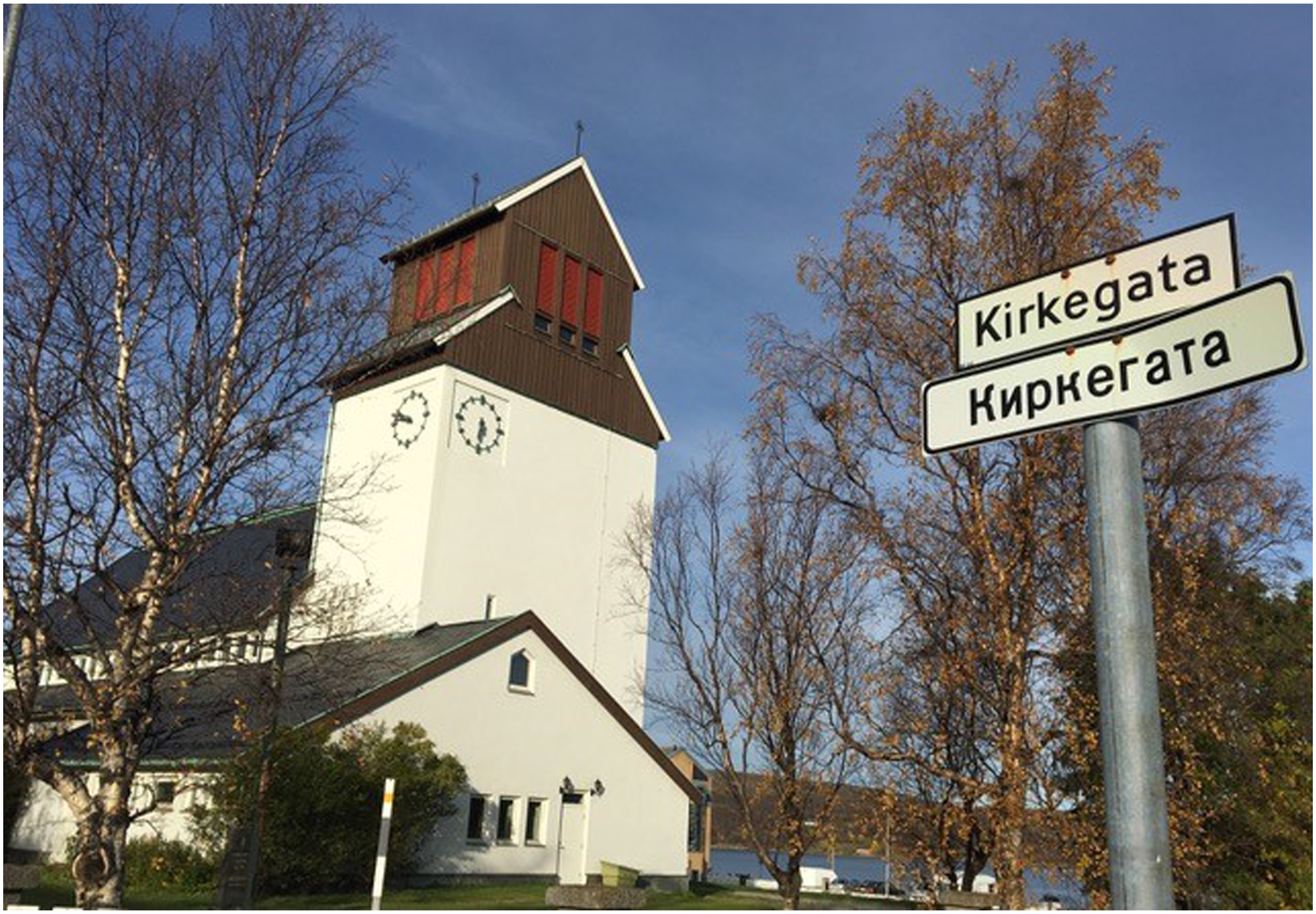
The idea of Barents Pride developed from the frequent exchanges between people in the area, who cross the border between Kirkenes and Murmansk on a daily basis. One of our research participants describes the relationship between Russians and Norwegians in the region as a people-to-people collaboration based on openness. Although the region may look insignificant for the world affairs, being located at a global periphery, it has a significant strategic importance for the Norwegian and Russian states, geopolitically (the presence of the border) and economically (natural resources). One key conflict in the region is the Sámi right to the land and the economic interests of the Norwegian state in the natural resources in the area. Recently, the Norwegian state has attempted to build railway tracks and expanding the port of Kirkenes, in order to prepare for intensifying the extraction of natural gas and oil from the sea. In our conversations with Mai, a Sámi reindeer herder living in Kirkenes, it is described how the Sámi community is involved in trials against the Norwegian state, since extracting natural resources in the area would negatively impact the reindeer population and the livelihood of Sámi reindeer herders. In this region, the categories of “metropolis/center” or “colony/periphery” are difficult to apply straightforwardly. From the mid-nineteenth century until the mid-1980s, people belonging to the Sami community were exposed to a harsh assimilation process of “Norwegianization” [førnorskning], exercised through the educational system and other public institutions, with severe repercussions for the Sámi people in the region still today. To solidify the nation-building ambitions of the late nineteenth-early twentieth century, Lutheran chapels were built to mark Norwegian sovereignty in relation to Finland and Russia. During the Cold War, the region had a military significance in the global rivalry between East and West. On a macro-political scale, the region continues to be of military-strategic interest on an international arena, marking the border between Russia and the NATO-country Norway. Described as “the last untouched resort for natural resources” (Runeson, 2007: 1), the region awakens economic and environmental interests not only from Russia and Norway but also from countries closely located such as Sweden. Today, there are intense political connections between Russia and Norway within the Barents region, which do not always align with Norway’s and Russia’s positions in international politics. As a result of the close collaboration between people in the border region, Kirkenes is sometimes called “Little Murmansk” (Gustavsson, 2009).When we were in Kirkenes in 2018, one of our Norwegian research partners told us that the mayor of Kirkenes wanted to invite Vladimir Putin to the celebration of the 75th anniversary of Red Army’s offensive that led to the expulsion of the Nazi troops from Finnmark in 1944. As reflected in the complex dynamics surrounding Barents Pride, sexualized figures both confirm and contest logics of sovereign statecraft today, recognized as a “tool in the domestic and international games of power” (Weber, 2016: 3). As we will discuss below, the interest of Norwegian state institutions to locate the event on the Norwegian side of the border, the border control of the Russian delegates when crossing the border upon their return, and the interest of Norwegian media in the event, offer an intricate account of how sexualized understandings of regional and international relations both “sustain and threaten to suspend traditional understandings of sovereignty” (Weber, 2016: 5). In such a laden context, Barents Pride serves as an ambivalent marker of geopolitical struggles for sovereignty and leadership in the world affairs.
Barents Pride 2018: Introducing the field
In September 2018, we attended the second pride in Kirkenes. It was a sunny chilly weekend with temperatures already dropping below 0°C at night. Kirkenes was calm, almost tranquil. The Pride’s official program started on Friday evening with a Rainbow mass (Regnbuemesse) in the Kirkenes Church of Norway. The mass was led by a local pastor with the involvement of Nadia, the Russian activist who initiated the pride idea, and Mai, a Sámi laywoman and reindeer herder, who led the Sami parts of the church service. The mass was trilingual—in Norwegian, Russian, and Sámi languages. The pastor and mass attendees prayed for those LGBT+ people who had to leave their homes, for Sámi people, for people living in a country with a high level of hostility towards them. This country, the mass continued, was Russia and mass participants prayed for LGBT+ people who were perceived there as criminals. Also, the crimes of the Norwegian state towards Sámi people were mentioned in the mass, as a present recognition of the violent history of the place. The mass was followed by a public discussion in Kirkenes’ library about the church as a possible ally in the struggle for LGBT+ rights. The discussion raised many political issues. The Norwegian pastor acknowledged the role of the Church of Norway in colonizing northern territories and compared the previously hostile attitude of the Norwegian state to Sámi people with the situation of LGBT+ people in Russia. The large share of the discussion was then dedicated to the perceptible role of the Russian Orthodox Church in the state-driven homophobic campaigns and promotion of “traditional” values.
The parade was scheduled on Saturday afternoon. In the morning, participants prepared banners and other materials. The messages of the banners in both Russian and English either appealed to human values such as love and equality (“All different - all equal. Love is human right,” “Love without borders”) or made straightforward political claims (“Pride in Russia - our right,” “My body is my business,” “No murders in Chechnya”). When the parade started at 14.00 from the Kirkenes school, it was noticeably cold outside. The Russian drag queen who would lead the parade had had to wait in the car before the parade started. Her décolleté dress stood out in the crowd who was dressed in regular warm clothes which suited the northern climate. There were also people in the uniform of Norwegian border guards. However, they seemed to be real border guards, not carnival characters. Some people wore masks or balaclavas to avoid being recognized. What shaped the pride parade visually was rainbow flags, scarfs, and banners. Some banners had a blue-rose-white background representing struggle for trans* rights. The general mood of the crowd was cheerful; however, the atmosphere was rather of controlled restraint than of “loud, colorful, and joyful celebrations of LGBT+ identity” (Bruce, 2016: 3). When the pride column moved along the streets of Kirkenes, it was moderately cheered by few accidental passerby. There were neither cheerful supporters nor organized protesters. The parade stopped in front of the Kirkenes library with signboards in two languages—Norwegian and Russian. The pride speeches by representatives of Norwegian Fri, Russian Maximum, and the mayor of Kirkenes were held inside. The speeches echoed the banners—love and humanity across the borders, condemnation of repressions against LGBT+ people in Russia, and acknowledgment of suffering of Russian queers. The mayor, however, was more diplomatic in his speech. Although he acknowledged the difficulties which LGBT+ people face in Russia, he also expressed his interest in a dialogue with his “Russian partners” (presumably, regional politicians) and a hope that the pride might help them look at the situation with LGBT+ rights in Russia differently.
This detailed description of Barents Pride provides a sense of the place and the context in which the pride is held. The strong political message dominates over a carnivalesque cheerful aspect of pride parades described in other research (e.g., Ammaturo, 2016; Peterson et al., 2018). Instead of being a “party with politics” (Browne, 2007), Barents Pride is politics with some elements of pride festivities including a party and a show program in the local club late on the Saturday evening. Instead of being frivolous and carnivalesque, Barents Pride is straightforwardly sober—even presumably carnivalesque characters such as border guards or pastors whom some Russian activists took for dressed up pride participants during the first pride in 2017 turn out to be real. Despite an explicit aim to vitalize the local LGBT+ community, the pride does not seek to queer the streets of Kirkenes since most people come from outside the region to take part in the event. The political message of the pride and the solidarity it expresses is unidirectional—it primarily addresses cruelty of the Russian state and solidarity comes from the Norwegian activists who express their support to suffering LGBT+ people in Russia.
A lesson in homotolerance
At a first glance, Barents Pride is an example of Western leveraged pedagogy that Kulpa defines “as a didactical and cultural hegemonic relation of power […], a hegemonic deployment of the Western EUropean liberal model of rights as the universal one […]” (2014: 432). As the messages appearing during the parade (“Love is human right,” “Pride in Russia is our right”) show, the discourse of human rights is central for Barents Pride. This discourse foremost problematizes the situation in Russia while Norway appears as an advanced subject with substantial achievements in the arena of gender equality and sexual rights. The gap between Norway and Russia is continuously stressed in information materials accompanying the pride where it is presented as “the huge difference in the treatment of LGBTI people on the respective sides of the border” (NHC, 2021) or as the widening difference in legislation that, in the Russian case, threatens the rights of lesbian, gay, and transgender people (NHS, 2020).
Pride organizers seem to be aware of this dynamic. The initial ambition of the pride, according to Lise, a representative of the main organizer FRI, was to create something collaborative, where everyone benefited from everyone—and not a situation where Norway entered to help others instead of learning something in exchange. The aim, Lise explained, was to create “shared tolerance” in the region, also with the Sámi environment, and to “include.” This was also underlined by a member of another involved Norwegian organizations, who said that Barents Pride is about confidence and trust across borders, which takes time: “The collaboration creates trust that we can do something together.” In this account, the “doing together” is understood as a way to show solidarity with people in a difficult situation. Notwithstanding these positive intentions, the collaboration did not always happen on equal terms. Another pride organizer, Neil from a Norwegian human rights organization, admits openly that in the first official Barents pride festival in 2017, there was still an attitude of superiority from the Norwegian partners in relation to the Russian activists. This tendency was emphasized by the fact that it was the Norwegian organizations who took the main responsibility for the planning for the first official Barents pride. Nonetheless, in 2018, the Russian activists were the main responsible partners of the program, which resulted in a better balance.
Another example is an informal conversation with Asta, a representative of the Barents Secretariat, noted in the fieldwork diary. As Asta sees it, the Barents Secretariat does not give money “to teach Russians,” as some partners from other regions sometimes want to use their funding. Rather, they are interested in mutual exchanges and learning. She names several projects where collaboration, in her view, is indeed mutual and equal—sport and school education. Success of such collaborations is determined by the fact that Norwegians and Russians from the Barents region have intense professional and personal contacts across the border and are less susceptible to national prejudices. Nonetheless, Asta admits that Barents Pride is a project that has a teaching component when Norway, that is “objectively better in regard to sexual rights than Russia,” teaches Russia a lesson of homotolerance.
Leveraged pedagogy in relation between Scandinavian and Russian LGBT+ activists extends beyond the pride. Speaking about cooperation with activists from Scandinavia more generally, Oleg, a pride co-organizer from the Russian side, admits that their foreign partners often provide Russian organizations with “learning opportunities and professional development.” Simultaneously, he fails to recall any examples when Russian activists are invited as teaching, not taught, subjects. Oleg himself does not question this state of affairs in his interview. Moreover, Oleg’s speech after the parade as well as other events of the pride weekend focuses predominantly on Russian repressive politics towards LGBT+-people unintentionally maintaining the homophobic image of the Russian state counterpoised to homotolerant Norway. In his interview, however, Oleg gives a more complex picture when he describes the discussion of Barents Pride with Finnish partners since Finland is also part of the Barents region: They [Finnish partners] say that everything is good with LGBT+-rights and tolerance in Helsinki. But outside of Helsinki the situation is not as good. And in the north, where there are many indigenous people, the level of homophobia is high. And parents do not accept their children. In principle, the same problems as we have in Russia. But they do not speak about this officially because there is legislation that punishes homophobia. But it still exists in people’s minds.
Thus, Oleg’s account nuances the superior character of Finland and Norway in relation to sexuality. It reiterates their advancements in sexual rights in the form of legislation but it also acknowledges homophobia that continue existing in these countries on a daily basis. Interestingly, however, that this homophobia is attributed to the indigenous population such as Sámi people and other minority groups. Oleg sees Barents Pride as a space to raise this problem in the north where LGBT+ people may experience homophobia and discrimination as well as the lack of possibilities to get support from the LGBT+ community or organizations.
Yet, Oleg’s more critical take on the situation with homophobia in the Barents region on the both sides of the border remain the subject of our private conversation. In the public discourse consisting of pride speeches and informational materials about the pride, Barents Pride becomes a political instrument for the Norwegian state to mark its cultural hegemony by claiming progressiveness and geopolitical superiority and to scold a dangerous Eastern neighbour. As Oleg speculates, Norway invests in Barents Pride as a part of larger political efforts to keep the border region stable and peaceful and, in the longer run, to decrease the number of LGBT+ people from Russia seeking asylum in Norway. The depiction of Russia as radically different from Norway in relation to sexual rights obscures internal tensions and power dynamics within each nation and real-life experiences of queer people on the both sides of the border. Moreover, such counterpositioning overshadows the importance of sexuality for nationalistic agendas and politics of sovereignty in both countries. As Suchland points out, “the regulation of sexuality in either repressive or emancipatory modes should not be assessed in isolation from their ethno-cultural, racial, and (neo) colonial investments” (Suchland, 2018: 1074).
Importantly, as a result of the violent ethno-biopolitical history of the region, inhabitants in Sør-Varanger belonging to minority and indigenous communities holds a relatively sceptic attitude to the Norwegian state. Their identity as Norwegians is weak and the boundaries between diverse ethnic belongings of people are blurred, as illuminated in our conversations with Lars, the pastor who led the Rainbow mass during Barents Pride: “My own family is almost not Norwegian at all,” Lars explains. “They are Sámi, Kven, Finns… They were attacked in school if they spoke Sami, they were beaten if they spoke to each other in Finnish.” Instead, belonging is rather shaped in relation to the two prominent social movements of the area: the labor movement and the religious Laestadian movement. Following Lars, these movements shape important foundations for the Sámi revitalization process that started in the late-1990s 6 as well as the ongoing struggles to recognize LGBTI+ people’s rights. Yet, despite the fact that people belonging to the Sámi community today have a greater visibility and a stronger influence in the municipality, significant challenges remain, according to Mai, the Sámi reindeer herder who led the Sami parts of the Rainbow mass. Among them, she mentions ethno-racist prejudices against Sámi men as violent, and Sámi children are still bullied at school. The struggles between the Sámi community and the state, in relation to the state ambitions to expand the extraction of oil and natural gas in the area, furthermore creates divisive conflicts within the Sami community itself, who have not a unanimous position in the matter.
Destabilizing narratives of homo- and hetero-nationalisms through transnational solidarity
In addition to the complex power asymmetries identified above, the collaboration between Norwegian and Russian LGBT+ activists in Barents Pride brings forth more multifaceted feelings of place and belonging than what is often acknowledged in queer theorizations of the nation-state or Western dominance in sexual rights struggle. Such accounts as Oleg’s reflections on homophobia in the northern parts of Finland and Norway, and Lars’ reflections around the weak Norwegian identity among people in the region, provide an important contrast that contributes to destabilizing dichotomies, such as those between East/West and challenge ideas of the nation as homogenous space and of the national border as the line demarcating communities and feelings of belonging. During fieldwork with representatives of the different Norwegian organizations involved, it was soon clear that tensions were growing between the organizations on the Norwegian side. These tensions were related to attempts from the Norwegian state to use Barents Pride to make a geopolitical statement and to the different ways in which diverse LGBT+ activists were positioned in relation to the Norwegian state. As previously mentioned, the initiative to organize Barents Pride came from two organizations: Russian Maximum and Norwegian Queer World. Yet, the funder wanted the event to be located only in Norway and a local organization had to be responsible. Taken together, these factors implied that there was only one organization that could be the main organizer of Barents Pride—FRI. Staff members in Queer World highlight certain problems with this turn of events. Dana in Queer World explains: All organizations have collaborated around [Barents Pride]. But in the website of the national Norwegian organization, it was said that they took the initiative to Pride. […] I travelled to bloody Kirkenes in the middle of the winter for a planning meeting. They were not there. They are rewriting history. We are made invisible.
Dana’s anger sheds light over the ways in which homonationalism in Norway relies on the marginalization or exclusion of racialized and sexualized others. To begin with, the very collaboration between Queer World and Maximum existed before Barents Pride. The exchange provides mutual support across national borders as members of both organizations encounter various forms of national exclusion such as, among other things, discourses and acts of homophobia, anti-migration, and racism. Nadia, a Russian co-organizer, consider Queer World as a reliable partner with whom the relations are horizontal. Dana explained that the Barents Secretariat awarded the sum allotted for the event, on the condition that the event was located in Norway only. Simultaneously, the Norwegian national LGBT+ organization FRI became appointed the main organizer of the Pride to fulfil the second condition of the funder to include a local LGBT+ organization in the region. These dynamics display how homonationalism is shaped by inter-locking processes of national inclusion/exclusion—processes that remain unrecognized when the pre-history of Barents Pride and the long-term collaboration across borders between the two organizations who took the initiative for the event are made invisible. The official Norwegian narrative of Barents Pride presents a unidimensional story where Norway is described as a safe haven for LGBT+ people, with no references to problems in Norway with racism or anti-migration, nor to the expectations of an account of victimization and gratitude among LGBT+ refugees seeking asylum in Norway.
However, in our fieldwork, this national narrative does not remain unchallenged. Diverse problematic consequences of national forms of exclusion were highlighted from the perspective of those who are excluded in Russia and in Norway. In this sense, the transnational collaboration between a Russian and a Norwegian organization, within which the idea of Barents Pride first emerged, visualizes not only the limitations of Russian state homophobia but also the limitations of the Norwegian idea of homonationalism, taking shape through the exclusion of gays who are not proper gays from the national community (Puar, 2007). The tensions around the preparation of Barents Pride, and Dana’s frustration, destabilizes the idea of the nation as a monolithic space by illuminating the multiplicity of space and by attempts at intervening into established relations within and between places marked by homophobia as well as homonationalism.
Destabilization of national homogeneity appears in conversations with the Russian activists as well. Both Nadia and Oleg underline that the situation with liveability of LGBT+ people in Norway is more complex than the official narrative of Norwegian homotolerance suggests. Nadia also brings the temporal dimension of sexual rights achievements in the discussion when she reflects on the meaningfulness of Barents Pride for Russian LGBT+ activists: I started noticing that all [Russian] activists who have ever visited any pride come back emotionally charged. And I realized that only a few of us went somewhere to the pride and saw the real life of the community and the path that this community walked. Otherwise, there is a [false] impression that Norway and Sweden were always tolerant, and that suddenly they gathered and decided, ‘Let’s have same-sex marriages’.
According to this quote, participation in prides as a way to encounter the LGBT+ community beyond the national borders of Russia gives Russian LGBT+ activists a more nuanced perspective on queer struggles in other contexts. It allows discovering the historical “path” that the LGBT+ community in Norway and Sweden as well as in other Westernized countries had to walk in order to achieve the rights that they enjoy now. The historical contextualization of LGBT+ struggles through pride events problematizes the essentialist idea of homotolerance as an out-of-time attribute of particular contexts or countries. In a similar line, Oleg also decouples “homophobia” from Russia while telling the history of his organization Maximum. He gives many examples of Maximum’s collaboration with the local state institutions and actors until 2013, when the general political landscape changed in Russia and LGBT+ organizations became the specific target of state repressions (Çağatay et al., 2022).
The idea of the nation as a homogeneous space and imagined community was furthermore challenged in our conversations with Neil, a representative of an NGO located in the north of Norway. Neil explained that there were conflicts among the Norwegian partner organizations during the first year’s organization of Barents Pride. The preparation of the event had mainly been taken care of by the Norwegian organizations which was difficult, Neil explained, because they were threading “unknown terrain.” With this, he referred to the different attitudes prevalent among people from the north and the south of Norway. He described how people from the north share a culture of pragmatism, based on informal structures, direct contact and by cultivating an “it will be fine, we will fix it-attitude,” while people from the south are more formal, theoretical, and academic and pose a series of problems to the collaboration before problems emerge. Living in the north himself, Neil expressed how he felt closer to people in the north—irrespective if they were Norwegian or Russian citizens—than to people in “the south,” because of these different attitudes: We [people in the Barents region] do things more informally, more directly. We solve problems as they come, while in Oslo they are focused on formal issues, security, to show concern… They created problems in advance, instead of just carrying on with the preparations…
Nadia shares Neil’s vision although we talked to them on different occasions. She admits that in spite of difficulties and conflicts during preparation of the first Barents Pride she was happy to take part in personalized collaboration: There were a lot of debates, attempts to prove something to each other, last-minute changes. Although it is a northern project, emotionally it was more like in the south (laugh). There were a lot of personal investments in this work. And this was good because you see people and not just electronic applications.
Nadia’s notion of north and south differs from Neil’s. She rather refers to stereotypes about southern people as more emotional and disorganized. As she underlines, although the project is northern, that is, supposedly well-planned and institutionalized, there were aspects in the process such as spontaneity and emotionality that characterizes it in southern categories. For Neil, on the contrary, spontaneity, and informality are the features of human communication in the Norwegian north which is also the periphery of Norway. At the same time, Norwegian south/center is regarded as more formal and arrogant. The difference between Neil’s and Nadia’s usage of spatial north-south categories notwithstanding, they have two things in common: first, they position themselves as belonging to the north (and not to Russia or Norway); second, they underline the importance of personal contacts and human interactions in their collaboration.
Barents Pride and politics of visibility
Pride parades are often synonymous with politics of visibility: to participate in Pride is to become visible. Yet, in our conversations, Dana from Queer World highlighted factors that served to illustrate the collective and contextual character of visibility/invisibility, bringing to light dilemmas and possibilities of transnational solidarity. Dana described the frustration she felt when certain Norwegian organizations took a position in the first row of the Pride parade, to be pictured on the front pages of all newspapers. She also expressed anger over the fact that the same organizations could pay salary to communicators to document the event and send updates to Facebook and news media which would give them great visibility in various media channels. Although some Norwegian organizations were taking lead positions in the parade, walking next to the mayor of Kirkenes, Dana, and others in Queer World joined the covered activists who did not want to be recognized and pictured in the media in the back row of the parade. By delinking the narrative of visibility from an individual decision and presenting it as a collective process of negotiation, connected to questions of space, belonging, and solidarity, Dana’s narrative highlighted more complex constructions of belonging and coalitions of struggle (Stella, 2015). Attending to “who does what and with what consequences,” Dana’s critical reflections around visibility/invisibility in Barents Pride parade produced a critique of understandings of visibility as a universal expression of self-affirmation within diversified contexts of solidarity, suggesting that notions of visibility/invisibility need to be carefully reconsidered within distinct contexts and relationships (Stella, 2015).
Concluding remarks
In this article, we have explored the ambiguities of transnational solidarity between LGBT+ activists from Norway and Russia through the case of Barents Pride. We set out to examine how scale and place matter in the construction of the pride agenda and solidarity networks and sought to bring nuance to the notion of transnational solidarity in pride activism beyond dichotomies of the global West/East-North/South. Although the cooperation between Norwegian and Russian activists to a certain extent reproduced Western cultural hegemony (embodied by Norwegians) in relation to sexual rights, Barents Pride is also an example of reflexive and careful collaboration aimed to establish mutual and equal relations between activists no matter what national context they represent. As we showed, the region where Barents Pride takes place shapes the pride agenda. Being located at the periphery of global centers for pride activism, in the geographic north, Barents Pride carries on an important political message of equality and love. The notion of the north allows Pride organizers to find a common identity beyond national belonging and to transgress the dichotomy of homotolerant Norway versus homophobic Russia. As we brought to light, national narratives do not remain unchallenged in the cooperation. The collaboration across borders between activists who encounter diverse forms of national exclusion destabilizes the idea of the nation as a monolithic space allowing the possibility of the region as a “minor” site (Gopinath, 2018) where colonial cartographies are disturbed giving room for other feelings of belonging, solidarities and modes of action than those of a sovereign nation. Yet, through our analysis, we also argue that the political message produced in Barents Pride at one level is unilaterally directed at Russia. This tendency became even more perceptible in the times of COVID19 when Russian LGBT+ activists could not attend the pride physically due to the border restrictions imposed by the Norwegian state. The popular slogan of Barents Pride “Love without borders” becomes bitterly ironic in this context.
This prompts us to suggest that Barents Pride could be understood as a political instrument for the Norwegian state to mark its independence by claiming progressiveness and civilizational superiority. Approaching Barents Pride as a place of tensions and conflicts, but also of significant border-crossing collaboration, we note how sexualized understandings have the potential to both sustain and suspend traditional understandings of sovereignty, as the micro-scale of Kirkegata becomes a site of macro-level dynamics, shaped by intersections between macro-level geopolitical and economic strategic interests of Norway and Russia, layers of historically accumulated Sámi struggles, and deep-rooted collaboration between local governments as well as people in the region. The question we ask ourselves is how such instrumentalization of pride activism can affect transnational solidarity networks and the purposes of transnational collaboration. Can Barents Pride and similar activist cooperation help improve lives of queer people in Norway and Russia or do they rather prioritize idealized notions of democracy and human rights at the expense of real lives and bodies, as Kulpa (2014) suggests? We conclude that Barents Pride as a small-scale cooperation provides activists with a space to reflect on these questions. Illuminating their concern about participants’ safety and the critical questioning of the visibility paradigm in the struggles for LGBT+ rights, we agree that Barents Pride organizers partially manage to reclaim Pride from the homonationalist agenda and turn it in a meaningful event for LGBT+ activists and queer people from both sides of the border.
Footnotes
Acknowledgements
We would like to thank our research partners who invited us to Barents Pride and shared their visions with us. We are also grateful to Erika Svedberg and participants of Gender Studies Seminar at Malmö University and to Katja Kahlina for her feedback on the first draft.
Declaration of conflicting interests
The author(s) declared no potential conflicts of interest with respect to the research, authorship, and/or publication of this article.
Funding
The author(s) disclosed receipt of the following financial support for the research, authorship, and/or publication of this article: The authors disclosed receipt of the following financial support for the research this article: This work was supported by Knut och Alice Wallenberg’s Foundation [2015.0180].
