




Abstract
The article explores the queer politics of homo/anti-normativity of Lesbians Who Tech, a corporate network for lesbian and queer women. Drawing from ethnographic fieldwork, I argue that critiques of ‘gay ordinariness’ are unable to capture extant ‘extra-ordinary’ trajectories of queer capitalist incorporation. I trace the ways in which corporate culture, leadership and values are currently reshaping queer life and politics in terms of a ‘CEO society’ to demonstrate that we should avoid assuming that anti-normativity is always on the side of the progressive and instead consider how this is taken up by the very institutions it is intended to contest.
Introduction
This paper explores the queer politics of homo- and anti-normativity of Lesbians Who Tech, a corporate network for ‘queer women and their allies’. 1 The network’s main event is an annual Summit. Envisaged as a networking event, the gathering takes place in the offices of some of the world’s most powerful tech corporations with the aim to promote corporate diversity and inclusion (D&I) by celebrating the successes and increasing the visibility of queer women working in tech. Created in response to the perceived dominance of cis men – straight and gay – in corporate spaces, the Summits attract women at different stages of their career: from graduate students looking for their first job, to LGBTQ+ activists turned D and I pundits who recently joined from the (not so distant) world of LGBTQ+ NGOs, to seasoned senior executives and even anthropologists, like myself, who are fascinated (and troubled) by corporate investments in queerness. Showcasing stories of personal and professional success as told by those for whom things have ‘gotten better’ (Grzanka and Mann, 2014), the Summits create highly seductive and spectacularized narratives about the ‘CEO lifestyle’, holding out lesbian and queer women tech executives as ‘changemakers’, ‘pioneers’ and examples of ‘progress’.
Whilst lesbian CEOs might surely feel empowering, scholars have argued that the incorporation of some (primarily white and middle-class) gays and lesbians into the institutions of late-capitalist modernity is accompanied by a homonormative depoliticization and ‘mainstreaming’ of queerness. In particular, critics have pointed out that recognition is achieved by side-lining anti-normativity and accentuating ‘sameness’ (Richardson, 2005), so much that ‘queerness’ now seems to mean little more than aspiring to ‘an LGBT+ version of straight…life’ (Tatchell, 2019: np). However, homonormativity critiques have seldom looked at how the very boundary between ‘queer’ and ‘normativity’ might itself be undone by this new brand of corporate queer politics. I argue that, as LGBTQ+ politics becomes increasingly ‘CEO-ized’, blurring the boundary between activism/corporations and social justice/business, critiques of ‘gay normality’ (Drucker, 2015) are less able to fully capture extant trajectories of queer capitalist incorporation. In this paper, I thus build on a growing body of literature that is starting to problematize the supposed progressiveness of homonormativity critiques (e.g. Kao, 2021; Quick, 2021) to ask whether homonormativity really need be accompanied by an erasure of ‘queerness’, and, if not, what that might mean for extant queer critiques, politics and activism.
I do so by drawing from ethnographic fieldwork conducted at and around the London chapter of the Lesbians Who Tech Summit. Tracing the ways in which the corporate network harnesses the transgressive impulses of anti-normativity, I coin the concept of ‘extra-ordinary homonormativity’ to describe a neoliberal corporate diversity politics that denotes not so much the emergence of a depoliticized ‘gay ordinariness’ but the rise of a cult of ‘queer extra-ordinariness’ that folds queers into capitalism by accentuating their distinctiveness, their uniqueness and their non-conformity to norms. I argue that this signals a queer version of what Bloom and Rhodes (2018) refer to as a ‘CEO society’ in which the values, aspirations and dispositions associated with CEOs and tech corporations are increasingly applied to every dimension of social, political and cultural life, including queer life. As a manifestation of Silicon Valley’s insurgent but ultimately corporate ethos, Lesbians Who Tech reveals both the appeal of capitalism’s promise to liberate queer workers from the normativities of corporate life, and the violent realities of corporate work that ultimately undermine its supposedly progressive appeal.
In demonstrating that there is something rather ‘queer’ about this new kind of corporate diversity politics, the article encourages homonormativity critiques to pay more attention to the ways in which corporate culture, leadership and values are increasingly infusing queer politics and activism. I use ‘queer’ throughout both as a shorthand for a non-heterosexual identity and as a form of political activism that distinguishes itself from more ‘mainstream’ LGBTQ+ politics in its critique of (homo)normativity, identity politics and assimilation. I hold onto both these iterations of queer – as identity and as anti-normativity – rather than trying to resolve them by fixing the meaning of ‘queer’ to demonstrate that the boundary between what is ‘queer’ (and thus radical, non-normative, activist) and what is ‘normative’ (and thus assimilatory, identitarian) is in fact increasingly difficult to sustain.
In so doing, I do not wish to dismiss homonormativity critiques altogether, nor do I wish to promote a gentrified understanding of queerness as something that can and/or should be seamlessly reconciled with processes of capital accumulation. Indeed, it is precisely because I believe in the relevance of homonormativity critiques and the potential of queerness to advance and remain grounded in a radical anti-capitalist politics that I seek to foreground capitalism’s capacity to co-opt queer desires for anti-normativity in pursuit of profit and thus reflect on some of the limitations of queer allegiances to anti-normativity as a mode of resistance.
The article begins by contextualising corporate LGBTQ+ networks in relation to the growing ‘CEO-ization’ of LGBTQ+ politics and corporate diversity politics, introducing homonormativity critiques and the queer politics of anti-normativity. I then introduce Lesbians Who Tech, contextualising the network and its events within a Silicon Valley ‘East Coast liberalism’ (Turner, 2006) that extolls the emancipatory potential of technology and tech companies as ‘counter-cultural’ sites of political and social change. After outlining my methodology, I draw from participant observation conducted at the London chapter of the Lesbians Who Tech Summit to introduce and discuss the politics of extra-ordinary homonormativity. The politics of extra-ordinary normativity are also analysed in relation the figure of ‘the lesbian tech CEO’. I conclude by exploring what lesbian tech CEOs and the corporate LGBTQ+ networks who spawn them might tell us about broader debates about homonormativity, anti-normativity, assimilation and neoliberalism.
CEO-ization and the corporate politics of diversity: Between homonormativity and queer anti-normativity
Rallying queer people’s aspirations in capitalist economies, corporate LGBTQ+ networks such as Lesbians Who Tech should be read as part of broader neoliberal ‘CEO-ization’ of everyday life in which corporations emerge as ‘the model form of organizing beyond compare’ (Bloom and Rhodes, 2018: 19). CEO-ization extends to LGBTQ+ organizing and the LGBTQ+ movement, whose interests have become increasingly aligned with those of corporations. Here CEO-ization has been propelled by the opening-up of new professional career paths for LGBTQ+ activists able and willing to forge alliances with the private sector (Richardson, 2005; Ward, 2003). These new careers are created both within LGBTQ+ NGOs and corporations, as LGBTQ+ activists increasingly take up jobs in a D and I growing industry as ‘consultants’, ‘experts’ and ‘specialists’.
Indeed, as it turns out, LGBTQ+ diversity has become a highly profitable source of untapped value for corporations that can be harnessed to bolster – rather than challenge – the status quo (Author, 2021a; Conway, 2021; David, 2017). Corporate LGBTQ+ networks emerge as part of a broader corporate diversity politics which embraces ‘difference’ as a productive advantage (Rumens, 2018). The turning of queer differences into resources that have to be managed in pursuit of profit has been accompanied by a shift from trade unions to corporate ‘LGBTQ+ networks’ and ‘LGBTQ+ employee resource groups’ as key sites of LGBTQ+ organizing (Author, 2021a). The result has been an increasingly narrow understanding of social justice focused less on overturning structures of inequality and more on promoting ‘visibility’, celebrating ‘diversity’, and holding up those who can and have mastered the ability to enter ‘the boardroom’ as ‘winners’ and examples of ‘progress’.
Defined as a form of politics that ‘does not contest dominant heteronormative assumptions and institutions… but upholds and sustains them while promising the possibility of a demobilized gay constituency and a privatized, depoliticized gay culture anchored in domesticity and consumption’ (Duggan, 2003: 179), the term ‘homonormativity’ emerges as a critique of the various forms of privilege and assimilation enabled by the CEO-ization of LGBTQ+ politics. Indeed, despite the mantras of ‘diversity’ and ‘inclusion’, queer critiques have argued that the new forms of recognition and inclusion opened-up by the celebration of diversity have only been reserved for those – mostly white and middle-class gays and lesbians – who can appear to be ‘normal’ (Drucker, 2015; Richardson, 2005).
Part of the work the term ‘homonormativity’ has been doing over the past two decades is that of naming and critiquing what David Halperin (2012) refers to as ‘the rise of a new and vehement cult of gay ordinariness’ (443) in which those queers who are able and willing to be(come) incorporated into the institutions of late-capitalist modernity do so by insisting ‘on their dullness, commonness, averageness… [to appear] completely indistinguishable from every one else’ (Ibid). These sentiments are echoed by queer academics and activists alike who lament the ‘mainstreaming of queerness’ (Halberstam et al., 2005), its loss of a ‘critical edge’ (Tatchell, 2019), the emergence of queer desires for ‘sameness’ (Richardson, 2005), and the fact that many queer people now ‘seem to aspire to little more than an LGBT+ version of straight…life’ (Tatchell, 2019: np).
These debates encapsulate the tensions between (homo)normativity and anti-normativity: the former embodying an assimilationist impulse towards dominant institutions and norms, the latter marking an unassimilable form of difference and political and activist desire to disrupt them. Queer activists and scholars have pursued the latter to both conceptualize non-conformity to norms and to ultimately rupture and/or ‘undo’ them (Butler, 1990). Whilst what exactly constitutes ‘anti-normativity’ has been the subject of much debate (see Wiegman and Wilson, 2015), suffice to say that the concept has been mobilized – both theoretically and as political activism – as a remarkably resistant form of engagement that opposes precisely the kind of ‘mainstreaming’, ‘normalization’, ‘sanitization’, ‘sameness’ and ‘assimilation’ – of politics, identities, lifestyles and aspirations – identified as one of the most troubling aspects of extant forms of CEO-ization. In queer political activism, this resistance to norms and assimilation has taken shape through slogans such as ‘queer liberation - not rainbow capitalism’, increasingly visible at Pride marches – especially in North America and the UK – as a critique of the incorporation of queer people into capitalist institutions and the need for Pride to remain a ‘protest’ (Figure 1). Image of queer activists at LGBT Pride in Dublin. Available at https://commons.wikimedia.org/wiki/File:Queer_Liberation_Not_Rainbow_Capitalism.jpg.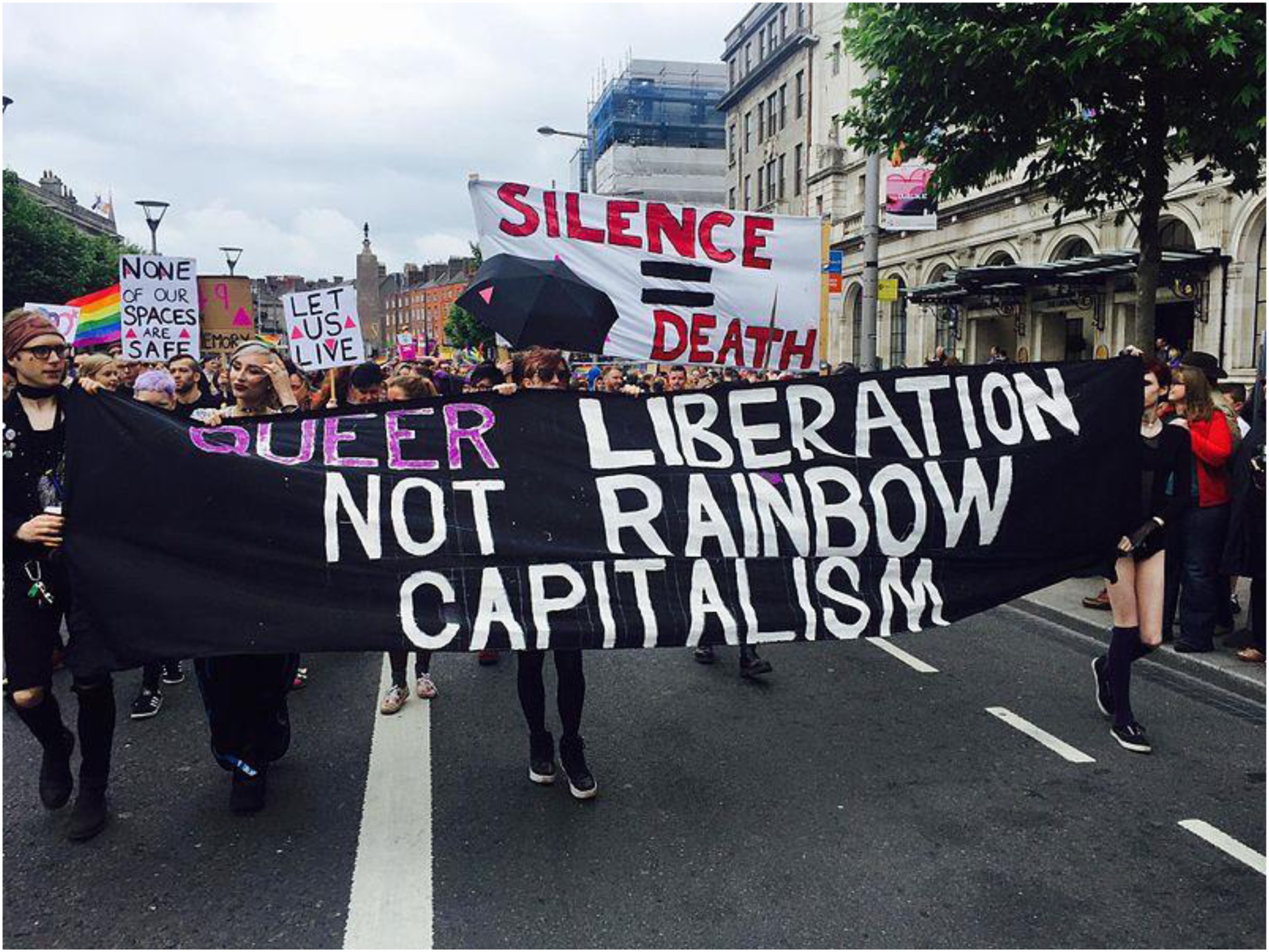
Critiques of homonormativity via anti-normativity have been instrumental for the development of the queer anti-capitalist sensibilities which inform this article. At the same time, within these debates there has been a lack of consideration of how ‘the longstanding embrace of [queer] non-conformity as a mode of resistance’ (Winnubst, 2012: 94) might itself be ‘colonized’ by neoliberalism. Rao (2020) alerts to the postcolonial politics of the temporal frames which inform a queer rejection of norms and assimilation in the West where ‘inclusion’, however, fraught and conditional, has been achieved and therefore can be rejected (also see Kao, 2021). Quick (2021) also points out that anti-normativity itself is increasingly congealing into an identity that is exclusionary for those who do not have access to the necessary capital to perform oppositional renderings of queerness. In this regard, a growing body of work has been problematizing homonormativity critiques by arguing that, in certain contexts and at certain times, the performance of anti-normativity might in fact confirm, rather than trouble, existing hierarchies of power (Jagose, 2015; Ludwig, 2016; Menon, 2015; Wiegman and Wilson, 2015; Winnubst, 2012; Ye, 2021).
In an essay entitled ‘Queer Privilege’, anonymous writer and academic Fuck Theory (2018) argues that this seems to be particularly the case in ‘activist’ and/or ‘social justice’ spaces ‘where a generalized ideology of anti-normativity holds sway, [and where] queerness is a badge of honour, a marker of specialness, and a source of crucial and moral authority: in short, a form of privilege’ (np). Extending these observations, I argue that, as the boundary between what counts as ‘social justice’ or ‘activism’ and what counts as ‘business’ becomes increasingly blurry, this might also apply to corporate spaces such as Lesbians Who Tech.
Lesbians Who Tech
Lesbians Who Tech (LWT) has emerged in recent years as the worlds’ largest congregation of ‘queer women in tech’. 2 Boasting over 70,000 members, the network was founded in 2012 by Leanne Pittsford, a white lesbian woman entrepreneur who began her career working for Equality California, campaigning to overturn prop 8. Now CEO of LWT, Leanne describes herself as a ‘queer and women’s rights activist’ who ‘love[s] politics and technology equally’ (Model View Culture, 2014). In an interview for Vice, she explains that LWT was created in response to her own experiences of Silicon Valley’s ‘Boys Club’ and the exclusion of queer women in tech (Yang, 2018). LWT hopes to ‘build from a tech perspective to solve the world’s problems’, 3 particularly ‘the problem of diversity’ and the dominance of cis men – straight and gay – in corporations (Lagorio-Chafkin, 2019). To this end, LWT functions as a networking space to connect not only lesbian and queer women, but all those excluded from ‘the mainstream’ corporate world of tech, with each other and with ‘inclusive’ start-ups and companies in pursuit of greater ‘equality’. This extends beyond the realm of the professional work and into everyday life. As a Vogue article explains, the particular benefit of LWT arises from enabling participants to forge connections ‘beyond day-to-day work’ (Heller, 2017: np).
Underpinned by a strong belief in technology as a force for good in the world, LWT is representative of an ‘East Coast liberalism’ that places in Silicon Valley’s tech corporations the faith to create a more socially just society (Turner, 2006). Emerging from the syncretic combination of both anti-authoritarian ideals of liberal democracy and a conviction in the power of the free market to save us from the vagaries of politics (Turner, 2006), this belief is based on a reconfiguration of the private, for-profit tech corporation not as an oppressive force but as a supposedly ‘countercultural’ site of progressive political and cultural change that is ‘on the side of the people’. LWT is a manifestation of Silicon Valley’s insurgent but ultimately corporate ethos. Whilst it is critical of the Valley’s ‘tech-bro culture’, it betrays a similar belief in the emancipatory potential of (inclusive) technology. Moreover, like Silicon Valley’s cis straight male leaders, Leanne has too fashioned herself as somewhat of a ‘rebel’ and ‘revolutionary’ liberating queer workers from the normativities of corporate life.
The LWT Summit – held in 40+ cities across the world and sponsored by tech giants such as Google, Amazon and Facebook – is the network’s main annual event. The San Francisco chapter of the Summit, held at the historic LGBTQ+ landmark Castro Theatre, is by far the network’s largest event. The Summit attracts over 5000 ‘lesbians, queer women and their allies in tech’, 4 making it one of the biggest corporate LGBTQ+ diversity events in the world. Whilst the Summit attendees are mainly at lesbian and queer women, the events are open to non-binary, gender nonconforming and trans people. With tickets ranging from $70 to $200, the Summits’ keynote speakers include major figures from Silicon Valley’s tech sector – from Youtube’s CEO Susan Wojcicki, Netflix’s CMO Bozoma Saint John and Facebook’s COO Sheryl Sandberg. Session speakers include lesbian and trans entrepreneurs who have launched their own start-ups, such as New York Times journalist Kara Swisher (founder of Recode) and actress, businesswoman and trans right activist Angelica Ross (founder of TransTech), as well as lesbian and queer women software engineers, service designers, diversity officers and marketing managers working at companies such as Google, Facebook, Twitter and Amazon. Diversity is at the heart of the Summits’ ethos, with a requirement that, of those who speak on the stage, at least half have to be women of colour, 30% black or Latinx, and 15% trans or gender nonconforming.
Whilst most speakers at the Summits come from the corporate world, at times these also include ‘activists’ from social movements such as civil rights activist Stacey Abrams and feminist activist Gloria Steinem. Most notably, in 2016 the Summit featured a keynote by BLM co-founder Patrisse Cullors, who spoke about systemic racism and taking care of the community. Speakers also include queer cultural ‘icons’ such as captain of the US Women’s Football team Megan Rapinoe, the cast of the lesbian hit series The L Word, and queer astrologer Chani Nicholas. The combination of both demonstrably corporate and queer activist/cultural themes is also reflected in the Summits’ slogans (e.g. ‘technology, diversity, community’ at the 2017 San Francisco Summit) and its session topics: from coding, AI, networking, the ‘hottest’ trends in tech and how to raise funds for your new start-up company, to climate change, police brutality, human rights, resistance, protest and ‘cyberactivsm’.
Indeed, most striking about the LWT Summits and the network more broadly is the way in which it confounds neat distinctions between ‘the activist’ and ‘the corporate’. 5 On the one hand, the Summits are distinctly corporate spaces: not only sponsored and hosted by corporations and marketed to their lesbian, queer, trans and non-binary employees, but also anchored in a corporatized culture which glorifies ‘networking’ and displays of (lesbian) ‘entrepreneurship’ (Bloom and Rhodes, 2018). At the same time, the Summits also clearly tap into queer activist sensibilities, movements, motivations and culture. As Leanne explains in an interview with Inc.: the Summits are meant to be ‘part networking event… part technology conference, and part social justice rally’ (Lagorio-Chafkin, 2019: np). By bringing together different speakers – some activist, some corporate – the Summit not only brings together communities that do not normally share a space but also demonstrates capitalism’s capacity to absorb and market potentially critical elements for its own ends.
Methodology
Across 2017 and 2018 I attended a number of diversity events catered to lesbian and queer women across different corporate sectors – from finance to professional services – as part of a broader ethnographic study on the politics of LGBT-friendliness. The LWT Summit embodied some of the dynamics observed elsewhere at these events but went a step further: whilst it confirmed that, if performed in the ‘right way’, certain forms of queerness could indeed be converted into valuable forms of difference in corporations as part of a broader celebratory politics of diversity (see Author, 2021a), at the event it appeared that the normative celebration of (certain forms of) difference had gone so far as to start approximating anti-normativity itself. I became intrigued by the tension between corporate celebrations of diversity and extant critiques of the ‘mainstreaming’ of queerness and thus became interested in the politics of homo- and anti- normativity of LWT, asking whether homonormativity really need be accompanied by an erasure of ‘queerness’, and, if not, what that might mean for extant queer critiques, politics and activism. The strength of this case study lies both in its typicality and its intensifying of broader patterns and dynamics.
In November 2017, I attended the London chapter of the LWT Summit main event, held at Facebook’s offices on Euston Road. At the event, I conducted participant observation by taking detailed fieldnotes of my observations and interactions with participants. Fieldnotes were transcribed but not coded as I opted in favour of an (auto)ethnographic storytelling approach. In this sense, I was less interested in discerning ‘patterns’ or counting ‘themes’ than in thinking about what the specific situated ethnographic encounter(s) could tell us about the relationship between activism and corporations and the politics of homo- and anti- normativity in the corporate world. I opted in favour of presenting my work in the form of ethnographic vignettes in order to capture the inseparability of data collection and analysis, and to foreground my fieldwork positionality. I also conducted a number of follow-up ‘ethnographic interviews’ (see Author, 2021a) with Summit attendees and volunteers. My ethnographic observations are further complemented and extended via a reading of cultural texts, media and materials in the public record.
As a lesbian doing a PhD in a Business School on the politics of diversity, my participation at the Summit was welcome and generally aligned with the network’s desired audience. Whilst my involvement in ‘queer political activism’ in London – specifically in two relatively visible actions targeting property developers and the presence of corporations at Pride – usually separated me from corporate diversity event attendees, I felt a sense of affinity with the Summit’s participants: young(ish) lesbian and queer women in their 20s and 30s with whom I had shared friendship groups and, on a few occasions, drinks at a popular East London queer nightclub called Dalston Superstore. This sense of belonging was reflected in my interactions with participants, which felt genuine and authentic.
At the same time, my lack of professional experience and aspiration in the corporate world, compounded by my strong anti-capitalist convictions – which made me particularly sceptical of corporate diversity events – still marked me out as an outsider. Reflecting some of the broader experiences of conducting fieldwork at these kinds of events, I thus felt concomitantly embedded and out of place in this corporate world of queer and lesbian women, mobilizing my status as insider/outsider to elicit information and data from participants (also see Author, 2020). I use reflections from my fieldnotes throughout to explore these (sometimes conflicting, sometimes not) positionalities and tensions.
Queer, badass, inclusive: A politics of extra-ordinary homonormativity
I arrive at Facebook’s headquarters for the LWT Summit. Sponsored by IBM, it is only the second year the Summit is hosted in London and a significant level of excitement and anxiety emanates from the Summit volunteers – unpaid, mostly quite junior employees of Facebook and Amazon, who hosted the launch party the previous night. They greet me in the foyer of the building on Euston Road wearing T-shirts with the Summit’s slogan: ‘Queer, Badass, Inclusive’. As I wait to be checked-in, I start talking to Amy, who has worked in the tech industry for a few years and is here today to ‘find some inspiration and maybe a new job… or maybe just to have fun’. Sitting next to a large polyester rainbow Facebook logo located on the ground floor, we discuss why we decided to attend the event. ‘When I went to tech events it was just me and a bunch of men. When I went to queer tech events, it was just me and some more men’, she explains. This event caters to people like Amy, promising to inspire and open-up networking opportunities for queer and lesbian women looking to enhance their career and be connected to other queer women in tech.
After registration, we make our way to the 15th floor. A large screen just outside the lift projects a black and white picture of Audre Lorde, accompanied by her quote ‘the master’s tools will never dismantle the master’s house’. I walk past the screen, horrified but also intrigued by such a display in a corporate setting. ‘Her work is so inspiring’ remarks a volunteer, who must have seen me gasp. I smile awkwardly, follow Amy into the open-plan room which extends across the totality of the 15th floor, and see approximately two hundred ‘queer women and their allies’ 6 who too, like me, have given up their Saturday to be here. They are mingling and talking in groups of 2–3, pouring themselves coffees from large metal containers scattered across the room, waiting for the event to begin.
At around 10 am, we are encouraged to take our seats. The lights dim and the eight screens hoisted around the stage light up to read: ‘THIS IS NOT YOUR TYPICAL TECH CONFERENCE. There won’t be a lot of this'. At this point, the screens cut to a series of images. In an article published in BuzzFeed, Ellen Cushing (2015) describes these very images (projected at the San Francisco chapter of the Summit) as displaying ‘shots of white tech dudes in various poses of white tech dude-ness, before showing us what we were in for, namely, “great hair”, “hula hoop contests”, “lesbians who look like Bieber”, “high-fives”, “geeking out”, and “more hugs than business cards”’ (np). In juxtaposing images of ‘white tech dudes’ and ‘lesbians’, a distinction is established between ‘the normal’ and this ‘un-ordinary’, ‘diverse’ and ‘inclusive’ networking event.
After lunch, and just as I thought I had become adequately accustomed to the excitement and enthusiasm which accompanied each speaker, there came a drum roll. ‘And now…’ announces the presenter, ‘our founder, CEO and lesbian leader … Leanne Pittsford!’ The drum roll fades to Kanye West’s ‘Stronger’ as Leanne makes her way onto the stage, met with expansive cheers. ‘Here comes the “cyber hero” of the lesbians’, whispers Amy, who is sitting next to me in the dark auditorium. ‘Hello! Is this what 200 lesbians look like?’ opens Leanne as the cheers are still lingering. I later find out from watching YouTube videos of other Summits that she uses this line or some permutation of it frequently in her entrances. Her performance suddenly felt very staged. ‘We are the most diverse conference in tech, there’s something so unique about all our identities. There’s rock-star talent from the queer women’s community. Turn to your neighbour and give them a high-five’, she continues. I turn to Amy, we high-five.
The Summit – like the LWT organization more broadly – also operationalized the language and temperament of ‘queer’ to market itself as ‘un-ordinary’, even ‘revolutionary’ (Cushing, 2015). This was evident in the explicit use of the word ‘queer’ to denote the constituency to whom the Summit was aimed at (‘queer women in or around tech’) and in the Summit’s own marketing (‘Queer, Badass, Inclusive’). It was also evident in references to ‘white cis male privilege’ and social justice figures such as Audre Lorde. In media coverage of LWT, it is not uncommon to read that a ‘tech conference’ is not where this is supposed to happen (e.g. Osworth, 2015). The choice of speakers – senior queer and lesbian women CEOs, founders of their own start-ups, but also an academic giving a presentation on queer theory, community-organizers, a drag performer – and the actual content of their presentations – on queer theory, cyber-activism, community-building – was also understood as an explicit challenge to the norms of ‘maleness’ and ‘straightness’ in the corporate world: a form of anti-normativity.
The performance of queer anti-normativity articulated at the Summit constitutes a specific form of homonormativity not denoted by ‘ordinariness’ but accompanied by the rise of a cult of queer, ‘badass’, extra-ordinariness. I term this an extra-ordinary form of homonormativity: a neoliberal politics of corporate diversity that is accompanied not by the erasure of ‘queerness’ or a desire for ‘assimilation’ but rather a desire for an extra-ordinary life of ‘rock-star talent’ and ‘uniqueness’. Positioning itself ‘against normativity’ in its celebration of ‘diversity’, this is a politics of homonormativity that folds queer into capitalism not by accentuating their ‘sameness’ (Richardson, 2005) but their distinctiveness, their uniqueness and their non-conformity to norms – in other words, their ‘queerness’. Here queerness is reconfigured as a form of ‘capital’ that is at once social, cultural and financial: a networking tool, a marker of ‘specialness’, a way of raising literal capital for investment (e.g. The LWT Summit ‘Pitch Competition’).
Whilst this form of politics harnesses the transgressive impulse of anti-normativity, it remains deeply homonormative in shape and form not only because it privileges a remarkably ‘narrow’ understanding of social, political and economic change as driven in the corporate world, but also because the forms of corporate queer capitalism it promotes are likely to remain extremely ‘unfriendly’ towards certain kinds of queers and queerness that cannot be turned into profitable resources for corporations. This includes those queers who for whatever reason cannot afford to perform their queerness in extra-ordinarily anti-normative ways (Author, 2021b; Fuck Theory, 2018; Quick, 2021). Moreover, contemporary iterations of homonormativity are likely to slip and translate into homonationalism (Puar, 2007). This applies to LWT, whose speakers often include queer and lesbian women working in the military-industrial-complex industry and (neo)liberal imperialists such as Hillary Clinton, who was a Summit keynote speaker in 2018.
Lesbian tech CEOs
‘Lesbian tech CEO, all the ceilings, crashed’ exclaims Leanne, introducing Hayley Sudbury to the room. She is referring to her breaking down of heterosexist barriers – often referred to as the ‘glass’ and ‘pink’ ceilings – by climbing to the top of the corporate world and becoming CEO of her own tech start-up. ‘This woman created a start-up to fight for our rights!’ exclaims Leanne to the room as the cheers get louder.
Lesbian tech CEOs such as Leanne Pittsford and Hayley Sudbury have in recent years been celebrated with notable fervour by media outlets such as The Guardian, Vogue, CNN, Buzzfeed, The Huffington Post and Forbes (see Cushing, 2015; Dunn, 2017; Eugenios, 2015; Heller, 2017; Restauri, 2014; Young-Powell, 2018). Lesbian tech CEOs are emblematic figures of a politics of extra-ordinary homonormativity: confident, successful, ‘out’ and ‘proud’ queer women that embrace their ‘lesbian-ness’ as a ‘benefit’ and key asset to their professional career. Their extra-ordinariness is somewhat compounded by the fact that both these women lead companies that have an explicitly ‘social’ mission: to improve the lives of lesbian and queer women and other minorities in corporations and, ultimately, in the world at large.
Bridging the gap between ‘business’ and ‘social justice’, lesbian tech CEOs represent a new brand of corporate politics that is indicative of the current shape and direction of queer political activism in a neoliberal era. One of Leanne Pittsford’s keynotes at the 2016 Summit in San Francisco, a recording of which is uploaded on YouTube, gives us an indication of the character of this new kind corporate queer politics. Entitled ‘Take a F@!#ing risk: How your badass leadership betters the world’, the video opens with a montage of news media segments talking about the lack of diversity in corporations. A screeching vinyl sound cuts to a black screen. We hear Leanne’s voice: ‘blah blah blah, anyone else tired of hearing about these numbers? Let Lesbians Who Tech show you how it’s done’. Accompanied by inspirational instrumental music, we are then catapulted into the world of LWT. Leanne’s voice, explaining the rationale and mission of the network, overlays images and recordings taken from the Summits depicting people having fun, high-fiving, clapping, smiling. This ‘feel good’ collection of snapshots then fades, making way for Leanne’s presentation.
In the presentation itself, Leanne explains her vision of the world to an auditorium of ‘1600 lesbians’. She explains that this a world free from discrimination, where women make more than men, where trans women of colour are not murdered every day, and where there is a Black lesbian president. The announcement of each these elements is met with expansive cheers from the audience. She explains that to get this world, the ‘the world we all want to see’, we need to ‘stop staying at home’ and ‘show up’ for our community. That is what she did when she created LWT. Only then will we change the fact that there are ‘more white, straight, cis men in power’. Flattening out histories and present realities of violence embedded in struggles for liberation, Leanne cites the victories of gay marriage and civil rights to ask us ‘what are you going to do to create the world you want to see?’
The versions of the (queer) world on offer here resonate especially powerfully with those – lesbian, queer, bisexual trans and non-binary, but also Black and other minoritized – employees disillusioned with the ‘old’ corporate world dominated by white, cis, straight men. This was reflected in interviews I conducted with Summit attendees. During an interview with a non-binary volunteer of the Summit, they described Leanne as ‘so inspiring… truly a role model’, explaining that it was ‘empowering’ to see such displays of ‘powerful lesbian leadership’. The seductive power of these lesbian tech CEOs lay not in the offer of a ‘good (queer) life’ (Berlant 2011) of ‘normality’ and ‘sameness’, but rather in the offer of a ‘cool life’ (Winnubst 2012) of challenging norms and, in the process, ‘making history’ (Osworth 2015).
Lesbian tech CEOs also invite us to invest in ‘tech’ a powerful redemptive quality, to let tech show us ‘how it’s done’. This was reflected in extant media coverage of the Summit. Writing for Autostraddle, a popular US-based online magazine for lesbian and queer women, Osworth (2015) explains how the fact that one of the Summit’s speakers brought up a slide reading ‘Black Trans Lives Matter’ made them challenge their assumption that ‘social justice and technology [are] diametric opposite’. Emerging as cyborgian-entrepreneurial neoliberal subjects (Haraway, 1985) – part lesbians, part Tech CEOs/machines –lesbian tech CEOs synthesize this new prosthetic relationship between ‘social justice’ and ‘technology’ to present tech companies as ‘saviours’ and ‘allies’ in the creation of ‘world[s] we all want to see’ (also see Evans and Meza, 2020).
These are versions of the world that actually approximate those proposed by contemporary iterations of queer anti-normativity, particularly in their emphasis on the need to challenge ‘straight norms’. In this sense, lesbian tech CEOs effectively collapse the distinction between ‘rainbow capitalism’ and ‘queer liberation’ to turn queer politics and activism into productive corporate activities. On the one hand, qualities, values, aspirations, lifestyles and styles of leadership traditionally associated with corporations become forms of ‘queer liberation’, which we are encouraged to participate in by coming out, investing in ourselves, taking risks, signing-up for the networking app, launching our own tech start-up, ‘showing up’ for our community, being visible and attending LWT. On the other hand, the accentuation and celebration of queerness via an extreme, intensified corporate queer politics of extra-ordinary homonormativity ostensibly reconfigures anti-normativity as ‘rainbow capitalism’s’ latest permutation.
A queer CEO society: The tech corporation as the new site of queer politics
In a forthcoming article, Evans and Meza (2022) coin the term ‘techno-theodicy’ to describe ‘the powers of salvation and redemption invested in technology today’ (np). Lesbian tech CEOs and the LWT Summit embody some of the elements of this techno-theological faith by positing the tech corporation as a place in which queers should organize socially and politically. This represents a new brand of corporate queer politics that enshrines the neoliberal colonization not only of ‘queer labour’ (David, 2016) but of queer life itself: the social, affective, inter-personal relations around which queer organizing unfolds. Reconfiguring the boundary between queer political activism, life and the tech corporation, this signals the emergence of a queer version of what Bloom and Rhodes (2018) refer to as a ‘CEO society’ in which the values, aspirations and dispositions associated with CEOs are increasingly applied to every dimension of social, political and cultural life, including queer life.
A ‘CEO society’, as they understand it, is a society that is not simply based on corporate management practices but that actually casts CEOs as ‘obvious social winners’ whose upwardly mobile aspirations, entrepreneurial qualities and neoliberal lifestyles need to be emulated and admired. The irony here is that despite being clearly responsible for widespread economic, social and environmental collapse, CEOs continue to be worshipped in the popular imagination as ‘role models’ and ‘leaders’ whose qualities can pave the way ‘to a brighter and more ethical capitalist future’ (Bloom and Rhodes, 2018: 5).
Complementing Bloom and Rhodes’ (2018) analysis and extending feminist readings to this new brand of corporate queer ‘technocapitalism’ (Suarez-Villa, 2009), it appears that precisely where neoliberalism might struggle to retain the idolization of CEOs, queerness is being used to restore the heroic ideal of the business executive ‘to save a dying capitalist order’ (Bloom and Rhodes, 2018: 225; also see Rao, 2020). Incorporating queer critiques of homonormativity and ‘the normal’, this new brand of corporate queer – and not simply ‘gay’ (Ward, 2003) – capitalism offers lesbian tech CEOs as new ‘ethical’ and ‘authentic’ leaders in exchange for a novel brand of capitalism that is progressive, inclusive, ‘friendly’, that has reformed itself and is now a social force for (queer) ‘good’.
Whilst at LWT tech corporations and lesbian CEOs emerge as bastions of ‘progress’ and ‘inclusion’, we know that the realities of work in the tech sector can be just as oppressive as the kind of ‘heterosexist’ workplace cultures that LWT claims to contest. Indeed, lurking behind the seemingly ‘cool’ and ‘transgressive’ approach to work in which employees are encouraged express their ‘queerness’, lies the sad reality of a life – its aspirations, dreams and stirring desires – endlessly colonized by the demands of capital. This applies both to the lesbian tech CEOs who enjoy its spoils (and for whom it is thus harder to feel empathy for), and those (straight and queer) employees for whom such a (supposedly) emancipative approach to work has in fact translated into longer working hours and deteriorating working conditions. As Jaffe (2021) explains, whilst tech companies proclaim their commitment to diversity and inclusion, the labour required to run them and that makes them profitable – from servicing their customers, stocking their warehouses and cleaning their offices – reproduces exclusionary dynamics that disproportionately affect women, working-class people, people with disabilities and people of colour in the North and across the global South who perform the bulk of this labour. Having a ‘lesbian tech CEO’ or encouraging the expression of a queer kind of (extra-ordinary) homonormativity is unlikely to change that.
Moreover, despite LWT’s fantasy that technology will solve the world’s problems, technology spawns its own forms of authoritarianism (Turner, 2019). From facial-recognition software used by law enforcement and militaries, to cloud services employed immigration detention agencies, to the fast and unfettered spread of far-right views, data mining, bots and artificial intelligence technologies that reproduce racist privileges, technology and its corporate masters have been propping up new forms of anti-democratic surveillance that ultimately contradict and undermine their supposedly ‘progressive’ appeal (also see Jaffe, 2021).
The emergence of a ‘queer (tech) CEO society’ raises some important questions for queer political activism, critiques of homonormativity and ‘rainbow capitalism’. Firstly, whilst activists and scholars have offered anti-normativity as a way to counter the assimilationist tendencies of LGBTQ+ politics, findings emerging from the LWT Summit suggests that we should avoid assuming that anti-normativity exists outside of normative logics, including those of capitalism. Indeed, I have argued that as an extreme, accentuated and intensified version of a corporate diversity politics, LWT’s celebration of ‘difference’ actually starts to approximate anti-normativity itself. Here the idea that ‘queerness’ and ‘anti-normativity’ have a prior subversive value is upended in favour of an understanding of norms as ‘more dynamic and more politically engaging than queer critique has usually allowed’ (Wiegman and Wilson, 2015: 2).
Secondly, re-inscribing the boundary between ‘queer’ and ‘normativity’, extant critiques of ‘gay normality’ are unable to fully capture the trajectories of queer capitalist incorporation engendered by the CEO-ization of LGBTQ+ politics. Indeed, whilst critiques of ‘rainbow capitalism’ have mostly argued that a politics of homonormativity works to expunge the ‘distinctiveness of queer life’ (Rumens, 2018), the very ‘distinctiveness’ that queer scholars argue is needed for queers to organize politically, the experience of fieldwork reveals a different story in the emergence of a noticeably political and queer form of extra-ordinary homonormativity that denotes not a desire for ‘sameness’ but indeed the accentuation of a distinctly lesbian and queer sexuality that intensifies rather than assimilates queerness. A much more fruitful use of the concept of ‘homonormativity’ might thus be unlocked if this is used not merely to merely denote – and denounce – ‘normativity’, but to ‘pluralize’ (Love, 2015; Martin, 1994) it, and understand the ways in which it is ethnographically operationalized, organized and performed in situated settings.
Finally, this new brand of corporate diversity politics promotes a trickle-down version of inclusion which appeals to both corporations and queer political activism. The productive power of capitalism to co-opt the language, temperament, dispositions and commitments of ‘queer anti-normativity’ thus puts into question one of the very operating principles upon which queer political activism has been built: the distinction between ‘queer’ and ‘normativity’. Indeed, whilst networks like LWT encourage ‘anti-normativity’ as a specific kind of valuable queer labour in tech, this replaces and at times even undermines other forms of queer labour organizing around trade unions. In an article for Protocol, Megan Rose Dickey (2021) examines some of these dynamics in conversation with union activists who claim that corporate diversity and inclusion initiatives can be used by tech corporations as tools to prevent union organizing. From this perspective, the dangers of such a queer tech ‘CEO society’ might not only be the extolling of lesbian tech CEOs as ‘the ultimate problem solvers, economic visionaries who can successfully cure all of society’s ills’ (Bloom and Rhodes, 2018: 222) but ultimately the ways in which these undermine alternative economic queer visions and solidarities.
Indeed, where Jaffe (2021) warns us of the ways in which ‘loving’ work actually keeps us exploited, exhausted and alone, I posit that the performance of extra-ordinary homonormativity plays here a similar role for LGBTQ+ employees, working to keep them motivated, affectively attached to the tech corporation and its promises of neoliberal inclusion. Whilst Bloom and Rhodes’ (2018) critique applies more broadly than this paper’s case study and focus on LWT and lesbian tech CEOs, the dangers of a ‘queer CEO society’ might be especially pronounced in the tech sector, where unionization efforts have been, both historically and presently, been met with particular hostility and resistance (De Vynck et al., 2021). A queer anti-capitalist political activism must thus not only consider the limits of the various (homo)norms which organize our lives but also the conceptual specificity of anti-normativity as it travels, and how this is taken up and/or co-opted by the very normative capitalist structures it is intended to contest.
Footnotes
Declaration of conflicting interests
The author(s) declared no potential conflicts of interest with respect to the research, authorship, and/or publication of this article.
Funding
The author(s) received no financial support for the research, authorship, and/or publication of this article.

