




Abstract
This research is an interpretative phenomenological analysis of same-sex couples’ decision-making process and experience when starting a family. Four same-sex couples with children participated in virtual semi-structured interviews. There is limited sociological research offering in-depth analysis of the relationship between sexual minority identities and the motivations, desires, and experiences of parenthood. This research reveals an array of complexities in the timing of parenthood. Participants also discuss the importance of financial and relationship stability before starting a family and the challenges and uncertainties throughout their unique adoption and IVF journeys. Moreover, participants reported the ongoing impact of the institutions of, and assumptions underpinning, heteronormativity on their experiences as a family, as well as the coping mechanisms they employed to counteract the consequences of heteronormativity.
Keywords
Introduction
Understanding same-sex couples’ motivations for, and experiences of, parenthood is located in the context of sociological themes such as the conceptualization of “the family” and the negotiation of parenthood in a heteronormative society. Moreover, this study is constructed on the emerging field of queer family practice (Allen and Mendez, 2018). Family practice research focuses on the “doing” of family, promoting research on the everyday, regular activities of family life. Research in this area is increasingly focusing on the myriad forms of intimacy, including parenting and friendship (Jamieson, 1998; Smart, 2007), but there is little family practice research which examines the motivations and experiences of same-sex couples starting a family.
Definitions and the idea of “the family” have changed drastically over the last few decades (Moore and Stambolis-Ruhstorfer, 2012). The Office of National Statistics (ONS) (2019) reveals a decline of the nuclear family; 14.9% of families in the UK are lone-parent families, whilst households occupied with multiple families have become the fastest-growing type of household over the last two decades. Additionally, it was reported that there were 212,000 same-sex families in the UK, an increase of 40% since 2015. Same-sex couples living together remain the most common type of same-sex family; however, the proportion of same-sex cohabiting couples has decreased, driven by the growing number of same-sex married couples (ONS, 2021).
This research aims to produce an interpretative phenomenological account of same-sex couples’ motivations for, and experiences of, starting a family through in-depth couple interviews. Interpretative phenomenological analysis (IPA) was selected for its focus on participants’ lived experiences and sense making. IPA accounts are becoming increasingly popular as they provide crucial detailed examinations of lived experiences (Smith, 2019; Tuffour, 2017). These accounts are valuable to understanding phenomena in their own terms, rather than through pre-existing theoretical conceptions (Smith and Osborn, 2015). This study offers a unique conceptual, sociological focus through which to consider same-sex parents’ experiences of starting a family. From data generated through in-depth virtual interviews with four same-sex couples, the study reveals new idiographic insights around the practicalities and challenges involved in starting a family as a same-sex couple.
Literature review
This section begins with a detailed examination of a range of contributions to academic debate on the motivations and decision-making process involved in starting a family. Subsequently, there is a critical engagement with family practice research and a commentary on what queer theory has to offer family practice analysis.
Fertility intentions
Starting a family is often considered a milestone in adult life course (Casper and Bianchi, 2001). The motivations and experiences of couples who are pursuing parenthood have been considered in numerous studies (Baldwin et al., 2019; Mynarska and Rytel, 2020; Pralat, 2020), highlighting a range of motivational factors, including the perceived emotional benefits that come with the parent–child bond, role-related benefits (the family line will continue), a feeling of happiness in the presence of children as well as a sense that children complete “a marriage.” Furthermore, in Parker and Alexander’s (2004) study which aimed to explore the importance and influence of timing when starting a family, two dominant factors emerged for both males’ and females’ decision-making processes: whether they could afford a child and whether their partner would make for a good parent. Other eminent factors included having someone to love, male partner’s job security, and to add meaning and purpose to one’s life. Other studies (Roberts et al., 2011; Thompson and Lee, 2011; Kariman et al., 2016) report that age and financial security ranked as the most important factors for men. Indeed, while these studies go some way in exploring fertility intentions, they are predominantly focused on heterosexual couples and are therefore limited in their capacity to make sense of sexual and gender minority families.
Research that does focus on lesbian and gay parenting primarily focuses on the children’s experiences (Bos et al., 2016; Truffour, 2017; Potter and Potter, 2017); from reactions of peers, opinions on homosexuality and how the children of same-sex parents choose to define family. There is evidence that children of gay or lesbian parents may face discrimination in the form of homophobic bullying (Goldberg and Byard, 2020; Prendergast and MacPhee, 2018) which is a factor that also informs parents’ decisions on starting a family (Wall, 2001). Most pertinently, however, children’s health and development are continually under scrutiny (Cameron, 1999; Holloway, 2002; Morgan, 2002). These concerns are often underpinned by the “differences” of same-sex families. In turn, this assumes that mothers and fathers parent differently, or in ways that are “gender-exclusive,” and that children need both an involved father and a mother for good health and successful development (Golombok et al., 2006). In this context, the assumption that underlies these claims is that raising a child in a same-sex family would not only adversely affect the health and development of children but that there is a sexual hierarchy in which being gay or lesbian is considered inferior to heterosexuality. In her recent decade review of the literature, Reczek (2020) supposes that the increased interest in researching sexual and gender minority families, and the particular attention paid to child outcomes, is not surprising given the ongoing debates around same-sex marriage. Whilst much of the existing empirical research on same-sex couples’ relationships and experiences of parenthood focus largely on the health and development of the children raised by same-sex couples, there is a more limited but growing research focus on sexual and gender minority family’s fertility intentions.
Kazyak et al. (2020) explore fertility intentions among sexual minority women in the US. Their findings highlight the largely heterosexual focus embedded in fertility intentions studies, demonstrating the variation among sexual minority women’s understandings of mothering. While some women emphasize the importance of having a biological child, their findings show a much broader understanding of motherhood among this population, with participants instead placing the emphasis on being a parent and raising children. This reflects the plethora of research on “chosen families” among queer communities (Weston, 1997). Moreover, Kazyak et al. highlight that some sexual minority women are, like some heterosexual women, voluntarily childless and that this is not always a decision related to sexuality. However, Kazyak does note that some childless sexual minority women lack the support and resources to overcome the legal and cultural barriers of becoming a parent as a sexual minority individual. While this work goes some way in exploring general attitudes toward parenthood among sexual minorities, the research is limited insofar as it focuses solely on women.
Other research that has explored fertility intentions among sexual minorities include Riskind and Patterson (2010) and Riskind and Tornello (2017), who both explore future parenthood intentions among childless lesbian, gay, and bisexual individuals. While the papers provide accounts of desires and intentions, the research does not extend to how these intentions are navigated in a heteronormative climate, nor does the research explore how these intentions and desires play out during the decision-making process of eventually becoming parents.
Overall, there is a lack of in-depth accounts of same-sex couples’ experiences of parenthood; something that this study aims to offer. In particular, there is limited research that explores the coping mechanisms employed as same-sex couples negotiate heteronormativity before, during, and after becoming parents and how this interacts with parental desires and intentions.
Queer theory and family practice
Morgan (1996) devised the concept of “family practice” to demonstrate that “family” is not a static category nor a defined structure, but rather, something that individuals “do.” Morgan wanted a model that made sense of the family as a broad orientation, rather than a firmly defined notion, one that can help accommodate for cohabitation, reconstituted families, and same-sex families. In this instance, the word “family” can be used as an adjective, as in, “family life,” “family events,” and so forth. This allows us to use the term as particular, but not exclusive. Despite the widening experience of family life (Smart, 2007), family practice studies do not extend its work far enough to explore motivations for, and experiences of, same-sex couples starting a family.
The use of the word “family” still, arguably, infers and replicates heteronormative ideals (Oswald et al., 2005). Engaging with a range of analytical tools derived from Butler’s work (1990; 1993; 2002) offers this research a unique, sociological lens that can examine the motivations for, and experiences of, same-sex couples starting a family. More specifically, performativity or gender citationality (Butler, 1993) facilitates the process of deconstructing the taken-for-granted heteronormativity embedded in family structures.
Davies and Robinson (2013) highlight that the concept of the nuclear family is crucial to the performance of heteronormative citizenship, which encompasses Western, white, middle-class, and Christian values and morals. Butler’s (1990, 1993) concept of performativity is useful in understanding the normalization of heteronormative family structures; it is the repetition and performance of family that make it appear (socially, politically, and legally) as a natural occurrence. Butler draws on gender citationality, previously referred to as performativity, to reveal the imitative structures of family life. Citationality reveals that resistance and subversion are possible. Although queer families’ presence exposes and reveals the imitative structures of family life, not all queer families are or ought to be subversive. Some, arguably, reproduce the heteronuclear model, whereas others challenge and redefine family practice (Folgerø, 2008). However, to challenge the heteronormativity of family structures “is to expose oneself to risk, risk of rejection by one’s family of origin, hostility from neighbours or friends, interference from the state, threats to one’s livelihood from employers, and physical violence from strangers and acquaintances” (p. 151, cited by Oswald et al., 2005). Fear of rejection can uncover the reasons why people choose to conform rather than challenge the heteronormative ideals of what “family” is; discussing or enacting family life that mirrors the heteronormative ideal makes it easier for others to understand and engage with one’s family.
The methodological framework
Methodology
This work utilizes an IPA. Interpretative phenomenological analysis, whilst having its foundations in phenomenology and symbolic interactionism, emphasizes that access to both subjective perception and individual interpretation is dependent on, and complicated by, the researcher’s own conceptions (Tuffour, 2017). Indeed, Schleiermacher (1998) points out that a thorough analysis of an individual’s description of their experience can lead to an understanding of an individual that is better than that person’s own understanding of themselves. The aim of adopting IPA is not to create a representative study of all same-sex couples, but to understand the motivations for, and experiences of, starting a family from the perspective of the participants involved in this study.
Participants and recruitment
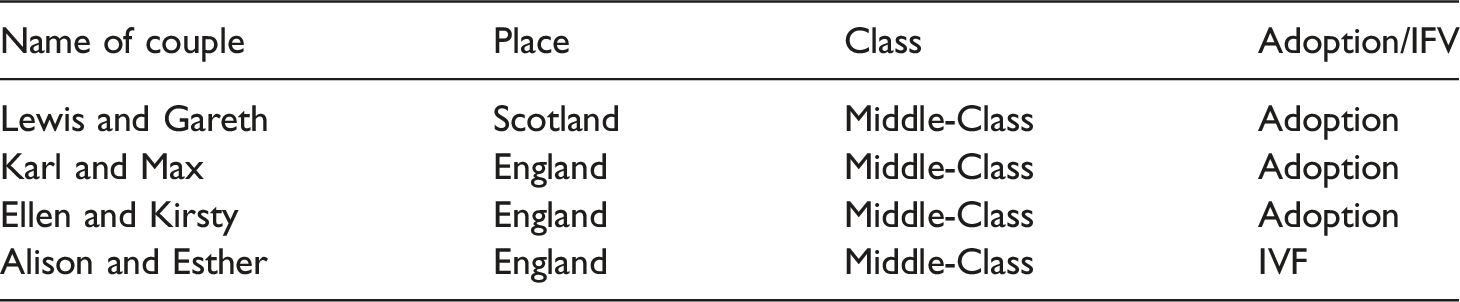
Within phenomenological research, small sample sizes are expected due to the in-depth examination of the data required to produce rich accounts of the participants’ experiences (Starks and Trinidad, 2007); four couples who self-identify as in same-sex relationships and who are parents, participated in this study. Participants were interviewed within their couple. Initially, I reached out to family friends that fit the purposive sampling criteria; participants had to be over 18 and had started their family with a same-sex partner. As well as known contacts, I employed snowball sampling, which relied on asking participants to encourage known associates to take part (Naderifar et al., 2017). Participants were recruited on a voluntary basis and took part in virtual semi-structured interviews using the online video call platform Zoom. Participants’ names are replaced with pseudonyms to ensure anonymity; all participants were provided with an information sheet detailing the purpose of the research and all provided informed consent.
Theoretical influences
Ahmed’s (2006) queer phenomenology offers a conceptual framework that accounts for the motivations and experiences of same-sex couples starting a family and facilitates an understanding of family life in a heteronormative world. Queer phenomenology proposes examining the orientation of phenomenology. Ahmed (2006) demonstrates how orientation is dependent on the direction we face, or in other words, our “point of view” (p. 547). We are susceptible to assuming our point of view is, in fact, natural, and not due to the way we “”face” toward objects, time, and space. Ahmed writes, “the lines that allow us to find our way, those that are ‘in front’ of us also make certain things, and not others, available…when we follow specific lines, some things become reachable and others remain or even become out of reach” (Ahmed, 2006: p. 14). The philosophical framework of queer phenomenology is used to reveal the experiences of those who are negatively impacted by the heteronormativity embedded in everyday life and look at how we can move beyond the limitations that family practice studies currently present.
Method
Semi-structured interviews are one of the most used research methods across a wide range of disciplines. Each interview was estimated to last around 45 min–60 min. Although it was my intention to carry out all interviews in person, this was not possible due to COVID-19 and current social distancing measures. Interviews were semi-structured and designed to elicit rich, detailed information. Participants were encouraged to discuss their feelings, thoughts, and experiences of their journey to and of parenthood as a same-sex couple. For each interview, both parents were involved to varying degrees, while 3 of the couples shared the interview time equally and answered together and in turns, Ellen was present for the duration of the interview and Kirsty, her partner, joined intermittently. Importantly, interviews with the individual couples were chosen over a group-based approach in order to encourage more in-depth discussions with each unique journey. Interpretative phenomenological analysis acknowledges each participant’s narrative as its own story, something that may get lost in a group-based approach. The interviews were designed to explore participants’ knowledge and early thoughts on pursuing parenthood within a same-sex couple, factors they felt may have informed their decisions, and how they describe their experience of being a same-sex couple influences their roles as parents.
Strategy
Interpretative phenomenological analysis facilitates an exploration of the quality, texture, and meanings of participants’ experiences. Interpretative phenomenological analysis must manage two levels of analysis: the phenomenological must detail the experiences of the participants as closely as possible to the description and the interpretative must integrate these accounts with the researcher’s interpretation. The process has been described as “double hermeneutics”; ultimately, the researcher is trying to make sense of the participant who is attempting to make sense of their own experiences concerning the world (Goldberg and Smith, 2008). During the process, the researcher needs to consider the data closely and balance out both the description and the interpretation.
There is no prescriptive method for analyzing interview data using an IPA framework; however, the recommendations of Smith and Obsorn (2015) were used. Transcripts were transcribed verbatim before being read numerous times, whilst initial observations were written down and broad understandings were achieved. On subsequent readings, the observations transformed from paraphrasing into more abstract themes. An initial list of themes was created, and appropriate extracts were lifted from the data. The final stage of the analytical process is the writing up of the three themes that emerged into narrative accounts. A good interpretative phenomenological analysis also integrates the use of critical questioning, asking whether there is an alternative meaning to that which the participant is describing or indeed asking what the participant’s description is trying to achieve (Rodham, 2013). Meaning is not always directly available but must be understood through the intensive process of engagement with the data and interpretation of the data. Particularly during in-depth and personal interviews, participants can struggle to express what they are thinking and feeling, and indeed there may be reasons they wish not to disclose certain information. Interpretative phenomenological analysis has a theoretical commitment to, therefore, interpret participants’ mental and emotional states concerning the words being said (Larkin et al., 2008). Allowing for this interpretation is likely to lead to a richer analysis and therefore do greater overall justice to the experience.
Findings
This section is designed to offer a theoretically and empirically informed discussion of the conceptual categories that have emerged through the rigorous process of interpretative phenomenological analysis.
Three categories emerged from the analysis. (1) Practicalities and Motivations (2) Uncertainty and Challenges (3) Negotiating heteronormativity
Participants are referred to using pseudonyms throughout. At the time of the interviews, Gareth and Lewis adopted their son 2 years ago. Max and Karl have adopted their son in the last year; Ellen and Kirsty have adopted 2 children, their daughter 6 years ago and their son 2 years ago; and following IVF, Alison gave birth to her and Esther’s son 3 years ago.
Practicalities and Motivations
In exploring their motivations and desires for parenthood, all participants interviewed to discuss the practicalities involved in starting a family as a same-sex couple. More specifically, participants refer to the amount of time both the adoption process and IVF process can take and how this can influence their planning, the importance of financial security when starting a family, and ensuring relationship stability. For all participants, it was particularly important to have a secure home in which to raise a child. Lewis and Gareth said:
“We wanted to have our own house. We wanted a secure place for a wee one to come into. We wanted to be really financially stable as well, we wanted to make sure we could give a wee one the best life and the life we wanted to give them and the life they deserve, and I think that all takes time. Learning to drive is another thing. We wanted to be able to drive because it can be difficult if you don’t. So, we wanted to do all of that, and really just have a good nest egg for a wee one to come into.” (Gareth)
Lewis, his partner, continued:
“Aye, it was that and I think we were in a really good place when we made the decision. We still are. But we were just really settled, and stable and our families are really integrated.” (Lewis)
These extracts echo findings in previous research on starting a family (Parker and Alexander, 2004; Van Balen, 2004), demonstrating one couple’s desire for a secure home, secure relationship, and a sense of stability; what is otherwise coined “package deal” (Sherif-Trask, 2003; Tach et al., 2010). However, these rigid ideals seem to be more dominant for Lewis and Gareth, as they continually expressed the practicalities of starting a family throughout the interview, and specifically, the idea of “the right time”:
“We waited until the time was right and you just need to be really secure, and you think it’s a life-time commitment having a child, so we waited until the time was right” (Gareth)
Integral to understanding the decision-making processes involved in starting a family is time, which is often shaped by personal, relational, and economic considerations. However, in the case of Lewis and Gareth, there seems to be a desire to have almost perfect conditions for the arrival of a child into the family, which, while desirable, may be exacerbated when the parents are of gender or sexual minority. The “package deal” may help to counteract the negativity or hesitancy from others they may face as parents, or indeed their own self-doubt as parents. This potential negativity or hesitancy reflects the lack of trust in non-normative family structures, resulting in added and extra pressure on same-sex couples starting a family. This can, in turn, materialize through internalized homophobia and a firm rejection of anything less than “perfect.”
Participants recognize and discuss the ways in which sexuality, gender, and age interact with timing. The female same-sex couples interviewed describe their readiness for parenthood, but relay concerns over the amount of time both the adoption process and the IVF process can take. Again, the couples discuss the “right” time:
“I wanted to be a young mum but obviously I would never have done it unless the time was right… We got the cat and then we were looking to buy our own house, and we were already thinking em, I’ve always been quite maternal and I’ve always wanted kids quite young, obviously I didn’t expect to be in this situation with a girl so em, I didn’t want to wait in terms of it taking longer than we expect… we knew we wanted to do it and if it doesn’t work at least we’ve started. We didn’t want to start in a couple of years and wish we had started sooner.” (Alison)
Similarly, Ellen explains her and her partner’s journey to becoming mothers:
“My mum is a foster carer which kind of changed everything because Isobel came along and we both kind of fell in love with this little girl and we hadn’t even planned at that point. We were both still living at home, I was 19/20, I wasn’t even old enough to adopt a child. She was fostered by my mum for a year and then she was adopted but the adoption fell through a few months before I turned 21 which is the requirement for adoption. Em, and she came back to my mums and so we kind of all at one time, decided to buy a house – I was still in my final year at uni… I was working two jobs. Still doing uni. But there was something about her that we couldn’t refuse.” (Ellen)
Both couples here demonstrate the complexity of the interplay between timing considerations and parental desires. Despite not planning to start their family at 21, Ellen and her partner took the opportunity to become parents in their stride. Likewise, Alison and her partner began looking into starting IVF despite describing themselves as “quite young” because of the amount of time IVF is expected to take. Both couples do still, however, mention the importance of buying a house and being financially stable as part of the process of becoming parents. Therefore, the “right time” was still dictated by rigid understandings of security and stability or, as highlighted before, potentially as a means to counteract and reject the idea that same-sex couples are not fit for parenthood; a narrative this is tied up in heteronormativity. However, in Ellen’s case, while normative structures guide her ideas of what being “ready” looks like and she tells her story through with these structures in mind, what she is actually saying seems to represent quite the opposite—she and her partner parent Isobel through her mother, whilst living at home and studying at university.
For the male same-sex couples, there was some more hesitation present in their accounts of timing. GoldbergDowning and Moyer (2012) argues that the perceived necessity of a female parent can undermine gay men’s recognition of their parental desire, delaying their overall pursuit of parenthood. As a result of this, Goldberg suggests that it can be certain events or experiences that encourage gay men in this position to reconsider their parental desires, often described as “turning points” (pg. 161). Berkowitz and Marsiglio (2007) claim such turning points include encounters with lesbian couples, or simply being around other gay men who chose to parent.
However, Max’s and Karl’s “turning point” was clearly defined:
“We were at our friend’s wedding, and there was a lesbian couple there that had adopted these two little boys and I just could not stop watching this family the entire day. You know, and I think the bit for me was looking at them and thinking, ‘there’s no way that you would question that those children were not their biological children’, they just looked like this amazing family… we should at least explore it and see if we’ve got what it takes to be adoptive parents and see what that looks like” (Max)
Again, this extract demonstrates that parental desires are shaped by a variety of factors, such as age, time, and sexuality. For Max and Karl, who are 10 years older than both female couples, their parental desires were put on hold. Over time, and with legislative changes, Max and Karl describe their turning point upon meeting a female same-sex couple at a wedding, prompting them to start their own adoption journey. However, it was not simply meeting another same-sex couple that is emphasized in the recalling of this encounter that is interesting, it is the recognition of the “legitimacy” of the family present in Max’s comment on the appearance of biological relatedness between the children and the parents. Max and Karl seemed persuaded by the idea that their family, too, could appear biologically related. Again, here, we see the way heteronormativity or, at least, perceived heteronormativity dictates their parental decision making. For their family to appear biologically related rejects their queer(ness).
Lewis and Gareth discuss Lewis being ready before Gareth, and eventually, describing their “turning point”:
“I wanted kids for a long time before Gareth was ready… I’m a wee bit older than Gareth as well, I’m three years older than Gareth so I was more geared toward starting my family as soon as we got engaged and bought a house. How long has it been now, about 6 years now? Yeah six years ago we bought the house together and we started having conversations and he’s like ‘Nut. Nope’ and then I think when our friends started having kids, you started changing your mind.”
The right timing, for Lewis, was dictated by financial security and stability in very rigid terms, that is, “got engaged and bought a house.” However, Lewis described willingly waiting for both him and Gareth to be equally as “ready.” One partner feeling a sense of readiness before the other was not exclusive to the male couples; when prompted about their timing, Alison mentions Esther not having as strong parental desires as themselves, “I kind of convinced Esther to do it sooner. I mean, would you have had kids at all?” Esther responds, “Probably not.” Throughout the interview, Esther enacts the nonchalant father figure, shrugging off the idea of parenthood, whereas Alison excitedly recalls her parental desires from a young age. This appears more like a role play than a genuine representation of Esther’s parental motivations and desires, with both Esther and Katie making jokes about Esther’s lack of maternal instinct. Despite this, Katie is quick to defend Esther’s parenting skills and frequently refers to her as a “good mum”.
Max discusses how timing can also be out of one’s control and in the hands of policy makers and legislators. Same-sex adoption in Scotland only became possible after the Adoption and Children (Scotland) Act was passed, and similarly, in England and Wales, legislation was passed earlier in 2002. Here, we see the interactions between parental desires, sexuality, age, and timing as Max discusses his coming out at a young age when same-sex adoption was not possible:
“I came out when I was 17 and at that point, I felt that making the decision to come out was also grieving the loss of the thought of being a parent because back then, adoption wasn’t a thing back then… and then I guess it’s just been about the campaigns and legislation changing and as a result of that, us getting to a point thinking ‘aw gosh we can’t definitely do this. We should definitely explore this and move ahead with it’” (Max)
Ultimately, the practicalities of starting a family for a same-sex couple are particular to each couple; however, they seem to be laced in very normative ideas of family as well as a rejection of “less than perfect” circumstances. For one of the couples, waiting for legislative change was paramount in their parental journey, whilst others demonstrate the numerous and complex ways sexuality interacts with age, time, and parental desires. Indeed, some of the conversation around “readiness” appears embedded in self-doubt and uncertainties, which was another common theme in the data.
Uncertainties and challenges
Reflective of the existing but limited work on queer family practice and the decision-making processes involved in starting a family, the data in this study suggest an array of uncertainties and challenges involved in same-sex couples starting a family. More specifically, this theme details participants’ narratives surrounding the mental and emotional demands of the process involved in adoption and IVF, as well as the perceived lack of support and clear guidelines when starting a family. Participants did express their awareness of the mental and emotional demands that are involved in the processes of starting a family as a same-sex couple:
“I kinda knew a bit about what we were in for and that it was going to be a long process, it was going to be emotional, it wasn’t going to be easy” (Lewis)
Lewis and Gareth found the adoption process an “emotional rollercoaster.” Lewis described a particularly challenging day during the adoption when he was due to meet his son for the first time and things did not work out:
“So we were just standing in the car park waiting to go in, and we got a phone call from the social worker saying you can’t come in and meet him and the panel didn’t go the way we wanted it to go and it’s been rescheduled and that was heartbreaking… I went home and cried. It was horrible.” (Lewis)
Participants described difficulties with a lack of control over the adoption process. Lewis explained that there wasn’t someone to blame in these instances, which only caused more frustration. Max and Karl began their adoption journey 2 years ago with their son Jacob and have just recently concluded a very demanding and challenging legal journey. Max opens up about the devastation he felt due to the prolonged adoption processes and things not going as planned:
“We actually didn’t meet him until September, which was brutal, it was really really bad. Imagine finishing up from work, having balloons, gifts, cards, all of that and then your work colleagues have been seconded into your job then this happened, so it was just very very difficult.” (Max)
Whilst experiencing these challenges, support and clear guidance is required. However, it became clear that the participants felt a lack of information and support was available. Although, I suspect a lack of support and guidance was not the main issue for Karl and Max, but rather the lack of emotional support during this time played an overwhelmingly negative role.
Max discusses how he got started on finding information:
“So, I just did my own research first of all… But I am a researcher, so I was more than comfortable picking up the phone and having the discussion, and I think as soon as we started going through the process together, I was the one who set up like little kinda Facebook groups… and I certainly used Scottish Adoptions Facebook more than anyone else. So, I was like firing out questions, facilitating debate… so I felt happy to do a lot of that research myself”
Whilst this worked for Max, Alison and Esther discuss the lack of clear guidance when they began looking at their options to start a family, finding it difficult to obtain the precise guidance they wanted from their doctor who had limited knowledge:
“Our doctor was clueless, you know like your GP (general practitioner), they had no idea what we were talking about. They were just like ‘we will have to refer you because I don’t deal with this’ and it’s like, there’s no personal to it, yeah, it’s very impersonal and you don’t feel like, you kind of just go through it on your own.” (Alison)
It appears that Alison’s experience with the doctor was not only frustrating for her but left her feeling isolated and somewhat disheartened at the beginning of her parental journey. I think she would have found some confidence through the approval and reassurance from her GP.
Esther, her partner, continues:
“People always come to us and ask where we went which obviously means people are finding it hard to know what is available. You know, we had to look around and ask loads of people when we were going through it.” (Esther)
This was a shared experience amongst three out of the four participants; although participants had many questions, they found difficulties getting answers, feeling professionals had little knowledge of their options. This resulted in clear feelings of frustration and uncertainty. A growing body of work exists demonstrating the barriers for same-sex couples starting a family (Park et al., 2016; Messina and D’ amore, 2018; Wong et al., 2020); therefore, ideally, access to a variety of support resources is particularly important (Goldberg and Smith, 2008).
However, Ellen reflects on being 21 and not fully understanding her and her partner’s options as a female same-sex couple to become parents:
“I think, you know, the whole you know IVF and potentially carrying a child and stuff like that em, I don’t know. I don’t think we were fully aware of what we could have done, especially at the time” (Ellen)
Ellen felt lack of knowledge toward her options, and the tone of her voice suggests that this lack of awareness is a result of something out of her control. The challenges involved in Ellen’s journey to parenthood are later directed at larger institutions or structures more explicitly.
As well as a lack of information and support in the early stages of planning a family, Gareth mentioned a lack of clear guidance from his social worker on navigating the legal processes of adoption and how this affected his confidence going into the courtroom:
“Even when we turned up to the court, when we turned up to the court I was scared. They didn’t really explain to us what to do, we had to stand up and stuff when the judge, I was like what do we do… ahh”.
Certainly, being in unfamiliar situations was a common theme across participants’ narratives, referring to the degree of uncertainty about the outcome of the adoption process as a whole. This “in limbo” (Ellen) state contributed to a sense of helplessness, as participants struggled to cope with the lack of control and uncertainty that characterized, not only theirs but their children’s future,
“What I didn’t like was the unknowns. I didn’t like not knowing what the outcome was going to be…I suppose that is the story of my life, I like to control everything, and I couldn’t in that situation, and it was horrible” (Lewis)
The unknowns create a sense of insecurity, a lack of belief. Two participants mention questioning themselves or feeling like they had something to prove as a same-same family:
“You beat yourself up more and I always feel like I’ve got something to prove – even now” (Ellen)
Ellen looks defeated. I think, for Ellen, she feels her experiences are closely tied to her sexual minority status. While others share this worry, it is less obviously tied to their sexuality in many ways:
“There was just a point that we got to thinking, is this so hard and are we facing these issues because we are a male same-sex couple and some of these panel members have unconscious bias?” (Lewis)
Lewis appears not to assume that there is a blatant homophobia at play in his experiences of adoption, but instead worries about a more subtle unconscious bias. In all, however, for these participants, the stress or insecurity of recognition for their relationship appears complicated by their sexual minority status in some way or another, undermining their sense of control over the process. Moreover, this reflects research carried out by Gianino (2008) and Brown et al. (2009) who demonstrated that lesbian and gay parents struggled with multiple personal doubts about the implications of their sexuality on their abilities to parent. As well as this, Gianino (2008) found that same-sex couples had to actively confront their doubts throughout the process of adoption, showing that self-doubt was especially challenging for gay men who face the intersection of negative attitudes based on their gender as men and parents.
Negotiating heteronormativity
This theme explores the overarching conceptual framework to emerge from this work, negotiating heteronormativity. More specifically, this theme will explore the experiences of heteronormativity faced by the four same-sex couples interviewed through the perception and management of their parental roles, assumptions from peers and strangers alike about their relationship, and the ways in which the couples navigate these assumptions and draw on a variety of coping mechanisms. Heteronormativity is characterized as presumed heterosexuality; Oswald et al. (2005) conceptualizes heteronormativity as an ideological composite that “fuses together gender ideology, sexuality ideology, and family ideology into a singular theoretical complex” (p. 144). In exploring participants’ experiences of the types of assumptions imposed on them, most participants recall the reinforcement of traditional male and female gender roles. For example:
“I always correct them and say, well actually, he has two dads, but I think a lot of people it is their way of handling it, they can put the ‘male, female’ roles into it and they understand that.” (Gareth)
Similarly, Alison and Esther recall the most asked questions from peers, “who is the mum?”, both Alison and Esther express their confusion at this question. Alison continued, “who is the dad?”
It is not surprising that participants relay experiences like this, mirroring heterosexual ideals make it easier for others to understand and engage with one’s family. This is likely due to the continuous perpetuation of traditional gender roles, giving them a socially, legally, and politically recognizable and “natural” form (Butler, 1990, 1993). Moreover, Ellen recalls a similar experience when her and her partner took their daughter to the hospital:
“Hospitals are the worst place as a same-sex couple. You know, ‘which one is mum?’, well both of us. ‘Well, which one of you did they come out of then?’. It’s like, what? My kids are literally sat right there” (Ellen)
Butler’s concept of gender citationality is useful when examining heteronormative assumptions such as those revealed by participants’ experiences. Despite two mothers being present in Ellen’s example, parental roles are still assumed to be gendered. Ellen discusses many examples of she and her partner facing heteronormative assumptions and seemed particularly distressed recalling some of these experiences. Whilst recalling her experience of being asked directly, “which one is mum?” at the hospital, Ellen said, “that’s one of the main ones that’s been upsetting, the fact they don’t seem to have any progressive knowledge.” Many of Ellen’s examples were experienced in larger institutions, such as the hospital, school, and in court. For instance, the school admissions forms, specifically asking for a mother’s details and a father’s details; importantly, Ellen mentions that this also extends to single-parent families and reconstituted families. Instead, Ellen suggests the use of “person 1, person 2 details, because you could just be the guardian of the child” on school forms. Despite highlighting her concerns about this to the school, Ellen confirmed that the choice of wording has not been altered several years later. Moreover, Ellen reveals her experience of adopting a boy:
“You do get comments now, like ‘he needs a father figure’, ‘he needs a man’, especially with Zander because he is a livewire.”
Ellen’s own ideas of gender roles seem to be at play here; she herself associates a more dominant parental role being connected to a male or a father figure. Again, this goes back to heteronormative assumptions about parenting styles, the mother is often painted as the nurturing, caring parent, while the father sets the rules and maintains order.
When prompted about whether her experience of adopting a boy and a girl differed, Ellen said:
“Yeah, I don’t know what it is, but especially with Zander, people expect a male to be in the picture.” (Ellen)
Since the 1970s, one of the biggest criticisms of lesbian families has been to highlight the lack of male role models (Clarke and Kitzinger, 2005). The premise of this argument is that children, especially young boys, are “missing out” and are therefore at risk of experiencing confusion around gender and sexuality identities. Whilst there has been a significant shift in the political climate since the 1970s, Ellen demonstrates how these arguments still affect not only the perception of lesbian motherhood, but her own ideas about what she is capable of doing as a parent. Similarly, Alison discusses some of the questions and expectations she receives in regard to a male parental figure for her son:
“People actually say, ‘do you think he looks like his dad?’ ‘Dad? You mean sperm donor?’ I mean, they don’t mean it in a bad way, but people are very docile about it all”
Whilst Ellen found dealing with these scenarios particularly challenging, some of the participants highlighted how useful humor was in dealing with heteronormative assumptions. Alison and Esther, whilst finding the repetitiveness of the assumptions and questions “silly,” show how humor helps them:
“It doesn’t offend us… we do it to ourselves as well because we joke around about Esther being the dad because she is so not maternal” (Alison)
Again, Esther’s lack of materteral instinct is paralleled to the father figure. Alison continued jokingly:
“We once got a baby-grow that said, ‘I love my daddy’ on it in a multipack, and I thought we aren’t throwing that away, I just put it on him hahaha” (Alison)
Rather than trying to break out of the rigidity of heteronormative parenting assumptions, Esther and Alison play into it and seem to repeat this structure themselves. Although their use of humor is a useful resistance strategy, it might work against them insofar as they continue to repeat and reinscribe traditional roles in parenthood.
Where the female same-sex couples typically face questions about the lack of male parental figure, Gareth, and Lewis wrestle with perceptions such as their little boy being more likely to be gay because he is raised by two gay men:
“I guess some people have these perceptions…. that are you know, our wee boy is going to grow up a certain way, he is maybe going to be more feminine, and I think that’s maybe a perception that is wrong. You know, he is going to grow up and be what he wants to be.”
When asked about how they deal with these assumptions, Gareth and Lewis expressed concern that they may be “overcompensating”:
“Maybe sometimes, I overcompensate. I was quite a boy-ish wee boy, and I like ‘boy’ stuff, so I sometimes worry I too much overcompensate. I got [football] goals and I’m trying to play football with him, I want him to be into ‘boy stuff’, but really it doesn’t matter, if he wants to play with dolls its fine… you can’t try and pigeonhole an infant, you can’t decide what someone will be in life because Ollie might be gay, he might be straight, or bi” (Lewis)
Whilst expressing his worry about overcompensating, Lewis demonstrates an open mind toward his son’s identity. Moreover, Lewis and Gareth joke about Lewis’ expression, “boy stuff,” with Gareth mocking Lewis’ choice of wording. Although Gareth is jokingly mocking Lewis’ comment, he also appears embarrassed by the idea that they, as a couple, subscribe to such binary thinking. I think this concern highlights previous discussions about Lewis and Gareth’s desire to have and to maintain the “package deal,” and Lewis’ overcompensating is an example of how this plays out in their parenting philosophy. Lewis, not picking up on Gareth’s momentary concern, continues about the benefits of two male parental figures:
“Gay dads might actually be a benefit for him, he will know how to take care of the house, you know what I mean, he will be nicer to women! He will dress well.” (Lewis)
Humor helps Gareth and Lewis to negotiate the heteronormative assumptions and figure out how they want to approach parenthood together. Clearly, maintaining a sense of humor plays an important role in the ability to make light of adversity, a kind of coping mechanisms.
All participants highlighted the importance of being open and communicating their concerns with others throughout starting a family and parenthood thereafter. For instance, Max recalls speaking with the nursery Jacob attends to ensure they could work around this:
“We’ve been very open with the nursery, they know he has got two dads, when we got to Mother’s day, we had a discussion with the nursery and we’ve had a think about this, we are aware you’ll probably be making mother’s day cards and Jacob has a nanny and a granny and we are probably going to use mother’s day to ensure that those are his days to kind of humor those people in his life.”
Furthermore, Ellen mentions her concerns about how her children will deal with potential bullying at school, particularly her eldest who is already at school. Ellen also discusses the importance of being open and honest with the children as they grow up to help them navigate some of the assumptions that will come their way:
“We are quite open and honest with the kids and I think that’s really important as well. Isla knows she came from someone else’s tummy, em and things like that and she knows that she’s got two mummy’s and for us that’s really important. She can speak for herself and she can be open with us if someone does say something different to her.”
Although Alison and Esther’s son is only 3 years old, they also emphasize the importance of being open and honest with him from a young age:
“He is only 3 but he does, he said it the other day, someone said they were going to see their daddy and he said ‘me go see daddy’, and I’m like you don’t have a daddy remember, you’ve got two mummies. He doesn’t really understand but he is getting to that age now where he is like, do I have a daddy? Why do these people have a daddy and I don’t? but yeah, we are very open with him”
Similarly, although Max and Karl’s son is also only 3, they have had conversations about which school in the local area they will send Jacob to and discussed how they intend to deal with any issues that may come up during his time at school. Max’s professional background in HR lends itself to working with other people on diversity and inclusion, allowing him the confidence to “hold discussions and hold people to account for their actions and challenge it all the way through.”
Wall (2001) highlights the role of potential discrimination toward the children of same-sex parents in the decision-making process of lesbian women and gay men starting a family. Though more diverse forms of families are emerging, society has not yet embraced same-sex families to its full extent, as we see heteronormativity embedded in the everyday. Overall, however, participants seem to show a resilience toward the heteronormative assumptions imposed on them and show confidence that they can navigate these assumptions.
Discussion
This research was guided by three main research questions: • How do participants describe their motivations and decision-making processes concerning becoming a parent? • Do factors such as age, length of the relationship, gender, and sexuality self-identification inform participants' decisions to become parents? • How do same-sex couples with children describe their experiences of parenthood?
This study has explored the experiences of four same-sex couples starting a family. Results contribute to the knowledge and understanding toward the specific motivations, desires, and challenges faced by lesbian and gay parents throughout IVF and adoption processes. The analysis has focused on three main aspects. Firstly, it examined the motivations for, and practicalities of, same-sex couples starting a family, shedding light on the complex interplay between age, time, and sexuality. All couples expressed a desire to be financially stable and more specifically, homeowners before starting a family; this transcended any questions or reservations about age, gender, or sexuality. Whilst the female same-sex couples demonstrated a readiness to be parents in their 20s, both male same-sex couples reflected the findings of previous research on gay men and parenthood, revealing that their parental desires emerged later in life, often recognizably with a “turning point” (GoldbergDowning and Moyer (2012)). Further analysis of this theme suggests that participants demonstrate their ability to be good parents through a readiness in terms of financial and relationship stability, which instead reads as an attempt to counteract negative assumptions about same-sex parents. Relatedly, the analysis explored the challenges and uncertainties of same-sex couples’ journeys into parenthood, examining issues of self-doubt, lack of support, and clear guidance. Participants revealed the “emotional rollercoaster” of starting a family as a same-sex couple, discussing the helplessness and frustration stemming from processes and delays out-with their control. These stressors resulted in participants questioning themselves and debating whether the challenges they were facing were a result of their sexuality. Lastly, participants provide compelling evidence that heteronormative assumptions about family can negatively impact the decision-making processes of same-sex couples starting a family; consistent with previous research (GoldbergDowning and Moyer (2012)), one participant experienced a sort of “mourning” of their parental desires at a young age. Furthermore, all participants demonstrate the ways in which gendered and heteronormative assumptions impact their experience as a family. In line with previous studies (Wall, 2001; Messina and D’ amore, 2018), the female same-sex couples discuss wrestling with perceptions about the lack of a male parental figure, especially for their sons. Whilst the male same-sex couples, on the other hand, deal with negative assumptions about the identity and sexuality of their son. Although most participants employed humor as a coping mechanism when faced with adversity, one participant found the repercussions of heteronormativity particularly challenging, feeling that formal institutions—such as nurseries, schools, and hospitals—fail to plan effectively for families that do not fit the heteronuclear norm. Engaging with critical queer theory, such as Butler’s “Gender Trouble” (1990) and her concept of gender citationality, allows for more fruitful interpretations of the challenges identified in this research, particularly the experiences of heteronormativity. Butler’s work facilitates an understanding as to the coping mechanisms employed by participants, demonstrating the socially, politically, and legally “natural” appearance of the heteronuclear family. Therefore, to mirror this enables family and peers to engage with one’s family more easily. Furthermore, questions participants faced, such as “who is the mum?” reinforces heteronormative assumptions, by encouraging “gender-specific” roles onto a same-sex family. Citationality and a deconstructionist perspective (Butler 1990, 1993) reveal that resistance and subversion are possible. Whilst humor can be interpreted as a coping mechanism, it can also be an act of resistance and subversion, as it creates solidarity and alliance from “within” the minority group (Weaver, 2010). This is a powerful strategy, creating and placing boundaries between the “in” and the “out” group, ultimately turning the tables on “the other” (Ahmed, 2006). Queer phenomenology supports the embodiment of being lesbian, gay, bisexual, transgender, queer (LGBTQ+) in a landscape of heteronormativity. The hegemony of heterosexuality makes parenting socially “normal” for many couples, but a deviant experience for same-sex couples. Same-sex couples may find it challenging to “orient” themselves differently from heterosexual couples, but in doing so, challenge the heteronormativity that is evidently embedded in the experiences of parenthood and family structures.
Limitations
Only couples with children were interviewed, and therefore, their decision-making process was in the past; perhaps it would be useful to consider interviewing couples beginning their parental journey to gain an earlier insight into this particular stage. Additionally, although it was not the aim of this study, and whilst this research can make a significant contribution to the understanding of couples’ motivations for, and experiences of, parenthood, such motivations and experiences may differ considerably for single gay men and lesbian women. Finally, three of the four couples interviewed adopted, whilst only one couple pursued IVF; thus, again, motivations for, and experiences of, parenthood may vary when exploring individuals and/or couples pursuing other routes of parenthood, such as surrogacy. The final limitation refers to the sample in this study. All 4 couples are cis, white, and would be considered middle-class. Future research would benefit from a more diverse sample, including black, non-binary, and trans individuals who may face different and specific challenges on their journey to parenthood.
Implications and conclusions
Parenting and the desire to parent transcends sexual orientation (Mccann and Delmonte, 2005). However, heteronormativity continues to shape the lives and experiences of same-sex families. The findings from this study have implications for a variety of practitioners who work with same-sex couples as they transition to parenthood, including nursery workers, social workers, teachers, and those in healthcare. Firstly, practitioners should be sensitive to understanding the particular experiences of same-sex parents. By adopting an IPA approach, this study reveals the individuality of same-sex couples’ decision-making process. Importantly, IPA accounts have demonstrated the ways in which parental desires are shaped by age, gender, and an array of timing considerations that can be traced back to and are intertwined with participants’ sexuality. Secondly, nurseries, schools, and hospitals in particular have been framed as reinforcing heteronormativity, and thus, those institutions have much space to learn and grow. In order to minimize the challenges and prepare couples efficiently, it is crucial that practitioners provide sufficient and relevant information and support resources from the beginning of the process, all the way through. By holding focus groups with same-sex parents, or creating a same-sex–led support group, in turn, offering more first-hand accounts which can act as a support resource for future parents. Regarding the provision of information, adoption agencies in particular could begin collating stories from other same-sex couples’ experiences of starting a family and share them with couples who are enquiring about the process of adoption; over time, this creates a bank of experiences for couples to draw on whilst making their own decisions. Across health psychology (Behal, 2020), IPA has proven to be a useful tool for engaging with, gaining a better understanding of, and improving the experience of patients through first-hand, in-depth accounts. Family practice research can build on this, the idiographic nature of IPA can provide valuable insights for practice that challenge formal institutions everyday assumptions. Moreover, with more engagement with IPA, family practice research can extend its depths by drawing on works such as Butler’s (1990, 1993, 2002), allowing researchers to explore, with a critical eye, the myriad of experiences and examples of “family.”
Supplemental Material
Supplemental Material - “Who is the mum? Who is the dad?”: Same-sex couples’ motivations for and experiences of parenthood
Supplemental Material for “Who is the mum? Who is the dad?”: Same-sex couples’ motivations for and experiences of parenthood by Kayleigh Charlton in Sexualities.
Footnotes
Declaration of conflicting interests
The author(s) declared no potential conflicts of interest with respect to the research, authorship, and/or publication of this article.
Funding
The author(s) received no financial support for the research, authorship, and/or publication of this article.

Supplemental Material
Supplemental material for this article is available online.
Kayleigh Charlton is a current PhD researcher at the University of Bath, undertaking research in the area of queer prison design and architecture.
References
Supplementary Material
Please find the following supplemental material available below.
For Open Access articles published under a Creative Commons License, all supplemental material carries the same license as the article it is associated with.
For non-Open Access articles published, all supplemental material carries a non-exclusive license, and permission requests for re-use of supplemental material or any part of supplemental material shall be sent directly to the copyright owner as specified in the copyright notice associated with the article.
