




Abstract
Identity formation for asexual people can be complicated by limited societal awareness of asexualities. Consequently, people who eventually identify on the asexuality spectrum often adopt other sexual identities in their early lives. In this paper, we extend sexual identity development theory by analyzing the identity trajectories of asexual-spectrum people who once identified as bisexual or pansexual. Quantitative data suggests that about half of asexual-spectrum respondents once identified as bisexual or pansexual and a third closely associate with bisexual or pansexual terminology. Qualitative data supports these findings, revealing that bisexuality, pansexuality, and asexuality are not always seen as mutually exclusive categories by asexual individuals. We argue that the intelligibility of bi-/pansexuality positions them as identity pathways for many asexual-spectrum individuals who experience equal (albeit little to no) attraction toward people of any gender.
Introduction
Sexual identity formation is an important—and often confusing—process for many sexual minorities. Scholars have spilled a great deal of ink discussing sexual identity development, developing a number of models, theories, and concepts to better understand such processes (e.g., Cass, 1979; Coleman, 1982; Dank, 1971; de Monteflores and Schultz, 1978; Plummer, 1975; Troiden, 1988). Despite substantial inquiry and debate, asexual identity development remains understudied. To some degree, this relative neglect is unsurprising: asexuality (generally understood to refer to a lack of sexual attraction) is even less widely known than other so-called “invisible sexualities” (Decker, 2015; Hayfield, 2020) such as bisexuality and pansexuality.
Asexual identity development may present significant complications for preexisting models of sexual identity development more broadly. Although these models have increasingly highlighted that sexual identity development is often not linear and that there is significant variation in developing and maintaining a sexual minority identity (Cain, 1991; D’Augelli, 1994; Eliason, 1996; Horowitz and Newcomb, 2002; Kaufman and Johnson, 2004; McDonald, 1982; Rust, 1993, 2003; Savin-Williams, 2011), many also situate discovery of same-sex attraction as pivotal to this process. For many (if not most) asexual-spectrum individuals, there is no “discovery” of same-sex attraction to be made. Furthermore, asexual terminology may not be encountered until later in life, leading asexual-spectrum individuals to struggle with articulating their experience of little to no sexual attraction (Gupta, 2017; Scott et al., 2016).
In our experience with asexual communities (both personal and professional), an anecdotal pattern emerged in which many individuals who identify as asexual had previously identified as bisexual and/or pansexual. At a glance, this is puzzling. Why would individuals who identify as asexual (i.e., experience little to no sexual attraction) have ever identified as bi or pansexual (i.e., experience sexual attraction to all/multiple genders)? Indeed, early models of asexuality positioned asexuality and bisexuality as “opposites” within a grid of sexual attraction by gender (Storms, 1980; Siggy, 2015; Van Houdenhove, Enzlin, and Gijs, 2017). Yet the anecdotal experiences shared within asexual communities did not necessarily frame asexual and bisexual identity labels as contradictions.
In this paper, we explore the relationship between bi-/pansexuality and asexuality through quantitative analysis of the 2018 Asexual Community Survey (ACS) and qualitative content analysis of posts collected from online asexual spaces. Our quantitative data indicates that nearly half of asexual-spectrum respondents identified as bisexual or pansexual at some point in time. Our qualitative data suggests that this strong association exists for several reasons, including (1) that bi-/pansexuality appears to be an identity pathway for many asexual individuals; (2) that some asexual-spectrum individuals identify simultaneously as asexual and bi-/pansexual; and (3) that some asexual-spectrum individuals identify privately as asexual but publicly as bi-/pansexual. We argue that bisexuality and pansexuality function as “identity pathways” for asexuality, and that each identity should not be considered mutually exclusive of the others.
Asexuality and bisexuality
The prevailing definition of asexuality refers to those who do not experience sexual attraction. This definition appears in much of the literature (e.g., Brotto et al., 2010; Jones et al., 2017; Van Houdenhove, Gijs, T’Sjoen et al., 2015) and was used by the Asexual Visibility and Education Network (AVEN) until 2021, when they updated their definition to “those who experience little to no sexual attraction” (AVEN Livestreams, 2021). However, the meaning and definition of asexuality can vary widely (Chasin, 2011; Mitchell and Hunnicutt, 2019; Scherrer, 2008). Some asexual (often abbreviated as “ace”) individuals report no sexual desire, while others do. Some asexual individuals are sexually active, while others are completely abstinent. Furthermore, many asexual individuals use additional modifiers to describe themselves, making asexuality a spectrum that harbors a great deal of heterogeneity (Chasin, 2015; Carrigan, 2011).
Differentiated attraction, often referred to as the “split-attraction model”, is one tool that has been shared within asexual communities to articulate their diversity of attractions (Sennkestra, 2020; Siggy, 2019). Within this framework, sexual and romantic attractions are understood as separate and independent: Just as asexual individuals’ attitudes towards sex can vary from complete aversion to some detached intellectual/cultural interests, their romantic orientations can vary (Antonsen et al., 2020; Carrigan, 2011; Scherrer, 2008). Elgie (2020) has raised concerns that the split-attraction model reinforces notions of family and intimacy that are produced within a cultural context that rests on capitalist, colonial logics of gender and race. Others within the asexual community have also pointed to limitations of the split-attraction model in describing their experience (Ask-an-Aro, 2019). However, concepts of differentiated attraction remain popular within asexual communities, with many individuals adopting romantic orientations that describe the gender(s) to which they are romantically attracted, such as heteroromantic, homoromantic, biromantic, panromantic, or aromantic.
While we could find only one brief mention of the historical and ideological connection between asexuality and bisexuality in academic literature (Rust, 1995: 239), non-academic asexual sources have noted a shared bi-ace history in which asexual individuals were included in the bisexual umbrella (e.g., Sounds Fake But Okay, 2021). As with asexuality, bisexuality has multiple definitions and manifestations (see Halperin, 2009; Storr, 1999). Generally, however, bisexuality is understood as an orientation defined by attraction to more than one gender (Flanders et al., 2017), as opposed to monosexualities that are based on attraction to one gender (e.g., heterosexual or homosexual).
Pansexuality also represents attraction to more than one gender, though definitions vary, with some defining pansexual as attraction “regardless of gender” (Belous and Bauman, 2017: 66). Therefore, while some counterpose bisexuality with pansexuality based on their prefix—one implying attraction to only two sexes/genders, the other to all sexes/genders—bisexuality often works as an umbrella term for several non-monosexualities (Belous and Bauman, 2017; Flanders et al., 2017). Research suggests that many bisexual-identifying individuals conceptualize gender not as binary but rather in ways remarkably similar to pansexual-identifying individuals (Flanders et al., 2017). Furthermore, the line between bisexuality and other non-monosexualities is often indistinct (Bauer et al., 2016; Belous and Bauman, 2017). Individuals who identify with one non-monosexuality can also identify with another, given the proximity and overlap between various nonmonosexual identities and definitions. While we acknowledge the histories and varied definitions around bisexuality and pansexuality, for this paper we discuss both in the context of attraction to more than one gender.
In short, asexuality and bisexuality both exist outside of the homosexual/heterosexual binary, for different but overlapping reasons. For asexuality, this is because the identity is generally premised on a lack of sexual attraction to any gender. For bisexuality, this is because the identity transcends the either-or dichotomy of being attracted to only one gender. Each identity’s existence outside the homo/heterosexual binary, then, contributes to their erasure and invisibility. Indeed, Yoshino (1999) has argued that investment in exclusive monosexualities (both among heterosexual and homosexual individuals) has led to significant bisexual erasure and invisibility (see also Alarie and Gaudet, 2013; Barker and Langdridge, 2008; Guittar, 2013). This can lead to hostility toward bisexual individuals, even in LGBTQIA+ spaces (Weier, 2020). Unsurprisingly, the stigmatization and delegitimization of bisexuality may actually prevent individuals from identifying as bisexual (Callis, 2013).
Research on asexual erasure (see Decker, 2015) is far more limited. Researchers have sometimes even contributed to asexual erasure. Storms (1980) suggested that formative sexualities research (such as work by Kinsey and Masters and Johnson) has likely miscategorized asexual individuals as bisexual by conflating what he called “sex role orientation” and “erotic orientation.” Despite research on asexualities remaining limited, one study suggests that asexual individuals face significant bias and stigma (MacInnis and Hodson, 2012), which may also prevent individuals from identifying as asexual, thereby reproducing asexual erasure. Moreover, lack of awareness and visibility acts as a barrier to the inclusion of asexuality in LGBTQ+ political organizing (Scherrer, 2008). Overall, then, it appears that erasure may be an integral element of understanding not only bisexual identity formation, but asexual identity formation as well.
Identity formation
Scholars have proposed various models for the formation of sexual identities, and of non-heterosexual identities in particular. Early literature, which overwhelmingly focused on lesbian and gay identities, often utilized “stage” models of identity development. These models sought to explain how individuals recognized non-heterosexual attractions, developed an identity based on those attractions, “came out” to others by disclosing that identity, and then lived as lesbian or gay adults (Cass, 1979; Coleman, 1982; Dank, 1971; de Monteflores and Schultz, 1978; Plummer, 1975; Troiden, 1988). Subsequent research has challenged these models, alleging that sexual identity development is often not a linear process and that there is significant variation in both developing and maintaining a sexual minority identity (Cain, 1991; D’Augelli, 1994; Eliason, 1996; Horowitz and Newcomb, 2002; Kaufman and Johnson, 2004; McDonald, 1982; Rust, 1993, 2003; Savin-Williams, 2011).
Despite these disagreements, there are two components of sexual identity formation central to most models: (1) awareness of same-sex attraction and (2) awareness of sexual self-labeling options (e.g., gay, lesbian, and bisexual). Both components pose potential problems in understanding asexual identity formation. First, asexuality is often defined as referring to a lack of sexual attraction, suggesting that the former component will not be relevant for many—if not most—asexual individuals. In fact, the widespread belief that all humans experience sexual attraction and desire and the pressures of compulsory sexuality may actually impede asexual identity development (Chasin, 2015; Gupta, 2015; Przybylo, 2011, 2019). Second, asexuality is much less widely known than many other minoritized sexual identities, such as lesbian, gay, and bisexual. For example, many continue to associate the “A” in LGBTQIA+ with “ally” (Mollet and Lackman, 2018). This lack of awareness is likely exacerbated by the invisibility and erasure of asexuality (Decker, 2015). Given scholarship finding that a lack of awareness of options beyond heterosexual/homosexual can produce prolonged confusion for bisexual individuals (Brown, 2002), it seems possible that asexual-spectrum individuals will face similar obstacles. Indeed, some scholars argue that “[t]he discovery of ‘asexuality’ may be considered its own stage in the model of asexuality identity development” because asexuality is not a readily available terminology (Robbins et al., 2016: 758).
The literature also suggests that age may intersect with asexualities in ways that challenge existing models of identity development. For example, researchers have found that fluid, multiplicitous and ambiguous sexuality labels—and even the rejection of labels altogether—have been on the rise, particularly among LGBTQ+ youth (Galupo et al., 2015; Rust, 2000; Savin-Williams, 2011; Troia, 2018). Millennial and post-millennial generations, whose coming-of-age has aligned with the rise in asexual-spectrum visibility, have largely embraced a post-structuralist approach to gender and sexual identity, resulting in fluid and multi-term identity constructs (Jacobson and Donatone, 2009; Savin-Williams, 2017; Vaccaro, 2009). The identities they adopt often challenge heteronormativity and binary gender systems, resulting in fewer youth who identify with heterosexuality (Savin-Williams, 2017). Altogether, this suggests that prevailing models of sexual identity development may not fully capture the process of coming to identify as asexual, as asexual-spectrum individuals—especially Millennials and younger—may move in and out of multiple sexual identities over time or adopt asexuality as a “companion” to other LGBTQ+ identity labels.
Methods
We have approached this study with a mixed-methods strategy. To explore the connection between asexuality and bi-/pansexuality, we first used quantitative data from the 2018 Asexual Community Survey to explore patterns of identity within the asexual community. Qualitative data from online asexual spaces offers additional explanation of how bisexuality and pansexuality function as identity pathways to asexuality.
2018 asexual community survey
The quantitative analysis for this study utilized data from the 2018 Asexual Community Survey (ACS). The ACS is an online, international survey of the asexual community that is distributed through popular asexual forums and social networking sites each year, resulting in a combination of convenience sampling and snowball sampling through asexual community networks. The ACS includes a large number of asexual-spectrum participants who are active in online asexual communities, though they may not be representative of the asexual population overall.
Sample characteristics and T-Test results, 2018 asexual community survey (N=7,568).
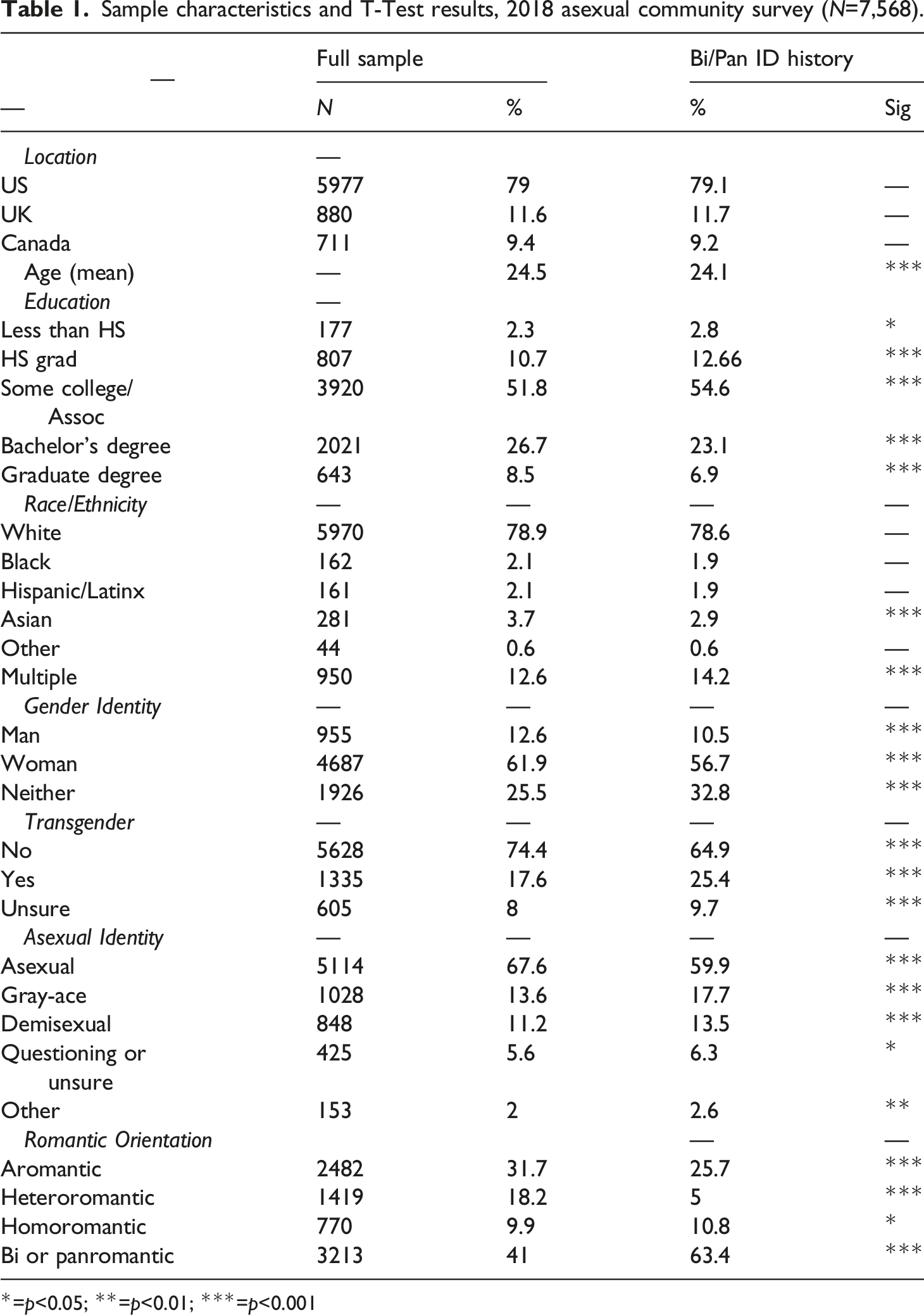
*=p<0.05; **=p<0.01; ***=p<0.001
Most respondents (79%) resided in the United States. The average age was 24.5, and about half of respondents had “some college,” which included current college students. Most respondents (79%) were white. Regarding gender identity, 62% identified as women, 13% as men, and 26% identified as neither men nor women. About 18% of respondents identified as transgender with another 8% who were unsure. The gender distribution of this sample is consistent with other studies of gender diversity within the asexual community (Cuthbert, 2019; Gupta, 2019).
The ACS allowed respondents to self-identify their sexual orientation and romantic orientation separately. Regarding sexual orientation, most respondents (68%) identified as asexual. Smaller proportions identified as gray-asexual (14%) and demisexual (11%). For their romantic orientation, about one-third of respondents (32%) identified as aromantic (i.e., experience little to no romantic attraction). About 18% were heteroromantic and 10% were homoromantic. About 41% of respondents identified as either biromantic or panromantic. Romantic orientation labels were not mutually exclusive.
Two variables were key to our analysis of asexual-spectrum respondents’ identity pathways. The first asked respondents “which of the following labels have you *ever* identified with at some point in time (even if you no longer do so currently)? Check all that apply” and offered options of asexual, gray-asexual, demisexual, straight, gay, lesbian, bisexual, pansexual, queer, questioning, and none of the above. This variable represents the respondent’s identity history. The second variable asked respondents, “excluding asexual, gray-asexual, and demisexual, which of the following orientation labels do you most closely identify with (if any)?” and asked respondents to select only one of the following options: straight, gay, lesbian, bisexual, pansexual, none of the above, questioning or unsure, and other. Answers to this question can reveal the conceptual proximity between different orientation labels.
The purpose of the quantitative analysis in this study was to identify (a) how prominent bisexual and pansexual identity histories are within asexual communities, and (b) how asexual-spectrum respondents who have bi-/pansexual identity histories compare to other members of asexual communities. We expected to find four patterns within the ACS data: (1) Histories of bisexual or pansexual identities will be more common among asexual-spectrum respondents than other sexual minority identities. (2) More asexual-spectrum respondents will identify with bisexuality or pansexuality, compared to other sexual identity labels. (3) Asexual-spectrum respondents with bisexual or pansexual identity histories will be younger than those with other identity histories. (4) Asexual-spectrum respondents with bi-/pansexual identity histories will be significantly more likely to now consider themselves bi/panromantic.
To test these hypotheses, we relied on descriptive statistics that identified proportions of asexual-spectrum respondents with connections to bi-/pansexual identities. We also ran t-tests to examine differences between those who had histories of bi-/pansexual identity labels and those who did not. T-tests were supported by OLS regressions (not shown) to account for spuriousness. Analysis of ACS data was performed by Carroll in STATA.
Qualitative content analysis
While the survey data paints an overall picture of the demographics of the asexual community, it cannot show how asexual-spectrum individuals make sense of asexuality, bisexuality, and pansexuality, nor could it explain why so many asexual-spectrum people have bi-/pansexual identity histories. Qualitative content analysis is especially useful for answering these questions because of its strengths in identifying patterns and processes in text-based data and in personal accounts/statements (Mayring, 2004). The qualitative data for this study comes from two major gathering spaces for asexual-spectrum individuals: Reddit and the AVEN (Asexual Visibility & Education Network) discussion forum. Reddit is one of the most highly visited social media websites worldwide. Registered users may submit content (i.e., posts) in the form of text, links, and images which can then be viewed by any internet user. Posts on Reddit cover a wide range of subjects and are organized by user-created topics called “subreddits,” which essentially function as discussion boards. There are a number of subreddits centering on asexuality; Winer focused on the r/asexual (34,000 members) and r/asexuality (nearly 90,000 members) subreddits.
AVEN is, according to its website, the largest online asexual community globally. It is an extremely influential online ace resource and, as aforementioned, its definition of asexuality is prevalent both inside and outside academia. In addition to storing a sizable archive of resources on asexuality, AVEN hosts a discussion forum that functions similarly to Reddit. Like Reddit, AVEN forums are organized by topic. This allowed us to focus on forums that specifically related to this project (e.g., “Bisexual and Asexual”). Although AVEN features a mere fraction of Reddit’s web traffic, it serves as a “main hub” of asexual community and an important space for fostering community and defining what it means to be asexual (Milks and Cerankowski, 2014; Scherrer, 2008; Przybylo and Cooper, 2014). Moreover, studies of asexuality often recruit participants through AVEN, heightening the importance of understanding the discursive space that has helped to produce so much of what we know about asexuality (Brotto and Yule, 2009; Van Houdenhove, Gijs, T’Sjoen et al., 2014).
Winer had already been conducting a cyber-ethnography centering on asexual-spectrum individuals’ experiences of masculinity and femininity and had incidentally found numerous mentions of asexual individuals posting that they had previously identified as bisexual or pansexual. For the current study, Winer shifted his focus toward a qualitative content analysis of posts about “coming out” processes, other minoritized sexual identities (bisexuality, pansexuality, homosexuality, etc.), and, perhaps most importantly, posts in which users responded to other users who were questioning their sexual identity and wondering if they were asexual. Analysis focuses on 117 posts from AVEN and Reddit.
On both AVEN and Reddit, Winer sometimes came across discussions of bisexuality/pansexuality without specifically seeking them out. Most of this project’s data was, however, found using search terms such as “bisexual,” “pansexual,” “questioning,” and “coming out,” within Google and limiting results to only display from Reddit pages on which the word “asexual” or “ace” also appeared or any page on the AVEN discussion forum (asexuality.org). Winer also used the same search terms directly via the search function on AVEN and the r/asexual and r/asexuality subreddits. Any post mentioning asexuality and any other sexual identity was analyzed. All posts analyzed were made between 2008 and 2020. Because AVEN has rules requiring researchers to obtain users’ permission before quoting their posts, the posts quoted in this study are mainly from Reddit. Quotes from AVEN that are shown are ones in which the user gave permission.
Following grounded theory techniques (Charmaz, 2006), Winer first used initial coding to describe what each segment of a post was about. Following this, he used focused coding to find similarities between posts. Codes were created inductively during data collection, reflecting categories that arose from the data (Glaser and Strauss, 2017). After focused coding, Winer wrote memos exploring similarities between posts. This process continued until reaching saturation, when new data ceased to develop new properties for a category or new emergent categories. To ensure inter-rater reliability, after Winer had finalized the coding scheme and finished coding all the posts, Yang did an additional round of coding independently, but with the same coding scheme. Yang and Winer then discussed the posts that they coded differently to decide on the most appropriate code(s) for those posts.
This data collection strategy is a particularly valuable resource for studying asexuality for several reasons. The internet creates virtual spaces for highly stigmatized and marginalized groups—such as asexual-spectrum people—to find community and support for their identity (Bargh and McKenna, 2004; Turkle, 1995; see also Jay, 2003). This helps make the internet ideal for reaching groups, like asexual-spectrum people, who largely do not congregate in physical spaces (bars, coffee shops, clubs, bookstores, etc.). Reddit and the AVEN chat room also do not have restrictive character limits, allowing for in-depth, lengthy discussion. Despite these advantages, however, this data collection strategy has limitations, including a potential class ceiling, since participation in these forums essentially requires internet access. Moreover, our quantitative data, which recruited individuals through websites frequented by asexual-spectrum individuals (including AVEN and Reddit), found that 79% of asexual-spectrum respondents were white, suggesting that this sample may disproportionately reflect white asexual individuals’ perspectives.
Individuals participating in these forums may also be more open about their sexuality and/or more active in asexual spaces and communities than the “typical” asexual individual. Moreover, there is no way to “confirm” whether the writers of these posts identify as asexual (though, arguably, the same could be said for other types of data collection). Many profiles list this information, and any posts that specifically indicated they were not made by asexual individuals were excluded from this data collection. Nonetheless, it is possible that some posts included in this data were made by individuals who do not identify on the asexuality spectrum. This notwithstanding, these online forums present an important tool for gathering the perspectives of a largely invisible, hard-to-reach population that usually does not congregate in physical spaces.
Findings
Quantitative analysis of the 2018 Asexual Community Survey shows that 47% of asexual-spectrum respondents identified as bisexual/pansexual at some point in their lives. In the quantitative analysis below, we explore patterns among asexual people who have histories of identifying with bisexuality or pansexuality. We supplement these findings with qualitative data which suggests that there are multiple ways relationships between these identities can manifest, but generally, bisexuality and/or pansexuality often serves as an identity pathway toward asexual identification.
Quantitative analysis
Data from the 2018 Asexual Community Survey shows that a majority of asexual-spectrum respondents (65%) identified as straight at some point in time, and nearly half (47%) identified as bisexual or pansexual at some point in time. Specifically, 39% of respondents identified as bisexual in the past, and 24% of respondents identified as pansexual in the past. About 70% of respondents with bisexual identity histories also identified as pansexual at some point in time.
Although most respondents have a history of identifying as straight, when asked to choose a sexual orientation label they most identify with currently other than asexual, gray-asexual, or demisexual, only 16% said that they most closely identify as straight. By contrast, 29% of respondents—more than any other group—chose bisexuality or pansexuality, suggesting that bi-/pansexuality and asexuality are conceptually adjacent to them. As we will demonstrate later, qualitative data further support this conceptual proximity. Examining the romantic identity labels of respondents separately from their sexual identity labels, only 18% of asexual people consider themselves heteroromantic whereas 41% identify as either biromantic or panromantic. These findings suggest a strong connection between asexual, bisexual, and pansexual identity labels.
To better understand the connection between bi-/pansexuality and asexuality, we ran independent samples t-tests to compare asexual-spectrum respondents who previously identified as bisexual or pansexual against asexual people who have never identified as bisexual or pansexual. The results are summarized in Table 1, alongside the demographics of the full sample.
There were no significant differences regarding location of the respondent, but asexual-spectrum respondents who once identified as bisexual or pansexual were significantly younger than those who did not. The same respondents also had significantly less educational attainment overall. However, a regression analysis confirmed that the relationship between education and identity history was spurious and no longer significant when controlling for age.
There were few significant differences in race/ethnicity among those who once identified as bisexual or pansexual and those who did not. Both groups included a majority of white respondents in statistically similar proportions. However, there were significantly fewer Asian respondents (and significantly more multiracial respondents) with histories of identifying as bisexual or pansexual.
There were significant contrasts in respondents' gender identities. Those who had a history of identifying as bisexual or pansexual were significantly more likely to identify as non-binary (i.e., neither man nor woman), compared to the rest of the sample. There were also significantly more respondents who identified as transgender (or were unsure) among those who once identified as bisexual or pansexual than the rest of the sample.
Regarding the asexual identity label respondents used at the time of the survey, those with bisexual or pansexual identity histories identified with labels on the asexual spectrum like “gray-asexual” and “demisexual” in significantly higher proportions. Additionally, the majority (63%) of respondents who previously identified as bi-/pansexual currently identified as bi-/panromantic, a significant difference from the rest of the sample, among whom only 21% identify as bi-/panromantic.
Qualitative content analysis
Posts on AVEN and Reddit reflect several relationships between bisexual/pansexuality and asexuality. The most common was individuals writing that they had previously—but no longer—identified as bisexual or pansexual before learning about asexuality (n = 54). A similar theme was found with users posting that they had previously identified as homosexual or considered the possibility that they were not cisgender before learning about asexuality (n = 10). The second most common theme was individuals writing that they found it possible to identify as both asexual and bisexual/pansexual (n = 19). The final theme was individuals posting that they either previously or currently identified as heterosexual, bisexual, homosexual, or some other label for social ease, while internally identifying as asexual (n = 6).
Bisexuality/pansexuality as an identity pathway
The most prominent theme in this data was individuals writing that they had previously identified as bisexual or pansexual before discovering asexuality. These posts generally reflect individuals feeling that they were not heterosexual since they did not feel sexual attraction to the “opposite” sex. Many surmised that, since they felt the same, sexually, about men and women, they must be bisexual/pansexual. The following exemplifies many of these posts: Yes, [I used to identify as bisexual] as in I'm not very interested in men and, theoretically, having sex with a woman seems about as appealing as having sex with a man, therefore I must be bi. (AVEN, 2017)
Posts like the above were frequent. A smaller number of posts noted that the user first presumed that they were homosexual, then bisexual, and then finally asexual. Questioned if I was gay since I was obviously not straight and I didn't know ace was a thing. Then decided I don't like girls any more than I like boys, so I must be bi but at a super low magnitude or something ... (r/asexuality, 2020)
The common theme in this category, then, is individuals recognizing that they do not feel heterosexual desire in ways that seem similar to those around them. Many of these individuals, however, appear to have been previously unaware of asexuality as an identificatory option. Tbh, I identified as bi because I never heard about asexuality until I was [i]n my early twenties. If I had been explained about it, I don't think I’d have ever had a doubt. (r/asexuality, 2020)
These posts reflect a common pattern in which users were unaware of asexuality as an option (see Robbins et al., 2016: 758). Many described stumbling into bisexual or pansexual identities because their distinct lack of attraction felt equal across all genders. The discovery of asexuality was, in many of these posts, framed as an “a-ha!” moment that sometimes sparked an almost-immediate change in sexual labels, with the previous identity (bisexuality, etc.) framed as an erroneous identity based on incomplete information.
Identifying as both asexual and bisexual/pansexual
Posts under this theme differ from the above in that they reflect individuals simultaneously identifying as both asexual and bisexual/pansexual. For example, in response to another user’s question of whether they can “by definition… both be Bisexual and Asexual,” one user wrote I consider myself Ace and Pan… Sexuality and romantic (and other) attraction can be complicated. Maybe could be biromantic or demisexual and bi along with it, or whatever else kind of thing for a mix that you feel may fit with you. (r/asexual, 2020)
The same user noted in an earlier post that openness to identifying with multiple identity labels was not limited to combining pansexuality/bisexuality with asexuality but extended to other labels as well. I consider myself Ace and Pan… [and] I have a friend that is an Ace lesbian and she is very much sex repulsed but is still hella gay. (r/asexual, 2019)
This approach to adopting multiple identity labels was not limited to asexuality-centric subreddits but was found on subreddits centering on other communities, such as bisexual individuals, as well. In response to a user on r/bisexual who asked if it was possible to be both bisexual and asexual, for example, one user responded: Of course you can identify as both of them together! You can be both bi and ace! Plenty of people are! (r/bisexual, 2019)
As reflected above, a great deal of this openness toward using multiple labels for one’s sexuality centers on an understanding of attraction as multifaceted, including sexual, romantic, esthetic, and other types of attraction. Many posts also surmised that if they “don’t really feel sexual attraction” but desire romantic partners irrespective of those partners’ gender, then a combination of terms like ace and bi could describe their sexuality. I usually tell people that I'm Bi and Ace. I'm very picky but gender just isn't a requirement of mine because I don't really feel sexual attraction anyways so why would I favor one or that other? (r/asexual, 2017)
Some posts explained that the possibility of identifying as both asexual and another sexual identity depended on how one defined asexuality. One user argued that “the definition [of asexuality] that is commonly accepted in the asexual community” accommodates combining asexuality with other sexual identities. It depends on your definition of asexuality, but using the definition that is commonly accepted in asexual community, it is possible to be asexual and bisexual/homosexual at the same time. That definition of asexuality being "lack of desire to have sex with other people". Asexuality doesn't mean that a person doesn't find anyone sexually attractive or doesn't have any sex drive. You can have high sex drive, find men and/or women sexually attractive, but still not having any desire to have actual sex with them. That’s what asexuality is, and sexual orientation does not affect it. Source: being asexual. (r/explainlikeimfive, 2017)
It should be noted that although a number of users either combined asexuality with other sexual labels or supported others doing so, some posts (n = 16) challenged the possibility of these combinations. I think you are confusing -sexuality with -romanticism. If you feel this way my guess is that you are biromantic asexual (love 2 or more genders, sexually attracted to none) or bisexual aromantic (sexually attracted to two or more genders, but don't love them)… Romantic and sexual orientations don't have to be linked. (r/asexuality, 2014)
As we see in the above, posts pushing back against simultaneously identifying as asexual and bisexual/pansexual/etc. are similar to supportive posts in discussing attraction as multifaceted, often differentiating between romantic and sexual attraction. Thus, we see some posts, such as a 2019 post from r/asexual, saying that, “I'm biromantic asexual. :) Bisexual asexual is a bit of an oxymoron though.” According to these posts, it is possible to be both “bi” and “ace” but only if one refers to sexual attraction and the other refers to romantic attraction.
Outwardly bi/pan/homo/heterosexual, inwardly asexual
The final, and least common, theme centers on users who outwardly identify as bi/pan/homo/heterosexual despite feeling that those identifiers are personally inaccurate and inwardly identifying as asexual. Posts in this category often mention the difficulty or annoyance of explaining asexuality to others, who are often unfamiliar with and/or confused by the term. I say I'm bisexual a lot of the time around people who don't know me because it's easier than having to explain (or worse, validate) myself around people I barely know. I could say biromantic asexual, but most people are under the belief that Romantic Attraction = Sexual Attraction in all cases, and will bring up a lot of questions when my sexuality questions their belief. (r/asexual, 2018)
Many posts were similar to the above, reflecting either an exhaustion of having to explain asexuality to others and/or a hesitance of initiating a conversation that may be invalidating (see also Rust, 2000). For some individuals, this meant that they identified one way among other asexual individuals (and sometimes among other members of the LGBTQIA+ community more broadly) and another among allosexual/heterosexual individuals. To other asexuals I call myself biromantic, because that’s how I identify, but people outside of asexual community more often than not have no idea what that means, so I find saying bisexual is easier. (r/asexual, 2018)
However, some asexual individuals use other sexual identity labels because they feel that it more accurately conveys information that felt was important for others to know (see also Rust, 2000). I sometimes call myself a lesbian, if it comes up in conversation. That’s partially because I'm sapphic af [as fuck] and I'm a part of the lesbian community (and I'm not sex-repulsed), but also because I love girls and I'm in a committed relationship with a girl and that’s what I usually want to get across rather than the details of how sex works for me. With more understanding people and family, I'm more direct, or if asexuality is relevant to the conversation, but most of the time I call myself a lesbian it's because I don't really want to have a detailed explain-y conversation about things. (r/asexual, 2018)
As the above comment shows, sexual labels can be used to communicate various elements of sexuality, including internal desires (or lack thereof), behaviors, preferences, group affinities, etc. The choice of which label to use may vary depending on what element of sexuality an individual is seeking to communicate.
Discussion
Overall, our data suggest important linkages between bi-/pansexual identity and asexual identity. Our quantitative analysis demonstrates that nearly half (47%) of asexual-spectrum respondents have at some point identified as bisexual or pansexual, and 29% closely identify with bisexuality and/or pansexuality when asked to choose an orientation label other than asexual, gray-asexual, and demisexual. Our qualitative analysis lends further texture to these quantitative findings, suggesting that this relationship can manifest in several ways.
The most prominent relationship in our qualitative data is bisexuality or pansexuality serving as an identity pathway before an individual discovered asexuality. The data suggests that this typically occurred when an individual surmised that they are not heterosexual, since they do not feel sexual attraction to the “opposite” sex. Upon reflecting that they felt the same toward men and women in a sexual sense (i.e., zero equals zero), these individuals concluded that they must be bisexual or pansexual. In other words, compulsory sexuality (Gupta, 2015; Przybylo, 2019) and the invisibility of asexuality (Decker, 2015) appear to make bi-/pansexuality more initially accessible identities for more individuals who later come to identify on the asexuality spectrum. This is reminiscent of findings that a lack of awareness of options beyond heterosexual/homosexual can produce prolonged confusion for bisexual individuals (Brown, 2002).
Importantly, our data does not suggest that it is primarily fear of being stigmatization or “acephobia” (discrimination against asexual-spectrum people) that drive these individuals to identify as bi-/pansexual rather than asexual. Instead, this phenomenon appears to stem from lack of knowledge about asexuality as an identity option, relative to the visibility of bisexuality especially. The tendency for asexual-spectrum individuals to first identify with bisexuality or pansexuality due to having equal (albeit little to no) attraction to both men and women is reminiscent of Storms’ (1980) comments on the miscategorization of asexual individuals as bisexual in sex research. Storms was particularly critical of Masters and Johnson’s (1979) findings of low rates of sexual fantasies among what they called “ambisexual” respondents and claimed that their use of Kinsey’s model had conflated asexual and bisexual respondents. Because our data was collected during a time of increased visibility of asexualities, we may be observing how later-in-life exposure to asexual terminology has impacted those who would have been categorized as bisexual by earlier models of sexual orientation.
It is also important to differentiate between bisexuality as an identity pathway and bisexuality as a “transitional identity” (see Guittar, 2013). Scholars like Guittar have noted that some individuals who are attracted only to members of the “same” sex (and who eventually adopt identities such as lesbian or gay) initially claim bisexuality as a “queer apologetic” in which they seek to acknowledge their attraction to the “same” sex while simultaneously seeking to meet heterosexist expectations to be attracted to the “other” sex. Although this phenomenon does sometimes occur, this conception of bisexuality also exists as a stereotype that harms bisexual people and contributes to bisexual erasure (Alarie and Gaudet, 2013; Barker and Langdridge, 2008). These stereotypes of bisexuality as a “transitional identity” assume that individuals are aware of their “true” selves, know about homosexual identities, and are being dishonest with others. What we find is different: asexual individuals sometimes claim bisexuality because they genuinely think they are bisexual and are not aware of asexuality. Their adoption of bisexuality is not so much a passing strategy for managing acephobia, but rather a result of agentic sense-making amidst the backdrop of asexual erasure and compulsory sexuality (Chasin, 2015; Decker, 2015; Gupta, 2015; Przybylo, 2019; Yang, 2021). In other words, bisexuality as an “identity pathway” differs from harmful stereotypes of bisexuality as a “transitional identity” (e.g., Guittar, 2013) in that the former involves individuals actively seeking to understand and name their feelings of sexual difference while the latter is framed as an attempt to maintain heterosexual privilege.
Our quantitative data lends further insight into the pathways between asexuality and bisexuality/pansexuality. Our third and fourth hypotheses were confirmed by the data: asexual-spectrum respondents with bisexual/pansexual identity histories were significantly younger than other asexual-spectrum respondents, and they were significantly more likely to identify as bi-/panromantic. These findings are consistent with literatures on complex sexual identity models among queer youth (Galupo et al., 2015; Savin-Williams, 2011). They also suggest a pattern in which initial identification with bisexuality/pansexuality is transformed for many (63%) into identification with bi-/panromanticism, which is viewed as compatible with asexuality.
Our qualitative data suggest that some asexual-spectrum individuals outwardly identify as bi/pan/homo/heterosexual despite inwardly identifying as asexual. To some degree, the decision to withhold outward asexual identification also appears to stem from its invisibility as a legitimate sexual identity. Many individuals in this category wrote that they used an identity label other than asexual simply because they felt-or had directly experienced-that others did not know about or understand asexuality. Reliance on concepts of differentiated attraction also appears to be behind this trend. Some individuals, for example, felt that other aspects of their romantic attraction to others (e.g., being a woman who is romantically attracted to and involved with other women) were simply more important for others to understand than their lack of sexual attraction, meaning that they prioritized their romantic attractions and sexual/romantic behaviors over their sexual attraction when discussing their sexuality with others. Regardless of their specific reasons—and it is worth noting that not all posts did explain or justify why an individual might use multiple sexual identities—our qualitative data points to the reality that sexual labels are simply not mutually exclusive to some within the asexual community.
The finding of non-mutually exclusive identification presents important implications for sexual identity formation theory. Perhaps most importantly, our findings suggest that more inclusive models of identity formation should accommodate not only fluidity but also overlap between identities. Moreover, although most models position realization of same-sex attraction as integral to queer identity formation, our findings point to the importance of realizing non-attraction to asexual identification. Put differently, models of sexual identity formation should account both for overcoming compulsory heterosexuality (Rich, 1980) and compulsory sexuality (Gupta, 2015; Przybylo, 2019) to better include asexual experiences. The phenomenon of bisexuality and pansexuality as identity pathways to asexual identification further supports this idea, with individuals first overcoming compulsory heterosexuality (to identify as bi/pan) and later overcoming compulsory sexuality in identifying as asexual. Our findings of overlapping sexual identifications also contribute to scholarship on bisexuality/pansexuality to show that these identities and communities (and indeed, perhaps all identities and communities) contain individuals who also identify as asexual. Research that neglects to account for this may inadvertently contribute to asexual erasure.
Also noteworthy is that our quantitative analysis shows that a large percentage of asexual-spectrum respondents (65%) reported identifying as heterosexual at some point in time. Again, this points to the fact that asexual individuals must contend with both the pressures of compulsory sexuality (Gupta, 2015; Przybylo, 2019) and compulsory heterosexuality (Rich, 1980). The pressures of compulsory heterosexuality position heterosexuality as a default label, even for individuals who later come to discard that label and claim a minoritized sexual identity. However, this becomes more complicated for asexual-spectrum individuals, many of whom draw upon concepts of differentiated attraction to identify as asexual and heteroromantic (or biromantic, panromantic, homoromantic, etc.) (Sennkestra, 2020).
Conclusion
Our data presents a number of complications for thinking of sexual identities as mutually exclusive. This adds further context to previous studies which have indicated openness among sexual minorities to drawing upon multiple sexual identities (Galupo et al., 2015; Rust, 2000; Savin-Williams, 2011). For example, the complexities of differentiated attraction—and how these complexities trouble prevailing understandings of sexuality—help us to better understand why some individuals in our qualitative and quantitative data identified as both asexual and some other sexual identity. The overlap appears particularly notable between asexuality and bi-/pansexuality, with 29% of respondents in our quantitative data reporting that they identified both as bisexual/pansexual and as asexual at the time of the survey. Our qualitative data suggest that these individuals might be using asexuality to describe part of their experience of sexuality (specifically sexual attraction) while using other labels (pansexual, bisexual, heterosexual, etc.) to describe other parts of their sexuality (often, but not exclusively, romantic attraction and sexual behavior). Another explanation can be found in our quantitative finding that asexual-spectrum respondents with histories of identifying as bisexual or pansexual were also significantly more likely to identify as gray-asexual, demisexual, or elsewhere along the asexual spectrum. This suggests that identification with bisexuality or pansexuality could be describing the sexual attractions they do experience, albeit in limited circumstances.
To some degree, our data reflects previous findings of fluid, multiplicitous, and ambiguous ways of identifying sexually, particularly among young people (Galupo et al., 2015; Jacobson and Donatone, 2009; Rust, 2000; Savin-Williams, 2011; Vaccaro, 2009). Asexual-spectrum respondents who previously and/or currently identified as bisexual or pansexual were significantly younger than those who did not, which is consistent with trends of greater openness to postmodern sexual identities among younger generations. Even within asexual spaces, however, this multifaceted way of identifying is contested. Namely, some asexual individuals argue that it is not possible to identify with multiple sexual identities (e.g., asexual and bisexual) and that various sexual identities are mutually exclusive. Yet our data points to instances in which bisexual, pansexual, and asexual identities were used inclusively of each other.
Implications for future research
Overall, our findings support previous research arguing that sexual identity development is often not a linear process and that there is significant variation in both developing and maintaining a sexual minority identity (Cain, 1991; Eliason, 1996; Horowitz and Newcomb, 2002; Kaufman and Johnson, 2004; McDonald, 1982; Rust, 1993, 2003; Savin-Williams, 2011). Our qualitative data suggest that many asexual individuals do narrativize a linear identity formation process (starting with bisexuality/pansexuality and ending with asexuality, with the initial claiming of a bisexual/pansexual identity understood as a “mistake”). However, some posts speak to identity formation processes that do not end in a single linear “point” of identity and instead create space for multifaceted sexual identities. Our findings build upon this body of research to suggest that even these updated models of sexual identity development do not convincingly explain the dynamics observed in our data.
Identity pathways toward asexuality in particular are complicated by a lack of awareness in society for asexual meanings. More data is needed to explore how asexual people navigate information about asexuality and arrive at their identities in the context of a society hostile to those who do not experience sexual attraction (Chasin, 2015). It would be especially interesting to see how the rising visibility of asexuality impacts future identity cohorts. For example, we found that younger people were more likely to have histories of identifying as bisexual or pansexual, which we attribute to younger generations’ fluid, postmodern approach to sexual identity and high rates of LGBTQ+ tolerance. However, it is possible that, as even younger generations are exposed to asexual terminology earlier in life, they will identify with asexuality before adopting bisexual or pansexual identities. Furthermore, because we combine bisexuality and pansexuality in our analysis, our study was unable to weigh the relative visibility of pansexuality and asexuality, both of which receive little attention in comparison to bisexual, lesbian, and gay identity labels (Hayfield, 2020). Future research should consider how the relative invisibility of asexuality and pansexuality shapes identity pathways between them.
Further research is also needed to explain associations found in our quantitative analysis that could not be put in conversation with our qualitative data due to the limitations of online content analysis. For example, we found that asexual-spectrum respondents with bisexual/pansexual identity histories were significantly less likely to identify as Asian and significantly more likely to identify as multiracial or multiethnic, compared to other asexual-spectrum respondents. It is possible that there are ethnocultural dynamics that can explain this pattern, but the anonymous nature of our qualitative data limits us from analyzing patterns of race or ethnicity. Future research should also consider why those who previously identified as bisexual or pansexual were also more likely to be men, non-binary, and/or transgender. It may be the case, for example, that exposure to LGBTQ+ communities among gender minorities shape their sexual identity pathways, but more research is needed to explore the connections between asexuality, bisexuality, pansexuality, and gender identity.
The degree to which asexual models of identity—and the split-attraction model in particular—troubles even prevalent LGBQ+ understandings of sexuality is, to some extent, shrouded by some asexual individuals’ decisions on how to publicly identify. Our findings suggest that increased visibility of asexualities and asexual models of identity may lead to greater identity flexibility rather than a “balkanization of sexuality into inflexible, distinct boundaries” (Savin-Williams, 2011: 683). It seems likely that as scholarly and public knowledge about asexuality grows (and asexual erasure fades), differences between models of identity will become more apparent, perhaps sending shockwaves into how we understand even non-asexual sexualities.
Footnotes
Acknowledgments
The authors would like to thank the reviewers, the Ace/Aro Scholar Support Network, I. Nathan, and the Ace Journal Club for their helpful comments in the development of this manuscript.
Declaration of Conflicting Interests
The author(s) declared no potential conflicts of interest with respect to the research, authorship, and/or publication of this article.
Funding
The author(s) received no financial support for the research, authorship, and/or publication of this article.
