




Abstract
The research presented in this paper supports claims by feminists and queer theorists that there are numerous and diverse sex/gender/desire categories (Bem, 1995). Taken from a broader digital ethnography of digital sex markets in the United Kingdom, the findings are based on ten in-depth interviews with those who identified as men or ‘gender flexible’ and who buy and/or sell sex within digital markets. The participants featured in this paper used digital sex markets as a space to explore and express non-normative/subversive sexual and gender identities. Yet for many of them, these subversive acts were bounded by the market, so they were able to uphold masculine heterosexual identities outside of sex markets. The relative privacy of digital sex markets empowered them to maintain heterosexist power, reducing the social risks of stigmatisation and ostracisation associated with subversive sexual and gender identities. The thematic analysis revealed the limitations of heteronormative and homonormative labels and assumptions of sex work relations, thus, prompting the need to write this paper. Framing sex markets in narrow binary terms, as either homosexual or heterosexual markets, or research participants as customers or workers do not reflect the fluidity and diversity evident in this small yet revealing sample. The study shows multiple and fluid expressions of sex/gender/desire; and a duality in market roles as workers and/or customers amongst men engaged in digital sex markets.
1. Introduction
Research has suggested that the internet has increased and diversified who is buying and selling sex (Bernstein, 2007; Jones, 2020; Rand, 2019; Van Doorn and Velthuis, 2018). In addition, the internet provides access to groups previously ‘hidden’ in sex work research (Minichiello et al., 2013; Sanders, 2008). In turn, there has been an increase in research focussing on men and transgender people who buy and/or sell sex (e.g. Huysamen, 2019; Matthen et al., 2018; MacPhail et al., 2015). This article adds to this body of research through an analysis of ten in-depth qualitative interviews, nine of whom self-identified as men and one who self-identified as ‘gender flexible’, who either buy and/or sell sexual services online. The interviews are taken from a broader digital ethnographic project on digital sex markets in the United Kingdom.
The study reveals multiple and fluid expressions of sex/gender/desire; and a duality in market roles as workers and/or customers. The paper analyses how those interviewed negotiate their multiple realities, and the tensions and contradictions of engaging in subversive sex/gender/desire within the boundary of the market, whilst maintaining and upholding hegemonic masculinities and heteronormativity outside of the market. The findings suggest the men have a lack of attachment to prescribed roles and identities, but the social risks associated with disrupting and challenging compulsory heterosexuality persist. Heterosexist power and associated material and social benefits that come with white, masculine heterosexual identities are maintained through the privacy and boundary of the market. The article presents novel understandings of men’s sexual identities and behaviours that challenge heteronormative and homonormative assumptions that, at times, have been reproduced through sex work research and are embedded in the popular imagination of sex work relations.
The findings presented in this paper disrupt heteronormative and homonormative assumptions of commercial sex in two ways. Firstly, the paper challenges binary assumptions of gender and sexuality. Following on from gender theorist Sandra Bem’s, 1995 (1995:330) ‘thousand categories of sex/gender/desire’, the paper adds to the evidence of the broadest possible range of genders and sexualities and seeks to highlight ‘non-normative’ aspects of heterosexual identities. The majority of men in this study publicly identified as heterosexual, thus, maintaining hegemonic masculinity as normative, despite a more complex reality of queerness in their everyday lives. I use a queer lens to make sense of the men’s use of digital sex markets, thus, ‘going beyond the hetero-centric gender norm’ (Smith et al., 2015: 2). The paper disrupts constructions of masculinities as either homosexual, heterosexual or bisexual. By queering masculinities, I wish to show the complexities of sexualities and the role sex markets have in providing a space for sexual and gender expressions.
Secondly, the paper challenges the traditional binary of women sex workers and men customers, as several of the participants in the study located themselves in the market as customers and/or workers. Hearing the experiences, observing practices and analysing the customers’ narratives has resulted in novel understandings of how those who identify as men engage with digital sex markets, as customers, workers and/or both. This duality of roles can in part be assigned to the transformative impact of the internet, and associated digital communications, on sex markets. This duality and flexibility of roles have been observed in a few studies with men who buy and sell sex from men (for instance Koken et al., 2004; MacPhail et al., 2015; Matthen et al., 2018). I add to these findings by analysing the fluid roles some participants inhabited within digital sex markets thus disrupting popular imaginations of sex work relations.
The article is structured in the following way. I begin the article by identifying current research on men as customers and workers in sex markets, highlighting the neoliberal logic of market rationality in the production of commercial sex markets. I then present theories of masculinities, with a focus on queering masculinities as the framework for the analysis. Following this, I outline the methods chosen to hear the sexual stories of those who buy and sell sexual services online; and to study the labour processes of digital sex markets more broadly. Having mapped out the methodological approach, I then consider the complexities of sexual and gender identities presented in the interviews. I highlight the tensions, negotiations and contradictions between public subjectivities and ‘market-based’ sexual identities, practices and behaviours through three themes. Firstly, I discuss how the market provides a space for the men in this study to express subversive sexual desires and identities. I argue the commercial nature of the sexual interaction provides an alibi for their actions. Secondly, I discuss how men in this study negotiate ‘straightness’, simultaneously reproducing and contesting compulsory heterosexuality. Thirdly, I continue evidencing the fluidity and diversity within digital sex markets, through the experiences of the four men who adopt dual roles as customers and/or workers. Although the paper is based on a small sample, the experiences of those interviewed disrupts the reproduction of a worker-customer binary often cited in sex work research. In this article, therefore, I consider how the market can be a site of sexual subversion, yet at the same time reinforce hegemonic masculinities. Queer masculinities expressed by the participants largely remain bounded within the market, thus, de-politicising and dis-identifying with overt homosexual and transgender identities. To conclude, I discuss the maintenance of compulsory heterosexuality through actions that remain private and de-politicised within the neoliberal market.
1.1. Men within sex markets
There have been extensive studies on women who sell sex in all modalities and spaces such as street-based, saunas, parlours, erotic dance, webcamming and phone sex (O'Connell Davidson, 1998; Sanders and Hardy, 2014; Sanders et al., 2018; Senft, 2008; Weitzer, 2010). This focus is unsurprising as historically, legally, culturally and socially, sex work has been framed as a female occupation, or worse, a social evil and the result of male vice with fallen women in need of rescue; thus, it remains a hotly contested feminist issue (c.f. Ashford, 2009; O'Connell Davidson, 1998). Alongside the development of digital sex markets, studies focussing on men who pay for sex have bourgeoned as the internet has brought novel ways to access and interview a population previously who were more hidden (Birch, 2015; Hammond and Van Hooff, 2019; Koken et al., 2004, 2010; Pettinger, 2011; Sanders, 2008; Sanders et al., 2021). Furthermore, there has been an increase in research on men who sell sex (Smith, 2012; Robinson and Moskowitz, 2013; Matthen et al., 2018) and men who both sell and buy sexual services (Minichiello et al., 2013).
Studies on men who pay for sex, not unlike studies of women who sell sex, tend to focus on motivations. The men in these studies often explain their reasons for buying sex through the ‘male sexual drive discourse’ (Hollway, 1984: 67), that is a biologically driven, insatiable appetite for sex that must be met (e.g. Monto, 2010; O'Connell Davidson, 1998). Yet, scholars also suggest a more complex picture. For instance, Sanders (2008) produced a typology of men’s motivations and Birch’s (2015) mixed-method study found multiple reasons why men buy sex. Both scholars problematize the labels of deviant, pathological and/or criminal as universalising negatives associated with those who buy sex. These labels are based on simplistic understandings of sex and sexuality, thus, the interaction between customers and sex workers is also oversimplified. Rather men who buy sex may seek emotional intimacy (Sanders, 2008) and authentic experiences that are bounded by the market exchange (Bernstein, 2007). Sex markets can provide a space where men can be emotionally and sexually intimate yet shielded from the pressures of normative ideals of masculine heterosexuality.
The neoliberal unswerving belief in the market can be seen amongst those who buy sexual services. Neoliberalism promotes self-satisfaction through the market, framing the market as the answer to all problems, including satisfying an individual’s sexual desires (Tuck, 2009; Hammond and Van Hooff, 2019). Hammond and Van Hooff (2019) study found the men who bought sex took on an ‘entrepreneurial masculinity’ and used a ‘self-managerial approach’ to their sexual lives by drawing on their economic resources and using the market to find sexual fulfilment and to address issues of sexual dissatisfaction. The men in their study framed buying sexual services from women as a normative masculine act.
Other studies show that the market provides online spaces to be subversive without the social risks often associated with queer sexualities and genders. Robinson and Moskowitz’s (2013) survey of 499 men who were seeking sexual services from men online found the internet provides a space for men to explore their sexual desires without risk of disclosure, and therefore stigmatisation. Koken et al.’s (2004) study found that men who buy sex from men also use commercial sexual encounters to explore potentially stigmatising aspects of their identity.
Similarly, research suggests that men who sell sex may also use the market as a space to explore, experiment and express gender and sexual identities without the risk of being ‘exposed, rejected, or ridiculed by others’ (Huysamen, 2019: 27). Matthen et al.‘s (2018: 491) study with men sex workers in Vancouver found ‘…that some individuals utilise sex work to express and explore stigmatized aspects of their identities’. In addition, the men were not universally workers nor clients as there was a movement between the two, a phenomenon Matthen et al. (2018) state is under-researched and is addressed in this paper.
Huysamen’s (2019) findings on men who buy sex from trans women and men came about by chance rather than design. In the study, she recruited men who bought sex from women and unexpectedly, several customers discussed buying sex from trans women and men. Similarly, I had not specifically designed to recruit men who both buy and/or sell sex to men. But as an investigative study of how the internet and digital technologies were changing sex markets; I did not limit genders or sexualities of either workers or customers, during recruitment. Yet, I had been limited by hetero-centric gender norms, assuming predominately men would be buying sexual services from women. However, the men in the study had a varied and broad understanding of their sexual selves regarding their involvement within digital sex markets. As Smith (2012) notes in her study of the political economy of male sex work in San Francisco, ignoring men in discussions on sex work reproduces the female body as ‘whore’, thus, reproducing gendered assumptions of commercial sex. The internet has enabled novel understandings of male sexual identities and behaviours that are worthy of research, and I respond to Matthen et al.‘s call for sex work researchers to give ‘attention to sexual and gender diversity in their field of inquiry’ (2018: 481). This article is based on the unexpected findings of men who buy sexual services but might also sell sexual services to different genders.
1.2. Queering masculinities
In queering masculinities, I aim to deconstruct what is considered ‘normal’ and am critical of notions of ‘naturalness’. In problematises the binary of homosexual and heterosexual, and the sex and gender binary that is the foundation of compulsory heterosexuality (Butler, 1990); this paper considers ways of being outside of heteronormative and homonormative constructions of masculinity. As Sandra Bem (1995: 331) noted, compulsory heterosexuality requires a very narrow range of sex/gender/desire to privilege heteronormativity. The findings from this study problematise heteronormative ideologies that assume people fit into two separate and complementary sex/gender/desire categories and how binding and constrictive these norms remain. Furthermore, the findings suggest there is a persistent privileging of heterosexuality and there are perceived risks in challenging heterosexuality and jeopardising acceptance within heteronormative cultures.
The concept of hegemonic masculinities provides a theoretical framework to understand conformity, as well as resistance to masculine norms (Connell and Messerschmidt, 2005). Central to the concept of hegemonic masculinities is the reinforcement and legitimisation of unequal gender relations and the maintenance of masculine power (Messerschmidt, 2018). The superiority of men over women, masculinity over femininity and ‘non-hegemonic’ masculinities, are upheld through social relations and social meanings, shaping what is considered acceptable and unacceptable gendered behaviour. The conceptualisation of hegemonic masculinities has been criticised for being vague and ambiguous (Whitehead, 2002) yet when understood as practices, social relations and identities that produce widespread normative ideals of what it is to be a ‘man’, the concept is useful to analyse negotiations and contradictions of sex/gender/desire constructions.
Judith Butler’s concept of gender performativity developed across her key texts (1990, 1993, 1997), in particular, Gender Trouble (1990) proposes gender is not given but produced through repeated practice. Gender is ‘a corporeal style, an act as it were, which is both intentional and performative, where “performative” suggests a dramatic and contingent construction of meaning’ (Butler, 1990: 139). Bodies are produced through discourses of what is ‘intelligible’ or acceptable, and what is ‘unintelligible’ and disrupts sex/gender/desire norms. Within this matrix of heteronormativity, we learn the performative acts of heteronormative conventions, what is ‘intelligible’ and what is ‘unintelligible’, with an awareness of the subtle and obvious, direct and indirect punishments of performing gender ‘wrong’. Gender is achieved in relation to others. People put pressure on themselves and others to perform gender appropriately, policing gender and sexuality norms.
Butler (1990) argues all subjectivities are precarious, but some more than others, thus, making it hard to occupy multiple and fluid subject positions. Seeking to maintain normative masculine standards of gender is impossible, thus, creating a fragility to heterosexuality and hegemonic masculinities (Butler, 1990; Connell, 2003). Connell highlights the risks of oppression and violence for men who live outside very narrow ideas of what it is to be a man. The gender binary affords men heterosexist power in many contexts but performing outside the norms of masculinity and heterosexuality risks losing this privilege that is assigned to hegemonic masculinity.
The findings from this study show a fragility to heterosexual identities and disrupt the binary of homosexual/heterosexual. Their sexual behaviours and practices that take place within the bounds of the market at times transgress normative gender/sex/desire codes. Butler (1993) proposes transgressive acts do not necessarily result in the subversion of gender/sexual norms but can reinforce them, depending upon social context and audience. The men’s narratives also suggest digital sex markets play a role in enabling them to be active agents in maintaining hegemonic masculinities. As Milani (2014) argues acts can simultaneously be empowering and complicit in maintaining heteronormativity. Outside of digital sex markets, most of the men interviewed reinforce hegemonic masculinities through their language, behaviour and practices. They are able to perform their gender ‘appropriately’ outside of digital sex markets, preserving hegemonic masculine identities and maintaining masculine heterosexual power.
2. Methods
This article is based on research conducted between 2015 and 2019. The study drew on multiple methods, which were grounded in an ethnographic approach, to build an understanding of digital sex markets in the United Kingdom. The research design was open and flexible and included non-participant observations, digital documentary analysis, qualitative interviews, online surveys and analysis of online forums. I was reflexive and responsive to the dynamic nature of digital sex markets. For instance, I was able to use the language observed in online forums and platforms to inform interview questions with customers and workers. I was able to unpack the meanings and nuances of the narratives (co)produced in the interview by comparing them with data drawn from other sources, such as online profiles of sex workers and survey responses from 22 customers of digital sex workers.
In total, I conducted 33 in-depth qualitative interviews with 19 workers, five customers, and a representative from a sex worker advocacy organisation, mainly conducted using digital communication technologies. Follow-up interviews were conducted with eight sex workers to clarify information. Participants were recruited using various techniques, including advertisements in the classified section of London’s free papers; posts on online sex work forums and forums used by customers of sex workers; and snowball sampling. The interviews were supported by a thematic analysis of published autobiographical sex worker accounts (blogs and books).
My methodology was influenced by Charmaz’s (2008) ‘social constructionist grounded theory’: the research design was led by the data with ‘explicit guidelines that promise flexibility and encourage innovation’ (Charmaz, 2008: 398). These include recognising that the research context is itself a social construct and is affected by the concerns of participants, their actions and situations. I responded to the insights and questions that arose from the participants by reflexively improvising and adapting the research methods, thus, collecting rich data so I could analyse and theorise without oversimplifying and erasing differences. This approach proved invaluable as I was able to be exploratory, adaptive and responsive to understand a relatively new phenomenon. The data drawn from multiple data sources were analysed using Nvivo where I identified themes and codes. In this process, I became aware that categories of homosexual, heterosexual or bisexual were not sufficient in analysing the men’s narratives of their experience of digital sex markets. Instead, I developed themes based on sexual identities, practices and desires.
Demographics of participants featured in this article.
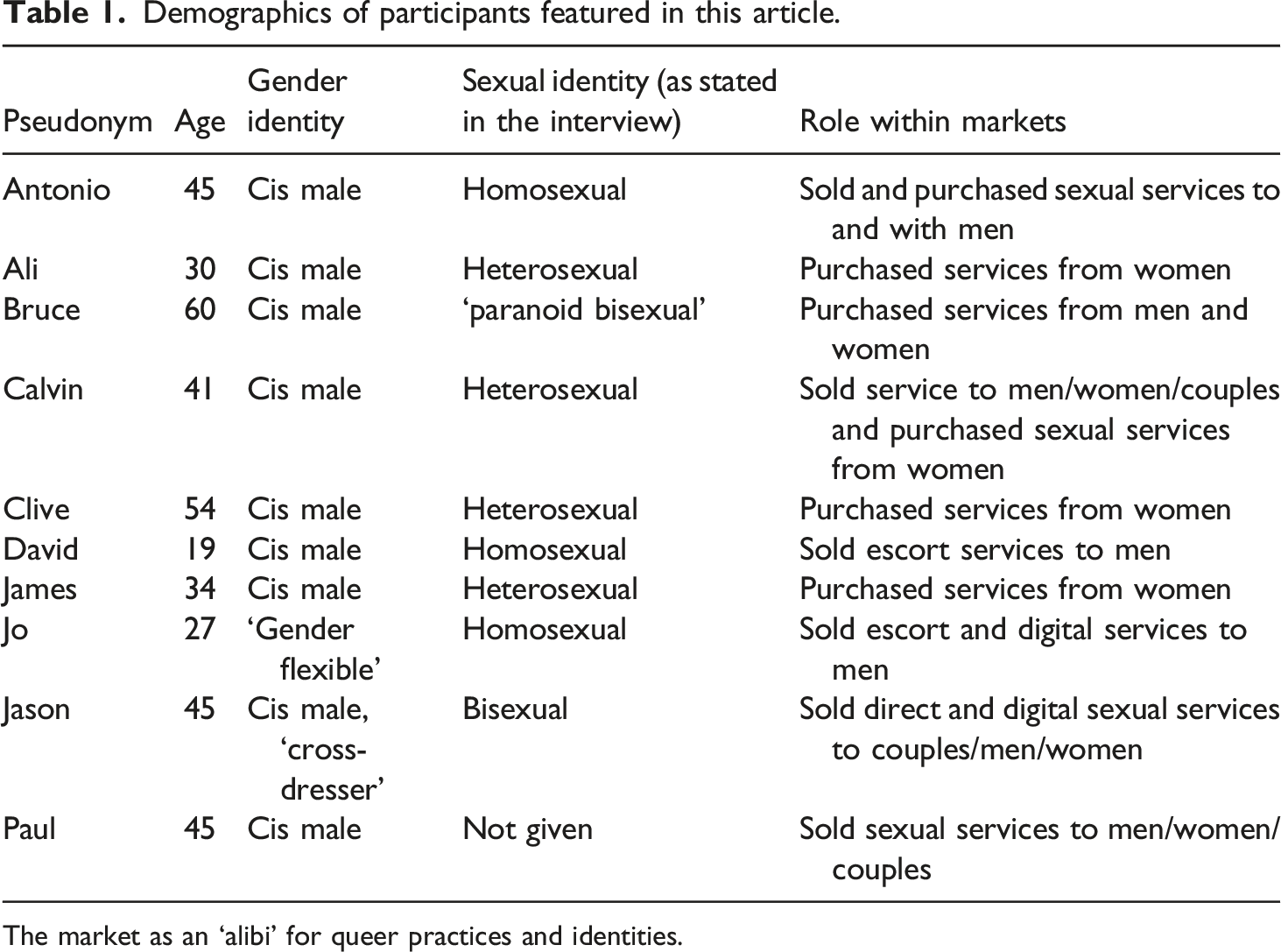
The market as an ‘alibi’ for queer practices and identities.
Jo, who described themselves as gender flexible, had used digital sex markets as space to explore their ‘trans girl’ appearance. Jo stated that they were not a full time ‘trans girl’ and presented as a man in their professional job in computing. During webcam sessions, Jo was able to ‘pretty up’ and ‘transform’ into a trans girl. A gender expression Jo describes as a ‘Venn diagram niche of effectively feminine male but not full trans’, adding ‘I haven't put that much effort into defining it’. Jo describes their confidence and self-esteem growing through 4 years of webcamming and becoming more comfortable with their penis. In part, Jo attributed this to the positive and flattering comments they received from customers. Within sex markets Jo felt accepted for whom they want to be, as Jo notes, ‘you are someone that they’ve been looking for anyway, you’re of a type that someone has been trying to find’. For Jo, the market provided a space that was welcoming of non-normative gender and sexuality. Drawing on Butler’s theory of gender, Jo was able to occupy multiple and fluid subject positions with reduced risk of direct or indirect punishments. Jo found a space that accepted their fluid gender.
Paul also used digital sex markets as a place where he could explore his sexuality without risk of disclosure, and therefore stigmatisation. Paul, aged 45, worked as an escort and performed webcam shows and telephone sex, and sold videos and photos. He sold his services predominately to men, and occasionally to women and women/men couples. He did this whilst also working at a University, thus, he claimed he was not driven by economics but rather used the market to explore his desires for same-sex encounters, both online and offline. He firstly engaged in commercial sex one bank holiday weekend: ‘to explore things a little bit more, you know, explore my sexuality, I guess. This place (Adultwork) has given me the opportunity to do that really’. At the time of the interview, he had been exploring things 'a little bit’ for 10 years. He describes selling online sexual services as an ego boost enjoying the attention of men. Yet, maintained a public heterosexual identity, stating ‘[I am] almost a different person really to what all my friends and family know as Paul. It is bizarre. It is like its own universe really’. Paul’s homosexual acts remained consumptive rather than relational.
Bernstein (2007) argues the market provides an important emotional boundary for both worker and customer. The potential anonymity of the internet and the market provide a space for men to explore and act out sexual and gender desires, particularly sexual desires that can cause ‘conflicts between their sexuality and their social presence as men’ (Connell, 1992: 737). Furthermore, the market can be an ‘ego boost’ as described by Paul and suggested by Jo with people paying to spend time with them.
Bruce, aged 60, was the oldest man I interviewed in the study and had been a lifetime consumer of sex. Initially visiting parlours in London and more recently visiting different commercial sexual venues, both online and offline. He described his sexuality as ‘confused. I guess you could say paranoid bisexual. I’m just so confused’. He discusses his early sexual experiences with women and men, but concerning the latter, he reflects on his feelings at the time stating, ‘that was really, really enjoyable’ at the same time he also felt ‘I shouldn’t be doing this’. As Connell states in his early works on masculinities: Men who have sex with men are generally oppressed…they face structurally-induced conflicts about masculinity - conflicts between their sexuality and their social presence as men, about the meaning of their choice of sexual object, and in their construction of relationships with women and with heterosexual men (1992: 737).
For Bruce, this oppression and resulting conflict appeared to have grounded his sexual experiences. He claimed to be sexually dissatisfied in his sexual relationship with women yet has consistently been in heterosexual relationships since his early twenties. His marriage of almost 30 years ended, as a new relationship with a woman started. In both relationships he had stopped having sex with them, yet maintained a public façade of a monogamous, heterosexual marriage. By doing this Bruce upheld heteronormative ideals and continued to benefit from a masculine heterosexual identity.
Within sex markets, Bruce opted for 'male focussed' sexual encounters with women sex workers, although he had also bought sex with men. He stated he was more inclined to buy sexual services from women because he ‘just feel paranoid’ and was worried he would be ‘found out that I was with a guy’. Bruce’s uneasiness around his sexuality meant he avoided direct and explicit sexual terms. By ‘male-focussed’, I assumed he was referring to anal sex or perhaps the use of a strap-on during sex with women sex workers. But my heteronormative restrictions of masculine sexuality and his uncomfortableness dictated a silence and an inability to ask a follow up question to clarify.
At the time of the interview, Calvin was 41 and worked as a personal trainer, a life coach, a sports therapist and as a sex worker. He had previously been in the army. It should be noted he did not use the term sex worker in the interview, but rather, stated he gave massages, mostly to men. Describing his sex work, he states I do a lot of massage basically. Massage therapy. It is all streams from massage. And being a sports masseur is just bending the skills and giving slightly extra.
Calvin self-identified as ‘straight’ and added ‘I am not bisexual, gay, bicurious, nothing’. Calvin understood the sexual massages he gave to men as an economic encounter, stating he could not get an erection for men and if he could, he would have sex with men for money. In the literature, this has been referred to as ‘gay for pay’ (Minichiello et al., 2013: 265), which supports Calvin’s economic reasoning of his sex work. Yet, it seems he had other means to make an income as a white, cis-man with degree level education. His motivation to present himself as a heterosexual male and engage in performances of hegemonic masculinity throughout the interview suggested there was more complex motivations to provide erotic massages to men than one based solely on economics. The market provided Calvin with an alibi to engage in sexual acts with other men.
The market arguably becomes an alibi for non-normative sexualities thereby de-politicising and dis-identifying with overt homosexual or transgender identities. The participants appeared restricted by normative labels such as homosexual, heterosexual and bisexual. They did not fit neatly into normative gender/sex/desire categories, thus, suggesting the redundancy of heteronormative categories but also the persistence of gendee/sex/desire binaries.
2.1. Negotiating straightness
At the time of the interview, Paul was single and made a clear distinction between his identity online in sex markets and his (hetero)normative identity outside of sex markets. Throughout the interview, he did not label his sexuality and was not drawn into heteronormative and homonormative assumptions, avoiding the label of bisexual. In the following extract, Paul describes how his market-based sexual practices do not overlap with his sexually conservative ‘family values’ outside of the market. If I was in a relationship with somebody I would want it to be exclusive and not with the adult side of things... I have just been single all the time I have done the adult stuff. I have not even got into a relationship with an escort cos I am not sure how I could deal with that... I am not sure I would want to be sharing my partner with lots of other people. I have never even done swinging before within relationships. I am not sure I could face seeing my partner with another guy effectively. So, it is strange as open-minded as I am[...] I still think I have completely got two minds on my private life: my adult side of things [selling sex], and my general private life [heterosexual identity]. Family values are instilled inside me and will never go. Effectively. I do think I am deep down, I am not waiting, but knowing if I am going to get into a relationship it is going to be that kind of exclusive–eventually living together–you know perhaps not kids now. I have got a grown-up daughter from a previous relationship and I think at 45 the way I look at things I don’t want any more children. But you don’t know, I would be looking at the more traditional family kind of relationship than the more open sort of thing.
Paul, like Bruce, wished to keep his subversive performances with the boundary of the market as this allowed them to explore potentially stigmatising practices and desires yet maintain the performative acts of heteronormative conventions such as monogamous heterosexual relationships; thus, upholding their heterosexist power. Paul negotiated a ‘straight’ identity by keeping a clear boundary between his public identity and position and the one he presented within sex markets.
As part of this dissonance, Paul did not use the term sex work rather vague statements such as ‘the adult side of things’. He rarely referred to his experiences of selling sex to men, focussing more on his experiences of webcamming and phone sex. This may have been in response to my study which focused on digital sex work, or it could have been him distancing himself from sex with men. Similarly, Calvin did not refer to himself as a sex worker rather he gave massages. The distancing and secrecy Paul and others described may attribute to the isolation experienced by male sex workers who are less likely to report crimes to the police and join online forums and networking sites (Sanders et al., 2021).
Bruce expressed shame and anxiety about his sexual practices and desires throughout the interview. As we closed the interview, he thanked me for listening and taking a non-judgemental approach, claiming it was the first time he had spoken about his sexual practices and desires outside of commercial sex encounters. This confessional experience of research participants is described by Plummer (1995) in Telling Sexual Stories. Reflecting on this interview, I am slightly amused as I had been judging his experiences, wondering why he insisted on maintaining a public façade of monogamous heterosexuality whilst engaging in commercial sex with different genders. Bruce’s experience prompted me to write this article. Although the market provided Bruce space to perform alternative subjectivities, he felt compelled to maintain a normative masculine ideal of heterosexuality despite the limitations it produced. He held onto the secrecy and shame resulting in what Bruce described as ‘paranoia’, ‘shame’ and ‘being out of control’. Sex markets, to some extent, empowered him to act on his desire to have sex with other men, yet also enabled complicity in maintaining heteronormativity.
To assert his ‘straightness’ Calvin performatively embraced almost caricature masculine behaviours, adopting a sexually aggressive mode, posturing his sexual successes with women and physical strength. As we see in the following extract, Calvin actively resisted the power imbalance in the research relationship by being sexually aggressive towards me. Because I will tell and be matter of fact. I am not going to waste your time. Are you ... to me do you want the fuck of your life? It is not a hard question that requires answers - it is a yes/no question. I believe you call it a closed question - don’t we - with a yes/no answer. As soon as they start saying yes, but… ‘I would like to get to know a bit more about you?’ Then they are not on the same page, are we?
It was unclear if Calvin was talking directly to me, or to a metaphorical woman whom he has sex with, commercially or otherwise. At the time it felt directed to me. Bruce similarly described his sexual ability and attractiveness as a heterosexual man. He stated, his current partner ‘said she had more orgasms with me than all the time she had with her husband’ and told stories of ‘attractive’ women coming on to him.
For both negotiating their straightness within the interview was important so they could still claim a public heterosexual identity. In the interview, Calvin may have felt his masculine identity was being challenged and I was objectifying him. He wanted his sexual story to be one of heterosexual masculine sexual power and knowledge, not of homosexuality. In this context, Calvin felt the need to defend his heterosexual masculine identity by repeatedly discussing his sexual prowess. As Butler (1988) claims, the reassurance of performing gender identity ‘well’ displaces the anxiety of punishing regulatory practices. In the following extract, he elaborates his ‘straightness’ in relation to selling sex to men. Interviewer: How does it work with erm... how do you feel about, if you are straight, then how do you feel about having male customers. Calvin: That works very easy for me. They get erect very quickly, they want to see my cock. They can’t see my cock because I am straight. So there is a technical imbalance. So for example I had a guy on Thursday who said suck my cock. I said ok you can pay me £1,000 to suck my cock but you’ll be sucking a very small willy. Surely you want a hard penis to suck, cos chemically men don’t do it for me. If I wanted to get an erection for a man I couldn’t. Believe you me I wish I could. Because I would be loaded right now. I would be very, very rich. And I wouldn’t be living in this country. So I would be loaded. If I could get an erection for a guy then the world is my oyster. I am about as straight as they come. I love women. You know. But I can turn a man on as easily as I can turn a woman on. It is easier to turn a man on, easier. It takes me an hour to make a woman cum properly, it takes 5 minutes to make a man cum properly.
Calvin maintained a binary position of sexuality despite his practices suggesting a multiple and fluid subjectivity (Butler, 1990). His paradox both reproduces and contests dominant discourses of heterosexuality.
2.2. Beyond binaries
Jason and Antonio’s ease in expressing their sexual identity and discussing sexual desires was in stark contrast to the men in the study who had public heterosexual identities and sold or bought sex with men. Jason, aged 45, had experienced a sexual ‘coming out’ through sex markets, and had found it a place where he could explore his sexual and gender identity. He described his sexuality as ‘kinky’ and he enjoyed dressing in ‘women’s’ clothes. He had married a sex worker, Fiona who was also interviewed for the study. As he describes, I was in an eighteen year relationship that was unhappy. I was seeing girls [sex workers] because it was easy, but as soon as I met my wife, I just knew. It wasn’t the thing of being a working girl. It wasn’t like that, it wasn’t like any of that, I just knew, and have been with her since, and that’s how I progressed into where we would do it [sell sex] as a couple.
Jason’s experience reveals a resistance to dominant norms of masculine sexuality and gender expressions. The market has provided him with opportunities to explore potentially stigmatising aspects of his identity and perform transgressive acts, both as a buyer and seller of sexual services.
Antonio’s interview, like Jason’s, highlighted the possibility of dual roles in sex markets, embodying both customer and worker. At the time of the interview, Antonio was neither buying nor selling sex, but was working in a sex shop as a retail assistant. He was initially interviewed as a customer of phone sex but as the interview developed, it transpired he had appeared in pornographic films and ‘tried’ webcamming and escorting as a form of paid labour. Like Paul and Jo, he described sex working as an ‘ego boost’ and something he did during a mid-life crisis as he ‘just needed validation’. Calvin also stated he had been a customer, buying sex from women sex workers, and at the time of the interview he was selling erotic massages and mediated services to men.
From a cultural perspective, this study evidences a blurring of worker and consumer identities (Du Gay, 1996), presenting a more complicated picture than binary considerations of male client–female worker, customer–worker, and online–offline. This duality disturbs the reproduction of the worker-customer binary and challenges gendered assumptions of male client-female workers. Like Raven Bowen’s definition of duality (2015), there is a lack of attachment to a specific role. As with other digital markets, embodying the role of both producer and consumer is a defining feature of online consumption practices (Ritzer and Jurgenson, 2010). In the digital age, consumption and work are not clearly defined, leading Ritzer and Jurgenson (2010) to claim the internet has expelled us into a new age of capitalism labelled ‘prosumer capitalism’. Digital sex markets allow for either role to be explored with ease as online profiles can be adapted according to requirements. Here, the men are sex workers in some contexts, and in other contexts and at different times, they are paying for sexual services. They are not bound by limiting binaries.
3. Concluding comments
The current literature on men’s involvement in digital sex markets tends to analyse them as either buyer or seller, in either heterosexual or homosexual sex markets. These narrow binaries do not give space to the revealing findings of this study. The narratives analysed here suggest a lack of attachment to a specific role and identity within sex markets. Indeed, digital sex markets provide a space for fluidity and acceptance of queer and/or fluid gender/sex/desire without the risk of being stigmatised, ostracised and shamed. Several participants celebrated the validation of performing their potentially ‘transgressive’ sex/gender/desire in digital sex markets. Those in this study found sex markets to be a space that allows for gender and sexual exploration outside of compulsory heterosexuality.
This paper further adds to the evidence of the problem and limitations of compulsory heterosexuality highlighted by feminists in the 1990s. Judith Butler, Sandra Bem, Raewyn Connell and others note the limitations of sex/gender/desire categories that are currently utilised in most Western societies. The narratives analysed here suggest a very real perception of the social risks associated with identities and behaviours that transgresses compulsory heterosexuality. Some of the accounts analysed for this paper, highlight a conviction and commitment to maintaining a hegemonic masculine identity, thus, holding onto the heterosexist power that comes with a masculine heterosexual identity. A power that some of the participants were not willing to risk losing, despite other risks associated with feelings of shame and secrecy.
In this situation and context, the market provides an alibi and thus participants, if they chose, could maintain heteronormative subjectivities. It provides an easily accessible space that can remain private. Although there are some privacy risks, such as hacking or being identified, digital sex markets largely provide a space that allows those interviewed to create a double life, keeping the two worlds separate. For some, the money involved provided an alibi as to their contradictory subjectivities. The acts remain consumptive rather than relational, and therefore they can de-politicise and dis-identify with overt homosexual or transgender identities. They did not fit neatly into normative gender/sex/desire categories but many of them were also complicit in maintaining compulsory heterosexuality.
To date policymakers and to some extent sex work research has continued to frame sex markets in narrow binary terms, but this study shows a more complex picture of male sexuality and sex markets more broadly. It would be fruitful to pursue further research on fluid customer/worker roles in the digital age. Although this research cannot provide a conclusive response, it does raise questions about the lack of attachment people have to specific roles in sex markets. It suggests a fluidity that is largely absent from existing research. The paper has gone some way to challenge stereotypes and myths about those who buy and/or sell sexual services.
Footnotes
Declaration of conflicting interests
The author(s) declared no potential conflicts of interest with respect to the research, authorship and/or publication of this article.
Funding
The author(s) received no financial support for the research, authorship and/or publication of this article.
