




Abstract
Lesbian, Gay, and Bisexual YouTube celebrities have come to the limelight of popular media culture. This article explores how 10 of the most popular and influential YouTubers from three Latin American countries (Argentina, Colombia, and Mexico) have come to occupy lesbian, gay, and bisexual subject positions in their coming out vlogs. We argue that through the entwinement of YouTube’s political economy of celebrity and performances of respectability, these vloggers were able to turn their coming-outs into a form of emotional labor that positions them as exemplary models of queer success within the neoliberal economy and cultural regime.
Introduction
YouTube celebrity vloggers have come to the limelight of popular culture since their emergence in the early-2000s. These personalities are “micro-celebrities” that build relatively large public followings through the performance of their personal lives and lifestyles in localized virtual spaces, crafting lucrative careers by monetizing their content and expanding their “brands” to other media (Turner, 2014). Many of these YouTube celebrities have come out publicly as gay, lesbian, or bisexual, usually via coming-out videos (Abidin and Cover, 2018; Lovelock, 2017). Latin American YouTube vloggers are no strangers to this global phenomenon and are increasingly capturing more audiences and growing in popularity (Suing et al., 2018). Within this set of young up-and-coming YouTubers, there is an important group of influential Latin American gay and lesbian vloggers, with names such as La Divaza and Juan Pablo Jaramillo amounting to over 15 million subscribers collectively.
This article explored how some Latin American YouTube celebrity vloggers have come to occupy lesbian, gay, and bisexual (LGB) subject positions in a way that allows them to participate in the neoliberal economy and consolidates them as proud and authentic YouTube celebrities and LGB persons. We achieved this by analyzing the coming out videos of 10 of the most popular LGB vloggers from three countries (Argentina, Colombia, and Mexico) of Latin American. 1 , 2 , 3 By focusing on the most influential vloggers of the region, we aimed to capture how the entwinement of YouTube’s fame economy and a neoliberal and normative interpretation of the coming-out narrative configured an LGB subjectivity that could enact a form of “discipline by example” (Hermes and Kooijman, 2016). Following Lovelock (2017), we contend that the discourses these YouTubers circulate act not only as aspirational role models but traced the limits of intelligibility of non-heterosexual subjectivities, marking what non-heterosexual individuals could be considered “acceptable” or “respectable” and could assimilate into the status quo (Hermes and Kooijman, 2016).
Following scholarship from and about Latin America that has problematized coming out as a linear process that leads to subject formation (e.g., Acosta, 2011; Decena, 2011; Vasquez del Aguila, 2012), we shift our focus away from personal processes of self-definition to the material and discursive conditions that shape how individuals come to occupy sexual subject positions. We argue that within the transnational space created by YouTube and its political economy, architecture, affordances, and cultural norms, some Latin American non-heterosexual subjects have managed to craft their “queerness” 4 as a form of labor that contributes with and propels their careers. These vloggers have achieved this “feat” by framing their sexualities through a discursive strategy we termed respectable outness. This allowed them to leverage YouTube’s economy of authenticity to position themselves as “visible” and “proud” LGB subjects while growing their personal brands and strengthening their relationships with their followers. However, such performances of “outness” were contingent on the upholding of respectability politics throughout their coming-outs, particularly, concerning their family relationships and how they interpreted their desire. Respectable LGB individuals must differentiate themselves from other queer subjects who fall outside the norm—sexualized, gender non-conforming, non-partnered, non-successful queer people—while actively performing practices that align them with “social norms that are gendered, white, middle-class and heterosexual” (Yuvraj, 2012: 410). Through respectable outness, these vloggers managed to negotiate the imperatives to be visible and authentic—pervasive to internet celebrity culture and hegemonic models of non-heterosexual subjectivity—in a way that does not challenge heteronormativity and positions them as exemplary models of queer success within the neoliberal economy and cultural regime.
Being queer and famous on YouTube
We understand YouTube celebrities as individuals whose celebrity status derives from their activities on the platform, which usually take the form of video blogs or “vlogs.” Vlogs are a form of confessional media where the vlogger reveals aspects of their personal lives, ranging from day-to-day anecdotes to highly emotional and intimate circumstances to an imagined audience in a conversational fashion (Burgess and Green, 2009). YouTube vlogs operate within an economy of authenticity that capitalizes on the public display of intimate aspects of the self and rewards these confessions with popularity and monetary gain (Burgess and Green, 2009).
In his analysis of gay and lesbian YouTube celebrities—Connor Franta and Ingrid Nilsen—Lovelock (2017) argues that a normative narrative of the coming out as the realization and articulation of an essential and authentic “truth” of the self has become entangled with YouTube’s economy of celebrity centered on highly individualized processes of affective labor, mediated authenticity, and gradual and selective self-revelation. By being able to transform their pain—a result of growing up in a heteronormative society—into self-acceptance and pride, these vloggers expanded their existing personal brands into other forms of media and advanced their lucrative careers (Lovelock, 2017).
The coming out narratives articulated by the celebrity YouTubers analyzed by Lovelock (2017) align partially with the “modern” formula for coming out in “the Global North,” 5 notably identified by Plummer (1995), and with Cover and Prosser’s (2013) account of the “core elements and key ideas” of the contemporary coming-out narrative in online settings. In short, this script conceives the coming out as the realization of an essential aspect of the self, and describes a linear trajectory from feeling “different” during childhood or early adolescence to the construction of an “identity,” the achievement of a coherent sense of self, and the integration to a community of others “alike” (Cover and Prosser, 2013; Plummer, 1995). However, YouTube’s LGB celebrity vloggers seem to build from these conventions of queer storytelling to turn the public articulation of their sexualities in the digital space as “simultaneously a ‘personal’ account and a ‘work practice’ that undertakes labour” (Abidin and Cover, 2018: 228).
Abidin and Cover (2018) analyzed how queer celebrity vloggers coming out narratives became a form of labor within YouTube’s political economy. Unlike amateur coming out videos, queer influencers’ personal narratives are “enshrined as inspirational by YouTube community, followers and sometimes the press” (Abidin and Cover, 2018: 228), becoming a form of resource for other queer people. This could lead to the queer influencer taking a role as an advocacy figure through the public discussion of their private sexual and gendered life, engaging in LGBTQ-targeted brand sponsorship work, and promoting sexual, mental, and physical health issues (Abidin and Cover, 2018). Moreover, this form of labor is linked to neoliberal ideals of entrepreneurialism and self-branding, as vloggers’ careers are perceived as self-made trajectories from amateur YouTubers to well-established celebrities and influencers in different forms of media (Smith, 2014).
Lovelock (2017) argues that through the authenticity-as-labor regime, the coming-out narratives of gay and lesbian YouTube celebrities make legible a normative subject position situated within homonormative and proto-homonormative cultural logics. Homonormativity is a concept employed to critically examine the processes through which some sexuality-based minorities have been discursively re-located from society’s margins to a position of acceptance, contingent on the assimilation to a model of LGB subjectivity aligned with heteronormativity, whiteness, and an urban middle-class habitus (Cover, 2013; Duggan, 2002).
Lovelock builds on this notion to assert that, whereas homonormativity addresses mainly an adult gay subject that can access to the so-called benefits of assimilationist politics (e.g., marriage, work, social status), proto-homonormativity centers on the affects of young queer individuals. Thus, proto-homonormativity could be better understood as a transitional phase between a turbulent adolescence and a “happy” and functional homonormative adulthood (Lovelock, 2019a). Proto-homonormativity achieves this transition by offering young queer individuals a set of meanings and strategies to “successfully” develop a relationship with their sexualities framed by self-acceptance and pride that could be capitalized as a source of empowerment and neoliberal success. Through this, it enables a “homonormative bond between the adult gay subjects and the social body” (Lovelock, 2017: 7).
However, coming out narratives undergirded by proto- and homonormative cultural logics obscure the intersectionalities of queer lives by addressing their message to a particular queer young subject, one that is “white, able-bodied, financially secure…, so that their only barrier to self-realization is constructed as their relationships with their sexuality” (Lovelock, 2017: 15). Thus, the coming-out narratives crafted by these celebrity YouTubers align with a zeitgeist of cultural texts that posit emotional literacy—the ability to manage and reflect on one’s own emotions—as the prime pathway to overcome social inequalities (Illouz, 2003).
“Coming out” in Latin America
A body of scholarly literature from and about Latin America problematizes the coming out formula from “the Global North” because of its failure to capture ways of subjectivation that deviate from so-called “global” LGB categories, and due to its role as a technology of normalization. Many Latin American and Latinx individuals understand and perform their non-normative sexualities without associating them with gay and lesbian subject positions (see Carrillo, 2017; Lancaster, 1994; Parker, 1999; Wekker, 2006). While studies about queer women are scarce (Perez and Babb, 2021), several scholars have reported how Latin American homoerotic and “bisexually active” men predominantly (but not exclusively) from lower socioeconomic status interpret their desires outside of stigmatized gay identities—such as “caletas”, and “activos” in Peru(Fernández-Dávila et al., 2008; Vasquez del Aguila, 2012), “entendidos” in Brazil (Parker, 1999) and Mexico (Carrillo, 2002), while many others just identify as “hombres” or “varones” (men) (Murray, 1995). This allowed them to maintain their masculine capital and status as heterosexual men.
Moreover, studies about non-heterosexual Latin American and Latinx individuals’ experiences of managing the visibility/invisibility of their sexualities reveal the limitations of the metaphor of “the closet” as an in/out, invisible/visible, shame/pride binary. In Peru and Argentina, various authors have described the institutionalization of “secreto a voces” (open secrets), a set of strategies centered around discretion, secrecy, and “turning a blind eye,” that homoerotic men and their families perform to manage these men’s sexualities, maintain kinship bonds, and avoid discrimination (Caceres and Rosasco, 2000; Vasquez del Aguila, 2012; Pecheny, 2002). Negotiating the junctures of “the closet” also served Brazilian homoerotic men in cruising websites—hiding or cropping their faces while over-exposing other body parts was a way to preserve their masculine capital and being able to simultaneously engage in same-sex relations (Zago, 2013). Likewise, in the context of transnational migration to the United States, Acosta (2011) and Decena (2011) captured how Latin American and Latinx queer men and women inhabited subject positions that exceeded the normative coming-out narrative by negotiating how, when, and with whom their sexual lives became (or not) a matter of discussion, occupying “in-between spaces” or tacit subject positions. These strategies allowed them to maintain kin networks that were crucial for their survival and upwards mobility (Decena, 2011).
Cultural critiques have also problematized the coming out as a subjectivation technology for the production of “normal” gay subjects; which may fit white, urban, middle-class individuals, but leave outside people in different positionalities (Guzman, 2006). Gay subject positions have a history in Latin America, entwined with a middle- and upper-class habitus (Garcia-Rabines, 2022; Klein, 1999; Lozano-Verduzco, 2017), and an idealized gaze of “the Global North,” positioning the cultural logics attributed to countries such as the United States as more “modern,” “egalitarian,” and “progressive” (Falconi, 2018). The circulation of subject positions from “the Global North” to Latin America does not mean that Latin American individuals are passive receptors of such discourses (Carrillo, 2017). However, hierarchies and power differentials are deployed when translocal interactions take place, which underscores the importance of looking at the structural and material conditions that shape how queer Latin American individuals occupy subject positions.
Taken together, these studies underscore the political economy of sexual subjectivation by showing how power dynamics and access to social, cultural, and material capital create the conditions that enable Latin American and Latinx non-heterosexual individuals’ to make visible/invisible their same-gender relations and “come to” (or not) an LGB subject position. We aimed to further explore lesbian, gay, and bisexual subject formation processes in Latin America by looking at a largely understudied context in the region—digital media—and employing a novel selection of texts as sources—the coming out videos of some of the most popular LGB Latin American YouTubers. Particularly, we discussed how vloggers occupied LGB subject positions through the entwinement of YouTube’s fame economy and respectability politics by focusing on three aspects of their coming out narratives: their relations with themselves, their families, and their desire.
Methodology
We employed a qualitative methodology grounded in a constructionist framework, which understands subjectivity as a socially mediated process (Madill et al., 2000). We selected ten coming-out videos made by LGB YouTube celebrity vloggers from three Latin American countries (Mexico, Colombia, and Argentina) (see Table 1—Sampling data) through the following steps. First, we defined a list of search terms in Spanish—“Saliendo del clóset” (coming out of the closet), “Soy gay” (I am gay), “Soy lesbiana” (I am lesbian)—and filtered YouTube’s results according to the language of the video (the video must be in Spanish), country of origin of the vlogger (it must be any Spanish-speaking Latin American country), and the number of subscribers to the vlogger’s channel (over 500 000 subscribers). Third, we selected videos taking into account the way of portrayal of the coming-out event (speaking directly to an imagined audience, not merely recollecting a previous coming-out experience). We narrowed the sample by calculating the engagement rate percentage using the following formula: [(Likes + Dislikes + Comment) ÷ [(Subscribers + Views) ÷ 2] Sampling data. Source: Elaborated by authors. aER refers to Engagement Rate.
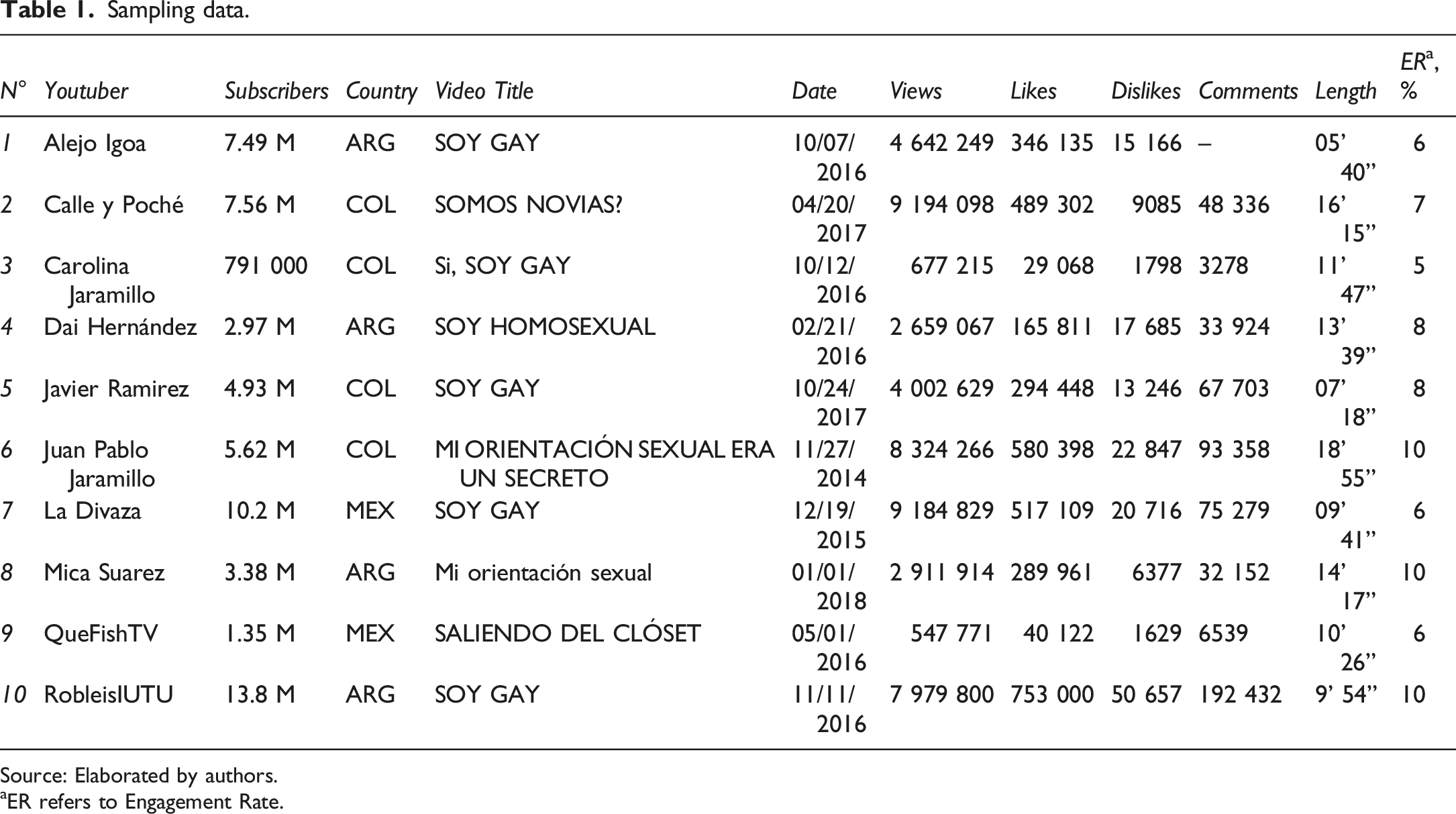
This approach considers the number of single interactions (likes, dislikes, and comments) in contrast with subscribers (for each channel) and views counts (for the selected video). Results over a 5% average engagement rate were finally selected while maintaining parity between female and male creators. The 5% engagement rate is a baseline to determine influence used by companies such as CreatorIQ (Dowling Semeraro, 2019) for medium-reach content creators (over 100 000 subscribers). Considering this, we defined a relevant sample of popular and influential LGB Latin American vloggers. It is worth noting that all of these vloggers were already popular on YouTube before their coming-out videos were published. Moreover, after their coming outs, some of these YouTubers have expanded their celebrity brands to other types of media, such as La Divaza releasing songs and music videos and Juan Pablo Jaramillo publishing an autobiography/self-help book aptly titled “La Edad de la Verdad” (The Age of Truth).
Vloggers’ age ranged from 18 to 27 years old, which, in line with previous studies (Albury and Byron 2016; Lovelock 2019b), qualifies them as part of the group of “young people.” Vloggers claimed different social categories to describe their sexualities: seven identified as gay or homosexual, sometimes used interchangeably; one identified as a lesbian, and three as bisexual. All of them were visibly feminine- and masculine-presenting in their coming out videos. 6 Following the conventions of the YouTube vlog genre, all of the videos were staged in a confessional manner: they took place in a domestic setting—usually the vloggers’ bedrooms—while they talked directly to the camera, set in a medium or medium close-up frontal angle (Mitry, 1998). Videos tend to be minimally edited, although some added emotive music in the background. Additionally, several vloggers included a “disclaimer” at the beginning of the videos, signaling a deviation from the usual content, which tends to have a lighter tone. Overall, these aspects served to frame the videos under a particular tone of intimacy, seriousness, and trustworthiness (Burgess and Green, 2009).
We analyzed the data using reflexive thematic analysis (TA), a technique that allows for the identification and analysis of patterns within a dataset (Braun and Clarke, 2006). Although the analysis mainly focused on the discursive dimension of the videos, we also paid attention to the performative aspect of them. Given the topic, objectives, and research questions, we employed a combination of inductive and deductive reflexive TA: inductive, as codes were generated organically from the data; and deductive, as we also drew on theoretical constructs from queer scholarship (e.g., homonormativity, proto-homonormativity, and respectable queerness) to understand certain features of the data (Braun and Clarke, 2012). Following Braun and Clarke (2006), we first watched and transcribed all of the videos to become familiar with the sample. Later, we generated codes by iteratively watching the videos, reading the transcripts, and categorizing data. Then, we clustered codes within potential themes, which are relevant, multifaceted patterns that organize codes around shared meaning (Braun and Clark, 2019). We discussed and compared potential themes until we were able to construct a final analytic narrative and define themes’ names. After a thorough analysis of the collected data, we decided upon three themes concerning our research objectives. Themes are illustrated with quotes extracted from the vloggers’ coming-out videos that have been translated to English.
Coming out as a form of labor
All of the videos we examined framed the coming out as a progressive process of self-discovery and self-revelation of an “authentic” aspect of the self, in line with the conventions of coming out stories on YouTube (Adams-Santos, 2020; Alexander and Losh, 2010; Cover and Prosser, 2013; De Ridder and Dhaenens, 2019; Humphrey, 2018; Wuest, 2014). Vloggers’ accounts delineated a trajectory of overcoming a distressing adolescence fueled by non-heterosexual desires through emotional labor, finally becoming an authentic, happy, and proud LGB individual that can publicly discuss their sexuality. However, this emotional labor, through YouTube’s fame economy and the cultural norms of vlogging, became a source of social, cultural, and economic capital that cemented the vloggers’ status as celebrity YouTubers.
Vloggers establish the discovery of one’s non-normative sexuality as the first step of the coming out journey. This usually happens at an early age—either during childhood or adolescence—and was represented as an extremely conflicting and distressing time in their lives. The discussion of feelings such as anguish, fear, sadness, and self-loathing, as well as the display of affects such as crying when talking about these moments, is quite central, as this is when they realize that they exist outside of heterosexuality’s norms of recognition. This is better exemplified in a quote from Dai Hernández, an Argentinian vlogger who portrays the time of discovering her sexuality as filled with negative emotions: The first years of my adolescence -because I knew about this from an early age- were chaos, terrible chaos. I didn't know what was wrong inside of me, though not because I thought it was wrong, but because everyone [around me] had so many prejudices, in a way that they didn't understand it, but they had the nerve to point it out even when there was nothing wrong about it. (Dai Hernandez, 2016, 0:03:47–0:04:15)
However, the coming-out discourses we examined also intended to portray an emotional transformation “from shame to pride.” Similar to the celebrity YouTubers analyzed by Lovelock (2017), these vloggers discuss finally finding self-love, self-acceptance, and pride through a process of individualized emotional labor. Although in some cases there are mentions of the importance of others (e.g., close friends, LGB organizations, or a virtual community) that can provide emotional support and understanding that helps them in the process of self-affirmation, the majority emphasized the role of introspection, willpower, courage, and individual responsibility in constructing a happy and proud self. For example, Mexican vlogger Sury Dorantes (QueFishTV) argues that she was only able to gain an increased sense of self and consequently, to come out to an acquaintance after she gained enough courage to confront herself: ...after a while, I was finally honest and dared to face myself and say: what am I doing with my life? Why am I going to live based on what other people think, or trying to please other people? Why do I have to restrict myself from loving, why do I have to restrict myself from being happy? Why can't I give myself that chance? And after spending many, many months, when I finally accepted it and dared to tell someone, my life changed completely, I was the happiest person in the world, I was much more confident, a much stronger person. (QueFishTV, 2016, 0:03:55–0:04:40)
This quote shows a logic that is also present in most of the videos we examined: that the only “obstacle” to happiness lies within oneself. According to this discourse, being inside of “the closet” is “an unlivable life” and coming out is the prime route to happiness and success. However, there is barely a mention of the structural factors that enable the systematic discrimination and exclusion of non-heterosexual people and that produce “the closet” these vloggers reject. Although most of the videos included a subtle critique of homophobic attitudes, vloggers seemed to lack the conceptual language to understand sexual prejudice, framing homophobia mainly as an individual issue, a negative attitude or opinion held by certain “close-minded” people. Nevertheless, coming out is not exempt from emotional hardships and vloggers acknowledge the difficulty of revealing this “private” aspect of themselves online. For example, while Colombian couple Calle and Poché discuss in their video the struggles related to coming out publicly as bisexual, Poché looks emotionally affected, stopping mid-sentence to murmur “I feel like I’m about to cry, I don’t want to cry” (Calle y Poché, 2017, 0:05:34–0:05:39), which immediately leads her to start crying on screen. Nonetheless, the feeling of liberation that overwhelms them after transforming their desire into discourse seems to exceed any amount of negative affect experienced before. As Colombian vlogger Juan Pablo Jaramillo puts it: With this video, I'm risking losing it all, but most importantly I'm risking to be free and happy, and those two things are worth more than any other… The internet is a place for us to express ourselves and I believe this is an act of sincerity and courage. (Juan Pablo Jaramillo, 2014, 0:17:52–0:18:13)
Thus, the promise of happiness through the coming out is deeply entwined with the idea of authenticity. Vloggers reproduce the homonormative and essentialist discourse that construes sexuality as something an individual innately has, and that the emotional journey is a process of discovery or recovery of a previously hidden, authentic self. Being authentic opens the possibilities of being happy, proud, and even finding romantic love in the future, which renders the LGB subject finally “capable” to integrate society as a viable homonormative subject. Moreover, within YouTube’s political economy (Burgess and Green, 2009), authenticity becomes a valuable currency that is exchanged for quantifiable signifiers of popularity—subscribers, video views, thumbs up, comments—and monetary gain (Lovelock, 2017; Raun, 2018). This image of the vloggers as “authentic” is further enhanced by their performances of negative affect during their coming out videos. Mediated tears and distress can be read as affirmations of authenticity in the archive of seemingly endless positive self-documentation YouTube vlogging can appear to be, which strengthens the vloggers’ ties with their virtual audiences (Berryman and Kavka, 2018).
In this way, the emotional journey these vloggers portray in their coming-out videos is incorporated into the corpus of “authentic” mediated performances upon which their popularity was constructed. Thus, their coming outs acted as a form of affective labor (Abidin and Cover, 2018), “intensifying the ideals of authenticity and self-revelation already bound to their celebrity personas” (Lovelock, 2017: 8). However, as we will explore in the following themes, the “success” of such performances of mediated authenticity was contingent on the upholding of respectability politics, which were expressed in the vloggers’ relation with their families and in how they interpreted their desire.
Family first: Family acceptance as pivotal for the construction of the public LGB subject
As many of the coming out videos show, once a queer individual finds and accepts “who they really are” through emotional labor, the construction of the public LGB subject takes place. Nonetheless, self-acceptance and proudness are hardly the last steps leading to being completely visible as an LGB individual (Acosta, 2011). Instead, for these celebrity vloggers, visibility—understood through a binary logic—is bound to the disclosure of their non-normative sexualities to close family members. Unlike the conventions of vloggers from “the Global North” (De Ridder and Dhaenens, 2019; Humphrey, 2018; Lovelock, 2017, 2019b; Wuest, 2014), who spent most of their videos narrating the process of “coming out to themselves,” one central aspect of these Latin American vloggers coming out videos was the discussion of family acceptance. With “family” we are referring to the traditional nuclear family, as vloggers mainly discussed their coming-out experiences with their biological parents and, in lesser instances, with their siblings and grandparents. However, this observation does not mean that familism—a construct that “emphasizes loyalty, solidarity, and interdependence with family” (Acosta, 2010: 65)—is an inherent aspect of Latin American “culture” nor that all Latin American people homogeneously hold familistic values (Baca-Zinn, 1982). Rather, familism can be thought of as the product of contextual social conditions (e.g., socioeconomic inequalities, structural discrimination, migration processes) that foster reliance on family relations (Acosta, 2010). Thus, we understand the saliency of the family in these coming-out narratives as a discursive strategy that serves to advance the vloggers’ performances of authenticity and respectability.
Except for the case of vlogger La Divaza, all of the analyzed videos place the event of coming out to close family members in a temporality that occurs after the vlogger has gained self-acceptance and before they can openly declare their sexuality to an anonymous YouTube audience (i.e., before they make it public). The linearity of the coming-out experiences, as narrated on YouTube, corresponds with the extended idea of repeatedly verbalizing one’s sexual identity as the only way of being a “good” queer individual, one that implies political responsibility (Adams, 2010). In that sense, coming out to the family is portrayed in most of the cases (except for vloggers Calle and Poché) as a choice, in which the queer individual has agency and control, instead of as something that happens involuntarily or due to external pressure.
Moreover, and in line with a previous study (Acosta, 2011), vloggers portray the event of coming out to their mothers as central for the process of occupying an LGB subject position publicly. Even when it is not necessarily clear from these narratives how the mother can facilitate the struggle for queer visibility, there is an implicit link in the discourses we analyzed between gaining the mother’s—and the family’s acceptance at large—and being prepared to come out to others.
While several studies have found that non-heterosexual Latin American and Latinx individuals strategically negotiate the visibility/invisibility of their sexualities with their families (e.g., Acosta, 2011; Decena, 2011; Vasquez del Aguila, 2012), this does not seem to be a choice for the vloggers we analyzed. Even when there is an open questioning of the need to be publicly visible, the importance put in the disclosure to and acceptance from the family, as a way to attain future visibility, is never underestimated in these coming out videos.
Still, coming out to close family members is not represented as an easy task and, as mentioned by vlogger Alejo Igoa, is a step that takes “a lot of courage” (2016, 0:03:01). There are several testimonies of experiencing fear of family rejection at the moment of deciding to come out to parents and siblings, which seems to stem from the fact that queer individuals recognize they hold a marginalized position in society. Indeed, this position is sustained through socially extended homophobic beliefs and prejudices about queer sexualities and “lifestyles,” which are deemed incompatible with heterosexual “respectability” (Rubin, 2006) and heteropatriarchal Catholic morality. Regarding this last point, although the cultural hegemony of Catholicism is in decline, it is still one of the predominant organizing principles in many Latin American societies (Hagopian, 2009), such as the countries of origin of these vloggers.
Thus, it makes sense that parents and other family members appeal to these ideas when trying to figure out how to deal with their queer relatives’ confessions. The video of Dai Hernández better exemplifies this issue, as it shows the struggle to find her mother’s acceptance who, along with her father, appeared in a segment of her coming out video. Hernandez’s mother explains that she initially refused to accept her daughter’s sexuality and even forbid her to socialize with her female friends because she was settled on traditional ideas of heterosexual romantic love, which involved her daughter marrying a “fairytale prince charming” (2016, 0:07:52). Therefore, the sole idea that Dai was attracted to women created huge contradictions, as it made this ideal impossible to fulfill.
Nevertheless, the coming out discourses we analyzed do not portray the process of overcoming these contradictions as one in which parents can question heteronormativity and challenge their homo-and-biphobic attitudes. Instead, to accept their children’s sexualities, parents seem to have relied on a logic based on the proto-homonormative notions of queer authenticity and happiness (Lovelock, 2019a), and a homonormative understanding of monogamous romantic love as the only legitimate way to embody same-sex desire (Valverde, 2006). Indeed, parents’ acceptance is portrayed as a process in which they come to realize that they have to let their children “be happy.” This happiness is related to allowing them to be their “authentic selves,” which at the same time, entails that they must be able to “love whomever they want.” Thus, the viability of the LGB subject, vis-a-vis the family, is defined mainly by the idea of authenticity and a heterosexual understanding of love, which is linked to the possibility of forming monogamous romantic relationships.
The process of coming out to family members, as narrated in these vloggers videos, further contributes to discursively binding the emotional dynamics of the proto- and homonormative coming out and the “respectable” performance of non-normative sexuality to the demands of mediated authenticity and self-branding of YouTube’s celebrity economy. Through the entwinement of these cultural logics, gaining the family’s acceptance is not only a moment of happiness that strengthens the LGB individual’s confidence to continue to articulate their sexualities publicly but a way to transit the margins of heteronormativity and move forward in the neoliberal economy.
(Romantic) love makes queer desire respectable
Even though family acceptance provides the LGB subject with a degree of recognition, respectability, and the possibility to assimilate into a heteronormative world, this status is precarious—it requires a continued iteration of acts that are evaluated against social norms based on what societies deemed respectable—(Yuvraj, 2012). This means that being respectable is only an illusion, as respectability cannot be thought of as a permanent state; instead, a person “is only ever in the process of being and becoming respectable by doing respectability” (Yuvraj, 2012: 419). As such, these vloggers repetitively performed respectability across their coming-out videos via discursive strategies geared toward normalizing their sexualities through the language of romantic love.
Vloggers expressed the desire for their coming outs—and, by extension, their LGB subjectivities—to be read as “something normal.” This was accompanied by the common assertion that by coming out they were not doing something “wrong” or “negative.” This message was, in some instances, directed to an imagined young queer audience, as shown in Alejo Igoa’s video: If you are gay or you like someone of the same sex… you don’t have to feel bad about it… I wanted to use this video to deliver this message: you're not doing something wrong, you simply like people of your same sex... it is completely normal (Alejo Igoa, 2016, 0:01:57–0:02:16).
This type of messages positions vlogger’s coming out stories and the emotional labor they imply as a form of discursive activism (Abidin and Cover, 2018) in support of LGB social inclusion. In most of these vloggers’ videos, this activism sought to claim the normalcy of same-sex desire; for instance, Dai Hernández affirmed that same-sex relationships are “not something done with bad intentions” because it is just a matter of “two people who want to love each other, care for each other, and be together” and that this type of affect is “a pure, beautiful feeling” (2016, 0:03:49–0:04:29). La Divaza adds to this by expressing a yearning for a world where same-sex sexuality “would simply be recognized as what it is: love” (2015, 0:07:54–0:07:58). Hence, these vloggers constructed normalcy (i.e., not doing something wrong/bad) by framing same-sex desire through the images of domesticity, monogamy, and romanticism of the respectable same-sex couple (Valverde, 2006).
If embodying the ideals of the respectable same-sex couple is equated to performing queer desire “right,” within normalcy, so to speak, then how would performing queer sexuality “wrong/bad” look like? A key characteristic of the respectable same-sex couple is that sexuality is only thought of in terms of romantic love (e.g., monogamy, marriage, and the wedding industry) and its legal status—or lack thereof—(Valverde, 2006; Yuvraj, 2012). Within these videos, performing queer desire wrong was not addressed directly, but implied through a particular strategy of silence: all vloggers systematically evaded any reference to sexual attraction, sexual experiences, or sexual pleasure. It could be argued that this silence advanced the goal of cementing them as respectable LGB subjects by distancing themselves from stereotypes of non-heterosexual people that portray them as sexual deviants or promiscuous (Crawley and Broad, 2004).
However, while references to sex or pleasure were completely suppressed, love or, more precisely, romantic love, was incorporated into these vloggers’ performances of respectability. For instance, Calle (from the vlogger couple Calle and Poché) described her feelings toward her girlfriend as something that compels her to “want to marry [her girlfriend]” because she “fell in love with [her] soul” (Calle y Poché, 2017, 0:13:18–0:13:24). This quote underscores the semiotic importance of the signs of normative heterosexuality such as marriage (Herrera, 2010), which served to grant respectability by prescribing “lifelong commitment and sexual monogamy… [while constructing] sexuality as a necessarily secretive and private aspect of identity” (Yuvraj, 2012: 422). Respectability was further achieved by demarcating their love from “earthly sexuality” and “lust” by invoking the idea of a “meeting of souls” (Giddens, 1992: 45). In this way, her desire is constructed as respectable because its target is not a sexualized body, but an immaterial and transcendent soul.
Romantic love also helped to curate respectable sexualities by making queer desire intelligible. For instance, Mica Suarez, an Argentinian vlogger, described her process of coming to terms with her sexuality in the following way: “I wasn’t going to accept I liked boys and girls... until I fell in love with one [women]... when I did fall in love I said: ‘Ok, I like girls, it is settled’” (Mica Suarez, 2018, 0:05–55-0:06–09). Additionally, Juan Pablo Jaramillo portrayed his first boyfriend as someone who “changed [his] life” and played a key role in his coming out process: Because of him, I built up the courage to tell my sister and my friends that I was gay… because he made me feel confident of who I was. (Juan Pablo Jaramillo, 2014, 0:03:56–0:04:02)
In this way, “falling in love” or being in a relationship was framed as a necessary step toward recognizing oneself as LGB, both to themselves and publically. Romantic love attributed same-sex relationships with the respectability needed to inch across the border that demarcates “good” sex (i.e., natural, normal, healthy, respectable) from “bad” sex (i.e., unnatural, abnormal, sick) according to Gayle Rubin’s sex hierarchy (2006). As a result, the diversity of forms of living and enjoying same-sex sexuality are rejected within the discourses of these vloggers in favor of a romanticized, sanitized, monogamous, domesticated partnership, which can more easily assimilate into the structures of normative heterosexuality (Duggan, 2002). This, we could argue, serves the purpose of claiming sameness to heterosexuality and therefore, allows LGB subjects to construct themselves as deserving of recognition (Yuvraj, 2012).
Conclusion
This article sought to critically interrogate the coming-out narratives of Latin American lesbian, gay, and bisexual YouTube celebrity vloggers as represented in their coming-out videos. We focused on the “practices of the self” through which these vloggers came to occupy an LGB subject position. In construing happiness and authenticity achieved through individualized processes of emotional labor as the prime route to a “successful” queer life, Latin American LGB YouTube celebrity vloggers recirculated proto-homonormativity. This cultural logic conceptualizes LGB subjectivity through notions of self-love, self-acceptance, and authenticity, which pervade neoliberal media culture (Lovelock, 2017, 2019a). Proto-homonormativity is entwined with the logic, conventions, and affordances of YouTube fame that capitalize on vloggers’ emotional labor and capacity to self-brand their sexualities while fulfilling the cultural mandate to “be true to oneself.” Thus, through proto-homonormativity, the coming out leveraged on the archive of previous performances of “authenticity” the vloggers had accumulated, becoming a form of labor that further cemented their status as YouTube celebrities while also turning them into exemplar LGB individuals.
However, there is a missing element in this production line. We argue that respectability provided the discursive conditions that enabled these vloggers’ coming out narratives to thrive in a still heteronormative world. Through what we termed as “respectable outness,” vloggers managed to negotiate the imperatives to be visible and authentic—both as LGB people and as celebrity vloggers—while still being “respectable”—sexually discreet, gender-conforming, depoliticized, assimilated into their biological families, and reproducing notions of (heterosexual) romantic love. In this way, “respectable outness” emerges as a set of discursive strategies that attempt to manage the public and private aspects of LGB subjectivities within both proto- and homonormative frameworks. Respectable outness captures the complex and sometimes contradictory negotiations LGB subjects engage in while they attempt to enact their sexualities during their coming out processes visibly and proudly without being cut off from the heteronormative world. Respectable outness configures an LGB subjectivity that is no longer contradictory to social inclusion and the possibility to achieve success in neoliberal terms. However, such inclusion is contingent on the continued performance of respectability throughout the coming out process.
Through respectable outness, we argue, these vloggers have achieved recognition and popularity within YouTube, while their coming-out narratives have become cultural texts available as vehicles of acculturation for young queer consumers. Vloggers’ fame and success in the neoliberal economy operate as disciplinary regimes that implicitly configure the boundaries of what constitutes a respectable LGB subjectivity and could potentially assimilate into a heteronormative society. This ends up being problematic, as these discourses do not question the mechanisms that maintain non-heterosexual people in marginalized positions. Instead, they inadvertently reified them, constructing heteronormativity as a fact of queer life—one that queer folk must “get over” to achieve happiness, connect with their authentic selves, and become “successful” individuals in the neoliberal economy. Additionally, even though these coming out videos intend to mitigate the marginalization experienced by many Latin American queer youths, they address a particular raced and classed subject—white and middle- and upper-class—whose experience does not cross with other axes of oppression. By reproducing a set of exclusionary ideals that aim to make LGB subjectivities intelligible, palatable, and profitable for a wider heteronormative and neoliberal society, these narratives could “other” some ways of embodying non-normative senses of self (Guzman, 2006)—particularly for individuals for whom different degrees of (in)visibility regarding their sexualities are paramount to the conditions that make their lives liveable (Decena, 2011).
This research contributes to the literature about sexual subjectivation, digital media, and YouTube celebrity culture by incorporating a novel perspective grounded in Latin America. However, our analysis was limited to the coming out videos produced by these YouTubers, thus we were not able to explore how their subjectivation processes continued to unfold within media created after their coming outs. Moreover, this research would surely be enriched by the inclusion of digital ethnographies on these YouTubers’ audiences, as meaning is not only constructed unilaterally. Future studies should incorporate a greater diversity of texts, across different types of media and employ an intersectional approach to capture the diversity of ways in which Latin American queer people como to sexual subjectivities and communities through digital platforms.
Footnotes
Acknowledgements
We would like to thank the Instituto de Investigación Científica of Universidad de Lima for their support throughout this project. We are also grateful for the valuable comments of three anonymous reviewers which allowed us to improve and deepen our analysis.
Declaration of conflicting interests
The author(s) declared no potential conflicts of interest with respect to the research, authorship, and/or publication of this article.
Funding
The author(s) received no financial support for the research, authorship, and/or publication of this article.
