




Abstract
“Sex as self-injury” is a well-established concept within Swedish society and is a new label for categorizing sexual risk-taking. The phenomenon has been discussed in Sweden since 2008, and about a decade later the concept appeared for the first time in Swedish scientific literature. “Sex as self-injury” is not yet an idea accepted by the international research field, but it can be assumed that it will eventually reach the international arena: the discourse about “self-destructive sex” has the potential to be established as a new diagnostic category of sexual dysfunction through “concept creep.” In this article, based on an analysis of media material from Sweden, we argue that the burgeoning discourse around “sex as self-injury” leads to a further strengthening of the normative division between “good” and “bad” sexualities, as described in Gayle Rubin’s work on a sex hierarchy.
Introduction
Sex has now become completely coercive; she reaches for the feeling, like an alcoholic after the bottle. Without the touch of men, she is no one. Men of all sorts, sizes. She sorts them according to her dad’s age: older or younger. The anxiety is greater than ever and, without sex, she gets no outlet, no release (Weigl, 2008).
Since “sex as self-injury” has made its entrance into the psychiatric research field in Sweden and is a well-established concept within Swedish society, it can be assumed that sooner or later it will reach an international audience as a result of attempts to make way for a new diagnostic category of sexual dysfunction. Because of so-called “concept creep,” the tendency for a conceptual field to encompass more and more phenomena (Haslam, 2016), it is possible that “sex as self-injury”—as an extension of other self-injury behaviors—in the future will be suggested as a sexual dysfunction category at the international level. As Gayle Rubin (1984, 2011) points out, diagnostic manuals are representations of the current moral hierarchy of sexual behavior. Thus, it is worthwhile to study the construction of the discourse of “sex as self-injury” as well as the potential effects the discourse can have on norms surrounding sexual activity and relations. In this paper, we explore the discursive construction in Sweden of “sex as self-injury” through an analysis of media representations and we discuss the possible impact of such a construction on what is perceived as “good” versus “bad” sexual expressions, in line with Rubin’s sex hierarchy (1984, 2011).
The social construction of sexual diagnostic categories
There seems to be a trend in the generating of diagnoses concerning sexual dysfunctions that prioritizes popular culture over science. The media play an important role for especially young people’s sexual development by establishing norms surrounding sex and relationships (Brown, 2002). Sexual behaviors that do not fit into the normative may be classified as addictions in need of treatment (Briggs et al., 2017). As for “sex as self-injury,” “sex addiction” was initially introduced through popular culture. Arguably, the media have pushed for the medicalization of sex addiction out of commercial interests and, while it still has a contradictory status as a diagnosis, 1 “sex addiction” is used for labeling non-normative sexuality (Reay et al., 2013). The discourse surrounding sex addiction has more recently been increasingly associated with the usage of pornography, which has led to the formation of what is known as “porn addiction.” In the media, porn addiction is often presented as an established diagnosis, despite the lack of scientific and medical support for it as a sexual dysfunction (Montgomery-Graham et al., 2015; Voros, 2009). When it comes to so-called porn addiction, neither the clinical nor the academic field has regarded it as a sexual dysfunction; rather porn users themselves have spread the idea in the media (Taylor, 2019, 2020; Taylor and Gavey, 2019). “Sex as self-injury” has developed in a similar way through media coverage of the stories of personal experiences, court cases, and self-proclaimed experts.
Rubin’s sex hierarchy: the charmed circle versus the outer limits
Phenomena that are medicalized in public discourse, described as, for example, “sex addiction” and “porn addiction,” can be better understood in the light of cultural norms of sexuality. In 1984, the American anthropologist Gayle Rubin presented a model to describe our society’s underlying norm system regarding sexuality. According to Rubin, the basic criterion for a “good” sexuality is fulfilled if the reasons for the sexual practice are love, reproduction, or marriage. What she calls “the charmed circle” at the center of the model involves sexual relations and practices that are seen as normal and beneficial, while practices at the outer limits represent the unnatural and damned sexuality. The blessed sexuality is the one that happens between a man and a woman from the same generation within a monogamous marriage, and, at best, with a reproductive purpose. So-called vanilla sex (without kinky elements) is an ideal and should preferably take place in the home in contrast to, for example, in a park. Ideally, neither pornography nor sex toys should be used and there should be no exchange of money. Damned sexual practices happen when there is no reproductive purpose, between two or more people of the same gender, of different generations, and/or outside marriage. Further, Rubin illustrates the perspective of the sex hierarchy in a model showing “the struggle over where to draw the line,” demonstrating the spectral quality of the accepted and the banned sexualities (Rubin, 1984, 2011). Toward the end of this article, we will discuss how the discourse on “sex as self-injury” can be related to Rubin’s model.
Material and delimitations
Number of hits and time span.
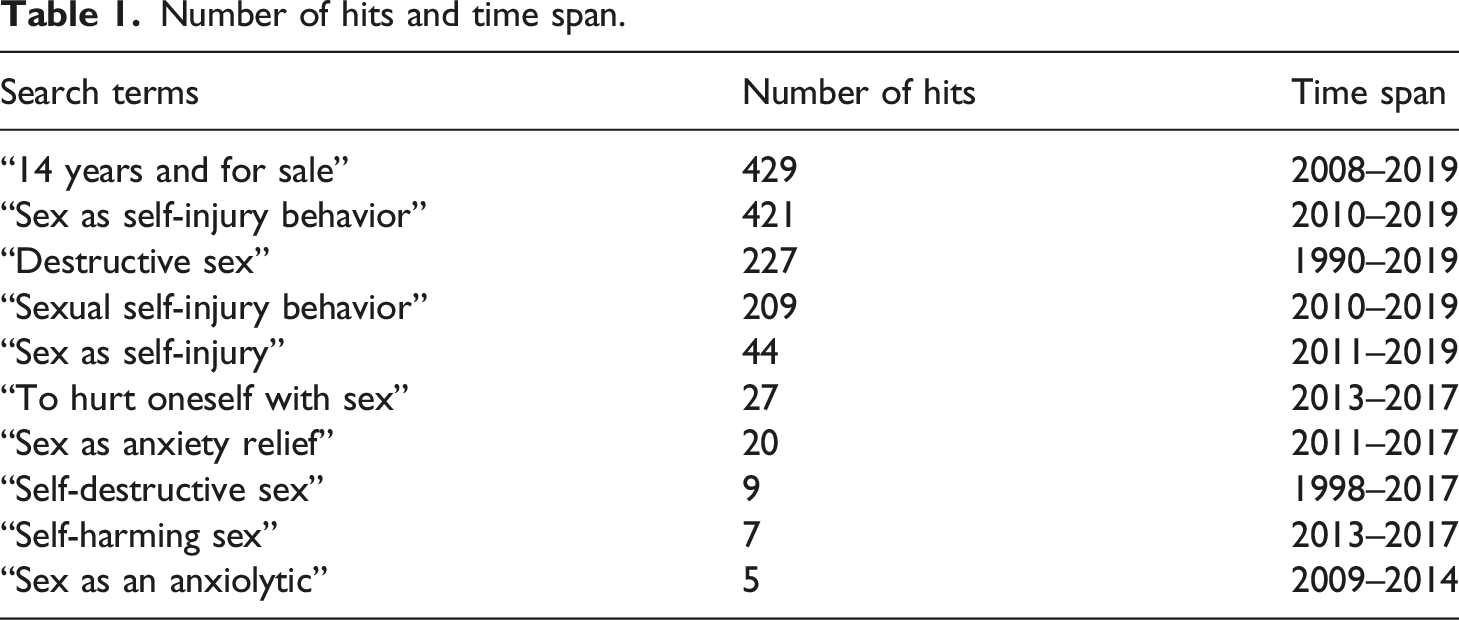
The most common term in Swedish would be translated into “sex as self-injury behavior,” which shows its conceptual closeness to other self-injury behaviors. Yet, in our discussion where one term needs to be used repeatedly, we prefer the shorter “sex as self-injury” since it is also used and readily understood.
In the formation of current social problems, which “sex as self-injury” is claimed to be, the mass media is a primary source (Loseke, 2003). Our choice to study media is thereby grounded in the assumption that many of us have access to and consume media in our daily lives, and that the media are where a significant part of the existing discourse of “sex as self-injury” plays out, which will have an impact on the spreading and establishment of a concept such as “sex as self-injury.” In this empirical material, there are personal stories and opinions that can be perceived as sensitive, but as it is public material, everyone has given their permission for it to be published. This paper does not aim to diminish any personal experiences, nor to put on the spot those who tell their personal stories in line with the newly established concept or to argue that they can be held responsible for the discursive construction of “sex as self-injury.”
Discourse analysis
Discourse analyses are a collection of methods and theories that are being used for exploring how language is applied and constructed in social contexts through the study of speech and text (Wetherell et al., 2001). Discourse analysis of sexuality-related issues often builds on Michel Foucault’s analysis of human sexuality as socially and culturally constructed, and focuses on the interconnected triad of power, knowledge, and discourse. The aim is not to search for the “truth” or the origin of a discourse, but to map out how power is being distributed and generated in the production of discourses and knowledges (Carabine, 2001). In this study, we have been inspired by Jean Carabine’s chapter “Guide to doing Foucauldian genealogical discourse analysis” (2001). We analyzed the data in line with her guidelines, which include select the topic, get to know the data, identify themes, explore inter-relationships between discourses, identify discursive strategies, explore resistances and counter-discourses, identify effects, and consider the limitations of the method. All empirical data were organized into a table identifying the search term that gave us the specific hit, terms for “sex as self-injury” occurring in the data, the claims-makers, the content, and reoccurring themes. The following themes were identified in the process: selling sex, reasons for allegedly hurting oneself with sex, effects/causes of using “sex as self-injury,” addiction and/or dysfunction, victims, perpetrators, internet, sexual behavior/practices, self-injury, prevalence, laws and court cases, and questioning of the discourse of “sex as self-injury.”
A challenge in discourse analysis is the fact that, as a researcher, one is embedded in the discourses one identifies and analyzes (Carabine, 2001). To create a distance to the empirical material and our own preconceptions, we were inspired by theoretical discussions such as Gayle Rubin’s work on a sex hierarchy, the discussion about concept creep in diagnosis systems, and research on folk-diagnostic concepts in association with sex.
What is “sex as self-injury”?
Tessan’s case became the epitome of “sex as self-injury,” through the re-telling of the book 14 years and for sale in the media, and also through published interviews with Tessan herself. By this time, in the beginning of the discursive construction of ‘sex as self-injury’ in 2008, the behavior was classified as “selling sex.” The transition from a somewhat limited discourse about selling sex to a broadening into one about “sex as self-injury” happened almost immediately, but appeared most clearly at the turn of the year 2009/2010. In a radio program in April 2010, several of the terms describing the phenomenon were displayed: “self-destructive sex,” “sex as self-injury behavior,” and “destructive sex” (Gunnarsson, 2010).
The lack of a clear definition of what “sex as self-injury” is has an effect on how it is being presented in the media, in that the descriptions are not consistent. The common denominator is that they all portray “risky” sexual behaviors. One of the few researchers to have studied “sex as self-injury,” medical researcher Cecilia Fredlund, commented on whether it is a new phenomenon or just a new way of categorizing sexual behaviors in a radio interview in 2019: I would say that it is a new way of looking at it. Thus, we talk about sex as self-injury here in Sweden since a couple of years. I have just been in San Diego, at a conference there and in the rest of the world, they do not look at this as a type of self-injury; they see it more as sexual risk-taking, but when I look at the stories that I collected through my studies, then I have people from 15 up to 64 years old [thinking back to their youth], and they describe the same type of behavior, irrespective of their age. If you are 64 or 15, it is the same thing that you expose yourself to. So, it is not something new, it is more how we look at it (Näslund, 2019).
The above excerpt supports the assertion that ‘sex as self-injury’ is a new way of categorizing what previously would be referred to as sexual risk-taking. The emergence of “sex as self-injury” can be seen as an example of what Donileen Loseke (2003) has called “domain expansion,” which refers to the expansion of a social problem, which “sex as self-injury” is claimed to be. Examples of risky sexual behaviors that are displayed as “sex as self-injury” in the media include having sex against one’s will (Nordström, 2014; Sveriges Radio, 2016), or putting oneself in violent and/or degrading sexual situations (e.g., Lowden, 2019; Näslund, 2019; Themner, 2019). The reasons for this can be past sexual abuse, a trauma that one is trying to process by re-experiencing the rape (e.g., Herkel, 2012; Weigl, 2008; Zakai, 2008). The sexual behavior among those supposedly having sex as self-injury is defined in our empirical material through metaphors referring to their previous experiences: the behavior is described as “letting themselves get raped” (ETC, 2011), by “going to their own rapes” (Richter, 2013) and “seeking new perpetrators” (Sjöström, 2012a: 8), or that those who hurt themselves with sex are “raping themselves” (Sjöström, 2012b: 10). The quotes contain inherent contradictions regarding agency, as they suggest that someone can choose to be raped; but if a person chooses to have sex without really wanting to, is it reasonable to call it “rape”? In this case, it is of importance to be aware of the difference between giving consent to a sexual act and wanting sex. Even though the degree of desire for sex could influence the decision of consenting to sex, there can still be an incongruence between the two: consenting to and wanting sex (Holmström et al., 2020; Muehlenhard and Peterson, 2005). In Sweden, a new law from 1 July 2018 criminalizes sex without consent: sex should always be voluntary, otherwise it is illegal (Ministry of Justice, 2018). This raises the question whether someone who allegedly uses sex as self-injury could—in legal terms—consent to sex, as this law disallows consent given by a person who is threatened, suffers from a mental disorder or is in a situation of dependence. The working definition of “sex as self-injury” as a diagnostic concept questions the authenticity of voluntariness and the validity of consent in situations characterized by this “disorder.” The quotes above also reveal a form of victim-blaming. This can be paralleled to how victims of sexual assault have been perceived throughout history, and reflect our society’s power distribution between men and women. Sex is described as something damaged, due to traumatic experiences, for those who purportedly self-harm with sex. Ida: I wanted to hurt myself, and the best way to hurt myself that I could think of was through sex. Because that was really the worst thing I knew. So, then I kept on having sex to hurt myself. Because I felt that I just wanted to die. I felt that I came very close to death by hurting myself with sex. Katarina: How? Ida: Because my perception of sex was totally ruined. Sex was something horrible. And it reminded me of the rapes (Gunnarsson, 2011).
Other reasons for allegedly having sex to self-harm appearing in the media include need for attention, feelings of shame and guilt, anxiety, and a need to re-gain power and control. Within the media discourse, those who purportedly use sex to self-harm are being portrayed as victims, whereas those who have sex with them are depicted as perpetrators. These victims have in common that they are young, most of them are children or teenagers, but some are young adults. The majority are girls, but the media still focus on pointing out that also boys sell sex and supposedly injure themselves with sex, even though only two boys are presented in our data. There seems to be no obvious risk group beside that being a teenager is seen as a risk factor: “‘It is not that hard to get into this situation as one might think, all teenagers feel bad now and then,’ says Anette Birgersson, who works with sexual self-injury behavior in adolescents” (Isberg, 2012).
The teenagers who are portrayed as sexually self-destructive in the media are described as sensitive individuals with impaired mental health; the discourse thereby continues to display those who purportedly injure themselves with sex as individuals without sexual agency. The fragility is presented as an effect of being in puberty and thus in the middle of exploring sexuality. In connection to a court case, the question of “sex as self-injury” was raised as it involved a couple of girls who had fallen victim to a group of men by selling sex to them. The case was described as a “group sex tangle” in the media: In addition to securing of evidence, the police officers have struggled with trying to understand what has driven the girls to – one by one – make contact with the men on the internet. Carlenfors’s [the criminal inspector] conclusion is that many of them have been in a delicate phase in their lives, which has made them vulnerable to invites from unknowns. “They have been curious and posted their profiles on the internet and answered chat posts and emails. But then they have lost control and it has gone overboard,” she says […] Another girl of the same age describes how she became “destructively” addicted to constantly make new sex contacts – despite that she did not want to (Bodin and Wierup, 2009).
In Sweden, the age of majority is 18 while the age for sexual consent is 15 years. In our empirical material, children over 15 years are seen as especially vulnerable when allegedly using sex as self-injury as they are unprotected by legislation (e.g., Bering, 2012; Engvall, 2011a; Rung, 2016). The exception is when there are financial transactions involved such as in the case described above, as sex purchase is criminalized in Sweden. The perpetrators portrayed in the media are all men, described as violent; and, as the victim and the perpetrator always get in contact through the internet, they are strangers at first. The internet is portrayed as a dangerous arena, as well as a parallel universe where one can at will be anonymous and remain hidden. According to how the phenomenon is described in the media, there seems to exist widespread risk-taking on the internet among the group of young people who are said to self-injure with sex.
Sexual deviance
“Sex as self-injury” is portrayed as an addiction, with media using language typically associated with substance abuse. Words such as “compulsion,” “drug,” and “self-medication” are frequent. Even the word “relapse” appears in connection to allegedly selling sex as a form of self-injury (Rosén, 2009; Zakai, 2008). Despite media using a language with analogies to addiction, the author of 14 years and for sale, Caroline Engvall insists there is a clear difference between “sex as self-injury” and “sex addiction,” arguing that sex addiction is driven by lust, whereas “sex as self-harm” is only about hurting oneself (Herkel, 2012). This would imply that someone purportedly having sex as self-injury does not experience sexual pleasure. Instead, sex would resemble some kind of punishment, described thus in analogy with the discourse on other self-injury behaviors (e.g., Gunne, 2010; Isberg, 2012; Näslund, 2019).
Categorizing the behaviors as a form of self-injury means comparing sex with cutting, eating disorders, and other self-harm. When the doctor and medical researcher Cecilia Fredlund raises the importance of perceiving what is alleged to be self-destructive sex as a form of “self-injury,” rather than just a risk behavior, she highlights the possibility of thereby offering the “right treatment” (Themner, 2019). It is being portrayed in the media as if those who supposedly self-harm with sex want to feel pain or transfer the mental pain from within their soul into physical pain. Ms Engvall re-tells a letter that she received from a girl describing “sex as self-injury” like this: She does not want to have sex with these men, she just lets them. She describes it as: it is not her that they have sex with, it is her body. And for many of these young people, it turns into an addiction. They go to these encounters with adults, because in that moment, when they have sex with them, it actually feels good. They compare it with cutting, like when you press the razorblade against the arm and the blood begins to flow, the anxiety is gone. But afterwards, it is a thousand times worse (Sveriges Radio, 2012).
The differences between “sex as self-injury” and other self-harming behaviors that are raised by the media are that when one purportedly has sex as self-injury, one leaves the control to someone else, and that sex is an invisible type of self-injury. Those who assert that “sex as self-injury” is different from other self-injury behaviors claim that it is actually someone else hurting the victim; the victim just lets them, which again can be related to the victim-blaming within the discourse. In our empirical material, sex is even being described as a “beneficial” self-injury in comparison to cutting oneself, as it does not leave any visible marks.
One definition of “sex as self-injury” that appears repeatedly in the media, as well as in the scientific research about the phenomenon, is a definition that the psychologist and psychotherapist Åsa Landberg has developed, which has obvious similarities with diagnoses of sexual dysfunctions in both ICD and DSM: To hurt oneself with sex means that a person has a pattern of seeking sexual situations involving mental or physical harm to themselves. The behavior causes significant distress or impairment in school, work, or other important areas (Bering, 2012).
When it comes to Landberg’s description of “sex as self-injury,” the authors of the book Unga som skadar sig med sex [Young people who hurt themselves with sex] (Jonsson & Mattsson, 2012) defend the definition because it excludes young people who experiment with sex and are driven by lust, while it includes those whose main purpose is to involve themselves in violent and degrading sexual situations (Karell, 2013). The question that arises then is whether young people who practice BDSM (Bondage, Discipline/Dominance, Submission/Sadism/Sadomasochism, Masochism) are thereby at risk of being understood as using “sex as self-injury,” as BDSM can involve sexual practices based on violence and humiliation. According to research, most BDSM practitioners would claim that BDSM does not fall within the definition, since these activities do not lead to significant distress or impairment but are to be categorized as a (positive) lifestyle choice (Carlström, 2019; Lin, 2017).
By perceiving “sex as self-injury” as a pathological condition, BDSM practitioners risk being regarded as victims of a “real pathology” of sexual dysfunction, as those identifying as submissive request someone else to inflict pain and/or degrade them as part of the practice. In contrast, from the perspective inherent in Gayle Rubin’s sex hierarchy (1984, 2011), the desire to receive pain or be degraded during BDSM play would be interpreted as an expression of sexual agency and choice. Thus, it can be viewed as a pathology only within a moralizing hierarchical discourse. The view of this practice has been inconsistent throughout history: sadomasochism was classified as a psychiatric diagnosis until 2009 in the Swedish version of ICD-10 (Carlström, 2019) and, at the international level, the diagnosis code of masochism is only now being eliminated as it has been removed from ICD-11 (Reed et al., 2019).
The outskirts of the circle
BDSM, as well as other sexual practices and relationships that are located on the outskirts of the charmed circle within Gayle Rubin’s sex hierarchy (1984, 2011), are in the media portrayed as a potential way of practicing what is alleged to be “sex as self-injury.” Caroline Engvall claims that “it is not about criminalizing a sexual orientation in this case BDSM sex (bondage, discipline and sadomasochism) – but about understanding that sex, even in violent forms, can be used as a way of harming oneself” (Zaccheus, 2011). Ms Engvall comments on a case that is recurring in the empirical material: On Wednesday, the verdict falls in a high-profile violent sex case in Malmö Court of Appeal. On the one hand a (then) 16-year-old girl who signed a slave contract and – on the surface completely voluntarily – allowed herself to be whipped and locked up naked in a dog cage for two days. On the other hand, a man almost double in age with orientation for BDSM-sex (bondage, discipline and sadomasochism) who argues that he can not take responsibility for others’ self-harming behaviors (Engvall, 2011b).
This case, and the media discussions that followed it, demonstrates the sometimes blurred lines between BDSM practices and what is portrayed as “sex as self-injury.”
Other than BDSM, the sexual practices that appear in connection to descriptions of “sex as self-injury” in the media are sex in groups (occasionally named “gangbangs”) and sexual activities involving manufactured objects. The detailed descriptions of what the media define as violent sexual practices, including the use of sex toys, appear mostly in connection to the media reporting on court cases. Another salient theme in those cases concerns sexual exposure. In a court case involving a group of men who had bought sex from young girls, one of the victims explained how she used to expose herself: “I sat online, porn websites here, porn websites there, I posted profiles online and showed myself on the webcam” (Bodin and Wierup, 2009). The sexual experimentation involving sharing naked pictures and having conversations of a sexual nature on the internet is portrayed, in our empirical material, as risky and as a gateway to young people being lured into having sex for money. That implies that prostitution is categorized as a form of self-harm or, rather, as a way to practice “sex as self-injury.” The exchange of money in connection to sex is portrayed as something filthy and the lowest of all forms of degradation: “to be bought by someone else is the ultimate self-injury; I cannot sink any lower than letting someone else use me as a commodity” (Svenberg, 2013). Such reasoning mirrors how society, according to research, tends to degrade sexuality expressed by women in prostitution and pornography by underscoring their vulnerability and risk of harm. While women are described as having their sexual agency restricted in our male dominated society, Carline (2011) has pointed out, discourses that are critical of prostitution and pornography actually promote dominant norms regarding female sexual behavior and, as a consequence, a certain morality of sexual interactions is endorsed.
One aspect that places “sex as self-injury” closer to the charmed circle is that the sexual relationships are almost exclusively heterosexual (sex between girls and men). The two times boys appear in the media as supposedly having sex to self-harm, they portray homosexual relationships. Most of the sexual relationships portrayed as having to do with “sex as self-injury” are between people from different generations, and this is the case also for the two boys appearing in the empirical material. Rubin (1984, 2011) describes sexual acts and/or relationships crossing generational boundaries as the most deviant form of eroticism. When it comes to reporting on court cases, the differences in age between the partners are framed as of importance both legally and socially. The age of the men is described as an ingredient of the self-harming behavior: “The negative spiral goes as far as making the young girls seek ever older and more violent men online” (Svensson, 2012). Thus, sex with older men is described as a contamination that only finding love with someone your own age can free you from (Olsson, 2017). The young girls (or boys) with less sexual agency are consequently the ones being cast as deviant and thus pathologized, rather than the old men seeking out children and/or teenagers as sexual partners on the internet. The victim-blaming within the “sex as self-injury” discourse pathologizes those who can be seen as victimized rather those who sexually victimize others. The assumption of lack of consent where this may not be the case, is also highly present within the discourse as moral judgments are made on sexual relationships with age differences and a built-in imbalance of power by assuming that they are non-consensual. Thus, an apparent paradox in the discourse is the focus on agency (“a pattern of seeking sexual situations...” in the working definition of a diagnosis) in situations where this agency may be curtailed, while concurrently denying agency on the part of those who willingly enter into unconventional sexual relationships and situations.
In our empirical material, young people who are said to use “sex as self-injury” are described as promiscuous as they have sex with many men, and they often portray themselves as objects rather than sexual beings. For example, they can describe themselves as “the funny whore” (Gunne, 2010), “a doll” (Näslund, 2019), or “boy toy,” as if made of plastic and without emotions (Gunnarsson, 2011). Within the media discourse, having sex with many strangers as a form of self-injury is pictured as a disorder that one needs to be declared healthy from in order to find, what Rubin (1984, 2011) refers to as the “true and blessed” sexuality within a monogamous, loving relationship. Anette, a woman who is alleged to have previously hurt herself with sex, describes it like this: “I feel really good. I have a boyfriend. Love. Now I have found the good things with sex. Like it should be and should have been the first time” (Danielsson, 2009). Another example is a woman who refers to her previous self-harming behavior as having to “suffocate the impulse of going to the pub and pick up [men] if [she] felt sad or angry” (Passanisi, 2013: 22). These two quotes exemplify how the “sex as self-injury” discourse favors sexuality in line with Rubin’s sex hierarchy (1984, 2011).
The claims-makers
The claims-makers within this media discourse consist of self-proclaimed experts, who claim the existence of “sex as self-injury” starting from subjective and/or objective interests. Subjective interests relate to someone’s personal history, and how they may boost their experiences to claim their relevance in the construction of a social problem. Objective interests build on personal benefits (for example, economical profit) for claims-making (Loseke, 2003). Appearing most frequently is author and journalist Caroline Engvall, who is treated as an expert on “sex as self-injury” with compassion to listen and help: “Caroline Engvall has become a kind of confessant parent” (Gunnarsson, 2011). Many personal stories of those claiming to have (had) sex as self-injury present themselves in connection to appearances by Ms Engvall. Personal stories are, in themselves, powerful tools for claims-making (Loseke, 2003). When the stories are presented as “true” (Metro, 2008) in the media, the phenomenon is even more difficult to question, as someone’s subjective truth is always to be respected, and such a truth claim renders the stories a function of having an enlightening role to play. Statements are made by organizations and other agencies, both private and state, that encounter young people who allegedly hurt themselves with sex, and these statements corroborate the burgeoning discourse. These claims-makers, mainly being Ms Engvall, girl shelters and other agencies targeting people with experiences of sexual violence or selling sex, focus on personal stories to substantiate the discourse and portray “sex as self-injury” as an expanding social problem by describing it as “an epidemic” (Engvall, 2010) and claiming that “there is a war going on out there” (Gunne, 2010). The eruption of personal stories appearing after media started to discuss “sex as self-injury” is illustrated by this description by Ms Engvall: “It was like turning on a tap” (Herkel, 2012). This is all in line with Donileen Loseke’s (2003) assertion that a phenomenon must be widespread in order to qualify as a “social problem” requiring attention and action.
Researchers are at the top of the hierarchy of credibility, when it comes to claims-making (Loseke, 2003). By using words such as “education” and “research” (Sjöström, 2012b: 10), Ms Engvall and the politician appearing in one particular article try to increase their authority and the credibility of the arguments presented. It is important to take into consideration that when this particular article was published in 2012, there was no scientific research done on “sex as self-injury.” Researchers from Linköping University expressed themselves frequently in the media; social worker Linda Jonsson appeared in the media and talked about the phenomenon as early as in 2008, leaning on research on commercial sex and young people’s sexual behavior on the internet (Antonson, 2008). In 2012, informational materials about “sex as self-injury” started to appear as Stiftelsen Allmänna Barnhuset [The Foundation General Orphanage] 2 and the association Stockholms Tjejjour [Stockholm’s Girl Shelter] 3 created compilations of interviews with young people and professionals. Notably, it was not until 2019 that claims did refer to actual scientific research in the form of a doctoral dissertation.
In a specific stream of the media discourse, there are those questioning “sex as self-injury,” not as a phenomenon but as a concept. These claims-makers can be defined as (feminist) activists who declare that the introduction of a concept of “sex as self-injury” imposes responsibility upon the victims instead of the perpetrators. They claim that “sex as self-injury” is only another way of depicting sexual abuse, as it is about men hurting girls and boys by having violent sex with them (Kärnekull Wolfe, 2019; Näslund, 2019). According to this view, what is now categorized as “sex as self-injury” ought not to be seen as a disorder of individuals but as a detrimental effect of our patriarchal society (Kristjansdottir, 2016).
Non-normative sexual behavior and a nascent diagnostic concept
The discourse of “sex as self-injury,” we contend, reproduces the division between “the good” and “the bad” sexual practices and relationships outlined by Gayle Rubin’s sex hierarchy (1984, 2011). The “sex as self-injury” discourse in Sweden grew out of existing discourses about self-injury behaviors and there is no discussion within the discourse about the risk of condemning non-normative sexualities. It is the abnormal, unnatural, and damned sexualities that are depicted as self-destructive sex, while the normal, natural, and blessed sexualities are those that ought to be sought by those who are said to use sex to hurt themselves. It is when the one who has used “sex to self-harm” finds the monogamous coupledom within a love relationship (preferably with someone of roughly the same age) that the person can be declared healthy and begin to have the right form of sex for the right reasons. The pathologizing discourse in the empirical material suggests that when those who claim to self-injure themselves with sex have gone into therapy, making it possible for them to be declared healthy, they are expected to practice sex and relationships in accordance with the norms. The pathologizing of practices known now as “sex as self-injury” legitimizes the moralization of them, and brands these practices as a sexual deviation.
The media have obviously had an extensive role in establishing and developing the discourse of “sex as self-injury,” and as with “sex addiction” and “porn addiction,” “sex as self-injury” is presented as a sexual dysfunction, which means that the discourse risks contributing to misleading notions that a formal diagnosis exists. Furthermore, a discourse such as this one reinforces views that certain behaviors are sexually deviant. This process unfolds despite the lack of solid scientific underpinning of an idea such as “sex as self-injury.”
The claims-makers behind the “sex-as-self-injury” discourse in Sweden use language associated with addiction and try to establish definitions of the phenomenon connected to diagnoses of sexual dysfunction. This supports our supposition that “sex as self-injury” will eventually enter the international arena as a suggested diagnostic category of sexual dysfunction. Also, the phenomenon is categorized as a self-injury behavior: this out of some similarities between non-suicidal self-injury (NSSI) and what researchers claim to be “sex as self-injury” (SASI) (Fredlund, 2019; Fredlund et al., 2017, 2020; Jonsson et al., 2019; Zetterqvist et al., 2018); for example, both groups are said to experience anxiety (Zetterqvist et al., 2018) and there are similarities in the ostensible functions of the behaviors, such as emotional regulation of bad feelings, self-punishment, and attention seeking (Jonsson et al., 2019). A possible outcome of claims-making may be an inclusion of the concept within the diagnostic code for non-suicidal self-injury. 4 Whether the concept would in the future be categorized as a sexual dysfunction or as a variant of non-suicidal self-injury, the same problematic effects regarding stigmatization of non-normative sexualities will be the result. One can also expect that a notion such as “sex as self-injury” among teenagers would be received and framed in even more alarmist terms in countries with a higher age of consent than Sweden’s 15 years.
The studies on “sex as self-injury” were published years after that the phenomenon had been established within the general discourse in Sweden, from 2017 and forward (Fredlund, 2019; Fredlund et al., 2017, 2020; Jonsson et al., 2019; Zetterqvist et al., 2018). Consequently, there is an obvious risk that the participants in these studies were influenced and affected by an already existing media discourse. Remarkably, this is not discussed as a limitation in any of the research publications. However, the few studies examining “sex as self-injury” all raise the point that there is a lack of conceptualization of the phenomenon (Fredlund et al., 2017; Fredlund et al., 2020; Jonsson et al., 2019; Zetterqvist et al., 2018) and that this, in turn, can have had a negative impact on the validity (Fredlund, 2019). The absence of a scientifically grounded definition affects the conclusions that can be drawn by the results, as there is uncertainty about what it really is the participants respond to when they confirm that they are supposedly harming themselves with sex. Also, none of the participants in Fredlund et al.’s (2017) study and only two thirds of the participants in Fredlund’s (2019) doctoral dissertation were given the opportunity to define “sex as self-injury” themselves, and this would arguably limit the researchers’ ability to draw any valid conclusions.
The media discourse on “sex as self-injury” thus emerged before any research about it had been conducted, and this media discourse formed the research that was conducted after the phenomenon had become part of the public discourse in Sweden. Fredlund’s (2019) thesis, covering both new and earlier studies, is an example of how the questions given to the participants were directly connected to the discourse in the media. For example, the participants in Fredlund (2019) were asked about the gender and age of the people they usually had sex with to allegedly self-harm—two central ingredients of the media discourse. Several of the reasons to use “sex as self-injury” mentioned in the media also appeared in the dissertation, such as if the participants supposedly used “sex as self-injury” to gain control, to punish themselves, or to get attention from those they had sex with. As a result, the doctoral thesis only confirmed what the media discourse on “sex as self-injury” already had outlined.
According to the media discourse on “sex as self-injury” and the limited research on it in Sweden, different experiences of trauma lead to anxiety, which may drive some young people to purportedly have self-harming sex: the anxiety is managed by having sex with others they do not really want to have sex with and by practicing sex they do not find pleasuring. However, this framing builds on the assumption that there are sexual practices that per definition should be unpleasurable and sex partners that are inappropriate. Prevalent discourses about normative sexualities have an impact on the understanding of one’s own sexuality: the sexual norms in “the charmed circle” encourage us not to enjoy or to avoid sexual practices and relationships represented at “the outer limits.” When there is a profound public discourse about “sex as self-injury,” subjective sexual experiences may be interpreted in line with the features of this discourse. People who self-identify in accordance with this notion will seek out others with similar experiences and a collective identity may emerge: that of self-injurers through sex.
Conclusions
In summary, “sex as self-injury” is a new concept for categorizing sexual behavior that previously would be described as sexual risk-taking, and our analysis of media material shows that it is the allegedly deviant sexual practices and relationships that are portrayed as self-destructive, and thereby pathologized. It is those who are perceived as lacking sexual agency that are interpreted as victims of “sex as self-injury,” such as young people, especially female. This while concurrently they are ascribed agency through the very construction of “sex as self-injury” as a distinctive phenomenon: in presumptive definitions, the individual’s drive to seek out harmful sexual situations is at the core of the conceptual construct. The personal stories, reports on court cases, and professionals’ talk about “sex as self-injury” in media correspond to the normative ideas on sexuality as described in Gayle Rubin’s “sex hierarchy” (1984, 2011). Sex is purportedly used as self-injury by young people—mostly girls—having sex with men from an older generation to reduce anxiety. Since having violent sex with a lot of older men for money is framed as an “addiction,” practices that are understood as deviant sexual behavior become classified within a frame of pathology. The route to this pathological/immoral endpoint often starts with sharing naked pictures online. The sexual practices are portrayed as violent and degrading, as the person said to use sex to self-harm is having sex that she does not want to have with allegedly non-self-selected sexual partners. This part of the discourse of “sex as self-injury” can be related to what Rubin (1984, 2011) calls the “brainwash theory,” in which erotic diversity is explained in terms of some sexual acts being labeled as disgusting and thus only performed if one is forced or deceived. The media discourse of “sex as self-injury” declares that having self-destructive sex impedes someone from experiencing sexual pleasure, and portrays these situations as results of a curable disorder of the individual.
In this paper, we do not take a position on whether sex as self-injury “exists” or not, but analyze the discourse that has emerged. Future research should look into the social and psychological effects of establishing a concept such as “sex as self-injury.” The Swedish media discourse about the phenomenon constitutes a normative perspective on sexual practices and relationships, and it is important to follow up on the consequences of bolstering the division between what is perceived as normal and healthy versus sick and unnatural sexuality. When the media display “sex as self-harm” as being similar to other self-injury behaviors and dysfunctions, we can see the potential of concept creep: sooner or later, “sex as self-injury” will likely be suggested as a sexual dysfunction category at the international level. In some contexts, wherein such a diagnosis category would activate criticisms of the blaming-the-victim framework, the suggestion would not be appreciated. 5 Competing claims surrounding this notion of “sex as self-harm” would thus balance between the pros of adopting an easily comprehensible category in line with existing self-harm diagnoses and sex/porn addiction notions, and the cons of establishing a new diagnosis which tends to place the blame on the victim.
Footnotes
Declaration of conflicting interests
The author(s) declared no potential conflicts of interest with respect to the research, authorship, and/or publication of this article.
Funding
The author(s) received no financial support for the research, authorship, and/or publication of this article.
