




Abstract
Although research tends to focus on the sexual and/or erotic aspects of consensual BDSM participation, there are many non-erotic and nonsexual beneficial outcomes arising from participating in BDSM. This research aims to elucidate those other meaningful aspects of BDSM that reach beyond the sexual in order to highlight their salience for BDSM practitioners and to ensure that these non-erotic aspects of BDSM participation are not overlooked. Eleven regular practitioners of consensual BDSM took part in customized in-depth, face to face interviews conducted within an interpretive phenomenological perspective that focused on the lived experiences of consensual BDSM. The template analysis method was used to analyse the data. Findings illustrated that various non-erotic and non-sexual aspects of BDSM are important to practitioners. These elements are necessary and significant to participants’ lived experiences of BDSM and will be discussed in this paper in terms of transformative experiences and demonstrate that BDSM should be studied from a holistic perspective.
Introduction
This article explores practitioners lived experiences of the non-erotic benefits of consensual BDSM. Much of the literature, as well as mainstream understandings, perceive consensual bondage, discipline, dominance and submission, and sadism and masochism (BDSM) as a solely sexual endeavour, meaning that other non-sexual and non-erotic positive outcomes of participation are frequently unnoticed. In this article I will focus on examining the non-erotic outcomes of consensual BDSM participation in order to illuminate benefits of BDSM other than the sexual.
Bondage, discipline, dominance and submission, and sadism and masochism are a collection of embodied activities framed around the erotic exchange of power and the application of intense physical and/or emotional sensations (Turley and Butt, 2015; Barker et al., 2007a, 2007b). Commonly referred to by the acronyms BDSM, SM or the term kink, these activities often place a sexual and/or erotic overlay onto activities that have not commonly been associated with ‘sexual’ behaviour in Western modern positivist accounts such as administering or receiving intense sensations such as pain, restraining or being restrained, and fantasy role play. These activities become eroticised within the context of the BDSM encounter, known as a scene (Yost, 2007). The emergence of a discourse that coded ‘sexuality’ as a natural, normative, and procreative interaction between heteronormative bodies led to the parallel construction of BDSM as an unnatural perversion (Beckmann, 2009; Foucault, 1978). BDSM scenes can take a variety of forms only limited by the imagination and fantasies of those involved (Turley et al., 2018). Although BDSM, SM, and kink (amongst a proliferation of other terms) can be understood as having different subcultures and practices, the term BDSM will be used throughout this article as these terms are frequently used interchangeably by both, practitioners themselves as well as within the existing academic literature. It should be acknowledged that the linguistic nominatives commonly used are not unproblematic, the terms sadism and masochism in particular are associated with negative stereotypes that reflect the stigmatizing agenda of the medical and psychiatric models (Faccio et al., 2020). This reflects Foucault’s (1978) notion of the deployment of sexuality; using perceived ‘expert’ discourses to define perversion and deviance and therefore constructs the non-normative, which excludes the heteronormative sphere from investigation and critical reflection (Beckmann, 2009). Given that BDSM is a commonly adopted acronym by practitioners, it is an appropriate descriptive term to use in this paper and is the term I will use throughout.
Historical background to the pathologization of BDSM
BDSM can be classed as a stigmatized identity and more generally as a stigmatized subculture arising from misunderstandings around issues of consent, the activities or practices that occur during a scene, and notions of psychiatric disorder or psychological damage. The semi criminalisation and legal confusion around consensual BDSM also contributes to this stigmatization (Beckmann, 2009; Weait, 2007). Goffman (1963) understood stigma as an unwanted difference from the expected and as an attribute that is discrediting to the individual, and by examining BDSM practices in the context of normative sexual practices, these differences described by Goffman are magnified. These common misunderstandings that BDSM is pathological stem from the medicalised perception of sex and sexuality perpetuated the majority of Victorian sexologists.
Sexologist Krafft-Ebing, 1886’s work constructed various non-normative sexual behaviours and activities, including sadism and masochism, as abnormal and this legacy remains influential for the continued and ongoing classification of BDSM as a pathology. These Victorian views of sex and normality and a focus on illness and cure continue to influence much mainstream Western thinking around sexuality for both the lay public and for medics and clinicians (Spinelli, 2006; Kleinplatz and Moser, 2005). Foucault (1978) observed that perverse forms of sexuality are the product of the exercise of power by the ruling classes for the purpose of self-affirmation and contributed to a normalization of human sexuality thus determining what was considered ‘typical’ and what was categorised as ‘pathological’. Specifically, Foucault (1978) highlighted that ‘perversion’ was constructed in relation to its opposite, referred to as ‘procreational heterosexuality’, which is positioned as the ‘ideal’ and the legitimised form of sexuality. Stemming from early sexologists and psychoanalysts to recent incarnations of diagnostic classifications, mainstream medical, psychological, and lay understandings have associated BDSM with sex and with psychiatric illness, dysfunction and pathology. These (mis)understandings have often been reinforced by the media, particularly television and film (Weiss, 2006). Despite a lack of evidence linking BDSM to psychopathology, the practice is still included as a paraphilia in the DSM 5 (Langdridge and Barker, 2007; Williams et al. 2017). Although this pathologization was also once a common theme in academic research, there has been a clear shift towards the publication of non-pathologizing academic work on BDSM over the last 25 or so years beginning with the earlier work of Beckmann (2001), Califia and Sweeny (1996), Golding (1992), and Rubin (1987) and others. This collection, along with more recent work by Carlström (2020a), Cruz (2016), Martin (2020), and Newmahr (2011) have explored a range of issues that challenge the association of BDSM with pathology and have positioned BDSM as a diverse set of unconventional sexual, erotic, spiritual and/or leisurely practices.
Sexual and erotic outcomes of BDSM
Much of the literature investigating BDSM from a non-pathologizing perspective has reported on the sexual and/or the erotic nature of the practice. In the following section of the article I will review the main areas of research that focus on the sexual and erotic outcomes of participating in BDSM.
One of the key signifiers of a BDSM interaction is the erotic exchange of power. Research on EPE, or erotic power exchange, has provided insight into the distinct elements that constitute this aspect of BDSM and foregrounding the ways that power can be constructed as a source of eroticism for BDSM practitioners (Faccio et al., 2020; Langdridge and Butt, 2005), along with an examination of the various ways to begin doing EPE and BDSM with a partner (Califia, 2002). Eroticism more broadly in BDSM has been investigated in terms of the adoption of roles and the creation of scenes, fantasies and the flow of desire (Carlström, 2019; Yost, 2007), and understandings and constructions of successful fantasy creation and maintenance have been explored (Turley et al., 2018; Yost, 2007; Zubriggen and Yost, 2004). Other studies have focused on constructions and meaning making of pleasure (Taylor and Ussher, 2001) and interpretations of BDSM as powerful pleasure (References “Goffman (1963); Brooks, McCluskey, Turley et al., 2015; Hearn and Burr (2008)” are cited in the text but not provided in the reference list. Please provide them in the reference list or delete these citations from the text.). Research examining the sexual activities practitioners of BDSM participate in have examined the types and range of behaviours involves and have reported on the various meanings made by participation in certain activities (Tomassilli et al., 2009; Alison et al., 2001). It is apparent that the sexual and erotic outcomes of taking part in BDSM have been of central importance to researchers in understanding this phenomenon. Given that there are also other outcomes, the following section will provide a justification for the exploration of the non-erotic outcomes of BDSM for participants.
The complexities of understanding the erotic in BDSM
This article argues that by conceptualising BDSM as a purely sexual practice, its nuances and complexities have become distorted and the benefits for participants other than those that are sexual are overlooked. By taking a holistic view rather than only focussing on the sexual, a more nuanced understanding of the pluralities of BDSM can be realized (Turley et al., 2018). This paper, while recognising that BDSM holds a sexual and/or erotic component for many practitioners, will focus on the non-erotic benefits of BDSM participation, and will contribute to the existing literature by elucidating these non-erotic elements and by developing a broader and more complete understanding of consensual BDSM participation. Some of these non-erotic outcomes have been the focus of empirical research (Beckmann, 2007; Golding, 1992), but are often only reported as part of larger findings (see Taylor and Usher, 2001; Turley et al., 2018) whereas this article exclusively examines the non-erotic benefits of BDSM participation.
The relationship between sex and BDSM is not clear (Newmahr, 2010). As reported earlier in this paper, there are clear sexual and erotic elements involved in BDSM for the majority of practitioners, and people enjoy taking part because it offers a transgressive and multifaceted approach to the normative Western ways of doing sex and sexuality (BLINDED, 2016). The phenomenon of BDSM has traditionally been linked exclusively to sexuality (Faccio et al., 2020), and mainstream analyses have often neglected other important, non-erotic outcomes. Much of Beckmann’s work argues that viewing BDSM as solely sexual is reductionist and is an overgeneralization of a complex phenomenon (2001, 2009, 2011). As long as research is overly focused on understanding BDSM as inherently sexual and in relation to normative sexual practices, other beneficial aspects for practitioners are not elucidated.
The complexities between what is considered as sexual and what is considered as erotic apply to studies of BDSM and to sexualities research more broadly. Often the terms are used interchangeably, however, I would argue that these are separate and distinct concepts with different meanings attached to them. BDSM practitioners often have difficulty articulating what is sexual versus what is erotic about their experiences, though most agree that there is a difference between the two. Often practitioners of BDSM draw on popular pseudo-scientific discourses, usually drawn from the media, such as ‘endorphins’ or ‘rush’ to describe their lived experiences of BDSM (BLINDED, 2016). Practitioners often express difficulty in explaining what is and what is not a sexual aspect of BDSM, and have difficulty articulating thoughts and experiences. Jackson (2003) posits that the lexicon to describe sexual pleasure and eroticism is lacking, and therefore linguistic explanations of this particularly marginalized phenomenon can be limited. Existing social structures also do not encourage open dialogue in relation to marginalized sexual cultures and a distinction between the sexual and the erotic (Van Ness et al., 2017) which can exacerbate the lack of clear distinction between the sexual and the erotic. Explanations of these distinctions tend to position the sexual as being physical and logistical, and the erotic as related to the individual and the personal (Van Ness et al., 2017), or that eroticism is a symbolic representation of the self (Hardy, 2000), however drawing on the theoretical perspective on Merleau-Ponty (1962) can illuminate these differences in a more nuanced manner.
Merleau-Ponty’s Phenomenology of Perception (1962) theorises that eroticism exists in life as an atmosphere that can hold many meanings for individuals and that can frame perception of the world. Eroticism is a pre-reflexive comprehension, and the nature of an individual’s relationship with the world enables the discovery of meanings in relation to understandings of sexuality and eroticism, making the body a place of meaning because of this perception. This atmosphere can only be understood by means of lived experience of the world that occurs before intellectual thought (Merleau-Ponty, 1962). The move to understand the nature of sexuality beyond the genital and reproductive functions located the erotic perception as kind of primordial unity between body and mind, linking eroticism to a holistic view of a person (Moya and Lorrain, 2016). Eroticism can act as a contextual field for a particular activity, and in the case of BDSM creating fantasy and scene setting eroticise activities and paraphernalia meaning they become erotically charged but would not be experienced the same way in another context (BLINDED, 2018). This phenomenological explanation of eroticism as a perceptual lens is useful given that many BDSM practitioners find BDSM erotic, yet do not engage in traditional sexual activities, such as genitally penetrative sex during scenes (Langdridge and Butt, 2005a). One example of this can be illustrated by the power dynamic in consensual BDSM play. Though BDSM players are not a homogenous group, for many practitioners the consensual eroticised exchange of power is an important aspect of BDSM (Barker et al., 2007a, 2007b; Langdridge and Butt, 2005b). Power is exchanged through the adoption of various roles which reflect an unequal power dynamic; these are dominant or top, submissive or bottom, and switches who adopt each role at different times and in different scenarios, however it should be noted that this occurs ideally within a negotiated relational level of a relationship and the boundaries of consent and with safety measures in place such as frequent ‘checking in’ with partners (Barker, 2013; Beckmann, 2004). Although this exchange of power is eroticised, it is not always related to the sexual. The psychological element of power exchange is erotic, and it is the implicit understanding that a status shift, of either giving up one’s power or the taking of power from another person, is what infuses a BDSM scene with eroticism even when sexual experiences are absent. (BLINDED, 2018).
The study
Eleven participants living in the UK were interviewed for this study using semi-structured, face to face interviews within an interpretive existential phenomenological framework (Merleau-Ponty, 1962). Interviews were customised to each participant based on earlier communication between me and each interviewee regarding BDSM enjoyment, and were designed to elucidate rich, complex and in-depth data and therefore each interview lasted for between two and a half and 4 hours. Although the sample size appears to be small, this is common when conducting interviews of this depth and complexity within the phenomenological tradition (Giorgi, 2009). The aim of qualitative research and phenomenology more specifically is not to produce generalizable, objective findings, rather it is to explore and to understand participants’ meanings and lived experiences of a phenomenon. Approval for the study was granted by a UK university ethics committee, and complies with the British Psychological Society’s ethical guidelines. The data were anonymised with all identifying information changed, and informed consent for interview extracts to be published in the form of verbatim quotes was obtained from each participant.
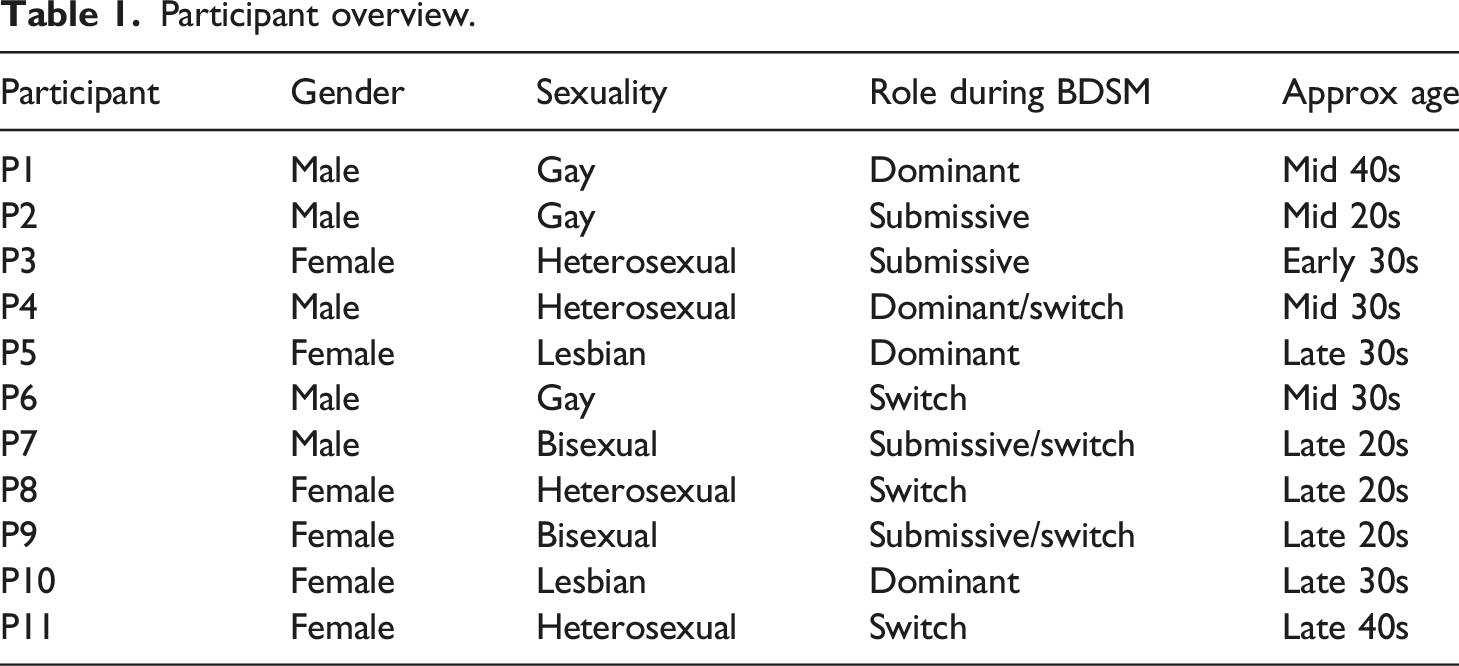
Participant overview.
Data were analysed using the template analysis method (King, 2012) within Merleau-Ponty’s existential interpretive phenomenological framework (1962). Merleau-Ponty’s work foregrounds lived, bodily experience of the world and collapses the dualism of mind-body, body world, and self and other present in many theoretical paradigms. There is no separation of the somatic and the psychic, instead there is a body-subject (Merleau-Ponty, 1962). The concept of the body-subject theorises that bodies give each person a unique perspective in the world and that variation in bodily form, position and location will determine and influence perspective. According to Merleau-Ponty (1962) rather than simply something to be observed, the body is the experiential vehicle by which to navigate the world, therefore the primary experimental vehicle of sexuality and sex is the lived body. This anti-dualist, embodied theoretical perspective is well suited to examinations of the lived experiences of sexuality, sensuality, and eroticism (Ahmed, 2006; Rubin, 1998). Beckmann’s (2009) work adopted an anti-dualistic stance in relation to BDSM and argues that a scene provides space for ‘the (re-) signification of ‘lived bodies’ through ‘bodily practices’’ (p.163). Given that BDSM is an embodied practice, using Merleau-Ponty’s framework in the research enables an in-depth exploration of this phenomenon. The template analysis approach is a flexible method of hierarchically organising the data into themes and subthemes for the purpose of salience (Brooks, McCluskey, Turley et al., 2015). All 11 interview transcripts were coded to produce an initial template of the analysis, the initial template was then modified iteratively by applying it to each interview transcript and attaching new themes to portions of text and/or modifying existing themes to include the new themes. A final analytical template was then produced which provided a complete analysis of the data, with no data remaining uncoded (King and Brooks, 2017). The following section of the paper will detail the analytical findings of the study and provide a contextual discussion of these findings in terms of the non-erotic outcomes of BDSM participation.
Findings and discussion: Non-erotic outcomes of BDSM participation
The participants foregrounded various transformational elements as the most significant non-erotic factors in their BDSM experiences, therefore the findings section will primarily focus on the salient experiential elements of spiritual and transcendent states of consciousness. Many of the participants in the study however also described other non-erotic outcomes as being important therefore the findings related to these aspects will be presented as discussed with reference to self-discovery, and therapeutic and cathartic benefits.
Transformational elements of BDSM
Spiritual and transcendent states of consciousness
The participants in the study described being able to explore themselves through BDSM, in ways that reached beyond the sexual and the erotic and reported spiritual or transcendent benefits. Like many of the participants, P10 reported a shift in her state of consciousness during scenes where she was assuming the submissive role, which only happens during participation in BDSM, ‘When everything’s going really well, I just kind of move…I kind of go into another place, mentally and physically, it’s a place of deep relaxation and almost…it’s hard to explain…pureness or complete purity. It never happens at any other time and it just feels lovely when everything moves to the background.’
P4 also described a change to his psychological state when he is deeply involved in domination, illustrating that although the lived experiences in the top and bottom roles are fundamentally different, commonalities exist between them in terms of a shared psychological and perceptual shift that is only made possible through BDSM. I get into a rhythm, of whatever it is, you know and…it think it’s because it is a sense of deep focus on what I’m doing that I become like a stone almost, I feel solid, like mentally nothing can penetrate me or affect me or get at me. I feel full up with power and satisfaction, and I find that really…peaceful.’
Only one participant reported adhering to any religion during the interview, though this was a relatively important aspect of her life. P11 described how submitting during her BDSM experiences could leave her feeling a sense of calmness and serenity that she sometimes felt when at church. ‘I’ve said to hubby before, that sometimes it’s like when we’re at church and it’s a lovely day and everyone is there and everyone is singing and I’m enjoying the hymns, I sometimes feel then a whole sense of calm just coming over me. I get that with BDSM too, though it’s not the same exactly but a feeling that everything is ok, everything is right’
These findings are supported by Taylor and Ussher’s (2001) discourse of ‘SM as transcendence’, where BDSM is experienced in terms of a spiritual and mystical experience. Beckmann (2001, 2009) also reported that BDSM can function as a form of spiritual practice that allows for the occurrence of transcendental experiences such as those experienced by these participants, Hearn and Burr (2008) concur, highlighting that religious uses of pain and discipline, such as Christian flagellation, aim to induce a state of ecstasy. Carlström (2020a) also draws direct parallels between BDSM and Christianity, reporting that participants drew on discourses of being in another person’s hands and the meaning-giving experiences of BDSM and describing their experiences in terms of spiritual practice. The ritualistic aspects of BDSM can be used to move participants to another state of consciousness and the application of intense sensations, such as pain, enable them to reach these altered states during a BDSM scene (Bake, 2018; Turner, 2008). This transition from one state of consciousness to another allows entry into a liminal space (Van Gennep, 1960) and enables practitioners to reach transcendent states within BDSM scenes (Carlström, 2020b). Participants described attaining a new psychological, emotional and physical level beyond their usual, daily expectations and perceived limitations in order to achieve a sense of peace and wellbeing, which often lasted beyond the scene itself. This is supported by Fennell’s (2018) work on BDSM and Paganism which found that mystical experiences occurring during BDSM play and outside of the ‘real world’ enabled a radical self-actualization which was not possible to attain in everyday reality (Thompson, 1991). Sagarin et al., (2015) comment that practitioners responses to extreme rituals in BDSM reflect those that occur in other extreme physical rituals such as body piercing and fire walking for the purpose of facilitating an escape from self. I would argue that an assumed desire for escape from oneself is perhaps a rather pathological explanation, instead I suggest that these rituals act as a tool to facilitate the entering of the liminal space needed to achieve transformation to a transcendent state of consciousness.
Although the participants did not explicitly use the terms ‘subspace’ and ‘topspace’, where BDSM participation produces a type of transcended consciousness (Miller and Devon, 2003), it is evident that their experiences during BDSM can be conceptualized in this way. On entering the state known as ‘topspace’, dominant and top participants experience an intense sense of focus and clarity that can be associated with a feeling of high energy, flow and becoming ‘other’ in some way (Bake, 2018; Newmahr, 2010). On entering ‘subspace’ submissive or bottom participants experience a unique, deeply subjective altered state of consciousness which shifts their psychological experience to a relaxed state. Those in subspace also experience flow which emanates from the intense sensations, rhythms and the concentrated focus on endurance (Ambler et al., 2017; Newmahr, 2010).
Klement et al. (2017) likened the effects of these alternative states of consciousness, such as euphoric feelings and feelings of connection to a higher power, to an array of religious experiences. Westerfelhaus (2007) concurs, highlighting the transformative effect of BDSM to turn individual fantasy into a sense of collective euphoria. Interestingly both Beckmann’s (2009) and Fennell’s (2018) ethnographic studies, BDSM was described in terms of satisfying a need for profound spiritual experience and self-actualization without any conventional religious attachment.
Self-discovery
Some participants, both dominant and submissive partners, reported they felt increased confidence and raised self-esteem when participating in BDSM. Participants reported how their levels of confidence and self-esteem change as a result of taking part in a scene, though participants differed in their experiences of whether this lasted beyond the duration of the single scene. For some, participating in consensual BDSM has resulted in a general increase in their self-confidence and self-esteem leading to a more positive self-image, while for others these feelings only lasted for as long as the scene and these feelings would return to everyday levels.
‘Again, it goes back to the ego boost. I can’t stress enough how good it feels to have my ego boosted. It increases self-confidence...you feel like you’re the most important person in the world, to anyone that feels brilliant. Normally I’m not a very confident person...so have someone put their faith in me it’s a huge shot in the arm and it fills me with confidence. When an under confident person feels so confident, it gives me a massive buzz, and to feel...loved almost, again it’s a buzz.’ {P6}
‘I feel so much better in myself…about myself really, since starting to do submission. My confidence is so much higher, and I just have a better view of myself than I used to, and I do think that comes across to other people.’ {P11}
It was clear that the majority of participants’ perceptions of BDSM was as a journey of self-discovery. Participants reported that taking part in BDSM enabled them to learn things about themselves, their bodies and sexuality that otherwise would remain undiscovered. This presentation was on the periphery of participants’ accounts; however, it was alluded to on many occasions.
‘I learned different things about my body. I tend to find that with BDSM, you learn things about yourself and your partner all the time.’ {P10}
‘It sounds corny I suppose, but you do learn a lot about yourself, you know…I probably wouldn’t have even discovered that I can be attracted to women as well as men without BDSM’ {P8}
This journey of self-discovery does not take the same form for each participant but varies depending upon the role adopted for BDSM and participants’ own subjective experiences that they bring with them to BDSM. BDSM can therefore be conceptualised as a process of ‘becoming’ in the sense that practitioners create themselves through their BDSM narratives and make meanings around who they are and who they want to be (Carlström, 2019). Beckmann (2011) concurs explaining that BDSM can free individuals from internalised social constructions through the creation of counter-narratives as well as counter-experiences that break down monopolies and representations of authority and expertise and can challenge normative societal concepts about power, gender, and sexuality as fixed and unchanging. This process of becoming increases expansion, creation and desire and can be perceived by practitioners as a process of striving and self-enhancement (Carlström, 2019). Carlström (2020a) draws on Cohen and Taylor (1976/2002) theory of reality slips to illustrate the transformative power of BDSM. Reality slips are occasions when individuals become overwhelmed by a strong feeling of or force which causes a re-examination of their understandings of the world and themselves. BDSM enables these transformative moments through the intense physical, psychological and emotional states and sensations, giving participants the phenomenological opportunity to acknowledge and recognise things appearing to their consciousness in alternative ways as if for the first time. The participants described the personal development they achieve from doing BDSM, as leading to an enhanced evolution and enhanced version of themselves, such as increased self-esteem, improved confidence, corporeal awareness and self-actualization (Graham et al., 2016; Beckmann, 2009). Although the positive psychological outcomes of BDSM participation are well documented (Wismeijer and Van Assen, 2013; Richters et al., 2008; Barker et al., 2007a, 2007b), the notion that BDSM facilitates personal growth, self-actualization and development is not broadly developed in the literature, however, this element appears to be an important facet of the lived experience of BDSM for practitioners.
Therapeutic and cathartic benefits
Four of the participants in the study felt as though BDSM had therapeutic benefits for them, enabling a sense of psychological repair or healing, or that they had experienced benefits through BDSM participation that could not be gained through therapy. P8 described how she had been the survivor of a sexual assault some years ago and that BDSM empowers her in ways that therapy did not, ‘I was always talking about myself as a victim in those sessions, always thinking of myself in that way but now I can get some of that power I lost, I can get some of it back through doing this and it makes me feel less like a victim’
P5 reported that the embodied nature of BDSM enables her to work through some of her issues in a much more corporeal way than she can through talking therapies, and although she still found therapy useful, BDSM was a beneficial addition for her. ‘I do get a lot of out of therapy, I do. I mean…yeah…but doing BDSM means I can explore things on a physical level, feel things physically that I need to, and that isn’t possible just with talking’
Other participants who did not report any trauma during the interview also reported that BDSM was a therapeutic or cathartic way for them to express their feelings, deal with everyday stresses and regain a sense of balance. This was reported as a kind of cathartic escapism from the mundane, everyday happenings of life, which was a psychologically beneficial activity for them and enabled a break from reality.
BDSM can be experienced as a therapeutic endeavour; Barker et al., (2007a, 2007b) argue that practitioners of BDSM can perceive their play as empowering, enabling them to cope with issues such as abuse, stress or pain. The potential for therapeutic benefits of BDSM participation are also reflected in work by Beckmann (2009), Mains (1984), and Califia and Sweeney (1996). Barker et al., (2007a, 2007b) also suggest BDSM can be used as a safe space from which to explore personal issues, traditionally discussed through psychotherapy and counselling, although they advise caution when considering ‘therapeutic BDSM’, while Fennell (2018) describes how intense pain, humiliation and suffering can becomes tools for self-exploration and a site for positive therapeutic outcomes. Easton (2007) advocates the use of BDSM play for the purpose of self-exploration and to confront upsetting or anger-inducing issues, and she describes how BDSM can be cathartic and can serve as a metaphoric ‘healing injection’. Fennell (2018) reports similar findings, explaining that for her study’s participants, BDSM’s cathartic potential came in the form of a cleansing or purifying effect. Hammers (2019) concurs, explaining that the critical role of fantasy is to re-enact rather than to repeat the original traumatic event, leading to the reformation of the trauma through BDSM into something more tolerable. The public retelling of trauma through BDSM re-enactment can, in some cases, enable a healing and renewal for practitioners (Hammers, 2019). The potential of BDSM in the creation of counter-narratives and new bodily practices (Beckmann, 2009) can be an important device for a disruption of the status quo and a reconfiguration or a remaking of past events.
The participants in this study described how engagement in BDSM provided other beneficial outcomes for them along with erotic thrill and sexual gratification; participants experienced BDSM as facilitating self-discovery, self-exploration and relaxation.
Limitations
The study’s sample suffers from the common problems arising from using a snowball strategy and those of researching a ‘hidden’ or difficult to access population. The sample lacked diversity as all participants were white, all were cisgender, all were employed, and all outwardly appeared to be able bodied. Although this reflects broader demographics of the researched population as mentioned earlier, this lack of diversity remains problematic. Information relating to disability or health was not collected as part of the demographic data, although two participants referred to non-visible health issues during their interviews. The participants were living and working in the UK at the time of the study, and all identified as British or European. People that take part in marginalized or criminalized activities, particularly related to sexuality, are difficult to recruit for research (Clarke et al., 2010). The sample therefore does not capture the diverse range of people who participate in BDSM, and although the aim of this research is not to produce generalizable results, recruiting a more inclusive sample in this study would have furthered understandings of this often marginalized sexual culture.
Conclusions
In this article, I have made the case for a broader examination of BDSM that looks beyond the traditional focus on the erotic and the sexual in order to elucidate the various non-erotic and non-sexual beneficial outcomes of BDSM participation. The article provides an important contribution to a field of research that has been steadily growing over the last 25 years, however, many other academic contributions in this area have failed to be sensitive to the importance of non-‘sexual’ aspects of consensual BDSM play.
By adopting this non-erotic lens, the article has examined the powerful transformative and transcendent aspects of BDSM thus making a valuable contribution to the research that has advocated for the depathologization of BDSM and the recognition of BDSM as a spiritual and/or therapeutic practice (Barker et al., 2007a, 2007b; Beckmann, 2001, 2007, 2009; Carlisle, 2018; Polhemus and Randall, 1994). The findings and subsequent discussion clearly indicate that these are considered to be important aspects of the lived experience of BDSM for these participants. BDSM allows practitioners to move beyond the everyday experiences of reality and inhabit an alternative, curated reality. The various BDSM processes and rituals enable entry to a transformative and liminal space, which opens a realm of possibilities for radical transformative experiences that exist independently of the erotic or the sexual outcomes of BDSM. These transcendent lived experiences create powerful opportunities for existential exploration and meaning making. More work is needed that examines the ways that such transformations are understood and developed as part of the lived experience of BDSM. Further research is also needed to unpack the sexual aspects of BDSM and delineate them from those non-sexual but important aspects and drawing on Simon and Gagnon’s (1986) sexual scripts theory would be useful here. The research has wider implications for contributing to the literature calling for depathologization by highlighting the benefits of consensual BDSM in relation to wellbeing, which in turn also strengthens the case for the legalization of consensual BDSM.
This article has illustrated that non-erotic erotic outcomes of BDSM are of similar salience as erotic outcomes for practitioners of consensual BDSM, and that the practice should be viewed holistically. Given the importance placed on these non-erotic outcomes by practitioners, these elements should not be neglected from understandings of the phenomenon of BDSM in order to emphasise the others.
Footnotes
Declaration of conflicting interests
The author(s) declared no potential conflicts of interest with respect to the research, authorship, and/or publication of this article.
Funding
The author(s) received no financial support for the research, authorship, and/or publication of this article.

Dr Emma L Turley is a Senior Lecturer in Criminology and a Chartered Psychologist with the British Psychological Society. Emma is a critical psychologist and has a broad range of interdisciplinary research interests that span criminology and psychology. Her specialist areas of interest include gender, social justice, inequalities, LGBTQI+ issues, feminism, sexualities, and the digital world. She is also interested in qualitative research methods, especially phenomenology and experiential research, and the use of innovative data collection techniques. Emma is a co-editor of the British Psychological Society’s Psychology of Women & Equalities Review, and editorial advisory board member for British Mensa’s Androgyny journal.