




Abstract
This article discusses the relationship between play and space through the examination of the porn-viewing room of men’s sex saunas in Taiwan and South Korea. In these spaces, varying notions of play and playfulness are encouraged and experienced. Through an examination of the spatial layout of the room, the content of the videos exhibited therein, and the physical manifestation of the enveloping cultural context, I consider how the intersection of these three elements serve to guide bodily pleasures by encouraging some forms of sexual pleasure over others. If the sauna is analogous to a playground, then the porn-viewing room is a piece of playground equipment that sets out to guide players to engage in acceptable use through its design, without necessarily accounting for the ways in which the equipment can be co-opted for other forms of pleasure. Ultimately, I seek to situate the question of what bodies can experience in terms of sexual pleasure in a specific setting and subsequently consider how the cultural context may influence the forms of pleasures experienced in these spaces.
In his book Play Matters (2014), Miguel Sicart asserts that a “play space is a location specifically created to accommodate play but does not impose any particular type of play, set of activities, purpose, or goal or reward structure” (p: 51), with playgrounds being the most commonly imagined example of a play space. Although Sicart states that sex is not a form of play (p: 21), thereby also suggesting that sex spaces are not play spaces, Susanna Paasonen argues that sex is play because “sexual play is practised for its own sake … and serves no specific purpose[] beyond the quest for pleasure through bodily intensity” (2018a, p: 544). Accepting Paasonen’s argument, one must then conclude that sex spaces are play spaces. I apply this position in this article, in which I discuss, based on in-person observations, the physical space and media of the pornography-viewing rooms in men’s sex saunas in Taiwan and South Korea and consider how these spaces suggest particular types of play. Although Sicart (2014) states that a “play space […] does not impose any particular type of play” (p: 51), the context in which play occurs does seem to suggest types of play through the rules (overt or implied) and materiality of the space itself. Therefore, this article considers all levels of context in which play occurs, from the physical to the cultural, in order to think through notions of play and space. Ultimately, I argue that the intersection of the physical space, the media content available, and the cultural context serves to nudge patrons toward some forms of sexual play over others.
In order to understand the relationship between play and space, it is important to first define play. Huizinga (1955) defines it, in part, as an opposite to reality—as something fun. Sicart (2014) disagrees with Huizinga, stating that “play is not necessarily fun” and that, while pleasurable, this pleasure can span the emotional gamut from happiness to pain (p: 3). Like Sicart, Henricks (2015) also disagrees with Huizinga’s conception of play, though he is greatly indebted to the general theory of Huizinga’s formulation. Extending the prototypical notion of play as a childhood activity (see Sutton-Smith, 1997; Vygotsky et al., 2016), Henricks also discusses play in relation to adulthood. Henricks describes play as one of four ways people understand themselves through activities; the other three being work, ritual, and communitas (an idea extending Huizinga’s conception of bonding (p: 58)). Though it is hard to discretely distinguish the four types of activities from each other (for example, considering how play can also be ritualistic), Henricks notes that play tends to be a transformative, curious, episodic, and fun activity (p: 63). Ultimately, Henricks concurs that while the experience of “play is fundamentally about individual minds and bodies[, it] is also about the physical environments that people inhabit” (p: 14). Considering the physical environment, then, naturally leads to a focus on playgrounds as the quintessential space for play—again taking the discussion back to the realm of play in relation to children.
Scholarly attention to playgrounds, as it relates to the theory of play, has primarily focused on two topics: how children learn in this physical setting (e.g., Becker et al., 2018; Couper and Sutherland, 2017) and how to design safer playground environments (e.g., Eriksen, 1985; Olsen et al., 2016). The former focuses on childhood development and the latter on sustaining forms of play while minimizing risk of harm. More recent research has examined two topics that may influence children’s playground play: design and media consumption. The former considers the ways in which design impacts children’s play (e.g., Dyment and O’Connell, 2013; Farley et al., 2008), though the focus tends to be on equipment use frequency rather than modes of use, while the latter focuses on how the media children consume may influence the imaginative play conjured on playgrounds (e.g., Burn, 2013). Nevertheless, there still appears to be a lack of scholarly attention to the way playground equipment or the material one brings along (e.g., toys) guides or suggests forms of play.
Seeing as discussions of play have largely avoided considerations of sex as play, Paasonen (2018a; 2018b) takes up this very notion, given that not all sex is undertaken with a particular goal in mind other than pleasure itself. In foregrounding play, Paasonen seeks to promote an understanding of the affective pull between bodies and objects that transcends different modes of sex, an affective pull that leads to experimentation and improvization. Like Henricks, Paasonen wants to extend the discussion of play from a focus on children to an examination of adults. Most scholarly works on adult sexual play have focused on the BDSM community—from wider BDSM sexual play (e.g., Hébert and Weaver, 2015; Thomas, 2019; Weiss, 2011) to subcommunities like those that engage in “pup play” (e.g., Wignall and McCormack, 2017)—and/or the queer community (e.g., “play parties” (Race, 2015)). Still, much of these discussions pay little attention to the actual environs in which forms of sexual play transpire.
Though there are a number of sex spaces to explore in relation to the topic of play, I focus on men’s sex saunas—a popular venue among men who have sex with men—in the context of Taiwan and South Korea. 1 In discussing men’s sex saunas, most extant research examines these establishments in relation to the sexual practices and health of the patrons (e.g., Hsieh et al., 2006; Hung et al., 2008; Kee et al., 2004; Kwong-Lai Poon et al., 2011). A smaller number of studies consider the layout of the space (e.g., Holmes et al., 2007; Richters, 2007), although some do so within a public health framework (e.g., Ko et al., 2008). In bringing together space and play in relation to the sauna, especially in the cultural contexts of Taiwan and Korea, I build on the work of Chun-ju Chen (2008), who discusses the theory of play applied to men’s sex saunas in Taipei. In this way, I hope to extend Chen’s examination to other areas of Taiwan and to South Korea in order to consider the ways in which culture influences the types of play one engages in within saunas through the spatial design and use of audiovisual media therein. And taking up the recent turn in the wider literature on play theory toward media consumption in relation to play and playgrounds, I incorporate this aspect in relation to adult sexual play and play space, thus turning my attention to pornography’s use in men’s sex saunas.
Methodology
Conducted between August 2018 and May 2019, this research focuses on Taiwan and South Korea in order to consider two East Asian countries that share a number of similar histories and characteristics—for example, making up half of the Asian Tigers, being products of countries divided into two by competing political ideologies (China and Taiwan; North and South Korea), having been colonized by Japan, and being a part of the Sinosphere (i.e., countries influenced by Chinese culture, language, politics, and philosophy)—while, at the same time, differing appreciably in their respective relationships to both sauna and sex cultures. The present study considers the interaction and interplay of culture, spatial design, audiovisual media, and sexual play in guiding the pleasures of those involved.
Summary of sauna characteristics.
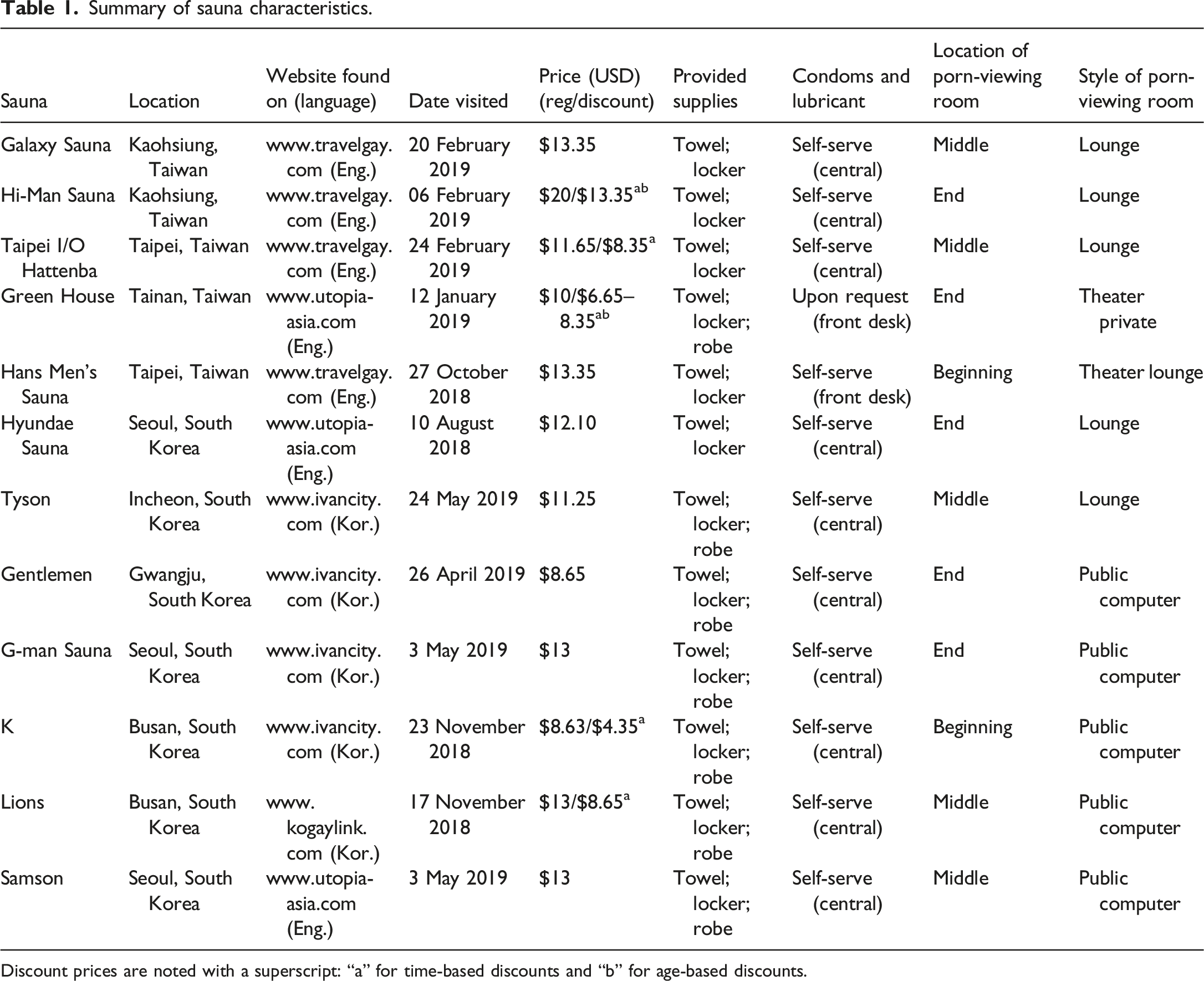
Discount prices are noted with a superscript: “a” for time-based discounts and “b” for age-based discounts.
In going into these sexual spaces, I took an observational research approach (Frank, 2015) to observe the layout of the establishment and the porn-viewing room, rather than observing the behavior of the sauna patrons themselves (that was just a bonus). The time of day or day of the week that I visited the saunas was therefore impertinent, assuming that the porn I observed in these spaces was representative of what normally plays there. Moreover, this assumption that the porn in these spaces generally adhered to specific genres was also based on the target audience (as determined by the websites of the saunas) and user comments on the four websites from which the saunas were procured. Ultimately, this assumption is impossible to truly verify without attending each sauna multiple times on different days of the week and different times of day.
In order to situate the porn-viewing room within the larger context of the sauna, I walked through each establishment upon entering, taking note of the spatial layout and amenities offered. In order to maximize the accuracy of recollection without drawing undue attention to myself, the recording of observations took place immediately after leaving the establishment, either in a notebook, on a recording device, or both. These observations were later rewritten and organized into tables in order to more fully ascertain trends across saunas and across countries.
Results
The salient characteristics of each sauna are summarized in Table 1, including the name and location of the sauna, the website on which it was found, the date visited, listed prices, supplies provided, and location of the porn-viewing rooms. The names of each sauna have a corresponding Mandarin- or Korean-language version, but only the English-language names are included in the table. The table is organized first by country (Taiwan and then South Korea), followed by the “style of porn-viewing room”, and then alphabetically.
Likewise, for consistency and ease of comparison, all prices have been converted to USD and are thus approximate prices based on the conversion rate at the time of writing. Admission to saunas in Taiwan costs between US$10 and US$20 at regular price and US$8.65 to US$13 for those in South Korea. The saunas that offer discounts do so primarily according to the time of day one enters (e.g., before 6 p.m.). Additionally, two saunas also offer age-based promotional prices: Green House to those aged 50 and above (US$6.65 Friday to Sunday) and hi-Man Sauna to students (US$13.35). Besides Taipei I/O Hattenba, all sauna establishments in both Taiwan and South Korea operate 24‐hours a day, 7 days a week.
At a minimum, all saunas provide a towel and a locker, with first-come-first-serve private rooms. Additionally, Green House in Taiwan and all saunas in Korea except Hyundae Sauna provide a short kimono-style robe, known as a yukata, upon entry. These robes have two pockets that facilitate carrying condoms and lube packets. Except Green House, all establishments provide self-service condoms and lube packets, either centrally located (e.g., next to the shower room) or on display at the front desk (Hans Men’s Sauna only); patrons of Green House must explicitly ask the front desk for sex supplies. For establishments that do not provide robes, towels are long enough to wrap around one’s waist, with condoms and lube packets carried in hand. Only hi-Man Sauna provided towels that could not be tied around one’s waist, making it is customary to wear underwear in the establishment.
The porn-viewing rooms can be categorized on two dimensions: location within the establishment and the style of the room itself. In all saunas, the locker and shower rooms are located immediately following the front desk, after which the layout of the establishment varies. If the porn-viewing room is closer to the locker and shower rooms on the intended path of the establishment (i.e., the order in which the layout attempts to guide patrons through rooms), then the location of the porn-viewing room has been categorized as “beginning.” If, after the locker and shower room, there are multiple rooms, spaces, or facilities both before and after the porn-viewing room, then it is categorized as “middle” and “end” if the porn-viewing room appears after most other rooms. The rooms themselves are also categorized by general style of presentation: “theater” for those that resemble a movie-theater experience (i.e., rows of seating all facing a large screen broadcasting pornography), “lounge” for rooms with benches arranged in a semicircular fashion, “private” for porn playing in private cabins, and “public computer” for rooms with one or more public computers with access to either online pornography or locally stored porn files.
Regarding the content of the porn shown in these establishments, porn broadcasted in the “theater,” “lounge,” or “private” style rooms was commercial white Western or Japanese pornography featuring conventionally attractive performers (i.e., good-looking, well-groomed, fit, and with a big dick). If the sauna caters to a specific market, then the videos shown often reflect this demographic—for example, Galaxy Sauna caters to the gay bear community and broadcasts porn featuring stocky-to-muscular hairy performers. The establishments with public computers additionally offer a few commercial videos featuring non‐white Western performers and an array of DIY porn videos; in the case of Korea, these videos are overwhelmingly DIY gay Korean porn. Moreover, all porn located within each establishment (i.e., not requiring Internet access) did not feature kink or fetish sex acts. This, of course, could be circumvented in the establishments with Internet-connected public computers as users are free to choose videos or images based on their personal tastes. And for many of the establishments in Korea, virtual private networks (VPNs) have been installed on the computers to facilitate access to porn given the illegal status of porn in South Korea (Ministry of Justice, 2017).
Discussion
According to Sicart (2014), “play takes place in the context of things, cultures, and people, in time and in space” (p: 50–51); in short, it is contextual. This idea speaks to the relationship between the materiality of objects and play itself, as well as between intangible elements (culture and time) and play. Sicart further states that “[t]he relationship between space and play is marked by the tension between appropriation and resistance” (p: 52). And it is this tension that will be discussed here, focusing on the ways that spaces create “resistance” to certain types of play (i.e., guide players to an intended use of the space). In thinking through the relationship of play and space, I am informed by Lefebvre’s (1991) conception of space as a continuous reproduction of one’s own culture (e.g., each individual bringing their own culture to social interactions), as well as a production of new culture stemming from the human and nonhuman social actors involved (e.g., two different cultures coming together to produce a new one). With space and culture being intricately intertwined and reciprocal, the discussion here focuses on space with the understanding that culture is also involved. Furthermore, this discussion is not advocating for spatial determinism (i.e., that space dictates and drives play), but rather highlights how space makes certain types of play more probable while maintaining the possibility of being appropriated for “unintended” types of play.
Time, order, and play
To begin, the locations of the porn-viewing rooms in the establishments visited offer broad suggestions for when one should play. Although play may occur to a limited degree in the locker, shower, and steam rooms, the placement of the porn-viewing room near the “beginning” of the establishment suggests a warming-up or arousal phase on the way to more indulgent pleasures. Similarly, for porn-viewing rooms that appear in the “middle,” the placement seems to suggest a heightening of sexual pleasures, while rooms located near the “end” may offer downtime from the action before one backtracks through the establishment. These suggestions are based on the order in which one is likely to encounter the porn-viewing room. Speaking to this, Huizinga (1955) states that play “is an activity which proceeds within certain limits of time and space, in a visible order, according to rules freely accepted, and outside the sphere of necessity or material utility” (p: 132).
The procession of one’s sauna experience is guided, to some degree, by the “visible order” of the sauna and its unspoken “rules.” But unlike an actual playground, which can oftentimes be approached from any direction given its open design (Dyment and O’Connell, 2013), movement through saunas is restricted by the walls of the establishment, which not only establish fixed entry and exit points of each room but also places limits on how the sauna can be designed. This isn’t to say that all establishments follow a linear pathway but that the layout, in general, directs patrons to encounter rooms in a particular order. Moreover, a sauna patron may enter the establishment with a particular room in mind, visiting that room directly without stopping in others, or a patron may miss rooms should they not fully explore all areas (e.g., the relative darkness of Green House’s porn-viewing room conceals the darkroom connected in the rear). Furthermore, patrons may move back-and-forth between rooms as a way to heighten sexual pleasure, relax from an encounter, or to scope out potential playmates.
Space and play
Just as the location of the porn-viewing room within the establishment suggests when one can play, the style of the room also suggests how. Citing Allan Bérubé, Richters (2007, p: 282) states that elements of the sauna are designed to recreate the excitement of outdoor sexual cruising, such as in parks, or in specific indoor locations, such as gyms; porn-viewing rooms, specifically, attempt to recreate the thrill of cruising in a movie theater. While this seems generally true, I would argue that the “public computer” rooms in Korea constitute an attempt to recreate PC bang—Korean-style Internet cafés used primarily for gaming (Choi et al., 2009). If one views the designers of the sauna as those operating along lines of power, able to determine the general layout and default objects available in these spaces, then one can see the strategies—to use de Certeau’s (1988) concept—employed to facilitate an intended use for the porn-viewing room. Thus, the structure, its attached cultural meanings, and repeated use impose, even implicitly, a set of expectations onto the potential player. Just as these three elements may suggest that a playground slide is meant to be slid down, the number of ways one can do so (e.g., seated, on one’s stomach, etc.) reveals the flexibility within the parameters of intended use. Moreover, even though certain uses are intended, and therefore likely comprise the most common uses, defying the intended use(s) and improvising a new one—known as a tactic (de Certeau, 1988)—can still constitute play; the same holds true for porn-viewing rooms.
The layout of the room and its relationship to the available screen (TV or computer) attempts to propose the number of people one can potentially interact with at a given time. For example, if the porn-viewing room is centered around a “public computer,” the single chair in front of an individual monitor suggests a more solo affair. The only sauna in which this is not the case is Lions, which had two computers separated by a wall with a glory hole. As one compares the “theater” to the “lounge” rooms, the proposed number for interaction increases from a limited few to wholly communal, respectively. That’s because the rows of chairs in the theater act as physical barriers that may inhibit patrons from interacting with anyone other than those immediately adjacent. In contrast, lounge-style rooms offer a more open play space as seating tends to line the walls, leaving the floor open to larger group or exhibitionist forms of play; an exception to this is Hyundae Sauna, with a sign on display explicitly prohibiting sexual acts in its “lounge” room.
Categorizing the porn-viewing rooms as a semipublic space, following Chen (2008) taxonomy of spatial division of saunas, offers an understanding of the degree to which sexual play is observable by others. Though Chen describes semipublic spaces as “a transitional space between private and public space” (p: 33), distinguishing the categories by how much one can dictate others’ involvement (i.e., a public space offers relatively little control over who can enter the space, while a more private space like a cabin offers more control), these divisions also seem to fall along a continuum of brightness. In the establishments visited, the more public the area (e.g., locker room and hallways), the more well-lit it is, while the more private the area, the darker it is (with, of course, the ability to control the lighting in private cabins). This continuum of brightness suggests a continuum of play, with lower visibility lending itself to play that is less inhibited by concerns of social repercussions. Brighter-lit semipublic spaces include an element of uncertainty around whether a patron can “score” potential partners (Chen, 2008) or their ability to show off. Conversely, Richters (2007) states that the “market of attractiveness are suspended” when entering rooms with little-to-no lighting as it forces patrons to play in other ways, relying on other senses. In relation to the porn-viewing rooms, Taiwanese saunas tended to feature dimly lit rooms, while the “public computer” rooms prominently featured in Korea tend to be more brightly lit—a difference that will be discussed further in the context of cultural differences.
In contrast to the private cabins and darkroom, which provide occupants with a sense of anonymity, the glow of the TV makes faintly visible everything a person may want to keep concealed. Such a design, then, may discourage some forms of sexual encounters—most notably, anal sex. This intention is suggested further by the lack of tissues in these spaces (while available in many of the saunas’ private cabins), making messier forms of sex here inconvenient. Though one is able to carry on their persons condom, lubricant, and tissue, the inconvenience minimizes the likelihood of potentially messier sexual encounters. This conflict of availability and convenience is discussed by Holmes, O’Byrne, and Gastaldo (2007), as well as by Ko et al. (2008) in the Taiwanese context, in relation to the lack of easy-access condoms and lubricant in saunas. Limited access to safer sex supplies may interrupt moments of play should a patron not have supplies on them and wish to incorporate them in a particular moment, although for some patrons this may conform to their ideas of play and not prove to be an impediment.
If, as Richters (2007) asserts, the design of saunas is in some ways meant to recreate the experience of typical cruising spaces (citing Bérubé), then the materiality of the objects within the establishment aids in structuring these fantasies. Despite being located in three different cities in Taiwan, Hans Men’s Sauna (Taipei), Green House (Tainan), and Galaxy Sauna (Kaohsiung) all share a similar decorative feature: these spaces use movie theater–style recliner chairs, with large arm rests and the ability to fully recline to a horizontal position. The chairs thus allow patrons to play in ways that recreate the cruising experience: a slight brush of the leg, a blowjob behind the seats, or a group circle jerk across rows, all under the dim light emanating from the porn playing on screen. In this way, the courting process associated with cruising (Chen, 2008) then becomes part of the mode of play.
While “theater” rooms facilitate notions of play by attempting to recreate the cruising that takes place in movie theaters, “lounge” and “public computer” rooms facilitate play in slightly different ways. Given that the seats in “lounge” rooms oftentimes line the walls of the space, patrons are forced to not only observe the videos being shown but also others in the space; the layout thus restructures modes of play accordingly. No longer can one hide their seductive passes behind objects such as chairs; instead, they must take place more openly. Of course, one can hide behind one’s robe or towel, but a subtle self-rub can be an invitation to others to play, or at the very least, an invitation to watch. Similarly, the layout of “public computer” rooms seems to suggest a more open and upfront way to play, especially considering the browser’s homepage on many of the computers being a porn site (as is the case at Gentlemen). Moreover, given the relative brightness of the room and the single chair in front of the computer, the layout does require a streak of exhibitionism on the player’s behalf.
What sets these spaces apart from the back row of an actual movie theater or a PC bang, however, is the lack of porn sound. In fact, in all establishments visited, the porn being broadcasted was muted. Even the computers in the “public computer” rooms lack speakers, preventing users from listening to the porn video; an exception being Lions, which allows users to control the volume of the computer—most likely as a way to instigate play with those on the other side of the glory hole. Hi-Man Sauna, at the time of visitation, was the only establishment to play music throughout its facilities; the K-pop playing throughout the establishment really added a special je ne sais quoi to the silent porn playing in the back room. The general lack of broadcasted audio seems to allow patrons to enjoy the real-life sounds of their surrounds. Forms of auditory pleasure (e.g., moans, grunts, and smacking of flesh) thereby become other conduits to play.
Devoid of sound, much of the porn available in these spaces exhibits a formulaic set of actions: kissing, oral, rimming, and fucking. Though the performers and studios are different, the sex in the videos, for the most part, follows a progression of these four actions with minimal variation. Lacking diversity of sexual actions and demographics of performers, these videos reinforce, intentionally or otherwise, a conventional script of sexual play. Paasonen (2018b) notes that “sexual play is generic and tied to repeatable patterns” (p: 36), though notions of playfulness may lead to curiosity-driven sexual explorations. Considering both Paasonen’s statement that sexual play is to some degree patterned and the formulaic nature of the videos present in these establishments, the sexual play suggested in these spaces seems to be one of routine. Without videos or other patrons to model or suggest novel forms of play, the sexual play of patrons seems less likely to deviate from what’s on display in the videos. This, of course, is not to say that deviations do not occur but that play can sometimes follow a routine, especially when that routine is made salient.
While the design of spaces influences play and vice versa (Dyment and O’Connell, 2013; Huizinga, 1955), the type of play that manifests in these spaces is not the same for all players at all times. After all, the variation in tactics used by players to play with, disregard, or overcome the spatial design of the establishment only reinforces the idea of the technically infinite possibilities of play that may occur. For example, potential players may decide to play with the unspoken rules of a given room by rearranging the chairs in the “theater” room to facilitate group play or by initiating an open session in the “lounge” room. Further still, players may use the brightness of a room as an opportunity to show off, rather than relegate such play to darker corners of the sauna. Time, too, influences play, with a room being deserted in the middle of a workday, but teeming with life, lust, and fun in the wee hours of a Friday night. These elements of when and how to play are informed by and reproduced through multiple layers of culture and history as they come together at a particular juncture.
Cultural context and play
Each sauna is embedded in layers of cultural codes: the wider culture of the country, the culture of men who have sex with men, and the culture of the individual (which may or may not align with the other layers). The wider culture may influence design choices, which in turn may influence the types of play likely to occur in said spaces. Likewise, the culture of cruising in saunas carries with it a code or set of rules that those who enter the space implicitly agree upon—for example, the reliance on body language rather than verbal communication. In visiting three Canadian bathhouses, Holmes, O’Byrne, and Gastoldo (2007) note: During our observational visits, body language represented the entire communication process. Practices were (de)coded by location, body postures, eye contact, smiles, walking pace, and the way the towel was worn. Furthermore, hand motions, touching one’s own body, slight touches between chests or buttocks while passing in narrow passages and stairways were all direct messages to be interpreted as an invitation for sex. (p: 279)
Finally, if the culture of the individual patron aligns with the culture of the designer (e.g., in the context of Korea, both the designer and the patron are Korean), then the patron will more likely understand and enact the intended behaviors of the space due to a shared cultural knowledge, which may include nonsexual cultural references and inspiration for the sexual space. For example, expecting patrons to shower before soaking in a bath—a common and expected practice in the nonsexual public baths of Korea (known as jjimjilbang or sauna and commonly used as cheap overnight sleeping accommodations, especially after a night out drinking).
To illustrate how culture and the design and codes of saunas reciprocally influence each other in relation to notions of play, I turn my attention to the type of porn-viewing rooms most prevalent in Korean saunas: the “public computer” room. Excluding Hyundae Sauna and Tyson, all other establishments in Korea do not broadcast pornography; instead, porn is located on individual computers to be browsed by the user, most likely due to the illegality of producing and distributing (i.e., broadcasting) porn in Korea. As such, the South Korean government actively censors its Internet, though it is clear that workarounds exist given the presence of porn files and VPN access on computers in Korean sex saunas. Though porn exists in Korea as a sort of “open secret” in various sex establishments (e.g., in love motels or adult PC bangs) (Jones, 2020), housing porn on a computer instead of openly broadcasting it may provide a degree of plausible deniability. Of all of the establishments, Hyundae Sauna and Tyson were the only two to have extra measures in place to notify staff about arriving patrons. They can thus screen potential patrons before allowing entry into the sauna, reducing the risk of openly broadcasting porn, while all other establishments may take the approach of denying responsibility for the porn on the computer (e.g., claiming it was downloaded by a patron).
What sets “public computer” rooms apart from the other styles of porn-viewing rooms is the presence of ashtrays, relatively bright lighting, TVs playing popular Korean game shows, and a lack of sleeping mats (unlike most other areas of the sauna). The indication here is that these spaces should be used for more nonsexual play purposes, especially if we again consider how the continuum of lighting relates to a continuum of play. In this way, the implication of the design suggests more covert forms of play or none at all.
The sleeping mat exemplifies Richters’ (2007) statement on how saunas are designed to recreate cruising spaces in a Korean context. If the “public computer” rooms are meant to recreate PC bang, then the sleeping mats can be seen as symbolic of cruising in the gender-segregated sleeping rooms in jjimjilbang, which increasingly appears in public discussion in Korea given recent news discourse (Kim, 2015). Just as similar movie theater–style recliners appear in three different Taiwanese saunas across three different cities, the sleeping mats typically found in a jjimjilbang, an icon of this uniquely Korean cultural institution, are found in all the Korean saunas. The presence of these mats in nearly all other dry rooms of the establishments visited (i.e., rooms other than the shower and steam room) and a lack of these mats in the “public computer” room seems to indicate a discouragement of overt sexual play in the “public computer” room. Such a subtle cue would be recognizable to those patrons who are familiar with jjimjilbang culture. Thus, both the presence of these mats in other rooms (and a lack of them in the “public computer” rooms) and the cultural codes that Korean patrons (arguably, the dominant patrons of these establishments) bring into these spaces help to construct the unspoken rules of this play space. Of course, given that play is appropriative (Paasonen, 2018b; Sicart 2014), there is no absolute mandate that an individual follow the established rules of play, arguably even in the case of Hyundae Sauna, with its sign explicitly prohibiting sexual acts in its “lounge” room.
Conclusion
Despite an understanding that play is appropriative, the bulk of the discussion in this article has focused on the ways space and communal rules “resist” forms of play by examining the porn-viewing rooms in Taiwanese and South Korean men’s sex saunas. I focus on the suggestions, the delineations of “acceptable” and “unacceptable” types of play, or—quite simply—forms of play more likely to not happen rather than what can happen because the possibilities of what can happen are circumscribed by the boundaries of the agreed-upon norms, rules, or rituals of the cultural space. To discuss how people might actually play in these spaces given the parameters of what is acceptable and amenable to the physical layout requires consideration of individual characteristics, and since no data on individuals were collected, it is difficult to conjecture about what forms of play will most likely occur.
This discussion highlights the ways in which space and its rules create “resistance,” guiding players to some forms of play over others. In no way is this meant to definitively determine what can and cannot transpire in a given space; after all, one can play with the rules, play with the objects, and play with others’ expectations, customs, and norms. As Paasonen (2018a; 2018b) states, play can be pleasurable, and it can be hurtful—it is not one thing, but a range of possibilities. Seen in this way, the spaces discussed in this article can always be appropriated, despite intended uses and the layering of cultural codes within these spaces. While the tension of appropriation and resistance always exists in these spaces, it is constantly being negotiated on a number of levels—human and nonhuman alike. Thus, modes of play are not fixed because the human element inevitably introduces a source of variation.
Footnotes
Declaration of conflicting interests
The author(s) declared no potential conflicts of interest with respect to the research, authorship, and/or publication of this article.
Funding
The author(s) received no financial support for the research, authorship, and/or publication of this article.
