




Abstract
Drawing upon findings from an ethnographic study of lap-dancing club customers, and those generated from desk-based research which examined lap-dancing club websites and promotional materials, this article will argue that the lap-dancing club is a heteronormative space, in which male customers practice normative masculinity. In exploring normative masculinity, this article will draw upon the work of Connell (1995), to demonstrate how different normative masculine practices are evident in the different attendance patterns of lap-dancing club customers. Overall, the findings discussed in this article make two important assertions, in support of Connell’s work. First, that masculinity is fluid, and context dependent; men can enact different versions of masculinity in different social spaces and situations. Second, normative masculine practices are pervasive, and encouraged, aided through heteronormative spaces such as lap-dancing clubs.
Introduction
By drawing upon findings from an ethnographic study of lap-dancing club customers, 1 alongside supplementary desk-based research involving the analysis of lap-dancing promotional materials (see Figures 1 to 3) and of the websites of chain-operated lap-dancing venues, this article will argue that the lap-dancing club is an exclusively heteronormative space, in which male customers practice normative masculinity. The work of Connell (1995) provides a theoretical framework, to explore the normative practices evident in the different attendance patterns of lap-dancing club customers. Overall, two important arguments are presented in this article, providing empirical support for Connell’s work. First, masculinity is fluid, and context specific, and second, that normative masculinity is pervasive and encouraged, aided through heteronormative spaces, such as lap-dancing clubs.
In developing these arguments, the first part of this article will discuss the existing lap-dancing literature, in order to illustrate the extent to which customer culture, and masculine practices, have been a central point of enquiry. Here it is argued that despite the contention of sexual objectification, patterns of attendance are complex, tied with culture, gender, sexuality and leisure consumer practices. The second part of this article will draw upon the work of Connell (1995), and others, to explore the role of heteronormativity and normative gendered practices. In providing theoretical context, attention is drawn to Connell’s discussion regarding configurations of practice, such as ‘hegemonic’, ‘complicit’, ‘marginal’ and ‘subordinate’ masculinities. The final part of this article will focus on the research data; here key findings from the analysis of promotional materials and lap-dancing websites, along with those from the ethnographic customer study will be explored. Through drawing upon the imagery and language used in advertising and promotional materials, alongside the bodily practices of dancers, and customers, it will be illustrated how the lap-dancing club is constructed and maintained as an exclusively heteronormative space. In relation to this point, this article will then explore how the patterns of attendance of lap-dancing club customers provide further insight into the different normative masculine practices which take place in these spaces. Here it will be argued that the motives for frequenting lap-dancing clubs are not exclusively rooted in sexual objectification, with three patterns of attendance suggested. First, ‘having a laugh with the lads’, accounted for those visiting lap-dancing venues in groups of two or more and emerged as the most prominent motive. Here the emphasis was on homosociality, not on emotional or sexual gratification; predominantly, complicit masculine practices were suggested in this pattern of attendance. Second, some customers indicated that they attended lap-dancing clubs for the emotional experience, in order to connect with women though conversation, somehow forging ‘romantic intimacy’; again, this was often suggested by customers who attended lap-dancing clubs alone, and related to those who displayed traits of ‘marginal’ masculinity, with the lap-dancing club providing them with a space to engage in normative masculine practices. Third, the pursuit of ‘sexual gratification’ was identified, here customers, who often attended alone, described going to lap-dancing clubs for their sexual arousal. However, this was only suggested by a small number of participants, yet it remains important as it provides insight into hegemonic masculine practices. Regardless of the pattern of attendance, customers, albeit in different ways, use the lap-dancing club as a space in which to practice normative masculinity.
The landscape of lap-dancing
To date there are several studies which have explored stripping, from the perspectives of the erotic dancers (Colosi, 2010a; Hales et al., 2019; Sanders and Hardy, 2014), local communities (with a focus on licensing) (Hubbard and Colosi, 2015) and customers (Egan, 2006; Frank, 2002). The literature exploring lap-dancing club customers has tended to place emphasis upon customer interactions with lap-dancers (Barton, 2006), drawing attention to the nuances of power experienced between customer and dancer, situating these relationships within a cultural context (Frank, 2002). The power dynamics are not static, and despite structural inequalities impacting upon the lives of dancers more widely (Barton, 2006; Frank, 2003), in the lap-dancing club environment the complex relationship between customer and dancer suggests that both parties may obtain different levels of control over one another at different times (Colosi, 2010a; Egan, 2006; Frank, 2003). Academic accounts infer that although some customers are abusive, this is not commonplace, with most acting respectfully (Barton, 2006). In addressing the balance of power, it has been noted that dancers find ways of subverting (customer) control in different ways, including the use of belittlement (of customers) (Barton, 2006; Colosi, 2010a, 2010b) – similarly, other sex work literature, in relation to prostitution, for example, cites the use of humour amongst sex workers to help them cope with difficulties in their job (Sanders, 2004). In relation to customer motivation, the key literature suggests that there are a multitude of reasons for using lap-dancing clubs, which are not limited to sexual titillation, despite some literature suggesting that the sex industry only serves to (sexually) gratify men by sexually objectifying women (Jeffreys, 2008). Alternatively, Frank (2003) argues that patterns of attendance are ‘intertwined with cultural discourses about masculinity, sexuality, leisure, and consumption, and that these visits become meaningful in relation to their everyday lives and relationships and their own personal and emotional experiences of gender and sexuality’ (61). The suggestion here, along with other explorations of customer culture, is that patterns of attendance and customer motive are more nuanced than authors such as Jeffreys (2008) suggest; both Egan (2006) and Barton (2006) support Frank (2003) by situating the sex industry within a broader cultural context. These accounts are echoed in other literature which explores consumerism within the wider sex industry. For example, Sanders (2008) contends that there are ‘pull’ and ‘push’ factors underpinning the patterns of consumerism; the ‘pull’ factors account for the mainstreaming of the sex industry and opportunity to consume sexual services. Alternatively, ‘push’ factors account for poor existing (sexual) relationships and/or unease with dating rituals. Moreover, there is agreement about different patterns of attendance, and a subtext suggesting that the narratives, and observed behaviours of customers, are important in helping us to understand the ‘unspoken’ motives (see Barton, 2006; Egan, 2006; Frank, 2002). Frank (2003) suggests ‘relaxation’ away from everyday life, by customers engaging with ‘fun’ and ‘hospitality’, provides escapism and opportunities for male fantasy. This is supported by the work of Liepe-Levinson (2002), who emphasises the role of homosociality in lap-dancing club settings. Furthermore, Frank (2003) reflects upon how gendered practices are evident in patterns of attendance, as some men clearly engage with ‘traditionally “masculine” activities and forms of consumption … such as drinking, smoking cigars, and even being “rowdy”, vulgar, or aggressive’ (65). Both examples, in different ways, highlight the use of lap-dancing clubs for the practice of normative masculinity (Connell, 1995).
Normative configurations
In arguing that the lap-dancing club is a heteronormative space, which encourages normative masculine practices, here, this article will draw upon the work of Connell and others to provide a theoretical framework.
There is scholarly agreement that heterosexuality is positioned as normative (Jackson, 1999; Jackson and Scott, 2010; Pilcher, 2012). Moreover, heterosexuality is seen as a practice which both reinforces, and emerges from, ‘normative’ masculinity (Connell, 1995; Connell and Messerscmidt, 2005). As Connell (1995) argues, homosexuality is associated with ‘subordinate’ masculinity; here clearly suggesting the association made between gender and sexuality. Furthermore, heteronormativity is more widely evident in public and political discourse, with social policies helping to instill these ‘normative’ ideals; in relation to this, education policies are noted to reinforce heterosexuality (McNeill, 2013), as well as media depictions of relationships, which also conflate gender with sexuality (Holz Ivory et al., 2009). Both Butler’s (2000) and Connell’s work (1995) suggest that heterosexual spaces are complex matrixes, which enable men and women to act out normative masculinity (see Connell, 1995) and femininity (see Butler, 2000); in doing so, heterosexuality is reinforced as ‘normal’. Such gendered practices can be observed in every day social life, including in educational environments (McNeill, 2013), the family (Tarrant and Hall, 2019), work (Mizzi, 2013) and in leisure spaces (Grazian, 2007); in relation to the latter, the night-time economy, through engaging with potentially (hetero)sexual encounters, provides opportunities for normative practices amongst both men and women (Grazian, 2007). It is suggested that spaces in cities and towns have consequentially become divided by normative ideals, with distinct ‘straight’ and ‘queer’ spaces making up the night-time economy (Hubbard, 2008). The lap-dancing club is one such space, which, as this article will argue, exemplifies heteronormativity in the urban landscape. Although erotic dance is neutral, it is still ‘contextually specific’ (Pilcher, 2012: 522); the heteronormative terrain of the lap-dancing club therefore provides the normative sexual context of the performances which take place there. As it will be discussed later in this article, normative practices are encouraged and supported in lap-dancing club venues, with different practices helping to maintain it as a heterosexual space.
In Connell’s (1995) original work on masculinities, she acknowledges that masculinity is multifaceted, with multiple and competing masculinities; it is identified as a set of social practices, rather than as a result of socialisation. Furthermore, it is suggested that masculinity is fluid, and therefore changes: … masculinity is not a fixed entity embedded in the body or personality traits of individuals. Masculinities are configurations of practice that are accomplished in social action and, therefore, can differ according to the gender relations in a particular social setting … (Connell and Messerscmidt, 2005: 836)
Method
This article is based upon the findings from an ethnographic study focussed on lap-dancing club customers, which explored their motives for attendance, and associated behaviours. Methods used to derive data included participant observations, observing as a ‘customer’, in different lap-dancing clubs in the UK, and 20 semi-structured interviews. Interview participants were reached through advertisements, and through ‘word-of-mouth’; thus, most of this sample was generated through a process of ‘convenience’. This study builds on auto-ethnographic research that I previously conducted whilst working as a lap-dancer, which focused on the relationships between dancers (Colosi, 2010a). Although my positionality as an insider did not guarantee complete acceptance, I was able to use my previous experiences and insider knowledge to gain the trust of both customer and dancer participants. 2 This was helpful when engaging in conversations with participants during observations and when conducting semi-structured interviews, as it encouraged them to talk openly. There are several ethical challenges associated with participant observation, 3 particularly when studying groups considered to be deviant. Here it is important to acknowledge that research can and should engage with risks in order to advance empirical and theoretical insights; this is feasible if researchers endeavour to protect the participants involved (Norris, 1993). This was achieved when making observations in three ways: first, by seeking the consent of participants, where possible 4 ; second, by carefully anonymising all participants, including, names and any other identifiable details. Finally, by using data sensitively, this resulted in excluding any findings which would identify or cause harm to participants.
For the purpose of this article, the findings from the customer study have been supplemented with data derived from the analysis of visual promotional materials used by lap-dancing clubs to advertise different events they host, and from the analysis of chain-operated lap-dancing club websites. Promotional materials were selected from several different promotional flyers available to the public on social media (i.e. such as Twitter and Instagram), or directly from the venues’ websites. The materials (Figures 1 to 3) included for discussion in this article visually illustrate some of the themes identified in the analysis of the original data generated from the customer study. Data from this study, and promotional materials, have been analysed thematically; it is on this basis that themes relating to normative gendered behaviours emerged. Here, during analysis, a schedule was used providing codes representing different themes of analysis; these were then applied to the promotional materials. Given that full imagery is necessary for illustrative and critical purposes in this article, the decision was taken not to anonymise 5 the models.
Findings
In what follows, the article will explore some of the key findings from the ethnographic study and supplementary desk-based research, which, first, demonstrate how the lap-dancing club is constructed and maintained as a heteronormative space, and second, how it simultaneously provides a place in which normative masculinity can be practiced.
Club promotion and advertising
The promotion of lap-dancing clubs indicates that it is a space in which normative gender practices are encouraged and supported; this is evident in both the language and imagery used on advertising materials (see Figures 1 and 2).
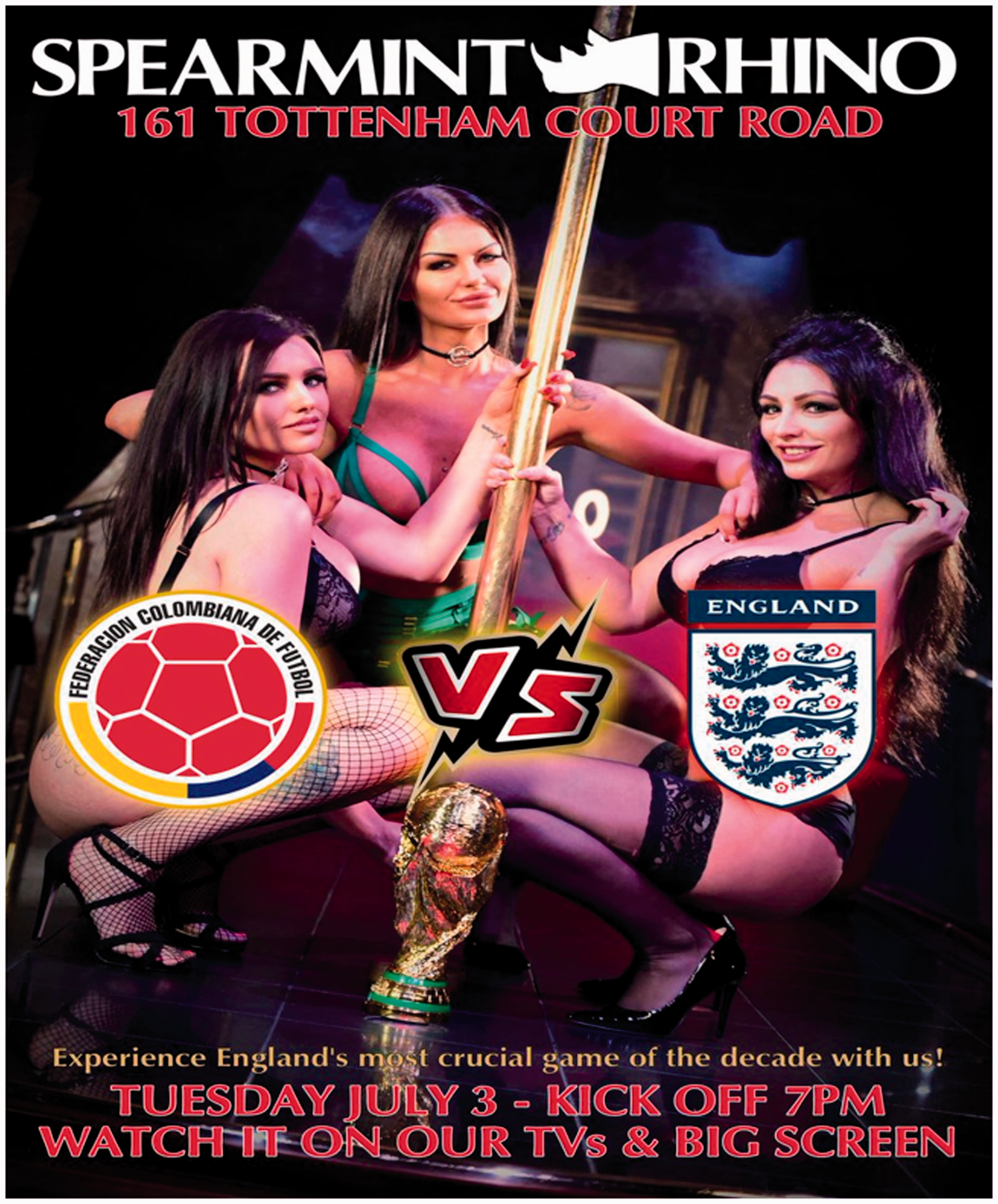
The female body is presented in a way that depicts ‘emphasised femininity’ (Connell and Messerscmidt, 2005).Source: Spearmint Rhino, 2019.
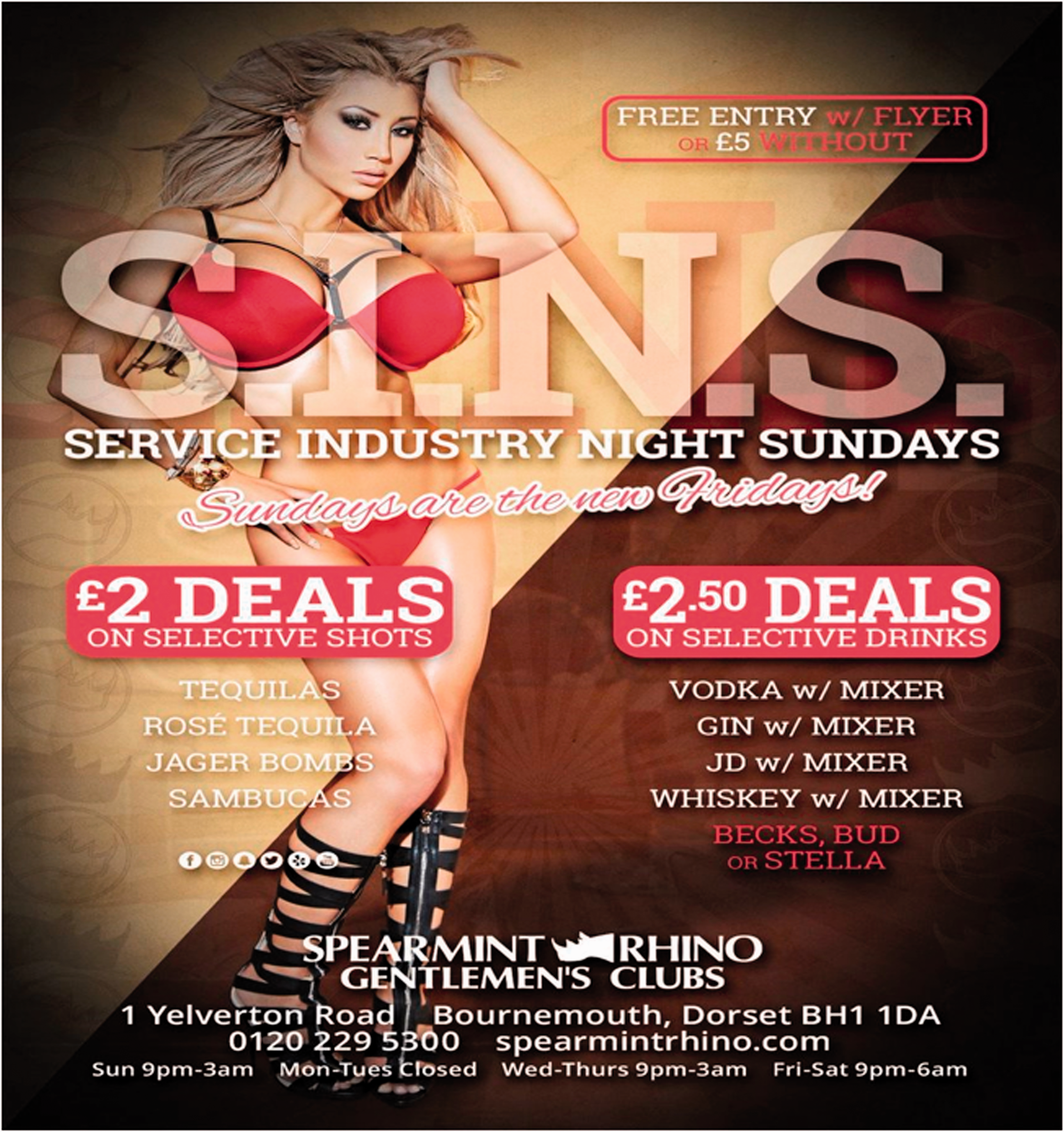
Spearmint Rhino is advertised as a ‘gentleman’s club’; suggesting it is an exclusively male space.Source: Spearmint Rhino, 2019.
For example, in relation to imagery used, as conveyed in Figures 1 and 2, the depictions of women’s bodies here are indicative of what Connell and Messerscmidt (2005) refer to as ‘emphasised femininity’; such images can also be seen on lap-dancing club websites (see www.spearminthrhino.com and www.fyeo.com). To explore this in more detail, the female bodies depicted on the promotional materials (Figures 1 and 2) offer a physical representation of normative female beauty, constructed as white (Deliovsky, 2008), ‘hairless’ (Toerien and Wilkinson, 2003), ‘unmuscular’ (Boyle, 2005) and sexually available (Connell and Messerscmidt, 2005). In relation to this, the importance of bodily aesthetics has a long history in the lap-dancing club environment. Like other women working in sexual entertainment, such as pornographers, lap-dancers are expected to conform to normative feminine beauty standards, suggested in the dancers’ use of temporary (i.e. use of make-up, fake tan, hair extensions) and permanent body technologies (i.e. cosmetic surgery) (Colosi, 2010a; Fazzino, 2013; Wesely, 2003). As such, for lap-dancers, this is reinforced by club operators, who have been reported to fine dancers for ‘inappropriate’ appearance, relating to clothing, hair or makeup, and ‘masculinised’ behaviours such as chewing gum, swearing and inebriation (Colosi, 2010a; Sanders and Hardy, 2014). Normative sexualised and gendered imagery is also evident in some of the lap-dancing clubs’ interior décor, for example the photographic imagery observed in lap-dancing clubs included semi-nude women. These spaces are also promoted as exclusively male, and heterosexualised, which is reflected in the language, and imagery, used in advertising (see Figure 2 for language). Moreover, some chain-operated lap-dancing clubs, including Spearmint Rhino and FYEO, refer to themselves as ‘gentleman’s clubs’ (Colosi, 2010a), with FYEO (2019) boasting it is the ‘ultimate gentlemen’s club’, on the homepage of their website (www.fyeo.com). By venues framing themselves in this way, they are inferring that these spaces are for (heterosexual) men. In relation to this, significantly, the customers who took part in this study, via interviews and through participant observations, were all male; this gendered dynamic is also reflected in other studies (Barton, 2006; Colosi, 2010a; Frank, 2003), and again indicates that the lap-dancing club is a masculinised space (Frank, 2002). More widely, sexual services are often identified as gendered, with women acting as ‘producers’ (Hales et al., 2019), and men as ‘consumers’ (Sander, 2007). In promoting the lap-dancing club as a masculinised heteronormative space, ‘stag’ parties are also encouraged to use these venues as part of their ‘stag’ entertainment (see Hollands, 2002); again, this is evident on the FYEO (2019) website, which provides ‘stag packs’ (www.fyeo.com). Furthermore, the organisation of leisure-based consumerism, facilitated by online travel-leisure organising platforms such as Red7 (www.redsevenleisure.co.uk), provides information for users to plan events such as stag parties for ‘lads’ weekends, with lap-dancing entertainment signposted on this site as a main event for these parties. Here the site provides extensive information about different lap-dancing venues across the UK and Europe (www.redsevenleisure.co.uk, 2019), further suggesting that this form of entertainment is central to normative masculine leisure practices. The role of lap-dancing clubs for stag, and even hen parties, has been well documented (Colosi, 2010a; Pilcher, 2012; Sanders and Hardy, 2014); as part of a (hetero)sexualised night-time economy, lap-dancing venues offer ‘stag’ parties an opportunity to engage in sexualised exchanges that do not necessarily involve physical contact (Colosi, 2010a), and that are to some extent, accepted as part of the wider sexualised culture (Attwood, 2006). Although over recent years lap-dancing clubs have marketed ‘female only’ events (see Figure 3), to attract hen parties and female consumers (Colosi, 2010a), such events are not commonplace and marketed separately from regular club nights (see www.fyeo.com and www.spearmintrhino.com). However, what is significant here, when looking at Figure 3, is that first, ‘The Chocolate Men’ are exclusively promoted for heterosexual women, but not gay men; again, this suggests that the lap-dancing club is maintained as a heteronormative space. Second, the imagery for the promotion materials in Figure 3 reinforces normative gender configurations, for example here the physical appearance of the male entertainers fits with the hegemonic physical trait of strength, with emphasis placed on their muscularised bodies (see Connell, 1995).

‘The Chocolate Men’ are promoted for heterosexual women, further suggesting that the lap-dancing club is a heteronormative space.Source: Spearmint Rhino, 2019.
The bodily practices of dancers
Pilcher (2012) stresses the importance of the physical nature of erotic dance, in that the bodies on display help construct and reaffirm ideas about normative gender roles. The female (erotic) dancer displays a feminine ideal (emphasised femininity), reflected in the aesthetics of dancers, through their use of body technologies (Colosi, 2010a; Wesely, 2003), which is also illustrated in the promotional materials in Figures 1 and 2, and images on venue websites. Furthermore, by being responsive to the needs of the (male) customer, ‘emphasised femininity’ is reinforced. This is supported in existing literature, which explores how dancers engage in fantasy play with customers (Colosi, 2010a); here dancers may feign feelings to offer customers a ‘believable’ performance (Colosi, 2010a; Deshotels and Forsyth, 2006; Wood, 2000). In relation to this, several techniques are adopted by dancers in order to fulfil customers’ fantasies (Colosi, 2010a; Deshotels and Forsyth, 2006). One such strategy which reinforces normative femininity is referred to as the ‘bimbo act’; here dancers ‘dumb down’ for customers, with the intention of making them ‘feel superior and portray the dancer as vulnerable’; this would involve ‘excessive flirting … hair flicking, enlarging eyes, pouting, making physical contact with customers during conversations, and giggling’ (Colosi, 2010a: 105). Such behaviour was evident in the customer study, as outlined in the fieldnote extract below during one of the visits to a busy chain-operated club: The dancers were having to work hard for private dances, this was primarily due to the high numbers of dancers working, and the limited number of customers. Whilst observing the dancers interacting with customers, in their efforts to secure dances, I witnessed several different techniques being used by dancers. Some simply approached customers and asked for a dance, swiftly moving on to the next, however, some spent considerable time talking to and flirting with customers; with one or two of the dancers sitting on the laps of customers.
The normative practices of dancers are not only evident in their interactions with customers, but in their responses to female customers. For example, the presence of female customers can be met with suspicion. This is evident in some of the dancers’ hostile responses to female customers discussed in other studies (see Colosi, 2010a). Significantly, during observations, male customers were observed approaching female clients. Here, the normative gendered and sexual dynamics of this space were suggested where male customers made assumptions about the (hetero)sexual availability of female clients, as outlined in the fieldnotes below: Looking over, two female customers were sitting together when a couple of male customers, who were part of what appeared to be a stag party, approached the two women. The approaching male customers pulled up a couple of chairs and started chatting with the women. At first, I wondered if the two parties knew each other, but judging from the body language of the female customers, which was hostile, they did not. It appeared the male customers were making (sexual) advances towards the two female customers; these attempts seemed to go on for some time.
Customer motives – Normative masculine bodily practices
Along with promotional material and advertising, and bodily practices of the lap-dancers, the bodily practices of customers also provide evidence to suggest how the space of the lap-dancing club is heterosexualised. Moreover, the customers’ bodily practices (including their spoken narratives) demonstrate the nature of the normative masculine practices which take place; here consumer leisure practices help to shape gendered identities within a normative framework (Edwards, 2003). In what follows, three key patterns of attendance will be explored, which include ‘having a laugh with the lads’, ‘romantic intimacy’ and ‘sexual gratification’.
Having a laugh with the lads
The lap-dancing club has been argued to offer a space of relaxation outside of the customers’ everyday lives with those expressing their engagement in fun, rather than sexual pleasure (Frank, 2003). This was articulated by a significant number of customers in this study, such as Jeff,
6
who attended only a few times a year: ‘ … when I go in I’m just there with the guys and we’re having a laugh and if you want a dance you can ask a lass to dance for you’. Given that Jeff states ‘if you want a dance’, implies that engaging with the sexual entertainment offered in lap-dancing clubs is not necessarily a priority. Similarly, Danny, who had only been to a lap-dancing club twice, suggested that it was incorporated into a regular night out: if you’re in a gang of lads, a lot of it’s just like, ah, you’ve been out drinking, boredom drinking. I mean, let’s be honest, you have a few drinks in another pub, it just breaks it up a bit … I think a lot of people who go in there (lap-dancing club), they’ve had a skin-full and, you know, it’s just a bit of a laugh, really. It sounds weird but it’s more like the banter with your mates … .It’s more of a laugh, you know when blokes get together you can have a laugh, you have women, you have beer and you have entertainment, it’s everything you want … I think it is more of a chilled atmosphere with your mates.
The findings suggest that by attending as part of an all-male group, customers can engage with normative masculine practices, through (at times) watching naked/semi-naked women, drinking alcohol and ‘having a laugh’ with (male) friends. In this way, these customers use this space to present their normative masculine identity to one another, and in doing so, gain mutual acceptance and respect; this is echoed in the work of Liepe-Levinson (2002), who acknowledges that homosociality plays a role in patterns of attendance in lap-dancing clubs. Group acknowledgement of performing normative masculinity correctly, is important, as it helps support the customers’ identities as heterosexual males, providing them with confidence ‘in one’s performance of masculinity and heterosexual power’ (Grazian, 2007: 224). During observations, this behaviour was identified on several occasions; one instance is outlined in the field diary extract below: A group of six young males, approximately between the ages of 20 to 30, were sitting around in a circle laughing; it wasn’t clear, from where I was observing, what they were laughing about, but they were fully engaged in each other’s conversations rather than their surroundings. It was only when two dancers approached them that they stopped talking/laughing and accepted private dances, which were performed where they were seated. It was interesting watching the reactions of the men who were given dances; they seemed more interested in the reactions of their friends than in watching the performances of the women dancing in front of them.
Romantic intimacy
Engaging with the sex industry as a consumer in order to satisfy emotional needs is reflected in the wider academic literature (Colosi, 2010a; Milrod and Weitzer, 2012; Sanders, 2008). In this study some of the customers indicated that they used lap-dancing clubs to engage in fantasies that provided romantic intimacy; this mirrors other findings which indicate clients may seek the ‘girlfriend experience’ from sexual entertainers (Milrod and Weitzer, 2012). Derek, one of the customers interviewed, stated that he liked to feel sexually and emotionally connected to the dancers: ‘I don’t want a robot (dancer). I want her to mean it when she dances for me. To look in my eyes, so to say “I want you. I want to fuck you”’. Derek was single, and regularly frequented lap-dancing clubs, always attending alone. He had never formed any romantic relationships with dancers, but emphasised that feeling an emotional connection was primarily what he wanted from a lap-dancer; he saw this as part of the service they should be offering. As a result of this, Derek admitted that he was selective about those who he would have dances with: ‘I don’t like those girls who just come up to me and say: “do you want a dance?”. I want conversation. That has to be part of the experience’. It is suggested here that intimacy is important to Derek; although he acknowledged that this was a service, for him, the service should at least momentarily convince him of a meaningful intimate encounter. This not only validates his sexuality as normative, by requiring dancers to demonstrate (even if feigned) an attraction to him, but this ultimately validates Derek’s gender, by positioning it as normative. Although, unlike with group attendance, this is not directly played out to other men, Derek’s practices in the lap-dancing club serve as ‘gendered’ self-assurance. Similar accounts have been given by other customers, for example Angelo convinced himself of intimacy with dancers: ‘You know they like you sometimes, the way they look at you. I haven’t asked any out but think I would be in with a shot’. The self-assurance and confidence in his ‘relationships’ with dancers, not only suggests the significance of the need to engage in fantasies of romantic (perhaps sexual) intimacy but is also indicative of normative masculinity. However, unlike Derek, Angelo only appeared to demonstrate such confidence in a lap-dancing club setting; outside of this space he appeared to be less self-assured and lacked confidence in forming romantic relationships, claiming ‘I prefer it in the lap-dancing club, I find it hard to talk to women outside (of the club)’; this is perhaps why he never made attempts to proposition dancers, despite his claim that they were attracted to him. This is also a reminder that Angelo was aware of the feigned nature of dancers’ performances, and accepts it is fantasy play (Colosi, 2010a). Another customer participant, Colin, in a similar way to Angelo, talked about his use of the lap-dancing club to connect with women ‘I am fucked in the real world, I haven’t had a girlfriend for years. At least I can talk to these women. They don’t make me feel like a loser’. Here Colin, indicates that he can forge intimacy with lap-dancers, helping to address his inability to confidently form romantic relationships in the ‘real world’ as he puts it. This lack of confidence articulated by both Colin and Angelo, along with their general demeanours, suggested, that both displayed some traits of what Connell (1995) refers to as ‘marginal’ masculinity. However, the lap-dancing club enabled both customers to subvert this and engage in normative gendered practices. However, despite such opportunities for these men, the discrimination that is encountered by those displaying marginalised masculinity (Connell, 1995), is evident in the rejection of, and stigmatisation of ‘romantic intimacy’ by other customers, such as those ‘having a laugh with the lads’.
Sexual gratification
Although, overall, the findings suggest that sexual gratification was not the most significant reason for attending lap-dancing clubs, it was, for some of the participants, a key reason. Unlike those who wanted romantic intimacy, those who attended for sexual gratification were not interested in making an emotional connection with lap-dancers. Some customers indicated that they used the lap-dancing club in order to play out normative sexual fantasies. This was the case for Robert, who acknowledged he ‘wanted to feel (sexually) excited’ and admitted that he enjoyed opportunities to make (sexual) physical contact with dancers ‘If she lets me touch her breasts or pussy (vulva/vagina) I will’. Further to this, Arthur, who frequented a range of different erotic dance venues, other than lap-dancing clubs, was critical of chain-operated lap-dancing clubs for employing too many surveillance methods, which he suggested, inhibit contact: I’ve been to Secrets or Spearmint (Rhino) when you go for a dance there’s an area sort of round the back but it’s not private booths, it’s fairly open. So, and they usually have cameras there and there’s the girls, there’s fairly minimal contact … it’s fairly restricted.
This type of sexual encounter, for customers like Arthur and Robert, was important as it offered them opportunities to exercise normative sexual practices, in a space where they did not feel inclined to think about pleasuring someone else. Here, sexual gratification is indicative of hegemonic masculinity, in which the masculinised body is constructed as being highly sexualised (Connell, 1995). In addition, what emerges from Arthur’s sexual experiences in informalised spaces of erotic dance, is that further understanding of the differences between formalised (licensed sexual entertainment venues – see Hubbard and Colosi, 2015) and informalised settings is needed; including how regulation shapes the customers’ behaviours, but also how it impacts upon the dancers working in these spaces.
Conclusion
This article has provided insight into the role lap-dancing clubs play in enabling men to embody normative gender roles and sexuality; here the work of Connell (1995) has helped to contextualise customer practices. In capturing the motives of lap-dancing club customers, it was identified that the most common pattern of attendance related to ‘having a laugh with the lads’, embodied through the leisure practices of the ‘new lad’, which is indicative of what Connell refers to as ‘complicit masculinity’. In identifying these bodily practices, it is suggested that normative masculinity is more likely to be represented by complicit configurations than hegemonic ones and continues to be significant in maintaining gendered divisions between men and women. Here, as shown through the promotion materials and advertising of lap-dancing clubs, consumer practices are shaped in a way that help to maintain normative gender configurations but have also helped to give rise to the ‘new lad’. Moreover, it is through both bodily practices and the specific nature of the advertising of lap-dancing venues, that this space is signposted as an exclusively heteronormative site. This article has also demonstrated that the lap-dancing club is used by male customers with different needs, who do not necessarily engage with normative masculine practices outside of this space, with some exhibiting more marginalised gendered behaviours outside of this environment. This, for example, was evident amongst those searching for ‘romantic intimacy’, here marginal masculinity was implicit in the customer narrative. In these cases, the lap-dancing club offered normative opportunities for (marginalised) men, enabling them to subvert their marginality, even if temporarily, by engaging with fantasy. As such, these findings have implications for how we think about marginal, and perhaps even subordinate, masculinities; here it is suggested that they are transient practices, which can be subverted given the correct circumstances. Moreover, this article has provided empirical examples to support Connell’s work: first, that masculinity is fluid, and context dependent; men can enact different versions of masculinity in different social spaces and situations. Second, normative masculine practices are pervasive, and encouraged, aided through exclusively heteronormative spaces such as the lap-dancing club.
Footnotes
Declaration of conflicting interests
The author(s) declared no potential conflicts of interest with respect to the research, authorship, and/or publication of this article.
Funding
The author(s) disclosed receipt of the following financial support for the research, authorship, and/or publication of this article: The findings of the study discussed in this article were funded by the British Academy, Grant SG-54013, ‘Leisure or Sexual Encounter? A Typology of Lap-dancing Club Customers’.
