




Abstract
The relationship between commercial sex and intimacy has been in focus in a number of studies on the purchase of sex, often distinguishing between one-time visitors and regular customers. This article is based on a study exploring how men who buy sex as one-time visitors navigate between commercialization and intimacy in a Swedish context. Based on interviews with 29 Swedish men purchasing sex, an inductive thematic analysis has been applied. The findings show how the men in this study balance between excitement and trust when purchasing sex, and how trust work is crucial for the purchase of sex not to be experienced as dangerous and instead pleasurable.
Introduction
The social landscape, conditions and market regarding commercial sex have both changed considerably and become more differentiated over recent decades. Migration and free movement within the EU, as well as technological developments and the internet, have changed the conditions for the purchase and sale of sexual services (Agustín, 2007; Bernstein, 2007; Holmström and Skilbrei, 2008; Vuolajärvi, 2019). Over the past century, the understanding of commercial sex has shifted (Holmström and Skilbrei, 2017; Svanström, 2006a), which has had different policy implications in different national contexts (Bernstein, 2001; Dodillet, 2009; Kulick, 2005; Sanders, 2008). In a Swedish context, the dominant political understanding of recent decades has been characterized by an interpretation of commercial sex as men’s violence against women, where the discourse has had a strong gender-based focus on the (female) seller as vulnerable and the (male) buyer as a perpetrator (Holmström and Skilbrei, 2017; Svanström, 2006b). In a Swedish context, the purchase of sex is primarily met with repressive measures and is associated with stigmatization (Holmström and Skilbrei, 2017; Kotsadam and Jakobsson, 2014). During the decades prior to the implementation of the Sex Purchase Act, research and policy were intertwined to a considerable extent, and a number of researchers were much involved in the process that resulted in a criminalization of the purchase of sex (Erikson, 2011; Månsson, 2018; Skilbrei and Holmström, 2013). Today, research and policy are largely separated in Sweden, and alternative interpretations of the sex buyer as a perpetrator have found it difficult to make the journey from research to policy (Kulick, 2005; Scaramuzzino, 2014; Vuolajärvi, 2019).
Men who buy sex have been the focus of research in a number of areas, such as sociology, social work, psychology and criminology (Khan, 2015; Kong, 2016; Kuosmanen, 2011; Munro and Della Giusta, 2016; Sandell et al., 1996; Sanders, 2008; Scaramuzzino, 2014). International research on the purchase of sex has interpreted the phenomenon as an expression of pathology and sexual defects (Ellis, 1959; Gibbens and Silberman, 1960), as an expression of masculinity or gender-based oppression (Farley, 2017; Joseph and Black, 2012; O’Connell Davidson, 1998), or as an expression of the commercialization of sexuality (Altman, 2001; Prasad, 1999). Although some research on the purchase of sex has been conducted in Sweden in recent years (Scaramuzzino, 2014), the main focus has been directed at the sellers of sexual services (de Cabo Y Moreda, 2018; Fredlund, 2019; Hulusjö, 2013; Kuosmanen and de Cabo, 2018).
The dominant understanding of commercial sex can be traced to either an oppression paradigm or an empowerment paradigm, although a growing number of scholars suggest a less one-dimensional or essentialist understanding of the phenomenon (Weitzer, 2010). Some members of the international research community have focused on the purchase of sex as an expression of the commercialization and commodification of sexuality and intimacy, both from the buyers’ and the sellers’ perspectives (Sanders, 2005; Milrod and Weitzer, 2012). In previous research on the commercialization of sexuality, men’s motivations for buying sex have often been categorized into different groups, and two of the specified categories of motivations have related to buying sex as a form of intimacy and emotional relationship or buying sex merely as consumption (Joseph and Black, 2012; Monto and Julka, 2009; Soo Jin and Shu Xu, 2016). However, other researchers have noted a complexity and heterogeneity among men’s motives and trajectories for purchasing sexual services (Bernstein, 2001; Sanders, 2008). Sanders (2008) has argued that perceptions about the purchase of sex are based on a false dichotomy between commercial and non-commercial relationships. Bernstein’s (2007) concept of purchasing sex as bounded authenticity provides one way of conceptualizing this fluidity. So does Sanders’ (2008) concept of ‘reciprocated’ intimacy, wherein the commercial act turns into a more egalitarian experience based on ‘private’, individualized intimacy, similar to that expected from conventional relationships (Sanders, 2008). Still, embedded in this interpretation is a notion that emotional labor and intimacy are interconnected with girlfriend experiences or regulars, while one-time visitors and those who purchase sex merely for the sake of the thrill are consumers on a market in which intimacy, trust and emotional labor are absent (Monto and Julka, 2009; Sanders, 2008; Soo Jin and Shu Xu, 2016). From the standpoint of Weitzer’s polymorphous paradigm (2010), the complexities of lived experience can be recognized without ignoring the different structural conditions that shape experiences of commercial sex.
The aim of this article is to explore how men who buy sex navigate in a complex area of tension between commercialization and intimacy in a national context criminalizing their actions. More specifically, this article will focus on (1) the construction of meaning and intimacy in commercial relationships for Swedish men who buy sex, and (2) how these men describe relational practices and strategies that are distinguished when purchasing sex.
Motives for the purchase of sex, and its meaning
A number of studies have explored the motives for men purchasing sex by categorizing and problematizing these motives (or the men). Several studies have tried to explain men’s motivations for buying sex on the basis of psychological or psychiatric perspectives (Atchison et al., 1998; Månsson and Linders, 1984; McKeganey and Barnard, 1996). Researchers have identified motivations such as being able to purchase specific sexual acts, to access a wide variety of women or women with specific characteristics, as well as engaging in limited, temporary relationships, or the thrill of the activity itself (McKeganey and Barnard, 1996; Monto, 2010). Others have pointed to physical unattractiveness, social unattractiveness/psychological maladjustment, psychopathology, the manifestation of cultural gendered role expectations or ideals of masculinity and the avoidance of gender role responsibilities, or have viewed the purchase of sex as a means by which disempowered men are able to exercise power (Atchison et al., 1998; Joseph and Black, 2012).
Sanders (2008) has argued for the need to look beyond perspectives that tend to individualize the desire to buy sex, and to instead capture the motivations to engage in commercial sex in terms of ‘push’ factors – elements of men’s lives that are lacking, and ‘pull’ factors – aspects of the sex industry that are attractive and that are promoted as ‘entertainment’ (Sanders, 2008). In addition, previous research has proposed compensatory arguments stating that commercial sex caters to a need that would be better satisfied within an intimate relationship in the private sphere (Giddens, 1992; O’Connell Davidson, 1998; see also Bernstein 2001). Conversely, Bernstein (2001) has argued that the market for commercial sex is experienced as facilitating and enhancing desired forms of non-domestic sexual activity. This remains the case regardless of whether the purchaser is looking for bounded authenticity, or looking for a wide variety of brief sexual liaisons, or looking for a sexual encounter that is ‘more real and human’ (Bernstein, 2001). A number of studies have discussed assumptions about masculinity and sexuality in relation to commercial sex (Huysamen and Boonzaier, 2015; Joseph and Black, 2012). Kong (2015) has argued that men who buy sex are torn between two different sexual scripts, where the one involves their wanting or being expected to be intimate and to live in romantic and monogamous relationships, while the other is an adventure script that focuses on the sex drive as explosive and uncontrollable and on the importance of sexual adventures and enjoyment without commitment (Kong, 2015). Kong (2016) has also argued that buying sex can be seen as a form of leisure edgework, where people who buy sex are constantly balancing between enjoyment and risk. The purchase of sex is understood as a negotiation between sexual scripts and as a way for buyers to relate to heterosexual ideals of masculinity.
Commercial sex is a heterogenous phenomenon. The types of sexual services offered and performed, how long they are performed for, and the environment differ depending on whether the sale takes place in a street environment, via escort services, or in other arenas (Bernstein, 2007; Durant and Couch, 2017; Lever and Dolnick, 2010). Previous research has identified differences in the vulnerability of those who sell sex depending on how and where they sell sex. Different forms of commercial sex are classified and valued hierarchically, both by the seller and the buyer (Bernstein, 2007; Sanders, 2008; Scaramuzzino, 2014). Different forms of commercial sex are associated with both risk and respectability for the individual buying sex, which can be traced back to both moral values and perceptions about what is more risky and dangerous, and for some the street environment is not seen as a legitimate place to buy sex and is thus associated with danger (Sanders, 2008). Newmahr (2011) has argued that trust is closely related to risk, and that edgework plays with a dialectic relationship between risk and trust. In addition, Sanders (2008) has argued that ‘trust’ as an emotion can produce some level of security in the relationship between seller and buyer, an emotion which also can result in bodily intimacy.
The diversification and hierarchical categorization in relation to risks and respectability (Sanders, 2008) needs to be located in relation to the intertwined development of commercial sexuality and post-industrial society. Commercial sexuality has changed as cities have become re-enriched, as new communication technologies have developed and as the service sector has become more specialized. The politics of buying and selling sexual services lie at the intersection between the public and the private spheres (Bernstein, 2007). Some caution should thus be exercised when drawing generalized conclusions about the effects of post-industrial societies on commercial sex, since different countries’ laws and policies also have an impact on people’s attitudes and behaviors regarding commercial sex (Scoular, 2010; Weitzer, 2015).
In the Swedish context, the political and medial understanding of commercial sex is strongly influenced by a gender power perspective (Erikson, 2011; Holmström and Skilbrei, 2017). Commercial sex has been a focus for the legislature and the social welfare authorities in Sweden for the last century, and since 1999 Sweden has had a law that criminalizes the purchase of sexual services. The Swedish Government has a neo-abolitionist approach and is striving to counteract the purchase of sexual services as part of the work to increase gender equality and stop men’s violence against women (Erikson, 2011; Holmström and Skilbrei, 2017). On the one hand, the purchase of sexual services is now being met with more repressive measures than were previously employed in the form of stricter legislation and more monitoring. On the other hand, the purchase of sex has become normalized as a result of technological developments and the opportunities provided by online accessibility and anonymity (Holmström and Skilbrei, 2017; Scaramuzzino, 2014; Vuolajärvi, 2019). A number of empirical studies on the purchase of sex were conducted during the decades prior to its criminalization, which primarily focused on individual factors and motivations why men purchase sex (Månsson, 1988, 1998; Månsson and Linders, 1984; Sandell et al., 1996). In the last decade, however, empirical studies that have focused on people buying sex have been scarce in Sweden (Scaramuzzino, 2014). Recent studies show that there is relatively substantial support for the legislation among the public (Jonsson and Jakobsson, 2017; Kuosmanen, 2011) and that buying sex in Sweden is associated with stigmatization (Kotsadam and Jakobsson, 2014; Kulick, 2005; Scaramuzzino, 2014). Risk and trust have emerged as important aspects in the relationship between sex buyers and sex sellers in a Swedish context. Previous research has showed that sex sellers perceive buyers as stressed and nervous, which affect both the interaction between sellers and buyers and the sellers’ safety strategies (Scaramuzzino, 2014; Vuolajärvi, 2019).
Commercialization of sexuality and intimacy
Bauman (2003) has argued that love and intimate relationships do not differ significantly from other areas of consumer society. With individualistic ideals, people strive to have no bonds to others, or at least to have bonds that are so loosely tied that they are easy to let go when circumstances require this (Bauman, 2003). Bauman’s (2003) views of changes in intimate relations, as well as Giddens’ (1992) notions on intimacy and pure relations, have been criticized. Some researchers have noted the viscosity of social norms on gender, love and relationships, which means that the changes regarding intimate relationships are more ambiguous than has been described by Bauman and Giddens (Pedersen, 2005; van Hooff, 2013). However, Zelizer (2005) has shown that intimate relationships are closely linked to economic exchanges in many different ways and that people are constantly negotiating with regard to the coexistence of economic exchange and intimate social relations (Zelizer, 2005). Based on this approach, intimate and commercial relationships exist on a continuum; we have different types of bonds in different human relationships, and these are more or less interconnected with different forms of economic transactions. There are no social relations that exist without economic exchange, but relations can continuously be renegotiated and changed by means of our constantly ongoing relational work (Zelizer, 2005).
With the blurring of the boundaries between the private and the commercial, what has previously been experienced as private and intimate (such as love, family relationships and friendships), may now be packaged as expert knowledge and become commodified (Hochschild, 2012). In a global era that is governed by capitalism, intimate and social relations become goods in the global market, while authenticity is becoming increasingly important and is thus acquiring greater value as a commodity. These changes are taking us farther and farther away from binary divisions between private and public, emotional and materialistic, love and money (Constable, 2009; Illouz, 2007). Sexuality plays a role in this, and the field of commercial sexuality is as complex and multifaceted, viewed in terms of the relationship between intimacy and economic exchange, as are other types of intimate and social relations (Zelizer, 2005). Similarly, intimacy, authenticity and emotional bonds exist in different forms and are handled differently between people who buy and sell sexual services (Milrod and Weitzer, 2012). Milrod and Weitzer (2012) have shown that such relations between the seller and the buyer are characterized by constantly ongoing relational work, and reworking of these relations. Bonds are alternately released and tightened, and both seller and buyer are negotiating and relocating their positions within the relationship.
Contrary to common assumptions that men often buy sexual services to avoid emotional ties and intimacy, a majority of the participating men in a study experienced authenticity and deepened feelings toward the providers (Milrod and Weitzer, 2012). Bernstein (2007) has argued that the people who buy sexual services are consuming neither a sexual act nor part of the personality of the seller. What is bought is a form of bounded authenticity, a temporary, delimited experience that is experienced as both physically and emotionally genuine. For the buyer to perceive the purchased sexual encounter as a form of bounded authenticity, the seller both does emotional labor and makes an emotional investment. Bernstein has argued that this is specific to the purchase of sexual services in the post-industrial era, due to a shift from relational sexual intimacy, to sexual intimacy as recreation, a shift that has generated a symbiotic relationship between globalized markets and the consumption of commercial sexuality (Bernstein, 2007). Meanwhile, the commercialization of sexuality and intimacy takes on different expressions in different national contexts (Weitzer, 2015). In Sweden, the state has long strived to counteract the commercialization of sexuality and counteract the purchase of sex through legalization and policy (Holmström and Skilbrei, 2017).
Method
The study data are based on interviews with 29 Swedish men who have purchased sexual services. The participants were recruited through advertising on two different websites that promote escort services, a post on a forum on one of those escort websites, via Facebook, Twitter and via ads in two local newspapers. The interviews were conducted from March to December in 2018. Contact was initiated by the participants replying to an advertisement by telephone or email. The participants were informed both verbally and in writing about the study’s purpose and procedures. Consent to participate was given in writing or recorded. All interviews (with the exception of those with two participants who declined recording) were transcribed verbatim and then de-identified. All quotations have then been translated into English. All names of the participants are pseudonyms and all personal information has been altered to preserve anonymity. Study approval was granted by the Regional Ethics Review Board in Lund (Dnr 2017/983).
The interviews were semi-structured. The themes that constitute the focus of this article include the meaning of buying sex, sexuality and partners, relationships and social networks. Both the interview process and the analytical work are drawn from Alvesson and Sköldberg’s (2018) ideas on reflexive methodology, in that there has been a parallel process in which the transcribing and processing of the interview material, the analysis of the same and an in-depth reading of relevant literature have occurred in a fluid process. The empirical material is interpreted as stories and the interpretation and analysis are based on a social constructionist understanding of storytelling (Plummer, 1995). The transcribed interviews have been organized and themed on the basis of recurrent and dominant stories, contrapositions and slippages in the stories. The software package NVivo 12 (QSR International, Melbourne) has been used and an inductive thematic analysis has been applied.
Purchasing sex is criminalized in Sweden and thus anonymity and confidentiality have been of major importance. For a majority of the participants, the interview was the first time they told anyone that they had bought sex. In some cases, the interview acquired the aspects of a confession, with the interviewer balancing between the dual roles of researcher and therapist. This was handled with great care in order to create a space in which it was possible for the participants to talk about their experiences without the researcher losing the research gaze (Hoffmann, 2007; Plummer, 1995). Another important aspect in relation to a criminalized and stigmatized phenomenon is how the participants present themselves (Alvesson and Kärreman, 2011) to the researcher as ‘nice’ sex buyers. This self-presentation may be performed both in relation to the sex seller (as will be shown in the Findings section), and in relation to the researcher when talking about buying sex.
Findings
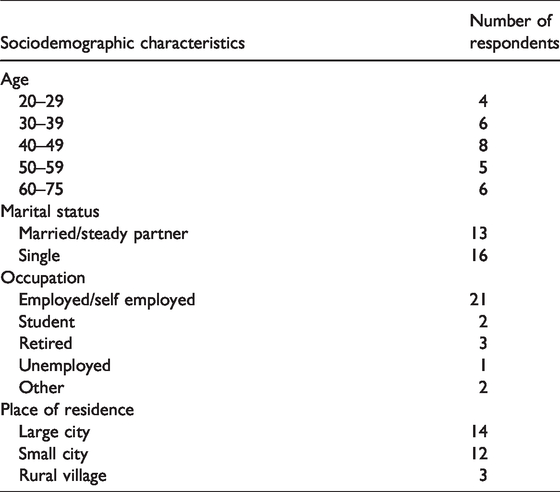
The participants had engaged in buying sex for between 1 and 30 years, and the frequency with which they did so ranged between 2 and 3 times a week and once a year. Most of the participants in the study had bought sex in different ways and had both been regulars of the same sex seller and one-time-visitors. The arenas for contact with women selling sex differed, but since most of the participants were recruited via escort sites these sites were regular means of contact used by the participants to reach sellers. Other locations of contact were brothels or sex clubs abroad, massage parlors, regular sex sites or dating sites, the street environment (abroad or, if in Sweden, several decades ago), or through friends or business associates. They all bought sex from women and one had also bought sex from transgender women. All except one had been born in Sweden and 12 had children. For an overview of the basic sociodemographic characteristics of the participants, see Table 1. The material presented in this article relates to those sex purchases that were single purchases from different people and not long-term relationships with a single seller.
Participants (n = 29)
Excitement and risk
For many of the participants, it was obvious that sexuality was an important factor in what the purchase of sex meant for them. Sexual desire, achievement and pleasure and a longing for these things, were important motives for having initially purchased sex and continuing to do so. Sexuality was present as a factor regardless of how and from whom they bought sex, but it acquired a more prominent and activity-oriented role when the meeting with the sex seller only happened once. Aspects that were highlighted by the participants included experiencing confirmation as a sexual being (and a man), obtaining an outlet for their sexual desire and feeling sexual pleasure and satisfaction. However, they also included feeling another person’s body and being close to a naked woman and seeing her enjoyment. For a few, specific sexual activities were highlighted as being important, but for most participants it was more about ‘having ordinary sex’. Martin said: … it’s not anal sex or anything advanced, it’s ordinary sex and, well, cuddling and soft sex and yes, a little socializing with these girls, so no, I don’t think it’s been significantly affected by the fact that I pay for it, no.
Aspects such as absolute anonymity also made buying sex more exciting and sexually arousing. For some, the build-up and expectation before a meeting was just as important, if not more important, than the actual encounter. Fredrik said: ‘It’s like when you do anything in life that’s exciting and fun. You build up to it a bit.’ Looking forward to something and fantasizing about it reinforced the whole experience, but also meant that it left a sense of emptiness afterwards. One participant compared it to longing to go on holiday and then the boredom of coming home after a successful trip. For many of the participants, the social norms that depict commercial sex as a forbidden area and as taboo, added to the incentive. For some of the participants, the criminalization in Sweden added to the thrill of buying sex. When asked what the thrill in buying sex was about, Fredrik said: ‘Well, to some extent it’s that it’s illegal, it’s a bit exciting to do something like that.’ Henrik put it as follows: It turns me on a little to pay as well … but maybe because it’s a bit … it’s also quite taboo to go to a prostitute and that makes it a little more exciting. … and then it’s the fact that you are committing criminal acts and hurting others, that I think is terribly hard. And it doesn’t feel … I’m not … there’s an anxiety about that as well. I don’t want to buy sex from a young girl who might be controlled by someone. No, I don’t think it’s okay. I’d like for her to be a person who does this by choice. Nothing is free in this world, of course, but I don’t want to feel that I’m using anyone. I want to pay, I can pay a lot too. I can’t really remember what felt weird, but it was something that just felt completely wrong, so I left and she got a bit annoyed. So, well, I gave her some money anyway. Well, I don’t meet any women who aren’t Swedish. After all, I only meet Swedish hobby escorts that kind of do it on the side. Because it’s illegal, I’m afraid that it’ll be someone who’s, with trafficking and so on, because it’s unregulated. The first time I went to Norway, I met someone who wasn’t Norwegian, but German. And then I didn’t think it felt good, I don’t know, it felt a bit more like, I don’t know how to describe it, it felt like quicker and more stressed. You know, this far too young girl I was with the last time, it was, well, I don’t know why I didn’t call it off and send her home. Yes, I know what happened, step by step, and it was so fucking stupid.
Several of the participants spoke about episodes when they had been drunk and had bought sex in a way that they later regretted. Buying sex while being drunk meant that the participants had bought sex in arenas or from people whom they would otherwise not buy sex from. This made them feel that they had crossed the boundaries of what they thought was morally justified. This was associated with feelings of loss of control and lack of judgment. Ulf said: It may be a prejudice of mine, but I think that the ones who usually walk the streets may have greater social problems. So, no, I have tried to avoid it, but in Norway it just happened by chance. I was far too drunk then as well, so that wasn’t good.
Trust and safety
Even if the participants had bought sex for the thrill, there was a fine line between excitement turning into unwanted danger and risk. Adding to this, the participants were not seeking completely anonymous sex with just any random sex seller. A recurrent theme in the interviews was the importance of chemistry, of trusting one’s intuition and being able to communicate fluently. Being able to communicate with each other was important for several different reasons. Firstly it was important in order to be able to agree on what activities would take place, and at what price, and to be sure that both parties were in agreement on this. Secondly, the small talk that occurred in addition to the sex was considered important in order to produce a relaxed atmosphere and for the sexual encounter not to feel instrumental. A third aspect was that communication was important in relation to being able to determine the seller’s vulnerability. Xander said: ‘but at least I have quite a good intuition, to kind of get a sense of the situation.’ Chemistry and intuition were difficult to explain, and in the interviews the discussion often ended with the participant saying ‘you just know’ or ‘it just feels right’.
The participants had several strategies for investigating the vulnerability of the seller. The participants did a lot of research before making an appointment with a sex seller in order to get a picture of who the seller was and to ensure that it was sufficiently safe for them to buy sex from that person. Ymer said: So, I’ve never just looked at an ad and then gone straight to meet the person; I’ve always talked a little first. And it’s always been … there were never any foreigners, it was always someone Swedish. I guess it’s about self-affirmation, if it feels like they want to see me, it feels better than if it’s just the money they are after.
Trust was an important factor for the participants when purchasing sex from someone they did not know. However, one of the reasons for meeting different people was to avoid the purchase of sex developing into a closer relationship. The participants described that having sex with the same person over longer periods of time made the sex boring and routine, but also more similar to a conventional romantic relationship. If the excitement and curiosity were lost, there was no longer any meaning in buying sex. Getting too close to the sex seller was also associated with a risk of developing romantic emotions and starting to care too much for each other in relation to the nature of the initial deal. In addition to the risk of emotional involvement and the fear of bonding with the sex seller, there was also the risk of disclosure. Some of the participants believed that there was an increased risk of a partner finding out or of getting caught by the police if they had a longer relationship with the same sex seller.
Balancing between excitement and trust
Present in many of the participants’ stories was the balance between excitement and trust. A sense of trust and confidence led to buying sex being perceived as not being too dangerous, but too much trust and intimacy made it boring and dangerous in other ways. A long-term relationship with the same sex seller made it feel routine, and for some it also became more difficult to ask about or try new sexual activities. Some of the participants said that when they had met a sex seller whom they did not know, their communication was more straightforward and clear, which meant that they got what they wanted but also that the agreement was clearer. Being a one-time visitor and purchasing sex from different people was perceived as more exciting, as long as they were careful to navigate in relation to risk and safety. Some of the participants likened purchasing sex to being a film director, you decide what you want and how it should be performed, but at the same time you want it to feel real and mutual. Per, who used to visit brothels in Denmark, talked about the importance of feeling welcome, of there being a cozy atmosphere and of it feeling like a human meeting with a nice woman. At the same time, it was important for Per that the brothel was well organized and safe. Per used the term ‘seeing someone in private’ to refer to his long-term relationships with sex sellers. I’m not the type who gets off on risky escapades, it’s exciting enough as it is. And there’s a big difference between seeing someone in private and having continuity in the relationship and these one-time-things. There’s an element of thrill to these one-time visits that’s quite tempting, I have to admit. You don’t really know what to expect. It’s not just the ejaculation you want, it’s kind of, well, a little snuggling and cuddling and some small talk and a fairly clear conscience afterwards as well.
Discussion
The aim of this study has been to explore how men who purchase sex navigate between commercialization and intimacy in a context where commercial sex is legally regulated and where the purchase of sex is criminalized. The participants’ descriptions of buying sex revealed a view of sexuality as something recreational and individualistic. The longing for sexual pleasure without relational commitments and the focus on excitement, thrill and curiosity may be seen as ways in which sexuality and sexual pleasure have become commercialized and commodified (cf. Bauman, 1998; Hochschild, 2012). The way the participants talked about being the director of the sexual act and getting what they ordered, is clearly in line with a view of sexual acts and sexual pleasure as a buyable service. Further, the importance of the paid sexual encounter as something exciting and driven by curiosity can be associated with Kong’s (2016) understanding of buying sex as a form of leisure edgework.
Although commercial sex may be seen as an individualistic form of recreation, the stories also show that the participants’ experiences are interconnected with relational and structural aspects that are negotiated and weighed against each other in relation to the seller. Consequently, the ways in which the participants navigate buying sex are not so easily dismissed as solely being a manifestation of the commercialization of sexual relationships. The participants attempt to navigate between their own individualistic sexual desire and pleasure, expected social norms regarding intimate relationships and Swedish social norms regarding the purchase of sex. Traditional norms regarding intimate relationships and stigmatizing views about men who purchase sex affect the participants’ relationships with women who sell sex. The stories presented in this article show that the study participants are on the one hand looking for excitement and thrills, and on the other attempting to create a sense of trust in relation to the sex seller. Further, the stories show that a certain amount of trust is crucial for the paid sexual encounter to be perceived as a manageable experience. The relational practices and strategies used by the men in the study when they purchase sex affect the meanings that intimacy in commercial relationships has for them. The participants’ stories about how they balance between thrill-seeking and safety are thus not so much about intimacy as they are about trust. This can in part be understood in relation to Bernstein’s (2007) and Sanders’ (2008) discussions of intimacy. The same is true of the desire expressed by the participants in this study that (one-off) paid sexual encounters should feel genuine and real, a form of bounded authenticity in Bernstein’s sense of the term. This longing among men who buy sex for a genuine and authentic experience has previously been linked to an increased expectation that sex sellers will engage in emotional labor (Bernstein, 2007) in order to meet this demand.
One element that is present in the participants’ stories and that extends beyond the concepts of emotional labor and bounded authenticity, is the work they do in relation to the seller prior to and during the paid sexual encounter. This work is not so much about intimacy or authenticity as it is about creating trust, or doing trust work. The trust work undertaken by men who purchase sex can be understood in relation to both relational and structural aspects of commercial sex. Some aspects are more associated with the relationship to the seller regardless of context, while others are more closely related to the Swedish context. As can be seen in the findings presented in this article, doing trust work in relation to the seller makes the purchase safe enough not to be dangerous, but not sufficiently intimate to make it boring. Trust work makes it possible for the participants to navigate between excitement, risk, safety and intimacy. Using Bauman’s (1998) frame of understanding, trust work is a way of handling two inherently incompatible roles in the search for thrills: being able to feel intrinsic pleasure (to be the body) while at the same time keeping one’s distance and maintaining sober judgments (being the owner of that body). Further, by doing trust work when buying sex, the participants in the study are able to maintain a self-image in which they are good people. Doing trust work in relation to the sex seller can be seen as a way to handle the normative views in Sweden of commercial sex, oppression and gender. By creating trust in relation to the seller, the participants are able to maintain distance between themselves and the stigmatized image of the sex buyer. Even if the main reason for purchasing sex is thrill, the way trust work is done in the relationship with the seller may be viewed as a way in which the participants are navigating different norm systems. Viscous norms regarding love, intimacy and companionship (van Hooff, 2013) affect the participants in such a way that they do not want to purchase sex without aspects such as trust and chemistry being present. This is intertwined with Swedish political norms, which regard the purchase of sex as a form of oppression. The Sex Purchase Act per se was not of major significance for their engagement in commercial sex, but prominent in their stories was how normative ideas about gender equality and male oppression affected their attitudes to commercial sex. The participants are preoccupied with a concern about being men who oppress women, and they develop different relational strategies to make the paid sexual encounter feel safer and more morally justified, both for themselves and for the seller, engaging in a quest for a more ideal sex purchase.
