




Abstract
This article reports the findings of a qualitative and quantitative study of seemingly aggressive but inherently benevolent humorous jibes that involve the sexualisation of women in the RoastMe practice performed by a growing social media community on Reddit. Based on a corpus of jocular insults, six forms of sexualisation comments are proposed: hyper-sexualisation, de-sexualisation and meta-sexualisation, each concerning the female body or practices. We account for the distribution of these categories, offering conclusions about humour and sexist ideologies, which RoastMe insults jocularly echo. Although the RoastMe community operates with a humour mindset, producing and recognising sexualisation jibes as a playful activity within a humorous frame, RoastMe insults speak volumes about the contemporary sexist ideologies and the salience of sexuality as a topic arbitrarily invoked in humour performance.
Introduction
The abundance of human interactions online has inspired a plethora of relevant studies investigating gender and sexuality (see Carter et al., 2013; Marwick, 2013). Social media platforms have created new venues for copious amounts of sexist and/or misogynist discourse (see e.g. Anderson and Cermele, 2014; Bou-Franch and Blitvich, 2014; Dynel and Poppi, 2020b), which reflects prevalent gender ideologies (Davis and Greenstein, 2009). These ideologies, i.e. collectively shared belief systems (van Dijk, 2006), represent and affect society members’ conceptualisations and evaluations of gendered behaviours.
Gender ideologies are also sought in sexist humour, which is often thought to seriously – rather than jocularly – disparage women and reinforce negative stereotypes about them (Bergmann, 1986; Kotthoff, 2006; Shifman and Lemish, 2011). The recent discussions of rape jokes, a salient manifestation of sexist humour, defend the generalising claim that these jokes promote patriarchal ideology and deny their negative implications (Pérez and Greene, 2016) or legitimise sexual violence towards women (Lockyer and Savigny, 2019). However, the sociological studies that are not evidently biased towards the feminist perspective rightly point out that jokes (and humour in general) should not be judged generically at face value, based only on their content; instead, they must be addressed within their micro- and macro-context, thanks to which even rape jokes may be considered amusing and ideologically innocuous (see Kramer, 2011). This also ties in with the argument that people’s ‘play’ with aggression (as opposed to genuine aggression) central to – at least – some forms of humour does not denote genuine hostility (Davies, 1990, 2002).
The present article contributes to this debate by focusing on RoastMe, an interesting online phenomenon standing at the crossroads of purported language aggression and humour, which includes a potentially sexist component. RoastMe centres on trading creative jocular insults hurled at individuals who have willingly submitted their pictures for (good-willed) roasting, a type of humorous activity performed for its own sake. When targeted at women, RoastMe insults, as is shown here, may rely on several forms of sexualisation, which humorously and playfully echo (but do not necessarily endorse) prevalent sexist ideologies. The central objective of this study is to examine the forms and frequencies of sexualisation jibes among RoastMe insults and to discuss the socio-cultural workings and implications of this humorous activity.
This article is divided into six sections. Following this introduction, the next section presents the background literature on the sexualisation of women online. The third section gives a description of RoastMe and anticipates the purpose of the current enterprise. In the fourth section, we present the methodology of the study, which is depicted in the fifth section, encompassing both qualitative and quantitative findings on sexualisation comments. The article closes with a discussion and concluding remarks about the sexualisation-based humorous jibes.
Sexualisation of women
It is women rather than men who are more often subject to sexual representation through sexualisation and objectification (Ganahl et al., 2003; Messineo, 2008). Both traditional and new media often portray women in a sexualised manner or as sexual objects (Ward, 2016) to get people’s attention by activating sexual associations (Gill, 2008; Lazar, 2006). Even though the terms ‘sexualisation’ and ‘objectification’ are sometimes used interchangeably in the literature, they should be seen as different, albeit potentially overlapping, notions (cf. Goldenberg, 2013). The term ‘sexualisation’, used in a variety of ways (see Gill and Donaghue, 2013; Jordan and Aitchison, 2008; Pellizzer et al., 2016; Smith and Attwood, 2011), refers to ‘the use of sexual attributes as a measure of a person’s value and worth’ (Papadopoulos, 2010: 24). Sexualisation often involves paying attention to women’s appearance, notably sexual features, and expected desires by implying their sexual readiness (Morris and Goldenberg, 2015). On the other hand, objectification can be defined as the representation of a person, here a woman, as an object of others’ sexual desires and an exchangeable source of satisfaction (Fredrickson and Roberts, 1997; Langton, 2009; Nussbaum, 1995, 1999).
The sexualisation of women is sometimes seen as being conducive to objectification (Evans et al., 2010). For instance, the studies conducted by Glick et al. (2005), Johnson and Gurung (2011) and Quinn (2002) show that sexualisation has the potential to objectify women and decrease their sense of agency in the workplace, particularly when women present themselves in sexually provocative ways that reduce their perceived expertise and competence. As a result of sexualisation and objectification, also in the form of self-objectification, women get used to being evaluated based on their appearance and perceive their bodies as commodities to be looked at and consumed by others (Fredrickson and Roberts, 1997).
Many studies adduce ample evidence that sexualisation of women’s images has intensified over the last few decades (e.g. Attwood, 2006; Hatton and Trautner, 2011; Kammeyer, 2008; see Tiggemann, 2011 for a review), and social media play a significant role in this process, having an impact on people’s construction of gender roles and sexuality (see Davis, 2018). The use of platforms such as Facebook and Instagram puts physically attractive peers in the limelight and stimulates self-objectification and extortionate self-criticism (Vandenbosch and Eggermont, 2016). The increasingly sexualised new media images are also linked to teenage users’ growing promiscuity and propensity for casual sex (van Oosten et al., 2017) and to the perpetuation of the rape culture via the celebration of male sexual conquests or via slut-shaming (Sills et al., 2016).
Moreover, on new media, women’s sexuality is sometimes flaunted (Griffin et al., 2013), with the communications being characterised by hyper-sexualisation, that is, ‘the combination of a multitude of sexualized attributes—body position, extent of nudity, textual cues, and more—the cumulative effect of which is to narrow the possible interpretations of the image to just, as de Beauvoir (1949) wrote, “the sex”’ (Hatton and Trautner, 2011: 257). In opposition to hyper-sexualisation, de-sexualisation represents an attempt to lessen the degree of body objectification and body surveillance (Kaminski and Hayslip, 2006; cf. Wouters, 2010). Additionally, it is a way for women to develop strategies to gain acceptance in contexts such as the workplace (see Omair, 2009). Although de-sexualisation may be orientated towards a willing emancipatory escape from hyper-sexualisation, it can also refer to uglification, whereby an individual is deliberately perceived as unattractive, so that his/her sexual undesirability is stigmatised (Synnott, 1990).
What we wish to show here is that sexualisation (and hence, hyper-sexualisation and de-sexualisation) can be manifest in verbalisations and reflect dominant gender ideologies (see Attwood, 2006; Wouters, 2010), which are ingrained in people’s minds but are not necessarily seriously endorsed while being jocularly replicated. Moreover, we propose that verbal sexualisation, based on the attribution of sexual features to women, can take three different forms which we propose in the light of the RoastMe data: ‘hyper-sexualisation’ and ‘de-sexualisation’, both embedded in the previous literature presented earlier, as well as ‘meta-sexualisation’, which we add to the two categories of sexualisation. Each of the three may concern the female body or practices. This is the point of departure for the present study on sexualisation comments in the humorous online practice of RoastMe.
Introduction to RoastMe and sexualisation jibes
RoastMe is a social media spin-off of the roast, the traditional American ritual of hurling jocular insults. It is widespread not only in the USA but also in other countries, popularised by television and YouTube broadcasts. A roast is a humour-oriented interaction in which one or more individuals is/are subjected to ritual insults, i.e. benevolent humorously disparaging jibes, produced by roasters for the sake of collective humour experience, including the roastee’s (see Dynel and Poppi, 2019, 2020a). Even though these jibes purport to be aggressive, they are inherently free from spite and genuine aggression and are not intended to cause offence. The traditional roast has given rise to the RoastMe practice on social media (see Dynel and Poppi, 2019, 2020a).
The RoastMe practice was introduced in April 2015 on Reddit, an international platform that thrives on user content and encompasses almost 2 million subreddits (Reddit metrics, n.d.), each of which is devoted to an independent discussion topic and/or communicative practice that its members pursue (see e.g. Robards, 2018). As evidenced by roastees’ pictures and self-descriptions alone (based on our three-year ethnographic observation), a qualitative conclusion can be drawn that the RoastMe community is diversified, spanning various nations, ethnic groups and age ranges (although roastees must be of age), and it also cuts across genders and sexual orientation types. By October 2019, the subreddit had gained over 1.5 million community members (subscribers), and the top Roasts had reached more than 43,000 upvotes and more than 4,300 comments.
An online Roast commences with a roasted post comprising a roastee’s picture and its title, which may provide some extra information about the roastee (see the two examples in Figure 1). The roastee is duly pelted with jocular insults, i.e. roasting posts, followed by upvotes/downvotes and further comments. All RoastMe community members (i.e. active signed-in users) must follow a few rules provided on the subreddit (see the list in the bottom right-hand corner in Figure 1), with user content being scrutinised by moderators. Importantly, a roastee must explicitly grant his/her consent to be roasted by bearing a clear ‘/r/RoastMe’ text in the voluntarily posted picture, which needs to present his/her face with no use of Photoshop. At the same time, while publicising their faces, roastees must remain anonymous and share no self-identifying details that could help other users to trace their identity or location. Roasters, on the other hand, cannot do ‘hating’ or ‘bullying’; instead, they should aim to make ‘an audience laugh’ by means of creative jocular comments (cf. the ‘unfunny abuse’ and ‘don’t be evil’ rules). What is pertinent in the context of the present study is the ‘Inappropriate flattery rule’, according to which fishing for compliments is not allowed; nor is flirting with a view to prospective dating.
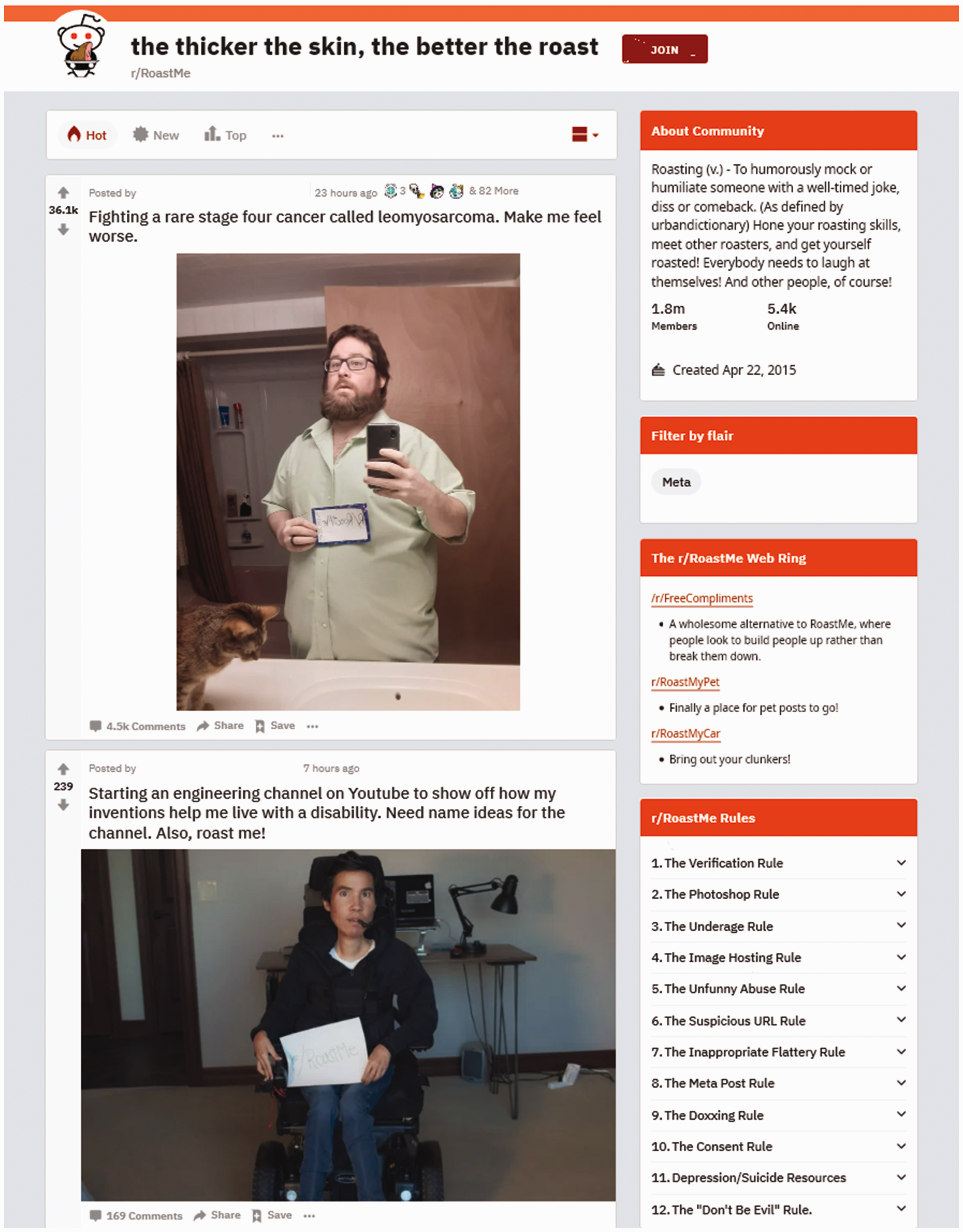
Print-screen of the main page of the subreddit (captured 20 February 2020).
The academic outsider (and thus etic) interpretation of RoastMe must be informed by the users’ emic understating (on the distinction, see Pike, 1990), that is the online community’s negotiated implementation and recognition of the nature of their interactional goings-on. 2 Essentially, sharing ostensibly aggressive humour in good faith is the primary reason for the functioning of the RoastMe community of practice (cf. Eckert and McConnell-Ginet, 1992; Lave and Wenger, 1991). As the notion of the community of practice presupposes, its members are oriented to their joint enterprise, which is the sharing of autotelic humour (humour for its own sake), the practice in which they are willingly engaged both as roasters and roastees, and so no one is (supposed to be) offended (see Dynel and Poppi, 2020a). This is why the many members of the RoastMe community of practice operating on the relevant subreddit need to be cognisant of the underlying rules and follow them, monitored by moderators and one another so that any posts that do not respect the rules are deleted.
Similar to ritual or jocular insults performed in face-to-face interactions, epitomised by the classical notions of ‘sounds’ or ‘dozens’ (e.g. Abrahams, 1962; Dollard, 1939; Labov, 1972), RoastMe insults are a ritual enacted by anonymous online community members. These insults are not intended to disparage or offend the targets but serve collective humour experience based on the competition of wits (Dynel and Poppi, 2019, 2020a). This effect is attained, as evidenced by upvotes and positive metapragmatic evaluations. RoastMe is predicated on the community’s joint agreement that they are engaged in an autotelic humour-oriented practice performed within a humorous frame (see Dynel, 2017 and references therein) based on a tacit ‘this is play’ metamessage that also holds for aggressive behaviours whose aggressiveness is not meant but rather overtly pretended (Bateson, 1956). In cognitive terms, to appreciate this humour, users operate within a paratelic mode (Apter, 1991) or play mode (Morreall, 2009) and with a humour mindset (Ford and Ferguson, 2004; Gray and Ford, 2013), thanks to which ‘serious’ thinking, logic or moral principles are abandoned or, at least, suspended (cf. Mulkay, 1988).
Taken collectively, 3 RoastMe jibes should not be considered to carry any ‘serious’ meanings about roastees, being bona fide comments made in jest, regardless of what the jocularly disparaged referents of the jibes may be or what inspires them. In other words, the topics of disparaging comments seem irrelevant for the community, as roasters’ central goal is solely to show their wit and amuse other community members with new creative jibes. Still, these jibes need to centre on some meanings somehow inspired by roastees’ posts.
With no personal knowledge of roastees at their disposal, roasters seek inspiration for the ‘referents’ of ritual insults, i.e. the specific features that are jocularly disparaged, in the anonymous roastees’ posts, primarily pictures (Dynel and Poppi, 2020a). The referents of insults most typically coincide with the salient features of roastees (their looks or artefacts on display) or other recognised characteristics manifest in roastees’ pictures or self-descriptions. On the other hand, less frequently, roasters attribute to roastees features that cannot be rationally verified based on the evidence at hand (Dynel and Poppi, 2020a). This recognised feature vs attributed feature dimension is pertinent also to RoastMe jibes addressing the issues of sexuality, which may be – as this study aims to show – the jocularly disparaged referents or background components of creative jibes.
Here are four random examples (all publicly available, found through a Google search) of roastee pictures with cherry-picked roasting posts, presumably considered very funny by the reposting users (see Figure 2). 4 These examples are meant to illustrate the mechanics of RoastMe jibes and anticipate the topic of the current analysis of sexualisation-based insults.
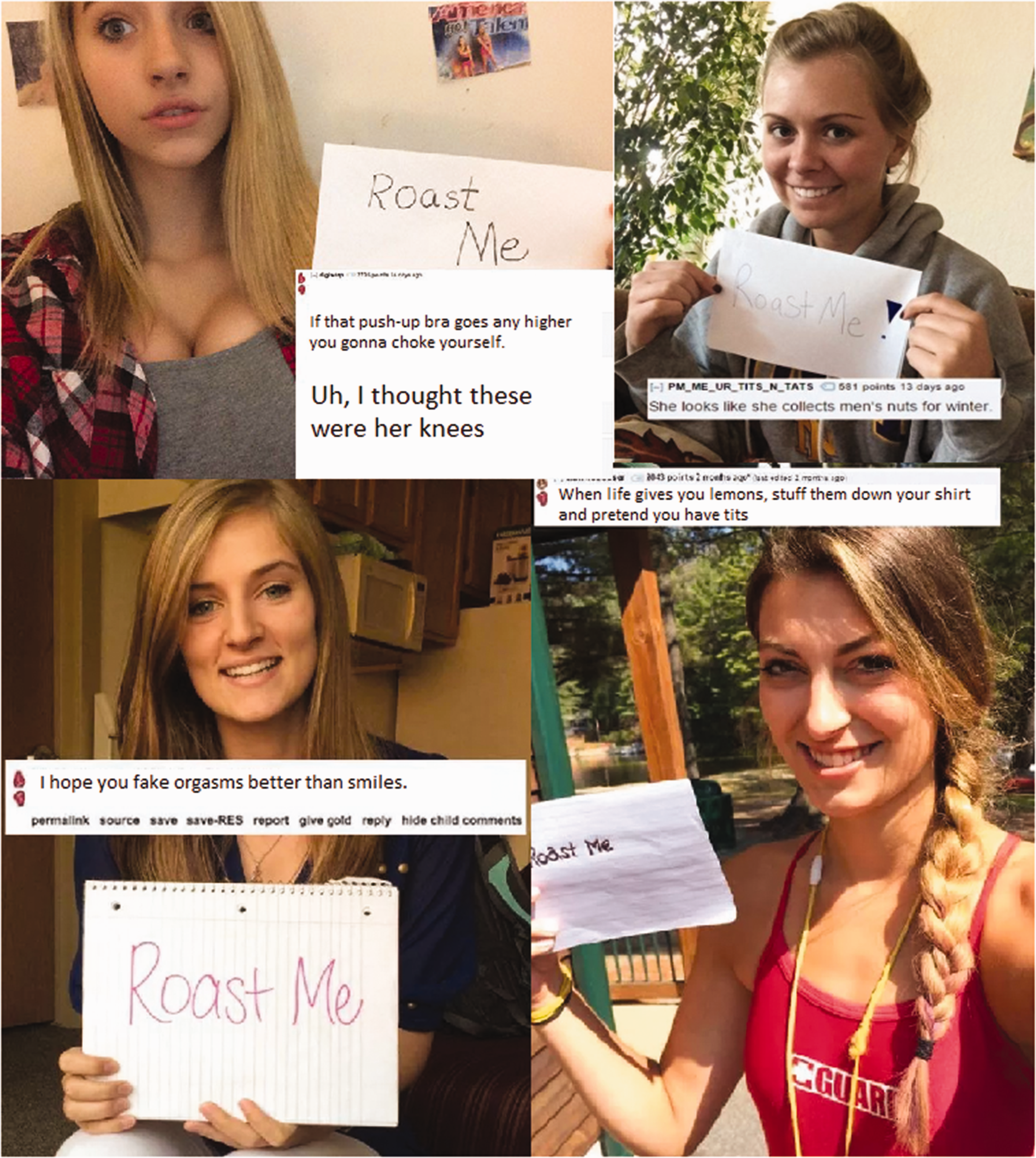
Examples of women’s roasted posts and isolated roasting comments.
The first young woman (top left) has been jocularly disparaged with reference to her recognised sexual feature; her exposed generous cleavage is thus subject to a humorously absurd hyper-sexualisation insult. The roasting jibe targeting the second woman (top right) takes as its point of departure her similarity to a squirrel (presumably due to her facial features) and, based on a pun, attributes to her some absurd sexual practice involving male organs. Commenting on the third roastee’s fake smile (a recognised feature as the referent) and making use of the readily available collocation, a roaster invokes the idea of her alleged sexual practice. Finally, the female lifeguard (bottom right) has earned a de-sexualisation comment, couched in a distortion of a saying, on her body part (breasts below the average size), a recognised feature which the roastee has displayed through wearing her workplace outfit.
Sexualisation comments, especially when divorced from anything that can be extrapolated from the roasted posts, do speak volumes about what reigns supreme in the roasters’ minds, namely the topic of sexuality. Even if these roasters act in good faith for the sake of shared amusement and cannot be regarded as intentionally communicating any serious meanings about female roastees, they appear to be tacitly echoing some sexist ideologies. A question arises as to how and how often they do this.
Data collection and annotation procedures
The primary objective of the present study is to explore the types and frequency of sexualisation comments about female targets made ‘in jest’ by RoastMe users. The Roasts and, most importantly, roasting comments, used as the corpus data for this investigation were culled from the RoastMe subreddit (Reddit, n.d.). This study follows the common ethical practice in social-media research by deploying data that are made publicly available by the users themselves and that are fully anonymous (as required by RoastMe rules for users) and have been accessed without signing in (see Townsend and Wallace, 2016).
For the present purposes, we arranged and viewed Roasts on the subreddit according to the ‘Top’ criterion, i.e. depending on the level of users’ engagement, choosing the ‘of all time’ temporal factor. Going from the beginning of the list, we selected only female roastees’ Roasts. Thus, we compiled a representative corpus comprising the Top 100 most amply commented female targets with the highest number of upvotes (of jibes) since the creation of the RoastMe subreddit community. 5 In the span of 17 days (between 25th May and 10th June 2019), when we managed to build the corpora of Roasts and roasting jibes, the Top 100 Roasts of female targets remained the same. Nonetheless, it needs to be pointed out that online data are constantly in a state of flux, and the list must be different at the time this text is being read. The top roastees were diversified and did not show any evident similarity patterns, especially such that might affect the study at hand. Thus, selecting the Top criterion led us to a randomised list of Roasts (with no arbitrary imposed criterion or researcher bias that we might have unwittingly introduced by picking ‘random’ examples manually), while at the same time securing a sufficient number of independent comments.
We duly compiled the Top 10 roasting comments in each of the 100 Roasts. Again, these are the comments with the highest number of upvotes, awards and replies, and hence the ones considered to be the best, i.e. the most creative and the funniest, by the online community. Starting from the top comments in each selected Roast, we extracted solely autonomous roasting jibes, excluding any user comments that did not involve roasting (e.g. posts evaluating preceding jibes, a given Roast or the subreddit, taken as a whole) and replies to previous comments (again, typically evaluating the preceding post, or – if roasting – usually based on the same referents as the comment replied to, which is why adding them to the corpus would have limited the spectrum of referents and skewed the results about sexualisation). This procedure yielded the initial corpus of 1000 items. Evaluated as the most amusing by the community (at the time of data collection), these jibes represent a solid sample of roasting comments for the purpose of the study at hand, based on which some conclusions can be extrapolated about humour-oriented sexualisation, a taboo topic which may be seen as a concomitant of humour.
For the sake of the internal reliability of the results, all the annotation tasks were performed manually by two competent coders, the two investigators, who evaluated the data independently. First, the investigators extracted all the comments that presented some reference to sexuality (whether or not as the central jocularly disparaged referent of the jibe) and compared the results. The initial inter-coder reliability for this stage of coding was determined to be 95%. We duly discussed the mismatches, deleted false positives (mainly comments that used polysemous words that could have sexual meanings, but were used in non-sexual senses) and completed omissions until reaching an agreement on the list of sexualisation posts (n = 285).
Second, these corpus data were analysed independently by the two co-investigators based on classificatory categories established jointly through a grounded theory approach. Although the types of sexualisation discerned for RoastMe jibes never appeared jointly in any previous work, we have tried to seek similar notions in previous research in order to describe our data better (cf. section ‘Sexualisation of women’). While ‘hyper-sexualisation’ encompasses jibes that emphasise sexual features, the ‘de-sexualisation’ category captures remarks in which sexuality is addressed but is minimised or even denied. We also suggest the notion of ‘meta-sexualisation’, a residual category that includes a sexuality-related component but serves neither de-sexualisation nor hyper-sexualisation. These three sexualisation categories are sub-divided depending on whether the jibes refer to body parts or practices.
The proposed sexualisation categories proved exhaustive of the entire dataset and guaranteed the saturation of description of the pertinent sexualisation jibes within and beyond the corpus as well. The inter-coder reliability for the annotation of the corpus of the 285 roasting posts was found to be 78%; the doubt-provoking jibes (n = 63) were discussed so that an agreement on their qualification could be reached in each case. In the last stage of the annotation, we divided roastees into those who display (presumably, deliberately) their sexual features (n = 10) through self-sexualisation (see Choi and DeLong, 2019 and references therein) and those who do not (n = 90). No roastee in the corpus can be considered to perform de-sexualisation. This roastee division was done in order to examine the relationship between the presence/lack of roastees’ recognisable sexual features purposefully shown in the pictures (low cleavage or a tight blouse exposing a woman’s breasts) 6 or presented in the titles (admission to sexual practices or activities) and the resulting sexualisation comments. The annotation result in this stage of the study was reached unanimously.
Owing to the categorical nature of the analysed data, Pearson’s chi-square, and Fisher’s exact tests were used to corroborate statistical significance, while Cramer’s V was applied to assess the effect size in the statistical analyses.
The analysis in the next section is presented in two sub-sections. In the qualitative part, the rationale behind the annotation procedures is presented, together with the nature of the data, i.e. the categories of the sexualisation jibes. The quantitative analysis concerns the distribution of the different categories of sexualisation jibes.
Analysis
Qualitative analysis of RoastMe jibes
The analytic categories obtained through a grounded theory approach are based on three dimensions of sexualisation: hyper-sexualisation, de-sexualisation and meta-sexualisation, each bifurcating into those concerning specifically body (parts) and practices. As regards the primary tripartite division proposed here, the ‘hyper-’ category captures jibes boosting roastees’ sexuality, whereas the ‘de-’ category encompasses jibes in which women’s sexuality is minimised. Finally, the ‘meta-’ (i.e. ‘beyond’ or ‘after’) category concerns the residual cases where sexualisation is invoked, but neither of the previous two applies. Adopting the two criteria, we have arrived at six categories of sexualisation RoastMe jibes: Hyper-sexualisation of body (parts) (HS – Body) De-sexualisation of body (parts) (DS – Body) Meta-sexualisation of body (parts) (MS – Body) Hyper-sexualisation of practices (HS – Practices) De-sexualisation of practices (DS – Practices) Meta-sexualisation of practices (MS – practices)
It needs to be pointed out that the body and practice aspects are often interdependent (sexual practices rely on the perceived physical attractiveness and vice versa), but we have tried to tease out the specific foci of sexualisation in the annotation process, as the following examples will illustrate. Jibes may roast bodily features while explicitly mentioning practices (as in examples 2, 10 and 12). On the other hand, jibes may target practices (allegedly) consequent upon chosen aspects of women’s appearance, which are pointed out (as in examples 5 and 15). Since RoastMe jibes are most often inspired by pictures (and not self-descriptions), whether or not roastees’ looks are explicitly referred to, they typically offer inspiration for comments about practices, with the associations being very often far-fetched or impossible to detect.
The hyper-sexualisation of body (parts) encompasses the jibes that depict sexually loaded body parts (notably, breasts, as in examples 1–3) or the entire female body (4) as the object of sexual desire, representing the commonly understood markers of sexual attractiveness (e.g. Dagnino et al., 2012; Dixson et al., 2011; Franzoi and Herzog, 1987).
‘That’s not cleavage it’s the Silicon Valley’ (about a woman exposing her large breasts, possibly enhanced through cosmetic surgery). ‘Tits of a porn star and face of a Pawn Star’ (about a buxom young woman). ‘That shirt really draws the eyes away from your lack of personality’ (about a buxom woman showing her cleavage). ‘Wow! You look like one of those real love dolls! Well done! Even down to the waxy complexion’ (about a woman with smooth glistening skin).
Similar to body hyper-sexualisation, hyper-sexualised practices concern the various sexual activities, whether or not normative (Renold and Ringrose, 2013), jocularly ascribed to female roastees, such as involvement in pornography (5) or prostitution (6–8), which amounts to slut-shaming (see Jane, 2017; Webb, 2015), albeit jocular.
5. ‘She looks like a girl that did porn once during her rebellious stage’ (about a young woman with heavy eye make-up and a nose piercing). 6. ‘You look like I could tip you with Lucky Strikes and pregnancy tests’ (about a woman in a death metal T-shirt, who says she has three jobs in the service industry). 7. ‘Failing grade 12 twice? That’s a nice way of saying “I’m gonna be a prostitute soon”’ (about a young woman who admits to having failed grade 12 twice). 8. ‘No Google, I said show me my horoscope not whores named Hope’ (about a young woman wearing glasses who presents herself as a university student).
The mirror reflection of hyper-sexualisation is de-sexualisation, which pictures women as lacking in, or being devoid of, sexuality. The de-sexualisation of the body or body parts is tantamount to body-shaming (Andrew et al., 2015; McDonnell and Lin, 2016) performed in the jocular context. Thus, roastees can be jocularly disparaged with regard to small breasts (9), general lack of sex appeal (10) or female features (11), and looks verging on masculinity (12).
9. ‘Why are you wearing a bra?’ (about a skinny woman). 10. ‘Drunk at 3AM and still nobody willing to come fuck you?’ (about a woman who presents herself as drunk at a party at 3 am). 11. ‘In today’s episode of Identify The Gender…’ (about a woman with a strong jawline). 12. ‘I assume your boyfriend usually cries when your penis goes in’ (about a young woman with no make-up and nose-piercing).
Likewise, RoastMe jibes involving the de-sexualisation of practices rely on denying female roastees’ prototypical heterosexual activities. This may involve, for instance, lack of fellatio skills (13), and even lack of flair at a sex-related profession (14), as well as virginity (15) or involuntary celibacy (16).
13. ‘You look like sober guys would fall asleep during your blow jobs’ (about a solemn-looking woman). 14. ‘“Do your thing I guess” – what most of your customers reluctantly say’ (about a woman who presents herself as a stripper). 15. ‘That is the face of someone who lost everything. Everything but her virginity.’ (about a young woman with no make-up). 16. ‘I didn’t realise female incels existed’ (about a young woman with glasses, braces and no make-up).
The category of body (parts) meta-sexualisation centres on topical references without any specific sexualisation ascribed to the roastee. For example, a roastee’s sex organs may be mentioned when a non-sexual feature is jocularly disparaged (17) or when such a feature is compared to the roaster’s sex organs (18) or metaphorically represented through a female organ (19).
17. ‘Do I insert a quarter in your vaginal crease to play pinball with your eyebrows?’ (about a woman with pencil-drawn eyebrows slanting towards the nose). 18. ‘Those eyebrows are messier than my pubic hair’ (about a woman with bushy eyebrows). 19. ‘Her nose’s camel toe is showing’ (about a woman with a marked septum).
By the same token, the meta-sexualisation of practices entails invoking, for instance, the idea of masturbation (20), having intercourse (21) or fellatio experience (22) without any hyper- or de-sexualisation interpretations. These activities are casually mentioned in a non-evaluative manner.
20. ‘Do you masturbate with only one hand so you can moan with the other?’ (about a roastee who presents herself as ‘deaf’). 21. ‘You look like you’d be so annoying after I trick you into having sex’ (about a woman who presents herself as a major in psychology with a Turkish background). 22. ‘The smartest thing that ever came out of your mouth was a penis’ (about a woman who claims to be ‘unroastable’).
What is evident from this sample analysis is that the various forms of sexualisation are amenable to consideration along three axes: hyper-, de- or meta-sexualisation; practice or body part/the body; and an attributed or recognised feature.
The hyper- and de- and meta-categories cut across overall positive/negative evaluations and beliefs that individuals may have outside RoastMe. In this playful practice, all sexual features are amenable to humorous disparagement in line with popular sexist ideologies (e.g. both small breasts and silicone breasts are subject to criticism). However, people’s genuine evaluations are individual and depend on many variables (e.g. gender, morality or idiosyncratic preferences), as is the case with people's perceptions of cleavage exposure. The same problem concerns practices such as celibacy and virginity or pornography and promiscuity, all of which can be disparaged for humorous purposes. Moreover, the sexualised feature (the body part or a practice) that is mentioned need not be the referent of a RoastMe jibe, as is the case with the backhanded compliments based on the juxtaposition of attractive sexual features and an unattractive face (2) or personality (3).
While most sexualisation references, especially to practices, are activated based on no evident rationale or on some unfounded folk associations (e.g. no make-up as an indication of virginity or celibacy), other ones seem to be consequent upon what roastees make manifest in their pictures or, much more rarely, titles. What is worth examining qualitatively is then the distribution of sexualisation jibes relative to roastees who do self-sexualisation (whilst not accounting for other recognised features).
Quantitative analysis of RoastMe sexualisation jibes
The quantitative findings presented in this section are statistically significant [Pearson’s χ2 (2) = 80.35, p < .0005] with a strong effect size [Cramer’s V = .531]. The fact that comments involving any form of sexualisation (n = 285) constitute as much as 28.5% of the general corpus of all jibes (n = 1000) testifies to the prominence of the sexualisation topic, validating the worthiness of the current research project. Even though less than one-third may be considered not too high a result from a statistical perspective, this number is still significant, especially given that most roasters introduce this topic at whim. This is because only 10 roastees in the corpus (n = 100) exhibit self-sexualisation, and hence recognisable sexual features, increasing the salience of the topic for roasters. However, the latter do not need to make use of it, which the current results show as well (see Figure 4).
As regards the relevant corpus of jocular insults (n = 285), the prevailing sexualisation comments concern practices (n = 181), with body sexualisation jibes being in the minority (n = 104), as represented by the shades of blue and red respectively in Figure 3. This distribution of the two primary categories appears to stem from two facts. First, sexualisation comments about practices may be performed with no visually perceptible motivation in roastees’ pictures, which take visual priority in RoastMe (Dynel and Poppi, 2020a), or verbal validation present in Roasts’ titles. Essentially, practices are more abstract and do not unequivocally manifest themselves in women’s appearance, which is why they can be easily attributed to them and sometimes loosely associated with the women’s appearance, albeit not self-sexualised. Second, utterly unsubstantiated sexualisation comments about female bodies would go against the grain and might not stand a chance of being considered amusing, being baffling instead.
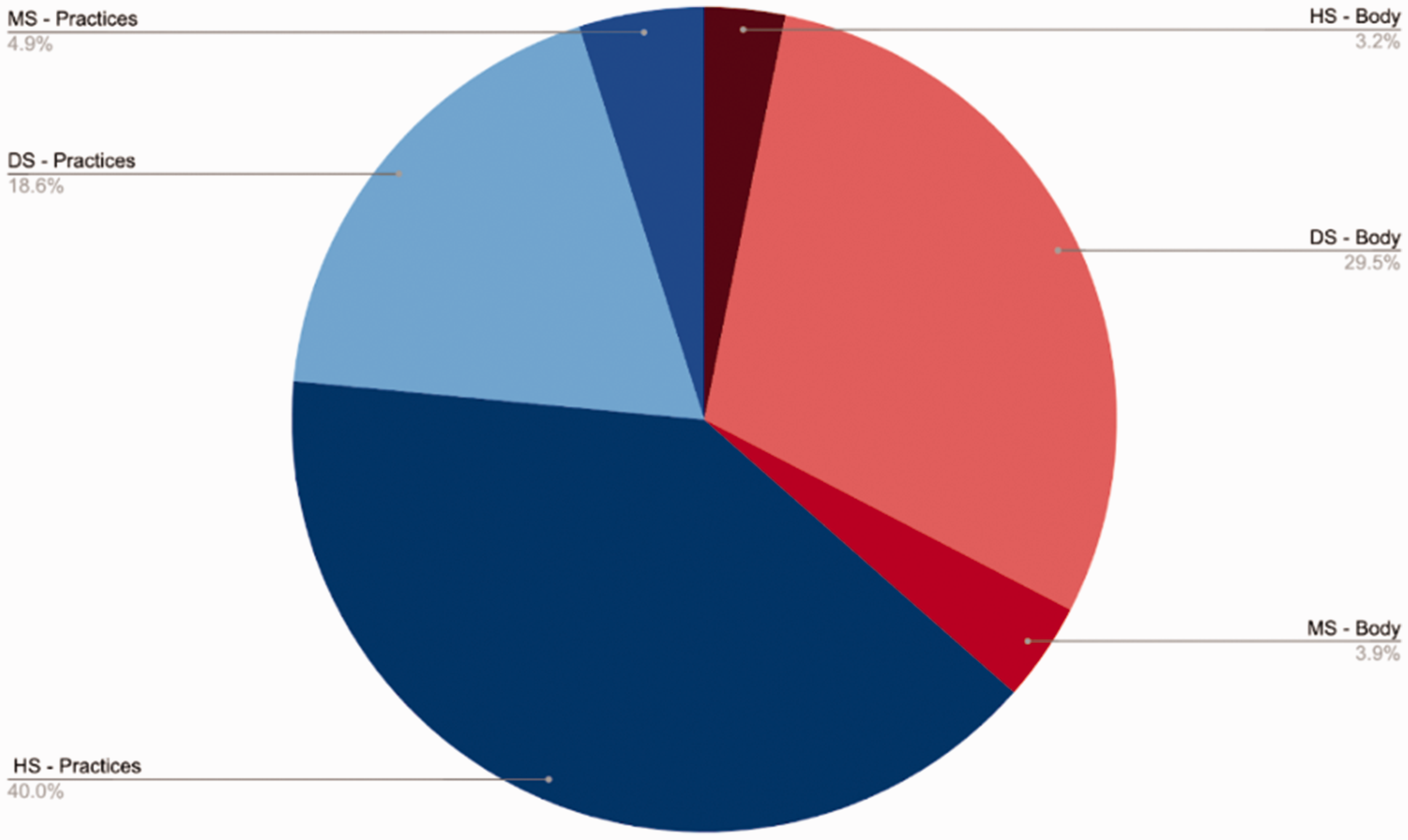
Distribution of hyper-sexualisation (HS), de-sexualisation (DS) and meta-sexualisation (MS) jibes about roastees’ practices and body (parts).
For both the body (n = 11) and practices (n = 14), meta-sexualisation seems to be a marginal category. However, the very presence of this category indicates that roasters can easily nurture sexual thoughts and make sexualisation comments, while passing no sexuality evaluations about female roastees.
Among the jibes involving body sexualisation, de-sexualisation is the dominating category (n = 84). This is because (a part of) a female body can easily become the jocularly deprecated referent of a jibe whenever it diverges from the epitome of female beauty in terms of facial features or silhouette. On the other hand, the much rarer hyper-sexualisation (n = 9), which might be regarded as praise, tends to involve more complicated stylistic and rhetorical procedures so that it can serve roasting. For example, a jibe can implicate a compliment about a roastee’s sexuality, while simultaneously criticising her, for instance, for exposing it or for it being artificially induced, or using a different feature as the roasted referent.
By contrast, as regards the jibes revolving around practices, hyper-sexualisation (n = 114) eclipses de-sexualisation (n = 53). Although both categories of jibes may involve sexuality-independent referents of jocular disparagement, hyper-sexualisation can be a form of stronger (jocular) criticism than de-sexualisation, indicative of the dearth of sexual activity. Hyper-sexualisation encompasses a wide range of sexual activities which are stigmatised when performed by women and which – albeit ultimately pleasure-giving to men – are commonly frowned upon in the dominant sexist ideology based on double standards (see e.g. Poppi, 2019; Sagebin Bordini and Sperb, 2013 and references therein).
These general findings are all the more interesting when the dimension of attributed vs recognised sexuality features is considered. Figure 4 presents the relationship between the presence of recognisable sexual features in the picture or title displayed by roastees and the resulting sexualisation comments. It should be noted that there may be different relationships between the recognised feature and the type of sexualisation of practice or the female body in RoastMe jibes; primarily inspired by a sexual feature, roasters may produce sexualisation comments about the relevant feature or a different one, cutting across the body vs practice division.
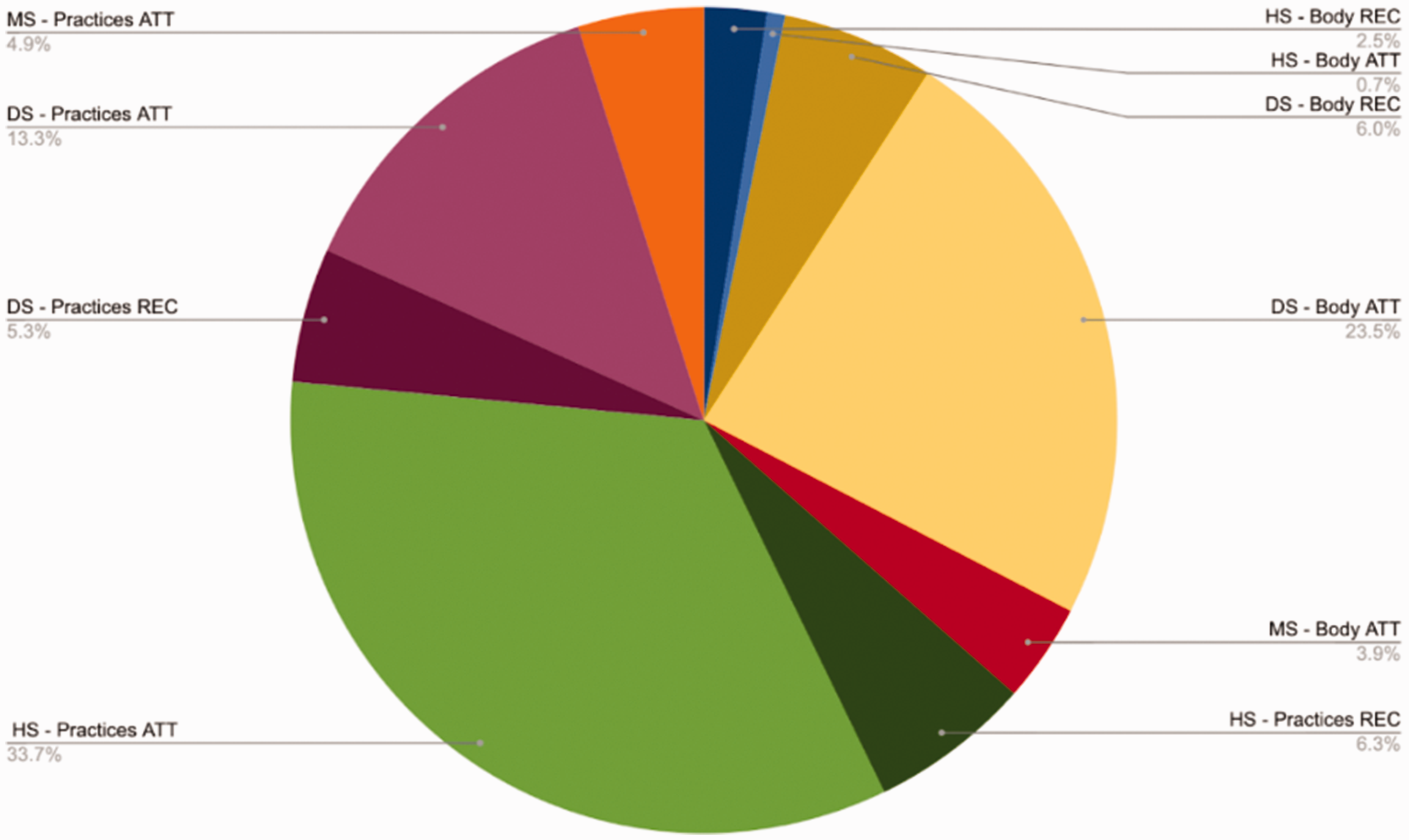
Distribution of hyper-sexualisation (HS), de-sexualisation (DS) and meta-sexualisation (MS) jibes about roastees’ practices and body (parts) with the attributed (ATT) vs recognised (REC) sexualisation division.
The 285 sexualisation comments are significantly different in terms of recognised and attributed sexuality features (Fisher’s exact test, p < 0.0005). Only 57 sexualisation comments (20%) in the corpus of all sexualisation comments (n = 285) may be considered to be somehow invited by the roastees displaying recognisable sexuality-related features (n = 10). Only these 10 out of the 100 female roastees in the corpus make some aspects of their sexuality overtly manifest, potentially inviting sexualisation comments (in 7 cases through exposing their breasts thanks to a tight blouse or low cleavage, and in 3 cases admitting to their jobs in adult entertainment or teenage pregnancy, indicative of unprotected sex at a young age). However, it is not the case that the actual sexualisation comments for the 10 roastees are the expected overwhelming majority in this part of the corpus of jibes, with only 57% of the potential space being exploited. Even though this is more than a half, this score is not strikingly high given the salience and interest that sexualisation may hold. Theoretically, the 10 self-sexualising roastees could have invited a total of 100 sexualisation comments. This is another indication of roasters’ arbitrary decisions on how they formulate their creative, humorous jibes, i.e. they can ignore evident sexuality.
The distribution of sexualisation jibes within the recognised category is neatly presented in Figure 5. It is not surprising that meta-sexualisation comments of either type (n = 0) are absent in reference to the 10 roastees manifesting sexualisation features; it seems that roasters – if at all – prefer to make use of the sexual features on display, rather than only tangentially invoke others. Additionally, even though the roastees prioritising their physical features are in the majority (n = 7), most jibes concern practices (n = 33).
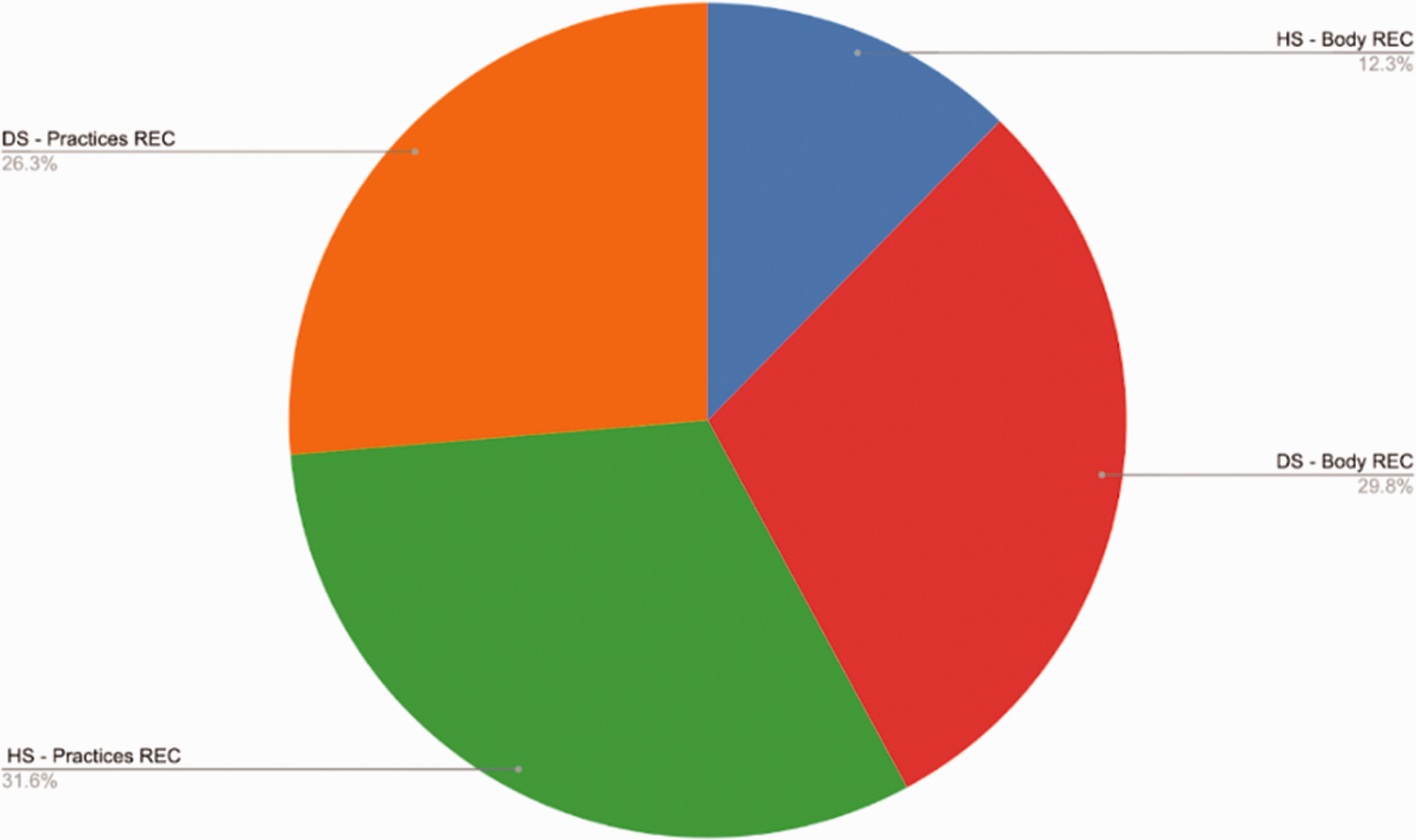
Distribution of (recognised) sexualisation jibes (n = 57) about roastees exhibiting sexual features.
It is also noteworthy that among the precious few comments hyper-sexualising the body (n = 9) in the entire corpus, most (n = 7) concern the women who expose their sexuality. Thus, among the body hyper-sexualisation comments, there is a strong dominance of recognised sexuality features over attributed ones. Body hyper-sexualisation comments are invited by roastees’ recognisable sexuality features, rather than being attributed to roastees for no evident reason, which seems to be much easier in the case of practices.
Even though the frequencies of the remaining three types of comments – body de-sexualisation (n = 17), as well as practice de-sexualisation (n = 15) and hyper-sexualisation (n = 18) – vary slightly, the differences cannot be considered significant. This corroborates the assumption that the three strategies are performed arbitrarily, even when physical sexual features are manifest in roasted posts.
Discussion and final comments
Our empirical study of sexualisation comments in RoastMe has adduced evidence that women are sometimes humorously disparaged with regard to the features of their bodies and alleged practices, and that these two aspects can also be invoked for the sake of roasting while not being the central referents of disparagement. Even though sexualisation posts are not in the majority and constitute less than one-third of the general corpus, their number is still significant and worthy of examination. The presence of sexualisation comments (in the form of hyper-sexualisation, de-sexualisation and meta-sexualisation), especially if not explicitly invited by roastees’ self-sexualisation (Choi and DeLong, 2019), indicates that the topic of sex(uality), can reign supreme in people’s minds and is arbitrarily activated as they do humour on social media. It also corroborates the well-known assumption that taboo, including sexual taboo, is a concomitant of humour (see e.g. Martin, 2007). Essentially, by referring to what is forbidden, users intuitively increase the funniness potential of their posts. Additionally, this explains the occurrence, albeit very low, of meta-sexualisation comments, whose humorous potential often depends heavily on the taboo sexuality allusions.
In the corpus used in the present study, sexualisation comments about practices outnumber those about the female body. This is presumably because sexualisation practices can be arbitrarily attributed to women without any evidence, or based on some loose associations in the light of roastees’ perceptible features. Jibes alluding to practices can hardly be evidently irrelevant or incomprehensible. Among the jibes that address practices, hyper-sexualisation is more frequent than de-sexualisation, possibly indicating the more powerful taboo and/or stigma (Plante and Fine, 2017; Sagebin Bordini and Sperb, 2013), and hence more funniness potential. It may also be claimed that the unsubstantiated attribution of sexual practices, such as promiscuity or prostitution, amounts to absurdity and is a strong cue for benevolent humorous intent and no intention to communicate any propositional meaning about roastees. This is in line with the original (but not entirely correct) conceptualisation of ritual insults as being necessarily based on the expression of falsehood (Labov, 1972), or rather overt untruthfulness (Dynel, 2017; see Dynel and Poppi, 2019 for discussion).
Jibes that make fun of body parts usually need some validation in roastees’ pictures, especially in the case of hyper-sexualisation, so that they are not considered incomprehensible or uncanny. Indeed, most comments involving body hyper-sexualisation address recognisable sexuality features that roastees intermittently make manifest, possibly deliberately facilitating roasting (see Dynel and Poppi, 2020a) through inviting relevant jibes (which, however, do not need to come, or which may involve some positively evaluative aspects as well). On the other hand, de-sexualisation, which prevails among the comments addressing/invoking the body, is facilitated by any non-prototypical features of female beauty that roasters can recognise in roastees’ appearance only to hyperbolise them for humorous purposes.
Overall, roasters are mostly concerned with the creativity of their comments; they may ignore salient sexual features or, as is most often the case, attribute such features to roastees when no self-sexualisation can be seen on the latter’s part. Even though the communication of meanings is insignificant in RoastMe, sexualisation-based RoastMe comments appear to echo dominant sexist ideologies about women. Notions amenable to deprecation encompass both de-sexualisation and hyper-sexualisation. For instance, a flat chest is subject to negative evaluation just as silicone breasts are, as evidenced by various body-shaming practices (Andrew et al., 2015; McDonnell and Lin, 2016). Similarly, virginity is frowned upon (Gessleman et al., 2017) just as sex work (e.g. Poppi and Sandberg, 2020; Scambler, 2007 and references therein) and promiscuity are (cf. Plante and Fine, 2017; Poppi, 2019; Sagebin Bordini and Sperb, 2013), which is typified by the prevalent slut-shaming practice (Dynel and Poppi, 2020b; Jane, 2017; Webb, 2015).
Even though humour resorting to sexual taboo in playful humour cannot be equated, in its gravity, with other more evidently harmful forms of verbal aggression against women (e.g. Anderson and Cermele, 2014; Bou-Franch and Blitvich, 2014), its potential negative outcomes cannot be unequivocally ruled out. Psychological research has shown that exposure to sexist or misogynist humour, which the sexualisation RoastMe jibes seem to represent, may have a bearing on people’s views and ideology about women, as well as expressions thereof, generally increasing their tolerance of sexism (e.g. Ford 2000, Ford and Ferguson 2004, Ford et al. 2008). However, much seems to depend on research design, so these findings cannot be considered conclusive (see Wright et al., 2017).
Be that as it may, sexualisation-based RoastMe humour should by no means be rashly interpreted as harmful sexism or misogyny sugar-coated with humour. The humour is the goal. RoastMe is a social media practice oriented towards achieving humour as an autotelic activity, i.e. humour for its own sake (Dynel, 2017). Similar to canned jokes told with no mean intent or negative bias against the target (see Davies, 1990, 2002), RoastMe jibes should not be interpreted as intentionally carrying or endorsing pejorative ideological meanings against women when the practice is adequately seen as being situated within a specific context and attributed to the special community of practice (see Kramer, 2011). According to the emic understanding of RoastMe, this is a benign form of humour appropriated by the humorous context, with users interacting within a humorous frame and with a humorous mindset. The RoastMe practice carries a presupposition that roastees (of both sexes) allow other community members (also of both sexes) 7 to pelt them with creative jibes, with no topic being disallowed, and that roasters do not intend to cause offence, but rather to afford the community amusement through their creative jibes. These premises underlying RoastMe are in line with Malinowski’s (1936 [1923]) phatic communion and Bateson’s (1987 [1972]) play, which involves pretended aggression. According to Malinowski (1936 [1923]: 316), phatic communion serves to ‘establish bonds of personal union between people brought together by the mere need of companionship and does not serve any purpose of communicating ideas’. Similarly, Bateson (1987 [1972]: 188–189) famously proposed that ‘the messages or signals exchanged in play are in a certain sense untrue or not meant’.
As Kramer (2011: 153) aptly puts it in reference to narrated jokes, ‘Laughing at a joke about X is not the same thing as laughing at X, because the narrated event is dislocatable from the narrating event.’ A similar conclusion should be drawn about RoastMe jibes; it is these creative jibes that are the source of amusement for the members of the online community of practice, rather than the roastees or the features attributed to them. Even if some creative jibes should be based on objectively recognisable features (e.g. big breasts), it is not that roasters wish to communicate any ideological (or otherwise) meanings while humorously referring to them in the roasting comments, whose goal is solely to benevolently poke fun at any feature in a creative manner. Incidentally, if someone should consider this playfully aggressive humour genuinely sexist, misogynist or otherwise offensive, it is presumably because they read some truthfulness into the jibes, which are devoid of it by design, according to the online community of roasters and voluntary roastees familiar with the ‘rules of the game’.
On balance, despite the RoastMe community’s presupposed lack of intention to communicate pertinent messages, the very evocation of sexualisation in some jibes at whim indicates the tacit presence of deeply ingrained ideologies concerning female bodies and sexual practices, which are humorously and innocuously echoed. Presumably, the frequency of sexualisation-based jibes would be much lower for male roastees. This is a prospective topic that we submit for future investigation.
Footnotes
Acknowledgements
The authors would like to thank Gosia Krawentek for her help with statistical analyses.
Funding
This work was supported by the National Science Centre, Poland (Project number 2018/30/E/HS2/00644).
