




Abstract
Drawing on interviews with 10 gay streamers and 30 viewers, this article analyzes a new feature of live streaming on Blued, a Chinese gay male dating app. Live streaming invites users to either perform themselves or watch others perform. Unlike western gay dating apps that monetize users’ hooking-up encounters, the business model behind Blued instead capitalizes on affective encounters among gay streamers and viewers. Through paid virtual gifts, which circulate as affective signs, live streaming fosters and intensifies viewers’ intimate attachment to gay streamers. The virtual intimacy produced by gay live streaming entails a significant economic dimension, and is therefore stigmatized. In consequence, gay streamers do not see streaming as sex-related work, and paying viewers do not portray gifts as consumption. In understating the economic and sexual underpinnings of affective encounters mediated by live streaming, gay streamers and viewers not only reinforce heteronormativity, but also produce homonormativity.
Introduction
In the afternoon of 17 December 2016, Hu, a 27-year-old gay man, was live streaming his weekend on Blued, a Chinese gay dating app (Figure 1). Seated in his living room in Beijing and directly addressing the camera, Hu sang, talked, and offered advice to viewers. In the live video, viewers fervently praised his singing. Real-time comments such as “Husband, husband! You are so hot!” and “I have been saving my body for you for an entire year.” continuously rolled in at the lower left corner of the screen. Simultaneously, virtual gifts sent by viewers such as roses and kisses sporadically appeared at the center of the screen. Each time he received a gift, Hu would blow a kiss to the camera and say, “Thank you [gift giver’s screen name] for your [gift]”.
Hu was live streaming on Blued on 20 December 2016. Hu gave his full permission for the use of image.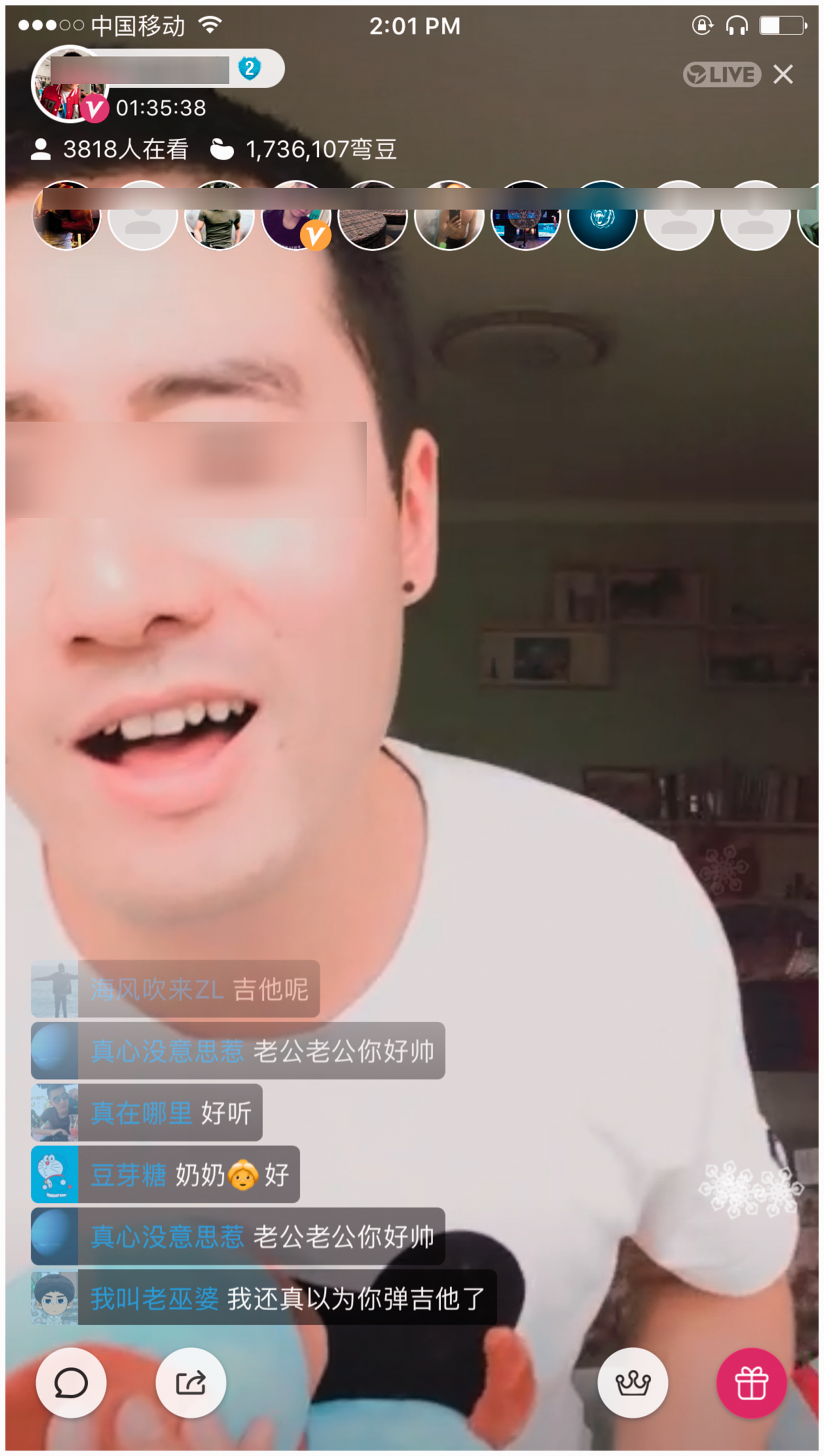
This article focuses on gay live streaming and its affective intensities on Blued (Figure 2). Blued is China’s first homegrown gay dating app. Launched in 2012, it now boasts a user base of 40 million.
1
Following a similar model to Grindr, the app’s main feature was originally location-based profile browsing. In 2016, Blued introduced the new feature of live streaming. The real-time audiovisual communications attracted users to either perform themselves or watch others perform. Although live streams can be watched free of charge, viewers are often sexually and emotionally affected by gay streamers. These affective intensities lead them to send virtual gifts through in-app purchases of beans – Blued’s digital currency. The monetary gains converted from beans are divided between gay streamers and the platform. In this way, live streaming has become Blued’s most profitable monetization scheme (Dai and Zhang, 2016).
The user interface of Blued. The buttons in the menu bar at the bottom of the screen are, from left to right, “Browse”, “Chat”, “Buzz”, “Live”, and “More”. Under “More” are options for digital top-ups, HIV testing, gaming, online shopping, and overseas surrogacy consultations.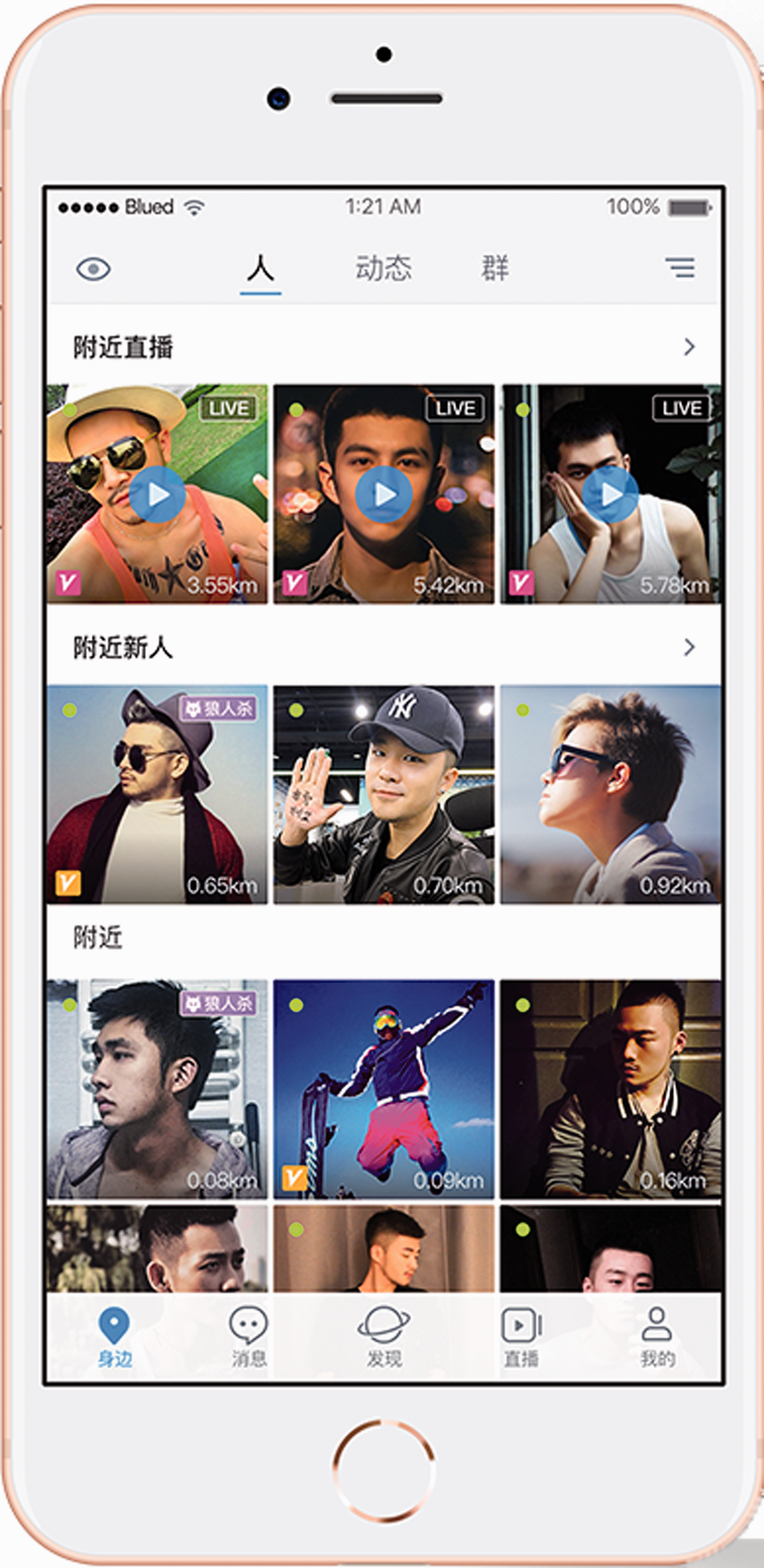
Studies on western gay dating apps (e.g. Grindr and Scruff) scarcely look into their monetization strategies. This lack can be explained, perhaps, by the fact that their strategies – membership fees and advertising revenue generated from user data – are so prominent as to be self-evident (see Albury, et al., 2017). However, Blued live streaming indicates another form of monetization, which focuses on viewers’ virtual affective encounters with gay streamers rather than physical hookups. Live streams on Blued are often personal, interactive, and sexually/emotionally charged, creating a variety of intimate virtual situations. These situations foster affective encounters, which take the forms of joy, fondness, hope, infatuation, jealousy, sensuality, and the like. They also elicit gifts from viewers. Gift-giving directs gay streamers’ attention toward viewers, and amplifies the affective intensity that these viewers feel. However, because of the stigmas surrounding paid intimacy (Nayar, 2017), neither gay streamers nor paying viewers see streaming as sex-related work, or gifts as consumption.
This article has two emphases. On the one hand, it examines how same-sex affective encounters are experienced, circulated and monetized on Blued live streaming. On the other hand, it explores how affective encounters and economic factors combine to shape sexual normativity in China. In doing so, it draws on Ahmed’s (2014) affect theory, which argues that affect binds subjects together through its circulation, and Zelizer’s (2005) theorization of how intimate relations are interconnected with economic interests. Although both theories stem from western experiences, they provide useful analytical tools for this study. As Kong (2016) and Wong (2016) explain, the hybridization of western theories with China’s complex sexual experiences offers a constructionist perspective for studying Chinese sexualities. Such a perspective could be sensitive to both local nuances/diversities and the global parameters of an uneven world knowledge system (Kong, 2016).
The qualitative analysis of gay male live streaming presented in this article is based on interviews with 10 gay streamers and 30 viewers, as well as the author’s experience of watching Blued live streaming over a period of two years (January 2016–January 2018). In the following, I first situate this study in relation to the growing scholarship of affect and social media, and social media’s role in connecting gay people through circulating same-sex affects. After setting out my method, I contextualize Blued’s development in China and how it has become a prominent social networking tool for Chinese gay men. I then show how affective encounters are experienced, circulated, and monetized on Blued live streaming, as well as how this reinforces heteronormativity in China. Finally, I discuss the gay streamer training program offered by Blued, unpacking how it simultaneously advances the platform’s affective production and produces homonormativity.
Social media, same-sex affect and affective value
Social media has become an important site at which sexual minorities acquire intimacy for their desires fall outside heteronormative acceptability (Attwood et al., 2017; Cho, 2015; Mcbean, 2014; McGlotten, 2013). These intimacies are predominantly produced through gay and lesbian users’ affective encounters with same-sex texts, images, sounds, videos, and other audiovisual materials on social media. Mcbean’s (2014) study of the videos through which a long-distance lesbian couple communicated on YouTube, for example, finds that their audiovisual performance of lesbian intimacy emotionally bonds same-sex viewers. The repeated re-blogging of explicit images/videos on Tumblr also connects LGBTQ users through the circulation of sexual affects (Cho, 2015). These audiovisually mediated sexual/intimate attachments are energized by a range of affects that are intensities of bodily sensations, resonances, and ambiguous feelings (Paasonen, 2011). Following these studies, I refer to same-sex affects as sensations and intensities of intimacy as they are circulated and mediated by social media.
Although gay social networking technologies have become an integral part of same-sex lives in China (Wang, 2018; Zhou, 2018), the ways in which they circulate and mediate same-sex affects are not reflected in the scholarship, which has mostly been conducted in western contexts. An analysis of how same-sex affect bonds Chinese gay men on social media therefore is long overdue. Due to China’s constrictive heteronormative environment, Chinese gay men usually live double lives, hiding their sexual identities in public while yearning for same-sex sexual and emotional intimacy in private (Ho et al., 2018; Zheng, 2015). Social networking technologies are of great importance in this milieu, for they ease the tension between the heterosexual conformity and their sexual/emotional needs (Wang, 2018; Zhou, 2018). Scholars have argued that mobile devices and their embedded applications are affective media that circulate affects and mediate intimacy (Hjorth and Lim, 2012; Lasen, 2004). The modes in which affects circulate and mediate may differ according to the different media genres, forms, and affordances in question – as the emotionally attuned YouTube and the sexualized Tumblr mentioned earlier both suggest. In the case of Blued live streaming, this article is concerned about two aspects of the circulation of same-sex affect: affective signs and affective capacities.
Affective signs highlight affect’s embodied and social aspects (Ahmed, 2014). Social networking technologies not only transmit affect, but also condition and modulate it (Paasonen, 2018; Serrano-Puche, 2016). In other words, social media shape the ways in which affect is circulated and experienced. On Blued live streaming, affect is modulated by virtual gifts. There are 19 kinds of virtual gift on Blued, including lollipops, kisses, cruise ships, castles (observation on 1 February 2018). They serve as signs that embody viewers’ affective encounters with gay streamers. Viewers are cultivated to express feelings with symbols represented in the gifts. For example, some viewers send lollipops to streamers whose voices are sweet. In this way, the gift signs are converted into affective intensities felt by both gay streamers and viewers (Ahmed, 2014). Affective capacities, by contrast, refer to someone’s capacity for either producing affects or being affected, both of which allow intimate relationships to occur (Seigworth and Gregg, 2010). For example, the youthful charm produced by some gay streamers might affect heterosexually married gay men desperate for same-sex affection. Finely positioned between gay streamers and viewers, Blued live streaming maneuvers both affective signs and affective capacities to galvanize the circulation of same-sex affects for monetization.
As affective encounters are increasingly fused with monetary transactions in the form of virtual gifts, same-sex intimacy on Blued has taken on a conspicuously economic dimension (Zelizer, 2005). The meeting of intimacy and economy is common in gendered relationships mediated by social media. Close intimate ties developing within a booming affective labor economy can be found, for example, in the videos produced by female and transgender identified YouTube vloggers (Berryman and Kavka, 2018; Raun, 2018). Blued live streaming presents a similar combination. At one level, sending gifts can intensify viewers’ affective encounters. At another, it also offers a tempting payoff for streamers’ affective labor.
Economic value aside, the convergence of same-sex affect and social media also shapes normative sexual values in society. The homonormativity produced by UK’s popular media culture, for instance, pressurizes gay men into being happy and proud to such an extent as to have become an affective burden (Lovelock, 2017, 2018). A study in the US context also finds that the digital cruising afforded by Grindr reinforces homonormativity by confining sex to the private home (Ahlm, 2017). Blued live streaming entails similar normalizing tendencies. The affective encounters mediated by Blued not only cultivate heterosexually married gay viewers’ habit of seeking same-sex intimacy through watching live streaming, they also allow the viewers to retain a heterosexual façade in real life. In this way, the intimacy mediated by gay live streaming seldom challenges the heterosexual status quo and therefore reinforces heterosexuality in China. Moreover, Blued awards higher visibility to gay streamers with significant affective capacities. These highly affect-capacitated gay streamers, it appears, are often gender/body conforming, attractive, and self-enterprising. All these characteristics, my analysis will show, are pivotal in producing viewers’ most intensive – and therefore the most valorized and homonormative – affective encounters. In consequence, Blued live streaming becomes a breeding ground for producing sexual normativity in China.
Methods
I have watched Blued live streaming closely over a period of two years (January 2016 – January 2018); my observations took place once a month and lasted for about half an hour. As discussed previously, virtual gifts are an affective design that modulates and amplifies affective encounters on Blued. Viewers’ feelings depend on gay streamers’ immediate affective responses to virtual gifts. The gift of a spectacular animated cruise ship, for example, makes waves across the screen. In reaction, gay streamers often express glee by adopting an excited voice, smiling face, and constantly blowing kisses. These real-time affective responses in turn emotionally satisfy viewers. In this way, intimate attachments among gay streamers and viewers are formed. Hence, I took notes on how virtual gifts intimately connect gay streamers and viewers through the circulation of different forms of gift animation.
To collect data on the lived and social aspects of affect (Ahmed, 2014), I conducted interviews with 30 viewers (aged 18–45, they are anonymized in this article as V1 to V30) and 10 gay streamers (aged 21–35). These interviews were initiated with the interviewees’ informed consent. Viewers were interviewed via Blued Chat immediately after I had observed them sending gifts. Interviews with gay streamers were conducted during a fieldtrip to Beijing and Shanghai between December 2016 and February 2017.
Originally my research design entailed interviewing viewers in the live channels of gay streamers whom I had already interviewed. The aim was to establish a shared understanding of the affective encounters, taking into account both what viewers felt and what gay streamers produced. The transactional relationships among viewers and gay streamers, however, are sensitive topics. Trying to access both gay streamers and their viewers created a number of issues. On 11 December 2017, for example, I approached a frequent gift-giver in the live channel of one of my gay streamer interviewees. I introduced myself as a researcher and informed the gift-giver of the purpose of my study. He agreed to be interviewed. Afterwards, the gift-giver relayed the contents of our interview to the gay streamer. The gay streamer then confronted me, saying that my questions “insulted him” for they alluded to an unspeakable transactional relationship between him and the viewer. However, I seldom use terms such as “economic” and “transactional” in formulating interview questions. Instead, I allow viewers themselves to explain their relationships with the recipients of their gifts. Nevertheless, out of respect for the feelings of this streamer, I have excluded his interview data from this study.
Through this incident, I realized how subtle and delicate the transactional intimate relations between gay streamers and viewers are. Like the complex relationships between “sugar daddies” and “sugar babies” formed through “sugar dating websites”, intimate relations between gay streamers and viewers have an economic underpinning and are therefore heavily stigmatized, although paid intimacy facilitated by Blued differs from explicit sex work (Nayar, 2017). For this reason, an academic intervention must be methodologically sensitive. To avoid jeopardizing interviews that I had already conducted with gay streamers, I changed my approach and focused on finding viewers to interview in random live channels. In this way, the supposedly “judgmental” researcher no longer came in-between gay streamers and their frequent gift-givers.
Because my interview requests often interrupted viewers while they were immersed in live streaming, most spent only three to ten minutes talking with me, with the exception of V12 (41-year-old, heterosexually married, private business owner), whom I interviewed for over an hour by voice call. Because of this limitation, I am unable to elaborate on how factors of class and migrancy have shaped viewers’ affective encounters. In contrast, the 10 gay streamers were interviewed in-depth (each for between 30 and 120 minutes), either in cafés or through voice calls. Owing to the informal setting and the dynamics of face-to-face communication, interviews conducted in cafés last longer than those conducted through voice calls. Concerned that their sexual orientations might be exposed, seven interviewed viewers have not disclosed their city of residence and occupation. Where I mention the narratives of the other interviewees, I will give their pseudonym and basic demographic information (age, occupation, and city/province of residence).
Gay male live streaming on Blued
Blued live streaming is not the first of its kind in China. In 2015, the Taiwan-based live streaming app 17 gained popularity in Mainland China. Although 17 was not specifically designed for gay men, the surge of male erotic performances (e.g. male-to-male intercourse and masturbation) prompted a spike in the number of same-sex viewers. Hence, mobile live streaming has produced a particular affective expectation among Chinese gay men, on the basis of which an enduring viewership has been established. Amid a child pornography scandal, however, 17 was removed from both App Store and the Android Play Store after operating for about three months. 2 The failure of 17 prompted Blued to formulate a strict Terms of Service, which proscribes pornography. 3 This does not mean, though, that Blued live streaming is not sexually provocative.
Although the display of intercourse and masturbation is strictly banned, sexually implicit content prevails on Blued. On live streaming, gay men often perform in response to viewers’ requests. At the early stage, these requests were often sex-related. For example, viewers asked muscular streamers to reveal their chests and caress themselves. To entertain viewers with such implicit same-sex eroticism, Blued launched concentrated commercial campaigns featuring topless muscular men as desirable objects and invited a number of gay social media influencers (e.g. porn stars and fitness bloggers) to broadcast their personal lives.
The increasing display of same-sex desires brought government intervention. On 9 November 2016, a cyber performance regulation was released by China’s Ministry of Culture. The regulation aims to control pornographic and vulgar content in the live streaming industry. 4 Following this, Blued has imposed stricter rules on the performance of same-sex desires. 5 Now the platform forbids gay streamers from talking about their personal sex life, spreading hooking-up information, and broadcasting from bathrooms. The rule also lays down a dress code and behavioral conduct for streamers, according to which, topless body displays and shorts cut above the knees are regarded “pornographic”. Moreover, in each live room a rolling reminder states that “live streaming prohibits overly short pants, crotch shots, and flirtatious and coarse languages/gestures.” All these changes indicate that Blued closely surveils and restricts visual presentations of same-sex desires.
Although the prominence of erotic talking/displays on the app has declined, Blued opens up spaces for more personal/emotional interactions. Viewers now ask questions about streamers’ romantic mishaps and dating preferences. Although these topics are not erotic in themselves, they have a sexual aspect (as demonstrated by Hu’s live streams, which I described at the beginning of this article). Therefore, despite the tightening self-censorship, it may be that the content of Blued live streaming has not transformed so much as expanded into a much broader spectrum of intimacy, in which sex and affections overlap. In my interviews I found that although viewers send more gifts when they are particularly emotionally affected, they admit that their gift recipients are often sexually attractive. Hence, it is almost impossible to separate the affective from the sexual with any clarity when it comes to gay live streaming on Blued.
The monetization of affective encounters and heteronormativity
In my interviews, viewers emphasized looks as the primary factor determining their affective captivation. Attractiveness has been theorized as a form of erotic capital that gives rise to social desirability (Hakim, 2010). On Blued live streaming, attractiveness takes the form of cuteness, youthfulness, warmth, masculinity, sophistication, and the like. As the interviewed viewers put it: “I like polite streamers who are able to bring me warmth and comfort.” (V11, 29-year-old) and “I only send gifts to those having masculine physiques, thick eyebrows, prominent noses, and short hair.” (V4, 32-year-old, Guangdong). Viewers usually express their feelings of captivation through two terms, both of which emphasize the visual: shun yan (“visually appealing”) and yan yuan (“feeling an instant connection”). That said, none of the interviewed viewers felt compelled to meet their gift recipients in real life. On the contrary, they preferred to maintain contact within the intimate situations created on Blued. Viewers use these intimate situations to find digital companionship and to escape the stress of everyday heteronormativity. Although viewers are fully aware that these intimate situations are virtual, temporary, and even unrealistic, they nonetheless find comfort, joy, fun, and happiness in them. This can be exemplified by two distinct groups of viewers identified during the interviews.
The first group of viewers is generous in giving gifts. These viewers are either heterosexually married or above 40 years of age. They tend to conceal their cities of residence. Their Blued profile photos either display landscape pictures or are simply left blank. For this group, live streaming’s intimate virtual situations offer them an escape, alleviating their loneliness and providing an entrance into same-sex life. V12, for example, is a 41-year-old private business owner in Quanzhou in southeastern China. He is in a heterosexual marriage and has only disclosed his same-sex attractions to close gay friends. His wife and child reside abroad, meaning that V12 lives alone for most of the time. Against nocturnal boredom and loneliness, Blued live streaming offers him the solace of same-sex intimacy. For nine months in 2017, V12 spent more than 200,000 Chinese yuan (approximately 32,000 US dollars) on Blued virtual gifts (he isolated himself from the app for three months while his family visited). Although he enjoys gay streamers’ companionship, he rarely asks them out.
On 16 December 2017, I came across V12 again in a live channel. He was showering a live streamer with a slew of gifts. Later V12 explained to me that there was another viewer in the room who said that he could help ascend the streamer’s place in Blued’s highest-paid gay streamer chart (Blued ranks gay streamers by the value of gifts earned). This upset V12, compelling him to double what his rival sent until the rival stopped sending gifts. This affective encounter mixed comfort (companionship), distress (when a rival generous gift-giver appeared), and jealousy (when the streamer’s attention was diverted). Like YouTube “crying vloggers” who use negative affects such as anxiety and vulnerability to strengthen the intimate ties with fans (Berryman and Kavka, 2018), Blued viewers’ negative feelings (e.g. distress and jealousy) can equally generate economic rewards for gay streamers.
Another viewer in this group, V15 (aged 49), is also married to a woman and has a child. Unlike V12, he refused to disclose his occupation and city of residence. V15 gave himself the name “My dear husband” on Blued. Upon receiving gifts from him, gay streamers express gratitude by saying his screen name. V15 explained that he came up with this name deliberately: “The name itself has no meaning, but I feel happy when streamers refer to me like that.” On 31 December 2017, I observed V15 sending gifts to a 23-year-old live streamer. The streamer joked about his name, saying “You’re taking advantage of me.” This is sufficient to “emotionally satisfy” V15. The circulation of words can evoke emotions (Ahmed, 2014). The word “husband” acts as an object for V15, through which a sense of intimacy and attachment is evoked. In other words, the word “husband” becomes sticky with feelings and affect as it circulates between himself and gay streamers (Ahmed, 2014). He adds, “Gifts are a way to keep streamers from forgetting me. I’m not good enough (here he refers to his relative agedness) for them so I’m not expecting anything in return except that visual satisfaction.” Virtual gifts thereby serve as a limited technique in these intimate situations that realizes affective encounters as much as it constrains them. For V15, sending gifts sustains and amplifies the intimacy he feels. In this sense, virtual gifts not only emphasize the economic dimension of the intimacy mediated by live streaming (Zelizer, 2005), but also attune viewers to the app-designed ways of experiencing affective intensities (Ash, 2013; Paasonen, 2018).
The second distinct group of viewers is younger and less economically secure. Although they spend less on virtual gifts, this can still be impulsive. This group of viewers tends to project longing for an ideal boyfriend or partner onto gay streamers. As a result, they often spend more money on Blued than one might expect. For example, V7 lives in a small city in the southwestern province of Sichuan. He is a salesman in the home appliance business with a monthly income of about 3000 Chinese yuan (approximately 475 US dollars). Despite his relatively low income, he spent more than 6000 yuan (nearly 950 US dollars) on Blued gifts in just a few months without realizing, I only send one live streamer gifts, because he is my ideal type of boyfriend. Although I cannot find a person like him in real life, I see similar qualities in him, which in a way fulfills my little dream. It brightens my mood when I watch him, especially when he acts like an idiot. I like watching him smile, but I don’t want any romantic entanglements with him. Although we have exchanged contact details, we don’t talk besides holiday greetings. We all have our personal lives (V7, 30 years old, Sichuan).
These findings suggest that while Blued live streaming offers a unique channel for experiencing same-sex intimacy, which is mediated by paid gifts, it also reinforces heteronormativity as a result. For example, although V12 has developed the habit of seeking same-sex intimacy on live streaming, this will not jeopardize his heterosexual marriage so long as he keeps his online homosexual intimacy and offline heterosexuality apart. As such, Blued live streaming not only cashes in on heterosexually married/hooked gay viewers’ needs but also cultivates same-sex needs. That is, Blued’s “safe” intimate situations may create more loneliness and other suppressed same-sex feelings than they relieve, which in turn expands Blued’s money-making potential. For example, I asked V15 (My dear husband) if he felt lonely when he was not watching live streaming. “A little bit”, he responded. “Watching live streaming has become an indispensable part of my life.” Seen in this light, these temporary intimate satisfactions have to be continually renewed through repeated engagement with live streaming. It is in this repetition that Blued’s potential for economic profit lies.
Gay streamer training and homonormativity
Despite the economic underpinning of same-sex intimacy on live streaming, gay streamers who eagerly ask for monetary compensation for their performances substantially reduce the intimacy felt by viewers. Hence, although virtual gifts amplify affective intensities, it is also contingent on how streamers navigate the subtle dynamics between money and intimacy. To exploit the paid intimacy in a sophisticated way, Blued has launched a streamer training program called “official streamers”. Although the program aims to expand gay streamers’ affective capacities, it also yields a homonormative mode of live streaming that is closely linked to viewers’ affective expectations.
When asked what type of gay streamers and which activities induce viewers to send gifts, a number of keywords are frequently mentioned by the interviewed viewers: being normative (zheng chang/bu yi lei); humorous (you mo/gao xiao); positive (zheng neng liang/zheng qi), talented (you cai yi); and comforting (shu fu/hui hong ren). These characteristics map out the affective contours of the homonormativity constructed in Blued live streaming. Together with the streamer training program, this affect-charged homonormativity can be summarized by pointing to three interlocking characteristics exhibited by gay streamers: male gender/body conformity (this does not necessarily entail masculinity); attractiveness without sexual provocation; and entrepreneurialism without being materialistic.
First, the program selects predominantly attractive and gender/body conforming gay men. Not all of them are muscular (in any case, bare chests are now forbidden). Blued offers these gay streamers a contract, and appoints staff, known as “streamer handlers”, to advise their live streaming practice. Moreover, Blued recommends contracted streamers on in-app banner advertisements and prioritizes their profiles on the live channel’s front page. As a result, official streamers enjoy a higher profile than those uncontracted streamers. These front-page gay streamers are labeled either “hot” or “trending”. In this way, Blued produces a sense of their popularity among viewers. At stake, here, is how popularity not only determines who produces and appreciates affective encounters, but establishes hierarchies among both gay streamers and viewers. For instance, Cha, a drag performer on Blued, notes that despite his best efforts in trying to entertain viewers, his efforts are not always appreciated: I don’t belong to the mainstream on live streaming. In terms of my body type (174 cm in height and 140 kg in weight), the number of viewers who like me could not be fewer. I apply female makeup and present myself to bring people joy. But when viewers provoke me by saying that “your parents gave birth to you to see you become a man and yet you have made yourself into a woman” I immediately shut off my live stream (Cha, 25-year-old, costume stylist in Beijing).
Similar concerns also register among viewers. Although I posed no drag-related questions in interviewing viewers, two (V1 and V28) nonetheless declared that they would never send gifts to drag streamers. In their own words, “Although we are gay men, we are still men” (V28, 18-year-old, Guangdong) and “Normal gay men are men not women” (V1, 24-year-old, Chongqing). Although a small number of drag streamers can still be found in the trending list, they have become less conspicuous. Drag performers’ relative lack of popularity limits their affective capacity and devalues the affective encounters they produce.
Second, although Blued recruits attractive gay men to be their official streamers, it prohibits any form of sexually provocative performance. Gay dating apps users tend to produce and internalize sexual stigmas that slut-shame promiscuity and casual sex (Blackwell et al., 2015; Jaspal, 2017). On Blued live streaming, slut-shaming has extended from gay men’s offline sex lives into the online audiovisual exchanges of same-sex desires. Although the interviewed viewers confide that their gift recipients are usually sexually attractive to them, both gay streamers and viewers are quick to insist that their intimate ties are non-sexual. For example, V29 (35-year-old, Jiangsu) laments how people perceive gay live streaming as a medium for “exchanging money for carnal desires” (se yu jiao yi), whereas he engages with the app largely for emotional intimacy. As such, viewers often romanticize the entanglement of virtual gifts, sexual desires, and intimacy on Blued. Divorcing money and the sexual from this virtual intimacy makes the homonormative principle of “attractiveness without sexual provocation” a plausible rationale through which viewers’ affective encounters are intensified. As V8 puts: It’s not like I’m giving them money. I just want to express my feelings. Live streamers are very happy when they receive gifts, which in turn makes me happy. It makes me feel like I’m being seen and valued, particularly when live streamers remember who I am when I enter their live channels (V8, 45-year-old, Anhui).
Third, Blued handlers coax contracted streamers into soliciting gifts from viewers through sexual insinuation. Still, both covert and overt materialism run counter to the interests of gay streamers, especially those who see viewers not as a cash cow, but as giving gifts out of fondness. For example, the streamer Hu (27-year-old, civil servant, Beijing) prefers to see gift giving as a spontaneous action affected by his live streams rather than purely an exchange of money and intimacy. Perhaps because Hu had befriended his Blued handler long before beginning live streaming, he has room to negotiate how he live streams. The contracted streamer Xu (26-year-old, fashion assistant, Beijing), by contrast, was removed from the “official streamer” program, bringing his popularity to an end because of his reluctance to ask viewers to send gifts.
Hu and Xu’s concerns about the stigma surrounding money resonate with viewers. V3 (34-year-old), for instance, says that: “If a live streamer is desperately asking for gifts, I will send some out of the annoyance. But I will no longer follow him”. In this way, gay streamers who have an obvious monetary agenda reduce intimacy significantly, perhaps entirely. This suggests that gay streamers must walk a fine line between their handlers’ entrepreneurial demands and their viewers’ non-materialistic affective expectations.
In summary, Blued’s training of gay streamers entails normalizing tensions in which virtual gifts (a monetary form), the sexual, and intimacy cannot be clearly disentangled. The dual stigma of slut- and money-shaming attached to gay live streaming gives rise to contradictions and ambiguities. Gay streamers and paying viewers romanticize their affective encounters, to which they imagine sex and money are irrelevant. Overall, Blued live streaming shows a normative tendency. It preferentially endorses gay streamers who conform to normative gender and body ideals, attract viewers with their personalities rather than acting in sexually provocative ways, and walk a fine line between being ambitious and being gold-digging. On the one hand, these preferences make homonormativity plausible as a mode in which paid same-sex intimacy can be experienced in an idealized way. On the other hand, they anchor affective homonormativity in an economic rationale of online popularity (Lovelock, 2017, 2018).
Conclusion
This article has analyzed how Blued live streaming monetizes affective encounters among gay streamers and viewers. By creating multiple intimate situations, Blued live streaming modulates and monetizes affective encounters through a wide array of virtual gifts. These gifts circulate as affective signs that embody, form, sustain, and amplify the intimate intensities between gay streamers and viewers. In this light, the virtual intimacy mediated by Blued live streaming entails a significant economic dimension, and is therefore associated with stigma (Nayar, 2017; Zelizer, 2005). In addition, the public display of sexual attractiveness leads to slut-shaming. Virtual intimacy on Blued live streaming therefore bears a dual stigma of slut- and money-shaming. For this reason, gay streamers intentionally divorce live streaming from sex-related affective labor, and paying viewers distance gift-giving from a transactional mindset, despite the affective investment and monetary expenses that live streaming involves.
These contradictions and ambiguities reveal the tensions through which Blued live streaming reinforces heteronormativity and produces homonormativity. A number of heterosexually married/hooked gay men habitually watch live streaming for same-sex intimacy. Their affective encounters remain safe for they are virtual and therefore less confronting in relation to the heteronormative status quo. Because the intimate ties fostered by Blued live streaming are inflected by the dual stigma of slut- and money-shaming, viewers understate the transactional significance of the gifts they send and accentuate the affective intensities they experience. Decoupling same-sex intimacy from its economic and sexual underpinnings in this way produces a homonormative mode of live streaming. Exemplified by Blued’s streamer training program, this homonormativity advances gay personas that embody male gender/body conformity and non-suggestive and non-gold-digging personalities. However, as my analysis of live streaming has shown, virtual gifts (a monetary form), the sexual, and intimacy cannot be separated for they orient the ways in which same-sex affective encounters are experienced.
Overall, this article shows how the monetization of gay dating apps has moved beyond physical hookups and expanded into a large spectrum of affective needs, which combine sex, intimacy, emotion, and money. The monetization of affective needs requires further critical attention, for it produces subtle tensions related to different forms of sexual normativity. As Lovelock (2017, 2018) points out observantly, homonormativity is not only a sexual norm, but also an affective norm, which forces LGBT people to be happy and have pride according to an economic rationale (e.g. celebrity statuses and social media influencers). Similarly, through its training program, Blued instructs gay streamers to perform positive affect. Often such positivity is anchored in a form of normative thought and practice, such as gender/body conformance, confidence, and optimism. As these normatively attuned affective encounters traverse generational and geographical boundaries, they shape and condition intimate same-sex encounters.
This article does not focus on how same-sex affect articulates with class, migrancy, and other socially constructed categories. Although there is no space to attend to all aspects of a fast-developing social networking platform in this article, these issues are a promising topic for future research. For example, although young gay men figured predominantly in my two-year observation (January 2016 – January 2018), in the second half 2018 a number of middle-aged and senior men started appearing on the front page of Blued live streaming. In stark contrast to the viewers of this age I had interviewed, most of whom withheld their personal information, these middle-aged and senior streamers make a unique case by staging themselves publicly. Further academic inquiries are needed to address critical issues stemming from this, such as are these middle-aged/senior men gay men? If they are, how these middle-aged/senior gay men negotiate the secrecy of their sexual orientations in relation to their public presence on a gay app and the heterosexual norm?
Footnotes
Acknowledgements
I would like to thank Sam Berlin. The discussions with Sam have helped shape the earlier argument of this article. I also thank the editor, anonymous reviewers, Jeroen de Kloet, and Rachel Spronk for their generous feedback and insightful comments on the manuscript.
Funding
This project has been supported by a consolidator grant from the European Research Council (ERC-2013-CoG 616882-ChinaCreative).