




Abstract
This article makes a case for sex-positive research and pedagogy that acknowledges and hence reflects on the researcher’s use of a “pornographic mirror,” a critical and consensual engagement with erotic and pornographic (self-)imagery that opens up bodily sensations and analysis in the public sphere. The article will do so by means of examples of research in which scholars were able to successfully test out such corporeal-driven scholarship and use of porn images. In the first example, the author interviewed an older generation of sex educators in San Francisco, who in the 1960s/1970s pioneered the idea that students could perform and analyze their own sexual behaviors by acting in, and reflecting on, sexually explicit movies, an idea which has also been incorporated into contemporary feminist and queer pornography. This historical moment in radical pedagogy is extended into a contemporary example of sex-positive research about online dating, in which the author comments on her use of sex chat and sexual self-imagery to dissect the online dating site adultfriendfinder.com.
Introduction
This article reflects the work of researchers and educators on pornography who are invested in defending an in-depth erotic and pornographic immersion within academic fieldwork and pedagogy. Based on my experiences with public screenings of erotic/pornographic media, It proposes that academics can make use of a “pornographic mirror” to examine and perform aspects of (self-)photography and eroticism. In recent years, as was shown in the 2018 resignation of filmmaker and professor Saul Levine from the Massachusetts College of the Arts, there has been a clampdown and unease about the screening of sexually explicit media in classrooms, which are frequently posited as contributing to or inclusive of sexual harassment. Levine decided to resign from his position after being accused anonymously by a student of sexual harassment and creating uncomfortable classroom dynamics when screening his abstract-formalist short experimental film Notes After Long Silence (1989), which includes a few stylized images of himself having sex with a partner (Artforum, 2018).
Levine revealed his decision to resign in an impassioned Facebook Live video that received an outpouring of support from fellow artists and students besides flighty messages of condemnation. 1 The college did not release any details about the case, nor a statement in defense of the right of teachers and artists to continue examining sexually explicit media. In this way the case sets an unfortunate precedent for a further polarization and stigmatization of pornography in the public sphere, even though Levine's artwork in itself was stylized rather than confrontational or explicit. The actual “pornographic” images in Notes After Long Silence are abstracted and do not reveal the face nor identity of the sex partners. These images are gentle and unusual rather than confrontational or explicit and are shown as part of a patchwork of domestic sceneries.
The pulse of this article is not to give in to this prohibitive academic zeitgeist nor to propose a naïve-sexual celebratory one; rather it intends to initiate a 21st-century civil rights enquiry and aesthetic debate about the consensual uses of sexually explicit media in academic venues and during fieldwork. Will academics continue to have the right to openly share sexually explicit media and (self) representations and engage in intimate interpersonal dynamics around them? As we shall see in the research examples covering sex scholarship from two different epochs, attempts were made to initiate an alternative and post-rationalist engagement with pornographic media. In this sense, the essay harkens back to former anthropological enquiries about researchers who tackle sex taboos and also wonders where we are standing with this line of enquiry today. In 1995, Don Kulick and Margaret Wilson published the anthology Taboo: Sex, Identity and Erotic Subjectivity in Anthropological Fieldwork, a pioneering collection of in-depth testimonies and well-presented arguments concerning the role of the researcher’s race and gender, relationship status, and sexual orientation and inclinations. In the book, academics write about encountering positive erotic and sexual cooperation, as well as being fearful and fragile amongst the difficulties of unwanted seduction, sexual dominance, and violence. Kulick and Wilson state that the researcher’s sexuality or erotic subjectivity is an academic taboo and thus it was difficult for them to convince academics to submit affirmative work about the topic. Sexual behaviors and culture were a popular topic within anthropology’s colonial history and amongst 20th-century pioneers such as Margaret Mead and Bronislaw Malinowsky, but most likely insights were relegated to the domain of their subjects or “others.” The oblique construction of the celibate fieldworker who resists sexual subjectivity as a threat to scientific stricture and moral order thus came into place (Kulick and Wilson, 1995: 3). Kulick and Wilson and their authors were trained anthropologists who were able to tackle and deconstruct this type of clichéd and unrealistic role model – why are we dealing with a forceful resurgence of these tropes more than 20 years later on? There is a too easy assumption that immersed sexuality or pornography researchers are morally naïve performers, prey to corruption or even abusive behavior if they are clearly enacting consensual research with subjects and students, as was the case of Saul Levine. Instead of endorsing the conveniently clichéd figure of a celibate academic, I would suggest that we look at how and why researchers make use of a porn mirror, so as to distinguish and protect their objectives and practices.
I am searching here for a kind of humanistic scholarship that would not erase the accounts of the researcher's plunge into sexual sensations and desires by means of images. The idea of examining pornographic imagery as consensual acts of sensing data, as well as “mirroring” or reflecting them to others, would allow scholars to publicly share media experiences in a manner that extends beyond the more typical detached academic discourses. It comes out of a plea for post-rationalist embodied research and for uncensored research environments that can allow for collective and critical statements about the manners in which digital media and screens represent and affect our sexuality. Needless to say, pornography is not unique in how people’s sense of embodiment and subjectivity correlate with their everyday media usage, specifically contemporary self-photography posted on social media. In this sense Paolo Favero has coined the term “present images” to refer to media that have the capacity to anchor themselves onto the materiality of our bodies. He looks for antecedents in art history and pre-digital media culture and argues, along with Roland Barthes and Maurice Merleau-Ponty, that viewing images always means opening up to complex bodily sensations, hence their meaning also stretches far beyond their “content and message surface” (Favero, 2018: 112). Favero also shows that researchers can be affected as “naked” beings when viewing images, even though this aspect of the analytical process is often obscured or de-emphasized in academic reports. In his chapter entitled “Images of living and dying,” he narrates how he performed with images when processing the death of his father. He enacted his own life and death through extreme note-taking and self-photography and while reflecting on the painful act of “opening up time” when accompanying a journey into death. As he describes, “Long exposure allowed me to feel the present moment, to stick to it, to live it” (Favero, 2017: 100). He has documented gliding into this realm in a way that would be well understood by an intimately mourning community and as an act of questioning or expunging rationalist logic within an academic framework.
A similar escape from rationalist logic has also been documented by Bonnie Nardi in her study of video gamers, My Life as a Night Elf Priest: An Anthropological Account of World of Warcraft. In this study, she revives John Dewey’s theory of the aesthetic experience to reflect on her experiences as a fantasy-character, “Night Elf Priest” (Nardi, 2010). Dewey was a pioneer in redefining aesthetics as performances or experiential processes of living time, focusing on the enjoyment or “consummation” of everyday chores and activities, hence something firmly distinguished from high art consumption. Nardi quotes Dewey on how gaming activities are lived as aesthetic experiences through an ongoing manipulation of “pieces of work”: A piece of work is finished in a way that is satisfactory; a problem receives its solution; a game is played through; a situation, whether that of eating a meal, playing a game of chess, carrying on a conversation, writing a book, or taking part in a political campaign, is so rounded out that its close is a consummation and not a cessation. (Dewey quoted in Nardi, 2010: 44)
Dewey’s aesthetics of play could be revisited once again to include and reflect on sexual and erotic immersion as an aesthetic experience. In 2005 and 2007, I collaborated with curators Matteo Pasquinelli and Marije Janssen and the Amsterdam Institute of Network Cultures to organize two conferences, which invited scholars, artists, and activists to screen examples and analyze their involvement in a variety of web-based pornographies. Several speakers used slide-shows to report on emerging pornographies which they had been involved with as media makers, performers, or audiences (Figure 1).
2
The speakers included the late Barbara de Genevieve, who was a professor at the School of the Chicago Art Institute, and who showed segments of porn videos that she had produced in collaboration with queer couples for the pornsite ssspread.com. She started her talk by stating that she had enjoyed the conference presentations but she had also stayed up overnight to edit together a selection of hard-core lesbian video scenes, which she thought would be a good addition to the presentations. For many in the audience, these types of hard-core bodies were a bit shocking, but at the same time de Genevieve’s “mirror” reflected the idea that the porn industry needed its own process of deconstruction and resexualization. At the same conference, Sergio Messina presented an extensive slide-show of amateur or “realcore” amateur images that he had collected from 1990s Usenet groups and that contained samples of sexual fetishes and unusual erotic imagery, such as a skinny elderly lady with sagging breasts smoking a cigarette in her bathtub while directly looking into the camera.
3
These porn images had been pieces of work for these researchers, and were now shared with a different type of audience. And perhaps more importantly, reporting on them found a common ground of consummation within an academic community. Francesco Macarone Palmieri on the trans-pornstar Buckangel at C/lick Me, 2007, Paradiso, Amsterdam.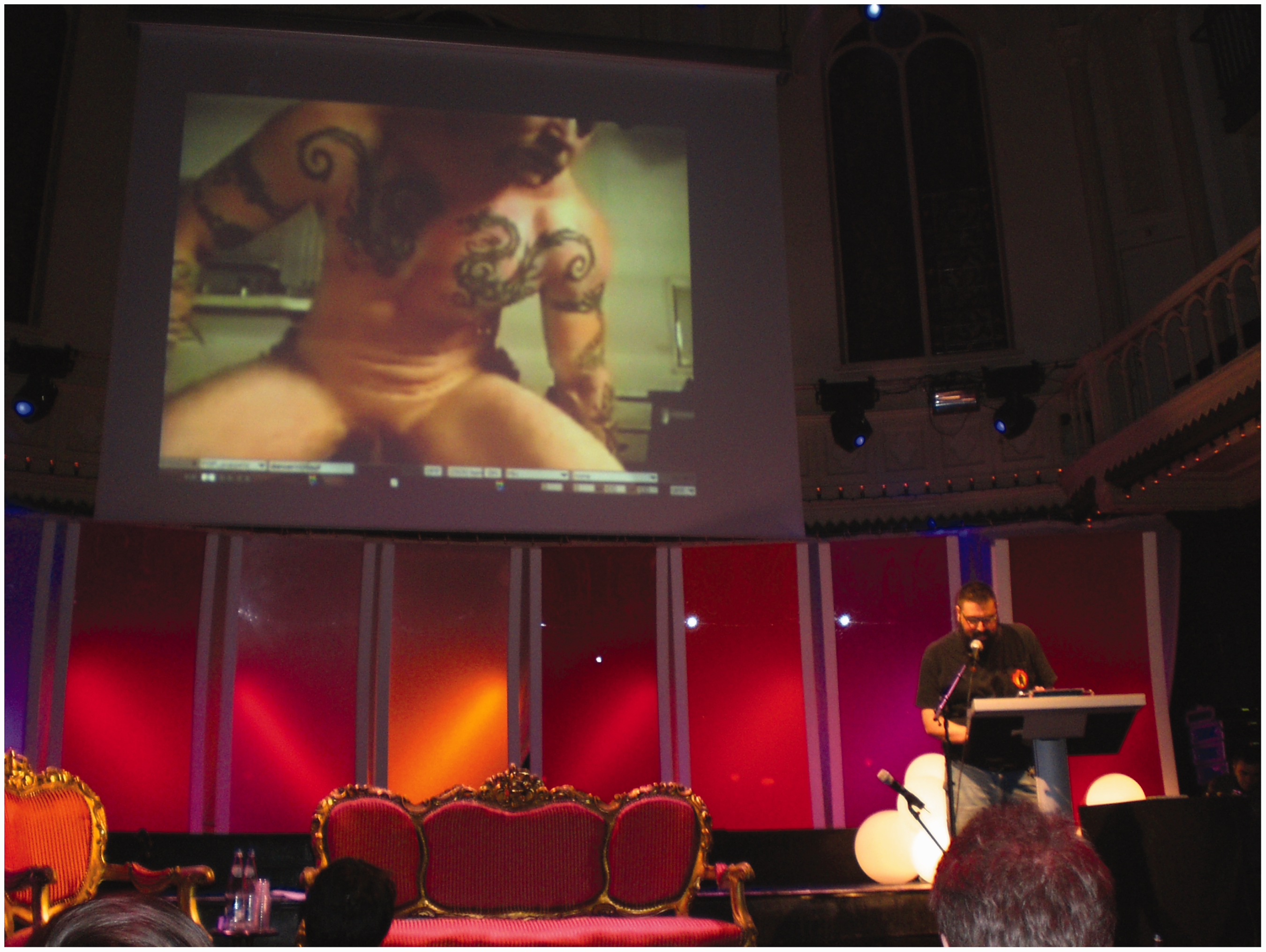
This is not to say that the audience simply approved of these pornographies or grooved on them, but they were open to witnessing, experiencing, and criticizing a researcher’s erotic subjectivity as an apt and inspiring handling of research. Since pornographic media are now totally banned from public spaces, including most movie theaters and academic venues, it is an important task for academics to protect them in a struggle for civil rights and within an ongoing critique of a rationalist type logic that dominates academia.
Sex pattern movies: Participation and afterthought
In summer 2015, I interviewed a group of sex entrepreneurs and educators about the beginnings and continuations of feminist and queer pornography in the San Francisco Bay area. Historically, San Francisco has been a catalyst for porn industries closely connected and involved with sex education and LGBTQ activism. Independently owned centers of sex culture and education, such as the Institute of the Advanced Study of Human Sexuality (IASHS) and the Center of Sex and Culture (CSC), have implemented and archived radical sexual pedagogies and ethnographic research models. When I visited the archives of CSC and IASHS, containing innumerable erotica/porn collections in various digital and pre-digital formats, I enjoyed the experience of drifting amongst unknown collections and realized it as a kind of aesthetic experience unto itself. Jerry Zientara showing one of millions of photos from the IASHS archive.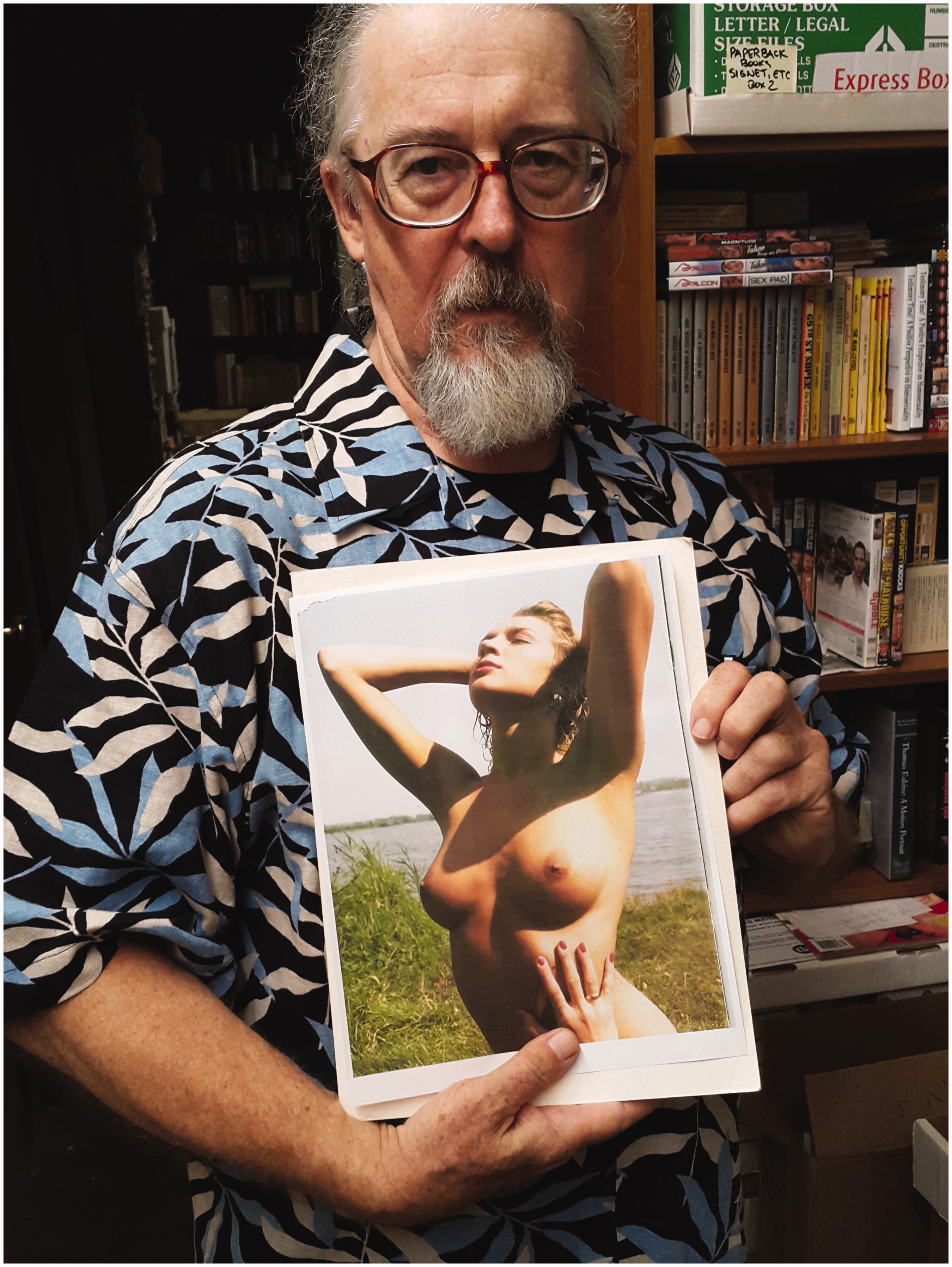
The archivist at the Center for Sex and Culture, Library Vixen, and the archivist at the Institute for Advanced Study of Human Sexuality, Jerry Zientara, both agreed to be interviewed while exhibiting selected items (Figure 2). Their ways of showing their own attachment to these items directly affected my own research. 4
Both CSC and IASHS have played an important role in advocating for the rights of sexual minorities in the USA and the de-stigmatization of pornography and sex culture in general. IASHS specializes in higher education and offers graduate degree programs for persons wishing professional training in sexology and “erotology.” The field of erotology is unique to the IASHS and refers to an academic study of human sexualities by means of erotic/pornographic media and artforms. When I interviewed IASHS founder Ted McIlvenna, he defined erotology as the scientific study of the graphic depictions of the actions of sex and love. He explained that he invented the term to study how people express their views and feelings about sex through artworks, and that it is perhaps one of the most “sensible” ways to study sexuality (McIlvenna, personal interview, 2015). Zientara further explained how students were encouraged to examine and use these collections as part of their theses in sex studies. He then elucidated the “sex pattern films” produced by IASHS, a collection of educational sex movies or erotic/pornographic self-ethnographies concerning human sex acts or “sex patterns.” The movies were produced by students in collaboration with a small film crew made up of McIlvenna and filmmaker Laird Sutton.
5
They were made, screened, and commented on by the performers inside classrooms and were also distributed as sex education films to medical schools, where they were used in courses on human sexuality. McIlvenna explained that the sex pattern movies were an attempt at pulling apart corporeal representation in commercial pornography: We decided one day that we’re going to film our own sex acts because what we saw in porn movies wasn’t really truthful. I wanted people to tell me how they really felt during sex and so we began studying sex patterns. I would make sure they agreed before we started fiming. We sold about 150 films and we kept about half of them. Of course I was being attacked a lot, they would say to me: “You can’t make movies about people’s sex acts.” I said. “These are their statements.” I took a long time asking their approval and making sure it was ok and that they approved. But my opponents criticized it heavily and the mass media also came along. (McIlvenna, personal interview, 2015) It was a very courageous program and quite a lot of movies were made. The premise was that after the film was made, the participants would get to look at the edited version and decide whether it accurately reflected their behaviors—they could “retell” the film so to speak (…) And the funny thing was that what they mostly argue about was music. They could never find the right music for these videos. (Zientara, personal interview, 2015)
Carol Queen is the founder of CSC and, as a graduate from IASHS, is familiar with the history of the sex pattern movies. Queen has also been involved as a producer and performer in early feminist and queer pornography, and she believes that some of these movies act as important predecessors. The process of making these images, the option to steer the sexual narrative, and the proviso for self-reflection are practices still commonly used in today’s queer porn. For instance, Pink&White Productions, currently San Francisco’s best-known queer porn company, offers a new model of sexual and ethnic diversity and queer-friendly porn. Their web-based Crashpad Series invites people from the LGBTQ community to perform on their set and comment on their sex acts. The movies are produced according to the sexual scripts proposed by participants and they are edited into episodes and uploaded on the website www.crashpadseries.com.
When performers are invited on to the Crashpad set, they do not obey the standard rules of performance in commercial pornography, nor does the sex act need to include fundamental pornographic aesthetics such as achieving orgasm by means of penetration. When I observed two performers starting their sex session in the Pink&White studio, they started with a quite intensive wrestling match, which, as was explained to me later, was an ode to queer porn celebrity Jiz Lee, who had wrestled on the floor with her partner in one of the earliest episodes. Pink&White also extends an educational mission by providing a web-based platform for reflection within a wider community. For instance, in Summer 2016, Jiz Lee launched a Twitter initiative in which they invited a large group of American sex and health educators to comment on Crashpad episodes. Most of these reviewers were teachers unafraid to publicly support the bold qualities of the sex performances.
Curating sexual personas and online performance
My own online persona, ‘Lizzy Kinsey’, was present in my life for several years in 2005–2008 and helped me open up to meaningful sexual encounters on adultfriendfinder.com, a USA dating site which had just opened divisions in different regions of the world, including Hong Kong. In December 2007, the site made the headlines because of its ground-breaking US$500 million sale to the Penthouse publishing company and because it had become the world’s largest adult entertainment network. Amongst its flamboyant pornographic imagery, I created and uploaded the profile of Lizzy Kinsey, a 40-year-old Caucasian bi-sexual woman, and the imagined granddaughter of Alfred Kinsey. During that time, I had been encouraged to make my own naked selfies and started taking snaps of myself in various poses, by scribbling notes directly onto my body, and eventually by inviting others to write on my body as well.
I had on a few occasions done academic performance art, in which I interrupted my conference presentation and invited the audience to write their feedback on my body. During the aff.com research, I opted for a similar idea but presented it in a more sexual or pornographic fashion. The profile picture I selected showed a close-up of my naked torso and breasts, but with a pen lying on top of my legs and text scribbled on my stomach that read “Are you Ready?”, a typical pickup line within this community (Figure 3). I also followed the Internet fashion of the day and disguised my identity by cropping the picture so that my face was not showing. The picture was ambiguous and suggested that I was ready to have sex, but I explained to people that I wanted to meet in a public space and have conversation. I would also interact with people online and exchange more photos and stories, or chat with them sometimes while masturbating. My aff.com profile pic as Lizzy Kinsey.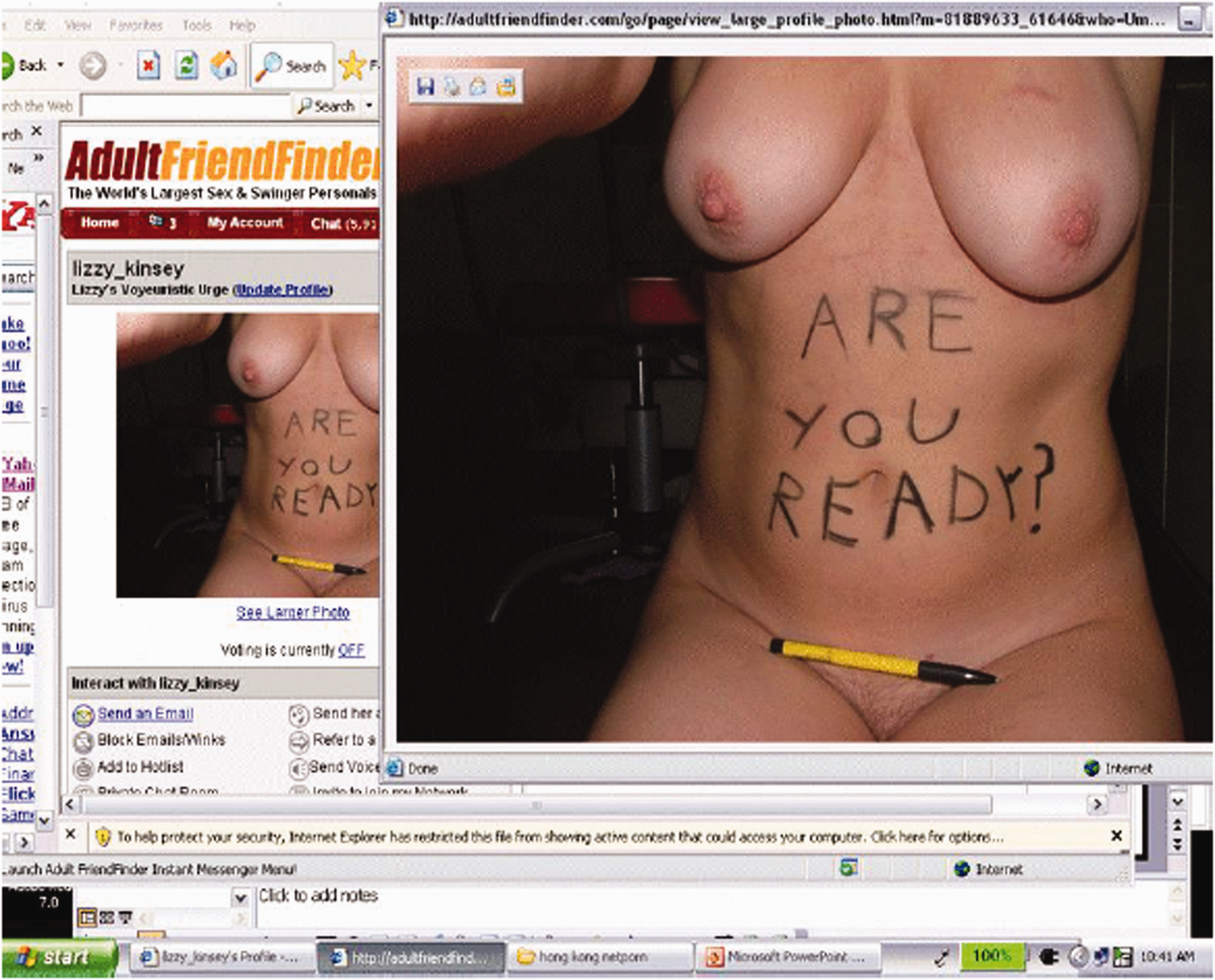
I have previously written about how and why Lizzy Kinsey was helpful in approaching informants, garnering data about being a white researcher in Hong Kong, and about inter-racial dynamics in sex culture (Jacobs, 2010). This work piece also became part of an aesthetic experience involving my own sexual desires through which I challenged and reexamined my ageing body, which I considered to be quite out of place on this website. I found that people scrutinized and appreciated the exact contours of my body and its imperfections, such as a nearly invisible scar on my breast. I also documented by means of photography going on long walks in the city and meeting with friendfinders in public venues in Hong Kong, most often restaurants or cafes or a large public library close to my house.
When taking these walks, I started to notice a stark contrast between my online fixation and city dwellers on the street. I lived in a quiet low-rise inner-city district that contained many small businesses, but the area was surrounded by massive high-rise buildings that hid their human inhabitants. The Lizzy Kinsey walks were a way of reflecting on the effects of the feverish online communication and of preparing for a different type of contact with people and the city. Even though I had negotiated and made it clear with people that I just wanted to talk and not have sex, and had thus lost the vast majority of friendfinders, these encounters were awkwardly fulfilling as we were forced to leave the zone of online communication. I was often feeling unhappy and stressed about being overly sexually immersed on aff.com, and it turned out that other sex seekers shared my sentiments. Of course, we all enjoyed getting attention on the site, but we also shared a critical perspective towards the site and its corporate-capitalist objectives. I discovered that it was possible to have refined and rewarding conversations with people, specifically the Cantonese males who for various reasons were deemed undesirable by Cantonese women.
The second reason that I persisted for several years as Lizzy Kinsey was that my work piece was doing its job fairly well and provoking me to pursue a new type of academic method, which helped my ability to fully engage with people and be emotionally and sexually present and receptive during fieldwork. For instance, there were people who wanted to have mutual masturbation sessions while being interviewed, as there were other people who wanted to share lengthy erotic fantasies that went way beyond utilitarian sex talk. By using a pornographic mirror, I projected my own moods and desires onto people, even if they were still intellectually inclined, and I received plenty of feedback back from them. I had entered the site to carry out ethnography and publish an article about Hong Kong sex culture, but overturned my own expectations and became a more vivacious sex researcher.
Conclusion
Theresa Senft carried out research while performing as a webcamgirl in search of an audience, companionship, and a feminist peer community. The advantages of her academic first-person narrative, just like Favero’s and Nardi’s, is that it demonstrates how this kind of fieldwork is driven by a moody aesthetic experience (Senft, 2008: 11). What Senft’s narrative also reveals, and what still is often deemphasized in academic reports, is how the “consummation” of ethnographic research cannot simply be geared towards cessation or “research output” as endless publications. For instance, Senft tells an anecdote about being stressed out and on a PhD deadline while witnessing a camgirl with bipolar disorder who was threatening to commit suicide. Senft had previously taken emotional distance from this person but, after much internal struggle, decided to go to the distressed person’s house and help her out (Senft, 2008: 70). She thereby broke an unspoken rule that impels one to minimize such engagements.
In Alice E Marwick’s study on Instagram fame, micro celebrities use online photography to collectively recreate their social class and status. She worked with a group of undergraduate students who were adequately versed in those aspects of social media, and whose personal experiences contributed to the research (Marwick, 2015: 145). These researchers involved their daily media lives, but it is still easier to debate this issue when non-sexual subjectivity is involved. I have simply argued for the inclusion of pornographic (self-)imaging as a way to activate sexual intensity and care as aspects of an honest scholarship. I have defended the use of a pornographic mirror as it unleashes sexual energy that cannot be censored out of academic activity and research. In order to emphasize an alternative mode of engaged and ethical work, I believe that researchers can narrate and theorize their sexual pursuits as aesthetic experiences. In an academic climate where erotic subjectivity is highly discouraged or policed, integral academic performance should include standing up for the researcher’s right to persist in this kind of work. Sexual communication easily falls prey to peer judgment and concurrent self-censorship. At this point, we need to, once again, tear apart the construct of the celibate researcher in order to invite those who wish to pursue a higher degree of sexual communication and holistically work those inclinations into a more refined variety of academic knowledge.
