



Abstract
School lunchboxes contain much more than just food. Maternal and paternal moralities, socioeconomic pressures, and the character of contemporary food systems can all be found within them. Lunchboxes, in turn, are microcosms of food system shifts, including the proliferation of highly-profitable, strategically-engineered ultra-processed foods. These commodities, often representing between 40% and 80% of energy intake depending on contexts, are having harmful effects on the health of children and adult populations worldwide. In this paper we examine evolving food system issues as they intersect with school lunchbox dynamics, through in-depth interviews with 34 parents in Australia. The results focus on the affective relations of ‘food parenting’, the fast-paced temporalities surrounding contemporary food cultures, the socialisation of dietary imbalances and governance of food systems and practices. We argue that the school lunchbox is an important example of the individualisation of responsibility for collective, multi-scale, social problems.
Introduction
Providing food for one’s offspring that fosters their health and wellbeing remains an enduring, albeit for many a fraught, act of parenting. Steeped in the moralities of nurturing life, school lunchboxes are much more than simply a meal. Their contents illustrate and embody the distinct cultural, economic and social contexts of parents. In many respects, rather than an individual choice, the school lunchbox is a socio-technical assemblage, emerging not merely through the parental knowledge about what is ‘good’ or ‘nutritious’, but via intermingling social forces of the day. The lunchbox – as do many other daily routines – reflects a wrestle between parents and corporations. This wrestle unfolds within an increasingly globalised, industrial scale food system (Baker et al., 2020). Food commodities designed to be ultra-appetising, while often lacking in nutritional value, are increasingly associated with negative health outcomes (Lane et al., 2024; Moss, 2014; Warner, 2013).
These harms emerge in a complex system of interactions between food industry actors, policymakers and consumers (Bennett et al., 2025). As emphasised by the World Health Organisation (2022), policy and other interventions require understanding the food system from the perspectives of many different stakeholders. This paper presents the findings from our in-depth interviews with parents, exploring their experiences navigating food for their families. Early in the data collection it became clear that school lunchboxes are a significant challenge for parents. While focused on the Australian context, this study contributes insights into parents’ experiences of the commercial determinants of health and food, a topic of international significance (Chung et al., 2022). This paper provides an illustrative example of the ways that food cultures, governance, economics and school environments can support or work against the cultivation of healthy dietary patterns across generations. Opening the (social problem of the) lunchbox, as we do here, invites a critical look at the social structures and familial relations that materialise as both health and harm.
Background
The lunchbox, as a site of sociological inquiry, is prone to varied regulatory structures and institutional histories, with significant variation in the organisation of school lunches around the world. In some countries, such as in France and India, schools provide food for students (Pastorino et al., 2023). In the authors’ context in Australia, and several other countries (such as Canada and Norway), the onus is almost entirely on parents. Here, most (90%) of children eat food packed by caregivers (Manson et al., 2024), with over 4 million lunchboxes sent with students every day (ABS, 2023). Whilst this on its own speaks to quantity not quality, the organising models of food at school mediates what lands in the hands and mouths of children.
There have been some attempts to map lunchbox quality. For instance, we know from previous research that the average school lunchbox in Australia contains excessive amounts of ‘discretionary’ foods that are energy-dense and nutrient-poor, and often contains no vegetables (Sanigorski et al., 2005; Sutherland et al., 2020). Much of this relates to practicality, in providing foods that last without refrigeration and that children will eat (Bathgate and Begley, 2011; O’Rourke et al., 2020). The cultural turn towards convenience (vis-à-vis whole food preparation), connected to time-constraints in dual-income households, has been met with the rise of ‘ultra-processed food’ (UPF). UPF is typically nutritionally imbalanced (high sugar, salt and fat, and low protein and fibre), and contains industrial ingredients (preservatives, colours, flavours, emulsifiers etc.; Monteiro et al., 2019). UPF is often designed to optimise tastiness, minimise costs and maximise profits (Moodie et al., 2021). This commercialised food environment has resulted in an even greater degree of concern and potential health harms surrounding what children eat.
It is estimated that 60%–80% of children’s energy intake in the United Kingdom is from UPF (Onita et al., 2021; Rauber et al., 2019). Similar trends have been found in Australia, with estimates of 42% of adult dietary intake (Marchese et al., 2022; child specific estimates are not yet available). Recent studies have identified significant associations between high-UPF diets and obesity, type 2 diabetes, cardiovascular disease, gastrointestinal disease and mental illness (Lane et al., 2024; Srour et al., 2022). School meals have been proposed as an avenue to improve children’s dietary patterns and health outcomes, reducing food insecurity, while also increasing the sustainability of food systems (Illøkken et al., 2021; Lalchandani et al., 2023; Oostindjer et al., 2017). The Tasmanian government’s fast-expanding school meal pilot has also initiated a national conversation (Jose et al., 2024), while underscoring the need for more in-depth family perspectives of both lunchbox provision and its alternatives (Manson et al., 2022).
Social scientists have generally not explored the school lunchbox specifically as a sociotechnical assemblage illustrative of food system imbalances. What previous social science in this context has underscored is the emotional, mental and physical labour that this ‘foodwork’ involves, and is primarily put on mothers (e.g. Brenton, 2017; Karademir Hazır, 2024; MacKendrick and Pristavec, 2019). These studies consider experiences of shame and blame as produced through collective and system-level dynamics (Hays, 1998; see also Ahmed, 2014), with language and culturally-dependent notions of what is (un)healthy food influencing social judgements within school food institutions (e.g. Allison, 1991; Karrebæk, 2012). A few of these studies have focused specifically on mothers’ perspectives and experiences of school lunchboxes (e.g. Bathgate and Begley, 2011; Watson-Mackie et al., 2023). This body of work provides a foundation for our focus here, which draws on the lived experiences of parents attempting to ‘deliver’ a nutritious lunch. We explore this in connection with work on both the affective/moral economy of food, and in turn, introducing important sociotechnical and political economy dimensions therein.
In line with C. Wright Mills, we argue for the centring of our increasingly imbalanced food systems, to rethink what is often seen as a private trouble (‘bad parents’, ‘fussy kids’, ‘poor quality lunches’) as a public and very social problem.
Methods
Data collection
This research has been conducted as part of an interdisciplinary programme of research that brings together the ecological and biological sciences of nutrition (DR) with critical social sciences and health sociology (JB and AB). The paper draws on in-depth interviews with 34 parents living in Australia, exploring how they experience contemporary food environments and their perceptions of the enablers and barriers to their family’s healthy diets. With ethics approval from The University of Sydney Human Research Ethics Committee (HREC #2024/084), we recruited participants using social media, primarily through a Facebook advertisement. This advertisement targeted parents in Australia with children under 18 years old. In Australia, while some pre-schools and childcare centres provide meals for children, others require home-packed foods (as young as 6 months old). The advertisement linked to the Participant Information Statement and Consent Form. Emails were sent to prospective participants, inviting them to schedule an interview.
In-depth semi-structured interviews were conducted between March and August 2024, on Zoom (n = 31) and in-person (n = 3). Interviews were approximately 1 hour, with two interviews going for 1.5 hours. JB conducted all the interviews, using her positionality as a mother of two children (pre-school and primary school aged) to help build rapport with participants. Interviews were continued until we had reached sufficient information power to address our research aims (Malterud et al., 2016). The study included 31 mothers and three fathers, reflecting an ongoing imbalance in parental roles and similar studies (e.g. Cappellini et al., 2018; Karademir Hazır, 2024; MacKendrick and Pristavec, 2019). More details can be seen in the Appendix 1, where we give the household composition and geographic location of each parent, along with additional relevant notes on their family diet and/or children, in participants’ own words. The problem of school lunchboxes was identified early in data collection as a significant and recurring theme.
Analysis
Analysis happened concurrently with data collection, rooted in interpretative traditions of qualitative data analysis and constructivist grounded theory (Charmaz, 2017). This involved an in-depth exploratory approach that sought to capture the subjective and multi-faceted experiences and perspectives of participants. The interviews were transcribed verbatim and the research team systematically reviewed each interview multiple times, taking notes and looking for patterns within the collected data. We conducted the analysis collaboratively, collating the interview transcriptions in an extended Microsoft Word document. We coded the data using Comments. Each Comment started with the code (e.g. Challenge – lunchbox, Barrier – time, Solution – regulation), and was followed by researcher reflections. A Visual Basic Macro was used to extract highlighted quotes, Comments (code and notes) and participant identifiers, to sort the codes and analyse themes in Microsoft Excel.
At our regular interdisciplinary research team meetings, we discussed the interviews and key themes. Guided by Charmaz’s (1990) framework for data analysis, we considered: what is the basis of the experiences and perspectives described in the interviews; what assumptions do these reflect; what broader social processes are these a part of; and what are their implications? Following identification of themes across the interviews, we returned to the data to search for additional related comments to develop, complicate and elucidate these further. This meant that different perspectives that we initially viewed as unrelated could later be seen in connection or in contrast with each other. Finally, we revisited the existing literature and conceptual tools from across disciplines, to interpret our findings.
As we analysed the lunchbox theme, we found that many other key systemic issues – limited time and money, the normalisation of imbalanced foods, the distrust in food governance and the moral economies of parenting – were implicated in this everyday object. In response, the primary research question we address in this paper is: how do parents’ everyday encounters with school lunchboxes reflect and shed light on evolving food system issues?
Results
Feeling like ‘failures’
I will fucking blow my shit if someone is commenting on what I’m giving my kid, like I just. . . I’m all about promoting healthy eating and stuff like that. But also like you can fuck right off. Like you just don’t comment on what I’m doing to my, like, yeah, I’m, that’s gonna really piss me off.
You’ve already got this premonition!
‘Cause I’ve heard about it like, I’ve got friends that have got older kids. . . ‘Are you gonna come to my house, buy my groceries and pack the lunch box? Because if you’re not, then you can piss off.’ You know. Like, because obviously you want to feed your kid the best food. . . frickin hell, so you probably already have a level of guilt about it.
The mere idea of the school lunchbox lights a fire inside Charlotte, a mother of 1-year-old twins. Steeped in a sense of judgement, and performative morality from ‘other’ parents and teachers, stories of lunchboxes flowed through the social worlds of parents. As Charlotte, and most, if not all, of the other interviewees articulated, this little box of food has a palpable presence in the day-to-day rhythms and fractures of family life. This was not just like other aspects of parenting (a life stage that is a swirl of intensifications) but was articulated as a sort-of yardstick for parenting ‘success’ and ‘failure’. This parenting ‘success’ was evaluated in relation to the perceived ‘other’ (peers, teachers, society), their relationship with their children, and their own assumptions relating to health and food. This moral encounter and the affective intensities therein were – self-initiated and relational – jarring with the spectre of food supply and food cultures.
Commonly framed as ‘mothering’ failures, participants described experiences of shame in confronting judgements (or anticipated judgements) of other parents, teachers or themselves. This drove many participants to pack healthy foods, even knowing it would not be eaten:
We were trying all these different like lunch options. And then the kinder teacher just was like, ‘look, he’s not eating it.’ And she’s like. . . ‘I’m not gonna judge you. I can see that’s what he wants to eat.’ And I’m like, ‘oh, thank you!’ Like, I still want her, I still wanted her to see that I tried, you know. I still wanted her to understand that it wasn’t because we hadn’t tried everything.
Whilst Maria’s teacher offered a non-judgemental approach, the parents we spoke to worried this would not be the case. For instance:
I always feel guilty, it’s difficult. It’s really hard because like, this is how I want you to eat, but I’m realistic. I know you’re not going to eat this. . . I’m really trying hard to balance things out. I saw some very good things in those [other children’s] lunch boxes. I’m like, ‘ok, that’s great.’ But then you know, some of those things my child wouldn’t eat. And I saw some terrible things [in other lunchboxes] that I would never put myself. But I understand, and I’m not judging, because if that’s the only thing the child will eat in like, 10 hours at daycare, then so be it, right?
The implicit judgements of such ‘terrible things’ were often accompanied by empathic qualifiers and self-judgements (mothers’ guilt), as participants navigate a mismatch between foods they want their children to eat, and those eaten. These internalised tensions were quickly externalised in interviews, expressed as frustrations with structural constraints – from the lack of facilities in schools, to foods disallowed due to allergies (such as nuts and eggs), and the limited time available for food preparation and eating constraints (of parents and children alike). This makes many parents feel they have no choice but to compromise their child’s health, for pragmatic convenience:
We know that processed food is really bad for kids. And then you just run out of options to put in their lunchbox. Because every time you try to cook something and put in the lunchbox, they don’t want it. It doesn’t keep warm. It doesn’t keep cold. What are you supposed to do?
My younger daughter can’t take kiwi fruit or yoghurt or. . . sesame seeds on bread because like there’s severe allergies in one of the kinder kids’ classes.
Lunchboxes I find really hard, because whenever I go to any effort to put anything slightly perishable or healthy in there, it comes back all slimy and uneaten.
Participants navigated these constraints with different degrees of self-perceived ‘success’, primarily by tailoring lunchbox contents to minimise the wasted food, time and money. This resulted in the basic elements of the lunchbox described by most parents as including: a sandwich (generally white bread and a spread or ham), a piece of fruit, and multiple packet foods such as muesli bars, chips, pretzels, popcorn, ‘a little snacky treat’ (as Chloe put it) such as Roll-ups or Tiny Teddies, and for some children, a ‘little juice popper’ (as Jane put it).
Participants recounted in detail the ways they tailored their lunchboxes to their child’s preferences, to minimise reduce food waste and with a common note as to the ‘fussiness’ of one child compared to a sibling. Nine of the 34 parents (Alina, Amy, Maria, Meredith, Michelle, Nin, Rachel, Victoria and Zahra) had an added challenge of adapting lunchboxes to the specific preferences and needs of children with diagnoses (e.g. autism, anxiety) and/or food sensory sensitivities, with Avoidant/Restrictive Food Intake Disorder the most extreme. Often these parents felt well supported by teachers and schools (such as being given extra time to eat). Some of these parents directed an intensity of emotions towards themselves and their child, whose eating behaviours confounded them. For example:
He’ll come home, and he would not have eaten his lunch. And it’s like. . . ‘Did I, did I cut the sandwich the wrong way? Did I leave the crusts on when you didn’t want it?’. . . You know, it’s every single aspect. ‘Is, was there too much cheese on it? Was it too cheesy? Was it not cheesy enough?’
Parents described various strategies and resources that helped them navigate lunchboxes. For example, the ‘Yuka’ app (that assesses foods by ingredients, via scanning a barcode) was mentioned as providing useful information for switching the unhealthiest packaged items for healthier equivalents (with fewer high-risk additives, and more nutritionally balanced). A few parents also described requiring their children to eat their leftover lunchbox food when they get home from school:
I just put whatever I want to put in it, and then if it comes home, and it’s fruit and veggies, they have to eat it for dinner. And then that usually stops it because it’s pretty gross.
However, even with such strategies, in the face of routine complaints and refusal, the restrictive nature and social context of school lunchboxes was an ongoing challenge:
It’s just hard, because we don’t have a soft Wonder White bread situation. . . my son will take sausages or take like cold meat. But my daughter won’t, so she eats like a really snacky kind of box.
Across all our interviews, it was clear that aspects of modern food systems and school food environments – well beyond parental influence – circulated through to parents’ sense of lunchbox ‘success’. A key aspect of this is the temporal structures within which school lunchboxes are prepared and eaten (or not).
Nutritional temporalities
Time has been a unifying notion in the social science of food, with ongoing and critical analyses of the undulations of slow and fast (Kenny et al., 2025). This has spanned both the sociality of food (such as the ‘slow food’ movement) and the ‘junk’ status of much ‘fast food’ now on offer in our modern world (e.g. Hsu, 2015; Parkins, 2004). These temporalities also have implications for biological processes such as digestion and nutrient absorption (e.g. de Graaf and Kok, 2010). Such analysis has much relevance in the face of an unjust globalised food system that has scaled and engineered ‘cheap’ food (Patel, 2007), with UPF fostering instant (rather than carefully prepared) food consumption, and propelling a nutritional temporality that parents wrestle with day-to-day.
The issue of temporality came to the foreground in shaping the ‘quick fixes’ sought for school lunches, and the institutional brokering of nourishment. Almost all interviewees expressed frustration with the time they spend planning, purchasing and preparing their children’s lunchboxes and at the end of the day, emptying the (now slimy) fruits of their labour into the bin. These encounters with waste were routinely described in relation to the lack of time allocated for children to eat at school. Many parents also described the way that this time is organised (typically a minimum eating period comprising the first 7–10 minutes within a 30-minute lunch break), which they believed to set up a trade-off between eating and play. The following quotes are indicative of these widely shared irritations:
So much [food] gets wasted because there’s not enough time to eat. . . They have like 10 minutes where they have to sit and eat, but they can talk, and then they can go play. They can keep eating, but obviously they’re not going to. So, when he goes to vacation care, he eats his whole lunch box. . . If he’s busy [and] he doesn’t eat, whatever, he’ll be fine. But it’s also the wastage. He’ll come home and just tip out half a lunch box if for that day he hasn’t eaten.
Here [in Australia] at schools, is kids don’t get the time to actually sit. . . yes, it’s important to do the running too, but how important is to actually sit and understand what you’re eating?
I’ve noticed that my son, the 8-year-old, he’s not interested in eating, he just wants to play football. Just he’s, he’s too busy. He just wants to play.
Parents, in the above interviews, and many others we talked to, expressed a belief that these normative temporalities, institutionalised within schools, were undermining their own efforts to provide a nourishing lunch. Connected to this temporal ‘disorder’ was the observation of a handful of participants that the school food environment devalues food itself, dislocating the sociality and connectivity that can surround food practices, at a very foundational point in life:
They sit in the line, behind each other so they don’t distract each other from the food intake because they have seven minutes. . . They cross legs, like they have their lunch box on top like this. It’s so sad. . . There’s no environment that is dedicated to the food and the eating and the sitting down and enjoying your food. And it’s just fuel and just eat eat eat eat and run away.
Descriptions of food as ‘fuelling’ minds and bodies was a common refrain across the interviews. However, as Sophie pointed out, what is missing from this frame is the social value of food: ‘The enjoyment, and the, and the social aspect of [food] and the taking time. The sitting down and taking time and enjoying each other’s company’.
This nutritional temporality and cultural logic unfolds, we were told in the interviews, in workplaces, social events and family meals, where food is habitually reduced to its utility. The planning, preparation and consumption of food are often cast as things to quickly ‘get done’, in service of ‘higher value’ tasks (such as learning, working and relaxing), and the slower sociality of food is often lost. In other words, what we see in school lunchboxes reflects broader cultural relationships to food and time. These ‘fast food’ cultures (in various forms) have become normal in Australia and around the world. Practices surrounding the school lunchbox both reflect and reproduce this norm. This is visible not only in the lack of time and spaces provided for children to eat their home-packed lunch, but in the surrounding institutions, such as school canteens which, as participants underscored, contribute to making unhealthy food seem ‘normal’ and healthy food seem ‘odd’.
Socialising imbalance
Food and eating are social and socialising practices (Warde, 1997). The food preferences of children and parents are, as with many other ‘tastes’, largely defined in relation to specific social-economic and cultural circumstances (Bourdieu, 1984). In UPF-dominated foodscapes, institutions such as supermarkets, the UPF industry and food regulatory agencies, influence the options made available for parents to put into lunchboxes, and the foods that children desire. The foods on offer in children’s educational settings are key aspects of the socialising of children into particular relationships with imbalanced foods. High sugar/fat/salt/processed foods have come to be seen as ‘treats’ and are a mainstay in school canteens, celebratory events and sports days (see also Rocha et al., 2023; Smith et al., 2017). Participants spoke about the ways that such institutional practices anchor unhealthy food norms, rendering imbalanced foods (which are mostly UPF) an acceptable, unavoidable and ultimately (for many children and time-pressured parents) a ‘desirable’ part of modern family life.
Australian state departments of education mandate school canteens to include healthy ‘options’, however many participants believed the mere presence of unhealthy options on canteen menus made healthy ‘choices’ more difficult, and worked directly against their food parenting efforts. The rising spectre of the chicken nugget was a prime example of this socialised imbalance:
I’ve worked in the canteen and the number one biggest seller there is bloody chicken nuggets. It’s gross, frozen chicken nuggets. I don’t think these nuggets have ever seen a chicken. So, I know there is, you know, they’re meant to have a balanced canteen offering in the schools. But although they have salads and salad sandwiches on the menu, I never ever made one.
My kids are like ‘why would I order a sandwich if I already eat that every day for school?’ Like ‘I want the chicken fingers.’ You know?. . . But if you don’t give them that option. . . then they will make better choices.
Because the kid sits next to the parent as they’re ordering canteen and goes ‘I want that, I saw my friend having that.’ And so, you know, it happens. So, I do think that there’s a certain responsibility that the schools have, to only have healthy stuff available.
Exemplifying cheap food produced at industrial scales (Patel and Moore, 2018), chicken nuggets combine factory-farmed chicken fed antibiotics and hormones, with long lists of fillers, preservatives, salt and sugar, frozen, ready to be deep fried in questionable oils. Designed to appeal to children’s tastebuds, these nuggets of harm are, in turn, objects of envy in the economy of schoolyard politics, and their widespread availability and affordability make them an almost unavoidable part of family foodscapes.
If nuggets were a lone example, an ‘occasional food’ as canteens label them, situated within social norms of whole food diets, they might not be so problematic. However, participants lamented the situation in which they felt bombarded by unhealthy foods, such as chips, sausages and confectionary. This, they said, makes low quality unhealthy ‘foods’ seem normal in children’s eyes, and healthy foods seem ‘odd’:
It’s left and right, it’s a bombard of this stuff. . . Like if you do wanna follow a healthy lifestyle is it’s very like you become the odd.
Kids here [in Australia] like, I think your children grow up, on chips. French fries, like that’s all they eat. Like, you know, whenever I see a child eating something, it’s chips.
The obsession we have with sausages, what is with that? Like, Oh we’ll do a Father’s Day breakfast at school, let’s serve sausages. We’ll have a scouts camp, and we’ll all go for a really nice hike and then we’ll have a sausage sizzle at the end. Come and play sport on the weekend and then have a sausage.
Having UPF on school canteen menus reflects – and reproduces – the normality of imbalanced foods as children’s foods. Combined with kid’s menus at restaurants, ‘without any sign of a vegetable’ as Grace put it, sets children’s expectations that UPF can be eaten multiple times a week or even multiple times a day. This normalising of imbalance intensifies the affective relations of and between parents, who worry that if they try to fight it, others will judge them or feel judged. As Grace continued:
It just scares me, when you have those sausage sizzles like, and, you know, you just don’t know what the quality of the meat is. And then it’s like, everyone’s doing it. And then they’re going to have their lolly snakes as well. And it makes it so hard for parents, you know? Because if everyone else is doing it. I mean, I’m not scared to be that mum, you know, and I’ll be the one that sends the message out saying I’m not bringing all these snakes to soccer. They can have fruit. If anyone wants to join me, that’s fine. If you don’t, no judgement.
How do you find that social aspect?
It’s really interesting actually. Because once you actually put it out there, a lot of parents are relieved. They’re like, ‘oh, my gosh, I don’t want my kids eating that either, I’m so glad that you would speak up.’ And they’re too scared to do it themselves.
At the crux of this problem of socialised imbalances is not that these ‘unhealthy’ foods have no place in our social worlds, or to wish for children to only ever be offered nutritionally balanced foods. Rather, the problem is the vicious circles that work against the health of populations. This raises an important question: how has the spectre of the nugget, and various foods of low quality and imbalance, made their way into foundational, pedagogical environments, working against parenting attempts to deliver nourishment and care?
(Un)helpful governance
Functioning to support the normalisation of nutritional imbalance is a complex consternation of nutritional disputes (e.g. Kearns et al., 2016; O’Connor, 2016; Scrinis, 2013) that, entangled as they are with institutions of economics and regulation, presents a pot of ambiguity ready for the food industry to stir (Nestle, 2013). This makes healthy ‘choices’ even more challenging. Across our interviews, participants resented many aspects of the unhelpful governance that directly or indirectly influences school lunchbox challenges. For example, the sponsorship of children’s sports by fast-food corporations, marketing strategies that directly target children, and the health claims and lists of ingredients on the front and back of food packages, which were widely seen to be confusing and even intentionally misleading:
Kids like Bluey [the cartoon character]. They see Bluey on the box, ‘Mum, I want that.’
The Player of the Match Awards, and it comes with a Dominos voucher, and I’m like how does that align with soccer, you know?
I feel like food labels are extremely deceptive. And by producers purposely confusing. . . you almost need a degree in all the numbers to be able to understand what’s in the food.
Conflicts of interest and unhelpful governance were also evident in the varied assumptions held implicitly by participants. For example, some participants described ice-cream and Milo (a sugary chocolate powder with added vitamins) as good sources of nutrition, and recommended by nutritionists:
When I think of ice cream, I’m like, well, it’s calcium, right? When you get down to it.
My nutritionist [said] you either have to have the Milo or you have to have ice cream with Milo on it. . . it’s the actual vitamins that are actually in the Milo.
In contrast, other participants named ice-cream and Milo as examples of unhealthy foods, and questioned the Government-endorsed Health Star Ratings commonly found on them:
They put the five stars, four stars, which is very misleading because they put it on the wrong product, like, I don’t know. They put five stars on some like Milo and things like this.
Is it telling the truth? Do you believe it if it’s got a five star or a four star rating on it? Because there are some breakfast cereals like that, like Cocoa Pops or Nutri-Grain have three and a half star rating, and what exactly does that mean?
Participants’ understandings of what is healthy food was spoken about as influenced by cultural backgrounds, education and interactions with different illnesses. For example, Olivia’s focus on micro and macronutrients was influenced by her experiences of malnutrition. In contrast, Isabella’s focus on fresh foods was influenced by her Italian cultural background, and her daughter’s illness that was healed by removing refined sugar from her diet. However, in a prime example of the public dimensions of private problems, these different personal beliefs distinctly aligned with debates within nutrition science. Mainstream nutrition science affirms Olivia’s understanding, with a focus on calories and micro- and macro-nutrients (e.g. Marriott et al., 2020). Meanwhile, approaches within critical nutrition studies affirm Isabella’s understanding, attending to whole foods and the harms of UPF displacing them (e.g. Guthman, 2014).
Participants who had experienced different ways of organising food in schools – such as countries with national school meal programmes, instead of home-packed lunchboxes – longed for such a public intervention:
[In Italy] everyone has their vegetables, their proteins. There’s a menu and it changes. . . So the government makes sure that the food provided [at school] is good, it’s got all the proteins and vitamins and things that you need.
[In France] basically you come in, you take a platter and then you have a choice, like staters, hot meals and desserts. And all of it is healthy choices. . . It’s part of the education and being exposed to different flavours.
[In Japan] so you know they had the protein and vegetables and soup. . . I would love to have that here, because I know that I don’t have to worry about packing lunches. If it works like that, then I know that the kids [have] actually [been] fed really healthy meals.
[In India] it’s government funded. So it’s amazing because that means, that’s the reason why kids go to school. Because they have a healthy meal every day.
I’d like to see [the Tasmanian school lunch pilot] rolled out and supported [nationally]. Because obviously it’s got a whole range of benefits, educationally and [for] health, and socially.
However, there was an important caveat to school food provision that multiple participants emphasised. Such an intervention would need to be high quality foods, and – as Amrita put it – ‘not the American way, where you have a canteen and it’s all rubbish’.
Participants also found a range of food initiatives in Australia to be supportive. For example, the cooked meals provided by early childcare centres were widely appreciated, seen as socialising healthier eating and taking pressure off parents. Participants described their appreciation for the ‘free fruits’ for kids in some supermarkets, the ‘Crunch and Sip’ or ‘fruit break’ programme in schools (where students have a short break to drink water and eat fruit or vegetables) and the Stephanie Alexander Kitchen Garden programmes (where children grow food and then cook it). These were described as examples of ‘positive peer pressure’ (Rachel), and ‘normalising’ healthy foods (Isabella).
Participants had many suggestions for how parents could be better supported, wishing that governments in particular would: ‘make information more easily available’ (Mila); ‘stop allowing cartoon characters to be on children’s food’ (Maria); make ‘things that are healthy a lot more affordable by maybe having more tax on processed stuff’ (Chloe); require supermarkets to ‘keep it [unhealthy foods] in the aisle’ and not at check out or spread across the store (Emma); and generate programmes that support children’s health in ‘sustainable ways, making fresh food cheaper while supporting farmers’ (Ava). Such suggestions resonate with multi-scale interventions that are having some success in Latin America (Popkin et al., 2021). It was clear across the interviews that ‘centring the mother’ (as Ava put it) in the development of solutions across multi-scale interventions would be instructive:
Mums have so many ideas, I think, because they are always thinking about their kids. . . I think every school or every kinder, you know, every council, or every government, should have some platform where mums can [make] suggestions.
Participants saw helpful food governance as an opportunity to benefit for public health, relieve parental stresses and support children’s health for life:
They talk about the obesity crisis, but they don’t talk about the origin of it. . . that there is no proper food education in school. . . Everything, the health crisis; and the agriculture; and you don’t know how to eat, so you snack. So then, they produce all these unhealthy stuff and package [it] with all this plastic, and [containing] all these processed ingredients. . . Learn how to eat in the first place, and that would solve so many problems.
Reflecting the above sentiments, participants demonstrated a remarkable understanding of the complex social forces that work against their efforts to parent food well.
Discussion
This study, focused specifically on parents, is part of a broader cultural tussle with (distorted and distorting) food systems and cultures and the ways in which macro conditions flow right through to the seemingly innocent site of a school lunch. Thrown away, saturated in hope (‘maybe they will eat it today’), imbued with judgement, and filled with the engineered and scaled commodities of our current milieu of industrially processed food, the lunchbox tells an important story. It is a story that resonates with previous work on the palpable intensity of parenting (Brenton, 2017; Yerkes et al., 2021), the huge imbalances of our food system (Janssen et al., 2018; Wood et al., 2023), and the ways that institutions and cultural norms can become part of the problem. Aligning with the revelations on the social and commercial determinants of health (Kickbusch et al., 2016; Maani et al., 2023), our in-depth look inside the school lunchbox illustrates some of the ways that social and commercial factors influence children’s eating and long-term health, and the efforts of parents to push back against this deteriorative system.
The dynamic across our results, and indeed throughout the interviews themselves, is twofold. First, the affective intensity of parenting, and the moral framings therein, offered a form of governmentality over children’s nourishment. This echoes earlier studies of mothers’ experiences of lunchbox pressures, in different contexts, emphasising the relationship between structural constraints of time and money and social and cultural expectations surrounding food and ‘good’ mothering ideals (e.g. Allison, 1991, in Japan; Cappellini et al., 2018, in the UK; Karrebæk, 2012, in Denmark; Seko et al., 2024, in Canada; and Watson-Mackie et al., 2023, in Australia). Despite being a nearly impossible task, delivering a ‘healthy lunch’ was nonetheless operating as a form of capital amongst parents and at school. That is, being a ‘good parent’ – reflected in a child being a ‘good eater’ – was a powerful aspiration and social dynamic, which functioned to distract from the forms of system imbalances that constrain parents’ options.
Second, there was an institutionalised and sometimes internalised logic of food, which framed both the practice of eating and, inevitably, what could and would be eaten. Absorbed by the school canteen, epitomised by the ubiquitous chicken nugget and stripped of the vitality of food as a site of sociality, economic priorities make their way into schools, socialising children as to the very purpose of food. This ‘purpose’, often sped up and stripped of wholesome qualities, speaks to the lunchbox as a site of socialisation. This sets up a reinforcing dyad with UPF making lunchboxes quick for parents, and which are fast for children to eat in short lunchtimes (see also O’Rourke et al., 2020). This is further fortified by the engineering and marketing of UPF to directly target children’s tastes and desires, creating yet another force that works against parenting healthy food.
Finally, nutritional science, media and food governance were seen as major influences within this dynamic, with the UPF industry utilising abstracted approaches to food (such as a focus on calories and micronutrients), to distract from the contexts of the whole foods, bodily processes, and social ecologies of particular histories and places (cf. Hayes-Conroy and Hayes-Conroy, 2013). Much of this milieu of food acted as a form of ‘social infrastructure’ which emerged from systems of production, distribution and consumption in food environments of diminishing nourishment, weak regulation and engineered commodities (Moss, 2014; Nestle, 2013). In essence, both the moral imperatives (‘you need to parent well’) and the logics of food (‘quick, tasty, convenient’) are both enacting and are enacted by system characteristics. These dynamics reinforce industrialised economies and globalised for-profit food systems. Without the efforts of parents to push back against the low-quality products dominating our current system, the health harms would be even more deteriorative.
While limited by a non-statistically representative sample, the in-depth nature of these interviews with participants from a range of backgrounds, responsible for children across a range of ages, underscores the shared significance of the issues explored. Further, the dynamics observed here centre the structural characteristics of a globalised processed food environment, pointing to the broader relevance of our results far beyond the school lunchbox. Our study indicates that, if children’s health is a public priority, a more supportive social infrastructure is required to enable it.
Conclusion
The logical shifts indicated by this study reinforce many of the enduring suggestions outlined in existing literature, attending to both the physical and social dimensions of food and eating at schools (Berggren et al., 2020). This includes: facilitating longer lunch breaks (Burton et al., 2022), integrating food with learning (Sumner, 2016), and developing national programmes of healthy and sustainable school meal provision (Oostindjer et al., 2017). Connecting the perspectives of our participants with global policy research, examples of helpful governance shifts might include: strict restrictions on marketing to children; replacing optional Australia’s Health Star Ratings with mandatory front-of-package warning labels; banning UPF from schools; and revising taxation and subsidies to make healthy options more affordable (Rockström et al., 2025; see also GFRP, 2025). However, schools and governments cannot make these changes alone, nor can a celebrity chef or a group of parents. The findings we have discussed have underscored the multi-scale nature of such changes: connecting institutions (e.g. school lunchtimes, canteens, education) with food cultures (e.g. at home, workplaces, sports), with affective relations around parenting, and with the broader regulatory ecosystem, industries and economies. This would necessarily cross multiple department portfolios and industry sectors (including food, education, health, business and agriculture), and – as our participants suggested – centre parents’ voices therein. This research puts forward that understanding the social nature of the problems contained in the school lunchbox, is a step towards its public solutions.
Footnotes
Appendix
Interviewee details.
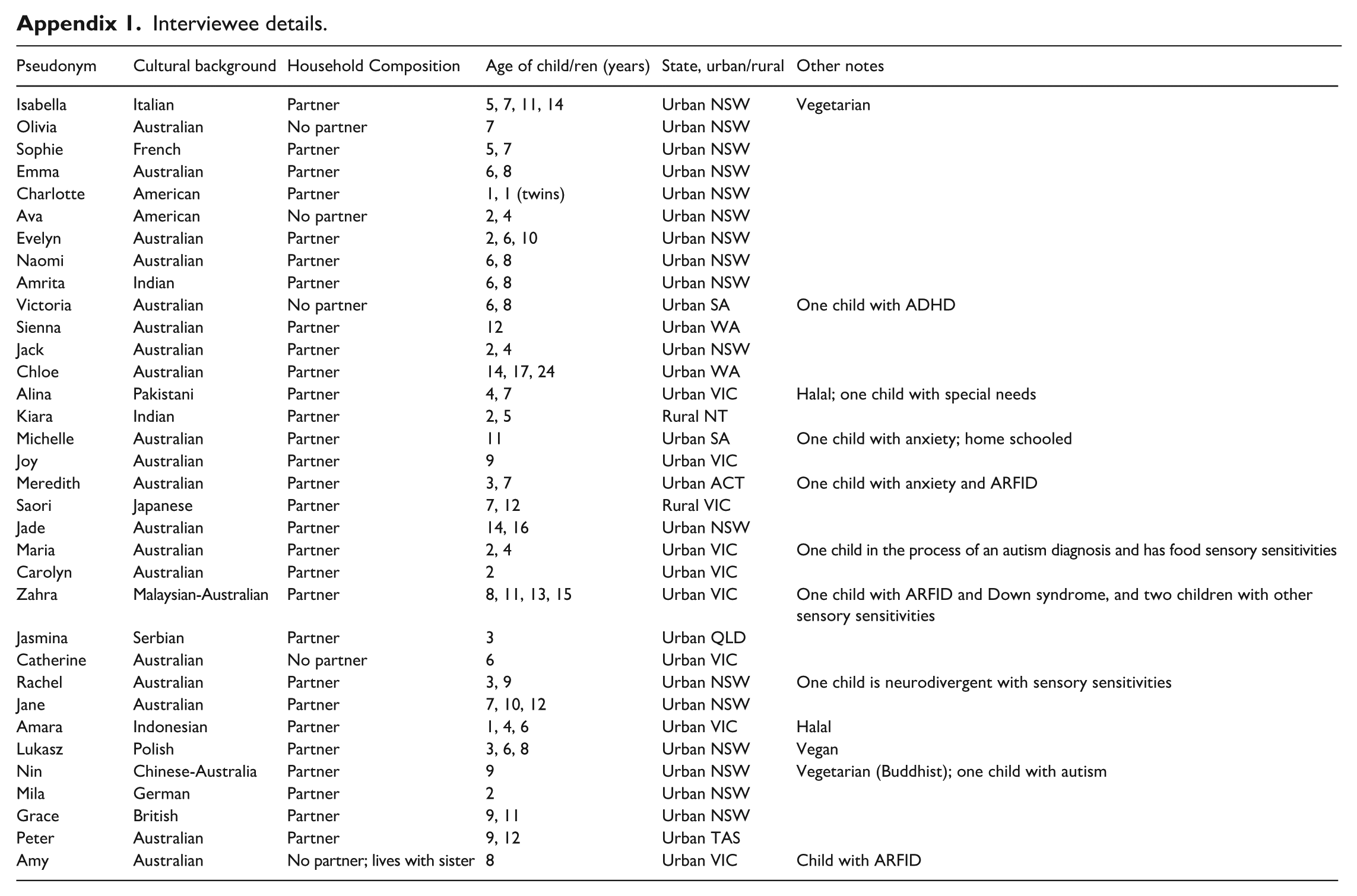
| Pseudonym | Cultural background | Household Composition | Age of child/ren (years) | State, urban/rural | Other notes |
|---|---|---|---|---|---|
| Isabella | Italian | Partner | 5, 7, 11, 14 | Urban NSW | Vegetarian |
| Olivia | Australian | No partner | 7 | Urban NSW | |
| Sophie | French | Partner | 5, 7 | Urban NSW | |
| Emma | Australian | Partner | 6, 8 | Urban NSW | |
| Charlotte | American | Partner | 1, 1 (twins) | Urban NSW | |
| Ava | American | No partner | 2, 4 | Urban NSW | |
| Evelyn | Australian | Partner | 2, 6, 10 | Urban NSW | |
| Naomi | Australian | Partner | 6, 8 | Urban NSW | |
| Amrita | Indian | Partner | 6, 8 | Urban NSW | |
| Victoria | Australian | No partner | 6, 8 | Urban SA | One child with ADHD |
| Sienna | Australian | Partner | 12 | Urban WA | |
| Jack | Australian | Partner | 2, 4 | Urban NSW | |
| Chloe | Australian | Partner | 14, 17, 24 | Urban WA | |
| Alina | Pakistani | Partner | 4, 7 | Urban VIC | Halal; one child with special needs |
| Kiara | Indian | Partner | 2, 5 | Rural NT | |
| Michelle | Australian | Partner | 11 | Urban SA | One child with anxiety; home schooled |
| Joy | Australian | Partner | 9 | Urban VIC | |
| Meredith | Australian | Partner | 3, 7 | Urban ACT | One child with anxiety and ARFID |
| Saori | Japanese | Partner | 7, 12 | Rural VIC | |
| Jade | Australian | Partner | 14, 16 | Urban NSW | |
| Maria | Australian | Partner | 2, 4 | Urban VIC | One child in the process of an autism diagnosis and has food sensory sensitivities |
| Carolyn | Australian | Partner | 2 | Urban VIC | |
| Zahra | Malaysian-Australian | Partner | 8, 11, 13, 15 | Urban VIC | One child with ARFID and Down syndrome, and two children with other sensory sensitivities |
| Jasmina | Serbian | Partner | 3 | Urban QLD | |
| Catherine | Australian | No partner | 6 | Urban VIC | |
| Rachel | Australian | Partner | 3, 9 | Urban NSW | One child is neurodivergent with sensory sensitivities |
| Jane | Australian | Partner | 7, 10, 12 | Urban NSW | |
| Amara | Indonesian | Partner | 1, 4, 6 | Urban VIC | Halal |
| Lukasz | Polish | Partner | 3, 6, 8 | Urban NSW | Vegan |
| Nin | Chinese-Australia | Partner | 9 | Urban NSW | Vegetarian (Buddhist); one child with autism |
| Mila | German | Partner | 2 | Urban NSW | |
| Grace | British | Partner | 9, 11 | Urban NSW | |
| Peter | Australian | Partner | 9, 12 | Urban TAS | |
| Amy | Australian | No partner; lives with sister | 8 | Urban VIC | Child with ARFID |

Ethical considerations
The University of Sydney Human Research Ethics Committee approved our research (approval #: 2024/HE000084) on 7 March 2024. Participants gave informed written consent prior to the interview.
Author contributions
JB: Conceptualisation, Writing – Original Draft, Writing – Review and Editing, Project Administration; AB: Conceptualisation, Writing – Original Draft, Writing – Review and Editing; Supervision; DR: Conceptualisation, Writing – Original Draft, Writing – Review and Editing, Supervision.
Funding
The authors disclosed receipt of the following financial support for the research, authorship, and/or publication of this article: This work was supported by The Charles Perkins Centre Jennie Mackenzie Research Fund, the Faculty of Arts and Social Sciences, University of Sydney, an anonymous foundation that supports early career research, and a Programme Grant from the National Health and Medical Research Council (GNT1149976).
Declaration of conflicting interests
The authors declared no potential conflicts of interest with respect to the research, authorship, and/or publication of this article.