



Abstract
In this study, we explore how participants articulate experiences of emotions during Covid-19 lockdown in the UK. We posit that emotions fulfil experiential and interpersonal functions, which are construed and conveyed through language choices. An online narrative survey was carried out. About 88 responses were analysed. Participants were from England and Wales. The mean age was 48.9 years old (SD = 62). A mixed-method approach was used. This combined quantitative Corpus Linguistics analysis and qualitative Interpretative Phenomenological Analysis with linguistic analysis. The findings show similarities to the public health and medical literature that highlight negative emotions, such as fear, distrust and anger in participants. However, we also found positive emotions not considered elsewhere, including happiness, relaxation, safety, optimism for the future and connectedness arising from the thematic IPA analysis. Emotions were construed using language explicitly labelling emotions and language implicitly signalling emotions. Our study highlights implications for managing risk behaviours associated with transmission in public health practices such as social distancing, as indicated by negative emotions. We also bring to light implications with perceived benefits of engaging in protective behaviours and social support central to public health measures, as suggested by the communication of positive emotions.
Introduction
In this study, we explore how participants construe emotions during Covid-19 lockdown in the UK through an examination of lived experiences. In pursuing a study of the articulation of emotions as a set of complex and situation specific patters of reaction (American Psychological Association, 2020), we aim to uncover not only negative but also positive emotions that participants experience when dealing with the trying circumstances of lockdown. Further to this, in taking a linguistic approach, we unveil how such emotions are not only articulated by also construed through specific linguistic patterns and choices of language when recalling the experience of lockdown.
Thus far into the pandemic, the wide range of psychological impact at personal, community/nation and international levels surrounding Covid-19 and the varied quarantine measures implemented worldwide have been vastly reported (e.g. Mattioli et al., 2020). Research to date has focussed on measuring the psychological impact of quarantine measures in the general population, indicating a negative impact on various aspects of life, such as mental health, economic practices, access to healthcare, education and gender-based violence (e.g. review of 15 studies by Chu et al., 2020). Qualitative studies have focussed on the negative psychological experience of hospitalised patients (Sun et al., 2021) or children (e.g. O’Sullivan et al., 2021). Research has also highlighted that quarantine effects might vary across demographic groups, including age, sex, socio-economic groups, etc. For example, Banks and Xu (2020) found that lockdown worsened mental health in young adults and women in the UK, which were groups with already lower levels of mental health. Contrariwise, the only positive aspect yielded by reviews (e.g. Brooks et al., 2020; Chu et al., 2020) is that of altruism as a consequence of the measures.
However, the study of emotions as fulfilling communicative functions emerging in an in-depth qualitative study of experiences of lockdown has, to date, remained unexplored. Therefore, the current study is innovative in a number of ways. Firstly, we examine lived experiences of lockdown from where emotions as a phenomenon are a common theme from the data. We explore emotions in the United Kingdom, in particular, where measures limiting freedom with government enforcement were imposed later than in countries such as China and Italy, a decision that has tentatively been seen as the cause of the high number of cases and deaths in the country (Pheby, 2020). Therefore, we examine how emotions derived from such circumstances are articulated by participants in their accounts as a way of providing a rounded perspective of a ‘complex reaction pattern (.) by which an individual attempts to deal with a personally significant matter or event’ (American Psychological Association, 2020: online). Given that ‘the specific quality of the emotion (e.g. fear, shame) is determined by the specific significance of the event’, an exploration of emotions in individuals who participated in the survey can offer a qualitative insight into the phenomenon and offer an insightful perspective on the impact of quarantine measures on individuals (American Psychological Association, 2020: online). Further to this, in taking a linguist approach, we examine how participants construe emotive meaning through a thorough examination of language choices made during reflected recalls of lockdown experiences. This is achieved through a combination of quantitative corpus linguistics methods for identifying key themes in language used and micro-level text parsing for language signalling or denoting emotion. Thirdly, we highlight positive emotions arising as by-products of quarantine measures. Finally, we derive implications for managing risk behaviours associated with negative emotions and the perceived benefits of embracing positive emotions as ways of contributing to public health measures.
In the next section we address the notion of emotions and the role of language in representing and construing them as the main theoretical contribution of this paper before outlining the approach and methodological choices made to address our aims.
Theoretical underpinnings
Research in evolutionary and social psychology suggests that emotions are evolved psychological mechanisms with problem-solving functions that motivate adaptive behaviours for humans (Rowe et al., 2014). Emotions arise as a consequence of situational events in which people assess and respond to the significance of such events in terms of personal threat or benefit (Lazarus, 2006). That is, they are ‘complex, physiological-affective-cognitive responses to the physical and socio-cultural environment’ (Schrauf and Sanchez, 2004: 267). Emotions are functional in that they motivate action tendencies with implications for behaviour (Lazarus, 2006). For example, happiness can motivate the attainment of goals and the maintenance of cooperative relations while fear indicates the experience of threat and promotes protective behaviour. Further to this, Schwarz-Friesel (2015: 162) sees emotion as ‘a mental state or process with three main parameters’ which include value (positive or negative), duration and intensity and that is represented in language by different markers.
Three aspects of the above definitions are of relevance to this work. Firstly, emotions are seen as a response to situational events. In the context of Covid-19 in the UK, a number of aspects, or events, have been identified to cause different emotions: threat and worry about the virus and its consequences (Jia et al., 2020); lack of motivation, meaning and self-worth, caused by the uncertain duration of the measures and perceived lack of ability to cope longer-term – these were identified mostly affecting those in low-paid or precarious employment (Williams et al., 2020); loneliness, caused by social distancing and isolation measures (Jia et al., 2020; Williams et al., 2020). Indeed, Harper et al. (2020) identified fear as a prominent emotion in the population. Interestingly, fear was found to be a stronger predictor of adherence to measures than moral/altruistic or socio-political adherence. This suggests that fear, as an emotion, has a functional role in promoting adherence behaviour. The above studies, however, did not set out to explore emotions in particular but rather the psychological effects of lockdown across various groups with the emotions identified above being seen as causes of psychological distress in the populations studied. Secondly, emotions are consequent states arising from the appraisal of events, implying a valence, either positive or negative. In this sense, we refer to Rowe et al. (2014), who classified basic emotions into positive (i.e. joy/happiness; relief; interest/excitement; love) and negative (i.e. anger; fear; sadness; boredom; disgust). Discrete emotions are then considered within basic emotion categories (e.g. frustration: anger; empathy: love) (Rowe et al., 2014: 290). Thirdly, we are interested in the role of language in the communication of emotions. We take the position that language is functionally related to reality (e.g. Halliday, 1973) and therefore suggest that the use of language ‘both reflects and construes emotions’ in the same way in which in ‘cause-effect relations and justifications (..) people construe social reality (emotion)’ (Bednarek, 2009: 396). We pose that emotions can be seen to have both experiential and interpersonal functions (e.g. Halliday, 1973). By this we mean that emotions communicate outer and/or inner experience – that is, the state of our ‘needs, desires and goals’ (Fitness, 2015: 297) – and this experience is realised in lexical and grammatical choices in language. Further to this, we pose that emotions allow the enactment of relationships as they elicit and/or promote action. Therefore, the experiential and interpersonal nature of emotive meaning entails that emotions cannot be separated from their situated contexts nor from the unique personal lived experience of individuals. Consequently, an examination of emotions needs to consider the socio-semiotic (i.e. language as functional) as well as idiographic aspects.
In this study we address such need and use a mixed-method approach combining automated and manual linguistics analysis with Interpretative Phenomenological Analysis (IPA; Smith et al., 2009). This combination of methods allows for a general automated identification of trends of language use, informing a manual micro-level analysis of language construing emotion and an in-depth exploration of people’s lived experiences of lockdown. As such, the approach we take in this study aims to obtain a reliable holistic overview of lockdown experiences and the impact of quarantine measures on various aspects of life. We add to the existing literature by offering an alternative perspective that accounts for the experiential and interpersonal aspects of emotions by explaining how emotions are construed and communicated through language choices. Finally, and most importantly, we also highlight positive emotions emerging in accounts of lockdown. Overall, we address the following research questions: (1) what emotions responding to UK lockdown are identified in trends of language use the sample studied? (2) what meanings do these construe in examinations of lived experiences of lockdown in the UK? (3) what implications do the findings have for public health therapeutic practices?
Methods
Data
The data were collected by means of an online narrative survey carried out in the UK. There are multiple reasons for narrowing the research to the UK context. One such reason was to obtain consistency in terms of language and cultural norms as they relate to lived experiences of lockdown measures, given that in this paper we see emotions as meaning construed in language – in this case, the English language as used in the UK. Halliday (1973) considers that meaning is socially and culturally bound, thus extending our survey to other languages and/or cultures would add other variables which were beyond the scope of this article. Of course, whilst there exists significant linguistic and cultural heterogeneity within the UK, there is also a significant heterogeneity in the implementation of quarantine measures around the world. As mentioned in the introduction, the delayed start of quarantine measures in the UK and its effects on population health has been a matter of contention. As such, we narrowed our exploration of lived experiences to the UK contexts to control for the effects that varying degrees of national quarantine measures – and other associated public health practices – may have on citizens’ emotional responses. The linguistic manifestation of emotional meanings can therefore be meaningfully interpreted by us as UK-based researchers with reference to the general socio-cultural practices and discourses of life in the UK.
We chose a narrative survey as a method of data collection on the basis that it ‘combines the respective benefits of nomothetic and ideographic approaches’ (Shkedi, 2004: 91). As such, it allows for findings to be more broadly cross-sectional and generalisable across the sample, as in the case of the corpus linguistics findings (cf. analysis section below) whilst also providing scope for in-depth exploration of the lived experience of the phenomena in the application of IPA. The latter is possible because, in using this tool, participants are able to tell their personal stories in ways that align with their understandings of the context and meanings that they ascribe to it (Shkedi, 2004). This method of data collection also allows for a generalised understanding of UK respondents’ emotional responses to lived experiences of lockdown whilst accounting specifically for particularised narrative, thereby enabling a consideration of linguistic, cultural and social heterogeneity within the analysis.
A call for participants was shared via social media channels, mainly Twitter, featuring ‘#lockdown’ and asking for ‘re-tweets’ and wide distribution. 1 The researchers’ professional and institutional social media accounts were used. 2 The hashtag ‘#lockdown’ was used to ensure that the tweet was available to any social media user who may have been interested in lockdown as a topic and were therefore able to find it when they searched for ‘lockdown’ as a keyword using the hashtag. This snowball sampling method of recruitment is widely used to maximise opportunities for participation (see Wasilewski et al., 2019).
The survey was open for 4 weeks. The online survey was accessed via a link included in the call. The Microsoft Forms platform was used. Informed consent was obtained prior to completion of the survey and participants could withdraw from the study by exiting the survey at any time. Inclusion criteria were 18 years of age and over and of UK residency. The questionnaire asked participants to write reflections of life in lockdown, as they would like to remember it in the future and to write as much or as little as they wished. The main section consisted of open questions asking participants to tell us about how they perceived the current situation and separate questions asking to tell us how lockdown affects the following aspects: home and community, relationships, daily activities, perception of self and health (see Table 1 below).
Questions and prompts used in open-ended survey.
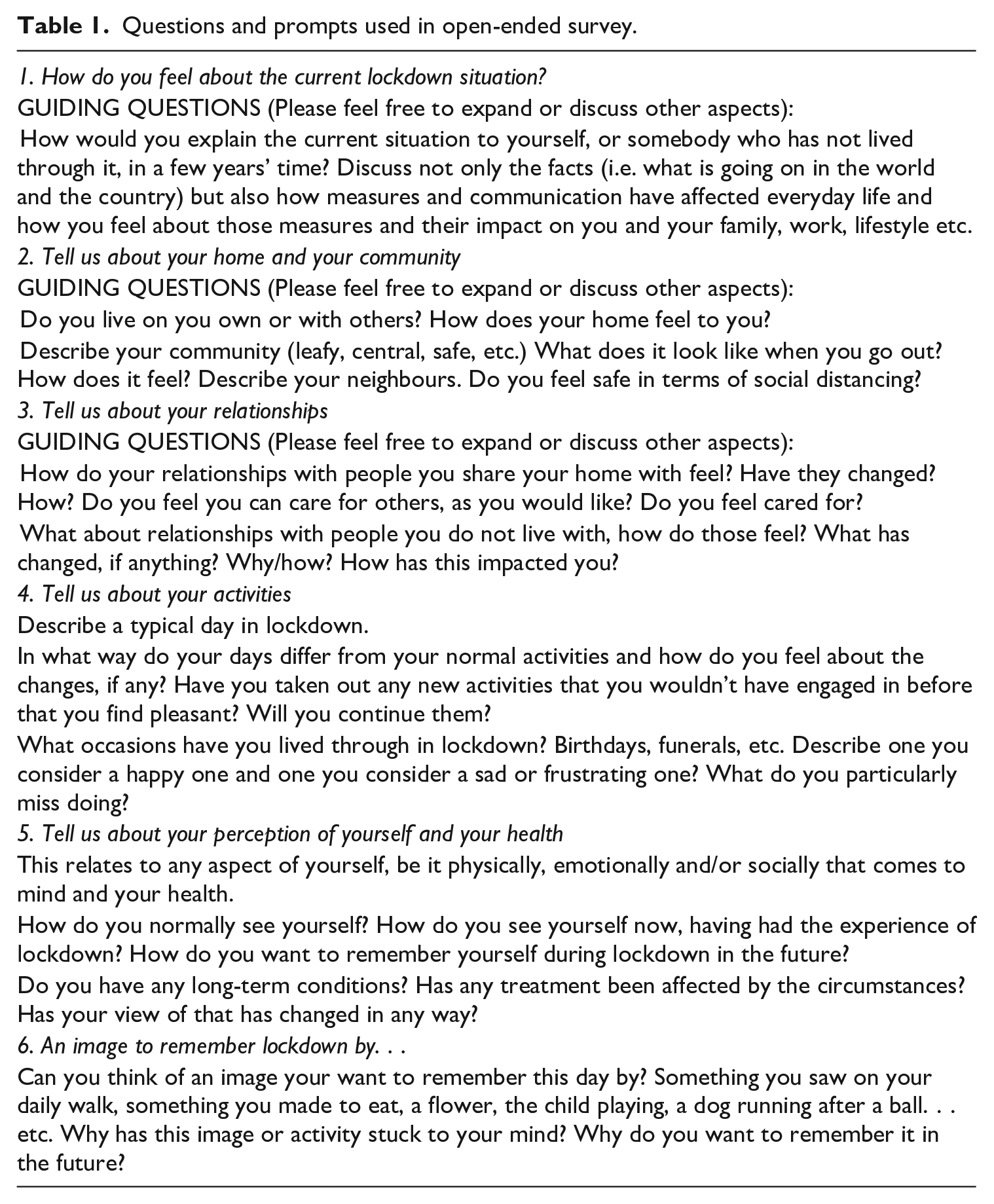
The sample analysed for this study consisted of 88 responses. Participants were from all over England and Wales. The mean age was 48.9 years old (SD = 62). Demographic information showed that 77% of participants were female; 80% live in a house with outdoor space; 57% were in part-time or full-time employment; 12% furloughed; 18% retired; 6% full-time students; 5% unemployed.
Analysis
In order to obtain a rounded perspective of lockdown as experienced not only physically and cognitively but also socially, we used a two-stage approach to the data analysis (conducted and audited by all authors).
The first stage consisted of using quantitative corpus linguistic tools to identify broad themes in salient patterns of language (Gabrielatos and Baker, 2008). The response data were uploaded and analysed in the online USAS semantic tagging system to determine whether frequent words revealed meaningful patterns (Archer et al., 2002). The tagging system automatically assigns words to discourse fields and groups them together through general association of words with similar mental concepts (Archer et al., 2002). Examples of discourse fields include ‘time’, ‘numbers and measurements’, ‘the body and the individual’, etc. We combined the pre-defined USAS emotional, linguistic, psychological and social discourse fields into the ‘socio-psychological discourse field’, thereby reflecting the interrelatedness of various behaviours and experiences. Therefore, the discourse fields represent themes in language use that indicate trends in linguistic manifestations of emotions. The discourse fields identified in the questionnaire response data were quantified by frequency value, thereby generating initial patterns of salience for triangulation with the IPA and providing a buffer of objectivity (Baker and Levon, 2015).
The second stage of analysis used IPA for an in-depth qualitative analysis focussing on individuals’ interpretations of the lived experience of lockdown. After a careful examination of all responses and identification of conceptual features, themes on psychological concepts representing key aspects of each individual’s lockdown experience were derived. Each theme was assigned corresponding illustrative quotes. This was followed by a cross-case analytical process where themes were reviewed and clustered in line with conceptual parallels between them. Convergences and divergences in experiences were examined iteratively with the analyst moving between part and whole, ensuring that interpretations remained grounded in the data (Smith et al., 2009). The themes endorsed by more than half of the sample were considered ‘common’ and representative of the lockdown experience (Smith, 2011). It is important to point out, however, that the interpretations presented in this work are a result of the researchers’ analysis and that participants’ accounts are a considered, credible and meaningful reflection of the UK lockdown in response.
The IPA-derived themes were then triangulated with the corpus findings and each theme was clustered under the discourse fields identified in stage 1. The clusters were identified by parsing the text for language features in the IPA sample data, illustrating the discourse fields identified in stage 1 (cf. Table 3). The language features identified refer to linguistic resources that either denote or signal emotion. The former refers to ‘expressions that name a particular emotional response’, for example, sad, happy (Bednarek, 2009: 396). The latter relates to lexical or grammatical features that signal or aid the construal of emotion. These include mental process verbs (i.e. verbs that reflect mental activities, e.g. think, as opposed to physical ones, e.g. walk), grading devices such as intensifiers (e.g. incredibly), comparatives (e.g. more than), qualifiers (e.g. beautiful) or negation devices (e.g. no rush). Other features include repetition, metaphorical language, pronoun use, affective connotations, evaluative adjectives, etc. (Bednarek, 2008: 11).
Results
Corpus analysis
The findings of the corpus analysis indicate that there are 49,462 word tokens (or word forms) in the corpus of 88 survey responses. The lexical items within the survey response corpus span across each of the 18 discourse fields of the adapted USAS semantic tagging system. Aside from the categories ‘General & Abstract Terms’ and ‘Names & Grammatical Words’, whose frequencies are skewed by stop words, the most frequently occurring discourse field by a considerable margin was the category of ‘Socio-Psychological Actions, States & Processes’ (see Table 2). Lexical items denoting socio-psychological behaviours and states are used 6494 times in the survey response corpus. As the most frequently employed discourse field entirely composed of content, rather than comprising also grammatical and function words (e.g. prepositions, etc.), this category was indicated as a salient pattern warranting further exploration qualitatively.
Discourse fields in the survey response corpus data, ordered by frequency.
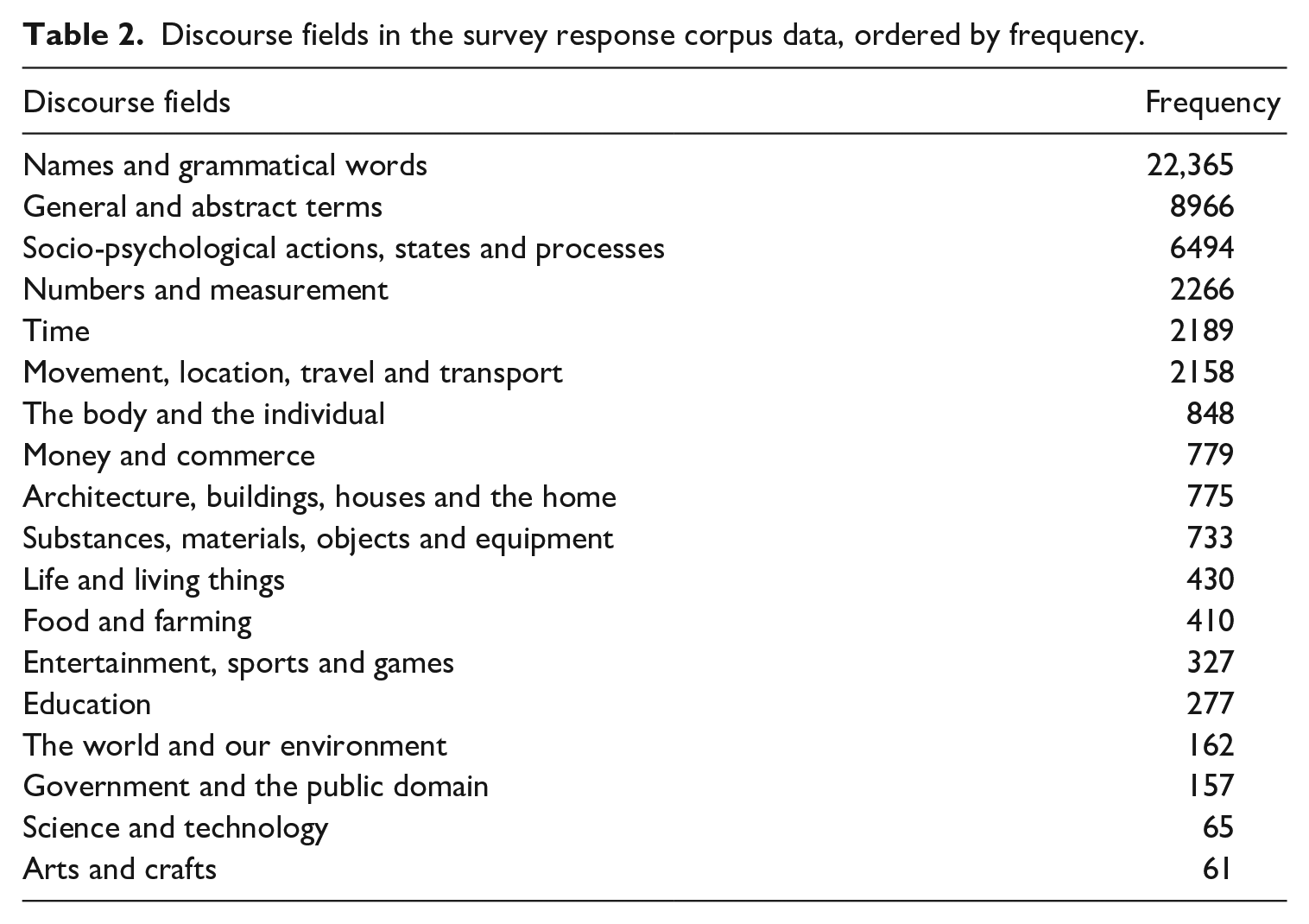
Further disaggregating the ‘Socio-Psychological Actions, States & Processes’ discourse field into more specific categories of language use yielded additional themes that can be broadly categorised into three key areas (see Table 3): (1) affect (2) perception; and, (3) relationships. The prevalence of the first two categories is unsurprising given the indication by previous studies that there is a strong relationship between quarantine measures, negative emotional responses and psychological distress, as discussed in the introduction. To avoid confusion with the broad view of emotion that we explore in this article defined above and as realising the macro-category of ‘socio-psychological states, processes and actions’, we shall refer to this category as ‘affect’ only. The prevalence of reference to people, relationships and social behaviours is likely expected given the very nature of quarantine as a means of isolating people from one another, changing and restricting all types of social interaction. Indeed, the phrase of ‘social distancing’ specifically brings to bear this fundamental shift in interactional behaviour as a result of lockdown measures.
Ten most frequent ‘Socio-Psychological . . .’ discourse categories, ordered by theme.
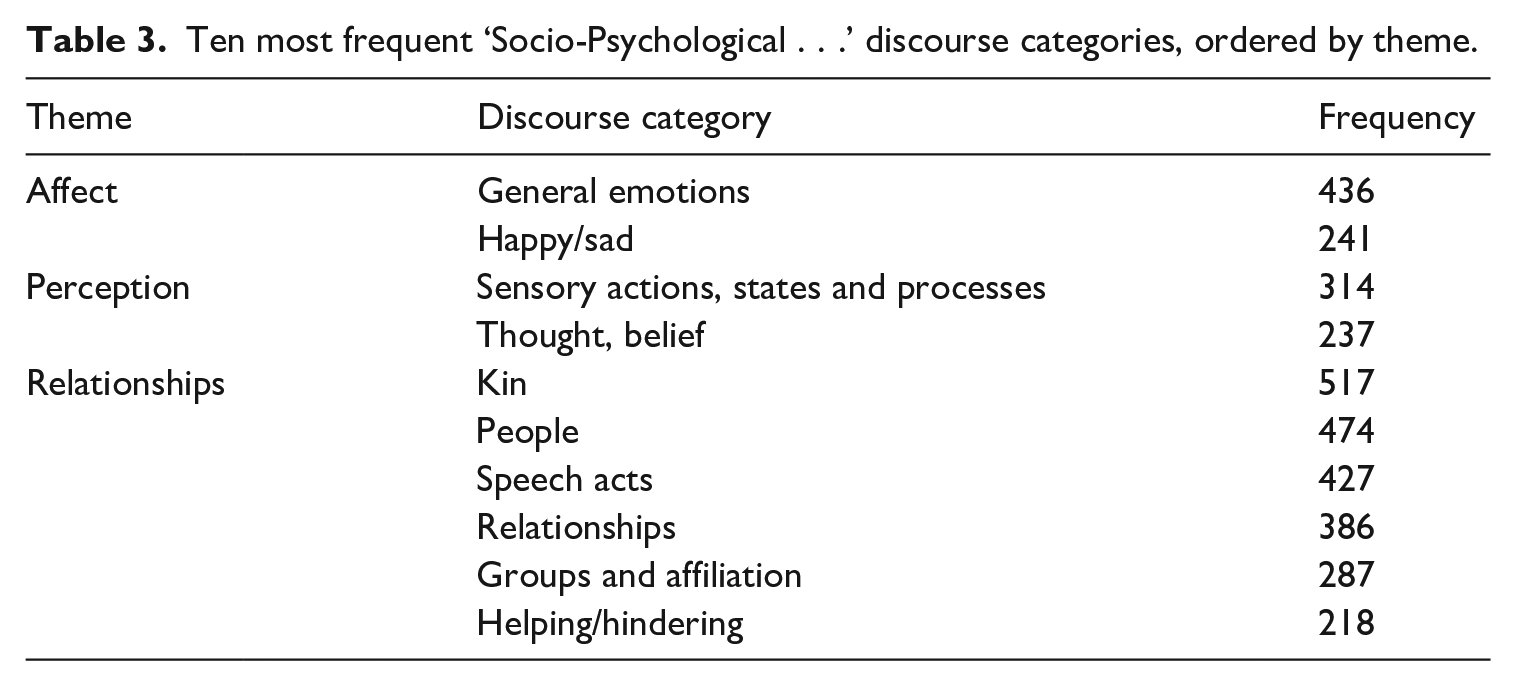
The combination of the broad themes of language use referring to affect, perception and relationships signalled a particularly fruitful means of exploring everyday experiences of lockdown in the UK worth exploring further through an in-depth qualitative approach, as presented below.
Interpretative phenomenological analysis
Participants’ descriptions acted as windows to the emotions experienced during the lockdown, with the whole continuum canvassed, from overwhelmingly negative through to momentous joy. The descriptions demonstrate that whilst distress and negative emotion were prevalent, participants were adaptable and able to see and experience the pleasant in their everyday lives. The IPA themes and the language choices identified as construing emotions are included under the overarching discourse field yielded in stage 1 of the analysis.
Discourse field 1: Affect
The IPA analysis shows that there are a number of themes that may be clustered within this category representing general emotions: fear, distrust, anger, sadness, happiness and joy.
Fear
A common reaction focussed on fears of the magnitude and unprecedented nature of the virus and its consequences. The extract below illustrates fear being explicitly labelled in a recall of the events during the early stages as the virus cases started to unfold in the UK.
At the time the UK had small isolated numbers.. it was reported for the first time that an elderly man ..contracted the virus and hadn’t had contact with a known carrier. This felt like the
The extract starts with a factual reporting on circumstances paving the way for the climax of the narrative where a natural disaster metaphor is used to frame the emotion of fear at the impending outbreak in Britain. Other participants signalled fear implicitly, invoking the invisibility of COVID-19: At first, it was difficult to remember that I was virtually
In this passage, the participant signals fear by framing their contrasting emotions within a ‘before-after’ paradigm marked by the time reference ‘at first’ and the conjunction ‘but’. This also parallels with the ‘inside-outside’ home dyad; the ‘inside’ aspect, which initially stood a negative motion associated with lack of freedom through the prison metaphor, then becomes a source of safety when the outside is conceptualised as a dangerous space by personifying the virus as an ever-present, obsessive persecutor. Fear is also translated to future-oriented concerns: The
Future-orientated emotions were frequent, with emotions centring on fear of the uncertain future, particularly around the economic impact. Within the metaphorical frame of the virus as an enemy causing destruction on society, there is catastrophic view of COVID-19 graduated by the adjective ‘impending’ indicating imminence, the adverb ‘overwhelming’ indicating severity and the presence of the negative participle in noun phrase ‘not one sector’ suggesting wide coverage.
Distrust
Participants’ initial reaction to the lockdown measures and social distancing relate to a sense of distrust and worst-case scenario thinking resulting in engagement in protective behaviour, as illustrated below: . . . the strangeness has been the
Distrust, labelled ‘paranoia’, as a by-product of fear is dominant in this extract. The participant compares social distancing to a metaphorical dance (‘shuffle’, ‘synchronised swimming’) where the entailments of coordination with the group, alertness and teamwork are mapped into the requirements of social distancing. The efforts to maintain social norms of politeness (‘nods’) whilst adhering to social distancing are also expressed metaphorically by, perhaps, reference to media images of cartoon characters ‘pinned to the walls’. These metaphors, despite seemingly light-hearted, serve to intensify the sense of distrust. The intensity of the distrust is also graduated by adverbs ‘ferociously’ and ‘primal’. The latter also references instinctual behaviour, driving the need to protect her child despite the lack of obvious risk.
Anger and frustration: Anger and frustration, mainly to the perceived government intervention (or lack of) were also implicitly evoked in the data: The UK acted
The extract centres around the lack of initial government intervention evaluating it negatively (‘late’, ‘poorly’) and the lack of protection for exposed people (‘working people’) in favour of the economy and one sector of the population. Interestingly, the participant, despite seemingly being British, marked by the use of ‘our’, later distances her/himself (through the demonym ‘Britons’ and use of pronouns ‘they’, ‘their’) from the group supporting the health system and condemning them for not taking action against the government instead.
Sadness: this was shown in terms of the overall situation and devastation believed to be causing as well as in how it is affecting people personally, usually in relation to being unable to see their closest family members, echoing the relationships theme discussed below. In the extract below, the participant construes sadness as an inner private emotional experience by means of mental state verbs: I
Happiness
Lockdown was also often discussed with reference to positive emotions. For many, happiness was found in participants’ newly found time available to spend with their family: My kids
Joyous moments were often described as images that participants hoped to remember, emphasising the significance of such moments to their experiences of lockdown, with love and connection central to these memories. The emotion is explicitly named (‘joy’) and intensified by a number of devices: the verbs suggesting pleasure (‘giggling’). A before-after frame is also introduced (‘anymore’) to create a contrast between the newly discovered happiness (‘joy’, ‘laugh’) and the past emotion (‘grumpy’). The affective derivation (‘little moments’) and the negation of the need for ‘anything special’ work to intensify the pleasure of being able to discard the negative emotion (‘grumpy’) of the past.
Discourse field 2: Perception
Within this category representing ‘sensory actions, states and processes’ and ‘thoughts and beliefs’, the IPA analysis highlighted the themes of ‘relaxing into being’, ‘home as a sanctuary’ and ‘positive future orientation’.
Relaxation
Another more positive aspect of the lockdown measures that was reflected by participants was the experience of life slowing down, this is linked to the theme of happiness above: To be honest, it’
Through the use of verbs indicating states of being (‘be’) and mental states (‘enjoy’, ‘think’), the participant construes the peace and relaxation brought about by having more time to spend at home and resting, and by the simplicity of a slower pace of life afforded by the lockdown measures. The repetitive structures ‘no running’ and ‘no rushing’ indicate the perceived burden of the past repetitive and strenuous routine and their lack of, signalled by the negations, affording relaxation and family time thereby construing the perception of calmness. Relaxation was also identified as having a positive impact on health: I’m
The consequent slowing down and relaxation induced by the lockdown measures was seen to have played a role in halting the participant’s psychological distress. The wellbeing is construed though intensified (‘so much’) comparatives (‘happier’; ‘more’; ‘better’) indicating a before-after lockdown frame.
The sanctuary of home: Echoing previous themes, participants also discussed a sense of security in the comfort of their homes, safe from the events happening outside: the home as a sanctuary metaphor reflects the perception of home to a place safe from pursuit, persecution or danger.
For us, our home has been our
Similarly the extract below reflects the perception of safety at home, construed by the use of affective derivation (diminutives) to refer to home (‘little’, ‘shrunk’) and the metaphorical framing of participants as affection-drawing animals (‘nest’ = bird; ‘hibernating’ = bear).
My home feels like a
The home-as-world metaphor and the reversing the meaning of the term ‘confinement’ (usually associated with negative emotions) all serve to convey the need for protection from the outside world, possibly echoing the fear of the invisible enemy discussed above.
Positive future orientation: Inevitably, reflections on lockdown became future-oriented, and these were dominated by optimism directed towards a better future. For the participant below, focus was on what they could take forward into their future: The one thing I
The use of mental state verbs (‘know’, ‘want’) indicating inner experience where the participant reframes lockdown as a learning experience with personal development at the core of their value system and indicates dissatisfaction with a past way of life. A before-after strategy is used to frame this theme here (‘back’, ‘previously’) and in the extract below where the theme of future orientation also extends to society.
Future orientation is construed by verbs denoting states of being (‘to be’, ‘become’) contrasting with action verbs (‘emerge’), indicating a negative perception of states of affairs and readiness for change. This is also reinforced by the use of contrasting adjectives ‘mad busy’ (before) and ‘better place’ (after).
Discourse field 3: Relationships
The IPA analysis shows the theme of relationships and connectedness of various types.
Connectedness with the community: A sense of connectedness with their local community is reflected in the data, normally construed as an inner experience through mental state verbs (‘want’, ‘hope’), indicating satisfaction (‘make me smile’), as below: Pictures of rainbows in peoples windows, in our local community they’re in almost every window, it
Acts of kindness and support, embodied by pictures of rainbows and feelings of warmth (‘care’) are perceived to have brought communities together. The sense of community connectedness is also conveyed by the metaphor comparing lockdown to a container where everybody is inside together expecting to come out of the container on a different side, that is with alternative improved attitudes towards others – also marked by comparatives ‘less’, ‘do more’.
Connectedness with people: There was also recognition that the lockdown circumstances had strengthened personal relationships both with people outside the household (through electronic tools) and with people in the same household: My relationship with the kids has definitely
Participants frequently reflected on the enhanced emotional closeness and opportunities to bond, with many reflecting that this would not have occurred without lockdown. In the extract above, the repetition of the structures ‘I find myself’, progressive verb forms ‘sitting’, ‘asking’ and other indicators of the repetition of actions (‘keep saying’, ‘constantly’) and the references to time (‘ten minutes’), all work to frame the narrative within a newfound routine denoting a happier, more relaxed and more connected home life that is positively evaluated by the qualifier ‘amazing’.
Connectedness with home: Echoing the above, the home as sanctuary metaphor was also used to signal a newfound relationship with home that has become a source of pleasure, demonstrated by the affective language used.
My home is my
For others, however, the pre-lockdown home sanctuary feeling and relationship with home was reversed by being forced to stay home and home even becoming a lonely place, causing negative emotions.
Prior to lockdown, my home was my sanctuary. Now, it’s become my 24/7 residence. ..it has been an
Discussion
The mixed-methods design combining corpus and manual linguistic analysis with Interpretative Phenomenological Analysis used in this study has allowed an examination of emotions in accounts of lockdown experiences in the UK, yielding interesting results. The quantitative corpus analysis findings revealed three main semantic categories of language used by participants which fall within the general ‘socio-psychological actions states and processes’ discourse field. These reflect themes in language choices indicating the construal of emotional meaning within the semantic domains of ‘affect’, ‘perception’ and ‘relationships’. The triangulation of these with the IPA analysis showed that the field of ‘affect’ is manifested in themes that reflect fear, distrust, anger, sadness and happiness. The field of ‘perception’ is realised in language indicating relaxation, safety and an optimistic view of the future. Finally, language choices reflecting the construal of emotional meaning referring to ‘relationships’ relate to personal, community and home connectedness. Each of these is realised through language explicitly denoting emotions (e.g. ‘I am fearful’) or signalling them (e.g. ‘we are in this together’). The combination of both approaches allowed for a triangulation of findings in the form of a quantitative overview of the main meanings, as represented by discourse fields in the corpus analysis, with qualitative in-depth exploration of themes in the IPA analysis and text parsing for identifying language denoting and signalling emotions. Methodologically, the present study highlights the benefits of this innovative merging of disciplines of corpus linguistics, text linguistics and psychology, demonstrating a more vivid and richly textured analysis of experiences of the UK lockdown response.
Theoretically, we worked on the premise that emotions have experiential and interpersonal functions. The findings of the micro-level examination of language use revealed that participants construe emotions as states of mind (hope) or processes (playing) of a cognitive (think), affective (love) and/or physiological (smile) nature. The evaluative dimension of emotions is also revealed through explicit lexis indicating, that is, positive (amazing, full of joy) and/or negative (devastating) valence. The corpus linguistics findings, alongside the in-depth phenomenological exploration of people’s lived experiences, also revealed changes in behaviour (e.g. ‘slow down’) and interpersonal relationships (e.g. the discourse field of ‘relationships’ and the IPA themes of ‘connectedness’) as being prominent aspects of people’s experience of lockdown, thereby also indicating an interpersonal function of emotions, as per our theoretical premise. Both aspects were uncovered by the examination of emotions from both linguistic and idiographic perspectives, as discussed above.
Despite some overlap with the public health literature on quarantine discussed in the introduction, when comparing our findings with Brooks et al. (2020) review of 24 studies assessing the psychological impact of quarantine – indicating that only 5% of emotions are positive – we found various positive aspects of Covid-19 lockdown present in the analysis. These relate to the domains of ‘perception’ and ‘relationships’. In particular, they are the quality of the time spent with the family, the sense of connectedness – that is, interpersonal aspects – as well as feeling safe at home and positive effect on health, as experiential aspects. Other aspects of the findings that appear to be in line with the literature (Brooks et al., 2020) relate to financial worries post-quarantine which are manifested as fear in the findings, as are fear of infection and of not being able to protect loved ones (Jia et al., 2020). Despite such a theme of fear in some participants’ accounts, the findings surrounding happiness and relaxation demonstrate benefit-finding and deriving positive growth from adversity across the sample.
Some potential caveats that need mentioning relate to the demographics of the sample. It is worth pointing out that 80% of the sample surveyed have access to outdoor space where they live, and the findings should be viewed in this context. This, therefore, means that findings may not be applicable to groups without outdoor access, or those from lower income sectors of the population, who are shown to have been affected negatively by lockdown in other studies mentioned in the introduction (e.g. Williams et al., 2020). The obvious speculation here is that people who have access to certain resources (e.g. garden space) are better equipped to successfully cope with lockdown. Despite it being worth acknowledging that people with a good socio-economic position might have been more prone to respond to the survey, therefore constituting a limitation of the findings if we were to generalise them, we do not intend for this to be the take-home message of the article. That is, we did not set out to investigate emotions in particular socio-economic groups in the first place. We do not aim to generalise our findings to specific social groups as sharing experiences of lockdown but rather to explore individual experiences, as per the premise of IPA (Smith et al., 2009) in order to unveil the experiential and interpersonal aspects of emotive meaning, as per our theoretical premise.
Further to this, given the predominance of female participants in our sample, it is also interesting to note positive emotions arising from such demographic considering that some studies in psychology have indicated that lockdown has worsened mental health in this group (e.g. Banks and Xu, 2020). It is important to point out that we are not cross-referencing our findings with such studies because we did not intend to investigate the impact of lockdown on mental health. Neither are we claiming a gendered dimension to our findings as this was not considered in our design and sample. However, we do acknowledge that the findings could be indicative of the need to enquire into the potentially gendered dimension of lockdown experiences, which is worthy of further investigation from both a health psychology and indeed a critical discourse analysis perspective.
Implications and concluding remarks
The findings provide insight into emotional responses to UK lockdown measures, with potential implications for pro-social behaviours, communication, risk perception and the impacts of isolation – all of which can impact control of disease transmission. Emotion is a powerful driver of behaviour, with anxiety being particularly important in motivating people to take appropriate protective action. Anxiety was common in participant narratives, though some linguistic devices used implied a sense of overwhelm and fear, which may result in unhelpful behaviours or psychological distress. Likewise, managing emotions such as anger and frustration may impede adherence to restrictions. In response to this, developing behavioural interventions to support the population in enduring potentially isolating impacts of lockdown would be beneficial in maximising adherence to restrictions. For example, precise and clear information about the purpose of lockdown restrictions are central in managing anxiety and building trust in governmental responses, and has been reflected in prior work conducted during the H1N1 influenza pandemic in 2009 (Taha et al., 2014).
In contrast, participants often engaged in benefit-finding, and reflected on the positive emotions found from quarantine measures, such as the value of personal and community connectedness as central to wellbeing during the lockdown period, demonstrating the value of social support as a protective buffer against stress. Indeed, supportive behaviours such as displaying a rainbow in a window drew out and reinforced the sense of support, solidarity and connectedness within a community. This is important for the complexities of managing multiple risk behaviours that are central to reducing transmission and public health messaging should endeavour to promote this, whilst highlighting the opportunities available to individuals to maximise the benefits of additional time spent at home under lockdown restrictions.
Footnotes
Funding
The author(s) received no financial support for the research, authorship, and/or publication of this article.

Data availability statement
The data that support the findings of this study are available from the corresponding author, upon reasonable request.